EP0407794A2 - Machine-outil avec table tournante et portes-pièces rotatifs - Google Patents
Machine-outil avec table tournante et portes-pièces rotatifs Download PDFInfo
- Publication number
- EP0407794A2 EP0407794A2 EP90111986A EP90111986A EP0407794A2 EP 0407794 A2 EP0407794 A2 EP 0407794A2 EP 90111986 A EP90111986 A EP 90111986A EP 90111986 A EP90111986 A EP 90111986A EP 0407794 A2 EP0407794 A2 EP 0407794A2
- Authority
- EP
- European Patent Office
- Prior art keywords
- cam
- machine tool
- tool according
- holding device
- axis
- Prior art date
- Legal status (The legal status is an assumption and is not a legal conclusion. Google has not performed a legal analysis and makes no representation as to the accuracy of the status listed.)
- Granted
Links
Images


Classifications
-
- B—PERFORMING OPERATIONS; TRANSPORTING
- B23—MACHINE TOOLS; METAL-WORKING NOT OTHERWISE PROVIDED FOR
- B23Q—DETAILS, COMPONENTS, OR ACCESSORIES FOR MACHINE TOOLS, e.g. ARRANGEMENTS FOR COPYING OR CONTROLLING; MACHINE TOOLS IN GENERAL CHARACTERISED BY THE CONSTRUCTION OF PARTICULAR DETAILS OR COMPONENTS; COMBINATIONS OR ASSOCIATIONS OF METAL-WORKING MACHINES, NOT DIRECTED TO A PARTICULAR RESULT
- B23Q1/00—Members which are comprised in the general build-up of a form of machine, particularly relatively large fixed members
- B23Q1/25—Movable or adjustable work or tool supports
- B23Q1/44—Movable or adjustable work or tool supports using particular mechanisms
- B23Q1/50—Movable or adjustable work or tool supports using particular mechanisms with rotating pairs only, the rotating pairs being the first two elements of the mechanism
- B23Q1/54—Movable or adjustable work or tool supports using particular mechanisms with rotating pairs only, the rotating pairs being the first two elements of the mechanism two rotating pairs only
- B23Q1/5468—Movable or adjustable work or tool supports using particular mechanisms with rotating pairs only, the rotating pairs being the first two elements of the mechanism two rotating pairs only a single rotating pair followed parallelly by a single rotating pair
-
- B—PERFORMING OPERATIONS; TRANSPORTING
- B23—MACHINE TOOLS; METAL-WORKING NOT OTHERWISE PROVIDED FOR
- B23Q—DETAILS, COMPONENTS, OR ACCESSORIES FOR MACHINE TOOLS, e.g. ARRANGEMENTS FOR COPYING OR CONTROLLING; MACHINE TOOLS IN GENERAL CHARACTERISED BY THE CONSTRUCTION OF PARTICULAR DETAILS OR COMPONENTS; COMBINATIONS OR ASSOCIATIONS OF METAL-WORKING MACHINES, NOT DIRECTED TO A PARTICULAR RESULT
- B23Q16/00—Equipment for precise positioning of tool or work into particular locations not otherwise provided for
- B23Q16/02—Indexing equipment
- B23Q16/022—Indexing equipment in which only the indexing movement is of importance
- B23Q16/025—Indexing equipment in which only the indexing movement is of importance by converting a continuous movement into a rotary indexing movement
-
- B—PERFORMING OPERATIONS; TRANSPORTING
- B23—MACHINE TOOLS; METAL-WORKING NOT OTHERWISE PROVIDED FOR
- B23Q—DETAILS, COMPONENTS, OR ACCESSORIES FOR MACHINE TOOLS, e.g. ARRANGEMENTS FOR COPYING OR CONTROLLING; MACHINE TOOLS IN GENERAL CHARACTERISED BY THE CONSTRUCTION OF PARTICULAR DETAILS OR COMPONENTS; COMBINATIONS OR ASSOCIATIONS OF METAL-WORKING MACHINES, NOT DIRECTED TO A PARTICULAR RESULT
- B23Q39/00—Metal-working machines incorporating a plurality of sub-assemblies, each capable of performing a metal-working operation
- B23Q39/04—Metal-working machines incorporating a plurality of sub-assemblies, each capable of performing a metal-working operation the sub-assemblies being arranged to operate simultaneously at different stations, e.g. with an annular work-table moved in steps
- B23Q39/042—Metal-working machines incorporating a plurality of sub-assemblies, each capable of performing a metal-working operation the sub-assemblies being arranged to operate simultaneously at different stations, e.g. with an annular work-table moved in steps with circular arrangement of the sub-assemblies
- B23Q39/046—Metal-working machines incorporating a plurality of sub-assemblies, each capable of performing a metal-working operation the sub-assemblies being arranged to operate simultaneously at different stations, e.g. with an annular work-table moved in steps with circular arrangement of the sub-assemblies including a loading and/or unloading station
-
- Y—GENERAL TAGGING OF NEW TECHNOLOGICAL DEVELOPMENTS; GENERAL TAGGING OF CROSS-SECTIONAL TECHNOLOGIES SPANNING OVER SEVERAL SECTIONS OF THE IPC; TECHNICAL SUBJECTS COVERED BY FORMER USPC CROSS-REFERENCE ART COLLECTIONS [XRACs] AND DIGESTS
- Y10—TECHNICAL SUBJECTS COVERED BY FORMER USPC
- Y10T—TECHNICAL SUBJECTS COVERED BY FORMER US CLASSIFICATION
- Y10T29/00—Metal working
- Y10T29/51—Plural diverse manufacturing apparatus including means for metal shaping or assembling
- Y10T29/5124—Plural diverse manufacturing apparatus including means for metal shaping or assembling with means to feed work intermittently from one tool station to another
- Y10T29/5127—Blank turret
- Y10T29/513—Stationary work
-
- Y—GENERAL TAGGING OF NEW TECHNOLOGICAL DEVELOPMENTS; GENERAL TAGGING OF CROSS-SECTIONAL TECHNOLOGIES SPANNING OVER SEVERAL SECTIONS OF THE IPC; TECHNICAL SUBJECTS COVERED BY FORMER USPC CROSS-REFERENCE ART COLLECTIONS [XRACs] AND DIGESTS
- Y10—TECHNICAL SUBJECTS COVERED BY FORMER USPC
- Y10T—TECHNICAL SUBJECTS COVERED BY FORMER US CLASSIFICATION
- Y10T74/00—Machine element or mechanism
- Y10T74/14—Rotary member or shaft indexing, e.g., tool or work turret
- Y10T74/1418—Preselected indexed position
- Y10T74/1424—Sequential
- Y10T74/1441—Geneva or mutilated gear drive
Definitions
- the invention relates to a machine tool with a machine frame, with a turntable rotatably mounted about a central axis on the machine frame, with machining stations arranged at an angular distance around the turntable, with at least one holding device rotatably mounted about a rotational axis on the turntable, which means by rotating the turntable into the machining stations can be brought and with a rotary drive for rotating the holding devices in different rotary positions.
- Such a machine tool is known from the prior art.
- the holding device is driven via a pinion which engages in a toothed segment, the toothed segment being of different lengths depending on the rotational position of the holding device to be achieved.
- the disadvantage of this drive for the holding devices can be seen in the fact that when the pinion is moved into the toothed segment, considerable impact stresses act on the pinion and the rotary table cannot therefore be rotated at a high speed.
- the invention is therefore based on the object of improving a rotary table of the generic type in such a way that the rotary table can be rotated at the highest possible speed, and regardless of this, during the rotation of the rotary table from processing station to processing station, the holding device is rotated by any desired size or size Angle is possible.
- the rotary drive comprises a first and a second cam cam, which is held stationary on the machine frame, and a first and a second cam element which is mounted on the rotary table and rotates along the cam cam when it rotates in each case the first cam curve lies in a first surface and the second cam curve lies in a second surface such that the first cam curve with a first cam surface of the first cam element and the second cam curve with a second cam surface of the second cam element interact in constant contact with one another, so that the first and the second cam element is coupled to rotate the holding device and hold it in each of its positions along the cam curves in a clearly defined rotational position, and that the cam elements and the cam tracks are arranged in such a way that access by one Cam element to its cam curve is contact-free with the cam curve of the other cam element or with its access with this cam curve.
- the fact that the access of one cam element to its cam curve takes place without contact with the cam curve of the other cam element or with its access to this cam curve ensures that the scanning of the first and the second cam curve by the first and the second cam element is independent can take place from one another and thus a defined guidance of each individual cam element on the respective cam curve and consequently also a defined determination of the rotational position of the holding device is possible.
- first and the second surface run parallel to one another.
- first and the second surface can lie in one plane.
- first and second surfaces are arranged one above the other.
- first and second cam elements rotate about axes perpendicular to the first and second surfaces, respectively.
- the axes are preferably multiple rotational symmetry axes for the respective cam element.
- the symmetry of the cam element can be multiple. However, it is particularly favorable if the axis is a two-fold rotational symmetry axis for the respective cam element.
- first and the second cam element have identical symmetry properties.
- the cam elements can for example be arranged so that their axes are arranged parallel and at a distance from one another.
- a constructive solution in which the cam elements sit on a single drive part of the rotary drive is particularly simple and expedient. It has proven to be expedient here, in particular to ensure independent access of the individual cam elements to the cam curves, if the cam elements are arranged at a distance from one another in the axial direction of the drive part.
- cam elements are held offset on the drive part.
- cam elements are arranged offset from one another on the drive part with a gap, wherein an offset of 90 ° is preferably provided for cam elements with a two-fold axis of symmetry.
- the cam elements can in principle be of any design. So it is possible that the cam elements have a single cam body, which runs on the cam curves. For reasons of running properties, however, it is particularly expedient if the cam elements run with rollers on the cam curves assigned to them.
- cam curves In the exemplary embodiments described so far, it has not yet been discussed in detail how the cam curves are to be designed. It is particularly advantageous if the cam curves run concentrically around the central axis. In the simplest case of a machine tool according to the invention, the cam curves run around the central axis.
- cam curves could be designed so that the cam elements lead enclosed between two guide surfaces.
- a structurally preferred solution provides that the cam curves run on one side of the cam elements, preferably on the side of the cam elements facing the central axis, and thus only constantly abut the cam elements on one side.
- the cam curves are divided into angle segments extending from one processing station to the next processing station.
- the arc length of the angular segments of the cam curves and thus also the angular distance between successive processing stations are preferably dimensioned such that the arc length corresponds to at least half a rolling circumference of the cam elements on the cam curves. It is even better if the sheet length corresponds to at least one roll circumference.
- the machine tool according to the invention can be designed particularly advantageously in that the cam elements rotate the holding device through different angles of rotation when passing through different angle segments, so that a different rotational position of the holding device from processing station to processing station is possible depending on the type of individual processing station.
- cam elements rotate the rotary shaft by an N-fold of an angular increment when passing through an angular segment, this angular increment representing the smallest angular unit by which rotation of the cam element is possible.
- cam curves are designed such that the cam elements rotate the drive shaft during the entire passage through an angular segment, since in this case the angular acceleration the holding device can be kept to a minimum, since the entire angular segment is available to continue rotating the holding device.
- the cam curves can be designed in a particularly simple and expedient manner if the rotary drive establishes a constant transmission ratio between rotation of the rotary table and the holding device while passing through each angular segment, since the cam curves within each angular segment can then be designed as a section of a periodic curve, it being possible without any problems to select the gear ratios differently in individual angle segments in order to rotate the holding device in the different angle segments by different angles of rotation.
- cam curves are designed in such a way that, in regions of their minimum distance from one axis of the respective cam element, this cam element is spaced apart from one another along two along the cam curve support arranged points, while the other cam element rests at one point on the other cam curve, which has the maximum distance from the axis of the other cam element.
- a preferred embodiment of the solution according to the invention provides that the cam elements are designed such that, with appropriately designed cam curves, the holding device can be rotated in the range from 0 ° to at least 360 °.
- cam elements rotate the rotary shaft in a single direction during a revolution on the cam curves.
- cam curves in order to be able to carry out the most varied machining cycles with the machine tool according to the invention, it is provided in one embodiment that they are held interchangeably on the machine frame. It is particularly advantageous if the first and second cam curves are held individually on the machine frame, so that they can be replaced without having to replace the holding device and the cam elements associated therewith.
- the retrofitting of a machine tool according to the invention can be carried out particularly simply if the cam curves are divided into corresponding curve segments in the angle segments.
- the holding device is provided with an indexing device with which the holding device can be fixed in a plurality of rotational positions, which are defined by a multiple of an angular increment.
- This angular increment is, for example, 7.5 °.
- This indexing device is expediently designed in such a way that it has an indexing ring which is non-rotatably connected to the holding device and which interacts with an indexing catch held on the rotary drive.
- the indexing latch is a lever with a latching lug engaging the spring-loaded indexing ring, it being provided in particular that the latching lug causes the holding device to be pre-fixed in its respective rotational position.
- the indexing device has an exact positioning of the holding device in the processing stations.
- This precise positioning expediently comprises positioning claws which can be brought into engagement with the indexing ring.
- a particularly preferred solution provides that the positioning claws can be brought into engagement with the indexing ring in a machine-controlled manner.
- machine-controlled is to be understood in such a way that the control of the positioning claws takes place directly with the control which is responsible for the control of the turntable, and that the positioning claws are not loosened or engaged only via a rotary movement of the turntable.
- a particularly preferred variant of the machine tool according to the invention provides that the positioning claws can be brought into engagement with the indexing ring by an actuating device fixedly arranged on the machine frame.
- This actuating device is designed in the simplest way as a hydraulic actuating device.
- each machining station is assigned such an actuating device for precise positioning.
- This lever is expediently designed such that the latching lug or the positioning claws can be brought into engagement with the indexing ring.
- the precise positioning is mounted on the turntable and only the actuation is carried out via the actuation device which is fixedly arranged on the machine frame.
- An embodiment of the machine tool according to the invention is designed so that the machining stations are arranged at equal angular intervals.
- processing devices are arranged in the processing stations. In order to be able to bring about an exact alignment of the processing devices relative to the respective holding device in the respective processing station, it is provided that the processing devices are arranged on the machine frame so as to be pivotable about an axis of rotation of the holding device standing in the respective processing station.
- an independent inventive concept can be seen in connection with a machine tool of the type described at the outset, in particular in connection with the indexing device, which specifies a precise positioning and possibly also a pre-positioning of the holding device Angle increments allowed.
- the combination of this indexing device with the pivotably arranged machining devices thus enables the relative orientation between the machining devices and the holding device in the respective machining station to be set continuously at any angle between 0 ° and 360 ° in a machine tool of the type described at the outset.
- the processing device has a working axis that runs parallel to a radial direction to the axis of rotation of the holding device standing in the respective processing station.
- the simplest embodiment of a machine tool in this regard provides that the working axis runs in the radial direction to the axis of rotation of the holding device in the respective processing station.
- the fastening bed preferably has a bed plane oriented transversely to the axis of rotation of the holding device standing in the respective processing station.
- the mounting bed has adjustable fastening elements for the processing device.
- FIG. 1 An embodiment of a machine tool according to the invention, shown in FIG. 1, comprises a machine frame 10, on which a turntable, designated as a whole by 14, is mounted rotatably about a central axis 12.
- a large number, in the exemplary embodiment shown a total of six, of a plurality of workpiece carriers 16 are provided as holding devices, which in turn can each be rotated relative to the turntable 14 about an axis of rotation 18.
- the workpiece carriers 16 are preferably of identical design and their axis of rotation 18 is arranged concentrically to the latter.
- all axes of rotation 18 are preferably at the same radius distance from the central axis 12 and are arranged at the same angular distances with respect to the central axis 12.
- the workpiece carriers 16 can be brought through the turntable 14 into various processing stations 20a to f, which are fixedly arranged relative to the machine frame.
- the workpiece carrier 16a is positioned in the processing station 20a, the workpiece carrier 16b of the processing station 20b etc.
- the rotary table 14 is rotated by an actuator to be described later by an angle which corresponds to the angular distance of the Workpiece carrier 16a, 16b etc. corresponds, so that in the next position the workpiece carrier 16a is in the processing station 20b, the workpiece carrier 16b is in the processing station 20c etc.
- each of these processing stations 20a to f either a processing device 22 is arranged or a workpiece feed 24 is provided, which, as shown in FIG. 2, can be carried out manually or automatically by corresponding workpiece feed devices in the simplest case.
- the processing devices 22 are arranged on a substructure 26 which runs around the rotary table 14 and which is part of the machine frame 10 and forms a fastening bed 28 on which the individual processing devices 22 can be mounted.
- This mounting bed 28 defines a bed plane 30, which extends transversely to the central axis 12, preferably perpendicularly to this, so that a defined positioning of all processing devices 22 is possible.
- T-grooves 32 and 34 run concentrically to the central axis 12 in the fastening bed 28, in which corresponding fastening devices, e.g. Sliding blocks 112, the machining devices 22 are anchored.
- the rotary table 14 is driven - as shown in FIG. 3 - by a motor 36, the motor axis 38 of which is aligned parallel to the central axis 12 and the motor shaft is provided with a pinion 40, which engages in an internal toothing 42 of a ring gear 44, which in turn is attached to an underside of the turntable 14 thereon.
- the motor 36 is held stationary on the machine frame 10.
- the rotary table 14 is mounted on the machine frame 10 via a table bearing 46 carried by the machine frame 10, which likewise acts on the underside of the rotary table 14 in the region of the ring gear 44.
- the workpiece carriers 16 are rotatably held in a bushing 48 which is fixedly connected to the rotary table 14 and penetrates it from its top to its underside, wherein they have a bearing body 50 which lies in the bushing 48 and extends through the entire bushing extends and carries a drive head 52 located below the turntable 14. Above the turntable 14, a clamping head 54 of the workpiece carrier 16 is provided, which is also carried by the bearing body 50 and is firmly connected to it. Workpieces can be clamped in various ways in this clamping head 54, depending on the design thereof.
- the drive head 52 of the workpiece carrier 16 is driven by a drive ring 56 which is held stationary on the machine frame 10 and runs around the central axis 12 and which is preferably located radially on the outside of the ring gear 44 is arranged.
- the drive head 52 and the drive ring 56 together form a rotary drive for the workpiece carrier 16.
- the drive head 52 comprises a first cam element 60 and a second cam element 62 arranged in the direction of the axis of rotation 18 at a distance below the first cam element 60.
- Each of the cam elements 60, 62 has two at the same radial distance from the axis of rotation 18 and rollers 64 and 66 arranged opposite one another, which together form the first cam element 60 and the second cam element 62, respectively.
- the rollers 64 and 66 are preferably mounted on a common drive head body 72 by bolts 68 and 70, respectively, the rollers 64 and 66 being rotatable about their respective bolts 68 and 70, respectively.
- the bolts 68 and 70 which fix the axes of rotation of the rollers 64 and 66, extend parallel to the axis of rotation 18 and this preferably extends parallel to the central axis 12.
- the rollers 64 and 66 are cylindrical and, with their cylindrical surface 74 and 76, form first and second cam surfaces which are parallel to the axis of the bolts 68 and 70, respectively.
- the drive ring comprises a first cam curve 80 and a second cam curve 82, the first cam curve 80 interacting with the first cam element 60 and the second cam curve 82 with the second cam element 62.
- the first cam curve 80 and the second cam curve 82 are spaced apart from each other in the direction of the axis of rotation, which corresponds to that between the first cam element 60 and the second cam element 62.
- the first and the second cam curve 80 and 82 extend in two mutually parallel planes and in each case in the radial direction to the central axis 12 and thus also in the direction perpendicular to the axis of rotation 18 of the workpiece carrier 16 with a varying radial distance from the axis of rotation 18 and thus also from the central axis 12.
- the first and second cam curves 80 and 82 together with the first and second cam elements 60 and 62 form the rotary drive for the workpiece carrier 16, which provides a constant transmission ratio between the rotation of the rotary table 14 and the rotation of the workpiece carrier 16 and also the Holds workpiece carrier 16 in any position along the cam curves 80 and 82 in a clearly defined rotational position.
- the cam elements 60 and 62 are arranged offset from one another by 90 ° on the drive head body 72, that is to say that the connecting lines between the bolts 68 and 70 form an angle of 90 ° with one another.
- the cam bodies 80 and 82 vary with their radial distance from the axis of rotation 18 with the same periodicity, since the first and the second cam elements 60 and 62 are identical, but with a phase shift of 180 °. Furthermore, the cam curves 80 and 82 are shaped such that at least one of the rollers 64 of the first cam element 60 and one of the rollers 66 of the second cam element 62 with its cam surface 74 or 76 abuts the corresponding cam curve 80 or 82, so that the rotational position of the drive head 52 is always held in a defined position both by the first cam element 60 and by the second cam element 62 and the corresponding cam curves 80 and 82.
- FIG. 5 The resultant function of the rotary drive is shown in FIG. 5, FIG. 5 showing, by way of example, a section of the cam curves 80 and 82 as it extends between the processing stations 20a and 20b, and the corresponding position of the cam elements 60, 62.
- the first cam curve 80 has the maximum radial distance from the axis of rotation 18 and thus the first cam element 60 lies against the first cam curve 80 with a roller 64, the connecting line between the bolts 68 of the first cam element 60 being perpendicular to the first cam curve 80 is.
- the second cam element 62 rotated by 90 ° with respect to the first cam element 60 is oriented with the connecting axis between the bolts 70 in such a way that it is perpendicular to the connecting line of the bolts 68.
- the second cam element 62 lies with both rollers 66 on the second cam curve 82 in order to clearly determine the rotational position of the drive head 52, since the roller 64 resting on the first cam curve 80 and a roller 66 resting on the second cam curve 82 provide a clear definition the rotational position of the drive head 52 would not be possible.
- the second cam curve 82 thus has in the machining position 20a the smallest radial distance from the axis of rotation 18, wherein it has such a shape that, as already described, both rollers 66 rest on it.
- the first cam curve 80 extends from the maximum radial distance from the axis of rotation 18 to the minimum radial distance from the axis of rotation 18 in the machining position 20b and the second cam curve 82 from the minimum radial distance from the axis of rotation 18 in the machining position 20a up to the maximum radial distance in the machining position 20b.
- the cam curves 80 and 82 are thus divided into angle segments 84 each extending from one machining position 20 to the next machining position 20, the transmission ratio of the rotary drive in each of the angle segments 84 being able to be of different sizes.
- a further angle segment 84 ' is shown in FIG. 6, which has such a transmission ratio, the drive head 52 and thus the workpiece carrier 16 undergoing a rotation through 360 ° when passing through the same.
- This angle segment 84 could, for example, be the angle segment between the machining position 20f and the machining position 20a.
- the cam curves 80 and 82 have the same radial distance from the axis of rotation 18 in the machining positions 20f and 20a, that is to say the cam curve 80 has the maximum radial distance and the cam curve 82 has the minimum radial distance, with both rollers 66 of the second cam element 62 these lie on in order to determine a clear position of the drive head 52.
- the first cam curve 80 extends to a minimum distance from a subsequent maximum radial distance and then again to a minimum radial distance from the axis of rotation 18, while the second cam curve 82 between the machining positions 20f and 20a to a maximum radial distance at one minimum radial distance and another maximum radial distance.
- the cam curves 80 and 82 are formed such that the two rollers 64 and 66 each rest on this at a minimal radial distance from the axis of rotation 18.
- the drive head 52 provided with an indexing ring 90 arranged above the first cam element 60, which has a ring gear 92 with, for example, 48 teeth 94.
- a ring gear 92 with, for example, 48 teeth 94.
- the swivel bolt 98 extends on a side of the indexing ring 90 facing the central axis 12 and preferably bears its teeth 96 at an intersection of a connecting line 102 between the axis of rotation 18 and the central axis 12.
- each processing station 20 there is an actuating bolt 104 which is arranged coaxially to the connecting line 102 between the central axis 12 and the axis of rotation 18 of a workpiece carrier 16 standing in this processing station 20 on the machine frame 10 and can be moved along this axis, for example hydraulically.
- the actuating bolt 104 allows the swivel bolt 98 to pass freely, so that its teeth 96 are out of engagement with the teeth 94 of the ring gear 92, but in its advanced position it presses the teeth 96 into the teeth 94 of the ring gear 92 and thus leads to a fixation of the respective workpiece carrier 16 that intercepts all machining forces to be absorbed by the workpiece carrier.
- the pivot bolt 98 is also connected to a latch bolt 106 which carries a latch 108 which also engages with the teeth 94 of the ring gear 92 is feasible.
- the latch bolt 106 preferably extends in a direction approximately perpendicular to the swivel bolt 98 and thus approximately in the radial direction to the central axis 12 to the side of the indexing ring 90, so that the latch 108 relative to the central axis 12 in the tangential direction and approximately at a distance from the central axis 12 , which corresponds to the distance of the axis of rotation 18 from the central axis 12, engages in the ring gear 92.
- the locking lug 108 is rounded off so that it merely pre-fixes the workpiece carrier 16 in the rotational position into which it is brought by the rotary drive consisting of the cam elements 60 and 62 and the cam curves 80 and 82.
- a spring 110 is provided in the area of the joint rotatable mounting of the swivel bolt 98 and the associated detent bolt 106, which spring is on the one hand on an underside of the turntable 14 and after the rotatable mounting of swivel bolt 98 is wrapped around it and latch bolt 106 is supported on the pivot bolt 98 and thus acts on the pivot bolt 98 in the direction of the central axis 12 and the latch bolt 98 in the direction of the ring gear 92, so that the catch 108 is constantly held in engagement with the ring gear 92 by the action of the spring 110.
- the actuating bolt 104 is moved into its retracted position, so that the swivel bolt 98 with the teeth 96 comes out of engagement with the toothed ring 92 under the action of the spring 110 and the toothed ring 92 only through the one again engaging with it Latch 108 is held pre-fixed.
- the workpiece carrier 16 is driven in rotation by the cam elements 60 and 62 in cooperation with the cam curves 80 and 82, the catch 108 being pressed out of engagement with the toothed ring 92 due to its shape and the workpiece carrier 16 accordingly rotated further by the angle specified by the rotary drive.
- the workpiece carrier 16 is again precisely fixed by means of the swivel bolt 98, the catch 108 again disengaging from the toothed ring 92.
- the latch 108 has the primary task of serving as a pre-fixation for the pivot bolt 98.
- the provision of the locking lug 108 also offers the possibility, if no rotation of the workpiece carrier 16 is necessary from one processing station 20 to the next No cam curves 80 and 82 are to be provided in this angular segment 84, so that the workpiece carrier 16 is held fixed only by the locking lug 108 in cooperation with the toothed ring 92 during the pivoting of the rotary table by this angular segment.
- the machine tool according to the invention is also characterized in that the machining device 22 can be fixed on the fastening bed 28.
- This fixation is preferably carried out by T-slots 32 and 34 engaging slot nuts with which fixing devices 112 acting on the machining devices 22 can be fixed.
- each fastening device is pivotally fixed to the machine frame 10 by means of a pivot pin 114, the pivot pin 114 being arranged coaxially to the axis of rotation 18 below the drive head 52.
- a guide cross member 116 is rotatably mounted, which extends from the respective pivot pin 114 to a carrier unit 118 of the respective processing device 22, the carrier unit 118 itself being additionally fixable to the fixing bed 28 by the fixing devices 112, for example in the form of sliding blocks .
- the carrier unit 118 is provided with side flanges 117 which have elongated holes 119.
- the fixation of the carrier unit 118 with the fastening devices 112 on the fastening bed 28 is preferably designed such that a Swiveling of the machining device 22 by 4 ° to the respective continuation of the connecting line 102 between the central axis 12 and the axis of rotation 118 located in the respective machining station is possible.
- an index increment of 7.5 ° is already predetermined by the indexing ring 90, which represents the smallest unit of an angle of rotation about which the workpiece carrier can be rotated.
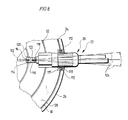
- the machine tool according to the invention offers the possibility of relative machining of a workpiece 120 clamped in the tool carrier 16 and indicated by dashed lines in FIG.
- the carrier unit 118' can also be pivoted in a plane 126 which is perpendicular to the bed plane 30, in such a way that the working axis 124 'can be pivoted about a center 128 located in the workpiece 122.
- the drive head 52 is on its lower side facing away from the turntable 14 with a radially over the cam elements 60 and 62 are provided with projecting support disk 130 which, if necessary, is supported in the respective processing station 20 by a support anvil 132 by resting thereon.
- This support anvil 132 can be arranged on the machine frame 10 on the one hand.
- the support anvil as shown in FIG. 4, is preferably arranged resting on the guide crossmember 116.
Landscapes
- Engineering & Computer Science (AREA)
- Mechanical Engineering (AREA)
- Machine Tool Units (AREA)
- Multi-Process Working Machines And Systems (AREA)
Applications Claiming Priority (2)
| Application Number | Priority Date | Filing Date | Title |
|---|---|---|---|
| DE3923230 | 1989-07-14 | ||
| DE3923230A DE3923230C2 (de) | 1989-07-14 | 1989-07-14 | Vorrichtung zum Schwenken für an einem Drehtisch angeordnete Werkstück-Halteeinrichtungen |
Publications (3)
| Publication Number | Publication Date |
|---|---|
| EP0407794A2 true EP0407794A2 (fr) | 1991-01-16 |
| EP0407794A3 EP0407794A3 (en) | 1991-06-26 |
| EP0407794B1 EP0407794B1 (fr) | 1994-10-19 |
Family
ID=6384981
Family Applications (1)
| Application Number | Title | Priority Date | Filing Date |
|---|---|---|---|
| EP90111986A Expired - Lifetime EP0407794B1 (fr) | 1989-07-14 | 1990-06-25 | Machine-outil avec table tournante et portes-pièces rotatifs |
Country Status (3)
| Country | Link |
|---|---|
| US (1) | US5090100A (fr) |
| EP (1) | EP0407794B1 (fr) |
| DE (2) | DE3923230C2 (fr) |
Cited By (12)
| Publication number | Priority date | Publication date | Assignee | Title |
|---|---|---|---|---|
| EP0607793A1 (fr) * | 1993-01-20 | 1994-07-27 | WITZIG & FRANK TURMATIC GmbH | Machine-outil rotative |
| EP1985410A1 (fr) * | 2007-04-27 | 2008-10-29 | IEMCA Giuliani Macchine Italia S.p.A. | Machine-outil de type transfert rotatitf avec changement automatique d'outil |
| FR2950276A1 (fr) * | 2009-09-18 | 2011-03-25 | Engineering Data | Dispositif de bridage et equipements associes |
| EP2543474A1 (fr) * | 2011-07-08 | 2013-01-09 | Ingenieursbüro IKS Neufeld | Machine de cadencement |
| CN103231247A (zh) * | 2013-04-22 | 2013-08-07 | 林俭丰 | 一种转台式多头数控钻攻机床 |
| CN103753214A (zh) * | 2014-01-22 | 2014-04-30 | 福州钜立机动车配件有限公司 | 一种汽缸六工位加工机及其加工方法 |
| CN108296772A (zh) * | 2017-12-29 | 2018-07-20 | 天长缸盖有限公司 | 一种自动切换工位的工件多面同步加工设备 |
| CN108356773A (zh) * | 2017-12-29 | 2018-08-03 | 天长缸盖有限公司 | 一种高效率多方位同步加工装置 |
| CN108356581A (zh) * | 2017-12-29 | 2018-08-03 | 天长缸盖有限公司 | 一种工件双面加工用双开式工作台 |
| CN108422197A (zh) * | 2018-05-25 | 2018-08-21 | 张家港市金采阳机械有限公司 | 平缝机牙架安装孔的自动加工机 |
| CN112518334A (zh) * | 2020-11-11 | 2021-03-19 | 宁波阅荷思山智能科技有限公司 | 回转式ic卡冲裁铣槽设备 |
| WO2022084756A1 (fr) * | 2020-10-22 | 2022-04-28 | Progettilab S.R.L. | Unité d'inclinaison rotative pour machines de transfert |
Families Citing this family (19)
| Publication number | Priority date | Publication date | Assignee | Title |
|---|---|---|---|---|
| IT233992Y1 (it) * | 1994-08-03 | 2000-02-16 | Riello Macchine Utensili Spa | Perfezionamento nelle macchine utensili transfer a tavola rotante |
| US5615468A (en) * | 1996-05-03 | 1997-04-01 | Chubbuck; Joseph | Modular mechanical system |
| IT1302005B1 (it) * | 1998-08-06 | 2000-07-20 | Salvagnini Italia Spa | Rotatore per macchina per la lavorazione di fogli di lamiera. |
| ATE299070T1 (de) * | 2000-11-02 | 2005-07-15 | Iemca Giuliani Macchine Italia | Werkzeugmaschine mit rundschalttisch |
| US20050077668A1 (en) * | 2003-10-10 | 2005-04-14 | Clouse Michael F. | Modular attachments for surface mount tools |
| DE102004007273A1 (de) * | 2004-02-14 | 2005-09-08 | Audi Ag | Scheibenwaschanlage für Fahrzeuge |
| US8269454B2 (en) * | 2009-10-09 | 2012-09-18 | Tai-Her Yang | Power charging device with charge saturation disconnector through electromagnetic force release |
| CN102581311A (zh) * | 2012-02-26 | 2012-07-18 | 蔡光宗 | 可连续自动加工的多功能车床 |
| CN104669168B (zh) * | 2015-03-12 | 2016-05-25 | 苏州博众精工科技有限公司 | 一种凸轮夹紧机构 |
| CN105834792A (zh) * | 2016-06-07 | 2016-08-10 | 李路 | 一种新型车床专用夹具装置 |
| CN106141687A (zh) * | 2016-08-29 | 2016-11-23 | 江苏海鑫机床有限公司 | 一种缝纫机包缝壳体加工多功能智能机床 |
| IT201900005394A1 (it) * | 2019-04-08 | 2020-10-08 | Proquadro S R L | “Macchina utensile a controllo numerico” |
| CN110340781B (zh) * | 2019-04-24 | 2022-02-18 | 惠州市盛广达实业有限公司 | 一种密胺餐具打孔和打磨自动化生产线及其工艺 |
| IT202000001054A1 (it) * | 2020-01-21 | 2021-07-21 | Grazioli Cesare S R L | Macchina transfer |
| CN111745416B (zh) * | 2020-05-27 | 2021-11-05 | 宁波市欧特瑞智能科技有限公司 | 一种回转式多工位复合机床 |
| CN116322550A (zh) * | 2020-09-30 | 2023-06-23 | 奥瑞斯健康公司 | 机器人外科手术中用于术中患者定位的引导协调式床运动 |
| CN114770119B (zh) * | 2022-03-28 | 2024-01-12 | 安徽省小小科技股份有限公司 | 一种转子支架生产用加工装置 |
| CN116533023B (zh) * | 2023-05-19 | 2025-11-28 | 泉州市闽达机械制造有限公司 | 一种工件加工设备的四轴旋转盘 |
| IT202300012543A1 (it) * | 2023-06-19 | 2024-12-19 | Sistemi Transfer S R L | Macchina transfer e metodo di evacuazione trucioli |
Family Cites Families (7)
| Publication number | Priority date | Publication date | Assignee | Title |
|---|---|---|---|---|
| DE877397C (de) * | 1944-03-01 | 1953-05-21 | Erwin Hennig | Schalttischautomat mit planetengeschalteten Werkstueckaufnahmen |
| US3492681A (en) * | 1967-07-07 | 1970-02-03 | Space Res Corp | Automatic machinery |
| BE795322A (fr) * | 1972-02-21 | 1973-05-29 | Vyzk Ustav Mech | Machine multi-operation a mouvement circulaire |
| US3835527A (en) * | 1972-09-29 | 1974-09-17 | R Cornair | Multi-purpose support apparatus |
| JPS5942534Y2 (ja) * | 1975-07-22 | 1984-12-12 | シノハラ シゲユキ | パラレルインデツクスカム装置 |
| JPS58156761A (ja) * | 1982-03-11 | 1983-09-17 | Toshiba Corp | 駆動装置 |
| JPS58206368A (ja) * | 1982-05-25 | 1983-12-01 | Musashino Sekkei Kogyo Kk | 複動式インデツクステ−ブル |
-
1989
- 1989-07-14 DE DE3923230A patent/DE3923230C2/de not_active Expired - Lifetime
-
1990
- 1990-06-25 DE DE59007483T patent/DE59007483D1/de not_active Expired - Lifetime
- 1990-06-25 EP EP90111986A patent/EP0407794B1/fr not_active Expired - Lifetime
- 1990-07-11 US US07/551,530 patent/US5090100A/en not_active Expired - Lifetime
Cited By (19)
| Publication number | Priority date | Publication date | Assignee | Title |
|---|---|---|---|---|
| EP0607793A1 (fr) * | 1993-01-20 | 1994-07-27 | WITZIG & FRANK TURMATIC GmbH | Machine-outil rotative |
| WO1994016860A1 (fr) * | 1993-01-20 | 1994-08-04 | Witzig & Frank Turmatic Gmbh | Machine-outil a mouvement rotatif cadence |
| US5452502A (en) * | 1993-01-20 | 1995-09-26 | Witzig & Frank Turmatic Gmbh | Turret-type machine tool |
| EP1985410A1 (fr) * | 2007-04-27 | 2008-10-29 | IEMCA Giuliani Macchine Italia S.p.A. | Machine-outil de type transfert rotatitf avec changement automatique d'outil |
| FR2950276A1 (fr) * | 2009-09-18 | 2011-03-25 | Engineering Data | Dispositif de bridage et equipements associes |
| EP2543474A1 (fr) * | 2011-07-08 | 2013-01-09 | Ingenieursbüro IKS Neufeld | Machine de cadencement |
| CN103231247A (zh) * | 2013-04-22 | 2013-08-07 | 林俭丰 | 一种转台式多头数控钻攻机床 |
| CN103231247B (zh) * | 2013-04-22 | 2016-06-15 | 林俭丰 | 一种转台式多头数控钻攻机床 |
| CN103753214B (zh) * | 2014-01-22 | 2015-11-25 | 福州钜立机动车配件有限公司 | 一种汽缸六工位加工机及其加工方法 |
| CN103753214A (zh) * | 2014-01-22 | 2014-04-30 | 福州钜立机动车配件有限公司 | 一种汽缸六工位加工机及其加工方法 |
| CN108296772A (zh) * | 2017-12-29 | 2018-07-20 | 天长缸盖有限公司 | 一种自动切换工位的工件多面同步加工设备 |
| CN108356773A (zh) * | 2017-12-29 | 2018-08-03 | 天长缸盖有限公司 | 一种高效率多方位同步加工装置 |
| CN108356581A (zh) * | 2017-12-29 | 2018-08-03 | 天长缸盖有限公司 | 一种工件双面加工用双开式工作台 |
| CN108356773B (zh) * | 2017-12-29 | 2020-10-27 | 天长缸盖有限公司 | 一种高效率多方位同步加工装置 |
| CN108296772B (zh) * | 2017-12-29 | 2021-01-08 | 天长缸盖有限公司 | 一种自动切换工位的工件多面同步加工设备 |
| CN108422197A (zh) * | 2018-05-25 | 2018-08-21 | 张家港市金采阳机械有限公司 | 平缝机牙架安装孔的自动加工机 |
| WO2022084756A1 (fr) * | 2020-10-22 | 2022-04-28 | Progettilab S.R.L. | Unité d'inclinaison rotative pour machines de transfert |
| CN112518334A (zh) * | 2020-11-11 | 2021-03-19 | 宁波阅荷思山智能科技有限公司 | 回转式ic卡冲裁铣槽设备 |
| CN112518334B (zh) * | 2020-11-11 | 2022-07-22 | 宁波阅荷思山智能科技有限公司 | 回转式ic卡冲裁铣槽设备 |
Also Published As
| Publication number | Publication date |
|---|---|
| EP0407794A3 (en) | 1991-06-26 |
| EP0407794B1 (fr) | 1994-10-19 |
| DE3923230A1 (de) | 1991-01-24 |
| DE3923230C2 (de) | 2002-06-20 |
| US5090100A (en) | 1992-02-25 |
| DE59007483D1 (de) | 1994-11-24 |
Similar Documents
| Publication | Publication Date | Title |
|---|---|---|
| EP0407794B1 (fr) | Machine-outil avec table tournante et portes-pièces rotatifs | |
| DE2822598A1 (de) | Getriebeanordnung | |
| EP2886223B1 (fr) | Tête à rouler les filets | |
| DE2644900C3 (de) | Profiliermaschine | |
| EP2897764B1 (fr) | Dispositif de changement de pièce et machine outil comprenant le dispositif de changement de pièce | |
| EP3698906A1 (fr) | Porte-outil et support d'outil | |
| DE19513992C2 (de) | Axiale Fixierung einer Welle-Nabe-Verbindung | |
| DE2940827A1 (de) | Vorrichtung zum plan- und ausdrehen | |
| EP0332801B1 (fr) | Appareil pour changer la forme de coupe d'ébauches de boites | |
| EP2282869B1 (fr) | Dispositif de positionnement de pièce | |
| DE3507224A1 (de) | Montageeinrichtung | |
| DE3809802A1 (de) | Einrichtung zur steuerung der werkzeugstellung in abhaengigkeit von der hubposition | |
| DE3438915C2 (de) | Lünette | |
| DE2702396A1 (de) | Zentrier- und drehvorrichtung | |
| DE3930335C1 (fr) | ||
| DE1502717B2 (de) | Vorrichtung zur Steuerung des intermittierenden Antriebes eines Rund schalttisches mit einem Malteserkreuz Getriebe | |
| DE9213786U1 (de) | Werkzeugwechsler | |
| DE2228654A1 (de) | Vorrichtung zum umsetzen von teilen, insbesondere werkzeugwechselvorrichtung bei werkzeugmaschinen | |
| EP0223152A1 (fr) | Dispositif et procédé pour le tournage de surfaces intérieures sphériques | |
| DE19856562C1 (de) | Spanneinrichtung für scheibenförmige Werkstücke | |
| DE19606592C2 (de) | Mähbalken | |
| DE2737598A1 (de) | Zahnrad-bearbeitungsmaschine fuer stirnkanten von zahnraedern | |
| DE19953283A1 (de) | Verstellbare Schlitteneinheit für Stanz-, Biege- und Montageautomaten | |
| DE2651174B2 (de) | Spann- und Führungseinrichtung für langgestreckte, axialbewegte Werkstücke | |
| DE3117522C2 (de) | Transportable Drehvorrichtung |
Legal Events
| Date | Code | Title | Description |
|---|---|---|---|
| PUAI | Public reference made under article 153(3) epc to a published international application that has entered the european phase |
Free format text: ORIGINAL CODE: 0009012 |
|
| AK | Designated contracting states |
Kind code of ref document: A2 Designated state(s): DE ES FR GB IT |
|
| PUAL | Search report despatched |
Free format text: ORIGINAL CODE: 0009013 |
|
| AK | Designated contracting states |
Kind code of ref document: A3 Designated state(s): DE ES FR GB IT |
|
| 17P | Request for examination filed |
Effective date: 19911121 |
|
| 17Q | First examination report despatched |
Effective date: 19930128 |
|
| GRAA | (expected) grant |
Free format text: ORIGINAL CODE: 0009210 |
|
| RAP1 | Party data changed (applicant data changed or rights of an application transferred) |
Owner name: HECKERT CHEMNITZER WERKZEUGMASCHINEN GMBH |
|
| AK | Designated contracting states |
Kind code of ref document: B1 Designated state(s): DE ES FR GB IT |
|
| PG25 | Lapsed in a contracting state [announced via postgrant information from national office to epo] |
Ref country code: ES Free format text: THE PATENT HAS BEEN ANNULLED BY A DECISION OF A NATIONAL AUTHORITY Effective date: 19941019 Ref country code: GB Effective date: 19941019 Ref country code: FR Effective date: 19941019 |
|
| ITF | It: translation for a ep patent filed | ||
| REF | Corresponds to: |
Ref document number: 59007483 Country of ref document: DE Date of ref document: 19941124 |
|
| EN | Fr: translation not filed | ||
| GBV | Gb: ep patent (uk) treated as always having been void in accordance with gb section 77(7)/1977 [no translation filed] |
Effective date: 19941019 |
|
| PLBE | No opposition filed within time limit |
Free format text: ORIGINAL CODE: 0009261 |
|
| STAA | Information on the status of an ep patent application or granted ep patent |
Free format text: STATUS: NO OPPOSITION FILED WITHIN TIME LIMIT |
|
| 26N | No opposition filed | ||
| PGFP | Annual fee paid to national office [announced via postgrant information from national office to epo] |
Ref country code: IT Payment date: 20090625 Year of fee payment: 20 |
|
| PGFP | Annual fee paid to national office [announced via postgrant information from national office to epo] |
Ref country code: DE Payment date: 20090623 Year of fee payment: 20 |
|
| PG25 | Lapsed in a contracting state [announced via postgrant information from national office to epo] |
Ref country code: DE Free format text: LAPSE BECAUSE OF EXPIRATION OF PROTECTION Effective date: 20100625 |