EP0408538A2 - ProcédÀ© de fabrication de tubes à partir d'une bande métallique - Google Patents
ProcédÀ© de fabrication de tubes à partir d'une bande métallique Download PDFInfo
- Publication number
- EP0408538A2 EP0408538A2 EP90890201A EP90890201A EP0408538A2 EP 0408538 A2 EP0408538 A2 EP 0408538A2 EP 90890201 A EP90890201 A EP 90890201A EP 90890201 A EP90890201 A EP 90890201A EP 0408538 A2 EP0408538 A2 EP 0408538A2
- Authority
- EP
- European Patent Office
- Prior art keywords
- pipe
- wall
- tube
- insert
- forming gas
- Prior art date
- Legal status (The legal status is an assumption and is not a legal conclusion. Google has not performed a legal analysis and makes no representation as to the accuracy of the status listed.)
- Granted
Links
Images
Classifications
-
- B—PERFORMING OPERATIONS; TRANSPORTING
- B21—MECHANICAL METAL-WORKING WITHOUT ESSENTIALLY REMOVING MATERIAL; PUNCHING METAL
- B21C—MANUFACTURE OF METAL SHEETS, WIRE, RODS, TUBES, PROFILES OR LIKE SEMI-MANUFACTURED PRODUCTS OTHERWISE THAN BY ROLLING; AUXILIARY OPERATIONS USED IN CONNECTION WITH METAL-WORKING WITHOUT ESSENTIALLY REMOVING MATERIAL
- B21C37/00—Manufacture of metal sheets, rods, wire, tubes, profiles or like semi-manufactured products, not otherwise provided for; Manufacture of tubes of special shape
- B21C37/06—Manufacture of metal sheets, rods, wire, tubes, profiles or like semi-manufactured products, not otherwise provided for; Manufacture of tubes of special shape of tubes or metal hoses; Combined procedures for making tubes, e.g. for making multi-wall tubes
- B21C37/12—Making tubes or metal hoses with helically arranged seams
- B21C37/127—Tube treating or manipulating combined with or specially adapted for use in connection with tube making machines, e.g. drawing-off devices, cutting-off
-
- B—PERFORMING OPERATIONS; TRANSPORTING
- B21—MECHANICAL METAL-WORKING WITHOUT ESSENTIALLY REMOVING MATERIAL; PUNCHING METAL
- B21C—MANUFACTURE OF METAL SHEETS, WIRE, RODS, TUBES, PROFILES OR LIKE SEMI-MANUFACTURED PRODUCTS OTHERWISE THAN BY ROLLING; AUXILIARY OPERATIONS USED IN CONNECTION WITH METAL-WORKING WITHOUT ESSENTIALLY REMOVING MATERIAL
- B21C37/00—Manufacture of metal sheets, rods, wire, tubes, profiles or like semi-manufactured products, not otherwise provided for; Manufacture of tubes of special shape
- B21C37/06—Manufacture of metal sheets, rods, wire, tubes, profiles or like semi-manufactured products, not otherwise provided for; Manufacture of tubes of special shape of tubes or metal hoses; Combined procedures for making tubes, e.g. for making multi-wall tubes
- B21C37/12—Making tubes or metal hoses with helically arranged seams
- B21C37/122—Making tubes or metal hoses with helically arranged seams with welded or soldered seams
-
- B—PERFORMING OPERATIONS; TRANSPORTING
- B23—MACHINE TOOLS; METAL-WORKING NOT OTHERWISE PROVIDED FOR
- B23K—SOLDERING OR UNSOLDERING; WELDING; CLADDING OR PLATING BY SOLDERING OR WELDING; CUTTING BY APPLYING HEAT LOCALLY, e.g. FLAME CUTTING; WORKING BY LASER BEAM
- B23K10/00—Welding or cutting by means of a plasma
-
- B—PERFORMING OPERATIONS; TRANSPORTING
- B23—MACHINE TOOLS; METAL-WORKING NOT OTHERWISE PROVIDED FOR
- B23K—SOLDERING OR UNSOLDERING; WELDING; CLADDING OR PLATING BY SOLDERING OR WELDING; CUTTING BY APPLYING HEAT LOCALLY, e.g. FLAME CUTTING; WORKING BY LASER BEAM
- B23K9/00—Arc welding or cutting
- B23K9/02—Seam welding; Backing means; Inserts
- B23K9/028—Seam welding; Backing means; Inserts for curved planar seams
- B23K9/0282—Seam welding; Backing means; Inserts for curved planar seams for welding tube sections
Definitions
- the invention relates to a process for the production of pipes from a metal strip, the metal strip being fed continuously at an acute angle to the pipe axis, corresponding to the desired pitch of the turns, and then shaped to the desired diameter in a shaping screw, and then the turns continuously and under Use of a forming gas, preferably argon with an admixture of 10 vol% hydrogen, welded together and finally pipe pieces of the desired length are cut off.
- the invention further relates to a device for carrying out the method, comprising a fixed feed device for the metal strip, a shaping screw with internal pressure rollers for deflecting the metal strip to the desired diameter, a welding head for welding the turns together and a cutting device for cutting off the tubes, preferably in Connection with a suction device.
- the welding torch is preferably mounted in a fixed manner and the feed of the metal strip rotates the tube about its axis, while at the same time advancing it in the axial direction.
- the cutting device usually a circular saw or cutting disc, must join this movement when cutting pieces of pipe of a certain length.
- the cutting devices were slidably mounted and moved during the cutting process from the end face of the advanced tube in its direction by pressure on the side surface of the saw blade. With this method, it is possible to continuously produce pipe pieces of essentially any length by continuously feeding them from the metal strip.
- this cutting method is very noisy, for example in the range of 110 dB, and has often resulted in damage to the saw blades due to the feed pressure and thus also in danger from fragments flying away.
- CH-PS 298 581 shows the production of a pipe using the spiral process, welding being carried out both on the inside and outside of the pipe.
- Forming gas is, however, only supplied through lines that cover electrodes. There are therefore no precautions to keep the forming gas over the weld seam until it has cooled below the reaction temperature, which can lead to material damage after welding. It is therefore necessary to rework the inside of the pipe in this manufacturing process.
- the continuous supply of forming gas results in very high gas consumption.
- DE-AS 21 28 115 also describes a method with continuous supply of protective gas and thus high gas consumption.
- the pipes are manufactured here, however, by unfolding a metal strip and welding it in the direction of its longitudinal axis, ie with a straight weld seam.
- the shielding gas is fed into a straight channel in a form and support insert in the interior of the tube, the said channel being seen in the tube feed direction becoming ever shallower. This enables the protective gas to be diluted and the oxygen concentration to be increased, and the consumption of protective gas rises considerably as a result of the large amounts required for purging.
- Another object was to carry out the cutting process in the method according to the invention safely, quietly and not to interrupt the continuous production process without changing the material properties.
- the interior of the tube is filled with the forming gas in a precisely limited area around the welding point, the length of the gas-filled area being determined exactly by leaving the weld seam below a temperature after leaving the said area cooled, in which there is no reaction between the pipe material and the atmospheric oxygen.
- the pipe pieces are cut during the feed by a plasma cutter carried along and the inner tube wall in the area of the plasma cutter is protected from material splashes and dust deposits except for a small section around the actual cutting area.
- the air is sucked out of the interior of said insert, at least during the cutting process.
- the invention also includes an apparatus for carrying out the method, which is characterized in that in the interior of the coiled strip, essentially from the point at which the Band windings abut each other, a sealing wall is provided, that a second sealing wall is provided, located somewhat further in the pipe feed direction, which forms a chamber with the first wall and the inner wall of the pipe, and that in the first wall a valve for admitting a forming gas into said chamber and in a valve for discharging the air initially located in the chamber is arranged on the second wall.
- a plasma cutter is provided for cutting the tube pieces, and an insert is arranged inside the tube, at least over the length of the path which the plasma cutter travels, which covers the inner wall of the tube to a small extent Covering the cut-out around the cutting line and thus protecting it from material splashes and dust deposits, whereby at least a part of the inner wall of the insert may be exchangeable or protected by an interchangeable, at least partially inner lining, preferably made of aluminum sheet, and the insert may be spaced somewhat from the forming gas chamber and on its end facing the said chamber is provided with an end wall corresponding to the size of the second sealing wall with a seal, preferably made of Teflon, which bears against the inner wall of the tube.
- the inside of the tube is filled with forming gas in a precisely limited area around the welding point, a precisely defined composition of the gas can be guaranteed in this area and there is only a minimal outflow of the gas or inflow of ambient air. Therefore, a certain amount of forming gas is sufficient for a long time of pipe production, only small amounts of forming gas have to be replaced regularly, if at all. If this replacement is carried out under the supervision of an oxygen sensor, it can be matched exactly to the respective requirement and thus additionally increases the economy of the method according to the invention.
- the spiral weld can, as the whole The inside of the pipe is filled with the forming gas, i.e.
- the entire inner surface lies under the protective gas atmosphere does not come into contact with the atmospheric oxygen at any point and therefore remains protected until it cools down under a harmless, ie no reaction between the pipe material and oxygen-triggering, temperature of the weld seam .
- the separation of the pipe sections by means of the plasma cutter has the advantage that no mechanical damage to the pipe and the cutting tool has to be feared.
- the protective insert protects the inner pipe surface against material splashes of the hot particles thrown away by the plasma cutter and against precipitation of hot dust, which also prevents damage to the inside of the pipe when cutting. This can be done by air extraction, which takes place at least during the cutting process, and the dust that could get through the narrow spaces between the inner tube wall and insert and thus to unprotected areas of the inner tube side.
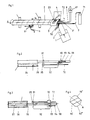
- a metal strip 2 is guided to a forming screw 3 by means of a conventional feed device 1.
- the metal strip is formed into a helical shape by this screw, with correspondingly designed shaped screws being provided for different values for bandwidth, pitch (corresponding to the number of turns per length) and diameter of the tube.
- pressure rollers 31 are arranged on a carrier 32 for exact shaping. They ensure that the metal strip lies precisely on the inner surface of the forming screw 3, which is important for the individual turns of the metal strip to lie against one another.
- the shaping screw 3 is finally provided with a cutout 33 through which the line at which the individual turns of the metal strip meet is accessible.
- the welding torch 4 is also used to connect the turns by welding processes, such as MIG welding.
- MIG welding an argon-nitrogen or carbon dioxide-nitrogen mixture, preferably a mixture commercially available under the name "Noxalic 12"
- the protective gas is used as the protective gas.
- the welded tube 5 is advanced by the supply of further metal strip with simultaneous rotation about its longitudinal axis in the direction thereof at a speed V R. It is guided on support devices 51.
- the cutting device 6 is carried along with the pipe.
- this device 6 is a plasma cutter which is provided with at least one roller 61, preferably three or four rollers 61.
- the pipe be filled with forming gas in a precisely defined area around the welding point, and according to a further feature also the inner wall of the pipe in the area of the plasma cutter through an insert (see Fig. 2 and 3) to protect, as well as to suck the air from the inside of this insert.
- the forming gas a mixture of approximately 90% by volume argon and 10% by volume hydrogen, is supplied via a feed line 7 from a container 71.
- the hydrogen in the forming gas together with any oxygen that may still be present or penetrating, results in a combustible mixture that is ignited by the temperature of the welding torch, as a result of which the oxygen cannot react with the metal of the inner tube wall.
- An operating device 72 ensures that the air in the tube before the forming gas is introduced can escape via a valve (see FIGS. 2 and 3).
- the air sucked out of the insert 96 in the cutting area is removed from a suction fan 81 via a suction line 8.
- the suction can take place continuously, that is, only during the cutting process, at most slightly longer in order to ensure that the dust is removed as far as possible.
- FIGS. 2 and 3 An embodiment of a device according to the invention, which is used to carry out the method described above, is shown in FIGS. 2 and 3.
- the area into which the protective gas is filled is limited on the one hand by the inner wall of the tube itself, and in the interior of the tube 5 two sealing walls 90, 91 are arranged at a certain distance from one another.
- the side edges of these sealing walls are provided with seals, preferably made of Teflon, which bear against the inner wall of the pipe. They are essentially functional even during the rotation and feed movement of the tube.
- the low forming gas losses that nevertheless occur can be compensated for by continuously supplying a small amount of gas per unit of time.
- a sensor for the oxygen content is provided in the area between the sealing walls in the "forming gas chamber" 92, which only triggers the introduction of gas into the chamber 92 when a certain limit value is exceeded, which leads to a reduction in gas consumption.
- the introduction takes place via an inlet connection 94 provided with a valve 93, which can be connected to the line 7.
- the air contained in chamber 92 at the beginning of the manufacturing process is displaced from the chamber by the forming gas via valve 95, which can be opened and closed via operating device 72.
- the oxygen sensor mentioned can advantageously be used to reduce the gas consumption, since it measures the reduction in the oxygen content below the critical value that is critical for the formation of metal oxides. Otherwise, with a little more consumption of forming gas, the chamber 92 must be purged with an amount of gas which corresponds to a multiple of the chamber volume. In practice, 5 to 6 times the volume has proven to be sufficient.
- It is made up of two semicircular and a rectangular element constructed such that the rectangular element 90 'short (after the abutment of the individual band windings and with respect to the direction of rotation of the tube a little before the welding point with one side edge sealingly against the inner wall of the tube, with its second side edge essentially on the opposite Pipe wall rests tightly, and on the sides transverse to the pipe axis A, the two semicircular elements 90 ⁇ , 90 ′′′ are arranged substantially perpendicular to the plane of the rectangular element, the element that is located in the pipe feed direction in front of the welding point with respect to the rectangular Element is mounted on the same side as the welding point, and the second semicircular element in the pipe feed direction is mounted behind and with respect to the rectangular element opposite the welding point.
- the rectangular wall element 90 'must also fulfill a protective function. It shields the welding point in the pipe so that any material splashes are caught and do not lead to impairment of the properties on the inside of the pipe.
- the wall element 90 'into the interior of the forming gas chamber 92, over the edge with the semicircular part 90', can be extended as desired.
- the distance of the second sealing wall 91 from the welding point results from the condition that the weld seam should be cooled to a temperature at which there is no reaction between the pipe material and atmospheric oxygen.
- a preferred material this means cooling below approx. 300 ° C before the weld seam can come into contact with atmospheric oxygen.
- the second sealing wall 91 can advantageously be displaced along the tube longitudinal axis A, but in any position fixable, assembled.
- an insert 96 made of metal, preferably of the same material from which the tube is made, is arranged after the forming gas chamber.
- This insert is a hollow body which, apart from a small area around the cutting line of the plasma cutter 6, where a cutout 97 is provided, shields the inner wall of the tube from the cutting line.
- the interior of the insert 96 is connected to the suction line 8 via a suction pipe 98, so that the dust-containing air can be extracted from the insert.
- the insert 96 thus protects the inner wall of the tube during plasma cutting from material splashes or by extracting the dust-containing air from the application of dust.
- the cut-out shape of the insert 96 is generally not important as long as it shields the entire circumferential area of the inner wall of the tube.
- An advantageous embodiment provides, however, that the insert 96 is spaced somewhat apart from the forming gas chamber 92 and, on its end face facing the said chamber, from an end wall 99 corresponding in size to the second sealing wall with a seal which lies against the inner wall of the tube over the entire circumference, preferably made of Teflon. In the event of a greater leak in the second sealing wall 91, this arrangement ensures that not all gas is immediately sucked out of the chamber 92 through the pipe 98.
- either a part of the insert 96 itself, which lies opposite the interface, or an at least partial inner lining 100, preferably made of aluminum sheet, can be replaced, so that in the event of damage by material splashes after prolonged use, the entire insert does not have to be changed.
- the insert 96 is provided with at least one, preferably two, bearing rollers 101. These are advantageously height-adjustable and are arranged or adjusted in such a way that the insert 96 and thus the entire device according to the invention lies exactly in the center of the tube 5. This prevents the seals of the sealing walls 90, 91 and the end wall 99 from being worn on one side or being damaged by excessive loads.
- the bearings 101 also act with at least one of the support devices 51, e.g. also equipped with rollers 52, together on the outside of the tube, to cover the entire arrangement, i.e. support the pipe together with the device.
- the insert 96 just described fulfills its task of protecting the inner tube wall the better the smaller the cutout 97 can be made.
- the assembly of rollers 61 on the plasma cutter described above already contributes to this.
- a further improvement in the cutting accuracy and thus the possible reduction of the cutout 97 to improve the protective effect of the insert 96 is possible by further automation.
- An automatic, e.g. Computer-controlled device can be provided, which carries the plasma cutter 6 movably and allows the automatic placement of the same with the roller or rollers 61, the switching on and off of the cutter 6, and the carrying, lifting and returning to the starting position.
- the control signals for this could, according to an advantageous embodiment, from signaling devices, such as Light barriers are supplied, which can be triggered by the plasma cutter and by the tube itself.
Landscapes
- Engineering & Computer Science (AREA)
- Mechanical Engineering (AREA)
- Physics & Mathematics (AREA)
- Plasma & Fusion (AREA)
- Arc Welding In General (AREA)
- Heat Treatment Of Strip Materials And Filament Materials (AREA)
- Bending Of Plates, Rods, And Pipes (AREA)
- Metal Extraction Processes (AREA)
Applications Claiming Priority (2)
| Application Number | Priority Date | Filing Date | Title |
|---|---|---|---|
| AT0166789A AT394149B (de) | 1989-07-10 | 1989-07-10 | Verfahren zur herstellung von rohren aus einem metallband |
| AT1667/89 | 1989-07-10 |
Publications (3)
| Publication Number | Publication Date |
|---|---|
| EP0408538A2 true EP0408538A2 (fr) | 1991-01-16 |
| EP0408538A3 EP0408538A3 (en) | 1991-08-07 |
| EP0408538B1 EP0408538B1 (fr) | 1993-09-15 |
Family
ID=3518384
Family Applications (1)
| Application Number | Title | Priority Date | Filing Date |
|---|---|---|---|
| EP90890201A Expired - Lifetime EP0408538B1 (fr) | 1989-07-10 | 1990-07-04 | Procédé de fabrication de tubes à partir d'une bande métallique |
Country Status (4)
| Country | Link |
|---|---|
| EP (1) | EP0408538B1 (fr) |
| AT (2) | AT394149B (fr) |
| DE (1) | DE59002711D1 (fr) |
| DK (1) | DK0408538T3 (fr) |
Cited By (3)
| Publication number | Priority date | Publication date | Assignee | Title |
|---|---|---|---|---|
| ES2077486A1 (es) * | 1991-07-19 | 1995-11-16 | Garcia Cesareo Rivas | Maquina conformadora de tubos de chapa. |
| EP1112787A3 (fr) * | 1999-12-30 | 2002-07-31 | Olimpia 80 SRL | Tuyau flexible soudé étanche aux gaz ainsi procédé et dispositif pour sa fabrication |
| AU770660B2 (en) * | 2001-07-10 | 2004-02-26 | Ching-Chi Chung | Hollow-pipe forming apparatus and it's products |
Family Cites Families (10)
| Publication number | Priority date | Publication date | Assignee | Title |
|---|---|---|---|---|
| US1929415A (en) * | 1930-04-21 | 1933-10-10 | California Corrugated Culvert | Manufacture of welded spiral pipe |
| DE569054C (de) * | 1930-08-22 | 1933-01-31 | Adam Schmidt | Vorrichtung zur Fuehrung eines Werkzeugs, insbesondere des Brenners einer Brennschneid- oder Schweissmaschine |
| CH298581A (fr) * | 1951-02-02 | 1954-05-15 | Mond Nickel Co Ltd | Procédé de fabrication d'un tube métallique et appareil pour la mise en oeuvre de ce procédé. |
| US3332675A (en) * | 1964-06-09 | 1967-07-25 | Raymond Int Inc | Cutting metal tubing |
| FR2093378A5 (fr) * | 1970-06-12 | 1972-01-28 | Tubest Sa | |
| FR2338095A1 (fr) * | 1976-01-15 | 1977-08-12 | Bindschedler Pierre | Procede et machine de fabrication de corps metalliques cylindriques creux, notamment pour boites a conserves |
| US4101067A (en) * | 1976-07-23 | 1978-07-18 | Sloan Purge Products Co., Inc. | Heat sink welding and purging apparatus |
| DD143223A1 (de) * | 1979-04-26 | 1980-08-13 | Mueller Karl Heinz | Einrichtung zum auffangen von abstoffen beim thermischen trennen |
| DD249655A1 (de) * | 1986-06-04 | 1987-09-16 | Volkswerft Stralsund Veb | Absaugeinrichtung fuer das plasmaschneiden an rohren |
| US4687892A (en) * | 1986-08-11 | 1987-08-18 | Fmc Corporation | Inert atmosphere control for induction heated pressure welding system |
-
1989
- 1989-07-10 AT AT0166789A patent/AT394149B/de not_active IP Right Cessation
-
1990
- 1990-07-04 DK DK90890201.8T patent/DK0408538T3/da not_active Application Discontinuation
- 1990-07-04 DE DE90890201T patent/DE59002711D1/de not_active Expired - Fee Related
- 1990-07-04 EP EP90890201A patent/EP0408538B1/fr not_active Expired - Lifetime
- 1990-07-04 AT AT90890201T patent/ATE94436T1/de not_active IP Right Cessation
Cited By (3)
| Publication number | Priority date | Publication date | Assignee | Title |
|---|---|---|---|---|
| ES2077486A1 (es) * | 1991-07-19 | 1995-11-16 | Garcia Cesareo Rivas | Maquina conformadora de tubos de chapa. |
| EP1112787A3 (fr) * | 1999-12-30 | 2002-07-31 | Olimpia 80 SRL | Tuyau flexible soudé étanche aux gaz ainsi procédé et dispositif pour sa fabrication |
| AU770660B2 (en) * | 2001-07-10 | 2004-02-26 | Ching-Chi Chung | Hollow-pipe forming apparatus and it's products |
Also Published As
| Publication number | Publication date |
|---|---|
| DE59002711D1 (de) | 1993-10-21 |
| ATA166789A (de) | 1991-08-15 |
| EP0408538B1 (fr) | 1993-09-15 |
| EP0408538A3 (en) | 1991-08-07 |
| DK0408538T3 (da) | 1993-11-01 |
| AT394149B (de) | 1992-02-10 |
| ATE94436T1 (de) | 1993-10-15 |
Similar Documents
| Publication | Publication Date | Title |
|---|---|---|
| CH616101A5 (fr) | ||
| DE7729871U1 (de) | Vorrichtung zum Schneiden eines metallischen Werkstücks | |
| EP2292367A1 (fr) | Procédé et dispositif de soudure ou de brasure sous atmosphère de gaz de protection | |
| DE112007000753T5 (de) | Schweißvorrichtung für Rohre aus rostfreiem Stahl sowie Schweißverfahren derselben | |
| CH682060A5 (fr) | ||
| DE102019121175A1 (de) | Schutzglas-Halteeinrichtung für eine Laserbearbeitungsvorrichtung sowie damit versehene Laserbearbeitungsvorrichtung | |
| DE2217770C3 (de) | Lichtbogenschweiß- oder Schneidbrenner | |
| DE69917238T2 (de) | Schweissbrenner mit umgekehrter rauchgasabsaugung | |
| EP0408538B1 (fr) | Procédé de fabrication de tubes à partir d'une bande métallique | |
| DE2448620C3 (de) | Mehrfach-Elektroden-Schweißbrenner | |
| DE2362657A1 (de) | Verfahren zur metallbearbeitung unter zuhilfenahme eines lichtbogens und eines gasstrahls und hierzu dienende vorrichtung | |
| DE3135381C2 (de) | Schutzgasschweißbrenner mit Rauchgasabsaugvorrichtung | |
| DE3145872A1 (de) | "vorrichtung zum raffinieren fluessiger metalle | |
| DE2738587A1 (de) | Abschirmvorrichtung fuer einen giessstrahl aus fluessigem metall | |
| EP1091181B1 (fr) | Buse d'expansion | |
| DE2748789C3 (de) | Verfahren und Vorrichtung zum thermochemischen Flämmen | |
| EP2277654B1 (fr) | Procédé et dispositif de protection contre les projections lors du soudage de pièces usinées creuses | |
| DE3936205C2 (fr) | ||
| EP2380692A1 (fr) | Assemblage ou revêtement de gaz protecteur avec une aspiration de fumée interne | |
| DE2133755A1 (de) | Vorrichtung zum Einschweißen von Rohren in Rohrplatten | |
| DE8422585U1 (de) | Vorrichtung zum bodenabstich einer metallschmelze aus einem schmelzofen oder einer giesspfanne | |
| DE2820246A1 (de) | Einrichtung zum zufuehren von schweissmaterial zu einer sich laengs eines vorbestimmten schweisspfades erstreckenden schweisstelle | |
| EP4547437B1 (fr) | Procédé et dispositif pour souder des pièces dans une chambre à gaz de protection | |
| DE740345C (de) | Vorrichtung zum Ausfuehren von Lichtbogenschweissungen mittels ummantelter Elektrode | |
| DE1515228C (de) | Verfahren und Vorrichtung zum Bearbeiten von Werkstücken mittels Lichtbogen unter Schutzgas. Arlm: Union Carbide Corp., New York, N.Y. (V.StA.) |
Legal Events
| Date | Code | Title | Description |
|---|---|---|---|
| PUAI | Public reference made under article 153(3) epc to a published international application that has entered the european phase |
Free format text: ORIGINAL CODE: 0009012 |
|
| AK | Designated contracting states |
Kind code of ref document: A2 Designated state(s): AT BE CH DE DK FR IT LI LU NL SE |
|
| PUAL | Search report despatched |
Free format text: ORIGINAL CODE: 0009013 |
|
| AK | Designated contracting states |
Kind code of ref document: A3 Designated state(s): AT BE CH DE DK FR IT LI LU NL SE |
|
| 17P | Request for examination filed |
Effective date: 19911104 |
|
| 17Q | First examination report despatched |
Effective date: 19920630 |
|
| GRAA | (expected) grant |
Free format text: ORIGINAL CODE: 0009210 |
|
| AK | Designated contracting states |
Kind code of ref document: B1 Designated state(s): AT BE CH DE DK FR IT LI LU NL SE |
|
| REF | Corresponds to: |
Ref document number: 94436 Country of ref document: AT Date of ref document: 19931015 Kind code of ref document: T |
|
| REF | Corresponds to: |
Ref document number: 59002711 Country of ref document: DE Date of ref document: 19931021 |
|
| REG | Reference to a national code |
Ref country code: DK Ref legal event code: T3 |
|
| ET | Fr: translation filed | ||
| ITF | It: translation for a ep patent filed | ||
| PG25 | Lapsed in a contracting state [announced via postgrant information from national office to epo] |
Ref country code: AT Effective date: 19940704 |
|
| PLBE | No opposition filed within time limit |
Free format text: ORIGINAL CODE: 0009261 |
|
| STAA | Information on the status of an ep patent application or granted ep patent |
Free format text: STATUS: NO OPPOSITION FILED WITHIN TIME LIMIT |
|
| 26N | No opposition filed | ||
| EPTA | Lu: last paid annual fee | ||
| EAL | Se: european patent in force in sweden |
Ref document number: 90890201.8 |
|
| PGFP | Annual fee paid to national office [announced via postgrant information from national office to epo] |
Ref country code: FR Payment date: 19950503 Year of fee payment: 6 |
|
| PGFP | Annual fee paid to national office [announced via postgrant information from national office to epo] |
Ref country code: BE Payment date: 19950509 Year of fee payment: 6 |
|
| PGFP | Annual fee paid to national office [announced via postgrant information from national office to epo] |
Ref country code: SE Payment date: 19950522 Year of fee payment: 6 |
|
| PGFP | Annual fee paid to national office [announced via postgrant information from national office to epo] |
Ref country code: LU Payment date: 19950601 Year of fee payment: 6 |
|
| PGFP | Annual fee paid to national office [announced via postgrant information from national office to epo] |
Ref country code: DK Payment date: 19950714 Year of fee payment: 6 |
|
| PGFP | Annual fee paid to national office [announced via postgrant information from national office to epo] |
Ref country code: CH Payment date: 19950726 Year of fee payment: 6 |
|
| PGFP | Annual fee paid to national office [announced via postgrant information from national office to epo] |
Ref country code: NL Payment date: 19950728 Year of fee payment: 6 |
|
| PG25 | Lapsed in a contracting state [announced via postgrant information from national office to epo] |
Ref country code: LU Free format text: LAPSE BECAUSE OF NON-PAYMENT OF DUE FEES Effective date: 19960704 Ref country code: DK Effective date: 19960704 |
|
| REG | Reference to a national code |
Ref country code: DK Ref legal event code: EBP |
|
| PG25 | Lapsed in a contracting state [announced via postgrant information from national office to epo] |
Ref country code: SE Effective date: 19960705 |
|
| PG25 | Lapsed in a contracting state [announced via postgrant information from national office to epo] |
Ref country code: LI Effective date: 19960731 Ref country code: CH Effective date: 19960731 Ref country code: BE Effective date: 19960731 |
|
| BERE | Be: lapsed |
Owner name: MOLDRICH METALLWAREN G.M.B.H. & CO. K.G. Effective date: 19960731 |
|
| PG25 | Lapsed in a contracting state [announced via postgrant information from national office to epo] |
Ref country code: NL Effective date: 19970201 |
|
| REG | Reference to a national code |
Ref country code: CH Ref legal event code: PL |
|
| PG25 | Lapsed in a contracting state [announced via postgrant information from national office to epo] |
Ref country code: FR Effective date: 19970328 |
|
| NLV4 | Nl: lapsed or anulled due to non-payment of the annual fee |
Effective date: 19970201 |
|
| EUG | Se: european patent has lapsed |
Ref document number: 90890201.8 |
|
| REG | Reference to a national code |
Ref country code: FR Ref legal event code: ST |
|
| PGFP | Annual fee paid to national office [announced via postgrant information from national office to epo] |
Ref country code: DE Payment date: 20020926 Year of fee payment: 13 |
|
| PG25 | Lapsed in a contracting state [announced via postgrant information from national office to epo] |
Ref country code: DE Free format text: LAPSE BECAUSE OF NON-PAYMENT OF DUE FEES Effective date: 20040203 |
|
| PG25 | Lapsed in a contracting state [announced via postgrant information from national office to epo] |
Ref country code: IT Free format text: LAPSE BECAUSE OF NON-PAYMENT OF DUE FEES;WARNING: LAPSES OF ITALIAN PATENTS WITH EFFECTIVE DATE BEFORE 2007 MAY HAVE OCCURRED AT ANY TIME BEFORE 2007. THE CORRECT EFFECTIVE DATE MAY BE DIFFERENT FROM THE ONE RECORDED. Effective date: 20050704 |