EP0409045B1 - Aus Dalbaheptide hergestellte Pentapeptid-Antibiotika - Google Patents
Aus Dalbaheptide hergestellte Pentapeptid-Antibiotika Download PDFInfo
- Publication number
- EP0409045B1 EP0409045B1 EP90113139A EP90113139A EP0409045B1 EP 0409045 B1 EP0409045 B1 EP 0409045B1 EP 90113139 A EP90113139 A EP 90113139A EP 90113139 A EP90113139 A EP 90113139A EP 0409045 B1 EP0409045 B1 EP 0409045B1
- Authority
- EP
- European Patent Office
- Prior art keywords
- antibiotic
- group
- pentapeptide
- salts
- hydrogen
- Prior art date
- Legal status (The legal status is an assumption and is not a legal conclusion. Google has not performed a legal analysis and makes no representation as to the accuracy of the status listed.)
- Expired - Lifetime
Links
- 0 CCCCC*(C)C[C@@]1C*CC1 Chemical compound CCCCC*(C)C[C@@]1C*CC1 0.000 description 7
Classifications
-
- C—CHEMISTRY; METALLURGY
- C07—ORGANIC CHEMISTRY
- C07K—PEPTIDES
- C07K7/00—Peptides having 5 to 20 amino acids in a fully defined sequence; Derivatives thereof
- C07K7/04—Linear peptides containing only normal peptide links
- C07K7/06—Linear peptides containing only normal peptide links having 5 to 11 amino acids
-
- C—CHEMISTRY; METALLURGY
- C07—ORGANIC CHEMISTRY
- C07K—PEPTIDES
- C07K9/00—Peptides having up to 20 amino acids, containing saccharide radicals and having a fully defined sequence; Derivatives thereof
- C07K9/006—Peptides having up to 20 amino acids, containing saccharide radicals and having a fully defined sequence; Derivatives thereof the peptide sequence being part of a ring structure
- C07K9/008—Peptides having up to 20 amino acids, containing saccharide radicals and having a fully defined sequence; Derivatives thereof the peptide sequence being part of a ring structure directly attached to a hetero atom of the saccharide radical, e.g. actaplanin, avoparcin, ristomycin, vancomycin
-
- A—HUMAN NECESSITIES
- A61—MEDICAL OR VETERINARY SCIENCE; HYGIENE
- A61K—PREPARATIONS FOR MEDICAL, DENTAL OR TOILETRY PURPOSES
- A61K38/00—Medicinal preparations containing peptides
- A61K38/02—Peptides of undefined number of amino acids; Derivatives thereof
-
- A—HUMAN NECESSITIES
- A61—MEDICAL OR VETERINARY SCIENCE; HYGIENE
- A61P—SPECIFIC THERAPEUTIC ACTIVITY OF CHEMICAL COMPOUNDS OR MEDICINAL PREPARATIONS
- A61P31/00—Antiinfectives, i.e. antibiotics, antiseptics, chemotherapeutics
- A61P31/04—Antibacterial agents
-
- A—HUMAN NECESSITIES
- A61—MEDICAL OR VETERINARY SCIENCE; HYGIENE
- A61K—PREPARATIONS FOR MEDICAL, DENTAL OR TOILETRY PURPOSES
- A61K38/00—Medicinal preparations containing peptides
Definitions
- This invention concerns pentapeptide antibiotics deriving from dalbaheptide antibiotics of the formula wherein W, Z, X 1 , X 2 and T represent the relative portions of an antibiotic of the dalbaheptide group, Y represents a carboxyacid group, a functional derivative of said carboxyacid group or a hydroxymethyl group.
- the invention includes the salts of the above represented pentapeptide antibiotics with acids or bases as well as their inner salts.
- a further object of this invention is a reductive cleavage process for producing the pentapeptide antibiotics from the corresponding dalbaheptide precursors.
- dalbaheptide are defined all antibiotic substances having in common a highly modified linear heptapeptidic structure made up of seven amino acids, five of which are constantly aryl- and arylmethylaminoacids, said structure being determinant of a common mechanism of action, i.e. the specific complexation with the D-alanyl-D-alanine terminus of one or more intermediates of the cell wall synthesis which leads to cell disruption (see also: Parenti, P. and Cavalleri, B. "Novel glycopeptide antibiotics of the dalbaheptide group", Drugs of the future, Vol. 15 (1) : 57-72 (1990)).
- the dalbaheptide antibiotics which are the precursors of the pentapeptide antibiotics of this invention can be represented conventionally with the following general structure wherein W, Z, X 1 , X 2 and T have the same meanings as above and Y represents a carboxyacid group or a functional derivative thereof.
- the formula (II) includes the salts of dalbaheptide antibiotics with acids and bases as well as their inner salts.
- the pentapeptide antibiotics of formula (I) can be obtained by reductive cleavage of the peptidic bond between the second and third aminoacid (starting from the right) of the seven aminoacids chain of the dalbaheptide antibiotics of formula (II).
- the above mentioned five fundamental aryl- and arylmethylaminoacids are those linked with the rests Z and W.
- the five aryl- and arylmethylaminoacids are substantially common to all members of the dalbaheptide antibiotic group, while the different type and structure of the two remaining aminoacid portions which bear the substituents X 1 and X 2 allow a further classification of the dalbaheptides so far known into four different sub-groups, each of which is referred, for practical reasons, to a well known antibiotic of the group that, in the previous scientific literature , has been generally identified as glycopeptide antibiotics.
- Said four sub-groups can be defined respectively as ristocetin-type, vancomycin-type, avoparcin-type and synmonicin-type antibiotics.
- the dalbaheptide antibiotics as well as the four sub-groups into which they are presently classified, includes both products produced as metabolites of microbial strains, as well as semisynthetic derivatives thereof.
- the fermentation products generally bear sugar moieties conjugated with the hydroxy groups positioned on the aryl or arylmethyl portions of the five fundamental aminoacids, or on the X 1 and / or X 2 moieties when they contain hydroxylated aromatic ring moieties.
- one phenolic hydroxy function may be esterified with a sulfuric acid rest.
- the function represented by the symbol Y generally is a carboxy acid or a lower alkyl carboxyester
- T in general, represents an amino, a lower alkyl amino (e.g. methylamino) or a tri(lower alkyl) ammonium function, e.g. (trimethylammonio).
- the semisynthetic derivatives described in the patents and scientific literature are, for instance, products deriving from complete or partial hydrolysis of the sugar portions, thus having free hydroxy groups on the aryl or the arylmethyl portions, products deriving from the elimination of the benzylic hydroxy group on the arylmethyl portions, products deriving from the introduction of specific sugar moieties or aliphatic or alicyclic rests on a phenolic hydroxy function (see, for instance, ref. 66), products deriving from the modifications of the carboxylic moiety Y to form functional derivatives thereof, e.g.
- esters, amide or hydrazide derivatives or products deriving from the modification of the portion T yielding various mono or di-substituted aminic rests (e.g. by alkylation or acylation) or resulting in a deamination or a substitution by a hydroxy, oxo or oxyimino function or products deriving from the acylation of the aminic rests of the amino sugar moieties, or products resulting from the dehalogenation of the aryl moieties originally containing halo substituents or products deriving from the introduction of halo (preferably chloro and bromo) substituents on the aryl moieties.
- Said semisynthetic derivatives may contain more than one of the above mentioned modifications of the basic structure of the natural products.
- R 1 is hydrogen, a sugar moiety, an aliphatic or alicyclic hydrocarbon rest.
- R 2 , R 3 and R 4 are each independently, hydrogen or halogen, preferably chloro or bromo, and are most preferably in the ortho position with respect to the ether bond.
- R 5 and R 6 are each independently hydrogen, or a group OR 7 wherein R 7 is hydrogen or a sugar moiety.
- the group W is simultaneously linked to the second, fourth and sixth aminoacid (starting from the right) rest of the heptapeptidic chain of dalbaheptides; wherein the groups OR 8 and OR 9 , preferably, are respectively in the para and ortho position with respect to the bond connecting the two phenyl rings and the radicals R 8 and R 9 each independently represents hydrogen or a sugar moiety; most preferably R 8 is hydrogen.
- the group OR 10 is, preferably, in the position ortho with respect to the bond connecting the two phenyl rings and the radical R 10 represents hydrogen or a sugar moiety.
- the group R 11 is, preferably, in the position meta with respect to the bond connecting the two phenyl rings and represents hydrogen or halogen, most preferably, hydrogen or chloro.
- the group Z is linked to the fifth and seventh aminoacid (starting from the right) rest of the heptapeptidic chain of dalbaheptides.
- X 2 represents a phenyl or a benzyl group wherein the phenyl ring may optionally bear one or two substituents selected from halogen, preferably chloro, lower alkyl, preferably methyl, and hydroxy wherein the hydroxy group can be optionally conjugated with a sugar moiety through an acetalic bond or esterified with a sulfuric acid residue, or it may also represent a (C 1 - C 2 ) aliphatic rest substituted with a carboxylic or carboxamide function, a thiomethyl or a methylsulfinyl group.
- X 2 represents a phenyl group which may optionally bear one or two substituents selected from halogen, preferably chloro, lower alkyl, preferably methyl, and hydroxy wherein the hydroxy group can be optionally conjugated with a sugar moiety through an acetalic bond, or it may represent a (C 1 -C 4 ) aliphatic rest, preferably methyl or isobutyl.
- X 1 and X 2 taken together may also represent a oxybis(phenylene) rest where one or both phenyl rings may optionally be substituted as indicated above.
- the symbol T preferably, identifies an aminic group wherein one or both hydrogen atoms may optionally be substituted by an alkyl radical of 1 to 12 carbon atoms which, in turn, can optionally bear one or more substituents, by a (C 4 -C 7 ) cycloalkyl, by an acyl radical or by a suitable protecting group of the aminic function or it may also represent a tri(lower alkyl)ammonium radical, whose positive charge is neutralized by an anion deriving from either a strong acid or an internal acid function, e.g.
- T may also represent hydrogen (e.g. teicoplanin semisynthetic derivatives) or a hydroxy, oxo or oxyimino rest (e.g. ristocetin derivatives). Accordingly, when T is a divalent radical the dotted line in both formula (I) and formula (II) represent an additional bond.
- Y represents a carboxy group, a functional derivative thereof such as a carboxyester, a carboxamide, a carbohydrazide group or a hydroxymethyl rest.
- This definition includes the naturally occurring lower alkyl esters as well as the esters formed by reaction of the carboxylic function with alcohols, e.g. aliphatic alcohols bearing substituents in the aliphatic chain, and includes also a wide series of substituted amides which are formed by reaction of the carboxy group with aliphatic, cycloaliphatic and heterocyclic amines.
- aliphatic amine may contain substituents on the aliphatic chain such as amino, lower alkylamino, di-lower alkylamino, hydroxy, lower alkoxy, carboxy, carbamyl, substituted carbamyl and the like.
- hydroxymethyl for Y in the pentapeptide compounds of formula (I) may result from the concomitant reduction of the lower alkyl ester function represented by the symbol Y in the dalbaheptide precursors of formula (II) during the reductive cleavage process of this invention.
- the salts of the end compounds of formula (I) and starting compounds of formula (II) can be those deriving from the salification with an acid of the basic functions of the molecule, e.g., in the end compounds of formula (I), the aminic function resulting from the reductive cleavage of the peptidic bond between the second and third aminoacid of the dalbaheptide peptidic chain, or, in both the starting materials and end compounds, the aminic function identified by the symbol T, or an aminic function contained as substituent in the carboxyester, carboxamide or carbohydrazide moiety represented by the symbol Y or in a sugar moiety (e.g. vancomycin, avoparcin).
- an acid of the basic functions of the molecule e.g., in the end compounds of formula (I), the aminic function resulting from the reductive cleavage of the peptidic bond between the second and third aminoacid of the dalbaheptide peptidic chain, or, in
- the salts may be formed through salification of the carboxylic acid function represented by the symbol Y, or an acidic function contained as substituent in the carboxyester or carboxamide moiety or any acidic function which may be present in any other portion of the molecule, with an appropriate base.
- the inner salts are those formed through internal salification in the cases of simultaneous presence of basic (e.g. aminic) and acid (e.g. carboxylic) functions of sufficient strength in the dalbaheptide precursor and/or the pentapeptide end compounds.
- the sugar moieties which can be linked to the hydroxy groups are either mono-or polysaccharides which can be acetylated or methylated in one of the hydroxylic groups or deoxygenated in one or two positions and may bear carboxylic or aminic substituents which can be acylated, for instance, by aliphatic acid radicals.
- Specific sugar moieties can be introduced through chemical or microbiological reactions on dalbaheptide substrates having free hydroxy groups on the aromatic rings.
- Typical examples of unsubstituted monosaccharide moieties linked to the hydroxy groups of the basic dalbaheptide structure include both hexoses and pentoses such as, for instance: glucose (e.g. actaplanin B 2 ), galactose (e.g. antibiotic A 41030C), mannose (e.g. teicoplanin A 2 ), fucose (e.g. antibiotic A 35512 B), rhamnose (e.g. avoparcin) and acetyl mannose (e.g. parvodicin C 3 ).
- glucose e.g. actaplanin B 2
- galactose e.g. antibiotic A 41030C
- mannose e.g. teicoplanin A 2
- fucose e.g. antibiotic A 35512 B
- rhamnose e.g. avoparcin
- acetyl mannose e.g. parvodicin C 3
- Typical examples of carboxy or amino substituted monosaccharide moieties linked to the hydroxy groups include N-acetyl glucosamine (e.g. teicoplanin A 2 complex), N-(C 9 -C 12 ) aliphatic acyl glucosamine (e.g. teicoplanin A 2 complex), ristosamine (e.g. ristocetin A), actinosamine (e.g. actinoidin A), N-(C 9 -C 12 )aliphatic acyl-2-amino-2-deoxy-glucuronic acid (e.g. ardacins).
- N-acetyl glucosamine e.g. teicoplanin A 2 complex
- N-(C 9 -C 12 ) aliphatic acyl glucosamine e.g. teicoplanin A 2 complex
- ristosamine e.g. ristocetin A
- actinosamine e.g.
- polysaccharide moieties may contain both unsubstituted and carboxy or amino substituted sugars units such as glucose (e.g. actaplanin A), mannose (e.g. ristocetin A) rhamnose (e.g. ristocetin B), olivose (e.g. orienticin B), vancosamine (e.g. vancomycin), epi-vancosamine (e.g. orienticin A, C and D), acosamine, (e.g. actinoidin), and ristosamine (e.g. avoparcin), linked with at least another sugar unit.
- glucose e.g. actaplanin A
- mannose e.g. ristocetin A
- rhamnose e.g. ristocetin B
- olivose e.g. orienticin B
- vancosamine e.g. vancomycin
- epi-vancosamine e.g. orienticin A, C
- the sub-group identified as ristocetin-type dalbaheptides is characterized by the fact that the symbols X 1 and X 2 taken together represent an oxybis(phenylene) rest wherein one or both phenyl rings may optionally bear one or two substituents selected from halogen, preferably chloro, lower alkyl, preferably methyl, and hydroxy wherein the hydroxy group can be optionally conjugated with a sugar moiety through an acetalic bond or esterified with a sulfuric acid residue.
- dalbaheptide antibiotics which can be assigned to this sub-group include the following: actaplanin (ref. 7, 8), teicoplanin (ref. 9, 10, 11), antibiotic A 35512 (ref. 12, 13), antibiotic A 41030 (ref. 14, 15), antibiotic A 47934 (ref. 16, 17), ardacin A, B, C (ref. 18, 19, 20), antibiotic A 40926 (ref. 21, 22, 23), kibdelin (ref. 24), parvodicin (ref. 25), and antibiotic UK 68597 (ref. 26).
- the semisynthetic derivatives of the above mentioned natural products are also included in this sub-group. See, for instance, the aglycone and pseudoaglycones of ardacins (ref. 27) and the derivatives thereof wherein Y is a carboxamide or a carbohydrazide rest (ref. 28); the aglycone and pseudoaglycone of parvodicin (ref. 29); the hydrolysis products of actaplanins (ref. 30); the conversion products of the first aminoacid moiety of ristocetin A, antibiotics A 35512, A 41030 and A 47934 to the corresponding keto-analogs (ref.
- one of the objects of this invention consists in the pentapeptide antibiotics deriving from the ristocetin-type dalbaheptides which can be generally represented through formula (I) above where W, Z, T and Y are defined as above, X 1 and X 2 are as specifically defined for the identification of the ristocetin-type dalbaheptides sub-group.
- ristocetin A (ref. 1, 2) has the following structure formula:
- Y corresponds to carboxymethyl
- the rests Z and W are as specified above, with R 2 , R 3 and R 4 all representing hydrogen and R 1 representing a four units sugar moiety wherein D-glucose is the member conjugated with the hydroxy group, the other units being L-rhamnose, D-mannose and D-arabinose, respectively.
- the symbol R 5 is a hydroxy group.
- the symbol R 6 is a hydroxy group conjugated with L-ristosamine.
- OR 8 is a hydroxy group.
- the symbol OR 9 is a hydroxy group conjugated with a D-mannose unit.
- the symbol OR 10 is a hydroxy group.
- the symbol R 11 is hydrogen.
- the symbols X 1 and X 2 taken together represents a oxybis(phenylene) radical linked to the first and third aminoacid of the seven aminoacids chain wherein the first (starting from the right) phenyl portion bears a hydroxy substituent and the second phenyl portion bears a hydroxy and a methyl group respectively as substituents.
- T represent an amino group.
- Ristocetin B (ref. 1,2) is also known as well as the aglycone, pseudoaglycones and aglycone acid of the ristocetins ( ref. 3,4,5,6), the semisynthetic is derivatives of the aglycone, wherein the amino group represented by the symbol T is replaced by hydroxy, oxo, oximino and acetylamino (ref. 82), and the acyl derivatives mentioned above (ref. 33).
- a particular group of compounds which can be assigned to the ristocetin-type dalbaheptides includes the teicoplanin A 2 complex, its main components (ref. 9) and related substances (ref. 36, 37) as well as the aglycone, pseudoaglycones (ref. 38, 39, 40) and the semisynthetic derivatives thereof.
- teicoplanin A 2 complex and the related substances are represented by the above formula (IIb) wherein R 1 is a N-(C 9 -C 12 ) aliphatic acyl-beta-glucosamine rest, R 3 and R 4 are both chloro,R 2 , R 5 , R 12 and R 13 are hydrogen, R 6 is a group -OR 7 wherein R 7 represents a N-acetyl-beta-D-glycosaminyl rest, R 9 is an alpha-D-mannosyl rest, Y is a carboxylic group.
- aglycone and pseudoaglycones may also be represented by the above formula (IIb) wherein one or more of the symbols R 1 , R 7 and R 9 are representing hydrogen with the proviso that R7 is hydrogen only if R 1 is hydrogen.
- the chemical structures of the semisynthetic derivatives which are particularly interesting for their biological activity have the same basic structure of the teicoplanin main components, the related substances, aglycone and pseudoaglycone with the modifications of either/both the C 63 carboxy group or/and the aminic rest on the C 15 .
- the C 63 carboxy rest corresponding to the symbol Y in the formula (IIb) above has been modified to the corresponding esters according to Int. Appl. Publ. No. WO 86/00075 and carboxamide group CONR 14 R 15 according to the meanings set forth respectively in the European Pat. Appln. Publ. No. 218099, Int. Pat. Appln. Publ. No.
- the aminic rest NR 12 R 13 on the C 15 identifies an aminic radical modified by introduction of a protecting groups or by conversion into the corresponding alkylamino or dialkylamino group wherein the alkyl portion(s) can bear further substituents according to European Pat. Appln. Publ. Nos. 276740, 351597, 351684 and 351685. Teicoplanin derivatives presenting modifications in both C 63 carboxylic group and aminic rest on the C 15 and processes for their manufacture have been described in European Pat. Appln. Publ. Nos. 352538 and 370283 .
- teicoplanin derivatives described in the prior art include the esters and hydrazides of the C 63 carboxy group (ref. 41 and 42), the de-acetyl glucosaminyl-deoxy teicoplanins (ref. 43) and the corresponding C 63 carboxyamides (ref. 44), the mono and di-dechloroderivatives of teicoplanin (ref. 45), and the O 56 alkyl and cycloalkyl derivatives of teicoplanin aglycone and pseudoaglycones of teicoplanin (ref. 46 and 97).
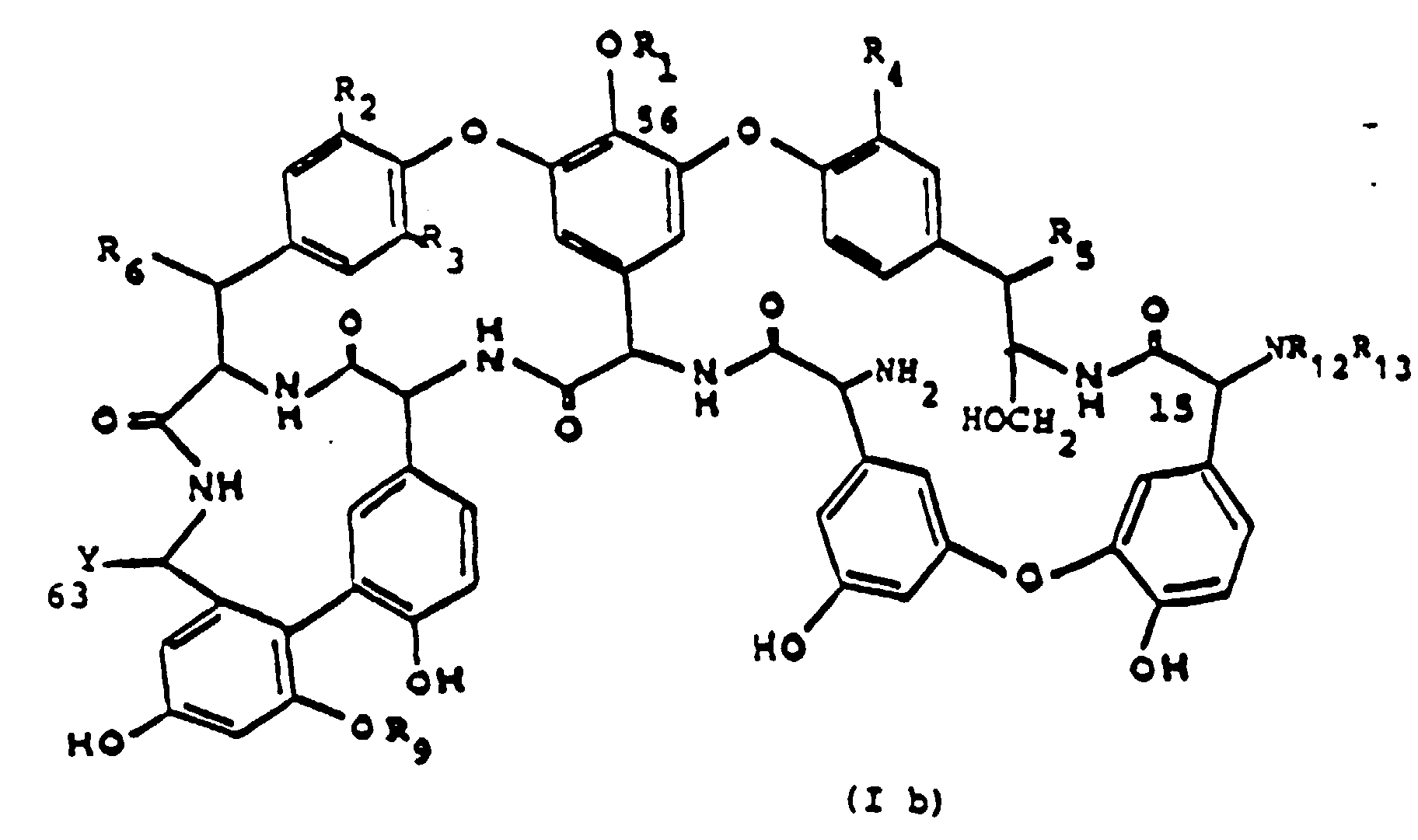
- a preferred embodiment of this invention include the pentapeptide antibiotics of formula (Ib) which can be obtained by reductive cleavage of the peptidic bond between the second and the third (starting from the right) aminoacid of the seven aminoacids chain of teicoplanin compounds represented in formula IIb above.
- R 1 , R 2 , R 3 , R 4 , R 5 , R 6 , R 7 , R 9 , R 12 , R 13 and Y in the above formula (Ib) have the same meanings as those of the starting materials of the formula IIb with the proviso that when the symbol Y of the starting teicoplanin compound represents a carboxyester group, in the corresponding compound of formula (Ib) obtained through the reductive cleavage process of this invention, Y represents a hydroxymethyl group as it occurs with ristocetin.
- a further particular group of compounds falling within the ristocetin-type dalbaheptides sub-group comprises antibiotic A 40926 complex and its main factors (ref. 21, 22, 23) as well as the aglycon (ref. 48), the mannosyl aglycon (ref. 47), the N-acylamino-deoxy-glycuronyl aglycones (ref. 48) and the deacyl derivatives (ref. 49). Also these compounds are suitable starting materials for conversion into the corresponding pentapeptide antibiotics of general formula (I) through the reductive cleavage process of this invention.
- the dalbaheptide antibiotic sub-group identified as vancomycin-type dalbaheptides is characterized by the fact that (reference is made to formula II above) the symbol X 1 represents a (C 1 -C 2 )aliphatic rest substituted with a carboxylic or carboxamide function and the symbol X 2 represents a (C 1 -C 4 )aliphatic rest.
- X 1 is a residue deriving from aspartic acid, asparagine or glutamine
- X 2 is a residue deriving from alanine or leucine.
- Some vancomycin-type dalbaheptides are further characterized by the fact that T represents a trimethylammonio group whose positive charge is neutralized by the carboxylate anion formed by the carboxylic group represented by the symbol Y.
- dalbaheptide antibiotics which can be assigned to this sub-group include the following: OA-7653 (ref. 51, 52), A 51568 A and B (ref. 53, 54), orienticins (ref. 56, 57), eremomycin (ref. 58, 59, 60, 61), A 42867 (ref. 50, 62), A 82846 (ref. 63, 64), chloroorienticins (ref. 65), MM 47761 and MM 49721 (ref. 94), decaplanin (ref. 95), MM 45289 and MM 47756 (ref. 96).
- the semisynthetic derivatives of the above mentioned natural products are included in this sub-group. See for instance: the variously glycosylated derivatives of the hydrolysis products of vancomycin, A 51568A and B and M 43D (ref. 66); the desvancosaminyl and des(vancosaminyl-O-glucosyl)derivatives of vancomycin, A 51568A; A 51568B, M 43A and M 43B (ref. 67), the derivatives of A 82846 (ref. 93); the reaction products of the aminic rests of some vancomycin-type dalbaheptides with aldehydes and ketones and the corresponding hydrogenation products (ref. 68, 69), the N-acyl derivatives of vancomycin-type antibiotics (ref. 70, 71), mono- and didechlorovancomycin (ref. 72) and the hydrolysis products of eremomycin (ref. 60).
- one of the objects of this invention consists in the pentapeptide antibiotics deriving from the vancomycin-type dalbaheptides which can be generally represented through the formula (I) above where W, Z, T and Y are defined as above, X 1 and X 2 are as specifically defined for the identification of the vancomycin-type dalbaheptide sub-group.
- vancomycin (ref. 2, 73, 74) has the following structure formula:
- R 11 is hydrogen
- X 1 is an asparagine residue -CH 2 CONH 2
- X 2 is a leucine residue -CH 2 CH(CH 3 ) 2
- T is a methylamino rest.
- vancomycin aglycone the two units sugar moiety is substituted by a hydrogen atom.
- vancomycin aglycone yields the corresponding pentapeptide compound wherein the disaccharide moiety is replaced by a hydrogen atom.
- the avoparcin-type dalbaheptide sub-group is characterized by the fact that the symbol X 1 in the general formula (II) represents a phenyl or benzyl group wherein the phenyl ring may optionally bear one or two substituents selected from hydroxy and halogen, preferably chloro, the symbol X 2 represents a phenyl group which may optionally bear one or two substituents selected from halogen, preferably chloro, and hydroxy which may optionally be conjugated with a sugar moiety (e.g. rhamnose).
- a sugar moiety e.g. rhamnose
- dalbaheptide antibioties which can ce assigned to this group include the following: actinoidin A, B (ref. 1, 75, 76), chloropolysporin A, B, C (ref. 77, 78, 79), actinoidin A 2 (ref. 80, 76) and helvecardin A, B (ref. 26), MM 47767, MM 55256 (ref. 92).
- Semisynthetic derivatives of avoparcin-type sub-group of dalbaheptide antibiotics are for instance the demannosyl chloropolysporin B derivatives, the chloropolysporin pseudoaglycone, the derhamnosyl alpha- and beta-avoparcin (ref. 81), the mannosyl aglycones of avoparcin (LL-AV290) and other derivatives wherein one or more sugar moieties are hydrolyzed (ref. 84).
- one of the objects of this invention consists in the pentapeptide antibiotics deriving from the avoparcin-type dalbaheptides which can be generally represented through formula (I) above where W, Z, T and Y are defined as above, X 1 and X 2 are as specifically defined for the identification of the avoparcin-type dalbaheptide sub-group.
- alpha-and beta-avoparcin (ref. 83, 84, 85) have the following structure formula: wherein R 16 is hydrogen or chloro.
- Y corresponds to carboxy
- the rests Z and W are as specified above with R 3 representing chloro and R 2 and R 4 both representing hydrogen
- R 1 being a two units sugar moiety wherein D-glucose is the member conjugated with the phenolic hydroxy group, the other unit being L-ristosamine.
- the symbol R 5 is a hydroxy group conjugated with a D-mannose unit.
- the symbol R 6 is a hydroxy group conjugated with L-ristosamine.
- OR 8 , OR 9 and OR 10 each represents a hydroxy group.
- the symbol R 11 is hydrogen.
- the symbol X 1 is a phenyl group substituted with hydroxy and a radical R 16 which represents hydrogen in alpha-avoparcin and chloro in beta-avoparcin.
- the symbol X 2 is phenyl substituted with a hydroxy group conjugated with a rhamnose unit. T represent a methylamino rest.
- the dalbaheptide antibiotics sub-group identified as synmonicin-type antibiotics is characterized by the fact that (reference is made to formula II above) the symbol X 1 represents a C 2 alkyl rest substituted on the terminal carbon with a thiomethyl or methylsulfinyl group, and the symbol X 2 represent a phenyl group bearing a hydroxy substituent which may be conjugated with a sugar moiety.
- Synmonicin (CWI-785) complex, its components and some of its hydrolysis products (ref. 86, 87, 88) seem to be, for the moment, the only members of this sub-group.
- one of the objects of this invention consists in the pentapeptide antibiotics derived from the synmonicin-type dalbaheptides which can be generally represented through formula (I) above where W, Z, T and Y are defined as above, X 1 and X 2 are as specifically defined for the identification of the synmonicin-type dalbaheptide sub-group.
- synmonicin A and B have the following structure formula wherein R 17 is methylsulfinyl or thiomethyl.
- Y corresponds to carboxy
- the rests Z and W are as specified above, with R 3 representing chloro, R 2 and R 4 both representing hydrogen, and R 1 representing a rhamnose unit.
- the symbol R 5 is a hydroxy group.
- the symbol R 6 is a hydroxy group conjugated with a vancosamine unit.
- the symbol OR 8 is a hydroxy group.
- the symbol OR 9 is a hydroxy group conjugated with a mannose unit.
- the symbol OR 10 is a hydroxy group.
- the symbol R 11 is hydrogen.
- the symbol X 1 is an ethyl rest substituted on the terminal carbon with thiomethyl (synmonicin B) or methylsulfinyl (synmonicin A).
- the symbol X 2 is a phenyl rest substituted with a hydroxy group conjugated with a glucose unit.
- the pentapeptide antibiotic of this invention can be isolated as free base or as addition salts with acids or bases.
- Representative acid addition salts are those formed by reaction with both inorganic and organic acids, for example, hydrochloric, sulfuric, phosphoric, succinic, citric, lactic, maleic, fumaric, cholic, d-glutamic, d-camphoric, glutaric, phthalic, tartaric, methanesulfonic, benzenesulfonic, benzoic, salicylic, trifluroacetic acid and the like.
- the salts with bases are those salts formed by reaction of an acid rest of the pentapeptide antibiotic, e.g. a carboxylic or a sulfuric acid rest, with a base such as, for instance, an alkali metal hydroxide or carbonate or an organic amine, such as mono-, di- or trialkyl-amine and the like.
- a base such as, for instance, an alkali metal hydroxide or carbonate or an organic amine, such as mono-, di- or trialkyl-amine and the like.
- the pentapeptide antibiotics of this inventions show antibacterial activity against staphylococcal and streptococcal strains such as Staphylococcus aureus Tour, Staphylococcus epidermidis ATCC 12228, Streptococcus pyogenes C 293, Streptococcus pneumoniae UC41, Streptococcus faecalis ATCC 7080, and Streptococcus mitis .
- staphylococcal and streptococcal strains such as Staphylococcus aureus Tour, Staphylococcus epidermidis ATCC 12228, Streptococcus pyogenes C 293, Streptococcus pneumoniae UC41, Streptococcus faecalis ATCC 7080, and Streptococcus mitis .
- staphylococcal and streptococcal strains such as Staphylococcus aureus Tour, Staphylococcus epidermidis
- the finding of an antimicrobial activity of the pentapeptide antibiotics of this invention is even more surprising if it is considered the result of the tests measuring their binding to the synthetic peptide analogue of the cell wall D-alanyl-D-alanine terminus, N,N'-diacetyl L-lysyl-D-alanyl-D-alanine.
- the tests carried out according to the differential UV assay show that the pentapeptide do not bind to such analogue.
- the antibiotic activity of the compounds of the invention is demonstrated in vitro by means of standard two-fold dilution tests in microtiter, using Difco Todd-Hewitt broth ( Strept . pyogenes and Strept . pneumoniae ) or Oxoid Iso-Sensitest broth ( Staphylococci , Strept.faecalis ). Broth cultures are diluted enough so that the final inoculum is about 10 4 colony forming units/ml (CFU/ml). Minimal inhibitory concentration (MIC) is considered as the lowest concentration which shows no visible growth after 18-24 h incubation at 37°C. Some representative results are reported in the following TABLE I.
- the pentapeptide derivatives of dalbaheptide antibiotics may be prepared according to a highly selective reductive cleavage process which implies concomitant splitting of the peptidic bond between the second and the third aminoacid (starting from the right) of the seven aminoacid chain of dalbaheptides and reduction of the carbonyl rest of the second aminoacid.
- the procedure comprises submitting a dalbaheptide antibiotic as defined above in a hydroalcoholic medium to a reductive cleavage with an alkali metal borohydride, preferably selected from sodium borohydride, potassium borohydride and sodium cyanoborohydride at a temperature comprised between 0°C and 40°C.
- an alkali metal borohydride preferably selected from sodium borohydride, potassium borohydride and sodium cyanoborohydride
- the hydroalcoholic medium is a mixture of H 2 O and a lower alkanol wherein the ratio H 2 O/alcohol ranges between 40/60 and 90/10 (v/v), preferably between 60/40 (v/v) and 68/32 (v/v), most preferably is 65/35 (v/v).
- the reaction occurs, in some cases, also in the presence of lower amounts of water, e.g. in mixtures H 2 O/alcohol 30/70 or 20/80, in general, the reaction rate is very low when the ratio H 2 O/alcohol is lower than 40/60.
- Preferred lower alkyl alcohols are linear and branched (C 1 -C 4 ) alkyl alcohols, among which the most preferred are ethanol and methanol.
- a hydroalcoholic mixture H 2 O/ethanol 65/35 (v/v) is used.
- a small amount of a polar co-solvent can be added to completely dissolve the dalbaheptide starting material during the course of the reaction, e.g. N,N-dimethylformamide, 1,3-dimethyl-3,4,5,6-tetrahydro-2(1H)-pyrimidone (DMPU), and dimethylsulfoxide.
- a polar co-solvent e.g. N,N-dimethylformamide, 1,3-dimethyl-3,4,5,6-tetrahydro-2(1H)-pyrimidone (DMPU), and dimethylsulfoxide.
- alkali metal borohydride the sodium borohydride is the most preferred one.
- the suitable amount of alkali metal borohydride employed may vary depending on the particular dalbaheptide compound used as starting material, on the solvent used and on the temperature of the reaction, but it is advisable to use an amount of alkali metal borohydride in a large excess over the stoichiometric requirement in such a way that the pH of the reaction mixture is alkaline, preferably between pH 8 and 10.
- the molar ratio between the alkali metal borohydride and the antibiotic starting material is comprised between 50 and 300.
- the reaction temperature may vary considerably depending on the specific starting materials and reaction conditions. In general, it is preferred to conduct the reaction at a temperature between 0 and 40°C, more preferably at room temperature. Also the reaction time may vary considerably depending on the other reaction parameters. In general, the reaction is completed in about 10-48 hours. In any case, the reaction course is monitored by TLC or, preferably, by HPLC according to methods known in the art. On the basis of the results of these assays a man skilled in the art will be able to evaluate the reaction course and decide when to stop the reaction and start working up the reaction mass according to known per se techniques which include, for instance, extraction with solvents, precipitation by addition of non-solvents, etc., in conjunction with further separations and purifications by column chromatography, when needed.
- the weakly basic conditions (pH 8-10) obtained with an aqueous solution of sodium borohydride are not sufficient to promote the hydrolysis of an amidic bond, but, the high selectivity of the reaction, which involves one peptidic bond in the heptapeptide chain, implies an unexpected activation of this linkage.
- the starting material contains an ester group, for instance a methyl ester group (see ristocetin A)
- said group is reduced to hydroxymethyl, before the reductive cleavage of the peptide bond is completed.
- the sugar moieties of the compounds of formula (I) which are obtained through the reductive cleavage process of this invention may be successively removed by selective acid hydrolysis to transform them into other compounds of formula (I) wherein the sugar moieties are totally or partially replaced by hydrogen atoms.
- a pentapeptide compound prepared with the reductive cleavage process of the invention starting from a teicoplanin compound of formula (IIb) wherein R 1 , R 7 and R 9 each represents a sugar moiety as above defined can be transformed into the corresponding pentapeptide compound of formula (Ib) wherein R 7 and R 9 are as above and R 1 is hydrogen by means of controlled acid hydrolysis in a strong concentrated aqueous organic acid.
- the concentrated organic acid in this case, is preferably aqueous trifluoroacetic acid at a concentration between 75% and 95%, and the reaction temperature is preferably between 10°C and 50°C.
- the preferred hydrolysis conditions are represented by about 90% trifluoroacetic acid at room temperature.
- reaction time varies depending on the other specific reaction parameters but, in any case, the reaction may be monitored by TLC or preferably HPLC techniques.
- Preferred hydrolysis conditions are in this case represented by the use of a concentrated mineral acid in the presence of an ether such as dimethoxyethane at room temperature. Also in this case, the reaction course may be monitored by TLC or preferably, HPLC. An analogous selective hydrolysis procedure is reported in European Patent Application Publication No. 175100.
- a pentapeptide compound prepared with the process of the invention starting from a teicoplanin compound of formula (IIb) wherein R 1 , R 7 and R 9 represent sugar moieties as defined above, or a compound of formula (IIb) wherein R 1 and R 9 represent hydrogen, and R 7 represents a sugar moiety as above defined may be transformed into the corresponding pentapeptide compound of formula (Ib) wherein R 1 , R 7 and R 9 represent hydrogen atoms by means of a selective hydrolysis in an organic protic solvent selected from aliphatic acids and alpha-halogenated aliphatic acids which at the reaction temperature are liquids, aliphatic and cycloaliphatic alkanols which at the reaction temperature are liquids slightly mixable with water, phenyl-substituted lower alkanols wherein the phenyl moiety may optionally carry (C 1 -C 4 )alkyl,(C 1 -C 4 ) alkoxy or halo rests
- the preferred hydrolysis conditions are represented by the use of a mineral acid, such as hydrochloric acid, in an haloalkanol such as trifluoroethanol, at a temperature between 65°C and 85°C.
- a mineral acid such as hydrochloric acid
- haloalkanol such as trifluoroethanol
- Analogous selective hydrolysis conditions on a similar substrate are described in European Patent Application Publication No. 146053.
- the hydrolysis of the sugar moieties may be carried out in aprotic polar solvent (e.g. dimethylsulfoxide) with a strong acid following the procedure disclosed in the European Pat. Appln. Publ. No 376042.
- pentapeptide compounds resulting from the reductive cleavage process or from the hydrolysis procedures described above can be directly isolated in the form of free bases or salts with acids or bases as described above.
- the end compound when the end compound is obtained by hydrolytic degradation of the sugar moiety(ies) of another pentapeptide of formula (I), it may be isolated as a salt of the same acid employed for the selective hydrolysis.
- the symbol T identifies an amino (e.g.
- the reductive cleavage reaction can be carried out on the deprotected dalbaheptide according to the general conditions described above and the protecting acyl rest, if desired, can be successively introduced by reacting the resulting pentapeptide with the appropriate acylating reactant.
- the acylation conditions involve reaction of both amino groups of the pentapeptide
- the desired N-acyl derivative can be obtained through selective deacylation procedures known in the art.
- Acid-base titrations were carried out under the following conditions: the sample was dissolved in a mixture methyl cellosolve/H 2 O 4/1, then an excess of 0.01M HCl in the same solvent mixture was added and the resulting solution was titrated with 0.01N NaOH.
- Table III shows the 1 H NMR spectra recorded with a 24 mg solution of the proper pentapeptide product in 0.5 mL of DMSO-d 6 at 303°K on a Bruker AM 500 NMR-spectrometer equipped with an Aspect 3000 computer, using (CH 3 ) 4 Si (delta 0.00ppm) as internal reference.
- Table III are reported only the significative delta concerning the portions of the new CH 2 OH group as the assignments of the other protons are already well known and there are no other significant chemical modifications in the pentapeptide molecule.
- FAB-MS positive ion spectra (Table IV) were obtained on a Kratos MS-5O double focusing mass spectrometer of 3000 dalton mass range, using 8 kV accelerating voltage. The instrument was operating under computer control. To obtain high quality data, a DS-90 data system in "raw data" acquisition was used: this gives peak shapes and provides better sensitivity than the usual operation mode which converts analogue signals to centroids.
- a saddle field atom gun was used with Xe gas (2 x 10 -5 torr pressure indicated on the source ion gauge) at 6kV voltage and 1 mA current.
- the samples were dissolved in a 1:1 mixture of MeOH/H 2 O containing 0.2N HCl or alternatively in dimethylformamide (DMF). Then, 1 microliter of this solution was mixed which 1 microliter of thioglycerol matrix eventually containing a 1N acetic acid solution on the target.
- DMF dimethylformamide
- the products were purified by reverse-phase column chromatography on silanized Silica-gel (0.063-0.2 mm; Merck). The ratio between crude product and Silica-gel was generally 1: 100 by weight. Columns were developed with linear step gradients from 0-10% to 40-70% of CH 3 CN in 0.01N acetic acid (or H 2 O), in 16-24h at a flow-rate of 200-400 mL/h, while collecting 15-25 mL fractions.
- Elutions were carried out at the flow-rate of 2 ml/min by mixing eluent a , 0.2% aqueous HCO 2 NH 4 , with eluent b ,CH 3 CN, according to a linear step gradient programmed as follows: minutes 0 10 20 30 40 50 % of b in a 5 23 26 35 75 5
- a suspension of 10 mmol of teicoplanin A 2 complex in 600 mL of a mixture H 2 O/ethanol 65/35 is stirred at 10-15°C for 90 min, while adding portionwise 100 g of NaBH 4 pellets.
- a clear solution forms which is stirred at room temperature for 5 hours then it is diluted with 1 L of MeOH and 0.5 L of EtOH and slowly poured into a solution of 200 mL of acetic acid in 0.5 L of MeOH. The solvents are evaporated at 35°C under reduced pressure and the jelly residue is redissolved in 1 L of H 2 O.
- the resulting solution is loaded at the top of a column of 200 g of silanized silica-gel in H 2 O.
- the column After eluting with 2 L of H 2 O, the column is developed with a linear step gradient from 10% to 80% of CH 3 CN in 0.01N acetic acid, in 15 hours at the flow rate of 400 ml/h while collecting 25 ml fractions.
- a suspension of 10 mmol of vancomycin in 600 mL of a H 2 O/ethanol 65/35 mixture is stirred at 10-15°C for 90 min, while adding portionwise 75.6 g of NaBH 4 in pellets.
- a clear solution forms which is stirred at room temperature for 48 hours.
- the resulting solution is slowly poured into a solution of an excess of acetic acid in 0.5 L of methanol, then the solvents are evaporated at 35°C under reduced pressure.
- the jelly residue, dissolved in 1 L of H 2 O is purified by reverse-phase column chromatography as described in Example 3A above.
- a suspension of 10 mmol of antibiotic A/40926 in 600 ml of a H 2 O/ethanol 65/35 mixture is stirred at 10-15°C for 90 min, adding portionwise 30.24 g of NaBH 4 , pellets.
- the solution is stirred at room temperature for 24 hours.
- the clear solution is treated according to the procedure described in Example 5 giving a yield of 68% of the pentapeptide compound having the same structure as A/40926 (ref. 23) with the exception that the peptidic bond between the second and third aminoacid (starting from the right) is split and the carbonyl function of the second aminoacid is reduced to hydroxymethyl.
Landscapes
- Chemical & Material Sciences (AREA)
- Health & Medical Sciences (AREA)
- Organic Chemistry (AREA)
- Life Sciences & Earth Sciences (AREA)
- General Health & Medical Sciences (AREA)
- Medicinal Chemistry (AREA)
- Proteomics, Peptides & Aminoacids (AREA)
- Biochemistry (AREA)
- Biophysics (AREA)
- Genetics & Genomics (AREA)
- Molecular Biology (AREA)
- Public Health (AREA)
- Pharmacology & Pharmacy (AREA)
- Veterinary Medicine (AREA)
- Animal Behavior & Ethology (AREA)
- Communicable Diseases (AREA)
- Nuclear Medicine, Radiotherapy & Molecular Imaging (AREA)
- General Chemical & Material Sciences (AREA)
- Oncology (AREA)
- Chemical Kinetics & Catalysis (AREA)
- Engineering & Computer Science (AREA)
- Bioinformatics & Cheminformatics (AREA)
- Immunology (AREA)
- Epidemiology (AREA)
- Medicines That Contain Protein Lipid Enzymes And Other Medicines (AREA)
- Peptides Or Proteins (AREA)
Claims (27)
- Pentapeptidantibiotikum der Formel (I)

- Pentapeptidantibiotikum nach Anspruch 1, wobei die Symbole W und Z die folgenden Teilstrukturen wiedergeben:

 X1 gibt eine Phenyl- oder eine Benzylgruppe wieder, in der der Phenolring gegebenenfalls einen oder zwei Substituenten tragen kann, die ausgewählt sind aus Halogenatomen, vorzugsweise einem Chloratom, Niederalkylresten, vorzugsweise einer Methylgruppe, und Hydroxygruppe, wobei die Hydroxygruppe gegebenenfalls über eine acetalische Bindung mit einer Zuckereinheit verknüpft oder mit einem Schwefelsäurerest verestert sein kann, oder es kann einen aliphatischen (C1-C2)-Rest wiedergeben, der mit einer Carboxyl- oder Carboxamidfunktion, einer Thiomethyl- oder einer Methylsulfinylgruppe substituiert ist;X2 gibt eine Phenylgruppe wieder, die gegebenenfalls einen oder zwei Substituenten tragen kann, die ausgewählt sind aus Halogenatomen, vorzugsweise einem Chloratom, Niederalkylresten, vorzugsweise einer Methylgruppe, und Hydroxygruppe, wobei die Hydroxygruppe gegebenenfalls über eine acetalische Bindung mit einer Zuckereinheit verknüpft sein kann, oder es kann einen aliphatischen (C1-C4)-Rest, vorzugsweise eine Methyl- oder Isobutylgruppe wiedergeben:ebenso können X1 und X2 zusammen einen Oxy-bis(phenylen)-rest darstellen, wobei gegebenenfalls ein Phenylring oder beide Phenylringe wie vorstehend angegeben, substituiert sein können;das Symbol T gibt (a) eine Aminogruppe wieder, in der ein oder beide Wasserstoffatome gegebenenfalls durch einen Alkylrest mit 1 bis 12 Kohlenstoffatomen, der wiederum gegebenenfalls einen oder mehrere Substituenten enthalten kann, durch einen (C4-C7)-Cycloalkylrest, durch einen Acylrest oder durch eine geeignete Schutzgruppe der Aminofunktion substituiert sein kann (können), (b) einen Tri(niederalkyl)ammoniumrest, dessen positive Ladung durch ein Anion, das entweder aus einer starken Säure oder einer inneren Säurefunktion stammt, neutralisiert wird, (c) ein Wasserstoffatom, (d) eine Hydroxygruppe, einen Oxo- oder Oxyiminorest; falls T einen zweiwertigen Rest darstellt, gibt die gepunktete Linie eine zusätzliche Bindung wieder;das Symbol Y gibt eine Carboxygruppe, einen Carboxyester, ein Carboxamid, eine Carbohydrazidgruppe oder eine Hydroxymethylgruppe wieder;sowie die Salze mit Säuren oder Basen und die inneren Salze.
 - Pentapeptidantibiotikum nach Anspruch 2, wobei die Symbole W, Z, T und Y die gleichen Bedeutungen haben wie in Anspruch 2, die Symbole X1 und X2 zusammen einen Oxy- bis(phenylen)-rest wiedergeben, wobei ein Phenylring oder beide Phenylringe gegebenenfalls einen oder zwei Substituenten tragen können, die ausgewählt sind aus Halogenatomen, vorzugsweise einem Chloratom, Niederalkylresten, vorzugsweise einer Methylgruppe, und Hydroxygruppe, wobei die Hydroxygruppe gegebenenfalls über eine acetalische Bindung mit einer Zuckereinheit verknüpft oder mit einem Schwefelsäurerest verestert sein kann; sowie dessen Salze mit Säuren oder Basen und die inneren Salze.
- Pentapeptidantibiotikum nach Anspruch 1, dadurch gekennzeichnet, daß es sich aus einem Dalbaheptidantibiotikum von Ristocetintyp ableitet.
- Pentapeptidantibiotikum nach einem der Ansprüche 1 bis 4, das durch die folgende Formel (Ia) wiedergegeben wird:

und die entsprechende Verbindung, in der Y eine Carboxygruppe darstellt und alle Zuckereinheiten durch Wasserstoffatome ersetzt sind;
sowie dessen Salze mit Säuren oder Basen und die inneren Salze. - Pentapeptidantibiotikum nach Anspruch 4, das weiterhin dadurch gekennzeichnet ist, daß es sich aus einem Dalbaheptidantibiotikum von Ristocetintyp, ausgewählt aus dem Teicoplanin A2-Komplex, dessen Hauptkomponenten, deren verwandten Substanzen, dem Aglycon, den Pseudoaglyconen und den halbsynthetischen Derivaten davon, ableitet; sowie dessen Salze mit Säuren oder Basen und die inneren Salze.
- Pentapeptidantibiotikum nach einem der Ansprüche 1, 2. 3, 4 und 6, das durch die folgende Formel (Ib) wiedergegeben wird:
- Pentapeptidantibiotikum nach Anspruch 7, wobei R1 eine N(8-Methylnonanoyl)-beta-D-glucosaminylgruppe darstellt und dessen Salze mit Säuren oder Basen und die inneren Salze.
- Pentapeptidantibiotikum nach Anspruch 4, das weiterhin dadurch gekennzeichnet ist, daß es sich aus einem Dalbaheptidantibiotikum von Ristocetintyp, ausgewählt aus dem Antibiotikum A 40926-Komplex, dessen Hauptfaktoren, dem Aglycon, dem Mannosylaglycon, den N-Acylamino-deoxy-glucuronylaglyconen und deren Deacylderivaten, ableitet; sowie dessen Salze mit Säuren oder Basen und die inneren Salze.
- Pentapeptidantibiotikum nach Anspruch 2, wobei W, Z, T und Z die gleichen Bedeutungen haben wie in Anspruch 2, das Symbol X1 einen aliphatischen (C1-C2)-Rest wiedergibt, der mit einer Carboxyl- oder Carboxamidfunktion substituiert ist, und X2 einen aliphatischen (C1-C4)-Rest, vorzugsweise eine Methyl- oder Isobutylgruppe, wiedergibt; sowie dessen Salze mit Säuren oder Basen und die inneren Salze.
- Pentapeptidantibiotikum nach Anspruch 10, wobei X1 einen Rest wiedergibt, der sich aus Asparginsäure, Asparagin oder Glutamin ableitet, und X2 einen Rest wiedergibt, der sich aus Alanin oder Leucin ableitet.
- Pentapeptidantibiotikum nach Anspruch 1, dadurch gekennzeichnet, daß es sich aus einem Dalbaheptidantibiotikum von Vancomycintyp ableitet.
- Pentapeptidantibiotikum nach einem der Ansprüche 1, 2, 10, 11 und 12, das durch die folgende Formel (Ic) wiedergegeben wird:

sowie dessen Salze mit Säuren und Basen und die inneren Salze. - Pentapeptidantibiotikum nach Anspruch 2, wobei die Symbole W, Z, T und Y die gleichen Bedeutungen haben wie in Anspruch 2, das Symbol X1 eine Phenyl- oder Benzylgruppe wiedergibt. wobei der Phenylring gegebenenfalls einen oder zwei Substituenten tragen kann, die ausgewählt sind aus Hydroxygruppen und Halogenatomen, vorzugsweise ein Chloratom, das Symbol X2 eine Phenylgruppe wiedergibt, die gegebenenfalls einen oder zwei Substituenten tragen kann, die ausgewählt sind aus Halogenatomen, vorzugsweise ein Chloratom, und einer Hydroxygruppe, die gegebenenfalls mit einer Zuckereinheit verknüpft kann; sowie dessen Salze mit Säuren oder Basen und die inneren Salze.
- Pentapeptidantibiotikum nach Anspruch 1, dadurch gekennzeichnet, daß es sich aus einem Dalbaheptidantibiotikum von Avoparcintyp ableitet.
- Pentapeptidantibiotikum nach einem der Ansprüche 1, 2, 14 und 15, das durch die folgende Formel (Id) wiedergegeben wird:

- Pentapeptidantibiotikum nach Anspruch 2, wobei die Symbole W, Z, T und Y die gleichen Bedeutungen haben wie in Anspruch 2, das Symbol X1 einen C2-Alkylrest wiedergibt, der durch eine Thiomethyl- oder Methylsulfinylgruppe substituiert ist, und das Symbol X2 eine Phenylgruppe wiedergibt, die einen Hydroxysubstituenten trägt, der mit einer Zuckereinheit verknüpft kann; sowie dessen Salze mit Säuren oder Basen und die inneren Salze.
- Pentapeptidantibiotikum nach Anspruch 1, dadurch gekennzeichnet, daß es sich aus einem Dalbaheptidantibiotikum von Synmonicintyp ableitet.
- Pentapeptidantibiotikum nach einem der Ansprüche 1, 2, 17 und 18, das durch die folgende Formel (le) wiedergegeben wird:

- Verfahren zur Herstellung eines Pentapeptidantibiotikums der Formel (I)

die reduktive Spaltung eines Dalbaheptidantibiotikums der Formel (II)
- Verfahren nach Anspruch 20, wobei die reduktive Spaltung in einem wäßrig-alkoholischen Medium durchgeführt wird, wobei es sich bei dem Alkohol um ein Niederalkanol handelt und das Verhältnis Wasser/Alkohol in einem Bereich zwischen 40/60 und 90/10 (v/v). vorzugsweise zwischen 60/40 (v/v) und 68/32 (v/v) liegt und am meisten bevorzugt 65/35 (v/v) beträgt.
- Verfahren nach einem der Ansprüche 20 und 21, wobei eine kleine Menge eines polaren Co-lösungsmittels zu dem Reaktionsgemisch gegeben wird.
- Verfahren nach einem der Ansprüche 20 bis 22 zur Herstellung einer Pentapeptidverbindung, in der die Zuckereinheiten, die dessen Dalbaheptidvorläufer kennzeichnen, ganz oder teilweise hydrolysiert sind, umfassend die zusätzliche Stufe einer selektiven Säurehydrolyse des Pentapeptidantibiotikums, das aus der reduktiven Spaltung erhalten wird.
- Verfahren nach einem der Ansprüche 20 bis 23, wobei die reduktive Spaltungsreaktion bei einem pH-Wert von 8 bis 10 durchgeführt wird und das molare Verhältnis zwischen dem Alkalimetallborhydrid und dem Dalbaheptidantibiotikum-Ausgangsmaterial zwischen 50 und 300 liegt.
- Verfahren nach einem der Ansprüche 20 bis 24, wobei die reduktive Spaltungsreaktion in einem Zeitraum zwischen 10 und 48 Stunden durchgeführt wird.
- Verfahren nach einem der Ansprüche 20 bis 25, wobei das Dalbaheptidantibiotikum-Ausgangsmaterial aus den Untergruppen ausgewählt ist, die als Antibiotika vom Ristocetintyp, vom Vancomycintyp, von Avoparcintyp und vom Synmonicintyp definiert sind.
- Verfahren nach Anspruch 26, wobei das Dalbaheptidantibiotikum-Ausgangsmaterial ausgewählt ist aus Ristocetin A, Ristocetin A-Aglyconsäure, Teicoplanin A2-Komplex, seinem Aglycon und seinen Pseudoaglyconen, Teicoplanin A2-Komplexkomponente 2, Antibiotikum A 40926, seinen Hauptfaktoren, seinem Aglycon, seinem Mannosylaglycon, seinem N-Acylamino-deoxy-glucuronylaglyconen und den Deacylderivaten, Vancomycin und Vancomycinaglycon.
Priority Applications (1)
| Application Number | Priority Date | Filing Date | Title |
|---|---|---|---|
| EP90113139A EP0409045B1 (de) | 1989-07-18 | 1990-07-10 | Aus Dalbaheptide hergestellte Pentapeptid-Antibiotika |
Applications Claiming Priority (3)
| Application Number | Priority Date | Filing Date | Title |
|---|---|---|---|
| EP89113132 | 1989-07-18 | ||
| EP89113132 | 1989-07-18 | ||
| EP90113139A EP0409045B1 (de) | 1989-07-18 | 1990-07-10 | Aus Dalbaheptide hergestellte Pentapeptid-Antibiotika |
Publications (3)
| Publication Number | Publication Date |
|---|---|
| EP0409045A2 EP0409045A2 (de) | 1991-01-23 |
| EP0409045A3 EP0409045A3 (en) | 1991-10-16 |
| EP0409045B1 true EP0409045B1 (de) | 1997-11-19 |
Family
ID=8201636
Family Applications (1)
| Application Number | Title | Priority Date | Filing Date |
|---|---|---|---|
| EP90113139A Expired - Lifetime EP0409045B1 (de) | 1989-07-18 | 1990-07-10 | Aus Dalbaheptide hergestellte Pentapeptid-Antibiotika |
Country Status (11)
| Country | Link |
|---|---|
| US (2) | US5602229A (de) |
| EP (1) | EP0409045B1 (de) |
| JP (1) | JP2769028B2 (de) |
| KR (1) | KR0145554B1 (de) |
| AT (1) | ATE160360T1 (de) |
| CA (1) | CA2021379C (de) |
| DE (1) | DE69031721T2 (de) |
| DK (1) | DK0409045T3 (de) |
| ES (1) | ES2110401T3 (de) |
| GR (1) | GR3025653T3 (de) |
| IE (1) | IE902598A1 (de) |
Cited By (1)
| Publication number | Priority date | Publication date | Assignee | Title |
|---|---|---|---|---|
| RU2126419C1 (ru) * | 1993-05-19 | 1999-02-20 | Группо Лепетит С.П.А. | Аглюкодальбагептиды и/или их соли с кислотами или основаниями, или их внутренние соли, способ получения, фармацевтическая композиция |
Families Citing this family (22)
| Publication number | Priority date | Publication date | Assignee | Title |
|---|---|---|---|---|
| WO1992010516A1 (en) * | 1990-12-05 | 1992-06-25 | Gruppo Lepetit S.P.A. | 38-decarboxy-38-hydroxymethyl derivatives of teicoplanin antibiotics, and a process for preparing them |
| ATE121101T1 (de) * | 1990-12-10 | 1995-04-15 | Lepetit Spa | Aus dalbaheptide hergestellte tetrapeptidantibiotika. |
| US5684127A (en) * | 1993-06-03 | 1997-11-04 | Gruppo Lepetit Spa | Tetrapeptides deriving from dalbaheptide antibiotics |
| KR20000010589A (ko) | 1996-04-23 | 2000-02-15 | 클라우디오 쿼르타 | 항생제a40926의아미드유도체의개선된화학적제조방법 |
| US5919771A (en) * | 1997-05-20 | 1999-07-06 | Eli Lilly And Company | Urea and thiourea derivatives of glycopeptides |
| US5952310A (en) * | 1997-05-20 | 1999-09-14 | Eli Lilly And Company | Glycopeptide hexapeptides |
| US6710168B1 (en) | 1999-05-19 | 2004-03-23 | The Trustees Of The University Of Princeton | Glycopeptide antibiotics, combinatorial libraries of glycopeptide antibiotics and methods of producing same |
| EP1095058A4 (de) * | 1998-07-14 | 2003-07-16 | Univ Princeton | Glykopeptidantibiotika, kombinatorische bibliotheken von glykopeptidantibiotika und verfahren zu ihrer herstellung |
| WO2001081373A2 (en) * | 2000-04-25 | 2001-11-01 | Merck & Co., Inc. | Glycopeptide antibacterial compounds and methods of using same |
| DE60238481D1 (de) * | 2001-04-25 | 2011-01-13 | Wyeth Corp | Im wesentlichen reine glycopeptid-antibiotika ac-98-1; ac-98-2; ac-98-3; ac-98-4 und ac-98-5 |
| US6713448B2 (en) | 2001-04-25 | 2004-03-30 | Wyeth Holdings Corporation | Substantially pure glycopeptide antibiotics AC-98-1; AC-98-2; AC-98-3; AC-98-4 and AC-98-5 |
| US20040241173A1 (en) * | 2002-02-14 | 2004-12-02 | William Marsh Rice University | Fullerene (C60) vancomycin conjugates as improved antibiotics |
| WO2005010039A1 (en) * | 2003-07-31 | 2005-02-03 | Pfizer Products Inc. | Bsep polypeptide variants and uses thereof |
| US20070173438A1 (en) * | 2006-01-13 | 2007-07-26 | The Scripps Research Institute | [PSI[CH2NH]PG4] glycopeptide antibiotic analogs |
| US9169203B2 (en) | 2012-01-06 | 2015-10-27 | Novus International, Inc. | Sulfoxide-based surfactants |
| HRP20181671T1 (hr) | 2012-02-09 | 2018-12-14 | Novus International, Inc. | Heteroatom koji sadrži cikličke dimere |
| CA2878617A1 (en) | 2012-07-12 | 2014-01-16 | Houston Stephen Smith | Matrix and layer compositions for protection of bioactives |
| US10227551B2 (en) | 2015-11-12 | 2019-03-12 | Novus International, Inc. | Sulfur-containing compounds as solvents |
| US11147249B2 (en) | 2016-12-08 | 2021-10-19 | Alector Llc | Siglec transgenic mice and methods of use thereof |
| US10584306B2 (en) | 2017-08-11 | 2020-03-10 | Board Of Regents Of The University Of Oklahoma | Surfactant microemulsions |
| US11470827B2 (en) | 2017-12-12 | 2022-10-18 | Alector Llc | Transgenic mice expressing human TREM proteins and methods of use thereof |
| US12324432B2 (en) | 2019-04-12 | 2025-06-10 | Ecolab Usa Inc. | Hard surface cleaning solution with rapid viricidal activity |
Family Cites Families (14)
| Publication number | Priority date | Publication date | Assignee | Title |
|---|---|---|---|---|
| US3067099A (en) * | 1955-09-16 | 1962-12-04 | Lilly Co Eli | Vancomycin and method for its preparation |
| US2990329A (en) * | 1957-02-11 | 1961-06-27 | Abbott Lab | Preparation of ristocetin a salts |
| GB1496386A (en) * | 1975-03-05 | 1977-12-30 | Lepetit Spa | Antibiotics |
| US4322343A (en) * | 1980-12-18 | 1982-03-30 | Eli Lilly And Company | Pseudo-aglycone of actaplanin |
| US4456593A (en) * | 1982-06-22 | 1984-06-26 | Abbott Laboratories | Ristocetin ψ-aglycone as an antibacterial agent |
| US4504467A (en) * | 1983-10-21 | 1985-03-12 | Eli Lilly And Company | Glycopeptide derivatives |
| US4497802A (en) * | 1983-10-21 | 1985-02-05 | Eli Lilly And Company | N-Acyl glycopeptide derivatives |
| US4563442A (en) * | 1983-10-21 | 1986-01-07 | Eli Lilly And Company | Glycopeptide bioconversion products |
| US4698327A (en) * | 1985-04-25 | 1987-10-06 | Eli Lilly And Company | Novel glycopeptide derivatives |
| US4639433A (en) * | 1985-08-14 | 1987-01-27 | Eli Lilly And Company | Glycopeptide derivatives |
| US4643987A (en) * | 1985-08-14 | 1987-02-17 | Eli Lilly And Company | Modified glycopeptides |
| GB8701872D0 (en) * | 1987-01-28 | 1987-03-04 | Lepetit Spa | N15-alkyl & n15,n15-dialkyl derivatives |
| GB8711066D0 (en) * | 1987-05-11 | 1987-06-17 | Lepetit Spa | Teicoplanin derivatives |
| US5438117A (en) * | 1990-12-20 | 1995-08-01 | Gruppo Lepetit S.P.A. | Hexapeptides deriving from aglucoteicoplanin and a process for preparing them |
-
1990
- 1990-07-10 AT AT90113139T patent/ATE160360T1/de not_active IP Right Cessation
- 1990-07-10 ES ES90113139T patent/ES2110401T3/es not_active Expired - Lifetime
- 1990-07-10 EP EP90113139A patent/EP0409045B1/de not_active Expired - Lifetime
- 1990-07-10 DE DE69031721T patent/DE69031721T2/de not_active Expired - Fee Related
- 1990-07-10 DK DK90113139.1T patent/DK0409045T3/da active
- 1990-07-16 KR KR1019900010753A patent/KR0145554B1/ko not_active Expired - Fee Related
- 1990-07-17 JP JP2187325A patent/JP2769028B2/ja not_active Expired - Fee Related
- 1990-07-17 IE IE259890A patent/IE902598A1/en not_active IP Right Cessation
- 1990-07-17 CA CA002021379A patent/CA2021379C/en not_active Expired - Fee Related
-
1995
- 1995-05-15 US US08/440,868 patent/US5602229A/en not_active Expired - Fee Related
- 1995-05-31 US US08/454,807 patent/US5648456A/en not_active Expired - Fee Related
-
1997
- 1997-12-10 GR GR970403306T patent/GR3025653T3/el unknown
Cited By (1)
| Publication number | Priority date | Publication date | Assignee | Title |
|---|---|---|---|---|
| RU2126419C1 (ru) * | 1993-05-19 | 1999-02-20 | Группо Лепетит С.П.А. | Аглюкодальбагептиды и/или их соли с кислотами или основаниями, или их внутренние соли, способ получения, фармацевтическая композиция |
Also Published As
| Publication number | Publication date |
|---|---|
| DK0409045T3 (da) | 1997-12-22 |
| CA2021379C (en) | 2001-03-06 |
| EP0409045A3 (en) | 1991-10-16 |
| ES2110401T3 (es) | 1998-02-16 |
| KR910002898A (ko) | 1991-02-26 |
| CA2021379A1 (en) | 1991-01-19 |
| GR3025653T3 (en) | 1998-03-31 |
| JPH0352900A (ja) | 1991-03-07 |
| EP0409045A2 (de) | 1991-01-23 |
| DE69031721T2 (de) | 1998-03-19 |
| US5648456A (en) | 1997-07-15 |
| JP2769028B2 (ja) | 1998-06-25 |
| IE902598A1 (en) | 1991-02-27 |
| ATE160360T1 (de) | 1997-12-15 |
| DE69031721D1 (de) | 1998-01-02 |
| US5602229A (en) | 1997-02-11 |
| KR0145554B1 (ko) | 1998-07-15 |
Similar Documents
| Publication | Publication Date | Title |
|---|---|---|
| US5602229A (en) | Pentapeptide antibiotics | |
| Nagarajan | Antibacterial activities and modes of action of vancomycin and related glycopeptides | |
| IE58708B1 (en) | Antibiotic a 40926 complex and its pure factors pa, pb a,b and bo | |
| CA1338002C (en) | Glycopeptide recovery process | |
| Nagarajan et al. | Synthesis and antibacterial activity of N-acyl vancomycins | |
| IE59523B1 (en) | Antibiotic A 40926 n-acylaminoglucronyl aglycons and antibiotic A 40926 aglycon | |
| EP0836619B1 (de) | Reinigung von dalbeheptide-antibiotika mittels isoelektrofokussierung | |
| EP0306645B1 (de) | Teicoplaninähnliche Derivate | |
| HUNT et al. | A51568A: N-demethylvancomycin | |
| US5194424A (en) | C63 -amide derivatives of 34-de(acetylglucosaminyl)-34-deoxy-teicoplanin and their use as medicaments against bacteria resistant to glycopeptide antibiotics | |
| EP0290922B1 (de) | Teicoplaninderivate | |
| US5684127A (en) | Tetrapeptides deriving from dalbaheptide antibiotics | |
| Cavalleri et al. | Teicoplanin, antibiotics from Actinoplanes teichomyceticus nov. sp. VIII. Opening of the polypeptide chain of teicoplanin aglycone under hydrolytic conditions | |
| US4789661A (en) | De-(acetylglucosaminyl)-di(dehydro)-deoxy teicoplanin derivatives | |
| DK167688B1 (da) | Antibiotika benaevnt a51568 faktor a og b, en fremgangsmaade til fremstilling heraf, mikroorganismen nocardia orientalis nrrl 15232 til brug ved fremgangsmaaden, farmaceutiske praeparater indeholdende saadanne antibiotika samt anvendelse af disse antibiotika som antibiotiske midler | |
| US5644025A (en) | Tetrapeptides deriving from dalbaheptide antibiotics | |
| Sitrin et al. | Separation methodology | |
| EP0561827B1 (de) | Aus dalbaheptide hergestellte tetrapeptidantibiotika | |
| EP0326873A2 (de) | Teicoplanin-Hydrazide | |
| HUT63860A (en) | Process for producing 39-decarboxy-38-(hydroxymethyl) derivatives of teikoplanin antibiotics | |
| SITRIN et al. | Smith Kline and French Laboratories, Philadelphia, PA, 19101 |
Legal Events
| Date | Code | Title | Description |
|---|---|---|---|
| PUAI | Public reference made under article 153(3) epc to a published international application that has entered the european phase |
Free format text: ORIGINAL CODE: 0009012 |
|
| AK | Designated contracting states |
Kind code of ref document: A2 Designated state(s): AT BE CH DE DK ES FR GB GR IT LI LU NL SE |
|
| 17P | Request for examination filed |
Effective date: 19901205 |
|
| RIN1 | Information on inventor provided before grant (corrected) |
Inventor name: KETTENRING, JUERGEN KURT Inventor name: CIABATTI, ROMEO Inventor name: MALABARBA, ADRIANO |
|
| RAP3 | Party data changed (applicant data changed or rights of an application transferred) |
Owner name: GRUPPO LEPETIT S.P.A. |
|
| PUAL | Search report despatched |
Free format text: ORIGINAL CODE: 0009013 |
|
| AK | Designated contracting states |
Kind code of ref document: A3 Designated state(s): AT BE CH DE DK ES FR GB GR IT LI LU NL SE |
|
| RAP1 | Party data changed (applicant data changed or rights of an application transferred) |
Owner name: GRUPPO LEPETIT S.P.A. |
|
| 17Q | First examination report despatched |
Effective date: 19950711 |
|
| GRAG | Despatch of communication of intention to grant |
Free format text: ORIGINAL CODE: EPIDOS AGRA |
|
| GRAH | Despatch of communication of intention to grant a patent |
Free format text: ORIGINAL CODE: EPIDOS IGRA |
|
| GRAH | Despatch of communication of intention to grant a patent |
Free format text: ORIGINAL CODE: EPIDOS IGRA |
|
| RAP1 | Party data changed (applicant data changed or rights of an application transferred) |
Owner name: BIOSEARCH ITALIA S.P.A. |
|
| GRAH | Despatch of communication of intention to grant a patent |
Free format text: ORIGINAL CODE: EPIDOS IGRA |
|
| GRAA | (expected) grant |
Free format text: ORIGINAL CODE: 0009210 |
|
| AK | Designated contracting states |
Kind code of ref document: B1 Designated state(s): AT BE CH DE DK ES FR GB GR IT LI LU NL SE |
|
| REF | Corresponds to: |
Ref document number: 160360 Country of ref document: AT Date of ref document: 19971215 Kind code of ref document: T |
|
| REG | Reference to a national code |
Ref country code: CH Ref legal event code: EP |
|
| REG | Reference to a national code |
Ref country code: DK Ref legal event code: T3 |
|
| REF | Corresponds to: |
Ref document number: 69031721 Country of ref document: DE Date of ref document: 19980102 |
|
| ET | Fr: translation filed | ||
| ITF | It: translation for a ep patent filed | ||
| REG | Reference to a national code |
Ref country code: CH Ref legal event code: NV Representative=s name: FIAMMENGHI-FIAMMENGHI |
|
| REG | Reference to a national code |
Ref country code: ES Ref legal event code: FG2A Ref document number: 2110401 Country of ref document: ES Kind code of ref document: T3 |
|
| PLBE | No opposition filed within time limit |
Free format text: ORIGINAL CODE: 0009261 |
|
| STAA | Information on the status of an ep patent application or granted ep patent |
Free format text: STATUS: NO OPPOSITION FILED WITHIN TIME LIMIT |
|
| 26N | No opposition filed | ||
| REG | Reference to a national code |
Ref country code: GB Ref legal event code: IF02 |
|
| PGFP | Annual fee paid to national office [announced via postgrant information from national office to epo] |
Ref country code: GB Payment date: 20030618 Year of fee payment: 14 |
|
| PGFP | Annual fee paid to national office [announced via postgrant information from national office to epo] |
Ref country code: LU Payment date: 20030619 Year of fee payment: 14 |
|
| PGFP | Annual fee paid to national office [announced via postgrant information from national office to epo] |
Ref country code: DK Payment date: 20030620 Year of fee payment: 14 |
|
| PGFP | Annual fee paid to national office [announced via postgrant information from national office to epo] |
Ref country code: GR Payment date: 20030625 Year of fee payment: 14 |
|
| PGFP | Annual fee paid to national office [announced via postgrant information from national office to epo] |
Ref country code: SE Payment date: 20030626 Year of fee payment: 14 |
|
| PGFP | Annual fee paid to national office [announced via postgrant information from national office to epo] |
Ref country code: FR Payment date: 20030627 Year of fee payment: 14 |
|
| BECA | Be: change of holder's address |
Owner name: *VICURON PHARMACEUTICALS INC.1209 ORANGE STREET, W Effective date: 20030619 |
|
| BECH | Be: change of holder |
Owner name: *VICURON PHARMACEUTICALS INC.1209 ORANGE STREET, W Effective date: 20030619 |
|
| PGFP | Annual fee paid to national office [announced via postgrant information from national office to epo] |
Ref country code: BE Payment date: 20030704 Year of fee payment: 14 |
|
| PGFP | Annual fee paid to national office [announced via postgrant information from national office to epo] |
Ref country code: AT Payment date: 20030709 Year of fee payment: 14 |
|
| PGFP | Annual fee paid to national office [announced via postgrant information from national office to epo] |
Ref country code: ES Payment date: 20030721 Year of fee payment: 14 |
|
| PGFP | Annual fee paid to national office [announced via postgrant information from national office to epo] |
Ref country code: CH Payment date: 20030724 Year of fee payment: 14 |
|
| PGFP | Annual fee paid to national office [announced via postgrant information from national office to epo] |
Ref country code: NL Payment date: 20030731 Year of fee payment: 14 Ref country code: DE Payment date: 20030731 Year of fee payment: 14 |
|
| NLS | Nl: assignments of ep-patents |
Owner name: VERSICOR INC. |
|
| NLT1 | Nl: modifications of names registered in virtue of documents presented to the patent office pursuant to art. 16 a, paragraph 1 |
Owner name: VICURON PHARMACEUTICALS INC. |
|
| REG | Reference to a national code |
Ref country code: GB Ref legal event code: 732E |
|
| REG | Reference to a national code |
Ref country code: CH Ref legal event code: PUE Owner name: VICURON PHARMACEUTICALS INC. Free format text: BIOSEARCH ITALIA S.P.A.#VIA R. LEPETIT, 34#21040 GERENZANO (VA) (IT) -TRANSFER TO- VICURON PHARMACEUTICALS INC.#455 SOUTH GULPH ROAD#KING OF PRUSSIA, PA 19405 (US) Ref country code: CH Ref legal event code: NV Representative=s name: ARNOLD & SIEDSMA AG |
|
| REG | Reference to a national code |
Ref country code: FR Ref legal event code: TP Ref country code: FR Ref legal event code: CD |
|
| REG | Reference to a national code |
Ref country code: CH Ref legal event code: NV Representative=s name: FIAMMENGHI-FIAMMENGHI |
|
| PG25 | Lapsed in a contracting state [announced via postgrant information from national office to epo] |
Ref country code: LU Free format text: LAPSE BECAUSE OF NON-PAYMENT OF DUE FEES Effective date: 20040710 Ref country code: GB Free format text: LAPSE BECAUSE OF NON-PAYMENT OF DUE FEES Effective date: 20040710 Ref country code: AT Free format text: LAPSE BECAUSE OF NON-PAYMENT OF DUE FEES Effective date: 20040710 |
|
| PG25 | Lapsed in a contracting state [announced via postgrant information from national office to epo] |
Ref country code: SE Free format text: LAPSE BECAUSE OF NON-PAYMENT OF DUE FEES Effective date: 20040711 |
|
| PG25 | Lapsed in a contracting state [announced via postgrant information from national office to epo] |
Ref country code: ES Free format text: LAPSE BECAUSE OF NON-PAYMENT OF DUE FEES Effective date: 20040712 |
|
| PG25 | Lapsed in a contracting state [announced via postgrant information from national office to epo] |
Ref country code: LI Free format text: LAPSE BECAUSE OF NON-PAYMENT OF DUE FEES Effective date: 20040731 Ref country code: CH Free format text: LAPSE BECAUSE OF NON-PAYMENT OF DUE FEES Effective date: 20040731 Ref country code: BE Free format text: LAPSE BECAUSE OF NON-PAYMENT OF DUE FEES Effective date: 20040731 |
|
| PG25 | Lapsed in a contracting state [announced via postgrant information from national office to epo] |
Ref country code: DK Free format text: LAPSE BECAUSE OF NON-PAYMENT OF DUE FEES Effective date: 20040802 |
|
| BERE | Be: lapsed |
Owner name: *VICURON PHARMACEUTICALS INC. Effective date: 20040731 |
|
| PG25 | Lapsed in a contracting state [announced via postgrant information from national office to epo] |
Ref country code: NL Free format text: LAPSE BECAUSE OF NON-PAYMENT OF DUE FEES Effective date: 20050201 Ref country code: DE Free format text: LAPSE BECAUSE OF NON-PAYMENT OF DUE FEES Effective date: 20050201 |
|
| PG25 | Lapsed in a contracting state [announced via postgrant information from national office to epo] |
Ref country code: GR Free format text: LAPSE BECAUSE OF NON-PAYMENT OF DUE FEES Effective date: 20050203 |
|
| REG | Reference to a national code |
Ref country code: DK Ref legal event code: EBP |
|
| EUG | Se: european patent has lapsed | ||
| GBPC | Gb: european patent ceased through non-payment of renewal fee |
Effective date: 20040710 |
|
| REG | Reference to a national code |
Ref country code: CH Ref legal event code: PL |
|
| PG25 | Lapsed in a contracting state [announced via postgrant information from national office to epo] |
Ref country code: FR Free format text: LAPSE BECAUSE OF NON-PAYMENT OF DUE FEES Effective date: 20050331 |
|
| NLV4 | Nl: lapsed or anulled due to non-payment of the annual fee |
Effective date: 20050201 |
|
| REG | Reference to a national code |
Ref country code: FR Ref legal event code: ST |
|
| PG25 | Lapsed in a contracting state [announced via postgrant information from national office to epo] |
Ref country code: IT Free format text: LAPSE BECAUSE OF NON-PAYMENT OF DUE FEES;WARNING: LAPSES OF ITALIAN PATENTS WITH EFFECTIVE DATE BEFORE 2007 MAY HAVE OCCURRED AT ANY TIME BEFORE 2007. THE CORRECT EFFECTIVE DATE MAY BE DIFFERENT FROM THE ONE RECORDED. Effective date: 20050710 |
|
| REG | Reference to a national code |
Ref country code: ES Ref legal event code: FD2A Effective date: 20040712 |
|
| BERE | Be: lapsed |
Owner name: *VICURON PHARMACEUTICALS INC. Effective date: 20040731 |