EP0409078A2 - Procédé de séquence d'acides déoxyribonucléiques - Google Patents
Procédé de séquence d'acides déoxyribonucléiques Download PDFInfo
- Publication number
- EP0409078A2 EP0409078A2 EP90113328A EP90113328A EP0409078A2 EP 0409078 A2 EP0409078 A2 EP 0409078A2 EP 90113328 A EP90113328 A EP 90113328A EP 90113328 A EP90113328 A EP 90113328A EP 0409078 A2 EP0409078 A2 EP 0409078A2
- Authority
- EP
- European Patent Office
- Prior art keywords
- dna
- sequencing
- einem
- concentration
- acid
- Prior art date
- Legal status (The legal status is an assumption and is not a legal conclusion. Google has not performed a legal analysis and makes no representation as to the accuracy of the status listed.)
- Granted
Links
Images

Classifications
-
- C—CHEMISTRY; METALLURGY
- C12—BIOCHEMISTRY; BEER; SPIRITS; WINE; VINEGAR; MICROBIOLOGY; ENZYMOLOGY; MUTATION OR GENETIC ENGINEERING
- C12Q—MEASURING OR TESTING PROCESSES INVOLVING ENZYMES, NUCLEIC ACIDS OR MICROORGANISMS; COMPOSITIONS OR TEST PAPERS THEREFOR; PROCESSES OF PREPARING SUCH COMPOSITIONS; CONDITION-RESPONSIVE CONTROL IN MICROBIOLOGICAL OR ENZYMOLOGICAL PROCESSES
- C12Q1/00—Measuring or testing processes involving enzymes, nucleic acids or microorganisms; Compositions therefor; Processes of preparing such compositions
- C12Q1/68—Measuring or testing processes involving enzymes, nucleic acids or microorganisms; Compositions therefor; Processes of preparing such compositions involving nucleic acids
- C12Q1/6869—Methods for sequencing
-
- C—CHEMISTRY; METALLURGY
- C12—BIOCHEMISTRY; BEER; SPIRITS; WINE; VINEGAR; MICROBIOLOGY; ENZYMOLOGY; MUTATION OR GENETIC ENGINEERING
- C12Q—MEASURING OR TESTING PROCESSES INVOLVING ENZYMES, NUCLEIC ACIDS OR MICROORGANISMS; COMPOSITIONS OR TEST PAPERS THEREFOR; PROCESSES OF PREPARING SUCH COMPOSITIONS; CONDITION-RESPONSIVE CONTROL IN MICROBIOLOGICAL OR ENZYMOLOGICAL PROCESSES
- C12Q1/00—Measuring or testing processes involving enzymes, nucleic acids or microorganisms; Compositions therefor; Processes of preparing such compositions
- C12Q1/68—Measuring or testing processes involving enzymes, nucleic acids or microorganisms; Compositions therefor; Processes of preparing such compositions involving nucleic acids
- C12Q1/6844—Nucleic acid amplification reactions
- C12Q1/686—Polymerase chain reaction [PCR]
Definitions
- Sanger sequencing is currently used almost exclusively for DNA sequencing, in which, starting from an oligonucleotide primer, the sequence of which is complementary to part of the DNA strand to be sequenced, in the presence of a mixture of the four deoxynucleotide triphosphates and a dideoxynucleotide triphosphate from a polymerase Complementary copies of the strand to be sequenced are created.
- the decisive factor here is the use of dideoxynucleotide triphosphates, since after their incorporation into the newly synthesized DNA, chain extension is no longer possible due to a missing hydroxyl group and sequence-specific chain terminations can be generated in this way.
- the chain extension reactions are usually carried out in separate batches for all four possible mixtures of the four deoxynucleotide triphosphates and one dideoxynucleotide triphosphate.
- the nucleic acid fragments generated are then separated lengthwise using conventional electrophoretic methods which enable the nucleotide sequence to be read directly.
- the reactions are carried out in two to three stages in all currently customary processes: in a first step (which is not necessary in the case of single-stranded DNA), the two complementary strands of the DNA to be sequenced are separated by means of elevated pH or heat. This is followed by the addition of the oligonucleotide primer at the beginning of the so-called annealing reaction at an elevated temperature (about 65 ° C.), which then binds to the strand to be sequenced as the solution cools. In the third step, the actual sequencing reaction takes place at a temperature suitable for the polymerase used.
- the DNA is subjected to steps a) to c) in a concentration of 10 ⁇ 16 to 2 ⁇ 10 ⁇ 14 mol per ⁇ l.
- concentration is preferably in the lower range, that is to say about 10 ⁇ 16 to 3 ⁇ 10 ⁇ 15 mol per ⁇ l.
- the heat denaturation step takes place at temperatures between 92 and 98 ° C., preferably 95 ° C.
- the annealing step works well at temperatures between 35 and 75 ° C.
- the nucleic acid synthesis step is based on an oligonucleotide primer which must be complementary to a section of the single strand to be sequenced.
- This primer which is about 10 to 50, preferably 15 to 30 nucleotides long, is attached to the DNA to be analyzed.
- the molar ratio between oligonucleotide primer and sequence to be sequenced is preferably between 5 and 30, ie between 5 and 30 moles of primer are used per mole of sequence to be sequenced.
- the primer is then in the presence of a mixture of the four deoxy extended nucleotide triphosphates and at least one dideoxynucleotide triphosphate complementary to the DNA strand to be sequenced.
- the extension is carried out enzymatically with a heat-stable polymerase, for example with the Taq polymerase. In the case of Taq polymerase, the nucleic acid synthesis step works well at a temperature of 65 to 85 ° C.
- Steps a) to c) are carried out approximately 10 to 60 times, preferably 10 to 30 times in succession.
- dideoxynucleotide triphosphates serves to terminate the synthesis of the complementary DNA in a sequence-specific manner.
- a certain of the four dideoxynucleotide triphosphates can be used for chain termination. In this case, DNA synthesis must be performed 4 times, i.e. once with each dideoxynucleotide triphosphate.
- oligonucleotide primers labeled deoxy- or dideoxynucleotide triphosphates. Labeling can be done with a radioisotope, an enzyme, a specific binding site for a detectable molecule or, preferably, with a fluorescent dye.
- the decisive difference between the method according to the invention and the currently used methods of DNA sequencing according to Sanger lies in the cyclical control of the sequencing reaction, using a very large number of cycles, and in addition in the use of very low DNA concentrations at extremely high ratios from primer molecules to DNA molecules to be sequenced.
- the very large number of cycles enables, on the one hand, the use of a large excess of oligonucleotide primers to achieve comparatively very high fragment yields.
- the combination of a very low DNA concentration and a very large ratio between the primer and DNA concentration makes it possible to sequence very critical DNA samples, such as double-stranded PCR products.
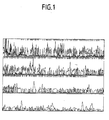
- 0.1 fmol of a pUC18 derivative containing a 600 bp insert in the multi-cloning site was in the presence of 4 pmol of the (-21) standard primer (5′-CGT TGT AAA ACG ACG GCC AGT-3) ') And the reverse primer (5'-CAC ACA GGA AAC AGC TAT GAC-3') and in the presence of 20 nMol each of the four deoxynucleotide triphosphates in a volume of 100 ⁇ l PCR buffer (50 mM KCl, 10 mM Tris HCl, 1.5 mM MgCl2, 0.01% gelatin, pH 8.3) with 5 units Taq polymerase (Cetus) amplified.
- reaction mixture was overlaid with 100 ul mineral oil and in a programmable thermostatic block (Programmable Dri-Block PHC-1, Techne) 30 temperature cycles consisting of 1.0 min. 96 ° C, 0.5 min. 37 ° C and 1.0 min. Subject to 72 ° C.
- a programmable thermostatic block Programmable Dri-Block PHC-1, Techne
- the deoxynucleotide triphosphates were then separated off using a Biospin P30 column (Biorad) according to the manufacturer's instructions and after equilibration of the column with the PCR buffer for the aqueous phase of the reaction solution.
- Each of the four reaction batches was analogous to the PCR reaction for 40 cycles consisting of 1.0 min. 96 ° C, 0.5 min. 55 ° C and 1.0 min. Subject to 72 ° C.
- the aqueous phases of the four reaction batches were then pipetted successively onto 20 ⁇ l of 3 M NaOAc (pH 7.8). 500 .mu.l of ethanol heated to -20.degree. C. were then added to this solution, and the solution became mixed, 15 min. placed on dry ice and centrifuged for 15 min at 13000 rpm and RT in an Eppendorf centrifuge 5415 C. The pellet, washed again with 800 ⁇ l 80% ethanol, was then dried under vacuum for 2 min, taken up in 2 ⁇ l 50 mM EDTA (pH 7.5) and 6 ⁇ l deionized formamide, heated to 95 ° C.
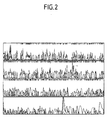
- the plasmid pUC18 was linearized with the restriction endonuclease XmnI and sequenced analogously to Example 1. Deviating from Example 1, however, 0.1 pmol (A and C reaction) or 0.2 pmol (G and T reaction) of the DNA and 2 pmol (A, C) or 4 pmol (G, T ) the primer was used, and only ten temperature cycles of the type used for the PCR in Example 1 were used.
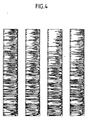
- a 1450 base long PCR fragment was sequenced completely analogously to Example 1, the amount of DNA used varying between 0.05 and 0.8 pmol.
- the results obtained for the first approximately 130 bases are summarized in Fig. 4. It becomes clear that with increasing amount of DNA there is a clear increase in non-specific terminations.
Landscapes
- Chemical & Material Sciences (AREA)
- Life Sciences & Earth Sciences (AREA)
- Organic Chemistry (AREA)
- Proteomics, Peptides & Aminoacids (AREA)
- Health & Medical Sciences (AREA)
- Wood Science & Technology (AREA)
- Zoology (AREA)
- Engineering & Computer Science (AREA)
- Biochemistry (AREA)
- General Engineering & Computer Science (AREA)
- Microbiology (AREA)
- Molecular Biology (AREA)
- Physics & Mathematics (AREA)
- Biotechnology (AREA)
- Analytical Chemistry (AREA)
- Biophysics (AREA)
- Bioinformatics & Cheminformatics (AREA)
- Immunology (AREA)
- General Health & Medical Sciences (AREA)
- Genetics & Genomics (AREA)
- Chemical Kinetics & Catalysis (AREA)
- Measuring Or Testing Involving Enzymes Or Micro-Organisms (AREA)
- Saccharide Compounds (AREA)
- Investigating Or Analysing Biological Materials (AREA)
- Preparation Of Compounds By Using Micro-Organisms (AREA)
Applications Claiming Priority (2)
| Application Number | Priority Date | Filing Date | Title |
|---|---|---|---|
| DE3923895 | 1989-07-19 | ||
| DE3923895A DE3923895A1 (de) | 1989-07-19 | 1989-07-19 | Verfahren zur sequenzierung von desoxyribonukleinsaeuren |
Publications (3)
| Publication Number | Publication Date |
|---|---|
| EP0409078A2 true EP0409078A2 (fr) | 1991-01-23 |
| EP0409078A3 EP0409078A3 (en) | 1991-07-17 |
| EP0409078B1 EP0409078B1 (fr) | 1994-11-09 |
Family
ID=6385388
Family Applications (1)
| Application Number | Title | Priority Date | Filing Date |
|---|---|---|---|
| EP90113328A Revoked EP0409078B1 (fr) | 1989-07-19 | 1990-07-12 | Procédé de séquence d'acides déoxyribonucléiques |
Country Status (6)
| Country | Link |
|---|---|
| EP (1) | EP0409078B1 (fr) |
| JP (1) | JPH0813279B2 (fr) |
| AT (1) | ATE113994T1 (fr) |
| DE (2) | DE3923895A1 (fr) |
| DK (1) | DK0409078T3 (fr) |
| ES (1) | ES2063206T3 (fr) |
Cited By (5)
| Publication number | Priority date | Publication date | Assignee | Title |
|---|---|---|---|---|
| WO1993003180A1 (fr) * | 1991-08-02 | 1993-02-18 | Europäisches Laboratorium für Molekularbiologie (EMBL) | Procede nouveau de sequençage d'acides nucleiques |
| EP0595982A4 (en) * | 1991-07-24 | 1995-10-11 | Univ Partnerships Pty Ltd | Single step amplification and sequencing of nucleic acids |
| EP0654091A4 (fr) * | 1991-09-27 | 1997-11-12 | Us Biochemical Corp | Sequen age cyclique d'adn. |
| WO1997037039A3 (fr) * | 1996-03-29 | 1997-11-27 | Gsf Forschungszentrum Umwelt | Utilisation de polymerases d'adn extremement thermophiles |
| US6291164B1 (en) | 1996-11-22 | 2001-09-18 | Invitrogen Corporation | Methods for preventing inhibition of nucleic acid synthesis by pyrophosphate |
Family Cites Families (1)
| Publication number | Priority date | Publication date | Assignee | Title |
|---|---|---|---|---|
| DE3930312A1 (de) * | 1988-10-24 | 1990-04-26 | Max Planck Gesellschaft | Verfahren zur direkten sequenzierung von nukleinsaeureketten |
-
1989
- 1989-07-19 DE DE3923895A patent/DE3923895A1/de not_active Withdrawn
-
1990
- 1990-07-12 ES ES90113328T patent/ES2063206T3/es not_active Expired - Lifetime
- 1990-07-12 EP EP90113328A patent/EP0409078B1/fr not_active Revoked
- 1990-07-12 DE DE59007676T patent/DE59007676D1/de not_active Revoked
- 1990-07-12 AT AT90113328T patent/ATE113994T1/de not_active IP Right Cessation
- 1990-07-12 DK DK90113328.0T patent/DK0409078T3/da active
- 1990-07-19 JP JP2189610A patent/JPH0813279B2/ja not_active Expired - Lifetime
Cited By (7)
| Publication number | Priority date | Publication date | Assignee | Title |
|---|---|---|---|---|
| EP0595982A4 (en) * | 1991-07-24 | 1995-10-11 | Univ Partnerships Pty Ltd | Single step amplification and sequencing of nucleic acids |
| WO1993003180A1 (fr) * | 1991-08-02 | 1993-02-18 | Europäisches Laboratorium für Molekularbiologie (EMBL) | Procede nouveau de sequençage d'acides nucleiques |
| EP0654091A4 (fr) * | 1991-09-27 | 1997-11-12 | Us Biochemical Corp | Sequen age cyclique d'adn. |
| WO1997037039A3 (fr) * | 1996-03-29 | 1997-11-27 | Gsf Forschungszentrum Umwelt | Utilisation de polymerases d'adn extremement thermophiles |
| US6291164B1 (en) | 1996-11-22 | 2001-09-18 | Invitrogen Corporation | Methods for preventing inhibition of nucleic acid synthesis by pyrophosphate |
| US6764839B2 (en) | 1996-11-22 | 2004-07-20 | Invitrogen Corporation | Methods for preventing inhibition of nucleic acid synthesis by pyrophosphate |
| US7344835B2 (en) | 1996-11-22 | 2008-03-18 | Invitrogen Corporation | Methods for preventing inhibition of nucleic acid synthesis by pyrophosphate |
Also Published As
| Publication number | Publication date |
|---|---|
| DE59007676D1 (de) | 1994-12-15 |
| EP0409078A3 (en) | 1991-07-17 |
| ES2063206T3 (es) | 1995-01-01 |
| EP0409078B1 (fr) | 1994-11-09 |
| ATE113994T1 (de) | 1994-11-15 |
| JPH0372899A (ja) | 1991-03-28 |
| JPH0813279B2 (ja) | 1996-02-14 |
| DK0409078T3 (da) | 1994-12-05 |
| DE3923895A1 (de) | 1991-01-24 |
Similar Documents
| Publication | Publication Date | Title |
|---|---|---|
| EP0597006B1 (fr) | Procede nouveau de sequencage d'acides nucleiques | |
| DE69708865T2 (de) | Verfahren zur direkten sequenzierung während "template"-amplifikation | |
| DE69520917T2 (de) | Dns-sequenzierung durch stufenweise ligierung und spaltung | |
| DE69524425T2 (de) | Nukleotid-sequenzierungsmethode | |
| DE69421277T2 (de) | NUKLEINSäURE-SEQUENZANALYSE DURCH DIE METHODE DER PARALLELEN PRIMEREXTENSION | |
| DE69322266T2 (de) | Proben zusammensetzung und verfahren | |
| EP0833942B1 (fr) | Procede d'amplification sans transcription d'acides nucleiques | |
| EP0826067A1 (fr) | Sequencage simultane d'acides nucleiques | |
| DE69713599T2 (de) | Verfahren zur bestimmung von nukleinsäure-sequenzen und diagnostische anwendungen derselben | |
| DE69720763T2 (de) | Sätze von, mit fluoreszierenden energieübertragungsverbindungen, markierten primern und deren verwendung in mehrkomponentenanalyse | |
| DE69727064T2 (de) | Verfahren zum nachweis von polynucleotid-sequenzen mittel massenspektrometrie | |
| DE69620006T2 (de) | Sequenzierverfahren | |
| DE68921515T2 (de) | DNS-Sequenzierung. | |
| DE69834056T2 (de) | De novo oder "universaler" sequenzierungs-array | |
| DE69704055T2 (de) | Kettenabbrechende nukleinsäure-sequenziermethode mit 2'-desoxyuridin-5'-triphosphat | |
| DE69927343T2 (de) | Verfahren und mittel zur analyse der nukleotidsequenz von nukleinsäuren | |
| DE69528706T2 (de) | Gekoppeltes ampflikation- und ligationverfahren | |
| DE69233458T2 (de) | Nukleinsäuretypisierung durch polymeraseverlängerung von oligonukleotiden unter verwendung von terminator-mischungen | |
| DE19633436A1 (de) | Verfahren zum Nachweis von Nukleinsäuren unter Ermittlung der Masse | |
| DE19653494A1 (de) | Verfahren zur entkoppelten, direkten, exponentiellen Amplifikation und Sequenzierung von DNA Molekülen unter Zugabe einer zweiten thermostabilen DNA Polymerase und dessen Anwendung | |
| EP1294946B1 (fr) | PROCEDE DE SEQUENçAGE MULTIPLEX | |
| DE69924140T2 (de) | Bestimmung der länge von repetitiven nukleinsäure-sequenzen durch eine diskontinuierliche primerverlängerung | |
| AT502823A4 (de) | Polynukleotid-amplifikation | |
| WO2011020588A1 (fr) | Procédé de détection d'acides nucléiques cibles | |
| EP1084266B1 (fr) | Utilisation de nucleotides 5'-modifies en biologie moleculaire et en medecine |
Legal Events
| Date | Code | Title | Description |
|---|---|---|---|
| PUAI | Public reference made under article 153(3) epc to a published international application that has entered the european phase |
Free format text: ORIGINAL CODE: 0009012 |
|
| AK | Designated contracting states |
Kind code of ref document: A2 Designated state(s): AT BE CH DE DK ES FR GB IT LI NL |
|
| 17P | Request for examination filed |
Effective date: 19901227 |
|
| PUAL | Search report despatched |
Free format text: ORIGINAL CODE: 0009013 |
|
| AK | Designated contracting states |
Kind code of ref document: A3 Designated state(s): AT BE CH DE DK ES FR GB IT LI NL |
|
| 17Q | First examination report despatched |
Effective date: 19930617 |
|
| GRAA | (expected) grant |
Free format text: ORIGINAL CODE: 0009210 |
|
| AK | Designated contracting states |
Kind code of ref document: B1 Designated state(s): AT BE CH DE DK ES FR GB IT LI NL |
|
| REF | Corresponds to: |
Ref document number: 113994 Country of ref document: AT Date of ref document: 19941115 Kind code of ref document: T |
|
| REG | Reference to a national code |
Ref country code: DK Ref legal event code: T3 |
|
| REF | Corresponds to: |
Ref document number: 59007676 Country of ref document: DE Date of ref document: 19941215 |
|
| GBT | Gb: translation of ep patent filed (gb section 77(6)(a)/1977) |
Effective date: 19941122 |
|
| ITF | It: translation for a ep patent filed | ||
| REG | Reference to a national code |
Ref country code: ES Ref legal event code: FG2A Ref document number: 2063206 Country of ref document: ES Kind code of ref document: T3 |
|
| ET | Fr: translation filed | ||
| PLBI | Opposition filed |
Free format text: ORIGINAL CODE: 0009260 |
|
| 26 | Opposition filed |
Opponent name: AMERSHAM INTERNATIONAL PLC Effective date: 19950809 |
|
| NLR1 | Nl: opposition has been filed with the epo |
Opponent name: AMERSHAM INTERNATIONAL PLC |
|
| PLBF | Reply of patent proprietor to notice(s) of opposition |
Free format text: ORIGINAL CODE: EPIDOS OBSO |
|
| PGFP | Annual fee paid to national office [announced via postgrant information from national office to epo] |
Ref country code: FR Payment date: 19960614 Year of fee payment: 7 |
|
| PGFP | Annual fee paid to national office [announced via postgrant information from national office to epo] |
Ref country code: NL Payment date: 19960620 Year of fee payment: 7 Ref country code: DK Payment date: 19960620 Year of fee payment: 7 |
|
| PGFP | Annual fee paid to national office [announced via postgrant information from national office to epo] |
Ref country code: CH Payment date: 19960621 Year of fee payment: 7 |
|
| PGFP | Annual fee paid to national office [announced via postgrant information from national office to epo] |
Ref country code: AT Payment date: 19960624 Year of fee payment: 7 |
|
| PGFP | Annual fee paid to national office [announced via postgrant information from national office to epo] |
Ref country code: GB Payment date: 19960701 Year of fee payment: 7 |
|
| PGFP | Annual fee paid to national office [announced via postgrant information from national office to epo] |
Ref country code: BE Payment date: 19960708 Year of fee payment: 7 |
|
| PGFP | Annual fee paid to national office [announced via postgrant information from national office to epo] |
Ref country code: ES Payment date: 19960712 Year of fee payment: 7 |
|
| PGFP | Annual fee paid to national office [announced via postgrant information from national office to epo] |
Ref country code: DE Payment date: 19960719 Year of fee payment: 7 |
|
| RDAH | Patent revoked |
Free format text: ORIGINAL CODE: EPIDOS REVO |
|
| REG | Reference to a national code |
Ref country code: DK Ref legal event code: EBP |
|
| RDAG | Patent revoked |
Free format text: ORIGINAL CODE: 0009271 |
|
| STAA | Information on the status of an ep patent application or granted ep patent |
Free format text: STATUS: PATENT REVOKED |
|
| REG | Reference to a national code |
Ref country code: CH Ref legal event code: PL |
|
| GBPR | Gb: patent revoked under art. 102 of the ep convention designating the uk as contracting state |
Free format text: 970201 |
|
| 27W | Patent revoked |
Effective date: 19970201 |
|
| NLR2 | Nl: decision of opposition |