EP0597006B1 - Procede nouveau de sequencage d'acides nucleiques - Google Patents
Procede nouveau de sequencage d'acides nucleiques Download PDFInfo
- Publication number
- EP0597006B1 EP0597006B1 EP92916948A EP92916948A EP0597006B1 EP 0597006 B1 EP0597006 B1 EP 0597006B1 EP 92916948 A EP92916948 A EP 92916948A EP 92916948 A EP92916948 A EP 92916948A EP 0597006 B1 EP0597006 B1 EP 0597006B1
- Authority
- EP
- European Patent Office
- Prior art keywords
- nucleic acid
- labelled
- fluorescein
- acid fragments
- sequencing
- Prior art date
- Legal status (The legal status is an assumption and is not a legal conclusion. Google has not performed a legal analysis and makes no representation as to the accuracy of the status listed.)
- Expired - Lifetime
Links
Images



Classifications
-
- C—CHEMISTRY; METALLURGY
- C12—BIOCHEMISTRY; BEER; SPIRITS; WINE; VINEGAR; MICROBIOLOGY; ENZYMOLOGY; MUTATION OR GENETIC ENGINEERING
- C12Q—MEASURING OR TESTING PROCESSES INVOLVING ENZYMES, NUCLEIC ACIDS OR MICROORGANISMS; COMPOSITIONS OR TEST PAPERS THEREFOR; PROCESSES OF PREPARING SUCH COMPOSITIONS; CONDITION-RESPONSIVE CONTROL IN MICROBIOLOGICAL OR ENZYMOLOGICAL PROCESSES
- C12Q1/00—Measuring or testing processes involving enzymes, nucleic acids or microorganisms; Compositions therefor; Processes of preparing such compositions
- C12Q1/68—Measuring or testing processes involving enzymes, nucleic acids or microorganisms; Compositions therefor; Processes of preparing such compositions involving nucleic acids
- C12Q1/6869—Methods for sequencing
-
- Y—GENERAL TAGGING OF NEW TECHNOLOGICAL DEVELOPMENTS; GENERAL TAGGING OF CROSS-SECTIONAL TECHNOLOGIES SPANNING OVER SEVERAL SECTIONS OF THE IPC; TECHNICAL SUBJECTS COVERED BY FORMER USPC CROSS-REFERENCE ART COLLECTIONS [XRACs] AND DIGESTS
- Y10—TECHNICAL SUBJECTS COVERED BY FORMER USPC
- Y10T—TECHNICAL SUBJECTS COVERED BY FORMER US CLASSIFICATION
- Y10T436/00—Chemistry: analytical and immunological testing
- Y10T436/14—Heterocyclic carbon compound [i.e., O, S, N, Se, Te, as only ring hetero atom]
- Y10T436/142222—Hetero-O [e.g., ascorbic acid, etc.]
- Y10T436/143333—Saccharide [e.g., DNA, etc.]
Definitions
- the present invention relates to a method for non-radioactive sequencing of nucleic acids.
- a direct sequencing method is described in WO90 / 04649.
- This method uses the polymerase chain reaction and deoxynucleoside thio-triphosphates, which act as cleavage sites for a chemical following the polymerase chain reaction or serve as an enzymatic reaction.
- the thio group also serves for end marking with radioactive, non-radioactive or enzymatic groups for the detection of those to be sequenced Nucleic acid fragments.
- the Maxam-Gilbert method uses labeled DNA molecules chemically modified in a base-specific manner, a partial one Strand termination and the fragments thus obtained separated by size and the sequence based on the marking certainly.
- DNA sequencing was carried out using radioactive ( 32 P or 35 S) labels.
- the gel electrophoretic separation of the fragments and autoradiography of the nucleotide sequence were carried out either manually or semi-automatically.
- DNA sequencing is carried out with automated systems using a non-radioactive label, in particular a fluorescent label (LM Smith et al., Nature 321 (1986), 674-679; W. Ansorge et al., J. Biochem. Biophys. Meth. 13: 315-323 (1986).
- LM Smith et al. Nature 321 (1986), 674-679
- W. Ansorge et al. J. Biochem. Biophys. Meth. 13: 315-323 (1986.
- the nucleotide sequence is read directly during the separation of the labeled fragments and entered directly into a computer.
- a way of marking of nucleic acid fragments is a labeled one
- Use oligonucleotide primers for the extension reaction so that the nucleic acid chain has a label at its 5 'end wearing.
- the other option is to use marked terminators, i.e. Chain termination molecules to use so that the Nucleic acid chain carries a label at its 3 'end.
- a work by Prober et al. describes a sequencing method in which the four Chain-terminating ddNTPs each with different Fluorescent dyes are coupled so that all four Sequencing approaches separated on a single gel track can be.
- a similar system with 4 different labeled primers is disclosed in GB-A 2155176.
- DE-OS 38 41 565 describes the use of fluorescent dyes, via a linker with the nucleic acid fragments are connected.
- the marking with the fluorescent dye is either on the 5'-phosphate group of the primer or at the 3 'end of the nucleic acid fragment on the purine or pyrimidine base.
- EP 0 409 078 also discloses the use of terminal labeled oligonucleotide primers or labeled Deoxy or dideoxynucleotide triphosphates.
- DE-OS 38 39 397 discloses a sequencing method according to Maxam and Gilbert using fluorescent dyes, in which the disadvantages of using Radioactivity can be avoided.
- the object of the present invention was therefore a method to provide for the sequencing of nucleic acids, in which the disadvantages of the prior art, at least in part are eliminated.
- the sequencing according to the method according to the invention can both by Maxam and Gilbert as well as the enzymatic chain termination method according to Sanger. In both cases a mixture is obtained of non-radioactive labeled nucleic acid fragments of different lengths, which at least as "inner” marking a deoxyribonucleoside monophosphate containing the a non-radioactive labeling group.
- the invention Simple procedure for all known DNA sequencing protocols (e.g. also with solid phase sequencing) can be applied.
- non-radioactive labeling groups are, for example Metals
- magnetic marker groups caused by nuclear magnetic resonance or by a superconducting quantum interferometric Detector (SQUID) are detectable, phosphorescence or Suitable for fluorescent dyes.
- SQUID superconducting quantum interferometric Detector
- Fluorescent dyes for example rhodamine, Texas red, Phycoerythrin or fluorescein and its derivatives.
- fluorescent dyes are preferred, the one Show absorption in a range from 600 to 800 nm. Examples for a variety of suitable dyes are in the catalog from Molecular Probes.
- the labeling is preferably via a linker to the C 5 position of pyrimidine bases (uracil, thymine or cytosine) or to the N 7 or C 8 position of purine bases (adenine, guanosine, hypoxanthine) or to the C 7 -Position of purine bases (7-deazaguanidine) coupled.
- the number of atoms in the linker chain is generally 1 to 50, preferably 4 to 24 and particularly preferably 10 to 18.
- fluorescein-labeled dUTP Fluorescein-12-2'-deoxyuridine-5'-triphosphate or fluorescein-12-dUTP
- Fluorescein-12-dUTP can be used in the invention Method used instead of dTTP or together with dTTP will.
- Fluorescein-12-2'-dCTP, Fluorescein-15-2'-dGTP and especially Fluorescein-15-2'-dATP proven to be excellently labeled dNTPs.
- several marked dNTPs can be the number of marked Nucleotides in a chain are greatly increased, which e.g. Cheap is when the starting material to be sequenced is only in very low concentration is available.
- the labeling can be done via enzymatic extension an oligonucleotide primer in the presence of a polymerase, the nucleic acid to be sequenced as a template and all four deoxyribonucleoside triphosphates, at least of which one contains a marker group.
- a sequence to be sequenced is formed Nucleic acid complementary strand, the labeling groups and then in the usual way, i.e. by partial base-specific cleavage using chemical Methods and subsequent separation of the resulting Fragment mixture can be sequenced.
- nucleotides incorporated into a single DNA fragment be, which increases the signal strength and thus the sensitivity increase the determination by an order of magnitude or more.
- the high signal strength enables a sensitive Detection of fluorescence bands in an automatic sequencer, even if it passes through the detector very quickly used laser beam migrate so that an implementation of DNA sequencing reactions at a very high rate, work up to several thousand bases per hour per clone, by using high voltages, e.g. in ultra thin Plate gels or in ultra-thin capillaries becomes.
- Another advantage of the method according to the invention is in that the resolution of the sequence ladder, in particular larger length surprisingly compared to that from the State of the art use of labeled primers is improved. This applies in particular to the conduct of a procedure, where the marker and the extension are in two separate Steps take place (see examples 2 and 3) and at Use of fluorescein-dATP or fluorescein-dUTP as Mark.
- the inventive method is characterized in that an oligonucleotide primer without a labeling group, in particular an oligonucleotide primer unmodified at the 5 'end can use.
- an oligonucleotide primer it is also possible in Combined with the labeled dNTPs an oligonucleotide primer to use with a dye at its 5 'end or / and a group capable of affinity binding is modified.
- double marking possible i.e. one uses a dye-labeled oligonucleotide primer, which has a different fluorescence wavelength than that at labeled dNTPs used in the corresponding approach.
- the oligonucleotide primer can be at its 5 'end be biotinylated, e.g. the bond with one with Streptavidin coated solid phase is possible.
- groups capable of affinity binding are haptens (e.g. digoxigenin or digoxin) with an antibody specific for the corresponding hapten are bindable.
- deoxyribonucleoside triphosphates are expediently used, modified at the 3 'position of the deoxyribose are that they have no free OH group, and yet are accepted as a substrate by the polymerase.
- chain termination molecules there are about 3'-fluoro-, 3-O-alkyl or 3'-H modified deoxyribonucleotides.
- chain termination molecules i.e. Dideoxyribonucleoside triphosphates (ddNTPs) are used.
- ddNTPs Dideoxyribonucleoside triphosphates
- a Oligonucleotide primer or for filling in restriction fragments preferably the Klenow fragment of E. coli DNA polymerase I, modified or unmodified T7 DNA polymerase, T4 DNA polymerase, Taq DNA polymerase, Bst DNA polymerase or reverse transcriptase used.
- T7 DNA polymerase modified or unmodified T7 DNA polymerase, T4 DNA polymerase, Taq DNA polymerase, Bst DNA polymerase or reverse transcriptase used.
- T7 DNA polymerase and the thermostable ones Taq and Bst DNA polymerases are particularly preferred.
- the labeled nucleic acid fragments can be separated the method according to the invention according to all in the art known methods, e.g. through various electrophoretic (e.g. polyacrylamide gel electrophoresis) or chromatographic (e.g. HPLC) procedures are carried out using a gel electrophoretic Separation is preferred. Furthermore, the Separation of the labeled nucleic acids to any of them Way, i.e. manual, semi-automatic or automatic done, but using an automatic Sequencing device is generally preferred. In this case can then separate the labeled nucleic acids into ultra-thin plate sources of 20 to 200 ⁇ m, preferably 100 ⁇ m thickness (see e.g. Stegemann et al., Methods in Mol. and Cell.Biol. 2 (1991), 182-184) or capillaries will.
- electrophoretic e.g. polyacrylamide gel electrophoresis
- chromatographic e.g. HPLC
- a way of amplification consists of one or more cycles of a polymerase chain reaction (PCR) using two primers the actual sequencing.
- the PCR is carried out usually without marked dNTPs. So the one to be sequenced Nucleic acid before performing the actual sequencing be amplified.
- the amplification step can also be carried out with the help a "thermocycling" reaction.
- the thermocycling reaction corresponds to a "normal” sequencing reaction, which however - like a PCR - is carried out in several cycles becomes.
- the reaction batch contains the nucleic acid template, the primer, the dNTPs and corresponding ones Chain termination molecules and a preferably thermostable Polymerase. In this way there is always a specific one per cycle Amount of labeled nucleic acid fragments synthesized, with large amounts of labeled in several cycles Fragments can be generated so that the DNA is linear and is not amplified exponentially as in PCR.
- the nucleic acid to be sequenced can be single-stranded as well as in double-stranded form. It good results will be obtained if the sequence to be sequenced Nucleic acid on a double-stranded DNA vector, e.g. a plamsid, cosmid, bacteriophage (lambda or P1), a viral vector or an artificial chromosome (artificial Yeast chromosome).
- a plamsid, cosmid, bacteriophage e.g. a plamsid, cosmid, bacteriophage (lambda or P1), a viral vector or an artificial chromosome (artificial Yeast chromosome).
- the enzymatic elongation reaction is carried out in the usual way, i.e. in several separate approaches by using different chain termination molecules in each approach, i.e. Terminators with different nucleotide bases, used.
- the chain termination molecules can either be added right at the start of the reaction or the reaction can be in two steps, an extension step in the absence of chain termination molecules and a termination step in the presence of the respective chain termination molecule be performed. If one uses T7 DNA polymerase for Chain extension, e.g. the extension step (without ddNTPs) in the presence of magnesium and the termination step (with ddNTPs) in the presence of manganese ions will.
- each approach being different ddNTP is present as a chain termination molecule.
- Be in this four approaches each have the same markings (one or several marked dNTPs) is a separate separation of the individual approaches required.
- a preferred one Variant of this embodiment can be two (or several) sequencing reactions with differently labeled Carry out dNTPs, with such marker groups in each case can be used that can be detected side by side. So you can e.g. in a first reaction (i.e. in all 4 Approaches to this reaction) and fluorescein dNTP in a second Use Rhodamine-dNTP reaction. The evaluation of this Both reactions can be done together, using 2 approaches with different markings (i.e. one Fluorescein and a rhodamine label) on a single Gel track applies and separated (by measurement at different Fluorescence wavelengths).
- Another object of the present invention is Use of non-radioactive labeled deoxyribonucleoside triphosphates in methods for sequencing nucleic acids after the mining method of Maxam and Gilbert or after the Sanger chain termination method.
- Deoxyribonucleoside triphosphates which are a non-radioactive Wear marking, for the inner marking of nucleic acid fragments in one of the described methods for sequencing of nucleic acids used, the introduction of the inner marker in the nucleic acid fragments in the absence of chain termination molecules takes place.
- the mark is preferably a fluorescent dye, especially preferably fluorescein or a derivative thereof.
- the mark is preferably linked to the dNTP via a linker.
- the number of atoms in the linker chain is generally 1 to 50, preferably 4 to 24 and particularly preferred 8 to 18.
- As favorable for an automatic sequencing process has the use of fluorescein-12-dUTP, Fluorescein-12 dCTP, Fluorescein-15 dGTP or / and Fluorescein-15 dATP proven.
- Another object of the invention is the use a reagent kit for sequencing nucleic acids according to the method described, the at least as a reagent contains a deoxyribonucleoside triphosphate that is associated with a non-radioactive labeling group is labeled, as well also a chain termination molecule.
- the reagent can e.g. in Form of a solution, a suspension or a lyophilisate be.
- the reagent kit can be used as additional reagents (e.g. Enzyme, primer, buffer solutions, unlabeled NTPs, terminators) contain.
- Sequencing was done with an automatic DNA sequencer (A.L.F. DNA sequencer from Pharmacia LKB). Experiments with T7 DNA polymerase and manganese or magnesium buffer using single-stranded and double-stranded DNA matrices.
- the nucleotides and enzymes were purchased from Pharmacia PL. Fluorescein-12-dUTP was purchased from Boehringer Mannheim. Good results were made using the following reaction protocol receive:
- 2 ul labeling mixture (each 1.5 ⁇ mol / 1 dATP, dCTP, dGTP and fluorescein-12-dUTP) added together with 3.5 U T7 DNA polymerase and 10 minutes incubated at room temperature.
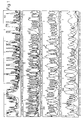
- Figure 1 shows the result of a typical plasmid sequencing using fluorescein-12-dUTP as a label.
- the signal begins immediately after the first marked T-residue after the priming site without visible primer peak.
- the intensities for multiple peaks are the same as in primer experiments with end mark.
- Both magnesium and manganese buffers have proven suitable for the T7 DNA polymerase proven.
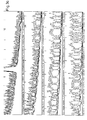
- Figures 2 and 3 show the results of plasmid sequencing using the above protocol and Fluorescein-12-dCTP ( Figure 2) or Fluorescein-15-dATP ( Figure 3) as a marker.
- sequence gels were evaluated on the automatic EMBL fluorescence sequencer. When using fluorescein-15-dATP as a label it is possible to add up to 1000 bases read.
Landscapes
- Life Sciences & Earth Sciences (AREA)
- Chemical & Material Sciences (AREA)
- Proteomics, Peptides & Aminoacids (AREA)
- Organic Chemistry (AREA)
- Zoology (AREA)
- Wood Science & Technology (AREA)
- Health & Medical Sciences (AREA)
- Engineering & Computer Science (AREA)
- Microbiology (AREA)
- Biochemistry (AREA)
- Biotechnology (AREA)
- Molecular Biology (AREA)
- Biophysics (AREA)
- Analytical Chemistry (AREA)
- Physics & Mathematics (AREA)
- Immunology (AREA)
- Bioinformatics & Cheminformatics (AREA)
- General Engineering & Computer Science (AREA)
- General Health & Medical Sciences (AREA)
- Genetics & Genomics (AREA)
- Measuring Or Testing Involving Enzymes Or Micro-Organisms (AREA)
- Investigating Or Analysing Biological Materials (AREA)
Abstract
Claims (36)
- Procédé de séquençage d'acides nucléiques, selon lequelcaractérisé en ce que(a) on produit un mélange de fragments d'acides nucléiques marqués de différentes longueurs,(b) on sépare selon la taille les fragments d'acides nucléiques marqués,(c) on détermine la séquence des acides nucléiques par l'intermédiaire du marqueur des différents fragments,
on dose les fragments d'acides nucléiques dans lesquels on a introduit un marqueur interne en incorporant au moins un triphosphate de désoxyribonucléoside portant un groupe de marquage non radioactif, l'introduction du marqueur interne dans les fragments d'acides nucléiques s'effectuant en l'absence de molécules de rupture de chaíne. - Procédé selon la revendication 1, caractérisé en ce que l'on produit le mélange de fragments d'acides nucléiques marqués par la méthode de dégradation chimique.
- Procédé selon la revendication 2, caractérisé en ce que l'on introduit le marqueur par extension enzymatique d'une amorce oligonucléotidique en présence d'une polymérase, de l'acide nucléique à séquencer comme matrice et d'au moins un désoxyribonucléotide marqué, puis on effectue par une méthode chimique une coupure partielle spécifique de bases des acides nucléiques marqués.
- Procédé selon la revendication 1, caractérisé en ce que l'on produit le mélange de fragments d'acides nucléiques marqués par la méthode de rupture enzymatique des chaínes.
- Procédé selon la revendication 4, caractérisé en ce que l'introduction du marqueur interne s'effectue par extension enzymatique d'une amorce oligonucléotidique en présence d'une polymérase et de triphosphates de désoxyribonucléosides, et la terminaison de la réaction d'extension se produit ensuite par addition de molécules de rupture de chaíne.
- Procédé selon l'une des revendications 1 à 5, caractérisé en ce que l'on utilise des triphosphates de désoxyribonucléosides qui sont liés au groupe de marquage par l'intermédiaire d'un lieur.
- Procédé selon la revendication 6, caractérisé en ce que le nombre d'atomes de la chaíne du lieur est de 10 à 18.
- Procédé selon l'une des revendications 1 à 7, caractérisé en ce que l'on utilise des triphosphates de désoxyribonucléosides marqués avec des colorants fluorescents.
- Procédé selon la revendication 8, caractérisé en ce que l'on utilise comme colorant fluorescent la fluorescéine ou ses dérivés.
- Procédé selon l'une des revendications 1 à 9, caractérisé en ce que l'on utilise comme désoxyribonucléosides marqués le fluorescéine-12-dUTP, le fluorescéine-12-dCTP, le fluorescéine-15-dGTP ou/et le fluorescéine-15-dATP.
- Procédé selon la revendication 3 ou 5, caractérisé en ce que l'on utilise pour l'extension enzymatique une amorce oligonucléotidique non modifiée en 5'.
- Procédé selon la revendication 3 ou 5, caractérisé en ce que l'on utilise une amorce oligonucléotidique qui est modifiée à l'extrémité 5' avec un colorant et/ou un groupe capable de former une liaison d'affinité.
- Procédé selon la revendication 12, caractérisé en ce que l'on utilise une amorce oligonucléotidique biotinylée en 5'.
- Procédé selon l'une des revendications 4 à 13, caractérisé en ce que l'on utilise comme molécules de rupture de chaíne des triphosphates de désoxyribonucléosides modifiés en 3', qui ont en position 3' du sucre un groupe F, O-alkyle ou H.
- Procédé selon la revendication 14, caractérisé en ce que l'on utilise comme molécules de rupture de chaínes des triphosphates de didésoxyribonucléosides.
- Procédé selon l'une des revendications 4 à 15, caractérisé en ce que l'on utilise des molécules de rupture de chaíne non marquées.
- Procédé selon l'une des revendications 3 ou 5, caractérisé en ce que l'on utilise comme polymérase pour l'extension enzymatique le fragment de Klenow de l'ADN-polymérase I d'E. coli, l'ADN-polymérase de T7 modifiée ou non modifiée, l'ADN-polymérase de T4, l'ADN-polymérase de Taq, l'ADN-polymérase de Bst ou une transcriptase inverse.
- Procédé selon l'une des revendications 1 à 17, caractérisé en ce que la séparation des fragments d'acides nucléiques marqués s'effectue par électrophorèse en gel.
- Procédé selon l'une des revendications 1 à 18, caractérisé en ce que l'on effectue la séparation des fragments d'acides nucléiques marqués dans un appareil de séquençage automatique.
- Procédé selon la revendication 18 ou 19, caractérisé en ce que l'on effectue la séparation dans des gels de plaques ultraminces ou des capillaires.
- Procédé selon l'une des revendications 1 à 20, caractérisé en ce que, lorsque l'on utilise des triphosphates de désoxyribonucléosides marqués avec des colorants fluorescents, après la séparation des fragments d'acides nucléiques, on excite le colorant fluorescent au laser pour doser le marqueur.
- Procédé selon l'une des revendications 1 à 21, caractérisé en ce que l'on effectue avant la réaction de séquençage un ou plusieurs cycles de réaction de PCR pour amplifier la quantité de l'acide nucléique à séquencer.
- Procédé selon l'une des revendications 4 à 22, caractérisé en ce que l'on effectue la réaction de séquençage en plusieurs étapes sous forme d'une réaction de "thermocycling", pour amplifier la quantité des fragments d'acides nucléiques marqués.
- Procédé selon l'une des revendications 1 à 23, caractérisé en ce que l'acide nucléique à séquencer se trouve sur un vecteur d'ADN double brin.
- Procédé selon la revendication 23, caractérisé en ce que le vecteur d'ADN double brin est un plasmide, un cosmide, un bactériophage, un vecteur viral ou un chromosome synthétique.
- Procédé selon l'une des revendications 5 à 25, caractérisé en ce que l'on effectue l'extension enzymatique dans la méthode de rupture des chaínes en plusieurs charges séparées, en utilisant dans chaque charge une molécule de rupture de chaíne différente.
- Procédé selon la revendication 26, caractérisé en ce que l'on utilise dans toutes les charges, pour le même marquage, un ou plusieurs triphosphates de désoxyribonucléosides marqués de la même manière, de sorte qu'une séparation séparée des différentes charges est nécessaire.
- Procédé selon la revendication 26, dans lequel on utilise des marquages différents pour les différentes charges, de sorte que l'on peut séparer en même temps ces charges marquées différemment.
- Procédé selon l'une des revendications 4 à 25, caractérisé en ce que l'on utilise ensemble au moins deux des molécules de rupture de chaíne en des quantités différentes dans une charge, et on différencie les fragments par l'intensité du signal de leur marqueur.
- Utilisation de triphosphates de désoxyribonucléosides portant un marqueur non radioactif pour le marquage inteme de fragments d'acides nucléiques dans un procédé selon l'une des revendications 1 à 29 pour le séquençage d'acides nucléiques, l'introduction du marqueur interne dans les fragments d'acides nucléiques s'effectuant en l'absence de molécules de rupture de chaíne.
- Utilisation selon la revendication 30, caractérisée en ce que le marqueur est un colorant fluorescent.
- Utilisation selon la revendication 31, caractérisée en ce que le marqueur est la fluorescéine ou un de ses dérivés.
- Utilisation selon l'une des revendications 31 à 32, caractérisée en ce que le groupe marqueur est lié à un triphosphate de désoxyribonucléoside par l'intermédiaire d'un lieur.
- Utilisation selon la revendication 33, caractérisée en ce que le nombre des atomes dans la chaíne du lieur est de 10 à 18.
- Utilisation selon l'une des revendications 30 à 34, caractérisée en ce que l'on utilise comme triphosphates de désoxyribonucléosides marqués le fluorescéine-12-dUTP, le fluorescéine-12-dCTP, le fluorescéine-15-dATP ou/et le fluorescéine-15-dGTP.
- Utilisation d'une trousse de réactifs dans un procédé de séquençage d'acides nucléiques selon l'une des revendications 1 à 29, caractérisée en ce que la trousse contient comme réactifs séparés au moins un triphosphate de désoxyribonucléoside marqué avec un groupe marqueur non radioactif, ainsi qu'une molécule de rupture de chaíne.
Applications Claiming Priority (5)
| Application Number | Priority Date | Filing Date | Title |
|---|---|---|---|
| DE4125745 | 1991-08-02 | ||
| DE4125745 | 1991-08-02 | ||
| DE4214112 | 1992-04-29 | ||
| DE4214112A DE4214112A1 (de) | 1991-08-02 | 1992-04-29 | Neues verfahren zur sequenzierung von nukleinsaeuren |
| PCT/EP1992/001756 WO1993003180A1 (fr) | 1991-08-02 | 1992-08-03 | Procede nouveau de sequençage d'acides nucleiques |
Publications (2)
| Publication Number | Publication Date |
|---|---|
| EP0597006A1 EP0597006A1 (fr) | 1994-05-18 |
| EP0597006B1 true EP0597006B1 (fr) | 1998-11-25 |
Family
ID=25906061
Family Applications (1)
| Application Number | Title | Priority Date | Filing Date |
|---|---|---|---|
| EP92916948A Expired - Lifetime EP0597006B1 (fr) | 1991-08-02 | 1992-08-03 | Procede nouveau de sequencage d'acides nucleiques |
Country Status (5)
| Country | Link |
|---|---|
| US (1) | US5912118A (fr) |
| EP (1) | EP0597006B1 (fr) |
| JP (1) | JP3135572B2 (fr) |
| DE (2) | DE4214112A1 (fr) |
| WO (1) | WO1993003180A1 (fr) |
Families Citing this family (48)
| Publication number | Priority date | Publication date | Assignee | Title |
|---|---|---|---|---|
| US5547859A (en) * | 1993-08-02 | 1996-08-20 | Goodman; Myron F. | Chain-terminating nucleotides for DNA sequencing methods |
| US6593086B2 (en) * | 1996-05-20 | 2003-07-15 | Mount Sinai School Of Medicine Of New York University | Nucleic acid amplification methods |
| JP3155279B2 (ja) * | 1994-11-07 | 2001-04-09 | 理化学研究所 | Dnaの塩基配列決定方法 |
| DE19515552A1 (de) * | 1995-04-27 | 1996-10-31 | Europ Lab Molekularbiolog | Simultane Sequenzierung von Nukleinsäuren |
| US5830655A (en) | 1995-05-22 | 1998-11-03 | Sri International | Oligonucleotide sizing using cleavable primers |
| US6821402B1 (en) * | 1998-09-16 | 2004-11-23 | Applera Corporation | Spectral calibration of fluorescent polynucleotide separation apparatus |
| DE19954934A1 (de) * | 1999-11-16 | 2001-05-17 | Otto S Wolfbeis | Verfahren zur Solubilisierung von optischen Markern |
| WO2000068422A2 (fr) * | 1999-05-07 | 2000-11-16 | Roche Diagnostics Gmbh | Marquage haute densite d'adn par des nucleotides modifies ou portant un chromatophore et adn polymerases mises en application |
| US20040214221A1 (en) * | 1999-05-07 | 2004-10-28 | Klaus Muehlegger | High density labeling of DNA with modified or "chromophore" carrying nucleotides and DNA polymerases used |
| US7332275B2 (en) | 1999-10-13 | 2008-02-19 | Sequenom, Inc. | Methods for detecting methylated nucleotides |
| US6958214B2 (en) | 2000-07-10 | 2005-10-25 | Sequenom, Inc. | Polymorphic kinase anchor proteins and nucleic acids encoding the same |
| DE10036743A1 (de) * | 2000-07-27 | 2002-02-07 | Max Planck Gesellschaft | Verfahren zur Bestimmung einer partiellen Nukleotidsequenz eines Nukleinsäuremoleküls |
| GB0021286D0 (en) * | 2000-08-30 | 2000-10-18 | Gemini Genomics Ab | Identification of drug metabolic capacity |
| US20030170678A1 (en) * | 2001-10-25 | 2003-09-11 | Neurogenetics, Inc. | Genetic markers for Alzheimer's disease and methods using the same |
| AU2002364945A1 (en) * | 2001-10-25 | 2003-07-09 | Neurogenetics, Inc. | Genes and polymorphisms on chromosome 10 associated with alzheimer's disease and other neurodegenerative diseases |
| US20030224380A1 (en) * | 2001-10-25 | 2003-12-04 | The General Hospital Corporation | Genes and polymorphisms on chromosome 10 associated with Alzheimer's disease and other neurodegenerative diseases |
| AU2003228809A1 (en) | 2002-05-03 | 2003-11-17 | Sequenom, Inc. | Kinase anchor protein muteins, peptides thereof, and related methods |
| US20030220844A1 (en) * | 2002-05-24 | 2003-11-27 | Marnellos Georgios E. | Method and system for purchasing genetic data |
| EP2112229A3 (fr) | 2002-11-25 | 2009-12-02 | Sequenom, Inc. | Procédés d'identification du risque du cancer du sein et traitements associés |
| US20050032072A1 (en) * | 2003-08-08 | 2005-02-10 | Perlegen Sciences, Inc. | Fragmentation and labelling with a programmable temperature control module |
| EP1773860A4 (fr) * | 2004-07-22 | 2009-05-06 | Sequenom Inc | Méthodes d'évaluation du risque d"apparition de diabètes de type ii et traitements associés |
| EP3260556B1 (fr) | 2006-05-31 | 2019-07-31 | Sequenom, Inc. | Procédés pour l'extraction d'acide nucléique à partir d'un échantillon |
| EP2236623A1 (fr) | 2006-06-05 | 2010-10-06 | Cancer Care Ontario | Evaluation du risque dans le cancer colorectal |
| US7902345B2 (en) | 2006-12-05 | 2011-03-08 | Sequenom, Inc. | Detection and quantification of biomolecules using mass spectrometry |
| WO2008098142A2 (fr) | 2007-02-08 | 2008-08-14 | Sequenom, Inc. | Tests a base d'acide nucléique destinés au typage rhd, à la détermination du sexe et la quantification d'acide nucléique |
| US20110189663A1 (en) | 2007-03-05 | 2011-08-04 | Cancer Care Ontario | Assessment of risk for colorectal cancer |
| AU2008230813B2 (en) | 2007-03-26 | 2014-01-30 | Sequenom, Inc. | Restriction endonuclease enhanced polymorphic sequence detection |
| WO2009032781A2 (fr) | 2007-08-29 | 2009-03-12 | Sequenom, Inc. | Méthodes et compositions s'appliquant à une amplification en chaîne par polymèrase universelle spécifique de la taille |
| CA2717320A1 (fr) | 2008-03-11 | 2009-09-17 | Sequenom, Inc. | Tests adn pour determiner le sexe d'un bebe avant sa naissance |
| WO2009120808A2 (fr) | 2008-03-26 | 2009-10-01 | Sequenom, Inc. | Détection de séquence polymorphique amplifiée par endonucléase de restriction |
| US8962247B2 (en) * | 2008-09-16 | 2015-02-24 | Sequenom, Inc. | Processes and compositions for methylation-based enrichment of fetal nucleic acid from a maternal sample useful for non invasive prenatal diagnoses |
| US8476013B2 (en) | 2008-09-16 | 2013-07-02 | Sequenom, Inc. | Processes and compositions for methylation-based acid enrichment of fetal nucleic acid from a maternal sample useful for non-invasive prenatal diagnoses |
| IL313131A (en) | 2009-02-11 | 2024-07-01 | Caris Mpi Inc | Molecular characterization of tumors |
| US20100279295A1 (en) * | 2009-03-18 | 2010-11-04 | Sequenom, Inc. | Use of thermostable endonucleases for generating reporter molecules |
| EP3514244B1 (fr) | 2009-04-03 | 2021-07-07 | Sequenom, Inc. | Procédés de préparation d'acides nucléiques |
| CA2779223A1 (fr) | 2009-10-27 | 2011-05-12 | Caris Mpi, Inc. | Profilage moleculaire pour medecine personnalisee |
| EP3088532B1 (fr) | 2009-12-22 | 2019-10-30 | Sequenom, Inc. | Procédés et kits pour identifier une aneuploïdie |
| WO2012149339A2 (fr) | 2011-04-29 | 2012-11-01 | Sequenom, Inc. | Quantification d'une minorité d'espèces d'acide nucléique |
| JP5672158B2 (ja) | 2011-06-03 | 2015-02-18 | 株式会社オートネットワーク技術研究所 | コネクタの製造方法 |
| HK1206055A1 (en) | 2012-03-02 | 2015-12-31 | Sequenom, Inc. | Methods and processes for non-invasive assessment of genetic variations |
| US10504613B2 (en) | 2012-12-20 | 2019-12-10 | Sequenom, Inc. | Methods and processes for non-invasive assessment of genetic variations |
| US9920361B2 (en) | 2012-05-21 | 2018-03-20 | Sequenom, Inc. | Methods and compositions for analyzing nucleic acid |
| US20140093873A1 (en) | 2012-07-13 | 2014-04-03 | Sequenom, Inc. | Processes and compositions for methylation-based enrichment of fetal nucleic acid from a maternal sample useful for non-invasive prenatal diagnoses |
| US9896728B2 (en) | 2013-01-29 | 2018-02-20 | Arcticrx Ltd. | Method for determining a therapeutic approach for the treatment of age-related macular degeneration (AMD) |
| HK1216655A1 (zh) | 2013-03-13 | 2016-11-25 | Sequenom, Inc. | 用於dna甲基化分析的引物 |
| US11365447B2 (en) | 2014-03-13 | 2022-06-21 | Sequenom, Inc. | Methods and processes for non-invasive assessment of genetic variations |
| JP7462632B2 (ja) | 2018-11-30 | 2024-04-05 | カリス エムピーアイ インコーポレイテッド | 次世代分子プロファイリング |
| WO2021112918A1 (fr) | 2019-12-02 | 2021-06-10 | Caris Mpi, Inc. | Prédicteur de réponse au platine dans une approche pan-cancer |
Family Cites Families (10)
| Publication number | Priority date | Publication date | Assignee | Title |
|---|---|---|---|---|
| US4795699A (en) * | 1987-01-14 | 1989-01-03 | President And Fellows Of Harvard College | T7 DNA polymerase |
| US5102785A (en) * | 1987-09-28 | 1992-04-07 | E. I. Du Pont De Nemours And Company | Method of gene mapping |
| US5075216A (en) * | 1988-09-23 | 1991-12-24 | Cetus Corporation | Methods for dna sequencing with thermus aquaticus dna polymerase |
| ATE121790T1 (de) * | 1988-10-21 | 1995-05-15 | Molecular Devices Corp | Verfahren und apparat zur messung der effekte von zellwirksamen mitteln auf lebende zellen. |
| DE3930312A1 (de) * | 1988-10-24 | 1990-04-26 | Max Planck Gesellschaft | Verfahren zur direkten sequenzierung von nukleinsaeureketten |
| DE3839397A1 (de) | 1988-11-22 | 1990-05-31 | Europ Lab Molekularbiolog | Verfahren zur sequenzierung von nukleinsaeuren |
| IL92474A (en) * | 1988-11-29 | 1994-04-12 | Orion Yhtymae Oy | Reaction method and combination for determining nucleotide sequences |
| DE3841565C2 (de) * | 1988-12-09 | 1998-07-09 | Europ Lab Molekularbiolog | Verfahren zur Sequenzierung von Nukleinsäuren |
| DE3923895A1 (de) * | 1989-07-19 | 1991-01-24 | Basf Ag | Verfahren zur sequenzierung von desoxyribonukleinsaeuren |
| US5674679A (en) * | 1991-09-27 | 1997-10-07 | Amersham Life Science, Inc. | DNA cycle sequencing |
-
1992
- 1992-04-29 DE DE4214112A patent/DE4214112A1/de not_active Withdrawn
- 1992-08-03 EP EP92916948A patent/EP0597006B1/fr not_active Expired - Lifetime
- 1992-08-03 WO PCT/EP1992/001756 patent/WO1993003180A1/fr not_active Ceased
- 1992-08-03 US US08/182,173 patent/US5912118A/en not_active Expired - Fee Related
- 1992-08-03 DE DE59209573T patent/DE59209573D1/de not_active Expired - Fee Related
- 1992-08-03 JP JP05503274A patent/JP3135572B2/ja not_active Expired - Fee Related
Also Published As
| Publication number | Publication date |
|---|---|
| JPH06509472A (ja) | 1994-10-27 |
| WO1993003180A1 (fr) | 1993-02-18 |
| US5912118A (en) | 1999-06-15 |
| DE4214112A1 (de) | 1993-02-04 |
| DE59209573D1 (de) | 1999-01-07 |
| JP3135572B2 (ja) | 2001-02-19 |
| EP0597006A1 (fr) | 1994-05-18 |
Similar Documents
| Publication | Publication Date | Title |
|---|---|---|
| EP0597006B1 (fr) | Procede nouveau de sequencage d'acides nucleiques | |
| DE69314951T2 (de) | Dns sequenzierungsverfahren | |
| DE69322266T2 (de) | Proben zusammensetzung und verfahren | |
| DE3841565C2 (de) | Verfahren zur Sequenzierung von Nukleinsäuren | |
| DE69704055T2 (de) | Kettenabbrechende nukleinsäure-sequenziermethode mit 2'-desoxyuridin-5'-triphosphat | |
| DE69837255T2 (de) | Bestimmung der anzahl von nukleinsäurewiederholungsequenzeinheiten durch schrittweise primerverlängerung | |
| DE69720763T2 (de) | Sätze von, mit fluoreszierenden energieübertragungsverbindungen, markierten primern und deren verwendung in mehrkomponentenanalyse | |
| DE69233458T2 (de) | Nukleinsäuretypisierung durch polymeraseverlängerung von oligonukleotiden unter verwendung von terminator-mischungen | |
| EP0826067A1 (fr) | Sequencage simultane d'acides nucleiques | |
| DE69524425T2 (de) | Nukleotid-sequenzierungsmethode | |
| DE69618649T2 (de) | Universale abstanshalter / energieübertragung farbstoffen | |
| DE69801802T2 (de) | Substituierte propargylethoxyamido-nukleoside | |
| DE69636895T2 (de) | Die Verwendung der 3'-wesentlichen Bearbeitungswirksamkeit von DNS-Polymerase | |
| DE69421277T2 (de) | NUKLEINSäURE-SEQUENZANALYSE DURCH DIE METHODE DER PARALLELEN PRIMEREXTENSION | |
| DE60016947T2 (de) | Template Abhängige Ligierung mit PNA-DNA chimerischen Sonden | |
| DE69703298T2 (de) | Propargylethoxyamino nucleotide | |
| DE60020124T2 (de) | Verlängerung einer pna-dna chimäre an ihrem 3' ende mittels einer polymerase | |
| DE69031665T2 (de) | Nachweis von Nukleinsäuresequenzen unter Verwendung von Fluoreszenz-Polarisation | |
| DE60005309T2 (de) | Methode zur sequenzierung von polynukleotiden | |
| DE19581489B4 (de) | Mit Energieübertragungs-gekuppelten Farbstoffen markierte Sonden | |
| DE60127939T2 (de) | Nukleinsäure-Nachweisverfahren mit universellem Priming | |
| DE68921515T2 (de) | DNS-Sequenzierung. | |
| DE69307503T2 (de) | Chemisches verfahren zur analyse von dns-sequenzen | |
| DE69520917T2 (de) | Dns-sequenzierung durch stufenweise ligierung und spaltung | |
| DE60108897T2 (de) | Methoden für externe kontrollen zur nukleinsäure amplifizierung |
Legal Events
| Date | Code | Title | Description |
|---|---|---|---|
| PUAI | Public reference made under article 153(3) epc to a published international application that has entered the european phase |
Free format text: ORIGINAL CODE: 0009012 |
|
| 17P | Request for examination filed |
Effective date: 19940125 |
|
| AK | Designated contracting states |
Kind code of ref document: A1 Designated state(s): BE CH DE FR GB IT LI NL SE |
|
| 17Q | First examination report despatched |
Effective date: 19960202 |
|
| ITCL | It: translation for ep claims filed |
Representative=s name: JACOBACCI CASETTA & PERANI S.P.A. |
|
| GBC | Gb: translation of claims filed (gb section 78(7)/1977) | ||
| TCNL | Nl: translation of patent claims filed | ||
| GRAG | Despatch of communication of intention to grant |
Free format text: ORIGINAL CODE: EPIDOS AGRA |
|
| GRAG | Despatch of communication of intention to grant |
Free format text: ORIGINAL CODE: EPIDOS AGRA |
|
| GRAH | Despatch of communication of intention to grant a patent |
Free format text: ORIGINAL CODE: EPIDOS IGRA |
|
| GRAH | Despatch of communication of intention to grant a patent |
Free format text: ORIGINAL CODE: EPIDOS IGRA |
|
| GRAA | (expected) grant |
Free format text: ORIGINAL CODE: 0009210 |
|
| AK | Designated contracting states |
Kind code of ref document: B1 Designated state(s): BE CH DE FR GB IT LI NL SE |
|
| REG | Reference to a national code |
Ref country code: CH Ref legal event code: NV Representative=s name: A. BRAUN, BRAUN, HERITIER, ESCHMANN AG PATENTANWAE Ref country code: CH Ref legal event code: EP |
|
| GBT | Gb: translation of ep patent filed (gb section 77(6)(a)/1977) |
Effective date: 19981126 |
|
| REF | Corresponds to: |
Ref document number: 59209573 Country of ref document: DE Date of ref document: 19990107 |
|
| ET | Fr: translation filed | ||
| PLBE | No opposition filed within time limit |
Free format text: ORIGINAL CODE: 0009261 |
|
| 26N | No opposition filed | ||
| PGFP | Annual fee paid to national office [announced via postgrant information from national office to epo] |
Ref country code: GB Payment date: 20000728 Year of fee payment: 9 Ref country code: FR Payment date: 20000728 Year of fee payment: 9 |
|
| PGFP | Annual fee paid to national office [announced via postgrant information from national office to epo] |
Ref country code: SE Payment date: 20000731 Year of fee payment: 9 Ref country code: DE Payment date: 20000731 Year of fee payment: 9 |
|
| PGFP | Annual fee paid to national office [announced via postgrant information from national office to epo] |
Ref country code: CH Payment date: 20000818 Year of fee payment: 9 |
|
| PGFP | Annual fee paid to national office [announced via postgrant information from national office to epo] |
Ref country code: BE Payment date: 20000823 Year of fee payment: 9 |
|
| PGFP | Annual fee paid to national office [announced via postgrant information from national office to epo] |
Ref country code: NL Payment date: 20000831 Year of fee payment: 9 |
|
| PG25 | Lapsed in a contracting state [announced via postgrant information from national office to epo] |
Ref country code: GB Free format text: LAPSE BECAUSE OF NON-PAYMENT OF DUE FEES Effective date: 20010803 |
|
| PG25 | Lapsed in a contracting state [announced via postgrant information from national office to epo] |
Ref country code: SE Free format text: LAPSE BECAUSE OF NON-PAYMENT OF DUE FEES Effective date: 20010804 |
|
| PG25 | Lapsed in a contracting state [announced via postgrant information from national office to epo] |
Ref country code: LI Free format text: LAPSE BECAUSE OF NON-PAYMENT OF DUE FEES Effective date: 20010831 Ref country code: CH Free format text: LAPSE BECAUSE OF NON-PAYMENT OF DUE FEES Effective date: 20010831 Ref country code: BE Free format text: LAPSE BECAUSE OF NON-PAYMENT OF DUE FEES Effective date: 20010831 |
|
| BERE | Be: lapsed |
Owner name: EUROPAISCHES LABORATORIUM FUR MOLEKULARBIOLOGIE Effective date: 20010831 |
|
| PG25 | Lapsed in a contracting state [announced via postgrant information from national office to epo] |
Ref country code: NL Free format text: LAPSE BECAUSE OF NON-PAYMENT OF DUE FEES Effective date: 20020301 |
|
| GBPC | Gb: european patent ceased through non-payment of renewal fee |
Effective date: 20010803 |
|
| EUG | Se: european patent has lapsed |
Ref document number: 92916948.0 |
|
| REG | Reference to a national code |
Ref country code: CH Ref legal event code: PL |
|
| PG25 | Lapsed in a contracting state [announced via postgrant information from national office to epo] |
Ref country code: FR Free format text: LAPSE BECAUSE OF NON-PAYMENT OF DUE FEES Effective date: 20020430 |
|
| NLV4 | Nl: lapsed or anulled due to non-payment of the annual fee |
Effective date: 20020301 |
|
| PG25 | Lapsed in a contracting state [announced via postgrant information from national office to epo] |
Ref country code: DE Free format text: LAPSE BECAUSE OF NON-PAYMENT OF DUE FEES Effective date: 20020501 |
|
| REG | Reference to a national code |
Ref country code: FR Ref legal event code: ST |
|
| PG25 | Lapsed in a contracting state [announced via postgrant information from national office to epo] |
Ref country code: IT Free format text: LAPSE BECAUSE OF NON-PAYMENT OF DUE FEES;WARNING: LAPSES OF ITALIAN PATENTS WITH EFFECTIVE DATE BEFORE 2007 MAY HAVE OCCURRED AT ANY TIME BEFORE 2007. THE CORRECT EFFECTIVE DATE MAY BE DIFFERENT FROM THE ONE RECORDED. Effective date: 20050803 |