EP0410177A1 - Alkylation de composés aromatiques organiques dans un système à deux lits - Google Patents
Alkylation de composés aromatiques organiques dans un système à deux lits Download PDFInfo
- Publication number
- EP0410177A1 EP0410177A1 EP90112863A EP90112863A EP0410177A1 EP 0410177 A1 EP0410177 A1 EP 0410177A1 EP 90112863 A EP90112863 A EP 90112863A EP 90112863 A EP90112863 A EP 90112863A EP 0410177 A1 EP0410177 A1 EP 0410177A1
- Authority
- EP
- European Patent Office
- Prior art keywords
- benzene
- molecular sieve
- propylene
- distillation
- sieve catalyst
- Prior art date
- Legal status (The legal status is an assumption and is not a legal conclusion. Google has not performed a legal analysis and makes no representation as to the accuracy of the status listed.)
- Granted
Links
- 238000005804 alkylation reaction Methods 0.000 title claims description 14
- 230000029936 alkylation Effects 0.000 title claims description 12
- 230000009977 dual effect Effects 0.000 title description 4
- 150000001491 aromatic compounds Chemical class 0.000 title description 2
- UHOVQNZJYSORNB-UHFFFAOYSA-N Benzene Chemical compound C1=CC=CC=C1 UHOVQNZJYSORNB-UHFFFAOYSA-N 0.000 claims abstract description 228
- RWGFKTVRMDUZSP-UHFFFAOYSA-N cumene Chemical compound CC(C)C1=CC=CC=C1 RWGFKTVRMDUZSP-UHFFFAOYSA-N 0.000 claims abstract description 98
- 239000003054 catalyst Substances 0.000 claims abstract description 95
- 238000004821 distillation Methods 0.000 claims abstract description 83
- 125000004805 propylene group Chemical group [H]C([H])([H])C([H])([*:1])C([H])([H])[*:2] 0.000 claims abstract description 73
- QQONPFPTGQHPMA-UHFFFAOYSA-N propylene Natural products CC=C QQONPFPTGQHPMA-UHFFFAOYSA-N 0.000 claims abstract description 72
- 239000002808 molecular sieve Substances 0.000 claims abstract description 54
- URGAHOPLAPQHLN-UHFFFAOYSA-N sodium aluminosilicate Chemical compound [Na+].[Al+3].[O-][Si]([O-])=O.[O-][Si]([O-])=O URGAHOPLAPQHLN-UHFFFAOYSA-N 0.000 claims abstract description 54
- 238000010992 reflux Methods 0.000 claims abstract description 25
- VPHBYBUYWBZLEX-UHFFFAOYSA-N 1,2-dipropylbenzene Chemical compound CCCC1=CC=CC=C1CCC VPHBYBUYWBZLEX-UHFFFAOYSA-N 0.000 claims abstract description 10
- 239000011541 reaction mixture Substances 0.000 claims abstract description 6
- 238000006243 chemical reaction Methods 0.000 claims description 57
- 239000007788 liquid Substances 0.000 claims description 33
- 238000000034 method Methods 0.000 claims description 33
- 238000009835 boiling Methods 0.000 claims description 15
- 239000007795 chemical reaction product Substances 0.000 claims description 12
- 239000007791 liquid phase Substances 0.000 claims description 11
- 238000004519 manufacturing process Methods 0.000 claims description 5
- 239000007792 gaseous phase Substances 0.000 claims 2
- WHFQAROQMWLMEY-UHFFFAOYSA-N propylene dimer Chemical compound CC=C.CC=C WHFQAROQMWLMEY-UHFFFAOYSA-N 0.000 claims 2
- 230000003197 catalytic effect Effects 0.000 abstract description 14
- 239000000047 product Substances 0.000 description 26
- 239000000463 material Substances 0.000 description 17
- VYPSYNLAJGMNEJ-UHFFFAOYSA-N Silicium dioxide Chemical compound O=[Si]=O VYPSYNLAJGMNEJ-UHFFFAOYSA-N 0.000 description 14
- 150000001336 alkenes Chemical class 0.000 description 12
- 239000004744 fabric Substances 0.000 description 12
- 230000000694 effects Effects 0.000 description 9
- 239000011148 porous material Substances 0.000 description 9
- 239000002253 acid Substances 0.000 description 8
- PNEYBMLMFCGWSK-UHFFFAOYSA-N aluminium oxide Inorganic materials [O-2].[O-2].[O-2].[Al+3].[Al+3] PNEYBMLMFCGWSK-UHFFFAOYSA-N 0.000 description 8
- 150000001768 cations Chemical class 0.000 description 8
- 238000012856 packing Methods 0.000 description 8
- 239000002245 particle Substances 0.000 description 8
- 229910052681 coesite Inorganic materials 0.000 description 7
- 229910052593 corundum Inorganic materials 0.000 description 7
- 229910052906 cristobalite Inorganic materials 0.000 description 7
- 239000013078 crystal Substances 0.000 description 7
- HNPSIPDUKPIQMN-UHFFFAOYSA-N dioxosilane;oxo(oxoalumanyloxy)alumane Chemical compound O=[Si]=O.O=[Al]O[Al]=O HNPSIPDUKPIQMN-UHFFFAOYSA-N 0.000 description 7
- 239000000377 silicon dioxide Substances 0.000 description 7
- 235000012239 silicon dioxide Nutrition 0.000 description 7
- 229910052682 stishovite Inorganic materials 0.000 description 7
- 229910052905 tridymite Inorganic materials 0.000 description 7
- 229910001845 yogo sapphire Inorganic materials 0.000 description 7
- 239000010457 zeolite Substances 0.000 description 7
- WKBOTKDWSSQWDR-UHFFFAOYSA-N Bromine atom Chemical compound [Br] WKBOTKDWSSQWDR-UHFFFAOYSA-N 0.000 description 6
- GDTBXPJZTBHREO-UHFFFAOYSA-N bromine Substances BrBr GDTBXPJZTBHREO-UHFFFAOYSA-N 0.000 description 6
- 229910052794 bromium Inorganic materials 0.000 description 6
- 101000648997 Homo sapiens Tripartite motif-containing protein 44 Proteins 0.000 description 5
- 102100028017 Tripartite motif-containing protein 44 Human genes 0.000 description 5
- 230000008901 benefit Effects 0.000 description 5
- 239000000376 reactant Substances 0.000 description 5
- 229910001220 stainless steel Inorganic materials 0.000 description 5
- 239000011152 fibreglass Substances 0.000 description 4
- 150000002500 ions Chemical class 0.000 description 4
- 239000000203 mixture Substances 0.000 description 4
- JRZJOMJEPLMPRA-UHFFFAOYSA-N olefin Natural products CCCCCCCC=C JRZJOMJEPLMPRA-UHFFFAOYSA-N 0.000 description 4
- 239000011734 sodium Substances 0.000 description 4
- 239000004677 Nylon Substances 0.000 description 3
- FKNQFGJONOIPTF-UHFFFAOYSA-N Sodium cation Chemical compound [Na+] FKNQFGJONOIPTF-UHFFFAOYSA-N 0.000 description 3
- 239000004809 Teflon Substances 0.000 description 3
- 229920006362 Teflon® Polymers 0.000 description 3
- YXFVVABEGXRONW-UHFFFAOYSA-N Toluene Chemical compound CC1=CC=CC=C1 YXFVVABEGXRONW-UHFFFAOYSA-N 0.000 description 3
- 230000002378 acidificating effect Effects 0.000 description 3
- 229910052782 aluminium Inorganic materials 0.000 description 3
- XAGFODPZIPBFFR-UHFFFAOYSA-N aluminium Chemical compound [Al] XAGFODPZIPBFFR-UHFFFAOYSA-N 0.000 description 3
- 238000004458 analytical method Methods 0.000 description 3
- 238000006555 catalytic reaction Methods 0.000 description 3
- 229920001778 nylon Polymers 0.000 description 3
- 230000002829 reductive effect Effects 0.000 description 3
- 238000000926 separation method Methods 0.000 description 3
- 229910001415 sodium ion Inorganic materials 0.000 description 3
- 239000010935 stainless steel Substances 0.000 description 3
- KKIGDGWHHNXWNM-UHFFFAOYSA-N 1,2,3-tripropylbenzene Chemical compound CCCC1=CC=CC(CCC)=C1CCC KKIGDGWHHNXWNM-UHFFFAOYSA-N 0.000 description 2
- QGZKDVFQNNGYKY-UHFFFAOYSA-N Ammonia Chemical compound N QGZKDVFQNNGYKY-UHFFFAOYSA-N 0.000 description 2
- 229920000742 Cotton Polymers 0.000 description 2
- YNQLUTRBYVCPMQ-UHFFFAOYSA-N Ethylbenzene Chemical compound CCC1=CC=CC=C1 YNQLUTRBYVCPMQ-UHFFFAOYSA-N 0.000 description 2
- 229910021536 Zeolite Inorganic materials 0.000 description 2
- 229910052783 alkali metal Inorganic materials 0.000 description 2
- 150000001340 alkali metals Chemical class 0.000 description 2
- AZDRQVAHHNSJOQ-UHFFFAOYSA-N alumane Chemical group [AlH3] AZDRQVAHHNSJOQ-UHFFFAOYSA-N 0.000 description 2
- VSCWAEJMTAWNJL-UHFFFAOYSA-K aluminium trichloride Chemical compound Cl[Al](Cl)Cl VSCWAEJMTAWNJL-UHFFFAOYSA-K 0.000 description 2
- -1 ammonium ions Chemical class 0.000 description 2
- 238000005341 cation exchange Methods 0.000 description 2
- 238000011049 filling Methods 0.000 description 2
- 238000005194 fractionation Methods 0.000 description 2
- 238000006384 oligomerization reaction Methods 0.000 description 2
- 230000036961 partial effect Effects 0.000 description 2
- 230000000737 periodic effect Effects 0.000 description 2
- 239000000843 powder Substances 0.000 description 2
- 230000008929 regeneration Effects 0.000 description 2
- 238000011069 regeneration method Methods 0.000 description 2
- 230000000717 retained effect Effects 0.000 description 2
- 230000002441 reversible effect Effects 0.000 description 2
- 230000000630 rising effect Effects 0.000 description 2
- 239000000126 substance Substances 0.000 description 2
- 238000010555 transalkylation reaction Methods 0.000 description 2
- 239000012808 vapor phase Substances 0.000 description 2
- NWUYHJFMYQTDRP-UHFFFAOYSA-N 1,2-bis(ethenyl)benzene;1-ethenyl-2-ethylbenzene;styrene Chemical compound C=CC1=CC=CC=C1.CCC1=CC=CC=C1C=C.C=CC1=CC=CC=C1C=C NWUYHJFMYQTDRP-UHFFFAOYSA-N 0.000 description 1
- SODQFLRLAOALCF-UHFFFAOYSA-N 1lambda3-bromacyclohexa-1,3,5-triene Chemical compound Br1=CC=CC=C1 SODQFLRLAOALCF-UHFFFAOYSA-N 0.000 description 1
- VHUUQVKOLVNVRT-UHFFFAOYSA-N Ammonium hydroxide Chemical compound [NH4+].[OH-] VHUUQVKOLVNVRT-UHFFFAOYSA-N 0.000 description 1
- OYPRJOBELJOOCE-UHFFFAOYSA-N Calcium Chemical group [Ca] OYPRJOBELJOOCE-UHFFFAOYSA-N 0.000 description 1
- VGGSQFUCUMXWEO-UHFFFAOYSA-N Ethene Chemical compound C=C VGGSQFUCUMXWEO-UHFFFAOYSA-N 0.000 description 1
- 239000005977 Ethylene Substances 0.000 description 1
- UFHFLCQGNIYNRP-UHFFFAOYSA-N Hydrogen Chemical compound [H][H] UFHFLCQGNIYNRP-UHFFFAOYSA-N 0.000 description 1
- DGAQECJNVWCQMB-PUAWFVPOSA-M Ilexoside XXIX Chemical group C[C@@H]1CC[C@@]2(CC[C@@]3(C(=CC[C@H]4[C@]3(CC[C@@H]5[C@@]4(CC[C@@H](C5(C)C)OS(=O)(=O)[O-])C)C)[C@@H]2[C@]1(C)O)C)C(=O)O[C@H]6[C@@H]([C@H]([C@@H]([C@H](O6)CO)O)O)O.[Na+] DGAQECJNVWCQMB-PUAWFVPOSA-M 0.000 description 1
- NBIIXXVUZAFLBC-UHFFFAOYSA-N Phosphoric acid Chemical compound OP(O)(O)=O NBIIXXVUZAFLBC-UHFFFAOYSA-N 0.000 description 1
- 229920005830 Polyurethane Foam Polymers 0.000 description 1
- 229910000831 Steel Inorganic materials 0.000 description 1
- 238000007171 acid catalysis Methods 0.000 description 1
- 229910021529 ammonia Inorganic materials 0.000 description 1
- 239000000908 ammonium hydroxide Substances 0.000 description 1
- 239000011324 bead Substances 0.000 description 1
- 150000001555 benzenes Chemical class 0.000 description 1
- 230000015572 biosynthetic process Effects 0.000 description 1
- 239000011575 calcium Substances 0.000 description 1
- 229910052791 calcium Inorganic materials 0.000 description 1
- 239000003729 cation exchange resin Substances 0.000 description 1
- 238000004587 chromatography analysis Methods 0.000 description 1
- 239000004927 clay Substances 0.000 description 1
- 150000001875 compounds Chemical class 0.000 description 1
- 238000000354 decomposition reaction Methods 0.000 description 1
- 230000003247 decreasing effect Effects 0.000 description 1
- 230000000881 depressing effect Effects 0.000 description 1
- 239000000539 dimer Substances 0.000 description 1
- 230000003292 diminished effect Effects 0.000 description 1
- 235000012489 doughnuts Nutrition 0.000 description 1
- 229910052675 erionite Inorganic materials 0.000 description 1
- 239000006260 foam Substances 0.000 description 1
- 239000011521 glass Substances 0.000 description 1
- 239000001257 hydrogen Substances 0.000 description 1
- 229910052739 hydrogen Inorganic materials 0.000 description 1
- 229910052500 inorganic mineral Inorganic materials 0.000 description 1
- 238000009434 installation Methods 0.000 description 1
- 230000001788 irregular Effects 0.000 description 1
- 230000007774 longterm Effects 0.000 description 1
- 238000012423 maintenance Methods 0.000 description 1
- 239000011159 matrix material Substances 0.000 description 1
- 229910052751 metal Inorganic materials 0.000 description 1
- 239000002184 metal Substances 0.000 description 1
- 239000011707 mineral Substances 0.000 description 1
- 238000002156 mixing Methods 0.000 description 1
- 229910052680 mordenite Inorganic materials 0.000 description 1
- 125000004430 oxygen atom Chemical group O* 0.000 description 1
- 239000008188 pellet Substances 0.000 description 1
- 239000012071 phase Substances 0.000 description 1
- 235000011007 phosphoric acid Nutrition 0.000 description 1
- 239000006187 pill Substances 0.000 description 1
- 229920000728 polyester Polymers 0.000 description 1
- 229920000642 polymer Polymers 0.000 description 1
- 239000011496 polyurethane foam Substances 0.000 description 1
- 238000011084 recovery Methods 0.000 description 1
- 230000001105 regulatory effect Effects 0.000 description 1
- 239000012858 resilient material Substances 0.000 description 1
- 238000007086 side reaction Methods 0.000 description 1
- 229910052710 silicon Inorganic materials 0.000 description 1
- 239000010703 silicon Substances 0.000 description 1
- 239000007787 solid Substances 0.000 description 1
- 239000010959 steel Substances 0.000 description 1
- 238000003786 synthesis reaction Methods 0.000 description 1
- 238000004448 titration Methods 0.000 description 1
Images

Classifications
-
- C—CHEMISTRY; METALLURGY
- C07—ORGANIC CHEMISTRY
- C07C—ACYCLIC OR CARBOCYCLIC COMPOUNDS
- C07C2/00—Preparation of hydrocarbons from hydrocarbons containing a smaller number of carbon atoms
- C07C2/54—Preparation of hydrocarbons from hydrocarbons containing a smaller number of carbon atoms by addition of unsaturated hydrocarbons to saturated hydrocarbons or to hydrocarbons containing a six-membered aromatic ring with no unsaturation outside the aromatic ring
- C07C2/64—Addition to a carbon atom of a six-membered aromatic ring
- C07C2/66—Catalytic processes
-
- B—PERFORMING OPERATIONS; TRANSPORTING
- B01—PHYSICAL OR CHEMICAL PROCESSES OR APPARATUS IN GENERAL
- B01D—SEPARATION
- B01D3/00—Distillation or related exchange processes in which liquids are contacted with gaseous media, e.g. stripping
- B01D3/009—Distillation or related exchange processes in which liquids are contacted with gaseous media, e.g. stripping in combination with chemical reactions
-
- C—CHEMISTRY; METALLURGY
- C07—ORGANIC CHEMISTRY
- C07C—ACYCLIC OR CARBOCYCLIC COMPOUNDS
- C07C15/00—Cyclic hydrocarbons containing only six-membered aromatic rings as cyclic parts
- C07C15/02—Monocyclic hydrocarbons
- C07C15/085—Isopropylbenzene
-
- C—CHEMISTRY; METALLURGY
- C07—ORGANIC CHEMISTRY
- C07C—ACYCLIC OR CARBOCYCLIC COMPOUNDS
- C07C7/00—Purification; Separation; Use of additives
- C07C7/04—Purification; Separation; Use of additives by distillation
-
- C—CHEMISTRY; METALLURGY
- C07—ORGANIC CHEMISTRY
- C07C—ACYCLIC OR CARBOCYCLIC COMPOUNDS
- C07C2529/00—Catalysts comprising molecular sieves
- C07C2529/04—Catalysts comprising molecular sieves having base-exchange properties, e.g. crystalline zeolites, pillared clays
- C07C2529/06—Crystalline aluminosilicate zeolites; Isomorphous compounds thereof
- C07C2529/08—Crystalline aluminosilicate zeolites; Isomorphous compounds thereof of the faujasite type, e.g. type X or Y
-
- C—CHEMISTRY; METALLURGY
- C07—ORGANIC CHEMISTRY
- C07C—ACYCLIC OR CARBOCYCLIC COMPOUNDS
- C07C2529/00—Catalysts comprising molecular sieves
- C07C2529/04—Catalysts comprising molecular sieves having base-exchange properties, e.g. crystalline zeolites, pillared clays
- C07C2529/06—Crystalline aluminosilicate zeolites; Isomorphous compounds thereof
- C07C2529/70—Crystalline aluminosilicate zeolites; Isomorphous compounds thereof of types characterised by their specific structure not provided for in groups C07C2529/08 - C07C2529/65
-
- Y—GENERAL TAGGING OF NEW TECHNOLOGICAL DEVELOPMENTS; GENERAL TAGGING OF CROSS-SECTIONAL TECHNOLOGIES SPANNING OVER SEVERAL SECTIONS OF THE IPC; TECHNICAL SUBJECTS COVERED BY FORMER USPC CROSS-REFERENCE ART COLLECTIONS [XRACs] AND DIGESTS
- Y02—TECHNOLOGIES OR APPLICATIONS FOR MITIGATION OR ADAPTATION AGAINST CLIMATE CHANGE
- Y02P—CLIMATE CHANGE MITIGATION TECHNOLOGIES IN THE PRODUCTION OR PROCESSING OF GOODS
- Y02P20/00—Technologies relating to chemical industry
- Y02P20/10—Process efficiency
-
- Y—GENERAL TAGGING OF NEW TECHNOLOGICAL DEVELOPMENTS; GENERAL TAGGING OF CROSS-SECTIONAL TECHNOLOGIES SPANNING OVER SEVERAL SECTIONS OF THE IPC; TECHNICAL SUBJECTS COVERED BY FORMER USPC CROSS-REFERENCE ART COLLECTIONS [XRACs] AND DIGESTS
- Y02—TECHNOLOGIES OR APPLICATIONS FOR MITIGATION OR ADAPTATION AGAINST CLIMATE CHANGE
- Y02P—CLIMATE CHANGE MITIGATION TECHNOLOGIES IN THE PRODUCTION OR PROCESSING OF GOODS
- Y02P20/00—Technologies relating to chemical industry
- Y02P20/50—Improvements relating to the production of bulk chemicals
- Y02P20/52—Improvements relating to the production of bulk chemicals using catalysts, e.g. selective catalysts
Definitions
- the present invention relates to a process for the alkylation of organic aromatic compounds.
- the invention relates to the alkylation of benzene with propylene to produce cumene.
- the invention relates to a process for the concurrent alkylation and distillation of reaction components (reactants and products) in a catalyst bed wherein the catalyst also serves as the distillation structure.
- the catalyst utilized is a dual bed of Omega and Y type molecular sieves.
- a structure described there is a cloth belt with a plurality of pockets spaced along the belt, which is then wound in a helix about a spacing material such as stainless steel knitted mesh. These units are then disposed in the distillation column reactor.
- a spacing material such as stainless steel knitted mesh.
- Ethylbenzene and cumene are currently produced by the reaction of benzene and the respective olefin, i.e., ethylene and propylene by acid catalysis.
- the catalyst is highly corrosive and has a relatively short life, e.g., AlCl3, H3PO4 on clay, BF3 on alumina, and others require periodic regeneration, e.g., molecular sieves.
- the exothermicity of the reaction and the tendency to produce polysubstituted benzene require low benzene conversions per pass with large volume recycle in conventional processes.
- Advantages of the present invention are that the catalysts are not highly corrosive and may not require periodic regeneration, the heat of reaction is used efficiently, only low volume is required and the feed ratios can approach unity.
- the inventors herein have discovered a process for the alkylation of benzene with propylene that takes advantage of the higher selectivity of the Omega type sieves while reducing the amount of undesirable olefins in the cumene product.
- the present invention is a process for the alkylation of benzene by contacting the benzene and propylene in a distillation column reactor containing a dual bed of molecular sieve catalyst in a reaction distillation zone thereby catalytically reacting the benzene and propylene to produce an cumene product and concurrently in said fixed bed fractionating the resultant cumene product from the unreacted materials.
- the molecular sieve catalyst in each bed provides both the catalytic sites and the distillation sites.
- the cumene having a higher boiling point, is withdrawn from the distillation column reactor at a point below the fixed bed and unreacted benzene and propylene (if any) may be taken off as an overhead.
- the two catalyst are arranged so that the initial reaction of propylene and benzene occurs in the Omega molecular sieve bed and a reaction mixture, corresponding to the mid reflux in a single bed catalytic reaction distillation system for the reaction, is directed to a type Y molecular sieve where the reaction is completed.
- reflux that would normally go back to the Omega bed instead goes to the type Y bed.
- the feed to the type Y bed may be characterized as containing benzene, cumene, isopropylene, dipropylbenzene, tripropylbenzene, propylene dimers and other oligomers.
- benzene cumene
- isopropylene dipropylbenzene
- tripropylbenzene propylene dimers and other oligomers.
- the dimers and/or other oligomers there is a degree of transalkylation occurring that favors the cumene production.
- the Omega type molecular sieve catalyst has been found to be more selective for the production of cumene than the type Y.
- the bottoms cumene product contains an unsatisfactory amount of heavier boiling olefins. This is believed to be due to the small pore size of the Omega catalyst as compared to the type Y sieve. The smaller pore size may not allow the dimerized propylene to react with the benzene, leaving it available to react with other propylene to produce the unwanted higher boiling olefins found in the cumene product.
- the dual bed system provides the additional advantage of carry over of benzene into the lower bed of Y sieve along with cumene and dimerized propylene.
- the dimerized propylene can react with the benzene present and reduces the amount of unwanted heavier boiling olefins in the cumene product.
- the higher yield of the Omega catalyst is obtained with reduced oligomerization.
- the molecular sieve catalyst packing is of such a nature as to allow vapor flow through the bed, yet provide a sufficient surface area for catalytic contact as described in the previously noted U.S. Patent No's 4,215,011 and,4,302,356 which are incorporated herein in their entirety.
- the two distinct beds are comprised of an Omega type molecular sieve and a Y type molecular sieve.
- the Omega sieve is disposed in the upper one-third to one-half of the distillation column reactor with the Y sieve occupying the lower portion of the reactor.
- the propylene feed is added either below the lower bed of catalyst or between the two beds, but preferably between the two beds.
- the benzene is preferably added above the Omega sieve and may be conveniently added to the reflux as make-up or fed separately.
- there is a large excess of benzene to propylene in the reactor in the range of 2 to 100 moles of benzene per mole of propylene.
- the net molar feed ratio of benzene to propylene may be close to 1:1, but the system is operated so as to maintain a substantial molar excess of benzene to propylene in the reaction zone.
- the cumene product is the highest boiling material and is separated in the lower portion of the column usually as bottoms.
- the benzene is the second highest boiling component (excluding inerts) as noted above, however, by operating with a large excess of benzene, the major portion of the propylene is reacted, thereby reducing the separation and recovery problems.
- the temperature in the reactor is determined by the boiling point of the liquid mixture present at any given pressure.
- the temperature in the lower portions of the column will reflect the constitution of the material in that part of the column, which will be higher than the overhead; that is, at constant pressure a change in the temperature of the system indicates a change in the composition in the column.
- To change the temperature the pressure is changed.
- Temperature control in the reaction zone is thus controlled by the pressure; by increasing the pressure, the temperature in the system is increased, and vice versa. It can also be appreciated that in catalytic distillation as in any distillation there is both a liquid phase (internal reflux) and a vapor phase.
- the reactants are partially in liquid phase which allows for a more dense concentration of molecules for reaction, whereas, the concurrent fractionation separates product and unreacted materials, providing the benefits of a liquid phase system (and a vapor phase system) while avoiding the detriment of having all of the components of the reaction system continually in contact with the catalyst which would limit the conversion to the equilibrium of the reaction system components.
- Molecular sieves are porous crystalline, three-dimensional alumina-silicates of the zeolite mineral group.
- the crystal skeleton is composed of silicon and aluminum atoms each surrounded by four oxygen atoms to form the crystalline structure.
- the term molecular sieve can be applied to both naturally occurring zeolites and synthetic zeolites.
- Naturally occurring zeolites have irregular pore size and are not generally considered as equivalent to synthetic zeolites. In the present invention, however, naturally occurring zeolites are acceptable so long as they are substantially pure.
- the balance of the present discussion shall be directed to the synthetic zeolites with the understanding that natural zeolites are considered equivalent thereto as indicated above, i.e., in so far as the natural zeolites are the functional equivalents to the synthetic zeolites.
- zeolites are prepared in the sodium form, that is, with a sodium cation in close proximity to each aluminum tetrahedron and balancing its charge.
- A seven principal types of molecular sieves have been reported, A, X, Y, L, erionite, Omega and mordenite.
- the A type have relative small pore size.
- pore size is meant the effective pore size (diameter) rather than the free pore size (diameter).
- Types X and Y have larger pore size (approximately 10 A.) and differ as to the range of ratio of Al2O3 to SiO2 as: Type X---Al2O3 /2.0-3.0 SiO2 Type Y---Al2O3/3.0-6.0 SiO2 Type L and the other types listed have still higher ratios of SiO2 to Al2O3.
- the Omega type which has an Al2O3 to SiO2 ratio of 1:5 to 1:12.
- the mole sieve catalysts employed in the present invention are the acid form mole sieves or exhibit acidic characteristics.
- the acid form of the mole sieves is commercially available, but also may be prepared by treating the mole sieves with acid to exchange Na for hydrogen.
- Another method to produce the acid form is to treat the mole sieve with decomposable cations (generally ammonium ions) to replace Na with the decomposable ions and thereafter to heat the mole sieve to decompose the cation leaving the acid form.
- decomposable cations generally ammonium ions
- the Na form mole sieve is treated with ammonium hydroxide to remove the Na and thereafter the mole sieve is heated to a temperature of about 350°C to remove the ammonia.
- univalent ions e.g. Na+
- bivalent e.g. Ca++
- the various types of mole sieves having reduced alkali metal content are characterized as the acid form molecular sieve and are all contemplated as useful in the present invention.
- zeolite catalysis occurs primarily inside the uniform crystal cavities, consequently zeolitic catalyst activity depends on the number of aluminum atoms in the crystal and thus on the chemical composition of the crystal. Moreover, these catalytic sites are fixed within the rigid structure of the crystal, so that access to site can be altered by altering the structure of the crystal.
- the acid form mole sieves are generally produced and available as particles in the range of ⁇ 10 micron (powders) to 0.2 inch in diameter (beads).
- mole sieves in the shape of conventional distillation structures, such as rings, saddles, and the like may be used in the present invention.
- the particulate mole sieves may be employed by enclosing them in a porous container such as cloth, screen wire or polymeric mesh.
- the material used to make the container must be inert to the reactants and conditions in the reaction system.
- the cloth may be any material which meets this requirement such as cotton, fiber glass, polyester, nylon and the like.
- the screen wire may be aluminum, steel, stainless steel and the like.
- the polymer mesh may be nylon, teflon or the like.
- the mesh or threads per inch of the material used to make the container is such that the catalyst is retained therein and will not pass through the openings in thermal aerial.
- Particles of about 0.15 mm size or powders may be used and particles up to about 1/4 inch diameter may be employed in the containers.
- the container employed to hold the catalyst particles may have any configuration, such as the pockets disclosed in the commonly assigned patents above or the container may be a single cylinder, sphere, doughnut, cube, tube or the like.
- Each container containing a solid catalytic material comprises a catalyst component.
- Each catalyst component is intimately associated with a spacing component which is comprised of at least 70 volume % open space up to about 95 volume % open space. This component may be rigid or resilient or a combination thereof.
- the combination of catalyst component and spacing component form the catalytic distillation structure.
- the total volume of open space for the catalytic distillation structure should be at least 10 volume % and preferably at least 20 volume % up to about 65 volume %.
- the spacing component or material should comprise about 30 volume % of the catalytic distillation structure, preferably about 30 volume % to 70 volume %.
- Resilient materials are preferred.
- One suitable such material is open mesh knitted stainless wire, known generally as demister wire or an expanded aluminum.
- Other resilient components may be similar open mesh knitted polymeric filaments of nylon, teflon and the like.
- Other materials such as highly open structures foamed material, e. g., reticulated polyurethane foam (rigid or resilient) may be formed in place or applied around the catalyst component.
- foamed material e. g., reticulated polyurethane foam (rigid or resilient) may be formed in place or applied around the catalyst component.
- foamed material e. g., reticulated polyurethane foam (rigid or resilient) may be formed in place or applied around the catalyst component.
- foamed material e. g., reticulated polyurethane foam (rigid or resilient) may be formed in place or applied around the catalyst component.
- reticulated polyurethane foam rigid or resilient
- each such larger component may
- a preferred catalytic distillation structure for use herein comprises placing the mole sieve particles into a plurality of pockets in a cloth belt, which is supported in the distillation column reactor by open mesh knitted stainless steel wire by twisting the two together in a helical form. This allows the requisite flows and prevents loss of catalysts.
- the cloth may be any material which is inert in the reaction. Cotton or linen are useful, but fiber glass cloth or "Teflon" cloth are preferred.
- the catalyst packing consisted of bags in the form of a fiber glass cloth belt approximately six inches wide with narrow pockets approximately 3/4 inch wide sewn across the belt. The pockets are spaced about 1/4 inch apart. These pockets are filled with the catalyst particles to form approximately cylindrical containers, and the open ends are then sewn closed to confine the particles.
- This belt is then twisted into a helical form to fit inside the column. Twisted in with the belt is also a strip of an open mesh knitted stainless steel wire, which serves to separate the mole sieve filled cloth pockets and provide a passage for vapor flow.
- the wire mesh provides the support for the catalyst (belt) and provides some degree of vapor passage through the catalyst particles which otherwise form a very compact bed which has a high pressure drop.
- the down flowing liquid is in intimate contact with the rising vapors in the column.
- catalyst packing would be made up of alternating layers of mole sieve filled cloth belts similar to the ones described above, and a spacing material which could be of any convenient, suitable substance, such as a corrugated wire screen or wire cloth or a knitted wire mesh.
- the layers would be arranged vertically or horizontally.
- a vertical orientation is preferred.
- the height of a section of this packing should be of any convenient dimension, from a few inches to several feet.
- the packing would be made into sections of the desired shape and size, each section fastened together with circumferential bands of tie wires depending on its size and shape.
- a complete assembly in a column would consist of several sections, arranged in layers, with possibly the orientation of the catalyst-filled belts turned at right angles in successive layers to improve liquid and vapor flow distribution.
- the preferred arrangement of the two different type mole sieve beds is to have a lower bed of type Y filling the lower one-half to two-thirds of the column with the Omega sieve filling the remainder. Although in two distinct beds, the method described above would be applied to each bed.
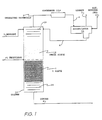
- Fig. 1 illustrates one embodiment of the present invention.
- distillation column reactor 10 is divided into two sections.
- the catalyst packing catalytic distillation structures
- Linde molecular sieve LZ-Y82 1/16" (Union Carbide Corp.) is deposited in the pockets of fiber glass belts and formed in to a helix with stainless steel mesh as described.
- Union Carbide Omega type sieve is likewise loaded into the reactor 10.
- Conventional distillation trays or structures 15 are positioned above and below the catalyst beds.
- the lower portion as well as the upper of the column may contain conventional distillation column structure (trays or inert packing) to achieve the desired final separation in the lower and upper sections of the column.
- the benzene is indicated to be introduced into the column 10 via flow line 2 into the upper bed 12 it may be conveniently added as makeup into reflux accumulator 11.
- the propylene is fed to the column via flow line 1 at about the mid point between the two catalyst beds 7 and 12 or below the lower catalyst bed (not shown) for better mixing.
- the propylene may also be fed at several points to reduce the concentration at any one location in the catalyst zone, thus reducing oligomerization as a side reaction.
- the reaction is exothermic and initiated by contacting the two reactants in the catalyst packing.
- Cumene is the principal reaction product in the Omega bed 12, however dimerized propylene is also produced along with some dipropylbenzene. Since complete separation of the reaction products and benzene does not occur in the Omega bed 12, cumene, small amounts of propylene, dimerized propylene, dipropylbenzene (tripropylbenzene is also present) and benzene flow down the column into the Y bed where any propylene and the dimerized propylene may react with the benzene to produce additional cumene and prevent formation of undesired higher boiling olefins. Additionally, the dipropylbenzene is transalkylated with unreacted benzene to produce additional cumene.
- the cumene product is higher boiling than benzene and propylene and is recovered via flow line 8 as a bottoms product.
- the feed of propylene is adjusted such that there is a molar excess of benzene in the reactor, such that the overhead 5 is primarily benzene, the propylene having been almost totally reacted.
- the overhead is passed to condenser 13 which is operated to condense substantially all of the benzene which passes via flow line 4 to accumulator 11 and hence, by reflux via flow line 6 to column 10.
- the benzene used in the reaction and lost with the lights (which exit accumulator 11 via 3) is made up by fresh benzene feed through flow line 2 or alternatively to accumulator 4 through flow line 14.
- Fig. 2 shows the embodiment wherein the Omega catalyst is in the distillation reactor as described before, except that the type Y sieve is outside of the column. A portion ( any amount up to 100%) of the mid-reflux of the column is removed via line 16 an passed through the type Y sieve then back via 17 to the lower portion of the column containing conventional distillation trays 15.
- the mole ratio of benzene to propylene in the column may be in the range of 2 to 100 : 1, preferably 2 to 50 : 1 and more desirably about 2 to 10 : 1.
- Alkylation is forced to completion, since the simultaneous and concurrent fractionation and removal of the alkylation product from the distillation column reactor does not allow the products to contribute to the reverse reaction (Le Chateliers' Principle).
- very large molar excesses of benzene require a very high reflux ratio, and a low unit productivity. In this reaction the propylene is the most volatile component and it is desirable to react it rather than have some carried off overhead.
- the presence of propylene or other lower boiling olefin in the tower with benzene will result in a small but detectable temperature depression in the tower where such lower boiling olefins are present as entities and unreacted.
- the magnitude of the temperature depression immediately above the propylene feed is a measure of the concentration of propylene in the system, that is, the larger the concentration of the propylene, the greater the depression of the temperature where the benzene and propylene are initially together and yet unreacted.
- concentration of propylene to provide a given temperature depression can be determined and plotted.
- a given ratio of propylene to benzene can be maintained in a simple and expedient manner. More significantly, the maintenance of the depression at a given temperature can assure that substantially all of the propylene will be reacted prior to the end of the catalyst bed and overhead exit, if the corresponding propylene concentration has been determined to produce that effect.
- the present alkylation reaction can be carried out at subthrough super atmospheric pressure, e.g., 0.20 to 40 atmospheres.
- the temperature will vary depending on the reactants and product.
- the temperature along the column will be as in any distillation column, the highest temperature will be in the bottom and the temperature along the column will be the boiling point of the composition at that point in the column under the particular conditions of pressure.
- the exothermic heat of reaction does not change the temperature in the column, but merely causes more boil up.
- the temperatures within the column with the above considerations in mind will generally be in the range of 50°C, e.g. 70°C to 500°C and more preferably in the range of about 80°C to 300°C at pressures of 0.5 to 20 atmospheres.
- the alkylation reaction is carried out by increasing the liquid level in the reaction distillation zone containing the Omega type molecular sieve. This is achieved by a liquid flow restrictor between the reaction distillation zone and the lower distillation zone. That is, the vapor from below may rise up to (and through) the reaction distillation zone as in a conventional or prior operation but a portion of the liquid is maintained there.
- a single distillation column reactor is used, a conventional distillation tray with the downcomer area blocked is located between the reaction distillation zone and the distillation zone.
- a by pass line for liquid flow is provided about the tray and a valve is provided in the liquid flow conduit to restrict liquid downflow and thereby to build up a liquid level above that tray just below the catalyst bed.
- a perforated plate may be used to support the catalyst and cause a liquid pressure drop in the column thus building up a level in the catalyst. If the two column system is used, then a valve or other restriction means is placed in the liquid flow line between the two columns.
- liquid level is used herein to mean an increased density of the material in the reaction distillation zone over that of a pure distillation as distinguished to a continuous liquid phase.
- the phase system as present in the reaction distillation zone is physically a froth. This is the result of the vapor traveling up through the liquid retained in the zone.
- the reactor was a 3 inch diameter pilot distillation tower having a 29 foot section packed with molecular sieve catalyst contained in glass cloth pockets twisted with demister wire as described above.
Landscapes
- Chemical & Material Sciences (AREA)
- Organic Chemistry (AREA)
- Chemical Kinetics & Catalysis (AREA)
- Engineering & Computer Science (AREA)
- Analytical Chemistry (AREA)
- Oil, Petroleum & Natural Gas (AREA)
- Water Supply & Treatment (AREA)
- Organic Low-Molecular-Weight Compounds And Preparation Thereof (AREA)
- Low-Molecular Organic Synthesis Reactions Using Catalysts (AREA)
Applications Claiming Priority (2)
| Application Number | Priority Date | Filing Date | Title |
|---|---|---|---|
| US07/385,443 US4950834A (en) | 1989-07-26 | 1989-07-26 | Alkylation of organic aromatic compounds in a dual bed system |
| US385443 | 1989-07-26 |
Publications (2)
| Publication Number | Publication Date |
|---|---|
| EP0410177A1 true EP0410177A1 (fr) | 1991-01-30 |
| EP0410177B1 EP0410177B1 (fr) | 1993-10-27 |
Family
ID=23521408
Family Applications (1)
| Application Number | Title | Priority Date | Filing Date |
|---|---|---|---|
| EP90112863A Expired - Lifetime EP0410177B1 (fr) | 1989-07-26 | 1990-07-05 | Alkylation de composés aromatiques organiques dans un système à deux lits |
Country Status (8)
| Country | Link |
|---|---|
| US (1) | US4950834A (fr) |
| EP (1) | EP0410177B1 (fr) |
| JP (1) | JPH0358945A (fr) |
| KR (1) | KR910002748A (fr) |
| CA (1) | CA2017620A1 (fr) |
| DE (1) | DE69004179T2 (fr) |
| ES (1) | ES2045663T3 (fr) |
| MY (1) | MY105783A (fr) |
Cited By (3)
| Publication number | Priority date | Publication date | Assignee | Title |
|---|---|---|---|---|
| EP0491464A3 (en) * | 1990-11-09 | 1993-06-16 | Chemical Research & Licensing Company | Aromatic alkylation process |
| CN1055455C (zh) * | 1994-08-16 | 2000-08-16 | 中国石化齐鲁石油化工公司 | 单烷基芳烃的制法及设备 |
| WO2008010942A3 (fr) * | 2006-07-19 | 2008-04-17 | Abb Lummus Global Inc | Procédé d'alkylation pour une conversion accrue et une utilisation de catalyseur réduite |
Families Citing this family (41)
| Publication number | Priority date | Publication date | Assignee | Title |
|---|---|---|---|---|
| US5118872A (en) * | 1989-03-10 | 1992-06-02 | Chemical Research & Licensing Company | Process for conducting heterogeneous chemical reactions |
| US5080871A (en) * | 1989-03-10 | 1992-01-14 | Chemical Research & Licensing Company | Apparatus for alkylation of organic aromatic compounds |
| US5043506A (en) * | 1990-09-17 | 1991-08-27 | Crossland Clifford S | Process for the alkylation of organic aromtic compounds in the presence of inert aliphatic compounds |
| US5113031A (en) * | 1990-11-09 | 1992-05-12 | Angel Sy | Aromatic alkylation process |
| US5215725A (en) * | 1990-11-09 | 1993-06-01 | Chemical Research & Licensing Company | Aromatic alkylation process |
| US5086193A (en) * | 1990-11-09 | 1992-02-04 | Chemical Research & Licensing Company | Aromatic alkylation process |
| US5149892A (en) * | 1991-10-22 | 1992-09-22 | Ppg Industries, Inc. | Chlorinated benzenes |
| FR2684893A1 (fr) * | 1991-12-16 | 1993-06-18 | Inst Francais Du Petrole | Procede de distillation reactive catalytique et appareillage pour sa mise en óoeuvre. |
| AU654757B2 (en) | 1992-02-10 | 1994-11-17 | Chemical Research & Licensing Company | Selective hydrogenation of C5 streams |
| FI96852C (fi) * | 1992-12-10 | 1996-09-10 | Neste Oy | Menetelmä ja laitteisto olefiinien oligomeroimiseksi |
| US5491277A (en) * | 1993-12-28 | 1996-02-13 | Uop | Mixed-phase solid bed hydrocarbon alkylation process |
| US5446223A (en) * | 1994-05-23 | 1995-08-29 | Chemical Research & Licensing Company | Alkylation of organic aromatic compounds |
| US5600049A (en) * | 1995-06-01 | 1997-02-04 | Chemical Research & Licensing Company | Process for depropanizing benzene |
| US5770782A (en) * | 1996-02-08 | 1998-06-23 | Huntsman Petrochemical Corporation | Process and system for alkylation of aromatic compounds |
| US6133492A (en) * | 1996-02-08 | 2000-10-17 | Huntsman Petrochemical Corporation | Alkylation of benzene to form linear alkylbenzenes using fluorine-containing mordenites |
| US5777187A (en) * | 1996-02-08 | 1998-07-07 | Huntsman Petrochemical Corporation | Two-step process for alkylation of benzene to form linear alkylbenzenes |
| US6166281A (en) * | 1996-02-08 | 2000-12-26 | Huntsman Petrochemical Corporation | Alkylation of benzene to form linear alkylbenzenes using fluorine-containing mordenites |
| US5877384A (en) * | 1996-02-12 | 1999-03-02 | The M. W. Kellogg Company | Apparatus and process for separating reaction effluent in the manufacture of cumene |
| US5847251A (en) * | 1996-02-12 | 1998-12-08 | Catalytic Distillation Technologies | Multibed transalkylator and process |
| US5856606A (en) * | 1996-09-27 | 1999-01-05 | Uop Llc | Turbulent bed solid catalyst hydrocarbon alkylation process |
| US5942456A (en) * | 1996-12-09 | 1999-08-24 | Catalytic Distillation Technologies | Multi-functional catalytic distillation structure |
| US5847249A (en) * | 1997-07-28 | 1998-12-08 | Catalytic Distillation Technologies | Apparatus and process for catalytic distillations |
| US6284104B1 (en) | 1999-03-04 | 2001-09-04 | Catalytic Distillation Technologies | Apparatus and process for hydrogenations |
| DE19936276A1 (de) * | 1999-08-02 | 2001-02-08 | Basf Ag | Vorrichtung und Verfahren zur isothermen Durchführung von heterogen katalysierten Dreiphasenreaktionen |
| US6274783B1 (en) | 2000-03-20 | 2001-08-14 | Catalytic Distillation Technologies | Catalytic distillation process for the production of C8 alkanes |
| US6555722B2 (en) | 2000-05-12 | 2003-04-29 | Catalytic Distillation Technologies | Countercurrent alkylation process |
| CN1639089A (zh) * | 2002-02-28 | 2005-07-13 | 斯东及韦伯斯特公司 | 烷基芳香族化合物的制备 |
| US6846959B2 (en) | 2002-10-07 | 2005-01-25 | Air Products And Chemicals, Inc. | Process for producing alkanolamines |
| KR100818438B1 (ko) * | 2003-03-21 | 2008-04-02 | 스톤 앤드 웹스터 인코포레이티드 | 촉매 재활성화를 통한 알킬 방향족 화합물의 생산 |
| US7722832B2 (en) * | 2003-03-25 | 2010-05-25 | Crystaphase International, Inc. | Separation method and assembly for process streams in component separation units |
| US7145049B2 (en) * | 2003-07-25 | 2006-12-05 | Catalytic Distillation Technologies | Oligomerization process |
| US7348465B2 (en) * | 2005-02-08 | 2008-03-25 | Shell Oil Company | Selective alkylation of aromatic hydrocarbons |
| US20070270623A1 (en) * | 2006-04-28 | 2007-11-22 | Fina Technology, Inc. | Alkylation reaction vessel |
| US7476637B1 (en) * | 2007-07-19 | 2009-01-13 | Catalytic Distillation Technologies | Coated catalyst for aromatic alkylation |
| EP2110368A1 (fr) | 2008-04-18 | 2009-10-21 | Total Petrochemicals France | Alkylation de substrats aromatiques et procédé de transalkylation |
| US9150469B2 (en) * | 2009-05-18 | 2015-10-06 | Uop Llc | Aromatic alkylation process with reduced byproduct formation |
| US10744426B2 (en) | 2015-12-31 | 2020-08-18 | Crystaphase Products, Inc. | Structured elements and methods of use |
| US10054140B2 (en) | 2016-02-12 | 2018-08-21 | Crystaphase Products, Inc. | Use of treating elements to facilitate flow in vessels |
| RS63920B1 (sr) | 2018-04-11 | 2023-02-28 | Lummus Technology Inc | Strukturirano pakovanje za katalitičku destilaciju |
| MX2022007367A (es) | 2019-12-20 | 2022-07-12 | Crystaphase Products Inc | Resaturacion de gas en una corriente de alimentacion liquida. |
| CA3192003A1 (fr) | 2020-09-09 | 2022-03-17 | Crystaphase Products, Inc. | Zones d'entree de recipient de traitement |
Citations (4)
| Publication number | Priority date | Publication date | Assignee | Title |
|---|---|---|---|---|
| EP0007126A1 (fr) * | 1978-07-06 | 1980-01-23 | Union Carbide Corporation | Procédé de synthèse du cumène |
| US4443559A (en) * | 1981-09-30 | 1984-04-17 | Chemical Research & Licensing Company | Catalytic distillation structure |
| EP0189683A1 (fr) * | 1985-01-07 | 1986-08-06 | CHEMICAL RESEARCH & LICENSING COMPANY | Alkylation de composés aromatiques organiques |
| US4774377A (en) * | 1987-09-11 | 1988-09-27 | Uop Inc. | Alkylation/transalkylation process |
Family Cites Families (12)
| Publication number | Priority date | Publication date | Assignee | Title |
|---|---|---|---|---|
| US3851004A (en) * | 1973-09-27 | 1974-11-26 | Union Carbide Corp | Hydrocarbon alkylation process using catalyst regeneration |
| US4049739A (en) * | 1975-06-16 | 1977-09-20 | Uop Inc. | Simulated moving bed alkylation process |
| US4242530A (en) * | 1978-07-27 | 1980-12-30 | Chemical Research & Licensing Company | Process for separating isobutene from C4 streams |
| US4215011A (en) * | 1979-02-21 | 1980-07-29 | Chemical Research And Licensing Company | Catalyst system for separating isobutene from C4 streams |
| US4232177A (en) * | 1979-02-21 | 1980-11-04 | Chemical Research & Licensing Company | Catalytic distillation process |
| US4302356A (en) * | 1978-07-27 | 1981-11-24 | Chemical Research & Licensing Co. | Process for separating isobutene from C4 streams |
| US4307254A (en) * | 1979-02-21 | 1981-12-22 | Chemical Research & Licensing Company | Catalytic distillation process |
| US4336407A (en) * | 1980-02-25 | 1982-06-22 | Chemical Research & Licensing Company | Catalytic distillation process |
| US4439350A (en) * | 1982-06-21 | 1984-03-27 | Chemical Research & Licensing Company | Contact structure for use in catalytic distillation |
| US4482775A (en) * | 1982-09-22 | 1984-11-13 | Chemical Research & Licensing Company | Isomerization of C4 alkenes |
| US4876408A (en) * | 1986-12-19 | 1989-10-24 | Union Oil Company Of California | Alkylation process using a catalyst having an increased selectivity for monoalkylation |
| US4849569A (en) * | 1987-11-16 | 1989-07-18 | Chemical Research & Licensing Company | Alkylation of organic aromatic compounds |
-
1989
- 1989-07-26 US US07/385,443 patent/US4950834A/en not_active Expired - Fee Related
-
1990
- 1990-05-28 CA CA002017620A patent/CA2017620A1/fr not_active Abandoned
- 1990-05-31 MY MYPI90000908A patent/MY105783A/en unknown
- 1990-07-02 KR KR1019900009945A patent/KR910002748A/ko not_active Withdrawn
- 1990-07-05 DE DE69004179T patent/DE69004179T2/de not_active Expired - Fee Related
- 1990-07-05 ES ES90112863T patent/ES2045663T3/es not_active Expired - Lifetime
- 1990-07-05 EP EP90112863A patent/EP0410177B1/fr not_active Expired - Lifetime
- 1990-07-11 JP JP2183870A patent/JPH0358945A/ja active Pending
Patent Citations (4)
| Publication number | Priority date | Publication date | Assignee | Title |
|---|---|---|---|---|
| EP0007126A1 (fr) * | 1978-07-06 | 1980-01-23 | Union Carbide Corporation | Procédé de synthèse du cumène |
| US4443559A (en) * | 1981-09-30 | 1984-04-17 | Chemical Research & Licensing Company | Catalytic distillation structure |
| EP0189683A1 (fr) * | 1985-01-07 | 1986-08-06 | CHEMICAL RESEARCH & LICENSING COMPANY | Alkylation de composés aromatiques organiques |
| US4774377A (en) * | 1987-09-11 | 1988-09-27 | Uop Inc. | Alkylation/transalkylation process |
Cited By (6)
| Publication number | Priority date | Publication date | Assignee | Title |
|---|---|---|---|---|
| EP0491464A3 (en) * | 1990-11-09 | 1993-06-16 | Chemical Research & Licensing Company | Aromatic alkylation process |
| CN1055455C (zh) * | 1994-08-16 | 2000-08-16 | 中国石化齐鲁石油化工公司 | 单烷基芳烃的制法及设备 |
| WO2008010942A3 (fr) * | 2006-07-19 | 2008-04-17 | Abb Lummus Global Inc | Procédé d'alkylation pour une conversion accrue et une utilisation de catalyseur réduite |
| US7632974B2 (en) | 2006-07-19 | 2009-12-15 | Lammus Technology Inc. | Alkylation process for increased conversion and reduced catalyst use |
| US8110161B2 (en) | 2006-07-19 | 2012-02-07 | Lummus Technology Inc. | Alkylation process for increased conversion and reduced catalyst use |
| CN101516810B (zh) * | 2006-07-19 | 2013-07-10 | 鲁姆斯科技公司 | 用于提高转化率和降低催化剂使用量的烷基化方法 |
Also Published As
| Publication number | Publication date |
|---|---|
| DE69004179T2 (de) | 1994-05-19 |
| MY105783A (en) | 1995-01-30 |
| KR910002748A (ko) | 1991-02-26 |
| CA2017620A1 (fr) | 1991-01-26 |
| ES2045663T3 (es) | 1994-01-16 |
| DE69004179D1 (de) | 1993-12-02 |
| US4950834A (en) | 1990-08-21 |
| EP0410177B1 (fr) | 1993-10-27 |
| JPH0358945A (ja) | 1991-03-14 |
Similar Documents
| Publication | Publication Date | Title |
|---|---|---|
| EP0410177B1 (fr) | Alkylation de composés aromatiques organiques dans un système à deux lits | |
| US5055627A (en) | Process for the preparation of cumene | |
| US5476978A (en) | Process for the preparation of ethyl benzene | |
| US5446223A (en) | Alkylation of organic aromatic compounds | |
| US4849569A (en) | Alkylation of organic aromatic compounds | |
| US5043506A (en) | Process for the alkylation of organic aromtic compounds in the presence of inert aliphatic compounds | |
| US5243115A (en) | Alkylation of organic aromatic compounds | |
| US5019669A (en) | Alkylation of organic aromatic compounds | |
| US5176883A (en) | Alkylation of organic aromatic compounds | |
| EP0407038B1 (fr) | Procédé pour la préparation d'éthers dialkyliques | |
| EP1606234B1 (fr) | Procede de fabrication d'alkylbenzene | |
| EP0415310A2 (fr) | Procédé pour la fabrication d'alcools tertiaires | |
| US5866736A (en) | Process for the production of alkyl benzene | |
| US5321181A (en) | Alkylation of organic aromatic compounds | |
| EP0390596B1 (fr) | Procédé combiné d'étherification et d'alcoylation | |
| EP0189683B1 (fr) | Alkylation de composés aromatiques organiques | |
| EP0927147B1 (fr) | Alkylation de composes aromatiques organiques au moyen d'un catalyseur zeolitique beta | |
| US5080871A (en) | Apparatus for alkylation of organic aromatic compounds | |
| US5847251A (en) | Multibed transalkylator and process | |
| US6555722B2 (en) | Countercurrent alkylation process | |
| KR100259780B1 (ko) | 큐멘 및 에틸 벤젠의 제조 방법 | |
| EP0438278B1 (fr) | Procédé d'amélioration du nombre d'octane | |
| Arganbright et al. | Alkylation of organic aromatic compounds | |
| WO1999003804A9 (fr) | Procede d'alkylation a contre-courant | |
| MXPA99002060A (en) | Alkylation of organic aromatic compounds using beta zeolite catalyst |
Legal Events
| Date | Code | Title | Description |
|---|---|---|---|
| PUAI | Public reference made under article 153(3) epc to a published international application that has entered the european phase |
Free format text: ORIGINAL CODE: 0009012 |
|
| AK | Designated contracting states |
Kind code of ref document: A1 Designated state(s): BE DE ES FR GB IT NL SE |
|
| 17P | Request for examination filed |
Effective date: 19910725 |
|
| 17Q | First examination report despatched |
Effective date: 19930329 |
|
| GRAA | (expected) grant |
Free format text: ORIGINAL CODE: 0009210 |
|
| ITF | It: translation for a ep patent filed | ||
| AK | Designated contracting states |
Kind code of ref document: B1 Designated state(s): BE DE ES FR GB IT NL SE |
|
| REF | Corresponds to: |
Ref document number: 69004179 Country of ref document: DE Date of ref document: 19931202 |
|
| REG | Reference to a national code |
Ref country code: ES Ref legal event code: FG2A Ref document number: 2045663 Country of ref document: ES Kind code of ref document: T3 |
|
| ET | Fr: translation filed | ||
| PGFP | Annual fee paid to national office [announced via postgrant information from national office to epo] |
Ref country code: FR Payment date: 19940613 Year of fee payment: 5 |
|
| PGFP | Annual fee paid to national office [announced via postgrant information from national office to epo] |
Ref country code: SE Payment date: 19940614 Year of fee payment: 5 |
|
| PGFP | Annual fee paid to national office [announced via postgrant information from national office to epo] |
Ref country code: GB Payment date: 19940620 Year of fee payment: 5 |
|
| PGFP | Annual fee paid to national office [announced via postgrant information from national office to epo] |
Ref country code: DE Payment date: 19940623 Year of fee payment: 5 |
|
| PGFP | Annual fee paid to national office [announced via postgrant information from national office to epo] |
Ref country code: BE Payment date: 19940705 Year of fee payment: 5 |
|
| PGFP | Annual fee paid to national office [announced via postgrant information from national office to epo] |
Ref country code: ES Payment date: 19940708 Year of fee payment: 5 |
|
| PGFP | Annual fee paid to national office [announced via postgrant information from national office to epo] |
Ref country code: NL Payment date: 19940731 Year of fee payment: 5 |
|
| PLBE | No opposition filed within time limit |
Free format text: ORIGINAL CODE: 0009261 |
|
| STAA | Information on the status of an ep patent application or granted ep patent |
Free format text: STATUS: NO OPPOSITION FILED WITHIN TIME LIMIT |
|
| 26N | No opposition filed | ||
| EAL | Se: european patent in force in sweden |
Ref document number: 90112863.7 |
|
| PG25 | Lapsed in a contracting state [announced via postgrant information from national office to epo] |
Ref country code: GB Effective date: 19950705 |
|
| PG25 | Lapsed in a contracting state [announced via postgrant information from national office to epo] |
Ref country code: SE Effective date: 19950706 Ref country code: ES Free format text: LAPSE BECAUSE OF THE APPLICANT RENOUNCES Effective date: 19950706 |
|
| PG25 | Lapsed in a contracting state [announced via postgrant information from national office to epo] |
Ref country code: BE Effective date: 19950731 |
|
| BERE | Be: lapsed |
Owner name: CHEMICAL RESEARCH & LICENSING CY Effective date: 19950731 |
|
| PG25 | Lapsed in a contracting state [announced via postgrant information from national office to epo] |
Ref country code: NL Effective date: 19960201 |
|
| GBPC | Gb: european patent ceased through non-payment of renewal fee |
Effective date: 19950705 |
|
| NLV4 | Nl: lapsed or anulled due to non-payment of the annual fee |
Effective date: 19960201 |
|
| PG25 | Lapsed in a contracting state [announced via postgrant information from national office to epo] |
Ref country code: DE Effective date: 19960402 |
|
| EUG | Se: european patent has lapsed |
Ref document number: 90112863.7 |
|
| PG25 | Lapsed in a contracting state [announced via postgrant information from national office to epo] |
Ref country code: FR Effective date: 19960430 |
|
| REG | Reference to a national code |
Ref country code: FR Ref legal event code: ST |
|
| REG | Reference to a national code |
Ref country code: FR Ref legal event code: ST |
|
| REG | Reference to a national code |
Ref country code: FR Ref legal event code: ST |
|
| REG | Reference to a national code |
Ref country code: ES Ref legal event code: FD2A Effective date: 19991102 |
|
| PG25 | Lapsed in a contracting state [announced via postgrant information from national office to epo] |
Ref country code: IT Free format text: LAPSE BECAUSE OF NON-PAYMENT OF DUE FEES;WARNING: LAPSES OF ITALIAN PATENTS WITH EFFECTIVE DATE BEFORE 2007 MAY HAVE OCCURRED AT ANY TIME BEFORE 2007. THE CORRECT EFFECTIVE DATE MAY BE DIFFERENT FROM THE ONE RECORDED. Effective date: 20050705 |