EP0410792A2 - Zweistufiges Verfahren zum Herstellen starker, dünner Schlauchblasfolien - Google Patents
Zweistufiges Verfahren zum Herstellen starker, dünner Schlauchblasfolien Download PDFInfo
- Publication number
- EP0410792A2 EP0410792A2 EP90308277A EP90308277A EP0410792A2 EP 0410792 A2 EP0410792 A2 EP 0410792A2 EP 90308277 A EP90308277 A EP 90308277A EP 90308277 A EP90308277 A EP 90308277A EP 0410792 A2 EP0410792 A2 EP 0410792A2
- Authority
- EP
- European Patent Office
- Prior art keywords
- film
- bubble
- hot
- blown
- pinch rolls
- Prior art date
- Legal status (The legal status is an assumption and is not a legal conclusion. Google has not performed a legal analysis and makes no representation as to the accuracy of the status listed.)
- Granted
Links
Images

Classifications
-
- B—PERFORMING OPERATIONS; TRANSPORTING
- B32—LAYERED PRODUCTS
- B32B—LAYERED PRODUCTS, i.e. PRODUCTS BUILT-UP OF STRATA OF FLAT OR NON-FLAT, e.g. CELLULAR OR HONEYCOMB, FORM
- B32B37/00—Methods or apparatus for laminating, e.g. by curing or by ultrasonic bonding
- B32B37/14—Methods or apparatus for laminating, e.g. by curing or by ultrasonic bonding characterised by the properties of the layers
- B32B37/15—Methods or apparatus for laminating, e.g. by curing or by ultrasonic bonding characterised by the properties of the layers with at least one layer being manufactured and immediately laminated before reaching its stable state, e.g. in which a layer is extruded and laminated while in semi-molten state
- B32B37/153—Methods or apparatus for laminating, e.g. by curing or by ultrasonic bonding characterised by the properties of the layers with at least one layer being manufactured and immediately laminated before reaching its stable state, e.g. in which a layer is extruded and laminated while in semi-molten state at least one layer is extruded and immediately laminated while in semi-molten state
-
- B—PERFORMING OPERATIONS; TRANSPORTING
- B29—WORKING OF PLASTICS; WORKING OF SUBSTANCES IN A PLASTIC STATE IN GENERAL
- B29C—SHAPING OR JOINING OF PLASTICS; SHAPING OF MATERIAL IN A PLASTIC STATE, NOT OTHERWISE PROVIDED FOR; AFTER-TREATMENT OF THE SHAPED PRODUCTS, e.g. REPAIRING
- B29C55/00—Shaping by stretching, e.g. drawing through a die; Apparatus therefor
- B29C55/28—Shaping by stretching, e.g. drawing through a die; Apparatus therefor of blown tubular films, e.g. by inflation
-
- B—PERFORMING OPERATIONS; TRANSPORTING
- B29—WORKING OF PLASTICS; WORKING OF SUBSTANCES IN A PLASTIC STATE IN GENERAL
- B29C—SHAPING OR JOINING OF PLASTICS; SHAPING OF MATERIAL IN A PLASTIC STATE, NOT OTHERWISE PROVIDED FOR; AFTER-TREATMENT OF THE SHAPED PRODUCTS, e.g. REPAIRING
- B29C55/00—Shaping by stretching, e.g. drawing through a die; Apparatus therefor
- B29C55/30—Drawing through a die
-
- B—PERFORMING OPERATIONS; TRANSPORTING
- B32—LAYERED PRODUCTS
- B32B—LAYERED PRODUCTS, i.e. PRODUCTS BUILT-UP OF STRATA OF FLAT OR NON-FLAT, e.g. CELLULAR OR HONEYCOMB, FORM
- B32B27/00—Layered products comprising a layer of synthetic resin
- B32B27/06—Layered products comprising a layer of synthetic resin as the main or only constituent of a layer, which is next to another layer of the same or of a different material
- B32B27/08—Layered products comprising a layer of synthetic resin as the main or only constituent of a layer, which is next to another layer of the same or of a different material of synthetic resin
-
- B—PERFORMING OPERATIONS; TRANSPORTING
- B32—LAYERED PRODUCTS
- B32B—LAYERED PRODUCTS, i.e. PRODUCTS BUILT-UP OF STRATA OF FLAT OR NON-FLAT, e.g. CELLULAR OR HONEYCOMB, FORM
- B32B27/00—Layered products comprising a layer of synthetic resin
- B32B27/30—Layered products comprising a layer of synthetic resin comprising vinyl (co)polymers; comprising acrylic (co)polymers
- B32B27/306—Layered products comprising a layer of synthetic resin comprising vinyl (co)polymers; comprising acrylic (co)polymers comprising vinyl acetate or vinyl alcohol (co)polymers
-
- B—PERFORMING OPERATIONS; TRANSPORTING
- B32—LAYERED PRODUCTS
- B32B—LAYERED PRODUCTS, i.e. PRODUCTS BUILT-UP OF STRATA OF FLAT OR NON-FLAT, e.g. CELLULAR OR HONEYCOMB, FORM
- B32B27/00—Layered products comprising a layer of synthetic resin
- B32B27/32—Layered products comprising a layer of synthetic resin comprising polyolefins
-
- B—PERFORMING OPERATIONS; TRANSPORTING
- B32—LAYERED PRODUCTS
- B32B—LAYERED PRODUCTS, i.e. PRODUCTS BUILT-UP OF STRATA OF FLAT OR NON-FLAT, e.g. CELLULAR OR HONEYCOMB, FORM
- B32B27/00—Layered products comprising a layer of synthetic resin
- B32B27/32—Layered products comprising a layer of synthetic resin comprising polyolefins
- B32B27/322—Layered products comprising a layer of synthetic resin comprising polyolefins comprising halogenated polyolefins, e.g. PTFE
-
- B—PERFORMING OPERATIONS; TRANSPORTING
- B29—WORKING OF PLASTICS; WORKING OF SUBSTANCES IN A PLASTIC STATE IN GENERAL
- B29K—INDEXING SCHEME ASSOCIATED WITH SUBCLASSES B29B, B29C OR B29D, RELATING TO MOULDING MATERIALS OR TO MATERIALS FOR MOULDS, REINFORCEMENTS, FILLERS OR PREFORMED PARTS, e.g. INSERTS
- B29K2023/00—Use of polyalkenes or derivatives thereof as moulding material
- B29K2023/04—Polymers of ethylene
- B29K2023/06—PE, i.e. polyethylene
-
- B—PERFORMING OPERATIONS; TRANSPORTING
- B29—WORKING OF PLASTICS; WORKING OF SUBSTANCES IN A PLASTIC STATE IN GENERAL
- B29K—INDEXING SCHEME ASSOCIATED WITH SUBCLASSES B29B, B29C OR B29D, RELATING TO MOULDING MATERIALS OR TO MATERIALS FOR MOULDS, REINFORCEMENTS, FILLERS OR PREFORMED PARTS, e.g. INSERTS
- B29K2023/00—Use of polyalkenes or derivatives thereof as moulding material
- B29K2023/04—Polymers of ethylene
- B29K2023/08—Copolymers of ethylene
- B29K2023/083—EVA, i.e. ethylene vinyl acetate copolymer
-
- B—PERFORMING OPERATIONS; TRANSPORTING
- B29—WORKING OF PLASTICS; WORKING OF SUBSTANCES IN A PLASTIC STATE IN GENERAL
- B29K—INDEXING SCHEME ASSOCIATED WITH SUBCLASSES B29B, B29C OR B29D, RELATING TO MOULDING MATERIALS OR TO MATERIALS FOR MOULDS, REINFORCEMENTS, FILLERS OR PREFORMED PARTS, e.g. INSERTS
- B29K2025/00—Use of polymers of vinyl-aromatic compounds or derivatives thereof as moulding material
-
- B—PERFORMING OPERATIONS; TRANSPORTING
- B32—LAYERED PRODUCTS
- B32B—LAYERED PRODUCTS, i.e. PRODUCTS BUILT-UP OF STRATA OF FLAT OR NON-FLAT, e.g. CELLULAR OR HONEYCOMB, FORM
- B32B2553/00—Packaging equipment or accessories not otherwise provided for
Definitions
- the present invention pertains to packaging film, and more particularly to a thin polymeric film suitable for replacing polyvinyl chloride film especially in packaging applications.
- PVC Polyvinyl chloride
- PVC has several desirable properties for this use. For example, it has excellent optics and good elasticity and stretch properties at use temperatures.
- PVC also has several disadvantages, including the production of hydrogen chloride gas during heat sealing and the generally corrosive effects of such gases in the packaging room.
- a relatively thin polymeric film preferably a polyolefin, and more preferably very low density polyethylene (VLDPE), produced by hot blowing and then stretch orienting the extruded film, exhibits excellent elasticity, toughness, stretch and optical properties.
- VLDPE very low density polyethylene
- the U. S. Patent No. 3,456,044 mentions thin films of thicknesses less than 1 mil such as 0.5 mils, and discloses a double bubble method for biaxially orienting thermoplastic films including the steps of producing a primary tubing which is inflated by introducing air into the interior thereof, and a cooling ring 22, as well as squeeze rolls 34 and 28, with rolls 34 having a greater speed than rolls 28. Between the two pairs of squeeze rolls is a reinflated secondary bubble. If annealing is desired, the tubing can be reinflated to form a bubble 70.
- a method of making a thin, oriented polymeric film comprises extruding the polymer as a melt stream through a tubular die; hot blowing the extruded film; heating the hot blown film to a temperature above its orientation temperature; directing the heated film through a first set of pinch rolls; reinflating the hot blown film by a blown bubble process; and collapsing the reinflated film through a second set of pinch rolls.
- a thin, oriented polymeric film useful as a packaging film is made by the steps of extruding the polymer as a melt stream through a tubular die; hot blowing the extruded film; heating the hot blown film to a temperature above its orientation temperature; directing the heated film through a first set of pinch rolls; reinflating the hot blown film by a blown bubble process; and collapsing the reinflated film through a second set of pinch rolls.
- a thin oriented packaging film comprises a layer of very low density polyethylene, the film having a thickness of less than about 1 mil.
- an apparatus for making thin, oriented polymeric film comprises means for extruding the polymer as a melt stream through a tubular die; means for hot blowing the extruded film to form a primary bubble; means for heating the hot blown film to a temperature above its orientation temperature; a first set of pinch rolls through which the heated film is directed; a second set of pinch rolls by means of which the heated film, after reinflation by a blown bubble process, is collapsed; and means for circulating a heated liquid to and from a reservoir disposed at the lower end of the primary bubble.
- polyolefin is used herein in its strict strictlyer sense to mean a thermoplastic polymer derived from simple olefins. Among these are polyethylene, polypropylene and copolymers thereof with olefinic comonomers. For example, very low density polyethylene may be considered a linear ethylene copolymer with a comonomer comprising such materials as butene, hexene or octene.
- polyolefin is also used herein in a broader sense to include copolymers of ethylene with comonomers that are not themselves olefins, such as vinyl acetate (e.g. ethylene vinyl acetate copolymer or EVA).
- VLDPE very low density polyethylene
- ethylene vinyl acetate copolymer refers to a copolymer formed from ethylene and vinyl acetate monomers wherein the ethylene derived units are present in major amounts and the vinyl acetate derived units are present in minor amounts, generally one to 30 percent by weight.
- Figure 1 shows schematically a device 10 for making the thin films of the present invention.
- a melt stream of a polymeric material preferably a material such as VLDPE is extruded through an extruder (not shown) and exits through a die 12 in a conventional manner.
- the extruded film is hot blown by conventional techniques to form a blown bubble 14.
- Air cooling ring 16 positioned circumferentially around the blown bubble at the position shown cools the thermoplastic melt as it exits die 12.
- An optional auxiliary chilling ring 17 may also be positioned circumferentially around the blown bubble down stream from air cooling ring 16 to further chill the hot blown film.
- the primary bubble 14 is melt oriented in both the machine and transverse directions. Various blow up ratios may be used, but preferably the primary bubble 14 is hot blown to a blow up ratio of between 1.5 and 3.0.
- the primary bubble 14 is collapsed at pinch rolls 16a.
- guide plates 18 are positioned at the extremities of the blown bubble 14.
- the collapsed bubble is then reinflated in a blown bubble process to stretch orient the blown and collapsed film. This is done in a conventional manner by trapping air or other hot gas within the secondary bubble 20 so that the material stretches at its orientation temperature transversely to impart further orientation of the material in the transverse direction.
- the secondary bubble 20 is collapsed at a second set of pinch rolls 22.
- a second set of guide plates 24 may be employed to assist in the collapsing process.
- the second set of pinch rolls 22 is rotated at a speed faster than the first set of pinch rolls 16a to impart stretch orientation in the machine or longitudinal direction to the thermoplastic material.
- the recollapsed bubble 20 then passes from the second set of pinch rolls 22 to take up roll 26.
- the take up roll 26 may be a mill log which can be immediately stored or shipped to a distributor or customer, or may be stored for further processing such as slitting into single wound film, machine or natural center fold film.
- the take up roll 26 represents any further processing, storage, or further modification of the double wound, collapsed film once it exits the second set of pinch rolls 22, and is used herein to denote any of these possible further processing steps.
- a reservoir 28 of heated fluid be disposed at the lower end of primary bubble 14 in such a way that the collapsing material drawn through the primary set of pinch rolls 16a will pass in communication with the heated fluid. In this manner, the film is more uniformly heated and temperature control can be achieved. Thickened tape edges can be substantially avoided by such means.
- the heated fluid of reservoir 28 is preferively hot water
- other media may be used if temperatures above the 212°F limit of hot water are desired.
- propylene glycol a food approved material
- hot oil a hot emulsions may be used.
- the exact nature of the heated fluid is not as critical as its effectiveness in helping to uniformly heat the collapsing bubble 14 as it is drawn through pinch rolls 16a, and to uniformly heat the collapsing bubble 14 to a temperature above its orientation temperature.
- the heated fluid may also be an "active" substance which not only reheats the surrounding film, but also actually coats the interior of the bubble as it passes over the reservoir.
- An example is a hot wax or other functional coating.
- the heated fluid may be recirculated from the reservoir through a heating means 30 by means of conduits 32 or other suitable transfer means.
- a heating means 30 by means of conduits 32 or other suitable transfer means.
- the types of materials which may be effectively used in the present process and device are increased. These materials fall generally into three classes.
- the first class consists of crystalline polymers which can be quenched to the amorphous state by either air or an external cooling mandrel of the types depicted schematically at 16 and 17 of Figure 1.
- Examples of such materials are polyethylene terephthalate, saran, and polypropylene.
- hot water is a suitable liquid medium for use in reservoir 28.
- polypropylene a higher temperature liquid medium is preferred.
- a second class of materials suitable for the present process are amorphous polymers such as polyethylene terephthalate glycol (PETG), polystyrene, and polycarbonate.
- PETG polyethylene terephthalate glycol
- polystyrene polystyrene
- polycarbonate a polycarbonate
- hot water is a suitable liquid medium for reservoir 28.
- Higher temperature liquid media are preferred for polystyrene and polycarbonate.
- a third class of materials which can be used with the present process are crystalline polymers which are not quenched amorphous by using air or external mandrel means.
- An example is high density polyethylene.
- a temperature of at least about 240°F for the medium of reservoir 28 is required to melt out most of the crystalline structure of HDPE material.
- a major advantage of this process and device of the present invention is that a variety of polyolefinic materials may be made into relatively thin, oriented, tough materials suitable for packaging applications such as in store tray overwrap.
- Film gauges of less than 1 mil, and preferably less than .6 mils, even more preferably less than .5 mils and as low as 0.3 or .2 mils or less are obtainable. Even films with thicknesses as low as .1 mils or lower can be made by the practice of the present invention.
- multilayer films may also be produced. This is both technically possible and also sometimes desirable depending on the nature of the monolayer film.
- a VLDPE available from Union Carbide and sold under the designation DFDA 1138 is a desirable material from a performance point of view.
- outer layers of a food approved material such as EVA may be used to "sandwich" the VLDPE or other core material.
- coextrusion techniques commonly available in the art may be employed.
- a central melt stream of very low density polyethylene (DFDA 1138 available from Union Carbide) and outside melt streams of an EVA (Elvax 3130 available from du Pont) were coextruded through a coextrusion die and hot blown to a blow up ratio of 1.78.
- the hot blown film had a thickness of 2 mils.
- the hot blown film was collapsed at a first set of pinch rolls and then inflated between the first set of pinch rolls and a second set of pinch rolls.
- the secondary bubble did not impart any substantial transverse orientation to the film material.
- the machine direction orientation was increased by speeding up the second set of pinch rolls relative to the first set of pinch rolls.
- the speed of the first set of pinch rolls was 36 feet per minute.
- the speed of the second set of pinch rolls was 180 feet per minute.
- the result was a stable bubble with no transverse expansion and 5:1 machine direction expansion to produce a final film with a thickness of .4 mils.
- a film was produced substantially like that of Example 1, with the same conditions for the primary bubble (hot blown film).
- the secondary bubble was inflated from 28 inch lay flat width to 46 inch lay flat width with transverse expansion of 1.64:1.
- the speed of the second set of pinch rolls was 108 feet per minute to effect a machine direction expansion of the secondary bubble of 3:1.
- the film collected had cold thick edges because of lack of temperature control, but the center had a gauge thickness of .20 mils.
- Example 2 The .20 mil film of Example 2 was used to package cut beef in a foam tray.
- the film exhibited strength and stretch characteristics approaching the characteristics of .60 mil stretch PVC.
- Hot wire cutting was similar to the PVC, but sealing required a heat-cool cycle to prevent the tabs from shrinking.
- the film when the heated hot blown film is collapsed through nip roll 16a and expanded into secondary bubble 20, the film can be either monoaxially or biaxially stretched. Stretching in the machine direction can be from ratios of 1:1 to 9:1. In the transverse direction, stretching ratios may range from 1:1 to 5:1. Any combination of ranges within those just described is possible. For example, the film may be essentially unstretched in the machine direction (1:1) and biaxially stretched at a 3:1 ratio in the transverse direction. The reverse is also true.
- the degree of transverse direction or machine direction stretching in secondary bubble 20 is substantially independent of the blow ratio in primary bubble 14, so that many combinations of blow up ratios in the primary and secondary bubble are achievable.
- more stress higher bubble pressure
- higher blow up ratios in the primary bubble will make it easier to orient a given material in the secondary bubble.
- a liquid reservoir or "sock" containing heated water, located at the lower interior portion of the hot blown primary bubble (see reference numeral 28 of Figure 1) was used to control the temperature of the hot blown film prior to re-inflation into the second bubble. More specifically, the heated water was maintained at temperatures between 183°F and 204°F to raise the temperature of the hot blown film to above its orientation temperature.
- the liquid reservoir not only brings the temperature of the hot blown film up to its orientation temperature, but also equilibrates the temperature of the film around the circumference of the bubble. This in turn provides for better control of the final film gauge, and in particular reduces the incidence of thickened edges in the final film.
- Table 2 a list of the film structures produced, and the blow up ratios in the primary and secondary bubble are listed. The thickness of the final film, and temperature of the heated water inside the reservoir are also listed.
- Table 3 describes materials utilized in Examples 18-50. Other materials used in Examples 18-50 are listed and described in Table 1.
- DU PONT EVA5 ELVAX 3170 EVA18%VA MELT INDEX 2.5 grams/10 min.
- DUPONT EVA6 ELVAX 3182 EVA28%VA MELT INDEX 3.0 grams/10 min.
- DU PONT EVA7 ELVAX 3508 EVA12% VA MELT INDEX .3 grams/10 min.
- Table 6 a list of additional film structures produced, and a blow up ratio in the primary and secondary bubble are listed. The thickness of the final film, and temperature of the heated water inside the reservoir are also listed.
- the inventor has found that materials with high molecular weight and wide molecular weight distribution are preferred for the core layer of multilayer film structures in accordance with the invention. These materials, particularly VLDPE, are also characterized by low crystallinity at processing temperatures.
- the oriented film produced by the process of the present invention has a relatively high free shrink and shrink force.
- a typical free shrink value for the film of the present invention is 50%.
- the material exiting the secondary bubble may be annealed or heat set by means of a tertiary bubble. This bubble may be characterized as one of intermediate pressure, compared with the relatively high pressure secondary bubble, and the relatively low pressure primary bubble.
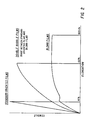
- Films produced by the present double bubble process can be graphically characterized as shown in Fig.2. Because of the nature of the process, a thin film is produced that has excellent "memory" combined with good elongation. This combination of properties compares favorably with conventionally oriented film,which has good memory but poor elongation properties. The present film also compares favorably with conventional hot blown films which exhibit good elongation but poor memory.
Landscapes
- Engineering & Computer Science (AREA)
- Mechanical Engineering (AREA)
- Shaping By String And By Release Of Stress In Plastics And The Like (AREA)
- Extrusion Moulding Of Plastics Or The Like (AREA)
- Laminated Bodies (AREA)
- Manufacture Of Macromolecular Shaped Articles (AREA)
Applications Claiming Priority (4)
| Application Number | Priority Date | Filing Date | Title |
|---|---|---|---|
| US38705689A | 1989-07-28 | 1989-07-28 | |
| US387056 | 1989-07-28 | ||
| US49469990A | 1990-03-16 | 1990-03-16 | |
| US494699 | 1990-03-16 |
Publications (3)
| Publication Number | Publication Date |
|---|---|
| EP0410792A2 true EP0410792A2 (de) | 1991-01-30 |
| EP0410792A3 EP0410792A3 (en) | 1992-03-11 |
| EP0410792B1 EP0410792B1 (de) | 1995-04-12 |
Family
ID=27011731
Family Applications (1)
| Application Number | Title | Priority Date | Filing Date |
|---|---|---|---|
| EP90308277A Expired - Lifetime EP0410792B1 (de) | 1989-07-28 | 1990-07-27 | Zweistufiges Verfahren zum Herstellen starker, dünner Schlauchblasfolien |
Country Status (18)
| Country | Link |
|---|---|
| EP (1) | EP0410792B1 (de) |
| JP (1) | JP2862648B2 (de) |
| KR (1) | KR0180533B1 (de) |
| CN (1) | CN1049311A (de) |
| AR (1) | AR248235A1 (de) |
| AT (1) | ATE121008T1 (de) |
| AU (3) | AU643691B2 (de) |
| BR (1) | BR9003666A (de) |
| CA (1) | CA2015153C (de) |
| DE (1) | DE69018537T2 (de) |
| DK (1) | DK0410792T3 (de) |
| ES (1) | ES2071027T3 (de) |
| HK (1) | HK1996A (de) |
| IL (1) | IL95016A (de) |
| MX (1) | MXPA95005376A (de) |
| MY (1) | MY107124A (de) |
| NZ (1) | NZ234429A (de) |
| PH (1) | PH31570A (de) |
Cited By (12)
| Publication number | Priority date | Publication date | Assignee | Title |
|---|---|---|---|---|
| US5272016A (en) * | 1992-03-23 | 1993-12-21 | Viskase Corporation | Multilayer stretch/shrink film |
| US5279872A (en) * | 1992-03-23 | 1994-01-18 | Viskase Corporation | Multilayer stretch/shrink film |
| US5283128A (en) * | 1992-03-23 | 1994-02-01 | Viskase Corporation | Biaxially oriented heat shrinkable film |
| US5326602A (en) * | 1992-12-01 | 1994-07-05 | Union Carbide Chemicals & Plastics Technology Corporation | Polyethylene blends |
| EP0712714A1 (de) * | 1994-11-21 | 1996-05-22 | Bollore Technologies | Wärmeschrumpfbare, biaxial orientierte, ultradünne Folie und Verfahren zu ihrer Herstellung |
| EP1147877A3 (de) * | 2000-04-17 | 2002-12-18 | Macro Engineering & Technology Inc. | Verfahren zur Herstellung einer Streckfolie |
| EP1368229A4 (de) * | 2001-01-11 | 2004-07-21 | Pechiney Emballage Flexible Eu | Wärmeschrumpfbare beutel mit sperre und antiblockadditiven |
| EP1707338A1 (de) * | 2005-03-27 | 2006-10-04 | Huhtamaki Forchheim Zweigniederlassung der Huhtamaki Deutschland GmbH & Co. KG | Verfahren zum Herstellen einer gereckten Kunststoff-Folie |
| WO2009143663A1 (zh) * | 2008-05-28 | 2009-12-03 | Yang Chi-Tsan | 应用环保材料制成收缩胶膜的制法改良及其装置 |
| CN112895371A (zh) * | 2018-08-09 | 2021-06-04 | 桐乡市凯瑞包装材料有限公司 | 一种多用途易降解改良型收纳储物袋的制作方法 |
| CN113021856A (zh) * | 2021-03-23 | 2021-06-25 | 四川群琪科技有限公司 | 多层塑料薄膜吹膜方法 |
| WO2022219143A1 (en) | 2021-04-14 | 2022-10-20 | Innovia Films Ltd | Naked collation package film |
Families Citing this family (7)
| Publication number | Priority date | Publication date | Assignee | Title |
|---|---|---|---|---|
| KR100362407B1 (ko) * | 2000-10-19 | 2002-11-25 | 기아자동차주식회사 | 자동차용 배기 시스템의 마운팅 러버 |
| KR100467349B1 (ko) * | 2001-10-11 | 2005-01-24 | 김영한 | 고수축률을 갖는 박층 필름의 제조 방법 및 그 장치 |
| US8562885B2 (en) * | 2009-02-21 | 2013-10-22 | Dow Global Technologies Inc. | Multilayer structures having annular profiles and methods and apparatus of making the same |
| CN104149327B (zh) * | 2014-08-14 | 2017-02-15 | 浙江南益生物科技有限公司 | 一种聚乳酸薄膜的二次吹胀成型方法 |
| CN108082990B (zh) * | 2017-12-14 | 2024-01-30 | 华南理工大学 | 基于牵引路径补偿的薄膜收卷方法及装置 |
| CN109955569B (zh) * | 2017-12-26 | 2022-03-08 | 升辉新材料股份有限公司 | 一种可重叠热封的收缩膜、其制备方法及由其制备的包装袋 |
| AU2021340305B2 (en) * | 2020-09-10 | 2023-08-31 | Hariharan Krishnan Nair | Recyclable packaging material and process of preparation thereof |
Family Cites Families (12)
| Publication number | Priority date | Publication date | Assignee | Title |
|---|---|---|---|---|
| DE1779859C2 (de) * | 1956-07-11 | 1974-01-03 | Dow Chemical Co | Verfahren und Vorrichtung zur Herstellung einheitlich molekular orientierter Filme aus Polystyrol |
| US2955318A (en) * | 1958-05-16 | 1960-10-11 | Union Carbide Corp | Method and apparatus for collapsing thermoplastic tubing |
| US3456044A (en) * | 1965-03-12 | 1969-07-15 | Heinz Erich Pahlke | Biaxial orientation |
| US3355531A (en) * | 1965-05-13 | 1967-11-28 | Dow Chemical Co | Method and apparatus for the preparation of thermoplastic resinous film |
| US3576658A (en) * | 1968-05-28 | 1971-04-27 | Kohjin Co | Manufacturing process of simultaneously biaxially oriented thermoplastic resin film with coated surface |
| US3661482A (en) * | 1968-08-28 | 1972-05-09 | Stuart L Brown Jr | Apparatus for manufacturing biaxially oriented film with dimensional stability |
| EP0221726A3 (de) * | 1985-10-28 | 1988-09-21 | Mobil Oil Corporation | Thermoplastischer Lamellarfilm mit wärmeschweissbarer Oberfläche |
| US4720427A (en) * | 1985-10-28 | 1988-01-19 | Mobil Oil Corporation | Oriented multi-layer heat sealable film |
| US4778699A (en) * | 1986-09-15 | 1988-10-18 | Reynolds Metals Company | Plastics film laminates |
| US4863784C1 (en) * | 1987-05-28 | 2001-05-01 | Bt Commercial Corp | Multilayer film containing very low density polyethylene |
| JPH0777754B2 (ja) * | 1987-07-07 | 1995-08-23 | 三井石油化学工業株式会社 | ストレッチ包装用フィルム |
| JP5112669B2 (ja) | 2005-09-30 | 2013-01-09 | 富山化学工業株式会社 | 難溶性薬物のナノ微粒子を含有する水性懸濁液剤 |
-
1990
- 1990-04-23 CA CA002015153A patent/CA2015153C/en not_active Expired - Fee Related
- 1990-07-10 IL IL9501690A patent/IL95016A/en not_active IP Right Cessation
- 1990-07-10 NZ NZ234429A patent/NZ234429A/en unknown
- 1990-07-25 AU AU59806/90A patent/AU643691B2/en not_active Ceased
- 1990-07-27 AT AT90308277T patent/ATE121008T1/de not_active IP Right Cessation
- 1990-07-27 BR BR909003666A patent/BR9003666A/pt not_active IP Right Cessation
- 1990-07-27 AR AR90317488A patent/AR248235A1/es active
- 1990-07-27 PH PH40911A patent/PH31570A/en unknown
- 1990-07-27 DK DK90308277.4T patent/DK0410792T3/da active
- 1990-07-27 DE DE69018537T patent/DE69018537T2/de not_active Expired - Fee Related
- 1990-07-27 EP EP90308277A patent/EP0410792B1/de not_active Expired - Lifetime
- 1990-07-27 JP JP2201029A patent/JP2862648B2/ja not_active Expired - Fee Related
- 1990-07-27 KR KR1019900011509A patent/KR0180533B1/ko not_active Expired - Fee Related
- 1990-07-27 ES ES90308277T patent/ES2071027T3/es not_active Expired - Lifetime
- 1990-07-28 CN CN90106595A patent/CN1049311A/zh active Pending
- 1990-07-28 MY MYPI90001271A patent/MY107124A/en unknown
-
1993
- 1993-09-22 AU AU47527/93A patent/AU658330B2/en not_active Ceased
- 1993-09-22 AU AU47526/93A patent/AU652519B2/en not_active Ceased
-
1995
- 1995-12-15 MX MXPA95005376A patent/MXPA95005376A/es unknown
-
1996
- 1996-01-04 HK HK1996A patent/HK1996A/en not_active IP Right Cessation
Cited By (17)
| Publication number | Priority date | Publication date | Assignee | Title |
|---|---|---|---|---|
| US5272016A (en) * | 1992-03-23 | 1993-12-21 | Viskase Corporation | Multilayer stretch/shrink film |
| US5279872A (en) * | 1992-03-23 | 1994-01-18 | Viskase Corporation | Multilayer stretch/shrink film |
| US5283128A (en) * | 1992-03-23 | 1994-02-01 | Viskase Corporation | Biaxially oriented heat shrinkable film |
| US5403668A (en) * | 1992-03-23 | 1995-04-04 | Viskase Corporation | Method of manufacturing biaxially oriented heat-shrinkable film |
| US5326602A (en) * | 1992-12-01 | 1994-07-05 | Union Carbide Chemicals & Plastics Technology Corporation | Polyethylene blends |
| EP0712714A1 (de) * | 1994-11-21 | 1996-05-22 | Bollore Technologies | Wärmeschrumpfbare, biaxial orientierte, ultradünne Folie und Verfahren zu ihrer Herstellung |
| FR2727050A1 (fr) * | 1994-11-21 | 1996-05-24 | Bollore Technologies | Procede de preparation d'un film ultramince thermoretractable bi-oriente et film ultramince notamment obtenu par ledit procede |
| US5709932A (en) * | 1994-11-21 | 1998-01-20 | Bollore Technologies | Ultra thin heat-shrinkable monolayer polyethylene films |
| EP1147877A3 (de) * | 2000-04-17 | 2002-12-18 | Macro Engineering & Technology Inc. | Verfahren zur Herstellung einer Streckfolie |
| EP1368229A4 (de) * | 2001-01-11 | 2004-07-21 | Pechiney Emballage Flexible Eu | Wärmeschrumpfbare beutel mit sperre und antiblockadditiven |
| EP1707338A1 (de) * | 2005-03-27 | 2006-10-04 | Huhtamaki Forchheim Zweigniederlassung der Huhtamaki Deutschland GmbH & Co. KG | Verfahren zum Herstellen einer gereckten Kunststoff-Folie |
| WO2009143663A1 (zh) * | 2008-05-28 | 2009-12-03 | Yang Chi-Tsan | 应用环保材料制成收缩胶膜的制法改良及其装置 |
| CN101590694B (zh) * | 2008-05-28 | 2011-07-27 | 杨启赞 | 应用环保材料制成收缩胶膜的制法改良及其装置 |
| CN112895371A (zh) * | 2018-08-09 | 2021-06-04 | 桐乡市凯瑞包装材料有限公司 | 一种多用途易降解改良型收纳储物袋的制作方法 |
| CN113021856A (zh) * | 2021-03-23 | 2021-06-25 | 四川群琪科技有限公司 | 多层塑料薄膜吹膜方法 |
| WO2022219143A1 (en) | 2021-04-14 | 2022-10-20 | Innovia Films Ltd | Naked collation package film |
| EP4410536A2 (de) | 2021-04-14 | 2024-08-07 | Innovia Films Limited | Film |
Also Published As
| Publication number | Publication date |
|---|---|
| KR910002582A (ko) | 1991-02-25 |
| NZ234429A (en) | 1994-05-26 |
| CA2015153C (en) | 2000-07-18 |
| AU5980690A (en) | 1991-01-31 |
| BR9003666A (pt) | 1991-08-27 |
| CN1049311A (zh) | 1991-02-20 |
| JP2862648B2 (ja) | 1999-03-03 |
| ES2071027T3 (es) | 1995-06-16 |
| JPH0369337A (ja) | 1991-03-25 |
| DK0410792T3 (da) | 1995-07-03 |
| AU652519B2 (en) | 1994-08-25 |
| DE69018537D1 (de) | 1995-05-18 |
| IL95016A (en) | 1995-12-31 |
| AU658330B2 (en) | 1995-04-06 |
| HK1996A (en) | 1996-01-12 |
| MXPA95005376A (es) | 2004-08-18 |
| MY107124A (en) | 1995-09-30 |
| AU643691B2 (en) | 1993-11-25 |
| DE69018537T2 (de) | 1995-08-17 |
| PH31570A (en) | 1998-11-03 |
| AR248235A1 (es) | 1995-07-12 |
| CA2015153A1 (en) | 1991-01-28 |
| EP0410792A3 (en) | 1992-03-11 |
| IL95016A0 (en) | 1991-06-10 |
| AU4752793A (en) | 1993-12-09 |
| AU4752693A (en) | 1993-12-09 |
| EP0410792B1 (de) | 1995-04-12 |
| KR0180533B1 (ko) | 1999-05-15 |
| ATE121008T1 (de) | 1995-04-15 |
Similar Documents
| Publication | Publication Date | Title |
|---|---|---|
| US5298202A (en) | Double bubble process for making strong, thin film | |
| EP0410792B1 (de) | Zweistufiges Verfahren zum Herstellen starker, dünner Schlauchblasfolien | |
| US5219666A (en) | Oriented film of high clarity and gloss | |
| EP0700778B1 (de) | Mehrlagiger, Polypropylen Homo- oder Copolymer enthaltender Film | |
| US5158836A (en) | Oriented film of high clarity and gloss | |
| US6391411B1 (en) | Machine direction oriented high molecular weight, high density polyethylene films with enhanced water vapor transmission properties | |
| AU689239B2 (en) | Polyolefin stretch film | |
| SE454662B (sv) | Vermekrympbar flerskiktsforpackningsfilm, som er baserad pa etensampolymerer | |
| SE460534B (sv) | Flerskiktsfilm med kaernskikt av linjaer polyeten och ytterskikt av etenpolymer | |
| JPH0470987B2 (de) | ||
| EP0141555A1 (de) | Gereckte Polymerfilme, die damit hergestellten Verpackungen und Verfahren zur Herstellung dieser Filme und Verpackungen | |
| EP0204843B1 (de) | Bei niedriger temperature durch erwärmung schrumpfbarer film und dessen herstellung | |
| US6413346B1 (en) | Production of stretch plastic film | |
| EP0448400B1 (de) | Orientierter Film mit hoher Klarheit und hohem Glanz | |
| JP2005144725A (ja) | ポリオレフィン系多層シュリンクフィルム | |
| JPH0424220B2 (de) | ||
| JPH054276A (ja) | ポリエチレン系二軸延伸フイルムの製造方法 | |
| JP2957660B2 (ja) | 熱収縮性積層フイルム | |
| WO2000074929A1 (en) | Machine direction oriented high molecular weight, high density polyethylene films with enhanced water vapor transmission properties | |
| EP0434322A1 (de) | Verbesserter heissschrumpfbarer Polyolefin-Film | |
| KR19980030536A (ko) | 선형 저밀도 폴리에틸렌 열수축성 필름 조성물 및 그 필름의 제조방법 | |
| HK20397A (en) | Films of blends of polypropylene and ethylene copolymer | |
| EP0885717A2 (de) | Mehrschichtiger schrumpfbarer Polyolefinfilm mit hoher Schrumpfung und niedriger Schrumpfkraft |
Legal Events
| Date | Code | Title | Description |
|---|---|---|---|
| PUAI | Public reference made under article 153(3) epc to a published international application that has entered the european phase |
Free format text: ORIGINAL CODE: 0009012 |
|
| AK | Designated contracting states |
Kind code of ref document: A2 Designated state(s): AT BE CH DE DK ES FR GB GR IT LI LU NL SE |
|
| PUAL | Search report despatched |
Free format text: ORIGINAL CODE: 0009013 |
|
| AK | Designated contracting states |
Kind code of ref document: A3 Designated state(s): AT BE CH DE DK ES FR GB GR IT LI LU NL SE |
|
| 17P | Request for examination filed |
Effective date: 19920724 |
|
| 17Q | First examination report despatched |
Effective date: 19931014 |
|
| GRAA | (expected) grant |
Free format text: ORIGINAL CODE: 0009210 |
|
| AK | Designated contracting states |
Kind code of ref document: B1 Designated state(s): AT BE CH DE DK ES FR GB GR IT LI LU NL SE |
|
| PG25 | Lapsed in a contracting state [announced via postgrant information from national office to epo] |
Ref country code: GR Free format text: LAPSE BECAUSE OF FAILURE TO SUBMIT A TRANSLATION OF THE DESCRIPTION OR TO PAY THE FEE WITHIN THE PRESCRIBED TIME-LIMIT Effective date: 19950412 |
|
| REF | Corresponds to: |
Ref document number: 121008 Country of ref document: AT Date of ref document: 19950415 Kind code of ref document: T |
|
| REF | Corresponds to: |
Ref document number: 69018537 Country of ref document: DE Date of ref document: 19950518 |
|
| ITF | It: translation for a ep patent filed | ||
| REG | Reference to a national code |
Ref country code: ES Ref legal event code: FG2A Ref document number: 2071027 Country of ref document: ES Kind code of ref document: T3 |
|
| REG | Reference to a national code |
Ref country code: DK Ref legal event code: T3 |
|
| PGFP | Annual fee paid to national office [announced via postgrant information from national office to epo] |
Ref country code: DK Payment date: 19950710 Year of fee payment: 6 |
|
| PGFP | Annual fee paid to national office [announced via postgrant information from national office to epo] |
Ref country code: AT Payment date: 19950713 Year of fee payment: 6 |
|
| PGFP | Annual fee paid to national office [announced via postgrant information from national office to epo] |
Ref country code: SE Payment date: 19950717 Year of fee payment: 6 |
|
| PGFP | Annual fee paid to national office [announced via postgrant information from national office to epo] |
Ref country code: CH Payment date: 19950726 Year of fee payment: 6 |
|
| PGFP | Annual fee paid to national office [announced via postgrant information from national office to epo] |
Ref country code: LU Payment date: 19950801 Year of fee payment: 6 |
|
| ET | Fr: translation filed | ||
| PGFP | Annual fee paid to national office [announced via postgrant information from national office to epo] |
Ref country code: BE Payment date: 19950911 Year of fee payment: 6 |
|
| BECA | Be: change of holder's address |
Free format text: 950412 W.R. *GRACE & CO.-CONN.:P.O. BOX 464, 100 ROGERS BRIDGE ROAD BUILDING A, DUNCAN SC 29334 |
|
| PLBE | No opposition filed within time limit |
Free format text: ORIGINAL CODE: 0009261 |
|
| STAA | Information on the status of an ep patent application or granted ep patent |
Free format text: STATUS: NO OPPOSITION FILED WITHIN TIME LIMIT |
|
| 26N | No opposition filed | ||
| PG25 | Lapsed in a contracting state [announced via postgrant information from national office to epo] |
Ref country code: LU Free format text: LAPSE BECAUSE OF NON-PAYMENT OF DUE FEES Effective date: 19960727 Ref country code: DK Effective date: 19960727 Ref country code: AT Effective date: 19960727 |
|
| REG | Reference to a national code |
Ref country code: DK Ref legal event code: EBP |
|
| PG25 | Lapsed in a contracting state [announced via postgrant information from national office to epo] |
Ref country code: SE Effective date: 19960728 |
|
| PG25 | Lapsed in a contracting state [announced via postgrant information from national office to epo] |
Ref country code: LI Effective date: 19960731 Ref country code: CH Effective date: 19960731 Ref country code: BE Effective date: 19960731 |
|
| BERE | Be: lapsed |
Owner name: W.R. GRACE & CO.-CONN. Effective date: 19960731 |
|
| REG | Reference to a national code |
Ref country code: CH Ref legal event code: PL |
|
| EUG | Se: european patent has lapsed |
Ref document number: 90308277.4 |
|
| PGFP | Annual fee paid to national office [announced via postgrant information from national office to epo] |
Ref country code: FR Payment date: 19980709 Year of fee payment: 9 |
|
| PGFP | Annual fee paid to national office [announced via postgrant information from national office to epo] |
Ref country code: NL Payment date: 19980728 Year of fee payment: 9 |
|
| PGFP | Annual fee paid to national office [announced via postgrant information from national office to epo] |
Ref country code: DE Payment date: 19980803 Year of fee payment: 9 |
|
| REG | Reference to a national code |
Ref country code: GB Ref legal event code: 732E |
|
| PGFP | Annual fee paid to national office [announced via postgrant information from national office to epo] |
Ref country code: GB Payment date: 19990721 Year of fee payment: 10 |
|
| PG25 | Lapsed in a contracting state [announced via postgrant information from national office to epo] |
Ref country code: FR Free format text: THE PATENT HAS BEEN ANNULLED BY A DECISION OF A NATIONAL AUTHORITY Effective date: 19990731 |
|
| REG | Reference to a national code |
Ref country code: FR Ref legal event code: TP |
|
| NLS | Nl: assignments of ep-patents |
Owner name: CRYOVAC, INC |
|
| PG25 | Lapsed in a contracting state [announced via postgrant information from national office to epo] |
Ref country code: NL Free format text: LAPSE BECAUSE OF NON-PAYMENT OF DUE FEES Effective date: 20000201 |
|
| NLV4 | Nl: lapsed or anulled due to non-payment of the annual fee |
Effective date: 20000201 |
|
| PG25 | Lapsed in a contracting state [announced via postgrant information from national office to epo] |
Ref country code: DE Free format text: LAPSE BECAUSE OF NON-PAYMENT OF DUE FEES Effective date: 20000503 |
|
| REG | Reference to a national code |
Ref country code: FR Ref legal event code: ST |
|
| PG25 | Lapsed in a contracting state [announced via postgrant information from national office to epo] |
Ref country code: GB Free format text: LAPSE BECAUSE OF NON-PAYMENT OF DUE FEES Effective date: 20000727 |
|
| GBPC | Gb: european patent ceased through non-payment of renewal fee |
Effective date: 20000727 |
|
| PGFP | Annual fee paid to national office [announced via postgrant information from national office to epo] |
Ref country code: ES Payment date: 20020726 Year of fee payment: 13 |
|
| PG25 | Lapsed in a contracting state [announced via postgrant information from national office to epo] |
Ref country code: ES Free format text: LAPSE BECAUSE OF NON-PAYMENT OF DUE FEES Effective date: 20030728 |
|
| REG | Reference to a national code |
Ref country code: ES Ref legal event code: FD2A Effective date: 20030728 |
|
| PG25 | Lapsed in a contracting state [announced via postgrant information from national office to epo] |
Ref country code: IT Free format text: LAPSE BECAUSE OF NON-PAYMENT OF DUE FEES;WARNING: LAPSES OF ITALIAN PATENTS WITH EFFECTIVE DATE BEFORE 2007 MAY HAVE OCCURRED AT ANY TIME BEFORE 2007. THE CORRECT EFFECTIVE DATE MAY BE DIFFERENT FROM THE ONE RECORDED. Effective date: 20050727 |