EP0412408A2 - Polymères électro-conducteurs et leur application comme couche d'orientation pour un commutateur et afficheur à cristal liquide - Google Patents
Polymères électro-conducteurs et leur application comme couche d'orientation pour un commutateur et afficheur à cristal liquide Download PDFInfo
- Publication number
- EP0412408A2 EP0412408A2 EP90114643A EP90114643A EP0412408A2 EP 0412408 A2 EP0412408 A2 EP 0412408A2 EP 90114643 A EP90114643 A EP 90114643A EP 90114643 A EP90114643 A EP 90114643A EP 0412408 A2 EP0412408 A2 EP 0412408A2
- Authority
- EP
- European Patent Office
- Prior art keywords
- liquid crystal
- orientation layer
- integer
- conductive polymer
- electrically conductive
- Prior art date
- Legal status (The legal status is an assumption and is not a legal conclusion. Google has not performed a legal analysis and makes no representation as to the accuracy of the status listed.)
- Granted
Links
- 229920001940 conductive polymer Polymers 0.000 title claims abstract description 20
- 239000004973 liquid crystal related substance Substances 0.000 title claims description 14
- 125000003545 alkoxy group Chemical group 0.000 claims abstract description 4
- 125000000217 alkyl group Chemical group 0.000 claims abstract description 4
- 229910052717 sulfur Inorganic materials 0.000 claims abstract description 4
- 125000004432 carbon atom Chemical group C* 0.000 claims abstract description 3
- 229910052736 halogen Inorganic materials 0.000 claims abstract description 3
- 150000002367 halogens Chemical class 0.000 claims abstract description 3
- 229920000642 polymer Polymers 0.000 claims description 15
- 239000007788 liquid Substances 0.000 claims description 2
- 125000004434 sulfur atom Chemical group 0.000 claims description 2
- 230000003287 optical effect Effects 0.000 abstract description 16
- 239000005262 ferroelectric liquid crystals (FLCs) Substances 0.000 abstract description 3
- 239000000758 substrate Substances 0.000 description 6
- 239000011521 glass Substances 0.000 description 5
- 238000000034 method Methods 0.000 description 5
- 210000004027 cell Anatomy 0.000 description 4
- 239000000178 monomer Substances 0.000 description 3
- 230000010287 polarization Effects 0.000 description 3
- 230000002269 spontaneous effect Effects 0.000 description 3
- YEJRWHAVMIAJKC-UHFFFAOYSA-N 4-Butyrolactone Chemical compound O=C1CCCO1 YEJRWHAVMIAJKC-UHFFFAOYSA-N 0.000 description 2
- HGINCPLSRVDWNT-UHFFFAOYSA-N Acrolein Chemical compound C=CC=O HGINCPLSRVDWNT-UHFFFAOYSA-N 0.000 description 2
- WYURNTSHIVDZCO-UHFFFAOYSA-N Tetrahydrofuran Chemical compound C1CCOC1 WYURNTSHIVDZCO-UHFFFAOYSA-N 0.000 description 2
- 230000005540 biological transmission Effects 0.000 description 2
- 239000003795 chemical substances by application Substances 0.000 description 2
- 239000000470 constituent Substances 0.000 description 2
- 239000002178 crystalline material Substances 0.000 description 2
- 230000005684 electric field Effects 0.000 description 2
- -1 for example Polymers 0.000 description 2
- 239000000463 material Substances 0.000 description 2
- 239000000203 mixture Substances 0.000 description 2
- 229920002959 polymer blend Polymers 0.000 description 2
- 229920000193 polymethacrylate Polymers 0.000 description 2
- 239000004926 polymethyl methacrylate Substances 0.000 description 2
- 230000003068 static effect Effects 0.000 description 2
- 229920002554 vinyl polymer Polymers 0.000 description 2
- LNAZSHAWQACDHT-XIYTZBAFSA-N (2r,3r,4s,5r,6s)-4,5-dimethoxy-2-(methoxymethyl)-3-[(2s,3r,4s,5r,6r)-3,4,5-trimethoxy-6-(methoxymethyl)oxan-2-yl]oxy-6-[(2r,3r,4s,5r,6r)-4,5,6-trimethoxy-2-(methoxymethyl)oxan-3-yl]oxyoxane Chemical compound CO[C@@H]1[C@@H](OC)[C@H](OC)[C@@H](COC)O[C@H]1O[C@H]1[C@H](OC)[C@@H](OC)[C@H](O[C@H]2[C@@H]([C@@H](OC)[C@H](OC)O[C@@H]2COC)OC)O[C@@H]1COC LNAZSHAWQACDHT-XIYTZBAFSA-N 0.000 description 1
- 125000004169 (C1-C6) alkyl group Chemical group 0.000 description 1
- 0 *C1=C*C=C1* Chemical compound *C1=C*C=C1* 0.000 description 1
- 229920002284 Cellulose triacetate Polymers 0.000 description 1
- 239000001856 Ethyl cellulose Substances 0.000 description 1
- ZZSNKZQZMQGXPY-UHFFFAOYSA-N Ethyl cellulose Chemical compound CCOCC1OC(OC)C(OCC)C(OCC)C1OC1C(O)C(O)C(OC)C(CO)O1 ZZSNKZQZMQGXPY-UHFFFAOYSA-N 0.000 description 1
- IAYPIBMASNFSPL-UHFFFAOYSA-N Ethylene oxide Chemical compound C1CO1 IAYPIBMASNFSPL-UHFFFAOYSA-N 0.000 description 1
- 244000043261 Hevea brasiliensis Species 0.000 description 1
- 239000004698 Polyethylene Substances 0.000 description 1
- 239000004793 Polystyrene Substances 0.000 description 1
- 239000004990 Smectic liquid crystal Substances 0.000 description 1
- NNLVGZFZQQXQNW-ADJNRHBOSA-N [(2r,3r,4s,5r,6s)-4,5-diacetyloxy-3-[(2s,3r,4s,5r,6r)-3,4,5-triacetyloxy-6-(acetyloxymethyl)oxan-2-yl]oxy-6-[(2r,3r,4s,5r,6s)-4,5,6-triacetyloxy-2-(acetyloxymethyl)oxan-3-yl]oxyoxan-2-yl]methyl acetate Chemical compound O([C@@H]1O[C@@H]([C@H]([C@H](OC(C)=O)[C@H]1OC(C)=O)O[C@H]1[C@@H]([C@@H](OC(C)=O)[C@H](OC(C)=O)[C@@H](COC(C)=O)O1)OC(C)=O)COC(=O)C)[C@@H]1[C@@H](COC(C)=O)O[C@@H](OC(C)=O)[C@H](OC(C)=O)[C@H]1OC(C)=O NNLVGZFZQQXQNW-ADJNRHBOSA-N 0.000 description 1
- DHKHKXVYLBGOIT-UHFFFAOYSA-N acetaldehyde Diethyl Acetal Natural products CCOC(C)OCC DHKHKXVYLBGOIT-UHFFFAOYSA-N 0.000 description 1
- 150000001241 acetals Chemical class 0.000 description 1
- 229920003232 aliphatic polyester Polymers 0.000 description 1
- 150000001450 anions Chemical class 0.000 description 1
- 238000000137 annealing Methods 0.000 description 1
- 239000000010 aprotic solvent Substances 0.000 description 1
- 239000011248 coating agent Substances 0.000 description 1
- 238000000576 coating method Methods 0.000 description 1
- 239000004020 conductor Substances 0.000 description 1
- 239000000356 contaminant Substances 0.000 description 1
- 210000002858 crystal cell Anatomy 0.000 description 1
- 238000009792 diffusion process Methods 0.000 description 1
- 238000004821 distillation Methods 0.000 description 1
- 238000001035 drying Methods 0.000 description 1
- 235000019325 ethyl cellulose Nutrition 0.000 description 1
- 229920001249 ethyl cellulose Polymers 0.000 description 1
- 238000002474 experimental method Methods 0.000 description 1
- PBZROIMXDZTJDF-UHFFFAOYSA-N hepta-1,6-dien-4-one Chemical compound C=CCC(=O)CC=C PBZROIMXDZTJDF-UHFFFAOYSA-N 0.000 description 1
- 229910052739 hydrogen Inorganic materials 0.000 description 1
- 239000001257 hydrogen Substances 0.000 description 1
- 125000004435 hydrogen atom Chemical class [H]* 0.000 description 1
- 150000002500 ions Chemical class 0.000 description 1
- FPYJFEHAWHCUMM-UHFFFAOYSA-N maleic anhydride Chemical compound O=C1OC(=O)C=C1 FPYJFEHAWHCUMM-UHFFFAOYSA-N 0.000 description 1
- 229920000609 methyl cellulose Polymers 0.000 description 1
- XJRBAMWJDBPFIM-UHFFFAOYSA-N methyl vinyl ether Chemical compound COC=C XJRBAMWJDBPFIM-UHFFFAOYSA-N 0.000 description 1
- 239000001923 methylcellulose Substances 0.000 description 1
- 235000010981 methylcellulose Nutrition 0.000 description 1
- 238000002156 mixing Methods 0.000 description 1
- HNHVTXYLRVGMHD-UHFFFAOYSA-N n-butyl isocyanate Chemical compound CCCCN=C=O HNHVTXYLRVGMHD-UHFFFAOYSA-N 0.000 description 1
- 229920003052 natural elastomer Polymers 0.000 description 1
- 229920001194 natural rubber Polymers 0.000 description 1
- LYGJENNIWJXYER-UHFFFAOYSA-N nitromethane Chemical compound C[N+]([O-])=O LYGJENNIWJXYER-UHFFFAOYSA-N 0.000 description 1
- 229920000620 organic polymer Polymers 0.000 description 1
- 229920003227 poly(N-vinyl carbazole) Polymers 0.000 description 1
- 229920000191 poly(N-vinyl pyrrolidone) Polymers 0.000 description 1
- 229920003229 poly(methyl methacrylate) Polymers 0.000 description 1
- 229920002037 poly(vinyl butyral) polymer Polymers 0.000 description 1
- 229920002239 polyacrylonitrile Polymers 0.000 description 1
- 239000004417 polycarbonate Substances 0.000 description 1
- 239000004814 polyurethane Substances 0.000 description 1
- 229920002689 polyvinyl acetate Polymers 0.000 description 1
- 239000011118 polyvinyl acetate Substances 0.000 description 1
- 239000004800 polyvinyl chloride Substances 0.000 description 1
- 229920000915 polyvinyl chloride Polymers 0.000 description 1
- 229920002717 polyvinylpyridine Polymers 0.000 description 1
- 150000005839 radical cations Chemical class 0.000 description 1
- 150000003254 radicals Chemical class 0.000 description 1
- 239000002904 solvent Substances 0.000 description 1
- 125000006850 spacer group Chemical group 0.000 description 1
- 238000004528 spin coating Methods 0.000 description 1
- 238000003756 stirring Methods 0.000 description 1
- 239000000126 substance Substances 0.000 description 1
- 230000001629 suppression Effects 0.000 description 1
Images

Classifications
-
- G—PHYSICS
- G02—OPTICS
- G02F—OPTICAL DEVICES OR ARRANGEMENTS FOR THE CONTROL OF LIGHT BY MODIFICATION OF THE OPTICAL PROPERTIES OF THE MEDIA OF THE ELEMENTS INVOLVED THEREIN; NON-LINEAR OPTICS; FREQUENCY-CHANGING OF LIGHT; OPTICAL LOGIC ELEMENTS; OPTICAL ANALOGUE/DIGITAL CONVERTERS
- G02F1/00—Devices or arrangements for the control of the intensity, colour, phase, polarisation or direction of light arriving from an independent light source, e.g. switching, gating or modulating; Non-linear optics
- G02F1/01—Devices or arrangements for the control of the intensity, colour, phase, polarisation or direction of light arriving from an independent light source, e.g. switching, gating or modulating; Non-linear optics for the control of the intensity, phase, polarisation or colour
- G02F1/13—Devices or arrangements for the control of the intensity, colour, phase, polarisation or direction of light arriving from an independent light source, e.g. switching, gating or modulating; Non-linear optics for the control of the intensity, phase, polarisation or colour based on liquid crystals, e.g. single liquid crystal display cells
- G02F1/133—Constructional arrangements; Operation of liquid crystal cells; Circuit arrangements
- G02F1/1333—Constructional arrangements; Manufacturing methods
- G02F1/1337—Surface-induced orientation of the liquid crystal molecules, e.g. by alignment layers
- G02F1/133711—Surface-induced orientation of the liquid crystal molecules, e.g. by alignment layers by organic films, e.g. polymeric films
-
- C—CHEMISTRY; METALLURGY
- C09—DYES; PAINTS; POLISHES; NATURAL RESINS; ADHESIVES; COMPOSITIONS NOT OTHERWISE PROVIDED FOR; APPLICATIONS OF MATERIALS NOT OTHERWISE PROVIDED FOR
- C09K—MATERIALS FOR MISCELLANEOUS APPLICATIONS, NOT PROVIDED FOR ELSEWHERE
- C09K19/00—Liquid crystal materials
- C09K19/04—Liquid crystal materials characterised by the chemical structure of the liquid crystal components, e.g. by a specific unit
- C09K19/38—Polymers
-
- C—CHEMISTRY; METALLURGY
- C09—DYES; PAINTS; POLISHES; NATURAL RESINS; ADHESIVES; COMPOSITIONS NOT OTHERWISE PROVIDED FOR; APPLICATIONS OF MATERIALS NOT OTHERWISE PROVIDED FOR
- C09K—MATERIALS FOR MISCELLANEOUS APPLICATIONS, NOT PROVIDED FOR ELSEWHERE
- C09K2323/00—Functional layers of liquid crystal optical display excluding electroactive liquid crystal layer characterised by chemical composition
- C09K2323/02—Alignment layer characterised by chemical composition
-
- G—PHYSICS
- G02—OPTICS
- G02F—OPTICAL DEVICES OR ARRANGEMENTS FOR THE CONTROL OF LIGHT BY MODIFICATION OF THE OPTICAL PROPERTIES OF THE MEDIA OF THE ELEMENTS INVOLVED THEREIN; NON-LINEAR OPTICS; FREQUENCY-CHANGING OF LIGHT; OPTICAL LOGIC ELEMENTS; OPTICAL ANALOGUE/DIGITAL CONVERTERS
- G02F1/00—Devices or arrangements for the control of the intensity, colour, phase, polarisation or direction of light arriving from an independent light source, e.g. switching, gating or modulating; Non-linear optics
- G02F1/01—Devices or arrangements for the control of the intensity, colour, phase, polarisation or direction of light arriving from an independent light source, e.g. switching, gating or modulating; Non-linear optics for the control of the intensity, phase, polarisation or colour
- G02F1/13—Devices or arrangements for the control of the intensity, colour, phase, polarisation or direction of light arriving from an independent light source, e.g. switching, gating or modulating; Non-linear optics for the control of the intensity, phase, polarisation or colour based on liquid crystals, e.g. single liquid crystal display cells
- G02F1/137—Devices or arrangements for the control of the intensity, colour, phase, polarisation or direction of light arriving from an independent light source, e.g. switching, gating or modulating; Non-linear optics for the control of the intensity, phase, polarisation or colour based on liquid crystals, e.g. single liquid crystal display cells characterised by the electro-optical or magneto-optical effect, e.g. field-induced phase transition, orientation effect, guest-host interaction or dynamic scattering
- G02F1/139—Devices or arrangements for the control of the intensity, colour, phase, polarisation or direction of light arriving from an independent light source, e.g. switching, gating or modulating; Non-linear optics for the control of the intensity, phase, polarisation or colour based on liquid crystals, e.g. single liquid crystal display cells characterised by the electro-optical or magneto-optical effect, e.g. field-induced phase transition, orientation effect, guest-host interaction or dynamic scattering based on orientation effects in which the liquid crystal remains transparent
- G02F1/141—Devices or arrangements for the control of the intensity, colour, phase, polarisation or direction of light arriving from an independent light source, e.g. switching, gating or modulating; Non-linear optics for the control of the intensity, phase, polarisation or colour based on liquid crystals, e.g. single liquid crystal display cells characterised by the electro-optical or magneto-optical effect, e.g. field-induced phase transition, orientation effect, guest-host interaction or dynamic scattering based on orientation effects in which the liquid crystal remains transparent using ferroelectric liquid crystals
Definitions
- ferroelectric liquid crystals serve as switching and display medium (FLC displays) are described, for example, in US Pat. No. 4,367,924. They contain a layer of a ferroelectric liquid-crystalline medium (FLC), which is enclosed on both sides by electrically insulating layers, electrodes and boundary plates, usually glass plates. They also contain one polarizer when in guest host mode and two polarizers when in birefringence mode.
- the electrically insulating layers are intended to prevent electrical short circuits between the electrodes and the diffusion of ions from the glass of the boundary plates into the liquid-crystalline layer.
- At least one and preferably both of the insulating layers serve as an orientation layer, which brings the liquid-crystalline material into a configuration in which the molecules of the liquid-crystalline layer lie with their longitudinal axes parallel to one another, and in which the smectic planes are arranged perpendicular or obliquely to the orientation layer.
- orientation layer which brings the liquid-crystalline material into a configuration in which the molecules of the liquid-crystalline layer lie with their longitudinal axes parallel to one another, and in which the smectic planes are arranged perpendicular or obliquely to the orientation layer.
- FLC displays can therefore be switched bistably. The switching times are in the ⁇ s range and are shorter the higher the spontaneous polarization of the liquid-crystalline material used.
- FLC displays Compared to the previously used liquid crystal displays. which are usually not ferroelectric, FLC displays have the particular advantage that the achievable multiplex ratio, i. H. the maximum number of lines which can be controlled in the time-sequential method (“multiplex method”) is very much larger than in the known non-ferroelectric displays.
- a disadvantage of FLC displays can, however, result from the fact that a display which has been in one of the two stable states for a long time (standing picture) is very difficult, i. H. with a very high amplitude or very long pulse duration of the applied voltage is to be switched to the other state, that is to say shows a pronounced optical hysteresis.
- the orientation layers preferably contain an electrically conductive polymer which consists of repeating units of the formula (I): in which R1, R2 independently of one another H or straight-chain or branched alkyl or alkoxy with 1-16 C atoms or halogen, XS or NH Y ⁇ BF - 4th , PF - 6 , PO 3- 4th , AsF - 6 , SbCl - 6 SO 2- 4th HSO - 4th , Alkyl-SO - 3rd , Perfluoroalkyl-SO - 3rd , Aryl-SO - 3rd , F ⁇ or Cl ⁇ , n is an integer from 4 to 100 and m is an integer from 1 to 30.
- R1, R2 independently of one another H or straight-chain or branched alkyl or alkoxy with 1-16 C atoms or halogen, XS or NH Y ⁇ BF - 4th , PF - 6 , PO 3- 4th ,
- Electrically conductive polymers that are in oxidized form in dipolar aprotic solvents Are room temperature soluble and which are derived from a monomer of formula (II) where at least one of the two radicals R3 and R4 is an alkoxy group and the other is optionally (C1-C6) alkyl or hydrogen, have already been described in DE-A 3 717 668, DE-A 3 628 895 and DE-A 3 736 114. The presentation, stability and electrical conductivity of the various positively doped polymers were also examined at this point.
- Electrically conductive polymers of the formula (I) with a (positive) degree of doping of 10 to 30% are particularly suitable for use in liquid crystal switching and display elements, the degree of doping being the ratio of the electrical charge (m) of the polymer to the number of monomer units from which it is built.
- the undoped polymers have only a negligibly low electrical conductivity; highly doped polymers (polymeric radical cations) are mostly unstable or difficult to access.
- Such conductive polymers are particularly preferably used as a component of the orientation layers in FLC displays in which n in the formula (I) is an integer from 4 to 30 and m is an integer from 1 to 9, very particularly preferred for n is one integer from 4 to 10 and for m an integer from 1 to 4.
- conductive polymers in which X in the formula (I) is a sulfur atom, and which is the anion (Y ⁇ ) BF - 4th , PO 3- 4th , SO 2- 4th , HSO - 4th , F ⁇ and / or Cl ⁇ included.
- the orientation layer preferably contains 30 to 100% by weight of the conductive polymer of the general formula (I).
- Other components that can be used are both electrically conductive materials and non-conductive substances, in particular organic polymers.
- the orientation layer in the liquid crystal switching and display element contains, in addition to a polymer of the formula (I), a non-conductive polymer such as, for example, polyvinyl formal, polyvinyl acetal, polyvinyl butyral, polyvinyl acetate, polyvinyl chloride, Poly-vinyl methyl ether, poly-vinyl methyl ketone, poly-maleic anhydride, poly-styrene, poly-N-vinyl carbazole, poly-N-vinyl pyrrolidone, poly vinyl pyridine, poly methacrylate, poly methyl methacrylate, poly acrylonitrile, polyacetaldehyde, poly acrolein, Poly-ethylene oxide, poly-tetrahydrofuran, aliphatic polyester, poly-carbonate, poly-butyl isocyanate, natural rubber, poly-urethane, methyl cellulose, ethyl cellulose, cellulose triacetate or poly-
- the orientation layer can also contain other conductive polymers.
- one of the orientation layers may consist of an electrically conductive polymer, while the other is an electrically insulating layer.
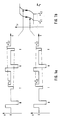
- An FLC display is subjected to a sequence of bipolar voltage pulses (Fig. 1a), in each case follows an "reset pulse" R, which is so large that the display switches in any case, an inverse test pulse T. Is the Voltage of the test pulse (V t ) high enough, the display switches in the opposite direction to the reset pulse, which causes the display to flash.
- the minimum voltage (critical voltage of the test pulse) V t c (FIG. 1b) that is required for switching by the test pulse depends on the history of switching the display. If the initial situation is such that the test pulses are too small to switch, so that there is a static display, the increase in the test pulse voltage V t only leads to relatively high values V c t2 (Fig.
- the ordinate is the intensity (in volts; which is proportional to the transmission) and the abscissa is the electrical field strength (in volts / ⁇ m).
- Fig. 2 shows in comparison the hysteresis curve obtained by the method explained above of a known display, in which the electrodes are insulated from the FLC by an orientation layer (FIG. 2a), and of a display according to the invention, in which two orientation layers made of rubbed conductive polymer in are in direct contact with the FLC (Fig. 2b).
- the extensive suppression of hysteresis in the latter case is clearly recognizable.
- a 2% nitromethane solution of an electrically conductive polymer with the following structural formula, where n is 5 or 6, is by a spin coating process with 1500 revolutions / minute on a 1 mm thick Glass substrate, which had previously been provided with a transparent electrode, spun on for 30 seconds.
- the substrate and the layer of the solution deposited thereon are annealed at 120 ° C. in a drying cabinet in order to drive the solvent by distillation.
- a polymer layer with a layer thickness of 100 nm is obtained, which is then rubbed lightly twice in the same direction using a grinder.
- a homogeneous, slightly bluish polymer layer with a thickness of 100 nm and a specific electrical conductivity of 8.0 x 10 -3 S / cm is obtained.
- the solution is applied in the same way as described in Example 1 on a glass substrate which has previously been provided with a transparent electrode. After annealing for one hour at 180 ° C., the layer thickness is 150 nm.
- a liquid crystal cell with A 2 ⁇ m thick liquid crystal layer is produced by aligning the substrates in the same manner as in Example 1.
- the cell is filled with the commercially available ®Felix 002 ferroelectric liquid crystal mixture (manufacturer: Hoechst AG). A good bistability is found.
- the liquid crystal switching element shows almost no optical hysteresis. 77% are measured as the optical transparency of the orientation layer at a light wavelength of 550 nm.
Landscapes
- Physics & Mathematics (AREA)
- Chemical & Material Sciences (AREA)
- Nonlinear Science (AREA)
- Crystallography & Structural Chemistry (AREA)
- Optics & Photonics (AREA)
- General Physics & Mathematics (AREA)
- Spectroscopy & Molecular Physics (AREA)
- Mathematical Physics (AREA)
- Organic Chemistry (AREA)
- Materials Engineering (AREA)
- Engineering & Computer Science (AREA)
- Liquid Crystal (AREA)
- Liquid Crystal Substances (AREA)
- Polyoxymethylene Polymers And Polymers With Carbon-To-Carbon Bonds (AREA)
- Devices For Indicating Variable Information By Combining Individual Elements (AREA)
- Addition Polymer Or Copolymer, Post-Treatments, Or Chemical Modifications (AREA)
Applications Claiming Priority (2)
| Application Number | Priority Date | Filing Date | Title |
|---|---|---|---|
| DE3925970 | 1989-08-05 | ||
| DE3925970A DE3925970A1 (de) | 1989-08-05 | 1989-08-05 | Elektrisch leitfaehige polymere und ihre verwendung als orientierungsschicht in fluessigkristall-schalt- und -anzeigeelementen |
Publications (3)
| Publication Number | Publication Date |
|---|---|
| EP0412408A2 true EP0412408A2 (fr) | 1991-02-13 |
| EP0412408A3 EP0412408A3 (en) | 1991-12-04 |
| EP0412408B1 EP0412408B1 (fr) | 1995-10-11 |
Family
ID=6386595
Family Applications (1)
| Application Number | Title | Priority Date | Filing Date |
|---|---|---|---|
| EP90114643A Expired - Lifetime EP0412408B1 (fr) | 1989-08-05 | 1990-07-31 | Polymères électro-conducteurs et leur application comme couche d'orientation pour un commutateur et afficheur à cristal liquide |
Country Status (5)
| Country | Link |
|---|---|
| US (1) | US5118538A (fr) |
| EP (1) | EP0412408B1 (fr) |
| JP (1) | JP2679861B2 (fr) |
| KR (1) | KR910004780A (fr) |
| DE (2) | DE3925970A1 (fr) |
Cited By (1)
| Publication number | Priority date | Publication date | Assignee | Title |
|---|---|---|---|---|
| EP0508227A3 (en) * | 1991-03-27 | 1993-02-17 | Canon Kabushiki Kaisha | Optical modulation element |
Families Citing this family (13)
| Publication number | Priority date | Publication date | Assignee | Title |
|---|---|---|---|---|
| EP0418833A3 (en) * | 1989-09-20 | 1993-03-17 | Hitachi, Ltd. | Organic thin film and liquid crystal display devices with the same |
| DE4141528C2 (de) * | 1991-12-17 | 1995-04-06 | Nokia Unterhaltungselektronik | Flüssigkristallzelle mit Streifenelektroden und Orientierungsschichten |
| US5465169A (en) * | 1992-08-25 | 1995-11-07 | Canon Kabushiki Kaisha | Ferroelectric liquid crystal device with electroconductive protective film and electroconductive alignment film |
| JP2794369B2 (ja) * | 1992-12-11 | 1998-09-03 | キヤノン株式会社 | 液晶素子 |
| WO1996028756A1 (fr) * | 1995-03-09 | 1996-09-19 | Geo-Centers, Inc. | Substrat conducteur, dispositif a cristaux liquides fabrique a partir de celui-ci, et composition cristalline liquide en contact avec ce substrat |
| CA2145135C (fr) * | 1995-03-21 | 2001-02-27 | Pierre Delvaux | Buche synthetique, decorative et non combustible |
| US6379509B2 (en) | 1998-01-20 | 2002-04-30 | 3M Innovative Properties Company | Process for forming electrodes |
| WO2000070405A1 (fr) | 1999-05-14 | 2000-11-23 | 3M Innovative Properties Company | Couche ameliorant l'ablation |
| US7357965B1 (en) * | 1999-10-15 | 2008-04-15 | Agfa-Gevaert, N.V. | Liquid crystal alignment layer |
| NO20005980L (no) | 2000-11-27 | 2002-05-28 | Thin Film Electronics Ab | Ferroelektrisk minnekrets og fremgangsmåte ved dens fremstilling |
| KR100685944B1 (ko) * | 2000-12-05 | 2007-02-23 | 엘지.필립스 엘시디 주식회사 | 광배향성 물질 및 이를 이용한 액정표시소자 |
| US8333812B2 (en) * | 2008-08-18 | 2012-12-18 | Forestwood Industrial, Inc. | Method and device for use of hollow spheres in a composite material |
| CN102492308B (zh) * | 2011-11-14 | 2014-07-09 | 湖北华丽染料工业有限公司 | 一种复合活性黑染料及其制备和应用 |
Family Cites Families (9)
| Publication number | Priority date | Publication date | Assignee | Title |
|---|---|---|---|---|
| US4367924A (en) * | 1980-01-08 | 1983-01-11 | Clark Noel A | Chiral smectic C or H liquid crystal electro-optical device |
| DE3001125A1 (de) * | 1980-01-14 | 1981-07-16 | Siemens AG, 1000 Berlin und 8000 München | Verfahren zur herstellung einer fluessigkristallanzeige |
| US4599194A (en) * | 1984-06-18 | 1986-07-08 | Allied Corporation | Simultaneous polymerization, doping and solubilization of heterocyclic polymers, solutions and cast articles |
| ATE112883T1 (de) * | 1986-08-26 | 1994-10-15 | Hoechst Ag | Lösliche, elektrisch leitende polymere, verfahren zu ihrer herstellung und ihre verwendung. |
| DE3628895A1 (de) * | 1986-08-26 | 1988-03-10 | Hoechst Ag | Loesliche, elektrisch leitende polymere, verfahren zu ihrer herstellung und ihre verwendung |
| DE3717668A1 (de) * | 1987-05-26 | 1988-12-15 | Hoechst Ag | Elektrisch leitende beschichtungsmasse, verfahren zu ihrer herstellung und ihre verwendung |
| DE3736114A1 (de) * | 1987-10-26 | 1989-07-13 | Hoechst Ag | Modifizierte elektrisch leitende polymere |
| EP0353760A3 (fr) * | 1988-08-03 | 1991-01-16 | TDK Corporation | Eléments à cristaux liquides et mélanges conducteurs de composés organiques filmogènes |
| DE3843228A1 (de) * | 1988-12-22 | 1990-06-28 | Hoechst Ag | Ferroelektrisches fluessigkristall-schalt- und anzeige-element mit verminderter optischer hysterese |
-
1989
- 1989-08-05 DE DE3925970A patent/DE3925970A1/de not_active Withdrawn
-
1990
- 1990-07-31 EP EP90114643A patent/EP0412408B1/fr not_active Expired - Lifetime
- 1990-07-31 DE DE59009764T patent/DE59009764D1/de not_active Expired - Fee Related
- 1990-08-03 KR KR1019900011912A patent/KR910004780A/ko not_active Withdrawn
- 1990-08-03 US US07/562,600 patent/US5118538A/en not_active Expired - Fee Related
- 1990-08-04 JP JP2207488A patent/JP2679861B2/ja not_active Expired - Lifetime
Cited By (3)
| Publication number | Priority date | Publication date | Assignee | Title |
|---|---|---|---|---|
| EP0508227A3 (en) * | 1991-03-27 | 1993-02-17 | Canon Kabushiki Kaisha | Optical modulation element |
| US5327272A (en) * | 1991-03-27 | 1994-07-05 | Canon Kabushiki Kaisha | Optical modulation element |
| US5838410A (en) * | 1991-03-27 | 1998-11-17 | Canon Kabushiki Kaisha | Optical modulation element |
Also Published As
| Publication number | Publication date |
|---|---|
| DE59009764D1 (de) | 1995-11-16 |
| KR910004780A (ko) | 1991-03-29 |
| EP0412408B1 (fr) | 1995-10-11 |
| JP2679861B2 (ja) | 1997-11-19 |
| DE3925970A1 (de) | 1991-02-07 |
| JPH0369921A (ja) | 1991-03-26 |
| EP0412408A3 (en) | 1991-12-04 |
| US5118538A (en) | 1992-06-02 |
Similar Documents
| Publication | Publication Date | Title |
|---|---|---|
| DE69028213T2 (de) | Elektrochromes Element, Materialien zur Verwendung in einem solchen Element, Herstellungsverfahren eines derartigen Elementes sowie derartiger Materialien und die Verwendung eines solchem Elementes in einem elektrochromen Gerät | |
| EP0412408B1 (fr) | Polymères électro-conducteurs et leur application comme couche d'orientation pour un commutateur et afficheur à cristal liquide | |
| DE3427597C2 (fr) | ||
| DE3020645C2 (de) | Flüssigkristallanzeige und Verfahren zu ihrer Herstellung | |
| DE2904052A1 (de) | Elektrochrome vorrichtung | |
| DE2160788A1 (de) | Verfahren zur Herstellung der homöotropen Textur in einem nematischen, flüssig-kristallinen Material | |
| DE3630012A1 (de) | Ferroelektrische fluessigkristallvorrichtung | |
| DE2656252B2 (de) | Dotierungsmittel für nematische Flüssigkristalle und damit dotiertes Flüssigkristallmaterial | |
| DE69131261T2 (de) | Flüssigkristallvorrichtung, Anzeigeverfahren und Anzeigesystem, das dieses benutzt | |
| DE2237997B2 (de) | Flüssigkristallzelle mit Speicherwirkung | |
| DE69015760T2 (de) | Flüssigkristallvorrichtung. | |
| DE3614113C2 (fr) | ||
| DE69231981T2 (de) | Optisches Modulationselement | |
| EP0844293B1 (fr) | Cellule à cristaux liquides ferroélectriques bistables | |
| DE69518658T2 (de) | Verfahren zur tränkung einer komponente in einem flüssigkristall-kompositmaterial und vorrichtungen, die dieses material verwenden | |
| WO1990015360A1 (fr) | Affichage ferro-electrique a cristaux liquides presentant des paliers de gris et/ou une gamme continue des gris | |
| DE3888661T2 (de) | Verschluss mit einem ferroelektrischen Flüssigkristall. | |
| DE2408389A1 (de) | Elekkrooptisches verfahren unter verwendung von fluessigkristallen | |
| DE69416194T2 (de) | Verfahren zur Herstellung einer Flüssigkristallzelle mit geringer elektrooptischer Schwellenspannung | |
| DE3929113C2 (fr) | ||
| DE2410557C2 (de) | Elektrooptische Vorrichtung mit Gast-Wirt-Flüssigkristallmaterial | |
| DE3524803C2 (fr) | ||
| EP0570366B1 (fr) | Emploi de polyamides aromatiques fluores comme couche d'orientation pour dispositifs de commutation et d'affichage a cristaux liquides | |
| EP0374865A2 (fr) | Elément de commutation ou d'affichage à cristal liquide ferro-électrique ayant une hystérésis optique réduite | |
| DE2202555C2 (de) | Elektro-optische Einrichtung zur intermittierenden Übertragung von Licht |
Legal Events
| Date | Code | Title | Description |
|---|---|---|---|
| PUAI | Public reference made under article 153(3) epc to a published international application that has entered the european phase |
Free format text: ORIGINAL CODE: 0009012 |
|
| AK | Designated contracting states |
Kind code of ref document: A2 Designated state(s): DE FR GB NL |
|
| 17P | Request for examination filed |
Effective date: 19901221 |
|
| PUAL | Search report despatched |
Free format text: ORIGINAL CODE: 0009013 |
|
| AK | Designated contracting states |
Kind code of ref document: A3 Designated state(s): DE FR GB NL |
|
| 17Q | First examination report despatched |
Effective date: 19940310 |
|
| RBV | Designated contracting states (corrected) |
Designated state(s): DE GB |
|
| GRAA | (expected) grant |
Free format text: ORIGINAL CODE: 0009210 |
|
| AK | Designated contracting states |
Kind code of ref document: B1 Designated state(s): DE GB |
|
| REF | Corresponds to: |
Ref document number: 59009764 Country of ref document: DE Date of ref document: 19951116 |
|
| GBT | Gb: translation of ep patent filed (gb section 77(6)(a)/1977) |
Effective date: 19951216 |
|
| PLBE | No opposition filed within time limit |
Free format text: ORIGINAL CODE: 0009261 |
|
| STAA | Information on the status of an ep patent application or granted ep patent |
Free format text: STATUS: NO OPPOSITION FILED WITHIN TIME LIMIT |
|
| 26N | No opposition filed | ||
| PGFP | Annual fee paid to national office [announced via postgrant information from national office to epo] |
Ref country code: GB Payment date: 19980603 Year of fee payment: 9 |
|
| PG25 | Lapsed in a contracting state [announced via postgrant information from national office to epo] |
Ref country code: GB Free format text: LAPSE BECAUSE OF NON-PAYMENT OF DUE FEES Effective date: 19990731 |
|
| GBPC | Gb: european patent ceased through non-payment of renewal fee |
Effective date: 19990731 |
|
| PGFP | Annual fee paid to national office [announced via postgrant information from national office to epo] |
Ref country code: DE Payment date: 20000617 Year of fee payment: 11 |
|
| PG25 | Lapsed in a contracting state [announced via postgrant information from national office to epo] |
Ref country code: DE Free format text: LAPSE BECAUSE OF NON-PAYMENT OF DUE FEES Effective date: 20020501 |