EP0412592B1 - Nitrofurantoinkristalle - Google Patents
Nitrofurantoinkristalle Download PDFInfo
- Publication number
- EP0412592B1 EP0412592B1 EP90201965A EP90201965A EP0412592B1 EP 0412592 B1 EP0412592 B1 EP 0412592B1 EP 90201965 A EP90201965 A EP 90201965A EP 90201965 A EP90201965 A EP 90201965A EP 0412592 B1 EP0412592 B1 EP 0412592B1
- Authority
- EP
- European Patent Office
- Prior art keywords
- nitrofurantoin
- particulates
- monohydrate
- mesh
- approximately
- Prior art date
- Legal status (The legal status is an assumption and is not a legal conclusion. Google has not performed a legal analysis and makes no representation as to the accuracy of the status listed.)
- Expired - Lifetime
Links
- NXFQHRVNIOXGAQ-YCRREMRBSA-N nitrofurantoin Chemical compound O1C([N+](=O)[O-])=CC=C1\C=N\N1C(=O)NC(=O)C1 NXFQHRVNIOXGAQ-YCRREMRBSA-N 0.000 title claims abstract description 170
- 229960000564 nitrofurantoin Drugs 0.000 title claims abstract description 168
- 239000013078 crystal Substances 0.000 title description 13
- NHBPVLAHAVEISO-JSGFVSQVSA-N 1-[(e)-(5-nitrofuran-2-yl)methylideneamino]imidazolidine-2,4-dione;hydrate Chemical compound O.O1C([N+](=O)[O-])=CC=C1\C=N\N1C(=O)NC(=O)C1 NHBPVLAHAVEISO-JSGFVSQVSA-N 0.000 claims abstract 7
- 239000000243 solution Substances 0.000 claims description 16
- 239000002245 particle Substances 0.000 claims description 13
- 238000002156 mixing Methods 0.000 claims description 8
- 238000009826 distribution Methods 0.000 claims description 6
- 238000004519 manufacturing process Methods 0.000 claims description 6
- 239000007864 aqueous solution Substances 0.000 claims description 3
- 238000001914 filtration Methods 0.000 claims description 2
- 229920006395 saturated elastomer Polymers 0.000 claims description 2
- 239000000203 mixture Substances 0.000 abstract description 40
- 239000007900 aqueous suspension Substances 0.000 abstract description 6
- 239000006186 oral dosage form Substances 0.000 abstract description 5
- 239000002552 dosage form Substances 0.000 description 15
- 239000000725 suspension Substances 0.000 description 14
- 238000000034 method Methods 0.000 description 12
- XLYOFNOQVPJJNP-UHFFFAOYSA-N water Substances O XLYOFNOQVPJJNP-UHFFFAOYSA-N 0.000 description 11
- 238000011282 treatment Methods 0.000 description 10
- KRKNYBCHXYNGOX-UHFFFAOYSA-N citric acid Chemical compound OC(=O)CC(O)(C(O)=O)CC(O)=O KRKNYBCHXYNGOX-UHFFFAOYSA-N 0.000 description 9
- SNAAJJQQZSMGQD-UHFFFAOYSA-N aluminum magnesium Chemical compound [Mg].[Al] SNAAJJQQZSMGQD-UHFFFAOYSA-N 0.000 description 8
- 230000000694 effects Effects 0.000 description 8
- 239000000463 material Substances 0.000 description 8
- IJGRMHOSHXDMSA-UHFFFAOYSA-N Atomic nitrogen Chemical compound N#N IJGRMHOSHXDMSA-UHFFFAOYSA-N 0.000 description 7
- 241001465754 Metazoa Species 0.000 description 7
- 208000015181 infectious disease Diseases 0.000 description 7
- 239000002775 capsule Substances 0.000 description 6
- 229920000609 methyl cellulose Polymers 0.000 description 6
- 235000010981 methylcellulose Nutrition 0.000 description 6
- 239000001923 methylcellulose Substances 0.000 description 5
- 239000000375 suspending agent Substances 0.000 description 5
- 208000018522 Gastrointestinal disease Diseases 0.000 description 4
- PEDCQBHIVMGVHV-UHFFFAOYSA-N Glycerine Chemical compound OCC(O)CO PEDCQBHIVMGVHV-UHFFFAOYSA-N 0.000 description 4
- 150000001875 compounds Chemical class 0.000 description 4
- 238000005259 measurement Methods 0.000 description 4
- LXCFILQKKLGQFO-UHFFFAOYSA-N methylparaben Chemical compound COC(=O)C1=CC=C(O)C=C1 LXCFILQKKLGQFO-UHFFFAOYSA-N 0.000 description 4
- 230000008569 process Effects 0.000 description 4
- QELSKZZBTMNZEB-UHFFFAOYSA-N propylparaben Chemical compound CCCOC(=O)C1=CC=C(O)C=C1 QELSKZZBTMNZEB-UHFFFAOYSA-N 0.000 description 4
- 239000007787 solid Substances 0.000 description 4
- 239000000126 substance Substances 0.000 description 4
- 208000019206 urinary tract infection Diseases 0.000 description 4
- 238000002835 absorbance Methods 0.000 description 3
- 230000002411 adverse Effects 0.000 description 3
- 238000004458 analytical method Methods 0.000 description 3
- 239000003242 anti bacterial agent Substances 0.000 description 3
- 230000008901 benefit Effects 0.000 description 3
- 239000001768 carboxy methyl cellulose Substances 0.000 description 3
- 239000008187 granular material Substances 0.000 description 3
- 239000007788 liquid Substances 0.000 description 3
- 239000002932 luster Substances 0.000 description 3
- 150000004682 monohydrates Chemical class 0.000 description 3
- 229910052757 nitrogen Inorganic materials 0.000 description 3
- 238000011269 treatment regimen Methods 0.000 description 3
- 230000004580 weight loss Effects 0.000 description 3
- -1 5-nitro-2-furanyl Chemical group 0.000 description 2
- 229920002134 Carboxymethyl cellulose Polymers 0.000 description 2
- FBPFZTCFMRRESA-FSIIMWSLSA-N D-Glucitol Natural products OC[C@H](O)[C@H](O)[C@@H](O)[C@H](O)CO FBPFZTCFMRRESA-FSIIMWSLSA-N 0.000 description 2
- RTZKZFJDLAIYFH-UHFFFAOYSA-N Diethyl ether Chemical compound CCOCC RTZKZFJDLAIYFH-UHFFFAOYSA-N 0.000 description 2
- 241000590002 Helicobacter pylori Species 0.000 description 2
- 241000282412 Homo Species 0.000 description 2
- VEXZGXHMUGYJMC-UHFFFAOYSA-N Hydrochloric acid Chemical compound Cl VEXZGXHMUGYJMC-UHFFFAOYSA-N 0.000 description 2
- 239000002253 acid Substances 0.000 description 2
- 239000011149 active material Substances 0.000 description 2
- 208000026935 allergic disease Diseases 0.000 description 2
- 230000002421 anti-septic effect Effects 0.000 description 2
- 235000010948 carboxy methyl cellulose Nutrition 0.000 description 2
- 239000008112 carboxymethyl-cellulose Substances 0.000 description 2
- 229920003086 cellulose ether Polymers 0.000 description 2
- 239000003086 colorant Substances 0.000 description 2
- GUJOJGAPFQRJSV-UHFFFAOYSA-N dialuminum;dioxosilane;oxygen(2-);hydrate Chemical compound O.[O-2].[O-2].[O-2].[Al+3].[Al+3].O=[Si]=O.O=[Si]=O.O=[Si]=O.O=[Si]=O GUJOJGAPFQRJSV-UHFFFAOYSA-N 0.000 description 2
- 239000003085 diluting agent Substances 0.000 description 2
- 239000003814 drug Substances 0.000 description 2
- 239000003937 drug carrier Substances 0.000 description 2
- 239000000839 emulsion Substances 0.000 description 2
- 239000000796 flavoring agent Substances 0.000 description 2
- 239000012530 fluid Substances 0.000 description 2
- 235000003599 food sweetener Nutrition 0.000 description 2
- 235000011187 glycerol Nutrition 0.000 description 2
- 230000007794 irritation Effects 0.000 description 2
- 229940090037 macrodantin Drugs 0.000 description 2
- 230000001404 mediated effect Effects 0.000 description 2
- BDAGIHXWWSANSR-UHFFFAOYSA-N methanoic acid Natural products OC=O BDAGIHXWWSANSR-UHFFFAOYSA-N 0.000 description 2
- 239000004292 methyl p-hydroxybenzoate Substances 0.000 description 2
- 235000010270 methyl p-hydroxybenzoate Nutrition 0.000 description 2
- 229960002216 methylparaben Drugs 0.000 description 2
- 230000000813 microbial effect Effects 0.000 description 2
- 230000004048 modification Effects 0.000 description 2
- 238000012986 modification Methods 0.000 description 2
- 229910052901 montmorillonite Inorganic materials 0.000 description 2
- 239000003755 preservative agent Substances 0.000 description 2
- 239000004405 propyl p-hydroxybenzoate Substances 0.000 description 2
- 235000010232 propyl p-hydroxybenzoate Nutrition 0.000 description 2
- 229960003415 propylparaben Drugs 0.000 description 2
- 239000000600 sorbitol Substances 0.000 description 2
- 238000004659 sterilization and disinfection Methods 0.000 description 2
- KDYFGRWQOYBRFD-UHFFFAOYSA-N succinic acid Chemical compound OC(=O)CCC(O)=O KDYFGRWQOYBRFD-UHFFFAOYSA-N 0.000 description 2
- 239000003765 sweetening agent Substances 0.000 description 2
- 230000001225 therapeutic effect Effects 0.000 description 2
- 238000002411 thermogravimetry Methods 0.000 description 2
- 230000001988 toxicity Effects 0.000 description 2
- 231100000419 toxicity Toxicity 0.000 description 2
- OSWFIVFLDKOXQC-UHFFFAOYSA-N 4-(3-methoxyphenyl)aniline Chemical compound COC1=CC=CC(C=2C=CC(N)=CC=2)=C1 OSWFIVFLDKOXQC-UHFFFAOYSA-N 0.000 description 1
- 208000035143 Bacterial infection Diseases 0.000 description 1
- OYPRJOBELJOOCE-UHFFFAOYSA-N Calcium Chemical compound [Ca] OYPRJOBELJOOCE-UHFFFAOYSA-N 0.000 description 1
- FBPFZTCFMRRESA-JGWLITMVSA-N D-glucitol Chemical compound OC[C@H](O)[C@@H](O)[C@H](O)[C@H](O)CO FBPFZTCFMRRESA-JGWLITMVSA-N 0.000 description 1
- FEWJPZIEWOKRBE-JCYAYHJZSA-N Dextrotartaric acid Chemical compound OC(=O)[C@H](O)[C@@H](O)C(O)=O FEWJPZIEWOKRBE-JCYAYHJZSA-N 0.000 description 1
- 241000588724 Escherichia coli Species 0.000 description 1
- 208000007882 Gastritis Diseases 0.000 description 1
- 206010017964 Gastrointestinal infection Diseases 0.000 description 1
- 239000004354 Hydroxyethyl cellulose Substances 0.000 description 1
- 229920000663 Hydroxyethyl cellulose Polymers 0.000 description 1
- DGAQECJNVWCQMB-PUAWFVPOSA-M Ilexoside XXIX Chemical compound C[C@@H]1CC[C@@]2(CC[C@@]3(C(=CC[C@H]4[C@]3(CC[C@@H]5[C@@]4(CC[C@@H](C5(C)C)OS(=O)(=O)[O-])C)C)[C@@H]2[C@]1(C)O)C)C(=O)O[C@H]6[C@@H]([C@H]([C@@H]([C@H](O6)CO)O)O)O.[Na+] DGAQECJNVWCQMB-PUAWFVPOSA-M 0.000 description 1
- FYYHWMGAXLPEAU-UHFFFAOYSA-N Magnesium Chemical compound [Mg] FYYHWMGAXLPEAU-UHFFFAOYSA-N 0.000 description 1
- 229920003091 Methocel™ Polymers 0.000 description 1
- ZLMJMSJWJFRBEC-UHFFFAOYSA-N Potassium Chemical compound [K] ZLMJMSJWJFRBEC-UHFFFAOYSA-N 0.000 description 1
- 241000220010 Rhode Species 0.000 description 1
- 229920002125 Sokalan® Polymers 0.000 description 1
- FEWJPZIEWOKRBE-UHFFFAOYSA-N Tartaric acid Natural products [H+].[H+].[O-]C(=O)C(O)C(O)C([O-])=O FEWJPZIEWOKRBE-UHFFFAOYSA-N 0.000 description 1
- DPXJVFZANSGRMM-UHFFFAOYSA-N acetic acid;2,3,4,5,6-pentahydroxyhexanal;sodium Chemical compound [Na].CC(O)=O.OCC(O)C(O)C(O)C(O)C=O DPXJVFZANSGRMM-UHFFFAOYSA-N 0.000 description 1
- 150000007513 acids Chemical class 0.000 description 1
- 230000009471 action Effects 0.000 description 1
- ORILYTVJVMAKLC-UHFFFAOYSA-N adamantane Chemical compound C1C(C2)CC3CC1CC2C3 ORILYTVJVMAKLC-UHFFFAOYSA-N 0.000 description 1
- 229910001573 adamantine Inorganic materials 0.000 description 1
- 235000010443 alginic acid Nutrition 0.000 description 1
- 229920000615 alginic acid Polymers 0.000 description 1
- 229940009868 aluminum magnesium silicate Drugs 0.000 description 1
- WMGSQTMJHBYJMQ-UHFFFAOYSA-N aluminum;magnesium;silicate Chemical compound [Mg+2].[Al+3].[O-][Si]([O-])([O-])[O-] WMGSQTMJHBYJMQ-UHFFFAOYSA-N 0.000 description 1
- 150000001413 amino acids Chemical class 0.000 description 1
- 230000000845 anti-microbial effect Effects 0.000 description 1
- 229940088710 antibiotic agent Drugs 0.000 description 1
- 239000004599 antimicrobial Substances 0.000 description 1
- 229940064004 antiseptic throat preparations Drugs 0.000 description 1
- 230000002238 attenuated effect Effects 0.000 description 1
- 238000001210 attenuated total reflectance infrared spectroscopy Methods 0.000 description 1
- 208000022362 bacterial infectious disease Diseases 0.000 description 1
- 239000011575 calcium Substances 0.000 description 1
- 229910052791 calcium Inorganic materials 0.000 description 1
- 150000001735 carboxylic acids Chemical class 0.000 description 1
- 229940105329 carboxymethylcellulose Drugs 0.000 description 1
- 238000012512 characterization method Methods 0.000 description 1
- 239000003795 chemical substances by application Substances 0.000 description 1
- 238000002512 chemotherapy Methods 0.000 description 1
- 238000010961 commercial manufacture process Methods 0.000 description 1
- 239000012612 commercial material Substances 0.000 description 1
- 238000001816 cooling Methods 0.000 description 1
- 239000008367 deionised water Substances 0.000 description 1
- 229910021641 deionized water Inorganic materials 0.000 description 1
- 230000001419 dependent effect Effects 0.000 description 1
- 239000000645 desinfectant Substances 0.000 description 1
- 229910001873 dinitrogen Inorganic materials 0.000 description 1
- 208000037265 diseases, disorders, signs and symptoms Diseases 0.000 description 1
- 239000006185 dispersion Substances 0.000 description 1
- 238000004090 dissolution Methods 0.000 description 1
- 229940079593 drug Drugs 0.000 description 1
- 238000009509 drug development Methods 0.000 description 1
- 239000002895 emetic Substances 0.000 description 1
- 239000003995 emulsifying agent Substances 0.000 description 1
- 239000000945 filler Substances 0.000 description 1
- 239000010419 fine particle Substances 0.000 description 1
- 235000019634 flavors Nutrition 0.000 description 1
- 235000013355 food flavoring agent Nutrition 0.000 description 1
- 235000019253 formic acid Nutrition 0.000 description 1
- 238000009472 formulation Methods 0.000 description 1
- 239000007789 gas Substances 0.000 description 1
- 230000002496 gastric effect Effects 0.000 description 1
- 210000001035 gastrointestinal tract Anatomy 0.000 description 1
- 239000007903 gelatin capsule Substances 0.000 description 1
- 239000011521 glass Substances 0.000 description 1
- 229960005150 glycerol Drugs 0.000 description 1
- BBKFSSMUWOMYPI-UHFFFAOYSA-N gold palladium Chemical compound [Pd].[Au] BBKFSSMUWOMYPI-UHFFFAOYSA-N 0.000 description 1
- 238000010438 heat treatment Methods 0.000 description 1
- 239000001307 helium Substances 0.000 description 1
- 229910052734 helium Inorganic materials 0.000 description 1
- SWQJXJOGLNCZEY-UHFFFAOYSA-N helium atom Chemical compound [He] SWQJXJOGLNCZEY-UHFFFAOYSA-N 0.000 description 1
- 239000003752 hydrotrope Substances 0.000 description 1
- 150000004679 hydroxides Chemical class 0.000 description 1
- 235000019447 hydroxyethyl cellulose Nutrition 0.000 description 1
- 230000006872 improvement Effects 0.000 description 1
- 239000011261 inert gas Substances 0.000 description 1
- 239000012678 infectious agent Substances 0.000 description 1
- 238000002329 infrared spectrum Methods 0.000 description 1
- 230000002401 inhibitory effect Effects 0.000 description 1
- 229910052500 inorganic mineral Inorganic materials 0.000 description 1
- 239000010410 layer Substances 0.000 description 1
- 239000006194 liquid suspension Substances 0.000 description 1
- 239000011777 magnesium Substances 0.000 description 1
- 229910052749 magnesium Inorganic materials 0.000 description 1
- 238000000691 measurement method Methods 0.000 description 1
- 238000002844 melting Methods 0.000 description 1
- 230000008018 melting Effects 0.000 description 1
- 125000000325 methylidene group Chemical group [H]C([H])=* 0.000 description 1
- 244000005700 microbiome Species 0.000 description 1
- 239000011707 mineral Substances 0.000 description 1
- 239000007971 pharmaceutical suspension Substances 0.000 description 1
- 239000008104 plant cellulose Substances 0.000 description 1
- 229920000642 polymer Polymers 0.000 description 1
- 239000011591 potassium Substances 0.000 description 1
- 229910052700 potassium Inorganic materials 0.000 description 1
- 239000000843 powder Substances 0.000 description 1
- 238000002360 preparation method Methods 0.000 description 1
- 238000004321 preservation Methods 0.000 description 1
- 238000011321 prophylaxis Methods 0.000 description 1
- 239000008213 purified water Substances 0.000 description 1
- 229910000275 saponite Inorganic materials 0.000 description 1
- 229910001753 sapphirine Inorganic materials 0.000 description 1
- 239000012047 saturated solution Substances 0.000 description 1
- 238000004626 scanning electron microscopy Methods 0.000 description 1
- 238000012216 screening Methods 0.000 description 1
- 229910021647 smectite Inorganic materials 0.000 description 1
- 239000011734 sodium Substances 0.000 description 1
- 229910052708 sodium Inorganic materials 0.000 description 1
- 235000019812 sodium carboxymethyl cellulose Nutrition 0.000 description 1
- 229920001027 sodium carboxymethylcellulose Polymers 0.000 description 1
- 239000007909 solid dosage form Substances 0.000 description 1
- 239000002904 solvent Substances 0.000 description 1
- 238000001228 spectrum Methods 0.000 description 1
- 230000001954 sterilising effect Effects 0.000 description 1
- 210000002784 stomach Anatomy 0.000 description 1
- 238000003860 storage Methods 0.000 description 1
- 239000001384 succinic acid Substances 0.000 description 1
- 239000002344 surface layer Substances 0.000 description 1
- 239000004094 surface-active agent Substances 0.000 description 1
- 230000002459 sustained effect Effects 0.000 description 1
- 208000024891 symptom Diseases 0.000 description 1
- 239000003826 tablet Substances 0.000 description 1
- 239000011975 tartaric acid Substances 0.000 description 1
- 235000002906 tartaric acid Nutrition 0.000 description 1
- 238000012360 testing method Methods 0.000 description 1
- PGAPATLGJSQQBU-UHFFFAOYSA-M thallium(i) bromide Chemical compound [Tl]Br PGAPATLGJSQQBU-UHFFFAOYSA-M 0.000 description 1
- 238000002560 therapeutic procedure Methods 0.000 description 1
- 238000002076 thermal analysis method Methods 0.000 description 1
- 210000002700 urine Anatomy 0.000 description 1
- 238000005303 weighing Methods 0.000 description 1
- 239000000230 xanthan gum Substances 0.000 description 1
- 235000010493 xanthan gum Nutrition 0.000 description 1
- 229920001285 xanthan gum Polymers 0.000 description 1
- 229940082509 xanthan gum Drugs 0.000 description 1
Images

Classifications
-
- C—CHEMISTRY; METALLURGY
- C07—ORGANIC CHEMISTRY
- C07D—HETEROCYCLIC COMPOUNDS
- C07D405/00—Heterocyclic compounds containing both one or more hetero rings having oxygen atoms as the only ring hetero atoms, and one or more rings having nitrogen as the only ring hetero atom
- C07D405/02—Heterocyclic compounds containing both one or more hetero rings having oxygen atoms as the only ring hetero atoms, and one or more rings having nitrogen as the only ring hetero atom containing two hetero rings
- C07D405/12—Heterocyclic compounds containing both one or more hetero rings having oxygen atoms as the only ring hetero atoms, and one or more rings having nitrogen as the only ring hetero atom containing two hetero rings linked by a chain containing hetero atoms as chain links
Definitions
- This invention relates to materials useful as antibacterial agents in humans and other animals, and compositions containing such materials.
- it relates to a novel crystalline form of nitrofurantoin.
- Nitrofurantoin is an antibacterial agent used extensively in the treatment of urinary tract infections. It is rapidly absorbed in the gastrointestinal tract, and reaches high concentrations in the urine. A general description of nitrofurantoin is found in D. E. Cadwallader, 15 J. American Pharmaceutical Association 409 (1975); and J. D. Conklin, "The Pharmacokinetics of Nitrofurantoin and Its Related Bioavailability," 25 Antibiotics and Chemotherapy 233 (1978).
- nitrofurantoin may be affected by the size and type of nitrofurantoin crystals used in a dosage form. See, for example, J. K. Haleblian, "Characterization of Habits and Crystalline Modification of Solids and Their Pharmaceutical Applications", 66 J. Pharmaceutical Sciences 1269 (1975).
- macrocrystalline nitrofurantoin has been found to reduce the level of emetic side effects that may be associated with nitrofurantoin. This association is discussed in the following articles: H. E. Paul et al., "Laboratory Studies with Nitrofurantoin", 56 J. Pharmaceutical Sciences 882 (1967), and N.
- Nitrofurantoin is marketed by Norwich Eaton Pharmaceuticals, Inc., in several dosage forms using nitrofurantoin of differing crystal size.
- One such dosage form is a suspension of nitrofurantoin monohydrate.
- the crystals of nitrofurantoin in these suspensions are fine particles typically smaller than 170 mesh.
- Another solid dosage form contains relatively large crystals of anhydrous nitrofurantoin (from 40 to 200 [from 420 »m to 74 »m] mesh), in a capsule (marketed under the tradename "Macrodantin”).
- the BET surface area of these macrocrystals is from 0.06 m2/g to 0.15 m2/g.
- nitrofurantoin A variety of dosage forms of nitrofurantoin are also known in the pharmaceutical literature.
- solid oral dosage forms of nitrofurantoin are described in U.S. Patent 4,122,157, Huber, issued October 24, 1978; U.S. Patent 4,370,313, Davies, issued January 25, 1983; European Patent Publication 250,023, Patel et al., published December 23, 1987; and European Patent Publication 250,038, Patel, published December 23, 1987.
- Suspensions of nitrofurantoin are described in N. Shah et al., "Effect of Polymers on Dissolution from Drug Suspensions", 65 J. Pharmaceutical Sciences 1618 (1976).
- the present invention provides nitrofurantoin particulates being larger than 200 mesh size (74»m).
- the BET surface area of said particulates is at least 0.2 m2/g and the surface of said particulates consists essentially of nitrofurantoin monohydrate crystalline forms.
- said particulates comprise at least 5%, more preferably at least 50% of nitrofurantoin monohydrate.
- Preferred compositions of the invention comprise these nitrofurantoin particulates in an aqueous suspension.
- nitrofurantoin particulates of this invention are highly efficacious for the delivery of nitrofurantoin in oral dosage forms.
- this invention provides stable nitrofurantoin particulates useful in the formulation of stable, efficacious aqueous suspensions, for the treatment of gastrointestinal disorders and urinary tract infections, without undue side effects.
- the present invention encompasses certain novel nitrofurantoin particulates, methods for their manufacture, dosage forms, and methods of administering the nitrofurantoin particulates to a human or other animal subject.
- Specific compounds and compositions to be used in this invention must, accordingly, be pharmaceutically acceptable.
- a "pharmaceutically-acceptable" component is one that is suitable for use with humans/and or animals without undue adverse side effects (such as toxicity, irritation, and allergic response) commensurate with a reasonable benefit/risk ratio.
- Nitrofurantoin particulates are:
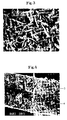
- Nitrofurantoin includes 1-[[(5-nitro-2-furanyl)methylene]-amino]-2,2-imidazolidinedione, and related compounds described in U.S. Patent 2,610,181, Hayes, issued September 9, 1952. Nitrofurantoin is described in the U.S. Pharmacopeia XXI. Nitrofurantoin may be made in a variety of physical forms, including (for example) "nitrofurantoin monohydrate” which contains about one mole of water chemically associated with one mole of nitrofurantoin. Nitrofurantoin monohydrate typically occurs in small, needlelike prisms. The crystals are transparent yellow with an adamantine luster. Such crystals are seen in Figure 3 of the drawings.
- Anhydrous nitrofurantoin contains essentially no chemically-bonded water, and typically occurs in pinacoid prisms with a length: width ratio of 3:1.
- the crystals are transparent to translucent yellow, with a nonmetallic waxy luster. Such crystals are seen in Figure 2 of the drawings. (Descriptive terms for crystals and particulates, used herein, are discussed in B. Mason and L. Berry, Elements of Mineralogy (1969), incorporated by reference herein.)
- nitrofurantoin particulates are comprised of discrete particulates of nitrofurantoin, wherein:
- the particle size and BET surface area of the particulates may vary somewhat from the ranges described herein.
- Such commercial materials may have a distribution of values for these parameters, with mean values within the ranges described above.
- size of the nitrofurantoin particulates of this invention refers to the measurement of the largest U. S. Standard mesh screen through which substantially all of the particulates will pass. In general, this mesh measurement is a function of the smallest dimension of the particulates being measured. As this minimum dimension of the particulates increases, the mesh size will decrease.
- particulates "larger than 200 mesh [74 »m] size” means that substantially all of the particulates will pass through a U. S. Standard mesh screen of less than 200 mesh [74 »m], with few particulates passing through the 200 mesh [74 »m] screen.
- particulates having a size distribution "of from 40 mesh [420 »m] to 60 mesh [250 »m] means that substantially all of the particulates will pass through a 40 mesh screen [420 »m], and essentially none of the particles will pass through a 60 mesh [250 »m] screen. Mesh measurements are discussed in “Screening", Chemical Engineer's Handbook , 4th Edition 21-46 (J. Perry, editor).
- the BET surface area of the nitrofurantoin particulates of this invention refers to the measurement of the surface area in immediate contact with an inert gas into which the particulate is placed, measured by the means generally described in S. Brunnaer et al., 60 J. American Chemical Society 309A (1938), using a single point measurement technique on a Micromeritics Flowsorb II 2300 (manufactured by Micromeritics Instrument Corporation, Norcross, Georgia, U.S.A.).
- the particulate sample is degassed at approximately 140°C (284°F) for approximately 15 minutes.
- the analysis gas is nitrogen/helium at a molar ratio of 30/70. Cooling baths are liquid nitrogen, and the apparatus is calibrated using nitrogen gas injected with a gas-tight syringe.
- the nitrofurantoin particulates of this invention have bulk physical characteristics similar to those of macrocrystalline anhydrous nitrofurantoin.
- the nitrofurantoin particulates are typically pinacoid prisms with a length:width ratio of about 3:1.
- These particulates are acicular microcrystalline aggregates with a nonmetallic silky to earthy luster.
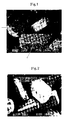
- Several of these nitrofurantoin particulates are depicted in Figure 1.
- Particulate 1 is a perspective view, showing both a face along its long axis and a face along its short axis.
- Particulate 2 is a perspective view, showing two faces along the long axis of the particulate. The similarity of the bulk physical characteristics of these particulates to the bulk physical characteristics of macrocrystalline anhydrous nitrofurantoin can be seen by comparison of the particulates depicted in Figure 1 with those depicted in Figure 2.
- the surface of the nitrofurantoin particulates preferably consists essentially of nitrofurantoin monohydrate crystalline forms.
- the "surface” is the portion of the nitrofurantoin particulate that is in immediate contact with a fluid into which the particulate is submersed.
- the remaining, inner portion of the nitrofurantoin particulate (the "core") is comprised of anhydrous nitrofurantoin, nitrofurantoin monohydrate, or mixtures thereof.
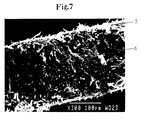
- Figure 5 depicts the surface 5 of a particulate, as well as the core 4 of the particulate.
- nitrofurantoin monohydrate crystalline forms are agglomerated nitrofurantoin particles, on the surface of the nitrofurantoin particulates of this invention, having a physical form substantially similar to nitrofurantoin monohydrate.
- the presence of such crystalline forms may be determined by scanning electron microscopy, using methods as described above.
- Said crystalline forms may be comprised of nitrofurantoin monohydrate or anhydrous nitrofurantoin.
- Such crystalline forms comprised of anhydrous nitrofurantoin readily rehydrate to form nitrofurantoin monohydrate when exposed to water; i.e.
- the surface of the nitrofurantoin particulates of this invention consists essentially of nitrofurantoin monohydrate crystalline forms comprising nitrofurantoin monohydrate.
- the nitrofurantoin particulates of this invention are preferably comprised of from 5% to 100% of nitrofurantoin monohydrate. More preferably, the nitrofurantoin particulates comprise at least 50%, more preferably at least 90%, nitrofurantoin monohydrate. Nitrofurantoin particulates containing less than 100% nitrofurantoin monohydrate consist of: a "surface layer" comprising nitrofurantoin monohydrate as the monohydrate crystalline forms on the surface, and in the contiguous portion of the core; with the remaining portion (if any) of the core comprising anhydrous nitrofurantoin.
- nitrofurantoin particulates comprised by nitrofurantoin monohydrate and nitrofurantoin anhydrous may be determined using standard analytical techniques well known in the art.
- the relative proportion of nitrofurantoin monohydrate in the nitrofurantoin particulates may be determined by thermogravimetric analysis.
- the chemically-bonded water of the monohydrate is driven off by heating, resulting in a weight loss. This weight loss is a function of the amount of monohydrate in a sample analyzed.
- thermogravimetric scan is performed on a sample of nitrofurantoin particulates (unground) of from 5 to 10 milligrams, under nitrogen, over the temperature range of from 30°C (86°F) to 220°C (428°F), scanned at a rate of about 5°C per minute.
- the chemically-bound water is measured as the weight loss occurring in the range of from 80°C (176°F) to 150°C (302°F). This lost weight constitutes approximately 7% of the weight of the nitrofurantoin monohydrate originally in the sample. Accordingly, the weight of nitrofurantoin monohydrate in the sample is determined by multiplying the weight of lost water by approximately 14.3.
- nitrofurantoin monohydrate on the surface of the particulates may be determined by attenuated total reflectance infrared spectroscopy. Samples of particulates are placed on a KRS-5 crystal (having approximately 50 cm x 3 cm x 3 cm dimensions), at a 45 degree entry angle. A 4 cm ⁇ 1 resolution spectrum is obtained over the range of from 4000 cm ⁇ 1 to 450 cm ⁇ 1 . Distinct absorbance is seen at the following wavenumbers (+/- 5): 3618, 3474, 1778, 1723, 1132, 1018, 893, and 877.
- absorbance for anhydrous nitrofurantoin is seen at the following wavenumbers (+/- 5): 1800, 1775, 1741, 1724, 1104, 1013, 901, and 867.
- Anhydrous nitrofurantoin will also pass identity test part B for nitrofurantoin, U.S. Pharmacopeia XXI, page 735.
- nitrofurantoin particulates of this invention may be made by the method comprising the steps of:
- the anhydrous nitrofurantoin and the saturated nitrofurantoin monohydrate solution are mixed, in step (c), for a period of time sufficient to yield a particulate having a desired nitrofurantoin monohydrate composition.
- Nitrofurantoin particulates having low levels of nitrofurantoin monohydrate are prepared by processes wherein this mixing step is 5 minutes.
- Nitrofurantoin particulates comprising 100% nitrofurantoin monohydrate are made by processes wherein the mixing step is continued for 24 hours.
- the specific duration of the mixing step will vary according to such factors as the size and configuration of the mixing vessel, the rate of mixing, and the size and surface characteristics of the nitrofurantoin anhydrous crystals used (the effective surface area of nitrofurantoin anhydrous exposed to the saturated solution of nitrofurantoin monohydrate).
- the specific mixing time to yield a nitrofurantoin particulate having a specific composition of nitrofurantoin monohydrate may be determined by routine experimentation.
- compositions are:
- compositions of this invention comprise:
- compositions of this invention may be provided in unit dosage form.
- a "unit dosage form” is a composition of this invention containing an amount of nitrofurantoin particulates that is suitable for administration to a human or lower animal subject, in a single dose, according to good medical practice.
- These compositions preferably contain from 5 mg (milligrams) to 1000 mg, more preferably from 10 mg to 200 mg, more preferably from 25 mg to 100 mg, of the nitrofurantoin particulates.
- compositions of this invention may be in any of a variety of dosage forms.
- a variety of pharmaceutically-acceptable carriers well known in the art may be used. These include solid or liquid fillers, diluents, hydrotropes, surface-active agents, and encapsulating substances.
- Optional pharmaceutically-active materials may be included, which do not substantially interfere with the antimicrobial activity of the nitrofurantoin particulates.
- the amount of carrier employed in conjunction with the nitrofurantoin particulates is sufficient to provide a practical quantity of material for administration per unit dose of the nitrofurantoin particulates.
- Techniques and compositions for making dosage forms useful in the methods of this invention are described in the following references, 7 Modern Pharmaceutics , Chapters 9 and 10 (Banker & Rhodes, editors, 1979); Lieberman et al., Pharmaceutical Dosage Forms: Tablets (1981); and Ansel, Introduction to Pharmaceutical Dosage Forms 2d Edition (1976).
- Various oral dosage forms can be used, including such solid forms as tablets, capsules, granules and bulk powders. These oral forms comprise a safe and effective amount, usually at least 5%, and preferably from 25% to 50%, of the nitrofurantoin particulates.
- Liquid oral dosage forms include aqueous solutions, emulsions, suspensions, solutions and/or suspensions reconstituted from non-effervescent granules, and effervescent preparations reconstituted from effervescent granules, containing suitable solvents, preservatives, emulsifying agents, suspending agents, diluents, sweeteners, melting agents, coloring agents and flavoring agents.
- compositions of this invention employ a suspension system comprising one or more compounds (herein “suspension agents”) that maintain the nitrofurantoin particulates in an essentially uniform aqueous suspension at typical conditions of storage and use.
- suspension agents include those well known in the art. See, for example, M. Pernarowski, “Solutions, Emulsions and Suspensions", Remington's Pharmaceutical Sciences (A. Osol, editor, 15th Edition, 1975).
- Suspension agents useful in the compositions of this invention include, for example, cellulose ethers (such as methylcellulose, hydroxyethylcellulose, and carboxymethylcellulose), alginates, carboxyvinylpolymers, xanthan gum, colloidal silicas, montmorillonite clays and hydrophobically treated montmorillonite clays (such as magnesium aluminum silicate), and mixtures thereof.
- Preferred suspension agents include mixtures of cellulose ethers and magnesium aluminum silicate.
- methylcellulose may be used at levels of from 0.1% to 10%, preferably from 0.5% to 1.5%, and magnesium aluminum silicate may be used at levels of from 0.19% to 10%, preferably from 2.5% to 4.0%.
- Methylcellulose, or cellulose methyl ether is commercially available from a variety of sources as a chemically treated plant cellulose derivative. Among such methylcellulose materials useful herein is Methocel, sold by Dow Chemical Company.
- Magnesium aluminum silicate (or aluminum magnesium silicate) is of the formula Al2MgO8Si2, occurring naturally in such smectite minerals as colerainite, saponite, and sapphirine. Refined magnesium aluminum silicates useful herein are readily available, such as Veegum, manufactured by R. T. Vanderbilt Company, Inc.
- compositions of this invention preferably contain an "antiseptic agent", i.e., one or more materials that prevent or arrest the growth or action of microorganisms by inhibiting their activity and/or by destroying them. These materials are preferably present at a level of from 0.001% to 0.5%.
- an antiseptic agent i.e., one or more materials that prevent or arrest the growth or action of microorganisms by inhibiting their activity and/or by destroying them.
- antiseptic agent i.e., one or more materials that prevent or arrest the growth or action of microorganisms by inhibiting their activity and/or by destroying them.
- antiseptic agent i.e., one or more materials that prevent or arrest the growth or action of microorganisms by inhibiting their activity and/or by destroying them.
- These materials are preferably present at a level of from 0.001% to 0.5%.
- Many antiseptic materials are known in the art, including preservatives, disinfectants and antiseptics. Such materials are described,
- compositions of the present invention may also contain optional components that modify the physical characteristics and/or therapeutic effects of the compositions.
- Such optional components must not, however, substantially affect, in an adverse manner, the therapeutic activity of the nitrofurantoin particulates.
- the optional components useful herein must not also substantially affect, in an undesired manner, the viscosity of the aqueous suspension.
- Preferred optional components useful herein include colorants, sweeteners, and flavorants, typically at levels of from 0.01% to 0.2%.
- the pH of liquid suspensions of this invention is preferably from 1 to 6, more preferably from 3.5 to 5.0.
- the pH may be adjusted by addition of a pharmaceutically-acceptable acid or base.
- Suitable acids include, for example, hydrochloric acid and carboxylic acids such as citric acid, tartaric acid, and succinic acid.
- Suitable bases include, for example, the oxides and hydroxides of calcium, potassium, sodium and magnesium, alkaline quaternary compounds, alkaline amino acids, and mixtures thereof.
- compositions of this invention may be made by any of a variety of processes well known in the industry. Such processes typically involve admixture of the components, followed by homogenizing. As will be appreciated by those skilled in the art, the conditions under which the compositions are mixed and homogenized may have an effect on the product viscosity.
- infectious disorder in a human or other animal subject can be treated or prevented by administering a safe and effective amount of nitrofurantoin particulates to said subject.
- infectious disorder is any disorder characterised by the presence of a microbial infection.
- a composition comprising the nitrofurantoin particulates of the present invention is preferably used for the treatment of bacterial infections, particularly for genito-urinary infections, and gastrointestinal infections.
- the specific dosage of nitrofurantoin particulates to be administered, as well as the duration of treatment, are mutually dependent.
- the dosage and treatment regimen will also depend upon such factors as the route of administration, the type of dosage form used, the infectious agent present, the ability of the nitrofurantoin particulates to reach sustained effective levels at the site of the infection, the nature and extent of other infections (if any), the personal attributes of the subject (such as weight), compliance with the treatment regimen, and the presence and severity of any side effects of the treatment.
- Treatment regimens preferably extend from 3 to 56 days, preferably from 7 to 28 days, in duration.
- a composition comprising the nitrofurantoin particulates of the present invention is preferably used for the treatment and prophylaxis of upper-gastrointestinal disorders mediated by Campylobacter pylori, (see EP-A-219,912, Kraff et al., published April 29, 1987).
- Nitrofurantoin particulates according to the present invention for the treatment of a human or other animal subject having such upper-gastrointestinal disorders are administered to said subject at a level of from 10 mg to 400 mg per day, for from 3 to 60 days.
- Nitrofurantoin particulates of this invention are made by adding approximately 200 g (grams) of nitrofurantoin monohydrate to approximately 40 L (liters) of deionized water, in a suitable container. This mixture is stirred for approximately 30 minutes, at ambient temperature (approximately 68°F, 20°C). The mixture is then filtered, removing the undissolved nitrofurantoin monohydrate.
- the mixture is then filtered, and the nitrofurantoin particulates washed with ether.
- the particulates are then air dried for approximately 1 hour.
- the particulates are further dried for approximately 24 hours at 60°C (140°F).
- Thermal gravimetric analysis of the particulates indicates that the particulates are comprised of approximately 98% nitrofurantoin monohydrate.
- the particles are screened, and are found to have a size of from 40 [420 »m] to 60 mesh [250 »m].
- the BET surface area is measured to be approximately 5.8 m2/g.
- An attenuated reflectance infrared spectrum is performed, and distinct absorbance is seen at the wavenumbers characteristic of nitrofurantoin monohydrate.
- Capsule dosage forms are made by filling gelatin capsules, with approximately 100 mg of the nitrofurantoin particulates in each shell.
- a human subject suffering from a urinary tract infection caused by Escherichia coli is then administered one of these capsules, four times a day, for seven days. The infection is eradicated.
- a composition of this invention is made having the following composition: Component % (by weight) nitrofurantoin particulates* 0.508 nitrofurantoin monohydrate 0.018 magnesium aluminum silicate 3.010 sodium carboxymethylcellulose 1.180 glycerin 13.570 sorbitol 15.050 methyl paraben 0.129 propyl paraben 0.022 citric acid 0.726 purified water 65.787 * made according to Example I
- the magnesium aluminum silicate is added to approximately one third of the water, and mixed for approximately one hour, at approximately 50°C (122°F). Separately, the glycerin, methyl paraben, propyl paraben, and carboxymethylcellulose are mixed. This mixture is then slowly added to the magnesium aluminum silicate/water mixture. The sorbitol, citric acid and remaining water is added, and the mixture stirred for approximately 1.5 hours.
- nitrofurantoin monohydrate is then added to the solution, and mixed for approximately 2 hours.
- the nitrofurantoin particulates are added, and the mixture stirred for approximately 3 hours.
- a human subject suffering from gastritis mediated by Campylobacter pylori is administered approximately 20 ml of this suspension (approximately 100 mg of nitrofurantoin), 4 times a day, for 28 days.
- Stomach cultures of the subject indicate the organism has been eradicated, with corresponding improvement in the subject's symptoms.
Landscapes
- Chemical & Material Sciences (AREA)
- Organic Chemistry (AREA)
- Pharmaceuticals Containing Other Organic And Inorganic Compounds (AREA)
- Saccharide Compounds (AREA)
- Nitrogen Condensed Heterocyclic Rings (AREA)
Claims (9)
- Teilchenförmiges Nitrofurantoin, dessen Teilchen größer als 74 »m (mesh-Größe 200) sind, dadurch gekennzeichnet, daß die BET-Oberfläche dieses teilchenförmigen Materials wenigstens 0,2 m²/g beträgt und daß die Oberfläche des teilchenförmigen Materials im wesentlichen aus kristallinen Formen von Nitrofurantoinmonohydrat besteht.
- Teilchenförmiges Nitrofurantoin nach Anspruch 1, wobei die BET-Oberfläche wenigstens 0,4 m²/g beträgt.
- Teilchenförmiges Nitrofurantoin nach Anspruch 2, wobei das teilchenförmige Material eine Teilchengrößenverteilung von 250 »m bis 420 »m (40 mesh bis 60 mesh) aufweist.
- Teilchenförmiges Nitrofurantoin nach einem der vorhergehenden Ansprüche, wobei das teilchenförmige Material wenigstens zu 50 % aus Nitrofurantoinmonohydrat besteht.
- Teilchenförmiges Nitrofurantoin nach Anspruch 4, welches wenigstens 90 % Nitrofurantoinmonohydrat enthält.
- Verfahren zur Herstellung von teilchenförmigem Nitrofurantoin, dessen Teilchen größer als 74 »m (mesh-Größe 200) sind, wobei die BET-Oberfläche dieses teilchenförmigen Materials wenigstens 0,2 m²/g beträgt und wobei die Oberfläche des teilchenförmigen Materials im wesentlichen aus kristallinen Formen von Nitrofurantoinmonohydrat besteht, welches Verfahren die folgenden Stufen umfaßt:(a) Herstellen einer gesättigten wäßrigen Lösung von Nitrofurantoinmonohydrat;(b) Hinzufügen von wasserfreiem Nitrofurantoin mit einer Teilchengröße größer als 74 »m (200 mesh) zu dieser Lösung;(c) Vermischen dieser Lösung während wenigstens 5 min; und(d) Filtrieren dieser Lösung.
- Verfahren zur Herstellung von teilchenförmigem Nitrofurantoin nach Anspruch 6, wobei das wasserfreie Nitrofurantoin eine Teilchengrößenverteilung von 250 »m bis 420 »m (40 mesh bis 60 mesh) aufweist.
- Verfahren zur Herstellung von teilchenförmigem Nitrofurantoin nach Anspruch 7, wobei das wasserfreie Nitrofurantoin zu der Lösung in einer Menge von 100 g/l der Lösung zugesetzt wird.
- Verfahren zur Herstellung von teilchenförmigem Nitrofurantoin nach Anspruch 6, wobei die Lösung in der Stufe (c) während wenigstens 6,5 h vermischt wird.
Applications Claiming Priority (2)
| Application Number | Priority Date | Filing Date | Title |
|---|---|---|---|
| US386050 | 1989-07-25 | ||
| US38605089A | 1989-07-26 | 1989-07-26 |
Publications (2)
| Publication Number | Publication Date |
|---|---|
| EP0412592A1 EP0412592A1 (de) | 1991-02-13 |
| EP0412592B1 true EP0412592B1 (de) | 1995-06-21 |
Family
ID=23523951
Family Applications (1)
| Application Number | Title | Priority Date | Filing Date |
|---|---|---|---|
| EP90201965A Expired - Lifetime EP0412592B1 (de) | 1989-07-26 | 1990-07-18 | Nitrofurantoinkristalle |
Country Status (10)
| Country | Link |
|---|---|
| EP (1) | EP0412592B1 (de) |
| AT (1) | ATE124041T1 (de) |
| AU (1) | AU641411B2 (de) |
| CA (1) | CA2020813C (de) |
| DE (1) | DE69020257T2 (de) |
| DK (1) | DK0412592T3 (de) |
| ES (1) | ES2073512T3 (de) |
| IE (1) | IE67044B1 (de) |
| IL (1) | IL95058A (de) |
| NZ (1) | NZ234636A (de) |
Families Citing this family (4)
| Publication number | Priority date | Publication date | Assignee | Title |
|---|---|---|---|---|
| WO1993004061A1 (en) * | 1991-08-14 | 1993-03-04 | Procter & Gamble Pharmaceuticals | Novel 4-oxocyclic ureas useful as antiarrhythmic and antifibrillatory agents |
| KR101974412B1 (ko) | 2018-02-28 | 2019-05-02 | 보령제약 주식회사 | 약학적 제제 및 이의 제조방법 |
| CN110776499A (zh) * | 2019-09-27 | 2020-02-11 | 济南金达药化有限公司 | 呋喃妥因一水合物晶体的制备方法以及呋喃妥因一水合物晶体 |
| CN117771201A (zh) * | 2023-09-28 | 2024-03-29 | 浙江普洛康裕制药有限公司 | 一种呋喃妥因大晶体胶囊及其制备工艺 |
-
1990
- 1990-07-10 CA CA002020813A patent/CA2020813C/en not_active Expired - Lifetime
- 1990-07-12 IL IL9505890A patent/IL95058A/en not_active IP Right Cessation
- 1990-07-18 DK DK90201965.2T patent/DK0412592T3/da active
- 1990-07-18 AT AT90201965T patent/ATE124041T1/de not_active IP Right Cessation
- 1990-07-18 EP EP90201965A patent/EP0412592B1/de not_active Expired - Lifetime
- 1990-07-18 DE DE69020257T patent/DE69020257T2/de not_active Expired - Fee Related
- 1990-07-18 ES ES90201965T patent/ES2073512T3/es not_active Expired - Lifetime
- 1990-07-24 NZ NZ234636A patent/NZ234636A/xx unknown
- 1990-07-24 IE IE269290A patent/IE67044B1/en not_active IP Right Cessation
- 1990-07-24 AU AU59753/90A patent/AU641411B2/en not_active Ceased
Also Published As
| Publication number | Publication date |
|---|---|
| NZ234636A (en) | 1993-08-26 |
| CA2020813C (en) | 1995-08-01 |
| ES2073512T3 (es) | 1995-08-16 |
| ATE124041T1 (de) | 1995-07-15 |
| DE69020257T2 (de) | 1995-12-21 |
| DK0412592T3 (da) | 1995-08-14 |
| IE67044B1 (en) | 1996-02-21 |
| IL95058A0 (en) | 1991-06-10 |
| AU5975390A (en) | 1991-09-30 |
| DE69020257D1 (de) | 1995-07-27 |
| IE902692A1 (en) | 1991-02-27 |
| EP0412592A1 (de) | 1991-02-13 |
| IL95058A (en) | 1995-03-30 |
| AU641411B2 (en) | 1993-09-23 |
Similar Documents
| Publication | Publication Date | Title |
|---|---|---|
| IE880584L (en) | Pharmaceutical tablet, pharmaceutical granulate and process¹for their preparation | |
| SK76999A3 (en) | Composition based on ziprasidone, method for treating psychoses and process for preparing big crystals of ziprasidone | |
| EA027869B1 (ru) | Стабилизированная композиция такролимуса | |
| US6342530B1 (en) | Composition and method for parenteral administration of ibuprofen d,l- or l-lysine salt | |
| EP0412592A1 (de) | Nitrofurantoinkristalle | |
| US5332832A (en) | Nitrofurantoin crystals | |
| JP2009514856A (ja) | 医薬品ガリウム組成物及び方法 | |
| EP1469835B1 (de) | Stabile salze von o-acetylsalicylsäure mit basischen aminosäuren ii | |
| EP0410517B1 (de) | Flüssige Nitrofurantoinsuspension | |
| EP2896625B1 (de) | Cokristall von piperacillin-natrium und sulbactam-natrium und herstellungsverfahren dafür sowie pharmazeutische zusammensetzungen damit und verwendungen davon | |
| EP0944612B1 (de) | N-(4-acetyl-1-piperazinyl)-4-fluorobenzamidhydrat | |
| SK14822000A3 (sk) | Forma vi 5,6-dichlór-2-(izopropylamino)-1-(beta-l-ribofuranozyl)- 1h-benzimidazolu, spôsob jej prípravy, farmaceutický prostriedok s jej obsahom a jej použitie | |
| US20040191326A1 (en) | Taste-masking vehicle for coated oxazolidinone particles | |
| CN118178409A (zh) | 一种艾沙康唑药物组合物及其制备方法 | |
| DE69600189T2 (de) | N,N-Diethyl-8,8-dipropyl-2-azaspiro[4.5]decan-2-propan-amin Dimaleatsalz | |
| JP3490146B2 (ja) | 抗ヘリコバクター・ピロリ剤 | |
| KR20190115948A (ko) | 다파글리플로진 l-프롤린을 포함하는 당뇨병 질환의 예방 또는 치료용 약제학적 조성물 | |
| JP2003137778A (ja) | 医薬組成物及び医薬品 | |
| JP6385011B2 (ja) | ハイドロタルサイトの口腔内速崩壊性小型錠剤 | |
| PT835653E (pt) | Composicoes de antiacido liquidas | |
| WO1997036935A1 (en) | Primycin compound with cyclodextrin | |
| MXPA99005427A (en) | N-(4-acetyl-1-piperazinyl)-4-fluorobenzamide hydrate |
Legal Events
| Date | Code | Title | Description |
|---|---|---|---|
| PUAI | Public reference made under article 153(3) epc to a published international application that has entered the european phase |
Free format text: ORIGINAL CODE: 0009012 |
|
| AK | Designated contracting states |
Kind code of ref document: A1 Designated state(s): AT BE CH DE DK ES FR GB GR IT LI LU NL SE |
|
| 17P | Request for examination filed |
Effective date: 19910802 |
|
| 17Q | First examination report despatched |
Effective date: 19930719 |
|
| GRAA | (expected) grant |
Free format text: ORIGINAL CODE: 0009210 |
|
| AK | Designated contracting states |
Kind code of ref document: B1 Designated state(s): AT BE CH DE DK ES FR GB GR IT LI LU NL SE |
|
| REF | Corresponds to: |
Ref document number: 124041 Country of ref document: AT Date of ref document: 19950715 Kind code of ref document: T |
|
| REF | Corresponds to: |
Ref document number: 69020257 Country of ref document: DE Date of ref document: 19950727 |
|
| ET | Fr: translation filed | ||
| ITF | It: translation for a ep patent filed | ||
| REG | Reference to a national code |
Ref country code: DK Ref legal event code: T3 |
|
| REG | Reference to a national code |
Ref country code: ES Ref legal event code: FG2A Ref document number: 2073512 Country of ref document: ES Kind code of ref document: T3 |
|
| REG | Reference to a national code |
Ref country code: GR Ref legal event code: FG4A Free format text: 3016537 |
|
| PLBE | No opposition filed within time limit |
Free format text: ORIGINAL CODE: 0009261 |
|
| STAA | Information on the status of an ep patent application or granted ep patent |
Free format text: STATUS: NO OPPOSITION FILED WITHIN TIME LIMIT |
|
| 26N | No opposition filed | ||
| NLT1 | Nl: modifications of names registered in virtue of documents presented to the patent office pursuant to art. 16 a, paragraph 1 |
Owner name: PROCTER & GAMBLE PHARMACEUTICALS, INC. |
|
| REG | Reference to a national code |
Ref country code: GB Ref legal event code: IF02 |
|
| PGFP | Annual fee paid to national office [announced via postgrant information from national office to epo] |
Ref country code: GB Payment date: 20030612 Year of fee payment: 14 |
|
| PGFP | Annual fee paid to national office [announced via postgrant information from national office to epo] |
Ref country code: AT Payment date: 20030613 Year of fee payment: 14 |
|
| PGFP | Annual fee paid to national office [announced via postgrant information from national office to epo] |
Ref country code: DK Payment date: 20030616 Year of fee payment: 14 |
|
| PGFP | Annual fee paid to national office [announced via postgrant information from national office to epo] |
Ref country code: NL Payment date: 20030619 Year of fee payment: 14 |
|
| PGFP | Annual fee paid to national office [announced via postgrant information from national office to epo] |
Ref country code: LU Payment date: 20030626 Year of fee payment: 14 |
|
| PGFP | Annual fee paid to national office [announced via postgrant information from national office to epo] |
Ref country code: FR Payment date: 20030702 Year of fee payment: 14 |
|
| PGFP | Annual fee paid to national office [announced via postgrant information from national office to epo] |
Ref country code: SE Payment date: 20030703 Year of fee payment: 14 |
|
| PGFP | Annual fee paid to national office [announced via postgrant information from national office to epo] |
Ref country code: ES Payment date: 20030721 Year of fee payment: 14 |
|
| PGFP | Annual fee paid to national office [announced via postgrant information from national office to epo] |
Ref country code: GR Payment date: 20030722 Year of fee payment: 14 |
|
| PGFP | Annual fee paid to national office [announced via postgrant information from national office to epo] |
Ref country code: DE Payment date: 20030731 Year of fee payment: 14 |
|
| PGFP | Annual fee paid to national office [announced via postgrant information from national office to epo] |
Ref country code: BE Payment date: 20030811 Year of fee payment: 14 |
|
| PGFP | Annual fee paid to national office [announced via postgrant information from national office to epo] |
Ref country code: CH Payment date: 20031006 Year of fee payment: 14 |
|
| PG25 | Lapsed in a contracting state [announced via postgrant information from national office to epo] |
Ref country code: LU Free format text: LAPSE BECAUSE OF NON-PAYMENT OF DUE FEES Effective date: 20040718 Ref country code: GB Free format text: LAPSE BECAUSE OF NON-PAYMENT OF DUE FEES Effective date: 20040718 Ref country code: AT Free format text: LAPSE BECAUSE OF NON-PAYMENT OF DUE FEES Effective date: 20040718 |
|
| PG25 | Lapsed in a contracting state [announced via postgrant information from national office to epo] |
Ref country code: SE Free format text: LAPSE BECAUSE OF NON-PAYMENT OF DUE FEES Effective date: 20040719 Ref country code: ES Free format text: LAPSE BECAUSE OF NON-PAYMENT OF DUE FEES Effective date: 20040719 |
|
| PG25 | Lapsed in a contracting state [announced via postgrant information from national office to epo] |
Ref country code: LI Free format text: LAPSE BECAUSE OF NON-PAYMENT OF DUE FEES Effective date: 20040731 Ref country code: CH Free format text: LAPSE BECAUSE OF NON-PAYMENT OF DUE FEES Effective date: 20040731 Ref country code: BE Free format text: LAPSE BECAUSE OF NON-PAYMENT OF DUE FEES Effective date: 20040731 |
|
| PG25 | Lapsed in a contracting state [announced via postgrant information from national office to epo] |
Ref country code: DK Free format text: LAPSE BECAUSE OF NON-PAYMENT OF DUE FEES Effective date: 20040802 |
|
| BERE | Be: lapsed |
Owner name: *NORWICH EATON PHARMACEUTICALS INC. Effective date: 20040731 |
|
| PG25 | Lapsed in a contracting state [announced via postgrant information from national office to epo] |
Ref country code: NL Free format text: LAPSE BECAUSE OF NON-PAYMENT OF DUE FEES Effective date: 20050201 Ref country code: DE Free format text: LAPSE BECAUSE OF NON-PAYMENT OF DUE FEES Effective date: 20050201 |
|
| PG25 | Lapsed in a contracting state [announced via postgrant information from national office to epo] |
Ref country code: GR Free format text: LAPSE BECAUSE OF NON-PAYMENT OF DUE FEES Effective date: 20050203 |
|
| REG | Reference to a national code |
Ref country code: DK Ref legal event code: EBP |
|
| EUG | Se: european patent has lapsed | ||
| GBPC | Gb: european patent ceased through non-payment of renewal fee |
Effective date: 20040718 |
|
| REG | Reference to a national code |
Ref country code: CH Ref legal event code: PL |
|
| PG25 | Lapsed in a contracting state [announced via postgrant information from national office to epo] |
Ref country code: FR Free format text: LAPSE BECAUSE OF NON-PAYMENT OF DUE FEES Effective date: 20050331 |
|
| NLV4 | Nl: lapsed or anulled due to non-payment of the annual fee |
Effective date: 20050201 |
|
| REG | Reference to a national code |
Ref country code: FR Ref legal event code: ST |
|
| PG25 | Lapsed in a contracting state [announced via postgrant information from national office to epo] |
Ref country code: IT Free format text: LAPSE BECAUSE OF NON-PAYMENT OF DUE FEES;WARNING: LAPSES OF ITALIAN PATENTS WITH EFFECTIVE DATE BEFORE 2007 MAY HAVE OCCURRED AT ANY TIME BEFORE 2007. THE CORRECT EFFECTIVE DATE MAY BE DIFFERENT FROM THE ONE RECORDED. Effective date: 20050718 |
|
| REG | Reference to a national code |
Ref country code: ES Ref legal event code: FD2A Effective date: 20040719 |
|
| BERE | Be: lapsed |
Owner name: *NORWICH EATON PHARMACEUTICALS INC. Effective date: 20040731 |