EP0413326A2 - Verfahren zur Herstellung eines Polyolefins - Google Patents
Verfahren zur Herstellung eines Polyolefins Download PDFInfo
- Publication number
- EP0413326A2 EP0413326A2 EP90115672A EP90115672A EP0413326A2 EP 0413326 A2 EP0413326 A2 EP 0413326A2 EP 90115672 A EP90115672 A EP 90115672A EP 90115672 A EP90115672 A EP 90115672A EP 0413326 A2 EP0413326 A2 EP 0413326A2
- Authority
- EP
- European Patent Office
- Prior art keywords
- group
- formula
- metallocene
- hydrogen atom
- mmol
- Prior art date
- Legal status (The legal status is an assumption and is not a legal conclusion. Google has not performed a legal analysis and makes no representation as to the accuracy of the status listed.)
- Granted
Links
- 229920000098 polyolefin Polymers 0.000 title claims description 5
- 238000004519 manufacturing process Methods 0.000 title description 4
- 239000003054 catalyst Substances 0.000 claims abstract description 8
- 150000001336 alkenes Chemical class 0.000 claims abstract description 6
- 229910052735 hafnium Chemical group 0.000 claims abstract description 4
- VBJZVLUMGGDVMO-UHFFFAOYSA-N hafnium atom Chemical group [Hf] VBJZVLUMGGDVMO-UHFFFAOYSA-N 0.000 claims abstract description 4
- 229910052845 zircon Inorganic materials 0.000 claims abstract description 3
- GFQYVLUOOAAOGM-UHFFFAOYSA-N zirconium(iv) silicate Chemical group [Zr+4].[O-][Si]([O-])([O-])[O-] GFQYVLUOOAAOGM-UHFFFAOYSA-N 0.000 claims abstract description 3
- 125000004435 hydrogen atom Chemical group [H]* 0.000 claims description 16
- 238000000034 method Methods 0.000 claims description 16
- 150000001875 compounds Chemical class 0.000 claims description 15
- 125000005843 halogen group Chemical group 0.000 claims description 12
- 125000004432 carbon atom Chemical group C* 0.000 claims description 9
- 125000002496 methyl group Chemical group [H]C([H])([H])* 0.000 claims description 9
- -1 polypropylene Polymers 0.000 claims description 9
- 239000000725 suspension Substances 0.000 claims description 8
- 125000000008 (C1-C10) alkyl group Chemical group 0.000 claims description 6
- 125000000041 C6-C10 aryl group Chemical group 0.000 claims description 6
- 125000001495 ethyl group Chemical group [H]C([H])([H])C([H])([H])* 0.000 claims description 6
- 239000007789 gas Substances 0.000 claims description 6
- 125000004429 atom Chemical group 0.000 claims description 5
- 125000001797 benzyl group Chemical group [H]C1=C([H])C([H])=C(C([H])=C1[H])C([H])([H])* 0.000 claims description 5
- 125000000956 methoxy group Chemical group [H]C([H])([H])O* 0.000 claims description 5
- 125000002023 trifluoromethyl group Chemical group FC(F)(F)* 0.000 claims description 5
- 125000000027 (C1-C10) alkoxy group Chemical group 0.000 claims description 4
- 125000006374 C2-C10 alkenyl group Chemical group 0.000 claims description 4
- 125000003710 aryl alkyl group Chemical group 0.000 claims description 4
- 125000001997 phenyl group Chemical group [H]C1=C([H])C([H])=C(*)C([H])=C1[H] 0.000 claims description 4
- 125000004169 (C1-C6) alkyl group Chemical group 0.000 claims description 3
- 125000004104 aryloxy group Chemical group 0.000 claims description 3
- 125000004122 cyclic group Chemical group 0.000 claims description 3
- 229910052698 phosphorus Inorganic materials 0.000 claims description 3
- 230000000379 polymerizing effect Effects 0.000 claims description 3
- 238000002360 preparation method Methods 0.000 claims description 3
- 125000000923 (C1-C30) alkyl group Chemical group 0.000 claims description 2
- 125000005018 aryl alkenyl group Chemical group 0.000 claims description 2
- 229910052799 carbon Inorganic materials 0.000 claims description 2
- 125000003709 fluoroalkyl group Chemical group 0.000 claims description 2
- JRZJOMJEPLMPRA-UHFFFAOYSA-N olefin Natural products CCCCCCCC=C JRZJOMJEPLMPRA-UHFFFAOYSA-N 0.000 claims description 2
- 239000004743 Polypropylene Substances 0.000 claims 1
- 125000004407 fluoroaryl group Chemical group 0.000 claims 1
- 229920001155 polypropylene Polymers 0.000 claims 1
- 125000000217 alkyl group Chemical group 0.000 abstract 1
- 229920006158 high molecular weight polymer Polymers 0.000 abstract 1
- YXFVVABEGXRONW-UHFFFAOYSA-N Toluene Chemical compound CC1=CC=CC=C1 YXFVVABEGXRONW-UHFFFAOYSA-N 0.000 description 93
- 239000000203 mixture Substances 0.000 description 42
- 239000000243 solution Substances 0.000 description 35
- OFBQJSOFQDEBGM-UHFFFAOYSA-N n-pentane Natural products CCCCC OFBQJSOFQDEBGM-UHFFFAOYSA-N 0.000 description 33
- WYURNTSHIVDZCO-UHFFFAOYSA-N tetrahydrofuran Substances C1CCOC1 WYURNTSHIVDZCO-UHFFFAOYSA-N 0.000 description 21
- 238000006116 polymerization reaction Methods 0.000 description 16
- 238000005481 NMR spectroscopy Methods 0.000 description 15
- RTZKZFJDLAIYFH-UHFFFAOYSA-N Diethyl ether Chemical compound CCOCC RTZKZFJDLAIYFH-UHFFFAOYSA-N 0.000 description 14
- VLKZOEOYAKHREP-UHFFFAOYSA-N n-Hexane Chemical compound CCCCCC VLKZOEOYAKHREP-UHFFFAOYSA-N 0.000 description 14
- 239000002244 precipitate Substances 0.000 description 14
- VGGSQFUCUMXWEO-UHFFFAOYSA-N Ethene Chemical compound C=C VGGSQFUCUMXWEO-UHFFFAOYSA-N 0.000 description 11
- 239000005977 Ethylene Substances 0.000 description 11
- VEXZGXHMUGYJMC-UHFFFAOYSA-N Hydrochloric acid Chemical compound Cl VEXZGXHMUGYJMC-UHFFFAOYSA-N 0.000 description 11
- 239000000706 filtrate Substances 0.000 description 11
- 239000003446 ligand Substances 0.000 description 10
- 238000003756 stirring Methods 0.000 description 10
- 229910052782 aluminium Inorganic materials 0.000 description 9
- CPOFMOWDMVWCLF-UHFFFAOYSA-N methyl(oxo)alumane Chemical compound C[Al]=O CPOFMOWDMVWCLF-UHFFFAOYSA-N 0.000 description 9
- 229920000642 polymer Polymers 0.000 description 9
- XLYOFNOQVPJJNP-UHFFFAOYSA-N water Substances O XLYOFNOQVPJJNP-UHFFFAOYSA-N 0.000 description 9
- IJGRMHOSHXDMSA-UHFFFAOYSA-N Atomic nitrogen Chemical compound N#N IJGRMHOSHXDMSA-UHFFFAOYSA-N 0.000 description 8
- QQONPFPTGQHPMA-UHFFFAOYSA-N propylene Natural products CC=C QQONPFPTGQHPMA-UHFFFAOYSA-N 0.000 description 8
- 125000004805 propylene group Chemical group [H]C([H])([H])C([H])([*:1])C([H])([H])[*:2] 0.000 description 8
- 239000002904 solvent Substances 0.000 description 8
- XAGFODPZIPBFFR-UHFFFAOYSA-N aluminium Chemical compound [Al] XAGFODPZIPBFFR-UHFFFAOYSA-N 0.000 description 7
- 239000007788 liquid Substances 0.000 description 7
- CSCPPACGZOOCGX-UHFFFAOYSA-N Acetone Chemical compound CC(C)=O CSCPPACGZOOCGX-UHFFFAOYSA-N 0.000 description 6
- IMNFDUFMRHMDMM-UHFFFAOYSA-N N-Heptane Chemical compound CCCCCCC IMNFDUFMRHMDMM-UHFFFAOYSA-N 0.000 description 6
- 229910007932 ZrCl4 Inorganic materials 0.000 description 6
- 239000000178 monomer Substances 0.000 description 6
- 239000012266 salt solution Substances 0.000 description 6
- DUNKXUFBGCUVQW-UHFFFAOYSA-J zirconium tetrachloride Chemical compound Cl[Zr](Cl)(Cl)Cl DUNKXUFBGCUVQW-UHFFFAOYSA-J 0.000 description 6
- 239000012968 metallocene catalyst Substances 0.000 description 5
- 239000007787 solid Substances 0.000 description 5
- YMWUJEATGCHHMB-UHFFFAOYSA-N Dichloromethane Chemical compound ClCCl YMWUJEATGCHHMB-UHFFFAOYSA-N 0.000 description 4
- LFQSCWFLJHTTHZ-UHFFFAOYSA-N Ethanol Chemical compound CCO LFQSCWFLJHTTHZ-UHFFFAOYSA-N 0.000 description 4
- KFZMGEQAYNKOFK-UHFFFAOYSA-N Isopropanol Chemical compound CC(C)O KFZMGEQAYNKOFK-UHFFFAOYSA-N 0.000 description 4
- 229910007928 ZrCl2 Inorganic materials 0.000 description 4
- 230000000694 effects Effects 0.000 description 4
- 229910052757 nitrogen Inorganic materials 0.000 description 4
- 239000011541 reaction mixture Substances 0.000 description 4
- 125000006273 (C1-C3) alkyl group Chemical group 0.000 description 3
- LIKMAJRDDDTEIG-UHFFFAOYSA-N 1-hexene Chemical compound CCCCC=C LIKMAJRDDDTEIG-UHFFFAOYSA-N 0.000 description 3
- KWKAKUADMBZCLK-UHFFFAOYSA-N 1-octene Chemical compound CCCCCCC=C KWKAKUADMBZCLK-UHFFFAOYSA-N 0.000 description 3
- YBYIRNPNPLQARY-UHFFFAOYSA-N 1H-indene Natural products C1=CC=C2CC=CC2=C1 YBYIRNPNPLQARY-UHFFFAOYSA-N 0.000 description 3
- 239000004215 Carbon black (E152) Substances 0.000 description 3
- QCWXUUIWCKQGHC-UHFFFAOYSA-N Zirconium Chemical group [Zr] QCWXUUIWCKQGHC-UHFFFAOYSA-N 0.000 description 3
- 239000001273 butane Substances 0.000 description 3
- 238000006243 chemical reaction Methods 0.000 description 3
- 229910052801 chlorine Inorganic materials 0.000 description 3
- 230000000052 comparative effect Effects 0.000 description 3
- 238000001816 cooling Methods 0.000 description 3
- 238000002425 crystallisation Methods 0.000 description 3
- 230000008025 crystallization Effects 0.000 description 3
- 238000009826 distribution Methods 0.000 description 3
- 229930195733 hydrocarbon Natural products 0.000 description 3
- 150000002430 hydrocarbons Chemical class 0.000 description 3
- 125000003454 indenyl group Chemical group C1(C=CC2=CC=CC=C12)* 0.000 description 3
- IJDNQMDRQITEOD-UHFFFAOYSA-N n-butane Chemical compound CCCC IJDNQMDRQITEOD-UHFFFAOYSA-N 0.000 description 3
- JFNLZVQOOSMTJK-KNVOCYPGSA-N norbornene Chemical compound C1[C@@H]2CC[C@H]1C=C2 JFNLZVQOOSMTJK-KNVOCYPGSA-N 0.000 description 3
- 239000012071 phase Substances 0.000 description 3
- 150000003839 salts Chemical class 0.000 description 3
- JLTRXTDYQLMHGR-UHFFFAOYSA-N trimethylaluminium Chemical group C[Al](C)C JLTRXTDYQLMHGR-UHFFFAOYSA-N 0.000 description 3
- 125000006656 (C2-C4) alkenyl group Chemical group 0.000 description 2
- WSSSPWUEQFSQQG-UHFFFAOYSA-N 4-methyl-1-pentene Chemical compound CC(C)CC=C WSSSPWUEQFSQQG-UHFFFAOYSA-N 0.000 description 2
- 150000001335 aliphatic alkanes Chemical class 0.000 description 2
- 125000001931 aliphatic group Chemical group 0.000 description 2
- AZDRQVAHHNSJOQ-UHFFFAOYSA-N alumane Chemical class [AlH3] AZDRQVAHHNSJOQ-UHFFFAOYSA-N 0.000 description 2
- 238000004458 analytical method Methods 0.000 description 2
- 125000003118 aryl group Chemical group 0.000 description 2
- 239000000460 chlorine Substances 0.000 description 2
- ARUVKPQLZAKDPS-UHFFFAOYSA-L copper(II) sulfate Chemical compound [Cu+2].[O-][S+2]([O-])([O-])[O-] ARUVKPQLZAKDPS-UHFFFAOYSA-L 0.000 description 2
- 239000012043 crude product Substances 0.000 description 2
- 230000008030 elimination Effects 0.000 description 2
- 238000003379 elimination reaction Methods 0.000 description 2
- 238000000605 extraction Methods 0.000 description 2
- 238000005227 gel permeation chromatography Methods 0.000 description 2
- 239000012442 inert solvent Substances 0.000 description 2
- UAEPNZWRGJTJPN-UHFFFAOYSA-N methylcyclohexane Chemical compound CC1CCCCC1 UAEPNZWRGJTJPN-UHFFFAOYSA-N 0.000 description 2
- 230000037048 polymerization activity Effects 0.000 description 2
- 239000000375 suspending agent Substances 0.000 description 2
- 238000010557 suspension polymerization reaction Methods 0.000 description 2
- VZGDMQKNWNREIO-UHFFFAOYSA-N tetrachloromethane Chemical compound ClC(Cl)(Cl)Cl VZGDMQKNWNREIO-UHFFFAOYSA-N 0.000 description 2
- 229910052723 transition metal Inorganic materials 0.000 description 2
- 150000003624 transition metals Chemical class 0.000 description 2
- 229910052726 zirconium Chemical group 0.000 description 2
- 125000006274 (C1-C3)alkoxy group Chemical group 0.000 description 1
- 125000004178 (C1-C4) alkyl group Chemical group 0.000 description 1
- 125000000229 (C1-C4)alkoxy group Chemical group 0.000 description 1
- GUPANBKWTDYEJM-UHFFFAOYSA-N 1-[2-(1h-inden-1-yl)-1,2-diphenylethyl]-1h-indene Chemical compound C1=CC2=CC=CC=C2C1C(C=1C=CC=CC=1)C(C1C2=CC=CC=C2C=C1)C1=CC=CC=C1 GUPANBKWTDYEJM-UHFFFAOYSA-N 0.000 description 1
- 238000001644 13C nuclear magnetic resonance spectroscopy Methods 0.000 description 1
- WKBOTKDWSSQWDR-UHFFFAOYSA-N Bromine atom Chemical group [Br] WKBOTKDWSSQWDR-UHFFFAOYSA-N 0.000 description 1
- KZBUYRJDOAKODT-UHFFFAOYSA-N Chlorine Chemical compound ClCl KZBUYRJDOAKODT-UHFFFAOYSA-N 0.000 description 1
- ZAMOUSCENKQFHK-UHFFFAOYSA-N Chlorine atom Chemical compound [Cl] ZAMOUSCENKQFHK-UHFFFAOYSA-N 0.000 description 1
- XDTMQSROBMDMFD-UHFFFAOYSA-N Cyclohexane Chemical compound C1CCCCC1 XDTMQSROBMDMFD-UHFFFAOYSA-N 0.000 description 1
- LCGLNKUTAGEVQW-UHFFFAOYSA-N Dimethyl ether Chemical compound COC LCGLNKUTAGEVQW-UHFFFAOYSA-N 0.000 description 1
- PXGOKWXKJXAPGV-UHFFFAOYSA-N Fluorine Chemical compound FF PXGOKWXKJXAPGV-UHFFFAOYSA-N 0.000 description 1
- 229910003865 HfCl4 Inorganic materials 0.000 description 1
- UFHFLCQGNIYNRP-UHFFFAOYSA-N Hydrogen Chemical compound [H][H] UFHFLCQGNIYNRP-UHFFFAOYSA-N 0.000 description 1
- NHTMVDHEPJAVLT-UHFFFAOYSA-N Isooctane Chemical compound CC(C)CC(C)(C)C NHTMVDHEPJAVLT-UHFFFAOYSA-N 0.000 description 1
- FYYHWMGAXLPEAU-UHFFFAOYSA-N Magnesium Chemical compound [Mg] FYYHWMGAXLPEAU-UHFFFAOYSA-N 0.000 description 1
- 239000007832 Na2SO4 Substances 0.000 description 1
- PMZURENOXWZQFD-UHFFFAOYSA-L Sodium Sulfate Chemical compound [Na+].[Na+].[O-]S([O-])(=O)=O PMZURENOXWZQFD-UHFFFAOYSA-L 0.000 description 1
- 150000001338 aliphatic hydrocarbons Chemical class 0.000 description 1
- 125000002877 alkyl aryl group Chemical group 0.000 description 1
- DIZPMCHEQGEION-UHFFFAOYSA-H aluminium sulfate (anhydrous) Chemical compound [Al+3].[Al+3].[O-]S([O-])(=O)=O.[O-]S([O-])(=O)=O.[O-]S([O-])(=O)=O DIZPMCHEQGEION-UHFFFAOYSA-H 0.000 description 1
- 150000004945 aromatic hydrocarbons Chemical class 0.000 description 1
- 239000003849 aromatic solvent Substances 0.000 description 1
- 230000015572 biosynthetic process Effects 0.000 description 1
- 238000009835 boiling Methods 0.000 description 1
- 125000001309 chloro group Chemical group Cl* 0.000 description 1
- 238000004440 column chromatography Methods 0.000 description 1
- 229910000365 copper sulfate Inorganic materials 0.000 description 1
- 229910000366 copper(II) sulfate Inorganic materials 0.000 description 1
- JZCCFEFSEZPSOG-UHFFFAOYSA-L copper(II) sulfate pentahydrate Chemical compound O.O.O.O.O.[Cu+2].[O-]S([O-])(=O)=O JZCCFEFSEZPSOG-UHFFFAOYSA-L 0.000 description 1
- 239000013078 crystal Substances 0.000 description 1
- 125000000058 cyclopentadienyl group Chemical group C1(=CC=CC1)* 0.000 description 1
- BUACSMWVFUNQET-UHFFFAOYSA-H dialuminum;trisulfate;hydrate Chemical compound O.[Al+3].[Al+3].[O-]S([O-])(=O)=O.[O-]S([O-])(=O)=O.[O-]S([O-])(=O)=O BUACSMWVFUNQET-UHFFFAOYSA-H 0.000 description 1
- 239000002283 diesel fuel Substances 0.000 description 1
- JVSWJIKNEAIKJW-UHFFFAOYSA-N dimethyl-hexane Natural products CCCCCC(C)C JVSWJIKNEAIKJW-UHFFFAOYSA-N 0.000 description 1
- 238000000921 elemental analysis Methods 0.000 description 1
- ZSWFCLXCOIISFI-UHFFFAOYSA-N endo-cyclopentadiene Natural products C1C=CC=C1 ZSWFCLXCOIISFI-UHFFFAOYSA-N 0.000 description 1
- 239000012259 ether extract Substances 0.000 description 1
- 125000001301 ethoxy group Chemical group [H]C([H])([H])C([H])([H])O* 0.000 description 1
- 238000001704 evaporation Methods 0.000 description 1
- 230000008020 evaporation Effects 0.000 description 1
- 238000002474 experimental method Methods 0.000 description 1
- 238000001914 filtration Methods 0.000 description 1
- 125000003983 fluorenyl group Chemical group C1(=CC=CC=2C3=CC=CC=C3CC12)* 0.000 description 1
- 229910052731 fluorine Inorganic materials 0.000 description 1
- 239000011737 fluorine Substances 0.000 description 1
- 238000010528 free radical solution polymerization reaction Methods 0.000 description 1
- 239000011521 glass Substances 0.000 description 1
- 230000009477 glass transition Effects 0.000 description 1
- PDPJQWYGJJBYLF-UHFFFAOYSA-J hafnium tetrachloride Chemical compound Cl[Hf](Cl)(Cl)Cl PDPJQWYGJJBYLF-UHFFFAOYSA-J 0.000 description 1
- 239000001257 hydrogen Substances 0.000 description 1
- 229910052739 hydrogen Inorganic materials 0.000 description 1
- 230000007062 hydrolysis Effects 0.000 description 1
- 238000006460 hydrolysis reaction Methods 0.000 description 1
- 239000012535 impurity Substances 0.000 description 1
- 239000011261 inert gas Substances 0.000 description 1
- 125000000959 isobutyl group Chemical group [H]C([H])([H])C([H])(C([H])([H])[H])C([H])([H])* 0.000 description 1
- 229910052749 magnesium Inorganic materials 0.000 description 1
- 239000011777 magnesium Substances 0.000 description 1
- GYNNXHKOJHMOHS-UHFFFAOYSA-N methyl-cycloheptane Natural products CC1CCCCCC1 GYNNXHKOJHMOHS-UHFFFAOYSA-N 0.000 description 1
- TVMXDCGIABBOFY-UHFFFAOYSA-N n-Octanol Natural products CCCCCCCC TVMXDCGIABBOFY-UHFFFAOYSA-N 0.000 description 1
- SYSQUGFVNFXIIT-UHFFFAOYSA-N n-[4-(1,3-benzoxazol-2-yl)phenyl]-4-nitrobenzenesulfonamide Chemical class C1=CC([N+](=O)[O-])=CC=C1S(=O)(=O)NC1=CC=C(C=2OC3=CC=CC=C3N=2)C=C1 SYSQUGFVNFXIIT-UHFFFAOYSA-N 0.000 description 1
- 230000007935 neutral effect Effects 0.000 description 1
- SJYNFBVQFBRSIB-UHFFFAOYSA-N norbornadiene Chemical compound C1=CC2C=CC1C2 SJYNFBVQFBRSIB-UHFFFAOYSA-N 0.000 description 1
- 238000000655 nuclear magnetic resonance spectrum Methods 0.000 description 1
- 239000012074 organic phase Substances 0.000 description 1
- 125000000538 pentafluorophenyl group Chemical group FC1=C(F)C(F)=C(*)C(F)=C1F 0.000 description 1
- YWAKXRMUMFPDSH-UHFFFAOYSA-N pentene Chemical compound CCCC=C YWAKXRMUMFPDSH-UHFFFAOYSA-N 0.000 description 1
- 238000003825 pressing Methods 0.000 description 1
- 238000000746 purification Methods 0.000 description 1
- 239000000376 reactant Substances 0.000 description 1
- 230000035484 reaction time Effects 0.000 description 1
- 230000002040 relaxant effect Effects 0.000 description 1
- 238000000926 separation method Methods 0.000 description 1
- 229910052938 sodium sulfate Inorganic materials 0.000 description 1
- 235000011152 sodium sulphate Nutrition 0.000 description 1
- 230000002269 spontaneous effect Effects 0.000 description 1
- 239000007858 starting material Substances 0.000 description 1
- 229920006301 statistical copolymer Polymers 0.000 description 1
- 239000000126 substance Substances 0.000 description 1
- 238000003786 synthesis reaction Methods 0.000 description 1
- 230000036962 time dependent Effects 0.000 description 1
- 150000003623 transition metal compounds Chemical class 0.000 description 1
- 150000003755 zirconium compounds Chemical class 0.000 description 1
- VPGLGRNSAYHXPY-UHFFFAOYSA-L zirconium(2+);dichloride Chemical compound Cl[Zr]Cl VPGLGRNSAYHXPY-UHFFFAOYSA-L 0.000 description 1
Classifications
-
- C—CHEMISTRY; METALLURGY
- C08—ORGANIC MACROMOLECULAR COMPOUNDS; THEIR PREPARATION OR CHEMICAL WORKING-UP; COMPOSITIONS BASED THEREON
- C08F—MACROMOLECULAR COMPOUNDS OBTAINED BY REACTIONS ONLY INVOLVING CARBON-TO-CARBON UNSATURATED BONDS
- C08F10/00—Homopolymers and copolymers of unsaturated aliphatic hydrocarbons having only one carbon-to-carbon double bond
-
- C—CHEMISTRY; METALLURGY
- C08—ORGANIC MACROMOLECULAR COMPOUNDS; THEIR PREPARATION OR CHEMICAL WORKING-UP; COMPOSITIONS BASED THEREON
- C08F—MACROMOLECULAR COMPOUNDS OBTAINED BY REACTIONS ONLY INVOLVING CARBON-TO-CARBON UNSATURATED BONDS
- C08F4/00—Polymerisation catalysts
- C08F4/42—Metals; Metal hydrides; Metallo-organic compounds; Use thereof as catalyst precursors
- C08F4/44—Metals; Metal hydrides; Metallo-organic compounds; Use thereof as catalyst precursors selected from light metals, zinc, cadmium, mercury, copper, silver, gold, boron, gallium, indium, thallium, rare earths or actinides
- C08F4/60—Metals; Metal hydrides; Metallo-organic compounds; Use thereof as catalyst precursors selected from light metals, zinc, cadmium, mercury, copper, silver, gold, boron, gallium, indium, thallium, rare earths or actinides together with refractory metals, iron group metals, platinum group metals, manganese, rhenium technetium or compounds thereof
- C08F4/62—Refractory metals or compounds thereof
- C08F4/64—Titanium, zirconium, hafnium or compounds thereof
- C08F4/659—Component covered by group C08F4/64 containing a transition metal-carbon bond
- C08F4/65912—Component covered by group C08F4/64 containing a transition metal-carbon bond in combination with an organoaluminium compound
-
- C—CHEMISTRY; METALLURGY
- C08—ORGANIC MACROMOLECULAR COMPOUNDS; THEIR PREPARATION OR CHEMICAL WORKING-UP; COMPOSITIONS BASED THEREON
- C08F—MACROMOLECULAR COMPOUNDS OBTAINED BY REACTIONS ONLY INVOLVING CARBON-TO-CARBON UNSATURATED BONDS
- C08F4/00—Polymerisation catalysts
- C08F4/42—Metals; Metal hydrides; Metallo-organic compounds; Use thereof as catalyst precursors
- C08F4/44—Metals; Metal hydrides; Metallo-organic compounds; Use thereof as catalyst precursors selected from light metals, zinc, cadmium, mercury, copper, silver, gold, boron, gallium, indium, thallium, rare earths or actinides
- C08F4/60—Metals; Metal hydrides; Metallo-organic compounds; Use thereof as catalyst precursors selected from light metals, zinc, cadmium, mercury, copper, silver, gold, boron, gallium, indium, thallium, rare earths or actinides together with refractory metals, iron group metals, platinum group metals, manganese, rhenium technetium or compounds thereof
- C08F4/62—Refractory metals or compounds thereof
- C08F4/64—Titanium, zirconium, hafnium or compounds thereof
- C08F4/659—Component covered by group C08F4/64 containing a transition metal-carbon bond
- C08F4/6592—Component covered by group C08F4/64 containing a transition metal-carbon bond containing at least one cyclopentadienyl ring, condensed or not, e.g. an indenyl or a fluorenyl ring
- C08F4/65922—Component covered by group C08F4/64 containing a transition metal-carbon bond containing at least one cyclopentadienyl ring, condensed or not, e.g. an indenyl or a fluorenyl ring containing at least two cyclopentadienyl rings, fused or not
- C08F4/65927—Component covered by group C08F4/64 containing a transition metal-carbon bond containing at least one cyclopentadienyl ring, condensed or not, e.g. an indenyl or a fluorenyl ring containing at least two cyclopentadienyl rings, fused or not two cyclopentadienyl rings being mutually bridged
Definitions
- the invention relates to an olefin polymer with a high molecular weight and low residual catalyst content.
- Isotactic PP can be produced with the aid of ethylene bis (4,5,6,7) tetrahydro-1-indenyl) zirconium dichloride together with an aluminoxane in a suspension polymerization (cf. EP-A 185 918).
- the polymer has a narrow molar mass distribution (M w / M n 1.6 to 2.6).
- a special preactivation method made it possible to achieve a considerable increase in the activity of the catalyst system (cf. DE 3 726 067).
- the grain morphology of the polymer was also improved by this preactivation method.
- the object was therefore to find a process for producing a high molecular weight olefin polymer which can be carried out in a technically interesting temperature range with great catalyst activity.
- the catalyst to be used for the process according to the invention consists of an aluminoxane and at least one metallocene of the formula I.
- M is hafnium or zirconium, preferably zirconium
- R1 and R2 are identical or different and denote a hydrogen atom, a C1-C10, preferably C1-C3 alkyl group, a C1-C1,, preferably C1-C3 alkoxy group, a C6- C10, preferably C6-C8 aryl group, a C6-C10, preferably C6-C8 aryloxy group, a C2-C10, preferably C2-C4 alkenyl group, a C7-C40, preferably C7-C10 arylalkyl group, one C7-C40-, preferably C7-C12-alkylaryl group, a C8-C40-, preferably C8-C12-arylalkenyl group or a halogen atom,
- R3 and R4 are the same or different and represent a hydrogen atom, a halogen atom, preferably a fluorine, chlorine or bromine atom, a C1-C10- preferably C1-C3-alkyl group, a -NR 9 2nd -, - SR-9, -OR9-, -OSiR 9 3rd -, -SiR 9 3rd - or -PR 9 2nd -
- the radical in which R9 is a C1-C10-, preferably C1-C3-alkyl group or C C-C10-, preferably C6-C8-aryl group, or in the case of radicals containing Si or P also a halogen atom, preferably chlorine atom, or each two adjacent radicals R3 or R4 form a ring with the C atoms connecting them.
- Particularly preferred ligands are indenyl, fluorenyl and cyclopentadienyl.
- R5, R6, R7 and R8 are the same or different and represent a hydrogen atom, a halogen atom, a C1-C30-, preferably C1-C4-alkyl group, in particular methyl group or ethyl group, a C1-C10-fluoroalkyl group, preferably CF3 group, one C6-C10-fluoroaryl group, preferably pentafluorophenyl group, a C6-C19, preferably C6-C8 aryl group, in particular -CH2-C6H5 and -C6H5, a C1-C10-, preferably C1-C4-alkoxy group, in particular methoxy group, a C2- C10-, preferably C2-C4-alkenyl group, a C7-C40-, preferably C7-C10-arylalkyl group, a C8-C40-, preferably C8-C12-arylalkenyl group or a C
- R5, R6 and R7 are very particularly preferably a hydrogen atom and R8 is a phenyl, benzyl, methyl, ethyl, trifluoromethyl or methoxy group or R5 and R7 are a hydrogen atom and R6 and R8 are a phenyl, benzyl, ethyl -, methyl, trifluoromethyl or methoxy group.
- the cocatalyst is an aluminoxane of the formula II for the linear type and / or the formula (III) for the cyclic type.
- R10 is a C1-C6 alkyl group, preferably methyl, ethyl or isobutyl, in particular methyl, and n is an integer from 2 to 50, preferably 5 to 40.
- n is an integer from 2 to 50, preferably 5 to 40.
- the exact structure of the aluminoxane is not known.
- the aluminoxane can be made in a number of ways.
- One possibility is the careful addition of water to a dilute solution of an aluminum trialkyl, by adding the solution of the aluminum trialkyl, preferably aluminum trimethyl, and the water in small portions to a larger amount of an inert solvent and waiting in between for the end of the gas evolution .
- finely powdered copper sulfate pentahydrate is slurried in toluene and so much aluminum trialkyl is added in a glass flask under inert gas at about -20 ° C. that about 1 mol of CuSO4 ⁇ 5H2O is available for every 4 Al atoms.
- the reaction mixture is left for 24 to 48 hours at room temperature, cooling being necessary if necessary so that the temperature does not rise above 30 ° C.
- the aluminoxane dissolved in toluene is then filtered off from the copper sulfate and the solution is concentrated in vacuo. It is believed that in this manufacturing process, the low molecular weight aluminoxanes condense to higher oligomers with elimination of aluminum trialkyl.
- aluminoxanes are obtained if aluminum trialkyl, preferably aluminum trimethyl, dissolved in an inert aliphatic or aromatic solvent, preferably heptane or toluene, is reacted with aluminum salts, preferably aluminum sulfate, containing water of crystallization at a temperature of -20 to 100.degree.
- the volume ratio between solvent and the aluminum alkyl used is 1: 1 to 50: 1 - preferably 5: 1 - and the reaction time, which can be controlled by splitting off the alkane, is 1 to 200 hours - preferably 10 to 40 hours.
- Aluminum salts containing water of crystallization those which have a high content of water of crystallization are used in particular.
- Aluminum sulfate hydrate is particularly preferred, especially the compounds Al2 (SO4) 3 ⁇ 16H2O and Al2 (SO4) 3 ⁇ 18H2O with the particularly high crystal water content of 16 or 18 mol H2O / mol Al2 (SO4) 3.
- a further variant for the preparation of aluminoxanes consists in dissolving aluminum trialkyl, preferably aluminum trimethyl, in the suspension medium, preferably in the liquid monomer, in heptane or toluene, which is present in the polymerization vessel, and then reacting the aluminum compound with water.
- the transition metal compound is preactivated in solution.
- the metallocene is preferably dissolved in a solution of the aluminoxane in an inert hydrocarbon.
- An aliphatic or aromatic hydrocarbon is suitable as the inert hydrocarbon.
- Toluene is preferably used.
- the concentration of the aluminoxane in the solution is in Range from approx. 1% by weight to the saturation limit, preferably from 5 to 30% by weight, in each case based on the total solution.
- the metallocene can be used in the same concentration, but it is preferably used in an amount of 10-1 mol per mol of aluminoxane.
- the preactivation time is 5 minutes to 60 hours, preferably 5 to 60 minutes. One works at a temperature of -78 ° C to 100 ° C, preferably 0 to 70 ° C.
- the polymerization is carried out in a known manner in solution, in suspension or in the gas phase, continuously or batchwise, in one or more stages at a temperature of 0 to 150 ° C., preferably 30 to 80 ° C.
- R11 and R12 are the same or different and represent a hydrogen atom or an alkyl radical having 1 to 28 C atoms. However, R11 and R12 can also form a ring with 4 to 28 C atoms with the C atoms connecting them.
- olefins examples include ethylene, propylene, 1-butene, 1-hexene, 4-methyl-1-pentene, 1-octene, norbornene, norbornadiene, pentene, hexene or octene.
- propylene is polymerized.
- hydrogen is added as a molecular weight regulator.
- the total pressure in the polymerization system is 0.5 to 100 bar. Polymerization in the technically particularly interesting pressure range from 5 to 64 bar is preferred.
- the metallocene compound is used in a concentration, based on the transition metal, of 10 ⁇ 3 to 10 ⁇ 7, preferably 10 ⁇ 4 to 10 ⁇ 6 mol transition metal per dm3 solvent or per dm3 reactor volume.
- the aluminoxane is used in a concentration of 10 ⁇ 5 to 10 ⁇ 1 mol, preferably 10 ⁇ 4 to 10 ⁇ 2 mol per dm3 solvent or per dm3 reactor volume. In principle, however, higher concentrations are also possible.
- At least one compound of the formula I is used as the metallocene. Mixtures of several compounds of the formula I or mixtures of isomers are also possible.
- an inert solvent customary for the Ziegler low-pressure process is used.
- an aliphatic or cycloaliphatic hydrocarbon such as, for example, butane, pentane, hexane, heptane, isooctane, cyclohexane, methylcyclohexane.
- a gasoline or hydrogenated diesel oil fraction can also be used.
- Toluene can also be used.
- Polymerization is preferably carried out in the liquid monomer. Become inert. If solvents are used, the monomers are added in gaseous or liquid form. If only one monomer is used as the suspending agent, the comonomer or the comonomers are metered in in gaseous or liquid form. Furthermore, it is possible to polymerize in a mixture of different monomers as suspending agents; a further monomer can then be metered in in liquid or gaseous form. If ethylene is used, it is advantageous to introduce part of the ethylene and to meter in the remainder during the polymerization.
- the duration of the polymerization is arbitrary, since the catalyst system to be used according to the invention shows only a slight time-dependent drop in the polymerization activity.
- the process according to the invention is characterized in that the metallocenes used are very temperature-stable so that they can be used with high activity even at temperatures up to 90 ° C.
- the aluminoxanes serving as cocatalysts can be added in lower concentrations than previously.
- the metallocenes or metallocene mixtures to be used according to the invention contain compounds which can polymerize propylene to give polymers having a molecular weight of more than 150,000 g / mol, preferably 200,000 g / mol. This is confirmed by the molecular weight distribution, which has a high M w / M n ratio (> 2). The molecular weight distribution is partially multimodal.
- the mixture was then stirred for 1.5 h at room temperature and 4 cm 3 of a 1.0 N (4 mmol) ethereal HCl solution were added. After the spontaneous lightening of the dark reaction mixture, an orange color remained.
- the mixture was then concentrated to 200 cm 3 and the inorganic salts were precipitated by adding toluene and filtered off. The filtrate was further concentrated. When the volume was still 100 cm3, a yellow-orange solid was obtained. To complete the mixture, the mixture was placed in the freezer overnight (-35 ° C.), then filtered, the precipitate was washed with a little cold toluene and then with n-pentane and dried in vacuo.
- the filtrate was further concentrated to 30 cm3 and refrigerated overnight (-35 ° C), decanted from precipitate B and evaporated to dryness (0.1 g; NMR showed starting materials, ie ligand and ZrCl4 (thf) 2, toluene and probably four Complexes).
- NMR showed two main components with resonances typical for CH3Zr species in the high field, namely, as expected, two resonances for the syn-form, at -0.76 and -0.88 ppm and for the anti-form, which due to the asymmetrical C2 bridge no longer has C2 symmetry, two signals with an almost identical shift of -1.02 ppm.
- a dry 16 dm3 kettle was flushed with nitrogen and filled at 20 ° C with 10 dm3 of gasoline (boiling range 100-120 ° C). Then the gas space of the boiler was flushed nitrogen-free by pressing 2 bar ethylene 5 times and relaxing. Thereafter, 30 cm3 of toluene solution of methylaluminoxane (10.5% by weight of methylaluminoxane, molecular weight after cryoscopic determination: 750 g / mol) were added. The contents of the kettle were heated to 60 ° C. in the course of 15 minutes with stirring. The total pressure was then adjusted to 5 bar by adding ethylene with stirring at 250 rpm.
- VZ viscosity number in cm3 / g
- Mw weight average molar mass in g / mol
- SD bulk density
- T g glass transition temperature.
- a clean and dry 1.5 dm3 polymerization reactor with stirrer was purged with nitrogen and then with ethylene and filled with a solution of norbornene in 750 cm3 of toluene.
- the reactor was then brought to a temperature of 20 ° C. with stirring and 1 bar of ethylene was injected.
- 20 cm3 of toluene solution of methylaluminoxane (10.1% by weight of methylaluminoxane with a molecular weight of 1300 g / mol by cryoscopic determination) were metered into the reactor and the mixture was stirred at 20 ° C. for 15 minutes, the ethylene pressure being kept at 1 bar by metering in ( Saturation of the toluene with ethylene).
- the metallocene was dissolved in 10 cm3 toluene methylaluminoxane solution (concentration and quality see above) and preactivated by standing for 15 minutes.
- the solution of the complex was then metered into the reactor.
- the mixture was then polymerized with stirring (750 rpm) at 20 ° C. for 1 h, the ethylene pressure being kept at 1 bar by further metering.
- the contents of the reactor were then quickly drained into a stirred vessel in which 100 cm 3 of isopropanol had been placed. This mixture was mixed with 2 dm3 of acetone, stirred for 10 min and then the suspended polymeric solid was filtered off.
- the filtered polymer was then placed in 600 cm3 of a mixture of two parts of 3 normal hydrochloric acid and one part of ethanol and this suspension was stirred for 2 hours. The polymer was then filtered off again, washed neutral with water and dried at 80 ° C. and 0.2 bar for 15 h. The results of the tests are summarized in Table 2.
- a clean and dry 1.5 dm3 polymerization reactor with stirrer was purged with nitrogen and then with propylene and filled with a solution of 30 g of norbornene in 750 cm3 of toluene.
- the reactor was then brought to a temperature of 20 ° C. with stirring and 1 bar of propylene was injected.
- 20 cm3 of toluene solution of methylaluminoxane (10.1% by weight of methylaluminoxane with a molecular weight of 1300 g / mol) were metered into the reactor and the mixture was stirred at 20 ° C. for 15 min, the propylene pressure being kept at 1 bar by saturation (saturation of the Toluene with propylene).
- the metallocene was dissolved in 10 cm3 toluene methylaluminoxane solution (concentration and quality see above) and preactivated by standing for 15 minutes.
- the solution of the complex was then metered into the reactor.
- the mixture was then polymerized with stirring (750 rpm) at 20 ° C. for 3 h, the propylene pressure being kept at 1 bar by metering in further.
- the contents of the reactor were then quickly drained into a stirred vessel in which 100 cm 3 of isopropanol had been placed. This mixture was mixed with 2 dm3 of acetone, stirred for 30 min and the suspended polymeric solid was filtered off.
- the filtered polymer was then placed in 600 cm3 of a mixture of two parts of 3 normal hydrochloric acid and one part of ethanol and this suspension was stirred for 2 hours. The mixture was then mixed with 200 cm 3 of toluene and, after stirring for a further 5 minutes, the toluene phase was separated off and 1 dm 3 of acetone was added. The polymer dissolved in toluene by extraction of the hydrochloric acid mixture was thereby precipitated. The precipitated polymeric solid was filtered off and dried at 80 ° C. and 0.2 bar for 15 h. The test results are summarized in Table 3.
- a dry 16 dm3 kettle was flushed with nitrogen and filled with 10 dm3 liquid propylene. Then two thirds of the amount of MAO given in Table 4 for the respective experiment were added as a toluene solution and the mixture was stirred at 30 ° C. for 15 minutes. In parallel, a solution of the metallocene was prepared in a third of the amount of MAO shown in Table 4 and preactivated by standing for 15 minutes.
- the metallocenes (Examples 1 to 7) were used without further purification as mixtures of compounds or as isomer mixtures.
- Metallocene Catalyst weight Norbornen insert yield VZ T g (mg) (G) (G) (cm3 / g) (° C) C (comparison) Zr (Ind) 2EtCl2 30.2 30th 5.5 25th 93.4 13 Zr (Ind) 2Et * EtCl2 29.9 30th 28.0 23 101.0 14 Zr (Ind) 2Et * MeCl2 30.1 30th 23 25th 99.0 15 Zr (Ind) 2Et * Ph2Cl2 120.4 30th 0.2 18th 79.7 E.g. Metallocene catalyst Temp.
Landscapes
- Chemical & Material Sciences (AREA)
- Health & Medical Sciences (AREA)
- Chemical Kinetics & Catalysis (AREA)
- Medicinal Chemistry (AREA)
- Polymers & Plastics (AREA)
- Organic Chemistry (AREA)
- Transition And Organic Metals Composition Catalysts For Addition Polymerization (AREA)
- Addition Polymer Or Copolymer, Post-Treatments, Or Chemical Modifications (AREA)
- Polymers With Sulfur, Phosphorus Or Metals In The Main Chain (AREA)
Abstract
R¹¹-CH=CH-R¹²
(R¹¹, R¹² = H oder C₁-C₁₄-Alkyl) werden in Gegenwart eines Katalysators bestehend aus mindestens einem Metallocen der Formel I

(M = Zirkon oder Hafnium) und einem Aluminoxan polymerisiert. Man erhält Polymere mit hoher Molmasse in hoher Ausbeute.
Description
- Die Erfindung bezieht sich auf ein Olefinpolymer mit hoher Molmasse und geringem Katalysatorrestgehalt.
- Die Herstellung von isotaktischem PP gelingt mit Hilfe des Ethylen-bis-(4,5,6,7)-tetrahydro-1-indenyl)-zirkondichlorids zusammen mit einem Aluminoxan in einer Suspensionspolymerisation (vgl. EP-A 185 918). Das Polymer besitzt eine enge Molmassenverteilung (Mw/Mn 1,6 bis 2,6).
- Durch eine spezielle Voraktivierungsmethode konnte eine beträchtliche Steigerung der Aktivität des Katalysatorsystems erzielt werden (vgl. DE 3 726 067). Die Kornmorphologie des Polymeren wurde ebenfalls durch diese Voraktivierungsmethode verbessert.
- Die Molmassen der Polymeren, die nach diesen beiden Anmeldungen erhalten werden, sind für eine technische Anwendung noch zu gering.
- Es bestand somit die Aufgabe, ein Verfahren zur Herstellung eines hochmolekularen Olefinpolymers zu finden, welches in einem technisch interessanten Temperaturbereich mit großer Katalysatoraktivität durchführbar ist.
- Es wurde gefunden, daß die Aufgabe durch Polymerisation von Olefinen in Gegenwart bestimmter Metallocen-Katalysatoren gelöst werden kann.
- Die Erfindung betrifft somit ein Verfahren zur Herstellung eines Polyolefins durch Polymerisation eines Olefins der Formel R¹¹-CH=CH-R¹², worin R¹¹ und R¹² gleich oder verschieden sind und ein Wasserstoffatom oder einen C₁-C₁₄-Alkylrest bedeuten oder R¹¹ und R¹² mit dem sie verbindenden C-Atom einen Ring mit 4 bis 28 C-Atomen bilden, bei einer Temperatur von 0°C bis 150°C, bei einem Druck von 0,5 bis 100 bar, in Lösung, in Suspension oder in der Gasphase, in Gegenwart eines Katalysators, welcher aus einem Metallocen und einem Aluminoxan der Formel (II)


M Zirkon oder Hafnium ist,
R¹ und R² gleich oder verschieden sind und ein Wasserstoffatom, eine C₁-C₁₀-Alkylgruppe, eine C₁-C₁₀-Alkoxygruppe, eine C₆-C₁₀-Arylgruppe, eine C₆-C₁₀-Aryloxygruppe, eine C₂-C₁₀-Alkenylgruppe, eine C₇-C₄₀-Arylalkylgruppe, eine C₇-C₄₀-Alkylarylgruppe, eine C₈-C₄₀-Arylalkenylgruppe oder ein Halogenatom bedeuten,
R³ und R⁴ gleich oder verschieden sind und ein Wasserstoffatom, ein Halogenatom, eine C₁-C₁₀-Alkylgruppe,
einen -NR


worin R⁹ eine C₁-C₁₀-Alkylgruppe, eine C₆-C₁₀-Arylgruppe oder im Falle Si oder P enthaltender Reste auch ein Halogenatom ist,
oder je zwei benachbarte Reste R³ oder R⁴ mit den sie verbindenden C-Atomen einen Ring bilden,
R⁵, R⁶, R⁷ und R⁸ gleich oder verschieden sind und ein Wasserstoffatom, ein Halogenatom, eine C₁-C₃₀-Alkylgruppe, eine C₁-C₁₀-Fluoralkylgruppe, eine C₆-C₁₀-Arylgruppe, eine C₆-C₁₀-Fluorarylgruppe, eine C₁-C₁₀-Alkoxygruppe, eine C₂-C₁₀-Alkenylgruppe, eine C₇-C₄₀-Arylalkylgruppe, eine C₈-C₄₀-Arylalkenylgruppe, eine -SiMe₃-Gruppe, eine -OSiMe₃-Gruppe, eine C₇-C₄₀-Alkylarylgruppe bedeuten oder R⁵ und R⁶ oder R⁷ und R⁹ jeweils mit den sie verbindenden Atomen einen Ring bilden. - Der für das erfindungsgemäße Verfahren zu verwendende Katalysator besteht aus einem Aluminoxan und mindestens einem Metallocen der Formel I

- R³ und R⁴ sind gleich oder verschieden und bedeuten ein Wasserstoffatom, ein Halogenatom, vorzugsweise ein Fluor-, Chlor- oder Bromatom, eine C₁-C₁₀- vorzugsweise C₁-C₃-Alkylgruppe, einen -NR


- R⁵, R⁶, R⁷ und R⁸ sind gleich oder verschieden und bedeuten ein Wasserstoffatom, ein Halogenatom, eine C₁-C₃₀-, vorzugsweise C₁-C₄-Alkylgruppe, insbesondere Methylgruppe oder Ethylgruppe, eine C₁-C₁₀-Fluoralkylgruppe, vorzugsweise CF₃-Gruppe, eine C₆-C₁₀-Fluorarylgruppe, vorzugsweise Pentafluorphenylgruppe, eine C₆-C₁₉-, vorzugsweise C₆-C₈-Arylgruppe, insbesondere -CH₂-C₆H₅ und -C₆H₅, eine C₁-C₁₀-, vorzugsweise C₁-C₄-Alkoxygruppe, insbesondere Methoxygruppe, eine C₂-C₁₀-, vorzugsweise C₂-C₄-Alkenylgruppe, eine C₇-C₄₀-, vorzugsweise C₇-C₁₀-Arylalkylgruppe, eine C₈-C₄₀-, vorzugsweise C₈-C₁₂-Arylalkenylgruppe oder eine C₇-C₄₀-, vorzugsweise C₇-C₁₂-Alkylarylgruppe oder R⁵ und R⁶ oder R⁷ und R⁸ bilden jeweils zusammen mit den sie verbindenden Atomen einen Ring.
- Ganz besonders bevorzugt sind R⁵, R⁶ und R⁷ ein Wasserstoffatom und R⁸ eine Phenyl-, Benzyl-, Methyl-, Ethyl-, Trifluormethyl- oder Methoxygruppe oder R⁵ und R⁷ sind ein Wasserstoffatom und R⁶ und R⁸ sind eine Phenyl-, Benzyl-, Ethyl-, Methyl-, Trifluormethyl- oder Methoxygruppe.
- Die vorstehend beschriebenen Metallocene können nach folgendem allgemeinen Reaktionsschema hergestellt werden:
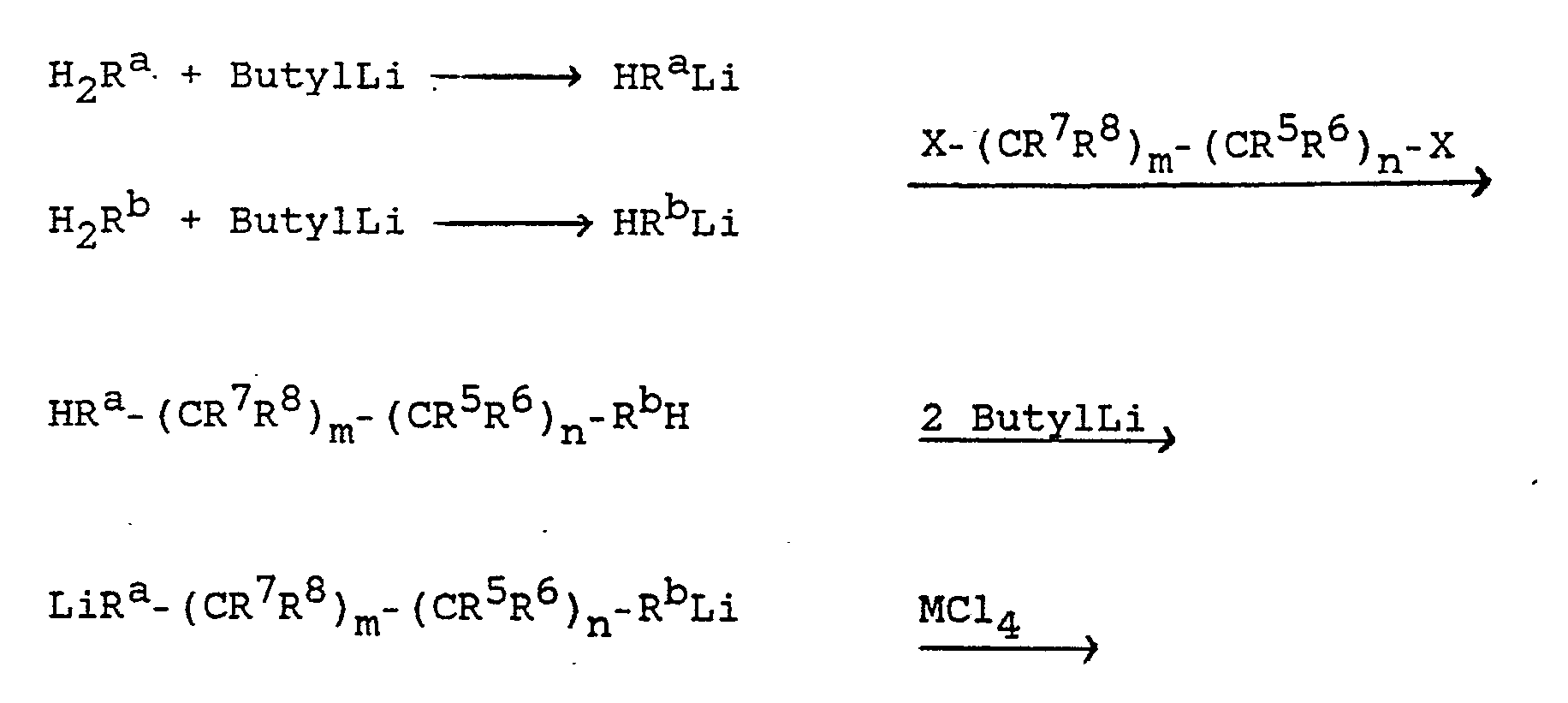

- Der Cokatalysator ist ein Aluminoxan der Formel II


- Das Aluminoxan kann auf verschiedene Art und Weise hergestellt werden.
- Eine Möglichkeit ist die vorsichtige Zugabe von Wasser zu einer verdünnten Lösung eines Aluminiumtrialkyls, indem die Lösung des Aluminiumtrialkyls, vörzugsweise Aluminiumtrimethyl, und das Wasser jeweils in kleinen Portionen in eine vorgelegte größere Menge eines inerten Lösemittels eingetragen werden und zwischendurch das Ende der Gasentwicklung jeweils abgewartet wird.
- Bei einem anderen Verfahren wird fein gepulvertes Kupfersulfatpentahydrat in Toluol aufgeschlämmt und in einem Glaskolben unter Inertgas bei etwa -20 °C mit soviel Aluminiumtrialkyl versetzt, daß für je 4 Al-Atome etwa 1 mol CuSO₄·5H₂O zur Verfügung steht. Nach langsamer Hydrolyse unter Alkan-Abspaltung wird die Reaktionsmischung 24 bis 48 Stunden bei Zimmertemperatur belassen, wobei gegebenenfalls gekühlt werden muß, damit die Temperatur nicht über 30 °C ansteigt. Anschließend wird das im Toluol gelöste Aluminoxan von dem Kupfersulfat abfiltriert und die Lösung im Vakuum eingeengt. Es wird angenommen, daß bei diesem Herstellungsverfahren die niedermolekularen Aluminoxane unter Abspaltung von Aluminiumtrialkyl zu höheren Oligomeren kondensieren.
- Weiterhin erhält man Aluminoxane, wenn man bei einer Temperatur von -20 bis 100 °C in einem inerten aliphatischen oder aromatischen Lösemittel, vorzugsweise Heptan oder Toluol, gelöstes Aluminiumtrialkyl, vorzugsweise Aluminiumtrimethyl, mit kristallwasserhaltigen Aluminiumsalzen, vorzugsweise Aluminiumsulfat, zur Reaktion bringt. Dabei beträgt das Volumenverhältnis zwischen Lösemittel und dem verwendeten Aluminiumalkyl 1:1 bis 50:1 -vorzugsweise 5:1 - und die Reaktionszeit, die durch Abspaltung des Alkans kontrolliert werden kann, 1 bis 200 Stunden - vorzugsweise 10 bis 40 Stunden.
- Von den kristallwasserhaltigen Aluminiumsalzen werden insbesondere jene verwendet, die einen hohen Gehalt an Kristallwasser aufweisen. Besonders bevorzugt ist Aluminiumsulfat-Hydrat, vor allem die Verbindungen Al₂(SO₄)₃·16H₂O und Al₂(SO₄)₃·18H₂O mit dem besonders hohen Kristallwassergehalt von 16 bzw. 18 mol H₂O/mol Al₂(SO₄)₃.
- Eine weitere Variante zur Herstellung von Aluminoxanen besteht darin, Aluminiumtrialkyl, vorzugsweise Aluminiumtrimethyl, in dem im Polymerisationskessel vorgelegten Suspensionsmittel, vorzugsweise im flüssigen Monomeren, in Heptan oder Toluol, zu lösen und dann die Aluminiumverbindung mit Wasser umzusetzen.
- Neben den zuvor geschilderten Verfahren zur Herstellung von Aluminoxanen gibt es weitere, welche brauchbar sind.
- Unabhängig von der Art der Herstellung ist allen Aluminoxanlösungen ein wechselnder Gehalt an nicht umgesetztem Aluminiumtrialkyl, das in freier Form oder als Addukt vorliegt, gemeinsam.
- Es ist möglich, das Metallocen vor dem Einsatz in der Polymerisationsreaktion mit einem Aluminoxan der Formel (II) und/oder (III) vorzuaktivieren. Dadurch wird die Polymerisationsaktivität deutlich erhöht und die Kornmorphologie verbessert.
- Die Voraktivierung der Übergangsmetallverbindung wird in Lösung vorgenommen. Bevorzugt wird dabei das Metallocen in einer Lösung des Aluminoxans in einem inerten Kohlenwasserstoff aufgelöst. Als inerter Kohlenwasserstoff eignet sich ein aliphatischer oder aromatischer Kohlenwasserstoff.
Bevorzugt wird Toluol verwendet.
Die Konzentration des Aluminoxans in der Lösung liegt im Bereich von ca. 1 Gew.-% bis zur Sättigungsgrenze, vorzugsweise von 5 bis 30 Gew.-%, jeweils bezogen auf die Gesamtlösung. Das Metallocen kann in der gleichen Konzentration eingesetzt werden, vorzugsweise wird es jedoch in einer Menge von 10⁻⁴ - 1 mol pro mol Aluminoxan eingesetzt. Die Voraktivierungszeit beträgt 5 Minuten bis 60 Stunden, vorzugsweise 5 bis 60 Minuten. Man arbeitet bei einer Temperatur von -78 °C bis 100 °C, vorzugsweise 0 bis 70°C. - Die Polymerisation wird in bekannter Weise in Lösung, in Suspension oder in der Gasphase, kontinuierlich oder diskontinuierlich, ein- oder mehrstufig bei einer Temperatur von 0 bis 150 °C, vorzugsweise 30 bis 80 °C, durchgeführt. Polymerisiert werden Olefine der Formel R¹¹-CH=CH-R¹². In dieser Formel sind R¹¹ und R¹² gleich oder verschieden und bedeuten ein Wasserstoffatom oder einen Alkylrest mit 1 bis 28 C-Atomen. R¹¹ und R¹² können jedoch auch mit den sie verbindenden C-Atomen einen Ring mit 4 bis 28 C-Atomen bilden. Beispiele für solche Olefine sind Ethylen, Propylen, 1-Buten, 1-Hexen, 4-Methyl-1-penten, 1-Octen, Norbornen, Norbornadien, Penten, Hexen oder Octen. Insbesondere wird Propylen polymerisiert.
- Als Molmassenregler wird, falls erforderlich, Wasserstoff zugegeben. Der Gesamtdruck im Polymerisationssystem beträgt 0,5 bis 100 bar. Bevorzugt ist die Polymerisation in dem technisch besonders interessanten Druckbereich von 5 bis 64 bar.
- Dabei wird die Metallocenverbindung in einer Konzentration, bezogen auf das Übergangsmetall, von 10⁻³ bis 10⁻⁷, vorzugsweise 10⁻⁴ bis 10⁻⁶ mol Übergangsmetall pro dm³ Lösemittel bzw. pro dm³ Reaktorvolumen angewendet. Das Aluminoxan wird in einer Konzentration von 10⁻⁵ bis 10⁻¹ mol, vorzugsweise 10⁻⁴ bis 10⁻² mol pro dm³ Lösemittel bzw. pro dm³ Reaktorvolumen verwendet. Prinzipiell sind aber auch höhere Konzentrationen möglich. Als Metallocen wird mindestens eine Verbindung der Formel I eingesetzt. Möglich sind auch Gemische mehrerer Verbindungen der Formel I oder Gemische von Isomeren.
- Wenn die Polymerisation als Suspensions- oder Lösungspolymerisation durchgeführt wird, wird ein für das Ziegler-Niederdruckverfahren gebräuchliches inertes Lösemittel verwendet. Beispielsweise arbeitet man in einem aliphatischen oder cycloaliphatischen Kohlenwasserstoff; als solcher sei beispielsweise Butan, Pentan, Hexan, Heptan, Isooctan, Cyclohexan, Methylcyclohexan genannt.
- Weiterhin kann eine Benzin- bzw. hydrierte Dieselölfraktion benutzt werden. Brauchbar ist auch Toluol. Bevorzugt wird im flüssigen Monomeren polymerisiert.
Werden inerte. Lösemittel verwendet, werden die Monomeren gasförmig oder flüssig zudosiert.
Wird nur ein Monomer als Suspensionsmittel verwendet, so wird das Comonomere, beziehungsweise werden die Comonomeren gasförmig oder flüssig zudosiert.
Des weiteren ist es möglich, in einer Mischung verschiedener Monomeren als Suspensionsmittel zu polymerisieren; ein weiteres Monomeres kann dann flüssig oder gasförmig zudosiert werden. Bei Verwendung von Ethylen ist es vorteilhaft, einen Teil des Ethylens vorzulegen und den Rest während der Polymerisation zuzudosieren. - Die Dauer der Polymerisation ist beliebig, da das erfindungsgemäß zu verwendende Katalysatorsystem einen nur geringen zeitabhängigen Abfall der Polymerisationsaktivität zeigt.
- Das erfindungsgemäße Verfahren zeichnet sich dadurch aus, daß die verwendeten Metallocene sehr temperaturstabil sind, so daß sie mit hoher Aktivität auch bei Temperaturen bis 90°C eingesetzt werden können. Außerdem können die als Cokatalysatoren dienenden Aluminoxane in geringeren Konzentrationen als bisher zugesetzt werden. Schließlich ist es nunmehr möglich, statistische Copolymere bei technisch interessanten Temperaturen herzustellen.
- Die erfindungsgemäß zu verwendenden Metallocene oder Metallocen-Gemische enthalten Verbindungen, welche Propylen zu Polymeren mit einer Molmasse von mehr als 150 000 g/mol, vorzugsweise 200 000 g/mol, polymerisieren können. Dies wird durch die Molmassenverteilung, die ein hohes Mw/Mn-Verhältnis (> 2) aufweist, bestätigt. Die Molmassenverteilung ist teilweise multimodal.
- Zu 8,17 g (336 mmol) Magnesiumspänen wurde eine Mischung aus 68,64 g (336 mmol) Methylphenyl-benzofulven, 4,92 cm³ (61 mmol) CCl₄ und 100 cm³ THF innerhalb von 0,5 h zugegeben. Die durch die eingetretene Reaktion warme Reaktionsmischung wurde dann über Nacht gerührt. Der erhaltene Grignard-Ansatz wurde zu etherischer HCl gegeben und anschließend Wasser zugefügt. Nach Abtrennung wurde die organische Phase über Na₂SO₄ getrocknet, filtriert und eingedampft.
- Das Rohprodukt wurde säulenchromatographisch gereinigt (50x 250 mm; 60 Å, 70 - 200 µm, beginnend mit reinem n-Hexan und zunehmendem H₂CCl₂-Gehalt).
Ausbeute 3,1 g (7,55 mmol 4,5 %), rF = 0,26 (vol. 3 Hexan/1 H₂CCl₂), Smp. 225 - 230°C. - Zu 12,2 g (42,6 mmol) des Liganden (Racemat) in 200 cm³ THF wurden bei Raumtemperatur 56 cm³ einer 1,6 n (89,6 mmol) Butyllithium-Hexanlösung innerhalb von 1 h zugetropft und der Ansatz bei 60°C bis 0,5 h nach Beendigung der Butanentwicklung gerührt.
Die erhaltene Dilithiosalzlösung wurde simultan mit einer Lösung von 16,6 g (44 mmol) ZrCl₄(thf)₂ in 300 cm³ THF bei Umgebungstemperatur zu 50 cm³ THF innerhalb von 2 h zugetropft. Der Ansatz wurd dann 1,5 h bei Raumtemperatur gerührt und 4 cm³ einer 1,0 n (4 mmol) etherischen HCl-Lösung zugefügt. Nach spontaner Aufhellung der dunklen Reaktionsmischung blieb eine orange Farbe bestehen. Nun wurde das Gemisch auf 200 cm³ eingeengt und die anorganischen Salze durch Toluolzugabe ausgefällt und abfiltriert.
Das Filtrat wurde weiter eingeengt. Als das Volumen noch 100 cm³ betrug, war ein gelboranger Feststoff angefallen. Zur Vervollständigung wurde das Gemisch über Nacht in den Tiefkühlschrank (-35°C) gestellt, anschließend filtriert, der Niederschlag mit wenig kaltem Toluol und dann mit n-Pentan gewaschen und im Vakuum getrocknet. Ausbeute I: 2,6 g (5,82 mmol = 13,7 %); NMR belegte ein 1:1-Gemisch zweier Komplexe.
Der sich beim weiteren Einengen des Filtrats abscheidende Niederschlag wurde wie vorstehend beschrieben behandelt. Ausbeute II: 3,3 g (7,39 mmol = 17,4 %); NMR zeigte ein Gemisch der Komplexe aus I.
Das Filtrat wurde zur Trockne eingedampft. Ausbeute III: 0,2 g.
Fraktion II wurde in Ether aufgenommen und langsam eingeengt. Der erste angefallene Niederschlag A zeigte nach NMR ein ∼ 1:3-Gemisch, wobei der im Fünfringprotonenbereich bei höherem Feld erscheinenden Komplex überwog. Wurde die Prozedur mit A wiederholt, so erhielt man eine Anreicherung auf besser als 1:4 (Niederschlag B, 1,2 g (2,69 mmol = 6,3 %).
Das zur Trockne eingedampfte Filtrat von B enthielt die bei niedrigerem Felde in Resonanz stehende Verbindung angereichert auf mehr als 4:1 (Ausbeute 0,8 g (1,79 mmol = 4,2 %).
Fraktion II zeigte eine korrekte CH-Analyse: gef. 58,5 (ber. 59,18) C; 4,6 (4,51 %) H. - 7,96 g (27,79 mmol) Ligand (Racemat) in 100 cm³ THF und 36 cm³ 1,6 n (57,6 mmol) Butyllithium-Hexanlösung wurden wie in Beispiel 1 beschrieben zum Dilithiosalz umgesetzt. Zu 50 cm³ THF wurden bei Raumtemperatur 10,78 g (28,58 mmol) ZrCl₄ (thf)₂ in 200 cm³ THF und die Dilithiosalzlösung getropft. Dabei wurde so verfahren, daß immer eine größere Menge an Zirkonverbindung vorgelegt war, d.h. die Zirkonlösung wurde innerhalb von 3 h, die Dilithiosalzlösung in 8,5 h zugegeben. Nach zweistündigem Rühren bei Umgebungstemperatur wurden 2,5 cm³ 1,0 n (2,5 mmol) etherische HCl zugefügt - es erfolgte sofort Aufhellung - und der Ansatz bis auf etwa 100 cm³ eingeengt. Dann wurden 150 cm³ Toluol zugefügt und das Gemisch über Nacht stehengelassen. Der angefallene Niederschlag wurde abgetrennt und das Filtrat eingeengt. Von einer dabei auftretenden kleinen Menge Öl wurde abdekantiert und die Flüssigkeit zur Trockne eingedampft. Das Rohprodukt wurde NMR-spektroskopisch untersucht. Es zeigte die aus Beispiel 1 bekannten Spezies als Hauptkomponenten und mindestens eine weitere Verbindung. Es wurde mit 2 x 120 cm³ Et₂O extrahiert und das Filtrat eingedampft. Sein NMR-Spektrum zeigt neben den aus Beispiel 1 bekannten Signalen weitere Resonanzen im Fünfringprotonenbereich. Die weiteren angefallenen Etherextrakte (Σ 1 cm³) wurden zur Trockne eingedampft. Es fielen 10,5 g gelber Feststoff an (23,5 mmol = 84,6 %; NMR: zwei Komplexe).
- Zu 7,7 g (30,53 mmol) Ligand (Racemat) in 100 cm³ THF wurden bei Raumtemperatur innerhalb von 1 h 41 cm³ 1,6 n (65,6 mmol) Butyllithium-Hexanlösung zugetropft und der Ansatz 0,5 h bis nach Beendigung der Butanentwicklung bei 60°C gerührt.
11,7 g (31,01 mmol) ZrCl₄(thf)₂ in 250 cm³ THF wurden simultan mit der Dilithiosalzlösung zu 50 cm³ THF bei Umgebungstemperatur innerhalb von 5 h zugegeben. Nach zweitägigem Rühren bei Raumtemperatur wurden 4 cm³ (4 mmol) etherische HCl zugegeben. Die nun klare, gelborange Reaktionsmischung wurde zur Trockne eingeengt. Der orangerote Eindampfrückstand wurde mit 6 x 80 cm³ Toluol extrahiert, filtriert und eingeengt. Von einem beim Einengen auf 200 cm³ anfallenden Öl wurde abdekantiert und das Filtrat weiter auf 80 cm³ eingeengt. Der dabei anfallende Niederschlag A wurde abfiltriert, mit wenig n-Pentan gewaschen und im Vakuum getrocknet. Ausbeute A: 1,85 g (4,28 mmol = 14 %); NMR belegt zwei Komplexe. - Das Filtrat wurde auf 30 cm³ weiter eingeengt und über Nacht kaltgestellt (-35°C), vom Niederschlag B abdekantiert und zur Trockne eingedampft (0,1 g; NMR zeigte Edukte, d.h. Ligand und ZrCl₄(thf)₂, Toluol und vermutlich vier Komplexe). Der Niederschlag B wurde mit Pentan gewaschen und im Vakuum getrocknet. Ausbeute: B 0,7 g (1,62 mmol = 5,3 %); NMR zeigte das Vorliegen eines Vierkomponentengemisches.
- Die Elementaranalyse erbrachte folgendes Ergebnis: gef. 57,9 % (ber. 58,32) C, 4,2 % (4,4) H.
- Zu 4,53 g (13 mmol) Ligand in 75 cm³ THF wurden 17,25 cm³ 1,6 n (27,6 mmol) Butyllithium-Hexanlösung getropft und der Ansatz anschließend bei 55°C bis 0,5 h nach Beendigung der Gasentwicklung gerührt.
Diese Dilithiosalzlösung wurde simultan mit 4,9 g (12,99 mmol) ZrCl₄(thf)₂ in 100 cm³ THF zu 30 cm³ THF innerhalb von 6 h bei Raumtemperatur zugegeben, zur Trockne eingedampft, in Toluol aufgenommen und filtriert. Nach Abziehen des Lösemittels wurde der Rückstand mehrmals mit n-Pentan digeriert, wobei das Pentan abdekantiert wurde. Der nun erhaltene Rückstand wurde getrocknet. Ausbeute: 2,28 g (ca. 4,47 mmol = 34,4 %); NMR bestätigte das Vorliegen von mindestens drei Komplexen, verunreinigt mit THF und Pentan. - Zu 2,04 g (4,97 mmol) Ligand (Diastereomerengemisch) in 40 cm³ THF wurden 6,25 cm³ 1,6 n (10 mmol) Butyllithium-Hexanlösung bei Raumtemperatur zugetropft. Dabei schied sich etwa nach Hälfte der Zugabe ein weißgrüner Niederschlag ab. Nach zweistündigem Rühren bei 60°C wurde das angefallene Dilithiosalz portionsweise zu 1,88 g (4,98 mmol) ZrCl₄(thf)₂, gelöst in 40 cm³ THF, bei 0°C zugegeben. Im Anschluß daran wurde der Ansatz 4 h bei Umgebungstemperatur gerührt und zur Trockne eingeengt, mit einem warmen (ca. 40°C) n-Pentan/Toluol-Gemisch (vol. 2:1) extrahiert, filtriert und die erhaltene klare, gelbe Lösung eingeengt. Ein dabei angefallener gelber Niederschlag A wurde abfiltriert, mit wenig kaltem Et₂O gewaschen und im Vakuum getrocknet. Ausbeute A: 0,45 g (ca. 0,86 mmol = 17,7 %); NMR zeigte neben Lösemitteln (Et₂O, THF, n-Pentan, Toluol) Signale mit für Indenylkomplexfünfringprotonen charakteristischen Aufspaltungsmuster mindestens zweier Komplexverbindungen. Zum Filtrat wurden 25 cm³ n-Pentan zugefügt und der gefällte Niederschlag B abfiltriert, mit wenig kaltem Et₂O gewaschen und im Vakuum getrocknet. Ausbeute B: 1,08 g (1,57 mmol = 31,5 %); NMR zeigte neben den Signalen von Toluol und Pentan das vermutliche Vorliegen einer einzigen Komplexspezies, die in A nicht vorhanden war.
Das Filtrat von B wurde zur Trockne eingedampft. Sein NMR zeigte neben Et₂O, Pentan und Toluol vermutlich Signale des Komplexes aus Niederschlag B und des Liganden. - Zu 7,2 g (26,95 mmol) Liganden (Racemat) in 200 cm³ THF wurden bei Raumtemperatur 34 cm³ 1,6 n (54,4 mmol) Butyllithium-Hexanlösung innerhalb einer Stunde zugetropft und im Anschluß daran der Ansatz 1 h bei 60°C gerührt. Die Dilithiosalzlösung wurde dann simultan mit 13 g (28 mmol) HfCl₄(thf)₂ in 200 cm³ THF zu 50 cm³ THF zusammengetropft, wobei so verfahren wurde, daß ein Hf-Überschuß im Reaktionsgefäß vorlag. Nach Zugabe von 2/3 wurde der Ansatz über Nacht stehen gelassen und der Rest der Reaktionspartner innerhalb von 4 h zugegeben. Darauf wurde der Ansatz über Nacht gerührt und 4 cm³ 1,0 n (4,0 mmol) etherische HCl zugefügt, wobei Farbaufhellung beobachtet wurde.
Der gelbbraune Eindampfrückstand wurde mit Toluol extrahiert, filtriert und zur Trockne eingedampft. Der erhaltene Rückstand I wurde mit n-Pentan digeriert, das filtrierte Lösemittel abgezogen und der Rest von ca. 25 cm³ vom angefallenen Niederschlag abgetrennt.
Ausbeute A: 0,61 g (1,14 mmol = 4,2 %); NMR zeigte neben den Signalen des Liganden Resonanzen im Indenylfünfringprotonenbereich, die das Vorliegen dreier Komplexverbindungen belegen, wobei zwei als Hauptkomponenten vorliegen.
Rückstand I wurde noch mit Pentan/Et₂O (vol. 1:2) extrahiert, filtriert und das Filtrat eingeengt. Ausbeute B: 0,26 g (0,49 mmol = 1,8 %); NMR belegte das Vorliegen eines komplexen Stoffgemisches, augenscheinlich von vier Verbindungen (vier Methylgruppen-Tripletts der Ethylgruppe im Bereich von 1,25 - 0,85 ppm).
Es wurde folgende Elementaranalyse gefunden: ber. 49,5 (gef. 50,9) C; 3,78 (4,1 %) H. - Zu 1,45 g (3,25 mmol) einer Suspension zweier Komplexverbindungen in 50 cm³ Et₂O wurden bei -40°C 4,1 cm³ 1,6 n (6,56 mmol) Methyllithium-Etherlösung zugetropft. Nachdem ein größerer Teil in Lösung gegangen war und ein schmutzigweißer Niederschlag auftrat, wurde zur Trockne eingedampft. Nach Extraktion mit 200 cm³ n-Pentan und Filtration wurde das Lösemittel abgezogen und der Rückstand im Vakuum getrocknet.
Ausbeute 1,15 g (ca. 2,83 mmol = 87,0 %); NMR zeigte neben einigen Verunreinigungen, vermutlich monomethylierter Verbindungen, zwei Hauptkomponenten mit für CH₃Zr-Spezies typischen Resonanzen im Hochfeldbereich, nämlich für die syn-form erwartungsgemäß zwei Resonanzen, bei -0,76 und -0,88 ppm und für die anti-Form, welche durch die unsymmetrische C₂-Brücke keine C₂-Symmetrie mehr besitzt, zwei Signale bei fast identischer Verschiebung von -1,02 ppm. - Ein trockener 16 dm³-Kessel wurde mit Stickstoff gespült und bei 20°C mit 10 dm³ eines Benzins (Siedebereich 100-120°C) gefüllt. Dann wurde der Gasraum des Kessels durch 5-maliges Aufdrücken von 2 bar Ethylen und Entspannen stickstofffrei gespült. Hiernach wurden 30 cm³ toluolische Methylaluminoxanlösung (10,5 Gew.-% Methylaluminoxan, Molmasse nach kryoskopischer Bestimmung: 750 g/mol) zugegeben. Unter Rühren wurde der Kesselinhalt innerhalb von 15 Minuten auf 60°C aufgeheizt. Durch Zuführen von Ethylen unter Rühren mit 250 UPM wurde der Gesamtdruck dann auf 5 bar eingestellt. Parallel dazu wurden 3,1 mg Metallocen in 20 cm³ toluolischer Methylaluminoxanlösung (Konzentration und Qualität wie oben) gelöst und durch 15-minütiges Stehenlassen voraktiviert. Danach wurde die Lösung in den Kessel gegeben. Das Polymerisationssystem wurde auf eine Temperatur von 65°C gebracht und dann durch entsprechende Kühlung 1 Stunde bei dieser Tempertur gehalten. Der Gesamtdruck wurde während dieser Zeit durch entsprechende Zufuhr von Ethylen bei 5 bar gehalten. Es wurden die in der Tabelle 1 aufgeführten Mengen erhalten.
- In den Tabellen sind die folgenden Abkürzungen verwendet worden:
VZ = Viskositätszahl in cm³/g,
Mw = Molmassengewichtsmittel in g/mol
Mw/Mn = Polydispersität ermittelt durch Gelpermeationschromatographie (GPC)
II = Isotaxie bestimmt durch ¹³C-NMR Spektroskopie,
SD = Schüttdichte, Tg = Glasumwandlungstemperatur. - Ein sauberer und trockener 1,5 dm³-Polymerisationsreaktor mit Rührer wurde mit Stickstoff und dann mit Ethylen gespült und mit einer Losung von Norbornen in 750 cm³ Toluol gefüllt. Unter Rühren wurde dann der Reaktor auf eine Temperatur von 20°C gebracht und 1 bar Ethylen aufgedrückt. Danach wurden 20 cm³ toluolische Methylaluminoxanlösung (10,1 Gew.-% Methylaluminoxan mit Molmasse 1300 g/mol kryoskopischer Bestimmung) in den Reaktor dosiert und die Mischung 15 min bei 20°C gerührt, wobei durch Nachdosieren der Ethylendruck bei 1 bar gehalten wurde (Sättigung des Toluols mit Ethylen). Parallel dazu wurde das Metallocen in 10 cm³ toluolischer Methylaluminoxanlösung (Konzentration und Qualität s.o.) gelöst und durch 15 minütiges Stehenlassen voraktiviert. Dann wurde die Lösung des Komplexes in den Reaktor dosiert. Unter Rühren (750 UPM) wurde dann 1 h bei 20°C polymerisiert, wobei der Ethylendruck durch Nachdosieren bei 1 bar gehalten wurde. Dann wurde der Reaktorinhalt schnell in ein Rührgefäß abgelassen, in dem 100 cm³ Isopropanol vorgelegt waren. Diese Mischung wurde mit 2 dm³ Aceton versetzt, 10 min gerührt und dann der suspendierte polymere Feststoff abfiltriert. Das abfiltrierte Polymere wurde dann in 600 cm³ einer Mischung aus zwei Teilen 3-normaler Salzsäure und einem Teil Ethanol gegeben und diese Suspension 2 h gerührt. Das Polymere wurde dann erneut abfiltriert, mit Wasser neutral gewaschen und bei 80°C und 0,2 bar 15 h getrocknet.
Die Ergebnisse der Versuche sind in Tabelle 2 zusammengefaßt. - Ein sauberer und trockener 1,5 dm³-Polymerisationsreaktor mit Rührer wurde mit Stickstoff und dann mit Propylen gespült und mit einer Lösung von 30 g Norbornen in 750 cm³ Toluol gefüllt. Unter Rühren wurde dann der Reaktor auf eine Temperatur von 20°C gebracht und 1 bar Propylen aufgedrückt. Danach wurden 20 cm³ toluolische Methylaluminoxanlösung (10,1 Gew.-% Methylaluminoxan mit Molmasse 1300 g/mol) in den Reaktor dosiert und die Mischung 15 min bei 20°C gerührt, wobei durch Nachdosieren der Propylendruck bei 1 bar gehalten wurde (Sättigung des Toluols mit Propylen). Parallel dazu wurde das Metallocen in 10 cm³ toluolischer Methylaluminoxanlösung (Konzentration und Qualität s.o.) gelöst und durch 15 minütiges Stehenlassen voraktiviert. Dann wurde die Lösung des Komplexes in den Reaktor dosiert. Unter Rühren (750 UPM) wurde danach 3 h bei 20°C polymerisiert, wobei der Propylendruck durch Nachdosieren bei 1 bar gehalten wurde. Dann wurde der Reaktorinhalt schnell in ein Rührgefäß abgelassen, in dem 100 cm³ Isopropanol vorgelegt waren. Diese Mischung wurde mit 2 dm³ Aceton versetzt, 30 min gerührt und der suspendierte polymere Feststoff abfiltriert. Das abfiltrierte Polymere wurde dann in 600 cm³ einer Mischung aus zwei Teilen 3-normaler Salzsäure und einem Teil Ethanol gegeben und diese Suspension 2 h gerührt. Danach wurde die Mischung mit 200 cm³ Toluol versetzt und nach weiteren 5 min Rühren die toluolische Phase abgetrennt und mit 1 dm³ Aceton versetzt. Das durch Extraktion der salzsauren Mischung in Toluol gelöste Polymere wurde dabei ausgefällt. Der ausgefällte polymere Feststoff wurde abfiltriert und bei 80°C und 0,2 bar 15 h getrocknet.
Die Versuchsergebnisse sind in Tabelle 3 zusammengefaßt. - Ein trockener 16 dm³ Kessel wurde mit Stickstoff gespült und mit 10 dm³ flüssigem Propylen befüllt. Dann wurden zwei Drittel der in Tabelle 4 für den jeweiligen Versuch angegebenen MAO-Menge als toluolische Lösung zugegeben und der Ansatz bei 30°C 15 Minuten gerührt.
Parallel dazu wurde eine Lösung des Metallocens in einem Drittel der in Tabelle 4 angegebenen MAO-Menge hergestellt und durch 15 minütiges Stehenlassen voraktiviert. Die Metallocene (Beispiele 1 bis 7) wurden ohne weitere Reinigung als Gemische von Verbindungen bzw. als Isomerengemische eingesetzt. - Diese Lösung wurde dann in den Kessel gegeben. Das Polymerisationssystem wurde auf die entsprechende Polymerisationstemperatur gebracht und die Polymerisation gestartet. Die Polymerisation wurde nach 60 Minuten durch Abkühlen des Reaktors und Entspannen gestoppt. Die erhaltene Polymerausbeute und die ermittelten analytischen Daten sind Tabelle 4 zu entnehmen.
Tabelle 1 Bsp. Metallocen Katalysatoreinwaage Ausbeute PE SD VZ Mw Mw/Mn (mg) (g) (g/cm³) (cm³/g) (10³g/mol) A (Vergleich) rac-Ethylen-bis-(1-indenyl) zirkondichlorid 4,2 430 120 220 160 3,1 7 rac-Methylethylen-bis-(1-indenyl) zirkondichlorid 5,3 250 50 390 8 rac-Ethylethylen-bis-(1-indenyl) zirkondichlorid 5,1 290 130 290 9 rac-1,2-Diphenylethylen-bis-(1-indenyl)zirkondichlorid 9,6 50 80 510 10 dito (einzelnes Isomeres) 10,1 60 150 320 Tabelle 2 Bsp. Metallocen Katalysatoreinwaage Norbornen-Einsatz Ausbeute VZ Tg (mg) (g) (g) (cm³/g) (°C) B (Vergleich) Zr(Ind)₂EtCl₂ 10,2 50 20 260 65,3 11 Zr(Ind)₂Et*EtCl₂ 6,0 50 30 164 67,5 12 Zr(Ind)₂Et*MeCl₂ 4,0 60 5,5 180 71,7 Tabelle 3 Bsp. Metallocen Katalysatoreinwaage Norbornen-Einsatz Ausbeute VZ Tg (mg) (g) (g) (cm³/g) (°C) C (Vergleich) Zr(Ind)₂EtCl₂ 30,2 30 5,5 25 93,4 13 Zr(Ind)₂Et*EtCl₂ 29,9 30 28,0 23 101,0 14 Zr(Ind)₂Et*MeCl₂ 30,1 30 23 25 99,0 15 Zr(Ind)₂Et*Ph₂Cl₂ 120,4 30 0,2 18 79,7 Tabelle 4 Bsp. Metallocen Katalysator Temp. °C Kontaktmenge (mg) Ausbeute (g) Aktivität (kgPP/gKO/h) MAO (mmol Al) Schüttgewicht (g/cm³) VZ (cm³/g) Mw (g/mol) Mw/Mn 16 Zr(Ind)₂C₂EtMe₂ 5 70 10,0 1764 176,4 74 420 53 55 000 4,4 17 Zr(Ind)₂EtMeCl₂ 2 70 10,8 1718 159,1 74 60 48 000 3,6 18 60 15,0 1750 116,7 74 64 62 000 3,6 19 50 13,3 887 66,7 74 0 77 000 4,6 20 40 22,4 347 15,5 74 0 81 000 4,3 21 Zr(Ind)₂Et*EtCl₂ 1a 70 16,0 2154 134,6 80 0 28 000 4,8 22 60 16,0 1717 107,3 80 0 22 500 3,5 23 50 15,0 636 42,4 80 268 42 37 000 4,9 24 40 28,0 291 10,4 72 0 71 000 2,7 25 Zr(Ind)₂Et*EtCl₂ 1b 40 50,0 1085 21,7 80 76 88 500 5,4 26 50 36,5 1212 33,2 80 172 70 69 000 5,8 27 60 15,0 672 44,8 80 265 53 55 000 4,2 28 70 15,0 995 66,3 80 381 53 51 000 4,0 29 Zr(Ind)₂Et*EtCl₂ 1c 40 15,0 563 37,5 80 120 142 163 000 4,2 30 50 20,0 1280 64,0 80 100 96 106 500 3,6 31 60 15,5 1049 67,7 80 185 78 77 500 3,6 32 70 23,3 2649 113,7 80 530 63 53 500 2,8 33 Zr(Ind)₂Et*EtCl₂ 1d 40 30,0 1659 55,3 80 200 47 36 000 4,4 34 50 20,5 1960 95,6 80 335 47 38 000 5,3 35 60 20,0 2450 122,5 80 470 52 49 000 5,5 36 Zr(Ind)₂Et*CH₂PhCl₂ 3 40 60,0 162 2,7 74 106 90 86 000 8,9 37 50 50,0 300 6,0 74 90 102 86 000 4,8 38 60 50,0 480 9,6 74 204 75 66 000 6,6 39 70 50,0 810 16,2 74 334 67 49 000 6,9 40 Zr(Ind)₂Et*(Ph)₂Cl₂ 4a 40 35,0 256 7,3 80 41 50 15,0 300 20,0 80 424 84 70 000 2,4 42 60 15,0 474 31,6 80 65 49 000 2,4 43 70 18,0 961 53,4 80 275 44 Zr(Ind)₂Et*(Ph)₂Cl₂ 4b 40 50,0 90 1,8 74 140 94 60 000 2,6 45 50 50,0 115 2,3 74 140 68 60 000 2,9 46 60 50,0 250 5,0 74 65 70 000 2,4 47 70 50,0 420 8,4 74 176 59 49 000 3,5
Claims (4)


M Zirkon oder Hafnium ist,
R¹ und R² gleich oder verschieden sind und ein Wasserstoffatom, eine C₁-C₁₀-Alkylgruppe, eine C₁-C₁₀-Alkoxygruppe, eine C₆-C₁₀-Arylgruppe, eine C₆-C₁₀-Aryloxygruppe, eine C₂-C₁₀-Alkenylgruppe, eine C₇-C₄₀-Arylalkylgruppe, eine C₇-C₄₀-Alkylarylgruppe, eine C₈-C₄₀-Arylalkenylgruppe oder ein Halogenatom bedeuten,
R³ und R⁴ gleich oder verschieden sind und ein Wasserstoffatom, ein Halogenatom, eine C₁-C₁₀-Alkylgruppe,
einen -NR


worin R⁹ eine C₁-C₁₀-Alkylgruppe, eine C₆-C₁₀-Arylgruppe oder im Falle Si oder P enthaltender Reste auch ein Halogenatom ist,
oder je zwei benachbarte Reste R³ oder R⁴ mit den sie verbindenden C-Atomen einen Ring bilden,
R⁵, R⁶, R⁷ und R⁸ gleich oder verschieden sind und ein Wasserstoffatom, ein Halogenatom, eine C₁-C₃₀-Alkylguppe, eine C₁-C₁₀-Fluoralkylgruppe, eine C₆-C₁₀-Arylgruppe, eine C₆-C₁₀-Fluorarylgruppe, eine C₁-C₁₀-Alkoxygruppe eine C₂-C₁₀-Alkenylgruppe, eine C₇-C₄₀-Arylalkylgruppe, eine C₈-C₄₀-Arylalkenylgruppe, eine -SiMe₃-Gruppe, eine -OSi-Me₃-Gruppe, eine C₇-C₄₀-Alkylarylgruppe bedeuten oder R⁵ und R⁶ oder R⁷ und R⁹ jeweils mit den sie verbindenden Atomen einen Ring bilden.
Applications Claiming Priority (2)
| Application Number | Priority Date | Filing Date | Title |
|---|---|---|---|
| DE3927257 | 1989-08-18 | ||
| DE3927257A DE3927257A1 (de) | 1989-08-18 | 1989-08-18 | Verfahren zur herstellung eines polyolefins |
Publications (3)
| Publication Number | Publication Date |
|---|---|
| EP0413326A2 true EP0413326A2 (de) | 1991-02-20 |
| EP0413326A3 EP0413326A3 (en) | 1992-09-02 |
| EP0413326B1 EP0413326B1 (de) | 1995-03-08 |
Family
ID=6387348
Family Applications (1)
| Application Number | Title | Priority Date | Filing Date |
|---|---|---|---|
| EP90115672A Expired - Lifetime EP0413326B1 (de) | 1989-08-18 | 1990-08-16 | Verfahren zur Herstellung eines Polyolefins |
Country Status (7)
| Country | Link |
|---|---|
| EP (1) | EP0413326B1 (de) |
| JP (1) | JP2948634B2 (de) |
| AU (1) | AU622826B2 (de) |
| CA (1) | CA2023559C (de) |
| DE (2) | DE3927257A1 (de) |
| ES (1) | ES2071716T3 (de) |
| ZA (1) | ZA906536B (de) |
Cited By (14)
| Publication number | Priority date | Publication date | Assignee | Title |
|---|---|---|---|---|
| EP0545140A1 (de) * | 1991-11-29 | 1993-06-09 | BASF Aktiengesellschaft | Ethylen-Copolymerisate niederer Dichte |
| AU670491C (en) * | 1993-03-31 | 1994-10-06 | Sanofi Aventis Deutschland | Pharmaceutical for the treatment of skin disorders |
| US5486585A (en) * | 1993-08-26 | 1996-01-23 | Exxon Chemical Patents Inc. | Amidosilyldiyl bridged catalysts and method of polymerization using said catalysts. |
| US5545785A (en) * | 1994-01-26 | 1996-08-13 | Witco Gmbh | Process for preparing biscyclopentadienyl compounds |
| EP0537686B1 (de) * | 1991-10-15 | 2005-01-12 | Basell Polyolefine GmbH | Verfahren zur Herstellung eines Olefinpolymers unter Verwendung von Metallocenen mit speziell substituierten Indenylliganden |
| US6936675B2 (en) | 2001-07-19 | 2005-08-30 | Univation Technologies, Llc | High tear films from hafnocene catalyzed polyethylenes |
| US7078467B1 (en) | 2005-06-14 | 2006-07-18 | Univation Technologies, Llc | Single catalyst low, medium and high density polyethylenes |
| US7381783B2 (en) | 1997-12-08 | 2008-06-03 | Univation Technologies, Llc | Polymerization catalyst systems, their use, their products and articles thereof |
| US7683140B2 (en) | 2004-05-20 | 2010-03-23 | Univation Technologies, Llc | Method for determining temperature value indicative of resin stickiness from data generated by polymerization reaction monitoring |
| US7754830B2 (en) | 2004-05-20 | 2010-07-13 | Univation Technologies, Llc | Polymerization reaction monitoring with determination of induced condensing agent concentration for preventing discontinuity events |
| US7774178B2 (en) | 2006-09-07 | 2010-08-10 | Univation Technologies, Llc | Methods for on-line determination of degree of resin stickiness using a model for depression of melt initiation temperature |
| US8273834B2 (en) | 2006-09-07 | 2012-09-25 | Univation Technologies, Llc | Methods for determining temperature value indicative of resin stickiness from data generated by polymerization reaction monitoring |
| US8399581B2 (en) | 2001-07-19 | 2013-03-19 | Univation Technologies, Llc | Polyethylene films with improved physical properties |
| US8497330B2 (en) | 1997-12-08 | 2013-07-30 | Univation Technologies, Llc | Methods for polymerization using spray dried and slurried catalyst |
Families Citing this family (8)
| Publication number | Priority date | Publication date | Assignee | Title |
|---|---|---|---|---|
| DE4015254A1 (de) * | 1990-05-12 | 1991-11-14 | Hoechst Ag | Verfahren zur herstellung eines polyolefins |
| TW227005B (de) | 1990-11-14 | 1994-07-21 | Hoechst Ag | |
| ES2109473T3 (es) * | 1991-12-13 | 1998-01-16 | Exxon Chemical Patents Inc | Copolimeros de etileno/alfa-olefinas superiores. |
| DE4406110A1 (de) * | 1994-02-25 | 1995-08-31 | Witco Gmbh | Verbrückte Cyclopentadienylmagnesium-Verbindungen und Verfahren zu ihrer Herstellung und ihre Verwendung zur Herstellung von Metallocenen |
| EP1661921B1 (de) | 2004-11-26 | 2019-07-17 | Mitsui Chemicals, Inc. | Synthetische Schmieröle und Schmierölzusammensetzung deren |
| WO2010123033A1 (ja) | 2009-04-21 | 2010-10-28 | 三井化学株式会社 | オレフィン重合体の製造方法 |
| US20120135903A1 (en) | 2010-05-11 | 2012-05-31 | Mitsui Chemicals, Inc. | Lubricating oil composition |
| CN104968668B (zh) | 2013-02-08 | 2017-11-17 | 三井化学株式会社 | 固体状聚铝氧烷组合物、烯烃聚合用催化剂、烯烃聚合物的制造方法及固体状聚铝氧烷组合物的制造方法 |
Family Cites Families (4)
| Publication number | Priority date | Publication date | Assignee | Title |
|---|---|---|---|---|
| DE3726067A1 (de) * | 1987-08-06 | 1989-02-16 | Hoechst Ag | Verfahren zur herstellung von 1-olefinpolymeren |
| IT1221653B (it) * | 1987-11-27 | 1990-07-12 | Ausimonti Spa | Copolimeri cristallini del propilene |
| DE3904468A1 (de) * | 1989-02-15 | 1990-08-16 | Hoechst Ag | Polypropylenwachs und verfahren zu seiner herstellung |
| DE3904469A1 (de) * | 1989-02-15 | 1990-08-16 | Hoechst Ag | Verfahren zur herstellung eines statistischen propylen-copolymers |
-
1989
- 1989-08-18 DE DE3927257A patent/DE3927257A1/de not_active Withdrawn
-
1990
- 1990-08-16 ES ES90115672T patent/ES2071716T3/es not_active Expired - Lifetime
- 1990-08-16 EP EP90115672A patent/EP0413326B1/de not_active Expired - Lifetime
- 1990-08-16 JP JP2215082A patent/JP2948634B2/ja not_active Expired - Fee Related
- 1990-08-16 DE DE59008625T patent/DE59008625D1/de not_active Expired - Fee Related
- 1990-08-17 AU AU61106/90A patent/AU622826B2/en not_active Ceased
- 1990-08-17 CA CA002023559A patent/CA2023559C/en not_active Expired - Fee Related
- 1990-08-17 ZA ZA906536A patent/ZA906536B/xx unknown
Cited By (21)
| Publication number | Priority date | Publication date | Assignee | Title |
|---|---|---|---|---|
| EP0537686B1 (de) * | 1991-10-15 | 2005-01-12 | Basell Polyolefine GmbH | Verfahren zur Herstellung eines Olefinpolymers unter Verwendung von Metallocenen mit speziell substituierten Indenylliganden |
| EP0545140A1 (de) * | 1991-11-29 | 1993-06-09 | BASF Aktiengesellschaft | Ethylen-Copolymerisate niederer Dichte |
| AU670491C (en) * | 1993-03-31 | 1994-10-06 | Sanofi Aventis Deutschland | Pharmaceutical for the treatment of skin disorders |
| AU670491B2 (en) * | 1993-03-31 | 1996-07-18 | Sanofi-Aventis Deutschland Gmbh | Pharmaceutical for the treatment of skin disorders |
| US5486585A (en) * | 1993-08-26 | 1996-01-23 | Exxon Chemical Patents Inc. | Amidosilyldiyl bridged catalysts and method of polymerization using said catalysts. |
| US5545785A (en) * | 1994-01-26 | 1996-08-13 | Witco Gmbh | Process for preparing biscyclopentadienyl compounds |
| US7381783B2 (en) | 1997-12-08 | 2008-06-03 | Univation Technologies, Llc | Polymerization catalyst systems, their use, their products and articles thereof |
| US8497330B2 (en) | 1997-12-08 | 2013-07-30 | Univation Technologies, Llc | Methods for polymerization using spray dried and slurried catalyst |
| US7989564B2 (en) | 1997-12-08 | 2011-08-02 | Univation Technologies, Llc | Catalyst systems and their use in polymerization processes |
| US8227564B2 (en) | 1997-12-08 | 2012-07-24 | Univation Technologies, Llc | Ethylene copolymers and their uses |
| US7172816B2 (en) | 2001-07-19 | 2007-02-06 | Univation Technologies, Llc | High tear films from hafnocene catalyzed polyethylenes |
| US7179876B2 (en) | 2001-07-19 | 2007-02-20 | Univation Technologies, Llc | High tear films from hafnocene catalyzed polyethylenes |
| US6936675B2 (en) | 2001-07-19 | 2005-08-30 | Univation Technologies, Llc | High tear films from hafnocene catalyzed polyethylenes |
| US8399581B2 (en) | 2001-07-19 | 2013-03-19 | Univation Technologies, Llc | Polyethylene films with improved physical properties |
| US7683140B2 (en) | 2004-05-20 | 2010-03-23 | Univation Technologies, Llc | Method for determining temperature value indicative of resin stickiness from data generated by polymerization reaction monitoring |
| US7754830B2 (en) | 2004-05-20 | 2010-07-13 | Univation Technologies, Llc | Polymerization reaction monitoring with determination of induced condensing agent concentration for preventing discontinuity events |
| US7223825B2 (en) | 2005-06-14 | 2007-05-29 | Univation Technologies, Llc | Single catalyst low, medium and high density polyethylenes |
| US7300988B2 (en) | 2005-06-14 | 2007-11-27 | Univation Technologies, Llc | Single catalyst low, medium and high density polyethylenes |
| US7078467B1 (en) | 2005-06-14 | 2006-07-18 | Univation Technologies, Llc | Single catalyst low, medium and high density polyethylenes |
| US7774178B2 (en) | 2006-09-07 | 2010-08-10 | Univation Technologies, Llc | Methods for on-line determination of degree of resin stickiness using a model for depression of melt initiation temperature |
| US8273834B2 (en) | 2006-09-07 | 2012-09-25 | Univation Technologies, Llc | Methods for determining temperature value indicative of resin stickiness from data generated by polymerization reaction monitoring |
Also Published As
| Publication number | Publication date |
|---|---|
| ZA906536B (en) | 1991-05-29 |
| JP2948634B2 (ja) | 1999-09-13 |
| AU622826B2 (en) | 1992-04-16 |
| CA2023559C (en) | 2001-10-30 |
| EP0413326A3 (en) | 1992-09-02 |
| DE59008625D1 (de) | 1995-04-13 |
| CA2023559A1 (en) | 1991-02-19 |
| JPH03106907A (ja) | 1991-05-07 |
| EP0413326B1 (de) | 1995-03-08 |
| AU6110690A (en) | 1991-02-21 |
| ES2071716T3 (es) | 1995-07-01 |
| DE3927257A1 (de) | 1991-02-21 |
Similar Documents
| Publication | Publication Date | Title |
|---|---|---|
| EP0413326B1 (de) | Verfahren zur Herstellung eines Polyolefins | |
| EP0387690B1 (de) | Verfahren zur Herstellung eines syndiotaktischen Polyolefins | |
| EP0387691B1 (de) | Verfahren zur Herstellung eines syndiotaktischen Polyolefins | |
| EP0516019B1 (de) | Verfahren zur Herstellung von syndiotaktischen Polyolefinen mit breiter Molmassenverteilung | |
| EP0399348B1 (de) | Verfahren zur Herstellung von Ethylenpolymeren | |
| EP0407870B1 (de) | Verfahren zur Herstellung von Cycloolefinpolymeren | |
| EP0433986B1 (de) | Verfahren zur Herstellung einer Polypropylen-Formmasse | |
| EP0336128B1 (de) | Verfahren zur Herstellung eines 1-Olefinpolymers | |
| EP0459185A2 (de) | Verfahren zur Herstellung eines Polyolefins | |
| EP0485823B1 (de) | 2-Substituierte Bisindenylmetallocene, Verfahren zu ihrer Herstellung und ihre Verwendung als Katalysatoren bei der Olefinpolymerisation | |
| EP0399347A2 (de) | Verfahren zur Herstellung eines Syndio-Isoblockpolymeren | |
| EP0384264A1 (de) | Polypropylenwachs und Verfahren zu seiner Herstellung | |
| EP0321852A1 (de) | 1-Olefinpolymerwachs und Verfahren zu seiner Herstellung | |
| DE3929693A1 (de) | Verfahren zur herstellung eines polyolefinwachses | |
| EP0480390B1 (de) | Verfahren zur Herstellung eines Polyolefins | |
| EP0384263B1 (de) | Verfahren zur Herstellung eines statistischen Propylen-Copolymers | |
| EP0336127A2 (de) | Verfahren zur Herstellung von 1-Olefinpolymeren | |
| EP0433987B1 (de) | Verfahren zur Herstellung eines syndiotaktischen Propylen-Copolymers | |
| EP0459320B1 (de) | Verfahren zur Herstellung eines Polyolefins | |
| EP0355439A2 (de) | Verfahren zur Herstellung von 1-Olefinpolymeren | |
| EP0421209B1 (de) | Verfahren zur Herstellung eines Polyolefins | |
| EP0523416A2 (de) | Katalysator und Verfahren zur Herstellung von hochmolekularen Polyolefinen |
Legal Events
| Date | Code | Title | Description |
|---|---|---|---|
| PUAI | Public reference made under article 153(3) epc to a published international application that has entered the european phase |
Free format text: ORIGINAL CODE: 0009012 |
|
| AK | Designated contracting states |
Kind code of ref document: A2 Designated state(s): BE DE ES FR GB IT NL |
|
| 17P | Request for examination filed |
Effective date: 19901221 |
|
| PUAL | Search report despatched |
Free format text: ORIGINAL CODE: 0009013 |
|
| AK | Designated contracting states |
Kind code of ref document: A3 Designated state(s): BE DE ES FR GB IT NL |
|
| 17Q | First examination report despatched |
Effective date: 19931001 |
|
| GRAA | (expected) grant |
Free format text: ORIGINAL CODE: 0009210 |
|
| AK | Designated contracting states |
Kind code of ref document: B1 Designated state(s): BE DE ES FR GB IT NL |
|
| REF | Corresponds to: |
Ref document number: 59008625 Country of ref document: DE Date of ref document: 19950413 |
|
| ITF | It: translation for a ep patent filed | ||
| GBT | Gb: translation of ep patent filed (gb section 77(6)(a)/1977) |
Effective date: 19950518 |
|
| REG | Reference to a national code |
Ref country code: ES Ref legal event code: FG2A Ref document number: 2071716 Country of ref document: ES Kind code of ref document: T3 |
|
| ET | Fr: translation filed | ||
| PLBE | No opposition filed within time limit |
Free format text: ORIGINAL CODE: 0009261 |
|
| STAA | Information on the status of an ep patent application or granted ep patent |
Free format text: STATUS: NO OPPOSITION FILED WITHIN TIME LIMIT |
|
| 26N | No opposition filed | ||
| PGFP | Annual fee paid to national office [announced via postgrant information from national office to epo] |
Ref country code: NL Payment date: 20010719 Year of fee payment: 12 |
|
| PGFP | Annual fee paid to national office [announced via postgrant information from national office to epo] |
Ref country code: BE Payment date: 20010912 Year of fee payment: 12 |
|
| REG | Reference to a national code |
Ref country code: GB Ref legal event code: IF02 |
|
| PG25 | Lapsed in a contracting state [announced via postgrant information from national office to epo] |
Ref country code: BE Free format text: LAPSE BECAUSE OF NON-PAYMENT OF DUE FEES Effective date: 20020831 |
|
| BERE | Be: lapsed |
Owner name: *HOECHST A.G. Effective date: 20020831 |
|
| PG25 | Lapsed in a contracting state [announced via postgrant information from national office to epo] |
Ref country code: NL Free format text: LAPSE BECAUSE OF NON-PAYMENT OF DUE FEES Effective date: 20030301 |
|
| NLV4 | Nl: lapsed or anulled due to non-payment of the annual fee |
Effective date: 20030301 |
|
| PGFP | Annual fee paid to national office [announced via postgrant information from national office to epo] |
Ref country code: GB Payment date: 20050810 Year of fee payment: 16 |
|
| PGFP | Annual fee paid to national office [announced via postgrant information from national office to epo] |
Ref country code: FR Payment date: 20050817 Year of fee payment: 16 |
|
| PGFP | Annual fee paid to national office [announced via postgrant information from national office to epo] |
Ref country code: ES Payment date: 20050826 Year of fee payment: 16 |
|
| PGFP | Annual fee paid to national office [announced via postgrant information from national office to epo] |
Ref country code: DE Payment date: 20050909 Year of fee payment: 16 |
|
| REG | Reference to a national code |
Ref country code: GB Ref legal event code: 732E |
|
| REG | Reference to a national code |
Ref country code: FR Ref legal event code: TP Ref country code: FR Ref legal event code: CD |
|
| PGFP | Annual fee paid to national office [announced via postgrant information from national office to epo] |
Ref country code: IT Payment date: 20060831 Year of fee payment: 17 |
|
| PG25 | Lapsed in a contracting state [announced via postgrant information from national office to epo] |
Ref country code: DE Free format text: LAPSE BECAUSE OF NON-PAYMENT OF DUE FEES Effective date: 20070301 |
|
| GBPC | Gb: european patent ceased through non-payment of renewal fee |
Effective date: 20060816 |
|
| REG | Reference to a national code |
Ref country code: FR Ref legal event code: ST Effective date: 20070430 |
|
| REG | Reference to a national code |
Ref country code: ES Ref legal event code: FD2A Effective date: 20060817 |
|
| PG25 | Lapsed in a contracting state [announced via postgrant information from national office to epo] |
Ref country code: GB Free format text: LAPSE BECAUSE OF NON-PAYMENT OF DUE FEES Effective date: 20060816 |
|
| BECH | Be: change of holder |
Owner name: *BASELL POLYOLEFINE G.M.B.H. Effective date: 20060406 |
|
| PG25 | Lapsed in a contracting state [announced via postgrant information from national office to epo] |
Ref country code: ES Free format text: LAPSE BECAUSE OF NON-PAYMENT OF DUE FEES Effective date: 20060817 |
|
| PG25 | Lapsed in a contracting state [announced via postgrant information from national office to epo] |
Ref country code: FR Free format text: LAPSE BECAUSE OF NON-PAYMENT OF DUE FEES Effective date: 20060831 |
|
| PG25 | Lapsed in a contracting state [announced via postgrant information from national office to epo] |
Ref country code: IT Free format text: LAPSE BECAUSE OF NON-PAYMENT OF DUE FEES Effective date: 20070816 |