EP0485823B1 - 2-Substituierte Bisindenylmetallocene, Verfahren zu ihrer Herstellung und ihre Verwendung als Katalysatoren bei der Olefinpolymerisation - Google Patents
2-Substituierte Bisindenylmetallocene, Verfahren zu ihrer Herstellung und ihre Verwendung als Katalysatoren bei der Olefinpolymerisation Download PDFInfo
- Publication number
- EP0485823B1 EP0485823B1 EP91118682A EP91118682A EP0485823B1 EP 0485823 B1 EP0485823 B1 EP 0485823B1 EP 91118682 A EP91118682 A EP 91118682A EP 91118682 A EP91118682 A EP 91118682A EP 0485823 B1 EP0485823 B1 EP 0485823B1
- Authority
- EP
- European Patent Office
- Prior art keywords
- group
- methyl
- indenyl
- rac
- formula
- Prior art date
- Legal status (The legal status is an assumption and is not a legal conclusion. Google has not performed a legal analysis and makes no representation as to the accuracy of the status listed.)
- Expired - Lifetime
Links
- 238000006116 polymerization reaction Methods 0.000 title claims description 29
- 238000000034 method Methods 0.000 title claims description 15
- 150000001336 alkenes Chemical class 0.000 title claims description 14
- 239000003054 catalyst Substances 0.000 title claims description 10
- 238000002360 preparation method Methods 0.000 title claims description 4
- 150000001875 compounds Chemical class 0.000 claims description 22
- 125000005843 halogen group Chemical group 0.000 claims description 19
- 125000002496 methyl group Chemical group [H]C([H])([H])* 0.000 claims description 13
- 125000004435 hydrogen atom Chemical group [H]* 0.000 claims description 12
- 229910052801 chlorine Inorganic materials 0.000 claims description 11
- 229910052739 hydrogen Inorganic materials 0.000 claims description 11
- 239000000460 chlorine Substances 0.000 claims description 10
- 239000001257 hydrogen Substances 0.000 claims description 10
- ZAMOUSCENKQFHK-UHFFFAOYSA-N Chlorine atom Chemical compound [Cl] ZAMOUSCENKQFHK-UHFFFAOYSA-N 0.000 claims description 9
- 125000000008 (C1-C10) alkyl group Chemical group 0.000 claims description 8
- 125000000041 C6-C10 aryl group Chemical group 0.000 claims description 8
- 239000003446 ligand Substances 0.000 claims description 7
- XUIMIQQOPSSXEZ-UHFFFAOYSA-N Silicon Chemical compound [Si] XUIMIQQOPSSXEZ-UHFFFAOYSA-N 0.000 claims description 5
- 229910052732 germanium Inorganic materials 0.000 claims description 5
- GNPVGFCGXDBREM-UHFFFAOYSA-N germanium atom Chemical compound [Ge] GNPVGFCGXDBREM-UHFFFAOYSA-N 0.000 claims description 5
- 229910052751 metal Inorganic materials 0.000 claims description 5
- 239000002184 metal Substances 0.000 claims description 5
- 229910052710 silicon Inorganic materials 0.000 claims description 5
- 229910052726 zirconium Inorganic materials 0.000 claims description 5
- 125000000027 (C1-C10) alkoxy group Chemical group 0.000 claims description 4
- 239000005977 Ethylene Substances 0.000 claims description 4
- ATJFFYVFTNAWJD-UHFFFAOYSA-N Tin Chemical compound [Sn] ATJFFYVFTNAWJD-UHFFFAOYSA-N 0.000 claims description 4
- 125000004429 atom Chemical group 0.000 claims description 4
- 125000001495 ethyl group Chemical group [H]C([H])([H])C([H])([H])* 0.000 claims description 4
- 229910052735 hafnium Inorganic materials 0.000 claims description 4
- 239000010703 silicon Substances 0.000 claims description 4
- 229910052718 tin Inorganic materials 0.000 claims description 4
- 125000002023 trifluoromethyl group Chemical group FC(F)(F)* 0.000 claims description 4
- 125000006374 C2-C10 alkenyl group Chemical group 0.000 claims description 3
- 239000007795 chemical reaction product Substances 0.000 claims description 3
- 230000000737 periodic effect Effects 0.000 claims description 3
- WHXSMMKQMYFTQS-UHFFFAOYSA-N Lithium Chemical compound [Li] WHXSMMKQMYFTQS-UHFFFAOYSA-N 0.000 claims description 2
- 229910052783 alkali metal Inorganic materials 0.000 claims description 2
- 150000001340 alkali metals Chemical class 0.000 claims description 2
- 229910052744 lithium Inorganic materials 0.000 claims description 2
- 125000001181 organosilyl group Chemical group [SiH3]* 0.000 claims 2
- WYURNTSHIVDZCO-UHFFFAOYSA-N Tetrahydrofuran Chemical compound C1CCOC1 WYURNTSHIVDZCO-UHFFFAOYSA-N 0.000 description 50
- YXFVVABEGXRONW-UHFFFAOYSA-N Toluene Chemical compound CC1=CC=CC=C1 YXFVVABEGXRONW-UHFFFAOYSA-N 0.000 description 48
- VLKZOEOYAKHREP-UHFFFAOYSA-N n-Hexane Chemical compound CCCCCC VLKZOEOYAKHREP-UHFFFAOYSA-N 0.000 description 35
- 239000000243 solution Substances 0.000 description 31
- -1 ethylene-bis (4,5,6,7-tetrahydro-1-indenyl) zirconium dichloride Chemical compound 0.000 description 28
- RTZKZFJDLAIYFH-UHFFFAOYSA-N Diethyl ether Chemical compound CCOCC RTZKZFJDLAIYFH-UHFFFAOYSA-N 0.000 description 25
- YLQBMQCUIZJEEH-UHFFFAOYSA-N tetrahydrofuran Natural products C=1C=COC=1 YLQBMQCUIZJEEH-UHFFFAOYSA-N 0.000 description 25
- 239000000203 mixture Substances 0.000 description 23
- 239000004743 Polypropylene Substances 0.000 description 21
- YMWUJEATGCHHMB-UHFFFAOYSA-N Dichloromethane Chemical compound ClCCl YMWUJEATGCHHMB-UHFFFAOYSA-N 0.000 description 19
- OFBQJSOFQDEBGM-UHFFFAOYSA-N Pentane Chemical compound CCCCC OFBQJSOFQDEBGM-UHFFFAOYSA-N 0.000 description 15
- 239000002904 solvent Substances 0.000 description 15
- 230000000694 effects Effects 0.000 description 13
- 230000015572 biosynthetic process Effects 0.000 description 11
- 238000003786 synthesis reaction Methods 0.000 description 11
- YBYIRNPNPLQARY-UHFFFAOYSA-N 1H-indene Chemical compound C1=CC=C2CC=CC2=C1 YBYIRNPNPLQARY-UHFFFAOYSA-N 0.000 description 9
- VYPSYNLAJGMNEJ-UHFFFAOYSA-N Silicium dioxide Chemical compound O=[Si]=O VYPSYNLAJGMNEJ-UHFFFAOYSA-N 0.000 description 9
- 229910007932 ZrCl4 Inorganic materials 0.000 description 9
- 229920000642 polymer Polymers 0.000 description 9
- 239000000047 product Substances 0.000 description 9
- DUNKXUFBGCUVQW-UHFFFAOYSA-J zirconium tetrachloride Chemical compound Cl[Zr](Cl)(Cl)Cl DUNKXUFBGCUVQW-UHFFFAOYSA-J 0.000 description 9
- 238000003756 stirring Methods 0.000 description 8
- 125000000217 alkyl group Chemical group 0.000 description 7
- 229920001155 polypropylene Polymers 0.000 description 7
- 150000003839 salts Chemical class 0.000 description 7
- UFHFLCQGNIYNRP-UHFFFAOYSA-N Hydrogen Chemical compound [H][H] UFHFLCQGNIYNRP-UHFFFAOYSA-N 0.000 description 6
- 238000004458 analytical method Methods 0.000 description 6
- 125000003118 aryl group Chemical group 0.000 description 6
- 238000004519 manufacturing process Methods 0.000 description 6
- 239000000725 suspension Substances 0.000 description 6
- VGGSQFUCUMXWEO-UHFFFAOYSA-N Ethene Chemical group C=C VGGSQFUCUMXWEO-UHFFFAOYSA-N 0.000 description 5
- 238000006243 chemical reaction Methods 0.000 description 5
- 238000000921 elemental analysis Methods 0.000 description 5
- 238000001704 evaporation Methods 0.000 description 5
- 230000008020 evaporation Effects 0.000 description 5
- 239000007788 liquid Substances 0.000 description 5
- 229920000098 polyolefin Polymers 0.000 description 5
- XLYOFNOQVPJJNP-UHFFFAOYSA-N water Substances O XLYOFNOQVPJJNP-UHFFFAOYSA-N 0.000 description 5
- IJGRMHOSHXDMSA-UHFFFAOYSA-N Atomic nitrogen Chemical compound N#N IJGRMHOSHXDMSA-UHFFFAOYSA-N 0.000 description 4
- YCKRFDGAMUMZLT-UHFFFAOYSA-N Fluorine atom Chemical compound [F] YCKRFDGAMUMZLT-UHFFFAOYSA-N 0.000 description 4
- HEDRZPFGACZZDS-MICDWDOJSA-N Trichloro(2H)methane Chemical compound [2H]C(Cl)(Cl)Cl HEDRZPFGACZZDS-MICDWDOJSA-N 0.000 description 4
- 125000003454 indenyl group Chemical group C1(C=CC2=CC=CC=C12)* 0.000 description 4
- 125000000959 isobutyl group Chemical group [H]C([H])([H])C([H])(C([H])([H])[H])C([H])([H])* 0.000 description 4
- CPOFMOWDMVWCLF-UHFFFAOYSA-N methyl(oxo)alumane Chemical compound C[Al]=O CPOFMOWDMVWCLF-UHFFFAOYSA-N 0.000 description 4
- DVSDBMFJEQPWNO-UHFFFAOYSA-N methyllithium Chemical compound C[Li] DVSDBMFJEQPWNO-UHFFFAOYSA-N 0.000 description 4
- SYSQUGFVNFXIIT-UHFFFAOYSA-N n-[4-(1,3-benzoxazol-2-yl)phenyl]-4-nitrobenzenesulfonamide Chemical class C1=CC([N+](=O)[O-])=CC=C1S(=O)(=O)NC1=CC=C(C=2OC3=CC=CC=C3N=2)C=C1 SYSQUGFVNFXIIT-UHFFFAOYSA-N 0.000 description 4
- 239000000843 powder Substances 0.000 description 4
- QQONPFPTGQHPMA-UHFFFAOYSA-N propylene Natural products CC=C QQONPFPTGQHPMA-UHFFFAOYSA-N 0.000 description 4
- 239000000377 silicon dioxide Substances 0.000 description 4
- 239000007787 solid Substances 0.000 description 4
- 125000004178 (C1-C4) alkyl group Chemical group 0.000 description 3
- UHOVQNZJYSORNB-UHFFFAOYSA-N Benzene Chemical compound C1=CC=CC=C1 UHOVQNZJYSORNB-UHFFFAOYSA-N 0.000 description 3
- 239000004215 Carbon black (E152) Substances 0.000 description 3
- 238000005481 NMR spectroscopy Methods 0.000 description 3
- 229910052782 aluminium Inorganic materials 0.000 description 3
- 229910052681 coesite Inorganic materials 0.000 description 3
- 230000000052 comparative effect Effects 0.000 description 3
- 238000001816 cooling Methods 0.000 description 3
- 229910052906 cristobalite Inorganic materials 0.000 description 3
- 238000001914 filtration Methods 0.000 description 3
- 229910052731 fluorine Inorganic materials 0.000 description 3
- 239000011737 fluorine Substances 0.000 description 3
- 239000007789 gas Substances 0.000 description 3
- 229910052736 halogen Inorganic materials 0.000 description 3
- 150000002367 halogens Chemical class 0.000 description 3
- 229930195733 hydrocarbon Natural products 0.000 description 3
- 150000002430 hydrocarbons Chemical class 0.000 description 3
- 150000002431 hydrogen Chemical class 0.000 description 3
- 239000012442 inert solvent Substances 0.000 description 3
- 239000000178 monomer Substances 0.000 description 3
- JRZJOMJEPLMPRA-UHFFFAOYSA-N olefin Natural products CCCCCCCC=C JRZJOMJEPLMPRA-UHFFFAOYSA-N 0.000 description 3
- 230000037048 polymerization activity Effects 0.000 description 3
- 125000004805 propylene group Chemical group [H]C([H])([H])C([H])([*:1])C([H])([H])[*:2] 0.000 description 3
- 238000000425 proton nuclear magnetic resonance spectrum Methods 0.000 description 3
- 239000012266 salt solution Substances 0.000 description 3
- 235000012239 silicon dioxide Nutrition 0.000 description 3
- 229910052682 stishovite Inorganic materials 0.000 description 3
- 229910052905 tridymite Inorganic materials 0.000 description 3
- 125000006273 (C1-C3) alkyl group Chemical group 0.000 description 2
- 125000006656 (C2-C4) alkenyl group Chemical group 0.000 description 2
- LIKMAJRDDDTEIG-UHFFFAOYSA-N 1-hexene Chemical compound CCCCC=C LIKMAJRDDDTEIG-UHFFFAOYSA-N 0.000 description 2
- KWKAKUADMBZCLK-UHFFFAOYSA-N 1-octene Chemical compound CCCCCCC=C KWKAKUADMBZCLK-UHFFFAOYSA-N 0.000 description 2
- WSSSPWUEQFSQQG-UHFFFAOYSA-N 4-methyl-1-pentene Chemical compound CC(C)CC=C WSSSPWUEQFSQQG-UHFFFAOYSA-N 0.000 description 2
- NLXLAEXVIDQMFP-UHFFFAOYSA-N Ammonia chloride Chemical compound [NH4+].[Cl-] NLXLAEXVIDQMFP-UHFFFAOYSA-N 0.000 description 2
- WKBOTKDWSSQWDR-UHFFFAOYSA-N Bromine atom Chemical compound [Br] WKBOTKDWSSQWDR-UHFFFAOYSA-N 0.000 description 2
- LCGLNKUTAGEVQW-UHFFFAOYSA-N Dimethyl ether Chemical compound COC LCGLNKUTAGEVQW-UHFFFAOYSA-N 0.000 description 2
- VEXZGXHMUGYJMC-UHFFFAOYSA-N Hydrochloric acid Chemical compound Cl VEXZGXHMUGYJMC-UHFFFAOYSA-N 0.000 description 2
- KFZMGEQAYNKOFK-UHFFFAOYSA-N Isopropanol Chemical compound CC(C)O KFZMGEQAYNKOFK-UHFFFAOYSA-N 0.000 description 2
- CSNNHWWHGAXBCP-UHFFFAOYSA-L Magnesium sulfate Chemical compound [Mg+2].[O-][S+2]([O-])([O-])[O-] CSNNHWWHGAXBCP-UHFFFAOYSA-L 0.000 description 2
- IMNFDUFMRHMDMM-UHFFFAOYSA-N N-Heptane Chemical compound CCCCCCC IMNFDUFMRHMDMM-UHFFFAOYSA-N 0.000 description 2
- 239000004698 Polyethylene Substances 0.000 description 2
- UIIMBOGNXHQVGW-UHFFFAOYSA-M Sodium bicarbonate Chemical compound [Na+].OC([O-])=O UIIMBOGNXHQVGW-UHFFFAOYSA-M 0.000 description 2
- RTAQQCXQSZGOHL-UHFFFAOYSA-N Titanium Chemical compound [Ti] RTAQQCXQSZGOHL-UHFFFAOYSA-N 0.000 description 2
- 125000003342 alkenyl group Chemical group 0.000 description 2
- XAGFODPZIPBFFR-UHFFFAOYSA-N aluminium Chemical compound [Al] XAGFODPZIPBFFR-UHFFFAOYSA-N 0.000 description 2
- 238000009835 boiling Methods 0.000 description 2
- 229910052794 bromium Inorganic materials 0.000 description 2
- 125000000484 butyl group Chemical group [H]C([*])([H])C([H])([H])C([H])([H])C([H])([H])[H] 0.000 description 2
- 125000004432 carbon atom Chemical group C* 0.000 description 2
- 239000012876 carrier material Substances 0.000 description 2
- 238000004440 column chromatography Methods 0.000 description 2
- 238000000605 extraction Methods 0.000 description 2
- 125000003709 fluoroalkyl group Chemical group 0.000 description 2
- 125000004407 fluoroaryl group Chemical group 0.000 description 2
- VBJZVLUMGGDVMO-UHFFFAOYSA-N hafnium atom Chemical compound [Hf] VBJZVLUMGGDVMO-UHFFFAOYSA-N 0.000 description 2
- 150000002469 indenes Chemical class 0.000 description 2
- 230000010354 integration Effects 0.000 description 2
- PNDPGZBMCMUPRI-UHFFFAOYSA-N iodine Chemical compound II PNDPGZBMCMUPRI-UHFFFAOYSA-N 0.000 description 2
- 229910052740 iodine Inorganic materials 0.000 description 2
- 229920001580 isotactic polymer Polymers 0.000 description 2
- UAEPNZWRGJTJPN-UHFFFAOYSA-N methylcyclohexane Chemical compound CC1CCCCC1 UAEPNZWRGJTJPN-UHFFFAOYSA-N 0.000 description 2
- 229910052757 nitrogen Inorganic materials 0.000 description 2
- 238000006384 oligomerization reaction Methods 0.000 description 2
- 125000001997 phenyl group Chemical group [H]C1=C([H])C([H])=C(*)C([H])=C1[H] 0.000 description 2
- XOJVVFBFDXDTEG-UHFFFAOYSA-N pristane Chemical compound CC(C)CCCC(C)CCCC(C)CCCC(C)C XOJVVFBFDXDTEG-UHFFFAOYSA-N 0.000 description 2
- 230000035484 reaction time Effects 0.000 description 2
- 239000000126 substance Substances 0.000 description 2
- 125000001424 substituent group Chemical group 0.000 description 2
- 229910052719 titanium Inorganic materials 0.000 description 2
- 239000010936 titanium Substances 0.000 description 2
- JOXIMZWYDAKGHI-UHFFFAOYSA-N toluene-4-sulfonic acid Chemical compound CC1=CC=C(S(O)(=O)=O)C=C1 JOXIMZWYDAKGHI-UHFFFAOYSA-N 0.000 description 2
- 229910052723 transition metal Inorganic materials 0.000 description 2
- 150000003624 transition metals Chemical class 0.000 description 2
- 238000010792 warming Methods 0.000 description 2
- 125000006274 (C1-C3)alkoxy group Chemical group 0.000 description 1
- 125000000229 (C1-C4)alkoxy group Chemical group 0.000 description 1
- 125000004169 (C1-C6) alkyl group Chemical group 0.000 description 1
- PAAZPARNPHGIKF-UHFFFAOYSA-N 1,2-dibromoethane Chemical compound BrCCBr PAAZPARNPHGIKF-UHFFFAOYSA-N 0.000 description 1
- 238000001644 13C nuclear magnetic resonance spectroscopy Methods 0.000 description 1
- 238000005160 1H NMR spectroscopy Methods 0.000 description 1
- JWVVFPXYZALZDT-UHFFFAOYSA-N 2-methyl-1,3-dihydroinden-2-ol Chemical compound C1=CC=C2CC(C)(O)CC2=C1 JWVVFPXYZALZDT-UHFFFAOYSA-N 0.000 description 1
- 101100058670 Aeromonas hydrophila subsp. hydrophila (strain ATCC 7966 / DSM 30187 / BCRC 13018 / CCUG 14551 / JCM 1027 / KCTC 2358 / NCIMB 9240 / NCTC 8049) bsr gene Proteins 0.000 description 1
- 241000349731 Afzelia bipindensis Species 0.000 description 1
- PNEYBMLMFCGWSK-UHFFFAOYSA-N Alumina Chemical class [O-2].[O-2].[O-2].[Al+3].[Al+3] PNEYBMLMFCGWSK-UHFFFAOYSA-N 0.000 description 1
- KZBUYRJDOAKODT-UHFFFAOYSA-N Chlorine Chemical compound ClCl KZBUYRJDOAKODT-UHFFFAOYSA-N 0.000 description 1
- VYZAMTAEIAYCRO-UHFFFAOYSA-N Chromium Chemical compound [Cr] VYZAMTAEIAYCRO-UHFFFAOYSA-N 0.000 description 1
- XDTMQSROBMDMFD-UHFFFAOYSA-N Cyclohexane Chemical compound C1CCCCC1 XDTMQSROBMDMFD-UHFFFAOYSA-N 0.000 description 1
- PXGOKWXKJXAPGV-UHFFFAOYSA-N Fluorine Chemical compound FF PXGOKWXKJXAPGV-UHFFFAOYSA-N 0.000 description 1
- NHTMVDHEPJAVLT-UHFFFAOYSA-N Isooctane Chemical compound CC(C)CC(C)(C)C NHTMVDHEPJAVLT-UHFFFAOYSA-N 0.000 description 1
- ZOKXTWBITQBERF-UHFFFAOYSA-N Molybdenum Chemical compound [Mo] ZOKXTWBITQBERF-UHFFFAOYSA-N 0.000 description 1
- CTQNGGLPUBDAKN-UHFFFAOYSA-N O-Xylene Chemical compound CC1=CC=CC=C1C CTQNGGLPUBDAKN-UHFFFAOYSA-N 0.000 description 1
- QCWXUUIWCKQGHC-UHFFFAOYSA-N Zirconium Chemical compound [Zr] QCWXUUIWCKQGHC-UHFFFAOYSA-N 0.000 description 1
- FJMJPZLXUXRLLD-UHFFFAOYSA-L [Cl-].[Cl-].C1=CC2=CC=CC=C2C1[Zr+2]([SiH](C)C)C1C2=CC=CC=C2C=C1 Chemical compound [Cl-].[Cl-].C1=CC2=CC=CC=C2C1[Zr+2]([SiH](C)C)C1C2=CC=CC=C2C=C1 FJMJPZLXUXRLLD-UHFFFAOYSA-L 0.000 description 1
- 125000001931 aliphatic group Chemical group 0.000 description 1
- 150000001338 aliphatic hydrocarbons Chemical class 0.000 description 1
- 235000019270 ammonium chloride Nutrition 0.000 description 1
- 150000004945 aromatic hydrocarbons Chemical class 0.000 description 1
- 125000003710 aryl alkyl group Chemical group 0.000 description 1
- 125000004104 aryloxy group Chemical group 0.000 description 1
- 229920001585 atactic polymer Polymers 0.000 description 1
- 125000001797 benzyl group Chemical group [H]C1=C([H])C([H])=C(C([H])=C1[H])C([H])([H])* 0.000 description 1
- 239000012267 brine Substances 0.000 description 1
- GDTBXPJZTBHREO-UHFFFAOYSA-N bromine Substances BrBr GDTBXPJZTBHREO-UHFFFAOYSA-N 0.000 description 1
- CODNYICXDISAEA-UHFFFAOYSA-N bromine monochloride Chemical compound BrCl CODNYICXDISAEA-UHFFFAOYSA-N 0.000 description 1
- 244000309464 bull Species 0.000 description 1
- 239000001273 butane Substances 0.000 description 1
- 229910052799 carbon Inorganic materials 0.000 description 1
- 239000000969 carrier Substances 0.000 description 1
- 239000013522 chelant Substances 0.000 description 1
- 125000001309 chloro group Chemical group Cl* 0.000 description 1
- 229910052804 chromium Inorganic materials 0.000 description 1
- 239000011651 chromium Substances 0.000 description 1
- 238000007334 copolymerization reaction Methods 0.000 description 1
- 239000012043 crude product Substances 0.000 description 1
- 238000002425 crystallisation Methods 0.000 description 1
- 230000008025 crystallization Effects 0.000 description 1
- 125000004122 cyclic group Chemical group 0.000 description 1
- 230000005595 deprotonation Effects 0.000 description 1
- 238000010537 deprotonation reaction Methods 0.000 description 1
- 239000002283 diesel fuel Substances 0.000 description 1
- 125000000118 dimethyl group Chemical group [H]C([H])([H])* 0.000 description 1
- FZTMUIDAMRKQPP-UHFFFAOYSA-N dimethyl-(2-methyl-1H-inden-1-yl)silane Chemical compound C1=CC=C2C([SiH](C)C)C(C)=CC2=C1 FZTMUIDAMRKQPP-UHFFFAOYSA-N 0.000 description 1
- JVSWJIKNEAIKJW-UHFFFAOYSA-N dimethyl-hexane Natural products CCCCCC(C)C JVSWJIKNEAIKJW-UHFFFAOYSA-N 0.000 description 1
- LIKFHECYJZWXFJ-UHFFFAOYSA-N dimethyldichlorosilane Chemical compound C[Si](C)(Cl)Cl LIKFHECYJZWXFJ-UHFFFAOYSA-N 0.000 description 1
- 238000009826 distribution Methods 0.000 description 1
- 238000001035 drying Methods 0.000 description 1
- 230000008030 elimination Effects 0.000 description 1
- 238000003379 elimination reaction Methods 0.000 description 1
- AKNFQQMSHPMPHD-UHFFFAOYSA-N ethene 2-methyl-1H-indene Chemical compound CC=1CC2=CC=CC=C2C1.C=C AKNFQQMSHPMPHD-UHFFFAOYSA-N 0.000 description 1
- 238000010528 free radical solution polymerization reaction Methods 0.000 description 1
- 239000000499 gel Substances 0.000 description 1
- UMJJFEIKYGFCAT-UHFFFAOYSA-N indan-2-one Chemical compound C1=CC=C2CC(=O)CC2=C1 UMJJFEIKYGFCAT-UHFFFAOYSA-N 0.000 description 1
- 125000001449 isopropyl group Chemical group [H]C([H])([H])C([H])(*)C([H])([H])[H] 0.000 description 1
- 229910003002 lithium salt Inorganic materials 0.000 description 1
- 159000000002 lithium salts Chemical class 0.000 description 1
- IHLVCKWPAMTVTG-UHFFFAOYSA-N lithium;carbanide Chemical compound [Li+].[CH3-] IHLVCKWPAMTVTG-UHFFFAOYSA-N 0.000 description 1
- 229910052943 magnesium sulfate Inorganic materials 0.000 description 1
- 235000019341 magnesium sulphate Nutrition 0.000 description 1
- 125000000956 methoxy group Chemical group [H]C([H])([H])O* 0.000 description 1
- GYNNXHKOJHMOHS-UHFFFAOYSA-N methyl-cycloheptane Natural products CC1CCCCCC1 GYNNXHKOJHMOHS-UHFFFAOYSA-N 0.000 description 1
- 229910052750 molybdenum Inorganic materials 0.000 description 1
- 239000011733 molybdenum Substances 0.000 description 1
- 239000012452 mother liquor Substances 0.000 description 1
- TVMXDCGIABBOFY-UHFFFAOYSA-N n-Octanol Natural products CCCCCCCC TVMXDCGIABBOFY-UHFFFAOYSA-N 0.000 description 1
- IJDNQMDRQITEOD-UHFFFAOYSA-N n-butane Chemical compound CCCC IJDNQMDRQITEOD-UHFFFAOYSA-N 0.000 description 1
- 229910052758 niobium Inorganic materials 0.000 description 1
- 239000010955 niobium Substances 0.000 description 1
- GUCVJGMIXFAOAE-UHFFFAOYSA-N niobium atom Chemical compound [Nb] GUCVJGMIXFAOAE-UHFFFAOYSA-N 0.000 description 1
- SJYNFBVQFBRSIB-UHFFFAOYSA-N norbornadiene Chemical compound C1=CC2C=CC1C2 SJYNFBVQFBRSIB-UHFFFAOYSA-N 0.000 description 1
- JFNLZVQOOSMTJK-KNVOCYPGSA-N norbornene Chemical compound C1[C@@H]2CC[C@H]1C=C2 JFNLZVQOOSMTJK-KNVOCYPGSA-N 0.000 description 1
- 239000012074 organic phase Substances 0.000 description 1
- 125000000538 pentafluorophenyl group Chemical group FC1=C(F)C(F)=C(*)C(F)=C1F 0.000 description 1
- 239000012071 phase Substances 0.000 description 1
- 229920000573 polyethylene Polymers 0.000 description 1
- 239000002244 precipitate Substances 0.000 description 1
- 125000001436 propyl group Chemical group [H]C([*])([H])C([H])([H])C([H])([H])[H] 0.000 description 1
- 230000001681 protective effect Effects 0.000 description 1
- 238000010992 reflux Methods 0.000 description 1
- 238000000926 separation method Methods 0.000 description 1
- 239000000741 silica gel Substances 0.000 description 1
- 229910002027 silica gel Inorganic materials 0.000 description 1
- 235000017557 sodium bicarbonate Nutrition 0.000 description 1
- 229910000030 sodium bicarbonate Inorganic materials 0.000 description 1
- HPALAKNZSZLMCH-UHFFFAOYSA-M sodium;chloride;hydrate Chemical compound O.[Na+].[Cl-] HPALAKNZSZLMCH-UHFFFAOYSA-M 0.000 description 1
- 238000010561 standard procedure Methods 0.000 description 1
- 239000007858 starting material Substances 0.000 description 1
- 230000000707 stereoselective effect Effects 0.000 description 1
- 238000010557 suspension polymerization reaction Methods 0.000 description 1
- 229910052715 tantalum Inorganic materials 0.000 description 1
- GUVRBAGPIYLISA-UHFFFAOYSA-N tantalum atom Chemical compound [Ta] GUVRBAGPIYLISA-UHFFFAOYSA-N 0.000 description 1
- 230000036962 time dependent Effects 0.000 description 1
- 239000012485 toluene extract Substances 0.000 description 1
- 150000003623 transition metal compounds Chemical class 0.000 description 1
- WFKWXMTUELFFGS-UHFFFAOYSA-N tungsten Chemical compound [W] WFKWXMTUELFFGS-UHFFFAOYSA-N 0.000 description 1
- 229910052721 tungsten Inorganic materials 0.000 description 1
- 239000010937 tungsten Substances 0.000 description 1
- 229910052720 vanadium Inorganic materials 0.000 description 1
- GPPXJZIENCGNKB-UHFFFAOYSA-N vanadium Chemical compound [V]#[V] GPPXJZIENCGNKB-UHFFFAOYSA-N 0.000 description 1
- 238000013022 venting Methods 0.000 description 1
- 238000005406 washing Methods 0.000 description 1
- 239000008096 xylene Substances 0.000 description 1
- 229910052845 zircon Inorganic materials 0.000 description 1
- GFQYVLUOOAAOGM-UHFFFAOYSA-N zirconium(iv) silicate Chemical compound [Zr+4].[O-][Si]([O-])([O-])[O-] GFQYVLUOOAAOGM-UHFFFAOYSA-N 0.000 description 1
Classifications
-
- C—CHEMISTRY; METALLURGY
- C08—ORGANIC MACROMOLECULAR COMPOUNDS; THEIR PREPARATION OR CHEMICAL WORKING-UP; COMPOSITIONS BASED THEREON
- C08F—MACROMOLECULAR COMPOUNDS OBTAINED BY REACTIONS ONLY INVOLVING CARBON-TO-CARBON UNSATURATED BONDS
- C08F110/00—Homopolymers of unsaturated aliphatic hydrocarbons having only one carbon-to-carbon double bond
- C08F110/04—Monomers containing three or four carbon atoms
- C08F110/06—Propene
-
- C—CHEMISTRY; METALLURGY
- C07—ORGANIC CHEMISTRY
- C07F—ACYCLIC, CARBOCYCLIC OR HETEROCYCLIC COMPOUNDS CONTAINING ELEMENTS OTHER THAN CARBON, HYDROGEN, HALOGEN, OXYGEN, NITROGEN, SULFUR, SELENIUM OR TELLURIUM
- C07F17/00—Metallocenes
-
- C—CHEMISTRY; METALLURGY
- C07—ORGANIC CHEMISTRY
- C07F—ACYCLIC, CARBOCYCLIC OR HETEROCYCLIC COMPOUNDS CONTAINING ELEMENTS OTHER THAN CARBON, HYDROGEN, HALOGEN, OXYGEN, NITROGEN, SULFUR, SELENIUM OR TELLURIUM
- C07F7/00—Compounds containing elements of Groups 4 or 14 of the Periodic Table
- C07F7/02—Silicon compounds
- C07F7/08—Compounds having one or more C—Si linkages
- C07F7/0803—Compounds with Si-C or Si-Si linkages
- C07F7/0805—Compounds with Si-C or Si-Si linkages comprising only Si, C or H atoms
-
- C—CHEMISTRY; METALLURGY
- C08—ORGANIC MACROMOLECULAR COMPOUNDS; THEIR PREPARATION OR CHEMICAL WORKING-UP; COMPOSITIONS BASED THEREON
- C08F—MACROMOLECULAR COMPOUNDS OBTAINED BY REACTIONS ONLY INVOLVING CARBON-TO-CARBON UNSATURATED BONDS
- C08F10/00—Homopolymers and copolymers of unsaturated aliphatic hydrocarbons having only one carbon-to-carbon double bond
-
- C—CHEMISTRY; METALLURGY
- C08—ORGANIC MACROMOLECULAR COMPOUNDS; THEIR PREPARATION OR CHEMICAL WORKING-UP; COMPOSITIONS BASED THEREON
- C08F—MACROMOLECULAR COMPOUNDS OBTAINED BY REACTIONS ONLY INVOLVING CARBON-TO-CARBON UNSATURATED BONDS
- C08F4/00—Polymerisation catalysts
- C08F4/42—Metals; Metal hydrides; Metallo-organic compounds; Use thereof as catalyst precursors
- C08F4/44—Metals; Metal hydrides; Metallo-organic compounds; Use thereof as catalyst precursors selected from light metals, zinc, cadmium, mercury, copper, silver, gold, boron, gallium, indium, thallium, rare earths or actinides
- C08F4/60—Metals; Metal hydrides; Metallo-organic compounds; Use thereof as catalyst precursors selected from light metals, zinc, cadmium, mercury, copper, silver, gold, boron, gallium, indium, thallium, rare earths or actinides together with refractory metals, iron group metals, platinum group metals, manganese, rhenium technetium or compounds thereof
- C08F4/62—Refractory metals or compounds thereof
- C08F4/639—Component covered by group C08F4/62 containing a transition metal-carbon bond
- C08F4/63912—Component covered by group C08F4/62 containing a transition metal-carbon bond in combination with an organoaluminium compound
-
- C—CHEMISTRY; METALLURGY
- C08—ORGANIC MACROMOLECULAR COMPOUNDS; THEIR PREPARATION OR CHEMICAL WORKING-UP; COMPOSITIONS BASED THEREON
- C08F—MACROMOLECULAR COMPOUNDS OBTAINED BY REACTIONS ONLY INVOLVING CARBON-TO-CARBON UNSATURATED BONDS
- C08F4/00—Polymerisation catalysts
- C08F4/42—Metals; Metal hydrides; Metallo-organic compounds; Use thereof as catalyst precursors
- C08F4/44—Metals; Metal hydrides; Metallo-organic compounds; Use thereof as catalyst precursors selected from light metals, zinc, cadmium, mercury, copper, silver, gold, boron, gallium, indium, thallium, rare earths or actinides
- C08F4/60—Metals; Metal hydrides; Metallo-organic compounds; Use thereof as catalyst precursors selected from light metals, zinc, cadmium, mercury, copper, silver, gold, boron, gallium, indium, thallium, rare earths or actinides together with refractory metals, iron group metals, platinum group metals, manganese, rhenium technetium or compounds thereof
- C08F4/62—Refractory metals or compounds thereof
- C08F4/639—Component covered by group C08F4/62 containing a transition metal-carbon bond
- C08F4/6392—Component covered by group C08F4/62 containing a transition metal-carbon bond containing at least one cyclopentadienyl ring, condensed or not, e.g. an indenyl or a fluorenyl ring
- C08F4/63922—Component covered by group C08F4/62 containing a transition metal-carbon bond containing at least one cyclopentadienyl ring, condensed or not, e.g. an indenyl or a fluorenyl ring containing at least two cyclopentadienyl rings, fused or not
- C08F4/63927—Component covered by group C08F4/62 containing a transition metal-carbon bond containing at least one cyclopentadienyl ring, condensed or not, e.g. an indenyl or a fluorenyl ring containing at least two cyclopentadienyl rings, fused or not two cyclopentadienyl rings being mutually bridged
-
- Y—GENERAL TAGGING OF NEW TECHNOLOGICAL DEVELOPMENTS; GENERAL TAGGING OF CROSS-SECTIONAL TECHNOLOGIES SPANNING OVER SEVERAL SECTIONS OF THE IPC; TECHNICAL SUBJECTS COVERED BY FORMER USPC CROSS-REFERENCE ART COLLECTIONS [XRACs] AND DIGESTS
- Y10—TECHNICAL SUBJECTS COVERED BY FORMER USPC
- Y10S—TECHNICAL SUBJECTS COVERED BY FORMER USPC CROSS-REFERENCE ART COLLECTIONS [XRACs] AND DIGESTS
- Y10S526/00—Synthetic resins or natural rubbers -- part of the class 520 series
- Y10S526/943—Polymerization with metallocene catalysts
Definitions
- the present invention relates to new bisindenylmetallocenes substituted in the 2-position, which can be used very advantageously as catalysts in the production of polyolefins with a high molecular weight.
- High molecular weight polyolefins are of particular importance for the production of films, sheets or large hollow bodies such as Pipes or fittings.
- Chiral metallocenes in combination with aluminoxanes are active, stereospecific catalysts for the production of polyolefins (US Pat. No. 4,769,510). Substituted indene compounds are also among these metallocenes.
- the use of the catalyst system ethylene-bis (4,5,6,7-tetrahydro-1-indenyl) zirconium dichloride / aluminoxane for the production of isotactic polypropylene is known; see. EP-A 185 918). Both this and numerous other prior art polymerization processes have the particular disadvantage that at technically interesting polymerization temperatures only polymers with an unacceptably low molecular weight are obtained.
- M1 is a metal from group IVb, Vb or VIb of the periodic table, for example titanium, zirconium, hafnium, Vanadium, niobium, tantalum, chromium, molybdenum, tungsten, preferably zircon, hafnium and titanium.
- R1 and R2 are the same or different and represent a hydrogen atom, a C1-C10, preferably C1-C3 alkyl group, a C1-C10, preferably C1-C3 alkoxy group, a C6-C10, preferably C6-C8 aryl group , a C6-C10-, preferably C6-C8-aryloxy group, a C2-C10-, preferably C2-C4-alkenyl group, a C7-C40-, preferably C7-C10-arylalkyl group, a C7-C40-, preferably C7-C12 -Alkylaryl group, a C8-C40-, preferably C8-C12-arylalkenyl group or a halogen atom, preferably chlorine.
- R3 and R4 are the same or different and represent a hydrogen atom, a halogen atom, preferably a fluorine, chlorine or bromine atom, a C1-C10, preferably C1-C4 alkyl group, which may be halogenated, a C6-C10, preferably C6-C8 aryl group, a -NR210, -SR10, -OSiR310, -SiR310 or -PR210 radical, wherein R10 is a halogen atom, preferably chlorine atom, or a C1-C10-, preferably C1-C3-alkyl group or C6-C10- , preferably C6-C8 aryl group.
- R3 and R4 are particularly preferably hydrogen.
- R5 and R6 are the same or different, preferably the same, and have the meaning described for R3 and R4, with the proviso that R5 and R6 must not be hydrogen.
- R5 and R6 (C1-C4) alkyl which can be halogenated, such as methyl, ethyl, propyl, isopropyl, butyl, isobutyl or trifluoromethyl, in particular methyl, are preferred.
- M2 is silicon, germanium or tin, preferably silicon and germanium.
- R8 and R9 are the same or different and have the meaning given for R11.
- n and n are identical or different and mean zero, 1 or 2, preferably zero or 1, where m plus n is zero, 1 or 2, preferably zero or 1.
- the particularly preferred metallocenes are those in which in formula I M1 Zr or Hf, R1 and R2 are the same or different and methyl or chlorine, R3 and R4 are hydrogen, R5 and R6 are the same or different and methyl, ethyl or trifluoromethyl, R7 a rest and n plus m zero or 1 mean; in particular the compounds I listed in the exemplary embodiments.
- the chiral metallocenes are used as racemates for the production of highly isotactic poly-1-olefins.
- the pure R or S shape can also be used.
- An optically active polymer can be produced with these pure stereoisomeric forms.
- the meso form of the metallocenes should be separated, since the polymerization-active center (the metal atom) in these compounds is no longer chiral due to mirror symmetry at the central metal and therefore cannot produce a highly isotactic polymer. If the meso form is not separated, atactic polymer is formed in addition to isotactic polymers. For certain applications - soft molded articles for example - this can be quite desirable.
- Suitable donor ligands are, for example, tetrahydrofuran, diethyl ether, dimethyl ether and the like, preferably tetrahydrofuran (THF).
- the synthesis is carried out under protective gas and in anhydrous solvents.
- the dried salt of formula II is added to a suspension of the compound of formula III in a solvent such as toluene, n-hexane, dichloromethane, ether, THF, n-pentane, benzene, preferably in dichloromethane or toluene.
- the reaction temperature is -78 ° C to 30 ° C, preferably -40 ° C to 10 ° C.
- the reaction time is 0.25 to 24 h, preferably 1 to 4 h.
- a solution of the salt of the formula II in one of the abovementioned solvents is added to a solution or a suspension of a compound of the formula IIIa in a solvent such as toluene, xylene, ether or THF, preferably THF.
- a solvent such as toluene, xylene, ether or THF, preferably THF.
- the reaction temperature is -40 ° C to 100 ° C, preferably 0 ° C to 50 ° C, especially 10 ° C to 35 ° C.
- the reaction time is 0.25 h to 48 h, preferably 1 h to 24 h, in particular 2 h to 9 h.
- halogen derivatives thus obtained can be converted into the alkyl, aryl or alkenyl complexes by known standard methods.
- the compounds of the formulas II are synthesized by deprotonation. This reaction is well known; see. J. Am. Chem. Soc., 1990 (1990) 2030-2031, ibid. 110 (1988) 6255-6256, ibid. 109 (1987), 6544-6545, J. Organomet. Chem., 322 (1987) 65-70, New. J. Chem. 14 (1990) 499-503 and the working examples.
- the radicals R are preferably the same and are methyl, isobutyl, phenyl or benzyl, particularly preferably methyl.
- radicals R are different, they are preferably methyl and hydrogen or alternatively methyl and isobutyl, hydrogen or isobutyl preferably containing 0.01-40% (number of the radicals R).
- the aluminoxane can be prepared in various ways by known methods.
- One of the methods is, for example, that an aluminum hydrocarbon compound and / or a hydridoaluminum hydrocarbon compound is reacted with water (gaseous, solid, liquid or bound - for example as water of crystallization) in an inert solvent (such as toluene).
- an inert solvent such as toluene
- AlR3 + AlR'3 two different aluminum trialkyls (AlR3 + AlR'3) are reacted with water according to the desired composition (see S. Pasynkiewicz, Polyhedron 9 (1990) 429 and EP-A 302 424).
- the transition metal compound is preactivated in solution.
- the metallocene is preferably dissolved in a solution of the aluminoxane in an inert hydrocarbon.
- An aliphatic or aromatic hydrocarbon is suitable as the inert hydrocarbon.
- Toluene is preferably used.
- the concentration of the aluminoxane in the solution is in the range from about 1% by weight to the saturation limit, preferably from 5 to 30% by weight, based in each case on the total solution.
- the metallocene can be used in the same concentration, but it is preferably used in an amount of 10-1 mol per mol of aluminoxane.
- the preactivation time is 5 minutes to 60 hours, preferably 5 to 60 minutes. One works at a temperature of -78 ° C to 100 ° C, preferably 0 to 70 ° C.
- the metallocene can also be prepolymerized or applied to a support.
- the (or one of the) olefin (s) used in the polymerization is preferably used.
- Suitable carriers are, for example, silica gels, aluminum oxides, solid aluminoxane or other inorganic carrier materials.
- a suitable carrier material is also a polyolefin powder in finely divided form.
- a salt-like compound of the formula R x NH 4-x BR'4 or the formula R3PHBR'4 is used as a cocatalyst.
- X 1, 2 or 3
- R alkyl or aryl, identical or different
- R ' aryl, which can also be fluorinated or partially fluorinated.
- the catalyst consists of the reaction product of a metallocene with one of the compounds mentioned (cf. EP-A 277 004).
- the polymerization or copolymerization is carried out in a known manner in solution, in suspension or in the gas phase, continuously or batchwise, in one or more stages at a temperature of 0 to 150 ° C., preferably 30 to 80 ° C.
- R a and R b are the same or different and represent a hydrogen atom or an alkyl radical having 1 to 14 carbon atoms. However, R a and R b can also form a ring with the C atoms connecting them.
- olefins examples include ethylene, propylene, 1-butene, 1-hexene, 4-methyl-1-pentene, 1-octene, norbornene or norbornadiene.
- propylene and ethylene are polymerized.
- hydrogen is added as a molecular weight regulator.
- the total pressure in the polymerization system is 0.5 to 100 bar. Polymerization in the technically particularly interesting pressure range from 5 to 64 bar is preferred.
- the metallocene is used in a concentration, based on the transition metal, of 10 ⁇ 3 to 10 ⁇ 8, preferably 10 ⁇ 4 to 10 ⁇ 7 mol transition metal per dm3 solvent or per dm3 reactor volume.
- the aluminoxane is used in a concentration of 10 ⁇ 5 to 10 ⁇ 1 mol, preferably 10 ⁇ 4 to 10 ⁇ 2 mol per dm3 solvent or per dm3 reactor volume. In principle, however, higher concentrations are also possible.
- an inert solvent customary for the Ziegler low-pressure process is used.
- an aliphatic or cycloaliphatic hydrocarbon such as, for example, butane, pentane, hexane, heptane, isooctane, cyclohexane, methylcyclohexane.
- a gasoline or hydrogenated diesel oil fraction can also be used.
- Toluene can also be used.
- Polymerization is preferably carried out in the liquid monomer.
- the monomers are added in gaseous or liquid form.
- the duration of the polymerization is arbitrary, since the catalyst system to be used according to the invention shows only a slight time-dependent drop in the polymerization activity.
- the process is characterized in that the metallocenes according to the invention produce polymers with a high molecular weight, high stereospecificity and good grain morphology in the technically interesting temperature range between 30 and 80 ° C.
- the zirconocenes according to the invention advance in a molar mass range which was previously reserved for the hafnocenes in the prior art.
- these had the disadvantage of only low polymerization activity and very high catalyst costs and the polymers produced with them had poor powder morphology.
- the dilithio salt thus obtained was added to a suspension of 1.24 g (5.32 mmol) of ZrCl4 in 50 cm3 of CH2Cl2 at -78 ° C and the mixture was stirred at this temperature for 3 h. After warming to room temperature overnight, the mixture was evaporated.
- the 1 H NMR spectrum showed, in addition to the presence of some ZrCl4 (thf) 2, a rac-meso mixture. After stirring with n-pentane and drying, the solid, yellow residue was suspended in THF, filtered off and examined by NMR spectroscopy. These three steps were repeated several times; finally 0.35 g (0.73 mmol-14%) product was obtained in which the rac form, according to 1 H-NMR, was enriched to more than 17: 1.
- the dilithio salt obtained was added to a suspension of 1.53 g (6.57 mmol) of ZrCl4 in 60 cm3 of H2CCl2 at -50 ° C and stirred at -35 ° C for 3 h. After warming to room temperature, filtered and extracted with a few portions of toluene / n-hexane, then evaporated, stirred with n-pentane and the solvent removed in vacuo. Yield: 0.81 g (1.76 mmol-27%); correct elementary analysis
- a dry 24 dm3 reactor was flushed with nitrogen and filled with 12 dm3 of liquid propylene.
- Example 1 was repeated, but 10.1 mg (0.023 mmol) of the metallocene was used and the polymerization was carried out at 50.degree.
- Example 1 was repeated, but 10.5 mg (0.023 mmol) of the metallocene were used and the mixture was polymerized at 30 ° C. for 10 h.
- the polymerization temperature was 60 ° C, the polymerization time 1 h.
- the metallocene activity was 178 kg PP / g metallocene x h.
- Example 8 was repeated, but using 15.2 mg (0.032 mmol) of the metallocene, the polymerization time was 2 h and the polymerization temperature was 30 ° C.
- the metallocene activity was 24.1 kg PP / g metallocene x h.
- Example 1 was repeated, but 17.4 mg (0.038 mmol) of the metallocene rac-methylethylene (2-methyl-1-indenyl) 2ZrCl2 were used. 2.89 kg of polypropylene were obtained. The metallocene activity was thus 165.9 kg PP / g metallocene x h.
Landscapes
- Chemical & Material Sciences (AREA)
- Organic Chemistry (AREA)
- Health & Medical Sciences (AREA)
- Chemical Kinetics & Catalysis (AREA)
- Medicinal Chemistry (AREA)
- Polymers & Plastics (AREA)
- Transition And Organic Metals Composition Catalysts For Addition Polymerization (AREA)
Description
- Die Vorliegende Erfindung betrifft neue in 2-Stellung substituierte Bisindenylmetallocene, die sehr vorteilhaft als Katalysatoren bei der Herstellung von Polyolefinen mit hoher Molmasse verwendet werden können.
- Polyolefine mit hoher Molmasse besitzen insbesondere Bedeutung für die Herstellung von Folien, Platten oder Großhohlkörpern wie z.B. Rohre oder Formteile.
- Chirale Metallocene sind in Kombination mit Aluminoxanen aktive, stereospezifische Katalysatoren zur Herstellung von Polyolefinen (US 4,769,510). Unter diesen Metallocen befinden sich auch substituierte Indenverbindungen. So ist z.B. die Verwendung des Katalysatorsystems Ethylen-bis(4,5,6,7-tetrahydro-1-indenyl)zirkondichlorid/Aluminoxan zur Herstellung von isotaktischem Polypropylen bekannt; vgl. EP-A 185 918). Sowohl dieses als auch zahlreiche andere zum Stand der Technik zählende Polymerisationsverfahren besitzen insbesondere den Nachteil, daß bei technisch interessanten Polymerisationstemperaturen nur Polymere mit unakzeptabel niedriger Molmasse erhalten werden.
- Überraschenderweise wurde nun gefunden, daß neue in 2-Stellung substituierte Bisindenylmetallocene geeignete Katalysatoren zur Herstellung von Olefinpolymeren mit hoher Isotaktizität, enger Molmassenverteilung und hoher Molmasse sind.
- Gegenstand der vorliegenden Erfindung sind daher die Verbindungen der nachstehenden Formel I

worin - M¹
- ein Metall der Gruppe IVb, Vb oder VIb des Periodensystems ist,
- R¹ und R²
- gleich oder verschieden sind und ein Wasserstoffatom, eine C₁-C₁₀-Alkylgruppe, eine C₁-C₁₀-Alkoxygruppe, eine C₆-C₁₀-Arylgruppe, eine C₆-C₁₀-Aryloxygruppe, eine C₂-C₁₀-Alkenylgruppe, eine C₇-C₄₀-Arylalkylgruppe, eine C₇-C₄₀-Alkylarylgruppe, eine C₈-C₄₀-Arylalkenylgruppe oder ein Halogenatom bedeuten,
- R³ und R⁴
- gleich oder verschieden sind und ein Wasserstoffatom, ein Halogenatom, eine C₁-C₁₀-Alkylgruppe, die halogeniert sein kann, eine C₆-C₁₀-Arylgruppe, einen -NR₂¹⁰, -SR¹⁰, -OSiR₃¹⁰, -SiR₃¹⁰ oder -PR₂¹⁰-Rest bedeuten, worin R¹⁰ ein Halogenatom, eine C₁-C₁₀-Alkylgruppe oder eine C₆-C₁₀-Arylgruppe ist,
- R⁵ und R⁶
- gleich oder verschieden sind und die für R³ und R⁴ genannte Bedeutung haben, mit der Maßgabe, daß R⁵ und R⁶ nicht Wasserstoff sind,
- R⁷
-

wobei - R¹¹, R¹² und R¹³
- gleich oder verschieden sind und ein Wasserstoffatom, ein Halogenatom, eine C₁-C₁₀-Alkylgruppe, C₁-c₁₀-Fluoralkylgruppe, eine C₆-C₁₀-Arylgruppe, eine C₆-C₁₀-Fluorarylgruppe, eine C₁-C₁₀-Alkoxygruppe, eine C₂-C₁₀-Alkenylgruppe, eine C₇-C₄₀-Arylalkylgruppe, eine C₈-C₄₀-Arylalkenylgruppe, eine C₇-C₄₀-Alkylarylgruppe bedeuten oder R¹¹ und R¹² oder R¹¹ und R¹³ jeweils mit den sie verbindenden Atomen einen Ring bilden,
- M²
- Silizium, Germanium oder Zinn ist,
- R⁸ und R⁹
- gleich oder verschieden sind und die für R¹¹ genannte Bedeutung haben und
m und n gleich oder verschieden sind und null, 1 oder 2 sind, wobei m plus n null, 1 oder 2 ist.
Alkyl steht für geradkettiges oder verzweigtes Alkyl. Halogen (halogeniert) bedeutet Fluor, Chlor, Brom oder Jod, bevorzugt Fluor oder Chlor. - In Formel I ist M¹ ein Metall der Gruppe IVb, Vb oder VIb des Periodensystems, beispielsweise Titan, Zirkon, Hafnium, Vanadium, Niob, Tantal, Chrom, Molybdän, Wolfram, vorzugsweise Zirkon, Hafnium und Titan.
- R¹ und R² sind gleich oder verschieden und bedeuten ein Wasserstoffatom, eine C₁-C₁₀-, vorzugsweise C₁-C₃-Alkylgruppe, eine C₁-C₁₀-, vorzugsweise C₁-C₃-Alkoxygruppe, eine C₆-C₁₀-, vorzugsweise C₆-C₈-Arylgruppe, eine C₆-C₁₀-, vorzugsweise C₆-C₈-Aryloxygruppe, eine C₂-C₁₀-, vorzugsweise C₂-C₄-Alkenylgruppe, eine C₇-C₄₀-, vorzugsweise C₇-C₁₀-Arylalkylgruppe, eine C₇-C₄₀-, vorzugsweise C₇-C₁₂-Alkylarylgruppe, eine C₈-C₄₀-, vorzugsweise C₈-C₁₂-Arylalkenylgruppe oder ein Halogenatom, vorzugsweise Chlor.
- R³ und R⁴ sind gleich oder verschieden und bedeuten ein Wasserstoffatom, ein Halogenatom, bevorzugt ein Fluor-, Chlor- oder Bromatom, eine C₁-C₁₀-, vorzugsweise C₁-C₄-Alkylgruppe, die halogeniert sein kann, eine C₆-C₁₀-, vorzugsweise C₆-C₈-Arylgruppe, einen -NR₂¹⁰, -SR¹⁰, -OSiR₃¹⁰, -SiR₃¹⁰ oder -PR₂¹⁰-Rest, worin R¹⁰ ein Halogenatom, vorzugsweise Chloratom, oder eine C₁-C₁₀-, vorzugsweise C₁-C₃-Alkylgruppe oder C₆-C₁₀-, vorzugsweise C₆-C₈-Arylgruppe ist. Besonders bevorzugt sind R³ und R⁴ Wasserstoff.
- R⁵ und R⁶ sind gleich oder verschieden, bevorzugt gleich, und haben die für R³ und R⁴ beschriebene Bedeutung, mit der Maßgabe, daß R⁵ und R⁶ nicht Wasserstoff sein dürfen. Bevorzugt sind R⁵ und R⁶ (C₁-C₄)-Alkyl, das halogeniert sein kann, wie Methyl, Ethyl, Propyl, Isopropyl, Butyl, Isobutyl oder Trifluormethyl, insbesondere Methyl.
- R⁷ ist


=BR¹¹, =AlR¹¹, -Ge-, -Sn-, -O-, -S-, =SO, =SO₂, =NR¹¹, =CO, =PR¹¹ oder =P(O)R¹¹, wobei R¹¹, R¹² und R¹³ gleich oder verschieden sind und ein Wasserstoffatom, ein Halogenatom, eine C₁-C₁₀-, vorzugsweise C₁-C₄-Alkylgruppe, insbesondere Methylgruppe, eine C₁-C₁₀-Fluoralkylgruppe, vorzugsweise CF₃-Gruppe, eine C₆-C₁₀-, vorzugsweise C₆-C₈-Arylgruppe, eine C₆-C₁₀-Fluorarylgruppe, vorzugsweise Pentafluorphenylgruppe, eine C₁-C₁₀-, vorzugsweise C₁-C₄-Alkoxygruppe, insbesondere Methoxygruppe, eine C₂-C₁₀-, vorzugsweise C₂-C₄-Alkenylgruppe, eine C₇-C₄₀-, vorzugsweise C₇-C₁₀-Arylalkylgruppe, eine C₈-C₄₀-, vorzugsweise C₈-C₁₂-Arylalkenylgruppe oder eine C₇-C₄₀-, vorzugsweise C₇-C₁₂-Alkylarylgruppe bedeuten, oder R¹¹ und R¹² oder R¹¹ und R¹³ bilden jeweils zusammen mit den sie verbindenden Atomen einen Ring. - M² ist Silizium, Germanium oder Zinn, bevorzugt Silizium und Germanium.
- R⁷ ist vorzugsweise -CR¹¹R¹², =SiR¹¹R¹², =GeR¹¹R¹², -O-, -S-, =SO, =PR¹¹ oder =P(O)R¹¹.
- R⁸ und R⁹ sind gleich oder verschieden und haben die für R¹¹ genannte Bedeutung.
- m und n sind gleich oder verschieden und bedeuten null, 1 oder 2, bevorzugt null oder 1, wobei m plus n null, 1 oder 2, bevorzugt null oder 1 ist.
- Somit sind die besonders bevorzugten Metallocene solche, bei denen in Formel I M¹ Zr oder Hf, R¹ und R² gleich oder verschieden sind und Methyl oder Chlor, R³ und R⁴ Wasserstoff, R⁵ und R⁶ gleich oder verschieden sind und Methyl, Ethyl oder Trifluormethyl, R⁷ einen Rest

und n plus m null oder 1
bedeuten; insbesondere die in den Ausführungsbeispielen aufgeführten Verbindungen I. - Unter den in den Ausführungsbeispielen genannten Verbindungen I besitzen rac-Dimethylsilyl(2-methyl-1-indenyl)₂zirkondichlorid, rac-Ethylen(2-methyl-1-indenyl)₂-zirkondichlorid, rac-Dimethylsilyl(2-methyl-1-indenyl)₂zirkondimethyl und rac-Ethylen(2-methyl-1-indenyl)₂-zirkondimethyl besondere Bedeutung.
- Die chiralen Metallocene werden als Racemat zur Herstellung von hochisotaktischen Poly-1-olefinen eingesetzt. Verwendet werden kann aber auch die reine R- oder S-Form. Mit diesen reinen stereoisomeren Formen ist ein optisch aktives Polymeres herstellbar. Abgetrennt werden sollte jedoch die meso-Form der Metallocene, da das polymerisationsaktive Zentrum (das Metallatom) in diesen Verbindungen wegen Spiegelsymmetrie am Zentralmetall nicht mehr chiral ist und daher kein hochisotaktisches Polymeres erzeugen kann. Wird die meso-Form nicht abgetrennt, entsteht neben isotaktischen Polymeren auch ataktisches Polymer. Für bestimmte Anwendungen - weiche Formkörper beispielsweise - kann dies durchaus wünschenswert sein.
- Die Trennung der Stereoisomeren ist im Prinzip bekannt.
- Gegenstand der vorliegenden Erfindung ist ferner ein Verfahren zur Herstellung der Metallocene I, dadurch gekennzeichnet, daß man eine Verbindung der Formel II

wobei R³-R⁹, m und n die in Formel I beschriebene Bedeutung haben und M³ ein Alkalimetall, bevorzugt Lithium, bedeutet, - a) mit einer Verbindung der Formel III
M¹X₄ (III),
worin M¹ die in Formel I genannte Bedeutung besitzt und X ein Halogenatom, bevorzugt Chlor, bedeutet, oder - b) mit einer Verbindung der Formel IIIa
M¹X₄L₂ (IIIa),
worin M¹ und X die genannten Bedeutungen besitzen und L für einen Donorliganden steht, umsetzt und das erhaltene Reaktionsprodukt gegebenenfalls derivatisiert. - Geeignete Donorliganden sind beispielsweise Tetrahydrofuran, Diethylether, Dimethylether u.ä., vorzugsweise Tetrahydrofuran (THF).
- Die Synthese wird unter Schutzgas und in wasserfreien Lösemitteln durchgeführt. Im Falle a) wird zu einer Suspension der Verbindung der Formel III in einem Lösemittel wie Toluol, n-Hexan, Dichlormethan, Ether, THF, n-Pentan, Benzol, vorzugsweise in Dichlormethan oder Toluol, das getrocknete Salz der Formel II zugegeben. Die Reaktionstemperatur beträgt -78°C bis 30°C, vorzugsweise -40°C bis 10°C. Die Reaktionsdauer beträgt 0,25 bis 24 h, vorzugsweise 1 bis 4 h.
- Im Falle b) wird zu einer Lösung oder einer Suspension einer Verbindung der Formel IIIa in einem Lösemittel wie Toluol, Xylol, Ether oder THF, vorzugsweise THF, eine Lösung des Salzes der Formel II in einem der obengenannten Lösemittel zugegeben. Es kann aber auch so vorgegangen werden, daß beide Komponenten simultan zu einem Lösemittel getropft werden. Dies wird bevorzugt durchgeführt. Die Reaktionstemperatur beträgt -40°C bis 100°C, vorzugsweise 0°C bis 50°C, insbesondere 10°C bis 35°C. Die Reaktionsdauer beträgt 0,25 h bis 48 h, vorzugsweise 1 h bis 24 h, insbesondere 2 h bis 9 h.
- Die so erhaltenen Halogenderivate können nach bekannten Standardverfahren in die Alkyl-, Aryl- oder Alkenylkomplexe umgewandelt werden.
- Die Synthese der Verbindungen der Formeln II erfolgt durch Deprotonierung. Diese Reaktion ist bekannt; vgl. J. Am. Chem. Soc., 112 (1990) 2030-2031, ibid. 110 (1988) 6255-6256, ibid. 109 (1987), 6544-6545, J. Organomet. Chem., 322 (1987) 65-70, New. J. Chem. 14 (1990) 499-503 und die Ausführungsbeispiele.
- Auch die Synthese der protonierten Formen von den Verbindungen dieser Formeln ist beschrieben, mit der Abweichung, daß sie in α- und β-Position nicht entsprechend substituiert sind (Bull. Soc. Chim., 1967, 2954). Die zu ihrer Synthese benötigten Brückenbausteine sind in der Regel bei kommerziellen Anbieten erhältlich, die benötigten Indenyl-Verbindungen dagegen nicht. Einige Synthesevorschriften beinhaltende Literaturzitate seien angegeben, die Vorgehensweise für nicht angeführte Indenderivate ist analog: J. Org. Chem., 49 (1984) 4226-4237, J. Chem. Soc., Perkin II, 1981, 403-408, J. Am. Chem. Soc., 106 (1984) 6702, J. Am. Chem. Soc., 65 (1943) 567, J. Med. Chem., 30 (1987) 1303-1308, Chem. Ber. 85 (1952) 78-85 und die Ausführungsbeispiele.
- Die Metallocene I können somit prinzipiell nach folgendem Reaktionsschema hergestellt werden:

X = Cl, Br, I, O-Tosyl; H₂Rc =
H₂Rd =
Erfindungsgemäß wird als Cokatalysator bei der Olefinpolymerisation ein Aluminoxan der Formel (IV)
für den linearen Typ und/oder der Formel (V)
für den cyclischen Typ verwendet, wobei in den Formeln (IV) und (V) die Reste R gleich oder verschieden sein können und eine C₁-C₆-Alkylgruppe, eine C₆-C₁₈-Arylgruppe oder Wasserstoff bedeuten, und p eine ganze Zahl von 2 bis 50, bevorzugt 10 bis 35 bedeutet. - Bevorzugt sind die Reste R gleich und bedeuten Methyl, Isobutyl, Phenyl oder Benzyl, besonders bevorzugt Methyl.
- Sind die Reste R unterschiedlich, so sind sie bevorzugt Methyl und Wasserstoff oder alternativ Methyl und Isobutyl, wobei Wasserstoff bzw. Isobutyl bevorzugt zu 0,01 - 40 % (Zahl der Reste R) enthalten sind.
- Das Aluminoxan kann auf verschiedene Arten nach bekannten Verfahren hergestellt werden. Eine der Methoden ist beispielsweise, daß eine Aluminiumkohlenwasserstoffverbindung und/oder eine Hydridoaluminiumkohlenwasserstoffverbindung mit Wasser (gasförmig, fest, flüssig oder gebunden - beispielsweise als Kristallwasser) in einem inerten Lösungsmittel (wie z.B. Toluol) umgesetzt wird. Zur Herstellung eines Aluminoxans mit verschiedenen Alkylgruppen R werden entsprechend der gewünschten Zusammensetzung zwei verschiedene Aluminiumtrialkyle (AlR₃ + AlR'₃) mit Wasser umgesetzt (vgl. S. Pasynkiewicz, Polyhedron 9 (1990) 429 und EP-A 302 424).
- Die genaue Struktur der Aluminoxane IV und V ist nicht bekannt.
- Unabhängig von der Art der Herstellung ist allen Aluminoxanlösungen ein wechselnder Gehalt an nicht umgesetzter Aluminiumausgangsverbindung, die in freier Form oder als Addukt vorliegt, gemeinsam.
- Es ist möglich, das Metallocen I vor dem Einsatz in der Polymerisationsreaktion mit einem Aluminoxan der Formel (IV) und/oder (V) vorzuaktivieren. Dadurch wird die Polymerisationsaktivität deutlich erhöht und die Kornmorphologie verbessert.
- Die Voraktivierung der Übergangsmetallverbindung wird in Lösung vorgenommen. Bevorzugt wird dabei das Metallocen in einer Lösung des Aluminoxans in einem inerten Kohlenwasserstoff aufgelöst. Als inerter Kohlenwasserstoff eignet sich ein aliphatischer oder aromatischer Kohlenwasserstoff. Bevorzugt wird Toluol verwendet.
- Die Konzentration des Aluminoxans in der Lösung liegt im Bereich von ca. 1 Gew.-% bis zur Sättigungsgrenze, vorzugsweise von 5 bis 30 Gew.-%, jeweils bezogen auf die Gesamtlösung. Das Metallocen kann in der gleichen Konzentration eingesetzt werden, vorzugsweise wird es jedoch in einer Menge von 10⁻⁴ - 1 mol pro mol Aluminoxan eingesetzt. Die Voraktivierungszeit beträgt 5 Minuten bis 60 Stunden, vorzugsweise 5 bis 60 Minuten. Man arbeitet bei einer Temperatur von -78 °C bis 100 °C, vorzugsweise 0 bis 70 °C.
- Das Metallocen kann auch vorpolymerisiert oder auf einen Träger aufgebracht werden. Zur Vorpolymerisation wird bevorzugt das (oder eines der) in der Polymerisation eingesetzte(n) Olefin(e) verwendet.
- Geeignete Träger sind beispielsweise Silikagele, Aluminiumoxide, festes Aluminoxan oder andere anorganische Trägermaterialien. Ein geeignetes Trägermaterial ist auch ein Polyolefinpulver in feinverteilter Form.
- Eine weitere mögliche Ausgestaltung des Verfahrens besteht darin, daß man an Stelle oder neben eines Aluminoxans eine salzartige Verbindung der Formel RxNH4-xBR'₄ oder der Formel R₃PHBR'₄ als Cokatalysator verwendet. Dabei sind x = 1,2 oder 3, R = Alkyl oder Aryl, gleich oder verschieden, und R' = Aryl, das auch fluoriert oder teilfluoriert sein kann. In diesem Fall besteht der Katalysator aus dem Reaktionsprodukt eines Metallocens mit einer der genannten Verbindungen (vgl. EP-A 277 004).
- Die Polymerisation oder Copolymerisation wird in bekannter Weise in Lösung, in Suspension oder in der Gasphase, kontinuierlich oder diskontinuierlich, ein- oder mehrstufig bei einer Temperatur von 0 bis 150 °C, vorzugsweise 30 bis 80 °C, durchgeführt. Polymerisiert oder copolymerisiert werden Olefine der Formel Ra-CH=CH-Rb. In dieser Formel sind Ra und Rb gleich oder verschieden und bedeuten ein Wasserstoffatom oder einen Alkylrest mit 1 bis 14 C-Atomen. Ra und Rb können jedoch auch mit den sie verbindenden C-Atomen einen Ring bilden. Beispiele für solche Olefine sind Ethylen, Propylen, 1-Buten, 1-Hexen, 4-Methyl-1-penten, 1-Octen, Norbornen oder Norbornadien. Insbesondere wird Propylen und Ethylen polymerisiert.
- Als Molmassenregler wird, falls erforderlich, Wassertoff zugegeben. Der Gesamtdruck im Polymerisationssystem beträgt 0,5 bis 100 bar. Bevorzugt ist die Polymerisation in dem technisch besonders interessanten Druckbereich von 5 bis 64 bar.
- Dabei wird das Metallocen in einer Konzentration, bezogen auf das Übergangsmetall, von 10⁻³ bis 10⁻⁸, vorzugweise 10⁻⁴ bis 10⁻⁷ mol Übergangsmetall pro dm³ Lösemittel bzw. pro dm³ Reaktorvolumen angewendet. Das Aluminoxan wird in einer Konzentration von 10⁻⁵ bis 10⁻¹ mol, vorzugsweise 10⁻⁴ bis 10⁻² mol pro dm³ Lösemittel bzw. pro dm³ Reaktorvolumen verwendet. Prinzipiell sind aber auch höhere Konzentrationen möglich.
- Wenn die Polymerisation als Suspensions- oder Lösungspolymerisation durchgeführt wird, wird ein für das Ziegler-Niederdruckverfahren gebräuchliches inertes Lösemittel verwendet. Beispielsweise arbeitet man in einem aliphatischen oder cycloaliphatischen Kohlenwasserstoff; als solcher sei beispielsweise Butan, Pentan, Hexan, Heptan, Isooctan, Cyclohexan, Methylcyclohexan, genannt.
- Weiterhin kann eine Benzin- bzw. hydrierte Dieselölfraktion benutzt werden. Brauchbar ist auch Toluol. Bevorzugt wird im flüssigen Monomeren polymerisiert.
- Werden inerte Lösemittel verwendet, werden die Monomeren gasförmig oder flüssig zudosiert.
- Die Dauer der Polymerisation ist beliebig, da das erfindungsgemäß zu verwendende Katalysatorsystem einen nur geringen zeitabhängigen Abfall der Polymerisationsaktivität zeigt.
- Das Verfahren zeichnet sich dadurch aus, daß die erfindungsgemäßen Metallocene im technisch interessanten Temperaturbereich zwischen 30 und 80 °C Polymere mit hoher Molmasse, hoher Stereospezifität und guter Kornmorphologie erzeugen.
- Insbesondere die erfingungsgemäßen Zirkonocene stoßen in einem Molmassenbereich vor, der beim bisherigen Stand der Technik den Hafnocenen vorbehalten war. Diese hatten jedoch den Nachteil nur geringer Polymerisationsaktivität und sehr hoher Katalysatorkosten und die damit hergestellten Polymeren wiesen eine schlechte Pulvermorphologie auf.
- Die nachfolgenden Beispiele sollen die Erfindung näher erläutern.
- 110,45 g (0,836 mol) 2-Indanon wurden in 500 cm³ Diethylether gelöst und 290 cm³ 3 n (0,87 mol) etherische Methylgrignardlösung so zugetropft, daß leicht refluxierte. Nach 2 h Kochen unter leichtem Rückfluß wurde auf eine Eis/Salzsäure-Mischung gegeben und mit Ammoniumchlorid ein pH von 2-3 eingestellt. Die organische Phase wurde abgetrennt und mit NaHCO₃ und Kochsalzlösung gewaschen und getrocknet. Es wurden 98 g Rohprodukt (2-Hydroxy-2-methyl-indan) erhalten, welches nicht weiter gereinigt wurde.
- In 500 cm³ Toluol wurde dieses Produkt gelöst, mit 3 g p-Toluolsulfonsäure am Wasserabscheider bis zur Beendigung der Wasserabspaltung erhitzt, eingeengt, in Dichlormethan aufgenommen und über Silicagel filtriert und im Vakuum destilliert (80°C/10 mbar).
Ausbeute: 26,49 g (0,22 mol-26 %). - Die Synthese dieser Verbindung ist auch beschrieben in: C.F. Koelsch, P.R. Johnson, J. Am. Chem. Soc., 65 (1943) 567-573
- 13 g (100 mmol) 2-Me-Inden wurde in 400 cm³ Diethylether gelöst und 62,5 cm³ 1,6 n (100 mmol) n-Butyllithium-n-Hexan-Lösung innerhalb 1 h unter Eiskühlung zugetropft und dann 1 h bei ∼35°C nachgerührt.
- 6,1 cm³ (50 mmol) Dimethyldichlorsilan wurden in 50 cm³ Et₂O vorgelegt und bei 0°C die Lithiosalzlösung innerhalb von 5 h zugetropft, über Nacht bei Raumtemperatur gerührt und über das Wochenende stehen gelassen.
- Vom abgesetzten Feststoff wurde abfiltriert und zur Trockne eingedampft. Nach Extraktion mit kleinen Portionen n-Hexan wurde filtriert und eingeengt. Es fielen 5,7 g (18,00 mmol) eines weißen Kristallisats an. Die Mutterlauge wurde eingeengt und dann säulenchromatographisch (n-Hexan/H₂CCl₂ 9:1 vol.) gereinigt, wobei nochmals 2,5 g (7,9 mmol-52 %) Produkt (als Isomerengemisch) anfielen.
rF (SiO₂; n-Hexan/H₂CCl₂ 9:1 vol.) = 0,37
Das 1-H-NMR-Spektrum zeigt die für ein Isomerengemisch zu erwartenden Signale in Verschiebung und Integrationsverhältnis. - 3 g (23 mmol) 2-Me-Inden wurden in 50 cm³ THF gelöst und 14,4 cm³ 1,6 n (23,04 mmol) n-Butyllithium-n-Hexan-Lösung zugetropft und dann 1 h bei 65°C gerührt. Danach wurde 1 ml (11,5 mmol) 1,2-Dibromethan bei -78°C zugegeben, auf Raumtemperatur erwärmen lassen und 5 h gerührt. Nach Eindampfen wurde säulenchromatographisch gereinigt (SiO₂; n-Hexan/H₂CCl₂ 9:1 vol.).
- Die produkthaltigen Fraktionen wurden vereinigt, eingedampft und in trockenem Ether aufgenommen, über MgSO₄ getrocknet, filtriert und das Lösemittel abgezogen.
Ausbeute: 1,6 g (5,59 mmol - 49 %) an Isomerengemisch
rF (SiO₂; n-Hexan/H₂CCl₂ 9:1 vol.) = 0,46
Das 1-H-NMR-Spektrum entspricht der Erwartung für ein Isomerengemisch in Signalverschiebung und Integration. - 1,68 g(5,31 mmol) des Chelatliganden Dimethylsilyl(2-methylinden)₂ wurden in 50 cm³ THF gegeben und 6,63 cm³ einer 1,6 n (10,61 mmol) n-BuLi-n-Hexan-Lösung zugetropft. Die Zugabe erfolgte bei Umgebungstemperatur innerhalb 0,5 h. Nach 2 stündigem Rühren bei ca. 35°C wurde das Lösemittel im Vakuum abgezogen und der Rückstand mit n-Pentan verrührt, abfiltriert und getrocknet.
- Das so erhaltene Dilithiosalz wurde bei -78°C zu einer Suspension von 1,24 g (5,32 mmol) ZrCl₄ in 50 cm³ CH₂Cl₂ gegeben und die Mischung 3 h bei dieser Temperatur gerührt. Nach Erwärmung auf Raumtemperatur über Nacht, wurde eingedampft. Das 1-H-NMR-Spektrum zeigte, neben dem Vorliegen von etwas ZrCl₄(thf)₂, ein rac-meso-Gemisch. Nach Verrühren mit n-Pentan und Trocknen wurde der feste, gelbe Rückstand in THF suspendiert, abfiltriert und NMR-spektroskopisch untersucht. Diese drei Arbeitsschritte wurden mehrmals wiederholt; schließlich wurden 0,35 g (0,73 mmol-14 %) Produkt erhalten, in dem die rac-Form, nach 1-H-NMR, auf mehr als 17:1 angereichert war.
- Die Verbindung zeigte eine korrekte Elementaranalyse und die folgenden NMR-Signale (CDCl₃, 100 MHz) : δ = 1,25 (s, 6H, Si-Me); 2,18 (s, 6H, 2-Me), 6,8 (s, 2H, 3-H-Ind); 6,92-7,75 (m, 8H, 4-7-H-Ind).
- 0,24 g (0,58 mmol) rac-Dimethylsilyl(2-Me-1-indenyl)₂-zirkondichlorid in 40 cm³ Et₂O wurden bei -50 °C tropfenweise mit 1,3 cm³ einer 1,6 n (2,08 mmol) etherischen MeLi-Lösung versetzt und 2 h bei -10 °C gerührt. Nach Austausch des Lösemittels gegen n-Pentan wurde noch 1,5 h bei Raumtemperatur gerührt und der filtrierte Rückstand im Vakuum sublimiert. Es wurden 0,19 g (0,44 mmol-81 %) Sublimat mit einer korrekten Elementaranalyse erhalten.
- Zu 5,07 g (17,7 mmol) Ligand Ethylen(2-methylinden)₂ in 200 cm³ THF wurde bei Raumtemperatur 14,2 cm³ 2,5 n (35,4 mmol) n-BuLi-n-Hexan-Lösung innerhalb 1 h zugetropft und dann 3 h bei ca. 50 °C gerührt. Dabei geht ein zwischenzeitlich gebildeter Niederschlag wieder in Lösung. Über Nacht wurde stehengelassen.
- 6,68 g (17,7 mmol) ZrCl₄(thf)₂ in 250 cm³ THF wurden simultan mit obiger Dilithiosalzlösung zu ca. 50 cm³ THF bei 50 °C zugetropft und dann 20 h bei dieser Temperatur gerührt. Der Toluolextrakt des Eindampfrückstands wurde eingedampft. Nach Extraktion des Rückstands mit wenig THF wurde aus Toluol umkristallisiert. Dabei wurden 0,44 g (0,99 mmol-5,6 %) Produkt erhalten, wobei die rac-Form besser als 15:1 angereichert war.
- Die Verbindung zeigte eine korrekte Elementaranalyse und die folgenden NMR-Signale (CDCl₃, 100 MHz) : δ = 2,08 (2s, 6H, 2-Me); 3,45-4,18 (m, 4H, -CH₂CH₂-), 6,65 (2H, 3-H-Ind); 7,05-7,85 (m, 8H, 4-7-H-Ind).
- 1,43 g (3,20 mmol) Cl₂Zr[(2-Me-Ind)₂CH₂CH₂] wurden in 50 cm³ Et₂O gelöst und bei -40°C tropfenweise mit 6 cm³ 1,6 n (9,6 mmol) etherischer Methyllithiumlösung versetzt. Nach 2 h Rühren bei -10°C wurde der Eindampfrückstand in n-Hexan aufgenommen, 1 h bei Raumtemperatur gerührt und dann nach Filtration eingedampft und sublimiert.
Ausbeute: 1,20 g (2,96 mmol-92 %); korrekte Elementaranalyse - Zu 4,41 g (10 mmol) (2-Me-Ind)₂SiPh₂ in 40 cm³ THF wurden 12,5 cm³ 1,6 n (20 mmol) n-Butyllithium-n-Hexanlösung bei Raumtemperatur innerhalb von 0,5 h zugetropft und dann 1 h bei 55°C gerührt. Nach Abziehen der Lösemittel wurde in n-Hexan verrührt, abfiltriert und im Vakuum getrocknet.
- 2,33 g (10 mmol) ZrCl₄ wurden in 50 cm³ H₂CCl₂ suspendiert und bei -78°C das Dilithiosalz aus obiger Reaktion zugegeben und über Nacht auf Raumtemperatur erwärmt. Nach Filtration wurde eingedampft, mit mehreren kleinen Portionen THF gewaschen und dann im Vakuum getrocknet. Es wurden 2,11 g (3,51 mmol-35 %) Produkt erhalten. Die Elementaranalyse entsprach den zu fordernden C,H,Cl-Werten.
- Zu 5,68 g (15 mmol) (2-Me-Ind)₂SiMePh in 50 cm³ THF wurden 12 cm³ 2,5 n (30 mmol) n-Butyllithium-n-Hexan-Lösung bei 10°C innerhalb von 1 h zugetropft und 1 h dann bei 50°C gerührt und eingedampft. Nach suspendieren in n-Hexan wurde abfiltriert und im Vakuum getrocknet.
- 3,5 g (15,02 mmol) ZrCl₄ wurden in 100 cm³ H₂CCl₂ suspendiert und das Dilithiosalz bei -78°C zugegeben. Dann wurde 6 h bei -25°C und 2 h bei 0°C gerührt. Nach Filtration wurde der Eindampfrückstand mit wenig THF mehrmals extrahiert und dann im Vakuum getrocknet.
Ausbeute: 1,47 g (2,73 mmol-18 %); mit korrekter Elementaranalyse - Zu 3,77 g (11,99 mmol) (2-Et-Ind)₂CH₂CH₂ in 150 cm³ THF wurden 9,6 cm³ 2,5 n (24 mmol) n-Butyllithium-n-Hexanlösung bei Raumtemperatur innerhalb 10 min. zugetropft. Nach 2 stündigem Rühren bei 50°C wurde die erhaltene, auf Umgebungstemperatur abgekühlte Dilithiosalzlösung simultan mit einer gleichvolumigen Lösung von 4,53 g (12 mmol) ZrCl₄ zu 50 cm³ THF bei 35°C innerhalb von 6 h zugetropft und über Nacht weitergerührt. Der eingedampfte Ansatz wurde mit mehreren Portionen einer Toluol/n-Hexan-Mischung (vol. 3:1) extrahiert, filtriert und eingedampft. Nach Waschen mit kleinen Portionen THF wurde im Vakuum getrocknet.
Ausbeute: 2,37 g (4,99 mmol-42 %). Die Elementaranalyse war korrekt. - 6,2 g (18 mmol) (2-Et-Ind)₂SiMe₂ in 150 cm³ THF werden mit 22,5 cm³ 1,6 n (36 mmol) etherischer Methyllithiumlösung tropfenweise bei Raumtemperatur innerhalb von 1 h versetzt und bis Beendigung der Gasentwicklung bei 45°C gerührt. Das Lösemittel wurde abgezogen und dann in n-Pentan digeriert, abfiltriert und im Vakuum getrocknet.
- Zu 4,2 g (18,02 mmol) ZrCl₄ suspendiert in 100 cm³ H₂CCl₂ wurde das Dilithiosalz bei -45°C zugegeben und auf -20°C erwärmen gelassen. Nach 3 h Rühren bei dieser Temperatur wurde auf Raumtemperatur erwärmt, filtriert und eingedampft. Dann wurde mit mehreren Portionen Toluol extrahiert, filtriert und eingedampft. Nach Verrühren mit n-Hexan wurde abfiltriert und im Vakuum getrocknet.
Ausbeute: 1,04 g (2,06 mmol-11 %). Die Substanz zeigte eine korrekte Elementaranalyse. - Zu 2,12 g (7.06 mmol) (2-Me-Ind)₂CHMeCH₂ in 40 cm³ THF wurden 8,85 cm³ 1,6 n (14,16 mmol) n-Buthyllithium-n-Hexanlösung bei Raumtemperatur innerhalb von 0,5 h zugetropft und dann 1,5 h bei 55°C gerührt. Diese Lösung wurde dann bei 0°C zu 2,66 g (7,05 mmol) ZrCl₄(thf)₂ in 50 cm³ THF über einen Zeitraum von 2 h zugegeben. Nach Rühren von 2 h bei Raumtemperatur wurde eingedampft und mit mehreren kleinen Portionen Toluol/n-Hexan 1:1 (vol.) extrahiert, eingedampft und in der Wärme mit n-Hexan extrahiert, eingeengt und abfiltriert.
Ausbeute: 0,44 g (0,96 mmol-14 %); korrekte Elementaranalyse - 1,97 g (6,56 mmol) (2-Me-Ind)₂CMe₂ in 60 cm³ Et₂O gelöst werden mit 8,2 cm³ (13,12 mmol) 1,6 n etherischer Methyllithiumlösung tropfenweise bei 0°C versetzt und dann 2 h refluxiert. Der Eindampfrückstand wurde mit n-Hexan verrührt, abgetrennt und im Vakuum getrocknet.
- Das erhaltene Dilithiosalz wurde zu einer Suspension von 1,53 g (6,57 mmol) ZrCl₄ in 60 cm³ H₂CCl₂ bei -50°C gegeben und 3 h bei -35°C gerührt. Nach Erwärmung auf Raumtemperatur filtriert und mit wenigen Portionen Toluol/n-Hexan extrahiert, dann eingedampft, mit n-Pentan verrührt und das Lösemittel im Vakuum abgezogen.
Ausbeute: 0,81 g (1,76 mmol-27 %); korrekte Elementaranalyse - 2,29 g (4,25 mmol) Cl₂Zr[(2-Me-Ind)₂SiMePh] wurden in 50 cm³ Et₂O gelöst und bei -50°C 6,5 cm³ 1,6 n (10,4 mmol) etherische Methyllithiumlösung zugetropft, bei -25°C 2,5 h gerührt. Nach Austausch des Lösemittels gegen n-Hexan wurde noch 1 h bei Raumtemperatur gerührt, abfiltriert, etwas eingeengt, erneut filtriert und das Lösemittel abgedampft.
Ausbeute: 1,58 g (3,17 mmol-75 %); korrekte Elementaranalyse - Me = Methyl, Et = Ethyl, Bu = Butyl, Ph = Phenyl, Ind = Indenyl, THF = Tetrahydrofuran, PP = Polypropylen, PE = Polyethylen
- Es bedeuten:
VZ = Viskositätszahl in cm³/g
II = Isotaktischer Index (
SD = Polymerschüttdichte in g/dm³
MFI (230/5) = Schmelzindex, gemessen nach DIN 53735 in g/10 min - Ein trockener 24 dm³-Reaktor wurde mit Stickstoff gespült und mit 12 dm³ flüssigem Propylen befüllt.
- Dann wurden 35 cm³ toluolische Methylaluminoxanlösung (entsprechend 52 mmol Al, mittlerer Oligomerisierungsgrad n = 17) zugegeben und der Ansatz bei 30 °C 15 Minuten gerührt.
- Parallel dazu wurden 6,9 mg (0,015 mmol) rac-Ethylen(2-Me-1-indenyl)₂zirkondichlorid in 13,5 cm³ toluolischer Methylaluminoxanlösung (20 mmol Al) gelöst und durch 15 minütiges Stehenlassen voraktiviert.
- Die Lösung wurde dann in den Reaktor gegeben, durch Wärmezufuhr auf 70 °C aufgeheizt (10°C/min) und das Polymerisationssystem 1 h durch Kühlung bei 70 °C gehalten. Gestoppt wurde die Polymerisation durch Abgasen des überschüssigen Monomeren. Es wurden 1,56 kg Polypropylen erhalten.
Die Aktivität des Metallocens betrug somit 226 kgPP/g Metallocen x h.
VZ = 67 cm³/g; Mw = 58 900 g/mol; Mw/Mn = 2,0; II = 95,9 %; SD = 350 g/dm³ - Beispiel 1 wurde wiederholt, es wurden jedoch 10,1 mg (0,023 mmol) des Metallocens verwendet und es wurde bei 50 °C polymerisiert.
- Es wurden 0,51 kg Polymerpulver erhalten, entsprechend einer Metallocenaktivität von 50,5 kgPP/g Metallocen x h.
VZ = 100 cm³/g; Mw = 108 500 g/mol; Mw/Mn = 2,2; II = 96,4 %; MFI (230/5) = 210 g/10 min - Beispiel 1 wurde wiederholt, es wurden jedoch 10,5 mg (0,023 mmol) des Metallocens eingesetzt und es wurde bei 30 °C 10 h polymerisiert.
- Es wurden 1,05 kg Polymerpulver erhalten, entsprechend einer Metallocenaktivität von 10,0 kgPP/g Metallocen x h.
VZ = 124 cm³/g; Mw = 157 000 g/mol; Mw/Mn = 2,2; II = 96,3 %; MFI (230/5) = 104 g/10 min - In zu den Beispielen 1 bis 3 analoger Weise wurde unter Verwendung des Metallocens rac-Ethylenbisindenylzirkondichlorid polymerisiert. Die Viskositätszahlen und Molmassen der dabei erhaltenen Polymerprodukte betrugen:
Vergl.-beisp. Polym.temp. [°C] VZ [cm³/g] Mw [g/mol] A 70 30 19 900 B 50 46 38 500 C 30 60 48 700 - Diese Vergleichsbeispiele zeigen den molmassenerhöhenden Einfluß des Substituenten in 2-Position am Indenylliganden.
- Es wurde verfahren wie in Beispiel 1, verwendet wurden jedoch 4,0 mg (0,008 mmol) rac-Dimethylsilyl(2-methyl-1-indenyl)₂zirkondichlorid.
Die Metallocenaktivität betrug 293 kgPP/g Metallocen x h.
VZ = 171 cm³/g; Mw = 197 000 g/mol; Mw/Mn = 2,5; II = 96,0 %; MFI (230/5) = 43,2 g/10 min; SD = 460 g/dm³, Schmp. = 145°C - Es wurde verfahren wie in Beispiel 1, verwendet wurden jedoch 6,0 mg (0,013 mmol) rac-Dimethylsilyl(2-methyl-1-indenyl)₂zirkondichlorid.
- Die Polymerisationstemperatur betrug 60 °C, die Polymerisationszeit 1 h.
Die Metallocenaktivität betrug 178 kgPP/g Metallocen x h.
VZ = 217 cm³/g; Mw = 297 000 g/mol; Mw/Mn = 2,3; II = 96,4 %; MFI (230/5) = 12,9 g/10 min, Schmp. = 148°C - Es wurde verfahren wie in Beispiel 1, verwendet wurden jedoch 2,4 mg (0,0052 mmol) rac-Dimethylsilyl(2-methyl-1-indenyl)₂zirkondichlorid. Die Polymerisationstemperatur betrug 50 °C, die Polymerisationszeit 3 h.
Die Metallocenaktivität betrug 89 kgPP/g Metallocen x h.
VZ = 259 cm³/g; Mw = 342 500 g/mol; Mw/Mn = 2,1; II = 96,8 %; MFI (230/5) = 8,1 g/10 min, Schmp. = 150°C - Es wurde verfahren wie in Beispiel 1, verwendet wurden jedoch 9,9 mg (0,021 mmol) rac-Dimethylsilyl(2-methyl-1-indenyl)₂zirkondichlorid.
Die Polymerisationstemperatur betrug 30 °C, die Polymerisationszeit 2 h.
Die Metallocenaktivität betrug 26,5 kgPP/g Metallocen x h.
VZ = 340 cm³/g; Mw = 457 000 g/mol; Mw/Mn = 2,4; II = 96,0 %; MFI (230/5) = 2,5 g/10 min - Ein trockener 24 dm³-Reaktor wurde mit Stickstoff gespült und mit 6 dm³ eines entaromatisierten Benzinschnittes mit dem Siedebereich 100-120°C sowie 6 dm³ flüssigem Propylen befüllt. Dann wurden 35 cm³ toluolische Methylaluminoxanlösung (entsprechend 52 mmol Al, mittlerer Oligomerisierungsgrad n = 17) zugegeben und der Ansatz bei 30 °C 30 Minuten gerührt.
- Parallel dazu wurden 14,7 mg (0,031 mmol) rac-Dimethylsilyl(2-methyl-1-indenyl)₂zirkondichlorid in 13,5 cm³ toluolischer Methylaluminoxanlösung (20 mmol Al) gelöst und durch 30 minütiges stehenlassen voraktiviert.
- Die Lösung wurde dann in den Reaktor gegeben und das Polymerisationssystem 1 h bei 50 °C durch Kühlung gehalten. Die Polymerisation wurde durch Zugabe von 50 cm³ Isopropanol gestoppt.
Die Metallocenaktivität betrug 159,2 kgPP/g Metallocen x h.
VZ = 188 cm³/g; Mw = 240 000 g/mol; Mw/Mn = 2,1; II = 96,0 %; MFI (230/5) = 28,6 g/10 min - Beispiel 8 wurde wiederholt, es wurden jedoch 15,2 mg (0,032 mmol) des Metallocens verwendet, die Polymerisationszeit war 2 h und die Polymerisationstemperatur war 30 °C.
Die Metallocenaktivität betrug 24,1 kgPP/g Metallocen x h.
VZ = 309 cm³/g; Mw = 409 000 g/mol; Mw/Mn = 2,3; II = 97,0 %; MFI (230/5) = 3,5 g/10 min - In zu den Beispielen 4, 6 und 7 analoger Weise wurde unter Verwendung des Metallocens Dimethylsilylbisindenylzirkondichlorid polymerisiert. Die Viskositätszahlen und Molmassen der dabei erhaltenen Polymerprodukte betrugen:
Vergl.-beisp. Polym.temp. [°C] VZ [cm³/g] Mw [g/mol] D 70 47 37 500 E 50 60 56 000 F 30 77 76 900 - Diese Beispiele zeigen den molmassenerhöhenden Einfluß des Substituenten in 2-Position am Indenylliganden.
- Beispiel 1 wurde wiederholt, es wurden jedoch 4,1 mg (0,008 mmol) des Metallocens rac-Phenyl(methyl)silyl-(2-methyl-1-indenyl)₂ZrCl₂ verwendet.
Es wurden 1,10 kg Polypropylen erhalten, entsprechend einer Aktivität des Metallocens von 269 kg PP/g Metallocen x h
VZ= 202 cm³/g, Mw= 230000 g/mol, Mw/Mn= 2,3, II= 97 %, MFI (230/5)= 36 g/10 min, Schmp.= 147°C. - Beispiel 1 wurde wiederholt, es wurden jedoch 5,2 mg (0,009 mmol) des Metallocens rac-Diphenylsilyl(2-methyl-1-indenyl)₂ZrCl₂ verwendet.
Es wurden 1,14 kg Polypropylen erhalten. Die Metallocenaktivität betrug somit 219 kg PP/g Metallocen x h.
VZ= 298 cm³/g, Mw= 367000 g/mol, Mw/Mn= 2,2, MFI (230/5)= 7,1 g/10 min. - Beispiel 1 wurde wiederholt, es wurden jedoch 17,4 mg (0,038 mmol) des Metallocens rac-Methylethylen(2-methyl-1-indenyl)₂ZrCl₂ verwendet.
Es wurden 2,89 kg Polypropylen erhalten. Die Metallocenaktivität betrug somit 165,9 kg PP/g Metallocen x h.
VZ= 138 cm³/g, Mw= 129000 g/mol, Mw/Mn= 2,2, Schmp.= 150°C. - Beispiel 1 wurde wiederholt, es wurden jedoch 9,6 mg (0,02 mmol) des Metallocens rac-Dimethylsilyl(2-ethyl-1-indenyl)₂zirkondichlorid verwendet.
Es wurden 1,68 kg Polypropylen, entsprechend einer Metallocenaktivität von 175,0 kg PP/g Metallocen x h, erhalten.
VZ= 143 cm³/g, Mw= 132000 g/mol, Mw/Mn= 2,3, Schmp.= 140°C.
Claims (5)
- Verfahren zur Herstellung einer Verbindung der Formel I
 M¹ ein Metall der Gruppe IVb, Vb oder VIb des Periodensystems ist,R¹ und R² gleich oder verschieden sind und ein Wasserstoffatom, eine C₁-C₁₀-Alkylgruppe, eine C₁-C₁₀-Alkoxygruppe, eine C₆-C₁₀-Arylgruppe, eine C₆-C₁₀-Aryloxygruppe, eine C₂-C₁₀-Alkenylgruppe, eine C₇-C₄₀-Arylalkylgruppe, eine C₇-C₄₀-Alkylarylgruppe, eine C₈-C₄₀-Arylalkenylgruppe oder ein Halogenatom bedeuten,R³ und R⁴ gleich oder verschieden sind und ein Wasserstoffatom, ein Halogenatom, eine C₁-C₁₀-Alkylgruppe, die halogeniert sein kann, eine C₆-C₁₀-Arylgruppe, einen -NR₂¹⁰, -SR¹⁰, -OSiR₃¹⁰ SiR₃¹⁰ oder -PR₂¹⁰-Rest bedeuten, worin R¹⁰ ein Halogenatom, eine C₁-C₁₀-Alkylgruppe oder eine C₆-C₁₀-Arylgruppe ist,R⁵ und R⁶ gleich oder verschieden sind und die für R³ und R⁴ genannte Bedeutung haben, mit der Maßgabe, daß R⁵ und R⁶ nicht Wasserstoff sind,R⁷
wobeiR¹¹, R¹² und R¹³ gleich oder verschieden sind und ein Wasserstoffatom, ein Halogenatom, eine C₁-C₁₀-Alkylgruppe, C₁-C₁₀-Fluoralkylgruppe, eine C₆-C₁₀-Arylgruppe, eine C₆-C₁₀-Fluorarylgruppe, eine C₁-C₁₀-Alkoxygruppe, eine C₂-C₁₀-Alkenylgruppe, eine C₇-C₄₀-Arylalkylgruppe, eine C₈-C₄₀-Arylalkenylgruppe, eine C₇-C₄₀-Alkylarylgruppe bedeuten oder R¹¹ und R¹² oder R¹¹ und R¹³ jeweils mit den sie verbindenden Atomen einen Ring bilden,M² Silizium, Germanium oder Zinn ist,R⁸ und R⁹ gleich oder verschieden sind und die für R¹¹ genannte Bedeutung haben unddadurch gekennzeichnet, daß man eine Verbindung der Formel II
m und n gleich oder verschieden sind und null, 1 oder 2 sind, wobei m plus n null, 1 oder 2 ist,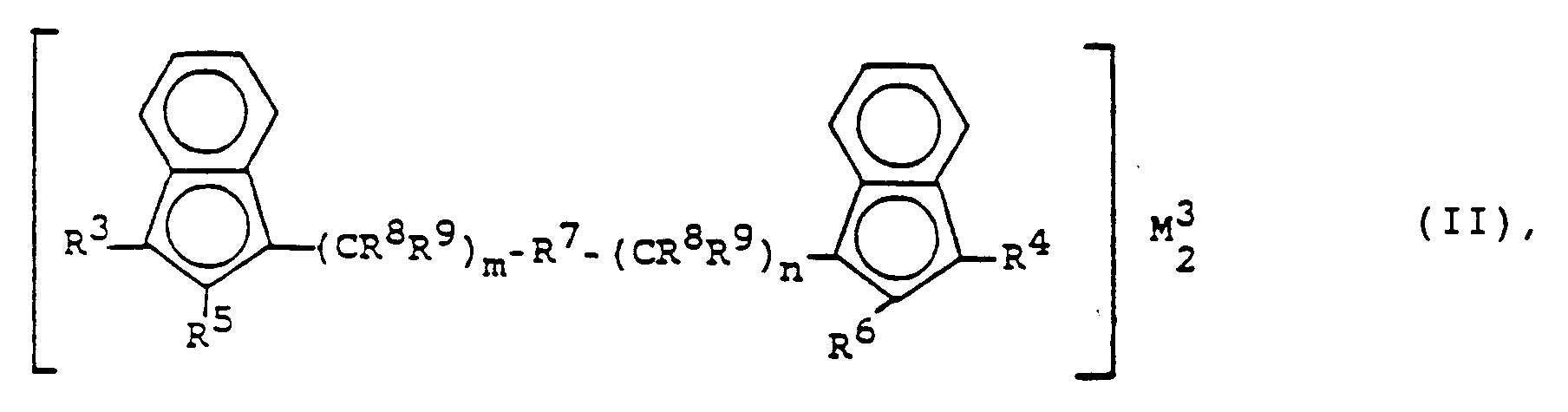 a) mit einer Verbindung der Formel III
M¹X₄ (III),
worin M¹ die in Formel I genannte Bedeutung besitzt und X ein Halogenatom, bevorzugt Chlor, bedeutet, oderb) mit einer Verbindung der Formel IIIa
M¹X₄L₂ (IIIa),
worin M¹ und X die genannten Bedeutungen besitzen und L für einen Donorliganden steht, umsetzt und das erhaltene Reaktionsprodukt gegebenenfalls derivatisiert. - Verfahren gemäß Anspruch 1, dadurch gekennzeichnet, daß in Formel I M¹ Zr oder Hf, R¹ und R² gleich oder verschieden sind und Methyl oder Chlor, R³ und R⁴ Wasserstoff, R⁵ und R⁶ gleich oder verschieden sind und Methyl, Ethyl oder Trifluormethyl, R⁷ einen Rest
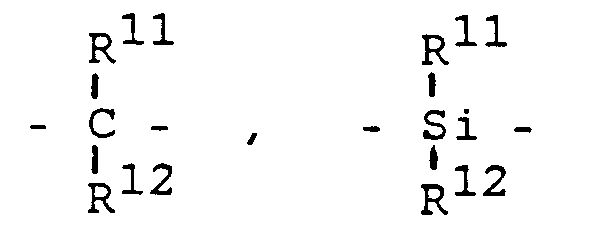
bedeuten. - Verfahren gemäß Anspruch 1 oder 2, dadurch gekennzeichnet, daß es sich bei der Verbindung der Formel I um rac-Dimethylsilyl(2-methyl-1-indenyl)₂zirkondichlorid, rac-Ethylen(2-methyl-1-indenyl)₂-zirkondichlorid, rac-Dimethylsilyl(2-methyl-1-indenyl)₂zirkondimethyl, rac-Ethylen(2-methyl-1-indenyl)₂-zirkondimethyl, rac-Phenyl(methyl)silyl(2-methyl-1-indenyl)₂zirkondichlorid, rac-Diphenylsilyl(2-methyl-1-indenyl)₂zirkondichlorid, rac-Methylethylen(2-methyl-1-indenyl)₂zirkondichlorid, rac-Dimethylsilyl(2-ethyl-1-indenyl)₂zirkondichlorid, rac-Ethylen(2-ethyl-1-indenyl)₂zirkondichlorid, rac-Isopropyliden(2-methyl-1-indenyl)₂zirkondichlorid oder rac-Phenyl(methyl)silyl(2-methyl-1-indenyl)₂zirkonmethyl handelt.
- Verwendung einer Verbindung der Formel I gemäß einem oder mehreren der Ansprüche 1 bis 3 als Katalysator bei der Olefinpolymerisation.
Applications Claiming Priority (2)
| Application Number | Priority Date | Filing Date | Title |
|---|---|---|---|
| DE4035883 | 1990-11-12 | ||
| DE4035883 | 1990-11-12 |
Publications (2)
| Publication Number | Publication Date |
|---|---|
| EP0485823A1 EP0485823A1 (de) | 1992-05-20 |
| EP0485823B1 true EP0485823B1 (de) | 1995-03-08 |
Family
ID=6418062
Family Applications (1)
| Application Number | Title | Priority Date | Filing Date |
|---|---|---|---|
| EP91118682A Expired - Lifetime EP0485823B1 (de) | 1990-11-12 | 1991-11-01 | 2-Substituierte Bisindenylmetallocene, Verfahren zu ihrer Herstellung und ihre Verwendung als Katalysatoren bei der Olefinpolymerisation |
Country Status (8)
| Country | Link |
|---|---|
| US (2) | US5145819A (de) |
| EP (1) | EP0485823B1 (de) |
| JP (1) | JP3272005B2 (de) |
| AU (1) | AU641341B2 (de) |
| CA (1) | CA2055219C (de) |
| DE (1) | DE59104869D1 (de) |
| ES (1) | ES2071888T3 (de) |
| ZA (1) | ZA918926B (de) |
Cited By (65)
| Publication number | Priority date | Publication date | Assignee | Title |
|---|---|---|---|---|
| EP0519237A3 (en) * | 1991-06-18 | 1993-01-27 | Basf Aktiengesellschaft | Soluble catalyst systems for preparing poly-1-alcenes with high molecular weight |
| EP0529908A1 (de) * | 1991-08-20 | 1993-03-03 | Mitsubishi Chemical Corporation | Olefinpolymerisationskatalysator |
| EP0530647A1 (de) * | 1991-08-26 | 1993-03-10 | Hoechst Aktiengesellschaft | Metallocene, diese enthaltende Katalysatoren und Verfahren zur Herstellung eines Olefinpolymers unter Verwendung dieser Katalysatoren |
| EP0545304A1 (de) * | 1991-11-30 | 1993-06-09 | Hoechst Aktiengesellschaft | Verfahren zur Herstellung substituierter Indene und ihre Verwendung als Ligandsysteme für Metallocen-Katalysatoren |
| EP0574597A1 (de) * | 1992-06-13 | 1993-12-22 | Hoechst Aktiengesellschaft | Verfahren zur Herstellung von verbrückten, chiralen Metallocenkatalysatoren des Types Bisindenyl |
| EP0576970A1 (de) * | 1992-06-27 | 1994-01-05 | Hoechst Aktiengesellschaft | Metallocene mit arylsubstituierten Indenylderivaten als Liganden, Verfahren zu ihrer Herstellung und ihre Verwendung als Katalysatoren |
| EP0581754A1 (de) * | 1992-07-10 | 1994-02-02 | Fina Technology, Inc. | Verfahren und Katalysator für Herstellung isotaktischen Polyolefinen |
| EP0582194A1 (de) * | 1992-08-03 | 1994-02-09 | Hoechst Aktiengesellschaft | Verfahren zur Herstellung eines Olefinpolymers unter Verwendung von Metallocenen mit speziell substituierten Indenylliganden |
| US5393911A (en) * | 1991-05-09 | 1995-02-28 | Phillips Petroleum Company | Cyclopentadiene type compounds and method for making |
| US5406013A (en) * | 1991-05-09 | 1995-04-11 | Phillips Petroleum Company | Cyclopentadiene type compounds and method for making |
| US5455366A (en) * | 1991-11-30 | 1995-10-03 | Hoechst Ag | Metallocenes having benzo-fused indenyl derivatives as ligands, processes for their preparation and their use as catalysts |
| US5468440A (en) * | 1994-05-06 | 1995-11-21 | Exxon Chemical Patents Inc. | Process of making oriented film or structure |
| US5486585A (en) * | 1993-08-26 | 1996-01-23 | Exxon Chemical Patents Inc. | Amidosilyldiyl bridged catalysts and method of polymerization using said catalysts. |
| US5521265A (en) * | 1994-03-22 | 1996-05-28 | Pcd Polymere Gesellschaft M.B.H. | Metallocenes and their use for olefin polymerization |
| US5616663A (en) * | 1993-11-12 | 1997-04-01 | Mitsui Petrochemical Industries, Ltd. | Transition metal compound, olefin polymerization catalyst component comprising the transition metal compound, olefin polymerization catalyst comprising the olefin polymerization catalyst component, and process for olefin polymerization |
| US5637666A (en) * | 1992-12-02 | 1997-06-10 | Hoechst Aktiengesellschaft | Polyolefin molding composition for producing fibers, filaments and webs by melt spinning |
| US5646322A (en) * | 1992-11-11 | 1997-07-08 | Dsm N.V. | Indenyl compounds and catalyst components for the polymerization of olefins |
| US5691264A (en) * | 1994-07-08 | 1997-11-25 | Spherilene S.P.A. | Components and catalysts for the polymerization of olefins |
| US5698487A (en) * | 1994-05-26 | 1997-12-16 | Montell Technology Company Bv | Components and catalysts for the polymerization of olefins |
| US5710297A (en) * | 1993-12-21 | 1998-01-20 | Hoechst Aktiengesellschaft | Metallocenes, and their use as catalysts |
| US5759940A (en) * | 1994-03-29 | 1998-06-02 | Montell Technology Company Bv | Components and catalysts for the polymerization of olefins |
| US5795838A (en) * | 1994-08-09 | 1998-08-18 | Mitsui Petrochemical Industries, Ltd. | Olefin polymerization catalyst and process for olefin polymerization |
| US5830821A (en) * | 1991-11-30 | 1998-11-03 | Targor Gmbh | Process for olefin preparation using metallocenes having benzo-fused indenyl derivatives as ligands |
| US5831105A (en) * | 1994-09-28 | 1998-11-03 | Targor Gmbh | Process for preparing bridged metallocenes |
| US5912373A (en) * | 1995-07-11 | 1999-06-15 | Basf Aktiengesellschaft | Process for converting the achiral meso form of an ansa-metallocene complex into the chiral racemic form |
| US5932669A (en) * | 1991-11-30 | 1999-08-03 | Targor Gmbh | Metallocenes having benzo-fused indenyl derivatives as ligands, processes for their preparation and their use as catalysts |
| US5965678A (en) * | 1997-07-02 | 1999-10-12 | Bayer Ag | Catalyst system based on monoazadiene metal complexes |
| WO1999061486A1 (en) | 1998-05-29 | 1999-12-02 | Univation Technologies Llc | Catalyst delivery method and catalyst feeder |
| US6051728A (en) * | 1995-01-23 | 2000-04-18 | Montell Technology Company Bv | Metallocene compounds, process for their preparation, and their use in catalysts for the polymerization of olefins |
| US6063949A (en) * | 1995-06-19 | 2000-05-16 | Targor Gmbh | Stereorigid metallocene compound |
| USRE37208E1 (en) | 1990-11-12 | 2001-06-05 | Targor Gmbh | Polyolefins prepared with metallocene catalysts having 2-substituted indenyl type ligands |
| US6369254B1 (en) | 1995-05-30 | 2002-04-09 | Basell Technology Company Bv | Bridged metallocene compounds, processes for the preparation thereof and use thereof in catalysts for the polymerization of olefins |
| US6399533B2 (en) * | 1995-05-25 | 2002-06-04 | Basell Technology Company Bv | Compounds and catalysts for the polymerization of olefins |
| US6410661B1 (en) | 1997-05-06 | 2002-06-25 | Basell Polyolefine Gmbh | Stereorigid metallocene compounds |
| US6414206B2 (en) | 2000-02-23 | 2002-07-02 | Akzo Nobel Nv | Process for preparing bisindenylalkanes |
| US6541584B1 (en) | 1998-11-18 | 2003-04-01 | Basell Poliolefine Italia S.P.A. | Bis(tetrahydro-indenyl) metallocenes as olefin-polymerization-catalyst |
| US6620953B1 (en) | 1998-11-25 | 2003-09-16 | Bassell Polyolefine Gmbh | Method for producing monoaryloxy-ansa-metallocenes |
| US6673880B2 (en) | 1998-03-09 | 2004-01-06 | Basell Technology Company B.V. | Bridged zirconocene compounds, process for their preparation and their use as catalyst components in the polymerization of olefins |
| US6680090B2 (en) | 1999-04-16 | 2004-01-20 | Andersen Corporation | Polyolefin wood fiber composite |
| US6693156B1 (en) | 1998-11-18 | 2004-02-17 | Basell Polyolefine Gmbh | Methylene bridged metallocenes as olefin-polymerization-catalyst components |
| US6743864B2 (en) | 2002-03-12 | 2004-06-01 | Basell Poliolefine Italia S.P.A. | Polyolefin compositions having high tenacity |
| EP1803747A1 (de) | 2005-12-30 | 2007-07-04 | Borealis Technology Oy | Oberflächemodifizierte Polymerisationskatalysatoren zur Herstellung von Polyolefinfilmen mit niedrigem Gelgehalt |
| WO2010071798A1 (en) | 2008-12-18 | 2010-06-24 | Univation Technologies, Llc | Method for seed bed treatment for a polymerization reaction |
| US8283428B2 (en) | 2008-06-20 | 2012-10-09 | Exxonmobil Chemical Patents Inc. | Polymacromonomer and process for production thereof |
| US8283419B2 (en) | 2008-06-20 | 2012-10-09 | Exxonmobil Chemical Patents Inc. | Olefin functionalization by metathesis reaction |
| US8372930B2 (en) | 2008-06-20 | 2013-02-12 | Exxonmobil Chemical Patents Inc. | High vinyl terminated propylene based oligomers |
| US8399725B2 (en) | 2008-06-20 | 2013-03-19 | Exxonmobil Chemical Patents Inc. | Functionalized high vinyl terminated propylene based oligomers |
| WO2014105614A1 (en) | 2012-12-28 | 2014-07-03 | Univation Technologies, Llc | Methods of integrating aluminoxane production into catalyst production |
| WO2014109832A1 (en) | 2013-01-14 | 2014-07-17 | Univation Technologies, Llc | Methods for preparing catalyst systems with increased productivity |
| US8802797B2 (en) | 2008-06-20 | 2014-08-12 | Exxonmobil Chemical Patents Inc. | Vinyl-terminated macromonomer oligomerization |
| CN101835536B (zh) * | 2007-10-22 | 2015-05-20 | 尤尼威蒂恩技术有限责任公司 | 具有改进性能的聚乙烯组合物 |
| WO2016182920A1 (en) | 2015-05-08 | 2016-11-17 | Exxonmobil Chemical Patents Inc. | Polymerization process |
| WO2018063764A1 (en) | 2016-09-27 | 2018-04-05 | Exxonmobil Chemical Patents Inc. | Polymerization process |
| WO2018063767A1 (en) | 2016-09-27 | 2018-04-05 | Exxonmobil Chemical Patents Inc. | Polymerization process |
| WO2018063765A1 (en) | 2016-09-27 | 2018-04-05 | Exxonmobil Chemical Patents Inc. | Polymerization process |
| WO2018118155A1 (en) | 2016-12-20 | 2018-06-28 | Exxonmobil Chemical Patents Inc. | Polymerization process |
| WO2019118073A1 (en) | 2017-12-13 | 2019-06-20 | Exxonmobil Chemical Patents Inc. | Deactivation methods for active components from gas phase polyolefin polymerization process |
| WO2019173030A1 (en) | 2018-03-08 | 2019-09-12 | Exxonmobil Chemical Patents Inc. | Methods of preparing and monitoring a seed bed for polymerization reactor startup |
| WO2020102385A1 (en) | 2018-11-13 | 2020-05-22 | Exxonmobil Chemical Patents Inc. | Polyethylene films |
| WO2020102380A1 (en) | 2018-11-13 | 2020-05-22 | Exxonmobil Chemical Patents Inc. | Polyethylene blends and films |
| WO2020109870A2 (en) | 2018-06-28 | 2020-06-04 | Exxonmobil Chemical Patents Inc. | Polyethylene compositions, wires and cables, and methods for making the same |
| WO2020163079A1 (en) | 2019-02-06 | 2020-08-13 | Exxonmobil Chemical Patents Inc. | Films and backsheets for hygiene articles |
| WO2021126458A1 (en) | 2019-12-17 | 2021-06-24 | Exxonmobil Chemical Patents Inc. | Films made of polyethylene blends for improved sealing performance and mechanical properties |
| WO2021183337A1 (en) | 2020-03-12 | 2021-09-16 | Exxonmobil Chemical Patents Inc. | Films made of polyethylene blends for improved bending stiffness and high md tear resistance |
| WO2022232760A1 (en) | 2021-04-30 | 2022-11-03 | Exxonmobil Chemical Patents Inc. | Processes for transitioning between different polymerization catalysts in a polymerization reactor |
Families Citing this family (270)
| Publication number | Priority date | Publication date | Assignee | Title |
|---|---|---|---|---|
| US5700896A (en) * | 1988-07-30 | 1997-12-23 | Hoechst Aktiengesellschaft | Polymer having long isotactic sequences and randomly-distributed ethylene content obtained by polymerizing propylene in presence of specific catalysts |
| USRE37573E1 (en) * | 1990-11-12 | 2002-03-05 | Basell Polyolefin Gmbh | Process for the preparation of an olefin polymer using metallocenes containing specifically substituted indenyl ligands |
| ES2093058T3 (es) * | 1990-11-12 | 1996-12-16 | Hoechst Ag | Procedimiento para la preparacion de un polimero olefinico. |
| USRE39532E1 (en) | 1990-11-12 | 2007-03-27 | Basell Polyolefine Gmbh | Metallocenes containing ligands of 2-substituted indenyl derivatives, process for their preparation, and their use as catalysts |
| US5401817A (en) * | 1991-05-09 | 1995-03-28 | Phillips Petroleum Company | Olefin polymerization using silyl-bridged metallocenes |
| US5466766A (en) * | 1991-05-09 | 1995-11-14 | Phillips Petroleum Company | Metallocenes and processes therefor and therewith |
| EP0702030B1 (de) * | 1991-05-27 | 2001-03-21 | TARGOR GmbH | Verfahren zur Herstellung von Polyolefinen mit breiter Molmassenverteilung |
| US5302733A (en) * | 1992-03-30 | 1994-04-12 | Ethyl Corporation | Preparation of metallocenes |
| ATE198207T1 (de) * | 1992-08-03 | 2001-01-15 | Targor Gmbh | Verfahren zur herstellung eines olefinpolymers unter verwendung spezieller metallocene |
| JPH0657057A (ja) † | 1992-08-11 | 1994-03-01 | Sumitomo Chem Co Ltd | ポリプロピレン組成物及びそのフィルム |
| USRE39156E1 (en) * | 1992-08-15 | 2006-07-04 | Basell Polyolefine Gmbh | Process for the preparation of polyolefins |
| ATE177436T1 (de) * | 1992-08-15 | 1999-03-15 | Targor Gmbh | Verfahren zur herstellung von polyolefinen |
| EP0586167B1 (de) * | 1992-09-04 | 2000-07-12 | BP Chemicals Limited | Katalysatorzusammensetzung und Verfahren zur Herstellung von Polyolefinen |
| TW272985B (de) * | 1992-09-11 | 1996-03-21 | Hoechst Ag | |
| US5602067A (en) * | 1992-12-28 | 1997-02-11 | Mobil Oil Corporation | Process and a catalyst for preventing reactor fouling |
| US5332706A (en) * | 1992-12-28 | 1994-07-26 | Mobil Oil Corporation | Process and a catalyst for preventing reactor fouling |
| US5608019A (en) * | 1992-12-28 | 1997-03-04 | Mobil Oil Corporation | Temperature control of MW in olefin polymerization using supported metallocene catalyst |
| US5420220A (en) * | 1993-03-25 | 1995-05-30 | Mobil Oil Corporation | LLDPE films |
| JP3307704B2 (ja) * | 1993-02-19 | 2002-07-24 | 三菱化学株式会社 | α‐オレフィン重合体の製造法 |
| EP0854212A1 (de) * | 1993-05-25 | 1998-07-22 | Exxon Chemical Patents Inc. | Polyolefinfasern und daraus hergestellte Flächengebilde |
| IT1271406B (it) * | 1993-09-13 | 1997-05-28 | Spherilene Srl | Procedimento per la preparazione di polimeri dell'etilene e prodotti ottenuti |
| JP3454827B2 (ja) * | 1993-09-30 | 2003-10-06 | 出光興産株式会社 | 遷移金属化合物,オレフィン重合触媒,該触媒を用いたオレフィン系重合体の製造方法 |
| US5455741A (en) * | 1993-10-26 | 1995-10-03 | Pulse Engineering, Inc. | Wire-lead through hole interconnect device |
| US5614456A (en) * | 1993-11-15 | 1997-03-25 | Mobil Oil Corporation | Catalyst for bimodal molecular weight distribution ethylene polymers and copolymers |
| DE4344689A1 (de) * | 1993-12-27 | 1995-06-29 | Hoechst Ag | Metallocenverbindung |
| US6391817B1 (en) | 1993-12-28 | 2002-05-21 | Exxonmobil Chemical Patents Inc. | Method for producing a prepolymerized catalyst |
| CA2180180C (en) * | 1994-01-11 | 2006-03-14 | Jeffrey Harold Butler | Alumoxanes and catalysts comprising alumoxanes |
| EP0668157B1 (de) | 1994-02-21 | 2003-05-21 | Basell Polyolefine GmbH | Siegelbare polyolefinische Mehrschichtfolie, Verfahren zu ihrer Herstellung und ihre Verwendung |
| JPH10502975A (ja) * | 1994-05-24 | 1998-03-17 | エクソン・ケミカル・パテンツ・インク | 低融点プロピレンポリマーを含む繊維及び布 |
| US5571619A (en) * | 1994-05-24 | 1996-11-05 | Exxon Chemical Patents, Inc. | Fibers and oriented films of polypropylene higher α-olefin copolymers |
| US5597935A (en) * | 1994-06-01 | 1997-01-28 | University Of Iowa Research Foundation | Synthesis of ansa-metallocene catalysts |
| US5495035A (en) * | 1994-06-01 | 1996-02-27 | University Of Iowa Research Foundation | Synthesis of ANSA-metallocene catalysts |
| IT1270253B (it) | 1994-06-20 | 1997-04-29 | Spherilene Srl | Copolimeri dell'etilene e procedimento per la preparazione di polimeri dell'etilene |
| US5473020A (en) * | 1994-06-30 | 1995-12-05 | Phillips Petroleum Company | Polymer bound ligands, polymer bound metallocenes, catalyst systems, preparation, and use |
| IT1273662B (it) * | 1994-07-20 | 1997-07-09 | Spherilene Srl | Procedimento per la preparazione di polimeri amorfi del propiline' |
| US5525678A (en) * | 1994-09-22 | 1996-06-11 | Mobil Oil Corporation | Process for controlling the MWD of a broad/bimodal resin produced in a single reactor |
| KR100417970B1 (ko) | 1994-11-22 | 2004-06-26 | 아토피나 리서치 | 올레핀중합촉매시스템에유용한가교메탈로센 |
| IT1272922B (it) * | 1995-01-23 | 1997-07-01 | Spherilene Srl | Procedimento per la preparazione di composti metallocenici |
| US5883278A (en) * | 1995-04-24 | 1999-03-16 | Albemarle Corporation | Enhanced synthesis of racemic metallocenes |
| US5556997A (en) * | 1995-04-24 | 1996-09-17 | Albemarle Corporation | Enhanced synthesis of racemic metallocenes |
| ES2182950T3 (es) * | 1995-05-16 | 2003-03-16 | Univation Tech Llc | Produccion de polietileno utilizando metalocenos estereosomericos. |
| ES2124054T3 (es) * | 1995-06-12 | 1999-01-16 | Targor Gmbh | Compuesto de metal de transicion. |
| AT403376B (de) * | 1995-07-03 | 1998-01-26 | Danubia Petrochem Polymere | Metallocene mit silylsubstituierten brücken und deren einsatz für die olefinpolymerisation |
| US5882750A (en) * | 1995-07-03 | 1999-03-16 | Mobil Oil Corporation | Single reactor bimodal HMW-HDPE film resin with improved bubble stability |
| DE19527047A1 (de) * | 1995-07-25 | 1997-01-30 | Danubia Petrochem Deutschland | Metallocene mit silylsubstituierten Brücken und deren Einsatz für die Olefinpolymerisation |
| US5635437A (en) * | 1995-07-28 | 1997-06-03 | Exxon Chemicals Patents, Inc. | Method for preparing metallocene catalyst systems |
| US6486089B1 (en) | 1995-11-09 | 2002-11-26 | Exxonmobil Oil Corporation | Bimetallic catalyst for ethylene polymerization reactions with uniform component distribution |
| US6066588A (en) * | 1995-11-22 | 2000-05-23 | Fina Research, S.A. | Bridged metallocenes catalyst for polymerization of olefins |
| US6787618B1 (en) | 1995-12-01 | 2004-09-07 | Basell Polypropylen Gmbh | Metallocene compound and high molecular weight copolymers of propylene and olefins having two or four to thirty-two carbon atoms |
| US5679814A (en) * | 1995-12-11 | 1997-10-21 | Albemarle Corporation | Purification of metallocenes |
| US5854362A (en) * | 1995-12-11 | 1998-12-29 | The Dow Chemical Company | Supported biscyclopentadienyl metal complexes |
| US5744415A (en) * | 1995-12-28 | 1998-04-28 | Union Carbide Chemicals & Plastics Technology Corporation | Rare earth metal catalyst for olefin polymerization |
| US6417130B1 (en) | 1996-03-25 | 2002-07-09 | Exxonmobil Oil Corporation | One pot preparation of bimetallic catalysts for ethylene 1-olefin copolymerization |
| DE69723244T2 (de) * | 1996-03-27 | 2004-04-22 | Dow Global Technologies, Inc., Midland | Allyl-enthaltende metallkomplexe, und verfahren zur polymerisation von olefinen |
| US6225426B1 (en) * | 1996-04-10 | 2001-05-01 | Uniroyal Chemical Company, Inc. | Process for producing polyolefin elastomer employing a metallocene catalyst |
| JP3181920B2 (ja) * | 1996-04-22 | 2001-07-03 | 日本ポリオレフィン株式会社 | ポリオレフィン製造用触媒及びポリオレフィンの製造方法 |
| US5710299A (en) * | 1996-06-27 | 1998-01-20 | Albemarle Corporation | Production of bridged metallocene complexes and intermediates therefor |
| CA2259999A1 (en) * | 1996-07-15 | 1998-01-22 | Mobil Oil Corporation | Comonomer pretreated bimetallic catalyst for blow molding and film applications |
| US6759499B1 (en) * | 1996-07-16 | 2004-07-06 | Exxonmobil Chemical Patents Inc. | Olefin polymerization process with alkyl-substituted metallocenes |
| US6207608B1 (en) | 1996-08-09 | 2001-03-27 | University Of Iowa Research Foundation | Olefin polymerization with direct use of ansa-metallocene amide complexes as catalysts |
| KR20000068428A (ko) | 1996-09-04 | 2000-11-25 | 엑손 케미칼 패턴츠 인코포레이티드 | 배향 필름용의 개선된 프로필렌 중합체 |
| US6583227B2 (en) | 1996-09-04 | 2003-06-24 | Exxonmobil Chemical Patents Inc. | Propylene polymers for films |
| US6576306B2 (en) | 1996-09-04 | 2003-06-10 | Exxonmobil Chemical Patents Inc. | Propylene polymers for films |
| US5760262A (en) * | 1996-09-17 | 1998-06-02 | Albemarle Corporation | Enhanced production of bridged hafnocenes |
| US6015868A (en) * | 1996-10-03 | 2000-01-18 | The Dow Chemical Company | Substituted indenyl containing metal complexes and olefin polymerization process |
| US5936108A (en) * | 1996-10-17 | 1999-08-10 | Albemarle Corporation | Metallocene synthesis |
| US5780660A (en) * | 1996-11-07 | 1998-07-14 | Albemarle Corporation | Zirconocene ismerization process |
| US5968864A (en) * | 1996-12-20 | 1999-10-19 | Fina Technology, Inc. | Catalyst efficiency for supported metallocene catalyst |
| US5900497A (en) * | 1996-12-20 | 1999-05-04 | Union Carbide Chemicals & Plsatics Technology Corporation | Process for preparing metallocene procatalysts |
| US5886202A (en) * | 1997-01-08 | 1999-03-23 | Jung; Michael | Bridged fluorenyl/indenyl metallocenes and the use thereof |
| US6005463A (en) * | 1997-01-30 | 1999-12-21 | Pulse Engineering | Through-hole interconnect device with isolated wire-leads and component barriers |
| US6107501A (en) * | 1997-01-30 | 2000-08-22 | Fina Technology, Inc. | Synthesis of metallocenes and enrichment of their rac isomer |
| US6051525A (en) * | 1997-07-14 | 2000-04-18 | Mobil Corporation | Catalyst for the manufacture of polyethylene with a broad or bimodal molecular weight distribution |
| US6153551A (en) | 1997-07-14 | 2000-11-28 | Mobil Oil Corporation | Preparation of supported catalyst using trialkylaluminum-metallocene contact products |
| DE19732804A1 (de) | 1997-07-30 | 1999-02-04 | Bayer Ag | Katalysatoren auf Basis von Fulven-Metallkomplexen |
| US5905162A (en) * | 1997-08-12 | 1999-05-18 | Albemarle Corporation | Enhanced production of bridged hafnocenes |
| BR9813196A (pt) | 1997-11-07 | 2000-08-29 | Bayer Ag | Processo para preparação de complexos metálicos de fulvenos |
| KR100274973B1 (ko) * | 1997-11-24 | 2000-12-15 | 성재갑 | 올레핀계 단량체의 중합 촉매 |
| CA2313244A1 (en) | 1997-12-08 | 1999-06-17 | Steven P. Diefenbach | Catalyst compositions of enhanced productivity |
| US6677265B1 (en) | 1997-12-08 | 2004-01-13 | Albemarle Corporation | Process of producing self-supported catalysts |
| US6551955B1 (en) | 1997-12-08 | 2003-04-22 | Albemarle Corporation | Particulate group 4 metallocene-aluminoxane catalyst compositions devoid of preformed support, and their preparation and their use |
| US5977270A (en) * | 1998-01-26 | 1999-11-02 | Union Carbide Chemicals & Plastics Technology Corporation | Process using a rare earth metal catalyst for olefin polymerization |
| DE19809159A1 (de) | 1998-03-04 | 1999-09-09 | Bayer Ag | Metallorganische Verbindungen |
| DE19812881A1 (de) | 1998-03-24 | 1999-10-07 | Bayer Ag | Neue dendrimere Verbindungen, ein Verfahren zu deren Herstellung sowie deren Verwendung als Katalysatoren |
| KR100358225B1 (ko) | 1998-04-09 | 2003-01-24 | 주식회사 엘지화학 | 조촉매의 재순환이 가능한 메탈로센 촉매 중합 방법 |
| KR100380018B1 (ko) | 1998-04-09 | 2003-10-04 | 주식회사 엘지화학 | 메탈로센담지촉매및이를이용한올레핀중합방법 |
| US6784269B2 (en) | 1998-05-13 | 2004-08-31 | Exxonmobil Chemical Patents Inc. | Polypropylene compositions methods of making the same |
| ES2220058T3 (es) | 1998-05-13 | 2004-12-01 | Exxonmobil Chemical Patents Inc. | Homopolimeros de propileno y metodos de fabricarlos. |
| US6306960B1 (en) | 1998-05-13 | 2001-10-23 | Exxonmobil Chemical Patents Inc. | Articles formed from foamable polypropylene polymer |
| DE69940653D1 (de) | 1998-06-25 | 2009-05-07 | Idemitsu Kosan Co | Propylenpolymer und Zusammensetzung damit, Formobjekt und Laminat damit sowie Verfahren zur Herstellung von Propylenpolymer und einer Zusammensetzung damit |
| DE19837739A1 (de) | 1998-08-20 | 2000-02-24 | Bayer Ag | Katalysatorsystem auf Basis von Fulven-Cyclopentadienyl-Metallkomplexen |
| DE19837734C1 (de) | 1998-08-20 | 1999-12-23 | Bayer Ag | Verfahren zur Herstellung von Katalysatoren auf Basis von Fulven-Metallkomplexen |
| US5965759A (en) * | 1998-09-23 | 1999-10-12 | Albemarle Corporation | Catalytic process for isomerizing metallocenes |
| US6225427B1 (en) | 1998-10-15 | 2001-05-01 | Uniroyal Chemical Company, Inc. | Olefin polymerization process employing metallocene catalyst provided by cocatalyst activation of a metallocene procatalyst |
| US6812182B2 (en) | 1998-10-23 | 2004-11-02 | Albemarle Corporation | Compositions formed from hydroxyaluminoxane and their use as catalyst components |
| US6555494B2 (en) | 1998-10-23 | 2003-04-29 | Albemarle Corporation | Transition metal compounds having conjugate aluminoxate anions, their preparation and their use as catalyst components |
| US20040002420A1 (en) * | 1998-10-23 | 2004-01-01 | Feng-Jung Wu | Stable catalysts and co-catalyst compositions formed from hydroxyaluminoxane and their use |
| US6492292B2 (en) | 1998-10-23 | 2002-12-10 | Albemarle Corporation | Gelatinous compositions formed from hydroxyaluminoxane, solid compositions formed therefrom, and the use of such compositions as catalyst components |
| US6160145A (en) * | 1998-10-23 | 2000-12-12 | Albemarle Corporation | Transition metal compounds having conjugate aluminoxate anions and their use as catalyst components |
| US6462212B1 (en) | 1998-10-23 | 2002-10-08 | Albemarle Corporation | Transition metal compounds having conjugate aluminoxate anions and their use as catalyst components |
| DE59914158D1 (de) | 1998-11-25 | 2007-03-08 | Basell Polyolefine Gmbh | Metallocenmonohalogenide |
| US6900343B1 (en) | 1998-11-25 | 2005-05-31 | Basell Polyolefine Gmbh | Method for the purification of metallocenes |
| US6174930B1 (en) | 1999-04-16 | 2001-01-16 | Exxon Chemical Patents, Inc. | Foamable polypropylene polymer |
| US6339134B1 (en) | 1999-05-06 | 2002-01-15 | Univation Technologies, Llc | Polymerization process for producing easier processing polymers |
| DE19922020A1 (de) * | 1999-05-12 | 2000-11-16 | Targor Gmbh | Übergangsmetallverbindung, Katalysatorsystem, Verfahren zu seiner Herstellung und seine Verwendung zur Polymerisation von Olefinen |
| US6750284B1 (en) * | 1999-05-13 | 2004-06-15 | Exxonmobil Chemical Patents Inc. | Thermoplastic filled membranes of propylene copolymers |
| US6500563B1 (en) | 1999-05-13 | 2002-12-31 | Exxonmobil Chemical Patents Inc. | Elastic films including crystalline polymer and crystallizable polymers of propylene |
| ATE288508T1 (de) | 1999-05-13 | 2005-02-15 | Exxonmobil Chem Patents Inc | Elastische fasern und daraus hergestellte artikel,die kristalline und kristallisierbare propylenpolymere enthalten |
| US6303718B1 (en) | 1999-09-17 | 2001-10-16 | Bayer Aktiengesellschaft | Composition based on fluorine-containing metal complexes |
| EP1214364B1 (de) | 1999-09-22 | 2003-07-16 | Basell Polyolefine GmbH | Katalysatorsystem unf verfahren zur polymerisierung von olefine |
| WO2001032758A1 (en) | 1999-11-04 | 2001-05-10 | Exxon Chemical Patents Inc. | Propylene copolymer foams and their use |
| US6977287B2 (en) * | 1999-12-10 | 2005-12-20 | Exxonmobil Chemical Patents Inc. | Propylene diene copolymers |
| ES2239631T3 (es) * | 1999-12-10 | 2005-10-01 | Exxonmobil Chemical Patents Inc. | Polimeros compolimerizados de propileno y dieno. |
| US6809168B2 (en) * | 1999-12-10 | 2004-10-26 | Exxonmobil Chemical Patents Inc. | Articles formed from propylene diene copolymers |
| US6281306B1 (en) | 1999-12-16 | 2001-08-28 | Univation Technologies, Llc | Method of polymerization |
| US6627723B2 (en) | 1999-12-22 | 2003-09-30 | Exxonmobil Chemical Patents Inc. | Adhesive alpha-olefin inter-polymers |
| DE10003581A1 (de) | 2000-01-28 | 2001-08-02 | Bayer Ag | Metallorganische Verbindungen mit anellierten Indenyl Liganden |
| JP2003522194A (ja) | 2000-02-08 | 2003-07-22 | エクソンモービル・ケミカル・パテンツ・インク | 第14族架橋ビスシクロペンタジエニル・リガンドの調製方法 |
| ES2220725T3 (es) | 2000-02-24 | 2004-12-16 | Basell Polyolefine Gmbh | Compuesto organometalico utilizable como c-catalizador para polimerizar olefinas. |
| US6846943B2 (en) | 2000-05-23 | 2005-01-25 | Chisso Corporation | Metallocene compound, olefin polymerization catalyst containing the compound, and method for producing an olefin polymer by use of the catalyst |
| US6252098B1 (en) | 2000-06-05 | 2001-06-26 | Albemarle Corporation | Enhanced synthesis of racemic metallocenes |
| US6858767B1 (en) | 2000-08-11 | 2005-02-22 | Uniroyal Chemical Company, Inc. | Process for producing liquid polyalphaolefin polymer, metallocene catalyst therefor, the resulting polymer and lubricant containing same |
| WO2002016450A1 (en) | 2000-08-22 | 2002-02-28 | Idemitsu Petrochemical Co., Ltd. | 1-butene polymer and molded product consisting of the polymer |
| GB0023662D0 (en) | 2000-09-27 | 2000-11-08 | Borealis Tech Oy | Supported catalyst |
| CN1478122A (zh) * | 2000-11-30 | 2004-02-25 | 埃克森美孚化学专利公司 | 用于精密注射成型应用的聚丙烯 |
| DE60135311D1 (de) | 2000-12-22 | 2008-09-25 | Basell Polyolefine Gmbh | Katalysatorkomponente fur die polymerisation von olefinen |
| EP1392705B1 (de) | 2001-05-21 | 2005-01-05 | Basell Polyolefine GmbH | Katalysatorsystem für die polymerisierung von olefinen |
| DE10127926A1 (de) | 2001-06-08 | 2002-12-12 | Bayer Ag | 1,3-disubstituierte Indenkomplexe |
| ATE444975T1 (de) * | 2001-06-12 | 2009-10-15 | Basell Polyolefine Gmbh | Verfahren zur polymerisation von buten-1 |
| US7459511B2 (en) | 2001-06-12 | 2008-12-02 | Basell Polyolefine Gmbh | Process for the polymerization of 1-butene |
| EP1279699A1 (de) | 2001-07-27 | 2003-01-29 | Baselltech USA Inc. | Weiche Polyolefinzusammensetzungen |
| MY132768A (en) * | 2001-10-09 | 2007-10-31 | Basell Poliolefine Italia Spa | Crystalline propylene copolymer compositions having improved sealability and optical properties and reduced solubility. |
| US7595103B2 (en) | 2001-10-30 | 2009-09-29 | Basell Poliolefine Italia S.P.A. | Pipe systems of polypropylene compositions |
| US20040044106A1 (en) * | 2001-11-08 | 2004-03-04 | Portnoy Robert C. | Polypropylene for precision injection molding applications |
| ATE324387T1 (de) | 2001-11-27 | 2006-05-15 | Basell Poliolefine Srl | Durchsichtige und flexible polypropenzusammensetzungen |
| KR20050035183A (ko) | 2001-11-30 | 2005-04-15 | 엑손모빌 케미칼 패턴츠 인코포레이티드 | 비-단일 부위/단일 부위 촉매 복합물을 이용하여 제조된에틸렌/알파-올레핀 공중합체, 이의 제조 방법 및 용도 |
| US6916892B2 (en) * | 2001-12-03 | 2005-07-12 | Fina Technology, Inc. | Method for transitioning between Ziegler-Natta and metallocene catalysts in a bulk loop reactor for the production of polypropylene |
| CN1282700C (zh) * | 2001-12-19 | 2006-11-01 | 巴塞尔聚烯烃意大利有限公司 | 抗冲击聚烯烃组合物 |
| DE10200422A1 (de) * | 2002-01-08 | 2003-07-17 | Basell Polyolefine Gmbh | Verfahren zur Herstellung von Dialkyl-ansa-Metallocenen |
| US7294674B2 (en) | 2002-03-12 | 2007-11-13 | Basell Poliolefine Italia S.P.A. | Soft polyolefin compositions with improved flow |
| US6706828B2 (en) * | 2002-06-04 | 2004-03-16 | Crompton Corporation | Process for the oligomerization of α-olefins having low unsaturation |
| US20030236365A1 (en) * | 2002-06-24 | 2003-12-25 | Fina Technology, Inc. | Polyolefin production with a high performance support for a metallocene catalyst system |
| CN100354356C (zh) | 2002-06-26 | 2007-12-12 | 巴塞尔聚烯烃意大利有限公司 | 抗冲击聚烯烃组合物 |
| IL165342A0 (en) | 2002-06-26 | 2006-01-15 | Basell Poliolefine Spa | Impact resistant polyolefin compositions |
| KR20100119802A (ko) * | 2002-08-16 | 2010-11-10 | 존슨 앤드 존슨 비젼 케어, 인코포레이티드 | 콘택트 렌즈 제조용 금형 |
| ATE445651T1 (de) * | 2002-09-06 | 2009-10-15 | Basell Polyolefine Gmbh | Verfahren zur copolymerisation von ethylen |
| US7125924B2 (en) | 2002-09-17 | 2006-10-24 | Basell Poliolefine Italia S.P.A. | Highly filled soft polyolefin compositions |
| US6846884B2 (en) * | 2002-09-27 | 2005-01-25 | Union Carbide Chemicals & Plastics Technology Corporation | Control of resin properties |
| WO2005108442A1 (en) | 2002-10-15 | 2005-11-17 | Exxonmobil Chemical Patents Inc. | Polyolefin adhesive compositions and articles made therefrom |
| US7223822B2 (en) | 2002-10-15 | 2007-05-29 | Exxonmobil Chemical Patents Inc. | Multiple catalyst and reactor system for olefin polymerization and polymers produced therefrom |
| US7176158B2 (en) * | 2002-10-25 | 2007-02-13 | Exxonmobil Chemical Patents Inc. | Polymerization catalyst composition |
| US20040102311A1 (en) * | 2002-11-21 | 2004-05-27 | Abbas Razavi | Bridged metallocene catalyst component, method of making, polyolefin catalyst having C1, C2, or Cs symmetry, methods of making, methods of polymerizing, olefins and products made thereof |
| US7589160B2 (en) | 2002-12-04 | 2009-09-15 | Basell Polyolefine Gmbh | Process for preparing 1-butene polymers |
| KR101021829B1 (ko) * | 2002-12-04 | 2011-03-17 | 바젤 폴리올레핀 게엠베하 | 1-부텐 공중합체 및 이들의 제조 방법 |
| DE60329523D1 (de) | 2002-12-04 | 2009-11-12 | Basell Polyolefine Gmbh | 1-Buten-Copolymere und Herstellungsverfahren dafür |
| US7195806B2 (en) * | 2003-01-17 | 2007-03-27 | Fina Technology, Inc. | High gloss polyethylene articles |
| WO2004078804A2 (en) * | 2003-03-06 | 2004-09-16 | Basell Polyolefine Gmbh | Catalyst system for the polymerization of olefins |
| US7288598B2 (en) | 2003-03-06 | 2007-10-30 | Basell Poliolefine Italia S.P.A. | Polyolefin masterbatch for preparing impact-resistant polyolefin articles |
| CN100351275C (zh) | 2003-03-21 | 2007-11-28 | 陶氏环球技术公司 | 形态控制的烯烃聚合方法 |
| MY136027A (en) | 2003-04-02 | 2008-07-31 | Basell Poliolefine Spa | Polyolefin masterbatch and composition suitable for injection molding |
| TW200427763A (en) | 2003-04-03 | 2004-12-16 | Basell Poliolefine Spa | Impact resistant polyolefin compositions |
| US20070004814A1 (en) * | 2003-04-17 | 2007-01-04 | Basell Polyolefine Gmbh | Process for preparing porous polymers and polymers thereof |
| CN100348623C (zh) * | 2003-05-30 | 2007-11-14 | 联合碳化化学及塑料技术公司 | 气相聚合及其控制方法 |
| CN101163723B (zh) | 2003-07-04 | 2010-12-22 | 巴塞尔聚烯烃股份有限公司 | 烯烃聚合方法 |
| RU2342411C2 (ru) | 2003-08-05 | 2008-12-27 | Базелль Полиолефин Италия С.Р.Л. | Полиолефиновые изделия |
| JP2005099712A (ja) * | 2003-08-28 | 2005-04-14 | Sharp Corp | 表示装置の駆動回路および表示装置 |
| JP2007505176A (ja) * | 2003-09-11 | 2007-03-08 | バセル ポリオレフィン ジーエムビーエイチ | ヘテロ相プロピレンコポリマーを製造するための多段方法 |
| EP1518866A1 (de) * | 2003-09-29 | 2005-03-30 | Basell Poliolefine Italia S.P.A. | Verfahren zur Herstellung von porösen Ethylenpolymeren |
| US8058350B2 (en) | 2003-11-06 | 2011-11-15 | Basell Poliolefine Italia, s.r.l. | Polypropylene composition |
| US20050148742A1 (en) * | 2004-01-02 | 2005-07-07 | Hagerty Robert O. | Method for controlling sheeting in gas phase reactors |
| US7985811B2 (en) * | 2004-01-02 | 2011-07-26 | Univation Technologies, Llc | Method for controlling sheeting in gas phase reactors |
| US20070073012A1 (en) * | 2005-09-28 | 2007-03-29 | Pannell Richard B | Method for seed bed treatment before a polymerization reaction |
| EP1564226A1 (de) * | 2004-02-16 | 2005-08-17 | Stichting Dutch Polymer Institute | Katalysatorsystem auf Basis von Titanocene |
| KR20070004712A (ko) | 2004-03-12 | 2007-01-09 | 바젤 폴리올레핀 게엠베하 | 올레핀 중합용 촉매 시스템 |
| US7943716B2 (en) | 2004-03-12 | 2011-05-17 | Basell Polyolefine Gmbh | Process for polymerizing 1-hexene or higher alpha-olefins |
| WO2005095473A1 (en) | 2004-03-12 | 2005-10-13 | Basell Polyolefine Gmbh | Process for polymerizing 1-hexene or higher alpha-olefins |
| US20050234198A1 (en) * | 2004-04-20 | 2005-10-20 | Fina Technology, Inc. | Heterophasic copolymer and metallocene catalyst system and method of producing the heterophasic copolymer using the metallocene catalyst system |
| RU2006141660A (ru) | 2004-04-27 | 2008-06-10 | Базелль Полиолефин Италия С.Р.Л. (It) | Полиолефиновая маточная смесь и композиция, пригодная для литья под давлением |
| RU2371458C2 (ru) | 2004-05-21 | 2009-10-27 | Базелль Полиолефин Италия С.Р.Л. | Ударопрочные полиолефиновые композиции |
| PL1753813T3 (pl) | 2004-06-08 | 2008-03-31 | Basell Poliolefine Italia Srl | Kompozycja poliolefinowa mająca wysokie zrównoważenie sztywności, udarności i wydłużenia przy zerwaniu oraz niskiego skurczu termicznego |
| CN1973160B (zh) | 2004-06-25 | 2010-10-13 | 巴塞尔聚烯烃意大利有限责任公司 | 丙烯和α-烯烃的无规共聚物、由其制造的管道系统和它们的制备方法 |
| WO2006037705A1 (en) | 2004-10-04 | 2006-04-13 | Basell Poliolefine Italia S.R.L. | Elastomeric polyolefin compositions |
| EP1650231A1 (de) * | 2004-10-21 | 2006-04-26 | Total Petrochemicals Research Feluy | Polyolefine hergestellt mit Metallocen- und neuen Single-Site-Katalysatorkomponenten in einem Reaktor |
| EP1655314A1 (de) | 2004-11-09 | 2006-05-10 | Basell Polyolefine GmbH | Polymerisationsverfahren von 1-buten mit propen |
| KR20070093058A (ko) | 2004-11-22 | 2007-09-17 | 바젤 폴리올레핀 게엠베하 | 프로필렌 기재 삼중합체 |
| EP1661921B1 (de) | 2004-11-26 | 2019-07-17 | Mitsui Chemicals, Inc. | Synthetische Schmieröle und Schmierölzusammensetzung deren |
| US7169864B2 (en) * | 2004-12-01 | 2007-01-30 | Novolen Technology Holdings, C.V. | Metallocene catalysts, their synthesis and their use for the polymerization of olefins |
| WO2006063905A1 (en) * | 2004-12-13 | 2006-06-22 | Basell Poliolefine Italia S.R.L. | Polyolefin composition, fibres and nonwoven fabrics |
| JP5198872B2 (ja) | 2004-12-17 | 2013-05-15 | ダウ グローバル テクノロジーズ エルエルシー | レオロジー改変相対的高溶融強度ポリエチレン組成物並びにパイプ、フィルム、シート、およびブロー成型品の製造方法 |
| EP1834015B1 (de) * | 2004-12-23 | 2008-11-19 | Basell Poliolefine Italia S.r.l. | Fasern mit elastischen eigenschaften |
| AU2006239376A1 (en) | 2005-04-28 | 2006-11-02 | Basell Poliolefine Italia S.R.L. | Reinforced polypropylene pipe |
| US7232869B2 (en) * | 2005-05-17 | 2007-06-19 | Novolen Technology Holdings, C.V. | Catalyst composition for olefin polymerization |
| JP5079223B2 (ja) | 2005-06-29 | 2012-11-21 | 出光興産株式会社 | 水分散性ポリオレフィン系樹脂組成物 |
| WO2007005400A2 (en) | 2005-07-01 | 2007-01-11 | Albemarle Corporation | Aluminoxanate salt compositions having improved stability in aromatic and aliphatic solvents |
| AU2006301423A1 (en) * | 2005-10-14 | 2007-04-19 | Basell Poliolefine Italia S.R.L. | Elastoplastic polyolefin compositions having low gloss |
| AU2006316650A1 (en) | 2005-11-22 | 2007-05-31 | Basell Poliolefine Italia S.R.L. | Polyolefin compositions having low gloss |
| DE602006012731D1 (de) | 2005-12-21 | 2010-04-15 | Basell Poliolefine Srl | Aus recycelten polyolefinen erhaltene zusammensetzungen |
| EP1847555A1 (de) * | 2006-04-18 | 2007-10-24 | Borealis Technology Oy | Mehrfach verzweigtes Polypropylen |
| WO2007130553A2 (en) | 2006-05-02 | 2007-11-15 | Dow Global Technologies Inc. | High-density polyethylene compositions, method of making the same, wire and cable jackets made therefrom, and method of making such wire and cable jackets |
| US7456244B2 (en) | 2006-05-23 | 2008-11-25 | Dow Global Technologies | High-density polyethylene compositions and method of making the same |
| CN101479334B (zh) | 2006-06-23 | 2012-07-04 | 巴塞尔聚烯烃意大利有限责任公司 | 聚烯烃热塑性硫化产品弹性体 |
| US7601255B2 (en) | 2006-09-06 | 2009-10-13 | Chemtura Corporation | Process for removal of residual catalyst components |
| BR122018012418B1 (pt) | 2006-09-21 | 2019-09-24 | Union Carbide Chemicals & Plastics Technology Llc. | Método para controlar um processo de produção de uma composição de polímero |
| WO2008068112A1 (en) | 2006-12-07 | 2008-06-12 | Basell Poliolefine Italia S.R.L. | Polyolefin compositions having low hardness and low gloss |
| EP2089470B1 (de) | 2006-12-07 | 2011-06-01 | Basell Poliolefine Italia S.r.l. | Polyolefinzusammensetzungen mit geringer härte und geringem glanz |
| JP5863157B2 (ja) | 2006-12-18 | 2016-02-16 | 日東電工株式会社 | 粘着シート |
| US8309659B2 (en) | 2006-12-20 | 2012-11-13 | Basell Poliolefine Italia S.R.L. | Filled polyolefin compositions |
| WO2008074712A1 (en) | 2006-12-20 | 2008-06-26 | Basell Poliolefine Italia S.R.L. | Polypropylene compositions containing fillers and/or pigments |
| WO2008074715A1 (en) | 2006-12-20 | 2008-06-26 | Basell Poliolefine Italia S.R.L. | Filled polyolefin compositions |
| CA2683693C (en) | 2007-04-09 | 2012-12-18 | Exxonmobil Chemical Patents Inc. | Soft heterogeneous isotactic polypropylene compositions |
| CA2656845C (en) | 2007-05-02 | 2015-09-22 | Dow Global Technologies Inc. | High-density polyethylene compositions, method of making the same, injection molded articles made therefrom, and method of making such articles |
| US20090053959A1 (en) * | 2007-08-21 | 2009-02-26 | Sudhin Datta | Soft and Elastic Nonwoven Polypropylene Compositions |
| US7981517B2 (en) | 2007-08-28 | 2011-07-19 | Dow Global Technologies Inc. | Bituminous compositions and methods of making and using same |
| US20090082754A1 (en) * | 2007-09-26 | 2009-03-26 | Ethicon, Inc. | Cannula implantation instrument |
| ES2360688T3 (es) * | 2007-10-17 | 2011-06-08 | Basell Poliolefine Italia S.R.L. | Composiciones poliolefínicas heterofásicas con mejores propiedades de tracción. |
| US7906588B2 (en) * | 2007-10-26 | 2011-03-15 | Exxonmobil Chemical Patents Inc. | Soft heterogeneous isotactic polypropylene compositions |
| KR101549901B1 (ko) * | 2007-11-27 | 2015-09-03 | 바셀 폴리올레핀 이탈리아 에스.알.엘 | 비투멘과 중합체 조성물의 혼합물 |
| ES2407121T3 (es) | 2007-12-18 | 2013-06-11 | Univation Technologies, Llc | Método para controlar la actividad de un catalizador bimodal durante una polimerización |
| US20100260990A1 (en) * | 2007-12-18 | 2010-10-14 | Basell Poliolefine Italia S.R.L | Membranes |
| CN102046723B (zh) * | 2007-12-19 | 2014-06-04 | 巴塞尔聚烯烃意大利有限责任公司 | 柔性和挠性的聚烯烃组合物 |
| BRPI0908411B1 (pt) * | 2008-02-29 | 2018-10-30 | Basell Poliolefine Italia Srl | composições de poliolefinas |
| US9938400B2 (en) | 2008-04-23 | 2018-04-10 | Exxonmobil Chemical Patents Inc. | Propylene copolymers in soft thermoplastic blends |
| US7880047B2 (en) * | 2008-05-06 | 2011-02-01 | Chemtura Corporation | Polyalphaolefins and processes for forming polyalphaolefins |
| JP5917916B2 (ja) | 2008-12-17 | 2016-05-18 | バーゼル・ポリオレフィン・イタリア・ソチエタ・ア・レスポンサビリタ・リミタータ | 発泡ポリオレフィン成分 |
| MX2011008053A (es) | 2009-01-30 | 2012-01-12 | Dow Global Technologies Llc | Composiciones de polietileno de alta densidad, metodo para producir las mismas, dispositivos de cierre elaborados de las mismas, y metodo para elaborar dichos dispositivos de cierre. |
| JP5525847B2 (ja) | 2009-03-17 | 2014-06-18 | 日本ポリプロ株式会社 | プロピレン系多層シートおよびそれを用いた加圧処理用包装袋 |
| WO2010112337A1 (en) | 2009-03-31 | 2010-10-07 | Basell Poliolefine Italia S.R.L. | Polyolefin masterbatch and composition suitable for injection molding |
| SG175292A1 (en) | 2009-04-21 | 2011-11-28 | Mitsui Chemicals Inc | Method for producing olefin polymer |
| US8067652B2 (en) | 2009-08-13 | 2011-11-29 | Chemtura Corporation | Processes for controlling the viscosity of polyalphaolefins |
| EP2467406B1 (de) | 2009-08-17 | 2017-06-07 | E. I. du Pont de Nemours and Company | Verbessertes olefinpolymerisationsverfahren |
| WO2011032917A1 (en) | 2009-09-21 | 2011-03-24 | Basell Poliolefine Italia S.R.L. | Polymer filament |
| CN102686662B (zh) | 2009-12-22 | 2015-11-25 | 巴塞尔聚烯烃意大利有限责任公司 | 用于膜的聚烯烃组合物 |
| EP2552974A1 (de) | 2010-03-29 | 2013-02-06 | E.I. Du Pont De Nemours And Company | Herstellung von alpha-olefinen |
| WO2011134897A2 (en) | 2010-04-30 | 2011-11-03 | Basell Polyolefine Gmbh | Polymer filament or fiber |
| US20120135903A1 (en) | 2010-05-11 | 2012-05-31 | Mitsui Chemicals, Inc. | Lubricating oil composition |
| WO2011159400A1 (en) | 2010-06-15 | 2011-12-22 | Exxonmobil Chemical Patents Inc. | Nonwoven fabrics made from polymer blends and methods for making same |
| ES2757926T3 (es) * | 2010-09-23 | 2020-04-30 | Total Res & Technology Feluy | Césped artificial |
| KR101972725B1 (ko) | 2010-11-22 | 2019-04-25 | 더블유.알. 그레이스 앤드 캄파니-콘. | 활성화제 조성물, 그의 제법 및 촉매 작용에서의 그의 용도 |
| WO2012149391A1 (en) | 2011-04-28 | 2012-11-01 | Adherent Laboratories, Inc. | Polyolefin based hot melt adhesive composition |
| EP2551109A1 (de) | 2011-07-25 | 2013-01-30 | Basell Poliolefine Italia S.r.l. | Leistungsauskleidung mit heterophasischen Polyolefinzusammensetzungen und wärmehärtendem Harz |
| EP2573091A1 (de) | 2011-09-23 | 2013-03-27 | Lummus Novolen Technology Gmbh | Verfahren zur Wiedergewinnung freier Liganden aus ihren jeweiligen Metallocenkomplexen |
| EP2592112A1 (de) | 2011-11-11 | 2013-05-15 | Basell Poliolefine Italia S.r.l. | Polymerzusammensetzung für Stoßstangen und Innenräume und polyethylenbasierte Harzvorläufer |
| EP2592111A1 (de) | 2011-11-11 | 2013-05-15 | Basell Poliolefine Italia S.r.l. | Polymerzusammensetzung für Stoßstangen und Innenräume und polyethylenbasierte Harzvorläufer |
| KR102064629B1 (ko) | 2012-04-27 | 2020-01-08 | 더블유.알. 그레이스 앤드 캄파니-콘. | 활성제 조성물, 이들의 제조, 및 촉매에서 이들의 용도 |
| WO2014069604A1 (ja) | 2012-11-02 | 2014-05-08 | 出光興産株式会社 | 粘接着剤組成物及びこれを用いた粘着テープ |
| WO2014069606A1 (ja) | 2012-11-02 | 2014-05-08 | 出光興産株式会社 | ポリオレフィン、これを含む粘接着剤組成物及びこれを用いた粘着テープ |
| WO2014077258A1 (ja) | 2012-11-15 | 2014-05-22 | 出光興産株式会社 | プロピレン系重合体及びホットメルト接着剤 |
| JP6290796B2 (ja) | 2013-02-08 | 2018-03-07 | 三井化学株式会社 | 固体状ポリアルミノキサン組成物、オレフィン重合用触媒、オレフィン重合体の製造方法、および固体状ポリアルミノキサン組成物の製造方法 |
| EP2960259A4 (de) | 2013-02-22 | 2016-11-23 | Idemitsu Kosan Co | Propylenpolymer und heissschmelzendes haftmittel |
| WO2014192767A1 (ja) | 2013-05-27 | 2014-12-04 | 出光興産株式会社 | ホットメルト接着剤用ベースポリマー及びホットメルト接着剤 |
| WO2015161241A1 (en) | 2014-04-18 | 2015-10-22 | IFS Industries Inc. | Low density and high performance packaging hot melt |
| CN107001504B (zh) | 2014-11-25 | 2020-07-17 | 尤尼威蒂恩技术有限责任公司 | 控制聚烯烃熔融指数的方法 |
| JP6470952B2 (ja) | 2014-11-28 | 2019-02-13 | 出光興産株式会社 | 木工用ホットメルト接着剤 |
| EP3601305B1 (de) | 2017-03-20 | 2021-12-15 | LANXESS Organometallics GmbH | Process for producing isopropylidene bis(cyclopentadienyl)zirconium dichloride |
| JP7027988B2 (ja) | 2017-04-27 | 2022-03-02 | 住友化学株式会社 | プロピレン重合体組成物 |
| US11518824B2 (en) | 2017-10-11 | 2022-12-06 | Basell Polyolefine Gmbh | Supported catalyst system |
| US11447587B2 (en) | 2018-05-02 | 2022-09-20 | Exxonmobil Chemical Patents Inc. | Methods for scale-up from a pilot plant to a larger production facility |
| EP3788082A1 (de) | 2018-05-02 | 2021-03-10 | ExxonMobil Chemical Patents Inc. | Verfahren zur aufskalierung von einer pilotanlage zu einer grösseren produktionsanlage |
| WO2020014138A1 (en) | 2018-07-09 | 2020-01-16 | Exxonmobil Chemical Patents Inc. | Polyethylene cast films and methods for making the same |
| WO2020023207A1 (en) | 2018-07-26 | 2020-01-30 | Exxonmobil Chemical Patents Inc. | Multilayer foam films and methods for making the same |
| WO2020056119A1 (en) | 2018-09-14 | 2020-03-19 | Fina Technology, Inc. | Polyethylene and controlled rheology polypropylene polymer blends and methods of use |
| EP3686209A1 (de) | 2019-01-28 | 2020-07-29 | LANXESS Organometallics GmbH | Verfahren zur herstellung von metallocenen |
| CA3121960A1 (en) | 2019-02-20 | 2020-08-27 | Fina Technology, Inc. | Polymer compositions with low warpage |
| US20220389133A1 (en) | 2019-10-30 | 2022-12-08 | China Petroleum & Chemical Corporation | Metallocene compound, and preparation method therefor and application thereof |
| CN115516017B (zh) | 2020-05-22 | 2023-09-26 | 巴塞尔聚烯烃意大利有限公司 | 高填充和柔性聚烯烃组合物 |
| EP4159439A4 (de) | 2020-06-02 | 2023-12-06 | Japan Polypropylene Corporation | Harzzusammensetzung auf polypropylenbasis, laminat und verfahren zur herstellung davon |
| WO2022024687A1 (ja) | 2020-07-31 | 2022-02-03 | 出光興産株式会社 | 樹脂用可塑剤 |
| WO2022128794A1 (en) | 2020-12-15 | 2022-06-23 | Basell Poliolefine Italia S.R.L. | Polyolefin composition with high transparency |
| MX2023011768A (es) | 2021-04-26 | 2023-10-10 | Fina Technology | Laminas de polimero delgadas catalizadas en un solo sitio. |
| CN113480563B (zh) * | 2021-09-07 | 2021-11-30 | 苏州欣诺科生物科技有限公司 | 内消旋桥联双茚络合物的合成方法 |
Family Cites Families (13)
| Publication number | Priority date | Publication date | Assignee | Title |
|---|---|---|---|---|
| DE8334679U1 (de) * | 1983-12-02 | 1984-03-01 | Siemens AG, 1000 Berlin und 8000 München | Taste |
| DE3443087A1 (de) * | 1984-11-27 | 1986-05-28 | Hoechst Ag, 6230 Frankfurt | Verfahren zur herstellung von polyolefinen |
| DE3508887A1 (de) * | 1985-03-13 | 1986-09-25 | Hoechst Ag, 6230 Frankfurt | Verfahren zur herstellung von optisch aktiven polyolefinen |
| DE3640948A1 (de) * | 1986-11-29 | 1988-06-01 | Hoechst Ag | Verfahren zur herstellung eines 1-olefin-stereoblockpolymers |
| US4794096A (en) * | 1987-04-03 | 1988-12-27 | Fina Technology, Inc. | Hafnium metallocene catalyst for the polymerization of olefins |
| US4975403A (en) * | 1987-09-11 | 1990-12-04 | Fina Technology, Inc. | Catalyst systems for producing polyolefins having a broad molecular weight distribution |
| IL89525A0 (en) * | 1988-03-21 | 1989-09-10 | Exxon Chemical Patents Inc | Silicon-bridged transition metal compounds |
| US5017714A (en) * | 1988-03-21 | 1991-05-21 | Exxon Chemical Patents Inc. | Silicon-bridged transition metal compounds |
| US4892851A (en) * | 1988-07-15 | 1990-01-09 | Fina Technology, Inc. | Process and catalyst for producing syndiotactic polyolefins |
| EP0685498B1 (de) | 1988-12-26 | 1999-05-26 | Mitsui Chemicals, Inc. | Olefincopolymere und Verfahren zur Herstellung davon |
| DE3844282A1 (de) * | 1988-12-30 | 1990-07-05 | Hoechst Ag | Bisindenyl-derivat und verfahren zu seiner herstellung |
| US5004820A (en) * | 1989-08-07 | 1991-04-02 | Massachusetts Institute Of Technology | Preparation of chiral metallocene dihalides |
| US5036034A (en) * | 1989-10-10 | 1991-07-30 | Fina Technology, Inc. | Catalyst for producing hemiisotactic polypropylene |
-
1991
- 1991-11-01 DE DE59104869T patent/DE59104869D1/de not_active Expired - Lifetime
- 1991-11-01 EP EP91118682A patent/EP0485823B1/de not_active Expired - Lifetime
- 1991-11-01 ES ES91118682T patent/ES2071888T3/es not_active Expired - Lifetime
- 1991-11-08 CA CA002055219A patent/CA2055219C/en not_active Expired - Fee Related
- 1991-11-08 US US07/790,234 patent/US5145819A/en not_active Ceased
- 1991-11-11 ZA ZA918926A patent/ZA918926B/xx unknown
- 1991-11-11 JP JP29468791A patent/JP3272005B2/ja not_active Expired - Lifetime
- 1991-11-11 AU AU87757/91A patent/AU641341B2/en not_active Ceased
-
1999
- 1999-07-13 US US09/352,824 patent/USRE37384E1/en not_active Expired - Lifetime
Cited By (87)
| Publication number | Priority date | Publication date | Assignee | Title |
|---|---|---|---|---|
| USRE37208E1 (en) | 1990-11-12 | 2001-06-05 | Targor Gmbh | Polyolefins prepared with metallocene catalysts having 2-substituted indenyl type ligands |
| US5393911A (en) * | 1991-05-09 | 1995-02-28 | Phillips Petroleum Company | Cyclopentadiene type compounds and method for making |
| US5406013A (en) * | 1991-05-09 | 1995-04-11 | Phillips Petroleum Company | Cyclopentadiene type compounds and method for making |
| US5296434A (en) * | 1991-06-18 | 1994-03-22 | Basf Aktiengesellschaft | Soluble catalyst systems for the preparation of polyalk-1-enes having high molecular weights |
| EP0519237A3 (en) * | 1991-06-18 | 1993-01-27 | Basf Aktiengesellschaft | Soluble catalyst systems for preparing poly-1-alcenes with high molecular weight |
| EP0529908A1 (de) * | 1991-08-20 | 1993-03-03 | Mitsubishi Chemical Corporation | Olefinpolymerisationskatalysator |
| US5561093A (en) * | 1991-08-20 | 1996-10-01 | Mitsubishi Chemical Corporation | Catalyst useful for the polymerization of olefins |
| US5329033A (en) * | 1991-08-26 | 1994-07-12 | Hoechst Aktiengesellschaft | Process for the preparation of an olefin polymer |
| US5278264A (en) * | 1991-08-26 | 1994-01-11 | Hoechst Ag | Process for the preparation of an olefin polymer |
| EP0530647A1 (de) * | 1991-08-26 | 1993-03-10 | Hoechst Aktiengesellschaft | Metallocene, diese enthaltende Katalysatoren und Verfahren zur Herstellung eines Olefinpolymers unter Verwendung dieser Katalysatoren |
| US5840948A (en) * | 1991-11-30 | 1998-11-24 | Targor Gmbh | Process for the preparation of substituted indenes and their use as ligand systems for metallocene catalysts |
| US6051522A (en) * | 1991-11-30 | 2000-04-18 | Targor Gmbh | Catalyst which can be used for the preparation of olefins during polymerization |
| US5455366A (en) * | 1991-11-30 | 1995-10-03 | Hoechst Ag | Metallocenes having benzo-fused indenyl derivatives as ligands, processes for their preparation and their use as catalysts |
| US5830821A (en) * | 1991-11-30 | 1998-11-03 | Targor Gmbh | Process for olefin preparation using metallocenes having benzo-fused indenyl derivatives as ligands |
| US5932669A (en) * | 1991-11-30 | 1999-08-03 | Targor Gmbh | Metallocenes having benzo-fused indenyl derivatives as ligands, processes for their preparation and their use as catalysts |
| US5929264A (en) * | 1991-11-30 | 1999-07-27 | Targor Gmbh | Process for the preparation of substituted indenes and their use as ligand systems for metallocene catalysts |
| EP0545304A1 (de) * | 1991-11-30 | 1993-06-09 | Hoechst Aktiengesellschaft | Verfahren zur Herstellung substituierter Indene und ihre Verwendung als Ligandsysteme für Metallocen-Katalysatoren |
| US5852142A (en) * | 1991-11-30 | 1998-12-22 | Targor Gmbh | Process for the preparation of an olefin polymer |
| EP0574597A1 (de) * | 1992-06-13 | 1993-12-22 | Hoechst Aktiengesellschaft | Verfahren zur Herstellung von verbrückten, chiralen Metallocenkatalysatoren des Types Bisindenyl |
| US6051727A (en) * | 1992-06-27 | 2000-04-18 | Targor Gmbh | Metallocenes containing aryl-substituted indenyl derivatives as ligands, process for their preparation, and their use as catalysts |
| EP0576970A1 (de) * | 1992-06-27 | 1994-01-05 | Hoechst Aktiengesellschaft | Metallocene mit arylsubstituierten Indenylderivaten als Liganden, Verfahren zu ihrer Herstellung und ihre Verwendung als Katalysatoren |
| US6255506B1 (en) | 1992-06-27 | 2001-07-03 | Targor Gmbh | Metallocenes containing aryl-substituted indenyl derivatives as ligands, process for their preparation, and their use as catalysts |
| US6242544B1 (en) | 1992-06-27 | 2001-06-05 | Targor Gmbh | Metallocenes containing aryl-substituted indenyl ligands and their use as catalysts |
| EP0581754A1 (de) * | 1992-07-10 | 1994-02-02 | Fina Technology, Inc. | Verfahren und Katalysator für Herstellung isotaktischen Polyolefinen |
| EP0582194A1 (de) * | 1992-08-03 | 1994-02-09 | Hoechst Aktiengesellschaft | Verfahren zur Herstellung eines Olefinpolymers unter Verwendung von Metallocenen mit speziell substituierten Indenylliganden |
| US5869584A (en) * | 1992-08-03 | 1999-02-09 | Targor Gmbh | Process for the preparation of an olefin polymer using metallocenes containing specifically substituted indenyl ligands |
| US5990253A (en) * | 1992-11-11 | 1999-11-23 | Dsm N.V. | Indenyl compounds and catalyst components for the polymerization of olefins |
| US5646322A (en) * | 1992-11-11 | 1997-07-08 | Dsm N.V. | Indenyl compounds and catalyst components for the polymerization of olefins |
| US5637666A (en) * | 1992-12-02 | 1997-06-10 | Hoechst Aktiengesellschaft | Polyolefin molding composition for producing fibers, filaments and webs by melt spinning |
| US5486585A (en) * | 1993-08-26 | 1996-01-23 | Exxon Chemical Patents Inc. | Amidosilyldiyl bridged catalysts and method of polymerization using said catalysts. |
| US5616663A (en) * | 1993-11-12 | 1997-04-01 | Mitsui Petrochemical Industries, Ltd. | Transition metal compound, olefin polymerization catalyst component comprising the transition metal compound, olefin polymerization catalyst comprising the olefin polymerization catalyst component, and process for olefin polymerization |
| US5859272A (en) * | 1993-11-12 | 1999-01-12 | Mitsui Petrochemical Industries, Ltd. | Transition metal compound, olefin polymerization catalyst component comprising the transition metal compound, olefin polymerization catalyst comprising the olefin polymerization catalyst component, and process for olefin polymerization |
| US5710297A (en) * | 1993-12-21 | 1998-01-20 | Hoechst Aktiengesellschaft | Metallocenes, and their use as catalysts |
| US5990254A (en) * | 1993-12-21 | 1999-11-23 | Targor Gmbh | Metallocenes as catalysts in the preparation of cycloolefin copolymers |
| US5521265A (en) * | 1994-03-22 | 1996-05-28 | Pcd Polymere Gesellschaft M.B.H. | Metallocenes and their use for olefin polymerization |
| US5759940A (en) * | 1994-03-29 | 1998-06-02 | Montell Technology Company Bv | Components and catalysts for the polymerization of olefins |
| US6096841A (en) * | 1994-03-29 | 2000-08-01 | Montell Technology Company Bv | Components and catalysts for the polymerization of olefins |
| US5468440A (en) * | 1994-05-06 | 1995-11-21 | Exxon Chemical Patents Inc. | Process of making oriented film or structure |
| US5698487A (en) * | 1994-05-26 | 1997-12-16 | Montell Technology Company Bv | Components and catalysts for the polymerization of olefins |
| US6291607B1 (en) | 1994-07-08 | 2001-09-18 | Montell Technology Company | Components and catalysts for the polymerization of olefins |
| US5691264A (en) * | 1994-07-08 | 1997-11-25 | Spherilene S.P.A. | Components and catalysts for the polymerization of olefins |
| US5795838A (en) * | 1994-08-09 | 1998-08-18 | Mitsui Petrochemical Industries, Ltd. | Olefin polymerization catalyst and process for olefin polymerization |
| US5831105A (en) * | 1994-09-28 | 1998-11-03 | Targor Gmbh | Process for preparing bridged metallocenes |
| US6518386B1 (en) | 1995-01-23 | 2003-02-11 | Basell Technology Company Bv | Metallocene compounds, process for their preparation thereof, and their use in catalysts for the polymerization of olefins |
| US6051728A (en) * | 1995-01-23 | 2000-04-18 | Montell Technology Company Bv | Metallocene compounds, process for their preparation, and their use in catalysts for the polymerization of olefins |
| US6399533B2 (en) * | 1995-05-25 | 2002-06-04 | Basell Technology Company Bv | Compounds and catalysts for the polymerization of olefins |
| US6369254B1 (en) | 1995-05-30 | 2002-04-09 | Basell Technology Company Bv | Bridged metallocene compounds, processes for the preparation thereof and use thereof in catalysts for the polymerization of olefins |
| US6063949A (en) * | 1995-06-19 | 2000-05-16 | Targor Gmbh | Stereorigid metallocene compound |
| US5912373A (en) * | 1995-07-11 | 1999-06-15 | Basf Aktiengesellschaft | Process for converting the achiral meso form of an ansa-metallocene complex into the chiral racemic form |
| US6410661B1 (en) | 1997-05-06 | 2002-06-25 | Basell Polyolefine Gmbh | Stereorigid metallocene compounds |
| US5965678A (en) * | 1997-07-02 | 1999-10-12 | Bayer Ag | Catalyst system based on monoazadiene metal complexes |
| US6673880B2 (en) | 1998-03-09 | 2004-01-06 | Basell Technology Company B.V. | Bridged zirconocene compounds, process for their preparation and their use as catalyst components in the polymerization of olefins |
| WO1999061486A1 (en) | 1998-05-29 | 1999-12-02 | Univation Technologies Llc | Catalyst delivery method and catalyst feeder |
| US6693156B1 (en) | 1998-11-18 | 2004-02-17 | Basell Polyolefine Gmbh | Methylene bridged metallocenes as olefin-polymerization-catalyst components |
| US6541584B1 (en) | 1998-11-18 | 2003-04-01 | Basell Poliolefine Italia S.P.A. | Bis(tetrahydro-indenyl) metallocenes as olefin-polymerization-catalyst |
| US6620953B1 (en) | 1998-11-25 | 2003-09-16 | Bassell Polyolefine Gmbh | Method for producing monoaryloxy-ansa-metallocenes |
| US6680090B2 (en) | 1999-04-16 | 2004-01-20 | Andersen Corporation | Polyolefin wood fiber composite |
| US6682789B2 (en) | 1999-04-16 | 2004-01-27 | Andersen Corporation | Polyolefin wood fiber composite |
| US6414206B2 (en) | 2000-02-23 | 2002-07-02 | Akzo Nobel Nv | Process for preparing bisindenylalkanes |
| US6743864B2 (en) | 2002-03-12 | 2004-06-01 | Basell Poliolefine Italia S.P.A. | Polyolefin compositions having high tenacity |
| EP1803747A1 (de) | 2005-12-30 | 2007-07-04 | Borealis Technology Oy | Oberflächemodifizierte Polymerisationskatalysatoren zur Herstellung von Polyolefinfilmen mit niedrigem Gelgehalt |
| CN101835536B (zh) * | 2007-10-22 | 2015-05-20 | 尤尼威蒂恩技术有限责任公司 | 具有改进性能的聚乙烯组合物 |
| US8283419B2 (en) | 2008-06-20 | 2012-10-09 | Exxonmobil Chemical Patents Inc. | Olefin functionalization by metathesis reaction |
| US8283428B2 (en) | 2008-06-20 | 2012-10-09 | Exxonmobil Chemical Patents Inc. | Polymacromonomer and process for production thereof |
| US8372930B2 (en) | 2008-06-20 | 2013-02-12 | Exxonmobil Chemical Patents Inc. | High vinyl terminated propylene based oligomers |
| US8399725B2 (en) | 2008-06-20 | 2013-03-19 | Exxonmobil Chemical Patents Inc. | Functionalized high vinyl terminated propylene based oligomers |
| US8431662B2 (en) | 2008-06-20 | 2013-04-30 | Exxonmobil Chemical Patents Inc. | Polymacromonomer and process for production thereof |
| US8653209B2 (en) | 2008-06-20 | 2014-02-18 | Exxonmobil Chemical Patents Inc. | High vinyl terminated propylene based oligomers |
| US8779067B2 (en) | 2008-06-20 | 2014-07-15 | Exxonmobil Chemical Patents Inc. | High vinyl terminated propylene based oligomers |
| US8802797B2 (en) | 2008-06-20 | 2014-08-12 | Exxonmobil Chemical Patents Inc. | Vinyl-terminated macromonomer oligomerization |
| WO2010071798A1 (en) | 2008-12-18 | 2010-06-24 | Univation Technologies, Llc | Method for seed bed treatment for a polymerization reaction |
| WO2014105614A1 (en) | 2012-12-28 | 2014-07-03 | Univation Technologies, Llc | Methods of integrating aluminoxane production into catalyst production |
| WO2014109832A1 (en) | 2013-01-14 | 2014-07-17 | Univation Technologies, Llc | Methods for preparing catalyst systems with increased productivity |
| WO2016182920A1 (en) | 2015-05-08 | 2016-11-17 | Exxonmobil Chemical Patents Inc. | Polymerization process |
| WO2018063767A1 (en) | 2016-09-27 | 2018-04-05 | Exxonmobil Chemical Patents Inc. | Polymerization process |
| WO2018063764A1 (en) | 2016-09-27 | 2018-04-05 | Exxonmobil Chemical Patents Inc. | Polymerization process |
| WO2018063765A1 (en) | 2016-09-27 | 2018-04-05 | Exxonmobil Chemical Patents Inc. | Polymerization process |
| WO2018118155A1 (en) | 2016-12-20 | 2018-06-28 | Exxonmobil Chemical Patents Inc. | Polymerization process |
| WO2019118073A1 (en) | 2017-12-13 | 2019-06-20 | Exxonmobil Chemical Patents Inc. | Deactivation methods for active components from gas phase polyolefin polymerization process |
| WO2019173030A1 (en) | 2018-03-08 | 2019-09-12 | Exxonmobil Chemical Patents Inc. | Methods of preparing and monitoring a seed bed for polymerization reactor startup |
| WO2020109870A2 (en) | 2018-06-28 | 2020-06-04 | Exxonmobil Chemical Patents Inc. | Polyethylene compositions, wires and cables, and methods for making the same |
| WO2020102385A1 (en) | 2018-11-13 | 2020-05-22 | Exxonmobil Chemical Patents Inc. | Polyethylene films |
| WO2020102380A1 (en) | 2018-11-13 | 2020-05-22 | Exxonmobil Chemical Patents Inc. | Polyethylene blends and films |
| WO2020163079A1 (en) | 2019-02-06 | 2020-08-13 | Exxonmobil Chemical Patents Inc. | Films and backsheets for hygiene articles |
| WO2021126458A1 (en) | 2019-12-17 | 2021-06-24 | Exxonmobil Chemical Patents Inc. | Films made of polyethylene blends for improved sealing performance and mechanical properties |
| WO2021183337A1 (en) | 2020-03-12 | 2021-09-16 | Exxonmobil Chemical Patents Inc. | Films made of polyethylene blends for improved bending stiffness and high md tear resistance |
| WO2022232760A1 (en) | 2021-04-30 | 2022-11-03 | Exxonmobil Chemical Patents Inc. | Processes for transitioning between different polymerization catalysts in a polymerization reactor |
Also Published As
| Publication number | Publication date |
|---|---|
| USRE37384E1 (en) | 2001-09-18 |
| DE59104869D1 (de) | 1995-04-13 |
| EP0485823A1 (de) | 1992-05-20 |
| ES2071888T3 (es) | 1995-07-01 |
| ZA918926B (en) | 1992-07-29 |
| JPH04300887A (ja) | 1992-10-23 |
| CA2055219A1 (en) | 1992-05-13 |
| CA2055219C (en) | 2002-08-06 |
| AU8775791A (en) | 1992-05-14 |
| US5145819A (en) | 1992-09-08 |
| AU641341B2 (en) | 1993-09-16 |
| JP3272005B2 (ja) | 2002-04-08 |
Similar Documents
| Publication | Publication Date | Title |
|---|---|---|
| EP0485821B1 (de) | Metallocene mit Liganden aus 2-substituierten Indenylderivaten, Verfahren zu ihrer Herstellung und ihre Verwendung als Katalysatoren | |
| EP0485822B1 (de) | Verfahren zur Herstellung eines hochmolekularen Olefinpolymers | |
| EP0485823A1 (de) | 2-Substituierte Bisindenylmetallocene, Verfahren zu ihrer Herstellung und ihre Verwendung als Katalysatoren bei der Olefinpolymerisation | |
| EP0722956B1 (de) | Verfahren zur Herstellung eines Olefinpolymers | |
| EP0549900B1 (de) | Metallocene mit benzokondensierten Indenylderivaten als Liganden, Verfahren zu ihrer Herstellung und ihre Verwendung als Katalysatoren | |
| EP0537686B1 (de) | Verfahren zur Herstellung eines Olefinpolymers unter Verwendung von Metallocenen mit speziell substituierten Indenylliganden | |
| EP0387690B1 (de) | Verfahren zur Herstellung eines syndiotaktischen Polyolefins | |
| EP0545303B1 (de) | Verfahren zur Herstellung eines hochmolekularen Olefinpolymers | |
| EP0387691B1 (de) | Verfahren zur Herstellung eines syndiotaktischen Polyolefins | |
| EP0516019B1 (de) | Verfahren zur Herstellung von syndiotaktischen Polyolefinen mit breiter Molmassenverteilung | |
| EP0528287B1 (de) | Verbrückte, chirale Metallocene, Verfahren zu ihrer Herstellung und ihre Verwendung als Katalysatoren | |
| EP0582195B1 (de) | Verfahren zur Herstellung eines Olefinpolymers unter Verwendung spezieller Metallocene | |
| EP0399347B1 (de) | Verfahren zur Herstellung eines Syndio-Isoblockpolymeren | |
| DE4344689A1 (de) | Metallocenverbindung | |
| DE4344688A1 (de) | Metallocenverbindung | |
| EP0490256A1 (de) | Metallocene mit bicyclischen Cyclopentadienderivaten als Liganden, Verfahren zu ihrer Herstellung und ihre Verwendung als Katalysatoren | |
| EP0582194A1 (de) | Verfahren zur Herstellung eines Olefinpolymers unter Verwendung von Metallocenen mit speziell substituierten Indenylliganden | |
| EP0576970A1 (de) | Metallocene mit arylsubstituierten Indenylderivaten als Liganden, Verfahren zu ihrer Herstellung und ihre Verwendung als Katalysatoren | |
| EP0530647A1 (de) | Metallocene, diese enthaltende Katalysatoren und Verfahren zur Herstellung eines Olefinpolymers unter Verwendung dieser Katalysatoren | |
| EP0459185A2 (de) | Verfahren zur Herstellung eines Polyolefins | |
| EP0336127B2 (de) | Verfahren zur Herstellung von 1-Olefinpolymeren | |
| EP0836608B1 (de) | Metallocene mit silylsubstituierten brücken und deren einsatz für die olefinpolymerisation | |
| EP0355439A2 (de) | Verfahren zur Herstellung von 1-Olefinpolymeren | |
| DE4125135A1 (de) | Verfahren zur herstellung eines stereoblockpolymers | |
| EP0694557A2 (de) | Organometallverbindung |
Legal Events
| Date | Code | Title | Description |
|---|---|---|---|
| PUAI | Public reference made under article 153(3) epc to a published international application that has entered the european phase |
Free format text: ORIGINAL CODE: 0009012 |
|
| AK | Designated contracting states |
Kind code of ref document: A1 Designated state(s): BE DE ES FR GB IT NL |
|
| 17P | Request for examination filed |
Effective date: 19920701 |
|
| 17Q | First examination report despatched |
Effective date: 19940613 |
|
| GRAA | (expected) grant |
Free format text: ORIGINAL CODE: 0009210 |
|
| AK | Designated contracting states |
Kind code of ref document: B1 Designated state(s): BE DE ES FR GB IT NL |
|
| REF | Corresponds to: |
Ref document number: 59104869 Country of ref document: DE Date of ref document: 19950413 |
|
| ITF | It: translation for a ep patent filed | ||
| GBT | Gb: translation of ep patent filed (gb section 77(6)(a)/1977) |
Effective date: 19950518 |
|
| ET | Fr: translation filed | ||
| REG | Reference to a national code |
Ref country code: ES Ref legal event code: FG2A Ref document number: 2071888 Country of ref document: ES Kind code of ref document: T3 |
|
| PLBE | No opposition filed within time limit |
Free format text: ORIGINAL CODE: 0009261 |
|
| STAA | Information on the status of an ep patent application or granted ep patent |
Free format text: STATUS: NO OPPOSITION FILED WITHIN TIME LIMIT |
|
| 26N | No opposition filed | ||
| REG | Reference to a national code |
Ref country code: GB Ref legal event code: IF02 |
|
| REG | Reference to a national code |
Ref country code: GB Ref legal event code: 732E |
|
| REG | Reference to a national code |
Ref country code: FR Ref legal event code: TP Ref country code: FR Ref legal event code: CD |
|
| PGFP | Annual fee paid to national office [announced via postgrant information from national office to epo] |
Ref country code: NL Payment date: 20061121 Year of fee payment: 16 |
|
| BECA | Be: change of holder's address |
Owner name: *NOVOLEN TECHNOLOGY HOLDINGS C.V.OOSTDUINLAAN 75, Effective date: 20060406 |
|
| BECH | Be: change of holder |
Owner name: *NOVOLEN TECHNOLOGY HOLDINGS C.V. Effective date: 20060406 |
|
| NLV4 | Nl: lapsed or anulled due to non-payment of the annual fee |
Effective date: 20080601 |
|
| PG25 | Lapsed in a contracting state [announced via postgrant information from national office to epo] |
Ref country code: NL Free format text: LAPSE BECAUSE OF NON-PAYMENT OF DUE FEES Effective date: 20080601 |
|
| PGFP | Annual fee paid to national office [announced via postgrant information from national office to epo] |
Ref country code: GB Payment date: 20081128 Year of fee payment: 18 |
|
| PGFP | Annual fee paid to national office [announced via postgrant information from national office to epo] |
Ref country code: DE Payment date: 20091202 Year of fee payment: 19 |
|
| GBPC | Gb: european patent ceased through non-payment of renewal fee |
Effective date: 20091101 |
|
| PG25 | Lapsed in a contracting state [announced via postgrant information from national office to epo] |
Ref country code: GB Free format text: LAPSE BECAUSE OF NON-PAYMENT OF DUE FEES Effective date: 20091101 |
|
| PGFP | Annual fee paid to national office [announced via postgrant information from national office to epo] |
Ref country code: FR Payment date: 20101202 Year of fee payment: 20 |
|
| PGFP | Annual fee paid to national office [announced via postgrant information from national office to epo] |
Ref country code: BE Payment date: 20101117 Year of fee payment: 20 Ref country code: IT Payment date: 20101124 Year of fee payment: 20 |
|
| PGFP | Annual fee paid to national office [announced via postgrant information from national office to epo] |
Ref country code: ES Payment date: 20101125 Year of fee payment: 20 |
|
| REG | Reference to a national code |
Ref country code: DE Ref legal event code: R119 Ref document number: 59104869 Country of ref document: DE Effective date: 20110601 Ref country code: DE Ref legal event code: R119 Ref document number: 59104869 Country of ref document: DE Effective date: 20110531 |
|
| PG25 | Lapsed in a contracting state [announced via postgrant information from national office to epo] |
Ref country code: DE Free format text: LAPSE BECAUSE OF NON-PAYMENT OF DUE FEES Effective date: 20110531 |
|
| BE20 | Be: patent expired |
Owner name: *NOVOLEN TECHNOLOGY HOLDINGS C.V. Effective date: 20111101 |
|
| REG | Reference to a national code |
Ref country code: ES Ref legal event code: FD2A Effective date: 20120206 |
|
| PG25 | Lapsed in a contracting state [announced via postgrant information from national office to epo] |
Ref country code: ES Free format text: LAPSE BECAUSE OF EXPIRATION OF PROTECTION Effective date: 20111102 |