EP0415535B1 - Matériaux photothermographiques en couleurs avec accélérateur de développement - Google Patents
Matériaux photothermographiques en couleurs avec accélérateur de développement Download PDFInfo
- Publication number
- EP0415535B1 EP0415535B1 EP90307478A EP90307478A EP0415535B1 EP 0415535 B1 EP0415535 B1 EP 0415535B1 EP 90307478 A EP90307478 A EP 90307478A EP 90307478 A EP90307478 A EP 90307478A EP 0415535 B1 EP0415535 B1 EP 0415535B1
- Authority
- EP
- European Patent Office
- Prior art keywords
- silver
- carbon atoms
- photothermographic
- emulsion
- recited
- Prior art date
- Legal status (The legal status is an assumption and is not a legal conclusion. Google has not performed a legal analysis and makes no representation as to the accuracy of the status listed.)
- Expired - Lifetime
Links
- 239000000463 material Substances 0.000 title description 36
- 239000004332 silver Substances 0.000 claims description 54
- 229910052709 silver Inorganic materials 0.000 claims description 54
- 239000000839 emulsion Substances 0.000 claims description 40
- 125000004432 carbon atom Chemical group C* 0.000 claims description 29
- 239000000975 dye Substances 0.000 claims description 29
- -1 silver halide Chemical class 0.000 claims description 28
- 125000000217 alkyl group Chemical group 0.000 claims description 22
- 125000000649 benzylidene group Chemical group [H]C(=[*])C1=C([H])C([H])=C([H])C([H])=C1[H] 0.000 claims description 16
- 125000001997 phenyl group Chemical group [H]C1=C([H])C([H])=C(*)C([H])=C1[H] 0.000 claims description 13
- 230000003197 catalytic effect Effects 0.000 claims description 12
- 239000011230 binding agent Substances 0.000 claims description 8
- AQRYNYUOKMNDDV-UHFFFAOYSA-M silver behenate Chemical compound [Ag+].CCCCCCCCCCCCCCCCCCCCCC([O-])=O AQRYNYUOKMNDDV-UHFFFAOYSA-M 0.000 claims description 8
- 125000003118 aryl group Chemical group 0.000 claims description 7
- GGCZERPQGJTIQP-UHFFFAOYSA-N sodium;9,10-dioxoanthracene-2-sulfonic acid Chemical compound [Na+].C1=CC=C2C(=O)C3=CC(S(=O)(=O)O)=CC=C3C(=O)C2=C1 GGCZERPQGJTIQP-UHFFFAOYSA-N 0.000 claims description 7
- 239000000758 substrate Substances 0.000 claims description 7
- 239000004372 Polyvinyl alcohol Substances 0.000 claims description 5
- 125000004429 atom Chemical group 0.000 claims description 5
- 125000000623 heterocyclic group Chemical group 0.000 claims description 5
- 229910052739 hydrogen Inorganic materials 0.000 claims description 5
- 125000002496 methyl group Chemical group [H]C([H])([H])* 0.000 claims description 5
- 229910052757 nitrogen Inorganic materials 0.000 claims description 5
- 229910052760 oxygen Inorganic materials 0.000 claims description 5
- 229920002451 polyvinyl alcohol Polymers 0.000 claims description 5
- 125000001424 substituent group Chemical group 0.000 claims description 5
- 239000001043 yellow dye Substances 0.000 claims description 5
- HBQUOLGAXBYZGR-UHFFFAOYSA-N 2,4,6-triphenyl-1,3,5-triazine Chemical compound C1=CC=CC=C1C1=NC(C=2C=CC=CC=2)=NC(C=2C=CC=CC=2)=N1 HBQUOLGAXBYZGR-UHFFFAOYSA-N 0.000 claims description 4
- 125000001054 5 membered carbocyclic group Chemical group 0.000 claims description 4
- 125000004008 6 membered carbocyclic group Chemical group 0.000 claims description 4
- 125000002541 furyl group Chemical group 0.000 claims description 4
- MXHTZQSKTCCMFG-UHFFFAOYSA-N n,n-dibenzyl-1-phenylmethanamine Chemical compound C=1C=CC=CC=1CN(CC=1C=CC=CC=1)CC1=CC=CC=C1 MXHTZQSKTCCMFG-UHFFFAOYSA-N 0.000 claims description 4
- 150000007524 organic acids Chemical class 0.000 claims description 4
- 230000005855 radiation Effects 0.000 claims description 4
- 125000001544 thienyl group Chemical group 0.000 claims description 4
- ODHXBMXNKOYIBV-UHFFFAOYSA-N triphenylamine Chemical compound C1=CC=CC=C1N(C=1C=CC=CC=1)C1=CC=CC=C1 ODHXBMXNKOYIBV-UHFFFAOYSA-N 0.000 claims description 4
- JKFYKCYQEWQPTM-UHFFFAOYSA-N 2-azaniumyl-2-(4-fluorophenyl)acetate Chemical compound OC(=O)C(N)C1=CC=C(F)C=C1 JKFYKCYQEWQPTM-UHFFFAOYSA-N 0.000 claims description 3
- 229910021607 Silver chloride Inorganic materials 0.000 claims description 3
- 229910021612 Silver iodide Inorganic materials 0.000 claims description 3
- SJOOOZPMQAWAOP-UHFFFAOYSA-N [Ag].BrCl Chemical compound [Ag].BrCl SJOOOZPMQAWAOP-UHFFFAOYSA-N 0.000 claims description 3
- 229910052799 carbon Inorganic materials 0.000 claims description 3
- 125000000113 cyclohexyl group Chemical group [H]C1([H])C([H])([H])C([H])([H])C([H])(*)C([H])([H])C1([H])[H] 0.000 claims description 3
- 125000001495 ethyl group Chemical group [H]C([H])([H])C([H])([H])* 0.000 claims description 3
- AJDUTMFFZHIJEM-UHFFFAOYSA-N n-(9,10-dioxoanthracen-1-yl)-4-[4-[[4-[4-[(9,10-dioxoanthracen-1-yl)carbamoyl]phenyl]phenyl]diazenyl]phenyl]benzamide Chemical compound O=C1C2=CC=CC=C2C(=O)C2=C1C=CC=C2NC(=O)C(C=C1)=CC=C1C(C=C1)=CC=C1N=NC(C=C1)=CC=C1C(C=C1)=CC=C1C(=O)NC1=CC=CC2=C1C(=O)C1=CC=CC=C1C2=O AJDUTMFFZHIJEM-UHFFFAOYSA-N 0.000 claims description 3
- 125000006413 ring segment Chemical group 0.000 claims description 3
- ADZWSOLPGZMUMY-UHFFFAOYSA-M silver bromide Chemical compound [Ag]Br ADZWSOLPGZMUMY-UHFFFAOYSA-M 0.000 claims description 3
- ZUNKMNLKJXRCDM-UHFFFAOYSA-N silver bromoiodide Chemical compound [Ag].IBr ZUNKMNLKJXRCDM-UHFFFAOYSA-N 0.000 claims description 3
- 229940045105 silver iodide Drugs 0.000 claims description 3
- HKZLPVFGJNLROG-UHFFFAOYSA-M silver monochloride Chemical compound [Cl-].[Ag+] HKZLPVFGJNLROG-UHFFFAOYSA-M 0.000 claims description 3
- 229910052717 sulfur Inorganic materials 0.000 claims description 3
- 125000003710 aryl alkyl group Chemical group 0.000 claims description 2
- 125000002837 carbocyclic group Chemical group 0.000 claims description 2
- 125000000753 cycloalkyl group Chemical group 0.000 claims description 2
- 125000004433 nitrogen atom Chemical group N* 0.000 claims description 2
- QJGQUHMNIGDVPM-UHFFFAOYSA-N nitrogen group Chemical group [N] QJGQUHMNIGDVPM-UHFFFAOYSA-N 0.000 claims description 2
- 125000004430 oxygen atom Chemical group O* 0.000 claims description 2
- 150000003839 salts Chemical class 0.000 claims description 2
- 125000004434 sulfur atom Chemical group 0.000 claims description 2
- IYDYVVVAQKFGBS-UHFFFAOYSA-N 2,4,6-triphenoxy-1,3,5-triazine Chemical compound N=1C(OC=2C=CC=CC=2)=NC(OC=2C=CC=CC=2)=NC=1OC1=CC=CC=C1 IYDYVVVAQKFGBS-UHFFFAOYSA-N 0.000 claims 2
- XCFIVNQHHFZRNR-UHFFFAOYSA-N [Ag].Cl[IH]Br Chemical compound [Ag].Cl[IH]Br XCFIVNQHHFZRNR-UHFFFAOYSA-N 0.000 claims 2
- HOLVRJRSWZOAJU-UHFFFAOYSA-N [Ag].ICl Chemical compound [Ag].ICl HOLVRJRSWZOAJU-UHFFFAOYSA-N 0.000 claims 2
- 230000000063 preceeding effect Effects 0.000 claims 2
- 150000007933 aliphatic carboxylic acids Chemical class 0.000 claims 1
- WPYMKLBDIGXBTP-UHFFFAOYSA-N benzoic acid Chemical compound OC(=O)C1=CC=CC=C1 WPYMKLBDIGXBTP-UHFFFAOYSA-N 0.000 claims 1
- 239000011347 resin Substances 0.000 claims 1
- 229920005989 resin Polymers 0.000 claims 1
- BQCADISMDOOEFD-UHFFFAOYSA-N Silver Chemical compound [Ag] BQCADISMDOOEFD-UHFFFAOYSA-N 0.000 description 33
- 239000010410 layer Substances 0.000 description 33
- OKKJLVBELUTLKV-UHFFFAOYSA-N Methanol Chemical compound OC OKKJLVBELUTLKV-UHFFFAOYSA-N 0.000 description 15
- 238000003384 imaging method Methods 0.000 description 15
- 239000000203 mixture Substances 0.000 description 11
- 239000003638 chemical reducing agent Substances 0.000 description 9
- UKMSUNONTOPOIO-UHFFFAOYSA-N docosanoic acid Chemical compound CCCCCCCCCCCCCCCCCCCCCC(O)=O UKMSUNONTOPOIO-UHFFFAOYSA-N 0.000 description 8
- YXFVVABEGXRONW-UHFFFAOYSA-N Toluene Chemical compound CC1=CC=CC=C1 YXFVVABEGXRONW-UHFFFAOYSA-N 0.000 description 6
- 239000000243 solution Substances 0.000 description 6
- 239000011248 coating agent Substances 0.000 description 5
- 238000000576 coating method Methods 0.000 description 5
- 150000001875 compounds Chemical class 0.000 description 5
- 238000009472 formulation Methods 0.000 description 5
- 235000021357 Behenic acid Nutrition 0.000 description 4
- 229940116226 behenic acid Drugs 0.000 description 4
- 229920000728 polyester Polymers 0.000 description 4
- 238000006722 reduction reaction Methods 0.000 description 4
- 230000001235 sensitizing effect Effects 0.000 description 4
- 239000000344 soap Substances 0.000 description 4
- 230000003595 spectral effect Effects 0.000 description 4
- ZWEHNKRNPOVVGH-UHFFFAOYSA-N 2-Butanone Chemical compound CCC(C)=O ZWEHNKRNPOVVGH-UHFFFAOYSA-N 0.000 description 3
- IMROMDMJAWUWLK-UHFFFAOYSA-N Ethenol Chemical compound OC=C IMROMDMJAWUWLK-UHFFFAOYSA-N 0.000 description 3
- FOIXSVOLVBLSDH-UHFFFAOYSA-N Silver ion Chemical compound [Ag+] FOIXSVOLVBLSDH-UHFFFAOYSA-N 0.000 description 3
- 125000003545 alkoxy group Chemical group 0.000 description 3
- 230000015572 biosynthetic process Effects 0.000 description 3
- 239000008199 coating composition Substances 0.000 description 3
- 238000010276 construction Methods 0.000 description 3
- 229910052736 halogen Inorganic materials 0.000 description 3
- 150000002367 halogens Chemical class 0.000 description 3
- DZVCFNFOPIZQKX-LTHRDKTGSA-M merocyanine Chemical compound [Na+].O=C1N(CCCC)C(=O)N(CCCC)C(=O)C1=C\C=C\C=C/1N(CCCS([O-])(=O)=O)C2=CC=CC=C2O\1 DZVCFNFOPIZQKX-LTHRDKTGSA-M 0.000 description 3
- 229920002037 poly(vinyl butyral) polymer Polymers 0.000 description 3
- 150000003378 silver Chemical class 0.000 description 3
- 229920002554 vinyl polymer Polymers 0.000 description 3
- XLYOFNOQVPJJNP-UHFFFAOYSA-N water Substances O XLYOFNOQVPJJNP-UHFFFAOYSA-N 0.000 description 3
- WZHHYIOUKQNLQM-UHFFFAOYSA-N 3,4,5,6-tetrachlorophthalic acid Chemical compound OC(=O)C1=C(Cl)C(Cl)=C(Cl)C(Cl)=C1C(O)=O WZHHYIOUKQNLQM-UHFFFAOYSA-N 0.000 description 2
- CSCPPACGZOOCGX-UHFFFAOYSA-N Acetone Chemical compound CC(C)=O CSCPPACGZOOCGX-UHFFFAOYSA-N 0.000 description 2
- 239000004215 Carbon black (E152) Substances 0.000 description 2
- 125000000218 acetic acid group Chemical group C(C)(=O)* 0.000 description 2
- 230000004888 barrier function Effects 0.000 description 2
- 150000001735 carboxylic acids Chemical class 0.000 description 2
- 229930195733 hydrocarbon Natural products 0.000 description 2
- 125000002887 hydroxy group Chemical group [H]O* 0.000 description 2
- 230000003647 oxidation Effects 0.000 description 2
- 238000007254 oxidation reaction Methods 0.000 description 2
- IJAPPYDYQCXOEF-UHFFFAOYSA-N phthalazin-1(2H)-one Chemical compound C1=CC=C2C(=O)NN=CC2=C1 IJAPPYDYQCXOEF-UHFFFAOYSA-N 0.000 description 2
- 229920002689 polyvinyl acetate Polymers 0.000 description 2
- 239000011118 polyvinyl acetate Substances 0.000 description 2
- 239000002356 single layer Substances 0.000 description 2
- 239000007787 solid Substances 0.000 description 2
- 239000002904 solvent Substances 0.000 description 2
- 238000006467 substitution reaction Methods 0.000 description 2
- 125000000999 tert-butyl group Chemical group [H]C([H])([H])C(*)(C([H])([H])[H])C([H])([H])[H] 0.000 description 2
- XVMSFILGAMDHEY-UHFFFAOYSA-N 6-(4-aminophenyl)sulfonylpyridin-3-amine Chemical compound C1=CC(N)=CC=C1S(=O)(=O)C1=CC=C(N)C=N1 XVMSFILGAMDHEY-UHFFFAOYSA-N 0.000 description 1
- VEXZGXHMUGYJMC-UHFFFAOYSA-M Chloride anion Chemical compound [Cl-] VEXZGXHMUGYJMC-UHFFFAOYSA-M 0.000 description 1
- 239000004606 Fillers/Extenders Substances 0.000 description 1
- 108010010803 Gelatin Proteins 0.000 description 1
- 239000004793 Polystyrene Substances 0.000 description 1
- 238000002835 absorbance Methods 0.000 description 1
- 239000002253 acid Substances 0.000 description 1
- 150000007513 acids Chemical class 0.000 description 1
- 239000002671 adjuvant Substances 0.000 description 1
- 239000007864 aqueous solution Substances 0.000 description 1
- 150000007656 barbituric acids Chemical class 0.000 description 1
- QRUDEWIWKLJBPS-UHFFFAOYSA-N benzotriazole Chemical compound C1=CC=C2N[N][N]C2=C1 QRUDEWIWKLJBPS-UHFFFAOYSA-N 0.000 description 1
- 239000012964 benzotriazole Substances 0.000 description 1
- 229910052794 bromium Inorganic materials 0.000 description 1
- 229910001622 calcium bromide Inorganic materials 0.000 description 1
- WGEFECGEFUFIQW-UHFFFAOYSA-L calcium dibromide Chemical compound [Ca+2].[Br-].[Br-] WGEFECGEFUFIQW-UHFFFAOYSA-L 0.000 description 1
- 239000003054 catalyst Substances 0.000 description 1
- 238000010531 catalytic reduction reaction Methods 0.000 description 1
- 229920002301 cellulose acetate Polymers 0.000 description 1
- 239000013626 chemical specie Substances 0.000 description 1
- 229910052801 chlorine Inorganic materials 0.000 description 1
- 238000007796 conventional method Methods 0.000 description 1
- 229920001577 copolymer Polymers 0.000 description 1
- 230000008878 coupling Effects 0.000 description 1
- 238000010168 coupling process Methods 0.000 description 1
- 238000005859 coupling reaction Methods 0.000 description 1
- 239000006185 dispersion Substances 0.000 description 1
- 238000010981 drying operation Methods 0.000 description 1
- 229910052731 fluorine Inorganic materials 0.000 description 1
- 229920000159 gelatin Polymers 0.000 description 1
- 239000008273 gelatin Substances 0.000 description 1
- 235000019322 gelatine Nutrition 0.000 description 1
- 235000011852 gelatine desserts Nutrition 0.000 description 1
- 125000005843 halogen group Chemical group 0.000 description 1
- 238000010438 heat treatment Methods 0.000 description 1
- 238000000265 homogenisation Methods 0.000 description 1
- 229910052740 iodine Inorganic materials 0.000 description 1
- 239000003446 ligand Substances 0.000 description 1
- 239000007788 liquid Substances 0.000 description 1
- 238000005259 measurement Methods 0.000 description 1
- NGYIMTKLQULBOO-UHFFFAOYSA-L mercury dibromide Chemical compound Br[Hg]Br NGYIMTKLQULBOO-UHFFFAOYSA-L 0.000 description 1
- 238000000034 method Methods 0.000 description 1
- 125000004573 morpholin-4-yl group Chemical group N1(CCOCC1)* 0.000 description 1
- 239000000025 natural resin Substances 0.000 description 1
- 125000002347 octyl group Chemical group [H]C([*])([H])C([H])([H])C([H])([H])C([H])([H])C([H])([H])C([H])([H])C([H])([H])C([H])([H])[H] 0.000 description 1
- 239000003605 opacifier Substances 0.000 description 1
- 235000005985 organic acids Nutrition 0.000 description 1
- 239000007800 oxidant agent Substances 0.000 description 1
- 229920002239 polyacrylonitrile Polymers 0.000 description 1
- 229920000515 polycarbonate Polymers 0.000 description 1
- 239000004417 polycarbonate Substances 0.000 description 1
- 229920000098 polyolefin Polymers 0.000 description 1
- 229920002223 polystyrene Polymers 0.000 description 1
- 229920000915 polyvinyl chloride Polymers 0.000 description 1
- 239000004800 polyvinyl chloride Substances 0.000 description 1
- 238000001556 precipitation Methods 0.000 description 1
- 125000001436 propyl group Chemical group [H]C([*])([H])C([H])([H])C([H])([H])[H] 0.000 description 1
- 239000000376 reactant Substances 0.000 description 1
- 159000000000 sodium salts Chemical class 0.000 description 1
- 238000001228 spectrum Methods 0.000 description 1
- 230000002194 synthesizing effect Effects 0.000 description 1
- 229920003002 synthetic resin Polymers 0.000 description 1
- 239000000057 synthetic resin Substances 0.000 description 1
- 229920001897 terpolymer Polymers 0.000 description 1
- AUHHYELHRWCWEZ-UHFFFAOYSA-N tetrachlorophthalic anhydride Chemical compound ClC1=C(Cl)C(Cl)=C2C(=O)OC(=O)C2=C1Cl AUHHYELHRWCWEZ-UHFFFAOYSA-N 0.000 description 1
- 229920006163 vinyl copolymer Polymers 0.000 description 1
Classifications
-
- G—PHYSICS
- G03—PHOTOGRAPHY; CINEMATOGRAPHY; ANALOGOUS TECHNIQUES USING WAVES OTHER THAN OPTICAL WAVES; ELECTROGRAPHY; HOLOGRAPHY
- G03C—PHOTOSENSITIVE MATERIALS FOR PHOTOGRAPHIC PURPOSES; PHOTOGRAPHIC PROCESSES, e.g. CINE, X-RAY, COLOUR, STEREO-PHOTOGRAPHIC PROCESSES; AUXILIARY PROCESSES IN PHOTOGRAPHY
- G03C1/00—Photosensitive materials
- G03C1/494—Silver salt compositions other than silver halide emulsions; Photothermographic systems ; Thermographic systems using noble metal compounds
- G03C1/498—Photothermographic systems, e.g. dry silver
- G03C1/49836—Additives
- G03C1/49845—Active additives, e.g. toners, stabilisers, sensitisers
- G03C1/49854—Dyes or precursors of dyes
Definitions
- the present invention relates to silver halide photothermographic color imaging materials and, in particular, to development accelerators for use therein.
- Silver halide photothermographic imaging materials often referred to as "dry silver” compositions because no liquid development is necessary to produce the final image, have been known in the art for many years. These imaging materials typically comprise a light insensitive, reducible silver source material; a light sensitive material which generates silver when irradiated; and a reducing agent for the silver ion in the silver source material.
- the silver source material is a material which contains silver ions.
- the earliest and generally preferred silver source materials comprise silver salts of long chain carboxylic acids, usually of from 10 to 30 carbon atoms.
- the silver salt of behenic acid or mixtures of acids of like molecular weight have primarily been used.
- the light sensitive material is typically a photosensitive silver halide which is in catalytic proximity to the light insensitive silver source material. Catalytic proximity is an intimate physical association of these two materials so that when silver specks or nuclei are generated by the irradiation or light exposure of the photosensitive silver halide, those nuclei are able to catalyze the reduction of the silver source by the reducing agent.
- the latent image In these photothermographic imaging materials, exposure of the silver halide to light produces small clusters of silver atoms. The imagewise distribution of these clusters is known in the art as the latent image.
- This latent image generally is not visible by ordinary means and the light sensitive article must be further processed in order to produce a visible image.
- the visible image is produced by the catalytic reduction of the silver ions of the silver source material which are in catalytic proximity to the silver specks of the latent image.
- Color forming, "dry silver” imaging systems are likewise well known in the photothermographic art. Color formation is typically based on the silver catalyzed oxidation/reduction reaction between the silver source material and the reducing agent.
- the reducing agent is a colorless or lightly colored leuco dye or dye forming developer that is oxidizable to a colored state.
- Multicolor photothermographic imaging articles typically comprise two or more monocolor-forming emulsion layers (often each emulsion layer comprises a set of bilayers containing the color-forming reactants) maintained distinct from each other by barrier layers.
- the barrier layer overlaying one photosensitive, photothermographic emulsion layer typically is insoluble in the solvent of the next photosensitive, photothermographic emulsion layer.
- Photothermographic articles having at least 2 or 3 distinct color-forming emulsion layers are disclosed in U.S. Patent Nos. 4,021,240 and 4,460,681.
- each of the color-forming photothermographic emulsion layers contains a reducible silver source material, a spectrally sensitized photosensitive silver halide, a reducing agent for silver ion and a solvent soluble binder.
- a reducible silver source material e.g., a spectrally sensitized photosensitive silver halide
- a reducing agent for silver ion e.g., a solvent soluble binder.
- U.S.Patent Nos. 4,460,681 and 4,452,883 disclose multicolor photothermographic articles in which each photothermographic emulsion layer is sensitized to a portion of the spectrum at least 60 nm different from the other photothermographic emulsion layers, and each photothermographic emulsion layer contains a leuco dye which when oxidized forms a visible colored dye having a maximum absorbance at least 60 nm different from that of the dye formed in the other photothermographic emulsion layers.
- U.S. Patent Nos. 4,626,500; 4,629,684; and 4,640,892 disclose development accelerator compounds for use with photothermographic emulsions containing a silver halide, a leuco dye and an organic silver salt oxidizing agent. Purportedly these compounds provide a heat developable color photographic light sensitive material which provides an image having a high maximum density and a low fog by heat developing at a relatively low temperature and for a relatively short time.
- the time and temperature required for the thermal development of multicolor photothermographic articles are typically determined by the time and temperature required to develop the color-forming emulsion layer having the slowest development rate.
- it is generally the yellow forming emulsion layer which requires the longest development time and/or the highest development temperature to achieve sufficient image density. It is toward the end of reducing the time and/or temperature required to thermally develop a yellow-forming emulsion layer that the present invention pertains.
- the present invention provides a photothermographic emulsion capable of producing a high density yellow image upon exposure to actinic radiation and thermal developing at a relatively low temperature and for a short period of time.
- the photothermographic emulsion of the invention may be used to decrease the time and temperature required for the development of a yellow image of suitable density in single color or multicolor photothermographic articles.
- the reduction in development time and temperature being attributable to the inclusion in the photothermographic emulsion of a development accelerator selected from the narrow class of compounds listed above.
- the photothermographic emulsion layer of the invention may be constructed as a single layer or a set of bilayers on a substrate.
- a single layer must contain the silver source material, the silver halide in catalytic proximity to the silver source material, the reducing agent in reactive association with the silver source material, the development accelerator in catalytic proximity to both the reducing agent and the silver source material, and binder. Additionally, optional materials such as toners, coating aids and other adjuvants may be included in this layer.
- the second layer preferably comprises a polyvinyl alcohol topcoat which may contain some of the optional materials described above.
- Catalytic proximity means that the compound is in such physical proximity to the silver source material that it can act as a catalyst in the thermally activated reduction of the silver source material.
- Reactive association means that the color-forming reducing agent can reduce the silver source material.
- the silver source material may be any material which contains a reducible source of silver ions.
- Silver salts of organic acids particularly long chain (10 to 30, preferably 15 to 28 carbon atoms) fatty carboxylic acids are preferred.
- Complexes of organic or inorganic silver salts wherein the ligand has a gross stability constant between 4.0 and 10.0 are also desirable.
- the silver source material should constitute from 20 to 70 percent by weight of the imaging layer. Preferably, it is present in an amount constituting from 30 to 55 percent by weight of the imaging layer.
- the second layer in the two-layer construction does not affect the percentage of the silver source material desired in the single imaging layer.
- the silver halide may be any photosensitive silver halide such as silver bromide, silver iodide, silver chloride, silver bromoiodide, silver chlorobromoiodide, silver chlorobromide, etc., and may be added to the emulsion layer in any fashion which places it in catalytic proximity to the silver source material.
- the silver halide is generally present in an amount constituting from 0.75 to 15 percent by weight of the imaging layer, although larger amounts, up to 20 or 25 percent, are useful. It is preferred to use from 1 to 10 percent by weight silver halide in the imaging layer and most preferred to use from 1.5 to 7.0 percent.
- the reducing agents useful in the present invention are the benzylidene leuco dyes oxidizable by silver ion into yellow dyes of the formula described above.
- Examples of suitable yellow dye forming benzylidene leuco dyes, and methods of synthesizing them, are described in E P-A- 0,294,099.
- the preferred benzylidene leuco dyes useful in the invention are those of the formula: which, upon oxidation by silver ions, provide yellow dyes of the formula: in which: X is O or S, preferably 0; Ar and R1 are as defined above; and R9 and R10 independently represent lower alkyl groups of 1 to 5 carbon atoms, aralkyl groups of up to 10 carbon atoms or a phenyl moiety.
- the more preferred benzylidene leuco dyes are barbituric acid derivatives of the following formula: in which: R11 is H or a methyl moiety; and R12 is selected from alkyl groups of up to 6 carbon atoms and cycloalkyl groups of up to 6 carbon atoms.
- the most preferred benzylidene leuco dye is that in which R11 is H and R12 is a cyclohexyl moiety.
- the benzylidene leuco dye should be present in an amount constituting from 1 to 10 percent by weight of the imaging layer.
- alkyl group is intended to include not only pure hydrocarbon alkyl chains such as methyl, ethyl, octyl, cyclo-hexyl, isooctyl , and tert-butyl, but also such alkyl chains bearing such conventional substituents in the art such as hydroxyl, alkoxy, phenyl, halo (F, Cl, Br, I), cyano, nitro, amino, etc.
- the phase "alkyl moiety” on the other hand is limited to the inclusion of only pure hydrocarbon alkyl chains such as methyl, ethyl, propyl, cyclonexyl, isooctyl, and tert-butyl.
- Toner materials may also be present, for example, in amounts of from 0.2 to 10 percent by weight of all of the silver bearing components. Toners are well known materials in the photothermographic art as shown by U.S. Patent Nos. 3,080,254; 3,847,612 and 4,123,282.
- the development accelerators useful in the present invention should be of sufficiently low volatility to remain in the emulsion layer during the drying operation.
- the development accelerators are solid at the temperatures used to dry the emulsions.
- the development accelerator is preferably present in an amount constituting from 0.005 to 0.5 percent by weight of the imaging layer.
- the binder may be selected from any of the well known natural and synthetic resins such as gelatin, polyvinyl acetyls, polyvinyl acetate, cellulose acetate, polyolefins, polyesters, polystyrene, polyacrylonitrile and polycarbonates. Copolymers and terpolymers are of course included in these definitions.
- the polyvinyl acetyls such as polyvinyl butyral and polyvinyl formal, and vinyl copolymers such as polyvinyl acetate/chloride are particularly desirable.
- the binder is generally used in an amount constituting from 20 to 75 percent by weight of the imaging layer, and preferably from 30 to 55 percent by weight.
- silver half-soaps For use on paper or other non-transparent backings it is generally found convenient to use silver half-soaps, of which an equimolar blend of silver behenate and behenic acid, prepared by precipitation from the aqueous solution of the sodium salt of commercial behenic acid and analyzing about 14.5 percent silver, represents a preferred example.
- Transparent sheet materials made on transparent film backings require a transparent coating and for this purpose the silver behenate full soap, containing not more than about four or five percent of free behenic acid and analyzing about 25.2 percent silver, may be used.
- Other components such as opacifiers, extenders, spectral sensitizing dyes, etc., may be incorporated as required for various specific purposes.
- Antifoggants such as mercuric salts, tetrachlorophthalic anhydride or tetrachlorophthalic acid, may also be included in the formulation.
- a dispersion of a silver behenate half soap was made at 15 percent solids in toluene by homogenization. From this a standard dry silver photothermographic formulation was prepared comprising: 127 g half-soap silver behenate 267.5 g toluene 267.5 g methyl ethyl ketone 1 ml of a 10% solution of pyridine in acetone 6 ml of a solution of 3.6 g HgBr2 in 100 ml methanol 6 ml of a solution of 2.6 g CaBr2 in 100 ml methanol 68 g poly(vinyl butyral) commercially available from Monsanto Co. under the trade designation "Butvar B-76" R.
- a top coat solution comprised of: 5 g polyvinyl alcohol commercially available from Air Products Inc. under the trade designation "Vinol 523" R 50 g methanol 50 g water 0.4 g phthalazinone was coated to a wet thickness of 3 mils (.076 mm) over the first coating and dried at 180°F (81°C).
- the photothermographic element of Control Example A was prepared as described above in Example 1 with the exception that there was no tribenzylamine present in the coating formulation.
- a topcoat solution comprised of: 5 g polyvinyl alcohol commercially available from Air Products Inc. under the trade designation "Vinol 523" R 50 g methanol 50 g water 0.06 g tetrachlorophthalic acid 0.0025 g benzotriazole was coated to a wet thickness of 3 mils (.076 mm) over the first coating and dried at 180°F (81°C).
- the photothermographic element of Control Example B was prepared as described above in Example 2 with the exception that there was no triphenylamine in the coating formulation.
- This mixture was then coated on a polyester substrate to a wet thickness of 3 mils (.076 mm) and dried at 180°F (81°C). Thereafter a topcoat comprised of: 5 g polyvinyl alcohol commercially available from Air Products Inc. under the trade designation "Vinol 523" R 50 g methanol 50 g water 0.4 g phthalazinone was coated to a wet thickness of 3 mils (.076 mm) over the first coating and dried at 180°F (81°C).
- a topcoat comprised of: 5 g polyvinyl alcohol commercially available from Air Products Inc. under the trade designation "Vinol 523" R 50 g methanol 50 g water 0.4 g phthalazinone was coated to a wet thickness of 3 mils (.076 mm) over the first coating and dried at 180°F (81°C).
- the photothermographic element of Control Example C was prepared as described above in Example 3 with the exception that there was no 2,4,6-triphenyl-s-triazine in the coating formulation.
- the photothermographic elements of Examples 1-3 and Control Examples A-C were exposed to white light on an EG&G flash sensitometer (commercially available from Edgerton Company) and developed on a hot roll processor for 6 seconds.
- the maximum image density (D max ) and the minimum image density (D min ) were then measured for each element with a MacBeth densitometer using a blue status A filter. The development temperature and the results of these measurements are shown below in Table 1 for each of the photothermographic elements tested.
- Table 1 shows that the photothermographic element of each Example provided an image having a greater D max than the photothermographic element of the corresponding Control Example upon development at the same temperature and for the same period of time.
Landscapes
- Chemical & Material Sciences (AREA)
- Engineering & Computer Science (AREA)
- Materials Engineering (AREA)
- Physics & Mathematics (AREA)
- General Physics & Mathematics (AREA)
- Non-Silver Salt Photosensitive Materials And Non-Silver Salt Photography (AREA)
- Heat Sensitive Colour Forming Recording (AREA)
Claims (11)
- Emulsion photothermographique pouvant produire une image ayant une couleur jaune visible par exposition à un rayonnement actinique et développement thermique comprenant :(a) un liant;(b) un sel d'argent d'un acide organique;(c) un halogénure d'argent photosensible au voisinage catalytique du sel d'argent;(d) un leucodérivé de colorant benzylidénique qui est oxydable par des ions d'argent en un colorant jaune de la formule générale :

n = 0, 1 ou 2,
R¹ représente H, CN, un alkyle inférieur de 1 à 5 atomes de carbone, un aryle ou COOR⁶ dans lequel R⁶ représente un alkyle inférieur de 1 à 5 atomes de carbone ou un aryle,
R² et R³ représentent indépendamment CN, NO₂, COOR⁶, SO₂R⁶ ou CONHR⁶, où R⁶ est tel que défini précédemment, ou bien R² et R³ représentent ensemble les atomes nécessaires pour former un cycle carbocyclique pentagonal ou hexagonal ou un cycle hétérocyclique comportant des atomes cycliques choisis parmi les atomes de C, N, O et S, lesquels cycles carbocycliques ou hétérocycliques possèdent au moins un substituant attracteur d'électrons conjugués,
R⁴ et R⁵ représentent indépendamment H, CN ou un alkyle inférieur de 1 à 5 atomes de carbone ou ensemble ils représentent les atomes nécessaires pour former un cycle carbocyclique pentagonal ou hexagonal, et
Ar représente un groupe thiényle, un groupe furyle ou un groupe phényle; et(e) un accélérateur de développement ayant la formule générale :
(Ph)₃-X
dans laquelle :
Ph est du phényle, et
X est un groupe de pontage contenant de l'azote choisi dans le groupe comprenant N,
- Emulsion photothermographique suivant la revendication 1, dans laquelle le leucodérivé de colorant benzylidénique est de la formule :

X est O ou S;
R¹ représente H, CN, un alkyle inférieur de 1 à 5 atomes de carbone, un aryle ou COOR⁶ dans lequel R⁶ est un alkyle inférieur de 1 à 5 atomes de carbone ou un aryle;
Ar représente un groupe thiényle, un groupe furyle ou un groupe phényle; et
R⁹ et R¹⁰ indépendamment représentent des groupes alkyle inférieurs de 1 à 5 atomes de carbone, des groupes aralkyle comprenant jusqu'à 10 atomes de carbone ou un fragment phényle. - Emulsion photothermographique suivant la revendication 1, dans laquelle le leucodérivé de colorant benzylidénique est de la formule :

R¹¹ est H ou un fragment méthyle, et
R¹² est choisi parmi les groupes alkyle comprenant jusqu'à 6 atomes de carbone et les groupes cycloalkyle comprenant jusqu'à 6 atomes de carbone. - Emulsion photothermographique suivant la revendication 3, dans laquelle R¹¹ est H et R¹² est un fragment cyclohexyle.
- Emulsion photothermographique suivant la revendication 3, dans laquelle R¹¹ est du méthyle et R¹² est un fragment éthyle.
- Emulsion photothermographique suivant l'une quelconque des revendications précédentes, dans laquelle le sel d'argent d'un acide organique est un sel d'un acide carboxylique aliphatique ou d'un acide carboxylique aromatique.
- Emulsion photothermographique suivant l'une quelconque des revendications précédentes, comprenant de plus une couche supérieure comprenant une résine d'alcool polyvinylique.
- Elément photothermographique comprenant l'émulsion photothermographique de l'une quelconque des revendications précédentes 1 à 6 sur un substrat.
- Elément photothermographique suivant la revendication 8, comprenant de plus au moins une autre couche d'émulsion de formation de couleur pouvant produire une couleur différente de celle produite par le leucodérivé de colorant benzylidénique.
- Elément photothermographique pouvant produire une image ayant une couleur jaune visible par exposition à un rayonnement actinique et développement thermique comprenant un substrat comportant une émulsion comprenant :(a) un liant;(b) du béhénate d'argent;(c) un halogénure d'argent choisi parmi le chlorure d'argent, le chlorobromure d'argent, le chloroiodure d'argent, le bromure d'argent l'iodobromure d'argent, le chloroiodobromure d'argent et l'iodure d'argent au voisinage catalytique du béhénate d'argent;(d) un leucodérivé de colorant benzylidénique de la formule :
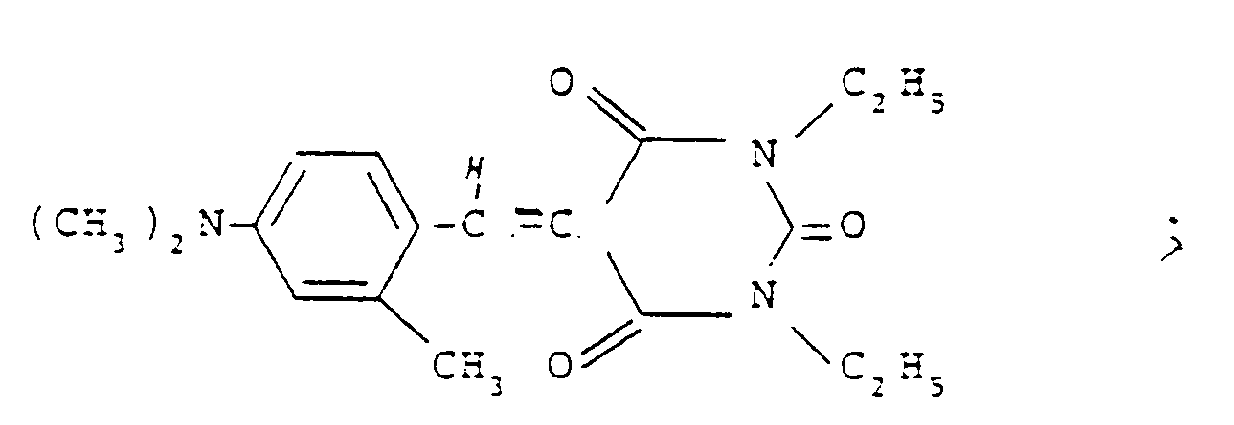 (e) un accélérateur de développement choisi parmi la tribenzylamine, la triphénylamine, la 2,4,6-triphényl-s-triazine et la 2,4,6-triphénoxy-s-triazine.
 - Elément photothermographique pouvant produire une image ayant une couleur jaune visible par exposition à un rayonnement actinique et développement thermique comprenant un substrat comportant une émulsion comprenant :(a) un liant;(b) du béhénate d'argent;(c) un halogénure d'argent choisi parmi le chlorure d'argent, le chlorobromure d'argent, le chloroiodure d'argent, le bromure d'argent, l'iodobromure d'argent, le chloroiodobromure d'argent et l'iodure d'argent au voisinage catalytique du béhénate d'argent;(d) un leucodérivé de colorant benzylidénique de la formule :
 (e) un accélérateur de développement choisi parmi la tribenzylamine, la triphénylamine, la 2,4,6-triphényl-s-triazine et la 2,4,6-triphénoxy-s-triazine.
Applications Claiming Priority (2)
| Application Number | Priority Date | Filing Date | Title |
|---|---|---|---|
| US386294 | 1989-07-27 | ||
| US07/386,294 US5026633A (en) | 1989-07-27 | 1989-07-27 | Color photothermographic materials with development accelerator |
Publications (2)
| Publication Number | Publication Date |
|---|---|
| EP0415535A1 EP0415535A1 (fr) | 1991-03-06 |
| EP0415535B1 true EP0415535B1 (fr) | 1995-09-20 |
Family
ID=23524998
Family Applications (1)
| Application Number | Title | Priority Date | Filing Date |
|---|---|---|---|
| EP90307478A Expired - Lifetime EP0415535B1 (fr) | 1989-07-27 | 1990-07-09 | Matériaux photothermographiques en couleurs avec accélérateur de développement |
Country Status (5)
| Country | Link |
|---|---|
| US (1) | US5026633A (fr) |
| EP (1) | EP0415535B1 (fr) |
| JP (1) | JPH0365947A (fr) |
| CA (1) | CA2019988A1 (fr) |
| DE (1) | DE69022517T2 (fr) |
Families Citing this family (2)
| Publication number | Priority date | Publication date | Assignee | Title |
|---|---|---|---|---|
| JP2002040592A (ja) | 2000-07-24 | 2002-02-06 | Fuji Photo Film Co Ltd | 画像記録材料 |
| WO2024110325A1 (fr) | 2022-11-24 | 2024-05-30 | Lanxess Deutschland Gmbh | Colorants méthiniques jaunes et leur utilisation pour la coloration des plastiques |
Family Cites Families (14)
| Publication number | Priority date | Publication date | Assignee | Title |
|---|---|---|---|---|
| US4017313A (en) * | 1974-09-30 | 1977-04-12 | E. I. Du Pont De Nemours And Company | Photosensitive composition containing a leuco dye, a photosensitizer, an aromatic aldehyde and a secondary or tertiary amine and the use thereof in a direct-print process |
| US4476220A (en) * | 1982-07-29 | 1984-10-09 | Minnesota Mining And Manufacturing Company | Spectrally sensitized photothermographic materials and preparation thereof |
| US4460681A (en) * | 1983-03-15 | 1984-07-17 | Minnesota Mining And Manufacturing Company | Image enhancement of photothermographic elements |
| US4452883A (en) * | 1983-05-17 | 1984-06-05 | Minnesota Mining And Manufacturing Company | Barrier resin for photothermographic color separation |
| JPS6153639A (ja) * | 1984-08-24 | 1986-03-17 | Fuji Photo Film Co Ltd | 熱現像感光材料 |
| JPS61140939A (ja) * | 1984-12-12 | 1986-06-28 | Fuji Photo Film Co Ltd | ハロゲン化銀写真感光材料 |
| JPS61169829A (ja) * | 1985-01-23 | 1986-07-31 | Fuji Photo Film Co Ltd | 光重合性組成物 |
| EP0203613B1 (fr) * | 1985-05-30 | 1989-10-25 | Fuji Photo Film Co., Ltd. | Matériau sensible à la lumière contenant des microcapsules et procédé d'enregistrement d'images utilisant celui-ci |
| JPS6286354A (ja) * | 1985-10-11 | 1987-04-20 | Fuji Photo Film Co Ltd | 感光材料 |
| US4902599A (en) * | 1985-10-12 | 1990-02-20 | Fuji Photo Film Co., Ltd. | Light-sensitive material |
| US4795697A (en) * | 1986-12-29 | 1989-01-03 | Minnesota Mining And Manufacturing Company | Stabilization of ketazine dyes |
| US4782010A (en) * | 1986-12-29 | 1988-11-01 | Minnesota Mining And Manufacturing Company | Photohermographic emulsions having stable color forming developers |
| GB8712961D0 (en) * | 1987-06-03 | 1987-07-08 | Minnesota Mining & Mfg | Colour photothermographic elements |
| DE3725949A1 (de) * | 1987-08-05 | 1989-02-16 | Hoechst Ag | Lichtempfindliches gemisch, daraus hergestelltes lichtempfindliches kopiermaterial und verfahren zur herstellung von negativen reliefkopien |
-
1989
- 1989-07-27 US US07/386,294 patent/US5026633A/en not_active Expired - Fee Related
-
1990
- 1990-06-27 CA CA002019988A patent/CA2019988A1/fr not_active Abandoned
- 1990-07-09 DE DE69022517T patent/DE69022517T2/de not_active Expired - Fee Related
- 1990-07-09 EP EP90307478A patent/EP0415535B1/fr not_active Expired - Lifetime
- 1990-07-26 JP JP2198970A patent/JPH0365947A/ja active Pending
Also Published As
| Publication number | Publication date |
|---|---|
| US5026633A (en) | 1991-06-25 |
| DE69022517D1 (de) | 1995-10-26 |
| CA2019988A1 (fr) | 1991-01-27 |
| JPH0365947A (ja) | 1991-03-20 |
| DE69022517T2 (de) | 1996-05-15 |
| EP0415535A1 (fr) | 1991-03-06 |
Similar Documents
| Publication | Publication Date | Title |
|---|---|---|
| US5028523A (en) | Photothermographic elements | |
| US4374921A (en) | Image enhancement of photothermographic elements | |
| US4021240A (en) | Photothermographic and thermographic compositions and uses therefor containing sulfonamidophenol reducing agents and four equivalent color couplers | |
| US4670374A (en) | Photothermographic accelerators for leuco diazine, oxazine, and thiazine dyes | |
| JPH09510022A (ja) | 光熱写真要素用増感剤 | |
| EP0306163B1 (fr) | Elément photothermographiques | |
| JP3229385B2 (ja) | 光熱写真材料用シアン発色性ロイコ染料 | |
| JP2003233151A (ja) | 改善された保存性および安定化組成物を有する熱現像可能な画像形成材料 | |
| EP0194026B1 (fr) | Stabilisateurs photothermographiques pour leuco-colorants de syringaldazine | |
| EP0415535B1 (fr) | Matériaux photothermographiques en couleurs avec accélérateur de développement | |
| US4782010A (en) | Photohermographic emulsions having stable color forming developers | |
| US4795697A (en) | Stabilization of ketazine dyes | |
| US4461828A (en) | Spectral sensitization of photothermographic elements | |
| US5370988A (en) | Print stabilizers and antifoggants for photothermography | |
| JP3241733B2 (ja) | 光熱写真エレメント用の黄色およびマゼンタ色発色性ロイコ色素 | |
| US4450229A (en) | Stabilization of latent images in photothermographic elements | |
| US4535056A (en) | Yellow color formers for use in color photothermographic system | |
| US5041368A (en) | Photothermographic elements | |
| US4352872A (en) | Stabilization of latent images in photothermographic elements | |
| US4181530A (en) | Thermally developable light-sensitive material having reduced fog | |
| EP0497053A1 (fr) | Constructions "Dry silver" |
Legal Events
| Date | Code | Title | Description |
|---|---|---|---|
| PUAI | Public reference made under article 153(3) epc to a published international application that has entered the european phase |
Free format text: ORIGINAL CODE: 0009012 |
|
| 17P | Request for examination filed |
Effective date: 19910102 |
|
| AK | Designated contracting states |
Kind code of ref document: A1 Designated state(s): BE DE FR GB IT |
|
| 17Q | First examination report despatched |
Effective date: 19931109 |
|
| GRAA | (expected) grant |
Free format text: ORIGINAL CODE: 0009210 |
|
| ITF | It: translation for a ep patent filed | ||
| AK | Designated contracting states |
Kind code of ref document: B1 Designated state(s): BE DE FR GB IT |
|
| REF | Corresponds to: |
Ref document number: 69022517 Country of ref document: DE Date of ref document: 19951026 |
|
| ET | Fr: translation filed | ||
| PGFP | Annual fee paid to national office [announced via postgrant information from national office to epo] |
Ref country code: FR Payment date: 19960617 Year of fee payment: 7 |
|
| PGFP | Annual fee paid to national office [announced via postgrant information from national office to epo] |
Ref country code: BE Payment date: 19960625 Year of fee payment: 7 |
|
| PGFP | Annual fee paid to national office [announced via postgrant information from national office to epo] |
Ref country code: GB Payment date: 19960626 Year of fee payment: 7 |
|
| PLBE | No opposition filed within time limit |
Free format text: ORIGINAL CODE: 0009261 |
|
| STAA | Information on the status of an ep patent application or granted ep patent |
Free format text: STATUS: NO OPPOSITION FILED WITHIN TIME LIMIT |
|
| 26N | No opposition filed | ||
| PG25 | Lapsed in a contracting state [announced via postgrant information from national office to epo] |
Ref country code: GB Free format text: LAPSE BECAUSE OF NON-PAYMENT OF DUE FEES Effective date: 19970709 |
|
| PGFP | Annual fee paid to national office [announced via postgrant information from national office to epo] |
Ref country code: DE Payment date: 19970729 Year of fee payment: 8 |
|
| PG25 | Lapsed in a contracting state [announced via postgrant information from national office to epo] |
Ref country code: BE Free format text: LAPSE BECAUSE OF NON-PAYMENT OF DUE FEES Effective date: 19970731 |
|
| BERE | Be: lapsed |
Owner name: MINNESOTA MINING AND MFG CY Effective date: 19970731 |
|
| GBPC | Gb: european patent ceased through non-payment of renewal fee |
Effective date: 19970709 |
|
| PG25 | Lapsed in a contracting state [announced via postgrant information from national office to epo] |
Ref country code: FR Free format text: LAPSE BECAUSE OF NON-PAYMENT OF DUE FEES Effective date: 19980331 |
|
| REG | Reference to a national code |
Ref country code: FR Ref legal event code: ST |
|
| PG25 | Lapsed in a contracting state [announced via postgrant information from national office to epo] |
Ref country code: DE Free format text: LAPSE BECAUSE OF NON-PAYMENT OF DUE FEES Effective date: 19990501 |
|
| PG25 | Lapsed in a contracting state [announced via postgrant information from national office to epo] |
Ref country code: IT Free format text: LAPSE BECAUSE OF NON-PAYMENT OF DUE FEES;WARNING: LAPSES OF ITALIAN PATENTS WITH EFFECTIVE DATE BEFORE 2007 MAY HAVE OCCURRED AT ANY TIME BEFORE 2007. THE CORRECT EFFECTIVE DATE MAY BE DIFFERENT FROM THE ONE RECORDED. Effective date: 20050709 |