EP0416929B1 - Procédé de traitement d'un alliage de titane et pièce produite du même - Google Patents
Procédé de traitement d'un alliage de titane et pièce produite du même Download PDFInfo
- Publication number
- EP0416929B1 EP0416929B1 EP90309793A EP90309793A EP0416929B1 EP 0416929 B1 EP0416929 B1 EP 0416929B1 EP 90309793 A EP90309793 A EP 90309793A EP 90309793 A EP90309793 A EP 90309793A EP 0416929 B1 EP0416929 B1 EP 0416929B1
- Authority
- EP
- European Patent Office
- Prior art keywords
- phase
- treatment
- alloy
- titanium alloy
- ageing
- Prior art date
- Legal status (The legal status is an assumption and is not a legal conclusion. Google has not performed a legal analysis and makes no representation as to the accuracy of the status listed.)
- Expired - Lifetime
Links
Images



Classifications
-
- C—CHEMISTRY; METALLURGY
- C22—METALLURGY; FERROUS OR NON-FERROUS ALLOYS; TREATMENT OF ALLOYS OR NON-FERROUS METALS
- C22F—CHANGING THE PHYSICAL STRUCTURE OF NON-FERROUS METALS AND NON-FERROUS ALLOYS
- C22F1/00—Changing the physical structure of non-ferrous metals or alloys by heat treatment or by hot or cold working
- C22F1/16—Changing the physical structure of non-ferrous metals or alloys by heat treatment or by hot or cold working of other metals or alloys based thereon
- C22F1/18—High-melting or refractory metals or alloys based thereon
- C22F1/183—High-melting or refractory metals or alloys based thereon of titanium or alloys based thereon
Definitions
- the present invention relates to a process for treating an ⁇ + ⁇ titanium alloy article or a ⁇ titanium alloy article.
- an ⁇ + ⁇ titanium alloy article is a two phase alloy comprising a hard phase and a soft phase and there is a difference in the hardness and the workability between the ⁇ phase and the ⁇ phase. Therefore, even when such an attempt is made to subject such an article to a mirror finishing, a mirror state cannot be produced.
- an ⁇ phase is present although the amount thereof is small, and thus makes it impossible to produce a mirror state due to a difference in the hardness and the workability between the ⁇ phase and the ⁇ phase.
- a heat treatment of a titanium alloy article which has been conducted for the purpose of enhancing the strength or toughness of the article, is disclosed in Japanese Patent Publication No. 48025/1983 and Japanese Patent Laid-Open No. 281860/1986.
- the article is solution treated below the ⁇ transformation point, is quenched, and is aged below the ⁇ transformation point.
- a pro-eutectoid ⁇ phase remains and there is a difference in the hardness and the workability between the pro-eutectoid ⁇ phase and the phase precipitated from the ⁇ phase by the ageing treatment, so that a mirror state cannot be obtained even if an attempt to produce mirror finishing is carried out.
- a titanium alloy article has been given a satin finish state or has been given a surface treatment such as overcoating.
- a titanium alloy has many advantages such as high specific strength, high temperature strength and good corrosion resistance and has therefore been extensively used for constructional or mechanical parts.
- a heat treatment is carried out for the purpose of imparting various functions such as strength, toughness, corrosion resistance and vibration resistance.
- the appearance of the product has not been of importance and a mirror state has not been considered necessary.
- these products have been used for ornaments by virtue of features of the titanium alloy such as low specific gravity, good corrosion resistance, high hardness and high-grade finish. In this case, these products have been used after a surface treatment such as overcoating or in a satin finish pattern, but it has not been possible to give them a mirror state.
- a process for treating an ⁇ + ⁇ titanium alloy article or a ⁇ titanium alloy article comprising subjecting said alloy article to a ⁇ solution treatment above the ⁇ transformation point, quenching the solution treated alloy article, and ageing the quenched alloy below the ⁇ transformation point characterised in that the alloy is moulded into an article having a desired final shape prior to the said solution treatment, and said article is finally subjected to a mirror finishing treatment.
- the finishing treatment is preferably a polishing treatment.
- the article is gradually cooled to room temperature.
- the said quenching preferably produces a martensitic phase (e.g. a martensitic single phase) or a ⁇ phase (e.g. a ⁇ single phase).
- a martensitic phase e.g. a martensitic single phase
- a ⁇ phase e.g. a ⁇ single phase
- the said ageing may produce the fine precipitation of an ⁇ phase or an ⁇ phase in a martensitic phase matrix or a ⁇ phase matrix.
- the said quenching may cause ⁇ and ⁇ phases to be homogeneously and finely precipitated.
- the process of the present invention enables titanium alloy ornaments to be produced without detriment to their high hardness and without marring the resistance characteristics of the titanium alloy even though mirror finishing is used as a post-treatment.
- the preferred process of the present invention comprises subjecting an ⁇ + ⁇ titanium alloy or a ⁇ titanium alloy to a ⁇ solution treatment above the ⁇ transformation point, quenching the treated alloy to room temperature, and subjecting the quenched alloy to an ageing treatment below the ⁇ transformation point to precipitate a fine precipitate from the martensitic phase and the ⁇ phase on the whole surface.
- the structure of an ⁇ + ⁇ titanium alloy is converted into a martensitic single phase when the alloy is heated and held above the ⁇ transformation point ( ⁇ solution treatment) and then quenched.
- the structure of a ⁇ titanium alloy is converted into a ⁇ single phase when the alloy is heated and held above the ⁇ transformation point and then quenched. Further, when the alloy is aged below the ⁇ transformation point, a fine precipitate of an ⁇ phase or an ⁇ phase is formed in a martensitic phase matrix or ⁇ phase matrix.
- the surface of the titanium alloy can be uniformly polished and a mirror state can be provided.
- Figure 2(A) shows the structure of the titanium alloy of Table 1 before a heat treatment, wherein two phases, i.e. ⁇ and ⁇ phases, are present in the structure.
- Figure 2(B) shows the structure of the titanium alloy of Table 1 after a solution treatment at 750°C for 0.5 h followed by oil quenching, wherein two phases, i.e. ⁇ and ⁇ phases are present in the structure.
- Figure 2(C) shows the structure of the titanium alloy of Table 1 after a solution treatment at 750°C for 0.5 h followed by oil quenching and an ageing treatment at 500°C for 5 h, wherein a fine ⁇ phase is precipitated from a ⁇ phase and a pro-eutectoid ⁇ phase remains as it is.
- Figure 2(D) shows the structure of the titanium alloy of Table 1 after a solution treatment at 850°C for 0.5 h followed by oil quenching, wherein the structure is a martensitic one.
- Figure 2(E) shows the structure of the titanium alloy of Table 1 after a solution treatment at 850°C for 0.5 h followed by oil quenching, and an ageing treatment at 400°C for 0.5 h and air cooling, wherein a fine ⁇ phase is precipitated from a martensitic matrix.
- Figure 2(F) shows the structure of the titanium alloy of Table 1 after a solution treatment at 850°C for 0.5 h followed by oil quenching, and an ageing treatment at 400°C for 16 h and air cooling, wherein a fine ⁇ phase or ⁇ phase is precipitated from a martensitic matrix.
- Figure 2(G) shows the structure of the titanium alloy of Table 1 after a solution treatment at 850°C for 0.5 h followed by oil quenching, and an ageing treatment at 500°C for 16 h and air cooling, wherein a fine acicular ⁇ phase is precipitated from a martensitic matrix.
- a martensitic single phase structure having no ⁇ phase remaining therein was prepared through a solution treatment above the ⁇ transformation point (780°C) followed by oil quenching. In this case, a period of 5 min or longer was necessary for the solution treatment.
- An ageing treatment in this state below the ⁇ transformation point gave rise to a structure wherein a fine ⁇ phase was precipitated from a martensitic matrix when the temperature was below 450°C, and a structure wherein a fine ⁇ phase was precipitated from a martensitic matrix when the temperature was above 450°C.
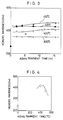
- Figure 3 is a graph showing the hardness of the titanium alloy of Table 1 after a solution treatment at 850°C for 0.5 h followed by quenching and an ageing treatment.
- the titanium alloy of Table 1 when subjected only to a solution treatment, exhibited a Vickers hardness, Hv, of 260. In each ageing treatment temperature, the Hv value was above 350 when the ageing tretment time was 2h, i.e. the effect of the ageing treatment was obtained.
- This effect could be attained by virtue of the precipitation of a fine ⁇ phase or ⁇ phase from the martensitic matrix.
- Figure 4 is a graph showing the hardness of the titanium alloy of Table 1 after a solution treatment at 750°C for 0.5 h followed by quenching and an ageing treatment.
- the titanium alloy of Table 1 when subjected only to a solution treatment, exhibited a Vickers hardness, Hv, of 240.
- Hv Vickers hardness
- the Hv value reached 420 when the ageing treatment was conducted at 400°C for 5 h, and reached 370 when the ageing treatment was conducted at 500°C for 5 h. This suggests that the effect of hardening by precipitation of an ⁇ phase or an ⁇ phase from the ⁇ + ⁇ phase was attained.
- Table 3 shows a specific roughness and surface state after polishing.
- the surface roughness was represented in terms of the maximum value, the minimum value, and the average value of the maximum surface roughness, Rmax, when measurements were conducted at seven points at intervals of 2 mm for each sample.
- the titanium alloy of Table 1 when subjected to a solution treatment at 750°C for 0.5 h followed by an ageing treatment at 500°C for 5 h, exhibited an Hv value of 370 and had only small corrugation and surface roughness but could be given only an uneven polishing due to the difference in the hardness between the ⁇ phase and the ⁇ phase, so that a satin finish pattern was formed.
- the titanium alloy of Table 1 when subjected to a solution treatment of 850°C for 0.5 h followed by oil quenching and an ageing treatment at 450°C for 5 h or at 500°C for 5 h, exhibited a high Vickers hardness and a small surface roughness, comprised an ⁇ phase or an ⁇ phase uniformly and finely precipitated in a martensitic matrix, was free from the risk of having uneven polishing, and could be given a mirror state.
- the titanium alloy of Table 1 when aged at 400°C for 5 h, brought about no complete precipitation of an ⁇ phase or a ⁇ phase, so that slight uneven polishing was observed.
- an excellent mirror state could be attained by solution-treating the alloy above the ⁇ transformation point, quenching the treated alloy, ageing the alloy below the ⁇ transformation point to form a structure wherein a fine ⁇ phase or ⁇ phase was precipitated from a martensitic matrix, and subjecting the alloy to a mirror finishing treatment.
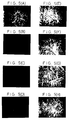
- Figure 5(A) shows the structure of the titanium alloy of Table 4 before heat treatment, wherein the structure comprises two phases, i.e. ⁇ and ⁇ phases.
- Figure 5(B) shows the structure of the titanium alloy of Table 4 after a solution treatment at 900°C for 0.5 h followed by oil quenching, wherein the structure comprises two phases, i.e. ⁇ and ⁇ phases.
- Figure 5(D) shows the structure of the titanium alloy of Table 4 after a solution treatment at 1050°C for 0.5 h followed by oil quenching, wherein the structure is a martensitic one.
- Figure 5(E) shows the structure of the titanium alloy of Table 4 after a solution treatment of 1050°C for 0.5 h followed by oil quenching, an ageing treatment at 400°C for 16 h and air cooling, wherein a fine ⁇ phase is precipitated in a martensitic matrix.
- Figure 5(F) to (H) each show the structure of the titanium alloy of Table 4 after a solution treatment at 1050°C for 0.5 h followed by ageing treatment at 500°C for 16 h, at 600°C for 16 h and at 700°C for 16 h and air cooling, wherein a fine ⁇ phase is precipitated from a martensitic matrix.
- the structure of the titanium alloy of Table 4 was converted into a martensitic single phase structure by solution-treating the alloy above the ⁇ transformation point (995°C) followed by cooling at a rate higher than that attained by oil quenching.
- a further ageing treatment in this state below the ⁇ transformation point gave rise to a structure wherein a fine ⁇ phase was precipitated from a martensitic matrix (ageing treatment temperature: 400°C) or a structure wherein a fine ⁇ phase was precipitated from a martensitic matrix (ageing treatment temperature: 400°C).
- the alloy of Table 4 when subjected to a solution treatment at 1050°C for 0.5 h followed by oil quenching, exhibited a Vickers hardness, Hv, of 335. A further ageing treatment below the ⁇ transformation point improved the Hv value from 350 to 370. This effect derives from the formation of a structure wherein a fine ⁇ phase or ⁇ phase is precipitated from a martensitic matrix.
- the titanium alloy of Table 4 when subjected to a solution treatment at 900°C for 0.5 h followed by oil quenching, exhibited a Hv value of 350. In this case, even when the alloy was further subjected to an ageing treatment at 600°C for 5 h, the Hv value was still 345. In other words, although a fine ⁇ phase was precipitated in a ⁇ phase, no improvement in the hardness was attained because the amount of the ⁇ phase was small.
- Table 6 Table 6 Solution treatment 1050°C, 0.5 h (O.Q.) 900°C, 0.5 h (O.Q.) Aging treatment - 400°C 16 h 500°C 16 h 600°C 16 h 700°C 16 h - 600°C 5 h Surface roughess max. Rmax ( ⁇ m) 0.804 0.531 0.329 0.199 0.163 0.649 0.415 min.
- the titanium alloy of Table 4 when subjected to a solution treatment at 900°C for 0.5 h followed by oil quenching, and the titanium alloy of Table 4, when subjected to a further ageing treatment at 600°C for 5 h, provided no mirror state even when a mirror finishing treatment was carried out.
- the titanium alloy of Table 4 when subjected to a solution treatment at 1050°C for 0.5 h followed by oil quenching and an ageing treatment at 500°C for 16 h, at 600°C for 16 h and at 700°C for 16 h provided an excellent mirror state as a result of a mirror finishing treatment.
- the ageing treatment was conducted at 400°C for 16 h, an ⁇ phase or ⁇ phase was not completely precipitated, so that no mirror state could be obtained.
- an excellent mirror state can be provided by solution-treating the alloy above the ⁇ transformation point, quenching the alloy to room temperature, ageing the quenched alloy below the ⁇ transformation point to form a structure wherein a fine ⁇ phase or ⁇ phase is precipitated in a martensitic matrix, and subjecting the aged alloy to a mirror finishing treatment.
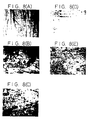
- Figure 8 (A) shows the structure of the titanium alloy of Table 7 before a heat treatment, wherein there is a long thin ⁇ grain boundary.
- Figure 8(B) shows the structure of the titanium alloy of Table 7 after a solution treatment at 750°C for 10 min. followed by oil quenching, wherein the structure is an isometric ⁇ single phase structure.
- Figure 8(C) shows the structure of the titanium alloy of Table 7 after a solution treatment at 750°C for 10 min. followed by oil quenching and an ageing treatment at 450°C for 40 h, wherein a fine ⁇ phase. is precipitated from the whole ⁇ phase.
- Figure 8(D) shows the structure of the titanium alloy of Table 7 after a solution treatment at 700°C for 10 min followed by oil quenching, wherein a ⁇ phase is contaminated with an ⁇ phase.
- Figure 8(E) shows the structure of the titanium alloy of Table 7 after a solution treatment at 700°C for 10 min followed by oil quenching and an ageing treatment at 450°C for 40 h, wherein a pro-eutectoid ⁇ phase remains in the structure although a fine ⁇ phase is precipitated from a ⁇ phase.
- a structure wherein a fine ⁇ or ⁇ phase is precipitated from a ⁇ phase is prepared by solution-treating the alloy above the ⁇ transformation point (730°C) and cooling the treated alloy to room temperature at a rate higher than that attained by oil quenching to form a ⁇ single phase structure and then ageing the alloy below the ⁇ transformation point.
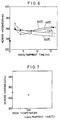
- the alloy of Table 7 when subjected to a solution treatment at 750°C for 10 min followed by oil quenching, exhibited a Vickers hardness, Hv, of 260, and an ageing treatment below 600°C provided a Hv value of above 300.
- the effect of the ageing treatment could be attained when the ageing time was above 40 h. This is because a fine ⁇ phase or ⁇ phase is precipitated from the ⁇ phase.
- Table 9 The results of a mirror finishing treatment of the titanium alloy of Table 7, when subjected to various heat treatments, are given in Table 9.
- the titanium alloy of Table 7 when subjected to a solution treatment at 750°C for 10 min followed by oil quenching and an ageing treatment at 450°C for 40 h, provided an excellent mirror state as a result of a mirror finishing treatment.
- an excellent mirror state can be attained by solution-treating the alloy above the ⁇ transformation point, quenching the treated alloy to room temperature, ageing the alloy below the ⁇ transformation point to form a structure wherein a fine ⁇ phase or an ⁇ phase is precipitated from a ⁇ phase, and subjecting the aged alloy to a mirror finishing treatment.
- a structure wherein a fine ⁇ phase or an ⁇ phase is uniformly precipitated from a martensitic single phase or a ⁇ single phase can be formed by heat-treating an ⁇ + ⁇ titanium alloy or a ⁇ titanium alloy, and an excellent mirror state can be attained by a mirror finishing treatment of such a structure.
Landscapes
- Chemical & Material Sciences (AREA)
- Physics & Mathematics (AREA)
- Thermal Sciences (AREA)
- Crystallography & Structural Chemistry (AREA)
- Engineering & Computer Science (AREA)
- Materials Engineering (AREA)
- Mechanical Engineering (AREA)
- Metallurgy (AREA)
- Organic Chemistry (AREA)
- Heat Treatment Of Nonferrous Metals Or Alloys (AREA)
Claims (7)
- Procédé de traitement d'un objet en alliage au titane α + β ou d'un objet en alliage au titane β qui consiste à soumettre cet objet en alliage à un traitement de passage en solution β au-dessus du point de transformation, à tremper l'objet en alliage traité en solution, et à vieillir l'alliage trempé en-dessous du point de transformation β caractérisé en ce qu'il consiste à mouler l'alliage en un objet ayant une forme finale souhaitée avant le traitement en solution et à soumettre finalement l'objet à un traitement de poli spéculaire.
- Procédé suivant la revendication 1 caractérise en ce qu'il consiste, après le vieillissement, à refroidir peu à peu l'objet à la température ambiante.
- Procédé suivant la revendication 1 dans lequel le traitement de poli spéculaire est un traitement de polissage.
- Procédé suivant l'une quelconque des revendications précédentes caractérisé en ce que la trempe produit une phase martensitique ou une phase β.
- Procédé suivant la revendication 4 caractérisé en ce que la trempe produit une phase martensitique unique ou une phase β unique.
- Procédé suivant l'une quelconque des revendications précédentes caractérisé en ce que le vieillissement produit la précipitation fine d'une phase α ou d'une phase ω dans une matrice de phase martensitique ou dans une matrice de phase β.
- Procédé suivant la revendication 4 ou 5 caractérisé en ce que la trempe fait que les phases α et ω précipitent d'une manière homogène et finement.
Applications Claiming Priority (2)
| Application Number | Priority Date | Filing Date | Title |
|---|---|---|---|
| JP233922/89 | 1989-09-08 | ||
| JP1233922A JPH07100846B2 (ja) | 1988-12-26 | 1989-09-08 | 鏡面を有するチタン合金の製造方法 |
Publications (2)
| Publication Number | Publication Date |
|---|---|
| EP0416929A1 EP0416929A1 (fr) | 1991-03-13 |
| EP0416929B1 true EP0416929B1 (fr) | 1994-11-30 |
Family
ID=16962704
Family Applications (1)
| Application Number | Title | Priority Date | Filing Date |
|---|---|---|---|
| EP90309793A Expired - Lifetime EP0416929B1 (fr) | 1989-09-08 | 1990-09-07 | Procédé de traitement d'un alliage de titane et pièce produite du même |
Country Status (3)
| Country | Link |
|---|---|
| US (1) | US5171375A (fr) |
| EP (1) | EP0416929B1 (fr) |
| DE (1) | DE69014501T2 (fr) |
Families Citing this family (7)
| Publication number | Priority date | Publication date | Assignee | Title |
|---|---|---|---|---|
| US5201967A (en) * | 1991-12-11 | 1993-04-13 | Rmi Titanium Company | Method for improving aging response and uniformity in beta-titanium alloys |
| US5399212A (en) * | 1992-04-23 | 1995-03-21 | Aluminum Company Of America | High strength titanium-aluminum alloy having improved fatigue crack growth resistance |
| US5397404A (en) * | 1992-12-23 | 1995-03-14 | United Technologies Corporation | Heat treatment to reduce embrittlement of titanium alloys |
| JP3083225B2 (ja) * | 1993-12-01 | 2000-09-04 | オリエント時計株式会社 | チタン合金製装飾品の製造方法、および時計外装部品 |
| WO1999037827A1 (fr) * | 1998-01-27 | 1999-07-29 | Tag-Heuer S.A. | Piece de montre en alliage de titane |
| CN114752875A (zh) * | 2022-04-08 | 2022-07-15 | 攀钢集团研究院有限公司 | 一种具有表面晶花的纯钛薄板及其加工方法 |
| US20250328109A1 (en) * | 2022-05-06 | 2025-10-23 | Rolex Sa | Timepiece component made of polished titanium alloy |
Family Cites Families (10)
| Publication number | Priority date | Publication date | Assignee | Title |
|---|---|---|---|---|
| US4053330A (en) * | 1976-04-19 | 1977-10-11 | United Technologies Corporation | Method for improving fatigue properties of titanium alloy articles |
| US4309226A (en) * | 1978-10-10 | 1982-01-05 | Chen Charlie C | Process for preparation of near-alpha titanium alloys |
| US4543132A (en) * | 1983-10-31 | 1985-09-24 | United Technologies Corporation | Processing for titanium alloys |
| US4482398A (en) * | 1984-01-27 | 1984-11-13 | The United States Of America As Represented By The Secretary Of The Air Force | Method for refining microstructures of cast titanium articles |
| US4631092A (en) * | 1984-10-18 | 1986-12-23 | The Garrett Corporation | Method for heat treating cast titanium articles to improve their mechanical properties |
| DE3622433A1 (de) * | 1986-07-03 | 1988-01-21 | Deutsche Forsch Luft Raumfahrt | Verfahren zur verbesserung der statischen und dynamischen mechanischen eigenschaften von ((alpha)+ss)-titanlegierungen |
| US4799975A (en) * | 1986-10-07 | 1989-01-24 | Nippon Kokan Kabushiki Kaisha | Method for producing beta type titanium alloy materials having excellent strength and elongation |
| FR2614040B1 (fr) * | 1987-04-16 | 1989-06-30 | Cezus Co Europ Zirconium | Procede de fabrication d'une piece en alliage de titane et piece obtenue |
| JPS63270449A (ja) * | 1987-04-28 | 1988-11-08 | Nippon Steel Corp | 異方性の小さい良延性チタン板の製造方法 |
| US4975125A (en) * | 1988-12-14 | 1990-12-04 | Aluminum Company Of America | Titanium alpha-beta alloy fabricated material and process for preparation |
-
1990
- 1990-09-06 US US07/579,467 patent/US5171375A/en not_active Expired - Lifetime
- 1990-09-07 EP EP90309793A patent/EP0416929B1/fr not_active Expired - Lifetime
- 1990-09-07 DE DE69014501T patent/DE69014501T2/de not_active Expired - Fee Related
Also Published As
| Publication number | Publication date |
|---|---|
| US5171375A (en) | 1992-12-15 |
| DE69014501T2 (de) | 1995-05-11 |
| EP0416929A1 (fr) | 1991-03-13 |
| DE69014501D1 (de) | 1995-01-12 |
Similar Documents
| Publication | Publication Date | Title |
|---|---|---|
| JP3083225B2 (ja) | チタン合金製装飾品の製造方法、および時計外装部品 | |
| EP1486576B1 (fr) | Méthode de traitement thermique d'alliages de titane tenaces présentant une résistance mécanique élevée | |
| KR0148414B1 (ko) | 티타늄 합금제 엔진밸브 및, 그것의 제조방법 | |
| EP0412204A1 (fr) | Procédé de vieillissement en deux étapes d'un alliage d'aluminium et pièce d'usinage | |
| US20030168138A1 (en) | Method for processing beta titanium alloys | |
| CN111534715B (zh) | 一种万向复位螺钉座钛合金棒材的制备方法 | |
| EP1521860B1 (fr) | Fil d'acier trempé et revenu présentant des caractéristiques de forgeage à froid supérieures | |
| EP0748878A1 (fr) | Acier inoxydable martensitique du type susceptible au durcissement à une température inférieure à zéro degré | |
| JPS63277745A (ja) | チタン合金製部材の製造方法及び該方法によって製造した部材 | |
| EP0508237A1 (fr) | Acier multiphasé microallié | |
| EP0416929B1 (fr) | Procédé de traitement d'un alliage de titane et pièce produite du même | |
| KR100219931B1 (ko) | 고강도 스틸스웨이바아 및 그 제조방법 | |
| JP3356281B2 (ja) | アルミニウム合金材料及びその製造方法 | |
| EP0725157B1 (fr) | Traitement d'alliages et produits ainsi obtenus | |
| US4563222A (en) | High strength bolt and method of producing same | |
| JPH02258960A (ja) | 鏡面を有するチタン合金の製造方法 | |
| US4395295A (en) | Process for treating copper-aluminum-silicon alloys to improve fatigue strength | |
| US6190468B1 (en) | Metamorphic processing of alloys and products thereof | |
| JP2655840B2 (ja) | プラスチツク成形プリハードン金型用鋼 | |
| JPS61261427A (ja) | 冷間加工性にすぐれ,且つ,浸炭加熱時の結晶粒粗大化を防止した鋼の製造方法 | |
| JPH02182849A (ja) | チタン合金を用いた装飾品 | |
| JPS58130269A (ja) | 硬化深さの大きな軟窒化処理物品の製法 | |
| JP2686075B2 (ja) | プラスチツク成形プリハードン金型用鋼 | |
| EP0340350A1 (fr) | Alliages à base d'alluminium contenant du lithium ne présentant pas de lignes d'hartmann | |
| JPS59136420A (ja) | 冷間加工部を有する非調質鋼部材の製造方法 |
Legal Events
| Date | Code | Title | Description |
|---|---|---|---|
| PUAI | Public reference made under article 153(3) epc to a published international application that has entered the european phase |
Free format text: ORIGINAL CODE: 0009012 |
|
| AK | Designated contracting states |
Kind code of ref document: A1 Designated state(s): DE FR GB |
|
| 17P | Request for examination filed |
Effective date: 19910730 |
|
| 17Q | First examination report despatched |
Effective date: 19930722 |
|
| GRAA | (expected) grant |
Free format text: ORIGINAL CODE: 0009210 |
|
| AK | Designated contracting states |
Kind code of ref document: B1 Designated state(s): DE FR GB |
|
| REF | Corresponds to: |
Ref document number: 69014501 Country of ref document: DE Date of ref document: 19950112 |
|
| ET | Fr: translation filed | ||
| PLBE | No opposition filed within time limit |
Free format text: ORIGINAL CODE: 0009261 |
|
| STAA | Information on the status of an ep patent application or granted ep patent |
Free format text: STATUS: NO OPPOSITION FILED WITHIN TIME LIMIT |
|
| 26N | No opposition filed | ||
| REG | Reference to a national code |
Ref country code: FR Ref legal event code: D6 |
|
| PGFP | Annual fee paid to national office [announced via postgrant information from national office to epo] |
Ref country code: GB Payment date: 19960829 Year of fee payment: 7 |
|
| PGFP | Annual fee paid to national office [announced via postgrant information from national office to epo] |
Ref country code: FR Payment date: 19960910 Year of fee payment: 7 |
|
| PGFP | Annual fee paid to national office [announced via postgrant information from national office to epo] |
Ref country code: DE Payment date: 19960913 Year of fee payment: 7 |
|
| PG25 | Lapsed in a contracting state [announced via postgrant information from national office to epo] |
Ref country code: GB Free format text: LAPSE BECAUSE OF NON-PAYMENT OF DUE FEES Effective date: 19970907 |
|
| PG25 | Lapsed in a contracting state [announced via postgrant information from national office to epo] |
Ref country code: FR Free format text: THE PATENT HAS BEEN ANNULLED BY A DECISION OF A NATIONAL AUTHORITY Effective date: 19970930 |
|
| GBPC | Gb: european patent ceased through non-payment of renewal fee |
Effective date: 19970907 |
|
| PG25 | Lapsed in a contracting state [announced via postgrant information from national office to epo] |
Ref country code: DE Free format text: LAPSE BECAUSE OF NON-PAYMENT OF DUE FEES Effective date: 19980603 |
|
| REG | Reference to a national code |
Ref country code: FR Ref legal event code: ST |