EP0418005B1 - Vorrichtung zur Feststellung des Vorhandenseins von fremden Stoffen - Google Patents
Vorrichtung zur Feststellung des Vorhandenseins von fremden Stoffen Download PDFInfo
- Publication number
- EP0418005B1 EP0418005B1 EP90309860A EP90309860A EP0418005B1 EP 0418005 B1 EP0418005 B1 EP 0418005B1 EP 90309860 A EP90309860 A EP 90309860A EP 90309860 A EP90309860 A EP 90309860A EP 0418005 B1 EP0418005 B1 EP 0418005B1
- Authority
- EP
- European Patent Office
- Prior art keywords
- vessel
- rotation
- rotatable body
- vessels
- inspecting
- Prior art date
- Legal status (The legal status is an assumption and is not a legal conclusion. Google has not performed a legal analysis and makes no representation as to the accuracy of the status listed.)
- Expired - Lifetime
Links
- 239000007788 liquid Substances 0.000 claims description 34
- 238000001514 detection method Methods 0.000 claims description 13
- 230000008859 change Effects 0.000 claims description 10
- 230000007246 mechanism Effects 0.000 claims description 10
- 230000033001 locomotion Effects 0.000 claims description 5
- 239000012530 fluid Substances 0.000 claims 4
- 238000007689 inspection Methods 0.000 description 13
- 230000000977 initiatory effect Effects 0.000 description 8
- 238000006243 chemical reaction Methods 0.000 description 7
- 238000005282 brightening Methods 0.000 description 6
- 238000005187 foaming Methods 0.000 description 6
- 230000035945 sensitivity Effects 0.000 description 6
- 230000001133 acceleration Effects 0.000 description 3
- 230000005856 abnormality Effects 0.000 description 2
- 230000002950 deficient Effects 0.000 description 2
- 238000010586 diagram Methods 0.000 description 2
- -1 acryl Chemical group 0.000 description 1
- 230000005540 biological transmission Effects 0.000 description 1
- 238000010276 construction Methods 0.000 description 1
- 239000000284 extract Substances 0.000 description 1
- 239000000945 filler Substances 0.000 description 1
- 239000011521 glass Substances 0.000 description 1
- 239000002184 metal Substances 0.000 description 1
- 238000000034 method Methods 0.000 description 1
- 238000012986 modification Methods 0.000 description 1
- 230000004048 modification Effects 0.000 description 1
- 230000010355 oscillation Effects 0.000 description 1
- 239000002244 precipitate Substances 0.000 description 1
- 230000008569 process Effects 0.000 description 1
- 239000000047 product Substances 0.000 description 1
- 230000000979 retarding effect Effects 0.000 description 1
- 238000006467 substitution reaction Methods 0.000 description 1
Images


Classifications
-
- B—PERFORMING OPERATIONS; TRANSPORTING
- B67—OPENING, CLOSING OR CLEANING BOTTLES, JARS OR SIMILAR CONTAINERS; LIQUID HANDLING
- B67C—CLEANING, FILLING WITH LIQUIDS OR SEMILIQUIDS, OR EMPTYING, OF BOTTLES, JARS, CANS, CASKS, BARRELS, OR SIMILAR CONTAINERS, NOT OTHERWISE PROVIDED FOR; FUNNELS
- B67C3/00—Bottling liquids or semiliquids; Filling jars or cans with liquids or semiliquids using bottling or like apparatus; Filling casks or barrels with liquids or semiliquids
- B67C3/02—Bottling liquids or semiliquids; Filling jars or cans with liquids or semiliquids using bottling or like apparatus
- B67C3/22—Details
-
- G—PHYSICS
- G01—MEASURING; TESTING
- G01N—INVESTIGATING OR ANALYSING MATERIALS BY DETERMINING THEIR CHEMICAL OR PHYSICAL PROPERTIES
- G01N21/00—Investigating or analysing materials by the use of optical means, i.e. using sub-millimetre waves, infrared, visible or ultraviolet light
- G01N21/84—Systems specially adapted for particular applications
- G01N21/88—Investigating the presence of flaws or contamination
- G01N21/90—Investigating the presence of flaws or contamination in a container or its contents
- G01N21/9018—Dirt detection in containers
- G01N21/9027—Dirt detection in containers in containers after filling
-
- G—PHYSICS
- G01—MEASURING; TESTING
- G01N—INVESTIGATING OR ANALYSING MATERIALS BY DETERMINING THEIR CHEMICAL OR PHYSICAL PROPERTIES
- G01N33/00—Investigating or analysing materials by specific methods not covered by groups G01N1/00 - G01N31/00
- G01N33/0078—Testing material properties on manufactured objects
- G01N33/0081—Containers; Packages; Bottles
Definitions
- the invention relates to an apparatus for inspecting the presence of foreign matters, and more particularly, to such apparatus which inspects vessels for the presence or not of a foreign matter or matters in a liquid which is filled therein.
- An arrangement for inspecting the presence of foreign matters comprising a plurality of receptacles rotatably disposed around a rotatable body and each adapted to receive a vessel to be placed thereon, a rotating mechanism for driving each of the receptacles for rotation in forward or reverse direction, and inspecting means disposed at a given location outside the locus of rotation of the rotatable body for inspecting the vessel for the presence of any foreign matter therein as it is driven for rotation during the rotary motion of the receptacle, the inspecting means being operable to inspect the vessels while the vessels assume an inspecting condition which is reached by a reverse rotation following a forward rotation of the vessels (see Japanese Patent Publication No. 10,466/1972).
- a reverse rotation which follows a forward rotation of the vessels which is caused by the rotating mechanism is effective to drive and collect any foreign matter which is mixed into the liquid filling the vessel toward the center of the vessel, thus facilitating the detection of such foreign matter.
- the rotating mechanism which is used in the apparatus of the kind described comprises a forward rotation friction belt which causes the receptacle to rotate in the forward direction, and a reverse rotation friction belt which is disposed downstream of the forward rotation belt to cause the receptacle to rotate in the reverse direction.
- the number of revolutions for the forward or reverse rotation, the time interval over which such rotation is to be maintained or the length of a pause interval between the forward and the reverse rotation generally depend on the size of the vessels, the degree of foaming or the viscosity of the filling liquid, but the allowance for the inspecting condition should be merely within 30% from the most desirable inspecting condition.
- the normal speed of rotation of the rotatable body should be 700 bottles per minute for the number of vessels being processed, for example, a condition which causes the number of processed vessels to be reduced substantially below 500 bottles per minute will depart from the allowance for the inspecting condition, which disables the inspection.
- a fluctuation in the line speed must be normally allowed from 200 to 700 bottles per minute, which could not have been met by a conventional apparatus for inspecting the presence of foreign matters.
- the rotating mechanism of the apparatus described above comprises a control motor mounted on the rotatable body for driving the receptacle for rotation in the forward or reverse direction, a controller for controlling the control motor and a detector for detecting the speed of rotation of the rotatable body.
- the controller responds to a signal from the detector by detecting a change in the speed of rotation of the rotatable body, and controls the motor in accordance with such change so that the vessel can be maintained in a predetermined, given permissible inspecting condition in the presence of a change in the speed of rotation of the rotatable body.
- the vessel can be maintained in its given, predetermined permissble inspecting condition as by causing the controller to displace the position at which the forward rotation of the vessel is to be initiated or at which the reverse rotation is to be initiated forwardly, as viewed in the direction of rotation of the rotatable body, thus retarding both the forward and the reverse rotation of the vessel.
- the vessel can be maintained in its given, predetermined permissible inspecting condition in this manner in the presence of a change in the speed of rotation of the rotatable body, it is possible to achieve and maintain an accurate inspection of foreign matters in the presence of appreciable speed changes in the rotation of the rotatable body.
- an apparatus 1 for inspecting the presence of foreign matters is constructed to inspect vessels 2 for the presence of any foreign matter which may be mixed into a liquid which fills them.
- the vessel 2 After being filled with a liquid, the vessel 2 (see Fig. 2) which has its mouth capped will be sequentially handed from a feed conveyor 3 to a pair of feed star wheels 4, 5, and subsequently is handed over from the wheel 5 to receptacles 7 sequentially which are arranged on a rotatable body 6. As handed over to the receptacles 7, the vessels 2 are conveyed as the rotatable body 6 rotates, and also revolve themselves as the receptacles 7 rotate.
- a rotating mechanism 8 is controlled by a controller 9 such that the receptacles 7 begin to rotate clockwise, as viewed in Fig. 1, from a position A, representing the initiation of a forward rotation, and continues to rotate at a given number of revolutions over a given time interval t1 until a stop position B is reached where the rotation of the receptacles is temporarily interrupted for a given time interval t2.
- the receptacles 7 begin to rotate counter-clockwise at position C, representing the initiation of a reverse rotation, at a given number of revolutions over a given time interval t3 until an inspecting position D is reached where they reach while they undergo a reverse rotation.
- a pair of inspecting means 10A, 10B each operate to inspect the vessels 2 if any foreign matter is mixed into a liquid which fills them.
- FIG. 4 A specific example of control over the rotation of the receptacle 7 is illustrated in Fig. 4.
- the time interval t1 which is required for the receptacle 7 to move from the forward rotation initiation position A to the stop position B is illustrated as 1 second
- the receptacle 7 When the receptacle 7 reaches the position A, it is accelerated at a predetermined, constant acceleration from its standstill condition to a number of revolutions equal to 1,200 rpm over an interval of about 0.1 to 0.15 second, and subsequently continues to rotate at a constant rate of 1,200 rpm. When the receptacle 7 subsequently reaches the stop position B, it is decelerated at a constant, predetermined deceleration from 1,200 rpm to its standstill condition over a time interval of about 0.1 to 0.15 second, and subsequently remains at rest.
- the receptacle 7 when the receptacle 7 reaches the position C, it is accelerated at a constant, predetermined acceleration in the reverse direction from its standstill condition to 300 rpm over a time interval of about 0.05 to 0.1 second, and subsequently continues its rotation at a constant rate of 300 rpm. It passes through the inspecting position D while continuing such rotation.
- the pair of inspecting means 10A, 10B reveal a positive result of inspection for the vessel 2, meaning that the vessel has a normal content
- such vessel may be delivered by a delivery star wheel 11 onto a delivery conveyor 12.
- any vessel 2 which is found to be defective will be diverted by a rejector 13 to be conveyed by the rotation of the delivery star wheel 11 to a position beyond the delivery conveyor 12, and is then handed over to a reject wheel 14 to be delivered onto a reject conveyor 15 as a defective product.
- the rejector 13 is well known in the art, and therefore will not be specifically described.
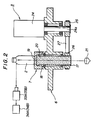
- each receptacle 7 is mounted on the rotatable body 6 along its outer periphery at an equal circumferential interval. As shown in Fig. 2, each receptacle 7 is mounted on the top end of a hollow rotary shaft 17 which is vertically disposed and journalled on the rotatable body 6. Each receptacle 7 includes a cylindrical holder 18 which is secured to the upper end of the rotary shaft 17, a transparent support plate 19 fitted in the axial portion of the holder 18 for carrying a vessel 2 thereon, and a light transmitting member 20 which is disposed in the hollow interior of the rotary shaft 17.
- the member 20 may be formed of clear acryl, for example, and acts to enable an efficient transmission of light emitted by a light source 21 to the vessel 2.
- the rotating mechanism 8 which drives the receptacles 7 for rotation comprises a control motor 24 mounted on the rotatable body 6 and having its drive shaft 24a directed vertically downward, a belt wheel 25 mounted on the drive shaft 24a, another belt wheel 26 mounted on the bottom of the rotary shaft 17, and a belt 27 running across the belt wheels 25, 26.
- the belt 27 extends around the belt wheel 26 of two adjacent receptacles 7, whereby two receptacles 7 can be simultaneously driven for rotation in the same direction by a single control motor 24.
- each control motor 24 is controlled by the controller 9 so as to drive the receptacles 7 for rotation under the operating conditions mentioned above.
- the controller 9 also controls the operation of a control motor 28 which is mechanically coupled to the rotatable body 6. Specifically, the controller 9 causes the rotatable body 6 to be continuously driven for rotation clockwise, as viewed in Fig. 1, and an angular position of the rotatable body 6 is detected by a rotary encoder 29 which is coupled to the control motor 28 while the speed of rotation of the rotatable body 6 is detected by a tachometer 30. Obviously, both the angular position and the speed of rotation of the rotatable body 6 may be detected by a single detector.
- the pair of inspecting means 10A, 10B disposed at the inspecting position D comprises tracking mirrors 31A, 31B which are angularly driven to track the vessels 2 as they are conveyed by the rotation of the rotatable body 6, and control motors 32A, 32B which operate as mirror drive means for angularly driving the respective tracking mirrors 31A, 31B counter-clockwise, as viewed in Fig. 1, in following or tracking relationship with the movement of the vessels 2 from their given start position and for quickly returning them to the start position by an angular drive in the opposite or clockwise direction as soon as a given end position is reached.
- a picture of the vessel 2 which forms on each of the tracking mirrors 31A, 31B can be photographed by respective video cameras 33A, 33B.
- each of the tracking mirrors 31A, 31B and the video cameras 33A, 33B is capable of taking four photographs of three vessels during the tracking operation.
- the tracking mirrors 31A, 31B are quickly returned from the end position to the start position to track the three vessels 2 again, such vessels are those which are by one vessel displaced rearwardly, as viewed in the direction of conveyance.
- one inspecting means 10A performs three tracking operations upon a single vessel 2, and takes four pictures during its tracking operation, thus yielding a total of twelve pictures.
- the other inspecting means 10B operates similarly. Accordingly, a total of twenty-four pictures can be obtained for a single vessel 2.
- the tracking mirrors 31A, 31B are reciprocatively driven for rotation over a tracking zone which is substantially identical to that required to track a single vessel 2, so that the length of the tracking zone for the mirrors can be reduced and a resulting distortion of the picture which may be caused by an increased length of the tracking zone may be reduced, as compared with an arrangement in which three vessels are tracked to provide a total of twelve pictures and then the mirrors are quickly returned to the start position to track three fresh or different vessels.
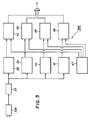
- Signals from the video cameras 33A, 33B are input to decision circuits 34A, 34B (Fig. 2). Each decision circuit 34A, 34B is identical in construction and therefore only decision circuit 34A will be described. Referring to Fig. 5, an analog signal from the video camera 33A is converted into a digital signal by an A/D converter 37, and is then input to four binary conversion circuits 38, 39, 40, 41 in the present embodiment.
- Each of the binary conversion circuits 38 to 41 operates to derive a binary value from the digital signal on the basis of a preset reference value. Accordingly, the picture of the three vessels 2 can be converted into a binary value on the basis of each reference value or required sensitivity.
- the signals which are obtained by the binary convertion circuits 38 to 41 are fed to a liquid vessel elevation decision circuit 43, and three or top, middle and bottom foreign matter decision circuits 44, 45, 46, respectively, and each of the decision circuits 43 to 46 also receives a signal from an inspection area selector 47 which designates a particular inspection area.
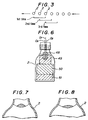
- the inspection area selector 47 establishes given inspection areas for each of the three vessels 2 which are photographed simultaneously. Referring to Fig. 6, the inspection area selector 47 feeds a liquid level area 48, which represents a region within the vessel 2 corresponding to the level of the filling liquid, to the liquid level elevation decision circuit 43, feeds a top area 49, corresponding to the top portion of the filling liquid from which the area 48 is excluded, to the top foreign matter decision circuit 44, feeds a middle area 50, representing the middle portion of the filling liquid, to the middle foreign matter decision circuit 45, and feeds a bottom area 51, representing the bottom portion of the filling liquid, to the bottom foreign matter decision circuit 46. It is to be noted that the areas 48 to 51 are chosen to overlap slightly each other.
- the liquid level elevation decision circuit 43 extracts a signal for the liquid level area 48 which is preset by the selector 47, from the binary signal derived by the binary conversion circuit 38, and compares the extracted signal or a detection value obtained therefrom against a predetermined reference value to determine if the liquid level of the vessel lies at a given elevation.
- the predetermined reference value used in the decision circuit 43 is chosen on the basis of a curved liquid surface.
- a generally diamond-shaped brightening portion forms in a less foaming filling liquid (see Fig. 7) while a generally disc-shaped brightening portion will form in a more foaming filling liquid since in this instance, a bubble region disposed above the liquid surface will tend to be brightened more strongly (see Fig. 8).
- the brightening portion is previously determined in accordance with the variety of the filling liquid and the speed of rotation, and the elevation of the middle of the brightening portion, for example, may be chosen as a reference value.
- the elevation of the middle of the brightening portion is detected along a vertical line O1 shown in Fig. 6 which is aligned with the axis of the vessel 2 and along two adjacent vertical lines O2 and O3 and a decision that a proper liquid level elevation is reached is rendered if at least one of the detected values coincides with the reference value.
- the purpose of such choice compensates for the fact that the center of the curved surface does not always coincide with axis of the vessel 2 due to the oscillation of the curved surface.
- Each of the top, the middle and the bottom foreign matter decision circuit 44, 45 and 46 operates to extract signals representing the respective areas 48 to 50 chosen by the selector 47, from the binary signal which is derived by the binary conversion circuits 39 to 41, respectively, at different sensitivities, and compares the extracted signal against a predetermined reference value to determine if any foreign matter is contained in the filling liquid.
- the binary conversion circuit 39 is chosen to exhibit a lowered sensitivity to avoid a false detection inasmuch as bubbles tend to form in the top area 48. Glass or metal pieces may precipitate in the bottom area 51, and accordingly the binary conversion circuit 41 is chosen to exhibit a higher sensitivity to improve the accuracy of detection.
- the binary conversion circuit 40 corresponding to middle area 50 exhibits a sensitivity which is intermediate the both sensitivities.
- the respective decision circuits 43 to 46 renders a decision twelve times upon a single vessel 2. If an abnormality is detected in one of these detections, an abnormality detection signal which is then produced actuates the rejector 13.
- the controller 9 detects the angular position and the speed of rotation of the rotatable body 6 by means of the rotary encoder 29 and the tachometer 30, and calculate a new position A, representing the initiation of the forward rotation, a new stop position B and a new position C, representing the initiation of the reverse rotation, in accordance with the speed of rotation of the rotatable body 6 in order to achieve the condition illustrated in Fig. 4.
- the positions A, B and C will be retarded relative to those positions which will be assumed when the rotatable body 6 runs at its normal speed, so that these positions will be displaced forwardly as viewed in the direction of rotation of the rotatable body.
- the condition as illustrated in Fig. 4 can be maintained as when a normal speed of rotation of the rotatable body is maintained.
- the position A for the initiation of the forward rotation may be calculated while the stop position B and the position C for the initiation of the reverse rotation may be determined by watching the time elapsed after the position A is reached.
- a vessel which has come to a stop at a position immediately before the inspecting position D may be compensated for by causing the rotating mechanism 8 to control the rotation of the receptacle 7 so that the condition illustrated in Fig. 4 is achieved before resuming the operation of the rotatable body 6.
- the control motors 24, 28, 32A and 32B may comprise servo motors, stepping motors or inverter motors with brakes as desired. While the acceleration and the deceleration applied when rotating the receptacles 7 have been maintained constant in the embodiment illustrated above, it should be understood that they may also be changed provided a given, predertermined permissible inspecting condition can be obtained.
Landscapes
- Health & Medical Sciences (AREA)
- Life Sciences & Earth Sciences (AREA)
- Chemical & Material Sciences (AREA)
- General Health & Medical Sciences (AREA)
- Physics & Mathematics (AREA)
- Analytical Chemistry (AREA)
- Biochemistry (AREA)
- General Physics & Mathematics (AREA)
- Immunology (AREA)
- Pathology (AREA)
- Food Science & Technology (AREA)
- Medicinal Chemistry (AREA)
- Engineering & Computer Science (AREA)
- Investigating Materials By The Use Of Optical Means Adapted For Particular Applications (AREA)
Claims (10)
- Vorrichtung zur Feststellung des Vorhandenseins von fremden Stoffen, die eine Vielzahl von Aufnahmen umfaßt, die drehbar um einen drehbaren Körper angeordnet sind, zur Aufnahme von darauf anzuordnenden Gefäßen, einen Drehmechanismus zum Antreiben der jeweiligen Aufnahmen zur Drehung in die Vorwärts- und Rückwärtsrichtung, und Untersuchungseinrichtungen, die an einer bestimmten Station außerhalb des drehbaren Körpers angeordnet sind, um die Gefäße auf das Vorhandensein irgeneines fremden Stoffes darin zu untersuchen, während sie durch die Drehung der Aufnahmen gedreht werden, wobei die Untersuchungseinrichtungen die Gefäße während ihres Untersuchungszustands untersuchen, der durch eine Rückwärtsdrehung erreicht wird, der eine Vorwärtsdrehung davon folgt;
worin der Drehmechanismus einen auf dem drehbaren Körper montierten Steuerungsmotor zum Antreiben der Aufnahme zur Drehung in die Vorwärts- und die Rückwärtsrichtung, einen Regler zum Regeln des Steuerungsmotors und einen Detektor zum Ermitteln der Rotationsgeschwindigkeit des drehbaren Körpers umfaßt, wobei der Regler auf ein Signal vom Detektor anspricht, um jegliche Veränderung der Rotationsgeschwindigkeit des drehbaren Körpers zu ermitteln, um den Steuerungsmotor entsprechend einer solchen Veränderung zu regeln, wodurch es ermöglicht wird, daß ein bestimmter, vorher festgelegter zulässiger Untersuchungszustand des Gefäßes beibehalten wird, wenn die Rotationsgeschwindigkeit des drehbaren Körpers sich ändert. - Vorrichtung nach Anspruch 1, worin der Steuerungsmotor dahingehend wirkt, daß er die Aufnahme zur Drehung in die Vorwärtsrichtung antreibt, sie dann anhält und sie dann zur Drehung in die Rückwärtsrichtung antreibt.
- Vorrichtung nach Anspruch 1, bei der jede der Aufnahmen am oberen Ende einer hohlen Drehwelle montiert ist, die vertikal auf dem drehbaren Körper gelagert ist, wobei die Drehwelle einen hohlen Abschnitt umfaßt, durch den Licht von einer Lichtquelle auf ein auf der Aufnahme angeordnetes Gefäß übertragen wird.
- Vorrichtung nach Anspruch 3, bei der ein durchsichtiges lichtübertragendes Element im hohlen Abschnitt der Drehwelle angeordnet ist.
- Vorrichtung nach Anspruch 1, die weiters einen Spurverfolgungsspiegel umfaßt, der so angeordnet ist, daß er die Spur einer Bewegung eines Gefäßes verfolgt, sowie Spiegelantriebsmittel, um zu bewirken, daß der Spurverfolgungspiegel die Spur des Gefäßes verfolgt, während es vom drehbaren Körper aus einer Ausgangsposition in eine Endposition befördert wird, woraufhin der Spiegel rasch in die Ausgangsposition zurückgebracht wird, und eine Videokamera zum Photographieren des Gefäßes während der Zeit, in der der Spurverfolgungsspiegel die Spur des Gefäßes verfolgt, wobei die Videokamera so betreibbar ist, daß sie ein Bild von einer Vielzahl von Gefäßen macht, während der Spurverfolgungsspiegel die Spur der Gefäße verfolgt, wobei die Spiegelantriebsmittel bewirken, daß der Spurverfolgungsspiegel während eines laufenden Durchgangs die Spur einer Vielzahl von Gefäßen auf solche Weise verfolgt, daß zumindest das hinterste der Gefäße, deren Spuren während des vorhergehenden Durchgangs verfolgt wurden, darin enthalten ist.
- Vorrichtung nach Anspruch 1, die weiters eine Videokamera zum Aufnehmen eines Bildes von Gefäßen umfaßt, während sie vom drehbaren Körper befördert werden, sowie eine Entscheidungsschaltung, die auf ein von der Videokamera gemachtes Bild und einen vorherbestimmten Bezugswert anspricht, um zu bestimmen, ob eine Flüssigkeit, mit der das Gefäß gefüllt ist, eine geeignete Flüssigkeitsspiegelhöhe hat, wobei der in der Entscheidungsschaltung verwendete Bezugswert auf der Basis einer gekrümmten Flüssigkeitsoberfläche gewählt ist, die innerhalb des Gefäßes gebildet wird, während sich die Aufnahme dreht.
- Vorrichtung nach Anspruch 1, die weiters eine Videokamera zum Aufnehmen eines Bildes von Gefäßen umfaßt, während sie vom drehbaren Körper befördert werden, sowie eine Entscheidungsschaltung zum Vergleichen eines von der Videokamera gemachten Bildes mit einem vorherbestimmten Bezugswert, um zu bestimmen, ob das Gefäß entspricht oder nicht, wobei die Entscheidungsschaltung eine erste Entscheidungsschaltung umfaßt, die einen Bereich des von der Videokamera gemachten Bildes mit einem ersten Bezugswert vergleicht, sowie eine zweite Entscheidungsschaltung, die einen anderen Bereich des von der Videokamera gemachten Bildes mit dem zweiten Bezugswert vergleicht.
- Vorrichtung (1) zum Feststellen des Vorhandenseins von fremdem Stoff in einer Flüssigkeit innerhalb eines Gefäßes (2), während dieses befördert wird, welche Vorrichtung umfaßt:
einen Förderer (6) zum Befördern des Gefäßes (2),
Dreheinrichtungen (8), die fähig sind, das Gefäß (2), während es befördert wird, um eine Achse davon zu drehen,
einen Regler (9) zum Regeln der Dreheinrichtung (8), um während des Beförderns die Drehung des Gefäßes (2) in eine Richtung und daraufhin in die entgegengesetzte Richtung zu ermöglichen, um die Flüssigkeit innerhalb des Gefäßes (2) in einen Bewegungszustand zu bringen, der das Feststellen von fremdem Stoff darin zuläßt, und
Ermittlungseinrichtungen, die fähig sind, Fremdstoff festzustellen, wenn die Flüssigkeit sich im genannten Ermittlungszustand befindet,
dadurch gekennzeichnet, daß der Regler (9) für jede Veränderung der Geschwindigkeit des Förderers (6) empfindlich ist und als Reaktion auf eine solche Veränderung fähig ist, die genannte Drehung des Gefäßes zu steuern, um diese auszugleichen und dadurch die Flüssigkeit innerhalb des Gefäßes (2) im wesentlichen im genannten zulässigen Ermittlungszustand zu halten. - Vorrichtung nach Anspruch 8, worin der Regler (9) so betreibbar ist, daß er das Gefäß für ein erstes Zeitintervall in eine Vorwärtsrichtung dreht, daraufhin die Drehung in die Vorwärtsrichtung zum Stillstand bringt und das Gefäß für ein zweites Zeitintervall in einem nichtdrehenden Zustand hält, daraufhin das Gefäß für ein drittes Zeitintervall in eine Rückwärtsrichtung dreht, alles vor dem Ermitteln durch die Ermittlungseinrichtung, während das Gefäß weiterhin in die Rückwärtsrichtung gedreht wird.
- Vorrichtung nach Anspruch 9, worin der Regler (9) als Reaktion auf das genannte Signal von der Ermittlungseinrichtung so betreibbar ist, daß er zumindest die Zeit, zu der die genannte Drehung in die Vorwärtsrichtung beginnt, verzögert oder vorzieht.
Applications Claiming Priority (4)
| Application Number | Priority Date | Filing Date | Title |
|---|---|---|---|
| JP1235986A JPH0743327B2 (ja) | 1989-09-11 | 1989-09-11 | 追従ミラーを備えた検査装置 |
| JP235986/89 | 1989-09-11 | ||
| JP25738289A JPH0695078B2 (ja) | 1989-10-02 | 1989-10-02 | 異物検査装置 |
| JP257382/89 | 1989-10-02 |
Publications (2)
| Publication Number | Publication Date |
|---|---|
| EP0418005A1 EP0418005A1 (de) | 1991-03-20 |
| EP0418005B1 true EP0418005B1 (de) | 1993-12-08 |
Family
ID=26532435
Family Applications (1)
| Application Number | Title | Priority Date | Filing Date |
|---|---|---|---|
| EP90309860A Expired - Lifetime EP0418005B1 (de) | 1989-09-11 | 1990-09-10 | Vorrichtung zur Feststellung des Vorhandenseins von fremden Stoffen |
Country Status (4)
| Country | Link |
|---|---|
| US (1) | US5073708A (de) |
| EP (1) | EP0418005B1 (de) |
| KR (1) | KR920007161B1 (de) |
| DE (1) | DE69005069T2 (de) |
Families Citing this family (24)
| Publication number | Priority date | Publication date | Assignee | Title |
|---|---|---|---|---|
| DE4343750C2 (de) * | 1993-02-27 | 1995-09-21 | Ortmann & Herbst Masch Gmbh | Getränkefüller mit Schaumsteuerung |
| DE59400970D1 (de) * | 1993-02-27 | 1996-12-12 | Ortmann & Herbst Masch Gmbh | Volumetrischer Getränkefüller |
| US6252980B1 (en) * | 1993-11-24 | 2001-06-26 | Nira Schwartz | Additional dynamic fluid level and bubble inspection for quality and process control |
| US5414778A (en) * | 1993-11-24 | 1995-05-09 | Schwartz; Nira | Dynamic fluid level and bubble inspection for quality and process control |
| US6894775B1 (en) * | 1999-04-29 | 2005-05-17 | Pressco Technology Inc. | System and method for inspecting the structural integrity of visibly clear objects |
| US6473169B1 (en) | 2000-05-03 | 2002-10-29 | Air Logic Power Systems, Inc. | Integrated leak and vision inspection system |
| NL1015515C2 (nl) * | 2000-06-23 | 2001-12-28 | Eagle Vision Systems B V | Werkwijze en inrichting voor het in lijn inspecteren van verpakkingen. |
| JP3785342B2 (ja) * | 2001-09-28 | 2006-06-14 | 日立エンジニアリング株式会社 | 被検体検査装置及び透明容器の充填液体中の異物検査装置 |
| PL212556B1 (pl) * | 2001-11-16 | 2012-10-31 | Heineken Tech Services | Urzadzenie do badania pojemnika wypelnionego cieklym produktem |
| NL1022810C2 (nl) | 2003-02-28 | 2004-08-31 | Heineken Tech Services | Werkwijze en systeem voor het inspecteren van verpakkingen. |
| EP1801558A3 (de) * | 2003-02-28 | 2014-05-21 | Imperial Chemical Industries Limited | Schaumprüfung |
| JP2006519373A (ja) | 2003-02-28 | 2006-08-24 | インペリアル・ケミカル・インダストリーズ・ピーエルシー | 気泡評価 |
| DE10339473A1 (de) * | 2003-08-27 | 2005-03-24 | Seidenader Maschinenbau Gmbh | Vorrichtung zur Prüfung von Erzeugnissen |
| CA2453935A1 (en) * | 2003-12-22 | 2005-06-22 | Labatt Brewing Company Limited | Improvements in automated bottle inspection apparatus and methods |
| US20070115467A1 (en) * | 2005-11-23 | 2007-05-24 | Owens-Brockway Glass Container | Apparatus and method for ensuring rotation of a container during inspection |
| DE102006062298B3 (de) * | 2006-12-27 | 2008-06-19 | Krones Ag | Vorrichtung und Verfahren zum Inspizieren von Behältnissen |
| US20080258704A1 (en) * | 2007-04-23 | 2008-10-23 | Ryskoski Matthew S | Method and apparatus for identifying broken pins in a test socket |
| CN103625699B (zh) * | 2008-05-20 | 2016-05-11 | 大日本印刷株式会社 | 饮料填充方法和装置 |
| DE102009020921A1 (de) * | 2009-05-12 | 2010-11-18 | Krones Ag | Vorrichtung und Verfahren zum Ausrichten von Behältern, insbesondere Flaschen, in einer Etikettiermaschine |
| KR101322714B1 (ko) * | 2012-12-28 | 2013-10-28 | 주식회사 서울금속 | 도광 조명 방식의 대상물 비전 검사 장치 |
| CN104071403A (zh) * | 2014-06-19 | 2014-10-01 | 北京创想智控科技有限公司 | 容器贴标位置调整系统以及给容器贴标的方法 |
| KR101815258B1 (ko) * | 2015-04-29 | 2018-01-05 | 피엔에스테크놀러지(주) | 병 충진액 검사장치 |
| DE102017215719A1 (de) | 2017-09-07 | 2019-03-07 | Krones Ag | Inspektionsvorrichtung und Verfahren zur Erkennung von Fremdkörpern in Behältern |
| CN108844956A (zh) * | 2018-05-02 | 2018-11-20 | 苏州静思三维视觉科技有限公司 | Sem连续式全方位图像采集装置及图像采集方法 |
Family Cites Families (11)
| Publication number | Priority date | Publication date | Assignee | Title |
|---|---|---|---|---|
| US2268098A (en) * | 1939-09-30 | 1941-12-30 | Rca Corp | Bottle inspection apparatus |
| US2331277A (en) * | 1941-09-10 | 1943-10-05 | Coca Cola Co | Rapid inspection device |
| US2317559A (en) * | 1941-09-10 | 1943-04-27 | Coca Cola Co | Method of detecting foreign ingredients in closed containers |
| US3133638A (en) * | 1960-06-20 | 1964-05-19 | Industrial Dynamics Co | Inspection apparatus |
| JPS5219798B2 (de) * | 1971-12-22 | 1977-05-30 | ||
| DE2260602A1 (de) * | 1972-12-12 | 1974-06-20 | Leitz Ernst Gmbh | Einrichtung zum nachweis von verunreinigungen bei klaren fluessigkeiten |
| JPS55119049A (en) * | 1979-03-08 | 1980-09-12 | Eisai Co Ltd | Method and apparatus for detecting extraneous matter in liquid |
| US4492475A (en) * | 1982-03-02 | 1985-01-08 | Eisai Co., Ltd. | Method of detecting foreign matters mixed in a liquid contained in transparent receptacles and apparatus relevant thereto |
| NL8303007A (nl) * | 1983-04-22 | 1984-11-16 | Thomassen & Drijver | Inrichting voor het controleren van houders. |
| JPS60220850A (ja) * | 1984-04-17 | 1985-11-05 | Suntory Ltd | 容器検査装置 |
| CH672955A5 (de) * | 1987-05-12 | 1990-01-15 | Elpatronic Ag |
-
1990
- 1990-09-07 US US07/578,779 patent/US5073708A/en not_active Expired - Lifetime
- 1990-09-10 EP EP90309860A patent/EP0418005B1/de not_active Expired - Lifetime
- 1990-09-10 DE DE69005069T patent/DE69005069T2/de not_active Expired - Fee Related
- 1990-09-11 KR KR1019900014309A patent/KR920007161B1/ko not_active Expired
Also Published As
| Publication number | Publication date |
|---|---|
| US5073708A (en) | 1991-12-17 |
| EP0418005A1 (de) | 1991-03-20 |
| DE69005069T2 (de) | 1994-05-19 |
| KR920007161B1 (ko) | 1992-08-27 |
| DE69005069D1 (de) | 1994-01-20 |
| KR910006729A (ko) | 1991-04-29 |
Similar Documents
| Publication | Publication Date | Title |
|---|---|---|
| US5073708A (en) | Apparatus for inspecting the presence of foreign matters | |
| US4172524A (en) | Inspection system | |
| EP1298428B1 (de) | Untersuchungsgerät zur Untersuchung von durchsichtigen flüssigkeitsgefüllten Behältern | |
| US5538054A (en) | Method and apparatus for filling transparent beverage receptacles | |
| EP1103513B1 (de) | Vorrichtung und Verfahren zur Dichtigkeitsprufung einer Schraubverschlusskappe auf einem Behälter | |
| US7295317B2 (en) | Device for inspecting filled and closed receptacles | |
| US5072108A (en) | Foreign object detecting method and device | |
| JP3994761B2 (ja) | 物品検査装置 | |
| US5243184A (en) | Mirror-following imaging method and device | |
| JP2005098832A (ja) | 被検体検査装置 | |
| JPH04367432A (ja) | 容器の方向規制装置 | |
| JP2003098107A (ja) | 容器検査装置および容器 | |
| JPH06273351A (ja) | 液中異物検査装置 | |
| JPH04328457A (ja) | 変形容器の検査装置 | |
| WO2024104745A1 (en) | A system and method for the inspection of cylindrical containers | |
| JPH0711441B2 (ja) | 液面高さの検査装置 | |
| JPH0695078B2 (ja) | 異物検査装置 | |
| JPH0396841A (ja) | 異物検査装置 | |
| JPH0743327B2 (ja) | 追従ミラーを備えた検査装置 | |
| JPH048353Y2 (de) | ||
| KR20010099300A (ko) | 용기의 측면 검사장치 | |
| JPH02203259A (ja) | 被検査物に対する検査方向の方向規制装置及びそれを含む異物検査装置並びに異物検査装置の検光面 | |
| JP2946613B2 (ja) | 容器検査装置の光ガイド | |
| JPH06258254A (ja) | 異物検査装置の水滴除去装置 | |
| JPH04361142A (ja) | 異物検査装置 |
Legal Events
| Date | Code | Title | Description |
|---|---|---|---|
| PUAI | Public reference made under article 153(3) epc to a published international application that has entered the european phase |
Free format text: ORIGINAL CODE: 0009012 |
|
| AK | Designated contracting states |
Kind code of ref document: A1 Designated state(s): DE FR GB IT |
|
| 17P | Request for examination filed |
Effective date: 19910527 |
|
| 17Q | First examination report despatched |
Effective date: 19930115 |
|
| GRAA | (expected) grant |
Free format text: ORIGINAL CODE: 0009210 |
|
| AK | Designated contracting states |
Kind code of ref document: B1 Designated state(s): DE FR GB IT |
|
| REF | Corresponds to: |
Ref document number: 69005069 Country of ref document: DE Date of ref document: 19940120 |
|
| ITF | It: translation for a ep patent filed | ||
| ET | Fr: translation filed | ||
| PLBE | No opposition filed within time limit |
Free format text: ORIGINAL CODE: 0009261 |
|
| STAA | Information on the status of an ep patent application or granted ep patent |
Free format text: STATUS: NO OPPOSITION FILED WITHIN TIME LIMIT |
|
| 26N | No opposition filed | ||
| REG | Reference to a national code |
Ref country code: GB Ref legal event code: IF02 |
|
| PGFP | Annual fee paid to national office [announced via postgrant information from national office to epo] |
Ref country code: DE Payment date: 20070906 Year of fee payment: 18 |
|
| PGFP | Annual fee paid to national office [announced via postgrant information from national office to epo] |
Ref country code: GB Payment date: 20070905 Year of fee payment: 18 |
|
| PGFP | Annual fee paid to national office [announced via postgrant information from national office to epo] |
Ref country code: IT Payment date: 20070926 Year of fee payment: 18 |
|
| PGFP | Annual fee paid to national office [announced via postgrant information from national office to epo] |
Ref country code: FR Payment date: 20070914 Year of fee payment: 18 |
|
| GBPC | Gb: european patent ceased through non-payment of renewal fee |
Effective date: 20080910 |
|
| REG | Reference to a national code |
Ref country code: FR Ref legal event code: ST Effective date: 20090529 |
|
| PG25 | Lapsed in a contracting state [announced via postgrant information from national office to epo] |
Ref country code: IT Free format text: LAPSE BECAUSE OF NON-PAYMENT OF DUE FEES Effective date: 20080910 Ref country code: DE Free format text: LAPSE BECAUSE OF NON-PAYMENT OF DUE FEES Effective date: 20090401 |
|
| PG25 | Lapsed in a contracting state [announced via postgrant information from national office to epo] |
Ref country code: FR Free format text: LAPSE BECAUSE OF NON-PAYMENT OF DUE FEES Effective date: 20080930 |
|
| PG25 | Lapsed in a contracting state [announced via postgrant information from national office to epo] |
Ref country code: GB Free format text: LAPSE BECAUSE OF NON-PAYMENT OF DUE FEES Effective date: 20080910 |