EP0419244A2 - Zuteilungsverfahren von Funksteuerkanälen in Mobil-Kommunikationen - Google Patents
Zuteilungsverfahren von Funksteuerkanälen in Mobil-Kommunikationen Download PDFInfo
- Publication number
- EP0419244A2 EP0419244A2 EP90310273A EP90310273A EP0419244A2 EP 0419244 A2 EP0419244 A2 EP 0419244A2 EP 90310273 A EP90310273 A EP 90310273A EP 90310273 A EP90310273 A EP 90310273A EP 0419244 A2 EP0419244 A2 EP 0419244A2
- Authority
- EP
- European Patent Office
- Prior art keywords
- mobile station
- radio
- channel
- paging
- channels
- Prior art date
- Legal status (The legal status is an assumption and is not a legal conclusion. Google has not performed a legal analysis and makes no representation as to the accuracy of the status listed.)
- Granted
Links
Images




Classifications
-
- H—ELECTRICITY
- H04—ELECTRIC COMMUNICATION TECHNIQUE
- H04W—WIRELESS COMMUNICATION NETWORKS
- H04W48/00—Access restriction; Network selection; Access point selection
- H04W48/20—Selecting an access point
-
- H—ELECTRICITY
- H04—ELECTRIC COMMUNICATION TECHNIQUE
- H04W—WIRELESS COMMUNICATION NETWORKS
- H04W68/00—User notification, e.g. alerting and paging, for incoming communication, change of service or the like
-
- H—ELECTRICITY
- H04—ELECTRIC COMMUNICATION TECHNIQUE
- H04W—WIRELESS COMMUNICATION NETWORKS
- H04W74/00—Wireless channel access
- H04W74/08—Non-scheduled access, e.g. ALOHA
Definitions
- the present invention relates to a method of arranging control channels for exchanging control signals between a base station and a mobile station in mobile communications.
- Control channels shared by a plurality of mobile stations in a conventional mobile communication system are mainly classified into paging and access control channels.
- paging and access control channels In a mobile station access mode, a mobile station paging mode, or a mobile station location registration mode, control signals are transmitted between a base station and a mobile station through these control channels.
- the paging and access control channels are arranged as independent channels.
- radio control channel in this specification represents a physical radio control channel.
- this channel is defined as a radio channel having a given frequency in FDMA, or as a radio channel constituted by a frequency and time slots in TDMA.
- control channels include functionally classified paging and access control channels in a broad sense.
- the radio zone configuration as an assumption of a control channel arrangement will be described below.
- Fig. 7 is a view for explaining a radio zone configuration and a paging area.
- One radio zone 51 (a hexagonal portion in Fig. 7) is formed to have one base station as its center.
- a paging area 52 (a portion surrounded by a thick line in Fig. 7) is formed to perform location registration and paging of a plurality of radio zones 51. Control channels are arranged under the zone configuration, as will be described with reference to Fig. 8.
- a P channel (paging channel or PCH) is a paging control channel which is commonly used within the location registration area and the paging area.
- a downward P channel 53 serves as a control channel for commonly transmitting paging information to mobile stations in radio zones within the paging area.
- An upward P channel 54 serves as a channel for transmitting to the base station a paging response signal in response to an paging signal to a mobile station.
- the upward P channel 54 controls a transmission timing of the mobile station so as to prevent signal collision on the basis of control from the base station and transmits the paging response signal.
- the P channel is called a broad control channel in a sense that the same information is transmitted to the plurality of radio zones.
- An A channel (access channel or ACH) is a access control channel used for causing a mobile station to transmit information.
- the A channels are independent of each other in units of radio zones.
- An upward A channel 56 is a random access channel.
- the mobile station transmits an access signal to the base station, and the base station transmits response signals to the mobile station through corresponding downward A channels 55.
- the A channel also transmits a location registration signal, a communication channel designation signal required to establish a communication channel.
- the A channel is called a narrow control channel in a sense that different pieces of information are transmitted in units of radio zones.
- FIG. 9(a) is a view showing a relationship between radio zones and a traffic taper
- Fig. 9(b) is a view showing a control channel arrangement in a radio zone having a higher traffic density
- Fig. 9(c) is a view showing a control channel arrangement in a radio zone having a lower traffic density.
- the number of P channels respectively assigned to the radio zones is determined in accordance with the number of subscribers in the entire paging area.
- the P channels are equally arranged in all the radio zones.
- the P channels Since simultaneous transmitting by plural base stations is performed, the P channels must have identical control channel structures in all the radio zones (PCH 1 and PCH 2 in Figs. 9(b) and 9(c)).
- the required number of ACHs is determined in accordance with the number of subscribers in each radio zone. That is, the ACHs are proportionally assigned to the radio zones in accordance with the numbers of subscribers in the radio zones.
- a channels (ACH 1, ACH 2 and 3 ) are used in a radio zone 51a having a high traffic density, while only one A channel (ACH 1) is used in a radio zone 51b having a low traffic density.
- a traffic taper is present. Since simultaneous transmitting is performed within a paging area, the same number of P channels as that in a radio zone having a high traffic density must be arranged in a radio zone having a low traffic density.
- the traffic zone having a low traffic density has poor efficiency of use of the upward P channel as compared with the radio zone having a high traffic density, thus further degrading efficiency as a whole.
- At least one P channel and at least one A channel must be arranged in each radio zone. Efficient utilization of frequency resources cannot be achieved, and thus the number of control transmitters/receivers is increased.
- the numbers of control transmitters/receivers in the base stations must be increased/decreased, respectively.
- an A-channel signal can also be transferred through a P-channel radio control channel.
- the P channel is used to transfer information (paging) to all mobile stations in a broad paging area, and efficiency per zone is as low as 1/(zone number in the paging area).
- the upward A channel is a random access channel, and its efficiency is generally low, i.e., a maximum of about 10%.
- the independent channels are arranged due to independent upward and downward channels having poor efficiency. Therefore, utilization efficiency of frequency resources and transmitters/receivers is poor.
- a method of arranging control channels in mobile communications in a mobile communication system for covering a service area with a plurality of radio zones and exchanging signals between a base station and a mobile station by using the control channels comprising the steps of assigning to the control channels a broadcasting information transmitting portion for broadcasting information associated with a radio zone from the base station to the mobile station, of broadcasting information associated with a control channel structure identical or different in units of base stations, and of determining a frequency and time slots for exchanging signals between the base station and the mobile station by using the information associated with the control channel structure and a number commonly recognized by the base station and the mobile station.
- a paging signal transmission portion grouped to be received by a given mobile station is determined by this given mobile station, and the base station has a function of transmitting a paging signal to only the paging signal transmitting portion grouped to be received by the given mobile station.
- the given mobile station receives only the paging portion grouped for the given mobile station.
- the given mobile station in the method of arranging control channels in mobile communications in the second aspect, has a function of receiving other control channels by portions other than the paging signal transmission portion grouped to be received by the given mobile station.
- the given mobile station monitors radio channels of other radio zones by the portions other than the paging signal transmission portion grouped to be received by the given mobile station.
- the method according to the first aspect of the present invention employs a paging/access (PA) integration arrangement of radio control channels.
- the number commonly recognized by the base and mobile stations and the content of the broadcasting information of each base station are subjected to predetermined processing, thereby determining a frequency and time slots for allowing the base and mobile stations to exchange signals.
- PA paging/access
- the PA integration channel arrangement is employed even if a plurality of radio control channels are used within the radio zone.
- the number commonly recognized by the base and mobile stations and the content of the broadcasting information of each base station are subjected to the predetermined processing to determine the frequency and time slots for allowing the base and mobile stations to exchange signals.
- the second aspect of the present invention is an application of the first aspect thereof. Of all PCHs grouped to be received by the given mobile station, the given mobile station receives only a designated paging slot. The second aspect exemplifies an application for an intermittent reception system.
- the third aspect of the present invention is an application of the second aspect thereof.
- the given mobile station must always receive its own PCH slot in the paging waiting mode. Other portions can be received if they are required. For example, the given mobile station can monitor radio channels of other radio zones during a time interval except for reception of its own PCH.
- Fig. 1 shows a basic control channel structure according to the present invention.
- Reference numeral 1 denotes a broadcasting control channel (BCCH) which is present only in the downward channel.
- the broadcasting control channel 1 broadcasts information for different control channel structures in units of base stations (a control channel code in each zone, a control channel number, a mobile station grouping number, information associated with determination of waiting channel, and regulating information), base station status information, paging area information, and the like to the mobile station.
- Reference numeral 2 denotes a paging channel (PCH) which is present as only the downward channel and performs paging of a mobile station.
- PCH paging channel
- Reference numerals 3 and 4 denote common control channels (CCCH) whose upward side is a random access channel for transmitting an access signal, a paging response signal, a location registration signal, and the like, and whose downward side transmits an access accept signal, a paging response accept signal, a channel designation signal, and the like.
- CCCH common control channels
- Reference symbols BCCH and PCH denote broad control channels; and CCCH, a narrow control channel. If a required number of radio control channels is two or more, these channels are constituted as a PA integration arrangement, thereby maximally enhancing the feature of the PA integration channels obtained by integrating independent upward and downward channels having poor efficiency.
- N f the number of radio control channels in a given radio zone
- N p the number of PCH groups in a given paging area
- the control structure of the base and mobile stations is determined.
- the group number N p may be set to be different in units of radio zones in place of setup in units of paging areas.
- the mobile stations are grouped to perform intermittent paging, thereby achieving battery savings.
- FIG. 2 A control channel arranged determined by the broadcasting information is shown in Fig. 2. This arrangement illustrates only a downward side.
- Each upward channel consists of a random access CCCH channel.
- a BCCH-PCH-CCCH arrangement is a superframe arrangement and is repeated at a predetermined period. The start of the BCCH channel is determined by changing a frame sync signal pattern to that of another channel slot. The number of BCCH slots is broadcast by the BCCH. The position of the PCH is determined by these pieces of information.
- a mobile station receives a BCCH channel and detects the number N f of radio control channels in this radio zone and the number N p of PCH groups of this radio zone.
- the mobile station calculates the following to detect its own paging PCH group No.: (I m - 1) mod N p + 1 - I p (1) where I p is the mobile station group No. (received PCH group No.)
- the radio control channel Nos. I f are consecutive numbers starting from one to N f .
- This slot position represents a number when the leftmost PCH slot position of each radio channel is defined as "1".
- a mod B is a remainder obtained by dividing A by B, and [A] represents a maximum integer which does not exceed A.
- the above calculations are also performed in the base station to select and specify a frequency and a time slot, both of which are capable of exchanging control signals with the mobile station.
- Reference symbols 10a to 10c denote radio zones; 11, a paging area.
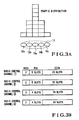
- the capacities of the PCHs in all the radio zones 10a to 10c within the area are equal to each other.
- the required time slot number of the CCCHs are determined in accordance with the capacities of the respective radio zones.
- Each channel has 30 time slots per unit time.
- the BCCH has two slots.
- the PCH has one slot per traffic unit (a traffic given when a given subscriber capacity is defined as a measuring unit) as far as paging is concerned.
- the CCCH requires about 9 slots per traffic unit.
- paging of, e.g., 18 traffic units must be performed in the paging area as a whole.
- the PCH requires 18 slots per zone.
- the PCH of 18 slots must be assured in each of the radio control channels 10a, 10b, and 10c.
- the radio zone 10c requires one traffic unit, and the CCCH has 9 (1 x 9) slots. In order to assure the PCH of 18 slots and the CCCH of 9 slots, one control channel is required.
- the radio zone 10a having a higher traffic density requires four radio control channels. As shown in Fig. 3C, however, the radio zone 10b requires two channels. As shown in Fig. 3D, the radio zone 10c having the lowest traffic density requires one channel.
- FIG. 4A to 4C Channel arrangements according to the conventional method are illustrated in Figs. 4A to 4C in correspondence with Figs. 3B, 3C, and 3D.
- a radio zone 10a having a high traffic density requires four channels as in Fig. 3B.
- a radio zone 10b requires three channels larger than that of Fig. 3C by one, as shown in Fig. 4B.
- a radio zone 10c having the lowest traffic density requires two channels larger than that of Fig. 3D by one. That is, the method of the present invention requires a total of 10 channels in five radio zones, while the conventional method requires a total of 14 channels. A total number of transmitters/receivers can be reduced by about 30% from the conventional method.
- the PCH for paging the mobile station in the waiting mode has the same frequency as that of the CCCH for exchanging signals in establishment of communication channels in the paging and access modes.
- control can be simpler than the conventional method which requires such a frequency change, thereby improving system reliability.
- the second embodiment exemplifies a method of maintaining positions of PCH slots received by a mobile station even if radio zones are shifted will be described below.
- Pieces of broadcasting information are defined as follows: N f : the number of radio control channels within a given radio zone N p : the number of PCH groups in a given paging area.
- the mobile station receives the BCCH and can detect the numbers N f and N p of the given radio zone.
- a div B represents a quotient obtained by dividing A by B.
- the mobile station obtains a channel number I f of a channel in which the PCH and CCCH to be received aro present.
- k represents the number of radio control channels having smaller numbers than the radio control channel I f which contains I p to be received by this mobile station.
- the channel Nos. I f are consecutive numbers starting from radio control channel 1 in each radio zone to channel N f .
- the above operation is also performed in the base station to select and specify a frequency and a time slot which allow control signal exchange between the base and mobile stations.
- the paging timings for each mobile station are equal in all the radio zones of a given paging area.
- the method of this embodiment eliminates the following incomplete transmission of the paging signal.
- the given mobile station cannot receive paging information because the paging signal is not transmitted from the base station in a movement start zone.
- the given station cannot receive this paging information in the movement end zone because the paging signal is already transmitted. Therefore, the method of this embodiment can improve paging reliability.
- broadcasting information and signals commonly recognized by the base and mobile stations are used to perform predetermined operations to designate a control channel structure, thereby determining a frequency and time slots for exchanging signals between the base and mobile stations.
- PCH slots are continuously present on one radio control channel.
- a CCCH slot may be interposed between PCH slots to add or modify broadcasting parameters.
- Radio channels can be designated in a TDMA scheme by designating a frequency to be used and slots to be used.
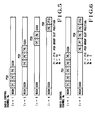
- One TDMA frame of three slots has a period of 20 ms, 36 TDMA frames constitute one superframe, and control channels BCCH, PCH, and CCCH are repeated, as shown in Fig. 10. In this case, one superframe is used as a unit.
- the radio control channel is assigned to slot 0, and slots 1 and 2 are used for communication.
- a synchronization word of the slot of the 0th TDMA frame is different from these of other TDMA frames, so that the start of the superframe can be recognized.
- the channel structure is determined on the basis of the start of the superframe.
- a given mobile station must receive its own PCH slots in the waiting mode and can receive other portions as needed.
- a frequency can be changed during an interval except for the PCH reception duration, the reception levels of other radio zones and sector output signals may be measured, and a reception level of frequencies designated by the base station can be measured.
- Figs. 11 and 12 show this example.
- a PCH group number is given as 5, which is used as an object to be moved with respect to the PCH group No. 4.
- the frequency of the given mobile station is changed to another frequency during an interval except for the PCH reception duration, thereby measuring its reception level.
- zones 2 to 4 are located around the zone 1, and signal exchange is performed in these zones 2 to 4 at frequencies f2 to f4.
- Fig. 12 shows a relationship between the receiving frequency and slots of the given mobile station.
- the given station receives the frequency f1 during the P4 slot as its own PCH slot.
- the given mobile station receives the frequencies f2 to f4 of the neighboring zones and measures reception levels. With these operations, the zone in the waiting mode can be determined without impairing paging.
- the frequency of the given mobile station is changed to a frequency received by each zone or sector, thereby measuring and comparing reception levels and hence detecting a radio zone or sector having a maximum level.
- the frequency may be changed to a frequency used to measure interference and measure reception levels.
- the mobile station calculates a ratio of the calculated reception level with the currently used level to obtain a ratio of a desired wave to an interference wave to facilitate selection of a communication channel.
- a time interval is provided between the BCCH and PCH slots to change a frequency of a receiver/transmitter of a mobile station and allow signal exchange
- the mobile station which receives any PCH slot can change the frequency before and after the BCCH slots to receive the broadcasting information of other radio zones or sectors. Therefore, reliability of zone or sector determination can be improved. More specifically, a slot (CCCH slot in this case) which need not be received in the waiting mode is assigned before and after the BCCH slots of each radio control channel.
- the frequency change time can be absorbed, and the mobile station can receives BCCH slots of other zones without impairing reception of its own PCH slots if reception levels of other zones are sufficiently high.
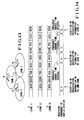
- Figs. 13 and 14 show a mobile station operation for receiving BCCH slots of zones 2 and 3 when this mobile station is located in a zone 1 in the waiting mode at a frequency f1.
- the mobile station receives the BCCH slot, and the frequency f1 is changed to a frequency f2 at the end of the BCCH slot, thereby receiving a BCCH slot of the zone 2.
- the mobile station simultaneously measures a reception level at the frequency f2.
- the frequency of the mobile station is returned to the frequency f1 so as to cause it to receive its own PCH slot. Since the frequency change time is long, it is absorbed by the CCCH slot which does not receive it.
- the frequency is changed to the f3 at the start of the next BCCH slot.
- the mobile station then receives the BCCH slot of the zone 3 and at the same time measures the reception level at the frequency f3.
- the mobile station can receive base station information. Even if the reception level is temporarily increased due to over reach or the like, its content is detected, and accurate zone determination based on not only reception levels but also other factors can be performed.
- all frequencies are assigned to one radio control channel as in FDMA to arrange the control channels.
- one frequency is subjected to time division to obtain time slots, and one time slot is used as a radio control channel, thereby facilitating extension.
- a radio channel arrangement in mobile communications wherein even if a traffic taper is present, a frequency resource can be effectively utilized, efficient control signal transmission requiring a smaller number of transmitters/receivers can be performed, and a system can be easily modified into an optimal arrangement in a system extension or the like.
Landscapes
- Engineering & Computer Science (AREA)
- Computer Security & Cryptography (AREA)
- Computer Networks & Wireless Communication (AREA)
- Signal Processing (AREA)
- Mobile Radio Communication Systems (AREA)
Applications Claiming Priority (2)
| Application Number | Priority Date | Filing Date | Title |
|---|---|---|---|
| JP1240823A JPH0822100B2 (ja) | 1989-09-19 | 1989-09-19 | 移動通信無線制御チャネル構成方式 |
| JP240823/89 | 1989-09-19 |
Publications (3)
| Publication Number | Publication Date |
|---|---|
| EP0419244A2 true EP0419244A2 (de) | 1991-03-27 |
| EP0419244A3 EP0419244A3 (en) | 1992-06-17 |
| EP0419244B1 EP0419244B1 (de) | 1996-11-20 |
Family
ID=17065230
Family Applications (1)
| Application Number | Title | Priority Date | Filing Date |
|---|---|---|---|
| EP90310273A Expired - Lifetime EP0419244B1 (de) | 1989-09-19 | 1990-09-19 | Zuteilungsverfahren von Funksteuerkanälen in Mobil-Kommunikationen |
Country Status (4)
| Country | Link |
|---|---|
| US (1) | US5081704A (de) |
| EP (1) | EP0419244B1 (de) |
| JP (1) | JPH0822100B2 (de) |
| DE (1) | DE69029182T2 (de) |
Cited By (10)
| Publication number | Priority date | Publication date | Assignee | Title |
|---|---|---|---|---|
| EP0529859A3 (en) * | 1991-08-22 | 1993-09-01 | Northern Telecom Limited | Radio link architecture for wireless communications systems |
| WO1996008938A1 (en) * | 1994-09-16 | 1996-03-21 | Ionica International Limited | Method and apparatus for selection of a radio channel |
| EP0762788A3 (de) * | 1995-08-29 | 1999-05-12 | Kabushiki Kaisha Kenwood | Rufempfangssteuerungsverfahren für digitales mobiles Telefongerät |
| EP0940935A1 (de) * | 1998-03-03 | 1999-09-08 | ICO Services Ltd. | Satellitenkontrollkanäle |
| EP0872033A4 (de) * | 1995-04-07 | 1999-09-29 | Motorola Inc | Verfahren und einrichtung zum empfang eines funksignals innerhalb eines hausüberwachungskanals in einem mehrkanal-funkkommunikationssystem |
| CN1053782C (zh) * | 1992-10-05 | 2000-06-21 | 埃利克逊Ge汽车交通股份有限公司 | 数字控制信道上发送广播信息的方法 |
| EP0991203A3 (de) * | 1998-09-07 | 2001-12-12 | Matsushita Electric Industrial Co., Ltd. | Kommunikationsendgerätevorrichtung für ein CDMA/TDD-System unter Verwendung von Signalen mit einer TDMA Rahmenstruktur |
| EP1168877A1 (de) * | 2000-06-19 | 2002-01-02 | Lucent Technologies Inc. | Zugriffsanforderungen und Funkrufnachrichten in einem drahtlosen System |
| EP1191800A3 (de) * | 1993-12-10 | 2002-08-07 | TELEFONAKTIEBOLAGET L M ERICSSON (publ) | Geräte und Mobilstationen zur Bereitstellung von Paketdatenkommunikation in digitalen zellularen TDMA-Systemen |
| EP0993147A3 (de) * | 1998-09-30 | 2004-01-14 | Mitsubishi Materials Corporation | Radioserver System |
Families Citing this family (36)
| Publication number | Priority date | Publication date | Assignee | Title |
|---|---|---|---|---|
| EP0439630B1 (de) * | 1989-08-25 | 1996-02-07 | Nippon Telegraph And Telephone Corporation | Regelungsverfahren eines funkkanalschalters |
| JP3093243B2 (ja) * | 1990-07-12 | 2000-10-03 | 株式会社東芝 | 移動無線通信システム |
| JP3034281B2 (ja) * | 1990-07-12 | 2000-04-17 | 株式会社東芝 | 無線通信方式 |
| JP2573738B2 (ja) * | 1990-10-04 | 1997-01-22 | 株式会社小電力高速通信研究所 | 無線通信システムにおける仮アドレス方式 |
| JPH04274627A (ja) * | 1991-03-01 | 1992-09-30 | Toshiba Corp | 移動局装置 |
| GB9112180D0 (en) * | 1991-06-06 | 1991-07-24 | British Telecomm | Communications network and method |
| JPH06502980A (ja) * | 1991-09-24 | 1994-03-31 | モトローラ・インコーポレイテッド | 共通の無線バックボーンを利用するセルラ無線システム |
| US5357559A (en) * | 1991-12-12 | 1994-10-18 | Telefonaktiebolaget L M Ericsson | Listening control channel in a cellular mobile radiotelephone system |
| US5249181A (en) * | 1992-03-25 | 1993-09-28 | Motorola, Inc. | Call processing using logical channel assignments |
| EP0582754A1 (de) * | 1992-08-11 | 1994-02-16 | Alcatel Bell-Sdt S.A. | Bewegliche Übertragungsanordnung mit linearer digitaler Modulationsvorrichtung |
| US5603081A (en) * | 1993-11-01 | 1997-02-11 | Telefonaktiebolaget Lm Ericsson | Method for communicating in a wireless communication system |
| US5768276A (en) * | 1992-10-05 | 1998-06-16 | Telefonaktiebolaget Lm Ericsson | Digital control channels having logical channels supporting broadcast SMS |
| US6041047A (en) * | 1992-10-05 | 2000-03-21 | Telefonaktiebolaget Lm Ericsson | Digital control channels having logical channels supporting broadcast SMS |
| US5604744A (en) * | 1992-10-05 | 1997-02-18 | Telefonaktiebolaget Lm Ericsson | Digital control channels having logical channels for multiple access radiocommunication |
| FI94994C (fi) * | 1992-10-19 | 1995-11-27 | Nokia Telecommunications Oy | Hajapääsymenetelmä radiojärjestelmässä |
| US5546443A (en) * | 1992-10-26 | 1996-08-13 | Ericsson Ge Mobile Communications, Inc. | Communication management technique for a radiotelephone system including microcells |
| JP3212169B2 (ja) * | 1993-01-06 | 2001-09-25 | 株式会社東芝 | 無線通信システム及び基地局 |
| FI97517C (fi) * | 1993-09-06 | 1996-12-27 | Nokia Mobile Phones Ltd | Pakettidatan siirto digitaalisessa solukkoverkossa |
| NZ276006A (en) * | 1993-11-01 | 1997-11-24 | Ericsson Telefon Ab L M | Cellular radio: scanning of neighbouring control channels |
| AU695892B2 (en) * | 1993-11-01 | 1998-08-27 | Telefonaktiebolaget Lm Ericsson (Publ) | Digital control channels having logical channels for multiple access radiocommunication |
| US6331971B1 (en) | 1993-11-01 | 2001-12-18 | Telefonaktiebolaget Lm Ericsson (Publ) | Enhanced sleep mode in radiocommunication systems |
| US5600635A (en) * | 1994-04-07 | 1997-02-04 | Matsushita Electric Industrial Co., Ltd. | Caller personal station equipped with simultaneous call function and multicast communication function and corresponding receiver personal station, and cell station and corresponding receiver personal station |
| FI98426C (fi) * | 1994-05-03 | 1997-06-10 | Nokia Mobile Phones Ltd | Järjestelmä pakettidatan siirtämiseksi digitaalisen aikajakomonikäyttöön TDMA perustuvan solukkojärjestelmän ilmarajapinnassa |
| FI98427C (fi) * | 1994-06-08 | 1997-06-10 | Nokia Mobile Phones Ltd | Järjestelmäpakettidatan siirtämiseksi eri bittinopeuksilla TDMA-solukkojärjestelmässä |
| US5579306A (en) * | 1994-09-01 | 1996-11-26 | Ericsson Inc. | Time and frequency slot allocation system and method |
| US6175557B1 (en) | 1994-10-31 | 2001-01-16 | Telefonaktiebolaget Lm Ericsson (Publ) | Layer 2 protocol in a cellular communication system |
| US5546411A (en) * | 1995-02-28 | 1996-08-13 | Motorola, Inc. | Method and apparatus for adaptively selecting a communication strategy in a selective call radio communication system |
| JPH08265310A (ja) * | 1995-03-20 | 1996-10-11 | Fujitsu Ltd | 多チャネル通信システム |
| US5625629A (en) * | 1995-08-07 | 1997-04-29 | Hughes Electronics | Method of ensuring bandwidth availability for non-page traffic in a communications systems |
| US6493561B1 (en) | 1996-06-24 | 2002-12-10 | Fujitsu Limited | Mobile communication system enabling efficient use of small-zone base stations |
| KR100234133B1 (ko) * | 1997-08-16 | 1999-12-15 | 윤종용 | 고속페이징 서비스를 제공하는 네트워크 및 그 제어방법 |
| FI109861B (fi) | 1998-01-05 | 2002-10-15 | Nokia Corp | Menetelmä solun yleislähetyskapasiteetin tehokkaaksi hyödyntämiseksi |
| KR100346117B1 (ko) * | 1998-04-14 | 2002-10-19 | 삼성전자 주식회사 | 이동통신시스템의역방향공용채널에서연속적인사용자데이터전송방법 |
| KR20020048751A (ko) * | 2000-12-18 | 2002-06-24 | 류정열 | 자동차의 글라스 런 채널 |
| CA2474340C (en) * | 2002-01-08 | 2015-12-01 | Ipr Licensing, Inc. | Maintaining a maintenance channel in a reverse link of a wireless communications system |
| JP4718254B2 (ja) * | 2005-06-17 | 2011-07-06 | 株式会社エヌ・ティ・ティ・ドコモ | チャネル割り当て装置およびチャネル割り当て方法 |
Family Cites Families (7)
| Publication number | Priority date | Publication date | Assignee | Title |
|---|---|---|---|---|
| JPS5550427A (en) * | 1978-10-03 | 1980-04-12 | Kawasaki Steel Corp | Manufacture of hot rolled medium or high carbon steel strip suitable for use in precision punching |
| DE3246741C1 (de) * | 1982-12-17 | 1984-07-05 | Philips Kommunikations Industrie AG, 8500 Nürnberg | Verfahren zum Auswaehlen eines Organisationskanals in einer beweglichen Funkstation eines Funkuebertragungssystems |
| DE3246742C1 (de) * | 1982-12-17 | 1984-07-05 | Philips Kommunikations Industrie AG, 8500 Nürnberg | Verfahren zur Verteilung der Verkehrsmenge auf verschiedene Organisationskanaele eines Funkuebertragungssystems |
| DE3246743C1 (de) * | 1982-12-17 | 1984-07-05 | Philips Kommunikations Industrie AG, 8500 Nürnberg | Verfahren zur Verteilung der Verkehrsmenge auf verschiedene Organisationskanaele eines Funkuebetragungssystems |
| FR2556532B1 (fr) * | 1983-12-09 | 1986-10-24 | Trt Telecom Radio Electr | Procede de radiocommunication bidirectionnelle entre des stations fixes et des stations mobiles |
| DE3527330A1 (de) * | 1985-07-31 | 1987-02-05 | Philips Patentverwaltung | Digitales funkuebertragungssystem mit verbindungsbegleitenden organisationskanal im zeitmultiplexrahmen |
| DE3611301C2 (de) * | 1986-04-04 | 1997-09-25 | Philips Patentverwaltung | Mobilfunksystem mit Nachrichtenübertragungskanal und Organisationskanal |
-
1989
- 1989-09-19 JP JP1240823A patent/JPH0822100B2/ja not_active Expired - Lifetime
-
1990
- 1990-09-19 EP EP90310273A patent/EP0419244B1/de not_active Expired - Lifetime
- 1990-09-19 US US07/584,977 patent/US5081704A/en not_active Expired - Lifetime
- 1990-09-19 DE DE69029182T patent/DE69029182T2/de not_active Expired - Lifetime
Cited By (16)
| Publication number | Priority date | Publication date | Assignee | Title |
|---|---|---|---|---|
| EP0529859A3 (en) * | 1991-08-22 | 1993-09-01 | Northern Telecom Limited | Radio link architecture for wireless communications systems |
| CN1053782C (zh) * | 1992-10-05 | 2000-06-21 | 埃利克逊Ge汽车交通股份有限公司 | 数字控制信道上发送广播信息的方法 |
| EP1191800A3 (de) * | 1993-12-10 | 2002-08-07 | TELEFONAKTIEBOLAGET L M ERICSSON (publ) | Geräte und Mobilstationen zur Bereitstellung von Paketdatenkommunikation in digitalen zellularen TDMA-Systemen |
| WO1996008938A1 (en) * | 1994-09-16 | 1996-03-21 | Ionica International Limited | Method and apparatus for selection of a radio channel |
| EP0872033A4 (de) * | 1995-04-07 | 1999-09-29 | Motorola Inc | Verfahren und einrichtung zum empfang eines funksignals innerhalb eines hausüberwachungskanals in einem mehrkanal-funkkommunikationssystem |
| EP0762788A3 (de) * | 1995-08-29 | 1999-05-12 | Kabushiki Kaisha Kenwood | Rufempfangssteuerungsverfahren für digitales mobiles Telefongerät |
| EP0940935A1 (de) * | 1998-03-03 | 1999-09-08 | ICO Services Ltd. | Satellitenkontrollkanäle |
| US6560439B1 (en) | 1998-03-03 | 2003-05-06 | Ico Services, Ltd. | Satellite paging channels |
| EP0991203A3 (de) * | 1998-09-07 | 2001-12-12 | Matsushita Electric Industrial Co., Ltd. | Kommunikationsendgerätevorrichtung für ein CDMA/TDD-System unter Verwendung von Signalen mit einer TDMA Rahmenstruktur |
| US6577617B1 (en) | 1998-09-07 | 2003-06-10 | Matsushita Electric Industrial Co., Ltd. | Communication terminal apparatus, base station communication apparatus and radio communication method |
| EP0993147A3 (de) * | 1998-09-30 | 2004-01-14 | Mitsubishi Materials Corporation | Radioserver System |
| EP1168877A1 (de) * | 2000-06-19 | 2002-01-02 | Lucent Technologies Inc. | Zugriffsanforderungen und Funkrufnachrichten in einem drahtlosen System |
| US6708040B1 (en) | 2000-06-19 | 2004-03-16 | Rajiv Laroia | Link level support of wireless data |
| AU775253B2 (en) * | 2000-06-19 | 2004-07-22 | Lucent Technologies Inc. | Link-level support of wireless data |
| KR100790609B1 (ko) * | 2000-06-19 | 2007-12-31 | 루센트 테크놀러지스 인크 | 무선 통신 이동 장치, 기지국 및 시스템에서의 사용 방법과 사용 장치 |
| CN100444542C (zh) * | 2000-06-19 | 2008-12-17 | 朗迅科技公司 | 无线数据的链路级支持 |
Also Published As
| Publication number | Publication date |
|---|---|
| JPH0822100B2 (ja) | 1996-03-04 |
| JPH03104428A (ja) | 1991-05-01 |
| EP0419244A3 (en) | 1992-06-17 |
| DE69029182T2 (de) | 1997-07-10 |
| EP0419244B1 (de) | 1996-11-20 |
| US5081704A (en) | 1992-01-14 |
| DE69029182D1 (de) | 1997-01-02 |
Similar Documents
| Publication | Publication Date | Title |
|---|---|---|
| EP0419244A2 (de) | Zuteilungsverfahren von Funksteuerkanälen in Mobil-Kommunikationen | |
| EP0329997B1 (de) | Wiederverwendungsgruppen für die Abtastungsüberwachung in digitalen zellularen Systemen | |
| EP0446363A1 (de) | System zum evaluieren eines sektors, worin sich eine bewegliche station befindet | |
| EP0419243B1 (de) | Kanalzuweisungsverfahren | |
| US5375123A (en) | Allocation of channels using interference estimation | |
| EP0427687B1 (de) | Verfahren zur Wahl einer Basisstation, eines Radiokanals und eines Zeitschlitzes in einer Mobilstation | |
| FI94693C (fi) | Makrodiversideettiä käyttävä, mikrosolukkotyyppien tiedonsiirtojärjestelmä | |
| EP0660633A2 (de) | Mobilfunkkommunikationssystem für in Sektoren aufgeteilte Funkzonen | |
| KR100270032B1 (ko) | 디지탈 콘트롤 채널 | |
| EP0905923A2 (de) | Kommunikationsverfahren für drahtlose zellulare TDMA Anordnung | |
| KR19990081962A (ko) | 비전용 개인 휴대 통신 시스템에서 대역 포트 채널들을할당하기 위한 방법 | |
| US6459690B1 (en) | Channel selector device for multiple access direct transmission systems between mobile stations | |
| GB2266030A (en) | Mobile communication congestion control system | |
| CA2164006A1 (en) | Mobile Radio Communication System | |
| US5995498A (en) | Channel strength measurement shifting scheme | |
| EP1026910B1 (de) | Mobile Funkstation | |
| JP4288008B2 (ja) | Gprs移動機ページング方法 | |
| JP2002516516A (ja) | 確立されたチャンネル以外の無線チャンネルの特性の測定 | |
| JPH04200032A (ja) | 移動通信方式 | |
| JP2001509348A (ja) | 移動通信システムにおけるチャンネル割り当て | |
| EP0509850B1 (de) | Zellularmobilkommunikationsystem worin das bediente Gebiet, in Antwort auf eine Kontaminierung des Kontrolsignals, reduziert wird, sowie entsprechendes Verfahren | |
| US5936947A (en) | Mobile communication system and control channel setting method in mobile communication system | |
| EP1363471B1 (de) | Zellenauswahlsystem und übereinstimmendes Verfahren in einem Funkkommunikationsnetz | |
| JP2854967B2 (ja) | ゾーン判定方法 | |
| CA2281578A1 (en) | Method of assigning and selecting radio channel |
Legal Events
| Date | Code | Title | Description |
|---|---|---|---|
| PUAI | Public reference made under article 153(3) epc to a published international application that has entered the european phase |
Free format text: ORIGINAL CODE: 0009012 |
|
| 17P | Request for examination filed |
Effective date: 19900924 |
|
| AK | Designated contracting states |
Kind code of ref document: A2 Designated state(s): DE GB SE |
|
| PUAL | Search report despatched |
Free format text: ORIGINAL CODE: 0009013 |
|
| AK | Designated contracting states |
Kind code of ref document: A3 Designated state(s): DE GB SE |
|
| RAP1 | Party data changed (applicant data changed or rights of an application transferred) |
Owner name: NIPPON TELEGRAPH AND TELEPHONE CORPORATION Owner name: NTT MOBILE COMMUNICATIONS NETWORK INC. |
|
| 17Q | First examination report despatched |
Effective date: 19940913 |
|
| GRAG | Despatch of communication of intention to grant |
Free format text: ORIGINAL CODE: EPIDOS AGRA |
|
| GRAH | Despatch of communication of intention to grant a patent |
Free format text: ORIGINAL CODE: EPIDOS IGRA |
|
| RAP1 | Party data changed (applicant data changed or rights of an application transferred) |
Owner name: NIPPON TELEGRAPH AND TELEPHONE CORPORATION Owner name: NTT MOBILE COMMUNICATIONS NETWORK INC. |
|
| GRAH | Despatch of communication of intention to grant a patent |
Free format text: ORIGINAL CODE: EPIDOS IGRA |
|
| GRAA | (expected) grant |
Free format text: ORIGINAL CODE: 0009210 |
|
| AK | Designated contracting states |
Kind code of ref document: B1 Designated state(s): DE GB SE |
|
| REF | Corresponds to: |
Ref document number: 69029182 Country of ref document: DE Date of ref document: 19970102 |
|
| PLBE | No opposition filed within time limit |
Free format text: ORIGINAL CODE: 0009261 |
|
| STAA | Information on the status of an ep patent application or granted ep patent |
Free format text: STATUS: NO OPPOSITION FILED WITHIN TIME LIMIT |
|
| 26N | No opposition filed | ||
| REG | Reference to a national code |
Ref country code: GB Ref legal event code: IF02 |
|
| PGFP | Annual fee paid to national office [announced via postgrant information from national office to epo] |
Ref country code: SE Payment date: 20090925 Year of fee payment: 20 Ref country code: GB Payment date: 20090727 Year of fee payment: 20 |
|
| PGFP | Annual fee paid to national office [announced via postgrant information from national office to epo] |
Ref country code: DE Payment date: 20090926 Year of fee payment: 20 |
|
| REG | Reference to a national code |
Ref country code: GB Ref legal event code: PE20 Expiry date: 20100918 |
|
| EUG | Se: european patent has lapsed | ||
| PG25 | Lapsed in a contracting state [announced via postgrant information from national office to epo] |
Ref country code: GB Free format text: LAPSE BECAUSE OF EXPIRATION OF PROTECTION Effective date: 20100918 |
|
| PG25 | Lapsed in a contracting state [announced via postgrant information from national office to epo] |
Ref country code: DE Free format text: LAPSE BECAUSE OF EXPIRATION OF PROTECTION Effective date: 20100919 |