EP0419268A2 - Kugelhahn - Google Patents
Kugelhahn Download PDFInfo
- Publication number
- EP0419268A2 EP0419268A2 EP90310324A EP90310324A EP0419268A2 EP 0419268 A2 EP0419268 A2 EP 0419268A2 EP 90310324 A EP90310324 A EP 90310324A EP 90310324 A EP90310324 A EP 90310324A EP 0419268 A2 EP0419268 A2 EP 0419268A2
- Authority
- EP
- European Patent Office
- Prior art keywords
- valve
- valve body
- inlet
- sub
- outlet openings
- Prior art date
- Legal status (The legal status is an assumption and is not a legal conclusion. Google has not performed a legal analysis and makes no representation as to the accuracy of the status listed.)
- Granted
Links
Images




Classifications
-
- F—MECHANICAL ENGINEERING; LIGHTING; HEATING; WEAPONS; BLASTING
- F16—ENGINEERING ELEMENTS AND UNITS; GENERAL MEASURES FOR PRODUCING AND MAINTAINING EFFECTIVE FUNCTIONING OF MACHINES OR INSTALLATIONS; THERMAL INSULATION IN GENERAL
- F16K—VALVES; TAPS; COCKS; ACTUATING-FLOATS; DEVICES FOR VENTING OR AERATING
- F16K5/00—Plug valves; Taps or cocks comprising only cut-off apparatus having at least one of the sealing faces shaped as a more or less complete surface of a solid of revolution, the opening and closing movement being predominantly rotary
- F16K5/08—Details
- F16K5/14—Special arrangements for separating the sealing faces or for pressing them together
- F16K5/20—Special arrangements for separating the sealing faces or for pressing them together for plugs with spherical surfaces
-
- F—MECHANICAL ENGINEERING; LIGHTING; HEATING; WEAPONS; BLASTING
- F16—ENGINEERING ELEMENTS AND UNITS; GENERAL MEASURES FOR PRODUCING AND MAINTAINING EFFECTIVE FUNCTIONING OF MACHINES OR INSTALLATIONS; THERMAL INSULATION IN GENERAL
- F16K—VALVES; TAPS; COCKS; ACTUATING-FLOATS; DEVICES FOR VENTING OR AERATING
- F16K5/00—Plug valves; Taps or cocks comprising only cut-off apparatus having at least one of the sealing faces shaped as a more or less complete surface of a solid of revolution, the opening and closing movement being predominantly rotary
- F16K5/08—Details
- F16K5/14—Special arrangements for separating the sealing faces or for pressing them together
- F16K5/20—Special arrangements for separating the sealing faces or for pressing them together for plugs with spherical surfaces
- F16K5/204—Special arrangements for separating the sealing faces or for pressing them together for plugs with spherical surfaces with the plugs or parts of the plugs mechanically pressing the seals against the housing
Definitions
- the present invention relates to a ball valve which comprises a valve box having inlet and outlet openings, and a spherical valve body rotatably arranged in the valve box.
- such a ball valve mounts an O-ring on each of the valve seat surfaces which are formed with an end portion of each of the inlet and outlet openings which are positioned inside the valve box, and the spherical valve body is forcibly contacted with the O-rings so as to keep a closing state.
- an ordinary O-ring is inferior in heat resistance, pressure tightness and chemical resistance and therefore such a ball valve is given a limitation with respect to places and conditions or fluids flown therethrough.
- An object of the present invention is to provide a ball valve which may prevent seizure of a spherical valve body and is superior in heat resistance, pressure tightness and chemical resistance.
- a ball valve comprises a valve box having inlet and outlet openings, and a spherical valve body rotatably arranged in the valve box and having a flow passage communicated with the inlet and outlet openings so as to open and close the inlet and outlet openings of the valve box with rotation of the spherical valve body, the improvement comprising a sub-valve plate disposed respectively on the side of a close surface of the spherical valve body for closing the inlet and outlet openings to be in contact with and apart from the inlet and outlet openings and pressing means for pressing the backs of the sub-valve plates to close the inlet and outlet openings by the sub-valve plates.
- the sub-valve plates are moved toward the inlet and outlet openings of the valve box so that the sub-valve plates may contact with the inlet and outlet openings surely and tightly and close them.
- a second object of the present invention is to provide a ball valve which may prevent incomplete close due to sandwitch of unexpected things in the flowing fluid between the sub-valve plates and the valve seats of a valve box.
- the ball valve according to the present invention further comprises a ring-like projecting valve seat disposed respectively on the inside wall of each of the end portions of the inlet and outlet openings, said inside wall being faced to the sub-valve body wherein a concave is respectively formed with peripheral portions of the spherical valve body perpendicular to the flow passage thereof to install the sub-valve plates therein to be movable in the directions close to and apart from the inlet and outlet openings and the peripheral portions of the spherical valve body adjacent the outer edges of the concaves are contacted with valve body support surfaces formed with the inner end of the inlet and outlet openings and the pressing means is positioned in the concaves behind the sub-valve plates.
- the sub-valve plates may be contacted with and apart from the valve seats by moving same forward and rearward without sliding the sub-valve plates on the valve seats of the inlet and outlet openings. Therefore, wearing of the sub-valve plates becomes minimum in comparison with a conventional valve body which is sliding on the valve seat and it becomes possible to close the inlet and outlet openings surely and tightly. Further, it is possible to easily release the sub-valve plates without necessitating a strong operating force.
- valve seats are formed respectively in a shape of a ring-like projection
- the sub-valve plates are contacted with the tip ends of the projections in a state of a line contact or an area contact of a thin width of a ring. Therefore, cut off of the fluid flowing through the ball valve may be carried out surely and sharply and as the result, even if unexpected things are included in the fluid, it becomes possible not to sandwitch the unexpected things between the sub-valve plates and the valve seats so as to close the ball valve precisely and completely.
- the spherical valve body may be smoothly rotated while contacting with the vlave body support surfaces of the inner ends of the inlet and outlet openings without chattering, and since the contacting portions of the spherical valve body do not function as a stopper for the fluid, it is possible to make its contact light so as to carry out rotation of the spherical valve body easily and smoothly.
- a third object of the present invention is to provide a ball valve which may easily change parts thereof and carry out its maintenance by simply removing the spherical valve body from the valve box.
- the spherical valve body may be smoothly rotated since the sub-valve plates do not slide but move apart from the valve seats of the inlet and outlet openings at the time of valve operation.
- the spherical surface of the spherical valve body is always fitted into the end surfaces of the inlet and outlet openings and sliding thereon, the spherical valve body cannot be taken out from the valve box when a lid of the valve box is detached and removed therefrom.
- a ball valve according to the present invention further comprises a lid detachably secured to an opening formed with an upper portion of the valve box to insert, the spherical valve body therein and take out same threrefrom, a valve stem connected to the spherical valve body to penetrate a central hole of the lid rotatably and to be supported thereby, inner tubes each forming a valve seat with the end surfaces of the inlet and outlet openings for each of the peripheries of the sub-valve plates, said inner tubes being detachably secured to the valve box, outer tubes each forming the valve body support surfaces to fit the periphery of the spherical valve body adjacent the outer edges of the concaves for installing the sub-valve plates therein, said outer tubes being screwed to the periphery of the inner tubes to be movable in a direction of an axis thereof.
- valve box is opened by removing the lid therefrom and the outer tubes, each of which has the valve body support surface for the spherica valve body, are rotated through the upper opening of the valve box so as to move the outer tubes away from the spherical valve body and the sub-valve plates may be moved away from the valve seats by releasing a pressing force of the pressing means. Therefore, the spherical valve body may be easily taken out from the valve box.
- the inner tubes and the outer tubes forming the inlet and outlet openings may be easily taken away in the valve box through the upper openings of the valve box Therefore, the spherical valve body and the inner and outer tubes may be easily taken out from the valve box through the upper opening in such a state that the valve box is being connected to conduits or pipes to be communicated therewith.
- maintenance and change of parts for the spherical valve body, the sub-valve plates and the inner and outer tubes may be easily carried out.
- the ball valve may be easily assembled in such a manner that the inner and outer tubes are inserted into the inlet and outlet openings and then the spherical valve body is inserted into the box and thereafter the outer tubes are screwed so as to fit the valve body support surfaces of the outer tubes to the periphery of the spherical valve body. Then, the lid is attached to the valve box.
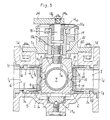
- FIG. 1 is a valve box having a valve chamber 1a on the both sides of which penetrating openings 1b and 1c are provided to be communicated to each other on the same axis thereof.
- a spherical, valve body 2 is arranged at a center of the valve chamber 1a to be rotatable.
- Inlet and outlet tubes 30 and 40 made of metal are fitted into the penetrating openings 1a and 1b to screw there within order to form inlet and outlet opening's 3′ and 4′.
- the inner end surfaces of the inlet and outlet openings 3′ and 4′ are formed to be valve body support surfaces 5 which may gently contact with and slide on the upper and lower peripheral portions of the spherical valve body 2.
- the inner portions of the inlet and outlet tubes 30 and 40 are formed to be ring-like projecting valve seats 6 and their tip portions in section are formed in a shape of a semi-circle in section or to be a surface of very thin width.
- valve body support surfaces 5 of the inner end surfaces of the inlet and outlet openings 3′ and 4′ are formed to have the same curved surfaces as that of the spherical valve body 2, and the tip ends of the ring-like projecting valve seats 6 slightly retreat inwardly about 0.5mm. from the curved surfaces.
- a flow passage 7 penetrates the spherical valve body 2 in a radial direction thereof to be able to communicate with the inlet and outlet openings 3′ and 4′.
- a circular concave 8 is formed respectively with the surfaces of the spherical valve body 2, which are perpendicular to the flow passage 7 and close the inlet and outlet openings 3′ and 4′.
- the circular concaves 8 have a suitable depth and a diameter smaller than that of the spherical valve body 2 and greater than those of the ring-like projecting valve seats 6.
- a sub-valve plate 9 made of metal is fitted respectively into the circular concaves 8 so that it may be taken out therefrom.
- Each of the sub-valve plates 9 is formed in a shape of a circle and has a back which is formed to be flat and vertical and to have substantially the same curved surface as the spherical valve body 2.
- the guide opening 10 indicates a guide opening which penetrates a centaral portion of the spherical valve body 2 in vertical directions.
- the guide opening 10 is formed in a shape of rectangular in cross section and to be wide towards both of the concaves 8.
- a communicated space 11 is formed respectively between the both sides of the guide opening 10 and the concaves 8.
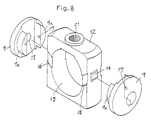
- the 12 is a cam plate which is fitted into the guide opening 10 to be vertically slidable.
- An elliptic opening 13, which is long in vertical directions, is formed with a central portion of the cam plate 12.
- the elliptic opening 13 has a diameter greater than that of a tube 7a which is fitted into the flow passage 7.
- the flow passage 7 having the tube 7a also penetrates the elliptic opening 13 and the cam plate 12 is mounted movably in vertical directions with respect to the tube 7a.
- a cam projection 14 having a predetermined height is formed integrally with central portions of the both sides of the cam plate 12, respectively.
- a projection 15 of semi-circle in section is formed integrally with a central portion of each of the backs of the sub-valve plates 9, respectively.
- a short arm 9a is formed respectively to project from the backs of the sub-valve plates 9 via the communicated spaces 11, and the short arms 9a face the central portions of the front and rear sides of the cam plate 12.
- An inclined groove 16 is formed respectively with the front and rear sides of the cam plate 12 in such a state, that the inclined grooves are inclined upwardly from the both sides of the elliptic opening 13 to the outer edges of the cam plate 12.
- the short arms 9a are slidably engaged with the inclined grooves 16 by means of an engaging projection 17 which projects respectively from the central portions of the short arms 9a, and when the cam plate 12 is moved upwardly, the engaging projections 17 are guided by and moved along the grooves 16 so as to retract the sub-valve plates 9 into the concaves 8.
- An upper valve stem 19 and a lower valve stem 19a are made to project from the upper and lower end surfaces of the spherical valve body 2 on the same vertical line.
- the upper valve stem 19 is formed to be a hollow shaft and the lower valve stem 19a is formed to be a short shaft.
- the upper valve stem 19 is supported rotatably in a penetrating opening 20 which penetrates a lid 60 vertically, and the upper valve stem 19 extends outwardly.
- the lower valve stem 19a is supported rotatably in a circular concave formed with a central portion of the bottom wall of the valve chamber 1a.
- a screwed tube 21 is fixed to the upper central portion of the cam plate 12 in a state of screw connection.
- the screwed tube 21 is screwed with a screw portion 18a which is provided with a lower portion of a cam plate operating shaft 18 which is rotatably supported in the hole of the upper valve shaft 19.
- the upper end portion of the cam plate operating shaft 18 is made to project from the upper valve stem 19.
- the cam plate operating shaft 18 is supported rotatably, but not to move vertically in the hole of the upper valve stem 19.
- the outer surface of the upper valve stem 19, which projects from the upper surface of the valve box 1, is formed to be an engaging portion 19b in a shape of rectangular.
- An engaging ring 22a is formed with a tip end of a first operating handle which has a rectangular hole, and the engaging portion 19b is detachably engated with the engaging ring 22a.
- a pin hole 23 is opened with the base and vertical surface of the first operating handle 22 which extends laterally.
- the numeral 24 indicates a second operating handle having a rectangular hole portion 24a at a tip thereof, and an angle shaft 18b formed with an upper portion of the cam plate operating shaft 18 is detachably engaged with the rectangular hole portion 24a.
- a projection 26 is formed integrally with the under surface of the second operating handle 24 and a lateral pin 25 is slidably supported by the projection 26.
- the base portion of the lateral pin 25 is fixed to a lever 27, and the lever, 27 is mounted on the under surface of the second operating handle 24 to be slidable in a longitudinal direction thereof.
- a compression spring 28 is interposed between a suitable portion of the lateral pin 25 and the projection 26, so as to always urge the lateral pin 25 in a direction of insertion to the pin hole 23.
- the lateral pin 25 is engaged with the pin hole 23 so that the first and second handles 22 and 24 are rotated integrally.
- 29 and 30 are stopper projections which are provided on the upper surface of the valve box 1 in order to stop rotation of the spherical valve body 2 in a closed position and an open position.
- the stopper projections 29 and 30 stop the first operating handle 22 in contact with the side surface thereof.
- the operation of the ball valve according to the first embodiment is as follows.
- the second operating handle 24 is grasped, and the lever 27 is withdrawn this side against a tension force of the spring 28 so that the lateral pin 25 may be apart from the pin hole 23 of the first operating handle 22.
- the second operating handle 24 is rotated in a direction of open (Counter clockwise in Fig, 3) so that the cam plate operating shaft 18 may be rotated together with the second operating handle 24 without rotation of the first operating handle 22 due to release of the lateral pin 25 from the pin hole 23.
- the screwed portion 18a of the cam plate operating shaft 18 rotates and the cam plate 12, which has the screwed tube 21 engaging with the screwed portion 18a, is moved upwardly so as to upwardly move the cam projections 14 away from the projections 15 of the sub-valve plates 9.
- the engaging projections 17 are withdrwn by means of the inclined grooves 16 so as to retract the sub-valve plates 9 into the concaves 8 of the spherical valve body.
- the pressing contact of the sub-valve plates 9 with the ring-like projecting valve seats 6 may be released.
- the second operating handle 24 is rotated upwardly of the first operating handle 22 and the lateral pin 25 is inserted into and engated with the pin hole 23.
- the second operating handle 24 is rotated, in the same direction (Counter clockwise) and then the first operating handle 22 is rotated integrally therewith so that second operating handle 24 may stop where it contacts with the stopper projection 30 for a closed position.
- the flow passage 7 of the spherical valve body 2 is communicated with the inlet and outlet openings 3′ and 4′ so as to allow the fluid to be flown.
- the second operating handle 24 is rotated clock wise at 90 degrees in such a state that the lateral pin 25 is engaged with the pin hole 23. Then, the first operating handle 22 is rotated integrally with the second operating handle 24 so as to contact with the stopper projection 29 for a closed position.
- the sub-valve plates 9 of the spherical valve body 2 are facing the inlet and outlet openings 3′ and 4′.
- the lever 27 is withdrawn this side against a tension force of the spring 28 so that the lateral pin 25 may be disengaged with and apart from the pin hole 23 of the first operating handle 22.
- the second operating handle 24 is rotated clock wise so as to rotate the cam plate operating shaft 18 integrally in the same directiion as the second operating handle 24.
- the cam plate 12 which has the screwed tube 21 engaged with the screwed portion 18a, moves down and the projections 15 ride on the cam projections 14 while the cam projections 14 are sliding on the cam projections 14. Therefore, the sub-valve plates having the projections 15 are made to project or pushed out from the concaves 8 so as to contact with the ring-like projecting valve seats 6 and close the inlet and outlet openings 3′ and 4′.
- pressing means for pushing and pressing the sub-valve plates 9 of the spherical valve body 2 suitable mechanisms such as a piston mechanism or a link motion mechanism may be used other than that pressing means as described in the embodiment.
- valve 1 is a valve box having a valve chamber 1a on the both sides of which penetrating openings 1b are provided to be communicated to each other on the same axis thereof.
- a spherical valve body 2 is arranged at a center of the valve chamber 1a to be rotatable.
- Inlet and outlet tubes 30 and 40 made of metal are fitted into the penetrating openings 1a and 1b to screw therewith in order to form inlet and outlet openings 3′ and 4′.
- An opening 1c is formed with the upper portion of the valve box 1 so that the spherical valve body 2 may be taken out fromt the opening 1c.
- Flanges 1d and 1e are formed with the outer ends of each of the opening 1c and the penetrating openings 1b, respectively.
- a ring-like projection 3a is provided with a middle portion of the periphery of the the inner tube 3 to be around same.
- An external thread portion 3b is formed with the periphery of an outer end of the inner tube 3.
- the external thread portion 3b is screwed with an inner wall of a ring-like edge 1f which projects from the inner wall of the end portion of the penetrating opening 1b.
- a packing 50 made of copper is positioned between and sandwitched by the opposit faces of the edge 1f and the projection 3a.
- a further external thread 3c is formed with the periphery of the inner end of the inner tube 3.
- the outer tube 4 is formed to have a thickness substantially equal to a clearance between the periphery of the inner end of the inner tube 3 and the inner surface of the penetrating opening 1b, and an internal thread 4a is formed with the inner wall of the inner tube 3 to be engaged with the external thread 3c of the inner tube 3.
- the inner ends of the inner tubes 3 and 3, which are facing to each other, are formed to be valve seat surfaces 3d which contact with the periphery of sub-valve plates 9 provided with the spherical valve body 2, which sub-valve plates 9 will be referred to hereinafter.
- the inner ends of the outer tubes 4 and 4, which are facing to each other are formed to be support surfaces 5 which contact with the periphery of the spherical valve body located outwardly of the sub-valve plates 9.
- a flow passage 7 penetrates the spherical valve body 2 in a radial direction thereof to be able to communicate with the inlet and outlet openings 3′ and 4′.
- a circular concave 8 is formed respectively with the surfaces of the spherical valve body 2, which are perpendicular to the flow passage 7 and close the inlet and outlet openings 3′ and 4′.
- the circular concaves 8 have a suitable depth and a diameter smaller than the inside diameter of the outner tube 4 and greater than the diameter of the valve seat surface 3d of the inner tube 3.
- a sub-valve plate 9 made of metal is fitted respectively into the circular concaves 8 so that it may be taken out therefrom.
- Each of the sub-valve plates 9 is formed in a shape of a circle and has a back which is formed to be flat and vertical and to have substantially the same curved surface as the spherical valve body 2.
- 60 indicates a lid which is detachably attached to the flange 1d of the opening 1c.
- the guide opening 10 indicates a guide opening which penetrates a centaral portion of the spherical valve body 2 in vertical directions.
- the guide opening 10 is formed in a shape of rectangular in cross section and to be wide towards both of the concaves 8.
- a communicated space 11 is formed respectively between the both sides of the guide opening 10 and the concaves 8.
- the 12 is a cam plate which is fitted into the guide opening 10 to be vertically slidable.
- An elliptic opening 13, which is long in vertical directions, is formed with a central portion of the cam plate 12.
- the elliptic opening 13 has a diameter greater than that of a tube 7a which is fitted into the flow passage 7.
- the flow passage 7 having the tube 7a also penetrates the elliptic opening 13 and the cam plate 12 is mounted movably in vertical directions with respect to the tube 7a.
- a cam projection 14 having a predetermined height is formed integrally with central portions of the both sides of the cam plate 12, respectively.
- a projection 15 of semi-circle in section is formed integrally with a central portion of each of the backs of the sub-valve plates 9, respectively.
- a short arm 9a is formed respectively to project from the backs of the sub-valve plates 9 via the communicated spaces 11, and the short arms 9a face the central portions of the front and rear sides of the cam plate 12.
- An inclined groove 16 is formed respectively with the front and rear sides of the cam plate 12 in such a state that the inclined grooves are inclined upwardly from the both sides of the elliptic opening 13 to the outer edges of the cam plate 12.
- the short arms 9a are slidably engaged with the inclined grooves 16 by means of an engaging projection 17 which projects respectively from the central portions of the short arms 9a, and when the cam plate 12 is moved upwardly, the engaging projections 17 are guided by and moved along the grooves 16 so as to retract the sub-valve plates 9 into the concaves 8.
- An upper valve stem 19 and a lower valve stem 19a are made to project from the upper and lower end surfaces of the spherical valve body 2 on the same vertical line.
- the upper valve stem 19 is formed to be a hollow shaft and the lower valve stem 19a is formed to be a short shaft.
- the upper valve stem 19 is supported rotatably in a penetrating opening 20 which penetrates a lid 60 vertically, and the upper valve stem 19 extends outwardly.
- the lower valve stem 19a is supported rotatably in a circular concave formed with a central portion of the bottom wall of the valve chamber 1a.
- a screwed tube 21 is fixed to the upper central portion of the cam plate 12 in a state of screw connection.
- the screwed tube 21 is screwed with a screw portion 18a which is provided with a lower portion of a cam plate operating shaft 18 which is rotatably supported in the hole of the upper valve shaft 19.
- the upper end portion of the cam plate operating shaft 18 is made to project from the upper valve stem 19.
- the cam plate operating shaft 18 is supported rotatably, but not to move vertically in the hole of the upper valve stem 19.
- the outer surface of the upper valve stem 19, which projects from the upper surface of the valve box 1, is formed to be an engaging portion 19b in a shape of rectangular.
- An engaging ring 22a is formed with a tip end of a first operating handle which has a rectangular hole, and the engaging portion 19b is detachably engated with the engaging ring 22a.
- a pin hole 23 is opened with the base and vertical surface of the first operating handle 22 which extends laterally.
- the numeral 24 indicates a second operating handle having a rectangular hole portion 24a at a tip thereof, and an angle shaft 18b formed with an upper portion of the cam plate operating shaft 18 is detachably engaged with the rectangular hole portion 24a.
- a projection 26 is formed integrally with the under surface of the second operating handle 24 and a lateral pin 25 is slidably supported by the projection 26.
- the base portion of the lateral pin 25 is fixed to a lever 27, and the lever 27 is mounted on the under surface of the second operating handle 24 to be slidable in a longitudinal direction thereof.
- a compression spring 28 is interposed between a suitable portion of the lateral pin 25 and the projection 26, so as to always urge the lateral pin 25 in a direction of insertion to the pin hole 23. In a normal state, the lateral pin 25 is engaged with the pin hole 23 so that the first and second handles 22 and 24 are rotated integrally.
- Stopper projections are provided on the upper surface of the valve box 1 in order to stop rotation of the spherical valve body 2 in a closed position and an open position, but they are not shown in the drawings.
- the above mentioned ball valve is used in such a state that the flange 1e is connected to a flange a of a pipe A, respectively by means of bolts.
- the operation of the ball valve according to the second embodiment is as follows.
- the second operating handle 24 is grasped and the lever 27 is withdrawn this side against a tension force of the spring 28 so that the lateral pin 25 may be apart from the pin hole 23 of the first operating handle 22.
- the second operating handle 24 is rotated in a direction of open so that the cam plate operating shaft 18 may be rotated together with the second operating handle 24 without rotation of the first operating handle 22 dine to release of the lateral pin 25 from the pin hole 23.
- the screwed portion 18a of the cam plate operating shaft 18 rotates and the cam plate 12, which has the screwed tube 21 engaging with the screwed portion 18a, is moved upwardly so as to upwardly move the cam projections 14 away from the projections 15 of the sub-valve plates 9.
- the engaging projections 17 are withdrwn by means of the inclined grooves 16 so as to retract the sub-valve plates 9 into the concaves 8 of the spherical valve body.
- the pressing contact of the sub-valve plates 9 with the valve seat surfaces 3d may be released.
- the second operating handle 24 is rotated upwardly of the first operating handle 22 and the lateral pin 25 is inserted into and engated with the pin hole 23.
- the second operating handle 24 is rotated in the same direction and then the first operating handle 22 is rotated integrally therewith so that second operating handle 24 may stop where it contacts with the stopper projection 30 for a closed position.
- the flow passage 7 of the spherical valve body 2 is communicated with the inlet and outlet openings 3′ and 4′ so as to allow the fluid to be flown.
- the second operating handle 24 is rotated at 90 degrees in such a state that the lateral pin 25 is engaged with the pin hole 23. Then, the first operating handle 22 is rotated integrally with the second operating handle 24 so as to contact with the stopper projection 29 for a closed position.
- the sub-valve plates 9 of the spherical valve body 2 are facing the inlet and outlet openings 3′ and 4′.
- the lever 27 is withdrawn this side against a tension force of the spring 28 so that the lateral pin 25 may be disengaged with and apart from the pin hole 23 of the first operating handle 22.
- the second operating handle 24 is rotated clock wise so as to rotate the cam plate operating shaft 18 integrally in the same directiion as the second operating handle 24.
- the cam plate 12 which has the screwed tube 21 engaged with the screwed portion 18a, moves down and the projections 15 ride on the cam projections 14 while the cam projections 14 are sliding on the cam projections 14. Therefore, the sub-valve plates having the projections 15 are made to project or pushed out from the concaves 8 so as to contact with the valve seat surfaces 3d of the inner tubes 3 and close the inlet and outlet openings 3′ and 4′.
- pressing means for pushing and pressing the sub-valve plates 9 of the spherical valve body 2 suitable mechanisms such as a piston mechanism or a link motion mechanism may be used other than that pressing means, as is described in the first embodiment.
- a suitable rotating jig such as a supana is inserted into the valve box 1 through the clearance of the opening portion 1c so as to rotate the inner ends of the outer tubes 4, which project from the penetrating opening 1b into the valve chamber 1a, and screw the outer tubes 4 towards the side of the projections 3a which project from the periphery of the inner tubes 3, As the result, the valve body support surfaces 5 of the outer tubes 4 becomes apart from the surface of the spherical valve body 2.
- the cam plate operating shaft 18 is rotated by means of the second operating handle 24 so as to release the pressing force to the sub-valve plates 9. Then, the sub-valve plates 9 are retracted in to the circular concaves 8 of the spherical valve body 2 and apart from the valve seat surfaces 3d of the inner tubes 3. This operation may be carried our prior to removement of the lid 60.
- the contact and engagement of the spherical valve body 2 with the inner and outer tubes 3 and 4 is released and as the result the spherical valve body 2 may be taken out from the valve chamber 1a by grasping same without interference of the inner and outer tubes 3 and 4.
- the inner tubes 3 After removing the spherical valve body 2 from the valve box 1, the inner tubes 3 is rotated by means of a suitable rotating jig such as a supana so that the inner tubes 3 are propelled into the valve chamber 1a in screw engagement with the screwed portion of the projecting edge portion 1f of the penetrating openings 1b of the valve box 1. Then, the inner tubes 3 may be taken out through the penetrating openings 1b together with the outer tubes 4.
- a suitable rotating jig such as a supana
- the spherical valve body 2 having the sub-valve plates 9, the inner and outer tubes 3 and 4 forming the inlet and outlet openings 3′ and 4′ may be separated from the valve box 1 which is connected to the pipes A.
- these elements my be eaisly changed or maintained where it is required and thereafter the inner and outer tubes 3 and 4 may be inserted into the penetrating openings 1b and the outer tubes 4 are screwed so as to contact the support surfaces of thereof with the periphery of the spherical valve body 2, and then the lid 60 is atached to the vlave box 1 to complete its assembling.
Landscapes
- Engineering & Computer Science (AREA)
- General Engineering & Computer Science (AREA)
- Mechanical Engineering (AREA)
- Taps Or Cocks (AREA)
- Fuel-Injection Apparatus (AREA)
- External Artificial Organs (AREA)
- Temperature-Responsive Valves (AREA)
- Multiple-Way Valves (AREA)
Applications Claiming Priority (4)
| Application Number | Priority Date | Filing Date | Title |
|---|---|---|---|
| JP24413289A JP2573064B2 (ja) | 1989-09-20 | 1989-09-20 | ボールバルブ |
| JP244132/89 | 1989-09-20 | ||
| JP142350/90 | 1990-05-30 | ||
| JP2142350A JP2530510B2 (ja) | 1990-05-30 | 1990-05-30 | ボ―ルバルブ |
Publications (3)
| Publication Number | Publication Date |
|---|---|
| EP0419268A2 true EP0419268A2 (de) | 1991-03-27 |
| EP0419268A3 EP0419268A3 (en) | 1991-07-24 |
| EP0419268B1 EP0419268B1 (de) | 1997-07-02 |
Family
ID=26474391
Family Applications (1)
| Application Number | Title | Priority Date | Filing Date |
|---|---|---|---|
| EP90310324A Expired - Lifetime EP0419268B1 (de) | 1989-09-20 | 1990-09-20 | Kugelhahn |
Country Status (7)
| Country | Link |
|---|---|
| US (1) | US5137258A (de) |
| EP (1) | EP0419268B1 (de) |
| KR (1) | KR930007951B1 (de) |
| AT (1) | ATE154971T1 (de) |
| AU (1) | AU639260B2 (de) |
| CA (1) | CA2025755C (de) |
| DE (1) | DE69030989T2 (de) |
Families Citing this family (10)
| Publication number | Priority date | Publication date | Assignee | Title |
|---|---|---|---|---|
| US5417404A (en) * | 1993-10-22 | 1995-05-23 | Varden; Arnold | Geared ball valve |
| RU2147704C1 (ru) * | 1998-07-14 | 2000-04-20 | Магнитогорская государственная горно-металлургическая академия им.Г.И.Носова | Задвижка |
| JP4002906B2 (ja) * | 2004-04-21 | 2007-11-07 | 株式会社アグリー | 開閉バルブ |
| CN114857269A (zh) * | 2014-03-21 | 2022-08-05 | 美国圣戈班性能塑料公司 | 旋转轴密封件 |
| CN205877247U (zh) * | 2016-05-26 | 2017-01-11 | 刘晓琦 | 一种强制密封球阀 |
| CN111434957A (zh) * | 2019-01-14 | 2020-07-21 | 伊利诺斯工具制品有限公司 | 多通道阀 |
| CN109707865B (zh) * | 2019-01-29 | 2023-10-20 | 中国石油化工股份有限公司 | 一种四阀瓣式无摩擦球阀 |
| CN110159785B (zh) * | 2019-06-19 | 2021-03-23 | 江特科技股份有限公司 | 一种改进型球阀 |
| CN110173574B (zh) * | 2019-06-21 | 2020-08-11 | 浙江英佰特阀门制造有限公司 | 一种长使用寿命球阀 |
| CN110159786B (zh) * | 2019-06-21 | 2021-02-26 | 立信阀门集团有限公司 | 一种无磨损球阀 |
Family Cites Families (14)
| Publication number | Priority date | Publication date | Assignee | Title |
|---|---|---|---|---|
| DE551241C (de) * | 1928-04-17 | 1932-05-30 | Ewald Haselhorst | Drehschieber |
| DE543960C (de) * | 1929-05-15 | 1932-02-12 | Richard Fischbach | Absperrventil |
| DE547765C (de) * | 1930-06-28 | 1932-03-29 | Richard Fischbach | Absperrventil mit drehbarem Durchleitungskoerper |
| CH156524A (de) * | 1931-06-22 | 1932-08-15 | Schmidt Alfred | Drehschieber. |
| US2372869A (en) * | 1943-09-01 | 1945-04-03 | Sr Frank Wheatley | Plug valve |
| US2612340A (en) * | 1948-05-12 | 1952-09-30 | Milton P Laurent | Rotary plug valve |
| FR1272470A (fr) * | 1958-01-31 | 1961-09-29 | Vanne | |
| US3193244A (en) * | 1960-11-23 | 1965-07-06 | Trymac Corp | Plug valve with improved expandable plug |
| US3350055A (en) * | 1965-03-26 | 1967-10-31 | Rodney B Campbell | Dual seal shutoff valve |
| SU480877A1 (ru) * | 1974-01-14 | 1975-08-15 | Центральное конструкторское бюро нефтеаппаратуры | Шаровой кран |
| US4217923A (en) * | 1978-03-17 | 1980-08-19 | Kamyr Valves, Inc. | Ball valve with readily removable ball and seats for high temperature environment |
| US4231440A (en) * | 1979-05-21 | 1980-11-04 | J. D. Kinsey | Rotary, segmented, expansible valves |
| EP0117610A3 (de) * | 1983-01-31 | 1987-04-29 | Kerotest Manufacturing Corporation | Durchflussregelventil aus Kunststoff |
| NL8800945A (nl) * | 1988-04-12 | 1989-11-01 | Koni Bv | Schokdemper. |
-
1990
- 1990-09-19 US US07/584,936 patent/US5137258A/en not_active Expired - Fee Related
- 1990-09-19 CA CA002025755A patent/CA2025755C/en not_active Expired - Fee Related
- 1990-09-20 AT AT90310324T patent/ATE154971T1/de not_active IP Right Cessation
- 1990-09-20 AU AU63054/90A patent/AU639260B2/en not_active Ceased
- 1990-09-20 KR KR1019900014917A patent/KR930007951B1/ko not_active Expired - Fee Related
- 1990-09-20 DE DE69030989T patent/DE69030989T2/de not_active Expired - Fee Related
- 1990-09-20 EP EP90310324A patent/EP0419268B1/de not_active Expired - Lifetime
Also Published As
| Publication number | Publication date |
|---|---|
| KR930007951B1 (ko) | 1993-08-25 |
| DE69030989D1 (de) | 1997-08-07 |
| ATE154971T1 (de) | 1997-07-15 |
| EP0419268A3 (en) | 1991-07-24 |
| KR910006648A (ko) | 1991-04-29 |
| EP0419268B1 (de) | 1997-07-02 |
| US5137258A (en) | 1992-08-11 |
| DE69030989T2 (de) | 1997-11-27 |
| CA2025755A1 (en) | 1991-03-21 |
| AU639260B2 (en) | 1993-07-22 |
| AU6305490A (en) | 1991-03-28 |
| CA2025755C (en) | 1995-04-25 |
Similar Documents
| Publication | Publication Date | Title |
|---|---|---|
| EP0006836B1 (de) | Mittel und Verfahren um die Dichtungsringe eines Kugelhahnes auszubauen | |
| EP0419268A2 (de) | Kugelhahn | |
| CN101622487B (zh) | 回转楔形插装阀机构以及组装和拆卸方法 | |
| CN101622486B (zh) | 回转楔形阀门机构及其制造方法 | |
| US4601308A (en) | Ball valve with seat loading mechanism | |
| US11536379B2 (en) | Ball valve and valve operating method | |
| CA2306653C (en) | Improved metal ball valves for gas | |
| IL96766A (en) | Control valve | |
| CA2994417A1 (en) | Axial-seal butterfly valves | |
| JP4022509B2 (ja) | 管継手の継手部材 | |
| CA1111405A (en) | Spring assembly for floating seat ring | |
| US4693451A (en) | Valve structures | |
| US4366946A (en) | Ball valve mechanism | |
| JPS5920061B2 (ja) | ゲ−ト弁 | |
| CA1187858A (en) | Flat sided ball valve | |
| US5109887A (en) | Multiway valve | |
| RU2137000C1 (ru) | Усовершенствованный водопроводный кран с шаровым клапаном | |
| CN211118180U (zh) | 用于快速枪座的连接模块以及快速枪座 | |
| JP2530510B2 (ja) | ボ―ルバルブ | |
| JP2014101988A (ja) | 流量調整式回転弁 | |
| JP2794210B2 (ja) | 水道用メータの取付装置 | |
| JP2573064B2 (ja) | ボールバルブ | |
| EP0461294A1 (de) | Absperrventil | |
| JPH0335552B2 (de) | ||
| JP4008545B2 (ja) | パイプ用管継手 |
Legal Events
| Date | Code | Title | Description |
|---|---|---|---|
| PUAI | Public reference made under article 153(3) epc to a published international application that has entered the european phase |
Free format text: ORIGINAL CODE: 0009012 |
|
| 17P | Request for examination filed |
Effective date: 19901010 |
|
| AK | Designated contracting states |
Kind code of ref document: A2 Designated state(s): AT BE CH DE DK ES FR GB GR IT LI LU NL SE |
|
| PUAL | Search report despatched |
Free format text: ORIGINAL CODE: 0009013 |
|
| RBV | Designated contracting states (corrected) |
Designated state(s): AT DE FR GB IT |
|
| AK | Designated contracting states |
Kind code of ref document: A3 Designated state(s): AT BE CH DE DK ES FR GB GR IT LI LU NL SE |
|
| 17Q | First examination report despatched |
Effective date: 19940107 |
|
| GRAG | Despatch of communication of intention to grant |
Free format text: ORIGINAL CODE: EPIDOS AGRA |
|
| GRAH | Despatch of communication of intention to grant a patent |
Free format text: ORIGINAL CODE: EPIDOS IGRA |
|
| GRAH | Despatch of communication of intention to grant a patent |
Free format text: ORIGINAL CODE: EPIDOS IGRA |
|
| GRAA | (expected) grant |
Free format text: ORIGINAL CODE: 0009210 |
|
| AK | Designated contracting states |
Kind code of ref document: B1 Designated state(s): AT DE FR GB IT |
|
| REF | Corresponds to: |
Ref document number: 154971 Country of ref document: AT Date of ref document: 19970715 Kind code of ref document: T |
|
| REF | Corresponds to: |
Ref document number: 69030989 Country of ref document: DE Date of ref document: 19970807 |
|
| ET | Fr: translation filed | ||
| PLBE | No opposition filed within time limit |
Free format text: ORIGINAL CODE: 0009261 |
|
| STAA | Information on the status of an ep patent application or granted ep patent |
Free format text: STATUS: NO OPPOSITION FILED WITHIN TIME LIMIT |
|
| 26N | No opposition filed | ||
| PGFP | Annual fee paid to national office [announced via postgrant information from national office to epo] |
Ref country code: GB Payment date: 20010803 Year of fee payment: 12 |
|
| PGFP | Annual fee paid to national office [announced via postgrant information from national office to epo] |
Ref country code: AT Payment date: 20010807 Year of fee payment: 12 |
|
| PGFP | Annual fee paid to national office [announced via postgrant information from national office to epo] |
Ref country code: FR Payment date: 20010928 Year of fee payment: 12 |
|
| PGFP | Annual fee paid to national office [announced via postgrant information from national office to epo] |
Ref country code: DE Payment date: 20011116 Year of fee payment: 12 |
|
| REG | Reference to a national code |
Ref country code: GB Ref legal event code: IF02 |
|
| PG25 | Lapsed in a contracting state [announced via postgrant information from national office to epo] |
Ref country code: GB Free format text: LAPSE BECAUSE OF NON-PAYMENT OF DUE FEES Effective date: 20020920 Ref country code: AT Free format text: LAPSE BECAUSE OF NON-PAYMENT OF DUE FEES Effective date: 20020920 |
|
| PG25 | Lapsed in a contracting state [announced via postgrant information from national office to epo] |
Ref country code: DE Free format text: LAPSE BECAUSE OF NON-PAYMENT OF DUE FEES Effective date: 20030401 |
|
| GBPC | Gb: european patent ceased through non-payment of renewal fee |
Effective date: 20020920 |
|
| PG25 | Lapsed in a contracting state [announced via postgrant information from national office to epo] |
Ref country code: FR Free format text: LAPSE BECAUSE OF NON-PAYMENT OF DUE FEES Effective date: 20030603 |
|
| REG | Reference to a national code |
Ref country code: FR Ref legal event code: ST |
|
| PG25 | Lapsed in a contracting state [announced via postgrant information from national office to epo] |
Ref country code: IT Free format text: LAPSE BECAUSE OF NON-PAYMENT OF DUE FEES;WARNING: LAPSES OF ITALIAN PATENTS WITH EFFECTIVE DATE BEFORE 2007 MAY HAVE OCCURRED AT ANY TIME BEFORE 2007. THE CORRECT EFFECTIVE DATE MAY BE DIFFERENT FROM THE ONE RECORDED. Effective date: 20050920 |