EP0419908A2 - Système ordinateur avec une fonction de mode dormant - Google Patents
Système ordinateur avec une fonction de mode dormant Download PDFInfo
- Publication number
- EP0419908A2 EP0419908A2 EP90117215A EP90117215A EP0419908A2 EP 0419908 A2 EP0419908 A2 EP 0419908A2 EP 90117215 A EP90117215 A EP 90117215A EP 90117215 A EP90117215 A EP 90117215A EP 0419908 A2 EP0419908 A2 EP 0419908A2
- Authority
- EP
- European Patent Office
- Prior art keywords
- sleep mode
- clock
- control
- control means
- clock pulse
- Prior art date
- Legal status (The legal status is an assumption and is not a legal conclusion. Google has not performed a legal analysis and makes no representation as to the accuracy of the status listed.)
- Withdrawn
Links
Images


Classifications
-
- G—PHYSICS
- G06—COMPUTING OR CALCULATING; COUNTING
- G06F—ELECTRIC DIGITAL DATA PROCESSING
- G06F1/00—Details not covered by groups G06F3/00 - G06F13/00 and G06F21/00
- G06F1/26—Power supply means, e.g. regulation thereof
- G06F1/32—Means for saving power
- G06F1/3203—Power management, i.e. event-based initiation of a power-saving mode
- G06F1/3234—Power saving characterised by the action undertaken
- G06F1/324—Power saving characterised by the action undertaken by lowering clock frequency
-
- G—PHYSICS
- G06—COMPUTING OR CALCULATING; COUNTING
- G06F—ELECTRIC DIGITAL DATA PROCESSING
- G06F1/00—Details not covered by groups G06F3/00 - G06F13/00 and G06F21/00
- G06F1/26—Power supply means, e.g. regulation thereof
- G06F1/32—Means for saving power
-
- G—PHYSICS
- G06—COMPUTING OR CALCULATING; COUNTING
- G06F—ELECTRIC DIGITAL DATA PROCESSING
- G06F1/00—Details not covered by groups G06F3/00 - G06F13/00 and G06F21/00
- G06F1/26—Power supply means, e.g. regulation thereof
-
- G—PHYSICS
- G06—COMPUTING OR CALCULATING; COUNTING
- G06F—ELECTRIC DIGITAL DATA PROCESSING
- G06F1/00—Details not covered by groups G06F3/00 - G06F13/00 and G06F21/00
- G06F1/26—Power supply means, e.g. regulation thereof
- G06F1/32—Means for saving power
- G06F1/3203—Power management, i.e. event-based initiation of a power-saving mode
-
- Y—GENERAL TAGGING OF NEW TECHNOLOGICAL DEVELOPMENTS; GENERAL TAGGING OF CROSS-SECTIONAL TECHNOLOGIES SPANNING OVER SEVERAL SECTIONS OF THE IPC; TECHNICAL SUBJECTS COVERED BY FORMER USPC CROSS-REFERENCE ART COLLECTIONS [XRACs] AND DIGESTS
- Y02—TECHNOLOGIES OR APPLICATIONS FOR MITIGATION OR ADAPTATION AGAINST CLIMATE CHANGE
- Y02D—CLIMATE CHANGE MITIGATION TECHNOLOGIES IN INFORMATION AND COMMUNICATION TECHNOLOGIES [ICT], I.E. INFORMATION AND COMMUNICATION TECHNOLOGIES AIMING AT THE REDUCTION OF THEIR OWN ENERGY USE
- Y02D10/00—Energy efficient computing, e.g. low power processors, power management or thermal management
Definitions
- the present invention relates to a personal computer and, more particularly, to a computer system with a sleep mode function to decrease the processing speed of its CPU to thereby save power (or reduce power dissipation) of the system.
- the so-called sleep mode function is to reduce the processing speed of a CPU (microprocessor) under predetermined conditions in order to save power of the power supply.
- the CPU does not require the normal processing speed (relatively high speed), making it possible to reduce the CPU's processing speed.
- the processing speed of the CPU is determined by the frequency of a clock pulse.
- the sleep mode function therefore switches a clock pulse of a high frequency, which is normally given to the CPU, to the one having a low frequency and supplies it to the CPU in a sleep mode.
- the predetermined conditions for transition to the sleep mode may be:
- the sleep mode when a certain condition, such as no keyboard operation being done for a given period of time, is satisfied, the sleep mode is automatically set. As a result, the clock pulse is switched to a low-frequency one, thus reducing the CPU's processing speed. In other words, when the sleep mode is set, the processing speed of the CPU decreases regardless of the contents of data processing. Even if the condition for setting the sleep mode is met, however, there may be a time that the CPU needs to process data at a high speed as in normal mode. Such a case may be when it is required to run an application program for demonstration while a personal computer is being displayed for a sales purpose.
- the sleep mode function can reduce the power consumption when needed, it may undesirable decrease the processing speed of the CPU even when the CPU should process data at a high speed as done in normal mode.
- a computer system with a sleep mode function comprising a processor unit, constituting a central processing unit for the system, for executing various types of data processing; a clock control unit for selecting one of a first clock pulse of a predetermined high frequency necessary in normal mode of the processor unit and a second clock pulse of a predetermined low frequency necessary in sleep mode of the processor unit, and supplying the selected clock pulse to the processor unit; a sleep mode control unit for determining whether or not a predetermined condition for executing the sleep mode is met and controlling the clock control unit to supply the second clock pulse to the processor unit when the predetermined condition is met; and a sleep operation control unit for permitting or inhibiting a control operation of the sleep mode control unit and allowing the clock control unit to supply the first clock pulse to the processor unit upon inhibition of the control operation.
- a computer system embodying the present invention is a laptop type personal computer operatable on a rechargeable battery.
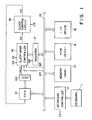
- the present system comprises a microprocessor 10 constituting a central processing unit (CPU), a keyboard 11, a keyboard controller (KBC) 12, a memory 13, a ROM (Read Only Memory) 14 having a BIOS (Basic I/O System) stored therein, an I/O device 15.
- the keyboard 11 and KBC 12 constitute an input device for entering data through an operation of various keys on the keyboard 11.
- the memory 13 comprising a RAM (Random Access Memory) constitutes various registers, such as a key buffer, for storing input data entered from the keyboard 11.
- the ROM 14 holds the BIOS for executing an input/output control operation.
- the I/O device 15 is an external storage device, such as a floppy disk drive.
- the present system further comprises a sleep mode controller 16 and a control register 17.
- the sleep mode controller 16 discriminates whether or not a predetermined condition for executing a sleep mode is satisfied, based on an instruction output from the CPU 10 and the like. When the predetermined condition is met, the controller 16 outputs a control signal SS to a clock control circuit 18.
- the control register 17 stores mode control data for permitting or inhibiting execution of the control operation of the sleep mode controller 16.
- the clock control circuit 18 has a clock generator 40 to generate a clock pulse that determines the processing speed of the CPU 10, as shown in Fig. 4.
- the generator 40 generates clock pulses NCK1 and NCK2 needed for the normal operation (high-speed operation) of the CPU 10 and a clock pulse SCK of a low frequency (e.g., 4 MHz) required for a sleep mode.
- the clock pulse NCK1 is a high-frequency pulse of 32 MHz, for example, and the clock pulse NCK2 a high-frequency pulse of 16 MHz, for example.
- the clock control circuit 18 has a first clock switching circuit 41 and a second clock switching circuit 42.
- the first clock switching circuit 41 selects the clock pulse NCK1 or NCK2 in accordance with a clock switch signal CS output from the KBC 12, and outputs the selected pulse as a clock pulse NCK in normal mode.
- the first clock switching circuit 41 comprises a logic circuit having AND circuits 41a and 41b, an OR circuit 41c and an inverter 41d.
- the second clock switching circuit 42 selects and outputs the clock pulse SCK in sleep mode in accordance with the clock switch signal CS from the sleep mode controller 16, while it selects and outputs the clock pulse NCK from the first clock switching circuit 41 in normal mode.
- the second clock switching circuit 42 comprises a logic circuit having AND circuits 42a and 42b, an OR circuit 42c and an inverter 42d.
- the sleep mode controller 16 has a circuit as illustrated in Fig. 2. That is, the controller 16 is a logic circuit having AND circuits 20a and 20b, flip-flops 21a to 21e, NAND circuits 22a and 22b, inverters 23a and 23b, an OR circuit 24 and buffer circuits 25a and 25b.
- the AND circuit 20a has a first input terminal supplied with mode control data CD stored in the control register 17 and a second input terminal supplied with a HALT instruction from the CPU 10.
- the HALT instruction when its logic level is "H" (high), is a significant signal.
- the mode control data CD enables a sleep mode when its logic level is "H,” and disables the sleep mode when the logic level is "L” (low).
- the AND circuit 20a When the mode control data CD of a logical level "L" is stored in the control register 17 and the HALT instruction of a logical level “H” is input, therefore, the AND circuit 20a outputs a signal of a logical level "H” to the OR circuit 24.
- the control register 17 is rendered writable by a write enable signal WE which is formed by decoding an I/O address output from the CPU 10.
- the mode control data CD is set in the control register 17 by CPU 10 in accordance with a key input from the keyboard 11, for example.
- the NAND circuit 22a has a first input terminal supplied with a system reset signals SR0 and SR1 and a second input terminal supplied with a sleep mode release signal (interrupt request) IR.
- the system reset signal SR1 is a reset signal (logic level "H") output from the gate array (not shown). This gate array generates a reset signal upon receiving a power on/off reset signal from the power source (not shown) or a control signal from the keyboard 11.
- the release signal IR is a power of signal (power on reset signal) output from the power source (not shown) or an interrupt signal from the interrupt controller (not shown).
- the NAND circuit 22b has a first input terminal supplied with a signal BR output from, for example, the DMA controller (not shown) so as to request the freeing of a system bus (19 in Fig. 1) and a second input terminal supplied with a signal BP output from CPU 10 so as to permit the use of the system bus 19.
- the signals BR and BP which are significant signals when their logic level is "H,” are generated at the time of accessing a file. When there is no file access, therefore, the signals BR and BP both have a logic level "L.”
- the flip-flops 21a to 21e each have a clock terminal CK supplied with a clock CLK from a clock generator (not shown).
- the AND circuit 20b serves to output the control signal SS that is an output signal of the controller 16.
- the mode control data CD has a logic level “L”
- the HALT instruction has a logic level “H”
- the signals BR and BP have a logic level “L”
- the AND circuit 20b outputs the "H"-level control signal SS, which means setting of the sleep mode.
- the sleep mode is released.
- the "H"-level mode control data CD which means inhibition of the control operation of the controller 16, is set in the control register 17, the sleep mode is also released.
- the HALT instruction is generated by a status decode circuit (LOGIC 100 shown in Fig. 1) as shown in Fig. 3.
- This circuit has AND circuits 30a to 30c and inverters 31a and 31b.
- the CPU 10 outputs various status signals MI, WR, DC, BH, BL and AS to the status decode circuit.
- the signal MI means a memory access when its logic level is "H,” and means an I/O access when having a logic level “L.”
- the signal WR means a write mode when having a logic level “H” and means a read mode when having a logic level “L.”
- the signal DC means data when having a logic level “H” and means a command when having a logic level “L.”
- the signal BH when having a logic level “H” means that the upper byte of the data is enabled
- the signal BL when having a logic level "H” means that the lower byte of the data is enabled.
- the signal AS when having a logic level "H” means that an address signal is valid.
- the status decode circuit renders the AND circuit 30a to output the "H"-level HALT instruction upon reception of the "H"-level signal MI, "H"-level signal WR, “L”-level signal DC, "H"-level signal BH, “L”-level signal BL and "H”-level signal AS from the CPU 10.
- the clock generator 40 of the clock control circuit 18 When the power of the battery of the system is set ON, the clock generator 40 of the clock control circuit 18 is activated to generate the clock pulses NCK1, NCK2 and SCK (steps S1 and S2).
- the first clock switching circuit 41 selects the clock pulse NCK1 or NCK2 in accordance with the clock switch signal CS output from the KBC 12 and outputs the selected pulse as a clock pulse NCK in normal mode.
- the sleep mode controller 16 outputs the "L"-level control signal SS to the clock control circuit 18 when a predetermined condition for setting the sleep mode is not met.
- the second clock switching circuit 42 of the clock control circuit 18 sends the clock pulse NCK as a clock CK to the CPU 10 in normal mode, as shown in Fig. 4.
- the CPU 10 executes the normal, high-speed data processing (normal mode).
- control register 17 In the control register 17 is set mode control data CD having a logic level "L" which means permission of the control operation of the sleep mode controller 16 (YES in step 3 or step 4).
- the controller 16 executes the sleep mode. That is, the CPU 10 executes the BIOS stored in the ROM 14 to detect the state where no key input operation through the keyboard 11 is performed for a given period of time. More specifically, the CPU 10 outputs the HALT instruction when input data from the KBC 12 is not stored in the key buffer of the memory 13 for a given period of time (YES in step S5). In other words, with no input data being stored in the key buffer, the status decode circuit (see Fig. 3) outputs the "H"-level HALT instruction to the controller 16.
- the "L"-level signals BR and BP are output to the controller 16 (NO in step S6).
- the controller 16 outputs the "H"-level control signal SS to the clock control circuit 18.
- the second clock switching circuit 42 of the clock control circuit 18 supplies the low-frequency clock pulse SCK as the clock CK to the CPU 10.
- the mode of the CPU 10 is switched to the sleep mode from the normal mode or high-speed operation mode, and the CPU 10 executes low-speed data processing according to this clock pulse SCK (steps S7 and S11).
- This sleep mode is released when there is an IR signal generated by inputting data through the keyboard 11 (step S12) or when there is a file access.
- step S3 When the mode control data CD having a logic level "H" which inhibits the control operation of the sleep mode controller 16 is input from the keyboard 11, it is set in the control register 17 (YES in step S3). As an "L"-level signal is input to the first input terminal of the AND circuit 20 of the controller 16 from the control register 17, as shown in Fig. 2, setting of the sleep mode is inhibited. Even if the aforementioned conditions (YES in step S5 and NO in step S6) are met, therefore, an operation in sleep mode is disabled (step S8). More specifically, the second clock switching circuit 42 of the clock control circuit 18 supplies the clock pulse NCK as the clock CK to the CPU 10 in response to the "L"-level control signal SS input. The CPU 10 performs data processing at a normal, high speed (normal mode) in response to the clock pulse NCK (steps S9 and S10).
- the sleep mode is set.
- the predetermined conditions may be no key input operation done through the keyboard for a given period of time and no file access done for a given period of time.
- the CPU 10 receives the low-frequency clock pulse SCK instead of the high-frequency clock pulse NCK which is used in normal, high-speed mode. Consequently, the CPU 10 executes a low-speed operation according to this clock pulse SCK.
- the normal, high-speed operation is not required as in the case of no input/output operation being performed, therefore, the processing speed of the CPU can be reduced, thus saving the power of the system.
- the CPU 10 Even when a condition for setting the sleep mode is met, there may be a case where the CPU 10 needs to process data at a high speed as in normal mode. Such a case may be when an application program for demonstration should repeatedly be executed while no data is input from the keyboard.
- the mode control data CD is set in the control register 17 through a key input operation of the keyboard 11. This mode control data CD inhibits execution of the sleep mode even a condition for setting the sleep mode is satisfied. Even when a condition for setting the sleep mode is met, therefore, the CPU 10 receives the high-frequency clock pulse NCK and is permitted to run the application program at the normal, high speed. In other words, the sleep mode can be set to reduce the power consumption, but it can be disabled when needed to realize the high-speed operation of the CPU 10.
Landscapes
- Engineering & Computer Science (AREA)
- Theoretical Computer Science (AREA)
- Physics & Mathematics (AREA)
- General Engineering & Computer Science (AREA)
- General Physics & Mathematics (AREA)
- Power Sources (AREA)
- Microcomputers (AREA)
- Executing Machine-Instructions (AREA)
Applications Claiming Priority (2)
| Application Number | Priority Date | Filing Date | Title |
|---|---|---|---|
| JP1254965A JPH03116311A (ja) | 1989-09-29 | 1989-09-29 | スリープモード制御方式 |
| JP254965/89 | 1989-09-29 |
Publications (2)
| Publication Number | Publication Date |
|---|---|
| EP0419908A2 true EP0419908A2 (fr) | 1991-04-03 |
| EP0419908A3 EP0419908A3 (en) | 1992-03-04 |
Family
ID=17272329
Family Applications (1)
| Application Number | Title | Priority Date | Filing Date |
|---|---|---|---|
| EP19900117215 Withdrawn EP0419908A3 (en) | 1989-09-29 | 1990-09-06 | Computer system with a sleep mode function |
Country Status (3)
| Country | Link |
|---|---|
| EP (1) | EP0419908A3 (fr) |
| JP (1) | JPH03116311A (fr) |
| KR (1) | KR930008259B1 (fr) |
Cited By (28)
| Publication number | Priority date | Publication date | Assignee | Title |
|---|---|---|---|---|
| EP0522720A1 (fr) * | 1991-06-18 | 1993-01-13 | Nokia Mobile Phones Ltd. | Réglage de la fréquence d'horloge d'un circuit électrique |
| EP0560320A1 (fr) * | 1992-03-11 | 1993-09-15 | Nec Corporation | Générateur d'horloge |
| EP0564302A1 (fr) * | 1992-04-02 | 1993-10-06 | Dia Semicon Systems Incorporated | Commande d'economie d'alimentation pour système d'ordinateur |
| FR2689656A1 (fr) * | 1992-03-06 | 1993-10-08 | Intel Corp | Procédé et appareil de gestion automatique de puissance dans un dispositif hautement intégré de commande de disque souple. |
| EP0565319A1 (fr) * | 1992-04-02 | 1993-10-13 | Dia Semicon Systems Incorporated | Système de commande d'économie d'alimentation pour système d'ordinateur avec initialisation sélective de commande d'économie d'alimentation |
| EP0566395A1 (fr) * | 1992-04-16 | 1993-10-20 | Dia Semicon Systems Incorporated | Système de commande d'entraînement pour un microprocesseur avec économie d'énergie conditionnelle |
| US5369771A (en) * | 1991-12-23 | 1994-11-29 | Dell U.S.A., L.P. | Computer with transparent power-saving manipulation of CPU clock |
| WO1994028477A1 (fr) * | 1993-05-21 | 1994-12-08 | Rambus, Inc. | Procede et appareil de commande d'alimentation dans des dispositifs |
| EP0502744A3 (fr) * | 1991-03-07 | 1995-06-21 | Nec Corporation | Appareil de commande d'affichage capable de commander efficacement un dispositif d'affichage |
| US5481731A (en) * | 1991-10-17 | 1996-01-02 | Intel Corporation | Method and apparatus for invalidating a cache while in a low power state |
| US5566340A (en) * | 1991-02-14 | 1996-10-15 | Dell Usa L.P. | Portable computer system with adaptive power control parameters |
| US5586332A (en) * | 1993-03-24 | 1996-12-17 | Intel Corporation | Power management for low power processors through the use of auto clock-throttling |
| US5634131A (en) * | 1992-11-06 | 1997-05-27 | Intel Corporation | Method and apparatus for independently stopping and restarting functional units |
| US5655127A (en) * | 1994-02-04 | 1997-08-05 | Intel Corporation | Method and apparatus for control of power consumption in a computer system |
| GB2315578A (en) * | 1996-07-23 | 1998-02-04 | Standard Microsyst Smc | Power management in a microprocessor system |
| US5821784A (en) * | 1995-12-29 | 1998-10-13 | Intel Corporation | Method and apparatus for generating 2/N mode bus clock signals |
| US5826067A (en) * | 1996-09-06 | 1998-10-20 | Intel Corporation | Method and apparatus for preventing logic glitches in a 2/n clocking scheme |
| US5834956A (en) * | 1995-12-29 | 1998-11-10 | Intel Corporation | Core clock correction in a 2/N mode clocking scheme |
| US5842029A (en) * | 1991-10-17 | 1998-11-24 | Intel Corporation | Method and apparatus for powering down an integrated circuit transparently and its phase locked loop |
| US5862373A (en) * | 1996-09-06 | 1999-01-19 | Intel Corporation | Pad cells for a 2/N mode clocking scheme |
| US5918043A (en) * | 1992-11-03 | 1999-06-29 | Intel Corporation | Method and apparatus for asynchronously stopping the clock in a processor |
| CN1043930C (zh) * | 1993-03-20 | 1999-06-30 | 宏碁电脑股份有限公司 | 具有控制电源供至外围设备的省电电脑系统 |
| US5935253A (en) * | 1991-10-17 | 1999-08-10 | Intel Corporation | Method and apparatus for powering down an integrated circuit having a core that operates at a speed greater than the bus frequency |
| US6216235B1 (en) | 1994-06-20 | 2001-04-10 | C. Douglass Thomas | Thermal and power management for computer systems |
| EP0947942B1 (fr) * | 1998-04-02 | 2002-07-24 | Datalogic S.P.A. | Procédé de lecture et lecteur de code optique |
| US7050203B2 (en) * | 2001-06-08 | 2006-05-23 | Kabushiki Kaisha Toshiba | Composite apparatus and method for controlling entering of the sleep state |
| US7167993B1 (en) | 1994-06-20 | 2007-01-23 | Thomas C Douglass | Thermal and power management for computer systems |
| US7293185B2 (en) * | 2003-07-22 | 2007-11-06 | Oki Electric Industry Co., Ltd. | Clock control circuit and clock control method that switchingly supplies a high-speed clock and a low-speed clock |
Families Citing this family (3)
| Publication number | Priority date | Publication date | Assignee | Title |
|---|---|---|---|---|
| JPH0512922U (ja) * | 1991-07-31 | 1993-02-19 | ぺんてる株式会社 | ハンデイタ−ミナル |
| US5802132A (en) | 1995-12-29 | 1998-09-01 | Intel Corporation | Apparatus for generating bus clock signals with a 1/N characteristic in a 2/N mode clocking scheme |
| JP3526009B2 (ja) | 1999-02-09 | 2004-05-10 | インターナショナル・ビジネス・マシーンズ・コーポレーション | コンピュータ・システムにおける電力管理装置および電力管理方法 |
Family Cites Families (2)
| Publication number | Priority date | Publication date | Assignee | Title |
|---|---|---|---|---|
| US4573117A (en) * | 1983-11-07 | 1986-02-25 | Motorola, Inc. | Method and apparatus in a data processor for selectively disabling a power-down instruction |
| JPS60198618A (ja) * | 1984-03-21 | 1985-10-08 | Oki Electric Ind Co Ltd | ダイナミツク論理回路 |
-
1989
- 1989-09-29 JP JP1254965A patent/JPH03116311A/ja active Pending
-
1990
- 1990-09-06 KR KR1019900014036A patent/KR930008259B1/ko not_active Expired - Fee Related
- 1990-09-06 EP EP19900117215 patent/EP0419908A3/en not_active Withdrawn
Cited By (42)
| Publication number | Priority date | Publication date | Assignee | Title |
|---|---|---|---|---|
| US5566340A (en) * | 1991-02-14 | 1996-10-15 | Dell Usa L.P. | Portable computer system with adaptive power control parameters |
| EP0502744A3 (fr) * | 1991-03-07 | 1995-06-21 | Nec Corporation | Appareil de commande d'affichage capable de commander efficacement un dispositif d'affichage |
| EP0522720A1 (fr) * | 1991-06-18 | 1993-01-13 | Nokia Mobile Phones Ltd. | Réglage de la fréquence d'horloge d'un circuit électrique |
| US5378935A (en) * | 1991-06-18 | 1995-01-03 | Nokia Mobile Phones Ltd. | Clock frequency adjustment of an electrical circuit |
| US5634117A (en) * | 1991-10-17 | 1997-05-27 | Intel Corporation | Apparatus for operating a microprocessor core and bus controller at a speed greater than the speed of a bus clock speed |
| US5481731A (en) * | 1991-10-17 | 1996-01-02 | Intel Corporation | Method and apparatus for invalidating a cache while in a low power state |
| US5884068A (en) * | 1991-10-17 | 1999-03-16 | Intel Corporation | Integrated circuit having a core which operates at a speed greater than the frequency of the bus |
| US5935253A (en) * | 1991-10-17 | 1999-08-10 | Intel Corporation | Method and apparatus for powering down an integrated circuit having a core that operates at a speed greater than the bus frequency |
| US5842029A (en) * | 1991-10-17 | 1998-11-24 | Intel Corporation | Method and apparatus for powering down an integrated circuit transparently and its phase locked loop |
| US5630146A (en) * | 1991-10-17 | 1997-05-13 | Intel Corporation | Method and apparatus for invalidating a cache while in a low power state |
| US5369771A (en) * | 1991-12-23 | 1994-11-29 | Dell U.S.A., L.P. | Computer with transparent power-saving manipulation of CPU clock |
| US5388265A (en) * | 1992-03-06 | 1995-02-07 | Intel Corporation | Method and apparatus for placing an integrated circuit chip in a reduced power consumption state |
| FR2689656A1 (fr) * | 1992-03-06 | 1993-10-08 | Intel Corp | Procédé et appareil de gestion automatique de puissance dans un dispositif hautement intégré de commande de disque souple. |
| EP0560320A1 (fr) * | 1992-03-11 | 1993-09-15 | Nec Corporation | Générateur d'horloge |
| EP0564302A1 (fr) * | 1992-04-02 | 1993-10-06 | Dia Semicon Systems Incorporated | Commande d'economie d'alimentation pour système d'ordinateur |
| EP0565319A1 (fr) * | 1992-04-02 | 1993-10-13 | Dia Semicon Systems Incorporated | Système de commande d'économie d'alimentation pour système d'ordinateur avec initialisation sélective de commande d'économie d'alimentation |
| EP0566395A1 (fr) * | 1992-04-16 | 1993-10-20 | Dia Semicon Systems Incorporated | Système de commande d'entraînement pour un microprocesseur avec économie d'énergie conditionnelle |
| US5918043A (en) * | 1992-11-03 | 1999-06-29 | Intel Corporation | Method and apparatus for asynchronously stopping the clock in a processor |
| US5634131A (en) * | 1992-11-06 | 1997-05-27 | Intel Corporation | Method and apparatus for independently stopping and restarting functional units |
| CN1043930C (zh) * | 1993-03-20 | 1999-06-30 | 宏碁电脑股份有限公司 | 具有控制电源供至外围设备的省电电脑系统 |
| US5586332A (en) * | 1993-03-24 | 1996-12-17 | Intel Corporation | Power management for low power processors through the use of auto clock-throttling |
| WO1994028477A1 (fr) * | 1993-05-21 | 1994-12-08 | Rambus, Inc. | Procede et appareil de commande d'alimentation dans des dispositifs |
| US5655127A (en) * | 1994-02-04 | 1997-08-05 | Intel Corporation | Method and apparatus for control of power consumption in a computer system |
| US7293186B2 (en) | 1994-06-20 | 2007-11-06 | Thomas C Douglass | Thermal and power management for computer systems |
| US7167993B1 (en) | 1994-06-20 | 2007-01-23 | Thomas C Douglass | Thermal and power management for computer systems |
| US6216235B1 (en) | 1994-06-20 | 2001-04-10 | C. Douglass Thomas | Thermal and power management for computer systems |
| US7418611B1 (en) | 1994-06-20 | 2008-08-26 | Thomas C Douglass | Thermal and power management for computer systems |
| US7506190B2 (en) | 1994-06-20 | 2009-03-17 | Thomas C Douglass | Thermal and power management for computer systems |
| US7937599B1 (en) | 1994-06-20 | 2011-05-03 | Ipventure, Inc. | Thermal and power management for computer systems |
| US6208180B1 (en) | 1995-12-29 | 2001-03-27 | Intel Corporation | Core clock correction in a 2/N mode clocking scheme |
| US6104219A (en) * | 1995-12-29 | 2000-08-15 | Intel Corporation | Method and apparatus for generating 2/N mode bus clock signals |
| US5834956A (en) * | 1995-12-29 | 1998-11-10 | Intel Corporation | Core clock correction in a 2/N mode clocking scheme |
| US5821784A (en) * | 1995-12-29 | 1998-10-13 | Intel Corporation | Method and apparatus for generating 2/N mode bus clock signals |
| GB2315578B (en) * | 1996-07-23 | 2001-06-27 | Standard Microsyst Smc | Method and apparatus for power management in a multifunction controller with an embedded microprocessor |
| US5848281A (en) * | 1996-07-23 | 1998-12-08 | Smalley; Kenneth George | Method and apparatus for powder management in a multifunction controller with an embedded microprocessor |
| GB2315578A (en) * | 1996-07-23 | 1998-02-04 | Standard Microsyst Smc | Power management in a microprocessor system |
| US5862373A (en) * | 1996-09-06 | 1999-01-19 | Intel Corporation | Pad cells for a 2/N mode clocking scheme |
| US5826067A (en) * | 1996-09-06 | 1998-10-20 | Intel Corporation | Method and apparatus for preventing logic glitches in a 2/n clocking scheme |
| EP0947942B1 (fr) * | 1998-04-02 | 2002-07-24 | Datalogic S.P.A. | Procédé de lecture et lecteur de code optique |
| US6607131B1 (en) | 1998-04-02 | 2003-08-19 | Datalogic S.P.A. | Reading method and reader for an optical code |
| US7050203B2 (en) * | 2001-06-08 | 2006-05-23 | Kabushiki Kaisha Toshiba | Composite apparatus and method for controlling entering of the sleep state |
| US7293185B2 (en) * | 2003-07-22 | 2007-11-06 | Oki Electric Industry Co., Ltd. | Clock control circuit and clock control method that switchingly supplies a high-speed clock and a low-speed clock |
Also Published As
| Publication number | Publication date |
|---|---|
| KR910006828A (ko) | 1991-04-29 |
| EP0419908A3 (en) | 1992-03-04 |
| JPH03116311A (ja) | 1991-05-17 |
| KR930008259B1 (ko) | 1993-08-27 |
Similar Documents
| Publication | Publication Date | Title |
|---|---|---|
| KR930008259B1 (ko) | 슬립 기능을 가진 컴퓨터 시스템 | |
| EP0474963A2 (fr) | Système ordinateur avec fonction de mode dormant | |
| JP4070824B2 (ja) | コンピュータシステムおよび割込制御装置 | |
| JP2838375B2 (ja) | Scsiディスクドライブパワーダウン装置 | |
| US5923838A (en) | Microcomputer with built-in flash memory | |
| JPH0667768A (ja) | バスユニットと実行ユニットとを含むタイプのプロセッサを動作させる方法、中央処理装置、コンピュータシステム、およびクロック制御装置回路 | |
| EP0312194B1 (fr) | Processeur de données ayant deux modes d'opération | |
| JP3726116B2 (ja) | Pcmciaカードのための起動システム | |
| JP4689087B2 (ja) | 情報処理装置及び省電力移行制御方法 | |
| KR930009768B1 (ko) | 슬리프기능을 갖춘 컴퓨터 시스템 및 그 제어방법 | |
| US7219248B2 (en) | Semiconductor integrated circuit operable to control power supply voltage | |
| US5546567A (en) | System for limiting change in bus clock frequency to duration of I/O operation upon completion signal | |
| JPH0876874A (ja) | 中央処理装置のクロック制御装置およびクロック制御方法 | |
| JP3024308B2 (ja) | データ処理装置 | |
| US5487157A (en) | Microprogrammed microcomputer with high-speed interrupt for DRAM refresh | |
| US20040233772A1 (en) | Semiconductor device, semiconductor circuit, electronic equipment, and method of controlling clock-supply | |
| KR940001683B1 (ko) | 슬리프 모드 기능을 구비하는 컴퓨터 시스템 | |
| US20040240307A1 (en) | Semiconductor device, semiconductor circuit, electronic equipment, and method of controlling clock-supply | |
| JP3047534B2 (ja) | 電力低消費システム | |
| JPH0589041A (ja) | データ処理装置 | |
| JP2000285227A (ja) | 情報処理装置とその制御方法 | |
| JPH05259825A (ja) | クロック発生回路 | |
| JP3489174B2 (ja) | 半導体集積回路 | |
| JP3302149B2 (ja) | コンピュータシステム | |
| JPH04218823A (ja) | スリープモード機能を備えたパーソナルコンピュータ |
Legal Events
| Date | Code | Title | Description |
|---|---|---|---|
| PUAI | Public reference made under article 153(3) epc to a published international application that has entered the european phase |
Free format text: ORIGINAL CODE: 0009012 |
|
| 17P | Request for examination filed |
Effective date: 19901002 |
|
| AK | Designated contracting states |
Kind code of ref document: A2 Designated state(s): DE FR GB |
|
| PUAL | Search report despatched |
Free format text: ORIGINAL CODE: 0009013 |
|
| AK | Designated contracting states |
Kind code of ref document: A3 Designated state(s): DE FR GB |
|
| 17Q | First examination report despatched |
Effective date: 19930630 |
|
| STAA | Information on the status of an ep patent application or granted ep patent |
Free format text: STATUS: THE APPLICATION IS DEEMED TO BE WITHDRAWN |
|
| 18D | Application deemed to be withdrawn |
Effective date: 19940111 |