EP0422438A2 - Polycarbonate aus Dihydroxydiphenylcycloalkanen mit Additiven - Google Patents
Polycarbonate aus Dihydroxydiphenylcycloalkanen mit Additiven Download PDFInfo
- Publication number
- EP0422438A2 EP0422438A2 EP90118355A EP90118355A EP0422438A2 EP 0422438 A2 EP0422438 A2 EP 0422438A2 EP 90118355 A EP90118355 A EP 90118355A EP 90118355 A EP90118355 A EP 90118355A EP 0422438 A2 EP0422438 A2 EP 0422438A2
- Authority
- EP
- European Patent Office
- Prior art keywords
- weight
- amounts
- mol
- formula
- polycarbonates
- Prior art date
- Legal status (The legal status is an assumption and is not a legal conclusion. Google has not performed a legal analysis and makes no representation as to the accuracy of the status listed.)
- Withdrawn
Links
- JGBDRQXASNVXSG-FPTRTVAXSA-N B[C@H]1SC(C)(C)CC(C(CC2)C=CC2O)(C(CC2)C=CC2O)C(C)C1 Chemical compound B[C@H]1SC(C)(C)CC(C(CC2)C=CC2O)(C(CC2)C=CC2O)C(C)C1 JGBDRQXASNVXSG-FPTRTVAXSA-N 0.000 description 1
- 0 Cc1c(*I)c(C(OC(*2*)=O)=O)c2c(*)c1I Chemical compound Cc1c(*I)c(C(OC(*2*)=O)=O)c2c(*)c1I 0.000 description 1
Classifications
-
- C—CHEMISTRY; METALLURGY
- C08—ORGANIC MACROMOLECULAR COMPOUNDS; THEIR PREPARATION OR CHEMICAL WORKING-UP; COMPOSITIONS BASED THEREON
- C08K—Use of inorganic or non-macromolecular organic substances as compounding ingredients
- C08K5/00—Use of organic ingredients
- C08K5/49—Phosphorus-containing compounds
- C08K5/50—Phosphorus bound to carbon only
-
- C—CHEMISTRY; METALLURGY
- C08—ORGANIC MACROMOLECULAR COMPOUNDS; THEIR PREPARATION OR CHEMICAL WORKING-UP; COMPOSITIONS BASED THEREON
- C08K—Use of inorganic or non-macromolecular organic substances as compounding ingredients
- C08K5/00—Use of organic ingredients
- C08K5/0008—Organic ingredients according to more than one of the "one dot" groups of C08K5/01 - C08K5/59
-
- C—CHEMISTRY; METALLURGY
- C08—ORGANIC MACROMOLECULAR COMPOUNDS; THEIR PREPARATION OR CHEMICAL WORKING-UP; COMPOSITIONS BASED THEREON
- C08K—Use of inorganic or non-macromolecular organic substances as compounding ingredients
- C08K5/00—Use of organic ingredients
- C08K5/49—Phosphorus-containing compounds
- C08K5/51—Phosphorus bound to oxygen
- C08K5/52—Phosphorus bound to oxygen only
- C08K5/524—Esters of phosphorous acids, e.g. of H3PO3
Definitions
- the invention in German patent application P 3 832 396.6 (Le A 26 344) relates to dihydroxydiphenylcycloalkanes of the formula (I) wherein R1 and R2 independently of one another are hydrogen, halogen, preferably chlorine or bromine, C1-C8-alkyl, C5-C6-cycloalkyl, C6-C10-aryl, preferably phenyl, and C7-C12-aralkyl, preferably phenyl-C1-C4-alkyl , especially benzyl, m is an integer from 4 to 7, preferably 4 or 5, R3 and R4, individually selectable for each X, independently of one another hydrogen or C1-C6-alkyl and X is carbon, with the proviso that on at least one atom X R3 and R4 simultaneously mean alkyl.
- R1 and R2 independently of one another are hydrogen, halogen, preferably chlorine or bromine, C1-C8-alkyl, C5-C6-cyclo
- the preferred alkyl radical is methyl; the X atoms in the ⁇ -position to the di-phenyl-substituted C atom (C-1) are preferably not dialkyl-substituted, whereas the alkyl disubstitution in the ⁇ -position to C-1 is preferred.
- the dihydroxydiphenylcycloalkanes of the formula (I) can be prepared in a manner known per se by condensation of phenols of the formula (V) and ketones of the formula (VI) are prepared, wherein in the formulas (V) and (VI) X, R1, R2, R3, R4 and m have the meaning given for formula (I).
- the phenols of the formula (V) are either known from the literature or can be obtained by processes known from the literature (see, for example, for cresols and xylenols, Ullmann's Encyclopedia of Industrial Chemistry 4th revised and expanded edition volume 15, pages 61-77, Verlag Chemie-Weinheim-New York 1978 ; for chlorophenols, Ullmann's Encyclopedia of Industrial Chemistry, 4th edition, Verlag Chemie, 1975, Volume 9, pages 573-582; and for alkylphenols, Ullmann's Encyclopedia of Industrial Chemistry, 4th edition, Verlag Chemie 1979, Volume 18, pages 191 -214).
- Suitable phenols of the formula (V) are: phenol, o-cresol, m-cresol, 2,6-dimethylphenol, 2-chlorophenol, 3-chlorophenol, 2,6-dichlorophenol, 2-cyclohexylphenol, diphenylphenol and o, - or p-benzylphenols.
- ketones of the formula (VI) are known from the literature (see for example) Beilsteins Handbuch der Organischen Chemie, 7th volume, 4th edition, Springer-Verlag, Berlin, 1925 and the corresponding supplementary volumes 1 to 4, and J. Am. Chem. Soc. Vol 79 (1957), pages 1488, 1490 and 1491, U.S. Patent 2,692,289, Allen et al., J. Chem. Soc., (1954), 2186, 2191 and J. Org. Chem. Vol 38, No . 26, (1973), pages 4431 ff, J. Am. Chem. Soc. 87 , (1965), page 1353 ff, in particular page 1355.
- a general process for the preparation of ketones of the formula (VI) is described, for example, in "Organikum, 15th edition, 1977, VEB-Deutscher Verlag dermaschineen, Berlin, for example page 698 described.
- ketones of the formula (VI) are: 3,3-dimethylcyclopentanone, 2,2-dimethylcyclohexanone, 3,3-dimethylcyclohexanone, 4,4-dimethylcyclohexanone, 3-ethyl-3-methylcyclopentanone, 2,3,3-trimethylcyclopentanone, 2,4,4-trimethylcyclopentanone, 3, 3,4-trimethylcyclopentanone, 3,3-dimethylcycloheptanone, 4,4-dimethylcycloheptanone, 3-ethyl-3-methylcyclohexanone, 4-ethyl-4-methylcyclohexanone, 2,3,3-trimethylcyclohexanone, 2,4,4-trimethylcyclohexanone, 3,3,4-trimethylcyclohexanone, 2,5,5-trimethylcyclohexanone, 3,3,5-trimethylcyclohexanone, 3,4,4-trimethylcyclohexanone, 2,3,3,4-tetra
- Bisphenol preparation generally uses 2 to 10 mol, preferably 2.5 to 6 mol, of phenol (V) per mol of ketone (VI). Preferred reaction times are 1 to 100 hours. In general, temperatures from -30 ° C to 300 ° C, preferably from -15 ° C to 150 ° C and at pressures from 1 to 20 bar, preferably from 1 to 10 bar.
- the condensation is generally carried out in the presence of acidic catalysts.
- acidic catalysts examples are hydrogen chloride, hydrogen bromide, hydrogen fluoride, boron trifluoride, aluminum trichloride, zinc dichloride, titanium tetrachloride, Tin tetrachloride, phosphorus halides, phosphorus pentoxide, phosphoric acid, concentrated hydrochloric acid or sulfuric acid and mixtures of acetic acid and acetic anhydride.
- acidic ion exchangers is also possible.
- reaction can be accelerated by adding co-catalysts such as C1-C18 alkyl mercaptans, hydrogen sulfide, thiophenols, thioacids and dialkyl sulfides.
- co-catalysts such as C1-C18 alkyl mercaptans, hydrogen sulfide, thiophenols, thioacids and dialkyl sulfides.
- the condensation can be carried out without a solvent or in the presence of an inert solvent (e.g. aliphatic and aromatic hydrocarbon, chlorinated hydrocarbon).
- an inert solvent e.g. aliphatic and aromatic hydrocarbon, chlorinated hydrocarbon.
- the catalyst also acts as a dehydrating agent, it is not necessary to use additional dehydrating agents, but the latter is in any case advantageous for achieving good sales if the catalyst used does not bind the water of reaction.
- Suitable dehydrating agents are, for example, acetic anhydride, zeolites, polyphosphoric acid and phosphorus pentoxide.
- the invention of the German patent application P 38 32 396.6 therefore also relates to a process for the preparation of the dihydroxydiphenylcycloalkanes of the formula (I) wherein R1 and R2 independently of one another are hydrogen, halogen, preferably chlorine or bromine, C1-C8-alkyl, C5-C6-cycloalkyl, C6-C10-aryl, preferably phenyl, and C7-C12-aralkyl, preferably phenyl-C1-C4-alkyl , especially benzyl, m are an integer from 4 to 7, preferably 4 or 5, R3 and R4, individually selectable for each X, independently of one another hydrogen or C1-C6-alkyl and X is carbon with the proviso that on at least one atom X R3 and R4 simultaneously mean alkyl, which is characterized in that phenols of the formula (V) wherein R1 and R2 have the meaning given for formula (I), with ketones of the formula (VI)
- Preferred in formula (I) are 1-2 atoms X, in particular only one atom X, R3 and R4 simultaneously alkyl.
- the preferred alkyl radical is methyl; ethyl or C3-C6-alkyl radicals, which can be straight-chain or branched, can also be used.
- the X atoms in the ⁇ -position to the di-phenyl-substituted C atom (C-1) are preferably not dialkyl-substituted, but disubstitution with alkyl in the ⁇ -position in C-1 is preferred.
- reaction is not entirely uniform, ie several different products can be formed, so that the desired compound must first be isolated from a mixture.
- the reaction can be controlled by choosing appropriate catalysts and reaction conditions so that the desired compound precipitates or crystallizes out, which facilitates their isolation.
- the diphenols of the formula (I) are particularly suitable for the production of high molecular weight, thermoplastic polycarbonates which are distinguished by high heat resistance in combination with a good other property profile.
- the invention of the German patent application P 3 832 396.6 thus also relates to the use of the diphenols of the formula (I) for the production of high-molecular thermoplastic, aromatic polycarbonates.
- diphenols of the formula (I) can also be used in a mixture with other diphenols, for example with those of the formula HO-Z-OH (VII), for the production of high-molecular, thermoplastic, aromatic polycarbonates.
- Suitable other diphenols of the formula HO-Z-OH (VII) are those in which Z is an aromatic radical having 6 to 30 carbon atoms, which may contain one or more aromatic nuclei, may be substituted and aliphatic radicals or other cycloaliphatic radicals than that of the formula (I) or heteroatoms as bridge members.
- diphenols of the formula (VII) are hydroquinone, Resorcinol, Dihydroxydiphenyls, Bis (hydroxyphenyl) alkanes, Bis (hydroxyphenyl) cycloalkanes, Bis (hydroxyphenyl) sulfides, Bis (hydroxyphenyl) ether, Bis (hydroxyphenyl) ketones, Bis (hydroxyphenyl) sulfones, Bis (hydroxyphenyl) sulfoxides, ⁇ , ⁇ ′-bis (hydroxyphenyl) diisopropylbenzenes and their nuclear alkylated and nuclear halogenated compounds.
- Preferred other diphenols are, for example: 4,4'-dihydroxydiphenyl, 2,2-bis (4-hydroxyphenyl) propane, 2,4-bis (4-hydroxyphenyl) -2-methylbutane, 1,1-bis (4-hydroxyphenyl) cyclohexane, ⁇ , ⁇ ′-bis (4-hydroxyphenyl) -p-diisopropylbenzene, 2,2-bis (3-methyl-4-hydroxyphenyl) propane, 2,2-bis (3-chloro-4-hydroxyphenyl) propane, Bis (3,5-dimethyl-4-hydroxyphenyl) methane, 2,2-bis (3,5-dimethyl-4-hydroxyphenyl) propane, Bis (3,5-dimethyl-4-hydroxyphenyl) sulfone, 2,4-bis (3,5-dimethyl-4-hydroxyphenyl) -2-methylbutane, 1,1-bis (3,5-dimethyl-4-hydroxyphenyl) cyclohexane, ⁇ , ⁇ ′-bis
- diphenols of the formula (VII) are, for example: 2,2-bis (4-hydroxyphenyl) propane, 2,2-bis (3,5-dimethyl-4-hydroxyphenyl) propane, 2,2-bis (3,5-dichloro-4-hydroxyphenyl) propane, 2,2-bis (3,5-dibromo-4-hydroxyphenyl) propane and 1,1-bis (4-hydroxyphenyl) cyclohexane.
- the other diphenols can be used both individually and in a mixture.
- the molar ratio of diphenols of the formula (I) to be used, if appropriate also the other diphenols to be used, for example those of the formula (VII), should be between 100 mol% (I) and 0 mol% other diphenol and 2 mol%.
- the high molecular weight polycarbonates from the diphenols of the formula (I), optionally in combination with other diphenols, can be prepared by the known polycarbonate production processes.
- the various diphenols can be linked to one another both statistically and in blocks.
- the invention of the German patent application P 3 832 396.6 is thus also a process for the production of high molecular weight thermoplastic, aromatic polycarbonates from diphenols, optionally chain terminators and optionally branching agents according to the known methods of polycarbonate production, preferably according to the two-phase interface process, which is characterized in that as diphenols those of the formula (I) in amounts of 100 mol% to 2 mol%, preferably in amounts of 100 mol% to 5 mol% and in particular in amounts of 100 mol% to 10 mol%, and very particularly 100 mol% to 20 mol%, based in each case on the total molar amount of diphenols used.
- small amounts preferably amounts between 0.05 and 2.0 mol% (based on diphenols used) of three or more than three-functional compounds, in particular those with three or more than three phenolic hydroxyl groups, are used as branching agents, if known to obtain branched polycarbonates.
- Some of the compounds that can be used have three or more than three phenolic hydroxyl groups
- Phloroglucin 4,6-dimethyl-2,4,6-tri- (4-hydroxyphenyl) -hepten-2, 4,6-dimethyl-2,4,6-tri- (4-hydroxyphenyl) heptane, 1,3,5-tri- (4-hydroxyphenyl) benzene, 1,1,1-tri- (4-hydroxyphenyl) ethane, Tri- (4-hydroxyphenyl) phenylmethane, 2,2-bis (4,4-bis (4-hydroxyphenyl) cyclohexyl) propane, 2,4-bis (4-hydroxyphenyl-isopropyl) phenol, 2,6-bis (2-hydroxy-5'-methylbenzyl) -4-methylphenol, 2- (4-hydroxyphenyl) -2- (2,4-dihydroxyphenyl) propane, Hexa- (4- (4-hydroxyphenyl-isopropyl) phenyl) orthoterephthalic acid ester, Tetra- (4-hydroxyphenyl) methane, Tetra- (4-
- Some of the other three-functional compounds are 2,4-dihydroxybenzoic acid, trimesic acid, cyanuric chloride and 3,3-bis (3-methyl-4-hydroxyphenyl) -2-oxo-2,3-dihydroindole.
- monofunctional compounds in conventional concentrations serve as chain terminators for regulating the molecular weight.
- Suitable compounds are, for example, phenol, tert-butylphenols or other alkyl-C1-C7-substituted phenols.
- Small amounts of phenols of the formula (VIII) are particularly suitable for regulating the molecular weight wherein R represents a branched C8 and / or C9 alkyl radical.
- R represents a branched C8 and / or C9 alkyl radical.
- the proportion of CH3 protons in the alkyl radical R between 47 and 89% and the proportion of CH and CH2 protons between 53 and 11%; R is also preferably in the o- and / or p-position to the OH group, and particularly preferably the upper limit of the ortho fraction 20%.
- the chain terminators are generally used in amounts of 0.5 to 10, preferably 1.5 to 8 mol%, based on the diphenols used.
- the polycarbonates of German patent application P 38 32 396.6 can preferably be used per se according to the phase interface method (cf. H. Schnell, "Chemistry and Physics of Polycarbonates", Polymer Reviews, Vol. IX, page 33 ff., Interscience Publ., 1964) be made in a known manner.
- the diphenols of the formula (I) are dissolved in an aqueous alkaline phase. Mixtures of diphenols of the formula (I) and the other diphenols, for example, are used to prepare copolycarbonates with other diphenols those of the formula (VII) used. Chain terminators, for example of formula (VIII), can be added to regulate the molecular weight.
- reaction temperature is between 0 ° C and 40 ° C.
- the optionally used 0.05 to 2 mol% of branching agents can either be introduced with the diphenols in the aqueous alkaline phase or added dissolved in the organic solvent before the phosgenation.
- diphenols of the formula (I) to be used and the other diphenols (VII) their mono- and / or bis-chlorocarbonic acid esters can also be used, these being added in solution in organic solvents.
- the amount of chain terminators and branching agents is then based on moles of diphenolate structural units of (I) and, if appropriate, of the other di-phenols, such as, for example, of (VII); Likewise, the amount of phosgene can be reduced accordingly in a known manner when using chlorocarbonic acid esters.
- Suitable organic solvents for the solution of the chain terminators and optionally for the branching agents and the chlorocarbonic acid esters are, for example, methylene chloride, chlorobenzene, acetone, acetonitrile and mixtures of these solvents, in particular mixtures of methylene chloride and chlorobenzene. If necessary, the chain terminators and branches used can be solved in the same solvent.
- the organic phase for the interfacial polycondensation is, for example, methylene chloride, chlorobenzene and mixtures of methylene chloride and chlorobenzene.
- Aqueous NaOH solution for example, serves as the aqueous alkaline phase.
- the production of the polycarbonates by the phase interface process can be catalyzed in the usual way by catalysts such as tertiary amines, in particular tertiary aliphatic amines such as tributylamine or triethylamine; the catalysts can be used in amounts of 0.05 to 10 mol%, based on moles of diphenols used.
- the catalysts can be added before the start of phosgenation or during or after the phosgenation.
- the polycarbonates are isolated in a known manner.
- the high-molecular, thermoplastic, aromatic polycarbonates can also by the known process in homogeneous phase, the so-called "pyridine process” and by the known melt transesterification process using, for example, diphenyl carbonate instead of phosgene.
- the polycarbonates according to the invention are isolated in a known manner.
- the polycarbonates obtainable by the process of German patent application P 38 32 396.6 preferably have molecular weights M w (weight average, determined by gel chromatography after prior calibration) of at least 10,000, particularly preferably from 10,000 to 200,000 and in particular from 20,000 to 80,000. They can be linear or branched, they are homopolycarbonates or copolycarbonates based on the diphenols of the Formula (I).
- the invention of the German patent application P 38 32 396.6 thus also includes high-molecular thermoplastic, aromatic polycarbonates M w (weight average molecular weights) of at least 10,000, preferably from 10,000 to 200,000 and in particular from 20,000 to 80,000, obtainable by the process according to the invention from diphenols of the formula (I) which are linear or branched.
- M w weight average molecular weights
- the invention of the German patent application P 38 32 396.6 thus also includes high-molecular, thermoplastic, aromatic polycarbonates M w (weight average molecular weights) of at least 10,000, preferably from 10,000 to 200,000 and in particular from 20,000 to 80,000, the bifunctional carbonate structural units of the formula (Ia) wherein X, R1, R2, R3, R4 and m have the meaning given for the formula (I), in amounts of 100 mol% to 2 mol%, preferably in amounts of 100 mol% to 5 mol% and in particular in amounts of 100 mol% to 10 mol% and very particularly 100 mol% to 20 mol -%, based on the total amount of 100 mol% of difunctional carbonate structural units in the polycarbonate.
- M w weight average molecular weights
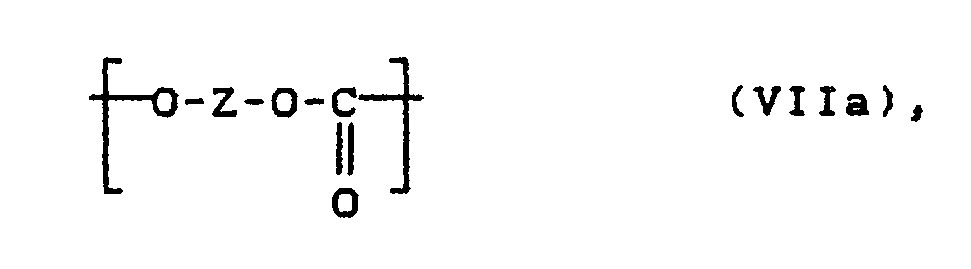
- the polycarbonates thus each contain 100 mol% of complementary amounts of other difunctional carbonate structural units, for example those of the formula (VIIa) thus in amounts from 0 mol% (inclusive) to 98 mol% inclusive, preferably from 0 mol% to 95 mol% and in particular from 0 mol% to 90 mol% and very particularly preferably 0 mol% to 80 mol%, based in each case on the total amount of 100 mol% of difunctional carbonate structural units in the polycarbonate.
- Polycarbonates based on cycloaliphatic bisphenols are known in principle and e.g. in EP-0 164 476, DE-OS 33 45 945, DE-OS 20 63 052, FR 14 27 998, WP 80 00 348, BE 785 189. They often have relatively high freezing temperatures, but other important physical properties such as UV and heat aging stability are insufficient.
- polycarbonates obtainable by the process of German patent application P 38 32 396.6 are isolated in a known manner by separating the organic phase obtained in the interfacial process, washing it neutral and free of electrolytes and then isolating it as granules, for example using an evaporation extruder.
- polycarbonates of German patent application P 38 32 396.6 can be added before or after their processing in the usual amounts of additives such as stabilizers, mold release agents, pigments, flame retardants, antistatic agents, fillers and reinforcing materials.
- carbon black, kieselguhr, kaolin, clays, CaF2, CaCO3, aluminum oxides, glass fibers and inorganic pigments can be added both as fillers and as nucleating agents, and as mold release agents, for example glycerol stearates, pentaerythritol tetrastearate and trimethylolpropentristearate.
- the polycarbonates of the German patent application P 38 32 396.6 can be processed into shaped articles by, for example, extruding the polycarbonates isolated in a known manner into granules and processing these granules, if appropriate after the addition of the additives mentioned above, by injection molding to various articles in a known manner.
- the polycarbonates of the German patent application P 38 32 396.6 can be used as moldings wherever the previously known polycarbonates have been used, i.e. in the electrical sector and in the construction sector for covers and glazing, and specifically when increased heat resistance with good processability, i.e. when complicated Components with high heat resistance are required.
- the glass transition temperature or glass transition temperature is measured by differential scanning calorimetry (DSC).
- the glass transition temperature of the polymer was determined to be 233 ° C. (DSC).
- the glass transition temperature of the polymer was determined to be 212 ° C. (DSC).
- the polycarbonate showed a relative solution viscosity of 1.386.
- the glass transition temperature of the polymer was determined to be 195 ° C. (DSC).
- the polycarbonate showed a relative solution viscosity of 1.437.
- the glass transition temperature of the polymer was determined to be 180 ° C. (DSC).
- the glass transition temperature of the polymer was determined to be 234 ° C. (DSC).
- the formation of primary radicals under UV radiation with a mercury vapor lamp (edge filter 305 nm) was determined in comparison to a polycarbonate based on the 2,2-bis (4-hydroxyphenyl) propane. It was found that the polycarbonate according to Example B1 has a lower primary radical formation rate and therefore a higher UV resistance.
- German patent application P 3 837 090.5 (Le A 26 402) also describes films made from the aforementioned polycarbonates.
- composite films of these polycarbonate films with films made of other plastics are also described in this application.
- mold release agents can also be used for the polycarbonates based on the diphenols of the formula (I), as described, for example, in German Patents 2,064,095 (Le A 13 461), 2 220 185 (Le A 14 329), 2 507 748 (Le A 16 284), 2 701 725 (Le A 17 784), 2 620 257 (Le A 17 163) and 2 708 467 (Le A 17 847) are listed.
- Suitable mold release agents of this type are, for example, Loxiole® G31 and G 47 (commercial products from Henkel, Düsseldorf), ester mixtures from stearyl alcohol with unbranched, aliphatic, saturated C20-C24 fatty acids, ester mixtures of the glycerides of lauric acid, myristic acid and palmitic acid (1: 1: 1).
- suitable mold release agents are the cerotinic esters of ceryl alcohol, the cerotinic esters of myricyl alcohol, and the palmitic esters of myricyl alcohol, pentaerythritol tristearate and trimethylolpropane palmitic acid-stearic acid mixed esters.
- Suitable mold release agents are, for example, also polycaprolactones according to DE-OS 2 622 412 (Mo-1528-I) and oxidized polyethylenes according to DE-OS 3 704 666 (Le A 24 915).
- the present invention thus relates to the polycarbonates of German patent application P 3 832 396.6 (Le A 26 344) with a release agent content in amounts of 0.01% by weight to 3% by weight, preferably 0.05% by weight. -% to 2.5 wt .-% and in particular from 0.1 wt .-% to 2 wt .-%, preferably as a mold release fatty acid ester of monoalcohols, trial alcohols, tetraalcohols or bisphenols, polycaprolactones and / or oxidized polyethylenes can be used.
- phosphite esters examples include tris (3-ethyloxethanyl-3-methyl) phosphite, triphenyl phosphite, tris (tetrahydrofuranyl-2) methylphosphite, Weston® 618, a commercial product from General Electric and Irgafos® 168, a commercial product from the company. Ciba Geigy, tridecyl phosphite and tris (p-tert-butylphenyl) phosphite.
- oxetane compounds are 3-hydroxymethyl-3-methyloxetone, 3-hydroxymethyl-3-amyloxetane, bis - [(3-ethyloxetanyl-3) methyl] carbonate, 3-phenoxymethyl-3-ethyloxetane and [3-ethyloxetanyl-3 ] methyl stearate.
- Examples of combinations of phosphite esters with oxetane compounds are, for example, mixtures of triphenyl phosphite with 3-hydroxymethyl-3-methyloxetane or with 3-hydroxymethyl-3-amyloxetane.
- the present invention thus also relates to the polycarbonates of German patent application P 3 832 396.6 (Le A 26 344) with a content of neutral esters of phosphorous acid in amounts of 0.001% by weight to 3% by weight, preferably 0, 01% by weight to 3% by weight and in particular from 0.05% by weight to 2% by weight, and optionally with a content of oxetane compounds in amounts of 0.05% by weight to 5% by weight %, preferably from 0.1% by weight to 3% by weight and in particular from 0.2% by weight to 2% by weight, based in each case on the weight of polycarbonate.
- thermal stabilizers are also phosphines as described in EP-PS 0 143 906 (Le A 22 588) and EP-PS 0 043 998 (Le A 20 430).
- Suitable phosphines are, for example, those of the formula (IX) (R6) 2-P-R5 (IX), in which R6 is an unsubstituted or substituted C6-C14 aryl and R5 is R or an unsubstituted or substituted C1-C18 alkyl.
- the preferred phosphine is triphenylphosphine, optionally in combination with oxetane compounds.
- the present invention thus also relates to the polycarbonates of German patent application P 3 832 396.6 (Le A 26 344) with a phosphine content in amounts of 0.001% by weight to 2% by weight, preferably of 0.01% by weight. % to 1 wt .-% and optionally with a content of oxetane compounds in amounts of 0.05 wt .-% to 5 wt .-%, preferably from 0.1 wt .-% to 3 wt .-%, based on weight Polycarbonate.
- Suitable stabilizers against moisture are also epoxy group-containing copolymers, as are described, for example, in German Patent DOS 2 019 325 or in US Pat. No. 3,761,440.
- the reactants for the vinyl monomers containing epoxide groups can be e.g. the following monomers are used: ethylene, propylene, isobutylene, vinyl chloride, vinylidene chloride, acrylic and methacrylic acid esters, amides and nitriles, vinyl acetate, propionate and benzoate, vinyl methyl ethyl and isobutyl ether, styrene, ⁇ -methylstyrene, Vinyl toluene, p-ethyl styrene, 2,4-dimethyl styrene, o-chlorostyrene and 2,5-dichlorostyrene.
- Suitable vinyl monomers containing epoxy groups are, for example, glycidyl esters of unsaturated carboxylic acids (glycidyl methacrylate), glycidyl ethers of unsaturated alcohols (allyl glycidyl ethers) and of alkenylphenols (isopropenylphenylglycidyl ether), vinyl and allyl esters of epoxycarboxylic acids (vinyl esters) of epoxidized oleic acid.
- all compounds which contain both a polymerizable unsaturated group and reactive epoxide groups in the molecule can be used to prepare the copolymers.
- Copolymers of glycidyl methacrylate, methyl methacrylate and styrene are particularly suitable.
- the copolymers which can be obtained by known processes, e.g. by a radical polymerization in chlorobenzene at 80 ° C in 50% solution, whose molecular weights, which have no significant influence on the properties of the pigmented polycarbonates, can be between about 20,000 and about 100,000, preferably between about 40,000 and about 80,000 and which advantageously contain about 5 to 500, preferably about 20 to about 200, epoxy groups per macromolecule are appropriately in amounts of about 5 to about 100% by weight, preferably in amounts of about 10 to about 30% by weight, based on the pigment content used.
- An example of such an epoxy-containing polymer is a copolymer of glycidyl acrylate, methyl methacrylate and styrene in a weight ratio of 20:20:60.
- epoxy stabilizers are 3,4-epoxycyclohexylmethyl-3,4-epoxycyclohexane carboxylate and bis (3,4-epoxycyclohexyl) adipate.
- the present invention thus also relates to the polycarbonates of German patent application P 3 832 396.6 (Le A 26 344) containing stabilizers containing epoxy groups, in particular copolymers containing epoxy groups, in quantities of 0.01% by weight to 5% by weight. , preferably from 0.1% by weight to 3% by weight, optionally in combination with pigments in the customary amounts, based in each case on the weight of polycarbonate.
- alkali and alkaline earth metal salts in particular alkyl-substituted aromatic sulfonic acids, such as, for example, lithium dodecylbenzenesulfonate, and alkali metal or alkaline earth metal salts of sulfosuccinic acid esters, such as, for example, sodium bis- (2-ethylhexyl) sulfosuccinate, are suitable as antistatic agents (see DOS 2 931 172 (Le A 19 826) and DOS 3 736 749 (Le A 25 548)).
- the present invention thus also relates to the polycarbonates of German patent application P 3 832 396.6 (Le A 26 344) with an antistatic content in amounts of 0.01% by weight to 5% by weight, preferably 0.01% by weight. -% to 2 wt .-%, based on the weight of polycarbonate.
- the antistatic agents mentioned are particularly suitable for the antistatic treatment of the polycarbonate films of German patent application P 3 837 090.5 (Le A 26 402).
- glass balls or BaSO4 can be added to the polycarbonates of German patent application P 3 832 396.6 (Le A 26 344) as fillers in addition to glass fibers, in particular if one wants to use them to produce opaque plates or other moldings.
- the addition of glass balls is described in DE-PS 2 721 885 (Le A 17 879) and the addition of BaSO4 for example in DE-OS 2 251 708.
- the present invention thus also relates to the polycarbonates of German patent application P 3 832 396.6 (Le A 26 344), the glass balls or BaSO4 in amounts of 0.1% by weight to 50% by weight, preferably 1% by weight. % to 25 wt .-%, based on the weight of polycarbonate.
- Suitable blowing agents are, for example, mixtures of 1,4-butanediol-bis- (carbonic acid ester-benzoic acid anhydride) and silicon dioxide according to DE-PS 2 441 418 (Le A 15 931) or mixtures of compounds of the formula (XII) wherein R1 to R4 are the same or different hydrogen, straight-chain or branched alkyl radicals having 1 to 4 carbon atoms, hydroxyl or nitro groups or halogen atoms and R2 also a molecular radical of the following formula where n can vary from 0-4, the radicals R1, R3 and R4 have the meaning given above and X is hydrogen or straight-chain or branched alkyl radicals having 1-4 carbon atoms, in combination with compounds of the general formula (XIII) A p EF q (XIII) where A is an element of the first main group of the periodic system, E is an element of the third, fourth or fifth main or subgroup of the periodic system Systems, F stands for fluorine,
- Suitable blowing agents are also tetrazoles such as 5-phenyltetrazole according to US Pat. No. 4,263,409.
- the present invention thus also relates to the polycarbonates of German patent application P 3 832 396.6 (Le A 26 344) containing propellants or propellant mixtures in amounts of 0.01% by weight to 10% by weight, preferably 0 , 02% by weight to 5% by weight, based on the weight of polycarbonate.
- Suitable blowing agents or mixtures are, for example: 5-phenyltetrazole, isatoic anhydride in combination with potassium tetrafluoroborate, di- (2-phenyl-1,3,4-oxadiazolon- (5)) - terephthalamide, optionally in combination with cyanuric acid and phenyldihydrooxadiazinon.
- the additives mentioned can be incorporated individually or in groups, preferably in extruders or kneaders, into the polycarbonates. In many cases, the additives can be added to the polycarbonates mentioned during production or even from the starting materials. The additives can also be added to solutions of the polycarbonates mentioned and the solvents can then be evaporated off.
- a copolycarbonate based on 1,1-bis (4-hydroxyphenyl) -3,3,5-trimethylcyclohexane and 2,2- (4-hydroxyphenyl) propane was used in a molar ratio of 35:65 with a relative Solution viscosity of 1.295 (measured in methylene chloride at 25 ° C and a concentration of 0.5 g / 100 ml) was used.
- the standard color values Y were determined after hot air aging at 150 ° C. in accordance with ASTM-D 1925.
- the copolycarbonate contained 0.1% by weight of tris (3-ethyloxetanyl-3-methyl) phosphite as a thermal stabilizer.
- H Standard color value Y 0 87.7 200 87.9 600 86.4 1,000 84.7
- the standard color values Y were determined in accordance with ASTM-D 1925 and the turbidity in accordance with DIN 5036 on a sample of the above-mentioned copolycarbonate which had aged 150 ° C. and contained 0.05% by weight of triphenylphosphine as a thermal stabilizer.
Landscapes
- Chemical & Material Sciences (AREA)
- Health & Medical Sciences (AREA)
- Chemical Kinetics & Catalysis (AREA)
- Medicinal Chemistry (AREA)
- Polymers & Plastics (AREA)
- Organic Chemistry (AREA)
- Compositions Of Macromolecular Compounds (AREA)
- Polyesters Or Polycarbonates (AREA)
Abstract

R¹ und R² unabhängig voneinander Wasserstoff, Halogen, C₁-C₈-Alkyl, C₅-C₆-Cycloalkyl, C₆-C₁₀-Aryl, und C₇-C₁₂-Aralkyl,
m eine ganze Zahl von 4 bis 7,
R³ und R⁴, für jedes X individuell wählbar, unabhänging voneinander Wasserstoff oder eines C₁-C₆-Alkyl
und
X Kohlenstoff bedeuten,
mit der Maßgabe, daß an mindestens einem Atom X, R³ und R⁴ gleichzeitig Alkyl ist,
mit einem Gehalt an üblichen Additiven, ausgewählt aus Entformungsmitteln, Stabilisatoren, Antistatika, Trübungsmitteln und Treibmitteln.
Description
- Gegenstand der Erfindung der deutschen Patentanmeldung P 3 832 396.6 (Le A 26 344) sind Dihydroxydiphenylcycloalkane der Formel (I)

R¹ und R² unabhängig voneinander Wasserstoff, Halogen, bevorzugt Chlor oder Brom, C₁-C₈-Alkyl, C₅-C₆-Cycloalkyl, C₆-C₁₀-Aryl, bevorzugt Phenyl, und C₇-C₁₂-Aralkyl, bevorzugt Phenyl-C₁-C₄-Alkyl, insbesondere Benzyl,
m eine ganze Zahl von 4 bis 7, bevorzugt 4 oder 5,
R³ und R⁴, für jedes X individuell wählbar, unabhängig voneinander Wasserstoff oder C₁-C₆-Alkyl
und
X Kohlenstoff bedeuten,
mit der Maßgabe, daß an mindestens einem Atom X R³ und R⁴ gleichzeitig Alkyl bedeuten. - Bevorzugt sind an 1 - 2 Atomen X, insbesondere nur an einem Atom X, R³ und R⁴ gleichzeitig Alkyl. Bevorzugter Alkylrest ist Methyl; die X-Atome in α-Stellung zu dem di-phenyl-substituierten C-Atom (C-1) sind bevorzugt nicht dialkylsubstituiert, dagegen ist die Alkyldisubstitution in β-Stellung zu C-1 bevorzugt. Insbesondere sind Gegenstand der Erfindung Dihydroxydiphenylcycloalkane mit 5 und 6 Ring-C-Atomen im cycloaliphatischen Rest (m = 4 oder 5 in Formel (I) wie beispielsweise die Diphenole der Formeln

- Die Dihydroxydiphenylcycloalkane der Formel (I) können in an sich bekannter Weise durch Kondensation von Phenolen der Formel (V)


- Die Phenole der Formel (V) sind entweder literaturbekannt oder nach literaturbekannten Verfahren erhältlich (siehe beispielsweise für Kresole und Xylenole, Ullmanns Encyklopädie der technischen Chemie 4. neubearbeitete und erweiterte Auflage Band 15, Seiten 61 - 77, Verlag Chemie-Weinheim-New York 1978; für Chlorphenole, Ullmanns Encyklopädie der technischen Chemie, 4. Auflage, Verlag Chemie, 1975, Band 9, Seiten 573-582; und für Alkylphenole, Ullmanns Encyklopädie der technischen Chemie, 4. Auflage, Verlag Chemie 1979, Band 18, Seiten 191-214).
- Beispiele für geeignete Phenole der Formel (V) sind: Phenol, o-Kresol, m-Kresol, 2,6-Dimethylphenol, 2-Chlorphenol, 3-Chlorphenol, 2,6-Dichlorphenol, 2-Cyclohexylphenol, Diphenylphenol und o,- oder p-Benzylphenole.
- Die Ketone der Formel (VI) sind literaturbekannt (siehe beispielsweise) Beilsteins Handbuch der Organischen Chemie, 7. Band, 4. Auflage, Springer-Verlag, Berlin, 1925 und die entsprechenden Ergänzungsbände 1 bis 4, und J. Am. Chem. Soc. Vol 79 (1957), Seiten 1488, 1490 und 1491, US-PS 2 692 289, Allen et al., J. Chem. Soc., (1954), 2186, 2191 und J. Org. Chem. Vol 38, No. 26, (1973), Seiten 4431 ff, J. Am. Chem. Soc. 87, (1965), Seite 1353 ff, insbesondere Seite 1355. Ein allgemeines Verfahren zur Herstellung von Ketonen der Formel (VI) ist beispielsweise in "Organikum, 15. Auflage, 1977, VEB-Deutscher Verlag der Wissenschaften, Berlin, beispielsweise Seite 698. beschrieben.
- Beispiele für bekannte Ketone der Formel (VI) sind:
3,3-Dimethylcyclopentanon, 2,2-Dimethylcyclohexanon, 3,3-Dimethylcyclohexanon, 4,4-Dimethylcyclohexanon, 3-Ethyl-3-Methylcyclopentanon, 2,3,3-Trimethylcyclopentanon, 2,4,4-Trimethylcyclopentanon, 3,3,4-Trimethylcyclopentanon, 3,3-Dimethylcycloheptanon, 4,4-Dimethylcycloheptanon, 3-Ethyl-3-methylcyclohexanon, 4-Ethyl-4-methylcyclohexanon, 2,3,3-Trimethylcyclohexanon, 2,4,4-Trimethylcyclohexanon, 3,3,4-Trimethylcyclohexanon, 2,5,5-Trlmethylcyclohexanon, 3,3,5-Trimethylcyclohexanon, 3,4,4-Trimethylcyclohexanon, 2,3,3,4-Tetramethylcyclopentanon, 2,3,4,4-Tetramethylcyclopentanon, 3,3,4,4-Tetramethylcyclopentanon, 2,2,5-Trimethylcycloheptanon, 2,2,6-Trimethylcycloheptanon, 2,6,6-Trimethylcycloheptanon, 3,3,5-Trimethylcycloheptanon, 3,5,5-Trimethylcycloheptanon, 5-Ethyl-2,5-dimethylcycloheptanon, 2,3,3,5-Tetramethylcycloheptanon, 2,3,5,5-Tetramethylcycloheptanon, 3,3,5,5-Tetramethylcycloheptanon, 4-Ethyl-2,3,4-trimethylcyclopentanon, 2-Isopropyl-4,4-dimethylcyclopentanon, 4-Isopropyl-2,4-dimethylcyclopentanon, 2-Ethyl-3,5,5-trimethylcyclohexanon, 3-Ethyl-3,5,5-trimethylcyclohexanon, 3-Ethyl-4-isopropyl-3-methyl-cyclopentanon, 4-sec. Butyl-3,3-dimethylcyclopentanon, 2-Isopropyl-3,3,4-trimethylcyclopentanon, 3-Ethyl-4-isopropyl-3-methyl-cyclohexanon, 4-Ethyl-3-isopropyl-4-methyl-cyclohexanon, 3-sec.Butyl-4,4-dimethylcyclohexanon, 3-Isopropyl-3,5,5-trimethylcyclohexanon, 4-Isopropyl-3,5,5-trimethylcyclohexanon, 3,3,5-Trimethyl-5-propylcyclohexanon, 3,5,5-Trimethyl-5-propyl cyclohexanon, 2-Butyl-3,3,4-trimethylcyclopentanon, 2-Butyl-3,3,4-trimethylcyclohexanon, 4-Butyl-3,3,5-trimethylcyclohexanon, 3-Isohexyl-3-methylcyclohexanon, 5-Ethyl-2,4-diisopropyl-5-methylcyclohexanon, 2,2-Dimethylcyclooctanon, und 3,3,8-Trimethylcyclooctanon. - Beispiele für bevorzugte Ketone sind

- Zur Bisphenolherstellung werden im allgemeinen 2 bis 10 Mol, vorzugsweise 2,5 bis 6 Mol Phenol (V) pro Mol Keton (VI), verwendet. Bevorzugte Reaktionszeiten betragen 1 bis 100 Stunden. Im allgemeinen arbeitet man bei Temperaturen von -30°C bis 300°C, vorzugsweise von -15°C bis 150°C und bei Drücken von 1 bis 20 bar, vorzugsweise von 1 bis 10 bar.
- Die Kondensation wird im allgemeinen in Gegenwart saurer Katalysatoren durchgeführt. Beispiele sind Chlorwasserstoff, Bromwasserstoff, Fluorwasserstoff, Bortrifluorid, Aluminiumtrichlorid, Zinkdichlorid, Titantetrachlorid, Zinntetrachlorid, Phosphorhalogenide, Phosphorpentoxid, Phosphorsäure, konzentrierte Salzsäure oder Schwefelsäure sowie Mischungen aus Essigsäure und Acetanhydrid. Die Verwendung saurer Ionenaustauscher ist ebenfalls möglich.
- Weiterhin kann die Umsetzung durch Zugabe von Co-Katalysatoren wie C₁-C₁₈-Alkyl-Mercaptanen, Schwefelwasserstoff, Thiophenolen, Thiosäuren und Dialkylsulfiden beschleunigt werden.
- Die Kondensation kann ohne Lösungsmittel oder in Gegenwart eines inerten Lösungsmittels (z.B. aliphatischer und aromatischer Kohlenwasserstoff, Chlorkohlenwasserstoff) durchgeführt werden.
- In den Fällen, in denen der Katalysator gleichzeitig als wasserentziehendes Mittel fungiert, ist es nicht erforderlich, zusätzlich wasserentziehende Mittel einzusetzen, letzteres ist jedoch zur Erzielung guter Umsätze in jedem Fall dann vorteilhaft, wenn der eingesetzte Katalysator das Reaktionswasser nicht bindet.
- Geeignete wasserentziehende Mittel sind beispielsweise Acetanhydrid, Zeolithe, Polyphosphorsäure und Phosphorpentoxid.
- Gegenstand der Erfindung der deutschen Patentanmeldung P 38 32 396.6 ist somit außerdem ein Verfahren zur Herstellung der Dihydroxydiphenylcycloalkane der Formel (I)

R¹ und R² unabhängig voneinander Wasserstoff, Halogen, bevorzugt Chlor oder Brom, C₁-C₈-Alkyl, C₅-C₆-Cycloalkyl, C₆-C₁₀-Aryl, bevorzugt Phenyl, und C₇-C₁₂-Aralkyl, bevorzugt Phenyl-C₁-C₄-Alkyl, insbesondere Benzyl,
m eine ganze Zahl von 4 bis 7, bevorzugt 4 oder 5, sind,
R³ und R⁴, für jedes X individuell wählbar, unabhängig voneinander Wasserstoff oder C₁-C₆-Alkyl
und
X Kohlenstoff ist
mit der Maßgabe, daß an mindestens einem Atom X R³ und R⁴ gleichzeitig Alkyl bedeuten,
das dadurch gekennzeichnet ist, daß man Phenole der Formel (V)
R¹ und R² die für Formel (I) angegebene Bedeutung haben,
mit Ketonen der Formel (VI)
X, m, R³ und R⁴ die für Formel (I) angegebene Bedeutung haben,
im Molverhältnis (V) : (VI) zwischen 2:1 und 10:1, vorzugsweise zwischen 2,5:1 und 6:1 bei Temperaturen zwischen -30°C und 300°C, vorzugsweise zwischen -15°C und 150°C und bei Drücken von 1 bis 20 bar, vorzugsweise von 1 bis 10 bar in Anwesenheit saurer Katalysatoren und gegebenenfalls in Anwesenheit von Co-Katalysatoen und/oder Lösungsmitteln und/oder wasserentziehenden Mitteln umsetzt. - Bevorzugt sind in Formel (I) an 1 - 2 Atomen X, insbesondere nur an einem Atom X, R³ und R⁴ gleichzeitig Alkyl. Bevorzugter Alkylrest ist Methyl; ebenfalls verwendbar sind Ethyl oder C₃-C₆-Alkylreste, die geradkettig oder verzweigt sein können. Die X-Atome in α-Stellung zu dem di-phenylsubstituierten C-Atom (C-1) sind bevorzugt nicht dialkylsubstituiert, dagegen ist die Disubstitution mit Alkyl in β-Stellung in C-1 bevorzugt.
- In manchen Fällen verläuft die Reaktion nicht ganz einheitlich, d.h. es können mehrere, unterschiedliche Produkte entstehen, so daß die gewünschte Verbindung zunächst aus einem Gemisch isoliert werden muß. Für Einzelheiten der Kondensation sei auf Schnell, Chemistry und Physics of Polycarbonates, Interscience Publishers, New York 1964 verwiesen. Manchmal kann die Reaktion durch Wahl entsprechender Katalysatoren und Reaktionsbedingungen so gesteuert werden, daß die gewünschte Verbindung ausfällt oder auskristallisiert, was deren Isolierung erleichtert.
- In einem 1 l-Rundkolben mit Rührer, Tropftrichter, Thermometer, Rückflußkühler und Gaseinleitungsrohr werden 7,5 Mol (705 g) Phenol und 0,15 Mol (30,3 g) Dodecylthiol vorgelegt und bei 28 bis 30°C mit trockenem HCl-Gas gesättigt. Zu dieser Lösung werden innerhalb von 3 Stunden eine Losung von 1,5 Mol (210 g) Dihydroisophoron (3,3,5-Trimethyl-cyclohexan-1-on) und 1,5 Mol (151 g) Phenol zugetropft, wobei weiterhin HCl-Gas durch die Reaktionslösung zugeleitet wird. Nach beendeter Zugabe leitet man für weitere 5 Stunden HCl-Gas ein. Man läßt 8 h bei Zimmertemperatur nachreagieren. Anschließend wird das überschüssige Phenol durch Wasserdampfdestillation entfernt. Der verbleibende Rückstand wird zweimal mit Petrolether (60-90) und einmal mit Methylenchlorid heiß extrahiert und abfiltriert.
Ausbeute: 370 g
Schmelzpunkt: 205 bis 207°C - Die Diphenole der Formel (I) sind insbesondere geeignet zur Herstellung von hochmolekularen, thermoplastischen Polycarbonaten, die sich durch hohe Wärmeformbeständigkeit in Kombination mit einem guten sonstigen Eigenschaftsbild auszeichnen.
- Gegenstand der Erfindung der deutschen Patentanmeldung P 3 832 396.6 ist somit auch die Verwendung der Diphenole der Formel (I) zur Herstellung von hochmolekularen thermoplastischen, aromatischen Polycarbonaten.
- Es können sowohl ein Diphenol der Formel (I) unter Bildung von Homopolycarbonaten als auch mehrere Diphenole der Formel (I) unter Bildung von Copolycarbonaten verwendet werden.
- Außerdem können die Diphenole der Formel (I) auch im Gemisch mit anderen Diphenolen, beispielsweise mit denen der Formel HO-Z-OH (VII), zur Herstellung von hochmolekularen, thermoplastischen, aromatischen Polycarbonaten verwendet werden.
- Geeignete andere Diphenole der Formel HO-Z-OH (VII) sind solche, in denen Z ein aromatischer Rest mit 6 bis 30 C-Atomen ist, der einen oder mehrere aromatische Kerne enthalten kann, substituiert sein kann und aliphatische Reste oder andere cycloaliphatische Reste als die der Formel (I) oder Heteroatome als Brückenglieder enthalten kann.
- Beispiele für Diphenole der Formel (VII) sind Hydrochinon,
Resorcin,
Dihydroxydiphenyle,
Bis-(hydroxyphenyl)-alkane,
Bis-(hydroxyphenyl)-cycloalkane,
Bis-(hydroxyphenyl)-sulfide,
Bis-(hydroxyphenyl)-ether,
Bis-(hydroxyphenyl)-ketone,
Bis-(hydroxyphenyl)-sulfone,
Bis-(hydroxyphenyl)-sulfoxide,
α,α′-Bis(hydroxyphenyl)-diisopropylbenzole
sowie deren kernalkylierte und kernhalogenierte Verbindungen. - Diese und weitere geeignete andere Diphenole sind z.B. in den US-PS 3 028 365, 2 999 835, 3 148 172, 3 275 601, 2 991 273, 3 271 367, 3 062 781, 2 970 131 und 2 999 846, in den deutschen Offenlegungsschriften 1 570 703, 2 063 050, 2 063 052, 2 211 956, der französischen Patentschrift 1 561 518 und in der Monographie "H. Schnell, Chemistry and Physics of Polycarbonates, Interscience Publishers, New York 1964", beschrieben.
- Bevorzugte andere Diphenole sind beispielsweise:
4,4′-Dihydroxydiphenyl,
2,2-Bis-(4-hydroxyphenyl)-propan,
2,4-Bis-(4-hydroxyphenyl)-2-methylbutan,
1,1-Bis-(4-hydroxyphenyl)-cyclohexan,
α,α′-Bis-(4-hydroxyphenyl)-p-diisopropylbenzol,
2,2-Bis-(3-methyl-4-hydroxyphenyl)-propan,
2,2-Bis-(3-chlor-4-hydroxyphenyl)-propan,
Bis-(3,5-dimethyl-4-hydroxyphenyl)-methan,
2,2-Bis-(3,5-dimethyl-4-hydroxyphenyl)-propan,
Bis-(3,5-dimethyl-4-hydroxyphenyl)-sulfon,
2,4-Bis-(3,5-dimethyl-4-hydroxyphenyl)-2-methylbutan,
1,1-Bis-(3,5-dimethyl-4-hydroxyphenyl)-cyclohexan,
α,α′-Bis-(3,5-dimethyl-4-hydroxyphenyl)-p-diisopropylbenzol,
2,2-Bis-(3,5-dichlor-4-hydroxyphenyl)-propan und
2,2-Bis-(3,5-dibrom-4-hydroxyphenyl )-propan. - Besonders bevorzugte Diphenole der Formel (VII) sind beispielsweise:
2,2-Bis-(4-hydroxyphenyl)-propan,
2,2-Bis-(3,5-dimethyl-4-hydroxyphenyl)-propan,
2,2-Bis-(3,5-dichlor-4-hydroxyphenyl)-propan,
2,2-Bis-(3,5-dibrom-4-hydroxyphenyl)-propan und
1,1-Bis-(4-hydroxyphenyl)-cyclohexan. - Insbesondere ist 2,2-Bis-(4-hydroxyphenyl)-propan bevorzugt.
- Die anderen Diphenole können sowohl einzeln als auch im Gemisch eingesetzt werden.
- Das molare Verhältnis von zu verwendenden Diphenolen der Formel (I) zu den gegebenenfalls mitzuverwendenden anderen Diphenolen, beispielsweise denen der Formel (VII), soll zwischen 100 Mol-% (I) zu 0 Mol-% anderem Diphenol und 2 Mol-%. (I) zu 98 Mol-% anderem Diphenol, vorzugsweise zwischen 100 Mol% (I) zu 0 Mol% anderem Diphenol und 5 Mol% (I) zu 95 Mol%. anderem Diphenol und insbesondere zwischen 100 Mol%(I) zu 0 Mol% anderem Diphenol und 10 Mol%. (I) zu 90 Mol%. anderem Diphenol und ganz besonders zwischen 100 Mol%. (I) zu 0 Mol% anderem Diphenol und 20 Mol% (I) zu 80 Mol% anderem Diphenol liegen.
- Die hochmolekularen Polycarbonate aus den Diphenolen der Formel (I), gegebenenfalls in Kombination mit anderen Diphenolen können nach den bekannten Polycarbonatherstellungsverfahren hergestellt werden. Dabei können die verschiedenen Diphenole sowohl statistisch als auch blockweise miteinander verknüpft sein.
- Gegenstand der Erfindung der deutschen Patentanmeldung P 3 832 396.6 ist somit auch ein Verfahren zur Hestellung von hochmolekularen thermoplastischen, aromatischen Polycarbonaten aus Diphenolen, gegebenenfalls Kettenabbrechern und gegebenenfalls Verzweigern nach den bekannten Methoden der Polycarbonatherstellung, vorzugsweise nach dem Zweiphasengrenzflächenverfahren, das dadurch gekennzeichnet ist, daß man als Diphenole solche der Formel (I) in Mengen von 100 Mol-% bis 2 Mol-%, vorzugsweise in Mengen von 100 Mol-% bis 5 Mol-% und insbesondere in Mengen von 100 Mol-% bis 10 Mol-%, und ganz besonders 100 Mol-% bis 20 Mol-%, bezogen jeweils auf die Gesamtmolmenge an eingesetzten Diphenolen, verwendet.
- Als Verzweiger dienen, falls benutzt, in bekannter Weise geringe Mengen, vorzugsweise Mengen zwischen 0,05 und 2,0 Mol% (bezogen auf eingesetzte Diphenole), an drei oder mehr als dreifunktionellen Verbindungen, insbesondere solchen mit drei oder mehr als drei phenolischen Hydroxylgruppen, um verzweigte Polycarbonate zu erhalten. Einige der verwendbaren Verbindungen mit drei oder mehr als drei phenolischen Hydroxylgruppen sind
- Phloroglucin,
4,6-Dimethyl-2,4,6-tri-(4-hydroxyphenyl)-hepten-2,
4,6-Dimethyl-2,4,6-tri-(4-hydroxyphenyl)-heptan,
1,3,5-Tri-(4-hydroxyphenyl)-benzol,
1,1,1-Tri-(4-hydroxyphenyl)-ethan,
Tri-(4-hydroxyphenyl)-phenylmethan,
2,2-Bis-(4,4-bis-(4-hydroxyphenyl)-cyclohexyl)-propan,
2,4-Bis-(4-hydroxyphenyl-isopropyl)-phenol,
2,6-Bis-(2-hydroxy-5′-methyl-benzyl)-4-methylphenol,
2-(4-Hydroxyphenyl)-2-(2,4-dihydroxyphenyl)-propan,
Hexa-(4-(4-hydroxyphenyl-isopropyl)-phenyl)-ortho-terephthalsäureester,
Tetra-(4-hydroxyphenyl)-methan,
Tetra-(4-(4-hydroxyphenyl-isopropyl)-phenoxy)-methan
und
1,4-Bis-((4′-,4˝-dihydroxytriphenyl)-methyl)-benzol. - Einige der sonstigen dreifunktionellen Verbindungen sind 2,4-Dihydroxybenzoesäure, Trimesinsäure, Cyanurchlorid und 3,3-Bis-(3-methyl-4-hydroxyphenyl)-2-oxo-2,3-dihydroindol.
- Als Kettenabbrecher zur Regelung des Molekulargewichts dienen in bekannter Weise monofunktionelle Verbindungen in üblichen Konzentrationen. Geeignete Verbindungen sind z.B. Phenol, tert.-Butylphenole oder andere Alkyl-C₁-C₇-substituierte Phenole. Zur Regelung des Molekulargewichts sind insbesondere kleine Mengen Phenole der Formel (VIII) geeignet

- Die Polycarbonate der deutschen Patentanmeldung P 38 32 396.6 können vorzugsweise nach dem Phasengrenzflächenverfahren (vgl. H. Schnell, "Chemistry and Physics of Polycarbonates", Polymer Reviews, Vol. IX, Seite 33 ff ., Interscience Publ., 1964) in an sich bekannter Weise hergestellt werden. Hierbei werden die Diphenole der Formel (I) in wäßrig alkalischer Phase gelöst. Zur Herstellung von Co-Polycarbonaten mit anderen Diphenolen werden Gemische von Diphenolen der Formel (I) und den anderen Diphenolen, beispielsweise denen der Formel (VII), eingesetzt. Zur Regulierung des Molekulargewichtes können Kettenabbrecher z.B. der Formel (VIII) zugegeben werden. Dann wird in Gegenwart einer inerten, vorzugsweise Polycarbonat lösenden, organischen Phase mit Phosgen nach der Methode der Phasengrenzflächenkondensation umgesetzt. Die Reaktionstemperatur liegt zwischen 0°C und 40°C.
- Die gegebenenfalls mitzuverwendenden 0,05 bis 2 Mol-% an Verzweigern können entweder mit den Diphenolen in der wäßrig alkalischen Phase vorgelegt werden oder in dem organischen Lösungsmittel gelöst vor der Phosgenierung zugegeben werden.
- Neben den einzusetzenden Diphenolen der Formel (I) sowie den anderen Diphenolen (VII) können auch deren Mono- und/oder Bis-chlorkohlensäureester mitverwendet werden, wobei diese in organischen Lösungsmitteln gelöst zugegeben werden. Die Menge an Kettenabbrechern sowie an Verzweigern richtet sich dann nach Molen Diphenolat-Struktureinheiten von (I) und gegebenenfalls von den anderen Di-phenolen wie beispielsweise von (VII); ebenso kann bei Einsatz von Chlorkohlensäureestern die Phosgenmenge in bekannter Weise entsprechend reduziert werden.
- Geeignete organische Lösungsmittel für die Lösung der Kettenabbrecher sowie gegebenenfalls für die Verzweiger und die Chlorkohlensäureester sind beispielsweise Methylenchlorid, Chlorbenzol, Aceton, Acetonitril sowie Mischungen dieser Lösungsmittel, insbesondere Mischungen aus Methylenchlorid und Chlorbenzol. Gegebenenfalls können die verwendeten Kettenabbrecher und Verzweiger im gleichen Solvens gelöst werden.
- Als organische Phase für die Phasengrenzflächenpolykondensation dient beispielsweise Methylenchlorid, Chlorbenzol sowie Mischungen aus Methylenchlorid und Chlorbenzol.
- Als wäßrige alkalische Phase dient beispielsweise wäßrige NaOH-Lösung.
- Die Herstellung der Polycarbonate nach dem Phasengrenzflächenverfahren kann in üblicher Weise durch Katalysatoren wie tertiäre Amine, insbesondere tertiäre aliphatische Amine wie Tributylamin oder Triethylamin katalysiert werden; die Katalysatoren können in Mengen von 0,05 bis 10 Mol-%, bezogen auf Mole an eingesetzten Diphenolen eingesetzt werden. Die Katalysatoren können vor Beginn der Phosgenierung oder während oder auch nach der Phosgenierung zugesetzt werden.
- Die Isolierung der Polycarbonate erfolgt in bekannter Weise.
- Die hochmolekularen, thermoplastischen, aromatischen Polycarbonate können auch nach dem bekannten Verfahren in homogener Phase, dem sogenannten "Pyridinverfahren" sowie nach dem bekannten Schmelzumesterungsverfahren unter Verwendung von beispielsweise Diphenylcarbonat anstelle von Phosgen hergestellt werden. Auch hier werden die erfindungsgemäßen Polycarbonate in bekannter Weise isoliert.
- Die nach dem Verfahren der deutschen Patentanmeldung P 38 32 396.6 erhältlichen Polycarbonate haben bevorzugt Molekulargewichte
M w (Gewichtsmittel, ermittelt durch Gelchromatographie nach vorheriger Eichung) von mindestens 10 000, besonders bevorzugt von 10 000 bis 200 000 und insbesondere von 20 000 bis 80 000. Sie können linear oder verzweigt sein, sie sind Homopolycarbonate oder Copolycarbonate auf Basis der Diphenole der Formel (I). - Gegenstand der Erfindung der deutschen Patentanmeldung P 38 32 396.6 sind somit auch hochmolekulare thermoplastische, aromatische Polycarbonate mit
M w (Gewichtsmittelmolekulargewichten) von mindestens 10 000, vorzugsweise von 10 000 bis 200 000 und insbesondere von 20 000 bis 80 000, erhältlich nach dem erfindungsgemäßen Verfahren aus Diphenolen der Formel (I), die linear oder verzweigt sind. - Gegenstand der Erfindung der deutschen Patentanmeldung P 38 32 396.6 sind somit auch hochmolekulare, thermoplastische, aromatische Polycarbonate mit
M w (Gewichtsmittelmolekulargewichten) von mindestens 10 000, vorzusweise von 10 000 bis 200 000 und insbesondere von 20 000 bis 80 000, die bifunktionelle Carbonatstruktureinheiten der Formel (Ia)
X, R¹, R², R³, R⁴ und m die für die Formel (I) genannte Bedeutung haben,
in Mengen von 100 Mol-% bis 2 Mol-%, vorzugsweise in Mengen von 100 Mol-% bis 5 Mol-% und insbesondere in Mengen von 100 Mol-% bis 10 Mol-% und ganz besonders 100 Mol-% bis 20 Mol-%, bezogen jeweils auf die Gesamtmenge von 100 Mol-% an difunktionellen Carbonatstruktureinheiten im Polycarbonat enthalten. - Die Polycarbonate enthalten somit jeweils zu 100 Mol-% komplementäre Mengen an anderen difunktionellen Carbonatstuktureinheiten, beispielsweise solchen der Formel (VIIa)
- Polycarbonate auf Basis von cycloaliphatischen Bisphenolen sind grundsätzlich bekannt und z.B. in EP-0 164 476, DE-OS 33 45 945, DE-OS 20 63 052, FR 14 27 998, WP 80 00 348, BE 785 189 beschrieben. Sie haben häufig relativ hohe Einfriertemperaturen, aber andere, wichtige physikalische Eigenschaften wie UV- und Wärmealterungsstabilität sind unzureichend.
- Es hat sich nun überraschenderweise gezeigt, daß wie bereits erwähnt durch den Einbau der erfindungsgemäßen Diphenole der Formel (I) neue Polycarbonate mit hoher Wärmeformbeständigkeit erhalten werden, die auch sonst ein gutes Eigenschaftsbild haben. Dies gilt insbesondere für die Polycarbonate auf Basis der Diphenole (I), in denen "m" 4 oder 5 ist, und ganz besonders für die Polycarbonate auf Basis der Diphenole (Ib)

R¹ und R² unabhängig voneinander die für Formel (I) genannte Bedeutung haben und besonders bevorzugt Wasserstoff sind. - Somit sind Gegenstand der Erfindung der deutschen Patentanmeldung P 38 32 396.6 vorzugsweise Polycarbonate, in denen die Struktureinheiten der Formel (Ia) eingeschränkt sind auf m = 4 oder 5 und ganz besonders solche der Formel (Ic) sind

R¹ und R² die für Formel (Ia) genannte Bedeutung haben, besonders bevorzugt aber Wasserstoff sind. - Diese Polycarbonate auf Basis der Diphenole der Formel (Ib), worin insbesondere R¹ und R² Wasserstoff sind, besitzen zur hohen Wärmeformbeständigkeit außerdem eine gute UV-Stabilität und ein gutes Fließverhalten in der Schmelze, was nicht zu erwarten war.
- Durch die beliebige Kombination mit anderen Diphenolen, insbesondere mit denen der Formel (VII) lassen sich zudem die Polycarbonateigenschaften in günstiger Weise variieren.
- Die Isolierung der nach dem Verfahren der deutschen Patentanmeldung P 38 32 396.6 erhältlichen Polycarbonate geschieht in bekannter Weise, indem man die bei Phasengrenzflächenverfahren erhaltene organische Phase abtrennt, neutral und elektrolytfrei wäscht und dann beispielsweise über einen Eindampfextruder als Granulat isoliert.
- Den Polycarbonaten der deutschen Patentanmeldung P 38 32 396.6 können noch vor oder nach ihrer Verarbeitung die für thermoplastische Polycarbonate üblichen Additive wie Stabilisatoren, Entformungsmittel, Pigmente, Flammschutzmittel, Antistatika, Füllstoffe und Verstärkungsstoffe in den üblichen Mengen zugesetzt werden.
- Im einzelnen können beispielsweise Ruß, Kieselgur, Kaolin, Tone, CaF₂, CaCO₃, Aluminiumoxide, Glasfasern und anorganische Pigmente sowohl als Füllstoffe als auch als Nucleierungsmittel zugesetzt werden, sowie als Entformungsmittel beispielsweise Glycerinstearate, Pentaerythrittetrastearat und Trimethylolpropentristearat.
- Die Polycarbonate der deutschen Patentanmeldung P 38 32 396.6 können zu Formkörpern verarbeitet werden, indem man beispielsweise die in bekannter Weise isolierten Polycarbonate zu Granulat extrudiert und dieses Granulat gegebenenfalls nach Zusatz der obengenannten Additive durch Spritzguß zu verschiedenen Artikeln in bekannter Weise verarbeitet.
- Die Polycarbonate der deutschen Patentanmeldung P 38 32 396.6 sind als Formkörper überall dort einsetzbar, wo die bislang bekannten Polycarbonate eingesetzt wurden, also im Elektrosektor sowie im Bausektor für Abdeckungen und Verglasungen, und zwar dann, wenn erhöhte Wärmeformbeständigkeit bei gleichzeitig guter Verarbeitbarkeit, also wenn komplizierte Bauteile hoher Wärmeformbeständigkeit verlangt werden.
- In den nachfolgenden Beispielen B.1 bis B.5 wird die relative Viskosität gemessen an 0,5 Gew.-%igen Lösung des Polycarbonats in CH₂Cl₂.
- Die Einfriertemperatur oder Glastemperatur wird gemessen durch Differential Scanning Calorimetry (DSC).
- 30,94 g (0,1 Mol) des Diphenols (II), 33,6 g (0,6 Mol) KOH und 560 g Wasser werden in einer Inertgas-Atmosphäre unter Rühren gelöst. Dann fügt man eine Lösung von 0,188 g (2 Mol-%) Phenol in 560 g Methylenchlorid zu. In die gut gerührte Lösung wurden bei pH 13 bis 14 und 21 bis 25°C 19,8 g (0,2 Mol) Phosgen eingeleitet. Danach wird 0,1 ml Ethylpyridin zugegeben und noch 45 Minuten gerührt. Die bisphenolatfreie wäßrige Phase wird abgetrennt, die organische Phase nach Ansäuern mit Phosphorsäure mit Wasser neutral gewaschen und vom Lösungsmittel befreit. Das Polycarbonat zeigte eine relative Lösungsviskosität von 1,259.
- Die Glastemperatur des Polymers wurde zu 233°C bestimmt (DSC).
- 68,4 g (0,3 Mol) Bisphenol A (2,2-Bis-(4-hydroxyphenyl)propan, 217,0 g (0,7 Mol) Diphenol (II), 336,6 g (6 Mol) KOH und 2700 g Wasser werden in einer Inertgas-Atmosphäre unter Rühren gelöst. Dann fügt man eine Lösung von 1,88 g (0,02 Mol) Phenol in 2500 g Methylenchlorid zu. In die gut gerührte Lösung wurden bei pH 13 bis 14 und 21 bis 25°C 198 g (2 Mol) Phosgen eingeleitet. Danach wird 1 ml Ethylpiperidin zugegeben und noch 45 Min. gerührt. Die bisphenolatfreie wäßrige Phase wird abgetrennt, die organische Phase nach Ansäuern mit Phosphorsäure mit Wasser neutral gewaschen und vom Lösungsmittel befreit. Das Polycarbonat zeigte eine relative Lösungsviskosität von 1,336.
- Die Glastemperatur des Polymers wurde zu 212°C bestimmt (DSC).
- Wie in Beispiel B.2 wurde eine Mischung aus 114 g (0,5 Mol) Bisphenol A und 155 g (0,5 Mol) Diphenol (II) zum Polycarbonat umgesetzt.
- Das Polycarbonat zeigte eine relative Lösungsviskosität von 1,386.
- Die Glastemperatur des Polymer wurde zu 195°C bestimmt (DSC).
- Wie in Beispiel B.2 wurde eine Mischung aus 159,6 g (0,7 Mol) Bisphenol A und 93 g (0,3 Mol) Diphenol (II) zum Polycarbonat umgesetzt.
- Das Polycarbonat zeigte eine relative Lösungsviskosität von 1,437.
- Die Glastemperatur des Polymers wurde zu 180°C bestimmt (DSC).
- 31,0 g (0,1 Mol) Diphenol (II), 24,0 g (0,6 Mol) NaOH und 270 g Wasser werden in einer Inertgas-Atmosphäre unter Rühren gelöst. Dann fübt man eine Lösung von 0,309 g (1,5 Mol-%) 4-(1,3-Tetramethylbutyl)-phenol in 250 g Methylenchlorid zu. In die gut gerührte Lösung wurden bei pH 13 bis 14 und 21 bis 25°C 19,8 g (0,2 Mol) Phosgen eingeleitet. Danach wird 0,1 ml Ethylpiperidin zugegeben und noch 45 Min. gerührt. Die bisphenolatfreie wäßrige Phase wird abgetrennt, die oganische Phase nach Ansäuern mit Phosphorsäure mit Wasser neutral gewaschen und vom Lösungsmittel befreit. Das Polycarbonat zeigte eine relative Lösungsviskosität von 1,314.
- Die Glastemperatur des Polymers wurde zu 234°C bestimmt (DSC).
- Zur Abschätzung des UV-Beständigkeit der neuen Polycarbonate wurde die Primärradikalbildung bei UV-Bestrahlung mit einer Quecksilberdampflampe (Kantenfilter 305 nm) im Vergleich zu einem Polycarbonat auf Basis des 2,2-Bis-(4-hydroxyphenyl)-propans bestimmt. Es zeigte sich, daß das Polycarbonat gemäß Beispiel B1 eine geringere Primärradikalbildungsrate und daher eine höhere UV-Beständigkeit aufweist.
- In der deutschen Patentanmeldung P 3 837 090.5 (Le A 26 402) sind außerdem Folien aus den vorstehend genannten Polycarbonaten beschrieben. Darüber hinaus sind in dieser Anmeldung auch Verbundfolien dieser Polycarbonat-Folien mit Folien aus anderen Kunststoffen beschrieben.
- Es hat sich nun gezeigt, daß für die Polycarbonate auf Basis der Diphenole der Formel (I) als Entformungsmittel außer den bereits genannten Glycerinstearaten, Pentaerythrittetrastearat und Trimethylolpropantristearaten auch andere Entformungsmittel eingesetzt werden können, wie sie beispielsweise in den deutschen Patentschriften 2 064 095 (Le A 13 461), 2 220 185 (Le A 14 329), 2 507 748 (Le A 16 284), 2 701 725 (Le A 17 784), 2 620 257 (Le A 17 163) und 2 708 467 (Le A 17 847) aufgeführt sind. Geeignete Entformungsmittel dieser Art sind beispielsweise die Loxiole® G31 und G 47 (Handelsprodukte der Fa. Henkel, Düsseldorf), Estergemische aus Stearylalkohol mit unverzweigten, aliphatischen, gesättigten C₂₀-C₂₄-Fettsäuren, Estergemische der Glyceride der Laurinsäure, Myristinsäure und Palmitinsäure (1:1:1).
- Geeignete Entformungsmittel sind außer den bereits genannten der Cerotinsäureester des Cerylalkohols, der Cerotinsäureester des Myricylalkohols, und der Palmitinsäureester des Myricylalkohols, Pentaerythrittristearat und Trimethylolpropanpalmitinsäure-stearinsäuremischester.
- Geeignete Entformungsmittel sind beispielsweise auch Polycaprolactone gemäß der DE-OS 2 622 412 (Mo-1528-I) und oxidierte Polyethylene gemäß der DE-OS 3 704 666 (Le A 24 915).
- Gegenstand der vorliegenden Erfindung sind somit die Polycarbonate der deutschen Patentanmeldung P 3 832 396.6 (Le A 26 344) mit einem Gehalt an Entformungsmittel in Mengen von 0,01 Gew.-% bis 3 Gew.-%, vorzugsweise von 0,05 Gew.-% bis 2,5 Gew.-% und insbesondere von 0,1 Gew.-% bis 2 Gew.-%, wobei vorzugsweise als Entformungsmittel Fettsäureester von Monoalkoholen, von Trialkoholen, von Tetraalkoholen oder von Bisphenolen, Polycaprolactone und/oder oxidierte Polyethylene eingesetzt werden können.
- Es hat sich außerdem gezeigt, daß die hochwärmeformbeständigen Polycarbonate der deutschen Patentanmeldung P 3 832 396.6 (Le A 26 344) im Zuge der bei hohen Temperaturen erforderlichen Verarbeitung einer gewissen Thermostabilisierung mit den für Polycarbonate üblichen Thermostabilisatoren bedürfen. Hierbei können je nach Bedarf verschiedene Phosphitester eingesetzt werden, also Ester der phosphorigen Säure, wie diese beispielsweise in der DE-AS 1 128 653 (Ue 1926) sowie in den deutschen Patentschriften 2 140 207 (Le A 13 917), 2 255 639 (Le A 14 709), 2 510 463 (Le A 16 231) und in dem US-PS 4 456 717 (Le A 21 688) in den verschiedensten Ausführungen beschrieben sind, gegebenenfalls in Kombination mit Oxetanverbindungen beispielsweise gemäß DE-PS 2 510 463 und gemäß US-Patent 4 456 717.
- Beispiele für derartige Phosphitester sind Tris-(3-ethyloxethanyl-3-methyl)-phosphit, Triphenylphosphit, Tris-(tetrahydrofuranyl-2)-methylphosphit, Weston® 618, Handelsprodukt der Fa. General Electric und Irgafos® 168, Handelsprodukt der Fa. Ciba Geigy, Tridecylphosphit und Tris-(p-tert.-butylphenyl)-phosphit.
- Beispiele für Oxetanverbindungen sind 3-Hydroxymethyl-3-methyloxeton, 3-Hydroxymethyl-3-amyloxetan, Bis-[(3-ethyloxetanyl-3)-methyl]-carbonat, 3-Phenoxymethyl-3-ethyloxetan und [3-Ethyloxetanyl-3]-methylstearat.
- Beispiele für Kombinationen von Phosphitestern mit Oxetanverbindungen sind beispielsweise Mischungen aus Triphenylphosphit mit 3-Hydroxymethyl-3-methyloxetan oder mit 3-Hydroxymethyl-3-amyloxetan.
- Gegenstand der vorliegenden Erfindung sind somit auch die Polycarbonate der deutschen Patentanmeldung P 3 832 396.6 (Le A 26 344) mit einem Gehalt an neutralen Estern der phosphorigen Säure in Mengen von 0,001 Gew.-% bis 3 Gew.-%, vorzugsweise von 0,01 Gew.-% bis 3 Gew.-% und insbesondere von 0,05 Gew.-% bis 2 Gew.-%, und gegebenenfalls mit einem Gehalt an Oxetanverbindungen in Mengen von 0,05 Gew.-% bis 5 Gew.-%, vorzugsweise von 0,1 Gew.-% bis 3 Gew.-% und insbesondere von 0,2 Gew.-% bis 2 Gew.-%, bezogen jeweils auf Gewicht Polycarbonat.
- Weitere geeignete Thermostabilisatoren sind auch Phosphine, wie sie in EP-PS 0 143 906 (Le A 22 588) und EP-PS 0 043 998 (Le A 20 430) beschrieben sind.
- Geeignete Phosphine sind beispielsweise solche der Formel (IX)
(R₆)₂-P-R₅ (IX),
wobei
R₆ ein unsubstituiertes oder substituiertes C₆-C₁₄-Aryl ist und
R⁵ R oder ein unsubstituiertes oder substituiertes C₁-C₁₈-Alkyl ist. - Diese Phosphine können wiederum in Kombination mit Oxetanverbindungen, beispielsweise der Formel (X)

R₇ C₁-C₁₆-Alkyl und
R₈ entweder ein n-bindiges C₂-C₈-Alkan, das noch durch OH-Gruppen substituiert sein kann, wobei n eine Zahl von 1-6 ist oder eine 2-bindiges Cycloalkan, wobei n = 2 ist, sind,
oder beispielsweise der Formel (XI)
R⁷ C₁-C₁₆-Alkyl und
R⁹ C₁-C₄-Alkyl, das gegebenenfalls durch Cyan, Carboxy oder Acetoxy substituiert sein kann, Allyl, C₆-C₁₄-Aryl, das gegebenenfalls alkylsubstituiert ist, C₇-C₁₄-Aralkyl oder C₁-C₄-Alkoxy, das gegebenenfalls durch C₁-C₄-Alkoxy oder Allyloxy substituiert sein kann, m eine ganze Zahl von 1 bis 4 und r eine ganze Zahl von 0 bis 3, wobei m + r immer gleich 4 ist,
kombiniert werden,
wobei das Mischungsverhältnis von Phosphin der Formel (IX) und Oxetanverbindung der Formel (X) oder (XI) zwischen 3 und 10 Oxetangruppenäquivalenten der oxetangruppenhaltigen Verbindung per Atomäquivalent Phosphor des Phosphans liegt. - Bevorzugtes Phosphin ist Triphenylphosphin, gegebenenfalls in Kombination mit Oxetanverbindungen.
- Gegenstand der vorliegenden Erfindung sind somit auch die Polycarbonate der deutschen Patentanmeldung P 3 832 396.6 (Le A 26 344) mit einem Gehalt an Phosphinen in Mengen von 0,001 Gew.-% bis 2 Gew.-%, vorzugsweise von 0,01 Gew.-% bis 1 Gew.-% und gegebenenfalls mit einem Gehalt an Oxetanverbindungen in Mengen von 0,05 Gew.-% bis 5 Gew-%, vorzugsweise von 0,1 Gew.-% bis 3 Gew.-%, bezogen jeweils auf Gewicht Polycarbonat.
- Geeignete Stabilisatoren gegen Feuchtigkeit sind außerdem epoxidgruppenhaltige Mischpolymere, wie sie beispielsweise im deutschen Patent DOS 2 019 325 oder in dem US-PS 3 761 440 beschrieben sind.
- Zur Herstellung der Mischpolymerisate können als Reaktionspartner zu den epoxidgruppenhaltigen Vinylmonomeren z.B. folgende Monomere verwendet werden: Ethylen, Propylen, Isobutylen, Vinylchlorid, Vinylidenchlorid, Acryl- und Methacrylsäure-ester, -amide und -nitrile, Vinylacetat, -propionat und -benzoat, Vinylmethyl-ethyl- und -isobutylether, Styrol, α-Methylstyrol, Vinyltoluol, p-Ethylstyrol, 2,4-Dimethylstyrol, o-Chlorstyrol und 2,5-Dichlorstyrol.
- Geeignete epoxidgruppenhaltige Vinylmonomere sind z.B. Glycidylester von ungesättigten Carbonsäuren (Glycidylmethacrylat), Glycidether von ungesättigten Alkoholen (Allylglycidether) und von Alkenylphenolen (Isopropenylphenylglycidether), Vinyl- und Allylester von Epoxycarbonsäuren (Vinylester der epoxydierten Ölsäure). Im allgemeinen können alle Verbindungen, die sowohl eine polymerisierbare ungesättigte Gruppe als auch reaktionsfähige Epoxidgruppen im Molekül enthalten, zur Herstellung der Mischpolymerisate verwendet werden. Besonders geeignet sind Mischpolymerisate aus Glycidylmethacrylat, Methylmethacrylat und Styrol.
- Die Mischpolymerisate, die man nach bekannten Verfahren, z.B. durch eine radikalische Polymerisation in Chlorbenzol bei 80°C in 50 %iger Lösung, erhält, deren Molekulargewichte, die keinen nennenswerten Einfluß auf die Eigenschaften der pigmentierten Polycarbonate haben, zwischen etwa 20.000 und etwa 100.000, bevorzugt zwischen etwa 40.000 und etwa 80.000, liegen können und die zweckmäßig etwa 5 bis 500, bevorzugt etwa 20 bis etwa 200 Epoxidgruppen pro Makromolekül enthalten, werden zweckmäßig in Mengen von etwa 5 bis etwa 100 Gew.-%, vorzugsweise in Mengen von etwa 10 bis etwa 30 Gew.-%, bezogen auf den Pigmentgehalt, verwendet.
- Daraus folgt, daß derartige Epoxide insbesondere bei Gegenwart von Pigmenten zu den zu stabilisierenden Polycarbonaten gegeben werden
- Ein Beispiel für ein derartiges epoxidhaltiges Polymer ist ein Mischpolymerisat aus Glycidylacrylat, Methylmethacrylat und Styrol in Gewichtsverhältnissen von 20:20:60.
- Andere Epoxidstabilisatoren niedermolekularer Art sind 3,4-Epoxycyclohexylmethyl-3,4-epoxycyclohexancarboxylat und Bis-(3,4-Epoxycyclohexyl)-adipat.
- Gegenstand der vorliegenden Erfindung sind somit auch die Polycarbonate der deutschen Patentanmeldung P 3 832 396.6 (Le A 26 344) mit einem Gehalt an epoxidgruppenhaltigen Stabilisatoren, insbesondere von epoxidgruppenhaltigen Mischpolymeren, in Mengen von 0,01 Gew.-% bis 5 Gew.-%, vorzugsweise von 0,1 Gew.-% bis 3 Gew.-%, gegebenenfalls in Kombination mit Pigmenten in den üblichen Mengen, bezogen jeweils auf Gewicht Polycarbonat.
- Es hat sich außerdem gezeigt, daß als Antistatika insbesondere Alkali- und Erdalkalisalze alkylsubstituierte aromatische Sulfonsäuren, wie beispielsweise Lithiumdodecylbenzolsulfonat sowie Alkali- oder Erdalkalisalze von Sulfobernsteinsäureestern, wie beispielsweise Natrium-bis-(2-ethylhexyl)-sulfosuccinat, geeignet sind (siehe DOS 2 931 172 (Le A 19 826) und DOS 3 736 749 (Le A 25 548)).
- Gegenstand der vorliegenden Erfindung sind somit auch die Polycarbonate der deutschen Patentanmeldung P 3 832 396.6 (Le A 26 344) mit einem Gehalt an Antistatika in Mengen von 0,01 Gew.-% bis 5 Gew.-%, vorzugsweise 0,01 Gew.-% bis 2 Gew.-%, bezogen auf Gewicht Polycarbonat.
- Die genannten Antistatika sind insbesondere für die antistatische Ausrüstung der Folien der Polycarbonate der deutschen Patentanmeldung P 3 837 090.5 (Le A 26 402) geeignet.
- Es hat sich außerdem gezeigt, daß als Füllstoffe außer Glasfasern auch Glaskugeln oder BaSO₄ den Polycarbonaten der deutschen Patentanmeldung P 3 832 396.6 (Le A 26 344) zugesetzt werden können, insbesondere wenn man daraus opake Platten oder andere Formkörper herstellen will. Der Zusatz von Glaskugeln ist in der DE-PS 2 721 885 (Le A 17 879) und der Zusatz von BaSO₄ beispielsweise in DE-OS 2 251 708 beschrieben.
- Gegenstand der vorliegenden Erfindung sind somit auch die Polycarbonate der deutschen Patentanmeldung P 3 832 396.6 (Le A 26 344), die Glaskugeln oder BaSO₄ in Mengen von 0,1 Gew.-% bis 50 Gew.-%, vorzugsweise von 1 Gew.-% bis 25 Gew.-%, bezogen auf Gewicht Polycarbonat, enthalten.
- Es hat sich weiter gezeigt, daß die Polycarbonate der deutschen Patentanmeldung P 3 832 396.6 (Le A 26 344) mit Treibmitteln vermischt werden können, um daraus Schaumstoffe herstellen zu können.
- Geeignete Treibmittel sind beispielsweise Gemische aus 1,4-Butandiol-bis- (kohlensäureester-benzoesäure-anhydrid) und Siliziumdioxid gemäß DE-PS 2 441 418 (Le A 15 931) oder Gemische aus Verbindungen der Formel (XII)


in Kombination mit Verbindungen der allgemeinen Formel (XIII)
ApEFq (XIII)
worin A ein Element der ersten Hauptgruppe des periodischen Systems bedeutet, E ein Element der dritten, vierten oder fünften Haupt- oder Nebengruppe des periodischen Systems, F für Fluor steht, p von 1-3 und q von 4-6 je nach Wertigkeit der Elemente E variieren können, gegebenenfalls in Kombination mit anderen bekannten Treibmitteln, gemäß DE-OS 3 602 014 (Le A 24 235). - Geeignete Treibmittel sind außerdem Tetrazole wie 5-Phenyltetrazol gemäß US-Patent 4 263 409.
- Geeignete Treibmittel sind schließlich auch in 4-Stellung acylierte 2-Phenyl-1-oxo-3,4-diazolone-5 der Formel (XIV)

n = 1 und R C₁-C₁₈-Alkoxy, C₆-C₁₂-Cycloalkoxy, C₆-C₁₈-Aryl, C₆-C₁₂-Aryloxy, C₇-C₁₈-Aralkyl, C₇-C₁₈-Aralkoxy, C₇-C₁₈-Alkaryl und C₇-C₁₈-Alkaryloxy bedeuten, oder worin
n = 2 und R C₆-C₁₈-Arylen, C₆-C₁₈-Arylen-dioxy, Isopropyliden-bis-(phenylenoxy) und C₁-C₅-Alkylen bedeuten oder
worin
n = 2 und H eine Einfachbindung ist, und die außerdem eine Zersetzungstemperatur in Substanz von mindestens 265°C haben müssen, zusammen mit Cyanursäure, gemäß EP-OS 0 154 805 (Le A 22 869). - Gegenstand der vorliegenden Erfindung sind somit auch die Polycarbonate der deutschen Patentanmeldung P 3 832 396.6 (Le A 26 344) mit einem Gehalt an Treibmitteln oder an Treibmittelgemischen in Mengen von 0,01 Gew.-% bis 10 Gew.-%, vorzugsweise von 0,02 Gew.-% bis 5 Gew.-%, bezogen auf Gewicht Polycarbonat.
- Geeignete Treibmittel bzw. -gemische sind beispielsweise: 5-Phenyltetrazol, Isatosäureanhydrid in Kombination mit Kaliumtetrafluoroborat, Di-(2-phenyl-1,3,4-oxadiazolon-(5))-terephthalamid, gegebenenfalls in Kombination mit Cyanursäure sowie Phenyldihydrooxadiazinon.
- Die genannten Additive können einzeln oder zu mehreren gemeinsam, vorzugsweise in Extrudern oder Knetern in die Polycarbonate eingearbeitet werden. In vielen Fällen können die Additive den genannten Polycarbonaten schon während der Herstellung oder auch schon den Ausgangsstoffen zugesetzt werden. Die Additive können auch zu Lösungen der genannten Polycarbonate zugegeben und die Lösungsmittel dann abgedampft werden.
- Gegenstand der vorliegenden Erfindung sind somit auch die Polycarbonate der deutschen Patentanmeldung P 3 832 396.6 (Le A 26 344) mit einem Gehalt an Additiven ausgewählt aus.
- 1. Entformungsmitteln in Mengen von 0,01 Gew.-% bis 3 Gew.-%,
- Le A 27 209
- 2. neutralen Estern der phosphorigen Säure in Mengen von 0,001 Gew.-% bis 3 Gew.-% und gegebenenfalls mit einem Gehalt an Oxetanverbindunen in Mengen von 0,05 Gew.-% bis 5 Gew.-%,
- 3. Phosphinen in Mengen von 0,001 Gew.-% bis 2 Gew.-% und gegebenenfalls mit einem Gehalt an Oxetanverbindungen in Mengen von 0,05 Gew.-% bis 5 Gew.-%,
- 4. epoxidgruppenhaltigen Stabilisatoren in Mengen von 0,01 Gew.-% bis 5 Gew.-% und gegebenenfalls in Kombination mit Pigmenten,
- 5. Antistatika in Mengen von 0,01 Gew.-% bis 5 Gew.-%,
- 6. Glaskugeln oder BaSO₄ in Mengen von 0,1 Gew.-% bis Gew.-% und
- 7. Treibmitteln oder Treibmittelgemischen in Mengen von 0,01 Gew.-% bis 10 Gew.-%,
- Die Polycarbonate der deutschen Patentanmeldung P 3 832 396.6 (Le A 26 344) bzw. Polycarbonatfolien der deutschen Patentanmeldung P 3 837 090.5 (Le A 26 402), die erfindungsgemäß die vorstehend genannten Additive wie Entformungsmittel, Stabilisatoren, Antistatika, Trübungsmittel und Treibmittel enthalten, können überall dort eingesetzt werden, wo entsprechende bekannte Polycarbonate bereits Verwendung finden, wo jedoch erhöhte Wärmeformbeständigkeit, verbunden mit guter Verarbeitbarkeit und Stabilität gegenüber Witterungseinflüssen (0₂, Feuchtigkeit und Temperatur), gefordert wird.
- Für die aufgeführten Beispiele wurde ein Copolycarbonat auf Basis von 1,1-Bis-(4-hydroxyphenyl)-3,3,5-trimethylcyclohexan und 2,2-(4-hydroxyphenyl)-propan in den Molverhältnissen 35:65 mit einer relativen Lösungsviskosität von 1,295 (gemessen in Methylenchlorid bei 25°C und einer Konzentration von 0,5 g/100 ml) eingesetzt.
- Die Normfarbwerte Y wurden nach einer Heißluftalterung bei 150°C nach ASTM-D 1925 bestimmt. Das Copolycarbonat enthielt als Thermostabilisator 0,1 Gew.-% Tris-(3-ethyloxetanyl-3-methyl)-phosphit.
h Normfarbwert Y 0 87,7 200 87,9 600 86,4 1.000 84,7 - Die Normfarbwerte Y wurden nach ASTM-D 1925 und die Trübung nach DIN 5036 an einer 150°C gealterten Probe des oben genannten Copolycarbonats, das 0,05 Gew.-% Triphenylphosphin als Thermostabilisator enthielt, bestimmt.
h Normfarbwert Y Trübung 0 87,5 1,6 100 87,7 1,8
Claims (1)
- Hochmolekulare, thermoplastische, aromatische Polycarbonate mit
M w (Gewichtsmittelmolekulargewichten) von mindestens 10.000, vorzusweise von 10.000 bis 200.000 und insbesondere von 20.000 bis 80.000, die bifunktionelle Carbonatstruktureinheiten der Formel (Ia)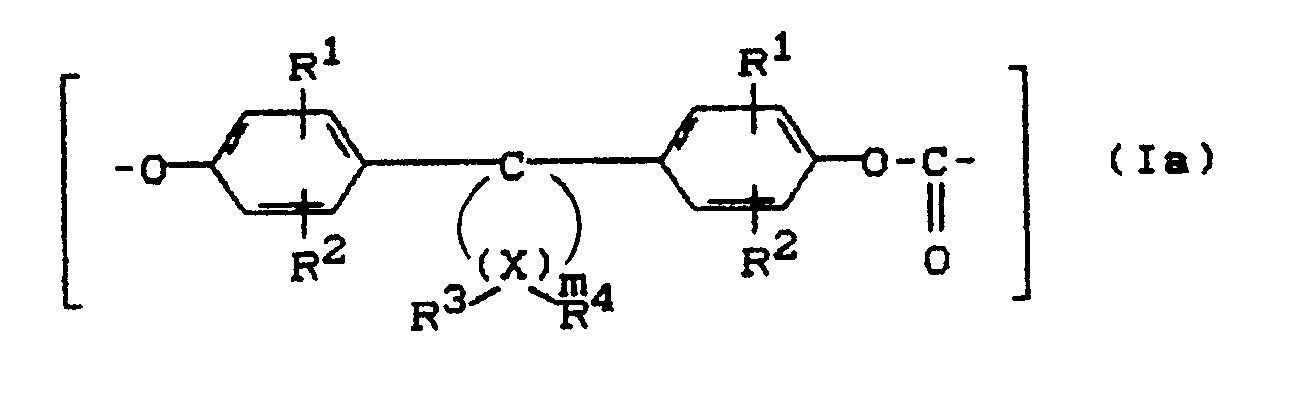
R¹ und R² unabhängig voneinander Wasserstoff, Halogen, C₁-C₈-Alkyl, C₅-C₆-Cycloalkyl, C₆-C₁₀-Aryl und C₇-C₁₂-Aralkyl,
m eine ganze Zahl von 4 bis 7,
R³ und R⁴ für jedes X individuell wählbar, unabhängig voneinander Wasserstoff, C₁-C₆-Alkyl und
X Kohlenstoff bedeuten
mit der Maßgabe, daß an mindestens einem Atom X R³ und R⁴ gleichzeitig Alkyl bedeuten,
mit einem Gehalt an Additiven ausgewählt aus
1. Entformungsmitteln in Mengen von 0,01 Gew.-% bis 3 Gew.-%,
2. neutralen Estern der phosphorigen Säure in Mengen von 0,001 Gew.-% bis 3 Gew.-% und gegebenenfalls mit einem Gehalt an Oxetanverbindunen in Mengen von 0,05 Gew.-% bis 5 Gew.-%,
3. Phosphinen in Mengen von 0,001 Gew.-% bis 2 Gew.-% und gegebenenfalls mit einem Gehalt an Oxetanverbindungen in Mengen von 0,05 Gew.-% bis 5 Gew.-%,
4. epoxidgruppenhaltigen Stabilisatoren in Mengen von 0,01 Gew.-% bis 5 Gew.-% und gegebenenfalls in Kombination mit Pigmenten,
5. Antistatika in Mengen von 0,01 Gew.-% bis 5 Gew.-%,
6. Glaskugeln oder BaSO₄ in Mengen von 0,1 Gew.-% bis 50 Gew.-% und
7. Treibmitteln oder Treibmittelgemischen in Mengen von 0,01 Gew.-% bis 10 Gew.-%,
wobei sich die Gewichtsangaben der Additive 1 bis 7 jeweils auf Gewicht Polycarbonat beziehen.
Applications Claiming Priority (2)
| Application Number | Priority Date | Filing Date | Title |
|---|---|---|---|
| DE19893933545 DE3933545A1 (de) | 1989-10-07 | 1989-10-07 | Polycarbonate aus dihydroxydiphenylcycloalkanen mit additiven |
| DE3933545 | 1989-10-07 |
Publications (2)
| Publication Number | Publication Date |
|---|---|
| EP0422438A2 true EP0422438A2 (de) | 1991-04-17 |
| EP0422438A3 EP0422438A3 (en) | 1991-11-13 |
Family
ID=6391032
Family Applications (1)
| Application Number | Title | Priority Date | Filing Date |
|---|---|---|---|
| EP19900118355 Withdrawn EP0422438A3 (en) | 1989-10-07 | 1990-09-25 | Dihydroxydiphenylcycloalkane polycarbonates containing additives |
Country Status (3)
| Country | Link |
|---|---|
| EP (1) | EP0422438A3 (de) |
| JP (1) | JPH03152154A (de) |
| DE (1) | DE3933545A1 (de) |
Cited By (4)
| Publication number | Priority date | Publication date | Assignee | Title |
|---|---|---|---|---|
| WO1992011319A1 (en) * | 1990-12-21 | 1992-07-09 | The Dow Chemical Company | Methods and compositions relating to halogenated polycarbonate having improved thermal stability |
| EP0643096A1 (de) * | 1993-08-24 | 1995-03-15 | Bayer Ag | Stabilisierte, flammwidrige Polycarbonatformmassen |
| EP0789053A1 (de) * | 1996-02-12 | 1997-08-13 | Bayer Ag | Stabilisatormischungen und ihre Verwendung in Polycarbonaten |
| WO2021116356A1 (de) * | 2019-12-12 | 2021-06-17 | Covestro Intellectual Property Gmbh & Co. Kg | Folien mit besonderen eigenschaften |
Families Citing this family (4)
| Publication number | Priority date | Publication date | Assignee | Title |
|---|---|---|---|---|
| DE4224769C2 (de) * | 1992-07-27 | 1994-11-10 | Bayer Ag | Verwendung von Siloxanen zur Veredelung von Polycarbonatabfällen |
| DE4440684A1 (de) * | 1994-11-15 | 1996-05-23 | Bayer Ag | Flammwidrige Polycarbonatformmassen |
| JP2005225432A (ja) | 2004-02-16 | 2005-08-25 | Sanyo Electric Co Ltd | 車両用空調システム |
| AU2013201729B2 (en) * | 2011-09-23 | 2013-11-07 | Nation, Anthony Bernard MR | A Swarf Collection Device |
Family Cites Families (6)
| Publication number | Priority date | Publication date | Assignee | Title |
|---|---|---|---|---|
| US4131575A (en) * | 1975-02-22 | 1978-12-26 | Bayer Aktiengesellschaft | Thermoplastic polycarbonate molding materials with improved mold release |
| DE3026503A1 (de) * | 1980-07-12 | 1982-02-18 | Bayer Ag, 5090 Leverkusen | Stabilisatorloesung, ihre verwendung zur stabilisierung von thermoplastischen polycarbonaten sowie stabilisierte thermoplastische polycarbonate |
| US4469833A (en) * | 1983-05-27 | 1984-09-04 | General Electric Company | Flame retardant polycarbonate compositions |
| DE3602014A1 (de) * | 1986-01-24 | 1987-07-30 | Bayer Ag | Verfahren zum verschaeumen von ester- und/oder carbonatgruppen enthaltenden thermoplastischen kunststoffen |
| DE3736749A1 (de) * | 1987-10-30 | 1989-05-11 | Bayer Ag | Verwendung von alkali- oder erdalkalisalzen von sulfobernsteinsaeureestern als interne antistatika, abzieh- und wickelhilfen fuer transparente polycarbonatfolien |
| NO170326C (no) * | 1988-08-12 | 1992-10-07 | Bayer Ag | Dihydroksydifenylcykloalkaner |
-
1989
- 1989-10-07 DE DE19893933545 patent/DE3933545A1/de not_active Withdrawn
-
1990
- 1990-09-25 EP EP19900118355 patent/EP0422438A3/de not_active Withdrawn
- 1990-10-04 JP JP26527390A patent/JPH03152154A/ja active Pending
Cited By (6)
| Publication number | Priority date | Publication date | Assignee | Title |
|---|---|---|---|---|
| WO1992011319A1 (en) * | 1990-12-21 | 1992-07-09 | The Dow Chemical Company | Methods and compositions relating to halogenated polycarbonate having improved thermal stability |
| EP0643096A1 (de) * | 1993-08-24 | 1995-03-15 | Bayer Ag | Stabilisierte, flammwidrige Polycarbonatformmassen |
| CN1052021C (zh) * | 1993-08-24 | 2000-05-03 | 拜尔公司 | 稳定、阻燃的聚碳酸酯模塑配合物 |
| EP0789053A1 (de) * | 1996-02-12 | 1997-08-13 | Bayer Ag | Stabilisatormischungen und ihre Verwendung in Polycarbonaten |
| US5852138A (en) * | 1996-02-12 | 1998-12-22 | Bayer Aktiengesellschaft | Stabilizer mixtures and their use in polycarbonates |
| WO2021116356A1 (de) * | 2019-12-12 | 2021-06-17 | Covestro Intellectual Property Gmbh & Co. Kg | Folien mit besonderen eigenschaften |
Also Published As
| Publication number | Publication date |
|---|---|
| EP0422438A3 (en) | 1991-11-13 |
| JPH03152154A (ja) | 1991-06-28 |
| DE3933545A1 (de) | 1991-04-11 |
Similar Documents
| Publication | Publication Date | Title |
|---|---|---|
| EP0402678B1 (de) | Verwendung von Polycarbonatmischungen in der Optik | |
| DE3832396A1 (de) | Dihydroxydiphenylcycloalkane, ihre herstellung und ihre verwendung zur herstellung von hochmolekularen polycarbonaten | |
| EP1609818B1 (de) | Thermostabilisierte Polycarbonat-Zusammensetzungen | |
| EP0414083B1 (de) | Stabilisierte Polycarbonate | |
| EP0422438A2 (de) | Polycarbonate aus Dihydroxydiphenylcycloalkanen mit Additiven | |
| EP0023571B1 (de) | Verfahren zur Herstellung von Polycarbonaten, die so erhältlichen Polycarbonate sowie ihre Verwendung | |
| EP0403837A2 (de) | Polycarbonat-Formmassen | |
| DE69510163T2 (de) | Thermisch stabile, gammastrahlenbeständige Polycarbonat-Polyester-Mischung | |
| EP0001823A2 (de) | Verwendung von Borsäureestern zum Stabilisieren von phosphitfreien Polycarbonaten und die erhaltenen stabilisierten Polycarbonatformmassen | |
| EP0393454A2 (de) | Wärmeformbeständige Polycarbonat-Formmassen | |
| EP0416404B1 (de) | UV-Absorberhaltige Polycarbonate | |
| EP0218064B1 (de) | Verfahren zur Herstellung von Polyethersulfonen | |
| EP0432580B1 (de) | Zweistufen-Verfahren zur Herstellung von Polycarbonaten auf Basis von speziellen Dihydroxydiphenylalkanen | |
| EP0480237B1 (de) | Spezielle Dihydroxydiphenylbicycloalkane, ihre Herstellung und ihre Verwendung zur Herstellung von hochmolekularen Polycarbonaten | |
| DE4236142A1 (de) | Gegen gamma-strahlung bestaendige polycarbonat-zusammensetzungen | |
| EP0423562B1 (de) | Polycarbonate mit verbesserter Wärmeformbeständigkeit | |
| DE3926767A1 (de) | Polycarbonate aus mehrfach substituierten cyclohexylidenbisphenolen | |
| EP0415066B1 (de) | Ternäre, thermoplastische Mischungen | |
| DE3930673A1 (de) | Stabilisierte polycarbonate | |
| DD297654A5 (de) | Verfahren zur herstellung von hochmolekularen thermoplastischen, aromatischen polycarbonaten | |
| DE2659756A1 (de) | Gegen thermische oxidation stabile polycarbonatzusammensetzung | |
| DE2117509C2 (de) | Thermisch stabile Polycarbonatformmasse | |
| DE4232897C2 (de) | Flammwidrige thermoplastische Polycarbonat-Formmassen und Verfahren zu ihrer Herstellung | |
| DE4003437A1 (de) | Spezielle dihydroxydiphenylcycloalkane, ihre herstellung und ihre verwendung zur herstellung von hochmolekularen polycarbonaten | |
| EP0457102A2 (de) | tert.-Alkylester-Bisphenole, Verfahren zu ihrer Herstellung und ihre Verwendung |
Legal Events
| Date | Code | Title | Description |
|---|---|---|---|
| PUAI | Public reference made under article 153(3) epc to a published international application that has entered the european phase |
Free format text: ORIGINAL CODE: 0009012 |
|
| 17P | Request for examination filed |
Effective date: 19900926 |
|
| AK | Designated contracting states |
Kind code of ref document: A2 Designated state(s): BE DE ES FR GB IT NL |
|
| PUAL | Search report despatched |
Free format text: ORIGINAL CODE: 0009013 |
|
| AK | Designated contracting states |
Kind code of ref document: A3 Designated state(s): BE DE ES FR GB IT NL |
|
| 17Q | First examination report despatched |
Effective date: 19940407 |
|
| STAA | Information on the status of an ep patent application or granted ep patent |
Free format text: STATUS: THE APPLICATION HAS BEEN WITHDRAWN |
|
| 18W | Application withdrawn |
Withdrawal date: 19941010 |