EP0423302B1 - Application de nouveaux fragments d'adn en tant que sequence codant pour un peptide signal pour la secretion de proteines matures par des levures recombinantes, cassettes d'expression, levures transformees et procede de preparation de proteines correspondant - Google Patents
Application de nouveaux fragments d'adn en tant que sequence codant pour un peptide signal pour la secretion de proteines matures par des levures recombinantes, cassettes d'expression, levures transformees et procede de preparation de proteines correspondant Download PDFInfo
- Publication number
- EP0423302B1 EP0423302B1 EP90907160A EP90907160A EP0423302B1 EP 0423302 B1 EP0423302 B1 EP 0423302B1 EP 90907160 A EP90907160 A EP 90907160A EP 90907160 A EP90907160 A EP 90907160A EP 0423302 B1 EP0423302 B1 EP 0423302B1
- Authority
- EP
- European Patent Office
- Prior art keywords
- amino acid
- fragment
- dna fragment
- preparation
- sequence
- Prior art date
- Legal status (The legal status is an assumption and is not a legal conclusion. Google has not performed a legal analysis and makes no representation as to the accuracy of the status listed.)
- Expired - Lifetime
Links
- 239000012634 fragment Substances 0.000 title claims abstract description 157
- 108090000623 proteins and genes Proteins 0.000 title claims abstract description 85
- 102000004169 proteins and genes Human genes 0.000 title claims abstract description 59
- 108010076504 Protein Sorting Signals Proteins 0.000 title claims abstract description 19
- 230000028327 secretion Effects 0.000 title claims abstract description 16
- 108020004414 DNA Proteins 0.000 title claims description 45
- 240000004808 Saccharomyces cerevisiae Species 0.000 title claims description 39
- 238000000034 method Methods 0.000 title claims description 36
- 230000008569 process Effects 0.000 title claims description 29
- 238000002360 preparation method Methods 0.000 title claims description 18
- 108091026890 Coding region Proteins 0.000 title description 2
- 150000001413 amino acids Chemical class 0.000 claims abstract description 38
- 108090000765 processed proteins & peptides Proteins 0.000 claims abstract description 24
- 239000013612 plasmid Substances 0.000 claims description 46
- 210000004027 cell Anatomy 0.000 claims description 25
- 108010007267 Hirudins Proteins 0.000 claims description 15
- 101150050575 URA3 gene Proteins 0.000 claims description 15
- 108010078480 insect defensin A Proteins 0.000 claims description 15
- 102000007625 Hirudins Human genes 0.000 claims description 14
- WQPDUTSPKFMPDP-OUMQNGNKSA-N hirudin Chemical compound C([C@@H](C(=O)N[C@@H](CCC(O)=O)C(=O)N[C@@H](CCC(O)=O)C(=O)N[C@@H]([C@@H](C)CC)C(=O)N1[C@@H](CCC1)C(=O)N[C@@H](CCC(O)=O)C(=O)N[C@@H](CCC(O)=O)C(=O)N[C@@H](CC=1C=CC(OS(O)(=O)=O)=CC=1)C(=O)N[C@@H](CC(C)C)C(=O)N[C@@H](CCC(N)=O)C(O)=O)NC(=O)[C@H](CC(O)=O)NC(=O)CNC(=O)[C@H](CC(O)=O)NC(=O)[C@H](CC(N)=O)NC(=O)[C@H](CC=1NC=NC=1)NC(=O)[C@H](CO)NC(=O)[C@H](CCC(N)=O)NC(=O)[C@H]1N(CCC1)C(=O)[C@H](CCCCN)NC(=O)[C@H]1N(CCC1)C(=O)[C@@H](NC(=O)CNC(=O)[C@H](CCC(O)=O)NC(=O)CNC(=O)[C@@H](NC(=O)[C@@H](NC(=O)[C@H]1NC(=O)[C@H](CCC(N)=O)NC(=O)[C@H](CC(N)=O)NC(=O)[C@H](CCCCN)NC(=O)[C@H](CCC(O)=O)NC(=O)CNC(=O)[C@H](CC(O)=O)NC(=O)[C@H](CO)NC(=O)CNC(=O)[C@H](CC(C)C)NC(=O)[C@H]([C@@H](C)CC)NC(=O)[C@@H]2CSSC[C@@H](C(=O)N[C@@H](CCC(O)=O)C(=O)NCC(=O)N[C@@H](CO)C(=O)N[C@@H](CC(N)=O)C(=O)N[C@H](C(=O)N[C@H](C(NCC(=O)N[C@@H](CCC(N)=O)C(=O)NCC(=O)N[C@@H](CC(N)=O)C(=O)N[C@@H](CCCCN)C(=O)N2)=O)CSSC1)C(C)C)NC(=O)[C@H](CC(C)C)NC(=O)[C@H]1NC(=O)[C@H](CC(C)C)NC(=O)[C@H](CC(N)=O)NC(=O)[C@H](CCC(N)=O)NC(=O)CNC(=O)[C@H](CO)NC(=O)[C@H](CCC(O)=O)NC(=O)[C@H]([C@@H](C)O)NC(=O)[C@@H](NC(=O)[C@H](CC(O)=O)NC(=O)[C@@H](NC(=O)[C@H](CC=2C=CC(O)=CC=2)NC(=O)[C@@H](NC(=O)[C@@H](N)C(C)C)C(C)C)[C@@H](C)O)CSSC1)C(C)C)[C@@H](C)O)[C@@H](C)O)C1=CC=CC=C1 WQPDUTSPKFMPDP-OUMQNGNKSA-N 0.000 claims description 14
- 229940006607 hirudin Drugs 0.000 claims description 14
- 230000017854 proteolysis Effects 0.000 claims description 10
- 210000005253 yeast cell Anatomy 0.000 claims description 9
- 108010002069 Defensins Proteins 0.000 claims description 7
- 102000000541 Defensins Human genes 0.000 claims description 7
- 238000013518 transcription Methods 0.000 claims description 7
- 239000001963 growth medium Substances 0.000 claims description 4
- 241000238631 Hexapoda Species 0.000 claims description 3
- 108010033276 Peptide Fragments Proteins 0.000 claims description 3
- 102000007079 Peptide Fragments Human genes 0.000 claims description 3
- 230000014621 translational initiation Effects 0.000 claims description 3
- 108091081024 Start codon Proteins 0.000 claims description 2
- 125000003275 alpha amino acid group Chemical group 0.000 claims 19
- 239000013600 plasmid vector Substances 0.000 claims 4
- DEGUERSKQBRZMZ-FXQIFTODSA-N Val-Ser-Ala Chemical group CC(C)[C@H](N)C(=O)N[C@@H](CO)C(=O)N[C@@H](C)C(O)=O DEGUERSKQBRZMZ-FXQIFTODSA-N 0.000 claims 1
- 230000005026 transcription initiation Effects 0.000 claims 1
- 235000014680 Saccharomyces cerevisiae Nutrition 0.000 description 34
- 108091034117 Oligonucleotide Proteins 0.000 description 23
- 239000002243 precursor Substances 0.000 description 22
- 239000013598 vector Substances 0.000 description 22
- 108020004705 Codon Proteins 0.000 description 18
- NPBGTPKLVJEOBE-IUCAKERBSA-N Lys-Arg Chemical group NCCCC[C@H](N)C(=O)N[C@H](C(O)=O)CCCNC(N)=N NPBGTPKLVJEOBE-IUCAKERBSA-N 0.000 description 12
- 238000010276 construction Methods 0.000 description 12
- JLCPHMBAVCMARE-UHFFFAOYSA-N [3-[[3-[[3-[[3-[[3-[[3-[[3-[[3-[[3-[[3-[[3-[[5-(2-amino-6-oxo-1H-purin-9-yl)-3-[[3-[[3-[[3-[[3-[[3-[[5-(2-amino-6-oxo-1H-purin-9-yl)-3-[[5-(2-amino-6-oxo-1H-purin-9-yl)-3-hydroxyoxolan-2-yl]methoxy-hydroxyphosphoryl]oxyoxolan-2-yl]methoxy-hydroxyphosphoryl]oxy-5-(5-methyl-2,4-dioxopyrimidin-1-yl)oxolan-2-yl]methoxy-hydroxyphosphoryl]oxy-5-(6-aminopurin-9-yl)oxolan-2-yl]methoxy-hydroxyphosphoryl]oxy-5-(6-aminopurin-9-yl)oxolan-2-yl]methoxy-hydroxyphosphoryl]oxy-5-(6-aminopurin-9-yl)oxolan-2-yl]methoxy-hydroxyphosphoryl]oxy-5-(6-aminopurin-9-yl)oxolan-2-yl]methoxy-hydroxyphosphoryl]oxyoxolan-2-yl]methoxy-hydroxyphosphoryl]oxy-5-(5-methyl-2,4-dioxopyrimidin-1-yl)oxolan-2-yl]methoxy-hydroxyphosphoryl]oxy-5-(4-amino-2-oxopyrimidin-1-yl)oxolan-2-yl]methoxy-hydroxyphosphoryl]oxy-5-(5-methyl-2,4-dioxopyrimidin-1-yl)oxolan-2-yl]methoxy-hydroxyphosphoryl]oxy-5-(5-methyl-2,4-dioxopyrimidin-1-yl)oxolan-2-yl]methoxy-hydroxyphosphoryl]oxy-5-(6-aminopurin-9-yl)oxolan-2-yl]methoxy-hydroxyphosphoryl]oxy-5-(6-aminopurin-9-yl)oxolan-2-yl]methoxy-hydroxyphosphoryl]oxy-5-(4-amino-2-oxopyrimidin-1-yl)oxolan-2-yl]methoxy-hydroxyphosphoryl]oxy-5-(4-amino-2-oxopyrimidin-1-yl)oxolan-2-yl]methoxy-hydroxyphosphoryl]oxy-5-(4-amino-2-oxopyrimidin-1-yl)oxolan-2-yl]methoxy-hydroxyphosphoryl]oxy-5-(6-aminopurin-9-yl)oxolan-2-yl]methoxy-hydroxyphosphoryl]oxy-5-(4-amino-2-oxopyrimidin-1-yl)oxolan-2-yl]methyl [5-(6-aminopurin-9-yl)-2-(hydroxymethyl)oxolan-3-yl] hydrogen phosphate Polymers Cc1cn(C2CC(OP(O)(=O)OCC3OC(CC3OP(O)(=O)OCC3OC(CC3O)n3cnc4c3nc(N)[nH]c4=O)n3cnc4c3nc(N)[nH]c4=O)C(COP(O)(=O)OC3CC(OC3COP(O)(=O)OC3CC(OC3COP(O)(=O)OC3CC(OC3COP(O)(=O)OC3CC(OC3COP(O)(=O)OC3CC(OC3COP(O)(=O)OC3CC(OC3COP(O)(=O)OC3CC(OC3COP(O)(=O)OC3CC(OC3COP(O)(=O)OC3CC(OC3COP(O)(=O)OC3CC(OC3COP(O)(=O)OC3CC(OC3COP(O)(=O)OC3CC(OC3COP(O)(=O)OC3CC(OC3COP(O)(=O)OC3CC(OC3COP(O)(=O)OC3CC(OC3COP(O)(=O)OC3CC(OC3COP(O)(=O)OC3CC(OC3CO)n3cnc4c(N)ncnc34)n3ccc(N)nc3=O)n3cnc4c(N)ncnc34)n3ccc(N)nc3=O)n3ccc(N)nc3=O)n3ccc(N)nc3=O)n3cnc4c(N)ncnc34)n3cnc4c(N)ncnc34)n3cc(C)c(=O)[nH]c3=O)n3cc(C)c(=O)[nH]c3=O)n3ccc(N)nc3=O)n3cc(C)c(=O)[nH]c3=O)n3cnc4c3nc(N)[nH]c4=O)n3cnc4c(N)ncnc34)n3cnc4c(N)ncnc34)n3cnc4c(N)ncnc34)n3cnc4c(N)ncnc34)O2)c(=O)[nH]c1=O JLCPHMBAVCMARE-UHFFFAOYSA-N 0.000 description 11
- 230000006337 proteolytic cleavage Effects 0.000 description 11
- 239000013604 expression vector Substances 0.000 description 10
- 239000006228 supernatant Substances 0.000 description 10
- DHMQDGOQFOQNFH-UHFFFAOYSA-N Glycine Chemical compound NCC(O)=O DHMQDGOQFOQNFH-UHFFFAOYSA-N 0.000 description 9
- 101100536354 Drosophila melanogaster tant gene Proteins 0.000 description 8
- 241000588724 Escherichia coli Species 0.000 description 8
- 230000015572 biosynthetic process Effects 0.000 description 8
- 101100246753 Halobacterium salinarum (strain ATCC 700922 / JCM 11081 / NRC-1) pyrF gene Proteins 0.000 description 7
- 108091028043 Nucleic acid sequence Proteins 0.000 description 7
- 230000010076 replication Effects 0.000 description 7
- 238000002741 site-directed mutagenesis Methods 0.000 description 7
- 238000003786 synthesis reaction Methods 0.000 description 7
- 108091005804 Peptidases Proteins 0.000 description 6
- 239000004365 Protease Substances 0.000 description 6
- 238000004519 manufacturing process Methods 0.000 description 6
- 102000004196 processed proteins & peptides Human genes 0.000 description 6
- 230000035897 transcription Effects 0.000 description 6
- KZSNJWFQEVHDMF-UHFFFAOYSA-N Valine Chemical compound CC(C)C(N)C(O)=O KZSNJWFQEVHDMF-UHFFFAOYSA-N 0.000 description 5
- 230000000694 effects Effects 0.000 description 5
- 210000003527 eukaryotic cell Anatomy 0.000 description 5
- IJGRMHOSHXDMSA-UHFFFAOYSA-N Atomic nitrogen Chemical compound N#N IJGRMHOSHXDMSA-UHFFFAOYSA-N 0.000 description 4
- TWRXJAOTZQYOKJ-UHFFFAOYSA-L Magnesium chloride Chemical compound [Mg+2].[Cl-].[Cl-] TWRXJAOTZQYOKJ-UHFFFAOYSA-L 0.000 description 4
- 102100037486 Reverse transcriptase/ribonuclease H Human genes 0.000 description 4
- 238000011534 incubation Methods 0.000 description 4
- 230000004048 modification Effects 0.000 description 4
- 238000012986 modification Methods 0.000 description 4
- 229920001184 polypeptide Polymers 0.000 description 4
- 241001515965 unidentified phage Species 0.000 description 4
- WEVYAHXRMPXWCK-UHFFFAOYSA-N Acetonitrile Chemical compound CC#N WEVYAHXRMPXWCK-UHFFFAOYSA-N 0.000 description 3
- 102000003960 Ligases Human genes 0.000 description 3
- 108090000364 Ligases Proteins 0.000 description 3
- 230000000844 anti-bacterial effect Effects 0.000 description 3
- 238000003776 cleavage reaction Methods 0.000 description 3
- 238000010353 genetic engineering Methods 0.000 description 3
- 230000000977 initiatory effect Effects 0.000 description 3
- 238000003780 insertion Methods 0.000 description 3
- 230000037431 insertion Effects 0.000 description 3
- 239000000203 mixture Substances 0.000 description 3
- 230000007017 scission Effects 0.000 description 3
- 238000013519 translation Methods 0.000 description 3
- QKNYBSVHEMOAJP-UHFFFAOYSA-N 2-amino-2-(hydroxymethyl)propane-1,3-diol;hydron;chloride Chemical compound Cl.OCC(N)(CO)CO QKNYBSVHEMOAJP-UHFFFAOYSA-N 0.000 description 2
- 229920001817 Agar Polymers 0.000 description 2
- OMLWNBVRVJYMBQ-YUMQZZPRSA-N Arg-Arg Chemical compound NC(N)=NCCC[C@H](N)C(=O)N[C@@H](CCCN=C(N)N)C(O)=O OMLWNBVRVJYMBQ-YUMQZZPRSA-N 0.000 description 2
- 241000894006 Bacteria Species 0.000 description 2
- 102000004594 DNA Polymerase I Human genes 0.000 description 2
- 108010017826 DNA Polymerase I Proteins 0.000 description 2
- 102000004190 Enzymes Human genes 0.000 description 2
- 108090000790 Enzymes Proteins 0.000 description 2
- WQZGKKKJIJFFOK-GASJEMHNSA-N Glucose Natural products OC[C@H]1OC(O)[C@H](O)[C@@H](O)[C@@H]1O WQZGKKKJIJFFOK-GASJEMHNSA-N 0.000 description 2
- 101150009006 HIS3 gene Proteins 0.000 description 2
- ROHFNLRQFUQHCH-YFKPBYRVSA-N L-leucine Chemical compound CC(C)C[C@H](N)C(O)=O ROHFNLRQFUQHCH-YFKPBYRVSA-N 0.000 description 2
- 101150007280 LEU2 gene Proteins 0.000 description 2
- 102000035195 Peptidases Human genes 0.000 description 2
- 101100394989 Rhodopseudomonas palustris (strain ATCC BAA-98 / CGA009) hisI gene Proteins 0.000 description 2
- 241000235070 Saccharomyces Species 0.000 description 2
- 108090000190 Thrombin Proteins 0.000 description 2
- DTQVDTLACAAQTR-UHFFFAOYSA-N Trifluoroacetic acid Chemical compound OC(=O)C(F)(F)F DTQVDTLACAAQTR-UHFFFAOYSA-N 0.000 description 2
- 239000002253 acid Substances 0.000 description 2
- 150000007513 acids Chemical class 0.000 description 2
- 239000008272 agar Substances 0.000 description 2
- AVKUERGKIZMTKX-NJBDSQKTSA-N ampicillin Chemical compound C1([C@@H](N)C(=O)N[C@H]2[C@H]3SC([C@@H](N3C2=O)C(O)=O)(C)C)=CC=CC=C1 AVKUERGKIZMTKX-NJBDSQKTSA-N 0.000 description 2
- 108010068380 arginylarginine Proteins 0.000 description 2
- 244000052616 bacterial pathogen Species 0.000 description 2
- 239000000872 buffer Substances 0.000 description 2
- 210000000170 cell membrane Anatomy 0.000 description 2
- 238000005119 centrifugation Methods 0.000 description 2
- 239000012228 culture supernatant Substances 0.000 description 2
- 210000002472 endoplasmic reticulum Anatomy 0.000 description 2
- 229940088598 enzyme Drugs 0.000 description 2
- 239000008103 glucose Substances 0.000 description 2
- 238000004128 high performance liquid chromatography Methods 0.000 description 2
- 230000002209 hydrophobic effect Effects 0.000 description 2
- 229910001629 magnesium chloride Inorganic materials 0.000 description 2
- 210000004962 mammalian cell Anatomy 0.000 description 2
- 230000035772 mutation Effects 0.000 description 2
- 229910052757 nitrogen Inorganic materials 0.000 description 2
- QJGQUHMNIGDVPM-UHFFFAOYSA-N nitrogen group Chemical group [N] QJGQUHMNIGDVPM-UHFFFAOYSA-N 0.000 description 2
- 108020004707 nucleic acids Proteins 0.000 description 2
- 102000039446 nucleic acids Human genes 0.000 description 2
- 150000007523 nucleic acids Chemical class 0.000 description 2
- 101150047627 pgk gene Proteins 0.000 description 2
- 239000000047 product Substances 0.000 description 2
- 210000001236 prokaryotic cell Anatomy 0.000 description 2
- 239000006152 selective media Substances 0.000 description 2
- 229960004072 thrombin Drugs 0.000 description 2
- QTBSBXVTEAMEQO-UHFFFAOYSA-M Acetate Chemical compound CC([O-])=O QTBSBXVTEAMEQO-UHFFFAOYSA-M 0.000 description 1
- YYSWCHMLFJLLBJ-ZLUOBGJFSA-N Ala-Ala-Ser Chemical compound C[C@H](N)C(=O)N[C@@H](C)C(=O)N[C@@H](CO)C(O)=O YYSWCHMLFJLLBJ-ZLUOBGJFSA-N 0.000 description 1
- 102100038910 Alpha-enolase Human genes 0.000 description 1
- 239000004475 Arginine Substances 0.000 description 1
- 108020004635 Complementary DNA Proteins 0.000 description 1
- 108010016626 Dipeptides Proteins 0.000 description 1
- 241000255925 Diptera Species 0.000 description 1
- 108010059378 Endopeptidases Proteins 0.000 description 1
- 102000005593 Endopeptidases Human genes 0.000 description 1
- 101150094690 GAL1 gene Proteins 0.000 description 1
- 102100028501 Galanin peptides Human genes 0.000 description 1
- 108700007698 Genetic Terminator Regions Proteins 0.000 description 1
- 239000004471 Glycine Substances 0.000 description 1
- 241000237902 Hirudo medicinalis Species 0.000 description 1
- 101000882335 Homo sapiens Alpha-enolase Proteins 0.000 description 1
- 101100121078 Homo sapiens GAL gene Proteins 0.000 description 1
- 241000500891 Insecta Species 0.000 description 1
- 101150045458 KEX2 gene Proteins 0.000 description 1
- FFEARJCKVFRZRR-BYPYZUCNSA-N L-methionine Chemical compound CSCC[C@H](N)C(O)=O FFEARJCKVFRZRR-BYPYZUCNSA-N 0.000 description 1
- KZSNJWFQEVHDMF-BYPYZUCNSA-N L-valine Chemical compound CC(C)[C@H](N)C(O)=O KZSNJWFQEVHDMF-BYPYZUCNSA-N 0.000 description 1
- ROHFNLRQFUQHCH-UHFFFAOYSA-N Leucine Natural products CC(C)CC(N)C(O)=O ROHFNLRQFUQHCH-UHFFFAOYSA-N 0.000 description 1
- WHXSMMKQMYFTQS-UHFFFAOYSA-N Lithium Chemical compound [Li] WHXSMMKQMYFTQS-UHFFFAOYSA-N 0.000 description 1
- 101000763602 Manilkara zapota Thaumatin-like protein 1 Proteins 0.000 description 1
- 101000763586 Manilkara zapota Thaumatin-like protein 1a Proteins 0.000 description 1
- OBVHKUFUDCPZDW-JYJNAYRXSA-N Met-Arg-Phe Chemical compound CSCC[C@H](N)C(=O)N[C@@H](CCCNC(N)=N)C(=O)N[C@H](C(O)=O)CC1=CC=CC=C1 OBVHKUFUDCPZDW-JYJNAYRXSA-N 0.000 description 1
- 241001465754 Metazoa Species 0.000 description 1
- 241000191938 Micrococcus luteus Species 0.000 description 1
- 101000966653 Musa acuminata Glucan endo-1,3-beta-glucosidase Proteins 0.000 description 1
- GMWNQSGWWGKTSF-LFSVMHDDSA-N Phe-Thr-Ala Chemical compound [H]N[C@@H](CC1=CC=CC=C1)C(=O)N[C@@H]([C@@H](C)O)C(=O)N[C@@H](C)C(O)=O GMWNQSGWWGKTSF-LFSVMHDDSA-N 0.000 description 1
- 108010021757 Polynucleotide 5'-Hydroxyl-Kinase Proteins 0.000 description 1
- 102000008422 Polynucleotide 5'-hydroxyl-kinase Human genes 0.000 description 1
- ITUDDXVFGFEKPD-NAKRPEOUSA-N Pro-Ser-Ile Chemical compound [H]N1CCC[C@H]1C(=O)N[C@@H](CO)C(=O)N[C@@H]([C@@H](C)CC)C(O)=O ITUDDXVFGFEKPD-NAKRPEOUSA-N 0.000 description 1
- 102000001253 Protein Kinase Human genes 0.000 description 1
- 108020004511 Recombinant DNA Proteins 0.000 description 1
- HRNQLKCLPVKZNE-CIUDSAMLSA-N Ser-Ala-Leu Chemical compound [H]N[C@@H](CO)C(=O)N[C@@H](C)C(=O)N[C@@H](CC(C)C)C(O)=O HRNQLKCLPVKZNE-CIUDSAMLSA-N 0.000 description 1
- 239000000877 Sex Attractant Substances 0.000 description 1
- 108020005038 Terminator Codon Proteins 0.000 description 1
- 241001125929 Trisopterus luscus Species 0.000 description 1
- ZZGPVSZDZQRJQY-ULQDDVLXSA-N Val-Leu-Phe Chemical compound CC(C)C[C@H](NC(=O)[C@@H](N)C(C)C)C(=O)N[C@@H](Cc1ccccc1)C(O)=O ZZGPVSZDZQRJQY-ULQDDVLXSA-N 0.000 description 1
- 229960000723 ampicillin Drugs 0.000 description 1
- 230000002785 anti-thrombosis Effects 0.000 description 1
- 239000004019 antithrombin Substances 0.000 description 1
- ODKSFYDXXFIFQN-UHFFFAOYSA-N arginine Natural products OC(=O)C(N)CCCNC(N)=N ODKSFYDXXFIFQN-UHFFFAOYSA-N 0.000 description 1
- 238000003556 assay Methods 0.000 description 1
- 230000001580 bacterial effect Effects 0.000 description 1
- 230000004071 biological effect Effects 0.000 description 1
- 210000004899 c-terminal region Anatomy 0.000 description 1
- 238000010804 cDNA synthesis Methods 0.000 description 1
- 230000015556 catabolic process Effects 0.000 description 1
- 238000004737 colorimetric analysis Methods 0.000 description 1
- 239000002299 complementary DNA Substances 0.000 description 1
- 238000006731 degradation reaction Methods 0.000 description 1
- VHJLVAABSRFDPM-QWWZWVQMSA-N dithiothreitol Chemical compound SC[C@@H](O)[C@H](O)CS VHJLVAABSRFDPM-QWWZWVQMSA-N 0.000 description 1
- 239000003814 drug Substances 0.000 description 1
- 238000002474 experimental method Methods 0.000 description 1
- 239000013613 expression plasmid Substances 0.000 description 1
- VLMZMRDOMOGGFA-WDBKCZKBSA-N festuclavine Chemical compound C1=CC([C@H]2C[C@H](CN(C)[C@@H]2C2)C)=C3C2=CNC3=C1 VLMZMRDOMOGGFA-WDBKCZKBSA-N 0.000 description 1
- 210000000087 hemolymph Anatomy 0.000 description 1
- 230000001939 inductive effect Effects 0.000 description 1
- 239000003112 inhibitor Substances 0.000 description 1
- 230000002401 inhibitory effect Effects 0.000 description 1
- 230000010354 integration Effects 0.000 description 1
- 230000003834 intracellular effect Effects 0.000 description 1
- 229910052744 lithium Inorganic materials 0.000 description 1
- XIXADJRWDQXREU-UHFFFAOYSA-M lithium acetate Chemical compound [Li+].CC([O-])=O XIXADJRWDQXREU-UHFFFAOYSA-M 0.000 description 1
- 238000012423 maintenance Methods 0.000 description 1
- 239000003550 marker Substances 0.000 description 1
- 239000000463 material Substances 0.000 description 1
- 230000007246 mechanism Effects 0.000 description 1
- 229930182817 methionine Natural products 0.000 description 1
- 230000000394 mitotic effect Effects 0.000 description 1
- 238000002703 mutagenesis Methods 0.000 description 1
- 231100000350 mutagenesis Toxicity 0.000 description 1
- 210000004898 n-terminal fragment Anatomy 0.000 description 1
- 239000002773 nucleotide Substances 0.000 description 1
- 125000003729 nucleotide group Chemical group 0.000 description 1
- 230000026731 phosphorylation Effects 0.000 description 1
- 238000006366 phosphorylation reaction Methods 0.000 description 1
- 231100000614 poison Toxicity 0.000 description 1
- 229920000642 polymer Polymers 0.000 description 1
- 108060006633 protein kinase Proteins 0.000 description 1
- 230000002797 proteolythic effect Effects 0.000 description 1
- 238000011403 purification operation Methods 0.000 description 1
- 230000001698 pyrogenic effect Effects 0.000 description 1
- 239000011541 reaction mixture Substances 0.000 description 1
- 238000011084 recovery Methods 0.000 description 1
- 230000003362 replicative effect Effects 0.000 description 1
- 210000003079 salivary gland Anatomy 0.000 description 1
- 230000001568 sexual effect Effects 0.000 description 1
- 241000894007 species Species 0.000 description 1
- 230000007480 spreading Effects 0.000 description 1
- 238000003892 spreading Methods 0.000 description 1
- 239000000758 substrate Substances 0.000 description 1
- 238000012360 testing method Methods 0.000 description 1
- 229940124597 therapeutic agent Drugs 0.000 description 1
- 231100000331 toxic Toxicity 0.000 description 1
- 230000002588 toxic effect Effects 0.000 description 1
- 239000003440 toxic substance Substances 0.000 description 1
- 230000005030 transcription termination Effects 0.000 description 1
- 230000005945 translocation Effects 0.000 description 1
- 238000011144 upstream manufacturing Methods 0.000 description 1
- 239000004474 valine Substances 0.000 description 1
- 108700026220 vif Genes Proteins 0.000 description 1
- XLYOFNOQVPJJNP-UHFFFAOYSA-N water Substances O XLYOFNOQVPJJNP-UHFFFAOYSA-N 0.000 description 1
Images


Classifications
-
- C—CHEMISTRY; METALLURGY
- C12—BIOCHEMISTRY; BEER; SPIRITS; WINE; VINEGAR; MICROBIOLOGY; ENZYMOLOGY; MUTATION OR GENETIC ENGINEERING
- C12Y—ENZYMES
- C12Y302/00—Hydrolases acting on glycosyl compounds, i.e. glycosylases (3.2)
- C12Y302/01—Glycosidases, i.e. enzymes hydrolysing O- and S-glycosyl compounds (3.2.1)
- C12Y302/01039—Glucan endo-1,3-beta-D-glucosidase (3.2.1.39)
-
- C—CHEMISTRY; METALLURGY
- C07—ORGANIC CHEMISTRY
- C07K—PEPTIDES
- C07K14/00—Peptides having more than 20 amino acids; Gastrins; Somatostatins; Melanotropins; Derivatives thereof
- C07K14/435—Peptides having more than 20 amino acids; Gastrins; Somatostatins; Melanotropins; Derivatives thereof from animals; from humans
- C07K14/43504—Peptides having more than 20 amino acids; Gastrins; Somatostatins; Melanotropins; Derivatives thereof from animals; from humans from invertebrates
- C07K14/43563—Peptides having more than 20 amino acids; Gastrins; Somatostatins; Melanotropins; Derivatives thereof from animals; from humans from invertebrates from insects
-
- C—CHEMISTRY; METALLURGY
- C07—ORGANIC CHEMISTRY
- C07K—PEPTIDES
- C07K14/00—Peptides having more than 20 amino acids; Gastrins; Somatostatins; Melanotropins; Derivatives thereof
- C07K14/81—Protease inhibitors
- C07K14/815—Protease inhibitors from leeches, e.g. hirudin, eglin
-
- C—CHEMISTRY; METALLURGY
- C12—BIOCHEMISTRY; BEER; SPIRITS; WINE; VINEGAR; MICROBIOLOGY; ENZYMOLOGY; MUTATION OR GENETIC ENGINEERING
- C12N—MICROORGANISMS OR ENZYMES; COMPOSITIONS THEREOF; PROPAGATING, PRESERVING, OR MAINTAINING MICROORGANISMS; MUTATION OR GENETIC ENGINEERING; CULTURE MEDIA
- C12N15/00—Mutation or genetic engineering; DNA or RNA concerning genetic engineering, vectors, e.g. plasmids, or their isolation, preparation or purification; Use of hosts therefor
- C12N15/09—Recombinant DNA-technology
- C12N15/11—DNA or RNA fragments; Modified forms thereof; Non-coding nucleic acids having a biological activity
- C12N15/62—DNA sequences coding for fusion proteins
- C12N15/625—DNA sequences coding for fusion proteins containing a sequence coding for a signal sequence
-
- C—CHEMISTRY; METALLURGY
- C12—BIOCHEMISTRY; BEER; SPIRITS; WINE; VINEGAR; MICROBIOLOGY; ENZYMOLOGY; MUTATION OR GENETIC ENGINEERING
- C12N—MICROORGANISMS OR ENZYMES; COMPOSITIONS THEREOF; PROPAGATING, PRESERVING, OR MAINTAINING MICROORGANISMS; MUTATION OR GENETIC ENGINEERING; CULTURE MEDIA
- C12N15/00—Mutation or genetic engineering; DNA or RNA concerning genetic engineering, vectors, e.g. plasmids, or their isolation, preparation or purification; Use of hosts therefor
- C12N15/09—Recombinant DNA-technology
- C12N15/63—Introduction of foreign genetic material using vectors; Vectors; Use of hosts therefor; Regulation of expression
- C12N15/79—Vectors or expression systems specially adapted for eukaryotic hosts
- C12N15/80—Vectors or expression systems specially adapted for eukaryotic hosts for fungi
- C12N15/81—Vectors or expression systems specially adapted for eukaryotic hosts for fungi for yeasts
-
- C—CHEMISTRY; METALLURGY
- C12—BIOCHEMISTRY; BEER; SPIRITS; WINE; VINEGAR; MICROBIOLOGY; ENZYMOLOGY; MUTATION OR GENETIC ENGINEERING
- C12N—MICROORGANISMS OR ENZYMES; COMPOSITIONS THEREOF; PROPAGATING, PRESERVING, OR MAINTAINING MICROORGANISMS; MUTATION OR GENETIC ENGINEERING; CULTURE MEDIA
- C12N9/00—Enzymes; Proenzymes; Compositions thereof; Processes for preparing, activating, inhibiting, separating or purifying enzymes
- C12N9/14—Hydrolases (3)
- C12N9/24—Hydrolases (3) acting on glycosyl compounds (3.2)
- C12N9/2402—Hydrolases (3) acting on glycosyl compounds (3.2) hydrolysing O- and S- glycosyl compounds (3.2.1)
-
- C—CHEMISTRY; METALLURGY
- C12—BIOCHEMISTRY; BEER; SPIRITS; WINE; VINEGAR; MICROBIOLOGY; ENZYMOLOGY; MUTATION OR GENETIC ENGINEERING
- C12Y—ENZYMES
- C12Y302/00—Hydrolases acting on glycosyl compounds, i.e. glycosylases (3.2)
- C12Y302/01—Glycosidases, i.e. enzymes hydrolysing O- and S-glycosyl compounds (3.2.1)
- C12Y302/01058—Glucan 1,3-beta-glucosidase (3.2.1.58)
-
- C—CHEMISTRY; METALLURGY
- C07—ORGANIC CHEMISTRY
- C07K—PEPTIDES
- C07K2319/00—Fusion polypeptide
-
- C—CHEMISTRY; METALLURGY
- C07—ORGANIC CHEMISTRY
- C07K—PEPTIDES
- C07K2319/00—Fusion polypeptide
- C07K2319/01—Fusion polypeptide containing a localisation/targetting motif
- C07K2319/02—Fusion polypeptide containing a localisation/targetting motif containing a signal sequence
-
- C—CHEMISTRY; METALLURGY
- C07—ORGANIC CHEMISTRY
- C07K—PEPTIDES
- C07K2319/00—Fusion polypeptide
- C07K2319/01—Fusion polypeptide containing a localisation/targetting motif
- C07K2319/036—Fusion polypeptide containing a localisation/targetting motif targeting to the medium outside of the cell, e.g. type III secretion
-
- C—CHEMISTRY; METALLURGY
- C07—ORGANIC CHEMISTRY
- C07K—PEPTIDES
- C07K2319/00—Fusion polypeptide
- C07K2319/61—Fusion polypeptide containing an enzyme fusion for detection (lacZ, luciferase)
Definitions
- the present invention relates to new DNA fragments and their use as DNA fragments coding for a signal peptide useful for the secretion of heterologous proteins by eukaryotic (animal or plant) or prokaryotic (bacteria) cells, more particularly yeasts such as Saccharomyces strains.
- Proteins which are secreted by a cell are very generally synthesized in the form of a polypeptide precursor comprising a fragment corresponding to the mature protein (active form) and an N-terminal fragment called the "pre" fragment.
- this polypeptide precursor also called signal peptide, which is involved in the secretion of protein by the cell.
- this polypeptide precursor can comprise one or more additional fragments, called “pro” fragments.
- the polypeptide precursor is called a "pre-pro” precursor or first precursor.
- a "pro" fragment is, in the majority of cases, inserted between the signal peptide and the fragment corresponding to the mature protein, although this is not an absolute rule.
- a signal peptide initiates (i) the insertion of the protein into the cell membrane, (ii) the translocation of the protein through the cell membrane, or (iii) the entry of the protein into the endoplasmic reticulum of the cell for the secretion of protein through the endoplasmic reticulum.
- the signal peptide Once the signal peptide has fulfilled its function, it is normally detached by proteolytic cleavage to release a mature protein or a second precursor called the "pro" precursor which, like the first precursor, has no biological activity, or which does not have the full activity of the mature protein.
- a “pro” fragment is useful insofar as it blocks or modifies the activity of the protein, thus making it possible to protect the cell against the possible toxic effects of the protein or to protect the protein against possible modifications or degradations. It can also intervene to a certain extent in the secretion mechanism. At the end of the secretion process, the "pro" fragment of the second precursor is detached by proteolytic cleavage to release a mature protein (active form).
- Factor ⁇ is in fact synthesized in the form of a "pre-pro" precursor as described in Kurjan and Herskowitz, Cell (1982) 30: 933.
- the amino acid sequence of the "pre" fragment of the precursor of Factor ⁇ is Met Arg Phe Pro Ser Ile Phe Thr Ala Val Leu Phe Ala Ala Ser Ser Ala Leu Ala while that of the "pro" fragment of the factor ⁇ precursor is
- heterologous protein is meant a protein which is not produced naturally by the host cell or which is encoded by a sequence which does not originate from the host cell.
- the subject of the present invention is a DNA fragment isolated which codes for a peptide whose amino acid sequence has a degree of homology of at least 60%, preferably at least 80%, with the amino acid sequence (I) or (II) , preferably with the sequence (II).
- the sequences (I) and (II) are as follows:
- isolated DNA fragment is meant a DNA fragment the 3 'end of which is not covalently linked to a DNA fragment coding for an enzyme having ⁇ -1,3 glucanase activity such as in particular described in Klebl & Tanner, J. Bact, Nov 1989, 171 : 6259.
- a DNA fragment according to the invention codes for a peptide comprising the following amino acid sequence (III): in which: R1 is an amino acid selected from Arg and Lys, R2 and R6 are each an amino acid independently selected from Ala, Asn, Cys, Gln, Gly, His, Ile, Leu, Met, Phe, Pro, Ser, Thr, Trp, Tyr and Val, R3 and R5 are each an amino acid independently selected from Asp, Gly, Asn, Pro and Ser, and R4 is an amino acid selected from Val, Leu, Ala, Cys, Phe, Ile and Met.
- R1 is an amino acid selected from Arg and Lys
- R2 and R6 are each an amino acid independently selected from Ala, Asn, Cys, Gln, Gly, His, Ile, Leu, Met, Phe, Pro, Ser, Thr, Trp, Tyr and Val
- R3 and R5 are each an amino acid independently selected from Asp, Gly, Asn, Pro and Ser
- a DNA fragment according to the invention codes for a peptide comprising the following amino acid (IV) sequence: in which : R1 is an amino acid selected from Arg and Lys, R2 and R6 are each an amino acid independently selected from Ala, Asn, Cys, Gln, Gly, His, Ile, Leu, Met, Phe, Pro, Ser, Thr, Trp, Tyr and Val, R3 and R5 are each an amino acid independently selected from Asp, Gly, Asn, Pro and Ser, R4 is an amino acid selected from Val, Leu, Ala, Cys, Phe, Ile and Met, R7 is a proteolysis sequence.
- R1 is an amino acid selected from Arg and Lys
- R2 and R6 are each an amino acid independently selected from Ala, Asn, Cys, Gln, Gly, His, Ile, Leu, Met, Phe, Pro, Ser, Thr, Trp, Tyr and Val
- R3 and R5 are each an amino acid independently selected from Asp, G
- R7 is preferably a proteolysis sequence R8-R9-R10 in which: R8 is an amino acid selected from Ala, Val, Ser, Cys, Gly, Ile, Leu, Thr, R9 is an amino acid selected from Ala, Arg, Cys, Gln, Gly, His, Ile, Leu, Met, Phe, Pro, Ser, Thr, Trp, Tyr and Val and R10 is an amino acid selected from Ala, Cys, Gly, Leu, Pro, Gln, Ser and Thr.
- a preferred DNA fragment codes for a peptide comprising an amino acid sequence selected from the sequences amino acids (V), (VI), (VII) and (VIII) below: in which R7 is as defined above. in which R7 is as defined above.
- R7 is a sequence in which R8 is Val, R9 is Ser and R10 is Ala.
- a DNA fragment according to the invention have as nucleotide sequence one of the following sequences (IX), (X), (XI) and (XII):
- the peptides encoded by the DNA fragments according to the invention comprise a hydrophobic region having an ⁇ -helical structure comprised between the amino acid in position 3 and the amino acid in position 18. This structure contributes to making them capable of use as signal peptide. It is known that the hydrophobic part of the signal sequences is mainly composed of the amino acids Ala, Cys, Phe, Ile, Leu, Met, Val. It can therefore also be expected that certain modifications of amino acids do not cause modification in the ability of the signal peptide to play its role.
- the invention therefore provides the application of a DNA fragment according to the invention as a DNA fragment coding for a signal peptide useful for the secretion of a heterologous protein by a host cell. in which the heterologous protein is synthesized.
- the invention can be implemented in a prokaryotic or eukaryotic cell, preferably in the latter.
- the eukaryotic cell can be, for example, a mammalian or yeast cell.
- the secretion of a heterologous protein using a signal peptide encoded by a fragment according to the invention is carried out by a yeast cell, for example of the genus Saccharomyces , more particularly of the species S. cerevisiae .
- DNA fragments coding for a signal peptide will be preceded by a translation initiation codon, generally a codon coding for a methionine, in particular an ATG.
- DNA fragments according to the invention can be used for the construction of a protein expression cassette, preceded by the codon initiation, alone or in combination with other components, for example a "pro" fragment.
- These DNA fragments can be prepared by chemical synthesis, using an oligonucleotide synthesizer by a technique known to those skilled in the art.
- fragment b) can be directly fused in phase with fragment c), insofar as, at the junction of fragment b) and fragment c), there is a DNA sequence coding for a site proteolytic cleavage so as to allow the release of a mature protein at the end of the expression and secretion process.
- the DNA sequence coding for a proteolytic cleavage site is read on fragment b).
- an expression cassette according to the invention further comprises a DNA fragment b ') coding for a peptide fragment "pro".
- This fragment b ') is fused in phase with fragment b) and fragment c), insofar as, at the junction of fragments b) and b') on the one hand and fragments b ') and c) d
- fragments b ') can be used in cassettes according to the invention.
- various fragments b ') can be constructed synthetically.
- the construction of a synthetic fragment b ′) is indicated below from the DNA sequence coding for the “pro” fragment of the factor ⁇ precursor. This sequence can be used in whole or in part.
- this deleted sequence of the part coding for amino acids in position 3 to 42 is used on the "pro"fragment; that is to say the sequence coding for: To form fragment b ′), this latter DNA sequence is followed by a sequence coding for (i) a peptide comprising a proteolytic cleavage site or (ii) a proteolytic cleavage site, the latter embodiment being preferred .
- this last cleavage site is Lys-Arg or Arg-Arg, the latter being recognized by the yopeF yeast endopeptidase which is encoded by the KEX2 gene and which cuts at the C-terminal end of the dipeptide Lys-Arg or Arg-Arg.
- a particular fragment b ') codes for
- the sequence a) comprises in particular a promoter functional in the cell in which it is desired to synthesize the heterologous protein encoded by fragment c), preferably a promoter functional in yeast.
- a promoter functional in yeast Mention may be made, for example, of promoters constituting yeast whose functionality has been confirmed by the transcription of genes coding for heterologous proteins coding for heterologous proteins such as the promoters PGK, ENO1, MF ⁇ 1, or alternatively inducible promoters, such as PH05, GAL1.
- the promoter of the MF ⁇ 1 gene may be used.
- the expression cassettes can also comprise a DNA fragment d) comprising transcription termination signals, preferably functional in yeast, for example that of the PGK gene.
- an expression cassette according to the invention can be introduced into a prokaryotic or eukaryotic cell, preferably a eukaryotic cell such as a mammalian or yeast cell; a yeast cell being very particularly preferred.
- This introduction can be carried out by placing the cassette in an autonomous replicating plasmid or in a construction intended for integration to be introduced directly into the yeast genome, so as to obtain in both cases a transformed cell.
- the plasmid When the plasmid is autonomous, it will include elements ensuring its partiton and its replication; for example, an origin of replication such as that of the plasmid 2 "of yeast.
- the plasmid may include selection elements such as the URA3 or LEU2 gene which ensure the complementation of yeast ura3 or leu2.
- URA3 gene deleted from its promoter URA3-d.
- plasmids can also contain elements ensuring their replication in bacteria, when the plasmid must be a shuttle plasmid, for example an origin of replication such as that of pBR322, a selection marker gene such as Amp R and / or other elements known to those skilled in the art.
- the present invention also relates to a cell transformed with (i) a DNA fragment according to the invention or (ii) an expression cassette according to the invention, either inserted into a plasmid or integrated in the genome of the cell.
- the transformed yeast cell is preferably of the MAT ⁇ sexual type.
- the subject of the invention is a process for the preparation of a heterologous protein, characterized in that a cell according to the invention is cultivated and, in that the said protein is recovered in the culture medium.
- This process applies to the preparation of any protein of heterologous nature.
- these proteins mention may in particular be made of hirudin or defensins, for example defensin A.
- the invention relates to a process for the secretion of hirudin in mature form from the yeast strains transformed according to the invention.
- Hirudin the main source of which is found in the salivary glands of medicinal leeches, is a very specific and very effective inhibitor of thrombin. It is therefore a very interesting therapeutic agent, the clinical use of which requires very high purity of the product, and which is therefore an interesting candidate for production by genetic engineering.
- HV1, HV2, HV3 A number of natural variants of hirudin have been identified and designated by HV1, HV2, HV3. Subsequently these natural variants as well as other analogs were prepared by genetic engineering in various host cells, as described for example in the European patent publications EP-A-0200655, EP-A-0273800 in the name of Applicant.
- the comparison of the hirudin synthesized by Escherichia coli ( E. coli ) and by a yeast of the genus S. cerevisiae has shown that the hirudin synthesized by E. coli remains intracellular and must therefore be purified from a very large number E. coli polypeptides. It is therefore particularly advantageous to be able to express a hirudin gene in yeast so as to obtain a hirudin secreted in mature form, and without the yeast producing pyrogenic or toxic substances for humans.
- the invention therefore applies to all hirudin molecules, that is to say, natural variants of hirudin as such or which have undergone one or more mutations while retaining their antithrombotic activity, the latter type of variant being called similar.
- the examples below will relate more particularly to the analog designated by rHV2Lys47 (for recombinant variant HV2 having undergone a mutation of the amino acid Asp in position 47 into amino acid Lys), described in patent publication EP-A-02738000 already mentioned.
- Defensins also called phormicins
- phormicins are peptides originally extracted from the hemolymph of certain insects, Diptera, which have bactericidal activity on Gram-positive germs. These defensins are more fully described in European patent application EP-A-349,451.
- Defensin A is a basic peptide having the sequence Defensin B differs from defensin A only in the amino acid at position 32 where an arginine replaces a glycine.
- EXAMPLE 1 Construction of the hirudin expression vectors: pTG3864, pTG3867, pTG3894 and pTG3884.
- NcoI-NcoI fragment of the vector pTG2958 which carries the sequences LEU2-d, 2 "and URA3 is replaced by the NcoI-NcoI fragment of pTG2800 described in the European patent publication EP-A-O268501 which carries the sequences of plasmid 2" and the URA3 gene deleted from its promoter (URA3-d) to give pTG2877.
- the vector M13TG3839 ( Figure 2) is derived from M13TG103 [Kieny, MP and al . (1983) Gene 26 , 91-99] in which the HindIII-HindIII fragment from pTG2877 is introduced into the same site.
- a SalI restriction site is introduced into this vector downstream of the translation termination codon of the region coding for rHV2Lys47 by site-directed mutagenesis using the following oligonucleotide: 5 'CAATGAAAAATGGTCGACTATCAATCATAG to give M13TG3839 SalI.
- a SphI restriction site is then introduced upstream of the expression cassette by eliminating the URA3-d sequence by site-directed mutagenesis using the following oligonucleotide: 5 'GACGGCCAGTGAATTGGCATGCTATTGATAAGATTTAAAG to give M13TG3840.
- the vector M13TG131 [Kieny MP et al . (1983) Gene 26 , 91-99] is cleaved by PstI, the ends made blunt by treatment with the Klenow fragment of DNA polymerase I to then be religated on itself to give M13TG3160. This vector is then cleaved by SmaI and EcoRV and then religated to give M13TG3149.
- the SphI-SalI fragment of M13TG3840 (described above) carrying the expression cassette for rHV2Lys47 (without transcription terminator sequence) is introduced into the SphI-SalI site of M13TG3149 to give M13TG3841 (FIG. 2).
- the SphI-SalI fragment of the vector M13TG3845 (FIG. 3) is introduced into the plasmid pTG3828 digested with SphI and SalI to give the expression vector pTG3864 (FIG. 5).
- a mutagenesis directed on M13TG3845 (FIG. 3) is carried out using the following oligonucleotide: 5 'GCCTCCCAAGTTTCAGCTATTACGTATACAGACTGC to obtain the vector M13TG3846.
- the SphI-SalI fragment of this vector is introduced into the plasmid pTG3828 (FIG. 4) digested with SphI and SalI to give the expression vector pTG3867.
- the sequence XI and that coding for rHV2Lys47 are adjacent. To obtain the schematic structure of this plasmid, it suffices in FIG. 5 to remove the deleted "pro" sequence from MF ⁇ 1.
- a SmaI site is created in the sequence coding for the "pro" fragment of the factor ⁇ precursor by site-directed mutagenesis on M13TG3841 (FIG. 2) using the following oligonucleotide: 5 'TCCGCATTAGCTGCTCCCGGGAACACTACAACAGAA to get M13TG3869.
- This vector is then digested with SphI and SmaI, the small fragment is isolated and it is ligated to the large SphI and SmaI fragment of M13TG3845 (FIG. 3) to give the vector M13TG3891.
- the SphI-SalI fragment of this vector is introduced into the plasmid pTG3828 (FIG.
- a yeast strain of the species Saccharomyces cerevisiae of genotype MAT ⁇ , ura3-251, -373, -328, leu2-3, -112, his3, pep4-3 is transformed by the plasmids pTG3864, pTG3867, pTG3894 and pTG3884 lithium acetate method [Ito, H. et al . J. Bacteriol. (1983) 153 : 163] and the Ura + prototrophs are selected. They are then cultured in an Erlenmeyer flask at 30 ° C. on a selective medium (0.7% of nitrogenous bases for yeasts (Yeast Nitrogen Base), 0.5% of casamino acids and 1% of glucose).
- the cells and the supernatant are separated by centrifugation and the thrombin inhibiting activity is determined in the supernatant using the colorimetric test (proteolytic activity on a synthetic substrate, the chromozyme TH - Boehringer Mannheim).
- Table I presents the results of the assays; each value corresponds to the average of two independent experiments.
- the activity of rHV2Lys47 is expressed in ATU / ml of supernatant.
- Table I Plasmid ATU / ml pTG3894 40 pTG3864 50 pTG3867 130 pTG3884 125 In all cases an anti-thrombin activity is measured.
- the rHV2Lys47 protein produced by yeast is therefore excreted in the supernatant. In addition, it is secreted in active form. The best results are obtained for the strains transformed with pTG3884 and pTG3867.
- the protein content of the supernatants is analyzed by HPLC.
- the major peak obtained corresponds well to that of rHV2Lys47 (in its form at 65 amino acids) and the determination of the N-terminal sequence confirms the obtaining of a molecule correctly synthesized.
- EXAMPLE 3 Construction of an insect defensin A expression vector: pTG4826.
- the synthesis is done in two blocks assembled thanks to their cohesive KpnI ends.
- the first block includes 3 oligonucleotides numbered from 1 to 3 and the second block, 6 oligonucleotides numbered from 4 to 9.
- Their sequence and the position of the oligonucleotides are given in Table II.
- the synthesis of the second block uses oligonucleotides 1, 2 and 3 and is carried out according to the same procedure as that described for the synthesis of the first block. In this case, only the oligonucleotide 2 is phosphorylated at its 5 'end.
- This second block is cloned between the HindIII and KpnI sites of the bacteriophage M13TG3821 and a clone carrying the DNA sequence coding for defensin A (FIG. 5) is isolated, it is called M13TG3849.
- a HindIII site is introduced into the sequence coding for mutated "pro" of MF ⁇ 1 using the oligonucleotide of sequence: 5 'GAAGGGGTAAGCTTGGATAAA Then the HindIII - BamHI fragment of M13TG3849 described above (Example 3, A.) which carries the synthetic sequence coding for defensin A is introduced into this vector previously treated with HindIII and BamHI to eliminate the sequence coding for rHV2Lys47.
- a yeast strain of the species Saccharomyces cerevisiae of genotype MAT ⁇ , ura3-251, -373, -328, leu2-3, -112, his3, pep4-3 is transformed by the plasmid pTG4839 by the acetate method of lithium [Ito, H. et al . J. Bacteriol. (1983) 153 : 163] and the Ura + prototrophs are selected. They are then cultured in an Erlenmeyer flask at 30 ° C. on a selective medium (0.7% of nitrogenous bases for yeasts (Yeast Nitrogen Base), 0.5% of casamino acids and 1% of glucose).
- the cells and the supernatant are separated by centrifugation and the supernatant is filtered through a 22 ”filter and then passed through the Sep-Pak C18 cartridge.
- the fixed material is eluted with 60% acetonitrile, 0.1% trifluoro acetic acid in water and dried under vacuum.
- the antibacterial activity of defensin A is then demonstrated by a spreading test on agar or on agar seeded with bacterial germs ( Micrococcus luteus ) in accordance with the procedure described by Lambert et al . (1989) PNAS 86 : 262-266.
- the protein content of the supernatants is analyzed by HPLC.
- the major peak obtained corresponds well to that of insect defensin A and the determination of the protein sequence confirms the obtaining of a correctly synthesized molecule.
Landscapes
- Health & Medical Sciences (AREA)
- Life Sciences & Earth Sciences (AREA)
- Chemical & Material Sciences (AREA)
- Genetics & Genomics (AREA)
- Organic Chemistry (AREA)
- Engineering & Computer Science (AREA)
- Zoology (AREA)
- Wood Science & Technology (AREA)
- Bioinformatics & Cheminformatics (AREA)
- General Engineering & Computer Science (AREA)
- General Health & Medical Sciences (AREA)
- Biochemistry (AREA)
- Biomedical Technology (AREA)
- Molecular Biology (AREA)
- Biotechnology (AREA)
- Biophysics (AREA)
- Microbiology (AREA)
- Medicinal Chemistry (AREA)
- Plant Pathology (AREA)
- Gastroenterology & Hepatology (AREA)
- Tropical Medicine & Parasitology (AREA)
- Mycology (AREA)
- Physics & Mathematics (AREA)
- Proteomics, Peptides & Aminoacids (AREA)
- Insects & Arthropods (AREA)
- Toxicology (AREA)
- Preparation Of Compounds By Using Micro-Organisms (AREA)
- Micro-Organisms Or Cultivation Processes Thereof (AREA)
- Peptides Or Proteins (AREA)
- Medicines Containing Material From Animals Or Micro-Organisms (AREA)
Description
- La présente invention a pour objet de nouveaux fragment d'ADN et leur utilisation en tant que fragments d'ADN codant pour un peptide signal utile pour la sécrétion de protéines hétérologues par des cellules eucaryotes (animales ou végétales) ou procaryotes (bactéries), plus particulièrement des levures telles que des souches de Saccharomyces.
- Lors de la préparation d'une protéine hétérologue par les techniques de l'ADN recombinant, un des objectifs souvent poursuivis est l'obtention d'un produit qui est sécrété dans le milieu de culture des cellules qui synthétisent la proteine hétérologue. En effet, dans le cas notamment de la préparation d'une protéine d'intérêt industriel, destinée à être produites en grande quantité, il est souhaitable, afin qu'elle conserve les propriétés désirées, que la protéine soit produite sous forme mature, c'est à dire dépourvue de tout acide aminé ou séquence peptidique supplémentaire demeurée fusionnée à la protéine. Par ailleurs, il peut être intéressant qu'elle soit sécrétée dans le milieu de culture afin de faciliter les opérations de récupération et purification.
- Les protéines qui sont sécrétées par une cellule, en particulier par une cellule eucaryote, sont trés généralement synthétisées sous forme d'un précurseur polypeptidique comprenant un fragment correspondant à la protéine mature (forme active) et un fragment N-terminal dit fragment "pré", aussi appelé peptide signal, qui intervient dans le mécanisme de sécrétion de la protéine par la cellule. En outre, ce précurseur polypeptidique peut comprendre un ou des fragments additionnels, appelés fragments "pro". Dans ce dernier cas, le précurseur polypeptidique est appelé précurseur "pré-pro" ou premier précurseur. Un fragment "pro" est, dans la majorité des cas, inséré entre le peptide signal et le fragment correspondant à la protéine mature, bien que ceci ne soit pas une règle absolue.
- Un peptide signal initie (i) l'insertion de la protéine dans la membrane cellulaire, (ii) la translocation de la protéine au travers de la membrane cellulaire, ou (iii) l'entrée de la protéine dans le réticulum endoplasmique de la cellule en vue de la sécrétion de la protéine par la voie du réticulum endoplasmique. Une fois que le peptide signal a rempli son office, il est normalement detaché par clivage protéolytique pour libérer une protéine mature ou un deuxième précurseur appelé précurseur "pro" qui, tout comme le premier précurseur, n'a pas d'activité biologique, ou qui n'a pas l'activité complète de la protéine mature.
- Un fragment "pro" est utile dans la mesure où il bloque ou modifie l'activité de la protéine, permettant ainsi de protéger la cellule contre les effets toxiques éventuels de la protéine ou de protéger la protéine contre d'eventuelles modifications ou dégradations. Il peut aussi intervenir dans une certaine mesure dans le mechanisme de sécrétion En fin du processus de sécrétion, le fragment "pro" du deuxième précurseur est détaché par clivage protéolytique pour libérer une protéine mature (forme active).
- A la jonction du fragment "pré" et du fragment "pro", ainsi que à la jonction du fragment "pro" et du fragment correspondant à la protéine mature, doit se trouver un site de clivage protéolytique qui est reconnu par une des protéases de la cellule dans laquelle la protéine est synthétisée. Ce site de clivage protéolytique est généralement constitué d'une séquence de 2 ou 3 acides aminés ou plus (appelée par la suite séquence de protéolyse) qui est accessible à la protéase sur le précurseur "pro" et qui, si elle existe sur le fragment correspondant à la protéine mature, n'est pas accessible. Trois cas sont a priori possibles, illustrés ci-dessous en référence à la jonction des fragments "pré" et "pro":
- ou bien la protéase coupe en tête de séquence et, par conséquent, la séquence de protéolyse doit se lire sur le fragment "pro";
- ou bien la protéase coupe en queue de séquence et, par conséquent, la séquence de protéolyse doit se lire sur le fragment "pré";
- ou bien la protéase coupe en milieu de séquence et, par conséquent, la séquence de protéolyse doit a lire à cheval sur les fragments " pré" et "pro".
- Ces considérations s'appliquent bien sur de manière similaire au site de clivage placé à la jonction du fragment "pro" et du fragment correspondant à la protéine mature.
- Pour la construction de précurseurs synthétiques par les méthodes du génie génétique on peut être amené à utiliser des fragments naturels (c'est-à-dire tels que trouvés dans la nature) et à insérer en bonne place un nouveau site de clivage protéolytique ou certains acides aminés de manière à reconstituer un nouveau site de clivage protéolytique en association avec les fragments, ce nouveau site de clivage étant bien sur reconnu par une des protéases de la cellule dans laquelle le précurseur synthétique est exprimé.
- Un exemple du type de synthèse et du mode de sécrétion décrit ci-dessus est illustré par le cas de la phéromone sexuelle α de la levure S. cerevisiae, aussi appelé facteur α (codé à partir du gène MFα1 ou MFα2). Le Facteur α est en effet synthétisé sous forme de précurseur "pré-pro" tel que décrit dans Kurjan et Herskowitz, Cell (1982) 30: 933. La séquence d'acides aminés du fragment "pré" du précurseur du Facteur α est Met Arg Phe Pro Ser Ile Phe Thr Ala Val Leu Phe Ala Ala Ser Ser Ala Leu Ala tandis que celle du fragment "pro" du précurseur du Facteur α est

- De manière surprenante, il a maintenant été trouvé que l'extrémité N-terminale du précurseur d'une enzyme de levure, cette extrémité N-terminale ayant la séquence d'acides aminés :

peut être utilisée à titre de peptide signal pour la sécrétion de protéines hétérologues, ainsi que différents variants de cette extrémité N-terminale. Par "proteine hétérologue" on signifie une protéine qui n'est pas produite naturellement par la cellule hôte ou bien qui est codée par une séquence qui ne provient pas de la cellule hôte. - Conformément à ceci, la présente invention à pour objet un fragment d'ADN isolé qui code pour un peptide dont la séquence d'acides aminés presente un degré d'homologie d'au moins 60%, de manière préférentielle d'au moins 80%, avec la séquence d'acides aminés (I) ou (II), de préférence avec la séquence (II). Les séquences (I) et (II) sont comme suit:

- Par "fragment d'ADN isolé" on signifie un fragment d'ADN dont l'extrémité 3' n'est pas liée par liaison covalente à un fragment d'ADN codant pour une enzyme ayant une activité β-1,3 glucanase telle que en particulier décrite dans Klebl & Tanner, J. Bact, Nov 1989, 171: 6259.
- Plus particulièrement, un fragment d'ADN selon l'invention code pour un peptide comprenant la sequence d'acides aminés (III) suivante :
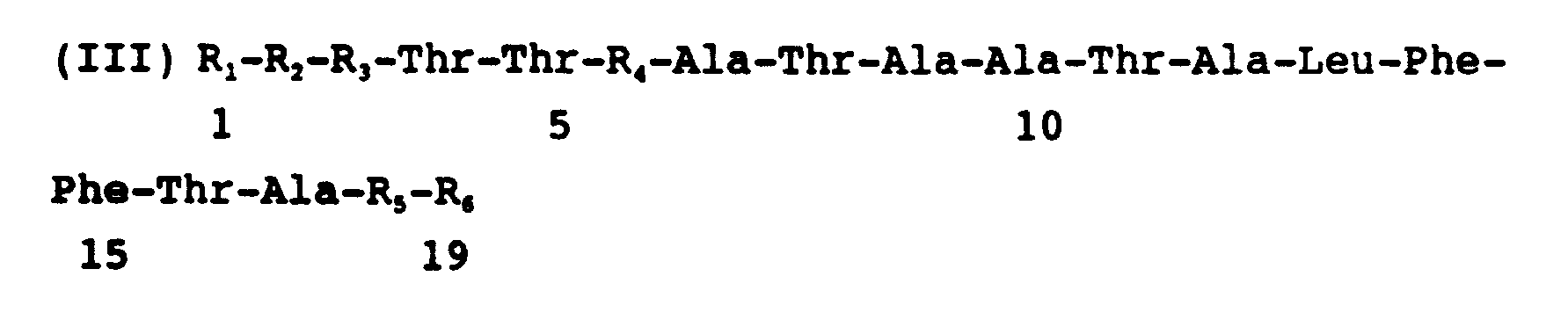
dans laquelle:
R₁ est un acide aminé selectionné parmi Arg et Lys,
R₂ et R₆ sont chacun un acide aminé sélectionné de manière indépendante parmi Ala, Asn, Cys, Gln, Gly, His, Ile, Leu, Met, Phe, Pro, Ser, Thr, Trp, Tyr et Val,
R₃ et R₅ sont chacun un acide aminé sélectionné de manière indépendante parmi Asp, Gly, Asn, Pro et Ser, et
R₄ est un acide aminé sélectionné parmi Val, Leu, Ala, Cys, Phe, Ile et Met. - De manière préférée, un fragment d'ADN selon l'invention code pour un peptide comprenant la sequence d'acides aminés (IV) suivante:

dans laquelle :
R₁ est un acide aminé selectionné parmi Arg et Lys,
R₂ et R₆ sont chacun un acide aminé sélectionné de manière indépendante parmi Ala, Asn, Cys, Gln, Gly, His, Ile, Leu, Met, Phe, Pro, Ser, Thr, Trp, Tyr et Val,
R₃ et R₅ sont chacun un acide aminé sélectionné de manière indépendante parmi Asp, Gly, Asn, Pro et Ser,
R₄ est un acide aminé sélectionné parmi Val, Leu, Ala, Cys, Phe, Ile et Met,
R₇ est une séquence de protéolyse. - R₇ est préférentiellement une séquence de protéolyse R₈-R₉-R₁₀ dans laquelle :
R₈ est un acide aminé sélectionné parmi Ala, Val, Ser, Cys, Gly, Ile, Leu, Thr,
R₉ est un acide aminé sélectionné parmi Ala, Arg, Cys, Gln, Gly, His, Ile, Leu, Met, Phe, Pro, Ser, Thr, Trp, Tyr et Val et
R₁₀ est un acide aminé sélectionné parmi Ala, Cys, Gly, Leu, Pro, Gln, Ser et Thr. - Selon l'invention, un fragment d'ADN préféré code pour un peptide comprenant une séquence d'acides aminés sélectionnée parmi les séquences d'acides aminés (V), (VI), (VII) et (VIII) suivantes :

dans laquelle R₇ est tel que défini ci-dessus.
dans laquelle R₇ est tel que défini ci-dessus. - De manière tout à fait préférée, R₇ est une sequence dans laquelle R₈ est Val, R₉ est Ser et R₁₀ est Ala.
- Il est tout particulièrement préféré qu'un fragment d'ADN selon l'invention ait pour séquence nucléotidique l'une des séquences (IX), (X), (XI) et (XII) suivantes :

- Les peptides codés par les fragment d'ADN selon l'invention comprennent une région hydrophobe possédant une structure en hélice α comprise entre l'acide aminé en position 3 et l'acide aminé en position 18. Cette structure contribue à les rendre aptes à une utilisation comme peptide signal. Il est connu que la partie hydrophobe des séquences signal est composée en majorité des acides aminés Ala, Cys, Phe, Ile, Leu, Met, Val. On peut donc aussi prévoir que certaines modifications d'acides aminés n'engendrent pas de modification dans l'aptitude du peptide signal à jouer son rôle.
- Sous un autre aspect, l'invention propose par conséquent l'application d'un fragment d'ADN selon l'invention à titre de fragment d'ADN codant pour un peptide signal utile pour la sécrétion d'une protéine hétérologue par une cellule hôte dans laquelle la protéine hétérologue est synthétisée. D'une manière générale, l'invention peut être mise en oeuvre dans une cellule procaryote ou eucaryote, de préférence dans cette dernière. La cellule eucaryote peut être par exemple, une cellule de mammifère ou de levure. De manière tout à fait préférée, la sécrétion d'une protéine hétérologue à l'aide d'un peptide signal codé par un fragment selon l'invention est réalisée par une cellule de levure, par exemple du genre Saccharomyces, plus particulièrement de l'espèce S. cerevisiae.
- Bien entendu, en tant que fragments d'ADN codant pour un peptide signal, les fragments d'ADN selon l'invention seront précédés d'un codon d'initiation de la traduction, généralement d'un codon codant pour une méthionine, en particulier un ATG.
- Les fragments d'ADN selon l'invention peuvent être utilisés pour la construction d'une cassette d'expression d'une protéine, précédés du codon d'initiation, seuls ou en combinaison avec d'autres composants, par exemple un fragment "pro". Ces fragments d'ADN peuvent être préparés par synthèse chimique, au moyen d'un synthétiseur d'oligonucléotides par une technique connue de l'homme du métier.
- L'invention concerne également une cassette d'expression d'une protéine hétérologue comprenant un fragment d'ADN selon l'invention à titre de fragment d'ADN codant pour le peptide signal de la dite protéine hétérologue. De manière détaillée, une cassette d'expression selon l'invention qui comporte donc l'information nécéssaire à la sécrétion d'une protéine hétérologue mature comprend, de façon séquentielle, au moins:
- a) un fragment d'ADN comportant des signaux d'initiation de transcription et de traduction,
- b) un fragment d'ADN selon l'invention,
- c) un fragment d'ADN codant pour une protéine hétérologue mature (avec codon de fin de traduction).
- Dans une première variante, on peut fusionner directement le fragment b) en phase avec le fragment c), dans la mesure où, à la jonction du fragment b) et du fragment c), il existe une séquence d'ADN codant pour un site de clivage protéolytique de manière à permettre la libération d'une protéine mature en fin du processus d'expression et de sécrétion. De manière préférée, la séquence d'ADN codant pour un site de clivage protéolytique se lit sur le fragment b).
- Dans une deuxième variante, une cassette d'expression selon l'invention comprend en outre un fragment d'ADN b') codant pour un fragment peptidique "pro". Ce fragment b') est fusionné en phase avec le fragment b) et le fragment c), dans la mesure où, à la jonction des fragments b) et b') d'une part et des fragments b') et c) d'autre part, il existe une séquence d'ADN codant pour un site de clivage protéolytique.
- De nombreux fragments b') peuvent être utilisés dans les cassettes selon l'invention. En particulier, divers fragments b') peuvent être construits de manière synthétique. A titre d'exemple, on indique ci-dessous la construction d'un fragment b') synthétique à partir de la séquence d'ADN codant pour le fragment "pro" du précurseur du Facteur α. Cette séquence peut être utilisée en totalité ou en partie. Dans un mode de réalisation particulier, on utilise cette séquence délétée de la partie codant pour les acides aminés en position 3 à 42 sur le fragment "pro"; c'est-à-dire la séquence codant pour :

Pour former le fragment b'), cette dernière séquence d'ADN est suivie d'une séquence codant pour (i) un peptide comprenant un site de clivage protéolytique ou (ii) un site de clivage protéolytique, ce dernier mode de réalisation étant préféré. Tout particulièrement, ce dernier site de clivage est Lys-Arg ou Arg-Arg, celui-ci etant reconnu par l'endopeptidase de levure yscF qui est codée par le gène KEX2 et qui coupe au niveau de l'extrémité C-terminale du dipeptide Lys-Arg ou Arg-Arg. En résumé, un fragment b') particulier code pour
- La séquence a) comprend en particulier un promoteur fonctionnel dans la cellule dans laquelle on souhaite synthétiser la protéine hétérologue codée par le fragment c), de préférence un promoteur fonctionnel chez la levure. On peut citer par exemple des promoteurs constitutifs de levure dont la fonctionnalité a été confirmée par la transcription de gènes codant pour des protéines hétérologues codant pour des protéines hétérologues tels que les promoteurs PGK, ENO1, MFα1, ou encore des promoteurs inductibles, tels que PH05, GAL1. Par exemple, lorsqu'on utilise dans la cassette d'expression des éléments du gène MFα1 de levure, on pourra utiliser le promoteur du gène MFα1.
- Enfin, les cassettes d'expression peuvent aussi comprendre un fragment d'ADN d) comportant des signaux de terminaison de la transcription, de préférence fonctionnels chez la levure, par exemple celui du gène PGK.
- De façon générale, une cassette d'expression selon l'invention peut être introduite dans une cellule procaryote ou eucaryote, de préférence eucaryote telle que cellule de mammifère ou de levure; une cellule de levure étant tout particulièrement préférée. Cette introduction peut être realisée en placant la cassette dans un plasmide à replication autonome ou dans une construction destinée à l'intégration pour être introduite directement dans le génome de la levure, de manière à obtenir dans les deux cas une cellule transformée.
- Lorsque le plasmide est autonome, il comportera des éléments assurant sa partiton et sa réplication; par exemple, une origine de réplication telle que celle du plasmide 2» de levure. En outre, le plasmide pourra comporter des éléments de sélection tel que le gène URA3 ou LEU2 qui assurent la complémentation de levure ura3 ou leu2. En particulier, on pourra avantageusement utiliser le gène URA3 délété de son promoteur (URA3-d).
- Ces plasmides peuvent également comporter des éléments assurant leur réplication dans les bactéries, lorsque le plasmide doit être un plasmide navette, par exemple une origine de réplication telle que celle du pBR322, un gène marqueur de sélection tel que AmpR et/ou d'autres éléments connus de l'homme du métier.
- En accord avec ce qui précède, la présente invention concerne également une cellule transformée par (i) un fragment d'ADN selon l'invention ou (ii) une cassette d'expression selon l'invention, soit inserée dans un plasmide, soit intégrée dans le génome de la cellule.
- Lorsque le promoteur est celui du gène MFα1, la cellule de levure transformée est de préférence de type sexuel MATα. On utilisera, par exemple, une souche de génotype ura3 ou leu2 ou autre, complémentée par le plasmide pour assurer le maintien du plasmide dans la levure par une pression de sélection appropriée.
- Enfin, l'invention a pour objet un procédé de préparation d'une protéine hétérologue, caractérisé en ce que l'on cultive un cellule selon l'invention et, en ce que l'on récupère la dite protéine dans le milieu de culture. Ce procédé s'applique à la preparation de toute protéine de nature hétérologue. Parmi ces protéines, on peut notamment citer l'hirudine ou des défensines, par exemple la défensine A.
- Plus particulièrement, l'invention concerne un procédé de sécrétion de l'hirudine sous forme mature à partir des souches de levures transformées selon l'invention.
- L'invention s'applique tout particulièrement bien à la production d'hirudine, c'est pourquoi un des exemples illustratifs de l'invention concerne cette protéine. En effet l'hirudine, dont la source principale se trouve dans les glandes salivaires des sangsues médicinales est un inhibiteur très spécifique et très efficace de la thrombine. Il s'agit donc d'un agent thérapeutique très intéressant dont l'utilisation en clinique exige une très grande pureté du produit, et qui est donc un candidat intéressant à la production par génie génétique.
- Un certain nombre de variants naturels de l'hirudine ont été identifiés et désignés par HV1, HV2, HV3. Par la suite ces variants naturels ainsi que d'autres analogues ont été préparés par génie génétique dans diverses cellules hôtes, comme cela est décrit par exemple dans les publications européennes de brevet EP-A-0200655, EP-A-0273800 au nom de la Demanderesse. La comparaison de l'hirudine synthétisée par Escherichia coli (E. coli) et par une levure du genre S. cerevisiae a montré que l'hirudine synthétisée par E. coli reste intracellulaire et doit donc être purifiée à partir d'un très grand nombre de polypeptides de E. coli. Il est donc particulièrement intéressant de pouvoir faire exprimer un gène de l'hirudine dans la levure de façon à obtenir une hirudine sécrétée sous forme mature, et sans que la levure ne produise de substances pyrogènes ou toxiques pour l'homme.
- L'invention s'applique donc à toutes les molécules d'hirudines, c'est à dire, variants naturels de l'hirudine tel quels ou ayant subi une ou plusieurs mutations tout en conservant leur activité antithrombotique, ce dernier type de variant étant appelé analogue. Les exemples ci-après concerneront plus particulièrement l'analogue désigné par rHV2Lys47 (pour recombinant variant HV2 ayant subi une mutation de l'acide aminé Asp en position 47 en acide aminé Lys), décrit dans la publication de brevet EP-A-02738000 déjà mentionnée.
- L'invention s'applique également à la production de défensines. Les défensines, aussi appelées phormicines, sont des peptides originellement extraits de l'hémolymphe des certains insectes, les Diptères, qui ont une activité bactéricide sur les germes Gram-positifs. Ces défensines sont plus amplement décrites dans la demande de brevet européenne EP-A-349 451. La défensine A est un peptide basique ayant pour séquence

La défensine B ne diffère de la défensine A que par l'acide aminé en position 32 où une arginine remplace une glycine. - Les exemples ci-après permettront de mettre en évidence d'autres caractéristiques et avantages de la présente invention. Ces exemples seront illustrés par les figures suivantes :
- la figure 1 représente la structure schématique du plasmide pTG2958.
- la figure 2 représente la structure schématique des vecteurs M13TG3839 et M13TG3841. Pour M13TG3839 les cadres hachurés aux extrémités correspondent à M13TG103 et pour M13TG3841 à M13TG3149.
- la figure 3 représente la structure schématique du vecteur M13TG3845. Le cadre hachuré correspond à M13TG3149.
- la figure 4 représente la structure schématique du plasmide pTG3828.
- la figure 5 représente la structure schématique du plasmide pTG3864.
- Le plasmide pTG2958 (figure 1) est peu différent du plasmide pTG1833 décrit dans la publication européenne de brevet EP-A-252854 porteur de la séquence codante pour rHV2Asp47. Le plasmide pTG2958 ne contient pas le site de restriction HindIII artificiellement introduit. Le plasmide pTG2958 contient :
- un fragment de 1217 paires de bases correspondant à la région 5' du gène MFα1 (contenant le promoteur, la séquence codant pour le peptide signal, la région "pro" et une séquence codant pour le peptide Lys-Arg), et 4 paires de bases (site BglII°, traitement par Klenow),
- un fragment de 234 paires de bases contenant l'ADN complémentaire de rHV2Lys47,
- un fragment de 243 paires de bases comprenant le terminateur PGK de levure,
- le fragment PvuII-EcoRI de pBR322 comprenant entre autres l'origine de réplication de ce plasmide et le gène de résistance à l'ampicilline (2292 paires de bases),
- le fragment EcoRI-HindIII du plasmide 2» de la levure (forme B), contenant le gène LEU2 de levure, sous forme délétée et inséré dans le site PstI,
- un fragment HindIII-SmaI du gène URA3 de levure.
- Le fragment NcoI-NcoI du vecteur pTG2958 qui porte les séquences LEU2-d, 2» et URA3 est remplacé par le fragment NcoI-NcoI de pTG2800 décrit dans la publication européenne de brevet EP-A-O268501 qui porte les séquences du plasmide 2» et du gène URA3 délété de son promoteur (URA3-d) pour donner pTG2877.
- Le vecteur M13TG3839 (figure 2) dérive de M13TG103 [Kieny, M.P. et al. (1983) Gene 26, 91-99] dans lequel le fragment HindIII-HindIII de pTG2877 est introduit dans le même site. Un site de restriction SalI est introduit dans ce vecteur en aval du codon de terminaison de traduction de la région codant pour rHV2Lys47 par mutagénèse dirigée à l'aide de l'oligonucléotide suivant :
5' CAATGAAAAATGGTCGACTATCAATCATAG pour donner M13TG3839 SalI. Un site de restriction SphI est alors introduit en amont de la cassette d'expression en éliminant la séquence URA3-d par mutagénèse dirigée à l'aide de l'oligonucléotide suivant :
5' GACGGCCAGTGAATTGGCATGCTATTGATAAGATTTAAAG pour donner M13TG3840. - Le vecteur M13TG131 [Kieny M.P. et al. (1983) Gene 26, 91-99] est clivé par PstI, les extrémités rendues franche par traitement à l'aide du fragment Klenow de l'ADN polymérase I pour être ensuite religué sur lui même pour donner M13TG3160. Ce vecteur est ensuite clivé par SmaI et EcoRV puis religué pour donner M13TG3149.
- Le fragment SphI-SalI de M13TG3840 (décrit ci-dessus) portant la cassette d'expression de rHV2Lys47 (sans séquence terminatrice de transcription) est introduit dans le site SphI-SalI de M13TG3149 pour donner M13TG3841 (figure 2).
- La séquence codant pour les acides aminés en position 3 à 42 sur le fragment "pro" du précurseur de MFα1 est éliminée de M13TG3149 par mutagénèse dirigée et un site de restriction SmaI introduit en utilisant l'oligonucléotide suivant :
5' CTCCGCATTAGCTGCTCCCGGGTTATTGTTTATAAAT, pour donner ce que l'on appelle par la suite une sequence "pro" délétée.
On obtient ainsi M13TG3842. Un site de restriction BamHI détruisant l'ATG du précurseur du facteur α est introduit dans ce vecteur par mutagénèse dirigée avec l'oligonucléotide suivant :
5' AATATAAACGATTAAAAGGATCCGATTTCCTTCAATTTTTA
On obtient alors M13TG3843. Après phosphorylation, les oligonucléotides suivants:
sont insérés dans le vecteur M13TG3843 coupé par BamHI et SmaI introduisant ainsi la séquence XI donc sans ATG. De manière à restaurer l'ATG, le site BamHI est éliminé par mutagénèse dirigée en utilisant l'oligonucléotide suivant :
5' AATATAAACGATTAAAAGAATGCGTTTCTCTACTACAGTC
pour donner le vecteur M13TG3845 (figure 3) qui comporte : - le promoteur du gène MFα1, suivi d'un codon ATG, en tant que fragment a)
- la séquence XI en tant que fragment b),
- la séquence "pro" délétée du gène MFα1, suivi des codons codant pour Lys-Arg en tant que fragment b'),
- la séquence codant pour rHV2Lys47 en tant que fragment c),
- une partie du vecteur M13TG3149.
- Le plasmide pTG848 décrit dans la publication européenne de brevet EP-A-0252854 est digéré par BglII puis religué pour donner pTG2886. Le grand fragment HindIII-EcoRI de pTG2886 est ligué en présence de ligase T4 au fragment HindIII-EcoRI de 2,1 kb du plasmide pFL1 [Parent, S.A. et al. (1985) Yeast 1, 83-138] qui porte la séquence du plasmide 2» de S. cerevisiae pour donner le plasmide pTG2886 LEU2-d, URA3-d. Le fragment HindIII de 0.9 kb du plasmide pTG2800 décrit dans la publication européenne de brevet EP-A-0258501 portant le gène URA3-d est alors inséré dans le site HindIII de ce plasmide pour donner pTG2886 URA3-d, delta LEU2-d. Le fragment SmaI-BglII de M13TG131 [Kieny et al. (1983) Gene 26, 91-99] qui possède plusieurs sites de restriction est ensuite introduit dans ce plasmide pour donner pTG3828 (figure 4) qui comporte:
- la séquence du gène URA3 délétée de son promoteur (URA3-d),
- des sites de restriction venant de M13TG131 permettant l'insertion des éléments de l'expression d'un gène hétérologue, rHV2Lys47 dans le cas présent,
- le terminateur de transcription du gène PGK de levure
- un fragment de pBR322 qui permet la réplication et la sélection chez E. coli,
- un fragment du plasmide 2» qui possède les éléments structuraux nécessaires à la réplication et à l'équipartition mitotique dans la levure.
- Le fragment SphI-SalI du vecteur M13TG3845 (figure 3) est introduit dans le plasmide pTG3828 digéré par SphI et SalI pour donner le vecteur d'expression pTG3864 (figure 5).
- Pour supprimer complètement la séquence codant pour le précurseur du gène MFα1 on effectue une mutagénèse dirigée sur M13TG3845 (figure 3) à l'aide de l'oligonucléotide suivant :
5' GCCTCCCAAGTTTCAGCTATTACGTATACAGACTGC
pour obtenir le vecteur M13TG3846. Le fragment SphI-SalI de ce vecteur est introduit dans le plasmide pTG3828 (figure 4) digéré par SphI et SalI pour donner le vecteur d'expression pTG3867. Dans ce vecteur, la séquence XI et celle codant pour rHV2Lys47 sont adjacentes. Pour obtenir la structure schématique de ce plasmide, il suffit sur la figure 5 de retirer la séquence "pro" délétée de MFα1. - Un site SmaI est créé dans la séquence codant pour le fragment "pro" du précurseur du facteur α par mutagénèse dirigée sur M13TG3841 (figure 2) grâce à l'oligonucléotide suivant :
5' TCCGCATTAGCTGCTCCCGGGAACACTACAACAGAA
pour obtenir M13TG3869. Ce vecteur est ensuite digéré par SphI et SmaI, le petit fragment est isolé et il est ligué au grand fragment SphI et SmaI de M13TG3845 (figure 3) pour donner le vecteur M13TG3891. Le fragment SphI-SalI de ce vecteur est introduit dans le plasmide pTG3828 (figure 4) ouvert aux sites SphI et SalI pour donner le vecteur d'expression pTG3894 qui comporte donc la séquence "pro" du précurseur du facteur α mutée. Pour obtenir la structure schématique de ce plasmide, il suffit sur la figure 5 de remplacer la séquence "pro" délétée de MFα1 par la séquence "pro" mutée. - La séquence XI est modifiée par mutagénèse dirigée sur M13TG3845 en utilisant l'oligonucléotide suivant :
5' GTTTCTCTACTACACTCGCTACTGC
La modification d'une seule base donne la séquence XII et induit le remplacement d'une valine par une leucine en tant qu'acide aminé R₄ du peptide signal. On obtient ainsi le bactériophage M13TG3846. Le fragment SphI-SalI de M13TG3846 est introduit dans le plasmide pTG3828 (figure 4) ouvert aux sites SphI et SalI pour donner le vecteur d'expression pTG3884 qui comporte : - la séquence du gène URA3 délétée de son promoteur (URA3-d),
- le promoteur du gène MFα1, suivi d'un codon ATG, en tant que fragment a),
- la séquence XII en tant que fragment b),
- la séquence "pro" délétée du gène MFα1, suivi des codons codant pout Lys-Arg, en tant que fragment b'),
- la séquence codant pour rHV2Lys47 en tant que fragment c),
- le terminateur du gène codant pour PGK de la levure.
- un fragment de pBR322,
- un fragment du plasmide 2».
- Une souche de levure de l'espèce Saccharomyces cerevisiae de génotype MATα, ura3-251,-373,-328, leu2-3,-112, his3, pep4-3 est transformée par les plasmides pTG3864, pTG3867, pTG3894 et pTG3884 par le méthode de l'acétate de lithium [Ito, H. et al. J. Bactériol. (1983) 153: 163] et les prototrophes Ura+ sont sélectionnés. Ils sont ensuite mis en culture en erlenmeyer à 30°C sur un milieu sélectif (0,7% de bases azotées pour levures (Yeast Nitrogen Base), 0,5% de casamino acides et 1% de glucose). Après 48 heures de culture, on sépare cellules et surnageant par centrifugation et l'activité inhibitrice de la thrombine est déterminée dans le surnageant en utilisant le test colorimétrique (activité protéolytique sur un substrat synthétique, le chromozyme TH - Boehringer Mannheim). Le tableau I présente les résultats des dosages; chaque valeur correspond à la moyenne de deux expériences indépendantes. L'activité de rHV2Lys47 est exprimée en ATU/ml de surnageant.
Tableau I Plasmide ATU/ml pTG3894 40 pTG3864 50 pTG3867 130 pTG3884 125
Dans tous les cas on mesure une activité anti-thrombine. La protéine rHV2Lys47 produite par la levure est donc excrétée dans le surnageant. De plus elle est secrétée sous forme active. Les meilleurs résultats sont obtenus pour les souches transformées par pTG3884 et pTG3867. - Le contenu en protéine des surnageants est analysé par HPLC. Le pic majeur obtenu correspond bien à celui de rHV2Lys47 (sous sa forme à 65 acides aminés) et la détermination de la séquence N-terminale confirme l'obtention d'une molécule correctement synthétisée.
- La synthèse se fait en deux blocs assemblés grâce à leurs extrémités cohésives KpnI. Le premier bloc comprend 3 oligonucléotides numérotés de 1 à 3 et le second bloc, 6 oligonucléotides numérotés de 4 à 9. Leur séquence et la position des oligonucléotides (dernière ligne du tableau; les ronds représentent la partie 5' de l'oligonucléotide) sont donnés dans le tableau II.

- La séquence obtenue est la suivante :

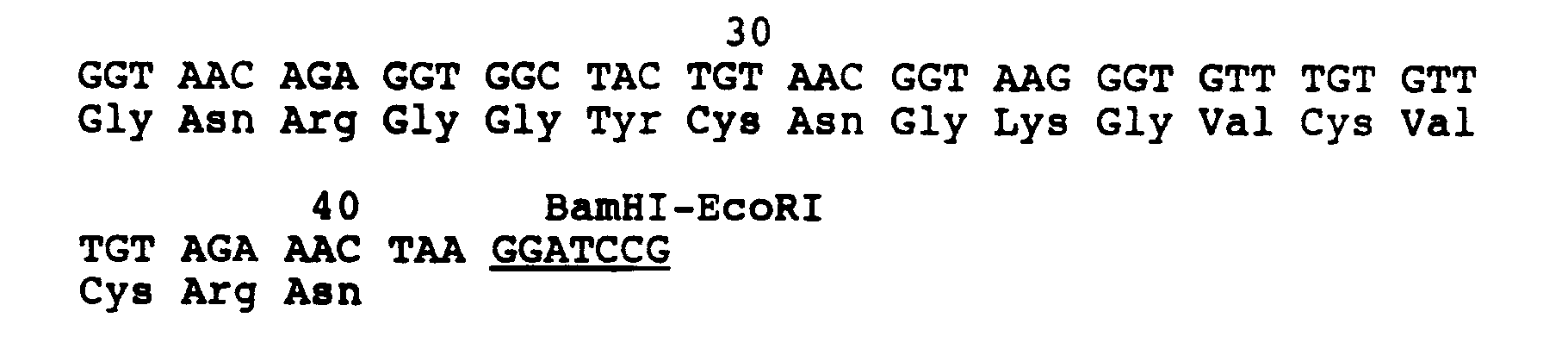
La synthèse du premier bloc utilise les oligonucléotides 4, 5, 6, 7, 8 et 9 et s'effectue de la façon suivante : - les oligonucléotides 5, 6, 7 et 8 sont tout d'abord phosphorylés à leur extrémités 5' pour éviter la formation de polymères au cours de l'assemblage. Pour chacun de ces oligonucléotides, 100 picomoles sont traitées à la polynucléotide kinase, 2 unités dans un volume final de 20 »l de Tris HCl 60 »M à pH 7,5; 10 »M de MgCl₂; 8 »M de dithiothréitol (tampon de kination) contenant 3,3 picomoles d'ATPγ marqué avec ³²P (5000 Ci/mmole). Après 15 minutes d'incubation à 37°C, 5 »moles d'ATP non marqué sont ajoutées.
- après incubation à 37°C pendant 30 min. 75 picomoles des oligonucléotides 5, 6, 7 et 8 sont mélangés, chauffés à 95°C pendant 3 min., puis les oligonucléotides 4 et 9 sont ajoutés dans un volume final de 90 »moles de tampon de kination décrit ci-dessus. L'ensemble est chauffé à 95°C pendant 3 min. puis refroidi lentement en 2 heures à 37°C.
- 25 picomoles de ces oligonucléotides hybridés sont soumis au traitement par la ligase T4 pendant une heure à 15°C. Ce mélange réactionnel (1 picomole) est ensuite ajouté à 50 ng du du bactériophage M13TG131 [Kieny M.P. et al. (1983) Gene 26, 91-99] traité par EcoRI et KpnI (1 heure à 15°C). Le mélange de ligation est utilisé pour transformer les cellules compétentes de la souche E. coli JM103 [Messing J. et al. (1981), Nucleic Acid Res. 9, 309]. Un clone présentant la séquence recherchée est isolé, il est appelé M13TG3821.
- La synthèse du second bloc utilise les oligonucléotides 1, 2 et 3 et s'effectue selon la même procédure que celle décrite pour la synthèse du premier bloc. Dans ce cas, seul l'oligonucléotide 2 est phosphorylé à son extrémité 5'.
- Ce second bloc est cloné entre les sites HindIII et KpnI du bactériophage M13TG3821 et un clone portant la séquence d'ADN codant pour la défensine A (figure 5) est isolé, il est appelé M13TG3849.
- Le fragment SphI - SmaI de 1045 paires de bases du bactériophage M13TG3846 décrit précédemment (Exemple 1, E.) est transféré dans le vecteur M13TG3869 décrit précédemment (Exemple 1, D.) préalablement digéré par SphI et SmaI. On obtient ainsi le vecteur M13TG4803 qui porte :
- le promoteur du gène MFα1, suivi d'un codon ATG,
- la séquence XII,
- la séquence "pro" mutée du gène MFα1 suivi des codons codant pour Lys-Arg,
- la séquence codant pour rHV2Lys47.
- Afin de remplacer la séquence codant pour rHV2Lys47 par celle codant pour la défensine A d'insecte on introduit un site HindIII dans la séquence codant pour "pro" mutée de MFα1 à l'aide de l'oligonucléotide de séquence :
5' GAAGGGGTAAGCTTGGATAAA
Puis on introduit le fragment HindIII - BamHI de M13TG3849 décrit précédemment (Exemple 3, A.) qui porte la séquence synthétique codant pour la défensine A dans ce vecteur préalablement traité par HindIII et BamHI pour éliminer la séquence codant pour rHV2Lys47. - Le fragment SphI-SalI de M13TG4813 est introduit dans le plasmide pTG3828 (figure 4) ouvert aux sites SphI et SalI pour donner le vecteur d'expression pTG4839 qui comporte :
- la séquence du gène URA3 délétée de son promoteur (URA3-d),
- le promoteur du gène MFα1, suivi d'un ATG,
- la séquence XII,
- la séquence "pro" mutée du gène MFα1 suivi des codons codant pour Lys-Arg,
- la séquence synthétique codant pour la défensine A d'insectes,
- le terminateur du gène codant pour PGK de la levure.
- un fragment de pBR322,
- un fragment du plasmide 2».
- Une souche de levure de l'espèce Saccharomyces cerevisiae de génotype MATα, ura3-251,-373,-328, leu2-3,-112, his3, pep4-3 est transformée par le plasmide pTG4839 par la méthode de l'acétate de lithium [Ito, H. et al. J. Bactériol. (1983) 153: 163] et les prototrophes Ura+ sont sélectionnés. Ils sont ensuite mis en culture en erlenmeyer à 30°C sur un milieu sélectif (0,7% de bases azotées pour levures (Yeast Nitrogen Base), 0,5% de casamino acides et 1% de glucose). Après 48 heures de culture, on sépare cellules et surnageant par centrifugation et le surnageant est filtré sur un filtre de 22 » puis passé sur cartouche Sep-Pak C18. Le matériel fixé est élué avec 60% d'acétonitrile, 0,1% d'acide trifluoro acétique dans de l'eau et séché sous vide. L'activité antibactérienne de la défensine A est ensuite mise en évidence par un test d'étalement sur agar ou sur gélose ensemencé de germes bactériens (Micrococcus luteus) conformément à la procédure décrite par Lambert et al. (1989) PNAS 86: 262-266.
- Dans le surnageant des levures transformées par le plasmide pTG4839 on détecte effectivement une activité antibactérienne. La protéine défensine A produite par la levure est donc excrétée dans le surnageant. De plus elle est secrétée sous forme active.
- Le contenu en protéine des surnageants est analysé par HPLC. Le pic majeur obtenu correspond bien à celui de la défensine A d'insecte et la détermination de la séquence de la protéine confirme l'obtention d'une molécule correctement synthétisée.
Claims (26)
- Procédé de préparation d'un fragment d'ADN isolé qui code pour un peptide signal utile pour la sécrétion d'une protéine hétérologue par une cellule dans laquelle la protéine hétérologue est synthétisée, caractérisé en ce qu'on prépare un fragment d'ADN qui code pour un peptide dont la séquence d'acides aminés présente un degré d'homologie d'au moins 60% avec la séquence d'acides aminés de formule (I) ou (II)
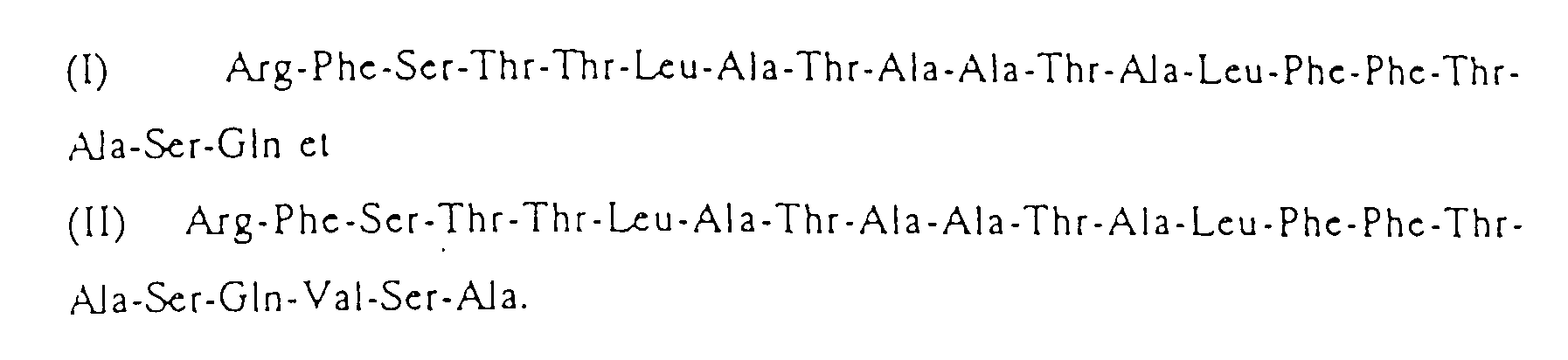
- Procédé selon la revendication 1, caractérisé en ce que le fragment d'ADN code pour un peptide dont la séquence d'acides aminés présente un degré d'homologie d'au moins 80% avec la séquence d'acides aminés (I) ou (II) de formule

- Procédé selon l'une des revendications 1 ou 2, caractérisé en ce que le fragment d'ADN code pour un peptide comprenant la séquence d'acides aminés (III)dans laquelle :

R₁ est un acide aminé sélectionné parmi Arg et Lys,
R₂ et R₆ sont chacun un acide aminé sélectionné de manière indépendante parmi Ala, Asn, Cys, Gln, Gly, His, Ile, Leu, Met, Phe, Pro, Ser, Thr, Trp, Tyr et Val,
R₃ et R₅ sont chacun un acide aminé sélectionné de manière indépendante parmi Asp, Gly, Asn, Pro et Ser, et
R₄ est un acide aminé sélectionné parmi Val, Leu, Ala, Cys, Phe, Ile et Met. - Procédé selon l'une des revendications 1 ou 2, caractérisé en ce que le fragment d'ADN code pour un peptide comprenant la séquence d'acides aminés (IV)dans laquelle :

R₁ est un acide aminé sélectionné parmi Arg et Lys,
R₂ et R₆ sont chacun un acide aminé sélectionné de manière indépendante parmi Ala, Asn, Cys, Gln, Gly, His, Ile, Leu, Met, Phe, Pro, Ser, Thr, Trp, Tyr et Val,
R₃ et R₅ sont chacun un acide aminé sélectionné de manière indépendante parmi Asp, Gly, Asn, Pro et Ser,
R₄ est un acide aminé sélectionné parmi Val, Leu, Ala, Cys, Phe, Ile et Met, et
R₇ est une séquence de protéolyse. - Procédé selon la revendication 4 dans lequel R₇ est une séquence de protéolyse R₈-R₉-R₁₀ dans laquelle :
R₈ est un acide aminé sélectionné parmi Ala, Val, Ser, Cys, Gly, Ile, Leu, Thr,
R₉ est un acide aminé sélectionné parmi Ala, Arg, Cys, Gln, Gly, His, Ile, Leu, Met, Phe, Pro, Ser, Thr, Trp, Tyr et Val et
R₁₀ est un acide aminé sélectionné parmi Ala, Cys, Gly, Leu, Pro, Gln, Ser et Thr. - Procédé selon l'une des revendications 1 ou 2, caractérisé en ce que le fragment d'ADN code pour un peptide comprenant une séquence d'acides aminés sélectionnée parmi les séquences d'acides aminés (V) et (VI)

- Procédé selon l'une des revendications 1, 2, 4, ou 5, caractérisé en ce que le fragment d'ADN code pour un peptide comprenant une séquence d'acides aminés sélectionnée parmi les séquences d'acides aminés de formule (VII) et (VIII)dans laquelle R₇ est une séquence de protéolyse;
 dans laquelle R₇ est une séquence de protéolyse.
- Procédé selon la revendication 7, caractérisé en ce que le fragment d'ADN code pour un peptide comprenant une séquence d'acides aminés sélectionnée parmi les séquences d'acides aminés de formule (VII) et (VIII) dans lesquelles R₇ est Val-Ser-Ala.
- Application d'un fragment d'ADN préparé selon l'une des revendications 1 à 8, caractérisé en ce que le fragment d'ADN code pour un peptide signal utile pour la sécrétion d'une protéine hétérologue par une cellule de levure dans laquelle la protéine hétérologue est synthétisée.
- Procédé de préparation d'une cassette d'expression d'une protéine hétérologue, caractérisé en ce qu'on prépare une cassette comprenant au moins :a) un fragment d'ADN comportant des signaux d'initiation de transcription et de traduction,b) un fragment d'ADN selon l'une des revendications 1 et 8 et,c) un fragment d'ADN codant pour la protéine hétérologue mature.
- Procédé de préparation d'une cassette selon la revendication 10, ladite cassette comprenant en outre un fragment d'ADN b') codant pour un fragment peptidique "pro".
- Procédé de préparation d'une cassette selon la revendication 11, ladite cassette comprenant un fragment d'ADN b') codant pour un fragment peptidique "pro" ayant pour séquence

- Procédé de préparation d'une cassette selon l'une des revendications 10 à 12, caractérisée en ce que le fragment a) comporte un promoteur fonctionnel dans une cellule de levure et un codon d'initiation de traduction ATG.
- Procédé de préparation d'une cassette d'expression selon l'une des revendications 10 à 13, caractérisée en ce que le fragment d'ADN c) code pour une hirudine.
- Procédé de préparation d'une cassette d'expression selon la revendication 14, caractérisée en ce que le fragment d'ADN c) code pour le variant hirudine rHV2Lys47.
- Procédé de préparation d'une cassette d'expression selon l'une des revendications 10 à 13, caractérisée en ce que le fragment d'ADN c) code pour une défensine d'insectes.
- Procédé de préparation d'une cassette d'expression selon la revendication 16, caractérisée en ce que le fragment d'ADN c) code pour la défensine A.
- Procédé de préparation d'un vecteur plasmidique, caractérisé en ce qu'on introduit une cassette d'expression selon l'une des revendications 10 à 17.
- Procédé de préparation d'un vecteur plasmidique selon la revendication 18, caractérisé en ce que ledit plasmide comporte un fragment du plasmide 2» de levure.
- Procédé de préparation d'un vecteur plasmidique selon la revendication 18 ou 19, caractérisé en ce que le plasmide comporte, en tant que gène de sélection, le gène URA3 délété de son promoteur.
- Une cellule transformée par un vecteur plasmidique selon l'une des revendications 18 à 20 ou ayant intégré dans son génome une cassette d'expression selon l'une des revendications 10 à 17.
- Une cellule de levure selon la revendication 21.
- Un procédé de préparation d'une protéine hétérologue, caractérisé en ce que l'on cultive une cellule selon la revendication 21 ou 22, et en ce que l'on récupère ladite protéine dans le milieu de culture.
- Un procédé selon la revendication 23, caractérisé en ce que la cellule est une cellule de levure.
- Un procédé selon la revendication 23 ou 24, caractérisé en ce que ladite protéine est une hirudine.
- Un procédé selon la revendication 23 ou 24, caractérisé en ce que ladite protéine est une défensine d'insectes.
Applications Claiming Priority (3)
| Application Number | Priority Date | Filing Date | Title |
|---|---|---|---|
| FR8905687A FR2646437B1 (fr) | 1989-04-28 | 1989-04-28 | Nouvelles sequences d'adn, leur application en tant que sequence codant pour un peptide signal pour la secretion de proteines matures par des levures recombinantes, cassettes d'expression, levures transformees et procede de preparation de proteines correspondant |
| FR8905687 | 1989-04-28 | ||
| PCT/FR1990/000306 WO1990013646A1 (fr) | 1989-04-28 | 1990-04-27 | Application de nouveaux fragments d'adn en tant que sequence codant pour un peptide signal pour la secretion de proteines matures par des levures recombinantes, cassettes d'expression, levures transformees et procede de preparation de proteines correspondant |
Publications (2)
| Publication Number | Publication Date |
|---|---|
| EP0423302A1 EP0423302A1 (fr) | 1991-04-24 |
| EP0423302B1 true EP0423302B1 (fr) | 1995-04-26 |
Family
ID=9381255
Family Applications (1)
| Application Number | Title | Priority Date | Filing Date |
|---|---|---|---|
| EP90907160A Expired - Lifetime EP0423302B1 (fr) | 1989-04-28 | 1990-04-27 | Application de nouveaux fragments d'adn en tant que sequence codant pour un peptide signal pour la secretion de proteines matures par des levures recombinantes, cassettes d'expression, levures transformees et procede de preparation de proteines correspondant |
Country Status (11)
| Country | Link |
|---|---|
| US (1) | US5631144A (fr) |
| EP (1) | EP0423302B1 (fr) |
| JP (1) | JP3085973B2 (fr) |
| AT (1) | ATE121781T1 (fr) |
| CA (1) | CA2032153C (fr) |
| DE (1) | DE69018920T2 (fr) |
| DK (1) | DK0423302T3 (fr) |
| ES (1) | ES2073571T3 (fr) |
| FR (1) | FR2646437B1 (fr) |
| PT (1) | PT93910B (fr) |
| WO (1) | WO1990013646A1 (fr) |
Families Citing this family (314)
| Publication number | Priority date | Publication date | Assignee | Title |
|---|---|---|---|---|
| WO1992009691A1 (fr) * | 1990-11-29 | 1992-06-11 | Institut National De La Recherche Agronomique - I.N.R.A. | Nouveaux variants derives des interferons de type i, leur procede de production, et leurs applications |
| FR2669931B1 (fr) * | 1990-11-29 | 1995-03-31 | Transgene | Nouveaux variants derives des interferons-alpha et leur procede de production. |
| GB9127250D0 (en) * | 1991-12-23 | 1992-02-19 | Unilever Plc | Modification |
| FR2700338B1 (fr) * | 1993-01-11 | 1995-03-31 | Transgene Sa | Nouvelle séquence pro permettant la secrétion de protéines hétérologues à partir d'une cellule de levure. |
| FR2714908A1 (fr) * | 1994-01-11 | 1995-07-13 | Transgene Sa | Famille de peptides appelés xénoxines. |
| ES2157261T3 (es) | 1993-06-29 | 2001-08-16 | Transgene Sa | Familia de peptidos denominados xenoninas. |
| US5712114A (en) * | 1995-06-06 | 1998-01-27 | Basf Aktiengesellschaft | Compositions for expression of proteins in host cells using a preprocollagen signal sequence |
| US5837247A (en) * | 1995-06-16 | 1998-11-17 | United States Of America As Represented By The Public Health Service National Institutes Of Health | Chemotactic agents for t-cells |
| US6998116B1 (en) | 1996-01-09 | 2006-02-14 | Genentech, Inc. | Apo-2 ligand |
| US6030945A (en) * | 1996-01-09 | 2000-02-29 | Genentech, Inc. | Apo-2 ligand |
| IL126383A0 (en) | 1996-04-01 | 1999-05-09 | Genentech Inc | Apo-2li and apo-3 apoptosis polypeptides |
| US6159462A (en) * | 1996-08-16 | 2000-12-12 | Genentech, Inc. | Uses of Wnt polypeptides |
| US5851984A (en) * | 1996-08-16 | 1998-12-22 | Genentech, Inc. | Method of enhancing proliferation or differentiation of hematopoietic stem cells using Wnt polypeptides |
| US6462176B1 (en) | 1996-09-23 | 2002-10-08 | Genentech, Inc. | Apo-3 polypeptide |
| WO1998013473A1 (fr) | 1996-09-25 | 1998-04-02 | Vanderbilt University | Levure genetiquement modifiee dotee d'un complexe peptidase-signal |
| WO1999027098A2 (fr) | 1997-11-21 | 1999-06-03 | Genentech, Inc. | Antigenes apparentes a a33 et leurs utilisations pharmacologiques |
| US6342369B1 (en) | 1997-05-15 | 2002-01-29 | Genentech, Inc. | Apo-2-receptor |
| EP1003856A1 (fr) | 1997-06-05 | 2000-05-31 | Board of Regents, The University of Texas System | Apaf-1, homologue humain de ced-4, activateur de caspase-3 |
| JP2002508663A (ja) | 1997-06-18 | 2002-03-19 | ジェネンテク,インコーポレイテッド | Apo−2DcR |
| US6342220B1 (en) | 1997-08-25 | 2002-01-29 | Genentech, Inc. | Agonist antibodies |
| PT1015587E (pt) | 1997-09-18 | 2008-07-31 | Genentech Inc | Polipéptido dcr3, um homólogo de tnfr |
| EP1967587A1 (fr) | 1997-10-10 | 2008-09-10 | Genentech, Inc. | Ligand APO-3 |
| US6387657B1 (en) | 1997-10-29 | 2002-05-14 | Genentech, Inc. | WISP polypeptides and nucleic acids encoding same |
| DE69840051D1 (de) | 1997-10-29 | 2008-11-06 | Genentech Inc | Durch wnt-1 induzierbare gene |
| US7192589B2 (en) | 1998-09-16 | 2007-03-20 | Genentech, Inc. | Treatment of inflammatory disorders with STIgMA immunoadhesins |
| EP1045906B1 (fr) | 1998-01-15 | 2008-10-15 | Genentech, Inc. | Apo-2 ligand |
| US6727079B1 (en) | 1998-02-25 | 2004-04-27 | The United States Of America As Represented By The Department Of Health And Human Services | cDNA encoding a gene BOG (B5T Over-expressed Gene) and its protein product |
| NZ525914A (en) | 1998-03-10 | 2004-03-26 | Genentech Inc | Novel polypeptides and nucleic acids encoding the same |
| ES2389387T3 (es) | 1998-03-17 | 2012-10-25 | Genentech, Inc. | Polipéptidos homólogos de VEGF y de BMP1 |
| EP1865061A3 (fr) | 1998-05-15 | 2007-12-19 | Genentech, Inc. | Polypeptides allogéniques IL-17 et utilisations thérapeutiques |
| AU740405B2 (en) | 1998-05-15 | 2001-11-01 | Genentech Inc. | IL-17 homologous polypeptides and therapeutic uses thereof |
| EP3112468A1 (fr) | 1998-05-15 | 2017-01-04 | Genentech, Inc. | Polypeptides allogéniques il-17 et utilisations thérapeutiques |
| US6545140B1 (en) * | 1998-07-13 | 2003-04-08 | University Of Georgia Research Foundation, Inc. | DNA encoding an avian beta-defensin and uses thereof |
| US20020172678A1 (en) | 2000-06-23 | 2002-11-21 | Napoleone Ferrara | EG-VEGF nucleic acids and polypeptides and methods of use |
| EP1950300A3 (fr) | 1998-11-18 | 2011-03-23 | Genentech, Inc. | Variantes d'anticorps avec une affinité de liaison plus élevée en comparaison aux anticorps parents |
| CA2450402A1 (fr) | 1998-12-22 | 2000-06-29 | Genentech, Inc. | Methodes et compositions permettant d'inhiber la croissance de cellules cancereuses avec la pro224 |
| EP2319929A1 (fr) | 1998-12-23 | 2011-05-11 | Genentech, Inc. | Polypeptides de type IL-1 |
| KR100940380B1 (ko) | 1999-01-15 | 2010-02-02 | 제넨테크, 인크. | 효과기 기능이 변화된 폴리펩티드 변이체 |
| AU5152700A (en) | 1999-06-15 | 2001-01-02 | Genentech Inc. | Secreted and transmembrane polypeptides and nucleic acids encoding the same |
| AT500848B1 (de) | 1999-06-25 | 2008-01-15 | Genentech Inc | Humanisierte anti-erbb2-antikörper |
| IL148936A0 (en) | 1999-10-20 | 2002-09-12 | Genentech Inc | Modulation of t cell differentiation for the treatment of t helper cell mediated diseases |
| EP1666494A1 (fr) | 1999-12-01 | 2006-06-07 | Genentech, Inc. | Polypeptides secretés et transmembranaires et acides nucléiques les codant |
| EP1897944B1 (fr) | 1999-12-23 | 2011-08-10 | Genentech, Inc. | Polypeptides allogéniques IL-17 et utilisations thérapeutiques |
| IL149893A0 (en) | 1999-12-30 | 2002-11-10 | Genencor Int | Trichoderma reesei xylanase |
| DE60137829D1 (de) | 2000-01-13 | 2009-04-16 | Genentech Inc | Menschliche stra6 polypeptide |
| JP2003528071A (ja) | 2000-03-23 | 2003-09-24 | エラン ファーマスーティカルズ インコーポレイテッド | アルツハイマー病治療用組成物および方法 |
| ATE394496T1 (de) | 2000-03-24 | 2008-05-15 | Genencor Int | Herstellung von sekretierten proteinen durch rekombinante eukaryotische zellen |
| AU2001247616B2 (en) | 2000-04-11 | 2007-06-14 | Genentech, Inc. | Multivalent antibodies and uses therefor |
| EP2042597B1 (fr) | 2000-06-23 | 2014-05-07 | Genentech, Inc. | Compositions et procédés pour le traitement et le diagnostic des troubles impliquant une angiogénèse |
| CA2709771A1 (fr) | 2000-06-23 | 2002-01-03 | Genentech, Inc. | Compositions et methode de diagnostic et de traitement des troubles mettant en cause l'angiogenese |
| PE20020276A1 (es) | 2000-06-30 | 2002-04-06 | Elan Pharm Inc | COMPUESTOS DE AMINA SUSTITUIDA COMO INHIBIDORES DE ß-SECRETASA PARA EL TRATAMIENTO DE ALZHEIMER |
| US6846813B2 (en) | 2000-06-30 | 2005-01-25 | Pharmacia & Upjohn Company | Compounds to treat alzheimer's disease |
| JP2004502665A (ja) | 2000-06-30 | 2004-01-29 | イーラン ファーマスーティカルズ、インコーポレイテッド | アルツハイマー病を治療する化合物 |
| ATE415978T1 (de) | 2000-07-27 | 2008-12-15 | Genentech Inc | Sequentielle verabreichung von cpt-11 und apo-2l polypeptid |
| DE60136281D1 (de) | 2000-08-24 | 2008-12-04 | Genentech Inc | Methode zur inhibierung von il-22 induziertem pap1 |
| EP1944317A3 (fr) | 2000-09-01 | 2008-09-17 | Genentech, Inc. | Polypeptides sécrétés et transmembranaires, et acides nucléiques les codant |
| US6673580B2 (en) | 2000-10-27 | 2004-01-06 | Genentech, Inc. | Identification and modification of immunodominant epitopes in polypeptides |
| WO2005010044A2 (fr) | 2003-07-08 | 2005-02-03 | Genentech, Inc. | Polypeptides heterologues il-17 a/f et utilisation des polypeptides a des fins therapeutiques |
| US20070160576A1 (en) | 2001-06-05 | 2007-07-12 | Genentech, Inc. | IL-17A/F heterologous polypeptides and therapeutic uses thereof |
| KR100576674B1 (ko) | 2001-06-20 | 2006-05-10 | 제넨테크, 인크. | 종양의 진단 및 치료를 위한 방법 및 이를 위한 조성물 |
| WO2003002122A1 (fr) | 2001-06-27 | 2003-01-09 | Elan Pharmaceuticals, Inc. | Derives de beta-hydroxyamine utiles dans le traitement de la maladie d'alzheimer |
| BR0212070A (pt) | 2001-08-29 | 2004-09-28 | Genentech Inc | ácidos nucléicos e polipeptìdeos bv8 com atividade mitogênica |
| ES2431929T3 (es) | 2001-09-18 | 2013-11-28 | Genentech, Inc. | Composiciones y procedimientos para el diagnóstico y el tratamiento de tumores |
| EP2067472A1 (fr) | 2002-01-02 | 2009-06-10 | Genentech, Inc. | Compositions et procédés pour le traitement et le diagnostic d'une tumeur |
| US20040258678A1 (en) | 2002-02-22 | 2004-12-23 | Genentech, Inc. | Compositions and methods for the treatment of immune related diseases |
| CA2481507A1 (fr) | 2002-04-16 | 2003-10-30 | Genentech, Inc. | Compositions et methodes permettant de diagnostiquer et de traiter une tumeur |
| EP2305710A3 (fr) | 2002-06-03 | 2013-05-29 | Genentech, Inc. | Bibliothèques de phages et anticorps synthétiques |
| MXPA04012243A (es) | 2002-06-07 | 2005-02-25 | Genentech Inc | Composiciones y metodos para l diagnostico y tratamiento de tumores. |
| EP1572130A4 (fr) | 2002-07-08 | 2008-07-02 | Genentech Inc | Compositions et procedes destines au traitement de maladies liees au systeme immunitaire |
| HUP0600340A3 (en) | 2002-07-15 | 2011-06-28 | Genentech Inc | Methods for identifying tumors that are responsive to treatment with anti-erbb2 antibodies |
| EP2277532A1 (fr) | 2002-09-11 | 2011-01-26 | Genentech, Inc. | Nouvelles compositions et procédés pour le traitement de maladies liées au système immunitaire |
| WO2004024072A2 (fr) | 2002-09-11 | 2004-03-25 | Genentech, Inc. | Nouvelles compositions et methodes pour le traitement de maladies associees au systeme immunitaire |
| EP1578364A4 (fr) | 2002-09-16 | 2011-06-08 | Genentech Inc | Compositions et methodes de traitement de maladies de nature immune |
| EP2500438A3 (fr) | 2002-09-25 | 2012-11-28 | Genentech, Inc. | Compositions et procédés nouveaux pour le traitement du psoriasis |
| EP1576137A4 (fr) | 2002-10-29 | 2010-06-30 | Genentech Inc | Compositions et methodes de traitement de maladies liees au systeme immunitaire |
| AU2003295401B2 (en) | 2002-11-08 | 2010-04-29 | Genentech, Inc. | Compositions and methods for the treatment of natural killer cell related diseases |
| JP2011516026A (ja) | 2002-11-26 | 2011-05-26 | ジェネンテック・インコーポレーテッド | 免疫関連疾患の治療のための組成物と方法 |
| EP1592777A4 (fr) | 2003-02-01 | 2008-06-04 | Tanox Inc | Procede destine a produire des anticorps a affinite elevee |
| AU2004219592C1 (en) | 2003-03-12 | 2011-02-24 | Genentech, Inc. | Use of Bv8 and/or EG-VEGF to promote hematopoiesis |
| AU2004229335C1 (en) | 2003-04-04 | 2010-06-17 | Genentech, Inc. | High concentration antibody and protein formulations |
| NZ621449A (en) | 2003-05-30 | 2015-07-31 | Genentech Inc | Treatment with anti-vegf antibodies |
| JP4629047B2 (ja) | 2003-06-12 | 2011-02-09 | イーライ リリー アンド カンパニー | Glp−1アナログ複合タンパク質 |
| US7097993B2 (en) | 2003-06-25 | 2006-08-29 | Wisconsin Alumni Research Foundation | Method for identifying an agent that modulates type 1 phosphatidylinositol phosphate kinase isoform β661 activity |
| US20050106667A1 (en) | 2003-08-01 | 2005-05-19 | Genentech, Inc | Binding polypeptides with restricted diversity sequences |
| WO2005019258A2 (fr) | 2003-08-11 | 2005-03-03 | Genentech, Inc. | Compositions et methodes de traitement de maladies relatives au systeme immunitaire |
| PL2295073T3 (pl) | 2003-11-17 | 2014-09-30 | Genentech Inc | Przeciwciało przeciwko CD22 do leczenia nowotworu pochodzącego z układu krwiotwórczego |
| EP1709193B1 (fr) | 2003-12-19 | 2011-03-16 | The Regents of The University of California | Procedes et materiaux pour evaluer des therapies du cancer de la prostate |
| AU2005205533B2 (en) | 2004-01-07 | 2012-03-22 | Novartis Vaccines And Diagnostics, Inc. | M-CSF-specific monoclonal antibody and uses thereof |
| WO2005099693A2 (fr) | 2004-02-24 | 2005-10-27 | The Regents Of The University Of California | Methodes et substances permettant d'evaluer des therapies du cancer de la prostate, et composes s'y rapportant |
| SI1730191T1 (sl) | 2004-03-30 | 2011-11-30 | Glaxo Group Ltd | Imunoglobulin-vezavni hOSM |
| TWI307630B (en) | 2004-07-01 | 2009-03-21 | Glaxo Group Ltd | Immunoglobulins |
| EP1771474B1 (fr) | 2004-07-20 | 2010-01-27 | Genentech, Inc. | Inhibiteurs de la proteine 4 de type angiopoietine, combinaisons correspondantes et leur utilisation |
| ES2343746T3 (es) | 2005-01-07 | 2010-08-09 | Diadexus, Inc. | Composiciones de anticuerpo ovr110 y metodos de uso. |
| US7709517B2 (en) | 2005-05-13 | 2010-05-04 | The Regents Of The University Of California | Diarylhydantoin compounds |
| CA2610709A1 (fr) | 2005-06-06 | 2006-12-14 | Genentech, Inc. | Nouvelles disruptions geniques, nouvelles compositions et nouveaux procedes s'y rapportant |
| WO2007016285A2 (fr) | 2005-07-28 | 2007-02-08 | Novartis Ag | Anticorps monoclonal specifique de m-csf et ses utilisations |
| AU2006280321A1 (en) | 2005-08-15 | 2007-02-22 | Genentech, Inc. | Gene disruptions, compositions and methods relating thereto |
| UA96139C2 (uk) | 2005-11-08 | 2011-10-10 | Дженентек, Інк. | Антитіло до нейропіліну-1 (nrp1) |
| EP3023497A1 (fr) | 2005-11-18 | 2016-05-25 | Glenmark Pharmaceuticals S.A. | Anticorps anti-integrine alpha-2 et leurs utilisations |
| EP1962584A2 (fr) | 2005-11-21 | 2008-09-03 | Genentech, Inc. | Nouvelles dissociations de gènes, compositions et procédés les concernant |
| AU2007233263A1 (en) | 2006-02-17 | 2007-10-11 | Genentech, Inc. | Gene disruptons, compositions and methods relating thereto |
| EP2010569A4 (fr) | 2006-03-20 | 2009-09-09 | Xoma Technology Ltd | Anticorps humains spécifiques à des matières et des procédés à base de gastrines |
| CN101437536A (zh) | 2006-03-23 | 2009-05-20 | 诺华有限公司 | 抗肿瘤细胞抗原抗体治疗 |
| ES2689292T3 (es) | 2006-03-27 | 2018-11-13 | The Regents Of The University Of California | Modulador del receptor de andrógenos para el tratamiento del cáncer de próstata y enfermedades asociadas con el receptor de andrógenos |
| NZ572374A (en) | 2006-03-29 | 2011-12-22 | Univ California | Diarylthiohydantoin compounds |
| AU2007243946B2 (en) | 2006-04-05 | 2012-11-29 | Curis, Inc. | Method for using BOC/CDO to modulate hedgehog signaling |
| EP2082645A1 (fr) | 2006-04-19 | 2009-07-29 | Genentech, Inc. | Nouvelle dislocation de gènes, compositions et procédés correspondants |
| ES2656359T3 (es) | 2006-06-30 | 2018-02-26 | Novo Nordisk A/S | Anticuerpos anti-NKG2A y usos de los mismos |
| JP5406027B2 (ja) | 2006-08-04 | 2014-02-05 | ノバルティス アーゲー | EphB3特異的抗体およびその使用 |
| EP3018144A1 (fr) | 2006-08-18 | 2016-05-11 | XOMA Technology Ltd. | Anticorps prlr spécifique et ses utilisations |
| BRPI0716680A2 (pt) | 2006-11-02 | 2013-09-24 | Daniel J Capon | "composto, multÍmero, composiÇço, mÉtodo de afetar a atividade de um alvo, complexo, processo de produÇço do composto, mÉtodo de produÇço de um extensço de aminoÁcidos consecutivos, processo de produÇço de uma extensço de aminoacidos consecutivos , processo para a produÇço de um composto , mÉtodo de produÇço de uma proteina e polipeptÍdeo" |
| JP5537946B2 (ja) | 2006-11-22 | 2014-07-02 | ブリストル−マイヤーズ スクイブ カンパニー | Igf−irを含むチロシンキナーゼ受容体に対する改変タンパク質に基づく標的治療薬 |
| JP5391073B2 (ja) | 2006-11-27 | 2014-01-15 | ディアデクサス インコーポレーテッド | Ovr110抗体組成物および使用方法 |
| KR20140119831A (ko) | 2006-12-07 | 2014-10-10 | 노파르티스 아게 | Ephb3에 대한 길항제 항체 |
| US20100144599A1 (en) | 2007-02-02 | 2010-06-10 | Bristol-Myers Squibb Company | Vegf pathway blockade |
| BRPI0806403A2 (pt) | 2007-02-09 | 2011-09-06 | Genentech Inc | anticorpo anti-robo4, usode um anticorpo e método de obtenção de imagem |
| US7875431B2 (en) | 2007-02-22 | 2011-01-25 | Genentech, Inc. | Methods for detecting inflammatory bowel disease |
| KR101572700B1 (ko) | 2007-06-07 | 2015-11-30 | 제넨테크, 인크. | 보체-관련 장애의 예방 및 치료를 위한 C3b 항체 및 방법 |
| ES2528922T3 (es) | 2007-07-16 | 2015-02-13 | Genentech, Inc. | Anticuerpos anti-CD79b humanizados e inmunoconjugados y métodos de uso |
| ATE543835T1 (de) | 2007-07-16 | 2012-02-15 | Genentech Inc | Anti-cd79b-antikörper und immunkonjugate und anwendungsverfahren |
| EP2220050A2 (fr) | 2007-10-26 | 2010-08-25 | The Regents Of The University Of California | Composés de diarylhydantoïne |
| CA2704973A1 (fr) | 2007-11-08 | 2009-05-14 | Genentech, Inc. | Anticorps anti-facteur b et leurs utilisations |
| WO2010135521A2 (fr) | 2009-05-20 | 2010-11-25 | Theraclone Sciences, Inc. | Compositions et procédés pour le traitement et le diagnostic de la grippe |
| EP2220116B1 (fr) | 2007-11-12 | 2012-09-05 | Theraclone Sciences, Inc. | Compositions et procédés pour traiter et diagnostiquer la grippe |
| TWI580694B (zh) | 2007-11-30 | 2017-05-01 | 建南德克公司 | 抗-vegf抗體 |
| AR070141A1 (es) | 2008-01-23 | 2010-03-17 | Glenmark Pharmaceuticals Sa | Anticuerpos humanizados especificos para el factor von willebrand |
| CN101952317B (zh) | 2008-01-24 | 2015-07-22 | 诺沃-诺迪斯克有限公司 | 人化抗-人nkg2a单克隆抗体 |
| PT2247620T (pt) | 2008-01-31 | 2016-08-23 | Genentech Inc | Anticorpos e imunoconjugados anti-cd79b e métodos de utilização |
| JP2011517314A (ja) | 2008-02-14 | 2011-06-02 | ブリストル−マイヤーズ スクイブ カンパニー | Egfrに結合する操作されたタンパク質に基づく標的化された治療薬 |
| ES2542308T3 (es) | 2008-03-10 | 2015-08-04 | Theraclone Sciences, Inc. | Composiciones y métodos para la terapia y diagnóstico de infecciones por citomegalovirus |
| EP3208612B1 (fr) | 2008-04-09 | 2019-09-18 | Genentech, Inc. | Compositions et procédés pour le traitement de maladies liées au système immunitaire |
| CR20170001A (es) | 2008-04-28 | 2017-08-10 | Genentech Inc | Anticuerpos anti factor d humanizados |
| PE20091931A1 (es) | 2008-05-22 | 2009-12-31 | Bristol Myers Squibb Co | Proteinas de dominio de armazon basadas en fibronectina multivalentes |
| NZ592436A (en) | 2008-11-06 | 2012-10-26 | Glenmark Pharmaceuticals Sa | Treatment with anti-alpha2 integrin antibodies |
| TWI496582B (zh) | 2008-11-24 | 2015-08-21 | 必治妥美雅史谷比公司 | 雙重專一性之egfr/igfir結合分子 |
| US20120027722A1 (en) | 2008-12-17 | 2012-02-02 | Medical Research Council | Hepatitis c virus combination therapy |
| AR074777A1 (es) | 2008-12-19 | 2011-02-09 | Glaxo Group Ltd | Proteinas de union a antigeno |
| SI3260136T1 (sl) | 2009-03-17 | 2021-05-31 | Theraclone Sciences, Inc. | Humani imunodeficientni virus (HIV)-nevtralizirajoča protitelesa |
| CA2757382A1 (fr) | 2009-04-01 | 2010-10-21 | Kristi Elkins | Anticorps anti-fcrh5 et immunoconjugues |
| US20100297127A1 (en) | 2009-04-08 | 2010-11-25 | Ghilardi Nico P | Use of il-27 antagonists to treat lupus |
| SG175305A1 (en) | 2009-04-23 | 2011-11-28 | Theraclone Sciences Inc | Granulocyte-macrophage colony-stimulating factor (gm-csf) neutralizing antibodies |
| TW201106972A (en) | 2009-07-27 | 2011-03-01 | Genentech Inc | Combination treatments |
| DK2473522T3 (en) | 2009-09-02 | 2016-11-28 | Genentech Inc | Smoothened MUTANT AND METHODS OF USING THE SAME |
| CN102656266B (zh) | 2009-10-15 | 2016-08-03 | 霍夫曼-拉罗奇有限公司 | 具有改变的受体特异性的嵌合成纤维细胞生长因子 |
| BR112012009409A2 (pt) | 2009-10-22 | 2017-02-21 | Genentech Inc | método de identificação de uma substância inibidora, molécula antagonista, ácido nucleico isolado, vetor, célula hospedeira, método para fabricar a molécula, composição, artigo de fabricação, método de inibição de uma atividade biológica, método de tratamento de uma condição patológica, método para detectar msp em uma amostra e método para detectar hepsina em uma amostra |
| WO2011056497A1 (fr) | 2009-10-26 | 2011-05-12 | Genentech, Inc. | Compositions de récepteur de l'activine de type iib et leurs méthodes d'utilisation |
| WO2011056502A1 (fr) | 2009-10-26 | 2011-05-12 | Genentech, Inc. | Compositions du gene recepteur de proteine morphogenetique osseuse type ii et procedes d'utilisation |
| WO2011056494A1 (fr) | 2009-10-26 | 2011-05-12 | Genentech, Inc. | Combinaisons d'antagonistes de la kinase-1 du type récepteur de l'activine et d'antagonistes vegfr3 |
| AR078986A1 (es) | 2009-11-12 | 2011-12-14 | Genentech Inc | Un metodo para promover la densidad de espinas dendriticas |
| PE20121584A1 (es) | 2009-11-30 | 2012-11-29 | Genentech Inc | Composiciones y metodos para el diagnostico y el tratamiento de tumores |
| TWI505836B (zh) | 2009-12-11 | 2015-11-01 | Genentech Inc | 抗-vegf-c抗體及其使用方法 |
| WO2011080050A2 (fr) | 2009-12-11 | 2011-07-07 | Novartis Ag | Molécules de liaison |
| BR112012013093A2 (pt) | 2009-12-21 | 2017-12-12 | Genentech Inc | ''formulação farmacêutica aquosa estável, artigo, métodos para estabilizar um anticorpo, para tratamento de uma doença ou distúrbio em um indivíduo, para reduzir a agregação de um anticorpo monoclonal terapêutico e de fabricação de uma formulação farmaceutica, frasco e tanque de aço inoxidável |
| KR20130028055A (ko) | 2010-01-28 | 2013-03-18 | 글락소 그룹 리미티드 | Cd 127 결합 단백질 |
| SG10201907588XA (en) | 2010-02-16 | 2019-09-27 | Aragon Pharmaceuticals Inc | Androgen Receptor Modulators And Uses Thereof |
| KR20130010461A (ko) | 2010-02-18 | 2013-01-28 | 브리스톨-마이어스 스큅 컴퍼니 | Il―23에 결합하는 피브로넥틴 기반 스캐폴드 도메인 단백질 |
| NZ601293A (en) | 2010-02-23 | 2014-10-31 | Genentech Inc | Compositions and methods for the diagnosis and treatment of tumor |
| MX2012009809A (es) | 2010-02-23 | 2012-11-23 | Sanofi Sa | Anticuerpos anti - integrina alfa2 y sus usos. |
| UA108227C2 (xx) | 2010-03-03 | 2015-04-10 | Антигензв'язуючий білок | |
| NZ602020A (en) | 2010-03-31 | 2014-05-30 | Boehringer Ingelheim Int | Anti-cd40 antibodies |
| ES2689875T3 (es) | 2010-04-13 | 2018-11-16 | Bristol-Myers Squibb Company | Proteínas con un dominio de armazón a base de fibronectina que se unen a PCSK9 |
| WO2011133931A1 (fr) | 2010-04-22 | 2011-10-27 | Genentech, Inc. | Utilisation d'antagonistes d'il-27 pour traiter une maladie intestinale inflammatoire |
| CN102958941A (zh) | 2010-05-03 | 2013-03-06 | 霍夫曼-拉罗奇有限公司 | 用于肿瘤诊断和治疗的组合物和方法 |
| TW201138808A (en) | 2010-05-03 | 2011-11-16 | Bristol Myers Squibb Co | Serum albumin binding molecules |
| EP4492053A3 (fr) | 2010-05-25 | 2025-03-19 | F. Hoffmann-La Roche AG | Procédés de purification de polypeptides |
| US9562089B2 (en) | 2010-05-26 | 2017-02-07 | Bristol-Myers Squibb Company | Fibronectin based scaffold proteins having improved stability |
| AU2011261161A1 (en) | 2010-06-01 | 2013-01-10 | Ludwig Institute For Cancer Research Limited | Antibodies directed to the unprocessed receptor tyrosine kinase c-Met |
| AR081556A1 (es) | 2010-06-03 | 2012-10-03 | Glaxo Group Ltd | Proteinas de union al antigeno humanizadas |
| KR101768118B1 (ko) | 2010-06-25 | 2017-08-14 | 인쎄름 (엥스띠뛰 나씨오날 드 라 쌍떼 에 드 라 흐쉐르슈 메디깔) | 기도 감염의 치료를 위한 방법 및 약학 조성물 |
| JP5883443B2 (ja) | 2010-07-22 | 2016-03-15 | グラクソスミスクライン バイオロジカルズ ソシエテ アノニム | 新規の抗原結合タンパク質 |
| WO2012021786A2 (fr) | 2010-08-12 | 2012-02-16 | Theraclone Sciences, Inc. | Compositions d'anticorps anti-hemagglutinine et ses méthodes d'utilisation |
| CN104474546A (zh) | 2010-08-13 | 2015-04-01 | 弗·哈夫曼-拉罗切有限公司 | 用于疾病治疗的针对IL-1β和IL-18的抗体 |
| EP3556396B1 (fr) | 2010-08-31 | 2022-04-20 | Theraclone Sciences, Inc. | Anticorps de neutralisation du virus de l'immunodéficience humaine (vih) |
| WO2012036884A2 (fr) | 2010-09-15 | 2012-03-22 | Aligna Technologies, Inc. | Production biologique de produits chimiques aromatiques à partir de composés dérivés de lignine |
| AU2011312205B2 (en) | 2010-10-05 | 2015-08-13 | Curis, Inc. | Mutant smoothened and methods of using the same |
| CA2814023C (fr) | 2010-10-08 | 2018-01-16 | Shanghai Kexin Biotech Co., Ltd. | Fragments de moesine et ses utilisations |
| JP5868410B2 (ja) | 2010-10-08 | 2016-02-24 | シャンハイ クーシン バイオテック カンパニー,リミテッド | 再生不良性貧血と関連しているモエシン断片 |
| WO2012045274A1 (fr) | 2010-10-08 | 2012-04-12 | Shanghai Kexin Biotech Co., Ltd. | Modulateurs de la moésine et leurs utilisations |
| EP2624852B1 (fr) | 2010-10-08 | 2016-12-14 | Shanghai Kexin Biotech Co., Ltd | Utilisations diagnostiques et thérapeutiques de fragments de la moésine |
| EP2624856B1 (fr) | 2010-10-08 | 2016-12-14 | Shanghai Kexin Biotech Co., Ltd | Fragments de la moésine pour leur utilisation dans le diagnostic de la thrombocytopénie immunitaire |
| SG190006A1 (en) | 2010-11-04 | 2013-06-28 | Boehringer Ingelheim Int | Anti-il-23 antibodies |
| WO2012088006A1 (fr) | 2010-12-22 | 2012-06-28 | Bristol-Myers Squibb Company | Protéines à domaine échafaudage à base de fibronectine qui se lient à l'il-23 |
| CA2824279A1 (fr) | 2010-12-22 | 2012-06-28 | Cephalon Australia Pty Ltd | Anticorps modifie presentant une demi-vie amelioree |
| EP2675478A4 (fr) | 2011-02-14 | 2015-06-10 | Theraclone Sciences Inc | Compositions et méthodes de thérapie et de diagnostic de la grippe |
| WO2012122512A1 (fr) | 2011-03-10 | 2012-09-13 | Hco Antibody, Inc. | Production recombinante de mélanges d'anticorps monocaténaires |
| US20140056897A1 (en) | 2011-03-10 | 2014-02-27 | Hco Antibody, Inc. | Bispecific three-chain antibody-like molecules |
| AU2012229188A1 (en) | 2011-03-15 | 2013-09-26 | Theraclone Sciences, Inc. | Compositions and methods for the therapy and diagnosis of influenza |
| ES2608835T3 (es) | 2011-04-13 | 2017-04-17 | Bristol-Myers Squibb Company | Proteínas de fusión Fc que comprenden nuevos enlazadores o disposiciones |
| PH12013502489B1 (en) | 2011-06-03 | 2019-04-24 | Xoma Technology Ltd | Antibodies specific for tgf-beta |
| JP2013040160A (ja) | 2011-07-01 | 2013-02-28 | Genentech Inc | 自己免疫疾患を治療するための抗cd83アゴニスト抗体の使用 |
| WO2013033069A1 (fr) | 2011-08-30 | 2013-03-07 | Theraclone Sciences, Inc. | Anticorps anti-rhinovirus humain (rvh) |
| JP2015504038A (ja) | 2011-10-31 | 2015-02-05 | ブリストル−マイヤーズ スクイブ カンパニーBristol−Myers Squibb Company | 低減した免疫原性を有するフィブロネクチン結合ドメイン |
| US20140315274A1 (en) * | 2011-11-11 | 2014-10-23 | Novozymes A/S | Methods For Production of Archeae Protease in Yeast |
| RS67639B1 (sr) | 2011-11-16 | 2026-02-27 | Boehringer Ingelheim Int | Anti il-36r antitela |
| JP6138815B2 (ja) | 2011-12-01 | 2017-05-31 | エーピー バイオサイエンシーズ, インコーポレイテッド | 補体経路およびvegf経路に対するタンパク質インヒビターおよびそれらの使用方法 |
| US20130243750A1 (en) | 2012-01-31 | 2013-09-19 | Genentech, Inc. | Anti-ige antibodies and methods using same |
| EP2844290A4 (fr) | 2012-05-01 | 2015-12-16 | Glaxosmithkline Llc | Nouveaux anticorps |
| CN104507497B (zh) | 2012-05-03 | 2018-10-19 | 勃林格殷格翰国际有限公司 | 抗IL-23p19抗体 |
| HUE043482T2 (hu) | 2012-09-13 | 2019-08-28 | Bristol Myers Squibb Co | Miosztatint megkötõ fibronektin alapú váz domén proteinek |
| CN115737643A (zh) | 2012-09-26 | 2023-03-07 | 阿拉贡药品公司 | 用于治疗非转移性去势抵抗性前列腺癌的抗雄激素 |
| EP2915819B1 (fr) | 2012-11-05 | 2019-08-14 | Zenyaku Kogyo Kabushikikaisha | Procédé de production d'anticorps et de composition d'anticorps |
| EP2929023B1 (fr) * | 2012-12-07 | 2017-08-16 | Danisco US Inc. | Compositions et procédés d'utilisation |
| DK2929022T3 (en) | 2012-12-07 | 2017-02-13 | Danisco Us Inc | COMPOSITIONS AND METHODS OF USE |
| BR112015012968A2 (pt) | 2012-12-07 | 2017-09-12 | Danisco Us Inc | composições e métodos de uso |
| DK2945628T3 (da) | 2013-01-15 | 2020-05-04 | Aragon Pharmaceuticals Inc | Androgen receptormodulator i kombination med abirateronacetat og prednison til behandling af prostatacancer |
| WO2014116749A1 (fr) | 2013-01-23 | 2014-07-31 | Genentech, Inc. | Anticorps anti-vhc et méthodes d'utilisation correspondantes |
| WO2014120891A2 (fr) | 2013-02-01 | 2014-08-07 | Bristol-Myers Squibb Company | Protéines d'échafaudage à base de fibronectine |
| ES2751735T3 (es) | 2013-02-12 | 2020-04-01 | Bristol Myers Squibb Co | Métodos de replegado de proteínas a elevado pH |
| EP2956468B1 (fr) | 2013-02-12 | 2020-06-10 | Bristol-Myers Squibb Company | Procédés de repliement de protéine utilisant la filtration tangentielle |
| SI2968467T1 (sl) | 2013-03-13 | 2020-11-30 | F. Hoffmann-La Roche Ag | Pripravki z zmanjšano oksidacijo |
| AU2014243700B2 (en) | 2013-03-13 | 2019-01-24 | Genentech, Inc. | Formulations with reduced oxidation |
| AR095399A1 (es) | 2013-03-13 | 2015-10-14 | Genentech Inc | Formulaciones con oxidación reducida, método |
| SI2968461T1 (sl) | 2013-03-13 | 2023-01-31 | Genzyme Corporation | Fuzijski proteini, ki vsebujejo vezavna dela PDGF in VEGF in postopek njihove uporabe |
| EP2968587A2 (fr) | 2013-03-13 | 2016-01-20 | Bristol-Myers Squibb Company | Domaines d'échafaudage à base de fibronectine liés à une sérum albumine ou fragment se liant à celle-ci |
| CN105209069B (zh) | 2013-03-13 | 2019-08-23 | 豪夫迈·罗氏有限公司 | 抗体配制剂 |
| AR095398A1 (es) | 2013-03-13 | 2015-10-14 | Genentech Inc | Formulaciones con oxidación reducida |
| AR095348A1 (es) | 2013-03-15 | 2015-10-07 | Genentech Inc | Medios de cultivo celular y métodos de producción de anticuerpos |
| WO2014145098A1 (fr) | 2013-03-15 | 2014-09-18 | Genentech, Inc. | Compositions de culture cellulaire ayant anti-oxydants et procédés pour une production de polypeptide |
| DK2968495T3 (da) | 2013-03-15 | 2019-10-14 | Daniel J Capon | Hybrid immunoglobulin indeholdende en ikke-peptid-bro |
| PE20151673A1 (es) | 2013-03-15 | 2015-11-27 | Genentech Inc | POLIPEPTIDOS DE IL-22 Y PROTEINAS DE FUSION DE IL-22 Fc Y METODOS DE USO |
| DK3049441T3 (da) | 2013-09-27 | 2020-02-03 | Hoffmann La Roche | Anti-PDL1-antistofformuleringer |
| EP3069137A1 (fr) | 2013-11-05 | 2016-09-21 | Novartis Ag | Composés organiques |
| WO2015095423A2 (fr) | 2013-12-17 | 2015-06-25 | Genentech, Inc. | Polythérapie comprenant des agonistes se liant à ox40 et des antagonistes se liant à l'axe pd-1 |
| BR112016013741A2 (pt) | 2013-12-17 | 2017-10-03 | Genentech Inc | Usos de antagonistas de ligação de eixo de pd-1 e um anticorpo de anti-cd20, e kit compreendendo os mesmos |
| SG10202002334PA (en) | 2013-12-17 | 2020-05-28 | Genentech Inc | Methods of treating cancers using pd-1 axis binding antagonists and taxanes |
| WO2016039801A1 (fr) | 2014-01-31 | 2016-03-17 | Boehringer Ingelheim International Gmbh | Nouveaux anticorps anti-baff |
| ES2694857T3 (es) | 2014-02-04 | 2018-12-27 | Genentech, Inc. | Smoothened mutante y métodos de uso de la misma |
| SI3116486T1 (sl) | 2014-03-14 | 2020-07-31 | Biomolecular Holdings Llc | Hibridni imunoglobulin, ki vsebuje nepeptidilno vezavo |
| SG11201607818WA (en) | 2014-03-20 | 2016-10-28 | Bristol Myers Squibb Co | Stabilized fibronectin based scaffold molecules |
| EP3129401B1 (fr) | 2014-03-20 | 2019-06-12 | Bristol-Myers Squibb Company | Domaines de fibronectine de type iii se liant à l'albumine sérique |
| EP3122799B8 (fr) | 2014-03-25 | 2020-03-11 | F.Hoffmann-La Roche Ag | Procédé de préparation de poloxamère pour une utilisation dans milieu de culture cellulaire |
| WO2015153514A1 (fr) | 2014-03-31 | 2015-10-08 | Genentech, Inc. | Thérapie combinatoires comprenant des agents anti-angiogenèse et des agonistes se liant à ox40 |
| WO2016014775A1 (fr) | 2014-07-24 | 2016-01-28 | Boehringer Ingelheim International Gmbh | Biomarqueurs utiles dans le traitement de maladies associées à l'il-23a |
| SG11201701821QA (en) | 2014-09-15 | 2017-04-27 | Genentech Inc | Antibody formulations |
| WO2016054185A1 (fr) | 2014-09-30 | 2016-04-07 | Danisco Us Inc | Compositions comprenant une bêta-mannanase et leurs procédés d'utilisation |
| EP3201334A1 (fr) | 2014-09-30 | 2017-08-09 | Danisco US Inc. | Compositions comprenant une bêta-mannanase et leurs procédés d'utilisation |
| EP3201330A1 (fr) | 2014-09-30 | 2017-08-09 | Danisco US Inc. | Compositions comprenant de la bêta-mannanase et procédés d'utilisation |
| WO2016054168A1 (fr) | 2014-09-30 | 2016-04-07 | Danisco Us Inc | Compositions comprenant de la bêta-mannamase, et procédés d'utilisation |
| EP3201332A1 (fr) | 2014-09-30 | 2017-08-09 | Danisco US Inc. | Compositions comprenant la bêta-mannanase et procédés d'utilisation |
| WO2016059602A2 (fr) | 2014-10-16 | 2016-04-21 | Glaxo Group Limited | Méthodes de traitement du cancer et compositions associées |
| EP3221360A1 (fr) | 2014-11-17 | 2017-09-27 | F. Hoffmann-La Roche AG | Polythérapie comprenant des agonistes se liant à ox40 et des antagonistes se liant à l'axe pd-1 |
| WO2016086021A1 (fr) | 2014-11-25 | 2016-06-02 | Bristol-Myers Squibb Company | Nouveaux polypeptides fixant pd-l1 pour l'imagerie |
| WO2016090546A1 (fr) | 2014-12-09 | 2016-06-16 | Wentao Zhang | Nbp158 et ses utilisations |
| US20170362621A1 (en) | 2014-12-18 | 2017-12-21 | Danisco Us Inc. | Engineered multifunctional enzymes and methods of use |
| US20180002683A1 (en) | 2014-12-18 | 2018-01-04 | Danisco Us Inc. | Engineered multifunctional enzymes and methods of use |
| WO2016100788A1 (fr) | 2014-12-19 | 2016-06-23 | Alkermes, Inc. | Protéines de fusion fc à chaîne unique |
| SG10202103879YA (en) | 2015-02-04 | 2021-05-28 | Boehringer Ingelheim Int | Methods of treating inflammatory diseases |
| WO2016126972A1 (fr) | 2015-02-04 | 2016-08-11 | Genentech, Inc. | Mutant smoothened et méthodes d'utilisation de celui-ci |
| MX2017013156A (es) | 2015-04-14 | 2018-02-21 | Boehringer Ingelheim Int | Metodos para tratar enfermedades. |
| CR20170482A (es) | 2015-04-24 | 2018-03-07 | Viiv Healthcare Uk No 5 Ltd | Polipéptidos dirigidos a la fusión de vih |
| ES2810700T3 (es) | 2015-05-29 | 2021-03-09 | Hoffmann La Roche | Metilación del promotor de PD-L1 en cáncer |
| CA2986263A1 (fr) | 2015-06-17 | 2016-12-22 | Genentech, Inc. | Procedes de traitement de cancers du sein metastatiques ou a un stade localement avance a l'aide d'antagonistes se liant a l'axe pd-1 et de taxanes |
| TWI870789B (zh) | 2015-08-04 | 2025-01-21 | 美商再生元醫藥公司 | 補充牛磺酸之細胞培養基及用法 |
| TWI733695B (zh) | 2015-09-18 | 2021-07-21 | 德商百靈佳殷格翰國際股份有限公司 | 治療發炎性疾病之方法 |
| EP3353198B1 (fr) | 2015-09-23 | 2020-06-17 | Bristol-Myers Squibb Company | Molécules à échafaudage à base de fibronectine se liant à la glypicane-3 |
| ES2781207T3 (es) | 2015-09-23 | 2020-08-31 | Bristol Myers Squibb Co | Dominios de fibronectina de tipo iii de unión a seroalbúmina con velocidad de disociación rápida |
| CA3007491A1 (fr) | 2015-12-30 | 2017-07-06 | Genentech, Inc. | Utilisation de derives du tryptophane pour formulations proteiques |
| EP3397287B8 (fr) | 2015-12-30 | 2025-07-23 | F. Hoffmann-La Roche AG | Formulations présentant une moindre dégradation des polysorbates |
| AR107303A1 (es) | 2016-01-08 | 2018-04-18 | Hoffmann La Roche | Métodos de tratamiento de cánceres positivos para ace utilizando antagonistas de unión a eje pd-1 y anticuerpos biespecíficos anti-ace / anti-cd3, uso, composición, kit |
| TWI726969B (zh) | 2016-01-11 | 2021-05-11 | 比利時商健生藥品公司 | 用作雄性激素受體拮抗劑之經取代之硫尿囊素衍生物 |
| AU2017213826A1 (en) | 2016-02-04 | 2018-08-23 | Curis, Inc. | Mutant smoothened and methods of using the same |
| US11767362B1 (en) | 2016-03-15 | 2023-09-26 | Chugai Seiyaku Kabushiki Kaisha | Methods of treating cancers using PD-1 axis binding antagonists and anti-GPC3 antibodies |
| EP3974451A3 (fr) | 2016-04-15 | 2022-07-06 | Boehringer Ingelheim International GmbH | Procédés de traitement de maladies inflammatoires |
| US10994033B2 (en) | 2016-06-01 | 2021-05-04 | Bristol-Myers Squibb Company | Imaging methods using 18F-radiolabeled biologics |
| EP3463486A1 (fr) | 2016-06-01 | 2019-04-10 | Bristol-Myers Squibb Company | Imagerie pet avec des polypeptides de liaison pd-l1 |
| WO2017210425A1 (fr) * | 2016-06-03 | 2017-12-07 | Janssen Biotech, Inc. | Domaines de fibronectine de type iii se liant à l'albumine sérique |
| JP7250674B2 (ja) | 2016-08-08 | 2023-04-03 | エフ・ホフマン-ラ・ロシュ・アクチェンゲゼルシャフト | がんの治療及び診断方法 |
| US20180105588A1 (en) | 2016-10-14 | 2018-04-19 | Boehringer Ingelheim International Gmbh | Methods of treating diseases |
| WO2018152496A1 (fr) | 2017-02-17 | 2018-08-23 | The Usa, As Represented By The Secretary, Dept. Of Health And Human Services | Compositions et méthodes de diagnostic et de traitement de l'infection par le virus zika |
| US20180273627A1 (en) | 2017-03-27 | 2018-09-27 | Boehringer Ingelheim International Gmbh | Anti il-36r antibodies combination therapy |
| EP4230649A3 (fr) | 2017-04-25 | 2023-10-25 | The U.S.A. As Represented By The Secretary, Department Of Health And Human Services | Anticorps et procédés de diagnostic et de traitement d'infection par le virus d'epstein barr |
| TWI897843B (zh) | 2017-05-03 | 2025-09-21 | 美商必治妥美雅史谷比公司 | 結合至肌肉生長抑制素以纖維連接蛋白為主之支架結構域蛋白質的穩定調配物 |
| US10793634B2 (en) | 2017-06-09 | 2020-10-06 | Boehringer Ingelheim International Gmbh | Anti-TrkB antibodies |
| WO2019018629A1 (fr) | 2017-07-19 | 2019-01-24 | The Usa, As Represented By The Secretary, Dept. Of Health And Human Services | Anticorps et procédés de diagnostic et de traitement d'infection par le virus de l'hépatite b |
| MX2020003845A (es) | 2017-10-16 | 2020-11-06 | Aragon Pharmaceuticals Inc | Antiandrógenos para el tratamiento de cáncer de próstata no metastásico resistente a la castración. |
| WO2019123262A1 (fr) | 2017-12-18 | 2019-06-27 | VIIV Healthcare UK (No.5) Limited | Polypeptides de liaison à un antigène |
| LT3743088T (lt) | 2018-01-26 | 2022-12-27 | F. Hoffmann-La Roche Ag | Il-22 fc kompozicijos ir jų naudojimo būdai |
| SG11202006259SA (en) | 2018-01-26 | 2020-08-28 | Genentech Inc | Il-22 fc fusion proteins and methods of use |
| JP2021514354A (ja) | 2018-02-21 | 2021-06-10 | ジェネンテック, インコーポレイテッド | IL−22Fc融合タンパク質による治療のための投与 |
| US12084489B2 (en) | 2018-05-02 | 2024-09-10 | The United States Of America, As Represented By The Secretary, Department Of Health And Human Services | Antibodies and methods for the diagnosis, prevention, and treatment of Epstein Barr virus infection |
| US20200030443A1 (en) | 2018-06-23 | 2020-01-30 | Genentech, Inc. | Methods of treating lung cancer with a pd-1 axis binding antagonist, a platinum agent, and a topoisomerase ii inhibitor |
| AU2019291890A1 (en) | 2018-06-29 | 2020-12-17 | Boehringer Ingelheim International Gmbh | Anti-CD40 antibodies for use in treating autoimmune disease |
| SG11202100601TA (en) | 2018-08-08 | 2021-02-25 | Genentech Inc | Use of tryptophan derivatives and l-methionine for protein formulation |
| EP3857230B1 (fr) | 2018-09-21 | 2023-06-07 | F. Hoffmann-La Roche AG | Méthodes de diagnostic du cancer du sein triple négatif |
| MA53980A (fr) | 2018-10-23 | 2022-01-26 | Consejo Superior Investigacion | Anticorps spécifiques de l'apoj glycosylée et leurs utilisations |
| EA202192405A1 (ru) | 2019-03-08 | 2022-01-13 | Бёрингер Ингельхайм Интернациональ Гмбх | Составы антител против il-36r |
| AU2020267874A1 (en) | 2019-05-09 | 2021-10-28 | Boehringer Ingelheim International Gmbh | Anti-Sema3A antibodies and their uses for treating eye or ocular diseases |
| TWI877179B (zh) | 2019-06-27 | 2025-03-21 | 德商百靈佳殷格翰國際股份有限公司 | 抗-angpt2抗體 |
| TW202123965A (zh) | 2019-09-09 | 2021-07-01 | 德商百靈佳殷格翰國際股份有限公司 | 抗-il-23p19抗體調配物 |
| TWI859339B (zh) | 2019-09-24 | 2024-10-21 | 德商百靈佳殷格翰國際股份有限公司 | 抗nrp1a抗體及其用於治療眼或眼部疾病之用途 |
| US12297451B1 (en) | 2019-10-25 | 2025-05-13 | Regeneron Pharmaceuticals, Inc. | Cell culture medium |
| CN111018960B (zh) * | 2019-12-04 | 2021-09-10 | 中国农业科学院饲料研究所 | 一种抗菌肽id13及其制备方法和应用 |
| CA3161723A1 (fr) | 2019-12-18 | 2021-06-24 | Karyn O'neil | Domaines de fibronectine de type iii se liant a la serum-albumine et leurs utilisations |
| EP4077378A1 (fr) | 2019-12-20 | 2022-10-26 | NovaRock Biotherapeutics, Ltd. | Anticorps anti-interleukine-23 p19 et leurs méthodes d'utilisation |
| EP4110407A1 (fr) | 2020-02-28 | 2023-01-04 | Bristol-Myers Squibb Company | Échafaudages et anticorps à base de fibronectine radiomarqués et leurs utilisations théranostiques |
| CN115776987A (zh) | 2020-03-31 | 2023-03-10 | 瑞佩尔托利免疫医药股份有限公司 | 可条码化可交换肽-mhc多聚体文库 |
| WO2021207662A1 (fr) | 2020-04-10 | 2021-10-14 | Genentech, Inc. | Utilisation d'il-22-fc pour le traitement ou la prévention de la pneumonie, du syndrome de détresse respiratoire aiguë ou du syndrome de libération de cytokines |
| MA59827B1 (fr) | 2020-05-26 | 2024-10-31 | Boehringer Ingelheim International Gmbh | Anticorps anti-pd-1 |
| MX2022015877A (es) | 2020-06-16 | 2023-01-24 | Genentech Inc | Metodos y composiciones para tratar cancer de mama triple negativo. |
| EP4208259A2 (fr) | 2020-09-04 | 2023-07-12 | NovaRock Biotherapeutics, Ltd. | Anticorps anti-nectine-4 et leurs utilisations |
| WO2022087154A1 (fr) | 2020-10-20 | 2022-04-28 | Repertoire Immune Medicines, Inc. | Multimères peptidiques de classe ii du cmh et leurs utilisations |
| WO2022162587A1 (fr) | 2021-01-27 | 2022-08-04 | Centre Hospitalier Universitaire Vaudois (C.H.U.V.) | Anticorps anti-sras-cov-2 et leur utilisation dans le traitement d'une infection par le sras-cov-2 |
| WO2022170008A2 (fr) | 2021-02-05 | 2022-08-11 | Boehringer Ingelheim International Gmbh | Anticorps anti-il1rap |
| CA3218692A1 (fr) | 2021-06-04 | 2022-12-08 | Boehringer Ingelheim International Gmbh | Anticorps anti-sirp-alpha |
| WO2022263638A1 (fr) | 2021-06-17 | 2022-12-22 | Centre Hospitalier Universitaire Vaudois (C.H.U.V.) | Anticorps anti-sars-cov-2 et leur utilisation dans le traitement d'une infection par le sars-cov-2 |
| PE20250390A1 (es) | 2021-12-22 | 2025-02-11 | Boehringer Ingelheim Int | Anticuerpos anti-c3 y fragmentos de union al antigeno de estos y sus usos para tratar enfermedades oftalmicas u oculares |
| EP4238988A1 (fr) | 2022-03-01 | 2023-09-06 | Consejo Superior De Investigaciones Científicas | Anticorps dirigés contre le sars-cov-2 et leurs utilisations |
| US20250326844A1 (en) | 2022-04-07 | 2025-10-23 | Repertoire Immune Medicines, Inc. | T cell receptor multimers and uses thereof |
| CN121293357A (zh) | 2022-08-22 | 2026-01-09 | 雅博得乐医疗公司 | Dll3结合分子及其用途 |
| WO2024068996A1 (fr) | 2022-09-30 | 2024-04-04 | Centre Hospitalier Universitaire Vaudois (C.H.U.V.) | Anticorps anti-sars-cov-2 et utilisation associée dans le traitement d'une infection par sars-cov-2 |
| US20260116963A1 (en) | 2024-01-06 | 2026-04-30 | Generate Biomedicines, Inc. | Anti-il-13 antibodies and methods of use thereof |
| WO2025177263A1 (fr) | 2024-02-25 | 2025-08-28 | Biohaven Therapeutics Ltd. | Protéines de liaison à la myostatine |
| US12600770B2 (en) | 2024-03-01 | 2026-04-14 | Boehringer Ingelheim International Gmbh | Antibodies to connective tissue growth factor (CTGF) and uses thereof |
| WO2026020031A2 (fr) | 2024-07-18 | 2026-01-22 | Novarock Biotherapeutics, Ltd. | Anticorps cdh17 et leurs utilisations |
Family Cites Families (7)
| Publication number | Priority date | Publication date | Assignee | Title |
|---|---|---|---|---|
| WO1985004418A1 (fr) * | 1984-03-27 | 1985-10-10 | Transgene S.A. | Vecteurs d'expression de l'hirudine, cellules transformees et procede de preparation de l'hirudine |
| FR2593518B1 (fr) * | 1985-05-02 | 1989-09-08 | Transgene Sa | Vecteurs d'expression et de secretion de l'hirudine par les levures transformees |
| MY101203A (en) * | 1985-12-12 | 1991-08-17 | Ucp Gen Pharma Ag | Production of thrombin iinhibitors. |
| MC1834A1 (fr) * | 1986-07-10 | 1988-06-03 | Transgene Sa | Bloc fonctionnel d'adn et plasmide codant pour l'hirudine,levure transformee,procede de preparation de l'hirudine,hirudine obtenue et son utilisation |
| FR2607517B2 (fr) * | 1986-12-01 | 1989-12-22 | Transgene Sa | Vecteurs d'expression de variants de l'hirudine dans les levures, procede et produit obtenu |
| FR2628429B1 (fr) * | 1988-03-08 | 1990-12-28 | Transgene Sa | Variants de l'hirudine, leurs utilisations et les procedes pour les obtenir |
| FR2633296B1 (fr) * | 1988-06-24 | 1991-11-15 | Centre Nat Rech Scient | Molecules peptidiques a action sur les germes a gram positif |
-
1989
- 1989-04-28 FR FR8905687A patent/FR2646437B1/fr not_active Expired - Fee Related
-
1990
- 1990-04-27 ES ES90907160T patent/ES2073571T3/es not_active Expired - Lifetime
- 1990-04-27 WO PCT/FR1990/000306 patent/WO1990013646A1/fr not_active Ceased
- 1990-04-27 CA CA002032153A patent/CA2032153C/fr not_active Expired - Fee Related
- 1990-04-27 PT PT93910A patent/PT93910B/pt not_active IP Right Cessation
- 1990-04-27 JP JP02507971A patent/JP3085973B2/ja not_active Expired - Fee Related
- 1990-04-27 DE DE69018920T patent/DE69018920T2/de not_active Expired - Fee Related
- 1990-04-27 DK DK90907160.7T patent/DK0423302T3/da active
- 1990-04-27 EP EP90907160A patent/EP0423302B1/fr not_active Expired - Lifetime
- 1990-04-27 AT AT90907160T patent/ATE121781T1/de not_active IP Right Cessation
-
1995
- 1995-02-07 US US08/385,375 patent/US5631144A/en not_active Expired - Fee Related
Non-Patent Citations (2)
| Title |
|---|
| Journal of Bacteriology, vol. 171, no. 11, Novembre 1989, American Society for Microbiology, (Baltimore, MD, US), F. Klebl et al. pp. 6259-6264 * |
| The Journal of Biological Chemistry, vol. 257, no. 24, 26.12.1982, American Society of Biological Chemists, Inc., (Baltimore, MD,US), J. Kaput et alpp. 15054-15058 * |
Also Published As
| Publication number | Publication date |
|---|---|
| CA2032153A1 (fr) | 1990-10-29 |
| WO1990013646A1 (fr) | 1990-11-15 |
| ES2073571T3 (es) | 1995-08-16 |
| CA2032153C (fr) | 2001-10-30 |
| US5631144A (en) | 1997-05-20 |
| FR2646437A1 (fr) | 1990-11-02 |
| PT93910A (pt) | 1991-01-08 |
| PT93910B (pt) | 1996-10-31 |
| DE69018920T2 (de) | 1995-09-07 |
| ATE121781T1 (de) | 1995-05-15 |
| DE69018920D1 (de) | 1995-06-01 |
| JP3085973B2 (ja) | 2000-09-11 |
| EP0423302A1 (fr) | 1991-04-24 |
| FR2646437B1 (fr) | 1991-08-30 |
| DK0423302T3 (da) | 1995-07-03 |
| JPH04500162A (ja) | 1992-01-16 |
Similar Documents
| Publication | Publication Date | Title |
|---|---|---|
| CA2032153C (fr) | Application de nouveaux fragments d'adn en tant que sequence codant pour un peptide signal pour la secretion de proteines matures par des levures recombinantes, cassettes d'expression, levures transformees et procede de preparation de proteines correspondant | |
| RU2194758C2 (ru) | СПОСОБ ПОЛУЧЕНИЯ ГЕТЕРОЛОГИЧНОГО ПОЛИПЕПТИДА В ДРОЖЖАХ Saccharomyces cerevisiae | |
| EP0200655B1 (fr) | Vecteurs d'expression et de sécrétion de l'hirudine par les levures transformées | |
| JP2553326B2 (ja) | インシュリン前駆体をコードするdna配列 | |
| CA2126356C (fr) | Serum-albumine humaine, preparation et utilisation | |
| CA2013239C (fr) | Souches de levure ameliorees pour la production de proteine heterologues matures en particulier d'hirudine et procede de preparation d'hirudine correspondant | |
| JP2001506495A (ja) | 抗微生物活性を有するポリペプチド | |
| EP0607080B1 (fr) | Nouvelle séquence pro permettant la sécrétion de protéines hétérologues à partir d'une cellule de levure | |
| CA2164221A1 (fr) | Inhibiteur de la tryptase |
Legal Events
| Date | Code | Title | Description |
|---|---|---|---|
| PUAI | Public reference made under article 153(3) epc to a published international application that has entered the european phase |
Free format text: ORIGINAL CODE: 0009012 |
|
| 17P | Request for examination filed |
Effective date: 19910225 |
|
| AK | Designated contracting states |
Kind code of ref document: A1 Designated state(s): AT BE CH DE DK ES FR GB IT LI LU NL SE |
|
| 17Q | First examination report despatched |
Effective date: 19930830 |
|
| RAP1 | Party data changed (applicant data changed or rights of an application transferred) |
Owner name: TRANSGENE S.A. |
|
| GRAA | (expected) grant |
Free format text: ORIGINAL CODE: 0009210 |
|
| AK | Designated contracting states |
Kind code of ref document: B1 Designated state(s): AT BE CH DE DK ES FR GB IT LI LU NL SE |
|
| REF | Corresponds to: |
Ref document number: 121781 Country of ref document: AT Date of ref document: 19950515 Kind code of ref document: T |
|
| REF | Corresponds to: |
Ref document number: 69018920 Country of ref document: DE Date of ref document: 19950601 |
|
| ITF | It: translation for a ep patent filed | ||
| GBT | Gb: translation of ep patent filed (gb section 77(6)(a)/1977) |
Effective date: 19950518 |
|
| REG | Reference to a national code |
Ref country code: DK Ref legal event code: T3 |
|
| REG | Reference to a national code |
Ref country code: ES Ref legal event code: FG2A Ref document number: 2073571 Country of ref document: ES Kind code of ref document: T3 |
|
| PLBE | No opposition filed within time limit |
Free format text: ORIGINAL CODE: 0009261 |
|
| STAA | Information on the status of an ep patent application or granted ep patent |
Free format text: STATUS: NO OPPOSITION FILED WITHIN TIME LIMIT |
|
| 26N | No opposition filed | ||
| REG | Reference to a national code |
Ref country code: GB Ref legal event code: IF02 |
|
| PGFP | Annual fee paid to national office [announced via postgrant information from national office to epo] |
Ref country code: DK Payment date: 20020318 Year of fee payment: 13 Ref country code: AT Payment date: 20020318 Year of fee payment: 13 |
|
| PGFP | Annual fee paid to national office [announced via postgrant information from national office to epo] |
Ref country code: SE Payment date: 20020319 Year of fee payment: 13 Ref country code: NL Payment date: 20020319 Year of fee payment: 13 |
|
| PGFP | Annual fee paid to national office [announced via postgrant information from national office to epo] |
Ref country code: ES Payment date: 20020327 Year of fee payment: 13 |
|
| PGFP | Annual fee paid to national office [announced via postgrant information from national office to epo] |
Ref country code: DE Payment date: 20020410 Year of fee payment: 13 |
|
| PGFP | Annual fee paid to national office [announced via postgrant information from national office to epo] |
Ref country code: CH Payment date: 20020411 Year of fee payment: 13 |
|
| PGFP | Annual fee paid to national office [announced via postgrant information from national office to epo] |
Ref country code: LU Payment date: 20020419 Year of fee payment: 13 Ref country code: GB Payment date: 20020419 Year of fee payment: 13 |
|
| PGFP | Annual fee paid to national office [announced via postgrant information from national office to epo] |
Ref country code: FR Payment date: 20020429 Year of fee payment: 13 |
|
| PGFP | Annual fee paid to national office [announced via postgrant information from national office to epo] |
Ref country code: BE Payment date: 20020514 Year of fee payment: 13 |
|
| PG25 | Lapsed in a contracting state [announced via postgrant information from national office to epo] |
Ref country code: LU Free format text: LAPSE BECAUSE OF NON-PAYMENT OF DUE FEES Effective date: 20030427 Ref country code: GB Free format text: LAPSE BECAUSE OF NON-PAYMENT OF DUE FEES Effective date: 20030427 Ref country code: AT Free format text: LAPSE BECAUSE OF NON-PAYMENT OF DUE FEES Effective date: 20030427 |
|
| PG25 | Lapsed in a contracting state [announced via postgrant information from national office to epo] |
Ref country code: SE Free format text: LAPSE BECAUSE OF NON-PAYMENT OF DUE FEES Effective date: 20030428 Ref country code: ES Free format text: LAPSE BECAUSE OF NON-PAYMENT OF DUE FEES Effective date: 20030428 |
|
| PG25 | Lapsed in a contracting state [announced via postgrant information from national office to epo] |
Ref country code: LI Free format text: LAPSE BECAUSE OF NON-PAYMENT OF DUE FEES Effective date: 20030430 Ref country code: DK Free format text: LAPSE BECAUSE OF NON-PAYMENT OF DUE FEES Effective date: 20030430 Ref country code: CH Free format text: LAPSE BECAUSE OF NON-PAYMENT OF DUE FEES Effective date: 20030430 Ref country code: BE Free format text: LAPSE BECAUSE OF NON-PAYMENT OF DUE FEES Effective date: 20030430 |
|
| BERE | Be: lapsed |
Owner name: S.A. *TRANSGENE Effective date: 20030430 |
|
| PG25 | Lapsed in a contracting state [announced via postgrant information from national office to epo] |
Ref country code: NL Free format text: LAPSE BECAUSE OF NON-PAYMENT OF DUE FEES Effective date: 20031101 Ref country code: DE Free format text: LAPSE BECAUSE OF NON-PAYMENT OF DUE FEES Effective date: 20031101 |
|
| NLV4 | Nl: lapsed or anulled due to non-payment of the annual fee |
Effective date: 20031101 |
|
| REG | Reference to a national code |
Ref country code: DK Ref legal event code: EBP |
|
| EUG | Se: european patent has lapsed | ||
| REG | Reference to a national code |
Ref country code: CH Ref legal event code: PL |
|
| GBPC | Gb: european patent ceased through non-payment of renewal fee | ||
| PG25 | Lapsed in a contracting state [announced via postgrant information from national office to epo] |
Ref country code: FR Free format text: LAPSE BECAUSE OF NON-PAYMENT OF DUE FEES Effective date: 20031231 |
|
| REG | Reference to a national code |
Ref country code: FR Ref legal event code: ST |
|
| REG | Reference to a national code |
Ref country code: ES Ref legal event code: FD2A Effective date: 20030428 |
|
| PG25 | Lapsed in a contracting state [announced via postgrant information from national office to epo] |
Ref country code: IT Free format text: LAPSE BECAUSE OF NON-PAYMENT OF DUE FEES;WARNING: LAPSES OF ITALIAN PATENTS WITH EFFECTIVE DATE BEFORE 2007 MAY HAVE OCCURRED AT ANY TIME BEFORE 2007. THE CORRECT EFFECTIVE DATE MAY BE DIFFERENT FROM THE ONE RECORDED. Effective date: 20050427 |