EP0424959B1 - Composés organosilyl alcoyliques-aromatiques - Google Patents
Composés organosilyl alcoyliques-aromatiques Download PDFInfo
- Publication number
- EP0424959B1 EP0424959B1 EP90120588A EP90120588A EP0424959B1 EP 0424959 B1 EP0424959 B1 EP 0424959B1 EP 90120588 A EP90120588 A EP 90120588A EP 90120588 A EP90120588 A EP 90120588A EP 0424959 B1 EP0424959 B1 EP 0424959B1
- Authority
- EP
- European Patent Office
- Prior art keywords
- formula
- radical
- compound
- denotes
- reacting
- Prior art date
- Legal status (The legal status is an assumption and is not a legal conclusion. Google has not performed a legal analysis and makes no representation as to the accuracy of the status listed.)
- Expired - Lifetime
Links
- 150000001875 compounds Chemical class 0.000 claims description 106
- 125000006239 protecting group Chemical group 0.000 claims description 35
- FYYHWMGAXLPEAU-UHFFFAOYSA-N Magnesium Chemical compound [Mg] FYYHWMGAXLPEAU-UHFFFAOYSA-N 0.000 claims description 31
- -1 cyano radicals Chemical class 0.000 claims description 30
- 239000011777 magnesium Substances 0.000 claims description 30
- 229910052749 magnesium Inorganic materials 0.000 claims description 30
- BASFCYQUMIYNBI-UHFFFAOYSA-N platinum Substances [Pt] BASFCYQUMIYNBI-UHFFFAOYSA-N 0.000 claims description 24
- ZMXDDKWLCZADIW-UHFFFAOYSA-N N,N-Dimethylformamide Chemical compound CN(C)C=O ZMXDDKWLCZADIW-UHFFFAOYSA-N 0.000 claims description 20
- 238000000034 method Methods 0.000 claims description 18
- 125000003178 carboxy group Chemical group [H]OC(*)=O 0.000 claims description 17
- 125000005843 halogen group Chemical group 0.000 claims description 16
- 125000002887 hydroxy group Chemical group [H]O* 0.000 claims description 15
- 229910052697 platinum Inorganic materials 0.000 claims description 14
- 238000002360 preparation method Methods 0.000 claims description 13
- 239000007858 starting material Substances 0.000 claims description 13
- 125000004093 cyano group Chemical group *C#N 0.000 claims description 8
- 125000004432 carbon atom Chemical group C* 0.000 claims description 6
- DOBRDRYODQBAMW-UHFFFAOYSA-N copper(i) cyanide Chemical compound [Cu+].N#[C-] DOBRDRYODQBAMW-UHFFFAOYSA-N 0.000 claims description 6
- WKBOTKDWSSQWDR-UHFFFAOYSA-N Bromine atom Chemical group [Br] WKBOTKDWSSQWDR-UHFFFAOYSA-N 0.000 claims description 5
- 239000004215 Carbon black (E152) Substances 0.000 claims description 5
- 239000000460 chlorine Substances 0.000 claims description 5
- 229910052801 chlorine Inorganic materials 0.000 claims description 5
- 229930195733 hydrocarbon Natural products 0.000 claims description 5
- 229910052751 metal Inorganic materials 0.000 claims description 5
- 239000002184 metal Substances 0.000 claims description 5
- KZBUYRJDOAKODT-UHFFFAOYSA-N Chlorine Chemical compound ClCl KZBUYRJDOAKODT-UHFFFAOYSA-N 0.000 claims description 4
- 238000005903 acid hydrolysis reaction Methods 0.000 claims description 4
- 125000004429 atom Chemical group 0.000 claims description 4
- XUIMIQQOPSSXEZ-UHFFFAOYSA-N Silicon Chemical group [Si] XUIMIQQOPSSXEZ-UHFFFAOYSA-N 0.000 claims description 3
- 125000002947 alkylene group Chemical group 0.000 claims description 3
- 125000003277 amino group Chemical group 0.000 claims description 3
- 125000000732 arylene group Chemical group 0.000 claims description 3
- 125000005724 cycloalkenylene group Chemical group 0.000 claims description 3
- 125000002993 cycloalkylene group Chemical group 0.000 claims description 3
- 229910052710 silicon Inorganic materials 0.000 claims description 3
- 125000001424 substituent group Chemical group 0.000 claims description 3
- JEVCWSUVFOYBFI-UHFFFAOYSA-N cyanyl Chemical compound N#[C] JEVCWSUVFOYBFI-UHFFFAOYSA-N 0.000 claims description 2
- TUJKJAMUKRIRHC-UHFFFAOYSA-N hydroxyl Chemical compound [OH] TUJKJAMUKRIRHC-UHFFFAOYSA-N 0.000 claims description 2
- ORTFAQDWJHRMNX-UHFFFAOYSA-M oxidooxomethyl Chemical compound [O-][C]=O ORTFAQDWJHRMNX-UHFFFAOYSA-M 0.000 claims description 2
- XFXPMWWXUTWYJX-UHFFFAOYSA-N Cyanide Chemical compound N#[C-] XFXPMWWXUTWYJX-UHFFFAOYSA-N 0.000 claims 2
- 125000003709 fluoroalkyl group Chemical group 0.000 claims 1
- 125000001997 phenyl group Chemical group [H]C1=C([H])C([H])=C(*)C([H])=C1[H] 0.000 claims 1
- 125000003396 thiol group Chemical group [H]S* 0.000 claims 1
- 239000000203 mixture Substances 0.000 description 52
- WYURNTSHIVDZCO-UHFFFAOYSA-N Tetrahydrofuran Chemical compound C1CCOC1 WYURNTSHIVDZCO-UHFFFAOYSA-N 0.000 description 40
- 150000003254 radicals Chemical class 0.000 description 36
- 238000006243 chemical reaction Methods 0.000 description 28
- YXFVVABEGXRONW-UHFFFAOYSA-N Toluene Chemical compound CC1=CC=CC=C1 YXFVVABEGXRONW-UHFFFAOYSA-N 0.000 description 27
- CURLTUGMZLYLDI-UHFFFAOYSA-N Carbon dioxide Chemical compound O=C=O CURLTUGMZLYLDI-UHFFFAOYSA-N 0.000 description 20
- OKKJLVBELUTLKV-UHFFFAOYSA-N Methanol Chemical compound OC OKKJLVBELUTLKV-UHFFFAOYSA-N 0.000 description 18
- YLQBMQCUIZJEEH-UHFFFAOYSA-N tetrahydrofuran Natural products C=1C=COC=1 YLQBMQCUIZJEEH-UHFFFAOYSA-N 0.000 description 18
- YMWUJEATGCHHMB-UHFFFAOYSA-N Dichloromethane Chemical compound ClCCl YMWUJEATGCHHMB-UHFFFAOYSA-N 0.000 description 15
- RTZKZFJDLAIYFH-UHFFFAOYSA-N Diethyl ether Chemical compound CCOCC RTZKZFJDLAIYFH-UHFFFAOYSA-N 0.000 description 15
- VEXZGXHMUGYJMC-UHFFFAOYSA-N Hydrochloric acid Chemical compound Cl VEXZGXHMUGYJMC-UHFFFAOYSA-N 0.000 description 13
- BZLVMXJERCGZMT-UHFFFAOYSA-N Methyl tert-butyl ether Chemical compound COC(C)(C)C BZLVMXJERCGZMT-UHFFFAOYSA-N 0.000 description 10
- 239000002253 acid Substances 0.000 description 10
- 229910002092 carbon dioxide Inorganic materials 0.000 description 10
- 238000010992 reflux Methods 0.000 description 10
- 239000004973 liquid crystal related substance Substances 0.000 description 9
- 239000000047 product Substances 0.000 description 9
- LFQSCWFLJHTTHZ-UHFFFAOYSA-N Ethanol Chemical compound CCO LFQSCWFLJHTTHZ-UHFFFAOYSA-N 0.000 description 7
- 235000010233 benzoic acid Nutrition 0.000 description 7
- 238000009835 boiling Methods 0.000 description 7
- 238000003756 stirring Methods 0.000 description 7
- XLYOFNOQVPJJNP-UHFFFAOYSA-N water Substances O XLYOFNOQVPJJNP-UHFFFAOYSA-N 0.000 description 7
- QTBSBXVTEAMEQO-UHFFFAOYSA-N Acetic acid Chemical compound CC(O)=O QTBSBXVTEAMEQO-UHFFFAOYSA-N 0.000 description 6
- IJGRMHOSHXDMSA-UHFFFAOYSA-N Atomic nitrogen Chemical compound N#N IJGRMHOSHXDMSA-UHFFFAOYSA-N 0.000 description 6
- 239000005711 Benzoic acid Substances 0.000 description 6
- WPYMKLBDIGXBTP-UHFFFAOYSA-N Benzoic acid Natural products OC(=O)C1=CC=CC=C1 WPYMKLBDIGXBTP-UHFFFAOYSA-N 0.000 description 6
- OKTJSMMVPCPJKN-UHFFFAOYSA-N Carbon Chemical compound [C] OKTJSMMVPCPJKN-UHFFFAOYSA-N 0.000 description 6
- ISWSIDIOOBJBQZ-UHFFFAOYSA-N Phenol Chemical compound OC1=CC=CC=C1 ISWSIDIOOBJBQZ-UHFFFAOYSA-N 0.000 description 6
- HEMHJVSKTPXQMS-UHFFFAOYSA-M Sodium hydroxide Chemical compound [OH-].[Na+] HEMHJVSKTPXQMS-UHFFFAOYSA-M 0.000 description 6
- WPYMKLBDIGXBTP-VQEHIDDOSA-N benzoic acid Chemical compound OC(=O)C1=CC=C[13CH]=C1 WPYMKLBDIGXBTP-VQEHIDDOSA-N 0.000 description 6
- 239000012074 organic phase Substances 0.000 description 6
- 230000003197 catalytic effect Effects 0.000 description 5
- IJOOHPMOJXWVHK-UHFFFAOYSA-N chlorotrimethylsilane Chemical compound C[Si](C)(C)Cl IJOOHPMOJXWVHK-UHFFFAOYSA-N 0.000 description 5
- 150000002148 esters Chemical class 0.000 description 5
- 239000002904 solvent Substances 0.000 description 5
- 125000000026 trimethylsilyl group Chemical group [H]C([H])([H])[Si]([*])(C([H])([H])[H])C([H])([H])[H] 0.000 description 5
- IAZKGRRJAULWNS-UHFFFAOYSA-N Chavicol Natural products OC1=CC=C(CCC=C)C=C1 IAZKGRRJAULWNS-UHFFFAOYSA-N 0.000 description 4
- IMNFDUFMRHMDMM-UHFFFAOYSA-N N-Heptane Chemical compound CCCCCCC IMNFDUFMRHMDMM-UHFFFAOYSA-N 0.000 description 4
- BLRPTPMANUNPDV-UHFFFAOYSA-N Silane Chemical compound [SiH4] BLRPTPMANUNPDV-UHFFFAOYSA-N 0.000 description 4
- VYPSYNLAJGMNEJ-UHFFFAOYSA-N Silicium dioxide Chemical compound O=[Si]=O VYPSYNLAJGMNEJ-UHFFFAOYSA-N 0.000 description 4
- HEDRZPFGACZZDS-MICDWDOJSA-N Trichloro(2H)methane Chemical compound [2H]C(Cl)(Cl)Cl HEDRZPFGACZZDS-MICDWDOJSA-N 0.000 description 4
- HUMNYLRZRPPJDN-UHFFFAOYSA-N benzaldehyde Chemical compound O=CC1=CC=CC=C1 HUMNYLRZRPPJDN-UHFFFAOYSA-N 0.000 description 4
- 150000001555 benzenes Chemical group 0.000 description 4
- 239000003054 catalyst Substances 0.000 description 4
- HCJWWBBBSCXJMS-UHFFFAOYSA-J copper;dilithium;tetrachloride Chemical compound [Li+].[Li+].[Cl-].[Cl-].[Cl-].[Cl-].[Cu+2] HCJWWBBBSCXJMS-UHFFFAOYSA-J 0.000 description 4
- 238000001035 drying Methods 0.000 description 4
- 239000007788 liquid Substances 0.000 description 4
- 238000002844 melting Methods 0.000 description 4
- 230000008018 melting Effects 0.000 description 4
- 238000005191 phase separation Methods 0.000 description 4
- 229910000077 silane Inorganic materials 0.000 description 4
- ZHQDTPGTRNYUIA-UHFFFAOYSA-N 1-(4-chlorophenyl)hexyl-trimethylsilane Chemical compound CCCCCC([Si](C)(C)C)C1=CC=C(Cl)C=C1 ZHQDTPGTRNYUIA-UHFFFAOYSA-N 0.000 description 3
- WEVYAHXRMPXWCK-UHFFFAOYSA-N Acetonitrile Chemical compound CC#N WEVYAHXRMPXWCK-UHFFFAOYSA-N 0.000 description 3
- 241001136792 Alle Species 0.000 description 3
- XEKOWRVHYACXOJ-UHFFFAOYSA-N Ethyl acetate Chemical compound CCOC(C)=O XEKOWRVHYACXOJ-UHFFFAOYSA-N 0.000 description 3
- 239000002262 Schiff base Substances 0.000 description 3
- 150000004753 Schiff bases Chemical class 0.000 description 3
- ZMANZCXQSJIPKH-UHFFFAOYSA-N Triethylamine Chemical compound CCN(CC)CC ZMANZCXQSJIPKH-UHFFFAOYSA-N 0.000 description 3
- 150000007513 acids Chemical class 0.000 description 3
- 150000001299 aldehydes Chemical class 0.000 description 3
- 125000000217 alkyl group Chemical group 0.000 description 3
- JFDZBHWFFUWGJE-UHFFFAOYSA-N benzonitrile Chemical compound N#CC1=CC=CC=C1 JFDZBHWFFUWGJE-UHFFFAOYSA-N 0.000 description 3
- 239000001569 carbon dioxide Substances 0.000 description 3
- 238000003776 cleavage reaction Methods 0.000 description 3
- 150000004820 halides Chemical class 0.000 description 3
- 238000010438 heat treatment Methods 0.000 description 3
- 125000004435 hydrogen atom Chemical group [H]* 0.000 description 3
- HVTICUPFWKNHNG-UHFFFAOYSA-N iodoethane Chemical compound CCI HVTICUPFWKNHNG-UHFFFAOYSA-N 0.000 description 3
- 150000002825 nitriles Chemical class 0.000 description 3
- 229910052757 nitrogen Inorganic materials 0.000 description 3
- 230000020477 pH reduction Effects 0.000 description 3
- 239000012071 phase Substances 0.000 description 3
- 125000002924 primary amino group Chemical group [H]N([H])* 0.000 description 3
- 125000001436 propyl group Chemical group [H]C([*])([H])C([H])([H])C([H])([H])[H] 0.000 description 3
- 230000007017 scission Effects 0.000 description 3
- 239000000126 substance Substances 0.000 description 3
- 125000004665 trialkylsilyl group Chemical group 0.000 description 3
- OCJBOOLMMGQPQU-UHFFFAOYSA-N 1,4-dichlorobenzene Chemical compound ClC1=CC=C(Cl)C=C1 OCJBOOLMMGQPQU-UHFFFAOYSA-N 0.000 description 2
- YOOWTPBRNNHOIH-UHFFFAOYSA-N 1-(4-chlorophenyl)propyl-trimethylsilane Chemical compound CCC([Si](C)(C)C)C1=CC=C(Cl)C=C1 YOOWTPBRNNHOIH-UHFFFAOYSA-N 0.000 description 2
- WVSYQCITZUEVAS-UHFFFAOYSA-N 1-(6-bromohexyl)-4-chlorobenzene Chemical compound ClC1=CC=C(CCCCCCBr)C=C1 WVSYQCITZUEVAS-UHFFFAOYSA-N 0.000 description 2
- BDRBSCRINVJXKW-UHFFFAOYSA-N 1-bromo-4-(methoxymethoxy)benzene Chemical compound COCOC1=CC=C(Br)C=C1 BDRBSCRINVJXKW-UHFFFAOYSA-N 0.000 description 2
- QTUBOLPRRJPHJQ-UHFFFAOYSA-N 1-but-3-enyl-4-(methoxymethoxy)benzene Chemical compound COCOC1=CC=C(CCC=C)C=C1 QTUBOLPRRJPHJQ-UHFFFAOYSA-N 0.000 description 2
- IEVCPYZEUADOOM-UHFFFAOYSA-N 1-chloro-4-hex-5-enylbenzene Chemical compound ClC1=CC=C(CCCCC=C)C=C1 IEVCPYZEUADOOM-UHFFFAOYSA-N 0.000 description 2
- CXBDYQVECUFKRK-UHFFFAOYSA-N 1-methoxybutane Chemical compound CCCCOC CXBDYQVECUFKRK-UHFFFAOYSA-N 0.000 description 2
- LBLYYCQCTBFVLH-UHFFFAOYSA-N 2-Methylbenzenesulfonic acid Chemical compound CC1=CC=CC=C1S(O)(=O)=O LBLYYCQCTBFVLH-UHFFFAOYSA-N 0.000 description 2
- HYFLYKVQAFPEHQ-UHFFFAOYSA-N 4-(1-trimethylsilylbutyl)benzoic acid Chemical compound CCCC([Si](C)(C)C)C1=CC=C(C(O)=O)C=C1 HYFLYKVQAFPEHQ-UHFFFAOYSA-N 0.000 description 2
- FCRLATXCNOXTGE-UHFFFAOYSA-N 4-(1-trimethylsilylhexyl)benzoic acid Chemical compound CCCCCC([Si](C)(C)C)C1=CC=C(C(O)=O)C=C1 FCRLATXCNOXTGE-UHFFFAOYSA-N 0.000 description 2
- PLIKAWJENQZMHA-UHFFFAOYSA-N 4-aminophenol Chemical compound NC1=CC=C(O)C=C1 PLIKAWJENQZMHA-UHFFFAOYSA-N 0.000 description 2
- YYROPELSRYBVMQ-UHFFFAOYSA-N 4-toluenesulfonyl chloride Chemical compound CC1=CC=C(S(Cl)(=O)=O)C=C1 YYROPELSRYBVMQ-UHFFFAOYSA-N 0.000 description 2
- 238000003747 Grignard reaction Methods 0.000 description 2
- 229910002621 H2PtCl6 Inorganic materials 0.000 description 2
- FAPWRFPIFSIZLT-UHFFFAOYSA-M Sodium chloride Chemical compound [Na+].[Cl-] FAPWRFPIFSIZLT-UHFFFAOYSA-M 0.000 description 2
- WQDUMFSSJAZKTM-UHFFFAOYSA-N Sodium methoxide Chemical compound [Na+].[O-]C WQDUMFSSJAZKTM-UHFFFAOYSA-N 0.000 description 2
- QAOWNCQODCNURD-UHFFFAOYSA-N Sulfuric acid Chemical compound OS(O)(=O)=O QAOWNCQODCNURD-UHFFFAOYSA-N 0.000 description 2
- 230000002378 acidificating effect Effects 0.000 description 2
- 239000008346 aqueous phase Substances 0.000 description 2
- 230000000903 blocking effect Effects 0.000 description 2
- 125000000484 butyl group Chemical group [H]C([*])([H])C([H])([H])C([H])([H])C([H])([H])[H] 0.000 description 2
- 239000007795 chemical reaction product Substances 0.000 description 2
- 238000001816 cooling Methods 0.000 description 2
- JHIVVAPYMSGYDF-UHFFFAOYSA-N cyclohexanone Chemical compound O=C1CCCCC1 JHIVVAPYMSGYDF-UHFFFAOYSA-N 0.000 description 2
- XUKFPAQLGOOCNJ-UHFFFAOYSA-N dimethyl(trimethylsilyloxy)silicon Chemical compound C[Si](C)O[Si](C)(C)C XUKFPAQLGOOCNJ-UHFFFAOYSA-N 0.000 description 2
- ZUOUZKKEUPVFJK-UHFFFAOYSA-N diphenyl Chemical compound C1=CC=CC=C1C1=CC=CC=C1 ZUOUZKKEUPVFJK-UHFFFAOYSA-N 0.000 description 2
- 238000006459 hydrosilylation reaction Methods 0.000 description 2
- RBTARNINKXHZNM-UHFFFAOYSA-K iron trichloride Chemical compound Cl[Fe](Cl)Cl RBTARNINKXHZNM-UHFFFAOYSA-K 0.000 description 2
- 238000004519 manufacturing process Methods 0.000 description 2
- CMIAIUZBKPLIOP-YZLZLFLDSA-N methyl (1r,4ar,4br,10ar)-7-(2-hydroperoxypropan-2-yl)-4a-methyl-2,3,4,4b,5,6,10,10a-octahydro-1h-phenanthrene-1-carboxylate Chemical compound C1=C(C(C)(C)OO)CC[C@@H]2[C@]3(C)CCC[C@@H](C(=O)OC)[C@H]3CC=C21 CMIAIUZBKPLIOP-YZLZLFLDSA-N 0.000 description 2
- QNGNSVIICDLXHT-UHFFFAOYSA-N para-ethylbenzaldehyde Natural products CCC1=CC=C(C=O)C=C1 QNGNSVIICDLXHT-UHFFFAOYSA-N 0.000 description 2
- 239000003208 petroleum Substances 0.000 description 2
- CLSUSRZJUQMOHH-UHFFFAOYSA-L platinum dichloride Chemical compound Cl[Pt]Cl CLSUSRZJUQMOHH-UHFFFAOYSA-L 0.000 description 2
- 239000002244 precipitate Substances 0.000 description 2
- 238000000746 purification Methods 0.000 description 2
- 229920006395 saturated elastomer Polymers 0.000 description 2
- 238000000926 separation method Methods 0.000 description 2
- 150000004756 silanes Chemical class 0.000 description 2
- 239000000741 silica gel Substances 0.000 description 2
- 229910002027 silica gel Inorganic materials 0.000 description 2
- KVCGISUBCHHTDD-UHFFFAOYSA-M sodium;4-methylbenzenesulfonate Chemical compound [Na+].CC1=CC=C(S([O-])(=O)=O)C=C1 KVCGISUBCHHTDD-UHFFFAOYSA-M 0.000 description 2
- 150000001629 stilbenes Chemical class 0.000 description 2
- 235000021286 stilbenes Nutrition 0.000 description 2
- 239000000725 suspension Substances 0.000 description 2
- FBEIPJNQGITEBL-UHFFFAOYSA-J tetrachloroplatinum Chemical compound Cl[Pt](Cl)(Cl)Cl FBEIPJNQGITEBL-UHFFFAOYSA-J 0.000 description 2
- PQDJYEQOELDLCP-UHFFFAOYSA-N trimethylsilane Chemical compound C[SiH](C)C PQDJYEQOELDLCP-UHFFFAOYSA-N 0.000 description 2
- 238000005406 washing Methods 0.000 description 2
- SGRHVVLXEBNBDV-UHFFFAOYSA-N 1,6-dibromohexane Chemical compound BrCCCCCCBr SGRHVVLXEBNBDV-UHFFFAOYSA-N 0.000 description 1
- MUTUODDPNOGBEY-UHFFFAOYSA-N 1-(4-bromophenyl)butyl-tert-butylsilane Chemical compound CC(C)(C)[SiH2]C(CCC)C1=CC=C(C=C1)Br MUTUODDPNOGBEY-UHFFFAOYSA-N 0.000 description 1
- JXKMQSWAXZLTJJ-UHFFFAOYSA-N 1-(4-bromophenyl)ethyl-dimethyl-trimethylsilyloxysilane Chemical compound C[Si](C)(C)O[Si](C)(C)C(C)C1=CC=C(Br)C=C1 JXKMQSWAXZLTJJ-UHFFFAOYSA-N 0.000 description 1
- KRDSFOVACPZQFB-UHFFFAOYSA-N 1-(4-chlorophenyl)butyl-trimethylsilane Chemical compound CCCC([Si](C)(C)C)C1=CC=C(Cl)C=C1 KRDSFOVACPZQFB-UHFFFAOYSA-N 0.000 description 1
- DNBVVDZWEQOOSZ-UHFFFAOYSA-N 1-(4-chlorophenyl)decyl-trimethylsilane Chemical compound CCCCCCCCCC([Si](C)(C)C)C1=CC=C(Cl)C=C1 DNBVVDZWEQOOSZ-UHFFFAOYSA-N 0.000 description 1
- CNVQWVJBWWOANN-UHFFFAOYSA-N 1-(4-chlorophenyl)pentyl-trimethylsilane Chemical compound CCCCC([Si](C)(C)C)C1=CC=C(Cl)C=C1 CNVQWVJBWWOANN-UHFFFAOYSA-N 0.000 description 1
- QDNBBDYPPSSRTB-UHFFFAOYSA-N 1-bromo-4-but-3-enylbenzene Chemical compound BrC1=CC=C(CCC=C)C=C1 QDNBBDYPPSSRTB-UHFFFAOYSA-N 0.000 description 1
- ULNABNCLKVVQSU-UHFFFAOYSA-N 1-chloro-4-dodec-11-enylbenzene Chemical compound ClC1=CC=C(CCCCCCCCCCC=C)C=C1 ULNABNCLKVVQSU-UHFFFAOYSA-N 0.000 description 1
- FPPBHDQTULOQFH-UHFFFAOYSA-N 1-chloro-4-non-8-enylbenzene Chemical compound ClC1=CC=C(CCCCCCCC=C)C=C1 FPPBHDQTULOQFH-UHFFFAOYSA-N 0.000 description 1
- PSBNAZJGCLFBIC-UHFFFAOYSA-N 1-chloro-4-pent-4-enylbenzene Chemical compound ClC1=CC=C(CCCC=C)C=C1 PSBNAZJGCLFBIC-UHFFFAOYSA-N 0.000 description 1
- XVKWOCBHXGEPTJ-UHFFFAOYSA-N 1-phenyl-n-[4-(1-trimethylsilylhexoxy)phenyl]methanimine Chemical compound C1=CC(OC(CCCCC)[Si](C)(C)C)=CC=C1N=CC1=CC=CC=C1 XVKWOCBHXGEPTJ-UHFFFAOYSA-N 0.000 description 1
- XMSPZMZQELELMJ-UHFFFAOYSA-N 1-trimethylsilylhexan-1-ol Chemical compound CCCCCC(O)[Si](C)(C)C XMSPZMZQELELMJ-UHFFFAOYSA-N 0.000 description 1
- VEDJCYCKSBHPBC-UHFFFAOYSA-N 1-trimethylsilylhexyl phenylmethanesulfonate Chemical compound CCCCCC([Si](C)(C)C)OS(=O)(=O)CC1=CC=CC=C1 VEDJCYCKSBHPBC-UHFFFAOYSA-N 0.000 description 1
- HECLRDQVFMWTQS-RGOKHQFPSA-N 1755-01-7 Chemical compound C1[C@H]2[C@@H]3CC=C[C@@H]3[C@@H]1C=C2 HECLRDQVFMWTQS-RGOKHQFPSA-N 0.000 description 1
- 238000005160 1H NMR spectroscopy Methods 0.000 description 1
- HZFRKZWBVUJYDA-UHFFFAOYSA-N 2-(4-chlorophenyl)ethanol Chemical compound OCCC1=CC=C(Cl)C=C1 HZFRKZWBVUJYDA-UHFFFAOYSA-N 0.000 description 1
- WGCXRBRAZUJNBH-UHFFFAOYSA-N 2-[2-(4-bromophenyl)phenyl]-2-[2-[2-(4-bromophenyl)phenyl]oxan-2-yl]oxyoxane Chemical compound BrC1=CC=C(C=C1)C1=C(C=CC=C1)C1(OCCCC1)OC1(OCCCC1)C1=C(C=CC=C1)C1=CC=C(C=C1)Br WGCXRBRAZUJNBH-UHFFFAOYSA-N 0.000 description 1
- HDECRAPHCDXMIJ-UHFFFAOYSA-N 2-methylbenzenesulfonyl chloride Chemical compound CC1=CC=CC=C1S(Cl)(=O)=O HDECRAPHCDXMIJ-UHFFFAOYSA-N 0.000 description 1
- ZWZCQKYCCJXJAL-UHFFFAOYSA-N 4-(1-dimethylsilyloctan-4-yl)benzoic acid Chemical compound C[SiH](C)CCCC(CCCC)C1=CC=C(C(O)=O)C=C1 ZWZCQKYCCJXJAL-UHFFFAOYSA-N 0.000 description 1
- BMFWGPIGZBYWPN-UHFFFAOYSA-N 4-(1-tert-butylsilylpropyl)benzoic acid Chemical compound CC(C)(C)[SiH2]C(CC)C1=CC=C(C(=O)O)C=C1 BMFWGPIGZBYWPN-UHFFFAOYSA-N 0.000 description 1
- MHPIKAOBTWQHAX-UHFFFAOYSA-N 4-(1-trimethylsilylbutyl)benzaldehyde Chemical compound CCCC([Si](C)(C)C)C1=CC=C(C=O)C=C1 MHPIKAOBTWQHAX-UHFFFAOYSA-N 0.000 description 1
- VXMMHQRDOZSJBZ-UHFFFAOYSA-N 4-(1-trimethylsilylbutyl)phenol Chemical compound CCCC([Si](C)(C)C)C1=CC=C(O)C=C1 VXMMHQRDOZSJBZ-UHFFFAOYSA-N 0.000 description 1
- SBYSSTXEAWVDRB-UHFFFAOYSA-N 4-(1-trimethylsilyldecyl)benzoic acid Chemical compound CCCCCCCCCC([Si](C)(C)C)C1=CC=C(C(O)=O)C=C1 SBYSSTXEAWVDRB-UHFFFAOYSA-N 0.000 description 1
- CLWZSHNPJWOTHL-UHFFFAOYSA-N 4-(1-trimethylsilylheptyl)benzoic acid Chemical compound CCCCCCC([Si](C)(C)C)C1=CC=C(C(O)=O)C=C1 CLWZSHNPJWOTHL-UHFFFAOYSA-N 0.000 description 1
- JHAFKLHZYIDLAD-UHFFFAOYSA-N 4-(1-trimethylsilylhexoxy)aniline Chemical compound CCCCCC([Si](C)(C)C)OC1=CC=C(N)C=C1 JHAFKLHZYIDLAD-UHFFFAOYSA-N 0.000 description 1
- GRZHGCZCHWJYSH-UHFFFAOYSA-N 4-(1-trimethylsilylhexoxy)phenol Chemical compound CCCCCC([Si](C)(C)C)OC1=CC=C(O)C=C1 GRZHGCZCHWJYSH-UHFFFAOYSA-N 0.000 description 1
- XAZICHJYZRNBQC-UHFFFAOYSA-N 4-(1-trimethylsilylnonyl)benzoic acid Chemical compound CCCCCCCCC([Si](C)(C)C)C1=CC=C(C(O)=O)C=C1 XAZICHJYZRNBQC-UHFFFAOYSA-N 0.000 description 1
- XRXQYSDTDCWDMP-UHFFFAOYSA-N 4-(1-trimethylsilyloctyl)benzoic acid Chemical compound CCCCCCCC([Si](C)(C)C)C1=CC=C(C(O)=O)C=C1 XRXQYSDTDCWDMP-UHFFFAOYSA-N 0.000 description 1
- HIPWLXWFAJDLDV-UHFFFAOYSA-N 4-(1-trimethylsilylpentyl)benzoic acid Chemical compound CCCCC([Si](C)(C)C)C1=CC=C(C(O)=O)C=C1 HIPWLXWFAJDLDV-UHFFFAOYSA-N 0.000 description 1
- XDOZOFGFRIDRGY-UHFFFAOYSA-N 4-(1-trimethylsilylpropyl)benzoic acid Chemical compound CCC([Si](C)(C)C)C1=CC=C(C(O)=O)C=C1 XDOZOFGFRIDRGY-UHFFFAOYSA-N 0.000 description 1
- USLOMGMGNIPFBT-UHFFFAOYSA-N 4-(4-bromophenyl)butyl-ethyl-dimethylsilane Chemical compound CC[Si](C)(C)CCCCC1=CC=C(Br)C=C1 USLOMGMGNIPFBT-UHFFFAOYSA-N 0.000 description 1
- ARUBXNBYMCVENE-UHFFFAOYSA-N 4-(4-bromophenyl)phenol Chemical group C1=CC(O)=CC=C1C1=CC=C(Br)C=C1 ARUBXNBYMCVENE-UHFFFAOYSA-N 0.000 description 1
- SKSWGZXIWPSEEO-UHFFFAOYSA-N 4-[1-(2,4,4,6,6,8,8-heptamethyl-1,3,5,7,2,4,6,8-tetraoxatetrasilocan-2-yl)butyl]benzoic acid Chemical compound O1[Si](C)(C)O[Si](C)(C)O[Si](C)(C)O[Si]1(C)C(CCC)C1=CC=C(C(O)=O)C=C1 SKSWGZXIWPSEEO-UHFFFAOYSA-N 0.000 description 1
- NXUJNRLCWVKBHI-UHFFFAOYSA-N 4-[1-[dimethyl(trimethylsilyloxy)silyl]ethyl]benzoic acid Chemical compound C[Si](C)(C)O[Si](C)(C)C(C)C1=CC=C(C(O)=O)C=C1 NXUJNRLCWVKBHI-UHFFFAOYSA-N 0.000 description 1
- LQQNDWFUJAMWBP-UHFFFAOYSA-N 4-[4-[ethyl(dimethyl)silyl]butyl]benzoic acid Chemical compound CC[Si](C)(C)CCCCC1=CC=C(C(O)=O)C=C1 LQQNDWFUJAMWBP-UHFFFAOYSA-N 0.000 description 1
- DMAYBPBPEUFIHJ-UHFFFAOYSA-N 4-bromobut-1-ene Chemical compound BrCCC=C DMAYBPBPEUFIHJ-UHFFFAOYSA-N 0.000 description 1
- GZFGOTFRPZRKDS-UHFFFAOYSA-N 4-bromophenol Chemical compound OC1=CC=C(Br)C=C1 GZFGOTFRPZRKDS-UHFFFAOYSA-N 0.000 description 1
- BSXPMRFSNMSKMC-UHFFFAOYSA-N 4-but-3-enylbenzoic acid Chemical compound OC(=O)C1=CC=C(CCC=C)C=C1 BSXPMRFSNMSKMC-UHFFFAOYSA-N 0.000 description 1
- FWTMIBUFGZJVIP-UHFFFAOYSA-N 4-dimethylsilylbenzoic acid Chemical compound C[SiH](C)C1=CC=C(C(O)=O)C=C1 FWTMIBUFGZJVIP-UHFFFAOYSA-N 0.000 description 1
- RIMXEJYJXDBLIE-UHFFFAOYSA-N 6-bromohex-1-ene Chemical compound BrCCCCC=C RIMXEJYJXDBLIE-UHFFFAOYSA-N 0.000 description 1
- ZCYVEMRRCGMTRW-UHFFFAOYSA-N 7553-56-2 Chemical compound [I] ZCYVEMRRCGMTRW-UHFFFAOYSA-N 0.000 description 1
- ZAMOUSCENKQFHK-UHFFFAOYSA-N Chlorine atom Chemical compound [Cl] ZAMOUSCENKQFHK-UHFFFAOYSA-N 0.000 description 1
- BUDQDWGNQVEFAC-UHFFFAOYSA-N Dihydropyran Chemical compound C1COC=CC1 BUDQDWGNQVEFAC-UHFFFAOYSA-N 0.000 description 1
- VGGSQFUCUMXWEO-UHFFFAOYSA-N Ethene Chemical class C=C VGGSQFUCUMXWEO-UHFFFAOYSA-N 0.000 description 1
- 229910021578 Iron(III) chloride Inorganic materials 0.000 description 1
- 229920000106 Liquid crystal polymer Polymers 0.000 description 1
- 229910019029 PtCl4 Inorganic materials 0.000 description 1
- PMZURENOXWZQFD-UHFFFAOYSA-L Sodium Sulfate Chemical compound [Na+].[Na+].[O-]S([O-])(=O)=O PMZURENOXWZQFD-UHFFFAOYSA-L 0.000 description 1
- 125000001931 aliphatic group Chemical group 0.000 description 1
- 150000001336 alkenes Chemical class 0.000 description 1
- 125000002877 alkyl aryl group Chemical group 0.000 description 1
- 150000001412 amines Chemical class 0.000 description 1
- 150000001448 anilines Chemical group 0.000 description 1
- 125000003118 aryl group Chemical group 0.000 description 1
- QSKKXNSTGHZSQB-UHFFFAOYSA-N azane;platinum(2+) Chemical class N.[Pt+2] QSKKXNSTGHZSQB-UHFFFAOYSA-N 0.000 description 1
- 150000003935 benzaldehydes Chemical group 0.000 description 1
- 150000001558 benzoic acid derivatives Chemical class 0.000 description 1
- 150000001559 benzoic acids Chemical class 0.000 description 1
- 125000001797 benzyl group Chemical group [H]C1=C([H])C([H])=C(C([H])=C1[H])C([H])([H])* 0.000 description 1
- 230000015572 biosynthetic process Effects 0.000 description 1
- 239000004305 biphenyl Substances 0.000 description 1
- 235000010290 biphenyl Nutrition 0.000 description 1
- DSVRVHYFPPQFTI-UHFFFAOYSA-N bis(ethenyl)-methyl-trimethylsilyloxysilane;platinum Chemical class [Pt].C[Si](C)(C)O[Si](C)(C=C)C=C DSVRVHYFPPQFTI-UHFFFAOYSA-N 0.000 description 1
- GDTBXPJZTBHREO-UHFFFAOYSA-N bromine Substances BrBr GDTBXPJZTBHREO-UHFFFAOYSA-N 0.000 description 1
- 229910052794 bromium Inorganic materials 0.000 description 1
- 125000001246 bromo group Chemical group Br* 0.000 description 1
- 125000004799 bromophenyl group Chemical group 0.000 description 1
- HIDTTYFDAIDXRY-UHFFFAOYSA-N butyl-[1-(4-chlorophenyl)butyl]-dimethylsilane Chemical compound CCCC[Si](C)(C)C(CCC)C1=CC=C(Cl)C=C1 HIDTTYFDAIDXRY-UHFFFAOYSA-N 0.000 description 1
- WSTFVEWRSMKTNJ-UHFFFAOYSA-N butyl-[3-(4-chlorophenyl)-3-trimethylsilylpropyl]-dimethylsilane Chemical compound CCCC[Si](C)(C)CCC([Si](C)(C)C)C1=CC=C(Cl)C=C1 WSTFVEWRSMKTNJ-UHFFFAOYSA-N 0.000 description 1
- 150000008422 chlorobenzenes Chemical class 0.000 description 1
- OOCUOKHIVGWCTJ-UHFFFAOYSA-N chloromethyl(trimethyl)silane Chemical compound C[Si](C)(C)CCl OOCUOKHIVGWCTJ-UHFFFAOYSA-N 0.000 description 1
- 238000004587 chromatography analysis Methods 0.000 description 1
- 239000012043 crude product Substances 0.000 description 1
- 239000013078 crystal Substances 0.000 description 1
- VLYFSLAEQRERHM-UHFFFAOYSA-L dichloroplatinum;2-methylpyridine Chemical compound Cl[Pt]Cl.CC1=CC=CC=N1.CC1=CC=CC=N1 VLYFSLAEQRERHM-UHFFFAOYSA-L 0.000 description 1
- MUTDDRYSEVISDK-UHFFFAOYSA-J dilithium;tetrabromocopper(2-) Chemical compound [Li+].[Li+].[Cu+2].[Br-].[Br-].[Br-].[Br-] MUTDDRYSEVISDK-UHFFFAOYSA-J 0.000 description 1
- NKDDWNXOKDWJAK-UHFFFAOYSA-N dimethoxymethane Chemical compound COCOC NKDDWNXOKDWJAK-UHFFFAOYSA-N 0.000 description 1
- KPUWHANPEXNPJT-UHFFFAOYSA-N disiloxane Chemical group [SiH3]O[SiH3] KPUWHANPEXNPJT-UHFFFAOYSA-N 0.000 description 1
- 230000008030 elimination Effects 0.000 description 1
- 238000003379 elimination reaction Methods 0.000 description 1
- 125000004185 ester group Chemical group 0.000 description 1
- QGBMSFLTRRZTGI-UHFFFAOYSA-N ethyl(dimethyl)silane Chemical compound CC[SiH](C)C QGBMSFLTRRZTGI-UHFFFAOYSA-N 0.000 description 1
- 239000000706 filtrate Substances 0.000 description 1
- 238000001914 filtration Methods 0.000 description 1
- 238000004508 fractional distillation Methods 0.000 description 1
- 238000005194 fractionation Methods 0.000 description 1
- 239000007789 gas Substances 0.000 description 1
- 229910052736 halogen Inorganic materials 0.000 description 1
- 150000002366 halogen compounds Chemical class 0.000 description 1
- NNFQRKIZFSEFMX-UHFFFAOYSA-N hex-5-enoxy(trimethyl)silane Chemical compound C[Si](C)(C)OCCCCC=C NNFQRKIZFSEFMX-UHFFFAOYSA-N 0.000 description 1
- 125000004051 hexyl group Chemical group [H]C([H])([H])C([H])([H])C([H])([H])C([H])([H])C([H])([H])C([H])([H])* 0.000 description 1
- 229910052739 hydrogen Inorganic materials 0.000 description 1
- 238000005984 hydrogenation reaction Methods 0.000 description 1
- 230000007062 hydrolysis Effects 0.000 description 1
- 238000006460 hydrolysis reaction Methods 0.000 description 1
- 125000002768 hydroxyalkyl group Chemical group 0.000 description 1
- 239000012442 inert solvent Substances 0.000 description 1
- 229910052740 iodine Inorganic materials 0.000 description 1
- 239000011630 iodine Substances 0.000 description 1
- WJQZISRFIXEZLJ-UHFFFAOYSA-L magnesium;4-methylbenzenesulfonate Chemical compound [Mg+2].CC1=CC=C(S([O-])(=O)=O)C=C1.CC1=CC=C(S([O-])(=O)=O)C=C1 WJQZISRFIXEZLJ-UHFFFAOYSA-L 0.000 description 1
- 125000001400 nonyl group Chemical group [H]C([*])([H])C([H])([H])C([H])([H])C([H])([H])C([H])([H])C([H])([H])C([H])([H])C([H])([H])C([H])([H])[H] 0.000 description 1
- 125000002347 octyl group Chemical group [H]C([*])([H])C([H])([H])C([H])([H])C([H])([H])C([H])([H])C([H])([H])C([H])([H])C([H])([H])[H] 0.000 description 1
- JRZJOMJEPLMPRA-UHFFFAOYSA-N olefin Natural products CCCCCCCC=C JRZJOMJEPLMPRA-UHFFFAOYSA-N 0.000 description 1
- 150000002900 organolithium compounds Chemical class 0.000 description 1
- 150000002901 organomagnesium compounds Chemical class 0.000 description 1
- 150000002902 organometallic compounds Chemical class 0.000 description 1
- 150000003961 organosilicon compounds Chemical class 0.000 description 1
- TWNQGVIAIRXVLR-UHFFFAOYSA-N oxo(oxoalumanyloxy)alumane Chemical compound O=[Al]O[Al]=O TWNQGVIAIRXVLR-UHFFFAOYSA-N 0.000 description 1
- 238000005554 pickling Methods 0.000 description 1
- 229920001296 polysiloxane Polymers 0.000 description 1
- 150000003141 primary amines Chemical class 0.000 description 1
- 230000001681 protective effect Effects 0.000 description 1
- 238000000425 proton nuclear magnetic resonance spectrum Methods 0.000 description 1
- 230000035484 reaction time Effects 0.000 description 1
- 238000007127 saponification reaction Methods 0.000 description 1
- 125000000467 secondary amino group Chemical class [H]N([*:1])[*:2] 0.000 description 1
- 239000000377 silicon dioxide Substances 0.000 description 1
- 235000012239 silicon dioxide Nutrition 0.000 description 1
- 125000003808 silyl group Chemical group [H][Si]([H])([H])[*] 0.000 description 1
- 238000006884 silylation reaction Methods 0.000 description 1
- 239000011780 sodium chloride Substances 0.000 description 1
- 229910052938 sodium sulfate Inorganic materials 0.000 description 1
- 235000011152 sodium sulphate Nutrition 0.000 description 1
- 239000011877 solvent mixture Substances 0.000 description 1
- PXQLVRUNWNTZOS-UHFFFAOYSA-N sulfanyl Chemical class [SH] PXQLVRUNWNTZOS-UHFFFAOYSA-N 0.000 description 1
- 238000003786 synthesis reaction Methods 0.000 description 1
- 125000001981 tert-butyldimethylsilyl group Chemical group [H]C([H])([H])[Si]([H])(C([H])([H])[H])[*]C(C([H])([H])[H])(C([H])([H])[H])C([H])([H])[H] 0.000 description 1
- WJIZAQMIAMPNFL-UHFFFAOYSA-N trimethyl(1-trimethylsilylhexoxy)silane Chemical compound CCCCCC([Si](C)(C)C)O[Si](C)(C)C WJIZAQMIAMPNFL-UHFFFAOYSA-N 0.000 description 1
- OJAJJFGMKAZGRZ-UHFFFAOYSA-N trimethyl(phenoxy)silane Chemical compound C[Si](C)(C)OC1=CC=CC=C1 OJAJJFGMKAZGRZ-UHFFFAOYSA-N 0.000 description 1
- 239000005051 trimethylchlorosilane Substances 0.000 description 1
- 125000003258 trimethylene group Chemical group [H]C([H])([*:2])C([H])([H])C([H])([H])[*:1] 0.000 description 1
Classifications
-
- C—CHEMISTRY; METALLURGY
- C08—ORGANIC MACROMOLECULAR COMPOUNDS; THEIR PREPARATION OR CHEMICAL WORKING-UP; COMPOSITIONS BASED THEREON
- C08G—MACROMOLECULAR COMPOUNDS OBTAINED OTHERWISE THAN BY REACTIONS ONLY INVOLVING UNSATURATED CARBON-TO-CARBON BONDS
- C08G77/00—Macromolecular compounds obtained by reactions forming a linkage containing silicon with or without sulfur, nitrogen, oxygen or carbon in the main chain of the macromolecule
- C08G77/04—Polysiloxanes
- C08G77/38—Polysiloxanes modified by chemical after-treatment
-
- C—CHEMISTRY; METALLURGY
- C07—ORGANIC CHEMISTRY
- C07F—ACYCLIC, CARBOCYCLIC OR HETEROCYCLIC COMPOUNDS CONTAINING ELEMENTS OTHER THAN CARBON, HYDROGEN, HALOGEN, OXYGEN, NITROGEN, SULFUR, SELENIUM OR TELLURIUM
- C07F7/00—Compounds containing elements of Groups 4 or 14 of the Periodic Table
- C07F7/02—Silicon compounds
- C07F7/08—Compounds having one or more C—Si linkages
- C07F7/0803—Compounds with Si-C or Si-Si linkages
- C07F7/081—Compounds with Si-C or Si-Si linkages comprising at least one atom selected from the elements N, O, halogen, S, Se or Te
-
- C—CHEMISTRY; METALLURGY
- C07—ORGANIC CHEMISTRY
- C07F—ACYCLIC, CARBOCYCLIC OR HETEROCYCLIC COMPOUNDS CONTAINING ELEMENTS OTHER THAN CARBON, HYDROGEN, HALOGEN, OXYGEN, NITROGEN, SULFUR, SELENIUM OR TELLURIUM
- C07F7/00—Compounds containing elements of Groups 4 or 14 of the Periodic Table
- C07F7/02—Silicon compounds
- C07F7/08—Compounds having one or more C—Si linkages
- C07F7/0834—Compounds having one or more O-Si linkage
- C07F7/0838—Compounds with one or more Si-O-Si sequences
-
- C—CHEMISTRY; METALLURGY
- C07—ORGANIC CHEMISTRY
- C07F—ACYCLIC, CARBOCYCLIC OR HETEROCYCLIC COMPOUNDS CONTAINING ELEMENTS OTHER THAN CARBON, HYDROGEN, HALOGEN, OXYGEN, NITROGEN, SULFUR, SELENIUM OR TELLURIUM
- C07F7/00—Compounds containing elements of Groups 4 or 14 of the Periodic Table
- C07F7/02—Silicon compounds
- C07F7/21—Cyclic compounds having at least one ring containing silicon, but no carbon in the ring
-
- C—CHEMISTRY; METALLURGY
- C09—DYES; PAINTS; POLISHES; NATURAL RESINS; ADHESIVES; COMPOSITIONS NOT OTHERWISE PROVIDED FOR; APPLICATIONS OF MATERIALS NOT OTHERWISE PROVIDED FOR
- C09K—MATERIALS FOR MISCELLANEOUS APPLICATIONS, NOT PROVIDED FOR ELSEWHERE
- C09K19/00—Liquid crystal materials
- C09K19/04—Liquid crystal materials characterised by the chemical structure of the liquid crystal components, e.g. by a specific unit
- C09K19/40—Liquid crystal materials characterised by the chemical structure of the liquid crystal components, e.g. by a specific unit containing elements other than carbon, hydrogen, halogen, oxygen, nitrogen or sulfur, e.g. silicon, metals
- C09K19/406—Liquid crystal materials characterised by the chemical structure of the liquid crystal components, e.g. by a specific unit containing elements other than carbon, hydrogen, halogen, oxygen, nitrogen or sulfur, e.g. silicon, metals containing silicon
- C09K19/408—Polysiloxanes
-
- Y—GENERAL TAGGING OF NEW TECHNOLOGICAL DEVELOPMENTS; GENERAL TAGGING OF CROSS-SECTIONAL TECHNOLOGIES SPANNING OVER SEVERAL SECTIONS OF THE IPC; TECHNICAL SUBJECTS COVERED BY FORMER USPC CROSS-REFERENCE ART COLLECTIONS [XRACs] AND DIGESTS
- Y02—TECHNOLOGIES OR APPLICATIONS FOR MITIGATION OR ADAPTATION AGAINST CLIMATE CHANGE
- Y02P—CLIMATE CHANGE MITIGATION TECHNOLOGIES IN THE PRODUCTION OR PROCESSING OF GOODS
- Y02P20/00—Technologies relating to chemical industry
- Y02P20/50—Improvements relating to the production of bulk chemicals
- Y02P20/55—Design of synthesis routes, e.g. reducing the use of auxiliary or protecting groups
Definitions
- the present invention relates to organosilicon compounds having a substituted benzene nucleus bonded directly or indirectly via an alkyl chain.
- EP-A 322 703 describes liquid crystals which have disiloxane groups in the molecule which are substituted twice with alkylenephenyloxy or alkyleneoxyphenylcarbonyloxy groups.
- the object of the present invention was to provide new starting materials, in particular for the production of liquid crystals.
- Another object of the present invention was to produce new silylated benzene derivatives as starting materials for liquid crystals, the silyl group (s) in the liquid crystal produced therefrom not making it more difficult to orientate them because of their steric hindrance.
- Halogen atoms are preferred as substituents on the radical R '' ''. However, R ′′ and R ′′ ′′ are preferably not substituted.
- t and u each independently have a value of at most 20, in particular at most 10, especially at most 5.
- t has the value 1 or 2 and u has the value 2, 3 or 4.
- Fluoroalkyl radicals having 1 to 18 carbon atoms are to be mentioned in particular as radicals R.
- the hydrogen atom denoted by the "H" in the above formula Y-H is preferably a hydrogen atom bonded directly to a silicon atom.
- a trialkylsilyl group is preferred as a protective group for a carboxyl group, in particular the trimethylsilyl group.
- Platinum and / or its compounds are preferably used as platinum metals and / or their compounds. All catalysts can be used here which have also been used to date for the addition of hydrogen atoms bonded directly to Si atoms to aliphatic unsaturated compounds. Examples of such catalysts are metallic and finely divided platinum, which can be on supports, such as silicon dioxide, aluminum oxide or activated carbon, compounds or complexes of platinum, such as platinum halides, for example PtCl4, H2PtCl6 * 6H2O, Na2PtCl4 * 4H2O, platinum-olefin complexes, Platinum-alcohol complexes, platinum-alcoholate complexes, Platinum-ether complexes, platinum-aldehyde complexes, platinum-ketone complexes, including reaction products of H2PtCl6 * 6H2O and cyclohexanone, platinum-vinylsiloxane complexes, in particular platinum-divinyltetramethyldisiloxane complex
- Platinum catalyst is preferably used in amounts of 0.5 to 500 ppm by weight (parts by weight per million parts by weight), in particular 2 to 400 ppm by weight, in each case calculated as elemental platinum and based on the total weight of the starting materials.
- step B1 The reaction of compound of formula (VI) in step B1) with magnesium to form the Grignard compound and the subsequent reaction of the Grignard compound with CO2 takes place in a manner known per se.
- the reaction according to step B2) is preferably carried out in the presence of CuCN at temperatures from 80 ° C to 250 ° C, especially in an inert solvent.
- the protective groups contained in formula (I) or those to be split off in step B3) are known per se. These are in particular the following groups: Trialkylsilyl groups such as trimethylsilyl, tert-butyldimethylsilyl and triethylsilyl groups; Alkoxymethylene groups such as methylmethylene and ethylmethylene groups; p-toluenesulfonyl groups; substituted or unsubstituted benzyl groups.
- Preferred protective groups are trialkylsilyl and alkyloxymethylene groups and ester groups, in particular the trimethylsilyl and the methoxymethylene and p-toluenesulfonyl groups.
- step B3 If X in formula (I) or (II) is to be a hydroxyl group blocked by a protective group, step B3) mentioned above is of course unnecessary.
- Q in formula (XIV) preferably denotes a bromine atom.
- the implementation takes place in a manner known per se.
- the corresponding reaction is i.a. in US-A-4,358,391 (issued November 9, 1982, H. Finkelmann et al., Wacker-Chemie GmbH).
- organomagnesium compounds as reaction partners can, as is well known to the person skilled in the art, instead be carried out with other organometallic compounds, for example with organolithium compounds.
- Compounds of the formula (II) for which X is a radical of the formula -NR2 and m has the value 1 can be prepared by reacting compounds of the formula (XVIII) after blocking the amino function by a protective group with compounds of the formula (XIX) Y- (CH2) n - ⁇ (XIX), wherein ⁇ is a known good leaving group, preferably a p-toluenesulfonyl group and in the above formulas (XVIII) and (XIX) Y, Z, n and p have the meanings given for formula (II), and subsequent cleavage of the protective group blocking the amino group.
- Protecting groups for the amino function are well known. In the present process, it is preferred to block the amino function to form a Schiff base. This is generally done by reaction with an appropriate aldehyde. In the present case, benzaldehyde is preferred as the aldehyde.
- the protective group can be split off in an acidic medium, for example in methanolic hydrochloric acid.
- Preferred halogen atoms M are chlorine or bromine atoms.
- M is a halogen atom, the compounds of formula (XV) are preferably first described above with magnesium and then with CO2 to the corresponding Acids implemented.
- the resulting acids or the compounds of formula (XV), for which M is a group of the formula -COOH, are then preferably reacted in a manner known per se to give the corresponding acid halides.
- the resulting acid halides or the compounds of the formula (XV), for which M is a group of the formula - COCl are reacted with an alcohol to form a molecule containing a mesogenic group.
- compounds of the formula (XV), for which M is a group of the formula —CN can be reacted in a manner known per se after saponification to give the corresponding acid.
- Compounds of the formula (XV) for which M denotes a hydroxyl group are preferably reacted with appropriately selected acids or acid halides to give the desired molecules containing mesogenic groups.
- Mesogenic groups are groups that can produce liquid crystalline properties in a molecule.
- Mesogenic groups and corresponding liquid crystalline compounds include by B. D. Demus, H. Demus and H. Zaschke (Liquid Crystals in Tables, 1974; D. Demus and H. Zaschke, Liquid Crystals in Tables II, 1984, VEB-Verlag für).
- US-A-4,358,391 H. Finkelmann et al., Wacker-Chemie GmbH describes liquid-crystalline polymers with an organopolysiloxane backbone and mesogenic side groups.
- the silylation can also be carried out with the protective group still present.
- 19.2 g (0.1 mol) of 4- (methoxymethoxy) -1- (3-butenyl) benzene were dissolved in 70 ml of toluene, 13.8 g (0.1 mol) of pentamethyldisiloxane and 100 ppm of platinum (in the form of a 0.5% solution of dicylclopentadiene platinum dichloride in dichloromethane) was added and the mixture was heated to 90 ° C. for 60 min. After cooling, the solvent was evaporated and the residue was cleaved with excess 2N acetic acid for 40 hours.
- 4- (3-butenyl) benzoic acid was prepared as in Example 3 and reacted with excess chlorotrimethylsilane to give trimethylsilyl 4- (3-butenyl) benzoate (bp at 0.1 hPa 100-102 ° C). 20.0 g (80.5 mmol) of this ester were dissolved in 60 ml of toluene and together with 1 ml of a 0.5% solution of dicyclopentadienylplatinum dichloride in dichloromethane and 22.8 g (80.5 mmol) of 1,3,3 , 5,5,7,7-heptamethyl-cyclotetrasiloxane kept at 60-80 ° C for 4 hours.
- a Grignard compound was prepared from 3.5 g (0.24 mol) of magnesium and 31.6 g (0.13 mol) of 4- (1-trimethylsilylbutyl) -1-chlorobenzene as in Example 1-C and decanted from the excess magnesium.
- the solution was at 5 - 10 ° C with stirring to a solution of 13.2 ml of dimethylformamide in 200 ml of tetrahydrofuran in 30 min. added dropwise and the mixture stirred for an hour. It was then poured onto ice and acidified with hydrochloric acid. The organic portions were extracted with methyl tert-butyl ether and the extract was washed, dried and concentrated. Fractionation of the residue gave 19.1 g (62.1% of theory) of 4- (1-trimethylsilylbutyl) benzaldehyde at 102-103 ° C. and 0.04 hPa.
- the 4- (1-trimethylsilylhexyloxy) aniline was released by cleavage of this derivative with hydrochloric acid in methanol, separation of the organic phases and shaking out of the basicized residue.
- Toluene sulfonic acid (1-trimethylsilylhexyl) ester was obtained as follows: Commercially available 5-hexenol-1 was converted into the (5-hexenyl) trimethylsilyl ether with toluene as solvent using trimethylsilyl chloride / triethylamine (boiling point at 78 ° C. and 32 hPa pressure). This compound was silylated in a laboratory autoclave with a molar amount of commercially available trimethylsilane and a catalytic amount of dicyclopentadienylplatinum dichloride as described in Example 7 on the double bond.
- the boiling point of the (1-trimethylsilylhexyl) trimethylsilyl ether obtained at 2 hPa pressure was 73-74 ° C.
- 1-trimethylsilylhexanol was released, which was converted into the desired ester in the usual manner using tosyl chloride.
- Li2CuCl4 / Li2CuBr4 (1: 1) was added to a solution of 32.8 g (0.1 mol) of toluenesulfonic acid (6-trimethylsilylhexyl-1) ester (preparation is described in Example 9) in 150 ml of tetrahydrofuran the above-mentioned solution of the Grignard compound was added dropwise with stirring. The mixture was heated to reflux for 6 hours, then cooled and the precipitate separated. After hydrolysis, purification and drying, 4-hydroxy-4 '- (6-trimethylsilylhexyl-1) biphenyl was obtained.
Landscapes
- Chemical & Material Sciences (AREA)
- Organic Chemistry (AREA)
- Crystallography & Structural Chemistry (AREA)
- Engineering & Computer Science (AREA)
- Materials Engineering (AREA)
- General Chemical & Material Sciences (AREA)
- Health & Medical Sciences (AREA)
- Chemical Kinetics & Catalysis (AREA)
- Medicinal Chemistry (AREA)
- Polymers & Plastics (AREA)
Claims (10)
- Composés de formule

Y est un résidu organique du silicium,
X est un radical de formule -COOH, -CN, -CHO ou -OH, ce dernier groupe hydroxyle pouvant être bloqué par un groupe protecteur,
Z représente des atomes d'halogène, identiques ou différents, sur la position 2, 3, 5 ou 6 du radical X,
p a une valeur de 0 à 4, et
R'' est un radical éventuellement substitué, de formule
-(O)q-R''''r-(O)s-,
où chacun des indices q et s, indépendamment l'un de l'autre, est le nombre 0 ou 1, et
r a une valeur de 1 à 3,
R'''' est un radical hydrocarboné divalent, éventuellement substitué, ayant jusqu'à 20 atomes de carbone, notamment un radical alkylène, cycloalkylène, cycloalcénylène, arylène, alcarylène ou aralkylène, du moment que q, r, s et R'''' sont choisis de façon à donner comme radical R'' un radical divalent, lequel relie le radical Y au noyau benzénique par l'intermédiaire d'une chaîne ayant au moins 3 atomes de carbone. - Composés de formule

n est un nombre entier valant au moins 2,
m est un nombre entier valant 0 ou 1, la somme n + m valant au moins 3, et X, Y, Z et p ont les significations données dans la formule (I). - Composés selon la revendication 1 ou 2, où, dans les formules (I) ou (II),
Y est un radical silanyle ou siloxanyle linéaire de formule (III)
R-[SiR₂O]t-SiR₂-(T)v- (III)
ou encore un radical cyclosiloxanyle de formule (IV)
[SiR₂O]uSiRO-(T)v- (IV)
où, dans les formules (III) et (IV) ci-dessus, et indépendamment les uns des autres :
R représente des radicaux hydrocarbonés identiques ou différents, éventuellement substitués et ayant de 1 à 18 atomes de carbone, les substituants éventuellement présents étant de préférence des atomes d'halogène, des radicaux cyano ou des groupes mercapto et amino,
t est un nombre entier valant au moins 0,
u est un nombre entier valant au moins 2 et de préférence au plus 8,
v est un nombre entier valant au moins 0, de préférence au plus 5, notamment au plus 1,
T est un résidu de formule -R''''-SiR₂-, où R et R'''' ont les significations données ci-dessus, dans les formules (III), (IV) ou (I). - Procédé pour préparer des composés de formule (II) selon la revendication 2, consistant à :A) à faire réagir des composés de formule (V)

A a l'une des significations de Q, ou est un groupe hydroxyle ou carboxyle protégé par un groupe protecteur, où
Q est un atome d'halogène, de préférence un atome de chlore ou de brome, et n, m, p et Z ont les significations données pour la formule (I)
avec des composés de formule Y-H, en présence de métaux du groupe du platine et/ou de leurs composés, pour donner des composés de formule (VI) B1) si X, dans le produit recherché de formule (II), doit être un résidu de formule -COOH, à faire réagir des composés de formule (VI), où A est un radical ayant la signification de Q, avec du magnésium puis avec du CO₂, ou encore à faire réagir des composés de formule (VI), dans laquelle A est un radical carboxyle bloqué par un groupe protecteur, avec élimination du groupe protecteur ;B2) si X, dans le produit recherché de formule (II) doit être un radical de formule -CN, à faire réagir des composés de formule (VI) dans laquelle A est un radical ayant la signification de Q, avec des cyanures, de préférence avec du cyanure de cuivre,B3) si X, dans le produit recherché de formule (II), doit être un radical de formule -OH et que le radical A de la formule (VI) est un groupe hydroxyle bloqué par un groupe protecteur, à éliminer le groupe protecteur d'une manière connue en soi,B4) si X, dans le produit recherché de formule (II), doit être un radical de formule -CHO, à faire réagir des composés de formule (VI), dans laquelle A est un radical ayant la signification de Q, avec du magnésium puis avec du N,N-diméthylformamide, puis à procéder à une hydrolyse acide.
 - Procédé pour préparer des composés de formule (II) selon la revendication 2, où m = 0, qui consiste :A) à faire réagir des composés de formule (VII)

Q est un atome d'halogène, de préférence un atome de chlore ou de brome, et
A a l'une des significations de Q ou est un groupe hydroxyle protégé par un groupe protecteur, et Z et p ont les significations données ci-dessus,
avec du magnésium pour donner des composés de Grignard (VIII)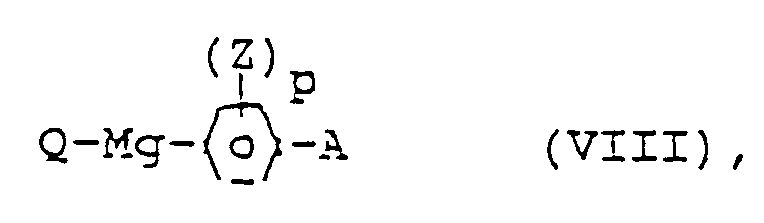 B) à faire réagir des composés de Grignard de formule (VIII) avec des composés de formule (IX)
H₂C=CH-(CH₂)n-2-Q (IX)
pour donner des composés de formule (X) C) à faire réagir des composés de formule (X) avec des composés de formule Y-H en présence de métaux du groupe du platine et/ou de leurs composés, pour donner des composés de formule (XI)
 D1) si X, dans le produit recherché de formule (II), doit être un radical de formule -COOH, à faire réagir des composés de formule (XI) dans laquelle A est un radical ayant la signification de Q, avec du magnésium, puis avec du CO₂,D2) si X, dans le produit recherché de formule (II), doit être un radical de formule -CN, à faire réagir des composés de formule (XI), dans laquelle A est un radical ayant la signification de Q, avec des cyanures, de préférence avec du cyanure de cuivre,D3) si X, dans le produit recherché de formule (II) doit être un radical de formule -OH et que le radical A de la formule (XI) est un groupe hydroxyle bloqué par un groupe protecteur, à éliminer le groupe protecteur d'une manière connue en soi,D4) si X, dans le produit recherché de formule (II), doit être un radical de formule -CHO, à faire réagir des composés de formule (XI) dans laquelle A est un radical ayant la signification de Q, avec du magnésium puis avec du N,N-diméthylformamide, puis à procéder à une hydrolyse acide.
 - Procédé selon la revendication 5, dans lequel A, dans les formules (VII), (VIII) et (X), est un groupe hydroxyle bloqué par un groupe protecteur, et ce groupe protecteur est dissocié du composé de formule (X) dès après l'étape B).
- Procédé selon la revendication 4, pour préparer des composés de formule (II) selon la revendication 2, ou m = 1, où on prépare le composé de départ de formule (XII), utilisé dans l'étape A)


H₂C=CH-(CH₂)n-2-Q (XIV)
où, dans les formules (XIII) et (XIV) ci-dessus, Z et p ont les significations données dans la revendication 1, A a les significations données dans la revendication 4 et Q a les significations données dans la revendication 5. - Procédé pour préparer des composés de formule (II) selon la revendication 2, qui consisteA) à faire réagir des composés de formule (XVI)

Y-(CH₂)x-E (XVII),
où, dans les formules (XVI) et (XVII) ci-dessus, l'un des radicaux E ou G est un radical de formule -Mg-Q, et l'autre est un radical ayant la signification de Q ou encore un radical hydroxyle bloqué par un groupe protecteur,
x est un nombre entier de 0 à n-1, du moment que, quand E représente -Mg-Q et que le radical -(CH₂)x-E de la formule (XVII) est directement lié à un atome de silicium, x vaut au moins 1, et que A, Y, Z, n, m et p ont les significations données dans la revendication 1 ou la revendication 4, et Q a les significations données dans la revendication 5, etB) à procéder à un post-traitement du composé ainsi obtenu de formule (VI), selon la revendication 4. - Utilisation de composés de formule

M est un atome d'halogène, un radical cyano, un résidu de formule -COCl, -COOH, -CHO, -NH₂ ou -OH, ce dernier groupe hydroxyle pouvant être bloqué par un groupe protecteur, et
Y, Z, R'' et p ont les significations données dans la revendication 1,
comme composés de départ pour la préparation de composés ayant des propriétés mésomorphes. - Procédés selon les revendications 1, 2 ou 3, procédés selon les revendications 4, 5, 6, 7 ou 8, ou utilisation selon la revendication 9, où p vaut 0 dans les formules (I), (II), (V), (VI), (VII), (VIII), (X), (XI), (XII), (XIII), (XV) et (XVI) mentionnées.
Applications Claiming Priority (2)
| Application Number | Priority Date | Filing Date | Title |
|---|---|---|---|
| DE3935638A DE3935638A1 (de) | 1989-10-26 | 1989-10-26 | Organosilylalkylaromaten |
| DE3935638 | 1989-10-26 |
Publications (3)
| Publication Number | Publication Date |
|---|---|
| EP0424959A2 EP0424959A2 (fr) | 1991-05-02 |
| EP0424959A3 EP0424959A3 (en) | 1991-09-11 |
| EP0424959B1 true EP0424959B1 (fr) | 1995-02-01 |
Family
ID=6392245
Family Applications (1)
| Application Number | Title | Priority Date | Filing Date |
|---|---|---|---|
| EP90120588A Expired - Lifetime EP0424959B1 (fr) | 1989-10-26 | 1990-10-26 | Composés organosilyl alcoyliques-aromatiques |
Country Status (5)
| Country | Link |
|---|---|
| US (1) | US5210247A (fr) |
| EP (1) | EP0424959B1 (fr) |
| JP (1) | JPH0764857B2 (fr) |
| CA (1) | CA2028286C (fr) |
| DE (2) | DE3935638A1 (fr) |
Families Citing this family (12)
| Publication number | Priority date | Publication date | Assignee | Title |
|---|---|---|---|---|
| DE3827600A1 (de) * | 1988-08-13 | 1990-02-15 | Hoechst Ag | Organosilylalkyl- oder -alkenyl-verbindungen, verfahren zu ihrer herstellung und ihre verwendung in fluessigkristallinen mischungen |
| US5523442A (en) * | 1993-02-16 | 1996-06-04 | Merrell Pharmaceuticals Inc. | Silylated acetylcholinesterase inhibitors |
| US5391795A (en) * | 1994-02-18 | 1995-02-21 | General Electric Company | Silylated agents useful for absorbing ultraviolet light |
| US5486633A (en) * | 1994-11-10 | 1996-01-23 | Duke University | Photochemically-removable silyl protecting groups |
| US5912377A (en) * | 1995-06-05 | 1999-06-15 | Minnesota Mining And Manufacturing Company | Aromatic cyanate ester silane coupling agents |
| US5608095A (en) * | 1996-04-30 | 1997-03-04 | Hoechst Marion Roussel, Inc. | Alkyl-4-silyl-phenols and esters thereof as antiatherosclerotic agents |
| JPH11307604A (ja) | 1998-04-17 | 1999-11-05 | Toshiba Corp | プロセスモニタ方法及びプロセス装置 |
| US7132294B2 (en) * | 2002-02-25 | 2006-11-07 | The United States Of America As Represented By The Secretary Of The Navy | Functionalized small molecules for use in chemical sensors |
| GB0222426D0 (en) | 2002-09-27 | 2002-11-06 | Imaging Res Solutions Ltd | Chemical process |
| DE102007015948A1 (de) * | 2007-04-03 | 2008-10-09 | Bayer Materialscience Ag | Modifizierte Polycarbonate, Polyestercarbonate und Polyester mit verbessertem Dehnverhalten und Flammwidrigkeit |
| US20090254425A1 (en) * | 2008-04-02 | 2009-10-08 | Evan Horowitz | Wiki-type collective intelligence mechanism for implementing a url redirect |
| KR102126680B1 (ko) * | 2016-05-23 | 2020-06-25 | 주식회사 엘지화학 | 신규 액정 화합물 및 이의 용도 |
Citations (1)
| Publication number | Priority date | Publication date | Assignee | Title |
|---|---|---|---|---|
| EP0304720A1 (fr) * | 1987-08-13 | 1989-03-01 | Consortium für elektrochemische Industrie GmbH | Benzoylchlorides substituées par un groupe diméthylsilyl et procédé de préparation |
Family Cites Families (13)
| Publication number | Priority date | Publication date | Assignee | Title |
|---|---|---|---|---|
| DE304720C (fr) * | ||||
| US3787281A (en) * | 1968-10-29 | 1974-01-22 | Du Pont | Forming a hydrolytically stable bond between glass and polytetrafluoroethylene |
| FR2245663A1 (en) * | 1973-08-17 | 1975-04-25 | Rhone Progil | Aminophenoxy alkyl silanes and dimers, polymers - by catalytic hydrogenation of corresponding nitrophenols |
| CH630089A5 (de) * | 1977-09-09 | 1982-05-28 | Ciba Geigy Ag | Verfahren zur herstellung von siliciummodifizierten imidyl-phthalsaeurederivaten. |
| GB2019862B (en) * | 1978-04-26 | 1982-05-19 | M & T Chemicals Inc | Phenoxyalkyl-silanes |
| US4395527A (en) * | 1978-05-17 | 1983-07-26 | M & T Chemicals Inc. | Siloxane-containing polymers |
| IL59345A0 (en) * | 1979-02-13 | 1980-05-30 | M & T Chemicals Inc | Silicone-containing bis-ether and bis-thioether aromatic amines and their manufacture |
| ES8105009A2 (es) * | 1979-08-08 | 1981-05-16 | M & T Chemicals Inc | Un metodo para preparar un silano |
| JPS60252486A (ja) * | 1984-05-28 | 1985-12-13 | Toray Silicone Co Ltd | 液晶性有機けい素化合物 |
| US4803254A (en) * | 1987-03-11 | 1989-02-07 | Iolab Corporation | Vinylsilylalkoxy arylbenzotriazole compounds and UV absorbing compositions made therefrom |
| JPH0832786B2 (ja) * | 1987-05-15 | 1996-03-29 | 東レ・ダウコーニング・シリコーン株式会社 | 液晶性オルガノポリシロキサンの製造方法 |
| DE3854383T2 (de) * | 1987-12-18 | 1996-03-14 | Canon Kk | Mesomorphische Verbindung, Flüssigkristallzusammensetzung und Flüssigkristallvorrichtung. |
| JP2631739B2 (ja) * | 1989-02-27 | 1997-07-16 | 信越化学工業株式会社 | フェノール基含有シロキサン化合物 |
-
1989
- 1989-10-26 DE DE3935638A patent/DE3935638A1/de not_active Withdrawn
-
1990
- 1990-10-19 JP JP2279517A patent/JPH0764857B2/ja not_active Expired - Lifetime
- 1990-10-22 US US07/600,659 patent/US5210247A/en not_active Expired - Fee Related
- 1990-10-23 CA CA002028286A patent/CA2028286C/fr not_active Expired - Fee Related
- 1990-10-26 DE DE59008409T patent/DE59008409D1/de not_active Expired - Fee Related
- 1990-10-26 EP EP90120588A patent/EP0424959B1/fr not_active Expired - Lifetime
Patent Citations (1)
| Publication number | Priority date | Publication date | Assignee | Title |
|---|---|---|---|---|
| EP0304720A1 (fr) * | 1987-08-13 | 1989-03-01 | Consortium für elektrochemische Industrie GmbH | Benzoylchlorides substituées par un groupe diméthylsilyl et procédé de préparation |
Also Published As
| Publication number | Publication date |
|---|---|
| JPH03145494A (ja) | 1991-06-20 |
| EP0424959A3 (en) | 1991-09-11 |
| CA2028286A1 (fr) | 1991-04-27 |
| DE59008409D1 (de) | 1995-03-16 |
| CA2028286C (fr) | 1995-07-04 |
| JPH0764857B2 (ja) | 1995-07-12 |
| EP0424959A2 (fr) | 1991-05-02 |
| DE3935638A1 (de) | 1991-05-02 |
| US5210247A (en) | 1993-05-11 |
Similar Documents
| Publication | Publication Date | Title |
|---|---|---|
| EP0358208B1 (fr) | Polyorganosiloxanes liquides cristallins contenant des groupes (méth) acryloxy | |
| EP0405326A2 (fr) | Dérivés de l'acide benzoique silylés | |
| EP0446912B1 (fr) | Organosilsesquioxanes avec au moins une groupe latérale mesogène | |
| EP0424959A2 (fr) | Composés organosilyl alcoyliques-aromatiques | |
| DE2642833A1 (de) | Oxysilan-verbindungen, verfahren zu ihrer herstellung und ihre verwendung | |
| EP0661287B1 (fr) | Siloxanes liquides criystallines polymérisable | |
| EP0711780B1 (fr) | Procédé de préparation de polyorganosiloxanes liquides cristallines contenant des groupements (méth-)acryloxiques | |
| EP0545409B1 (fr) | Cristaux liquides avec des groupes terminaux contenant plus d'un groupe silane | |
| EP0466183B1 (fr) | Cyclosiloxanes avec des groupes latérales mésogènes | |
| DE69514557T2 (de) | Silacyclohexan Verbindungen, Verfahren zu ihrer Herstellung und Flüssigkristallzusammensetzungen, die sie enthalten | |
| DE69312118T2 (de) | Verfahren zur Chlorierung einer Siliziumverbindung | |
| EP0503668B1 (fr) | Composés organosiliciés contenant des groupes alkényles, leur fabrication et leur utilisation | |
| EP0424960A2 (fr) | Composés organosiliciés contenant des groupes alkényles, leurs fabrication et utilisation | |
| DE69309584T2 (de) | Alkoxysilane mit Azasilacycloalkylgruppe und Tetrametyldisiloxane mit Azasilacycloalkylgruppe | |
| CH661928A5 (de) | Verfahren zur herstellung funktionell substituierter silane. | |
| DE69420824T2 (de) | Eine Silacyclohexanverbindung, deren Herstellung und diese enthaltende Flüssigkristallzusammensetzungen | |
| DE1935884A1 (de) | Cyanoalkoxyalkenyl- und Aminoalkoxyalkenylsilane und ihre Verwendung | |
| DE4004944A1 (de) | Poly(arylenvinylen-siloxane) | |
| DE69520187T2 (de) | Neue Silacyclohexanverbindungen, eine sie enthaltende Flüssigkristallinezusammensetzung und eine die Zusammensetzung enthaltende flüssigkristalline Vorrichtung | |
| EP3577123B1 (fr) | Procédé pour la préparation d'aminopropylalcoxysilanes | |
| EP0404140B1 (fr) | Dérivés de l'acide benzoique silylés II | |
| DE1266301B (de) | Verfahren zur Herstellung von Alkylhalogensilanen | |
| DE3920509A1 (de) | Silylierte benzoesaeurederivate | |
| Edward | SYNTH ES I S tfj', tffi | |
| JPH05230072A (ja) | シリル基含有アゾ化合物 |
Legal Events
| Date | Code | Title | Description |
|---|---|---|---|
| PUAI | Public reference made under article 153(3) epc to a published international application that has entered the european phase |
Free format text: ORIGINAL CODE: 0009012 |
|
| 17P | Request for examination filed |
Effective date: 19901026 |
|
| AK | Designated contracting states |
Kind code of ref document: A2 Designated state(s): BE CH DE FR GB LI NL |
|
| PUAL | Search report despatched |
Free format text: ORIGINAL CODE: 0009013 |
|
| AK | Designated contracting states |
Kind code of ref document: A3 Designated state(s): BE CH DE FR GB LI NL |
|
| 17Q | First examination report despatched |
Effective date: 19930906 |
|
| GRAA | (expected) grant |
Free format text: ORIGINAL CODE: 0009210 |
|
| AK | Designated contracting states |
Kind code of ref document: B1 Designated state(s): BE CH DE FR GB LI NL |
|
| REF | Corresponds to: |
Ref document number: 59008409 Country of ref document: DE Date of ref document: 19950316 |
|
| GBT | Gb: translation of ep patent filed (gb section 77(6)(a)/1977) |
Effective date: 19950306 |
|
| ET | Fr: translation filed | ||
| PGFP | Annual fee paid to national office [announced via postgrant information from national office to epo] |
Ref country code: NL Payment date: 19950913 Year of fee payment: 6 Ref country code: FR Payment date: 19950913 Year of fee payment: 6 Ref country code: CH Payment date: 19950913 Year of fee payment: 6 |
|
| PGFP | Annual fee paid to national office [announced via postgrant information from national office to epo] |
Ref country code: BE Payment date: 19950925 Year of fee payment: 6 |
|
| PGFP | Annual fee paid to national office [announced via postgrant information from national office to epo] |
Ref country code: GB Payment date: 19950927 Year of fee payment: 6 |
|
| PGFP | Annual fee paid to national office [announced via postgrant information from national office to epo] |
Ref country code: DE Payment date: 19951102 Year of fee payment: 6 |
|
| PLBE | No opposition filed within time limit |
Free format text: ORIGINAL CODE: 0009261 |
|
| STAA | Information on the status of an ep patent application or granted ep patent |
Free format text: STATUS: NO OPPOSITION FILED WITHIN TIME LIMIT |
|
| 26N | No opposition filed | ||
| PG25 | Lapsed in a contracting state [announced via postgrant information from national office to epo] |
Ref country code: GB Effective date: 19961026 |
|
| PG25 | Lapsed in a contracting state [announced via postgrant information from national office to epo] |
Ref country code: LI Effective date: 19961031 Ref country code: CH Effective date: 19961031 Ref country code: BE Effective date: 19961031 |
|
| BERE | Be: lapsed |
Owner name: CONSORTIUM FUR ELEKTROCHEMISCHE INDUSTRIE G.M.B.H Effective date: 19961031 |
|
| PG25 | Lapsed in a contracting state [announced via postgrant information from national office to epo] |
Ref country code: NL Effective date: 19970501 |
|
| REG | Reference to a national code |
Ref country code: CH Ref legal event code: PL |
|
| GBPC | Gb: european patent ceased through non-payment of renewal fee |
Effective date: 19961026 |
|
| PG25 | Lapsed in a contracting state [announced via postgrant information from national office to epo] |
Ref country code: FR Effective date: 19970630 |
|
| NLV4 | Nl: lapsed or anulled due to non-payment of the annual fee |
Effective date: 19970501 |
|
| PG25 | Lapsed in a contracting state [announced via postgrant information from national office to epo] |
Ref country code: DE Effective date: 19970701 |
|
| REG | Reference to a national code |
Ref country code: FR Ref legal event code: ST |