EP0425204A2 - Dispositif d'analyse de masse utilisant des ions secondaires - Google Patents
Dispositif d'analyse de masse utilisant des ions secondaires Download PDFInfo
- Publication number
- EP0425204A2 EP0425204A2 EP90311491A EP90311491A EP0425204A2 EP 0425204 A2 EP0425204 A2 EP 0425204A2 EP 90311491 A EP90311491 A EP 90311491A EP 90311491 A EP90311491 A EP 90311491A EP 0425204 A2 EP0425204 A2 EP 0425204A2
- Authority
- EP
- European Patent Office
- Prior art keywords
- aperture
- image
- specimen
- ions
- ion
- Prior art date
- Legal status (The legal status is an assumption and is not a legal conclusion. Google has not performed a legal analysis and makes no representation as to the accuracy of the status listed.)
- Withdrawn
Links
Images



Classifications
-
- H—ELECTRICITY
- H01—ELECTRIC ELEMENTS
- H01J—ELECTRIC DISCHARGE TUBES OR DISCHARGE LAMPS
- H01J49/00—Particle spectrometers or separator tubes
- H01J49/26—Mass spectrometers or separator tubes
Definitions
- the present invention relates to a secondary ion mass analyzing apparatus and in particular to a secondary ion mass analyzing apparatus which is suitable for performing a depth directional analysis of a specimen at a high accuracy.
- Prior art secondary ion mass analyzing apparatuses have been widely used for depth directional analysis of a specimen.
- Electronic aperture method has been widely used for enhancing the accuracy of the analysis in a depth direction.
- the electronic aperture method includes raster-scanning a primary ion beam on a specimen to etch the specimen uniformly, gating a detection system so that secondary ion from etching crater edges different in depth will not be introduced to a mass analyzer, introducing signals from only the central portion of the etched crater to the mass analyzer to integrate them, whereby the accuracy of the depth directional analysis, that is, the dynamic range in a depth direction is enhanced.
- the specimen is subjected to two dimensional scanning of a primary ion beam along X and Y axes. This causes the specimen to be etched so that the etched portion becomes a crater. Secondary ions are generated from the crater and are detected.
- the secondary ions from the edge of the crater are eliminated by an electrical gate, that is, an electronic aperture so that substantially only the ions from the central portion of the crater, that is, only necessary secondary ion beam is introduced to the mass-analyzer at which it is mass-analyzed. This enhances the analysis accuracy of the specimen in a depth direction and widens the dynamic range.
- the ion density distribution of primary ion beam generally exhibits a Gaussian distribution characteristics.
- the density distribution of primary ions in fact exhibit a distribution having a skirt remarkably broader than that of the Gaussian distribution due to variations in initial energy of primary ions and collision with residual gas molecules and scattering thereby. Therefore, introduction of the secondary ions generated from the periphery of the crater into the mass analyzer is inevitable even if the electronic sperture is opened only when the primary ion beam is positioned in the center of the crater.
- Fig. 1 is a view showing the above mentioned prior art electronic aperture method.
- a crater 3 is formed on a specimen 2 by an etching, if a primary ion beam 1 is raster-scanned on the specimen 2.
- the ion density distribution 4 of primary ion beam 1 generally exhibits a Gaussian distribution characteristics.
- practical density distribution of primary ions exhibits a distribution having a skirt remarkably broader than that of the Gaussian distribution due to variations in initial energy of primary ions and collision with residual gas molecules and scattering thereby.
- a detection gate is opened in the electronic aperture method when the center of the primary ion beam 1 is located at a secondary ion capture area 5, the captured secondary ions inevitably includes unwanted secondary ions from the periphery of the crater edge 6 due to existence of the skirt of the density distribution of the primary ion beam 1.
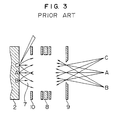
- Fig. 2 is a view showing an imaging condition of a secondary ion emission pattern in a prior art.
- an emission pattern of the secondary ions 7 emitted by irradiation with the primary ions 1 is imaged on a position of an exit slit 9 of a mass analyzer by means of an extraction electrode 10 and a transfer lens 8 so that the field of the emission pattern is restricted by the dimension of the exit slit and only such ions as not to include any ions from the crater periphery parts are introduced to the mass analyzer by restricting the dimension of the beam and the secondary ions from the periphery of the beam distribution.
- setting of conditions of the lens 8 can be determined based on only the strength of the secondary ions 7 passing through the exit slit 9.
- the conditions of the lens 8 are preset in such a manner that a maximum amount of the secondary ions 7 can pass through the exit slit 9.
- means for forming an image of secondary ions an aperture disposed on a position in which the image is formed, means for detecting the secondary ions which have passed through the aperture and for converting the detected ions into electrical signals, and means for displaying an image of said aperture based on the electrical signals.
- an aperture is disposed upon a secondary ion image forming position.
- the image of the aperture is displayed on an image displaying apparatus by using the secondary ions which have passed through the aperture. If the ion image is not formed on the position of the aperture, the contour of the aperture image would be unclear while if the ion image is formed on the position of the aperture, the contour of the aperture image would be clear. Accordingly, by monitoring the clearness of the aperture image, focusing of the ion image upon the aperture position may be determined. Therefore, the secondary ions which have generated from the specimen corresponding to a portion other than the central portion of the primary ion beam can be prevented from being introduced to a mass analyzing portion.
- a primary ion beam 1 which is emitted from an ion source 11 is pulled out by means of a pull-out electrode 12 and is converged upon a specimen 15 by means of lenses 13 and 14.
- a deflecting voltage which is a deflection signal is applied upon a static field type apparatus 16 from a deflection power source 17. This causes the converged primary ion beam 1 to be two dimensionally scanned on and along the specimen 15.
- the specimen 15 When the specimen 15 is bombarded with the converged primary ion beam 1 and is subjected to two dimensional scanning of the primary ion beam 1, the specimen 15 is etched with the primary ion beams 1 so that the etched portion becomes a crater.
- Secondary ions 7 which are generated from the specimen 15 are pulled out by a pull-out electrode 18 so that an image of the specimen 15 is formed of the secondary ions 7 on the position of an exit slit or an aperture 20 by means of a static field type lens 19.
- the primary ion beam 1 generally exhibits a distribution having a skirt remarkably broader than that of the Gaussian distribution as mentioned above. Accordingly, the secondary ions 7 generated from the center the crater may include the secondary ions 7 generated from the crater edge even if the primary ion beams bombards the center of the crater of the sepcimen 15. However the secondary ions 7 emitted from the specimen 15 portion corresponding to a portions other than the center of the primary ion beam 1 are eliminated by the aperture 20. The secondary ions from the crater edge are thus eliminated by the aperture 20 while only the secondary ions 7 from the center of the crater substantially pass through the aperture 20.
- the secondary ions 7b which has passed through the aperture 20 are dispersed depending on its energy by an electrostatic field generated from an electrostatic field generator 21.
- An ion electron converter 22 is disposed on an energy focusing plane at which an energy is converged with a static field.
- the secondary ions (non mass-dispersed ions) 7a having a given energy pass through an opening of the ion electron converter 22 while the secondary ions (non mass-dispersed ions) 7a having the other energy are converted into electrons by the ion electron converter 22.
- the converted electrons are detected by a secondary ion detector 23 which generates electrical signals es corresponding to the amount of the secondary ions detected by the ion electron converter 22.
- the secondary ions 7b which have passed through the ion electron converter 22 are dispersed depending on its mass by a magnetic field generated by a magnetic field generator 24.
- the secondary ions 7c having a given mass number are deflected by a deflector 25 and pass through a collector-slit 26 and a specific ion detector 27.
- the output signals from the specific ion detector 27 are recorded by a recorder 28 and are inputted to a data processor 29.
- the magnetic field generated by the magnetic field generator 24 is swept to perform a mass number sweeping. That is, the secondary ions having various mass numbers are successively detected by the specific ion detector 27 by the magnetic field sweeping.
- electrical signals es from the detector 23 are applied to a grid G which is a brightness modulation electrode of a cathode ray tube 30.
- Deflection signals from a deflection power source 17 are also applied to a deflection apparatus of the cathode ray tube 30. This accomplishes two demensional scanning on a screen of the cathode ray tube 30 in synchronization with two dimensional scanning on the specimen 15. Accordingly, the image of a scanned area of the specimen 15 which is restricted by the aperture 20 is displayed on the screen of the cathode ray tube 30.
- the contour of the aperture image would be clear if the secondary ion image of the specimen 15 is formed just on the position of the aperture 20 and would be unclear if it is not formed on the position of the aperture.
- a lens power source 31 connected with the static lens 19 is adjusted to change the focal length of the lens 19 by automatically or manually changing the voltage of the lens power source 31 until the contour of the aperture image displayed on the cathode ray tube 30 becomes clear.
- the imaging position of the secondary ion image may optionally be changed by adjusting the voltage applied to the pull-out electrode 18 from the power source 32 solely or together with the adjustment of the lens 19.
- Figs. 5 and 6 show images displayed on the cathode ray tube 30 when a metallic mesh is used as a specimen 15 in Fig. 4.
- Fig. 5 shows a secondary ion image of the metallic mesh of the specimen 15 which is not formed on the aperture 20. It is found from Fig. 5 that the area of the displayed image is larger and that a boundary between a mesh image appearing area and an area at which a mesh image reflecting the shape of the aperture 20 does not appear is not clear.
- Fig. 6 shows a secondary ion image of the metallic mesh of the specimen 15 which is just formed on the aperture. It is found from Fig.
- the secondary ion image be located in the center of the cathode ray tube 30 in order that the secondary ion image be located in the center of the cathode ray tube 30, fine adjustment of the vertical position of the specimen 20 and the lateral position of the aperture 20 is carried out.
- the secondary ion image may be displayed on the cathode ray tube 30 during a depth direction analysis. Accordingly, shift of the ion orbit due to charge up of the specimen 15, etc. can be detected by monitoring the shift of the secondary ion image from the center of the cathode ray tube 30.
- the aperture 20 may be replaced with other aperture having a desired opening shape such as circle, T-shape and L-shape and a desired dimension. This may be accomplished by moving each opening to the secondary ions passing path by means of an aperture driving apparatus 33 connected with the aperture 20.
- a large area of a patterned region to be analyzed is assured by use of an aperture having a T-shaped opening represented with a dotted line so that the ions from the other areas cannot be captured, resulting in an enhancement in detection sensitivity.
Landscapes
- Chemical & Material Sciences (AREA)
- Analytical Chemistry (AREA)
- Electron Tubes For Measurement (AREA)
- Analysing Materials By The Use Of Radiation (AREA)
Applications Claiming Priority (2)
| Application Number | Priority Date | Filing Date | Title |
|---|---|---|---|
| JP273802/89 | 1989-10-23 | ||
| JP1273802A JP2624854B2 (ja) | 1989-10-23 | 1989-10-23 | 2次イオン質量分析装置 |
Publications (2)
| Publication Number | Publication Date |
|---|---|
| EP0425204A2 true EP0425204A2 (fr) | 1991-05-02 |
| EP0425204A3 EP0425204A3 (en) | 1992-01-02 |
Family
ID=17532782
Family Applications (1)
| Application Number | Title | Priority Date | Filing Date |
|---|---|---|---|
| EP19900311491 Withdrawn EP0425204A3 (en) | 1989-10-23 | 1990-10-19 | Secondary ion mass analyzing apparatus |
Country Status (3)
| Country | Link |
|---|---|
| US (1) | US5086227A (fr) |
| EP (1) | EP0425204A3 (fr) |
| JP (1) | JP2624854B2 (fr) |
Cited By (1)
| Publication number | Priority date | Publication date | Assignee | Title |
|---|---|---|---|---|
| EP2786398A4 (fr) * | 2011-11-17 | 2015-10-21 | Canon Kk | Procédé de spectrométrie de distribution de masse et spectromètre de distribution de masse |
Families Citing this family (7)
| Publication number | Priority date | Publication date | Assignee | Title |
|---|---|---|---|---|
| US5391870A (en) * | 1993-09-01 | 1995-02-21 | High Voltage Engineering Europa B.V. | High-speed precision mass selection system |
| KR100217325B1 (ko) * | 1996-07-02 | 1999-10-01 | 윤종용 | 반도체장치의 제조공정 분석방법 |
| KR100276387B1 (ko) * | 1998-01-08 | 2000-12-15 | 윤종용 | 반도체 장치의 자기정렬 콘택 형성 방법 |
| GB2467548B (en) * | 2009-02-04 | 2013-02-27 | Nu Instr Ltd | Detection arrangements in mass spectrometers |
| JP2013101918A (ja) * | 2011-10-13 | 2013-05-23 | Canon Inc | 質量分析装置 |
| CN111710617B (zh) * | 2020-06-30 | 2023-08-22 | 度亘激光技术(苏州)有限公司 | 半导体结构的检测方法及半导体结构 |
| US20240128051A1 (en) * | 2022-10-14 | 2024-04-18 | Carl Zeiss Multisem Gmbh | Multi-beam charged particle beam system with anisotropic filtering for improved image contrast |
Family Cites Families (9)
| Publication number | Priority date | Publication date | Assignee | Title |
|---|---|---|---|---|
| US3479505A (en) * | 1966-06-30 | 1969-11-18 | Applied Res Lab | Method of operating an ion microprobe using secondary elections |
| JPS5015594A (fr) * | 1973-06-08 | 1975-02-19 | ||
| JPS5314953A (en) * | 1976-07-26 | 1978-02-10 | Toa Douro Kougiyou Kk | Treating method of cyan containing sludge |
| JPS53147791U (fr) * | 1977-04-25 | 1978-11-21 | ||
| JPS5451589A (en) * | 1977-09-30 | 1979-04-23 | Hitachi Ltd | Slit device in mass spectrometer |
| JPS54160093U (fr) * | 1978-04-28 | 1979-11-08 | ||
| JPS5929332A (ja) * | 1982-08-11 | 1984-02-16 | Hitachi Ltd | イオンマイクロアナライザ− |
| JP2607573B2 (ja) * | 1987-12-25 | 1997-05-07 | 株式会社日立製作所 | イオンマイクロアナライザ |
| JPH071686B2 (ja) * | 1988-09-22 | 1995-01-11 | 株式会社日立製作所 | イオンマイクロアナライザ |
-
1989
- 1989-10-23 JP JP1273802A patent/JP2624854B2/ja not_active Expired - Lifetime
-
1990
- 1990-10-18 US US07/599,407 patent/US5086227A/en not_active Expired - Fee Related
- 1990-10-19 EP EP19900311491 patent/EP0425204A3/en not_active Withdrawn
Cited By (2)
| Publication number | Priority date | Publication date | Assignee | Title |
|---|---|---|---|---|
| EP2786398A4 (fr) * | 2011-11-17 | 2015-10-21 | Canon Kk | Procédé de spectrométrie de distribution de masse et spectromètre de distribution de masse |
| US9312116B2 (en) | 2011-11-17 | 2016-04-12 | Canon Kabushiki Kaisha | Mass distribution spectrometry method and mass distribution spectrometer |
Also Published As
| Publication number | Publication date |
|---|---|
| EP0425204A3 (en) | 1992-01-02 |
| US5086227A (en) | 1992-02-04 |
| JPH03138850A (ja) | 1991-06-13 |
| JP2624854B2 (ja) | 1997-06-25 |
Similar Documents
| Publication | Publication Date | Title |
|---|---|---|
| US5493116A (en) | Detection system for precision measurements and high resolution inspection of high aspect ratio structures using particle beam devices | |
| KR100382026B1 (ko) | 주사형전자현미경 | |
| US6265719B1 (en) | Inspection method and apparatus using electron beam | |
| DE69224506T2 (de) | Elektronenstrahlgerät | |
| EP1305816B1 (fr) | Collecte d'electrons secondaires a travers l'objectif d'un microscope electronique a balayage | |
| US20090039259A1 (en) | Scanning electron microscope | |
| EP0113746B1 (fr) | Systeme d'electrodes pour spectrometre a champ contrarie pour un appareil de mesure a faisceau electronique | |
| US6555819B1 (en) | Scanning electron microscope | |
| US4132892A (en) | Raster scanning ion microscope with quadrupole mass filter | |
| JPH0286036A (ja) | イオンマイクロアナライザ | |
| US3881108A (en) | Ion microprobe analyzer | |
| US5086227A (en) | Secondary ion mass analyzing apparatus | |
| US5300775A (en) | Method of selecting a spatial energy spread within an electron beam, and an electron beam apparatus suitable for carrying out such a method | |
| US4789780A (en) | Apparatus for energy-selective visualization | |
| US4160162A (en) | Method for the pictorial display of a diffraction image in a transmission-type, scanning, corpuscular-beam microscope | |
| US5089699A (en) | Secondary charged particle analyzing apparatus and secondary charged particle extracting section | |
| JPS5811569B2 (ja) | デンシブンコウソウチ | |
| US3479505A (en) | Method of operating an ion microprobe using secondary elections | |
| US20020079449A1 (en) | SEM having a detector surface segmented into a number of separate regions | |
| WO1996008835A1 (fr) | Detecteur de faisceaux de particules permettant d'obtenir un contraste topographique et dans les trois dimensions | |
| JP3174307B2 (ja) | 二次荷電粒子解析装置、及びそれを用いた試料解析方法 | |
| EP0555911A1 (fr) | Procédé pour réduire une dispersion spatiale d'énergie d'un faisceau électronique et appareil à faisceau électronique convenant pour la mise en oeuvre d'un tel procédé | |
| JPH08212964A (ja) | レーザイオン化質量分析装置及び分析方法 | |
| JPH03176955A (ja) | 走査形電子ビーム装置 | |
| EP0190251A1 (fr) | Procede et appareil de micro-analyses ou de visionnement d'echantillons. |
Legal Events
| Date | Code | Title | Description |
|---|---|---|---|
| PUAI | Public reference made under article 153(3) epc to a published international application that has entered the european phase |
Free format text: ORIGINAL CODE: 0009012 |
|
| 17P | Request for examination filed |
Effective date: 19901205 |
|
| AK | Designated contracting states |
Kind code of ref document: A2 Designated state(s): FR GB |
|
| PUAL | Search report despatched |
Free format text: ORIGINAL CODE: 0009013 |
|
| AK | Designated contracting states |
Kind code of ref document: A3 Designated state(s): FR GB |
|
| 17Q | First examination report despatched |
Effective date: 19940513 |
|
| STAA | Information on the status of an ep patent application or granted ep patent |
Free format text: STATUS: THE APPLICATION IS DEEMED TO BE WITHDRAWN |
|
| 18D | Application deemed to be withdrawn |
Effective date: 19950503 |