EP0425923B1 - Wiederaufarbeitbares Stossfängersystem - Google Patents
Wiederaufarbeitbares Stossfängersystem Download PDFInfo
- Publication number
- EP0425923B1 EP0425923B1 EP19900120067 EP90120067A EP0425923B1 EP 0425923 B1 EP0425923 B1 EP 0425923B1 EP 19900120067 EP19900120067 EP 19900120067 EP 90120067 A EP90120067 A EP 90120067A EP 0425923 B1 EP0425923 B1 EP 0425923B1
- Authority
- EP
- European Patent Office
- Prior art keywords
- weight
- bumper
- polypropylene
- propylene
- ethylene
- Prior art date
- Legal status (The legal status is an assumption and is not a legal conclusion. Google has not performed a legal analysis and makes no representation as to the accuracy of the status listed.)
- Expired - Lifetime
Links
- 229920001155 polypropylene Polymers 0.000 claims description 34
- -1 polypropylene Polymers 0.000 claims description 27
- 239000004743 Polypropylene Substances 0.000 claims description 22
- 239000006260 foam Substances 0.000 claims description 18
- 239000003365 glass fiber Substances 0.000 claims description 13
- VGGSQFUCUMXWEO-UHFFFAOYSA-N Ethene Chemical compound C=C VGGSQFUCUMXWEO-UHFFFAOYSA-N 0.000 claims description 11
- 229920001971 elastomer Polymers 0.000 claims description 9
- 239000000835 fiber Substances 0.000 claims description 8
- 239000005977 Ethylene Substances 0.000 claims description 6
- QQONPFPTGQHPMA-UHFFFAOYSA-N propylene Natural products CC=C QQONPFPTGQHPMA-UHFFFAOYSA-N 0.000 claims description 6
- HQQADJVZYDDRJT-UHFFFAOYSA-N ethene;prop-1-ene Chemical group C=C.CC=C HQQADJVZYDDRJT-UHFFFAOYSA-N 0.000 claims description 5
- 238000001746 injection moulding Methods 0.000 claims description 3
- 125000004805 propylene group Chemical group [H]C([H])([H])C([H])([*:1])C([H])([H])[*:2] 0.000 claims description 3
- 239000011248 coating agent Substances 0.000 claims 2
- 238000000576 coating method Methods 0.000 claims 2
- 238000001125 extrusion Methods 0.000 claims 1
- 230000003179 granulation Effects 0.000 claims 1
- 238000005469 granulation Methods 0.000 claims 1
- 238000006116 polymerization reaction Methods 0.000 claims 1
- 239000011162 core material Substances 0.000 description 14
- 239000003973 paint Substances 0.000 description 11
- 239000000203 mixture Substances 0.000 description 9
- 239000004814 polyurethane Substances 0.000 description 9
- 239000000463 material Substances 0.000 description 7
- 238000000034 method Methods 0.000 description 7
- 229920002635 polyurethane Polymers 0.000 description 7
- 239000002245 particle Substances 0.000 description 6
- 229920003023 plastic Polymers 0.000 description 6
- 239000004033 plastic Substances 0.000 description 6
- 239000011521 glass Substances 0.000 description 5
- 239000000047 product Substances 0.000 description 5
- 229920001519 homopolymer Polymers 0.000 description 4
- 238000004519 manufacturing process Methods 0.000 description 4
- 229920001577 copolymer Polymers 0.000 description 3
- 238000009826 distribution Methods 0.000 description 3
- 239000008187 granular material Substances 0.000 description 3
- 229920001707 polybutylene terephthalate Polymers 0.000 description 3
- 239000004417 polycarbonate Substances 0.000 description 3
- 239000011265 semifinished product Substances 0.000 description 3
- 229920001169 thermoplastic Polymers 0.000 description 3
- 239000004416 thermosoftening plastic Substances 0.000 description 3
- 239000005995 Aluminium silicate Substances 0.000 description 2
- 229920002943 EPDM rubber Polymers 0.000 description 2
- 235000012211 aluminium silicate Nutrition 0.000 description 2
- 230000000694 effects Effects 0.000 description 2
- 239000000945 filler Substances 0.000 description 2
- 238000007731 hot pressing Methods 0.000 description 2
- NLYAJNPCOHFWQQ-UHFFFAOYSA-N kaolin Chemical compound O.O.O=[Al]O[Si](=O)O[Si](=O)O[Al]=O NLYAJNPCOHFWQQ-UHFFFAOYSA-N 0.000 description 2
- 239000004922 lacquer Substances 0.000 description 2
- 239000000155 melt Substances 0.000 description 2
- 229920000642 polymer Polymers 0.000 description 2
- 229920000098 polyolefin Polymers 0.000 description 2
- 238000000926 separation method Methods 0.000 description 2
- 238000003466 welding Methods 0.000 description 2
- VXNZUUAINFGPBY-UHFFFAOYSA-N 1-Butene Chemical compound CCC=C VXNZUUAINFGPBY-UHFFFAOYSA-N 0.000 description 1
- NIXOWILDQLNWCW-UHFFFAOYSA-M Acrylate Chemical compound [O-]C(=O)C=C NIXOWILDQLNWCW-UHFFFAOYSA-M 0.000 description 1
- 241001136792 Alle Species 0.000 description 1
- RPNUMPOLZDHAAY-UHFFFAOYSA-N Diethylenetriamine Chemical compound NCCNCCN RPNUMPOLZDHAAY-UHFFFAOYSA-N 0.000 description 1
- 206010013786 Dry skin Diseases 0.000 description 1
- 229920000181 Ethylene propylene rubber Polymers 0.000 description 1
- 239000004698 Polyethylene Substances 0.000 description 1
- 229920005830 Polyurethane Foam Polymers 0.000 description 1
- BLRPTPMANUNPDV-UHFFFAOYSA-N Silane Chemical compound [SiH4] BLRPTPMANUNPDV-UHFFFAOYSA-N 0.000 description 1
- 239000002318 adhesion promoter Substances 0.000 description 1
- 239000000853 adhesive Substances 0.000 description 1
- 230000001070 adhesive effect Effects 0.000 description 1
- 150000001338 aliphatic hydrocarbons Chemical class 0.000 description 1
- 239000011324 bead Substances 0.000 description 1
- 238000005452 bending Methods 0.000 description 1
- IAQRGUVFOMOMEM-UHFFFAOYSA-N butene Natural products CC=CC IAQRGUVFOMOMEM-UHFFFAOYSA-N 0.000 description 1
- 125000003178 carboxy group Chemical group [H]OC(*)=O 0.000 description 1
- 238000010276 construction Methods 0.000 description 1
- 238000007796 conventional method Methods 0.000 description 1
- 238000005520 cutting process Methods 0.000 description 1
- 150000001993 dienes Chemical class 0.000 description 1
- 239000000428 dust Substances 0.000 description 1
- 238000007786 electrostatic charging Methods 0.000 description 1
- 238000005538 encapsulation Methods 0.000 description 1
- 239000010419 fine particle Substances 0.000 description 1
- 239000011888 foil Substances 0.000 description 1
- 239000000446 fuel Substances 0.000 description 1
- 238000002347 injection Methods 0.000 description 1
- 239000007924 injection Substances 0.000 description 1
- 239000002184 metal Substances 0.000 description 1
- 125000005395 methacrylic acid group Chemical group 0.000 description 1
- 238000012986 modification Methods 0.000 description 1
- 230000003287 optical effect Effects 0.000 description 1
- 150000001451 organic peroxides Chemical class 0.000 description 1
- 239000000049 pigment Substances 0.000 description 1
- 239000013502 plastic waste Substances 0.000 description 1
- 229920000515 polycarbonate Polymers 0.000 description 1
- 229920001225 polyester resin Polymers 0.000 description 1
- 239000004645 polyester resin Substances 0.000 description 1
- 229920000573 polyethylene Polymers 0.000 description 1
- 229920005630 polypropylene random copolymer Polymers 0.000 description 1
- 239000011496 polyurethane foam Substances 0.000 description 1
- 238000003825 pressing Methods 0.000 description 1
- 229920005604 random copolymer Polymers 0.000 description 1
- 239000002994 raw material Substances 0.000 description 1
- 238000004064 recycling Methods 0.000 description 1
- 239000012783 reinforcing fiber Substances 0.000 description 1
- 238000012958 reprocessing Methods 0.000 description 1
- 238000000518 rheometry Methods 0.000 description 1
- FZHAPNGMFPVSLP-UHFFFAOYSA-N silanamine Chemical compound [SiH3]N FZHAPNGMFPVSLP-UHFFFAOYSA-N 0.000 description 1
- 229910000077 silane Inorganic materials 0.000 description 1
- 239000007858 starting material Substances 0.000 description 1
- 239000000454 talc Substances 0.000 description 1
- 229910052623 talc Inorganic materials 0.000 description 1
- 238000009849 vacuum degassing Methods 0.000 description 1
- 125000000391 vinyl group Chemical group [H]C([*])=C([H])[H] 0.000 description 1
- 229920002554 vinyl polymer Polymers 0.000 description 1
- XLYOFNOQVPJJNP-UHFFFAOYSA-N water Substances O XLYOFNOQVPJJNP-UHFFFAOYSA-N 0.000 description 1
- 230000002087 whitening effect Effects 0.000 description 1
Images
Classifications
-
- B—PERFORMING OPERATIONS; TRANSPORTING
- B60—VEHICLES IN GENERAL
- B60R—VEHICLES, VEHICLE FITTINGS, OR VEHICLE PARTS, NOT OTHERWISE PROVIDED FOR
- B60R19/00—Wheel guards; Radiator guards, e.g. grilles; Obstruction removers; Fittings damping bouncing force in collisions
- B60R19/02—Bumpers, i.e. impact receiving or absorbing members for protecting vehicles or fending off blows from other vehicles or objects
- B60R19/03—Bumpers, i.e. impact receiving or absorbing members for protecting vehicles or fending off blows from other vehicles or objects characterised by material, e.g. composite
-
- B—PERFORMING OPERATIONS; TRANSPORTING
- B60—VEHICLES IN GENERAL
- B60R—VEHICLES, VEHICLE FITTINGS, OR VEHICLE PARTS, NOT OTHERWISE PROVIDED FOR
- B60R19/00—Wheel guards; Radiator guards, e.g. grilles; Obstruction removers; Fittings damping bouncing force in collisions
- B60R19/02—Bumpers, i.e. impact receiving or absorbing members for protecting vehicles or fending off blows from other vehicles or objects
- B60R19/18—Bumpers, i.e. impact receiving or absorbing members for protecting vehicles or fending off blows from other vehicles or objects characterised by the cross-section; Means within the bumper to absorb impact
- B60R2019/1806—Structural beams therefor, e.g. shock-absorbing
- B60R2019/1833—Structural beams therefor, e.g. shock-absorbing made of plastic material
- B60R2019/1853—Structural beams therefor, e.g. shock-absorbing made of plastic material of reinforced plastic material
-
- B—PERFORMING OPERATIONS; TRANSPORTING
- B60—VEHICLES IN GENERAL
- B60R—VEHICLES, VEHICLE FITTINGS, OR VEHICLE PARTS, NOT OTHERWISE PROVIDED FOR
- B60R19/00—Wheel guards; Radiator guards, e.g. grilles; Obstruction removers; Fittings damping bouncing force in collisions
- B60R19/02—Bumpers, i.e. impact receiving or absorbing members for protecting vehicles or fending off blows from other vehicles or objects
- B60R19/18—Bumpers, i.e. impact receiving or absorbing members for protecting vehicles or fending off blows from other vehicles or objects characterised by the cross-section; Means within the bumper to absorb impact
- B60R2019/186—Additional energy absorbing means supported on bumber beams, e.g. cellular structures or material
- B60R2019/1873—Cellular materials
-
- B—PERFORMING OPERATIONS; TRANSPORTING
- B60—VEHICLES IN GENERAL
- B60R—VEHICLES, VEHICLE FITTINGS, OR VEHICLE PARTS, NOT OTHERWISE PROVIDED FOR
- B60R19/00—Wheel guards; Radiator guards, e.g. grilles; Obstruction removers; Fittings damping bouncing force in collisions
- B60R19/02—Bumpers, i.e. impact receiving or absorbing members for protecting vehicles or fending off blows from other vehicles or objects
- B60R19/18—Bumpers, i.e. impact receiving or absorbing members for protecting vehicles or fending off blows from other vehicles or objects characterised by the cross-section; Means within the bumper to absorb impact
- B60R2019/1886—Bumper fascias and fastening means therefor
-
- Y—GENERAL TAGGING OF NEW TECHNOLOGICAL DEVELOPMENTS; GENERAL TAGGING OF CROSS-SECTIONAL TECHNOLOGIES SPANNING OVER SEVERAL SECTIONS OF THE IPC; TECHNICAL SUBJECTS COVERED BY FORMER USPC CROSS-REFERENCE ART COLLECTIONS [XRACs] AND DIGESTS
- Y10—TECHNICAL SUBJECTS COVERED BY FORMER USPC
- Y10T—TECHNICAL SUBJECTS COVERED BY FORMER US CLASSIFICATION
- Y10T428/00—Stock material or miscellaneous articles
- Y10T428/23—Sheet including cover or casing
- Y10T428/233—Foamed or expanded material encased
-
- Y—GENERAL TAGGING OF NEW TECHNOLOGICAL DEVELOPMENTS; GENERAL TAGGING OF CROSS-SECTIONAL TECHNOLOGIES SPANNING OVER SEVERAL SECTIONS OF THE IPC; TECHNICAL SUBJECTS COVERED BY FORMER USPC CROSS-REFERENCE ART COLLECTIONS [XRACs] AND DIGESTS
- Y10—TECHNICAL SUBJECTS COVERED BY FORMER USPC
- Y10T—TECHNICAL SUBJECTS COVERED BY FORMER US CLASSIFICATION
- Y10T428/00—Stock material or miscellaneous articles
- Y10T428/24—Structurally defined web or sheet [e.g., overall dimension, etc.]
- Y10T428/24744—Longitudinal or transverse tubular cavity or cell
-
- Y—GENERAL TAGGING OF NEW TECHNOLOGICAL DEVELOPMENTS; GENERAL TAGGING OF CROSS-SECTIONAL TECHNOLOGIES SPANNING OVER SEVERAL SECTIONS OF THE IPC; TECHNICAL SUBJECTS COVERED BY FORMER USPC CROSS-REFERENCE ART COLLECTIONS [XRACs] AND DIGESTS
- Y10—TECHNICAL SUBJECTS COVERED BY FORMER USPC
- Y10T—TECHNICAL SUBJECTS COVERED BY FORMER US CLASSIFICATION
- Y10T428/00—Stock material or miscellaneous articles
- Y10T428/249921—Web or sheet containing structurally defined element or component
- Y10T428/249953—Composite having voids in a component [e.g., porous, cellular, etc.]
- Y10T428/249987—With nonvoid component of specified composition
- Y10T428/249991—Synthetic resin or natural rubbers
- Y10T428/249992—Linear or thermoplastic
Definitions
- the components of bumper systems namely the carrier, foam core and cover, are increasingly being made of plastic in order to save weight and thus reduce fuel consumption.
- plastics Various types of plastics have proven suitable for the components mentioned.
- the material used for the bumper beam is primarily glass fiber-reinforced polyester resin (SMC), foamed polyurethane (PUR foam) is preferred for the energy-absorbing foam core, polycarbonate / polybutylene terephthalate mixtures (PC / PBT), polypropylene / Ethylene-propylene-rubber mixtures (PP / EPDM) and polyurethane (PUR-RIM) are used.
- SMC glass fiber-reinforced polyester resin
- PUR foam foamed polyurethane
- PC / PBT polycarbonate / polybutylene terephthalate mixtures
- PP / EPDM polypropylene / Ethylene-propylene-rubber mixtures
- PUR-RIM polyurethane
- US Pat. No. 4,749,613 describes a bumper support made of fiber-reinforced thermoplastics, in which laminates made of unidirectionally oriented continuous fibers and random-fiber mats are used as reinforcing fibers.
- the preferred thermoplastic is polypropylene. This bumper support can be combined with polyurethane foam and a polyurethane cover.
- EP-A-97 504 recommends foamed polypropylene with a density of 15-45 g / l as the core material for car bumpers. Polyurethane, polypropylene and polyethylene are mentioned as suitable materials for the bumper cover.
- EP-A-174 483 recommends foamed ethylene / propylene copolymer with a density of 47-180 g / l as the core material. Polyurethane or a propylene copolymer are mentioned as the material for the shell.
- the object of the invention was to develop an all-plastic bumper system which can be reprocessed and which, even if it is provided with lacquer, gives molded articles with acceptable mechanical properties.
- the bumper system consists of a bumper beam A made of glass fiber reinforced polypropylene, an energy absorbing foam core B made of foamed polypropylene and a tough, deformable cover C made of rubber-modified polypropylene, which can be lacquered if necessary.
- the bumper system can be easily removed from the old car and can then be fully reprocessed by mechanically crushing, extruding and granulating it. It has been shown that the mechanical values measured on injection molded test specimens are still sufficiently high even when the bumper system was coated with 0.05 to 4% by weight of paint. This was surprising insofar as it was to be expected that the paint particles would greatly reduce the toughness due to their notch effect. In fact, this effect is observed when glass fiber-free thermoplastics are used as the bumper beam, but surprisingly not when glass fiber reinforced polypropylene is used.
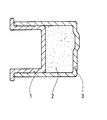
- the bumper system according to the invention is shown schematically in the figure. With 1 the carrier is designated, with 2 the foam core and with 3 the shell.
- the components A, B and C can by conventional fastening techniques such. B. by welding at temperatures above the softening point of polypropylene or by screwing or clipping together.
- the paint is applied to the bumper cover using conventional methods.
- the bumper system meets the highest demands on resilience; it holds e.g. B. stood an impact at a speed of up to 8 km / h without damage.
- the bumper is first mechanically crushed, e.g. B. first roughly by cutting or impact mills, then finely by hammer or rotor mills.
- the comminuted material with a particle size of about 5-10 mm is melted and homogenized in a commercially available, high-shear extruder, and then granulated.
- Shaped bodies can be injected from the granules, which - if the starting materials have been selected correctly - have the following properties:
- the paint particles are preferably smaller than 300 ⁇ m.
- a material with these properties can be reused in a variety of ways, e.g. B. in two-component injection molding for stiffening molded parts, for engine compartment encapsulation, for the production of foil or carpet-clad door panels or trunk linings, for the production of cable ducts, air supply and housings for headlights or taillights.
- the product is further modified in the discharge extruder by adding 0.5% by weight, based on polymer, of a mixture of
- the product obtained has the following properties
- This product is used to produce a bumper cover on a large injection molding machine with a clamping force of 1500 t in a bumper cover tool (mass temp. 250 ° C, mold temperature 30 ° C, cycle time 3.5 min).
- the complete bumper system is crushed in a hammer mill to pieces of approx. 5 - 10 mm. To avoid electrostatic charging especially of the foam particles, some water is injected into the mill (approx. 1% based on the total weight).
- the mixture of finely chopped carrier and finely chopped casing on the one hand and the finely chopped foam core on the other hand is metered in in the mixing ratio as in the bumper system (92: 8), melted, kneaded and homogenized and discharged in the form of plastic strands.
- the throughput is 80 kg / h.
- Test specimens are injected from the granules obtained and the following properties are measured:
- the recyclate obtained has the following properties:
- Example 1 The procedure is as in Example 1 - with the following differences:
- the complete bumper system is subjected to a wind sifting by means of a cyclone after being cut into pieces of approx. 10 mm. Due to their strong density difference (density of A approx. 1.2, density of B approx. 0.08, density of C approx. 0.9 g / cm 3 ), components A, B and C can contain> 90% Purity can be separated.
- the additional fine particles ⁇ 1.5 mm (approx. 1 - 3% of the total), which mainly consists of glass fibers, are collected in the cyclone filter.
- the components B and C are entered separately via dosing devices (differential dosing scales) and melted.
Landscapes
- Engineering & Computer Science (AREA)
- Mechanical Engineering (AREA)
- Compositions Of Macromolecular Compounds (AREA)
- Separation, Recovery Or Treatment Of Waste Materials Containing Plastics (AREA)
- Processing And Handling Of Plastics And Other Materials For Molding In General (AREA)
- Reinforced Plastic Materials (AREA)
- Injection Moulding Of Plastics Or The Like (AREA)
- Manufacture Of Porous Articles, And Recovery And Treatment Of Waste Products (AREA)
Description
- Die Bestandteile von Stoßfängersystemen, nämlich Träger, Schaumkern und Hülle werden in steigendem Maß aus Kunststoff hergestellt, um Gewicht zu sparen und damit den Kraftstoffverbrauch zu senken. Für die genannten Bestandteile haben sich verschiedenartige Kunststoffe als geeignet erwiesen. In der Praxis wird als Material für den Stoßfängerträger vor allem glasfaserverstärktes Polyesterharz (SMC) eingesetzt, für den energieabsorbierenden Schaumkern ist geschäumtes Polyurethan (PUR-Schaum) bevorzugt, für die schlagfeste Kunststoffhülle werden Polycarbonat/Polybutylenterephthalat-Mischungen (PC/PBT), Polypropylen/Ethylen-Propylen-Kautschuk-Mischungen (PP/EPDM) und Polyurethan (PUR-RIM) verwendet.
- Seit einiger Zeit wird dem Problem des stofflichen Recycling von großen Kunststoffteilen von Automobilen steigende Beachtung geschenkt, weil beim Shreddern von Altautos erhebliche Anteile vermischter und damit kaum nutzbringend wiederaufarbeitbarer Kunststoffabfälle übrig bleiben, die deponiert werden müssen, während der Metallschrott weitgehend recyclisiert werden kann.
- Zahlreiche Versuche haben gezeigt, daß Kunststoffteile mit einheitlicher Rohstoffbasis prinzipiell stofflich recyclisierbar sind. Es ist jedoch sehr aufwendig und teuer, z. B. bei einem Stoßfängersystem aus PC/PBT-Hülle, PUR-Schaumkern und SMC-Trägereine Trennung der sich gegenseitig beim Recycling sehr störenden Komponenten vorzunehmen. Dazu kommt, daß auch nach erfolgter Trennung lackierte Stoßfängerhüllen, auch wenn sie kleingemahlen und über einen gut homogenisierenden Extruder aufgearbeitet werden, wegen der harten Lackreste zu einer drastischen Verringerung der mechanischen und optischen Eigenschaften des Recyclats führen.
- In dem US-A- 4,749,613 ist ein Stoßfängerträger aus faserverstärkten Thermoplasten beschrieben, bei dem als Verstärkungsfasern Laminate aus unidirektional orientierten Endlosfasern und Wirrfasermatten eingesetzt werden. Bevorzugter Thermoplast ist Polypropylen. Dieser Stoßfängerträger kann mit Polyurethanschaum und einer Polyurethanhülle kombiniert werden.
- In EP-A-97 504 wird geschäumtes Polypropylen einer Dichte von 15 - 45 g/I als Kernmaterial fürAuto-Stoßstangen empfohlen. Als geeignetes Material für die Stoßfängerhülle werden Polyurethan, Polypropylen und Polyethylen genannt.
- Die EP-A-174 483 empfiehlt als Kernmaterial geschäumtes Ethylen/Propylen-Copolymer mit einer Dichte von 47-180 g/I. Als Material für die Hülle werden Polyurethan oder ein Propylen-Copolymer genannt.
- Aufgabe der Erfindung wares, ein Vollkunststoff-Stoßfängersystem zu entwickeln, das wiederaufarbeitbar ist und dabei - auch wenn es mit Lack versehen ist - Formkörper mit akzeptablen mechanischen Eigenschaften ergibt.
- Diese Aufgabe wird durch das erfindungsgemäße Stoßfänger-System gelöst. Es besteht aus einem Stoßfängerträger Aaus glasfaserverstärktem Polypropylen, einem energieabsorbierenden Schaumkern B aus geschäumtem Polypropylen und einer zähen, verformbaren Hülle C aus kautschukmodifiziertem Polypropylen, die gegebenenfalls lackiert sein kann. Das Stoßfängersystem kann leicht vom Altauto abmontiert werden und ist dann voll wiederaufarbeitbar, indem man es mechanisch zerkleinert, extrudiert und granuliert. Dabei hat sich gezeigt, daß die mechanischen Werte, die an spritzgegossenen Probekörpern gemessen werden, auch dann noch ausreichend hoch sind, wenn das Stoßfängersystem mit 0,05 bis 4 Gew.-% Lack überzogen war. Dies war insofern überraschend als zu erwarten war, daß die Lackpartikel infolge ihrer Kerbwirkung die Zähigkeit stark herabsetzen. Tatsächlich wird dieser Effekt dann beobachtet, wenn als Stoßfängerträger glasfaserfreie Thermoplasten eingesetzt werden, überraschenderweise jedoch nicht, wenn man glasfaserverstärktes Polypropylen einsetzt.
- In der Abbildung ist das erfindungsgemäße Stoßfängersystem schematisch dargestellt. Mit 1 ist der Träger bezeichnet, mit 2 der Schaumkern und mit 3 die Hülle.
- Zu den einzelnen Komponenten des Systems ist folgendes zu sagen:
- A. Der Stoßfängerträger macht 70 - 30 Gew.-% des Systems aus. Er besteht aus eines glasfaserverstärkten Propylenpolymerisat mit zumindest teilweise unidirektional orientierten Endlosfasern, wobei der Glasfasergehalt mindestens 30 Gew.-%, vorzugsweise 40 - 70 Gew.-%, bezogen auf A, beträgt. Als Propylenpolymerisat ist das Homopolymere bevorzugt. Es kann aber auch bis zu 10 Gew.-% Comonomere, z. B. Ethylen einpolymerisiert enthalten oder bis zu 20 Gew.-% Ethylen/Propylen-Kautschuk zugemischt enthalten. Bevorzugt ist isotaktisches Polypropylen mit einem Molekulargewicht Mw von 100000 bis 300 000 und enger Molekulargewichtsverteilung. Zur Verbesserung der Haftung an den Glasfasern können dem Polypropylen 1 - 20 Gew.-% eines mit Carboxylgruppen gepfropften Polypropylens oder EPDM-Kautschuks oder eines reaktiven Silans, z. B. Vinyl-, Methacryl- oder Aminosilans in Kombination mit einem organischen Peroxid zugesetzt werden. Die Glasfaserkomponente enthält sowohl unidirektional orientierte Endlosfasern als auch Wirrfasermatten, die bevorzugt in abwechselnden Schichten angeordnet und miteinander vernadelt sind. Das Gewichtsverhältnis von Endlosfasern zu Wirrfasern beträgt vorzugsweise 80 : 20 bis 40 : 60. Ein entsprechendes bevorzugtes Halbzeug ist in der EP-A 323 571 beschrieben. Der Stoßfängerträger wird durch Heißpressen aus dem plattenförmigen Halbzeug hergestellt. Die Dicke des Trägers liegt im allgemeinen zwischen 3 und 25 mm.
- B. Der Schaumkern macht 2 - 15 % des Gewichts des Stoßfängersystems aus. Er besteht aus einem schaumförmigen Propylenpolymerisat mit einem Raumgewicht von 30 bis 150 g/I, vorzugsweise von 50 bis 120 g/I. Das Propylenpolymerisat kann ein Homopolymeres sein, bevorzugt sind Random-Copolymere mit 2 - 10 Gew.-% Ethylen oder Buten oder einer Mischung aus beiden. Der Schaumkern wird hergestellt durch Verpressen und Verschweißen von Schaumpartikeln in einer Form.
- C. Die Stoßfängerhülle macht 28 - 73 % des Gemischs des Systems aus. Sie besteht aus einem Propylenpolymerisat, welches mit 25 bis 65 Gew.-%, bezogen auf C, eines Ethylen/Propylen-Kautschuks schlagzäh modifiziert ist. Als Propylenpolymerisat ist wieder das Homopolymere bevorzugt. Es hat sich gezeigt, daß ein relativ hoher Gehalt an Kautschuk unerläßlich ist, damit im Beanspruchungsfall die Stoßfängerhülle keinen sichtbaren Weißbruch erleidet. Bevorzugt ist ein Mindestgehalt an EP-Kautschuk von 35 Gew.-%, insbesondere von 40 Gew.-%. Bei einer bevorzugten Herstellweise wird zunächst aus der Gasphase Propylen homopolymerisiert, dann wird ein Gemisch von Ethylen und Propylen, sowie ggf. einem Dien zugefügt und dieses in Gegenwart des vorgebildeten Polypropylens polymerisiert (sogenannte "reactor blends"). Ein derartiges Verfahren ist in der DE-A-38 27 565 beschrieben. Das kautschukhaltige Propylenpolymerisat kann zur Verbesserung der Lackhaftung bzw. zur Modifizierung der Eigenschaften wie Steifigkeit, Wärmeformbeständigkeit, Schwindung etc. bis zu 30 Gew.-% Füllstoffe enthalten, z.B. Talkum, Kreide, Kaolin, kurze Glasfasern. Gegebenenfalls können auch hierwie bei AzurVerbesserung der Haftung zwischen Füllstoff und Propylenpolymerisat bzw. zur Erhöhung der Zähigkeit geeignete Haftvermittler zugesetzt werden. Die Dicke der weichen, flexiblen Stoßfängerhülle beträgt vorzugsweise 1,5 bis 6 mm.
- D. Sofern der Stoßfänger lackiert ist, macht das Gewicht des Lacks 0,05 bis 4, vorzugsweise 0,1 - 2 % aus. ES kommen grundsätzlich alle üblichen Autolacke in Frage, vorzugsweise flexible Acrylat- oder Polyurethanlacke, welche die üblichen Pigmente enthalten können.
- Die Bestandteile A, B und C können durch übliche Befestigungstechniken, z. B. durch Verschweißen bei Temperaturen oberhalb des Erweichungspunktes von Polypropylen oder durch Verschrauben oder Klipsen miteinander verbunden werden. Der Lack wird nach üblichen Verfahren auf die Stoßfängerhülle aufgetragen. Das Stoßfängersystem genügt höchsten Anforderungen an die Belastbarkeit; es hält z. B. einem Aufprall mit einer Geschwindigkeit von bis zu 8 km/h ohne Schädigung stand.
- Bei richtiger Wahl der Materialien für die Einzelkomponenten unter Beachtung der oben beschriebenen Kriterien wird ein wiederaufarbeit bares System erhalten. Bei der Wiederaufarbeitung wird zunächst der Stoßfänger mechanisch zerkleinert, z. B. erst grob durch Schneid- oder Prallmühlen, dann fein durch Hammer- oder Rotormühlen. Das zerkleinerte Gut mit einer Teilchengröße von etwa 5 - 10 mm wird in einem handelsüblichen, gut scherenden Extruder aufgeschmolzen und homogenisiert, und anschließend granuliert. Aus dem Granulat können Formkörper gespritzt werden, die - sofern die Ausgangsmaterialien richtig ausgewählt worden waren - folgende Eigenschaften aufweisen:

- Ein Werkstoff mit diesen Eigenschaften kann in vielfältiger Weise wieder eingesetzt werden, z. B. im ZweiKomponenten-Spritzguß zur Aussteifung von Formteilen, für Motorraumkapselungen, für die Herstellung folien- oder teppichkaschierter Türseitenverkleidungen oder Kofferraumauskleidungen, für die Herstellung von Kabelkanälen, Luftzuführungen sowie von Gehäusen von Scheinwerfern oder Rückleuchten.
-
- A. Ein flächiges Halbzeug aus glasmattenverstärktem Polypropylen, das aufgebaut ist aus
- 55 Gew.-% hochisotaktischem (> 97 % isotakt. Anteile) Polypropylen mit enger Molmassenverteilung
- (sog. controlled rheology-Produkt) und MFI (230°/2, 16 kg) = 70 g/10 min
- 20 Gew.-% Glasmatten mit regelloser Anordnung der Glasfasern
- 25 Gew.-% gerichteten langen Glasfasern,
- wobei die einzelnen Glasfaserlagen miteinandervernadelt sind, wird mit IR-Strahlern auf ca. 250°C aufgeheizt und in einem Stoßfängerträgerwerkzeug durch Heißpressen verformt, so daß die gerichteten Glasfasern horizontal in dem Träger angeordnet sind und so die Biegesteifigkeit und -festigkeit des Trägers stark erhöhen.
- B. Für die Herstellung eines geformten Polypropylenschaumkerns wird ein Polypropylen-Random-Copolymeres, das 2,2 Gew.-% Ethylen statistisch eingebaut enthält, einen MFI (230/2,16) von 8 g/10 min aufweist und in Form kleiner Granulatkörner mit 1,5 mm Durchmesser vorliegt, mit einem aliphatischen Kohlenwasserstoff auf ein Raumgewicht von 30 g/I aufgeschäumt. Die geschäumten Perlen werden dann in die Form gegeben, verdichtet und mit Wasserdampf verschweißt, so daß sich ein geformter Schaumkern mit einem Raumgewicht von 80 g/I ergibt.
- C. Zur Herstellung einer Stoßfängerhülle aus EP-Kautschukmodifiziertem Polypropylen wird folgendermaßen verfahren:
- In einer aus zwei gerührten Reaktoren bestehenden Kaskade wird in der Gasphase ein mit EP-Kautschuk modifiziertes Polypropylen mit folgenden Kennwerten hergestellt:
- Ethylengehalt 28 %
- Gehalt an Ethylen/Propylen-Kautschuk 49 Gew.-%
- MFI (230/2,16) = 10 g/10 min
- Enge Molmassenverteilung (CR-Produkt)
- Das Produkt wird im Austragsextruder weiter modifiziert durch Zusatz von 0,5 Gew.-%, bezogen auf Polymer, einer Mischung aus

- Das erhaltene Produkt hat folgende Eigenschaften

- Mit diesem Produkt wird auf einer Großspritzgußmaschine mit einer Schließkraftvon 1500 t in einem Stoßfängerhüllenwerkzeug eine Stoßfängerhülle hergestellt (Massetemp. 250°C, Formtemperatur 30°C, Zykluszeit 3,5 min).
- D. Die Stoßfängerhülle wird folgendermaßen lackiert:
- Vorbehandlung durch Beflammen
- Auftrag einer 25 µm dicken Haftgrundierung auf Basis eines chlorierten Polyolefins (GC01-7109 der BASF Lacke + Farben) 15 Minuten trocknen bei 80°C
- Auftrag einer 40 µm dicken Decklackierung auf Basis Polyurethan:
- Metallic-Basislack FW 95 der BASF Lacke + Farben
- Klarlack 2K-PUR-GK 01-0102 der BASF Lacke + Farben
- Das aus den vier beschriebenen Komponenten aufgebaute Stoßfängersystem enthält in Gewichtsteilen
- 46 Gew.-% Träger
- 8 Gew.-% Schaumkern
- 45 Gew.-% Hülle
- 1 Gew.-% Lack
- Das komplette Stoßfängersystem wird in einer Schlagmühle zerkleinert zu ca. 5 - 10 mm großen Stücken. Zur Vermeidung elektrostatischer Aufladung speziell der Schaumteilchen wird etwas Wasser in die Mühle eingedüst (ca. 1 % bezogen auf Gesamtgewicht).
- In einem angeschlossenen Windsichterwerden die wesentlich leichteren Schaumpartikel abgetrennt, um später eine gleichmäßige Dosierung in den Konfektionierextruder zu ermöglichen.
- In einem konventionellen Zweiwellenextruder (ZSK 53 von Werner + Pfleiderer), ausgerüstet mit 1 atmosphärischen und 1 Vakuumentgasung wird die Mischung aus kleingehäckseltem Träger und kleingehäckselter Hülle einerseits und der kleingehäckselte Schaumkern andererseits im Mischungsverhältnis wie im Stoßfängersystem vorliegend (92 : 8) eindosiert, aufgeschmolzen, innig verknetet und homogenisiert und in Form von Kunststoffsträngen ausgetragen. Der Durchsatz beträgt 80 kg/h.
- Aus dem erhaltenen Granulat werden Probekörper gespritzt und folgende Eigenschaften gemessen:

- Es wird wie in Beispiel 1 verfahren, mit dem einzigen Unterschied, daß die Stoßfängerhülle nicht lackiert wird.
- Am Recyclat werden folgende Werte gemessen:

- Es wird wie im Beispiel 1 verfahren, mit folgenden Unterschieden:
- Die Gewichtsanteile des Stoßfängersystems betragen
- 32 Gew.-% Träger
- 10 Gew.-% Schaumkern
- 57 Gew.-% Hülle
- 1 Gew.-% Lack
- Das erhaltene Recyclat hat folgende Eigenschaften:

- Es wird wie in Beispiel 1 verfahren - mit folgenden Unterschieden: Das komplette Stoßfängersystem wird nach Zerkleinern in ca. 10 mm große Stücke einer Windsichtung mittels Zyklon unterworfen. Hierbei können die Komponenten A, B und C aufgrund ihres starken Dichteunterschiedes (Dichte von A ca. 1,2, Dichte von B ca. 0,08, Dichte von C ca. 0,9 g/cm3) mit > 90 %iger Reinheit getrennt werden. Der beim Zerkleinern zusätzlich anfallende Feinanteil < 1,5 mm (ca. 1 - 3 % auf Gesamt), der vorwiegend aus Glasfasern besteht, wird im Filter des Zyklons aufgefangen.
- In den Einzug des Extruders (baugleich wie in Beispiel 1) werden die Komponenten B und C jeweils getrennt über Dosiereinrichtungen (Differentialdosierwaage) eingegeben und aufgeschmolzen.
- Komponente Asowie der Feinstaub werden über eine handelsübliche Dosier- und Stopfeinrichtung bei ca. 30 % des Extruderverfahrensteils in die Schmelze aus B + C eingetragen, wobei der Polymeranteil aufschmilzt. Im weiteren Durchgang durch den Extruder werden alle Komponenten innig vermischt.
- Am Recyclat werden folgende Werte gemessen:

Claims (4)
dadurch gekennzeichnet, daß es aufgebaut ist aus

Applications Claiming Priority (3)
| Application Number | Priority Date | Filing Date | Title |
|---|---|---|---|
| DE3936194A DE3936194A1 (de) | 1989-10-31 | 1989-10-31 | Wiederaufarbeitbares stossfaengersystem |
| DE3936194 | 1989-10-31 | ||
| CA 2031317 CA2031317C (en) | 1989-10-31 | 1990-12-03 | Recyclable bumper system |
Publications (3)
| Publication Number | Publication Date |
|---|---|
| EP0425923A1 EP0425923A1 (de) | 1991-05-08 |
| EP0425923B1 true EP0425923B1 (de) | 1993-05-12 |
| EP0425923B2 EP0425923B2 (de) | 1998-01-14 |
Family
ID=25674388
Family Applications (1)
| Application Number | Title | Priority Date | Filing Date |
|---|---|---|---|
| EP19900120067 Expired - Lifetime EP0425923B2 (de) | 1989-10-31 | 1990-10-19 | Wiederaufarbeitbares Stossfängersystem |
Country Status (6)
| Country | Link |
|---|---|
| US (1) | US5122398A (de) |
| EP (1) | EP0425923B2 (de) |
| JP (1) | JPH03208744A (de) |
| CA (1) | CA2031317C (de) |
| DE (2) | DE3936194A1 (de) |
| ES (1) | ES2043216T5 (de) |
Cited By (3)
| Publication number | Priority date | Publication date | Assignee | Title |
|---|---|---|---|---|
| US5817420A (en) * | 1995-09-29 | 1998-10-06 | Japan Polyolefins Co., Ltd. | Multilayer resin molding utilizing coated resin moldings |
| US6416614B1 (en) | 1998-05-02 | 2002-07-09 | Fraunhofer-Gesellschaft zur Förderung der angewandten Gesellschaft | Method for the production of a cellular composite material |
| EP1500770A2 (de) | 2003-07-23 | 2005-01-26 | Basf Aktiengesellschaft | Wärmegedämmtes Extrusionsprofil für Fensterrahmen |
Families Citing this family (62)
| Publication number | Priority date | Publication date | Assignee | Title |
|---|---|---|---|---|
| DE4101806A1 (de) * | 1991-01-23 | 1992-07-30 | Basf Ag | Schockabsorbierende propylenpolymer-verbundformteile |
| JP2555782B2 (ja) * | 1991-01-31 | 1996-11-20 | 豊田合成株式会社 | モール及びその製造方法 |
| US5468779A (en) * | 1993-03-29 | 1995-11-21 | Isuzu Motors Limited | Method for recycling painted plastic materials |
| US5424013A (en) | 1993-08-09 | 1995-06-13 | Lieberman; Mark | Thermoplastic closed loop recycling process |
| DE4328309C2 (de) * | 1993-08-23 | 1998-02-19 | Haslbeck Technik Gmbh | Stoß- und/oder schlagabsorbierendes Bauteil, insbesondere Frontschutzbügel und Verfahren zu dessen Herstellung |
| DE4330861A1 (de) * | 1993-09-11 | 1995-03-16 | Basf Ag | Flächiges Halbzeug aus GMT-Recyclat |
| EP0651003A1 (de) * | 1993-10-29 | 1995-05-03 | Azdel, Inc. | Faserverstärkter, funktionalisierter Polyolefinverbundwerkstoff |
| US5545022A (en) * | 1994-02-10 | 1996-08-13 | Shape Corporation | Apparatus for manufacturing a vehicle bumper |
| US6168226B1 (en) * | 1994-05-19 | 2001-01-02 | Henkel Corporation | Composite laminate automotive structures |
| JP2904708B2 (ja) * | 1994-07-20 | 1999-06-14 | 三井化学株式会社 | 自動車内装部品 |
| US5780125A (en) * | 1994-08-22 | 1998-07-14 | Honda Giken Kogyo Kabushiki Kaisha | Bumper made of synthetic resin for automobile, and process for producing the same |
| US6165588A (en) * | 1998-09-02 | 2000-12-26 | Henkel Corporation | Reinforcement of hollow sections using extrusions and a polymer binding layer |
| US5900300A (en) * | 1997-07-02 | 1999-05-04 | Slaven; John P. | High modulus and stiffness polymer foam/GMT composites |
| US6237304B1 (en) | 1997-07-18 | 2001-05-29 | Henkel Corporation | Laminate structural bulkhead |
| US6233826B1 (en) | 1997-07-21 | 2001-05-22 | Henkel Corp | Method for reinforcing structural members |
| US6096403A (en) * | 1997-07-21 | 2000-08-01 | Henkel Corporation | Reinforced structural members |
| EP1057718A3 (de) * | 1997-07-21 | 2000-12-13 | Henkel Corporation | Verstärktes Bauelement |
| DE19732559A1 (de) | 1997-07-29 | 1999-02-04 | Basf Ag | Verfahren zum Verbinden eines Schaumstoffkerns mit einer Hülle |
| US6451231B1 (en) | 1997-08-21 | 2002-09-17 | Henkel Corporation | Method of forming a high performance structural foam for stiffening parts |
| DE19741766A1 (de) * | 1997-09-22 | 1999-03-25 | Bayerische Motoren Werke Ag | Geschäumte Struktur |
| US6103341A (en) | 1997-12-08 | 2000-08-15 | L&L Products | Self-sealing partition |
| US6068424A (en) * | 1998-02-04 | 2000-05-30 | Henkel Corporation | Three dimensional composite joint reinforcement for an automotive vehicle |
| EP1071549A4 (de) | 1998-03-16 | 2002-01-23 | American Commodities Inc | Verfahren zum entfernen schädlicher oberflächenmaterialien von zerkleinerten polymeren partikeln |
| US5967592A (en) * | 1998-03-23 | 1999-10-19 | The Budd Company | Hollow FRP bumper |
| US5992923A (en) * | 1998-05-27 | 1999-11-30 | Henkel Corporation | Reinforced beam assembly |
| US6131897A (en) | 1999-03-16 | 2000-10-17 | L & L Products, Inc. | Structural reinforcements |
| DE19913080A1 (de) * | 1999-03-23 | 2000-09-28 | Bayerische Motoren Werke Ag | Energieabsorbierendes Bauteil für ein Fahrzeug |
| US6358584B1 (en) | 1999-10-27 | 2002-03-19 | L&L Products | Tube reinforcement with deflecting wings and structural foam |
| DE19959652A1 (de) * | 1999-12-10 | 2001-06-13 | Basf Ag | Sandwichplatte |
| US6668457B1 (en) * | 1999-12-10 | 2003-12-30 | L&L Products, Inc. | Heat-activated structural foam reinforced hydroform |
| US6467834B1 (en) | 2000-02-11 | 2002-10-22 | L&L Products | Structural reinforcement system for automotive vehicles |
| CA2399457C (en) * | 2000-02-11 | 2009-09-15 | L&L Products, Inc. | Structural reinforcement system for automotive vehicles |
| US6422575B1 (en) | 2000-03-14 | 2002-07-23 | L&L Products, Inc. | Expandable pre-formed plug |
| US6482486B1 (en) * | 2000-03-14 | 2002-11-19 | L&L Products | Heat activated reinforcing sleeve |
| US6296298B1 (en) | 2000-03-14 | 2001-10-02 | L&L Products, Inc. | Structural reinforcement member for wheel well |
| US6321793B1 (en) | 2000-06-12 | 2001-11-27 | L&L Products | Bladder system for reinforcing a portion of a longitudinal structure |
| AU2001268419A1 (en) | 2000-06-14 | 2001-12-24 | Luzenac America, Inc. | High flexural modulus and/or high heat deflection temperature thermoplastic elastomers and methods for producing the same |
| US6820923B1 (en) | 2000-08-03 | 2004-11-23 | L&L Products | Sound absorption system for automotive vehicles |
| US6471285B1 (en) | 2000-09-29 | 2002-10-29 | L&L Products, Inc. | Hydroform structural reinforcement system |
| US6561571B1 (en) | 2000-09-29 | 2003-05-13 | L&L Products, Inc. | Structurally enhanced attachment of a reinforcing member |
| JP2003237507A (ja) * | 2002-02-19 | 2003-08-27 | Om Kogyo Kk | バンパ補強材 |
| DE60305480T2 (de) * | 2002-04-19 | 2006-11-16 | Ube Industries, Ltd., Ube | Verfahren zur wiederverwendung von zerkleinertem kunstharzprodukt mit darin eingearbeitetem gehärtetem harz |
| EP1510538B1 (de) * | 2002-05-09 | 2010-09-15 | Ube Industries, Ltd. | Verfahren zur wiederverwendung von zerkleinertem kunstharzprodukt |
| DE10307528B4 (de) * | 2003-02-21 | 2016-10-20 | Bayerische Motoren Werke Aktiengesellschaft | Kraftfahrzeug mit zumindest einem Bauteil |
| ATE441573T1 (de) * | 2003-05-09 | 2009-09-15 | Pilatus Flugzeugwerke Ag | Flugzeugflügel |
| SI21606A (sl) * | 2003-09-12 | 2005-04-30 | KOLPA Proizvodnja in predelava plasti�nih mas d.d. | Postopek mehanskega recikliranja kompozitnega polimernega materiala |
| USRE44893E1 (en) | 2004-03-26 | 2014-05-13 | Hanwha Azdel, Inc. | Fiber reinforced thermoplastic sheets with surface coverings |
| ITTV20050101A1 (it) * | 2005-07-12 | 2007-01-13 | Plastal Spa | Paraurti e calandra per veicoli medio-pesanti. |
| ES2600739T3 (es) * | 2005-12-23 | 2017-02-10 | Borealis Technology Oy | Espuma de polipropileno reforzada con fibra |
| ITMI20060970A1 (it) | 2006-05-17 | 2006-08-16 | Adlev Srl | Complesso di paraurti per veicolo e relativo veicolo comprendente tale complesso di paraurti |
| US8141305B2 (en) | 2008-05-28 | 2012-03-27 | Rite-Hite Holding Corporation | Side seal members for a dock seal |
| JP5564237B2 (ja) * | 2009-11-27 | 2014-07-30 | 株式会社アステア | バンパ補強材 |
| US20130169000A1 (en) * | 2011-12-28 | 2013-07-04 | Aerofficient Llc | Crash bar aerodynamic device |
| JP5898525B2 (ja) * | 2012-02-27 | 2016-04-06 | 曙ブレーキ工業株式会社 | 摩擦材用樹脂組成物の製造方法 |
| EP2757066B1 (de) * | 2013-01-22 | 2018-10-31 | Trumpf Sachsen GmbH | Verfahren zur Herstellung einer Tragstruktur |
| US9682674B2 (en) * | 2014-12-11 | 2017-06-20 | Shape Corp. | Pultruded beam, and apparatus and methods for manufacturing |
| KR102187577B1 (ko) | 2015-08-05 | 2020-12-08 | 현대자동차주식회사 | 범퍼용 빔 |
| CN105350865A (zh) * | 2015-11-06 | 2016-02-24 | 美环五金门部件(平湖)有限公司 | 一种门框中档 |
| DE102016212589A1 (de) * | 2016-07-11 | 2018-01-11 | Röchling Automotive SE & Co. KG | Formstabiler Verbundwerkstoff mit einer Lage aus faserverstärktem Recyclat-Mahlgut |
| EP4275966A4 (de) * | 2021-01-07 | 2024-05-22 | Nippon Steel Corporation | Strukturelement |
| CN116003908B (zh) * | 2022-12-29 | 2024-09-17 | 重庆普利特新材料有限公司 | 一种闭环回收的免火焰处理的喷漆保险杠专用环保改性再生聚丙烯复合材料及其制备方法 |
| CN117024884A (zh) * | 2023-09-12 | 2023-11-10 | 广东聚石化学股份有限公司 | 一种玻纤增强聚丙烯材料及其制备方法、应用 |
Family Cites Families (9)
| Publication number | Priority date | Publication date | Assignee | Title |
|---|---|---|---|---|
| US3493257A (en) * | 1967-03-22 | 1970-02-03 | Gen Motors Corp | Resilient microcellular foam bumper |
| JPS58221745A (ja) * | 1982-06-19 | 1983-12-23 | Japan Styrene Paper Co Ltd | 自動車のバンパ−用芯材 |
| DE3237762A1 (de) * | 1982-10-12 | 1984-04-12 | Messerschmitt-Bölkow-Blohm GmbH, 8000 München | Stossfaenger-tragkoerper aus faserverstaerktem werkstoff fuer automobile oder dergleichen |
| JPS59176147A (ja) * | 1983-03-24 | 1984-10-05 | Japan Styrene Paper Co Ltd | バンパ−用芯材およびその製造方法 |
| JPS6146744A (ja) * | 1984-08-14 | 1986-03-07 | Kanegafuchi Chem Ind Co Ltd | 自動車バンパー用芯材の製造方法 |
| GB8519432D0 (en) * | 1985-08-02 | 1985-09-11 | Ford Motor Co | Vehicle bumper |
| JPH0620743B2 (ja) * | 1985-12-26 | 1994-03-23 | 日本板硝子株式会社 | 複合長繊維強化熱可塑性樹脂スタンパブルシ−ト及びそれを成形してなるバンパ−ビ−ム |
| CA1329228C (en) * | 1986-08-20 | 1994-05-03 | Tessa Malcolm-Brown | Intumescent seals |
| DE3702038A1 (de) * | 1987-01-24 | 1988-08-04 | Basf Ag | Verfahren zum herstellen von propylen-ethylen-polymerisaten |
-
1989
- 1989-10-31 DE DE3936194A patent/DE3936194A1/de not_active Withdrawn
-
1990
- 1990-10-19 EP EP19900120067 patent/EP0425923B2/de not_active Expired - Lifetime
- 1990-10-19 DE DE9090120067T patent/DE59001440D1/de not_active Expired - Fee Related
- 1990-10-19 ES ES90120067T patent/ES2043216T5/es not_active Expired - Lifetime
- 1990-10-31 JP JP2292191A patent/JPH03208744A/ja active Pending
- 1990-11-26 US US07/618,331 patent/US5122398A/en not_active Expired - Fee Related
- 1990-12-03 CA CA 2031317 patent/CA2031317C/en not_active Expired - Lifetime
Cited By (4)
| Publication number | Priority date | Publication date | Assignee | Title |
|---|---|---|---|---|
| US5817420A (en) * | 1995-09-29 | 1998-10-06 | Japan Polyolefins Co., Ltd. | Multilayer resin molding utilizing coated resin moldings |
| US6166136A (en) * | 1995-09-29 | 2000-12-26 | Japan Polyolefins Co., Ltd. | Resin composition utilizing coated resin moldings and multilayer resin molding |
| US6416614B1 (en) | 1998-05-02 | 2002-07-09 | Fraunhofer-Gesellschaft zur Förderung der angewandten Gesellschaft | Method for the production of a cellular composite material |
| EP1500770A2 (de) | 2003-07-23 | 2005-01-26 | Basf Aktiengesellschaft | Wärmegedämmtes Extrusionsprofil für Fensterrahmen |
Also Published As
| Publication number | Publication date |
|---|---|
| JPH03208744A (ja) | 1991-09-11 |
| DE59001440D1 (de) | 1993-06-17 |
| CA2031317C (en) | 1999-05-11 |
| ES2043216T5 (es) | 1998-03-01 |
| DE3936194A1 (de) | 1991-05-02 |
| US5122398A (en) | 1992-06-16 |
| ES2043216T3 (es) | 1993-12-16 |
| EP0425923B2 (de) | 1998-01-14 |
| EP0425923A1 (de) | 1991-05-08 |
| CA2031317A1 (en) | 1992-06-04 |
Similar Documents
| Publication | Publication Date | Title |
|---|---|---|
| EP0425923B2 (de) | Wiederaufarbeitbares Stossfängersystem | |
| EP0575751B1 (de) | Verfahren zur Wiedergewinnung des Kunststoffes aus lackierten Kunststoffteilen | |
| DE69422396T2 (de) | Verfahren und Vorrichtung zur Extrusion von Gemischen bestehend aus thermoplastischen und vernetzbaren Kunststoffen und dadurch hergestellte Produkte | |
| DE3887564T2 (de) | Schalldämmende, erneut verformbare holzgefüllte Folie. | |
| EP0630746B1 (de) | Tiefziehfähige Folie, Verfahren zu deren Herstellung und Verwendung derselben | |
| EP0560129B1 (de) | Flächiger Verbundwerkstoff | |
| DE4101806A1 (de) | Schockabsorbierende propylenpolymer-verbundformteile | |
| US9346946B2 (en) | Composite materials and shaped articles | |
| DE69123698T2 (de) | Pulver aus thermoplastischem Elastomer und Pulver-Schlickergiessverfahren unter Verwendung derselben | |
| DE4423883A1 (de) | Tiefziehfähige Folie, Verfahren zu deren Herstellung und Verwendung derselben | |
| DE4211415A1 (de) | Folie oder Formkörper aus einem mehrphasigen Kunststoff | |
| DE4204776A1 (de) | Recyclingverfahren fuer faserverstaerkte thermoplastische materialien | |
| DE69514291T2 (de) | Thermoplastische Harzzusammensetzungen mit verbesserter Leistung | |
| EP0525510B1 (de) | Wärmehärtbare Formmasse | |
| EP0636473B1 (de) | Tiefziehfähige Folie, Verfahren zu deren Herstellung und Verwendung derselben | |
| EP0528456B1 (de) | Wiederverwertung duroplastischer PU-Schaumteile | |
| EP0569621B1 (de) | Verwendung eines Zusatzes von vernetzten PP-EPDM-Mischungen zur Kraftfahrzeugfolienherstellung | |
| DE4230157C2 (de) | Verfahren zur Wiederverwertung von Kunststoffabfällen oder Kunststoffaltmaterial zur Herstellung von Kunststoffbauteilen und deren Verwendung | |
| US5888913A (en) | Glass matt reinforced thermoplastics suitable for the production of paintable parts and parts produced therefrom | |
| DE4139257A1 (de) | Recycling-kunststofformmasse | |
| JP2887986B2 (ja) | 自動車部品用リサイクルスタンパブルシート積層体の製造方法 | |
| EP0794214B1 (de) | Zur Herstellung lackierbarer Teile geeignete glasmattenverstärkte Thermoplasten | |
| DE69602240T2 (de) | Gelackte Gegenstände enthaltend Kunststoffzusammensetzungen und Mehrschichtgegenstand | |
| EP0475377A2 (de) | Verfahren zur Wiederverwertung von Abfällen oder Altartikeln aus Kunststoff, insbesondere vernetztem Kunststoff | |
| DE4130082A1 (de) | Verfahren zur wiederverwertung von abfaellen oder altartikeln aus kunststoff, insbesondere vernetztem kunststoff |
Legal Events
| Date | Code | Title | Description |
|---|---|---|---|
| PUAI | Public reference made under article 153(3) epc to a published international application that has entered the european phase |
Free format text: ORIGINAL CODE: 0009012 |
|
| 17P | Request for examination filed |
Effective date: 19901227 |
|
| AK | Designated contracting states |
Kind code of ref document: A1 Designated state(s): BE DE ES FR GB IT NL SE |
|
| 17Q | First examination report despatched |
Effective date: 19920930 |
|
| GRAA | (expected) grant |
Free format text: ORIGINAL CODE: 0009210 |
|
| AK | Designated contracting states |
Kind code of ref document: B1 Designated state(s): BE DE ES FR GB IT NL SE |
|
| ITF | It: translation for a ep patent filed | ||
| REF | Corresponds to: |
Ref document number: 59001440 Country of ref document: DE Date of ref document: 19930617 |
|
| GBT | Gb: translation of ep patent filed (gb section 77(6)(a)/1977) |
Effective date: 19930526 |
|
| ET | Fr: translation filed | ||
| REG | Reference to a national code |
Ref country code: ES Ref legal event code: FG2A Ref document number: 2043216 Country of ref document: ES Kind code of ref document: T3 |
|
| PLBI | Opposition filed |
Free format text: ORIGINAL CODE: 0009260 |
|
| PLAB | Opposition data, opponent's data or that of the opponent's representative modified |
Free format text: ORIGINAL CODE: 0009299OPPO |
|
| 26 | Opposition filed |
Opponent name: DSM N.V. PATENT DEPARTMENT Effective date: 19940210 Opponent name: SYMALIT AG Effective date: 19940210 Opponent name: HIMONT INCORPORATED Effective date: 19940214 Opponent name: PEGUFORM-WERKE GMBH Effective date: 19940210 |
|
| R26 | Opposition filed (corrected) |
Opponent name: DSM N.V. PATENT DEPARTMENT * 940210 SYMALIT AG * 9 Effective date: 19940210 |
|
| NLR1 | Nl: opposition has been filed with the epo |
Opponent name: SYMALIT AG Opponent name: PEGUFORM-WERKE GMBH Opponent name: HIMONT INCORPORATED Opponent name: DSM N.V. PATENT DEPARTMENT |
|
| EAL | Se: european patent in force in sweden |
Ref document number: 90120067.5 |
|
| PLAB | Opposition data, opponent's data or that of the opponent's representative modified |
Free format text: ORIGINAL CODE: 0009299OPPO |
|
| R26 | Opposition filed (corrected) |
Opponent name: DSM N.V. PATENT DEPARTMENT * 940210 SYMALIT AG * 9 Effective date: 19940210 |
|
| NLR1 | Nl: opposition has been filed with the epo |
Opponent name: SYMALIT AG Opponent name: DSM N.V. PATENT DEPARTMENT Opponent name: MONTELL NORTH AMERICA INC. Opponent name: PEGUFORM-WERKE GMBH |
|
| PLAW | Interlocutory decision in opposition |
Free format text: ORIGINAL CODE: EPIDOS IDOP |
|
| PLAW | Interlocutory decision in opposition |
Free format text: ORIGINAL CODE: EPIDOS IDOP |
|
| PUAH | Patent maintained in amended form |
Free format text: ORIGINAL CODE: 0009272 |
|
| STAA | Information on the status of an ep patent application or granted ep patent |
Free format text: STATUS: PATENT MAINTAINED AS AMENDED |
|
| 27A | Patent maintained in amended form |
Effective date: 19980114 |
|
| AK | Designated contracting states |
Kind code of ref document: B2 Designated state(s): BE DE ES FR GB IT NL SE |
|
| REG | Reference to a national code |
Ref country code: ES Ref legal event code: DC2A Kind code of ref document: T5 Effective date: 19980122 |
|
| NLR2 | Nl: decision of opposition | ||
| ITF | It: translation for a ep patent filed | ||
| GBTA | Gb: translation of amended ep patent filed (gb section 77(6)(b)/1977) | ||
| ET3 | Fr: translation filed ** decision concerning opposition | ||
| NLR3 | Nl: receipt of modified translations in the netherlands language after an opposition procedure | ||
| REG | Reference to a national code |
Ref country code: GB Ref legal event code: IF02 |
|
| PGFP | Annual fee paid to national office [announced via postgrant information from national office to epo] |
Ref country code: NL Payment date: 20041003 Year of fee payment: 15 |
|
| PGFP | Annual fee paid to national office [announced via postgrant information from national office to epo] |
Ref country code: SE Payment date: 20041006 Year of fee payment: 15 |
|
| PGFP | Annual fee paid to national office [announced via postgrant information from national office to epo] |
Ref country code: GB Payment date: 20041013 Year of fee payment: 15 |
|
| PGFP | Annual fee paid to national office [announced via postgrant information from national office to epo] |
Ref country code: ES Payment date: 20041116 Year of fee payment: 15 |
|
| PG25 | Lapsed in a contracting state [announced via postgrant information from national office to epo] |
Ref country code: IT Free format text: LAPSE BECAUSE OF NON-PAYMENT OF DUE FEES;WARNING: LAPSES OF ITALIAN PATENTS WITH EFFECTIVE DATE BEFORE 2007 MAY HAVE OCCURRED AT ANY TIME BEFORE 2007. THE CORRECT EFFECTIVE DATE MAY BE DIFFERENT FROM THE ONE RECORDED. Effective date: 20051019 Ref country code: GB Free format text: LAPSE BECAUSE OF NON-PAYMENT OF DUE FEES Effective date: 20051019 |
|
| PG25 | Lapsed in a contracting state [announced via postgrant information from national office to epo] |
Ref country code: SE Free format text: LAPSE BECAUSE OF NON-PAYMENT OF DUE FEES Effective date: 20051020 Ref country code: ES Free format text: LAPSE BECAUSE OF NON-PAYMENT OF DUE FEES Effective date: 20051020 |
|
| PG25 | Lapsed in a contracting state [announced via postgrant information from national office to epo] |
Ref country code: NL Free format text: LAPSE BECAUSE OF NON-PAYMENT OF DUE FEES Effective date: 20060501 |
|
| EUG | Se: european patent has lapsed | ||
| GBPC | Gb: european patent ceased through non-payment of renewal fee |
Effective date: 20051019 |
|
| NLV4 | Nl: lapsed or anulled due to non-payment of the annual fee |
Effective date: 20060501 |
|
| REG | Reference to a national code |
Ref country code: ES Ref legal event code: FD2A Effective date: 20051020 |
|
| PGFP | Annual fee paid to national office [announced via postgrant information from national office to epo] |
Ref country code: DE Payment date: 20071011 Year of fee payment: 18 |
|
| PGFP | Annual fee paid to national office [announced via postgrant information from national office to epo] |
Ref country code: BE Payment date: 20071220 Year of fee payment: 18 |
|
| PGFP | Annual fee paid to national office [announced via postgrant information from national office to epo] |
Ref country code: FR Payment date: 20071009 Year of fee payment: 18 |
|
| PLAB | Opposition data, opponent's data or that of the opponent's representative modified |
Free format text: ORIGINAL CODE: 0009299OPPO |
|
| BERE | Be: lapsed |
Owner name: *BASF A.G. Effective date: 20081031 |
|
| REG | Reference to a national code |
Ref country code: FR Ref legal event code: ST Effective date: 20090630 |
|
| PG25 | Lapsed in a contracting state [announced via postgrant information from national office to epo] |
Ref country code: DE Free format text: LAPSE BECAUSE OF NON-PAYMENT OF DUE FEES Effective date: 20090501 |
|
| PG25 | Lapsed in a contracting state [announced via postgrant information from national office to epo] |
Ref country code: BE Free format text: LAPSE BECAUSE OF NON-PAYMENT OF DUE FEES Effective date: 20081031 |
|
| PG25 | Lapsed in a contracting state [announced via postgrant information from national office to epo] |
Ref country code: FR Free format text: LAPSE BECAUSE OF NON-PAYMENT OF DUE FEES Effective date: 20081031 |