EP0428178B1 - Formbare Polymermischungen - Google Patents
Formbare Polymermischungen Download PDFInfo
- Publication number
- EP0428178B1 EP0428178B1 EP90121959A EP90121959A EP0428178B1 EP 0428178 B1 EP0428178 B1 EP 0428178B1 EP 90121959 A EP90121959 A EP 90121959A EP 90121959 A EP90121959 A EP 90121959A EP 0428178 B1 EP0428178 B1 EP 0428178B1
- Authority
- EP
- European Patent Office
- Prior art keywords
- composition
- polyblend
- bis
- hydroxyphenyl
- poly
- Prior art date
- Legal status (The legal status is an assumption and is not a legal conclusion. Google has not performed a legal analysis and makes no representation as to the accuracy of the status listed.)
- Expired - Lifetime
Links
Classifications
-
- C—CHEMISTRY; METALLURGY
- C08—ORGANIC MACROMOLECULAR COMPOUNDS; THEIR PREPARATION OR CHEMICAL WORKING-UP; COMPOSITIONS BASED THEREON
- C08L—COMPOSITIONS OF MACROMOLECULAR COMPOUNDS
- C08L23/00—Compositions of homopolymers or copolymers of unsaturated aliphatic hydrocarbons having only one carbon-to-carbon double bond; Compositions of derivatives of such polymers
- C08L23/02—Compositions of homopolymers or copolymers of unsaturated aliphatic hydrocarbons having only one carbon-to-carbon double bond; Compositions of derivatives of such polymers not modified by chemical after-treatment
- C08L23/16—Ethylene-propylene or ethylene-propylene-diene copolymers
-
- C—CHEMISTRY; METALLURGY
- C08—ORGANIC MACROMOLECULAR COMPOUNDS; THEIR PREPARATION OR CHEMICAL WORKING-UP; COMPOSITIONS BASED THEREON
- C08L—COMPOSITIONS OF MACROMOLECULAR COMPOUNDS
- C08L67/00—Compositions of polyesters obtained by reactions forming a carboxylic ester link in the main chain; Compositions of derivatives of such polymers
- C08L67/02—Polyesters derived from dicarboxylic acids and dihydroxy compounds
-
- C—CHEMISTRY; METALLURGY
- C08—ORGANIC MACROMOLECULAR COMPOUNDS; THEIR PREPARATION OR CHEMICAL WORKING-UP; COMPOSITIONS BASED THEREON
- C08L—COMPOSITIONS OF MACROMOLECULAR COMPOUNDS
- C08L69/00—Compositions of polycarbonates; Compositions of derivatives of polycarbonates
Definitions
- the present invention relates to thermoplastic molding compositions based on a resinous polyblend to which a polylactone has been added to improve surface gloss, and in particular to aromatic polycarbonate based polyblends to which poly(epsilon-caprolactone) has been added to improve surface gloss.
- Aromatic polycarbonates are a widely used class of thermoplastic molding polymers selected for superior molding properties.
- molded aromatic polycarbonate articles lack critical thickness impact strength and chemical resistance. This has been overcome by forming polyblends of polycarbonates with thermoplastic poly(alkylene terephthalates) and elastomeric rubber polymers (EP-A-0 107 048). Articles molded from such polyblends lack surface gloss, a necessary feature the absence of which makes the polyblends unsuitable for many end use applications.
- Polylactones have been shown to be useful property modifiers for resinous thermoplastic molding compositions.
- U.S. Patent No. 4,492,782 discloses that polycaprolactone improves the impact strength and dimensional stability of polyester molding compositions.
- U.S. Patent No. 4,536,531 discloses that polycaprolactone improves the crystallization rate of polyester molding compositions.
- U.S. Patent No. 4,656,206 discloses that polycaprolactone improves the impact strength of polyester molding compositions.
- U.S. Patent No. 4,064,195 discloses that polycaprolactone improves the stress crack resistance of aromatic polycarbonate molding compositions.
- U.S. Patent No. 4,388,443 discloses that polylactones compatiblize molding composition blends of aromatic polycarbonate and rubber-modified styrene maleic anhydride.
- polylactones when added to a thermoplastic molding composition prepared from a resinous polyblend of an aromatic polycarbonate with a poly(alkylene terephthalate) polyester and an elastomeric rubber improves the surface gloss of articles molded therefrom.
- the surface gloss of articles molded from the polylactone containing molding compositions is improved without a loss of physical properties important to the end use applications of the articles.
- thermoplastic composition prepared from a resinous polyblend of an aromatic polycarbonate with a polyester of an aromatic dicarboxylic acid, an elastomeric rubber, and a polylactone, wherein the polylactone is present within the range of from 1.0 to 10 weight % of the resinous blend.
- polylactone significantly improves the surface gloss of articles molded from the resinous blend.
- the polylactone addition does not adversely affect physical properties of the articles such as impact strength, surface hardness, tensile strength or elongation.
- the physical properties and surface gloss are measured according to ASTM test procedures, including procedures set forth in ASTM-D638 for tensile strength and elongation, ASTM-D256 for impact strength, ASTM-D785 for surface hardness and ASTM-D523 for surface gloss.
- a method or producing a molded polyblend by forming a polyblend of an aromatic polycarbonate with a polyester of an aromatic dicarboxylic acid, elastomeric rubber, and a polylactone present in an amount within the range of from 1.0 to 10 weight % of the polyblend, and then molding the formed polyblend.
- the resinous thermoplastic molding compositions of the present invention are based upon an aromatic polycarbonate. Any aromatic polycarbonates suitable for use in thermoplastic molding compositions can be employed in the polyblends of this invention.
- the useful aromatic polycarbonate resins may include homopolycarbonate, copolycarbonate- and terpolycarbonate resins or mixtures thereof.
- the polycarbonate resins may be prepared by the known polycondensation of phosgene and aromatic dihydroxy compounds as taught by H. Schnell, Chemistry and Physics of Polycarbonates (Interscience Publishers, New York 1964).
- Such suitable polycarbonates are typically manufactured from aromatic dihydroxy compounds such as resorcinol, hydroquinone, dihydroxydiphenyls, bis-(hydroxyphenyl)-derivatives and the like.
- aromatic dihydroxy compounds such as resorcinol, hydroquinone, dihydroxydiphenyls, bis-(hydroxyphenyl)-derivatives and the like.
- bis-(hydroxyphenyl)-derivatives useful in the practice of the invention are bis-(hydroxyphenyl)-alkanes, -cycloalkanes, -ethers, -ketones, -sulfoxides, -sulfones and alpha, alpha-bis-(hydroxyphenyl)-diisopropylbenzenes.
- the most preferred aromatic polycarbonates for use in the polyblend compositions hereof include bis-(hydroxyphenyl)-derivatives, including 2,2-bis-(4-hydroxyphenyl)-propane (i.e., Bisphenol A), 2,4-bis-(4-hydroxyphenyl)-2-methylbutane, 1,1-bis-(4-hydroxyphenyl)-cyclohexane, alpha, alpha-bis-(4-hydroxyphenyl)-p-diisopropylbenzene, 2,2-bis-(3-chloro-4-hydroxy-phenyl)-propane, hydroxybenzophenone, 4,4'-sulfonyldiphenyl, and 2,2-bis(2,3,5,6-tetramethyl-4-hydroxyphenyl) propane (i.e., Tetramethyl Bisphenol A).
- the most preferred bis-(hydroxyphenyl)-derivatives are Bisphenol A and Tetramethyl Bisphenol A.
- the polycarbonates of the invention may contain units derived from one or more of the suitable bis-(hydroxyphenyl)-derivatives.
- the polycarbonates useful to the invention may be prepared by any of the processes known in the art, such as by interfacial polycondensation, polycondensation in a homogeneous phase or by transesterification.
- the suitable processes and associated reactants, catalysts and solvents are known in the art and have been taught in the above polycarbonate patents, as well as in U.S. Patent Nos. 3,248,414, 3,153,008, 3,215,668, 3,187,065, 2,964,974, and 1,991,273; and German Patent Nos. 1,046,311 and 962,274.
- branched polycarbonates derived from aromatic phenolic compounds with three or more hydroxyl groups, as taught in published German Specification Nos. 1,596,762, 2,116,974 and 2,113,347, published British Specification No. 1,079,821 and U.S. Patent No. 3,544,514.
- Examples of phenolic compounds with three or more hydroxyl groups are disclosed in U.S. Patent No. 4,554,314.
- Phenolphthalein based polycarbonate, copolycarbonate and terpolycarbonate resins are also suitable in the practice of the invention, and are described in U.S. Patent Nos. 3,036,036 and 4,210,741.
- the polycarbonate resins useful in the practice of the invention have weight average molecular weights of at least 15,000 and generally between 20,000 and 60,000 and preferably have weight average molecular weights between 25,000 and 50,000.
- the polycarbonate resins are additionally characterized by a melt flow of between 5.0 and 17.0 g/10min. at 280°C as determined by ASTM D-1238.
- the polyesters of aromatic dicarboxylic acids useful in the practice of the invention may be any such polyester suitable for use in thermoplastic molding compositions.
- the polyesters are typically derived from a dicarboxylic acid and a diol component.
- the dicarboxylic acid component of the polyester should contain at least 20 % but not limited to aromatic dicarboxylic acids selected from terephthalic acid, isopthalic acid, napthalene dicarboxylic acid, diphenyletherdicarboxylic acid, diphenyldicarboxylic acid, diphenylsulfonedicarboxylic acid, diphenoxyethane dicarboxylic acid and the like.
- the dicarboxylic acid component of the polyester may optionally contain up to 80 % of but is limited to aliphatic dicarboxylic acids selected from succinic acid, adipic acid, sebacic acid and the like.
- the diol component of the polyesters may be selected from aliphatic and alicyclic diols containing from 2 to 10 carbon atoms such as ethylene glycol, diethylene glycol, trimethylene glycol, tetramethylene glycol, 1,4-cyclohexanediol and the like.
- the diol component may contain up to 100% of aromatic diols such as hydroquinone, dihydroxynaphthalene, and the like.
- the preferred polyesters are poly(alkylene terephthalates) characterized in that the structure comprises units of the general formula: wherein n is an integer between 2 and 6.
- the most preferred poly(alkylene terephthalates) are poly (ethylene terephthalate) and poly(butylene terephthalate).
- Suitable polyesters of aromatic dicarboxylic acids are further characterized as having intrinsic viscosities between 0.4 and 1.2 g/deciliter and preferably between 0.6 and 0.8. Intrinsic viscosity is obtained by extrapolation of viscosity values to zero concentration of solutions of PET in a 60/40 volume ratio of phenol/tetrachloroethane at 25°C.
- Such polyesters are taught by U.S. Patent No. 2,465,319 and may be derived by the preparation methods disclosed by this patent and U.S. Patent No. 3,047,539.
- the polyblend contains from 5 to 50 weight % of polyesters of aromatic dicarboxylic acids.
- the polyblends of the invention also include one or more elastomeric rubbers, which may be any elastomeric rubber suitable for use in thermoplastic molding compositions.
- elastomeric rubbers include essentially non-crystalline, saturated or unsaturated rubber copolymers of two or more alpha monoolefins, preferably copolymerized with at least one polyene, usually a diene.
- Saturated monoolefin copolymer rubber commonly called EPM rubber, can also be used, such as copolymers of ethylene and propylene.
- EPDM rubber unsaturated monoolefin copolymer rubber
- satisfactory examples include products from the polymerization of monomers of two alpha monoolefins, usually ethylene and propylene, and a lesser quantity of non-conjugated diene.
- R is hydrogen or an alkyl of 1 to 8 carbon atoms, such as ethylene, propylene, 1-butene, 1-pentene, 1-hexene, 2-methyl 1-propene, 3-methyl-1-pentene, 4-methyl-1-pentene, 3-dimethyl-1-butene, 2,4,4-trimethyl-1-pentene, 5-methyl-1-hexene, 1,4-ethyl-1-hexene and the like.
- Satisfactory non-conjugated dienes include straight chain dienes such as 1,4-hexadiene, cyclic dienes such as cyclooctadiene and bridged cyclic dienes such as ethylidenenorborene.
- Suitable elastomeric rubber compounds include acrylate interpolymers, and random and block copolymers of styrene, acrylonitrile, butadiene and/or isoprene such as Shell's Kraton D's and also their hydrogenated versions to ethylene-butylene and/or ethylene-propylene such as Shell Kraton G's.
- Suitable elastomeric rubbers are further characterized as having Mooney Viscosities (MV) between 30 and 100.
- the Mooney Viscosities are measured as per ASTM-D1646-74.
- Preferable MV for the elastomeric rubbers is between 30 to 50.
- the elastomeric rubber is a monoolefinic copolymer, even more preferably, the monoolefinic copolymer is unsaturated. Most preferably, the unsaturated monoolefinic copolymer is EPDM rubber.
- the polyblend contains from 5 to 20 weight % of elastomeric rubber.
- the polylactone suitable for use in the invention can be any polylactone suitable for use in thermoplastic- molding compositions.
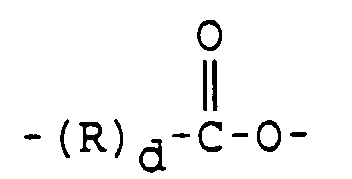
- Preferred polylactones are characterized in that the structure comprises units of a general formula: wherein R is an independently selected straight chained or branched alkyl radical having from 1 to 5 carbon atoms and d is an integer between 1 and 6. More preferred polylactones include poly(beta-propiolactone), poly(gamma-butyrolactone), poly(delta-valerolactone) and poly(epsilon-caprolactone). The most preferred polylactone is poly(epsilon-caprolactone).
- Poly(epsilon-caprolactones) suitable for use in the present invention are characterized by a number average molecular weight above 10,000 and preferably in the range of between 20,000 and 100,000. Even more preferred are poly(epsilon-caprolactones) having number average molecular weights between 25,000 and 50,000.
- the polyblend contains from 1 to 10 weight % of polylactone. Preferably, the polyblend will contain from 1 to 5 weight % of polylactone.
- the polyblend of the invention is suitable to produce molded articles using conventional molding apparatus.
- the polyblend can optionally contain in amounts up to 50 weight % of the total formula weight of art-recognized additives such as pigments, fillers, stabilizers, fire retardants, lubricants, accelerators, vulcanizing agents, antidegradants, antioxidants, processing aids, adhesives, tackifiers, rubber plasticizers, prevulcanization inhibitors, discontinuous fibers such as wood or cellulose fibers, extender oils, mold release agents and nucleating agents.
- additives such as pigments, fillers, stabilizers, fire retardants, lubricants, accelerators, vulcanizing agents, antidegradants, antioxidants, processing aids, adhesives, tackifiers, rubber plasticizers, prevulcanization inhibitors, discontinuous fibers such as wood or cellulose fibers, extender oils, mold release agents and nucleating agents.
- the multiple polyblend of this invention can be prepared using any art-recognized method for blending polymers.
- the polymers can be dry blended at room temperature followed by melt mixing at a temperature above the softening points of the polymers using any conventional melt mixing apparatus including extruders, calendars, kneaders and the like.
- the polymers to be dry blended can be an initial blend of one or more of the polymers to which the polylactone is to be added, including commercially available polymer blends.
- a polycarbonate-polyester, polycarbonate-rubber, polyester-rubber or polycarbonate-polyester-rubber blend may be used.
- a blend of 90% Bisphenol A polycarbonate (PC), 5% polyethylene terephthalate (PET) and 5% EPDM rubber were blended at room temperature with Union Carbide P-700 a poly(epsilon caprolactone) having a number average molecular weight of 40,000.
- the polycarbonate had a weight average molecular weight of 30,000 and a melt flow of about 10-12.
- the PET had an intrinsic viscosity of 0.62 g/deciliter measured in a 60/40 volume ratio of phenol to tetrachloroethane at 25°C.
- the EPDM had an MV of 45-50.
- the blends were prepared according to the weight-percent formulations listed in Table I. The sample of Example 3 was prepared as a control. TABLE I Example 1 2 3 PC/PET/EPDM 95 98 100 P-700 5 2 0
- the PC/PET/EPDM blend was dried in a dehumidifying oven at 110°C for 48 hours. Then the samples were removed and cooled in a dry environment and then dry-blended with the polycaprolactone. The samples were then extruded using a Haake Buchler system 90 extruder and pelletized. The melt temperature was 260°C.
- the compounded pellets were dried again for 48 hours at 110°C prior to injection molding.
- a hopper dryer was used on a Nissei 1.016 tonne (80 ton), 141.7 g (5 ounce) injection molding machine to keep the samples dry prior to injection molding.
- Test specimens such as tensile bars, flexural bars and the discs were molded.
- the melt temperature was 260-265°C.
- the injection pressure was 82.8 ⁇ 10 6 Pa (12,000 psi).
- the total cycle time for molding was 52 seconds.
- the surface gloss of the samples were tested according to ASTM-D523, with measurements taken at 20, 60 and 85° using a Glossmeter.
- Example 3 The samples of Examples 1 and 2 containing 5% and 2% P-700 showed significantly improved surface gloss especially at low incidence angle over the control sample of Example 3, containing no P-700.
- the physical properties of the samples were also tested for tensile strength and elongation according to ASTM-D638, impact strength according to ASTM-D256 and surface hardness according to ASTM-D785. The test results are set out in Table III.
Landscapes
- Chemical & Material Sciences (AREA)
- Health & Medical Sciences (AREA)
- Chemical Kinetics & Catalysis (AREA)
- Medicinal Chemistry (AREA)
- Polymers & Plastics (AREA)
- Organic Chemistry (AREA)
- Compositions Of Macromolecular Compounds (AREA)
- Polyamides (AREA)
Claims (17)
- Masse, umfassend eine Polymermischung aus einem aromatischen Polycarbonat, einem Polyester einer aromatischen Dicarbonsäure, einem elastomeren Kautschuk und einem Polylacton, wobei das Polylacton im Bereich 1,0 bis 10,0 Gewichtsprozent der Polymermischung vorliegt, der Polyester einer aromatischen Dicarbonsäure im Bereich 5 bis 50 Gewichtsprozent der Polymermischung vorliegt und der elastomere Kautschuk im Bereich 5 bis 20 Gewichtsprozent der Polymermischung vorliegt.
- Masse nach Anspruch 1, wobei das Polylacton im Bereich 1 bis 5 Gewichtsprozent der Polymermischung vorliegt.
- Masse nach Anspruch 1, wobei das Polylacton gekennzeichnet ist durch die Formel
- Masse nach Anspruch 3, wobei das Polylacton ausgewählt ist aus der Gruppe, bestehend aus Poly(β-propiolacton, Poly(γ-butyrolacton), Poly(δ-valerolacton) und Poly(ε-caprolacton).
- Masse nach Anspruch 4, wobei das Polylacton Poly(E-caprolacton) darstellt.
- Masse nach Anspruch 1, wobei das aromatische Polycarbonat ein Polykondensationsprodukt von Phosgen und einer aromatischen Dihydroxyverbindung, ausgewählt aus der Gruppe, bestehend aus Resorcin, Hydrochinon, Dihydroxydiphenylverbindungen und Bis(hydroxyphenyl)-Derivaten darstellt.
- Masse nach Anspruch 6, wobei die Bis-(hydroxyphenyl)-Derivat-Verbindungen ausgewählt sind aus der Gruppe, bestehend aus Bis-(hydroxyphenyl)-alkanen, Bis-(hydroxyphenyl)-cycloalkanen, Bis-(hydroxyphenyl)-ethern, Bis-(hydroxyphenyl)-ketonen, Bis-(hydroxyphenyl)-sulfoxiden, Bis-(hydroxyphenyl)-sulfonen und a,a-Bis-(hydroxyphenyl)-diisopropylbenzolen.
- Masse nach Anspruch 7, wobei das Bis(hydroxyphenyl)-alkan ausgewählt ist aus der Gruppe, bestehend aus Bisphenol A und Tetramethyl-Bisphenol A.
- Masse nach Anspruch 1, wobei der Polyester einer aromatischen Dicarbonsäure Poly(alkylenterephthalat), umfassend wiederkehrende Einheiten, angegeben durch die Formel:

- Masse nach Anspruch 9, wobei das Poly(alkylenterephthalat) ausgewählt ist aus der Gruppe, bestehend aus Poly(ethylenterephthalat) und Poly(butylenterephthalat).
- Masse nach Anspruch 1, wobei der elastomere Kautschuk ausgewählt ist aus der Gruppe, bestehend aus gesättigten Copolymeren von zwei oder mehreren α-Monoolefinen, ungesättigten Copolymeren von zwei oder mehreren α-Monoolefinen mit einem Dien, Acrylat-Copolymeren und statistischen und Block-Copolymeren von zwei oder mehreren Monomeren, ausgewählt aus der Gruppe, bestehend aus Styrol, Acrylnitril, Butadien und Isopren.
- Masse nach Anspruch 11, wobei das Copolymer ein selektiv hydriertes Block-Copolymer von Styrol und Butadien darstellt.
- Masse nach Anspruch 11, wobei der elastomere Kautschuk ein ungesättigtes Copolymer von zwei oder mehreren α-Monoolefinen mit einem Dien darstellt.
- Masse nach Anspruch 13, wobei das ungesättigte Copolymer von zwei oder mehreren α-Monoolefinen mit einem Dien EPDM-Kautschuk darstellt.
- Masse nach Anspruch 1, weiterhin umfassend bis zu 50 Gewichtsprozent ein oder mehrere Additive, ausgewählt aus der Gruppe, bestehend aus Pigmenten, Füllstoffen, Stabilisatoren, Flammverzögerungsmitteln, Gleitmitteln, Beschleunigern, Vulkanisiermitteln, Antiabbaumitteln, Antioxidantien, Verarbeitungshilfen, Klebstoffen, Klebrigmachern, Kautschukplastifizierungsmitteln, Vorvulkanisierungsinhibitoren, Kurzfasern, Extenderölen, Formtrennmitteln und Keimbildungsmitteln.
- Verfahren zur Herstellung einer geformten Polymermischung, umfassend:(a) Bildung einer Polymermischung, umfassend ein aromatisches Polycarbonat, einen Polyester einer aromatischen Dicarbonsäure, einen elastomeren Kautschuk und ein Polylacton, wobei das Polylacton im Bereich 1,0 bis 10 Gewichtsprozent der Polymermischung vorliegt, der aromatische Dicarbonsäurepolyester im Bereich 5 bis 50 Gewichtsprozent der Polymermischung vorliegt und der elastomere Kautschuk im Bereich 5 bis 20 Gewichtsprozent der Polymermischung vorliegt; und(b) Formen der Polymermischung.
- Geformte Polymermischung, hergestellt nach dem Verfahren von Anspruch 16.
Applications Claiming Priority (2)
| Application Number | Priority Date | Filing Date | Title |
|---|---|---|---|
| US07/437,538 US5041493A (en) | 1989-11-16 | 1989-11-16 | Moldable polyblends |
| US437538 | 1999-11-10 |
Publications (3)
| Publication Number | Publication Date |
|---|---|
| EP0428178A2 EP0428178A2 (de) | 1991-05-22 |
| EP0428178A3 EP0428178A3 (en) | 1992-03-11 |
| EP0428178B1 true EP0428178B1 (de) | 1997-05-07 |
Family
ID=23736853
Family Applications (1)
| Application Number | Title | Priority Date | Filing Date |
|---|---|---|---|
| EP90121959A Expired - Lifetime EP0428178B1 (de) | 1989-11-16 | 1990-11-16 | Formbare Polymermischungen |
Country Status (6)
| Country | Link |
|---|---|
| US (1) | US5041493A (de) |
| EP (1) | EP0428178B1 (de) |
| AT (1) | ATE152753T1 (de) |
| DE (1) | DE69030642D1 (de) |
| DK (1) | DK0428178T3 (de) |
| GR (1) | GR3023435T3 (de) |
Families Citing this family (6)
| Publication number | Priority date | Publication date | Assignee | Title |
|---|---|---|---|---|
| US5288800A (en) * | 1992-12-28 | 1994-02-22 | Shell Oil Company | Polymer blends |
| US5420212A (en) * | 1994-03-31 | 1995-05-30 | Eastman Chemical Company | Polyester/polycarbonate/polycaprolactone blends |
| EP0685525A1 (de) * | 1994-05-09 | 1995-12-06 | General Electric Company | Polymer Mischung aus einem Polyalkylenphthalat, einem Vinylaromatischen (Meth)Acrylnitril-Kautschuk Pfropfcopolymeren und einem linearen aliphatischen Polyester oder einem organischen Phosphat |
| US7238745B2 (en) * | 2003-12-15 | 2007-07-03 | Bayer Materialscience Llc | Aqueous polyurethane/urea dispersions containing alkoxysilane groups |
| GB201020965D0 (en) * | 2010-12-10 | 2011-01-26 | 3M Innovative Properties Co | Methods and compositions for lens blocking |
| CN105131543B (zh) * | 2015-09-23 | 2017-01-18 | 南京理工大学 | 一种无卤膨胀型阻燃体系阻燃聚乳酸材料及其制备方法 |
Citations (1)
| Publication number | Priority date | Publication date | Assignee | Title |
|---|---|---|---|---|
| GB2125057A (en) * | 1982-08-03 | 1984-02-29 | Bip Chemicals Ltd | Polyester moulding compositions |
Family Cites Families (6)
| Publication number | Priority date | Publication date | Assignee | Title |
|---|---|---|---|---|
| US3835089A (en) * | 1972-06-23 | 1974-09-10 | Gen Electric | Polylactone-modified linear polyesters and molding compositions containing the same |
| US4388443A (en) * | 1982-02-19 | 1983-06-14 | Atlantic Richfield Company | Moldable polyblends |
| EP0107048A1 (de) * | 1982-09-30 | 1984-05-02 | General Electric Company | Durch Acrylharze modifizierte Polycarbonat- und Polyethylenterephthalatharzzusammensetzungen |
| US4786692A (en) * | 1982-12-20 | 1988-11-22 | General Electric Company | High strength, reduced heat distortion temperature thermoplastic composition |
| US4554314A (en) * | 1983-05-16 | 1985-11-19 | Mobay Chemical Corporation | Thermoplastic molding compositions |
| GB8417872D0 (en) * | 1984-07-13 | 1984-08-15 | Johnson & Johnson | Thermoplastic composition |
-
1989
- 1989-11-16 US US07/437,538 patent/US5041493A/en not_active Expired - Fee Related
-
1990
- 1990-11-16 AT AT90121959T patent/ATE152753T1/de not_active IP Right Cessation
- 1990-11-16 EP EP90121959A patent/EP0428178B1/de not_active Expired - Lifetime
- 1990-11-16 DK DK90121959.2T patent/DK0428178T3/da active
- 1990-11-16 DE DE69030642T patent/DE69030642D1/de not_active Expired - Lifetime
-
1997
- 1997-05-15 GR GR970401084T patent/GR3023435T3/el unknown
Patent Citations (1)
| Publication number | Priority date | Publication date | Assignee | Title |
|---|---|---|---|---|
| GB2125057A (en) * | 1982-08-03 | 1984-02-29 | Bip Chemicals Ltd | Polyester moulding compositions |
Also Published As
| Publication number | Publication date |
|---|---|
| DE69030642D1 (de) | 1997-06-12 |
| ATE152753T1 (de) | 1997-05-15 |
| US5041493A (en) | 1991-08-20 |
| EP0428178A3 (en) | 1992-03-11 |
| EP0428178A2 (de) | 1991-05-22 |
| GR3023435T3 (en) | 1997-08-29 |
| DK0428178T3 (da) | 1997-06-30 |
Similar Documents
| Publication | Publication Date | Title |
|---|---|---|
| EP0748356B1 (de) | Hochschlagfeste gegenstände aus polyestermischungen | |
| US4292233A (en) | High-impact polybutylene terephthalate | |
| US6495631B1 (en) | Impact modified melt-stable lactide polymer compositions and processes for manufacture thereof | |
| CA1166388A (en) | Thermoplastic polyester moulding compositions containing grafted polyacrylates | |
| CA1235833A (en) | Thermoplastic resinous blend and a method for its preparation | |
| US4246381A (en) | Polyarylate blends with copolyesters | |
| US6329463B1 (en) | High temperature, oil resistant thermoplastic vulcanizates made from polar plastics and acrylate or ethylene-acrylate elastomers | |
| JPH02380B2 (de) | ||
| US4628074A (en) | Polycarbonate compositions | |
| JPS62187761A (ja) | ポリアミドとエポキシ官能性化合物を含有する熱可塑性ブレンド | |
| US4897448A (en) | Polyester/polycarbonate blends | |
| EP0528462A1 (de) | Lösungsmittelbeständige Polycarbonat-Polyestermischungen mit verbesserter Schlagzähigkeit | |
| US20050165207A1 (en) | Polyester molding composition and process for its preparartion | |
| US5041493A (en) | Moldable polyblends | |
| US4845169A (en) | High impact polyethylene terephthalate polyblends | |
| KR20040061766A (ko) | 내충격특성이 우수한 폴리옥시메틸렌 수지 조성물 | |
| JPH01230666A (ja) | 熱可塑性ポリカーボネート−ポリエステル配合物 | |
| US4840984A (en) | Polyethylene terephthalate resin composition | |
| EP0282153B1 (de) | Mischungen von Polyamiden, Polyestern und durch Maleinsäureanhydrid modifizierten E.P.D.M.-Kautschuken | |
| EP0149091A1 (de) | Polycarbonate mit modifizierter Schlagzähmigkeit | |
| US4271063A (en) | Thermoplastic molding compositions | |
| US4626572A (en) | Resinous composition | |
| JPH05230349A (ja) | 熱可塑性樹脂組成物 | |
| US5280088A (en) | Thermoplastic blends of a polyamide having low amine end-group concentration and a polymer containing carbonate linkages | |
| US4717751A (en) | Linear polyester resin blends with high impact resistance |
Legal Events
| Date | Code | Title | Description |
|---|---|---|---|
| PUAI | Public reference made under article 153(3) epc to a published international application that has entered the european phase |
Free format text: ORIGINAL CODE: 0009012 |
|
| AK | Designated contracting states |
Kind code of ref document: A2 Designated state(s): AT BE CH DE DK ES FR GB GR IT LI LU NL SE |
|
| PUAL | Search report despatched |
Free format text: ORIGINAL CODE: 0009013 |
|
| AK | Designated contracting states |
Kind code of ref document: A3 Designated state(s): AT BE CH DE DK ES FR GB GR IT LI LU NL SE |
|
| 17P | Request for examination filed |
Effective date: 19920430 |
|
| 17Q | First examination report despatched |
Effective date: 19940726 |
|
| GRAG | Despatch of communication of intention to grant |
Free format text: ORIGINAL CODE: EPIDOS AGRA |
|
| GRAH | Despatch of communication of intention to grant a patent |
Free format text: ORIGINAL CODE: EPIDOS IGRA |
|
| GRAH | Despatch of communication of intention to grant a patent |
Free format text: ORIGINAL CODE: EPIDOS IGRA |
|
| GRAA | (expected) grant |
Free format text: ORIGINAL CODE: 0009210 |
|
| AK | Designated contracting states |
Kind code of ref document: B1 Designated state(s): AT BE CH DE DK ES FR GB GR IT LI LU NL SE |
|
| PG25 | Lapsed in a contracting state [announced via postgrant information from national office to epo] |
Ref country code: IT Free format text: LAPSE BECAUSE OF FAILURE TO SUBMIT A TRANSLATION OF THE DESCRIPTION OR TO PAY THE FEE WITHIN THE PRE;WARNING: LAPSES OF ITALIAN PATENTS WITH EFFECTIVE DATE BEFORE 2007 MAY HAVE OCCURRED AT ANY TIME BEFORE 2007. THE CORRECT EFFECTIVE DATE MAY BE DIFFERENT FROM THE ONE RECORDED.SCRIBED TIME-LIMIT Effective date: 19970507 Ref country code: ES Free format text: THE PATENT HAS BEEN ANNULLED BY A DECISION OF A NATIONAL AUTHORITY Effective date: 19970507 Ref country code: FR Free format text: THE PATENT HAS BEEN ANNULLED BY A DECISION OF A NATIONAL AUTHORITY Effective date: 19970507 Ref country code: GR Free format text: LAPSE BECAUSE OF FAILURE TO SUBMIT A TRANSLATION OF THE DESCRIPTION OR TO PAY THE FEE WITHIN THE PRESCRIBED TIME-LIMIT Effective date: 19970507 Ref country code: AT Effective date: 19970507 |
|
| REF | Corresponds to: |
Ref document number: 152753 Country of ref document: AT Date of ref document: 19970515 Kind code of ref document: T |
|
| REG | Reference to a national code |
Ref country code: CH Ref legal event code: EP Ref country code: CH Ref legal event code: NV Representative=s name: KIRKER & CIE SA |
|
| REF | Corresponds to: |
Ref document number: 69030642 Country of ref document: DE Date of ref document: 19970612 |
|
| ET | Fr: translation filed | ||
| REG | Reference to a national code |
Ref country code: DK Ref legal event code: T3 |
|
| REG | Reference to a national code |
Ref country code: GR Ref legal event code: FG4A Free format text: 3023435 |
|
| PG25 | Lapsed in a contracting state [announced via postgrant information from national office to epo] |
Ref country code: DE Effective date: 19970808 |
|
| PG25 | Lapsed in a contracting state [announced via postgrant information from national office to epo] |
Ref country code: GB Free format text: LAPSE BECAUSE OF NON-PAYMENT OF DUE FEES Effective date: 19971116 Ref country code: LU Free format text: LAPSE BECAUSE OF NON-PAYMENT OF DUE FEES Effective date: 19971116 |
|
| PG25 | Lapsed in a contracting state [announced via postgrant information from national office to epo] |
Ref country code: SE Free format text: LAPSE BECAUSE OF NON-PAYMENT OF DUE FEES Effective date: 19971117 |
|
| PG25 | Lapsed in a contracting state [announced via postgrant information from national office to epo] |
Ref country code: BE Free format text: LAPSE BECAUSE OF NON-PAYMENT OF DUE FEES Effective date: 19971130 Ref country code: CH Free format text: LAPSE BECAUSE OF NON-PAYMENT OF DUE FEES Effective date: 19971130 Ref country code: LI Free format text: LAPSE BECAUSE OF NON-PAYMENT OF DUE FEES Effective date: 19971130 |
|
| PG25 | Lapsed in a contracting state [announced via postgrant information from national office to epo] |
Ref country code: DK Free format text: LAPSE BECAUSE OF NON-PAYMENT OF DUE FEES Effective date: 19971231 |
|
| PLBE | No opposition filed within time limit |
Free format text: ORIGINAL CODE: 0009261 |
|
| STAA | Information on the status of an ep patent application or granted ep patent |
Free format text: STATUS: NO OPPOSITION FILED WITHIN TIME LIMIT |
|
| 26N | No opposition filed | ||
| BERE | Be: lapsed |
Owner name: ENICHEM S.P.A. Effective date: 19971130 |
|
| PG25 | Lapsed in a contracting state [announced via postgrant information from national office to epo] |
Ref country code: NL Free format text: LAPSE BECAUSE OF NON-PAYMENT OF DUE FEES Effective date: 19980601 |
|
| GBPC | Gb: european patent ceased through non-payment of renewal fee |
Effective date: 19971116 |
|
| REG | Reference to a national code |
Ref country code: CH Ref legal event code: PL |
|
| EUG | Se: european patent has lapsed |
Ref document number: 90121959.2 |
|
| NLV4 | Nl: lapsed or anulled due to non-payment of the annual fee |
Effective date: 19980601 |
|
| REG | Reference to a national code |
Ref country code: FR Ref legal event code: ST |
|
| REG | Reference to a national code |
Ref country code: DK Ref legal event code: EBP |