EP0430189A2 - Druckgaslastschalter - Google Patents
Druckgaslastschalter Download PDFInfo
- Publication number
- EP0430189A2 EP0430189A2 EP19900122688 EP90122688A EP0430189A2 EP 0430189 A2 EP0430189 A2 EP 0430189A2 EP 19900122688 EP19900122688 EP 19900122688 EP 90122688 A EP90122688 A EP 90122688A EP 0430189 A2 EP0430189 A2 EP 0430189A2
- Authority
- EP
- European Patent Office
- Prior art keywords
- gas
- chamber
- contact
- piston
- suction chamber
- Prior art date
- Legal status (The legal status is an assumption and is not a legal conclusion. Google has not performed a legal analysis and makes no representation as to the accuracy of the status listed.)
- Granted
Links
Images



Classifications
-
- H—ELECTRICITY
- H01—ELECTRIC ELEMENTS
- H01H—ELECTRIC SWITCHES; RELAYS; SELECTORS; EMERGENCY PROTECTIVE DEVICES
- H01H33/00—High-tension or heavy-current switches with arc-extinguishing or arc-preventing means
- H01H33/70—Switches with separate means for directing, obtaining, or increasing flow of arc-extinguishing fluid
- H01H33/88—Switches with separate means for directing, obtaining, or increasing flow of arc-extinguishing fluid the flow of arc-extinguishing fluid being produced or increased by movement of pistons or other pressure-producing parts
- H01H33/90—Switches with separate means for directing, obtaining, or increasing flow of arc-extinguishing fluid the flow of arc-extinguishing fluid being produced or increased by movement of pistons or other pressure-producing parts this movement being effected by or in conjunction with the contact-operating mechanism
- H01H33/901—Switches with separate means for directing, obtaining, or increasing flow of arc-extinguishing fluid the flow of arc-extinguishing fluid being produced or increased by movement of pistons or other pressure-producing parts this movement being effected by or in conjunction with the contact-operating mechanism making use of the energy of the arc or an auxiliary arc
-
- H—ELECTRICITY
- H01—ELECTRIC ELEMENTS
- H01H—ELECTRIC SWITCHES; RELAYS; SELECTORS; EMERGENCY PROTECTIVE DEVICES
- H01H33/00—High-tension or heavy-current switches with arc-extinguishing or arc-preventing means
-
- H—ELECTRICITY
- H01—ELECTRIC ELEMENTS
- H01H—ELECTRIC SWITCHES; RELAYS; SELECTORS; EMERGENCY PROTECTIVE DEVICES
- H01H33/00—High-tension or heavy-current switches with arc-extinguishing or arc-preventing means
- H01H33/02—Details
- H01H33/022—Details particular to three-phase circuit breakers
Definitions
- the present invention relates to a gas-blast load-break switch and, more particularly, to a breaker switch including a negative pressure generating apparatus for forming blasting gas flow against an arc.
- a conventional gas-blast load-break switch of this type as disclosed in the specification of U.S. Patent No. 4,511,776, comprises: within a sealed container containing arc extinguishing fluid such as SF6 gas or the like, a fixed contact and a movable contact disconnectable to each other; a pressure storage device including a pressure storage chamber for raising the pressure of arc extinguishing fluid using the arc energy generated by the separation of those contacts; and a negative pressure generating device including a negative pressure chamber which generates negative pressure by the relative movement between a cylinder and a piston caused by the separating operation of the movable contact.
- arc extinguishing fluid such as SF6 gas or the like
- the arc between the detached contacts will be extinguished by a blasting of gas flow directing from the pressure storage chamber to the negative pressure chamber, which gas flow is caused by the differential pressure between the initial pressure and rising pressure caused by the arc energy in the pressure storage chamber and the negative pressure in the negative pressure chamber.
- the contact length L is predetermined between the movable contact and the fixed contact when the movable contact is thrown into the fixed contact, which length L is equal to the length of the piston movement defining the negative pressure chamber. Consequently, the movable contact moves by the distance L relative to the fixed contact during the breaking operation of the movable contact, the movable contact begins to be detached from the fixed contact and, at the same time, the negative pressure chamber initiates to communicate with the gas chamber located on the other side of the negative chamber from the piston. Succeedingly, the negative pressure chamber immediately communicates with the gas chamber on the other side thereof from the piston.
- the pressure by the arc energy cannot be satisfactorily raised up to achieve a complete extinguishment of the arc.
- an electric current of approximately 100 to 500 ampere is applied between the contacts, as the electric current being relatively lower, the arc is extinguished by merely the differential pressure between the initial pressure in the pressure storage chamber and the negative pressure in the negative pressure chamber.
- the rising pressure caused by the arc energy in the pressure storage chamber is instantly risen up because of the fact that the arc energy is generated in proportion to the higher current, thereby to extinguish the arc.
- the volume of the gas chamber on the opposite side of the piston from the negative pressure chamber is predetermined to be smaller than those of the pressure storage chamber and the negative pressure chamber, which gas chamber is filled up with the heated fluid after extinguishing the arc.
- it also causes a problem that the temperature of the arc extinguishing fluid in the gas chamber is risen to an extent that insulating capacity of the arc extinguishing fluid itself is remarkably deteriorated and to lose its insulatability.
- An object of the present invention is to provide a gas-blast load-break switch which can positively extinguish the discharge current arc, of a lower or higher intensity, and which has an excellent insulating capacity.
- a gas-blast load-break switch comprising: a sealed container filled with arc extinguishing gas, a fixed contact and a movable contact detachable from each other, both contacts being disposed within the sealed container; a pressure storage chamber including an insulating nozzle with a throat portion through which the movable contact is inserted thereinto and containing therewithin a contact portion between the both contacts; and a suction chamber formed on the opposite side of the insulating nozzle from the pressure storage chamber and including a piston connected to the movable contacts; the switch further comprising a space formed not only as a housing for an operation lever which drives the movable contact, but also as a gas chamber, on the opposite side of the piston from the suction chamber within the sealed container; the volume of the gas chamber being predetermined greater than those of the pressure storage chamber and the suction chamber; and a gas flowing means for communicating the suction chamber and the gas chamber and dislocating between both chambers during the movement
- the suction chamber when the movable contact is dislocated from the fixed contact, the suction chamber is not communicated with the gas chamber defined on the opposite side of the piston from the suction chamber enables the rising pressure generated by the arc energy to accumulate in the pressure storage chamber.
- the gas flowing means communicates the suction chamber and the gas chamber located on opposite side of the piston from the suction chamber during the piston movement, the rising pressure by the arc energy can favorably be activated to positively extinguish the arc.
- the volume of the gas chamber is predetermined relatively large, the temperature of the heated arc extinguishing gas introduced into the gas chamber can be lowered, contributing to maintain the insulating capacity.
- Fig. 1 is a vertically cross-sectional view showing a cut-off breaker of a gas-blast load-break switch according to one embodiment of the present invention
- Fig. 2 is a horizontally cross-sectional plan view showing a three-phase cut-off breakers in a triple type gas-blast load-break switch which makes use of a principle of the cut-off breaker of Fig. 1;
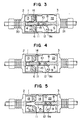
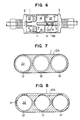
- Figs. 3 to 6 are cross-sectional views illustrative of different stages in breaking operations of the cut-off breaker of Fig. 1, respectively;
- Fig. 7 is a cross-sectional view of a second gas flowing means, taken along a line VII - VII of Fig. 2;
- Fig. 8 is a cross-sectional view showing a modified structure of the second gas flowing means shown in Fig. 7;
- Fig. 9 and 10 are vertically cross-sectional views illustrating cut-off breakers of gas-blast load-break switches according to further embodiments of the present invention.
- Fig. 1 is a vertically cross-sectional front view of a gas-blast load-break switch according to one embodiment of the present invention, a cut-off breaker of the switch being shown in a closed state.
- One end of a cylindrical sealed container 1 of the cut-off beaker is airtightly closed by a terminal end plate 2 and a bushing 20, and the other end is also airtightly closed by a terminal end plate 3 and a bushing 21.
- the container 1 is filled with arc-extinguishing gas such as FS6 gas or the like.
- a fixed contact 4 is securely connected on an inner surface of one terminal end plate 2 within the cut-off breaker of the sealed container 1, and a fixed conductor 5 is securely connected on an inner surface of the other terminal end plate 3 within the sealed container 1 of the cut-off breaker.
- a movable contact 7 including a current collector 8 which is always in contact with the fixed conductor 5 contacts with the fixed contact 4.
- the fixed contact 4, the movable contact 7, the current collector 8 and the fixed conductor 5 are disposed in alignment between the terminal end plates 2 and 3.
- the fixed conductor 5 is slidably fit in a groove formed at the central portion of the current collector 8.
- a lever 9a is connected to the movable contact 7 via a link 10 which is made of an insulating material.
- the lever 9a is connected to an operation system (not shown) by a common driving shaft 9.
- an insulating nozzle 6 Fixed on an inner surface of the sealed container 1 of the cut-off breaker is an insulating nozzle 6 which divides the inner space of the closed container 1 into a pressure storage chamber 13 on one side of the nozzle containing a contact portion between both contacts 4 and 7 and a suction chamber 14 located on the opposite side thereof.
- the suction chamber 14 is defined by a surface on one side of a piston 15 connected to the movable contact 7 and a surface of the insulating nozzle 6 opposite to the surface of the piston.
- a gas chamber 22 On the other side of the piston 15 from the suction chamber 14 a gas chamber 22 is formed.
- the gas chamber receives therewithin a system of connecting mechanism of the movable contact 7 comprising the link 10 and the lever 9a as well as a current collector ring mechanism section such as the current collector 8 and the like for electrically connecting the fixed conductor 5 and the movable contact 7.
- the volume of the gas chamber 22 is arranged larger than those of the pressure storage chamber 13 and the suction chamber 14, so that the temperature of heated gas introduced into the gas chamber 22 will be easily lowered so as to maintain favorable insulating capacity.
- the inner surface of the sealed container 1 in the cut-off breaker which slidingly contacts with the outer periphery of the piston 15 is formed with a recessed portion which serves as a first gas flowing means 11, communicating the suction chamber 14 and the gas chamber 22 at the closed condition illustrated in the drawings and also in the beginning of breaking operation.
- This gas flowing means 11 is maintained for communicating the suction chamber 14 and the gas chamber 22 only when the piston 15 moves the distance L1 in a direction of breaking the circuit.
- the inner surface of the sealed container 1 of the cut-off breaker at the right hand side of the first gas flowing means is formed with a sliding surface which is brought into closed contact with the outer periphery of the piston 15.
- a second gas flowing means 12 which is formed with an enlarged portion 12A communicating the suction chamber 14 and the gas chamber 22.
- the second gas communicating means 12 initiates to work when the piston 15 moves for breaking operation by the distance L2 from the initial switch-closed position shown in Fig. 1. It is distinguished from the above-described first gas flowing means 11 which shuts off from communication between both chambers during the breaking operation for a length from the end portion of the first gas flowing means, i.e., the end of the distance L1 to the terminal portion of the sliding surface, i.e., the end of the distance L2.
- the working distance L2 of the above-described second gas flowing means 12 is predetermined larger than the contact length L3 between both contacts which is obtained when the movable contact 7 is thrown into the fixed contact 4. As a result, the rising pressure caused by arc energy will be stored within the pressure storage chamber 13.
- Fig. 3 shows a closed condition of the cut-off breaker, with the fixed contact 4 being in contact with the movable contact 7 within the pressure storage chamber 13, while the suction chamber 14 communicates with the gas chamber 22 through the first gas flowing means 11 formed between the inner surface of the sealed container 1 of the cut-off breaker and the outer periphery of the piston 15.
- the route of current is established between the bushing 20, the terminal end plate 2, the fixed contact 4, the movable contact 7, the current collector 8, the fixed conductor 5, the terminal end plate 3, and the bushing 21, and the remaining routes other than the current route are electrically insulated by an ordinal way.
- the movable contact 7 Before it reaches the position as shown in Fig. 5 (a state when the piston 15 has moved the distance L2), the movable contact 7 is dislocated from the fixed contact 4, causing the rise of gas pressure in the pressure storage chamber 13 due to the generated arc.
- the movable contact 7 comes out of the throat portion of the insulating nozzle 6, a gas flow which directs from the pressure storage chamber 13 through the suction chamber 14 is formed.
- the arc is blasted by this gas flow. If the breaking-current is small, the arc is extinguished by the blasting, however, if the breaking-current is large, the pressure of the suction chamber 14 is immediately risen up to a maximum level due to the gas flow accelerated by the arc energy from the storage 13. For the reason, the blasting does cannot be continued satisfactorily.
- the second gas flowing means 12 communicates the suction chamber 14 and the gas chamber 22 so as to make the pressurized gas in the suction chamber 14 flow into the gas chamber 22, thereby to form a gas flow which enables to extinguish the arc.
- the second gas flowing means 12 leading to the gas chamber 22 is formed between the inner surface of the sealed container 1 of the cut-off breaker and the outer periphery of the piston 15, so that the gas flow flowing into the gas chamber 22 is directed toward the cut-off direction of the movable contact 7 and at the same time, it also enables to serve the space of the gas chamber 22 for gas blasting, which volume has not yet been utilized.
- the heated gas flows into the gas chamber 22 and lowers its temperature by the gas chamber 22 which has a larger volume than those of the pressure storage chamber 13 and the suction chamber 14, to thereby maintain the insulation.
- the terminal end position of the movable contact 7 during breaking operation is preset by a stopper which is arranged such that the proximal end or the right end portion of the movable contact 7 abuts against the distal end or the left end portion of the fixed conductor 5. Consequently, even when the excessive pressure which exerts force applied against the piston 15 causes it toward the right direction to be acted over a predetermined stroke, the current collector 8 will not be broken as in the case of the conventional type shown in Fig. 11 and also, the structure of the invention is simpler than that of an exclusive stopper of the conventional breaker.
- Fig. 2 is a horizontally cross-sectional plan view illustrating of three-phase cut-off breakers integrally connected and housed within the triple type common sealed container 1.
- each cut-off breaker is substantially identified with that shown in Fig. 1.
- a through hole 12A for mutually communicating adjacent gas chambers 22 is provided, which serves to make the weight of the breaker much lighter.
- each of second gas flowing means 12 restricts gas flow in a direction of the breaking operation of a movable contact 7 so as to make it flow into the large volume gas chamber 22, whereby the high temperature gas is rapidly lowered, thereby to regulate the gas pressure in a range permissible for establishing the favorable insulation, as well as to obtain substantially the same effect as the abovementioned first embodiment.
- Fig. 7 is a vertical cross-sectional view showing the sealed container of the cut-off breaker taken along a line VII - VII of Fig. 2, which illustrates the second gas flowing means 12.
- a recess is formed all around the inner surface of the sealed container 1 of the cut-off breaker.
- a spline type second gas flowing means 12 comprising a plurality of recesses which are formed on the inner peripheral surface of the sealed container and spaced apart from one another.
- Fig. 9 is a vertical cross-sectional view of a cut-off breaker according to another embodiment of the present invention. Comparing with the first embodiment of Fig. 1, the embodiment shown in Fig. 9 differs from the first embodiment with respect to the first and second gas flowing means 11, 12. According to this embodiment, a portion exposed to high temperature gas which may contribute to extinguish the arc is formed of an insulating material having an insulating nozzle 6 integral therewith. Particularly, an insulating cylinder 23 integrally formed with the insulating nozzle 6 is attached on the inner surface of the sealed container 1 of the cut-off breaker, the first and the second gas flowing means 11, 12 being provided by defining recesses on the inner surface of this insulating cylinder.
- an insulation capacity between the high-tension arc section such as both contacts 4, 7 and the sealed container 1 of the cut-off breaker can favorably be maintained.
- Fig. 10 is a vertical cross-sectional view showing further embodiment of a cut-off breaker according to the present invention.
- the difference between this embodiment and first embodiment shown in Fig. 1 resides on the arrangement of the stopper which serves to electrically contact between a movable contact 7 and a fixed conductor 5 and to protect the movable contact 7 from overrunning. That is to say, the stopper is arranged in such a manner that a current collector 8 is attached on the left end of the fixed conductor 5 which is securely mounted on a central conductor of a bushing 21 in order that the right end of the movable contact 7 is to be inserted into the groove portion of the fixed conductor 5.
- the overstroke of the movable contact 7 can be prevented with a simple structure.
- the second gas flowing means is defined between the inner surface of the sealed container of the cut-off breaker and the outer periphery of the piston adjacent the suction chamber. After a movable contact is separated from the fixed contact and a certain period of time is expired, the second gas flowing means enables communication between the suction chamber and the gas chamber, which is located on the other side of the suction chamber from the piston, whereby the rising pressure caused by the arc energy can be stored in the pressure storage chamber, which rising energy is applied to the arc for the reliable extinguishment of the arc. Further, the volume of the gas chamber is formed larger than those of the pressure storage chamber and the suction chamber. So that the temperature of the heated gas streamed into the gas chamber can be promptly cooled, thereby to maintain its insulation capacity.
Landscapes
- Circuit Breakers (AREA)
- Gas-Insulated Switchgears (AREA)
Applications Claiming Priority (2)
| Application Number | Priority Date | Filing Date | Title |
|---|---|---|---|
| JP307567/89 | 1989-11-29 | ||
| JP1307567A JP2880543B2 (ja) | 1989-11-29 | 1989-11-29 | ガス開閉器 |
Publications (3)
| Publication Number | Publication Date |
|---|---|
| EP0430189A2 true EP0430189A2 (de) | 1991-06-05 |
| EP0430189A3 EP0430189A3 (en) | 1992-02-12 |
| EP0430189B1 EP0430189B1 (de) | 1995-05-10 |
Family
ID=17970633
Family Applications (1)
| Application Number | Title | Priority Date | Filing Date |
|---|---|---|---|
| EP90122688A Expired - Lifetime EP0430189B1 (de) | 1989-11-29 | 1990-11-27 | Druckgaslastschalter |
Country Status (6)
| Country | Link |
|---|---|
| US (1) | US5084600A (de) |
| EP (1) | EP0430189B1 (de) |
| JP (1) | JP2880543B2 (de) |
| KR (1) | KR0157616B1 (de) |
| CN (1) | CN1018490B (de) |
| DE (1) | DE69019314T2 (de) |
Families Citing this family (5)
| Publication number | Priority date | Publication date | Assignee | Title |
|---|---|---|---|---|
| JPH09231885A (ja) * | 1996-02-22 | 1997-09-05 | Hitachi Ltd | ガス遮断器 |
| US6797909B2 (en) * | 2003-02-27 | 2004-09-28 | Mcgraw-Edison Company | High-voltage loadbreak switch with enhanced arc suppression |
| DE102014004665B4 (de) * | 2014-03-31 | 2019-12-05 | Schaltbau Gmbh | Mehrpoliges Leistungsschütz |
| CN114141574B (zh) * | 2021-10-20 | 2024-03-26 | 平高集团有限公司 | 一种断路器及其主拉杆 |
| CN119170431B (zh) * | 2024-09-30 | 2025-06-03 | 浙江正泰电气科技有限公司 | 快速接地开关及gis设备 |
Family Cites Families (4)
| Publication number | Priority date | Publication date | Assignee | Title |
|---|---|---|---|---|
| FR2053503A5 (de) * | 1969-07-07 | 1971-04-16 | Merlin Gerin | |
| FR2535518B1 (fr) * | 1982-10-28 | 1985-10-25 | Alsthom Atlantique | Chambre de coupure pour disjoncteur a gaz |
| US4517425A (en) * | 1983-09-14 | 1985-05-14 | Mcgraw-Edison Company | Self-flow generating gas interrupter |
| US5045651A (en) * | 1989-02-08 | 1991-09-03 | Hitachi, Ltd. | Switch |
-
1989
- 1989-11-29 JP JP1307567A patent/JP2880543B2/ja not_active Expired - Lifetime
-
1990
- 1990-11-26 KR KR1019900019189A patent/KR0157616B1/ko not_active Expired - Fee Related
- 1990-11-27 DE DE69019314T patent/DE69019314T2/de not_active Expired - Fee Related
- 1990-11-27 EP EP90122688A patent/EP0430189B1/de not_active Expired - Lifetime
- 1990-11-27 US US07/618,465 patent/US5084600A/en not_active Expired - Fee Related
- 1990-11-29 CN CN90109548A patent/CN1018490B/zh not_active Expired
Also Published As
| Publication number | Publication date |
|---|---|
| EP0430189B1 (de) | 1995-05-10 |
| JPH03171522A (ja) | 1991-07-25 |
| DE69019314T2 (de) | 1995-10-26 |
| US5084600A (en) | 1992-01-28 |
| KR0157616B1 (ko) | 1998-11-16 |
| CN1018490B (zh) | 1992-09-30 |
| JP2880543B2 (ja) | 1999-04-12 |
| CN1052215A (zh) | 1991-06-12 |
| EP0430189A3 (en) | 1992-02-12 |
| DE69019314D1 (de) | 1995-06-14 |
| KR910010571A (ko) | 1991-06-29 |
Similar Documents
| Publication | Publication Date | Title |
|---|---|---|
| US4774388A (en) | Compressed dielectric gas circuit breaker | |
| EP0430189B1 (de) | Druckgaslastschalter | |
| US2606262A (en) | Electric circuit interrupter | |
| US5750949A (en) | Metal-encapsulated, gas-insulated high-voltage circuit-breaker | |
| JP2568304B2 (ja) | 自動吹付け式中電圧遮断器 | |
| US4228332A (en) | Gas pressure circuit interrupter | |
| EP0436951B1 (de) | Gaslastschalter | |
| JPS6118290B2 (de) | ||
| US4488022A (en) | Mechanism for adjusting the speed of displacement of an arc contact for a switching apparatus | |
| JP2523480B2 (ja) | パツフア形ガスしや断器 | |
| RU2054728C1 (ru) | Дугогасительное устройство | |
| JPH0367431A (ja) | パッファ形ガス遮断器 | |
| JPH10269912A (ja) | ガス遮断器 | |
| JP2625983B2 (ja) | パッファ形ガス遮断器 | |
| JPH077624B2 (ja) | パツフア式ガスしや断器 | |
| JP2551124B2 (ja) | パッファ形ガス遮断器 | |
| US5258588A (en) | Puffer type switch high current electrical switch contact assembly | |
| SU603017A1 (ru) | Жидкостной выключатель высокого напр жени | |
| JP2586240B2 (ja) | ガス絶縁開閉装置 | |
| JPH0797468B2 (ja) | パツフア形ガス遮断器 | |
| SU853690A1 (ru) | Вакуумна дугогасительна камераС уСТРОйСТВОМ дл КОНТРОл дАВлЕНи | |
| SU828243A1 (ru) | Жидкометаллический контактный узел | |
| JP2701338B2 (ja) | パッファ形ガス遮断器 | |
| RU1777184C (ru) | Электрический аппарат | |
| JP2635559B2 (ja) | パツフア形ガス遮断器 |
Legal Events
| Date | Code | Title | Description |
|---|---|---|---|
| PUAI | Public reference made under article 153(3) epc to a published international application that has entered the european phase |
Free format text: ORIGINAL CODE: 0009012 |
|
| 17P | Request for examination filed |
Effective date: 19901212 |
|
| AK | Designated contracting states |
Kind code of ref document: A2 Designated state(s): DE FR GB |
|
| RIN1 | Information on inventor provided before grant (corrected) |
Inventor name: TSUBAKI, TOHRU Inventor name: HONDA, HARUO Inventor name: ITOU, SYUNJI Inventor name: SEKI, TAKAHIDE |
|
| PUAL | Search report despatched |
Free format text: ORIGINAL CODE: 0009013 |
|
| AK | Designated contracting states |
Kind code of ref document: A3 Designated state(s): DE FR GB |
|
| 17Q | First examination report despatched |
Effective date: 19940118 |
|
| GRAA | (expected) grant |
Free format text: ORIGINAL CODE: 0009210 |
|
| AK | Designated contracting states |
Kind code of ref document: B1 Designated state(s): DE FR GB |
|
| REF | Corresponds to: |
Ref document number: 69019314 Country of ref document: DE Date of ref document: 19950614 |
|
| ET | Fr: translation filed | ||
| PLBE | No opposition filed within time limit |
Free format text: ORIGINAL CODE: 0009261 |
|
| STAA | Information on the status of an ep patent application or granted ep patent |
Free format text: STATUS: NO OPPOSITION FILED WITHIN TIME LIMIT |
|
| 26N | No opposition filed | ||
| PGFP | Annual fee paid to national office [announced via postgrant information from national office to epo] |
Ref country code: FR Payment date: 20011022 Year of fee payment: 12 |
|
| PGFP | Annual fee paid to national office [announced via postgrant information from national office to epo] |
Ref country code: GB Payment date: 20011116 Year of fee payment: 12 |
|
| PGFP | Annual fee paid to national office [announced via postgrant information from national office to epo] |
Ref country code: DE Payment date: 20011230 Year of fee payment: 12 |
|
| REG | Reference to a national code |
Ref country code: GB Ref legal event code: IF02 |
|
| PG25 | Lapsed in a contracting state [announced via postgrant information from national office to epo] |
Ref country code: GB Free format text: LAPSE BECAUSE OF NON-PAYMENT OF DUE FEES Effective date: 20021127 |
|
| PG25 | Lapsed in a contracting state [announced via postgrant information from national office to epo] |
Ref country code: DE Free format text: LAPSE BECAUSE OF NON-PAYMENT OF DUE FEES Effective date: 20030603 |
|
| GBPC | Gb: european patent ceased through non-payment of renewal fee | ||
| PG25 | Lapsed in a contracting state [announced via postgrant information from national office to epo] |
Ref country code: FR Free format text: LAPSE BECAUSE OF NON-PAYMENT OF DUE FEES Effective date: 20030731 |
|
| REG | Reference to a national code |
Ref country code: FR Ref legal event code: ST |