EP0430264A2 - Ordinateur neuronal - Google Patents
Ordinateur neuronal Download PDFInfo
- Publication number
- EP0430264A2 EP0430264A2 EP90122896A EP90122896A EP0430264A2 EP 0430264 A2 EP0430264 A2 EP 0430264A2 EP 90122896 A EP90122896 A EP 90122896A EP 90122896 A EP90122896 A EP 90122896A EP 0430264 A2 EP0430264 A2 EP 0430264A2
- Authority
- EP
- European Patent Office
- Prior art keywords
- values
- input
- neuro
- output function
- computer
- Prior art date
- Legal status (The legal status is an assumption and is not a legal conclusion. Google has not performed a legal analysis and makes no representation as to the accuracy of the status listed.)
- Granted
Links
Images

Classifications
-
- G—PHYSICS
- G06—COMPUTING OR CALCULATING; COUNTING
- G06N—COMPUTING ARRANGEMENTS BASED ON SPECIFIC COMPUTATIONAL MODELS
- G06N3/00—Computing arrangements based on biological models
- G06N3/02—Neural networks
- G06N3/10—Interfaces, programming languages or software development kits, e.g. for simulating neural networks
-
- G—PHYSICS
- G06—COMPUTING OR CALCULATING; COUNTING
- G06N—COMPUTING ARRANGEMENTS BASED ON SPECIFIC COMPUTATIONAL MODELS
- G06N3/00—Computing arrangements based on biological models
- G06N3/02—Neural networks
- G06N3/04—Architecture, e.g. interconnection topology
- G06N3/048—Activation functions
Definitions
- neuro-computers are formed by mathematically modeling the nerve cells of a brain.
- Each of the nerve cells of a brain is a single cell entirely surrounded by a continuous cell membrane.
- a nerve cell is composed of a section of the main body called a cell body, a section called a dendrite made up of a large number of projections projecting in a tree-like form from the main body, and a section made up of one long fiber called an axon.
- Each section has its own information processing function.
- the dendrite receives the input signal, the cell body processes the input signal, and the axon outputs the output signal.
- the axons spread into many branches at midway, and each of terminals thereof are connected to the dendrites (or to the surface of the cell body) of the other nerve cells, and these connected portions are called synapses. That is, the output information of one cell body is transmitted to the other cell bodies via the synapses.
- the cell body is enclosed by a cell membrane, and an inside of the cell body is capable of having an electrical potential which differs from that of the outside, and usually the electrical potential of the inside of the cell body is lower than that of the outside.
- the film potential the electrical potential of the inside of a cell body
- the static film potential the electrical potential of the film potential
- the film potential When an input signal is input to the cell body, the film potential varies, and the film potential becomes higher than the static film potential.
- the film potential exceeds a predetermined threshold value, the cell body becomes active and the film potential rises sharply, and thereafter the film potential drops rapidly and returns its original potential value. This is called an impulse of the cell body.
- an electrical pulse is generated from the cell body, and the generated electrical pulse is transmitted through an axon to a synapse which is a connection point with the other cell bodies.
- the inventor of the present invention know that a neuro-computer has problems in that a large amount of storage capacity is required because all the values of a sigmoid function corresponding to the individual input values are stored in memory as a function table, and a neural net LSI (Large-Scale Integrated circuits) known as a neural chip which has a small amount of storage capacity cannot be used, and as a consequence a sigmoid function cannot be calculated with high accuracy.
- LSI Large-Scale Integrated circuits
- An object of the present invention can be achieved by a neuro-computer adapted to be connected with both an input device and a general computer, which is capable of calculating values of an output function for each of input values with a limited storage capacity includes a unit connected to the general computer for storing the first output values function corresponding to the first input values from the input device, a unit connected to the input device for quantizing the second input values received from the input device and for calculating a difference between the second input value and the first input value, and a unit connected to both the storage unit and the quantization unit for computing the second output function values corresponding to the second input value on a basis of the calculated difference between the second input values and the first input values and on a basis of the first output function values stored in the storage unit.
- the storage unit is adapted to use the general computer for calculating the values of the output function so that the calculated values of the second output function are stored in the storage unit in a form of a function table.
- the first output function is a sigmoid function ⁇ (s) with the ⁇ (s) being represented in a form of with x i representing the input values and w i representing weights which represents an amount of connection efficiency of a synapse corresponding to each of the input values x i , and n is the dimension of input vector.
- the second output function is a sigmoid function ⁇ (
- the storage unit is preferably a memory having a sufficient capacity for storing the values of the second output function.
- the quantization unit is preferably an arithmetic device which is capable of judging the input values being positive or negative, and which is adapted to transmitting the judged result to the computing unit.
- the arithmetic device is capable of calculating absolute values of the input values, preferably.
- the computing unit is preferably a microprocessor which is adapted to calculate the values of the output function by using a difference between the second input values and the first input values with referring to the function table stored in the storage unit.
- a storage unit stores a first output function value corresponding to a first input value.
- a quantization unit quantizes a second input value and calculates the difference between the second input value and the first input value.
- a computing unit receives the difference between the second input value and the first input value from the quantization unit which receives the first output function value stored in the storage unit from the storage unit, and computes the second output function value corresponding to the second input value in accordance with the calculated difference and the first output function value.
- the neuro-computer is equipped with a computing unit for computing the second output function value corresponding to the second input value on the basis of a difference in input values quantized by a quantization unit and the first output function value corresponding to the first input value, thereby a desired second output function value can be computed by using the limited number of the first output function values.
- a neural chip having a small amount of storage capacity becomes useful in memory.
- Fig. 1 shows an arrangement of the neuro-computer according to the embodiment of the present invention
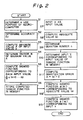
- Fig. 2 is a flowchart showing a sigmoid function computation process according to an embodiment of a neuro-computer of the present invention
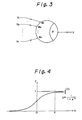
- Fig. 3 schematically shows a mathematical model in a neural network which can be used in the neuro-computer of the present invention
- Fig. 4 shows an output profile of a sigmoid function
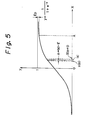
- Fig. 5 is a view partially explaining the sigmoid function of Fig. 4.
- FIG. 1 The arrangement of the neuro-computer according to this embodiment is shown in Fig. 1.
- An input device 1 and a general computer 2 are connected with a neuro-computer 3 which is composed of a memory 4 connected to the general computer 2 serving as a storage unit, an arithmetic device 5 connected to the input device 1 serving as a quantization unit, and a microprocessor 6 connected to both the arithmetic device 5 and the memory 4 serving as a computation unit.
- a neuro-computer 3 which is composed of a memory 4 connected to the general computer 2 serving as a storage unit, an arithmetic device 5 connected to the input device 1 serving as a quantization unit, and a microprocessor 6 connected to both the arithmetic device 5 and the memory 4 serving as a computation unit.
- a mathematical model for the neuron cells of a brain As a mathematical model for the neuron cells of a brain, a mathematical model called a McCulloch-Pitts type formal neuron (or a threshold element) is known.
- Fig. 3 shows a McCulloch-pitts type neuron.
- a neuro-computer which uses this neuron is formed or an information processing clement with multiple inputs - one output.
- n inputs of input signals to a unit are denoted as a weight (load) representing the amount of connection efficiency of a synapse corresponding to each of the n inputs is denoted as and denoting a threshold value as ⁇
- the output (signal) value y from the unit can be expressed as where and ⁇ (s) is the output function of the unit.
- the sigmoid function 1/(1+e -s ) is often used for the output function ⁇ (s), as shown in Fig. 4.
- the calculation process of the sigmoid function is shown in Fig. 2.
- the calculation of the sigmoid function ⁇ (s) starts with determining a use purpose of the neuro-computer 3 (step S1).
- the next step is to determine an accuracy Ep of the sigmoid function ⁇ (s) which indicates an allowable error range in the sigmoid function in order to determine the purpose of the neuro-computer 3 by the input device 1 (step S2).
- the next step is to determine a maximum value A of the input values x in the range in order to determine the range that the input value x of the sigmoid function ⁇ (s) can take on the basis of the accuracy Ep (step S3).
- the maximum value A can be determined from the following relational equation: that is, and the maximum value A is an integer.
- the next step is to determine the number of the partition N in order to evenly divide the input values x (step S4).
- the number of partition N is determined by the following equation: That is, N ⁇ Np, and the number of partition N is an integer.
- a value A/N which is obtained by dividing the maximum value A of the input values x by the number of partition N, becomes an interval value between respective divided input values x.
- the number of the sigmoid function is N+l in all.
- Respective sigmoid functions are calculated by means of the general computer 2 which is disposed on the outside and connected therewith (step S5).
- Each of the calculated sigmoid functions is stored in the memory 4 of the neuro-computer 3 from the general computer 2 as a function table (step S6).
- the input device 1 transmits the input value x to the arithmetic device 5 of the neuro-computer 3 (step S7).
- the arithmetic device 5 judges the input value x has the plus or minus sign, and transmits the budged result to the microprocessor 6, and computes the absolute value of the input value x (step S8).
- the next step is to determine the value n in accordance with the division interval of the evenly divided A, of which the absolute value
- belongs to, by the computing unit 5, from the relational equation of where n 0, 1, 2, ⁇ ⁇ ⁇ , N-1 (step S9). For example, when the absolute value
- _ x is equivalent to the input value of one sigmoid function in the function table stored in the memory 4.
- ⁇ ( _ x ) is a sigmoid function corresponding to the input value _ x , which has already been stored in the memory 4 as one sigmoid function in the function table. Therefore, ⁇ (
- the error E r of the sigmoid function determined by an approximation calculation indicates a value smaller than the set error value Ep.
- E r indicates a very small error value.
- the computed sigmoid function ⁇ (x) and the first-order derivative ⁇ ' (x) can be used in a supervised learning algorithm called a back propagation algorithm.
Landscapes
- Engineering & Computer Science (AREA)
- Physics & Mathematics (AREA)
- Theoretical Computer Science (AREA)
- Software Systems (AREA)
- Computing Systems (AREA)
- General Health & Medical Sciences (AREA)
- General Physics & Mathematics (AREA)
- Computational Linguistics (AREA)
- Data Mining & Analysis (AREA)
- Evolutionary Computation (AREA)
- Biomedical Technology (AREA)
- Molecular Biology (AREA)
- Artificial Intelligence (AREA)
- General Engineering & Computer Science (AREA)
- Biophysics (AREA)
- Mathematical Physics (AREA)
- Life Sciences & Earth Sciences (AREA)
- Health & Medical Sciences (AREA)
- Management, Administration, Business Operations System, And Electronic Commerce (AREA)
- Calculators And Similar Devices (AREA)
- Feedback Control In General (AREA)
- Complex Calculations (AREA)
Applications Claiming Priority (2)
| Application Number | Priority Date | Filing Date | Title |
|---|---|---|---|
| JP310458/89 | 1989-11-29 | ||
| JP1310458A JPH03168862A (ja) | 1989-11-29 | 1989-11-29 | ニューロコンピュータ |
Publications (3)
| Publication Number | Publication Date |
|---|---|
| EP0430264A2 true EP0430264A2 (fr) | 1991-06-05 |
| EP0430264A3 EP0430264A3 (en) | 1992-01-15 |
| EP0430264B1 EP0430264B1 (fr) | 1998-01-21 |
Family
ID=18005495
Family Applications (1)
| Application Number | Title | Priority Date | Filing Date |
|---|---|---|---|
| EP90122896A Expired - Lifetime EP0430264B1 (fr) | 1989-11-29 | 1990-11-29 | Ordinateur neuronal |
Country Status (3)
| Country | Link |
|---|---|
| EP (1) | EP0430264B1 (fr) |
| JP (1) | JPH03168862A (fr) |
| DE (1) | DE69031975T2 (fr) |
Cited By (2)
| Publication number | Priority date | Publication date | Assignee | Title |
|---|---|---|---|---|
| EP1065601A1 (fr) * | 1999-07-02 | 2001-01-03 | BRITISH TELECOMMUNICATIONS public limited company | Méthode d'apprentrissage |
| WO2019057987A1 (fr) * | 2017-09-25 | 2019-03-28 | Nissan Motor Manufacturing (Uk) Ltd. | Système de vision artificielle |
Family Cites Families (2)
| Publication number | Priority date | Publication date | Assignee | Title |
|---|---|---|---|---|
| JPH0631990B2 (ja) * | 1984-01-07 | 1994-04-27 | カシオ計算機株式会社 | 波形の補間装置 |
| GB2206428A (en) * | 1987-06-15 | 1989-01-05 | Texas Instruments Ltd | Computer |
-
1989
- 1989-11-29 JP JP1310458A patent/JPH03168862A/ja active Pending
-
1990
- 1990-11-29 EP EP90122896A patent/EP0430264B1/fr not_active Expired - Lifetime
- 1990-11-29 DE DE69031975T patent/DE69031975T2/de not_active Expired - Fee Related
Cited By (5)
| Publication number | Priority date | Publication date | Assignee | Title |
|---|---|---|---|---|
| EP1065601A1 (fr) * | 1999-07-02 | 2001-01-03 | BRITISH TELECOMMUNICATIONS public limited company | Méthode d'apprentrissage |
| WO2019057987A1 (fr) * | 2017-09-25 | 2019-03-28 | Nissan Motor Manufacturing (Uk) Ltd. | Système de vision artificielle |
| CN111465940A (zh) * | 2017-09-25 | 2020-07-28 | 日产自动车株式会社 | 机器视觉系统 |
| US11386307B2 (en) | 2017-09-25 | 2022-07-12 | Nissan Motor Co., Ltd. | Machine vision system |
| CN111465940B (zh) * | 2017-09-25 | 2024-03-26 | 日产自动车株式会社 | 机器视觉系统 |
Also Published As
| Publication number | Publication date |
|---|---|
| DE69031975T2 (de) | 1998-07-30 |
| EP0430264B1 (fr) | 1998-01-21 |
| EP0430264A3 (en) | 1992-01-15 |
| DE69031975D1 (de) | 1998-02-26 |
| JPH03168862A (ja) | 1991-07-22 |
Similar Documents
| Publication | Publication Date | Title |
|---|---|---|
| EP0378689B1 (fr) | Procede de determination de regles d'inference et moteur d'inference | |
| Chryssolouris et al. | Confidence interval prediction for neural network models | |
| Dundar et al. | The effects of quantization on multilayer neural networks | |
| EP1949523B1 (fr) | Systeme, procede, et article de fabrication permettant de determiner un vecteur d'etat de batterie estime | |
| KR950012380B1 (ko) | 뉴로-퍼지 융합 데이터처리 시스템 | |
| US5255344A (en) | Inference rule determining method and inference device | |
| US20040019469A1 (en) | Method of generating a multifidelity model of a system | |
| Lin et al. | Selection of learning parameters for CMAC-based adaptive critic learning | |
| EP0384709B1 (fr) | Machine élève | |
| KR920006792B1 (ko) | 다입력-출력회로를 계층형상으로 접속한 학습기계 | |
| EP0430264A2 (fr) | Ordinateur neuronal | |
| US5438645A (en) | Neural network which uses a monitor | |
| USRE36823E (en) | Inference rule determining method and inference device | |
| Huntley | Neural nets: An approach to the forecasting of time series | |
| Primadusi et al. | Backpropagation neural network models for LiFePO4 Battery | |
| Artem'ev | Stability of numerical methods for solving stochastic differential equations | |
| CN115238873B (zh) | 神经网络模型部署方法、装置、计算机设备 | |
| EP0533099A2 (fr) | Unité et appareil de réconnaissance | |
| CN113723598B (zh) | 神经网络计算方法、装置、板卡及计算机可读存储介质 | |
| CN113723600B (zh) | 神经网络计算方法、装置、板卡及计算机可读存储介质 | |
| CN113723597B (zh) | 神经网络计算方法、装置、板卡及计算机可读存储介质 | |
| CN113723599B (zh) | 神经网络计算方法、装置、板卡及计算机可读存储介质 | |
| Htay et al. | Correcting errors in linear codes with neural network | |
| Tanaka et al. | The characteristics of the convergence time of associative neural networks | |
| JPH0484308A (ja) | パラメーター決定方法及びプラント監視制御方法 |
Legal Events
| Date | Code | Title | Description |
|---|---|---|---|
| PUAI | Public reference made under article 153(3) epc to a published international application that has entered the european phase |
Free format text: ORIGINAL CODE: 0009012 |
|
| 17P | Request for examination filed |
Effective date: 19901221 |
|
| AK | Designated contracting states |
Kind code of ref document: A2 Designated state(s): DE FR GB |
|
| PUAL | Search report despatched |
Free format text: ORIGINAL CODE: 0009013 |
|
| AK | Designated contracting states |
Kind code of ref document: A3 Designated state(s): DE FR GB |
|
| 17Q | First examination report despatched |
Effective date: 19940706 |
|
| GRAG | Despatch of communication of intention to grant |
Free format text: ORIGINAL CODE: EPIDOS AGRA |
|
| GRAH | Despatch of communication of intention to grant a patent |
Free format text: ORIGINAL CODE: EPIDOS IGRA |
|
| GRAH | Despatch of communication of intention to grant a patent |
Free format text: ORIGINAL CODE: EPIDOS IGRA |
|
| GRAA | (expected) grant |
Free format text: ORIGINAL CODE: 0009210 |
|
| AK | Designated contracting states |
Kind code of ref document: B1 Designated state(s): DE FR GB |
|
| REF | Corresponds to: |
Ref document number: 69031975 Country of ref document: DE Date of ref document: 19980226 |
|
| ET | Fr: translation filed | ||
| PLBE | No opposition filed within time limit |
Free format text: ORIGINAL CODE: 0009261 |
|
| STAA | Information on the status of an ep patent application or granted ep patent |
Free format text: STATUS: NO OPPOSITION FILED WITHIN TIME LIMIT |
|
| 26N | No opposition filed | ||
| REG | Reference to a national code |
Ref country code: GB Ref legal event code: IF02 |
|
| PGFP | Annual fee paid to national office [announced via postgrant information from national office to epo] |
Ref country code: DE Payment date: 20071122 Year of fee payment: 18 |
|
| PGFP | Annual fee paid to national office [announced via postgrant information from national office to epo] |
Ref country code: FR Payment date: 20071108 Year of fee payment: 18 Ref country code: GB Payment date: 20071128 Year of fee payment: 18 |
|
| GBPC | Gb: european patent ceased through non-payment of renewal fee |
Effective date: 20081129 |
|
| REG | Reference to a national code |
Ref country code: FR Ref legal event code: ST Effective date: 20090731 |
|
| PG25 | Lapsed in a contracting state [announced via postgrant information from national office to epo] |
Ref country code: DE Free format text: LAPSE BECAUSE OF NON-PAYMENT OF DUE FEES Effective date: 20090603 |
|
| PG25 | Lapsed in a contracting state [announced via postgrant information from national office to epo] |
Ref country code: GB Free format text: LAPSE BECAUSE OF NON-PAYMENT OF DUE FEES Effective date: 20081129 |
|
| PG25 | Lapsed in a contracting state [announced via postgrant information from national office to epo] |
Ref country code: FR Free format text: LAPSE BECAUSE OF NON-PAYMENT OF DUE FEES Effective date: 20081130 |