EP0430339A2 - Projektionslinsensystem - Google Patents
Projektionslinsensystem Download PDFInfo
- Publication number
- EP0430339A2 EP0430339A2 EP19900203044 EP90203044A EP0430339A2 EP 0430339 A2 EP0430339 A2 EP 0430339A2 EP 19900203044 EP19900203044 EP 19900203044 EP 90203044 A EP90203044 A EP 90203044A EP 0430339 A2 EP0430339 A2 EP 0430339A2
- Authority
- EP
- European Patent Office
- Prior art keywords
- lens
- lens system
- lens element
- object surface
- power
- Prior art date
- Legal status (The legal status is an assumption and is not a legal conclusion. Google has not performed a legal analysis and makes no representation as to the accuracy of the status listed.)
- Withdrawn
Links
Images

Classifications
-
- G—PHYSICS
- G02—OPTICS
- G02B—OPTICAL ELEMENTS, SYSTEMS OR APPARATUS
- G02B13/00—Optical objectives specially designed for the purposes specified below
- G02B13/16—Optical objectives specially designed for the purposes specified below for use in conjunction with image converters or intensifiers, or for use with projectors, e.g. objectives for projection TV
Definitions
- This invention relates to a projection lens system for projecting an enlarged image of a concave object surface onto a planar display screen.
- this invention is concerned with the provision of a lens system designed for use within a projection television (TV) set where the concave object surface is provided by a phosphor layer formed on an inwardly convex faceplate of a cathode ray tube (CRT) and the planar display screen is a translucent screen.
- TV projection television
- CRT cathode ray tube
- EP-A-O 188 016 (corresponding to US-A-4 699 476) describes such a lens system. As discussed in EP-A-O 188 016 it is desirable to reduce the distance between the CRT and the translucent screen so as to keep to a minimum the depth of the television cabinet. This can be achieved by the use of mirrors and more importantly by the use of a wide angle lens system, that is a lens system capable of projecting at field angles of ⁇ 30 degrees or more. In addition, because by convention three separate CRTs are used for colour projection TV sets and because lenses having aspherical surfaces may be used, the number of lens elements required can be reduced.
- the lens system described in EP-A-O 188 016 has a first lens element of negative power, that is a diverging lens element, arranged to be positioned adjacent the concave object surface, second and third lens elements of positive power and a low power fourth lens element remote from the object surface, with at least two aspheric lens element surface and with the relative powers of the lens elements being selected as defined in EP-A-188 016 so as to provide a wide angle lens system with improved light transmission and resolution.
- a lens system for projecting an enlarged image of a concave object surface onto a planar display screen characterised in that the lens system comprises a first lens element for arrangement adjacent the object surface and, arranged sequentially following the first lens element, second, third and fourth lens elements having respective powers K2, K3 and K4 selected such that the power K2 of the second lens element lies in the range of from about -0.20K to about 0.0K, the power K3 of the third lens elements lies in the range of from about 0.75K to about 1.00K and the power K4 of the fourth lens element lies in the range of from about 0.3K to about 0.45K, where K is the power of the lens system, the first lens element having a power selected such that when the first lens element is arranged adjacent the object surface the first lens element has an effective power K1 which is negative with respect to the power K of the lens system, and at least two of the lens elements each having at least one aspheric surface.
- the lens system has an acceptance cone defined, as is conventional in the art, as the solid angle within which, for a given point on the object surface, light is accepted or is capable of being transmitted by the lens system.
- This solid angle is generally symmetric about the optical axis for parts on the axis but tilts over or becomes more oblique and less symmetric for parts off the optical axis.
- the fact that a substantial proportion, that is greater than or equal to 75 percent, of the overall lens power K is concentrated in the third lens element means that, for the lens system to be thermally stable, only the third lens element need be made of glass and the other lens elements can be made of a suitable plastics material such as an acrylic or polycarbonate.
- a coupling medium may be provided in contact with the first lens element for positioning between the first lens element and the concave object surface, for example the phosphor layer provided on the inwardly convex faceplate of a CRT.
- the first lens element may be arranged to be surrounded by air or to be itself in contact with the faceplate of a CRT.
- the coupling medium element may comprise a liquid coolant for the object surface.
- the contacting surfaces of the first lens element and the coupling medium element may be planar or appropriately curved and the coupling medium element may vary in thickness to conform to the opposing surfaces of the object surface and the first lens element.
- each of the first, second and fourth lens elements may have at least one aspherical surface whilst both surfaces of the third lens element may be spherical.
- the surfaces of the first, second and fourth lens elements facing the third lens element may be aspherical which should facilitate manufacture of the lens system.
- the lens system may have a relative aperture of F/1 and a nominal magnification from about 7 to about 10.
- the object surface may have a radius of curvature of about 350mm whilst the lens system may have, in operation (that is including the effects of the object surface), an overall focal length of about 95mm.
- Adjacent surfaces of the lens elements may be separated so that, for example, the adjacent surfaces of the first and second lens elements are as close as practically possible bearing in mind their respective curvatures and so that the fourth lens element is as far from the third lens element as is practically possible bearing in mind the normal constraints on the overall length of the lens system.
- the separation along the optical axis of adjacent surfaces of the first and second, second and third, and third and fourth lens elements may be in the ranges 0.3/K to 0.5/K 0 to 0.35/K, and 0.3/K.
- the separation of the object surface and the adjacent surface of the first lens element will depend on the thickness of any coupling element which may be used and on the thickness of the faceplate FP.
- the lens system in combination with the faceplate of a cathode ray tube having an interior surface providing the object surface may be substantially as described in Table I, Table II or Table III of the following description.
- the present invention provides a projection system comprising a cathode ray tube having a faceplate having an interior surface providing the object surface and a lens system in accordance with the first aspect.
- the interior surface of the faceplate may be provided with an interference filter, such as described in US-A-4 683 398, 4 634 926 or 4 647 812.
- the lens system has the advantage of being capable of ensuring that light is collected at angles within the restricted emission angles of a CRT provided with an interference filter even at the extreme periphery of the object or picture at the interior surface of the CRT faceplate.
- the lens system may be optimised for these angles which should provide improved resolution.
- the lens system comprises a first lens element L1 for arrangement adjacent the object surface S1 and, arranged sequentially following the first lens element L1, second, third and fourth lens elements L2, L3 and L4 having respective powers K2, K3 and K4 such that: -0.20K ⁇ K2 ⁇ 0.0K 0.75K ⁇ K3 ⁇ 1.00K and 0.3K ⁇ K4 ⁇ 0.45K, where K is the power of the lens system, the first lens element L1 having a power selected such that, when the first lens element L1 is arranged adjacent the object surface S1, the first lens element L1 has an effective power K1 which is negative with respect to the power K of the overall lens system, and at least two L1, L2, L4 of the lens elements each having at least one S4, S6, S
- the lens system 3 has an acceptance cone defined, as is conventional in the art, as the solid angle within which, for a given point on the object surface, light is accepted or is capable of being transmitted by the lens system 3.
- This solid angle is generally symmetric about the optical axis x of the lens system for points on axis but tilts over with respect to the optical axis and is no longer symmetric for points off axis. Because, using such a lens system, a substantial proportion of the power of the lens system is concentrated within the third lens element L3, the obliquity of the acceptance cone that the lens system subtends at the object surface is reduced. As the intensity of the light tends to reduce for higher angles, this reduction of obliquity enables the lens system to collect more light whilst avoiding any significant increase in the geometric distortion of the image relative to the object.
- the fact that a substantial proportion (greater than or equal to about 75 percent) of the overall power K of the lens system is concentrated in the third lens element L3 means that the thermal stability, that is the degree to which the characteristics, for example the focal length, of the lens system change with temperature, of the lens system is only significantly affected by the third lens element L3. Accordingly, only the third lens element L3 need be made of a highly thermally stable material such as glass whilst the other lens elements L1,L2 and L4 can be made of a suitable plastics material, for example an acrylic such as polymethylmethacrylate (PMMA), polycarbonate or polystyrene.
- PMMA polymethylmethacrylate
- PMMA polymethylmethacrylate
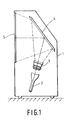
- a lens system 3 in accordance with the invention is particularly suited for use within a projection TV set and a schematic layout for a projection TV set incorporating such a lens system 3 is shown in Figure 1.
- the projection TV set comprises a free standing cabinet 1 within which is mounted (by means not shown) a cathode ray tube (CRT) 2, the lens system 3, and a front metallised mirror 4 for folding the optical path P for projecting an image from the CRT 2 onto a translucent screen 5 mounted within the front of the cabinet 1.
- the translucent screen 5 may be a compound screen comprising one or more of the following, a Fresnel lens, a light scattering component, a lenticular element and light absorbing areas.
- the TV is a colour TV
- three separate CRTs will be provided, each with a respective lens system, usually arranged so that the two not shown in Figure 1 are on either side of the CRT 2 (i.e. above and below the plane of the paper) with the respective lens systems arranged to project the three primary colour pictures in coincidence on the translucent screen 5.
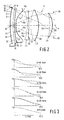
- Figure 2 illustrates a first embodiment of a lens system 3 in accordance with the invention in combination with the faceplate FP of the CRT 2.
- the faceplate FP of the cathode ray tube 2 has curved exterior and interior surfaces S2 and S1 so that the inner surface S1 is convex when viewed from within the CRT 2.
- a conventional phosphor layer 6 is deposited on the interior surface S1 of the faceplate and so, by virtue of the convex nature of the interior surface S1 of the faceplate FP, provides an outwardly concave (that is concave when viewed from the lens system 3) object surface S1 which may, for example, have a radius of curvature of about 300 to 350mm.
- a thin reflecting metallic layer 8 may be provided on the phosphor layer 6.
- the first lens element L1 has a first surface S3 which is to be positioned adjacent the exterior surface S2 of the faceplate FP and an aspherical second surface S4 which has a central portion which is arranged to be convex towards and directed away from the faceplate FP.
- the faceplate FP of the CRT 2 and the first surface S3 of the first lens elements L1 are similarly curved so that the intervening coupling medium element M has two opposed similarly curved surfaces M1 and M2 shaped to conform to the surfaces S2 and S3 is positioned between and in contact with the surfaces S2 and S3.
- the coupling medium element M may comprise or contain a liquid coolant, such as a water and glycol mixture, for cooling the faceplate FP in conventional manner.
- the first lens element L1 may be separated from the exterior surface S2 of the faceplate FP by an air gap or may be substantially in contact with the exterior surface S2 of the faceplate FP.
- one or both of the surfaces S2 and S3 may be planar.
- the second lens element L2 has a first spherical surface S5 and a second aspherical surface S6 with the central portions of the surfaces S5 and S6 being concave when viewed from the CRT 2.
- the third lens element L3 has first and second spherical surfaces S7 and S8 with the first surface S7 facing towards the faceplate FP so that the first surface S7 is convex when viewed from the CRT 2 and the second surface S8 concave.
- the fourth lens element L4 has a first aspherical surface S9 which faces towards and has a central portion which appears concave when viewed from the CRT 2 and a second spherical surface S10 which appears concave from the CRT 2.
- An aperture or stop 20 is provided adjacent the fourth lens element L4 on the side remote from the third lens element L3.
- Table I of the Appendix attached to the end of this description gives the detailed specification of the lens elements L1, L2, L3 and L4, faceplate FP and coupling medium element M of the arrangement shown in Figure 2 with surfaces which are convex when viewed from the CRT 2 being given a positive radius of curvature and surfaces which are concave when viewed from the CRT 2 being given a negative radius of curvature.
- the aspheric surfaces S4, S6 and S9 are defined in accordance with the equation: where z is the deviation, in the axial direction, of the surface from a plane normal to the optical axis X and tangential to the surface at its pole for a zone of the surface which is at a distance s from the axis, C is the curvature of the surface at its pole, e is a conic constant, and a4, a6 a8 and a10 are constants for the surface.
- Figure 3 illustrates the modulation transfer function (MTF) at various different object points measured at a distance A perpendicular to the optical axis x for the lens system shown in Figure 2 and defined in Table I where the diameters of the lens elements are selected to give a relative aperture of F/1.1.
- the lens system 3 may have a nominal magnification of 8.7 and a total throw distance from object surface S1 to image of 1050mm.
- the modulation is shown for spatial frequencies from 0 to 10 cycles mm ⁇ 1 (c/mm) as measured at the surface S1 of the CRT faceplate FP with in each case the long dash line illustrating the tangential and the short dash line illustrating the sagital MTF.
- interference filter 7 of the type described in US-A-4 634 926 or US-A-4 647 812 is provided then light incident in the filter 7 at angles greater than a specified constant value determined by the characteristics of the filter 7 is reflected back towards the phosphor layer 8 and may subsequently after scattering in the phosphor layer 6 and/or after reflection at the thin metallic layer 8 be re-directed back towards the interference filter 7.
- Light refracted into the faceplate FP travels via the lens elements L1, L2, L3 and L4 to the translucent screen where the final image is formed.
- Figure 2 also shows the paths through the projection lens of four rays of light.
- Two 10a, 10b of these start in the phosphor layer 6 from a point 10 which is on the axis X of the projection lens, while the other two 11a, 11b start in the phosphor layer 6 from a point 11 which is a significant distance from the axis X of the projection lens system.
- Each pair of rays is chosen to represent the upper and lower extremes of the acceptance cone of the projection lens system 3.
- Also shown at point 11 is the normal 12 to interior surface S1 of the faceplate.
- 4 634 926 and 4 647 812 is restricted to a solid cone centred on this normal, the upper and lower extremes being represented by lines 13 and 14. It can be seen that the acceptance angles of the lens, represented by the rays from point 11, lie substantially within the emission cone represented by lines 13 and 14.
- the extreme corners of the picture on the CRT faceplate FP lie at 66.6mm from the axis X of the lens.
- the upper and lower angles of the acceptance cone of the lens represented by the rays from point 11, are 26.6 degrees and 48.5 degrees from the lens axis X respectively.
- the normal 12 to faceplate surface S1 at this point is tilted by 12.8 degrees to the lens axis X.
- the lens accepts light in a cone lying between 13.8 degrees and 35.7 degrees from the normal 12 to the faceplate FP. Since typical emission cut-off angles for a CRT with an interference filter according to U.S.
- Patents 4 634 926 and 4 647 812 are approximately 40 degrees, it can be seen that the aperture of lens system 3 shown in Figure 2 is substantially filled by light emitted from the CRT 2 at this point. For picture points which are at smaller distances from the lens axis X, the situation is even better. For example at 40mm from the lens axis, the acceptance cone of the lens lies between 1.8 degrees and 32.8 degrees from the normal to surface S1 of the faceplate FP.
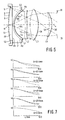
- Figure 4 illustrates a second embodiment of a lens system in accordance with the invention.
- the exterior surface S2 of the faceplate FP is planar and the coupling medium element M has a first planar surface M1 abutting the surface S2 of the faceplate and a convex (when viewed from the CRT 2) surface M2 abutting a complementary convex first surface S3 of the first lens element L1.
- the surfaces S4, S6 and S9 are aspheric with the central portion of the surfaces S4 and S7 being convex when viewed from the CRT.
- the effective power K1 of the first lens elements L1 that is the power of the first lens element L1 combined with the power of the coupling medium M and the faceplate FP, is -0.22K whilst the powers K2, K3 and K4 of the second, third and fourth lens elements L2, L3 and L4 are -0.12K, 0.94K and 0.37K, respectively.
- the path of four light rays 10a,10b,11a,11b through the lens system is shown in Figure 4.
- the upper and lower angles of the acceptance cone are 18.4 degrees and 38.4 degrees from the normal to surface S1 for a picture point at 66.6mm from the lens axis, and 1.5 degrees and 34.6 degrees from the normal for a picture point at 40mm from the lens axis.
- FIG 5 illustrates the modulation transfer functions (MTF) for the lens system 3 of Figure 4 where the relative aperture, nominal magnification, and total throw are as given for the lens system of Figure 2.
- MTF modulation transfer functions
- Figure 6 illustrates a third embodiment of a lens system in accordance with the invention for which the specific details are given in Table III.
- Figure 7 illustrates the MTF, equivalent to that given in Figure 3, for the lens system of Figure 6 where the lens system has the same relative aperture, nominal magnification and total throw as the lens system shown in Figure 2.
- the coupling medium element M lies between the planar surface S2 of the faceplate FP and the convex surface S3 of the first lens element L1 with the thickness of the first lens element L1 being substantially constant.
- the effective power K1 of the first lens element L1 that is the power of the first lens element L1 combined with the power of the coupling medium M and the faceplate FP, is -0.19K whilst the relative powers K2, K3 and K4 of the second, third and fourth lens elements L2, L3 and L4 are -0.05K, 0.9K and 0.35K respectively.
- the surfaces S4, S6 and S9 are aspheric.
- the upper and lower angles of the acceptance cone are 11.4 degrees and 35.5 degrees from the normal to surface S1 for a picture point at 66.6mm from the lens axis, and 1.3 degrees and 33.2 degrees from the normal for a picture point at 40mm from the lens axis.
- the axial separation of the object surface S1 and the surface S3 of the first lens element L1 will depend, of course, on the thickness of the coupling element M and on the thickness of the faceplate FP.
- the adjacent surfaces S4 and S5 of the first and second lens elements L1 and L2 should be as close as is practically possible bearing in mind their respective curvatures whilst the fourth lens element L4 should be as far as possible from the third lens element L3 bearing in mind the physical constraints on the overall length of the lens system. In each case, the lens aperture 20 should be just beyond the fourth lens element L4.
- the surfaces S4, S6 and S9 are aspheric, others of the surfaces may be formed to be aspheric. Forming the surface S4 as an aspheric surface rather than the surface S3 has the advantage of facilitating manufacture because the asphericity does not have to be so large to achieve the desired effect. In contrast, it is possible to form surface S5 as an aspheric surface rather than surface S6 and provide a lens of comparable performance. It is also desirable for the surface S9 rather than the surface S10 to be aspheric because, should the exposed surface S10 of the lens system be damaged in assembly, it can be more easily reground if it is a spherical surface.
- a lens system in accordance with the invention has been designed so as to reduce the lens acceptance angles whilst giving the required distortion characteristics without significantly increasing the number of lens elements and with little loss of resolution.
- the third lens element L3 has two spherical surfaces S7 ad S8, this lens element may alternatively have one or two aspherical surfaces.
- this lens element may be manufactured using suitable glass moulding techniques or plastic-on-glass replication techniques.
- the other lens elements L1, L2 and L4 may be manufactured using moulding or replication techniques in glass or a plastics material.
Landscapes
- Physics & Mathematics (AREA)
- General Physics & Mathematics (AREA)
- Optics & Photonics (AREA)
- Lenses (AREA)
Applications Claiming Priority (2)
| Application Number | Priority Date | Filing Date | Title |
|---|---|---|---|
| GB8926347A GB2238397A (en) | 1989-11-22 | 1989-11-22 | A projection lens system having aspheric surfaces |
| GB8926347 | 1989-11-22 |
Publications (2)
| Publication Number | Publication Date |
|---|---|
| EP0430339A2 true EP0430339A2 (de) | 1991-06-05 |
| EP0430339A3 EP0430339A3 (en) | 1992-01-08 |
Family
ID=10666694
Family Applications (1)
| Application Number | Title | Priority Date | Filing Date |
|---|---|---|---|
| EP19900203044 Withdrawn EP0430339A3 (en) | 1989-11-22 | 1990-11-16 | A projection lens system |
Country Status (3)
| Country | Link |
|---|---|
| EP (1) | EP0430339A3 (de) |
| JP (1) | JPH03175408A (de) |
| GB (1) | GB2238397A (de) |
Family Cites Families (10)
| Publication number | Priority date | Publication date | Assignee | Title |
|---|---|---|---|---|
| US4810075A (en) * | 1984-03-26 | 1989-03-07 | Hitachi, Ltd. | Projection system with a cathode ray tube and a lens |
| US4801196A (en) * | 1984-08-21 | 1989-01-31 | U.S. Precision Lens, Incorporated | Wide angle projection lens |
| US4707084A (en) * | 1984-08-21 | 1987-11-17 | U.S. Precision Lens, Inc. | Projection lens |
| JPH073504B2 (ja) * | 1984-12-05 | 1995-01-18 | 松下電器産業株式会社 | 投写レンズ |
| GB2168502A (en) * | 1984-12-14 | 1986-06-18 | Philips Electronic Associated | Projection lens system |
| US4685774A (en) * | 1986-01-17 | 1987-08-11 | U.S. Precision Lens, Incorporated | Projection lens |
| US4776681A (en) * | 1986-01-17 | 1988-10-11 | U.S. Precision Lens, Incorporated | Projection lens |
| JPH0820594B2 (ja) * | 1986-05-28 | 1996-03-04 | 株式会社日立製作所 | 投写形テレビ用光学装置 |
| NL8602975A (nl) * | 1986-11-24 | 1988-06-16 | Philips Nv | Beeldprojektiestelsel. |
| US4792217A (en) * | 1986-12-09 | 1988-12-20 | Pioneer Electronic Corporation | Projection lens system |
-
1989
- 1989-11-22 GB GB8926347A patent/GB2238397A/en not_active Withdrawn
-
1990
- 1990-11-16 EP EP19900203044 patent/EP0430339A3/en not_active Withdrawn
- 1990-11-22 JP JP31573190A patent/JPH03175408A/ja active Pending
Also Published As
| Publication number | Publication date |
|---|---|
| GB8926347D0 (en) | 1990-01-10 |
| EP0430339A3 (en) | 1992-01-08 |
| JPH03175408A (ja) | 1991-07-30 |
| GB2238397A (en) | 1991-05-29 |
Similar Documents
| Publication | Publication Date | Title |
|---|---|---|
| EP0266393B1 (de) | Optisches dreispiegelsystem mit reeller eingangspupille | |
| EP0305009A2 (de) | Einteiliger Projektionsschirm | |
| EP0514538B1 (de) | Optische elemente mit gradientenindex und katadioptrische optische systeme | |
| US4189211A (en) | Wide angle telecentric projection lens assembly | |
| US2683394A (en) | Wide aperture optical projection lens system | |
| US4810075A (en) | Projection system with a cathode ray tube and a lens | |
| EP0135216B1 (de) | Projektionslinsensystem | |
| EP0272807B1 (de) | Transmissions-Overhead-Projektor mit reduzierter Höhe | |
| CA1261180A (en) | Projection lens system | |
| KR940011595B1 (ko) | 투영 스크린용 프레스넬 렌즈 및 이를 구비하는 칼라 투영 tv시스템 | |
| US4249205A (en) | Aspheric projection lens system utilizing concave image | |
| EP0184879B1 (de) | Projektionslinsensystem | |
| US4824224A (en) | Lens system for a cathode ray tube projection system | |
| CN119291892B (zh) | 光学镜头及电子设备 | |
| EP0430339A2 (de) | Projektionslinsensystem | |
| EP0135215B1 (de) | Projektionslinsensystem | |
| JPH0316002B2 (de) | ||
| EP0272719B1 (de) | Projektionslinsensystem | |
| JPH068930B2 (ja) | 投写レンズ系 | |
| JP3064300B2 (ja) | 投写用レンズ及びプロジェクションテレビ | |
| JP2934458B2 (ja) | 投写用レンズ装置及びそれを用いた投写型画像ディスプレイ装置 | |
| JPH07219055A (ja) | 透過型スクリーン | |
| JPS5844657A (ja) | 投写用陰極線管 | |
| GB2091898A (en) | Aspheric projection lens system utilizing concave image | |
| Bradley et al. | Ultra-wide viewing angle rear projection television screen |
Legal Events
| Date | Code | Title | Description |
|---|---|---|---|
| PUAI | Public reference made under article 153(3) epc to a published international application that has entered the european phase |
Free format text: ORIGINAL CODE: 0009012 |
|
| AK | Designated contracting states |
Kind code of ref document: A2 Designated state(s): DE FR GB IT NL |
|
| PUAL | Search report despatched |
Free format text: ORIGINAL CODE: 0009013 |
|
| AK | Designated contracting states |
Kind code of ref document: A3 Designated state(s): DE FR GB IT NL |
|
| RAP3 | Party data changed (applicant data changed or rights of an application transferred) |
Owner name: N.V. PHILIPS' GLOEILAMPENFABRIEKEN Owner name: PHILIPS ELECTRONICS UK LIMITED |
|
| 17P | Request for examination filed |
Effective date: 19920707 |
|
| STAA | Information on the status of an ep patent application or granted ep patent |
Free format text: STATUS: THE APPLICATION HAS BEEN WITHDRAWN |
|
| 18W | Application withdrawn |
Withdrawal date: 19930826 |