EP0430860A2 - Binarisierungsverarbeitungsverfahren für Bilder mehrerer Werte und Dichtemustererzeugungsverfahren zur Reproduktion binärer Gradationen - Google Patents
Binarisierungsverarbeitungsverfahren für Bilder mehrerer Werte und Dichtemustererzeugungsverfahren zur Reproduktion binärer Gradationen Download PDFInfo
- Publication number
- EP0430860A2 EP0430860A2 EP90710032A EP90710032A EP0430860A2 EP 0430860 A2 EP0430860 A2 EP 0430860A2 EP 90710032 A EP90710032 A EP 90710032A EP 90710032 A EP90710032 A EP 90710032A EP 0430860 A2 EP0430860 A2 EP 0430860A2
- Authority
- EP
- European Patent Office
- Prior art keywords
- matrix
- output priority
- area
- gradation
- lines
- Prior art date
- Legal status (The legal status is an assumption and is not a legal conclusion. Google has not performed a legal analysis and makes no representation as to the accuracy of the status listed.)
- Ceased
Links
Images








Classifications
-
- H—ELECTRICITY
- H04—ELECTRIC COMMUNICATION TECHNIQUE
- H04N—PICTORIAL COMMUNICATION, e.g. TELEVISION
- H04N1/00—Scanning, transmission or reproduction of documents or the like, e.g. facsimile transmission; Details thereof
- H04N1/40—Picture signal circuits
- H04N1/405—Halftoning, i.e. converting the picture signal of a continuous-tone original into a corresponding signal showing only two levels
- H04N1/4055—Halftoning, i.e. converting the picture signal of a continuous-tone original into a corresponding signal showing only two levels producing a clustered dots or a size modulated halftone pattern
- H04N1/4058—Halftoning, i.e. converting the picture signal of a continuous-tone original into a corresponding signal showing only two levels producing a clustered dots or a size modulated halftone pattern with details for producing a halftone screen at an oblique angle
-
- G—PHYSICS
- G06—COMPUTING OR CALCULATING; COUNTING
- G06V—IMAGE OR VIDEO RECOGNITION OR UNDERSTANDING
- G06V10/00—Arrangements for image or video recognition or understanding
- G06V10/20—Image preprocessing
- G06V10/28—Quantising the image, e.g. histogram thresholding for discrimination between background and foreground patterns
Definitions
- the present invention relates to a binarization processing method for multivalued image to provide the compatibility of gradation and resolution when multivalued image, expressing the density gradations by multivalues, is reproduced as binary image based on printing dots, and it also relates to a method to form density pattern when binary gradation is reproduced by binary values of white and black (ON and OFF) printing dots from the multivalued image expressing the density gradation by multivalues.
- a binary gradation reproduction method is used, by which the density gradation of the image is expressed by changing the ratio of the area of the inked portion in small unit area on the image to be reproduced by ON-OFF control of a plurality of printing dots arranged in longitudinal and lateral directions in matrix form.
- printing can be achieved much easier compared with the density gradation method, by which the density of ink is changed or the thickness of applied ink is changed to express the gradation of density.
- This method is called the area-type density expression method.
- the area-type density expression method is roughly divided into dither method and density pattern method.
- the dither method after the original image is divided into a plurality of pixels in matrix form and the gradation of density for each pixel is expressed by multivalues (e.g. 0, 1, 2, ⁇ , 255), each printing dot is allocated to one pixel, and the gradation value of the inputted pixel is compared with the threshold corresponding to the position of said printing dot. If it is larger than the threshold, said printing dot is expressed as "black” (ON), and if it is smaller than the threshold, it is expressed as "white” (OFF), thus expressing by two gradations.
- a group of printing dots of mn in quantity in the matrix form of m x n is allocated to one pixel, and it is expressed by one of the gradations of "mn + 1" gradations of 0, 1, 2, ⁇ , mn, which are expressed by the number of printing dots of "dark” (ON) in this group of printing dots.
- the dither method provides higher resolution, while the density pattern method has higher gradation expression.
- the present invention relates to the latter method.
- digital multivalued image as inputted from the original image by scanner is reproduced through binary values by of a plurality of "black” and “white” printing dots arranged in matrix form.
- the density is expressed by the size of the inked area with the density of ink on a constant level.
- This method is called the area gradation method and is widely used because of its easy printing process compared with the density gradation method, by which density is expressed by changing the density of ink itself or the thickness of ink layer.
- the original image is divided into a plurality of pixels arranged in matrix form of k x l, and the gradation of density of each pisel is given by 8 bits in 256 steps from 0 to 255.
- pixels are divided by the grids having 200 - 500 parallel lines per inch. The number of these parallel lines per inch may be smaller than the above.
- each printing dot is allocated to each pixel of the input image (e.g. the number of the line per inch is set to 500 lines.) and to adopt the method to express darkness or light of the printing dot according to the gradation of the input pixel (dither method).
- the gradation value on the boundary between light and darkness to determine the light and darkness of each printing dot is called threshold.
- Such technique to rotate the direction of the mesh to the direction of line (or row) of printing dots in printer is useful not only for the case a plurality of plates are used such as color printing but also in case printing is performed by one plate. In fact, it is generally said that the better printing can be provided when rotated by 45° than when the direction of mesh is coincided with the horizontal direction of the image.
- the higher resolution can be obtained by the dither method, while the image looks monotonous because the gradation is expressed by light and darkness of the printing dots in unit area.
- the density pattern method the more the number of dots is increased to obtain higher gradation, the fewer the number of the input pixels per inch is and the more the resolution is decreased.
- Organizational dither method is a method, in which the threshold of gradation value in determining light and darkness of printing dots is changed periodically in the direction of dot arrangement so that the "black" printing dots are gathered periodically.
- the error diffusion method the error from the threshold of gradation value in determining light and darkness of printing dots is dispersed and added to gradation value of the input pixels in the surroundings, and light and dark ness of the next printing dot is determined through comparison between the new gradation thus obtained and the threshold. The error is then deffused, and this procedure is repeated.
- the gradation of original image is reflected in the determination of light and darkness of the printing dots.
- This problem is caused by the restriction on the number of printing dots usable for one image, and there has been developed a new technique to increase the number of printing dots to about 2,500. This is to form printing dots through printing on film by laser, and this is used for printing technique.
- the problems of the density pattern method are as follows: When mesh is to be generated with the halftone dots at rotated position in the density pattern method, each halftone dot after rotation, which comes to the position of each halftone dot before rotation, is deviated from of the original halftone dot except the case where the rotating angle ⁇ is 0° , 90° , 180° and 270° .
- the mode of such deviation is divided into two types: The case where the same mode of deviation is repeated periodically at several halftone dots in X direction and Y direction according to the rotating angle ⁇ , and the case where it is not repeated at all. However, it is not repeated in almost all cases. This is because trigonometrical function of angle ⁇ in general is an irrational number in almost all cases and the coordinates after rotation are expressed by this trigonometrical function.
- each printing dot is allocated to one pixel and ON-OFF condition is determined by comparing with the threshold. Accordingly, to form the rotated halftone dots, a threshold table is prepared, in which smaller thresholds appear periodically for a plurality of printing dots in the direction of imaginary rotated mesh so that the dark dots appear periodically in the direction of the imaginary rotated mesh (organizational dither method).
- the present invention is offered to solve these problems. It is an object of the present invention to provide a binarization processing method of multivalued image, in which binary values are outputted by an equipment where the number of printing dots per inch is not sufficient, and gradation is expressed by mesh system without decreasing the resolution below a certain level. Thus, in case it is difficult to have sufficient number of printing dots mn (> 1) to express such gradation the gradation as close to the desired level as possible can be attained.
- Another object of the invention is to offer a method to form density pattern for reproducing binary gradation to shorten the processing time and to prevent moiré.
- it is possible to maintain excellent gradation of the density pattern method and the advantage of shorter processing time through collective input of a plurality of printing dots without requiring large size equipment, and to form density pattern of any desired form including the meshes on the screen rotated at any angle without disturbing the gradation values or pattern form and without preparing the density pattern for all pixels.
- the method to form the density pattern for reproducing binary value gradation of the second aspect of this invention is a method to form density pattern for reproducing binary gradation using an area-type density expression pattern table, in which said area-type density expression pattern table is obtained in such a manner that a basic output priority matrix of h lines and i rows having output priority rank as the element is prepared, a rotated basic output priority matrix is obtained by repeating said basic output priority matrix in X and Y directions and rotating it by the angle ⁇ , then an output priority matrices corresponding to mesh units of V lines and W rows is obtained in which the element of said output priority matrices is corresponed to equal or nearest element of said rotated output priority matrix, and in each mesh unit the printing dots are outputted in the order of element of said output priority matrix according higher priority to form said area-type density expression pattern table, as the result, density patterns of hierarchy of 0,1, 2 ⁇ ⁇ ⁇ , mn can be expressed.
- the number of printing dots mn in one grid to be used for gradation expression is determined.
- the hierarchy C r to which it belongs, is determined and the area-type density expression pattern table corresponding to the hierarchy C r and x, y and the next upper area-type density expression pattern are determined, and the area-type density expression pattern is outputted by binary values by the group of "mn" printing dots at the positions on the grid corresponding to a y,x .
- the gradation of input pixel a y,x is compared with the reference value N r , which represents the hierarchy C r , and the error a y,x - N r occurred is dispersed and added to the gradation value of the surrounding pixels according to the size of the coefficient in the diffusion coefficient matrix relatively corresponding to the position of said pixel.
- the gradation value of the next pixel (e.g. a y+1,x )is a new gradation value obtained as the result of error diffusion.
- the group of the new "mn" printing dots on the upper position of the corresponding grid is outputted by binary values as the area-type density expression pattern corresponding to the coordinates of the belonging hierarchy and the pixels, and the error is diffused.
- all groups of printing dots in the grid are outputted by binary values as the area-type density expression pattern respectively, and the original image is reproduced.
- the reproduction thus obtained has the gradations of "mn + 1" steps, and the gradation is increased because error is diffused to the surroundings.
- the error diffusion is calculated not for each printing dot but for each group of "mn" printing dots.
- calculation is completed by 1/mn times, and the time for processing is reduced.
- the basic output priority matrix of h lines and i rows is prepared according to the shape of the density pattern, and the number of lines V and the number of rows W of one block are selected according to the rotating angle ⁇ .
- the repeated unit matrix is obtained by repeating the basic output priority matrix in X and Y directions rotating it by the angle ⁇ , where the element (output priority rank) occupying the position near each printing dot in said block is allocated to said printing dot.
- This repeated unit matrix corresponds to one block, i.e. small group of "VW” printing dots in small group of "VW” grids, and the table where the repeated unit matrix is repeated in X and Y directions corresponds to all images.
- the repeated unit matrix consists of "VW" partial matrices of m lines and n rows. In case ⁇ 0° , all of these are different from each other, and one partial matrix corresponds to one grid.
- one of said partial matrices corresponding to the grid of the coordinates (X, Y) is determined, and this is used as the output priority matrix corresponding to the coordinates (X, Y).
- the elements contained in an output priority matrix "mn" elements (overlapping allowed) of the output priority matrix expressed by natural number of from 1 to hi.
- the values of V and W are selected that the shape and the size of halftone dot are approximately maintained at the connections between blocks.
- the total image is such that a square having its side equal to the grid ⁇ b2 + c2 is repeated in X and Y directions.
- ⁇ b2 + c2 By approximating ⁇ b2 + c2 by d, continuous halftone dots can be formed on the connections of such repeating.
- are overlapped and cut off, and the halftone dots are slightly bigger or smaller than in other portions.
- said matrix is enlarged or reduced, and it is multiplied by (d/ ⁇ b2 + c2 ) ⁇ (m/h) times in X direction and by (d/ ⁇ b2 + c2 ) ⁇ (n/i) times in Y direction so that the arrangement of the elements in square having the grid of ⁇ b2 + c2 corresponds to the group of printing dots in a square of d x d.
- the same halftone dot as in the other portions is formed on the connection of repeatings.
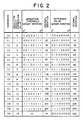
- Fig. 2 To divide the hierarchy, the method of Fig. 2 may be taken. Namely, in Fig. 2, C0 , C1 , C2 , ⁇ , C16 are hierarchies, and each of these subscripts represents the number of printing dots (area-type density expression value) to be "black" of 16 dots, and it is indicated that the gradation value not exceeding the gradation threshold (in binary and decimal values) is indicated for each hierarchy.
- the negative value from the error diffusion as described later is included in C0 . Also, the values larger than 256 are included in C16.
- Reference value N r is provided in each hierarchy C r .
- the procedure to determine the hierarchy and the reference value is not limited to the above. It is possible to divide the hierarchy with unequal spacings according to human visual sensitivity or to select the gradation value not included in the hierarchy as reference value.
- the next gradation value a 2,1 is the value after the error diffusion as described above.
- a 2,1 the hierarchy is determined in the same way, and the area-type density expression in the corresponding area-type density expression pattern table is determined and is out-putted in binary values.
- the error is obtained, and this error is diffused to the gradation values within ⁇ lines and ⁇ rows as counted from a 2,1 .
- This procedure is performed to a 1,1 , a 2,1 , ⁇ in the main scanning direction of the scanner.
- the procedure is repeated to a 2,1 , a 2,2 , ⁇ in the second row, and then in the third row.
- the pattern outputted in binary values to the pixel a y,x is an element having: (y - 1) mod (v) + 1 as line number, and (x - 1) mod (w) + 1 as row number (consisting of a group of printing dots of m lines and n rows).
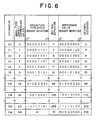
- Fig. 6 shows an example of the procedure to divide the hierarchy and the procedure to determine reference value in case the number of printing dots in a halftone dot is 64.
- 10 represents an input image
- this input image 10 consists of the pixels 20 arranged in matrix form of k lines and l lines.
- the density gradation of the pixcel 20 is expressed by multivalues, e.g. by one of the values from 0 to 255.
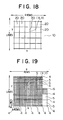
- Fig. 19, 3 is a printing dot of the output unit such as dot printer, and it comprises a group of printing dots arranged in matrix form of p lines and q rows.
- This group of printing dots is divided by the grid group 5 partitioned by virtual grid partition line 4, and one grid 5 contains a small group of printing dots 6 in partial matrix form having m lines and n rows (6 lines and 6 rows in the figure).
- the pixel 20 and the grid 5 correspond to each other by 1:1 through the coordinates (X, Y) having the line number on X coordinate, and row number in Y coodinate.
- a small group of printing dots 6 consists of "mn” printing dots, and each printing dot can express two gradations of “inked” and “non-inked”, i.e. “black” and “white” according to ON and OFF of the output.
- Each small group of printing dots 6 can express "mn + 1" types (37 in the figure) of gradations of 0, 1, 2, ⁇ , mn (36 in the figure) according to the number of ON printing dots.
- each pixel 20 When the gradation value of each pixel 20 is expressed by the value r of the gradations of 0, 1, 2, ⁇ , mn + 1 according its size, and when "r" printing dots are turned to ON in the small group of printing dots 6 corresponding to the pixel 20, and the remainder is turned to OFF in binary value output, binary value gradation can be reproduced.
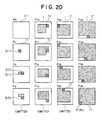
- the output priority rank to show which dot should be turned to ON is given by the output priority matrix 7 (the matrix of Fig. 21 in the example of Fig. 20) of m lines and n rows (6 lines and 6 rows), and the density pattern to all of r is given. If such output priority matrix 7 can be obtained, the density pattern to each value of r can be obtained by turning the printing dots 3 (1) , 3 (2) , 3 (3) , 3 (r-1) , ⁇ , 3 (36) to ON, which correspond to the output priority.
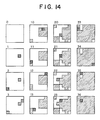
- the binary gradation reproduction 30 it is the same gradation 13 and is constituted by 16 different types of density pattern 11 by the coordinates (X, Y). These 16 types of density pattern 11 (e,f) (1 ⁇ e ⁇ 4, 1 ⁇ f ⁇ 4) forms one block 13 continuous in longitudinal and lateral direction in matrix form of 4 lines and 4 rows.
- Binary gradation reproduction 30 is continuous by repeating this block 13 in matrix form in longitudinal and lateral directions.
- the degree of this basic output priority matrix does not necessarily agree with the degree of the matrix of the small group of printing dots 6 to express the gradation and can be arbitrarily selected.
- the size of the block 13 is selected according to the given rotating angle ⁇ .
- the elements are arranged with equal spacings in X and Y direction.
- the spacing of the basic output priority table (Fig. 11) is m/h times of the unit length in y direction and n/i times of the unit length in x direction on a plane of x-y coordinates having a set (x, y) of the row number x and line number y of the group of printing dots as the coordinates and the basic output priority Table 16 (See Fig. 11), and it is rotated by an angle ⁇ on a plane of x - y coordinates Table 17 (Fig. 10).
- each of these elements is allocated to the coordinates (x, y) as obtained by rounding off the decimal portion of the coordinates (x′, y′) of the position on a plane of x-y coordinates of the elements, and this is rotated to provide a rotated output priority temporary table (not shown).
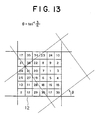
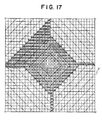
- this is provided continuously repeating the square AB′C′D′ of the grid having a side of ⁇ 17 ( ⁇ 4.12) by repeating in line direction and row direction. This can be easily shown from the fact that ⁇ D′AE is congruent to ⁇ C′B′G and ⁇ D′C′H is congruent to ⁇ AB′F.
- the output priority matrix must be furnished as many as the number of pixels in the original image, i.e. for each coordinate (x, y).
- square ABCD similar to the square AB′C′D is used as a repeated unit instead of the latter.
- the number 4 which is an integer closer to ⁇ 17 and the error is at the smallest, is selected as the repeating cycles W, in in X and Y directions, and a rotated halftone dot is formed.
- 0.12 x 6 0.72 printing dot for about 0.12 grid is rounded off for every 24 printing dots, which correspond to 4 grids of the square ABCD, and the dimension of the halftone dot is smaller by such degree on the connection of the repeating.
- One side of the square ABCD contains 24 printing dots, and the matrix of 24 lines and 24 rows where the element in the rotated output priority provisional table is the element of such position is regarded as the repeated unit matrix 18 (Fig. 8).
- the repeated unit matrix 18 can be taken anywhere on x-y coordinates if one side of it contains 24 printing dots, and it can be selected regardless of the position of the partition line 4. Because the relation with the partition line can be selected from 36 types, the repeated unit matrix 18 can be selected by 36 ways in case of Fig. 10.
- Fig. 8 shows the repeating unit matrix 18 in case a square having the point K as vertex instead of the vertex A.
- elements are contained in all lines and rows by the correction. If these are divided into partial matrix of 6 lines and 6 rows (output priority matrix 12), one of the elements from 1 to 36 is missing, and the other elements are overlapped as the result (The number of missing or overlapping elements are 1 - 5.).
- output priority matrix is allocated to the matrix 11 (X,Y) of m lines and n rows in the grid, which corresponds to the given coordinates (X, Y) on the rotated output priority table (not shown), which is obtained by continuously repeating the repeated unit matrix 18 in the above block 13 in X and Y directions as repeated unit.
- Such matrix is equal to 11 (e,f) (where e or f is one of the integers from 1 to 4).
- the density pattern corresponding to each of the gradations r 0, 1, ⁇ , mn can be obtained, and it can be outputted when necessary.
- 0.071 (grid) is discarded.
- the rotated halftone dot instead of the ideal rotated mesh, using a square with ⁇ b2 + c2 as one side is used as repeating cycle, the rotated halftone dot, where a square having d as one side is used as repeating cycle, is prepared. In the rotated halftone dot, a slight difference occurs on the repeating connections, and the mode of difference differs generally between X direction and Y direction.
- the distance between elements of the Fig. 17 can be enlarged or reduced so that one side of the square AB′C′D′ is equal to d. That is, basic output priority matrix 15 is continuously repeated in X and Y directions, and the elements are arranged with equal spacings in X and Y directions.
- the spacing between the elements is (d/ ⁇ b2 + c2 ) ⁇ m/h times of unit length in X direction on x-y coordinate plane in X direction and it is (d/ ⁇ b2 + c2 ) ⁇ n/i times of the unit length in y direction on x-y coordinate plane in Y direction.
- one output priority matrix contains "mn" elements (overlapping allowed) of the output priority ranks as expressed by natural numbers from 1 to hi.
- the density patterns of the gradations of 0, 1, 2, ⁇ , mn can be obtained.
- the present invention it is possible according to the present invention to form the density pattern of any shape including the halftone dot on screen rotated at an arbitrary angle without requiring large size equipment and maintaining the advantage of excellent gradation of the desity pattern method and shorter processing time through collective output of a plurality of printing dots. Moreover, it is possible to form the pattern without disturbing gradations and pattern shape, to shorten the processing time without worrisome procedure to prepare density pattern for all pixels, and to provide a method to form density pattern for binary gradation reproduction to prevent moiré.
Landscapes
- Engineering & Computer Science (AREA)
- Multimedia (AREA)
- Signal Processing (AREA)
- Physics & Mathematics (AREA)
- General Physics & Mathematics (AREA)
- Theoretical Computer Science (AREA)
- Facsimile Image Signal Circuits (AREA)
- Image Processing (AREA)
- Color, Gradation (AREA)
Priority Applications (1)
| Application Number | Priority Date | Filing Date | Title |
|---|---|---|---|
| EP95120517A EP0711067A3 (de) | 1989-11-21 | 1990-11-17 | Verfahren zur Bildung von Dichtemustern für die Wiedergabe von binären Gradationen |
Applications Claiming Priority (4)
| Application Number | Priority Date | Filing Date | Title |
|---|---|---|---|
| JP302464/89 | 1989-11-21 | ||
| JP1302464A JPH03162177A (ja) | 1989-11-21 | 1989-11-21 | 多値画像の2値化処理方法 |
| JP35774/90 | 1990-02-16 | ||
| JP2035774A JPH03239567A (ja) | 1990-02-16 | 1990-02-16 | 2値階調複製用濃度パターンの形成方法 |
Related Child Applications (1)
| Application Number | Title | Priority Date | Filing Date |
|---|---|---|---|
| EP95120517.8 Division-Into | 1990-11-17 |
Publications (2)
| Publication Number | Publication Date |
|---|---|
| EP0430860A2 true EP0430860A2 (de) | 1991-06-05 |
| EP0430860A3 EP0430860A3 (en) | 1993-01-13 |
Family
ID=26374773
Family Applications (2)
| Application Number | Title | Priority Date | Filing Date |
|---|---|---|---|
| EP95120517A Withdrawn EP0711067A3 (de) | 1989-11-21 | 1990-11-17 | Verfahren zur Bildung von Dichtemustern für die Wiedergabe von binären Gradationen |
| EP19900710032 Ceased EP0430860A3 (en) | 1989-11-21 | 1990-11-17 | Binarization processing method for multivalued image and method to form density pattern for reproducing binary gradations |
Family Applications Before (1)
| Application Number | Title | Priority Date | Filing Date |
|---|---|---|---|
| EP95120517A Withdrawn EP0711067A3 (de) | 1989-11-21 | 1990-11-17 | Verfahren zur Bildung von Dichtemustern für die Wiedergabe von binären Gradationen |
Country Status (2)
| Country | Link |
|---|---|
| US (1) | US5259042A (de) |
| EP (2) | EP0711067A3 (de) |
Cited By (1)
| Publication number | Priority date | Publication date | Assignee | Title |
|---|---|---|---|---|
| EP1026878A3 (de) * | 1999-02-05 | 2002-01-02 | Seiko Epson Corporation | Farbelektrofotografische Vorrichtung und Verfahren zur Verarbeitung eines damit erzeugten Bildes |
Families Citing this family (12)
| Publication number | Priority date | Publication date | Assignee | Title |
|---|---|---|---|---|
| JPH06137839A (ja) * | 1992-02-18 | 1994-05-20 | Nec Corp | リード曲り測定装置 |
| JP3362875B2 (ja) * | 1992-08-21 | 2003-01-07 | 株式会社リコー | 画像処理装置 |
| US6714212B1 (en) * | 1993-10-05 | 2004-03-30 | Canon Kabushiki Kaisha | Display apparatus |
| US5625716A (en) * | 1994-03-15 | 1997-04-29 | Adobe Systems Incorporated | Method for compensating for transfer characteristics of a printing system in a halftone screening process |
| US5499305A (en) * | 1994-03-30 | 1996-03-12 | Lasermaster Corporation | Method and apparatus for coalescing a grayscale image and rendering the coalesced grayscale image as a binary image |
| US5892496A (en) * | 1995-12-21 | 1999-04-06 | Advanced Micro Devices, Inc. | Method and apparatus for displaying grayscale data on a monochrome graphic display |
| JP3334779B2 (ja) * | 1996-01-26 | 2002-10-15 | セイコーエプソン株式会社 | 複合画像の処理方式及び方法 |
| US5737453A (en) * | 1996-05-17 | 1998-04-07 | Canon Information Systems, Inc. | Enhanced error-diffusion method for color or black-and-white reproduction |
| JPH09327015A (ja) * | 1996-06-06 | 1997-12-16 | Matsushita Electric Ind Co Ltd | 画像圧縮方法 |
| JP3667002B2 (ja) * | 1996-09-11 | 2005-07-06 | キヤノン株式会社 | 画像処理方法及び装置 |
| US7075681B1 (en) | 1999-11-09 | 2006-07-11 | Kodak Graphic Communications Canada Company | System and method for reducing the data volume of images |
| US20140176661A1 (en) * | 2012-12-21 | 2014-06-26 | G. Anthony Reina | System and method for surgical telementoring and training with virtualized telestration and haptic holograms, including metadata tagging, encapsulation and saving multi-modal streaming medical imagery together with multi-dimensional [4-d] virtual mesh and multi-sensory annotation in standard file formats used for digital imaging and communications in medicine (dicom) |
Family Cites Families (11)
| Publication number | Priority date | Publication date | Assignee | Title |
|---|---|---|---|---|
| DE1901101A1 (de) * | 1969-01-10 | 1970-10-29 | Hell Rudolf Dr Ing Fa | Verfahren zur punkt- und zeilenweisen gerasterten Aufzeichnung der durch Abtastung von Halbtonbildern gewonnenen Bildsignale mit gegen die Aufzeichnungsrichtung gedrehtem Raster |
| US4084183A (en) * | 1970-03-18 | 1978-04-11 | Dr. Ing. Rudolf Hell Gmbh. | Method for the electro-optical reproduction of half-tone pictures |
| DE2827596C2 (de) * | 1978-06-23 | 1984-11-22 | Dr.-Ing. Rudolf Hell Gmbh, 2300 Kiel | Verfahren und Anordnung zur Herstellung gerasterter Druckformen |
| JPS57171337A (en) * | 1981-04-14 | 1982-10-21 | Dainippon Screen Mfg Co Ltd | Production of halftone plate picture |
| JPS5880639A (ja) * | 1981-11-07 | 1983-05-14 | Dainippon Screen Mfg Co Ltd | 網目版画像の記録方法 |
| GB2120896B (en) * | 1982-04-06 | 1987-01-28 | Canon Kk | Half-tone facsimile system |
| JPS5977769A (ja) * | 1982-10-27 | 1984-05-04 | Canon Inc | 像再生装置 |
| JPH0657049B2 (ja) * | 1984-12-07 | 1994-07-27 | 大日本スクリ−ン製造株式会社 | 網点形成方法 |
| US4890121A (en) * | 1985-01-31 | 1989-12-26 | Kabushiki Kaisha Toshiba | Halftone image printing device |
| US4742400A (en) * | 1986-02-12 | 1988-05-03 | Ricoh Corporation | Digital image processing device for intermediate tone |
| US4680645A (en) * | 1986-08-25 | 1987-07-14 | Hewlett-Packard Company | Method for rendering gray scale images with variable dot sizes |
-
1990
- 1990-11-17 EP EP95120517A patent/EP0711067A3/de not_active Withdrawn
- 1990-11-17 EP EP19900710032 patent/EP0430860A3/en not_active Ceased
- 1990-11-20 US US07/616,159 patent/US5259042A/en not_active Expired - Fee Related
Cited By (3)
| Publication number | Priority date | Publication date | Assignee | Title |
|---|---|---|---|---|
| EP1026878A3 (de) * | 1999-02-05 | 2002-01-02 | Seiko Epson Corporation | Farbelektrofotografische Vorrichtung und Verfahren zur Verarbeitung eines damit erzeugten Bildes |
| US6791715B1 (en) | 1999-02-05 | 2004-09-14 | Seiko Epson Corporation | Color electrophotographic apparatus and method of processing an image produced thereby |
| US7355756B2 (en) * | 1999-02-05 | 2008-04-08 | Seiko Epson Corporation | Color electrophotographic apparatus and method of processing an image produced thereby |
Also Published As
| Publication number | Publication date |
|---|---|
| EP0711067A2 (de) | 1996-05-08 |
| US5259042A (en) | 1993-11-02 |
| EP0430860A3 (en) | 1993-01-13 |
| EP0711067A3 (de) | 1996-07-10 |
Similar Documents
| Publication | Publication Date | Title |
|---|---|---|
| US5166809A (en) | Apparatus and methods for digital halftoning | |
| EP0201674B2 (de) | Verfahren zur Reproduktion digitaler Bilder mit Mehrfachtönung mittels eines Doppeltönungsdruckers mit fester Punktgrösse | |
| EP0473433B1 (de) | Umsetzung von Farbbildern auf schwarz-weiss texturierten Bildern | |
| US5201013A (en) | Dither processing method | |
| EP0740458B1 (de) | Punktgrössensteuerverfahren bei digitaler Halbtonrasterung mit mehrzelligen Schwellenmatrix | |
| EP0803160B1 (de) | Bildanzeigevorrichtung mit unregelmässig placierten spiralförmigen strukturen | |
| US5053887A (en) | Technique for producing a fine grained dithered halftone image having an increased number of gray levels | |
| US7330291B2 (en) | Dither mask creating method and creating device | |
| US5276535A (en) | Method and apparatus for halftoning of images using grayscale error diffusion | |
| EP0430860A2 (de) | Binarisierungsverarbeitungsverfahren für Bilder mehrerer Werte und Dichtemustererzeugungsverfahren zur Reproduktion binärer Gradationen | |
| US5489991A (en) | Method for generating digital halftone images | |
| JP2003116002A (ja) | ディジタルカラー画像をハーフトーン化する方法 | |
| US5689586A (en) | Methods to print N-tone images with multi-leveling techniques | |
| US5526445A (en) | Spot function endtone noise and growth | |
| EP0982932A2 (de) | Vorrichtung und Verfahren zum Halbtonzittern in einem Simplex im Farbraum | |
| US5499305A (en) | Method and apparatus for coalescing a grayscale image and rendering the coalesced grayscale image as a binary image | |
| US5572600A (en) | Color image processing apparatus capable of suppressing moire | |
| US5615021A (en) | Print N-tone images with imperceptible dots | |
| EP0461250B1 (de) | Fehlerhafte dichtekonturunterdrückung, die zufallsmodifizierte eingangssignale für den vergleich mit schwellenwerten benutzt | |
| US5198910A (en) | Mixed matrix image processing for rendering halftone images with variable dot sizes | |
| EP0361538A1 (de) | Verfahren und Anordnung zur Randverstärkung bei der Reproduktion digitalisierter Multipegelbilder durch einen Printer mit konstanter Punktgrösse | |
| EP0476220A2 (de) | Farbbildinformationsverarbeitungsverfahren | |
| EP0458966A1 (de) | Gemischte matrix-bildverarbeitung zur wiedergabe von halbtonbildern mit veränderlicher punktgrösse. |
Legal Events
| Date | Code | Title | Description |
|---|---|---|---|
| PUAI | Public reference made under article 153(3) epc to a published international application that has entered the european phase |
Free format text: ORIGINAL CODE: 0009012 |
|
| 17P | Request for examination filed |
Effective date: 19901211 |
|
| AK | Designated contracting states |
Kind code of ref document: A2 Designated state(s): DE GB |
|
| PUAL | Search report despatched |
Free format text: ORIGINAL CODE: 0009013 |
|
| AK | Designated contracting states |
Kind code of ref document: A3 Designated state(s): DE GB |
|
| 17Q | First examination report despatched |
Effective date: 19950628 |
|
| GRAG | Despatch of communication of intention to grant |
Free format text: ORIGINAL CODE: EPIDOS AGRA |
|
| STAA | Information on the status of an ep patent application or granted ep patent |
Free format text: STATUS: THE APPLICATION HAS BEEN REFUSED |
|
| 18R | Application refused |
Effective date: 19970920 |