EP0431467A1 - Multiprozessorsystem mit verteilten gemeinsamen Betriebsmitteln und mit Vervielfältigung von globalen Daten - Google Patents
Multiprozessorsystem mit verteilten gemeinsamen Betriebsmitteln und mit Vervielfältigung von globalen Daten Download PDFInfo
- Publication number
- EP0431467A1 EP0431467A1 EP90122832A EP90122832A EP0431467A1 EP 0431467 A1 EP0431467 A1 EP 0431467A1 EP 90122832 A EP90122832 A EP 90122832A EP 90122832 A EP90122832 A EP 90122832A EP 0431467 A1 EP0431467 A1 EP 0431467A1
- Authority
- EP
- European Patent Office
- Prior art keywords
- page
- cpus
- local
- global
- memory
- Prior art date
- Legal status (The legal status is an assumption and is not a legal conclusion. Google has not performed a legal analysis and makes no representation as to the accuracy of the status listed.)
- Granted
Links
Images


Classifications
-
- G—PHYSICS
- G06—COMPUTING OR CALCULATING; COUNTING
- G06F—ELECTRIC DIGITAL DATA PROCESSING
- G06F15/00—Digital computers in general; Data processing equipment in general
- G06F15/16—Combinations of two or more digital computers each having at least an arithmetic unit, a program unit and a register, e.g. for a simultaneous processing of several programs
- G06F15/161—Computing infrastructure, e.g. computer clusters, blade chassis or hardware partitioning
Definitions
- the present invention relates to a multiprocessor system having distributed shared resources and dynamic global data replication. It also refers to the related method for dynamic allocation of global data.
- the modern data processing systems may perform several processes at the same time and are defined multiprocessing systems.
- a program may be defined as a sequence of ordered instructions which perform on a set of data
- a process is shortly defined as "an address space, a thread of control which operates within that address space and the set of required system resources”.
- the execution of a program requires the creation of one or more processes, that is the set up, in terms of addressable space, and the organization of the required resources and their operation.
- the data needed for program execution and on which the program operates must be loaded in the process space.
- a physical working memory space must necessarily correspond to the process space as a material support for the data.
- processors In the modern data processing systems and in order to obtain higher performances, a plurality of processors are jointly used, which processors may jointly and simultaneously execute a plurality of processes.
- the processors are interconnected by a system bus, through which they cmmunicate among them and with common shared resources, such as input/output units and working memories.
- a local memory is related to a processor and may be accessed by the related processor without need to obtain access to the system bus.
- Local memories are preferably used to store "local data" only used by the related processor in the processes executed by the related processor.
- the concept may be introduced of local data, shared or unshared, as data used in the processes performed in a single processor, and global data, that is shared data which are used by more processes executed in differing processors.
- the global data may be stored in a single shared memory, which may be accessed through the system bus, or in one or more local memories to which the unrelated processors may have access through the system bus, with the already indicated drawbacks.
- the global data are stored and replicated in each of the local memories of a multiprocessor system.
- each system processor may read the global data in its related local memory without having access to the system bus.
- a second drawback is that the local memories must be sized to store the global data.
- the present invention achieves this result by adopting a criterion of dynamical global data replication and is based on the fact that global data may be considered of two broad categories: - Global data which define the status of the system and may be needed at any time by any one of the processors. They are generally data used by the system Supervisor. - Global data of user processes, which may be needed in a plurality of user processes, hence needed by several processors, jointly, in limited time periods during which each of the processors performs one of the processes simultaneously with the other processors. The global data of the second category are therefore data shareable by more processors but actually shared in particular circumstances only.
- the global data oth the second category as long as used by one processor only, are stored only in the local memory related to the one processor and qualified as local data, so as not to require space in the local memory of the other processors, nor replication operations and consequent system bus accesses.
- the global data replication in each of the system local memories requires that some space be available in each local memory, for replication.
- replication is performed with a global data write command characterized by a physical memory address and generated by one system processor, it is required that the physical memory space reserved to the global data, has the same physical addresses.
- This real address is converted, in each local memory, in a physical address, generally different in each local memory, by means of a a plurality of translation memories, each coupled to a local memory.
- each processor may control the allocation of global data in its own local memory, in autonomous way, even if at system level the global data are referenced by a common address, say the real address.
- a common address say the real address.
- each system processor is provided with a first memory management unit or MMU which converts logical or virtual addresses, used at SW level, directly in physical addresses in case of local data, and in real addresses, in case of global data.
- Each system processor is further provided with a second address translation unit, coupled to its own local memory, for converting the real addresses in physical addresses.
- Each processor manages the allocation of the information in its own local memory, with its own memory memory management system and in autonomous way.
- Figure 1 shows, in block diagram, a multiprocessor system capable of global data replication and dynamic and selective management in accordance with the present invention.
- the system of Fig. 1 comprises four central processing units CPU0,CPU1,CPU2,CPU3, connected each to the other through a system bus 5. The several units are timed by a timing unit 6.
- CPU0 comprises a microprocessor 7 or MPU0, an address managing unit 9 or MMU0, a local memory 8 or LM0, an interface and arbitration unit 10, a local arbitrator 13 and an address translation unit 8B.
- the microprocessor 7 communicates with the local memory and with the interface unit 10 by means of a local bus 11.
- the microprocessor 7 has access to the system bus, through the interface unit 10, for receiving from and forwarding information to the other CPUs, and for referencing the local memory of the other CPUs or peripheral control units connected to the system bus, such as a controller 20 for disk unit 21 or secondary memories, a controller 22 for a display 23 and keyboard 24, a communication line controller 25, a controller 26 for a printer 27.
- Unit 10 together with corresponding units in the other CPUs, arbitrates access to the system bus by the several CPUs and manages the communication protocol on the system bus.
- the other CPUs of the system may obtain access, through the interface unit 10, to the local bus 11 of CPU0 and from there to the local memory 8.
- the address management unit 9, shown in Fig. 1 as an entity separate from processor 7, may be incorporate as an integral part of processor 7. For instance this is the case if processor 7 consists in an integrated microprocessor manufactured by the US firm MOTOROLA and marketed with the code MC68030.
- CPU0 In addition to the address management unit 9 (MMU0) CPU0 comprises an address translation unit 8B. coupled to the local memory 8.
- the addressing of local memory 8 is performed by a physical addresses, received through the local bus 11 either from the address management unit 9 or from the interface and arbitration unit 10.
- this address is detected as a global data address and converted in a physical address by the translation unit 8B coupled to the local memory 8.
- the other CPUs of the system have an architecture identical to the one of CPU0.
- a physical or real address, in output from the MMU of any one of the CPUs comprises 32 bits (bits 0-31).
- bits 29,30 identify, depending on their level, the memory space (that is the local memory) of one of the several CPUs 0,1,2,3.
- bit 28 asserted indicates that the referenced space is a "global space" for storing global data; bit 28 deasserted indicates that the referenced space is a local space for storing local information.
- Bit 31 asserted indicates that the addressed space is internal that is within the resources of the same CPU where the address is generated. If bits 29,30 are both deasserted and bit 31 is asserted the selected internal space is the one of the local memory and within this space bit 28, depending on its level, references a local or global space.
- the referenced internal space is generically a "register space”: bits 0-28 or some of them are used to reference one among a plurality of resources other than the local memory.
- the conversion operation is peformed in autonomous way by each CPU, through the related translation unit (such as unit 8B in CPU0).
- Bits from 27 to 12 of each address are a physical or real page address (depending on bit 28 being false or true) and bits from 11 to 0, are an "offset" (invariant in the conversion of an address from logical to real and from real to physical one) which references a byte of information within a 4 kbytes page.
- a CPU may reference, through the related MMU, an entry of its own local memory (internal space) or an entry of any one of the other local memories (external space) which are seen as distributed and shared memory resources.
- the selection of an internal memory space may be performed through the local bus, without affecting the system bus.
- the selection of an external space is performed through the local bus and the interface unit of the agent CPU, the system bus, the interface unit and the local bus of the CPU related to the destination local memory.
- the global data addressing is performed with the real address which locally, just upstream of each local memory is converted in a physical address by the address translation unit coupled to each local memory.
- the management of the local memories which in the whole form a distributed and shared memory, is performed, as known, by means of a main memory management program or MMMS, based on a set of sofware tables, linked in a hierarchical data structure.
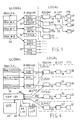
- FIG. 3 shows such tables and their linking in schematics. These tables are obviously stored in memory and, in view of the specific context of the invention, for each of them it is indicated if it is local (LOCAL) or global (GLOBAL), that is replicated in each of the local memories.
- LOCAL local
- GLOBAL global
- the memory space needed for storing such tables is allocated by the supervisor system, at initialization.
- the first table 30 named PROC.T.E is basically a list of processes (in Fig. 3 the generical processes PROC#X,PROC#Y,PROC#Z are shown) which have been created for execution in the system (by means of system primitives which in the case of UNIX V are FORK and EXEC).
- Process ID has a pointer to a data region named P-REGION.
- the P-REGION contains information related to the virtual address space used by the process (space bases) that is to the regions of addresses used by the process.
- P-REGIONs 31,32,33 are shown respectively connected to processes #X,#Y,#Z.
- a first region is for storing instructions executed by the process.
- a second region, named DATA is for storing data used and/or created by the process.
- a third region, named STACK is for storing transient information used in the course of process execution.
- a fourth or more regions is/are for storing global data.
- This data structure defines the virtual address base of the segment and a pointer to a further table named REGION.
- FIG. 3 shows REGION tables 34,35,36,37.
- Tables PROC.T.E. and P-REGION contain information which may be used and tested by more processors in differing processors.
- This information is a global data and therefore these tables are replicated in each one of the local memories in a shared memory segment of the "Kernel".
- This segment is allocated in a predetermined memory space whose physical address coincide with the real address.
- the REGION table related to each virtual segment of the process contains information as to the size and nature of the segment and a pointer to a second table or list named R-LIST (tables 38,39 of Fig. 3).
- the R-LIST defines, in terms of "displacement", the virtual addresses of the page sets which form the segment.
- Each address refers to a further table PTE (page table entry, tables 40,41,42,43 of Fig. 3).
- This table contains the physical page address which correspond to each logical address and which is assigned by the MMMS.
- Tables REGION, R-LIST and PTE have the character of information specific of the process which they describe. Therefore they are local data, stored only in the local memory of the processor where the process is active.
- REGION related to a shared memory segment contains further a pointer to a global data structure which the system uses to coordinate the use of the shared memory segment in the several CPUs.
- This data structure is an essential feature of the present invention.
- the conventional operation of an operating system with the above described data structures related to non shared segments is as follows.
- the operating system adds, in the table PROC.T.E, a new process identifier and related pointer, builds up a new P-REGION for the new process, a new REGION and a new R-LIST for each segment of the process and a new PTE table, where the physical pages are tagged as missing (invalid).
- the effective allocation of physical pages to the process, the compilation of the PTE tables with physical page addresses and their validation, are performed, page by page, on demand.
- the operating system further loads the possible references to a mass storage (disk) and a context register, contained in the MMU related to the processor. All the MMU entries are tagget as invalid. In fact, by the previous operations a certain memory space has been reserved, without filling it with valid contents.
- the processor controls the reading of a first instruction of the TEXT segment at a first virtual address. This address is received by the MMU.
- the MMU Since an invalid contents corresponds to this entry, the MMU generates an error signal (Page fault) which call for supervisor intervention.
- the supervisor may ascertain the reason of the error signal by means of the contex register contents and the already mentioned linked tables. Therefore it reads the first text page from a secondary storage and load it in an available physical page of local memory, whose physical address is caused to be related to the virtual address of the first text page.
- the PTE entry corresponding to the virtual page address is loaded with the corresponding physical page address and with a valid page indicator. Then the process may be restarted and proceeds until the generation of a virtual address for which there is no correspondence with a valid physical address.
- FIG. 4 shows in schematics, the tables used, in accordance with the invention, for managing shared memory segments, and the links of such tables.
- the system uses a new global table comprising a fixed size portion 44 SHM-DS (for Shared Memory-Data Structure) and a variable size portion GSD (for Global Segment Descriptor).
- SHM-DS Shared Memory-Data Structure
- GSD variable size portion
- Each of the local REGIONs contains the information already considered with reference to the TEXT,DATA,STACK segments.
- the local R-LISTs, related to the SHM segment, are functionally identical to those related to the TEXT,DATA,STACK segments.
- the format of the global segment descriptor GSD 45 is shown in Fig. 5 and comprises an identification header HD and one entry E1,E2,E3, for each logical page address of the segment.
- Each entry contains a page real address RA corresponding to a page logical address, a status bit GS, which defines the related page as global or local, a status bit for each CPU, S0,S1,S2,S3 which defines for each CPU if the page is valid or invalid and a swap area address SWA, where in case the information contained in the related page has to be saved.
- Table GSD points, through tables SHM-DS,REGION,R-LIST, as shown in Fig. 4 to four local tables PTE 58,59,60,61.
- Each one of tables 58,59,60,61 is for storing a physical page address corresponding to each virtual page address.
- a global table which is simply a list RALIST 62 (fig. 4) of real addresses used in association with global segments which have been created and are in existance, as well as a table 63 (KEYLIST) which establishes a relation between each global segment key and global segment identification code or shm-id.
- the shared memory identifier shm-id enables to directly point to the structure SHM-DS.
- shm-get is activated.
- This primitive checks if a shared segment having the required features and functionalities is already existing.
- This check is performed by means of the KEY LIST.
- the data structure SHM-DS (which is a global table, and is therefore replicated) is built up, to describe the new segment.
- a local REGION is built up in each CPU to provide a local description of the new segment; the SHM-DS table and the REGION tables are linked each other through pointers.
- a table GSD is allocated as global table (hence replicated in the local memory of each CPU).
- Table GDS is provided with the due heading, corresponding to the segment key or shm-id.
- the size of the table is defined as a function of the size of the segment to be described.
- table GSD is empty, except for the heading.
- the KEYLIST is updated with the new pair KEY/shm-id related to the created shared segment.
- Both REGION tables 50,51 are linked to the same table SHM-DS 44. Further, the first time the primitive shm-at is performed in a CPU for connecting the segment, the tables R-LIST (54,55,56,57 of Fig.4) and the tables PTE (58,59,60,61 of Fig.4) are built-up in the local memory of all the CPUs.
- this space is booked in terms of required number of pages, but not allocated.
- segment GSD is compiled with a series of real addresses choosen among those which have not been used, on the basis of the list RALIST, which is updated.
- the physical addresses so assigned are then written in the translation memory 8B for locally converting the real addresses in physical addresses.
- the field reserved to indicate the number of current users of the shared segment, initially empty, is incremented by one.
- shm-at primitive connects a shared segment to a process but does not allocate a physical memory space to the process.
- Allocation is made on demand, by the page fault mechanism, suitably modified.
- the memory management system MMMS is activated.
- GSD table it can be detected that the page is for a shared segment and it does not exist in any one of the local memories (bits S0,S1,S2,S3 invalid in GSD table).
- the MMMS system selects a free memory page and loads the related physical address in the PTE table.
- Bit 28 which characterizes the information as global or local is set to 0.
- the page fault mechanism is again activated and once ascertained that the page already exists in the same CPU, after having checked that the page is not yet global (block 119) and is referenced by the physical address stored in the PTE table, the MMU entries are updated to provide the new relation virtual address sinonym/physical address.
- the MMU would be loaded with the real address instead of the physical one.
- requesting CPU the MMMS system is activated and through the already considered tables it may ascertain that the page is already present in the local memory of another CPU (CPU0 which for the following is referenced as owing CPU).
- CPU0 which for the following is referenced as owing CPU.
- the requesting CPU then requests that the page be converted from local to global hence be replicated in all local memories.
- the requesting CPU gives instructions to all other CPUs and to itself, but not to the owning CPU, so that each one allocates a physical free page
- a predetermined real address, selected among those already booked and present in the GSD table is assigned to each allocated page.
- Each CPU other than the owning CPU by means of its own MMMS system, finds a free physical page within the local memory and loads the corresponding physical address in the translation memory 8B coupled to its own local memory, at the translation memory entry defined by the assigned real address.
- the physical address is also written in the PTE table.
- each CPU other than the owning CPU provides to notify the requesting CPU that the operations have been completed.
- the requesting CPU sends a message to the owing CPU and requests that the requested page be moved to the global space.
- the owning CPU sends a message to the requesting CPU and notifies that the page has been replicated, may be validated and the user process may be restarted.
- the requesting CPU once this message is received, updates the status bit, related to its own local memory, in the GSD table, validates the page in its own local memory and restarts the program who requested the page.
- the CPUs others than the owning and requesting one do not update the related status bit in the GSD table and leave invalid the page which is replicated in their local memory, even if present.
- the page fault mechanism detects, through the GSD table, that the page is global.
- a shared or global segment in the course of its use by a plurality of processors consists in a plurality of physical pages some of which are global, hence replicated in the local memory of the CPUs, which have requested them, others of which are local and present in only one of the local memories, not necessarily the same local memory for all the local pages.
- Fig. 6 shows the status of GSD table, compiled to describe the status of a virtual segment comprising pages defined by real addresses 1,2,3,4,5.
- the first one is implicit: at the end of a process the operating system causes the exit from the process.
- the second is explicit command, which controls the disconnection of a segment.
- the command shm-dt decrements by one the number of users stored in the structure SHM-DS and in the REGION table related to CPUN and tests if in the REGION table the users number has become zero.
- the CPUN signals to the receiving CPU that this second one is the last to use one or more pages of the shared segment and that such pages have to be converted in local pages.
- the receiving CPU get access in turn to the GSD table to change bit GS (global page indicator) from 1 to zero for all pages which remain of esclusive use by the receiving CPU.
- the physical address is obtained from the translation memory 8B coupled to the local memory related to the receiving CPU.
- the segment When in the last CPU using pages of the shared segment, the last process using the shared segment ends, the segment consists in local pages only, even if they may be distributed in several CPUs.
- figures 7,8,9 provide an example.
- bit S0 related to the pages having real address 2,3 is set to 0 (Fig. 7) and the related memory space in CPU0 becomes free (usable for other purpose).
- the page having real address 3 was global but used in CPU0 and CPU1 only. Therefore it becomes a local page of CPU1 (bit GS is set to 0) and the related memory space becomes available in all CPUs, except CPU1, for other purposes.
- Page 1 which was global, is converted to local and it is the only one still in use.
- the conversion of a page, from local to global, by its replication may be performed by the requesting CPU, rather than the owning CPU and by means of direct memory access (DMA) circuits, rather than by the CPU processor.
- DMA direct memory access
Landscapes
- Engineering & Computer Science (AREA)
- Computer Hardware Design (AREA)
- Physics & Mathematics (AREA)
- General Engineering & Computer Science (AREA)
- Theoretical Computer Science (AREA)
- Mathematical Physics (AREA)
- Software Systems (AREA)
- General Physics & Mathematics (AREA)
- Memory System Of A Hierarchy Structure (AREA)
- Computer And Data Communications (AREA)
- Multi Processors (AREA)
Applications Claiming Priority (2)
| Application Number | Priority Date | Filing Date | Title |
|---|---|---|---|
| IT2259389 | 1989-12-04 | ||
| IT22593A IT1239122B (it) | 1989-12-04 | 1989-12-04 | Sistema multiprocessore a risorse distribuite con replicazione dinamica di dati globali |
Publications (2)
| Publication Number | Publication Date |
|---|---|
| EP0431467A1 true EP0431467A1 (de) | 1991-06-12 |
| EP0431467B1 EP0431467B1 (de) | 1995-06-07 |
Family
ID=11198229
Family Applications (1)
| Application Number | Title | Priority Date | Filing Date |
|---|---|---|---|
| EP90122832A Expired - Lifetime EP0431467B1 (de) | 1989-12-04 | 1990-11-29 | Multiprozessorsystem mit verteilten gemeinsamen Betriebsmitteln und mit Vervielfältigung von globalen Daten |
Country Status (4)
| Country | Link |
|---|---|
| US (1) | US5247673A (de) |
| EP (1) | EP0431467B1 (de) |
| DE (1) | DE69019925T2 (de) |
| IT (1) | IT1239122B (de) |
Cited By (2)
| Publication number | Priority date | Publication date | Assignee | Title |
|---|---|---|---|---|
| EP0602772A1 (de) * | 1992-12-18 | 1994-06-22 | Fujitsu Limited | Mehrprozessorsystem |
| KR100295725B1 (ko) * | 1996-03-08 | 2001-08-07 | 포만 제프리 엘 | 공유데이터파일의사본관리방법,데이터관리시스템및컴퓨터시스템 |
Families Citing this family (41)
| Publication number | Priority date | Publication date | Assignee | Title |
|---|---|---|---|---|
| JPH05108473A (ja) * | 1991-03-20 | 1993-04-30 | Hitachi Ltd | デ−タ処理システム |
| US5446856A (en) * | 1991-04-29 | 1995-08-29 | Intel Corporation | Circuitry and method for addressing global array elements in a distributed memory, multiple processor computer |
| US5584017A (en) * | 1991-12-19 | 1996-12-10 | Intel Corporation | Cache control which inhibits snoop cycles if processor accessing memory is the only processor allowed to cache the memory location |
| SE515344C2 (sv) * | 1994-02-08 | 2001-07-16 | Ericsson Telefon Ab L M | Distribuerat databassystem |
| EP0678812A1 (de) * | 1994-04-20 | 1995-10-25 | Microsoft Corporation | Replikationsüberprüfung |
| US5717926A (en) * | 1995-02-28 | 1998-02-10 | International Business Machines Corporation | Efficient forking of a process |
| WO1997030399A1 (en) | 1996-02-20 | 1997-08-21 | Intergraph Corporation | High-availability super server |
| US6412017B1 (en) | 1996-07-01 | 2002-06-25 | Microsoft Corporation | Urgent replication facility |
| US5897656A (en) * | 1996-09-16 | 1999-04-27 | Corollary, Inc. | System and method for maintaining memory coherency in a computer system having multiple system buses |
| US6049809A (en) * | 1996-10-30 | 2000-04-11 | Microsoft Corporation | Replication optimization system and method |
| US5987506A (en) * | 1996-11-22 | 1999-11-16 | Mangosoft Corporation | Remote access and geographically distributed computers in a globally addressable storage environment |
| US6148377A (en) * | 1996-11-22 | 2000-11-14 | Mangosoft Corporation | Shared memory computer networks |
| US5909540A (en) * | 1996-11-22 | 1999-06-01 | Mangosoft Corporation | System and method for providing highly available data storage using globally addressable memory |
| US6647393B1 (en) * | 1996-11-22 | 2003-11-11 | Mangosoft Corporation | Dynamic directory service |
| US7058696B1 (en) | 1996-11-22 | 2006-06-06 | Mangosoft Corporation | Internet-based shared file service with native PC client access and semantics |
| US6026474A (en) * | 1996-11-22 | 2000-02-15 | Mangosoft Corporation | Shared client-side web caching using globally addressable memory |
| US6167437A (en) * | 1997-09-02 | 2000-12-26 | Silicon Graphics, Inc. | Method, system, and computer program product for page replication in a non-uniform memory access system |
| US6401174B1 (en) | 1997-09-05 | 2002-06-04 | Sun Microsystems, Inc. | Multiprocessing computer system employing a cluster communication error reporting mechanism |
| US6249802B1 (en) | 1997-09-19 | 2001-06-19 | Silicon Graphics, Inc. | Method, system, and computer program product for allocating physical memory in a distributed shared memory network |
| US6289424B1 (en) | 1997-09-19 | 2001-09-11 | Silicon Graphics, Inc. | Method, system and computer program product for managing memory in a non-uniform memory access system |
| US6148379A (en) * | 1997-09-19 | 2000-11-14 | Silicon Graphics, Inc. | System, method and computer program product for page sharing between fault-isolated cells in a distributed shared memory system |
| US7756830B1 (en) | 1999-03-31 | 2010-07-13 | International Business Machines Corporation | Error detection protocol |
| RU2163392C1 (ru) * | 2000-04-10 | 2001-02-20 | Государственное унитарное предприятие Центральный научно-исследовательский институт "Гранит" | Корабельная боевая информационно-управляющая система |
| US6711595B1 (en) | 2000-05-09 | 2004-03-23 | Openwave Systems Inc. | Method and apparatus for sharing standard template library objects among processes |
| RU2169943C1 (ru) * | 2000-05-22 | 2001-06-27 | Государственное унитарное предприятие Центральный научно-исследовательский институт "Гранит" | Многопроцессорная корабельная управляющая вычислительная система |
| US6430659B1 (en) * | 2000-09-22 | 2002-08-06 | International Business Machines Corporation | Method and means for increasing performance of multiprocessor computer systems by reducing accesses to global memory locations through the use of quanta |
| RU2174704C1 (ru) * | 2000-10-30 | 2001-10-10 | Государственное унитарное предприятие Центральный научно-исследовательский институт "Гранит" | Многопроцессорная корабельная управляющая вычислительная система |
| US20020161452A1 (en) * | 2001-04-25 | 2002-10-31 | Peltier Michael G. | Hierarchical collective memory architecture for multiple processors and method therefor |
| US6950846B2 (en) * | 2001-06-27 | 2005-09-27 | International Business Machines Corporation | Providing a globally consistent desired group of reachable nodes |
| US7302692B2 (en) | 2002-05-31 | 2007-11-27 | International Business Machines Corporation | Locally providing globally consistent information to communications layers |
| US7082600B1 (en) | 2002-11-04 | 2006-07-25 | Savaje Technologies, Inc. | Method and apparatus for integrating a computer application programming language runtime environment with an operating system kernel |
| US7086048B1 (en) * | 2002-11-04 | 2006-08-01 | Savaje Technologies, Inc. | Method and apparatus for combining operating system resource data and application program resource data in a shared object |
| US8527454B2 (en) | 2007-08-29 | 2013-09-03 | Emc Corporation | Data replication using a shared resource |
| US20090077777A1 (en) * | 2007-09-24 | 2009-03-26 | Horowitz Michael S | Looking good fashion clip |
| RU2406125C1 (ru) * | 2009-05-08 | 2010-12-10 | Федеральный научно-производственный центр Открытое акционерное общество "Научно-производственное объединение "Марс" | Многоуровневая многопроцессорная корабельная информационно-управляющая система |
| RU2583741C1 (ru) * | 2015-01-26 | 2016-05-10 | Открытое акционерное общество "Концерн "Гранит-Электрон" | Многопроцессорная корабельная вычислительная система |
| US11240334B2 (en) | 2015-10-01 | 2022-02-01 | TidalScale, Inc. | Network attached memory using selective resource migration |
| US11385926B2 (en) * | 2017-02-17 | 2022-07-12 | Intel Corporation | Application and system fast launch by virtual address area container |
| US11023135B2 (en) | 2017-06-27 | 2021-06-01 | TidalScale, Inc. | Handling frequently accessed pages |
| US10817347B2 (en) | 2017-08-31 | 2020-10-27 | TidalScale, Inc. | Entanglement of pages and guest threads |
| US11175927B2 (en) | 2017-11-14 | 2021-11-16 | TidalScale, Inc. | Fast boot |
Citations (2)
| Publication number | Priority date | Publication date | Assignee | Title |
|---|---|---|---|---|
| EP0081056A2 (de) * | 1981-11-27 | 1983-06-15 | International Business Machines Corporation | Datenverarbeitungsnetzwerk mit einer verteilten Dateizugriffskontrolle |
| GB2206714A (en) * | 1987-05-18 | 1989-01-11 | Singer Link Miles Ltd | Multiprocessing architecture |
Family Cites Families (2)
| Publication number | Priority date | Publication date | Assignee | Title |
|---|---|---|---|---|
| US4620276A (en) * | 1983-06-02 | 1986-10-28 | International Business Machines Corporation | Method and apparatus for asynchronous processing of dynamic replication messages |
| IT1223142B (it) * | 1987-11-17 | 1990-09-12 | Honeywell Bull Spa | Sistema multiprocessore di elaborazione con multiplazione di dati globali |
-
1989
- 1989-12-04 IT IT22593A patent/IT1239122B/it active IP Right Grant
-
1990
- 1990-11-16 US US07/614,804 patent/US5247673A/en not_active Expired - Lifetime
- 1990-11-29 DE DE69019925T patent/DE69019925T2/de not_active Expired - Fee Related
- 1990-11-29 EP EP90122832A patent/EP0431467B1/de not_active Expired - Lifetime
Patent Citations (2)
| Publication number | Priority date | Publication date | Assignee | Title |
|---|---|---|---|---|
| EP0081056A2 (de) * | 1981-11-27 | 1983-06-15 | International Business Machines Corporation | Datenverarbeitungsnetzwerk mit einer verteilten Dateizugriffskontrolle |
| GB2206714A (en) * | 1987-05-18 | 1989-01-11 | Singer Link Miles Ltd | Multiprocessing architecture |
Non-Patent Citations (2)
| Title |
|---|
| AFIPS CONFERENCE PROCEEDINGS, Anaheim, CA, 16th - 19th May 1983, pages 557-564; S.L. LILLEVIK et al.: "A multiprocessor with replicated shared memory" * |
| CERN CONFERENCE PROCEEDINGS, Geneva, 7th - 8th October 1985, pages 283-290; J. ZALEWSK: "An approach to programming multi-microprocessor bus systems" * |
Cited By (3)
| Publication number | Priority date | Publication date | Assignee | Title |
|---|---|---|---|---|
| EP0602772A1 (de) * | 1992-12-18 | 1994-06-22 | Fujitsu Limited | Mehrprozessorsystem |
| US5896501A (en) * | 1992-12-18 | 1999-04-20 | Fujitsu Limited | Multiprocessor system and parallel processing method for processing data transferred between processors |
| KR100295725B1 (ko) * | 1996-03-08 | 2001-08-07 | 포만 제프리 엘 | 공유데이터파일의사본관리방법,데이터관리시스템및컴퓨터시스템 |
Also Published As
| Publication number | Publication date |
|---|---|
| EP0431467B1 (de) | 1995-06-07 |
| IT1239122B (it) | 1993-09-28 |
| DE69019925T2 (de) | 1995-12-14 |
| US5247673A (en) | 1993-09-21 |
| IT8922593A1 (it) | 1991-06-04 |
| DE69019925D1 (de) | 1995-07-13 |
| IT8922593A0 (it) | 1989-12-04 |
Similar Documents
| Publication | Publication Date | Title |
|---|---|---|
| EP0431467B1 (de) | Multiprozessorsystem mit verteilten gemeinsamen Betriebsmitteln und mit Vervielfältigung von globalen Daten | |
| EP0447736B1 (de) | Mehrrechnersystem mit verteilten gemeinsamen Betriebsmitteln und dynamischer und selektiver Vervielfältigung globaler Daten und Verfahren dafür | |
| US5251308A (en) | Shared memory multiprocessor with data hiding and post-store | |
| US4742450A (en) | Method to share copy on write segment for mapped files | |
| JP2833062B2 (ja) | キャッシュメモリ制御方法とこのキャッシュメモリ制御方法を用いたプロセッサおよび情報処理装置 | |
| US6907494B2 (en) | Method and system of managing virtualized physical memory in a memory controller and processor system | |
| US4928225A (en) | Coherent cache structures and methods | |
| EP0258736B1 (de) | Parallelrechner mit verteilten, gemeinsam genutzten Speichern und verteilten, aufgabenaktivierenden Schaltungen | |
| US5539899A (en) | System and method for handling a segmented program in a memory for a multitasking data processing system utilizing paged virtual storage | |
| US5379394A (en) | Microprocessor with two groups of internal buses | |
| US8255591B2 (en) | Method and system for managing cache injection in a multiprocessor system | |
| US6920521B2 (en) | Method and system of managing virtualized physical memory in a data processing system | |
| US6904490B2 (en) | Method and system of managing virtualized physical memory in a multi-processor system | |
| JPH1124943A (ja) | 計算機再起動方法および計算機停止方法 | |
| JPH07210520A (ja) | メモリアクセス機構 | |
| JPH11232173A (ja) | ローカルメモリに組み込んでいるリモートキャッシュとcc−NUMA(キャッシュ整合型の不均一メモリアクセス)アーキテクチュアを有するデータ処理システム | |
| US7117338B2 (en) | Virtual memory address translation control by TLB purge monitoring | |
| JP3882321B2 (ja) | オペレーティングシステムのモジュールプログラムを備えた計算機 | |
| US20070150665A1 (en) | Propagating data using mirrored lock caches | |
| US6865651B2 (en) | Method and system for optimizing translation buffer recovery after a miss operation within a multi-processor environment | |
| US5440708A (en) | Microprocessor and storage management system having said microprocessor | |
| CA2019300C (en) | Multiprocessor system with shared memory | |
| JP3814521B2 (ja) | データ処理方法および装置 | |
| JPH0926910A (ja) | 情報処理装置及びその方法及び情報処理システム及びその制御方法 | |
| JP2829115B2 (ja) | ファイル共用方法 |
Legal Events
| Date | Code | Title | Description |
|---|---|---|---|
| PUAI | Public reference made under article 153(3) epc to a published international application that has entered the european phase |
Free format text: ORIGINAL CODE: 0009012 |
|
| AK | Designated contracting states |
Kind code of ref document: A1 Designated state(s): DE FR GB |
|
| 17P | Request for examination filed |
Effective date: 19910920 |
|
| 17Q | First examination report despatched |
Effective date: 19940906 |
|
| GRAA | (expected) grant |
Free format text: ORIGINAL CODE: 0009210 |
|
| AK | Designated contracting states |
Kind code of ref document: B1 Designated state(s): DE FR GB |
|
| REF | Corresponds to: |
Ref document number: 69019925 Country of ref document: DE Date of ref document: 19950713 |
|
| ET | Fr: translation filed | ||
| PLBE | No opposition filed within time limit |
Free format text: ORIGINAL CODE: 0009261 |
|
| STAA | Information on the status of an ep patent application or granted ep patent |
Free format text: STATUS: NO OPPOSITION FILED WITHIN TIME LIMIT |
|
| 26N | No opposition filed | ||
| REG | Reference to a national code |
Ref country code: GB Ref legal event code: IF02 |
|
| PGFP | Annual fee paid to national office [announced via postgrant information from national office to epo] |
Ref country code: DE Payment date: 20041026 Year of fee payment: 15 Ref country code: GB Payment date: 20041026 Year of fee payment: 15 |
|
| PG25 | Lapsed in a contracting state [announced via postgrant information from national office to epo] |
Ref country code: GB Free format text: LAPSE BECAUSE OF NON-PAYMENT OF DUE FEES Effective date: 20051129 |
|
| PG25 | Lapsed in a contracting state [announced via postgrant information from national office to epo] |
Ref country code: DE Free format text: LAPSE BECAUSE OF NON-PAYMENT OF DUE FEES Effective date: 20060601 |
|
| GBPC | Gb: european patent ceased through non-payment of renewal fee |
Effective date: 20051129 |
|
| PGFP | Annual fee paid to national office [announced via postgrant information from national office to epo] |
Ref country code: FR Payment date: 20071129 Year of fee payment: 18 |
|
| REG | Reference to a national code |
Ref country code: FR Ref legal event code: TP Ref country code: FR Ref legal event code: CD |
|
| REG | Reference to a national code |
Ref country code: FR Ref legal event code: TP |
|
| REG | Reference to a national code |
Ref country code: FR Ref legal event code: ST Effective date: 20090731 |
|
| PG25 | Lapsed in a contracting state [announced via postgrant information from national office to epo] |
Ref country code: FR Free format text: LAPSE BECAUSE OF NON-PAYMENT OF DUE FEES Effective date: 20081130 |