EP0432165B1 - Schwefelhaltige Polyalphaolefine mit hohem Viskositätsindex - Google Patents
Schwefelhaltige Polyalphaolefine mit hohem Viskositätsindex Download PDFInfo
- Publication number
- EP0432165B1 EP0432165B1 EP89907613A EP89907613A EP0432165B1 EP 0432165 B1 EP0432165 B1 EP 0432165B1 EP 89907613 A EP89907613 A EP 89907613A EP 89907613 A EP89907613 A EP 89907613A EP 0432165 B1 EP0432165 B1 EP 0432165B1
- Authority
- EP
- European Patent Office
- Prior art keywords
- lubricant
- sulfur
- catalyst
- oligomer
- adduct
- Prior art date
- Legal status (The legal status is an assumption and is not a legal conclusion. Google has not performed a legal analysis and makes no representation as to the accuracy of the status listed.)
- Expired - Lifetime
Links
- 229920013639 polyalphaolefin Polymers 0.000 title description 49
- 150000003568 thioethers Chemical class 0.000 title 1
- 239000000314 lubricant Substances 0.000 claims abstract description 51
- 239000004711 α-olefin Substances 0.000 claims abstract description 21
- 239000000654 additive Substances 0.000 claims abstract description 15
- 125000004432 carbon atom Chemical group C* 0.000 claims abstract description 4
- 239000003054 catalyst Substances 0.000 claims description 71
- AFFLGGQVNFXPEV-UHFFFAOYSA-N 1-decene Chemical compound CCCCCCCCC=C AFFLGGQVNFXPEV-UHFFFAOYSA-N 0.000 claims description 55
- 229910052717 sulfur Inorganic materials 0.000 claims description 34
- 239000011593 sulfur Substances 0.000 claims description 34
- NINIDFKCEFEMDL-UHFFFAOYSA-N Sulfur Chemical compound [S] NINIDFKCEFEMDL-UHFFFAOYSA-N 0.000 claims description 33
- 239000000203 mixture Substances 0.000 claims description 25
- 238000006384 oligomerization reaction Methods 0.000 claims description 10
- 239000007866 anti-wear additive Substances 0.000 claims description 8
- 239000007788 liquid Substances 0.000 claims description 8
- 239000010687 lubricating oil Substances 0.000 claims description 7
- 230000000996 additive effect Effects 0.000 claims description 6
- 239000003112 inhibitor Substances 0.000 claims description 6
- 125000002496 methyl group Chemical group [H]C([H])([H])* 0.000 claims description 6
- 239000011701 zinc Substances 0.000 claims description 6
- HCHKCACWOHOZIP-UHFFFAOYSA-N Zinc Chemical compound [Zn] HCHKCACWOHOZIP-UHFFFAOYSA-N 0.000 claims description 5
- 239000003963 antioxidant agent Substances 0.000 claims description 5
- 230000003647 oxidation Effects 0.000 claims description 5
- 238000007254 oxidation reaction Methods 0.000 claims description 5
- 229910052725 zinc Inorganic materials 0.000 claims description 5
- OAICVXFJPJFONN-UHFFFAOYSA-N Phosphorus Chemical compound [P] OAICVXFJPJFONN-UHFFFAOYSA-N 0.000 claims description 4
- UCKMPCXJQFINFW-UHFFFAOYSA-N Sulphide Chemical compound [S-2] UCKMPCXJQFINFW-UHFFFAOYSA-N 0.000 claims description 4
- 239000003638 chemical reducing agent Substances 0.000 claims description 4
- 239000002480 mineral oil Substances 0.000 claims description 4
- 235000010446 mineral oil Nutrition 0.000 claims description 4
- 229910052698 phosphorus Inorganic materials 0.000 claims description 4
- 239000011574 phosphorus Substances 0.000 claims description 4
- WGLPBDUCMAPZCE-UHFFFAOYSA-N Trioxochromium Chemical compound O=[Cr](=O)=O WGLPBDUCMAPZCE-UHFFFAOYSA-N 0.000 claims description 3
- 229910052799 carbon Inorganic materials 0.000 claims description 2
- 238000005260 corrosion Methods 0.000 claims description 2
- 230000007797 corrosion Effects 0.000 claims description 2
- 239000002270 dispersing agent Substances 0.000 claims description 2
- 239000003995 emulsifying agent Substances 0.000 claims description 2
- 239000005077 polysulfide Substances 0.000 claims description 2
- 229920001021 polysulfide Polymers 0.000 claims description 2
- 150000008117 polysulfides Polymers 0.000 claims description 2
- 238000011282 treatment Methods 0.000 claims description 2
- BWGNESOTFCXPMA-UHFFFAOYSA-N Dihydrogen disulfide Chemical compound SS BWGNESOTFCXPMA-UHFFFAOYSA-N 0.000 claims 1
- 239000003153 chemical reaction reagent Substances 0.000 claims 1
- 229910000423 chromium oxide Inorganic materials 0.000 claims 1
- 239000003599 detergent Substances 0.000 claims 1
- 239000004519 grease Substances 0.000 claims 1
- 125000001570 methylene group Chemical group [H]C([H])([*:1])[*:2] 0.000 claims 1
- 230000001590 oxidative effect Effects 0.000 claims 1
- 239000010689 synthetic lubricating oil Substances 0.000 claims 1
- 150000003463 sulfur Chemical class 0.000 abstract description 4
- 239000000047 product Substances 0.000 description 45
- 150000001336 alkenes Chemical class 0.000 description 36
- VYPSYNLAJGMNEJ-UHFFFAOYSA-N Silicium dioxide Chemical compound O=[Si]=O VYPSYNLAJGMNEJ-UHFFFAOYSA-N 0.000 description 27
- JRZJOMJEPLMPRA-UHFFFAOYSA-N olefin Natural products CCCCCCCC=C JRZJOMJEPLMPRA-UHFFFAOYSA-N 0.000 description 21
- 238000006243 chemical reaction Methods 0.000 description 20
- LIKMAJRDDDTEIG-UHFFFAOYSA-N 1-hexene Chemical compound CCCCC=C LIKMAJRDDDTEIG-UHFFFAOYSA-N 0.000 description 18
- 239000003921 oil Substances 0.000 description 18
- 239000011651 chromium Substances 0.000 description 16
- 238000000034 method Methods 0.000 description 16
- 238000001644 13C nuclear magnetic resonance spectroscopy Methods 0.000 description 14
- 239000013638 trimer Substances 0.000 description 13
- 239000000377 silicon dioxide Substances 0.000 description 11
- 239000000126 substance Substances 0.000 description 11
- 239000011148 porous material Substances 0.000 description 9
- 238000001228 spectrum Methods 0.000 description 9
- VSCWAEJMTAWNJL-UHFFFAOYSA-K aluminium trichloride Chemical compound Cl[Al](Cl)Cl VSCWAEJMTAWNJL-UHFFFAOYSA-K 0.000 description 8
- 239000000539 dimer Substances 0.000 description 8
- 239000012530 fluid Substances 0.000 description 8
- 229920000642 polymer Polymers 0.000 description 8
- -1 VIB metal oxide Chemical class 0.000 description 7
- 230000003078 antioxidant effect Effects 0.000 description 7
- 229910052804 chromium Inorganic materials 0.000 description 7
- 150000001875 compounds Chemical class 0.000 description 7
- 238000009472 formulation Methods 0.000 description 7
- 238000006317 isomerization reaction Methods 0.000 description 7
- 230000001050 lubricating effect Effects 0.000 description 7
- 239000000463 material Substances 0.000 description 7
- QTBSBXVTEAMEQO-UHFFFAOYSA-N Acetic acid Chemical compound CC(O)=O QTBSBXVTEAMEQO-UHFFFAOYSA-N 0.000 description 6
- IJGRMHOSHXDMSA-UHFFFAOYSA-N Atomic nitrogen Chemical compound N#N IJGRMHOSHXDMSA-UHFFFAOYSA-N 0.000 description 6
- VYZAMTAEIAYCRO-UHFFFAOYSA-N Chromium Chemical compound [Cr] VYZAMTAEIAYCRO-UHFFFAOYSA-N 0.000 description 6
- 238000005481 NMR spectroscopy Methods 0.000 description 6
- 238000000921 elemental analysis Methods 0.000 description 6
- 229910052751 metal Inorganic materials 0.000 description 6
- 239000002184 metal Substances 0.000 description 6
- 239000002904 solvent Substances 0.000 description 6
- 239000007795 chemical reaction product Substances 0.000 description 5
- 229910044991 metal oxide Inorganic materials 0.000 description 5
- 238000006116 polymerization reaction Methods 0.000 description 5
- VXNZUUAINFGPBY-UHFFFAOYSA-N 1-Butene Chemical compound CCC=C VXNZUUAINFGPBY-UHFFFAOYSA-N 0.000 description 4
- KWKAKUADMBZCLK-UHFFFAOYSA-N 1-octene Chemical compound CCCCCCC=C KWKAKUADMBZCLK-UHFFFAOYSA-N 0.000 description 4
- HFDVRLIODXPAHB-UHFFFAOYSA-N 1-tetradecene Chemical compound CCCCCCCCCCCCC=C HFDVRLIODXPAHB-UHFFFAOYSA-N 0.000 description 4
- 125000000217 alkyl group Chemical group 0.000 description 4
- 239000012298 atmosphere Substances 0.000 description 4
- 238000005336 cracking Methods 0.000 description 4
- 238000009826 distribution Methods 0.000 description 4
- 230000000694 effects Effects 0.000 description 4
- 150000002430 hydrocarbons Chemical class 0.000 description 4
- 238000005984 hydrogenation reaction Methods 0.000 description 4
- 239000003879 lubricant additive Substances 0.000 description 4
- 150000004706 metal oxides Chemical class 0.000 description 4
- VLKZOEOYAKHREP-UHFFFAOYSA-N n-Hexane Chemical compound CCCCCC VLKZOEOYAKHREP-UHFFFAOYSA-N 0.000 description 4
- 239000012299 nitrogen atmosphere Substances 0.000 description 4
- 239000003208 petroleum Substances 0.000 description 4
- 238000002360 preparation method Methods 0.000 description 4
- 239000011541 reaction mixture Substances 0.000 description 4
- LFQSCWFLJHTTHZ-UHFFFAOYSA-N Ethanol Chemical compound CCO LFQSCWFLJHTTHZ-UHFFFAOYSA-N 0.000 description 3
- OKKJLVBELUTLKV-UHFFFAOYSA-N Methanol Chemical compound OC OKKJLVBELUTLKV-UHFFFAOYSA-N 0.000 description 3
- 150000001412 amines Chemical class 0.000 description 3
- 238000004458 analytical method Methods 0.000 description 3
- 238000009835 boiling Methods 0.000 description 3
- 230000003197 catalytic effect Effects 0.000 description 3
- 238000004821 distillation Methods 0.000 description 3
- 239000007789 gas Substances 0.000 description 3
- 229930195733 hydrocarbon Natural products 0.000 description 3
- 229910052500 inorganic mineral Inorganic materials 0.000 description 3
- 239000000543 intermediate Substances 0.000 description 3
- 238000004519 manufacturing process Methods 0.000 description 3
- 125000000325 methylidene group Chemical group [H]C([H])=* 0.000 description 3
- 239000011707 mineral Substances 0.000 description 3
- 229910052757 nitrogen Inorganic materials 0.000 description 3
- 150000002895 organic esters Chemical class 0.000 description 3
- 230000008569 process Effects 0.000 description 3
- 238000007086 side reaction Methods 0.000 description 3
- 229910002027 silica gel Inorganic materials 0.000 description 3
- 239000000741 silica gel Substances 0.000 description 3
- 239000002002 slurry Substances 0.000 description 3
- 239000007787 solid Substances 0.000 description 3
- 239000000243 solution Substances 0.000 description 3
- 238000010186 staining Methods 0.000 description 3
- 150000004763 sulfides Chemical class 0.000 description 3
- 238000003786 synthesis reaction Methods 0.000 description 3
- 238000012360 testing method Methods 0.000 description 3
- BIGYLAKFCGVRAN-UHFFFAOYSA-N 1,3,4-thiadiazolidine-2,5-dithione Chemical compound S=C1NNC(=S)S1 BIGYLAKFCGVRAN-UHFFFAOYSA-N 0.000 description 2
- YXIWHUQXZSMYRE-UHFFFAOYSA-N 1,3-benzothiazole-2-thiol Chemical compound C1=CC=C2SC(S)=NC2=C1 YXIWHUQXZSMYRE-UHFFFAOYSA-N 0.000 description 2
- ZGEGCLOFRBLKSE-UHFFFAOYSA-N 1-Heptene Chemical compound CCCCCC=C ZGEGCLOFRBLKSE-UHFFFAOYSA-N 0.000 description 2
- CRSBERNSMYQZNG-UHFFFAOYSA-N 1-dodecene Chemical compound CCCCCCCCCCC=C CRSBERNSMYQZNG-UHFFFAOYSA-N 0.000 description 2
- GQEZCXVZFLOKMC-UHFFFAOYSA-N 1-hexadecene Chemical compound CCCCCCCCCCCCCCC=C GQEZCXVZFLOKMC-UHFFFAOYSA-N 0.000 description 2
- WSSSPWUEQFSQQG-UHFFFAOYSA-N 4-methyl-1-pentene Chemical compound CC(C)CC=C WSSSPWUEQFSQQG-UHFFFAOYSA-N 0.000 description 2
- OLTHARGIAFTREU-UHFFFAOYSA-N 9-methylnonacosane Chemical compound CCCCCCCCCCCCCCCCCCCCC(C)CCCCCCCC OLTHARGIAFTREU-UHFFFAOYSA-N 0.000 description 2
- RWSOTUBLDIXVET-UHFFFAOYSA-N Dihydrogen sulfide Chemical compound S RWSOTUBLDIXVET-UHFFFAOYSA-N 0.000 description 2
- CPLXHLVBOLITMK-UHFFFAOYSA-N Magnesium oxide Chemical compound [Mg]=O CPLXHLVBOLITMK-UHFFFAOYSA-N 0.000 description 2
- IMNFDUFMRHMDMM-UHFFFAOYSA-N N-Heptane Chemical compound CCCCCCC IMNFDUFMRHMDMM-UHFFFAOYSA-N 0.000 description 2
- GWEVSGVZZGPLCZ-UHFFFAOYSA-N Titan oxide Chemical compound O=[Ti]=O GWEVSGVZZGPLCZ-UHFFFAOYSA-N 0.000 description 2
- PNEYBMLMFCGWSK-UHFFFAOYSA-N aluminium oxide Inorganic materials [O-2].[O-2].[O-2].[Al+3].[Al+3] PNEYBMLMFCGWSK-UHFFFAOYSA-N 0.000 description 2
- 230000015572 biosynthetic process Effects 0.000 description 2
- 238000006555 catalytic reaction Methods 0.000 description 2
- 239000003795 chemical substances by application Substances 0.000 description 2
- 238000004587 chromatography analysis Methods 0.000 description 2
- 239000012967 coordination catalyst Substances 0.000 description 2
- HOWGUJZVBDQJKV-UHFFFAOYSA-N docosane Chemical compound CCCCCCCCCCCCCCCCCCCCCC HOWGUJZVBDQJKV-UHFFFAOYSA-N 0.000 description 2
- 238000005516 engineering process Methods 0.000 description 2
- 239000012208 gear oil Substances 0.000 description 2
- FNAZRRHPUDJQCJ-UHFFFAOYSA-N henicosane Chemical compound CCCCCCCCCCCCCCCCCCCCC FNAZRRHPUDJQCJ-UHFFFAOYSA-N 0.000 description 2
- 125000000623 heterocyclic group Chemical group 0.000 description 2
- 238000004128 high performance liquid chromatography Methods 0.000 description 2
- 239000001257 hydrogen Substances 0.000 description 2
- 229910052739 hydrogen Inorganic materials 0.000 description 2
- 125000004435 hydrogen atom Chemical class [H]* 0.000 description 2
- 229910000037 hydrogen sulfide Inorganic materials 0.000 description 2
- CBFCDTFDPHXCNY-UHFFFAOYSA-N icosane Chemical compound CCCCCCCCCCCCCCCCCCCC CBFCDTFDPHXCNY-UHFFFAOYSA-N 0.000 description 2
- 238000010348 incorporation Methods 0.000 description 2
- 238000005461 lubrication Methods 0.000 description 2
- 230000014759 maintenance of location Effects 0.000 description 2
- 239000010705 motor oil Substances 0.000 description 2
- TVMXDCGIABBOFY-UHFFFAOYSA-N n-Octanol Natural products CCCCCCCC TVMXDCGIABBOFY-UHFFFAOYSA-N 0.000 description 2
- 230000003606 oligomerizing effect Effects 0.000 description 2
- 239000003960 organic solvent Substances 0.000 description 2
- 239000000376 reactant Substances 0.000 description 2
- 238000000926 separation method Methods 0.000 description 2
- 239000007858 starting material Substances 0.000 description 2
- 239000000758 substrate Substances 0.000 description 2
- 238000005987 sulfurization reaction Methods 0.000 description 2
- 229910002029 synthetic silica gel Inorganic materials 0.000 description 2
- WMYJOZQKDZZHAC-UHFFFAOYSA-H trizinc;dioxido-sulfanylidene-sulfido-$l^{5}-phosphane Chemical class [Zn+2].[Zn+2].[Zn+2].[O-]P([O-])([S-])=S.[O-]P([O-])([S-])=S WMYJOZQKDZZHAC-UHFFFAOYSA-H 0.000 description 2
- XLYOFNOQVPJJNP-UHFFFAOYSA-N water Substances O XLYOFNOQVPJJNP-UHFFFAOYSA-N 0.000 description 2
- UVLKUUBSZXVVDZ-HTXNQAPBSA-N (e)-icos-9-ene Chemical compound CCCCCCCCCC\C=C\CCCCCCCC UVLKUUBSZXVVDZ-HTXNQAPBSA-N 0.000 description 1
- YHMYGUUIMTVXNW-UHFFFAOYSA-N 1,3-dihydrobenzimidazole-2-thione Chemical compound C1=CC=C2NC(S)=NC2=C1 YHMYGUUIMTVXNW-UHFFFAOYSA-N 0.000 description 1
- TXIGBDWGZSSUHZ-UHFFFAOYSA-N 11-octyldocosane Chemical compound CCCCCCCCCCCC(CCCCCCCC)CCCCCCCCCC TXIGBDWGZSSUHZ-UHFFFAOYSA-N 0.000 description 1
- CDQPRLDIAOVHRJ-UHFFFAOYSA-N 9-methyl-11-octylhenicosane Chemical compound CCCCCCCCCCC(CCCCCCCC)CC(C)CCCCCCCC CDQPRLDIAOVHRJ-UHFFFAOYSA-N 0.000 description 1
- NEAFLGWVOVUKRO-UHFFFAOYSA-N 9-methylidenenonadecane Chemical compound CCCCCCCCCCC(=C)CCCCCCCC NEAFLGWVOVUKRO-UHFFFAOYSA-N 0.000 description 1
- VAEODIOQYMCRMF-UHFFFAOYSA-N 9-methylnonadec-9-ene Chemical compound CCCCCCCCCC=C(C)CCCCCCCC VAEODIOQYMCRMF-UHFFFAOYSA-N 0.000 description 1
- OKTJSMMVPCPJKN-UHFFFAOYSA-N Carbon Chemical compound [C] OKTJSMMVPCPJKN-UHFFFAOYSA-N 0.000 description 1
- 239000004215 Carbon black (E152) Substances 0.000 description 1
- OKTJSMMVPCPJKN-OUBTZVSYSA-N Carbon-13 Chemical compound [13C] OKTJSMMVPCPJKN-OUBTZVSYSA-N 0.000 description 1
- RYGMFSIKBFXOCR-UHFFFAOYSA-N Copper Chemical compound [Cu] RYGMFSIKBFXOCR-UHFFFAOYSA-N 0.000 description 1
- 230000005526 G1 to G0 transition Effects 0.000 description 1
- 238000004566 IR spectroscopy Methods 0.000 description 1
- VQTUBCCKSQIDNK-UHFFFAOYSA-N Isobutene Chemical class CC(C)=C VQTUBCCKSQIDNK-UHFFFAOYSA-N 0.000 description 1
- 239000002841 Lewis acid Substances 0.000 description 1
- LSDPWZHWYPCBBB-UHFFFAOYSA-N Methanethiol Chemical compound SC LSDPWZHWYPCBBB-UHFFFAOYSA-N 0.000 description 1
- 229910019142 PO4 Inorganic materials 0.000 description 1
- 229920002367 Polyisobutene Polymers 0.000 description 1
- VKCLPVFDVVKEKU-UHFFFAOYSA-N S=[P] Chemical class S=[P] VKCLPVFDVVKEKU-UHFFFAOYSA-N 0.000 description 1
- 150000001242 acetic acid derivatives Chemical class 0.000 description 1
- WDNIVTZNAPEMHF-UHFFFAOYSA-N acetic acid;chromium Chemical compound [Cr].CC(O)=O.CC(O)=O WDNIVTZNAPEMHF-UHFFFAOYSA-N 0.000 description 1
- 238000007171 acid catalysis Methods 0.000 description 1
- 230000004913 activation Effects 0.000 description 1
- 239000002998 adhesive polymer Substances 0.000 description 1
- 125000003545 alkoxy group Chemical group 0.000 description 1
- 125000003277 amino group Chemical group 0.000 description 1
- 238000005899 aromatization reaction Methods 0.000 description 1
- 125000003118 aryl group Chemical group 0.000 description 1
- QVGXLLKOCUKJST-UHFFFAOYSA-N atomic oxygen Chemical compound [O] QVGXLLKOCUKJST-UHFFFAOYSA-N 0.000 description 1
- 230000009286 beneficial effect Effects 0.000 description 1
- 238000001354 calcination Methods 0.000 description 1
- 238000004364 calculation method Methods 0.000 description 1
- 239000012159 carrier gas Substances 0.000 description 1
- 230000008859 change Effects 0.000 description 1
- 150000001844 chromium Chemical class 0.000 description 1
- UZEDIBTVIIJELN-UHFFFAOYSA-N chromium(2+) Chemical compound [Cr+2] UZEDIBTVIIJELN-UHFFFAOYSA-N 0.000 description 1
- BFGKITSFLPAWGI-UHFFFAOYSA-N chromium(3+) Chemical compound [Cr+3] BFGKITSFLPAWGI-UHFFFAOYSA-N 0.000 description 1
- UOUJSJZBMCDAEU-UHFFFAOYSA-N chromium(3+);oxygen(2-) Chemical class [O-2].[O-2].[O-2].[Cr+3].[Cr+3] UOUJSJZBMCDAEU-UHFFFAOYSA-N 0.000 description 1
- WYYQVWLEPYFFLP-UHFFFAOYSA-K chromium(3+);triacetate Chemical compound [Cr+3].CC([O-])=O.CC([O-])=O.CC([O-])=O WYYQVWLEPYFFLP-UHFFFAOYSA-K 0.000 description 1
- 239000004927 clay Substances 0.000 description 1
- 239000003426 co-catalyst Substances 0.000 description 1
- 239000003086 colorant Substances 0.000 description 1
- 239000012230 colorless oil Substances 0.000 description 1
- 238000002485 combustion reaction Methods 0.000 description 1
- 229910052802 copper Inorganic materials 0.000 description 1
- 239000010949 copper Substances 0.000 description 1
- 238000006356 dehydrogenation reaction Methods 0.000 description 1
- 238000006704 dehydrohalogenation reaction Methods 0.000 description 1
- QDOXWKRWXJOMAK-UHFFFAOYSA-N dichromium trioxide Chemical compound O=[Cr]O[Cr]=O QDOXWKRWXJOMAK-UHFFFAOYSA-N 0.000 description 1
- 239000006185 dispersion Substances 0.000 description 1
- 150000002019 disulfides Chemical class 0.000 description 1
- PXJJSXABGXMUSU-UHFFFAOYSA-N disulfur dichloride Chemical compound ClSSCl PXJJSXABGXMUSU-UHFFFAOYSA-N 0.000 description 1
- SNRUBQQJIBEYMU-UHFFFAOYSA-N dodecane Chemical compound CCCCCCCCCCCC SNRUBQQJIBEYMU-UHFFFAOYSA-N 0.000 description 1
- 229940069096 dodecene Drugs 0.000 description 1
- 230000009977 dual effect Effects 0.000 description 1
- 230000007613 environmental effect Effects 0.000 description 1
- 150000002148 esters Chemical class 0.000 description 1
- 230000001747 exhibiting effect Effects 0.000 description 1
- 230000002349 favourable effect Effects 0.000 description 1
- 238000001914 filtration Methods 0.000 description 1
- 239000006260 foam Substances 0.000 description 1
- 238000007306 functionalization reaction Methods 0.000 description 1
- 238000004817 gas chromatography Methods 0.000 description 1
- 239000000499 gel Substances 0.000 description 1
- 239000011521 glass Substances 0.000 description 1
- 238000010438 heat treatment Methods 0.000 description 1
- MJOOWVYBALWUTI-UHFFFAOYSA-N hexanedioic acid;tridecan-1-ol Chemical compound OC(=O)CCCCC(O)=O.CCCCCCCCCCCCCO.CCCCCCCCCCCCCO MJOOWVYBALWUTI-UHFFFAOYSA-N 0.000 description 1
- 229920006158 high molecular weight polymer Polymers 0.000 description 1
- GHYZNGUAPGNBKZ-UHFFFAOYSA-N icos-8-ene Chemical compound CCCCCCCCCCCC=CCCCCCCC GHYZNGUAPGNBKZ-UHFFFAOYSA-N 0.000 description 1
- 230000002401 inhibitory effect Effects 0.000 description 1
- 238000002347 injection Methods 0.000 description 1
- 239000007924 injection Substances 0.000 description 1
- JEIPFZHSYJVQDO-UHFFFAOYSA-N iron(III) oxide Inorganic materials O=[Fe]O[Fe]=O JEIPFZHSYJVQDO-UHFFFAOYSA-N 0.000 description 1
- 239000011968 lewis acid catalyst Substances 0.000 description 1
- 150000007517 lewis acids Chemical class 0.000 description 1
- 239000007791 liquid phase Substances 0.000 description 1
- 239000000395 magnesium oxide Substances 0.000 description 1
- 238000002844 melting Methods 0.000 description 1
- 230000008018 melting Effects 0.000 description 1
- 150000002736 metal compounds Chemical class 0.000 description 1
- 238000002156 mixing Methods 0.000 description 1
- 239000002808 molecular sieve Substances 0.000 description 1
- VAMFXQBUQXONLZ-UHFFFAOYSA-N n-alpha-eicosene Natural products CCCCCCCCCCCCCCCCCCC=C VAMFXQBUQXONLZ-UHFFFAOYSA-N 0.000 description 1
- 229940094933 n-dodecane Drugs 0.000 description 1
- 150000002823 nitrates Chemical class 0.000 description 1
- QJGQUHMNIGDVPM-UHFFFAOYSA-N nitrogen group Chemical group [N] QJGQUHMNIGDVPM-UHFFFAOYSA-N 0.000 description 1
- 230000009972 noncorrosive effect Effects 0.000 description 1
- 229910052760 oxygen Inorganic materials 0.000 description 1
- 239000001301 oxygen Substances 0.000 description 1
- 239000002245 particle Substances 0.000 description 1
- 238000002161 passivation Methods 0.000 description 1
- 230000000737 periodic effect Effects 0.000 description 1
- 235000021317 phosphate Nutrition 0.000 description 1
- 150000003013 phosphoric acid derivatives Chemical class 0.000 description 1
- 229920000151 polyglycol Polymers 0.000 description 1
- 239000010695 polyglycol Substances 0.000 description 1
- 230000000379 polymerizing effect Effects 0.000 description 1
- 229920013636 polyphenyl ether polymer Polymers 0.000 description 1
- 229920001296 polysiloxane Polymers 0.000 description 1
- 239000002243 precursor Substances 0.000 description 1
- 238000010926 purge Methods 0.000 description 1
- 239000002516 radical scavenger Substances 0.000 description 1
- 230000009257 reactivity Effects 0.000 description 1
- 230000000717 retained effect Effects 0.000 description 1
- 150000003839 salts Chemical class 0.000 description 1
- 150000004760 silicates Chemical class 0.000 description 1
- URGAHOPLAPQHLN-UHFFFAOYSA-N sodium aluminosilicate Chemical compound [Na+].[Al+3].[O-][Si]([O-])=O.[O-][Si]([O-])=O URGAHOPLAPQHLN-UHFFFAOYSA-N 0.000 description 1
- 239000011949 solid catalyst Substances 0.000 description 1
- 229910001220 stainless steel Inorganic materials 0.000 description 1
- 239000010935 stainless steel Substances 0.000 description 1
- FNKUJDADVODZOY-UHFFFAOYSA-N sulfanyl thiohypochlorite Chemical compound SSCl FNKUJDADVODZOY-UHFFFAOYSA-N 0.000 description 1
- 125000004354 sulfur functional group Chemical group 0.000 description 1
- 239000000725 suspension Substances 0.000 description 1
- 238000006276 transfer reaction Methods 0.000 description 1
- 239000003039 volatile agent Substances 0.000 description 1
- 239000003643 water by type Substances 0.000 description 1
Images



Classifications
-
- C—CHEMISTRY; METALLURGY
- C10—PETROLEUM, GAS OR COKE INDUSTRIES; TECHNICAL GASES CONTAINING CARBON MONOXIDE; FUELS; LUBRICANTS; PEAT
- C10M—LUBRICATING COMPOSITIONS; USE OF CHEMICAL SUBSTANCES EITHER ALONE OR AS LUBRICATING INGREDIENTS IN A LUBRICATING COMPOSITION
- C10M169/00—Lubricating compositions characterised by containing as components a mixture of at least two types of ingredient selected from base-materials, thickeners or additives, covered by the preceding groups, each of these compounds being essential
- C10M169/04—Mixtures of base-materials and additives
- C10M169/041—Mixtures of base-materials and additives the additives being macromolecular compounds only
-
- C—CHEMISTRY; METALLURGY
- C10—PETROLEUM, GAS OR COKE INDUSTRIES; TECHNICAL GASES CONTAINING CARBON MONOXIDE; FUELS; LUBRICANTS; PEAT
- C10M—LUBRICATING COMPOSITIONS; USE OF CHEMICAL SUBSTANCES EITHER ALONE OR AS LUBRICATING INGREDIENTS IN A LUBRICATING COMPOSITION
- C10M107/00—Lubricating compositions characterised by the base-material being a macromolecular compound
- C10M107/02—Hydrocarbon polymers; Hydrocarbon polymers modified by oxidation
- C10M107/10—Hydrocarbon polymers; Hydrocarbon polymers modified by oxidation containing aliphatic monomer having more than 4 carbon atoms
-
- C—CHEMISTRY; METALLURGY
- C10—PETROLEUM, GAS OR COKE INDUSTRIES; TECHNICAL GASES CONTAINING CARBON MONOXIDE; FUELS; LUBRICANTS; PEAT
- C10M—LUBRICATING COMPOSITIONS; USE OF CHEMICAL SUBSTANCES EITHER ALONE OR AS LUBRICATING INGREDIENTS IN A LUBRICATING COMPOSITION
- C10M143/00—Lubricating compositions characterised by the additive being a macromolecular hydrocarbon or such hydrocarbon modified by oxidation
- C10M143/08—Lubricating compositions characterised by the additive being a macromolecular hydrocarbon or such hydrocarbon modified by oxidation containing aliphatic monomer having more than 4 carbon atoms
-
- C—CHEMISTRY; METALLURGY
- C10—PETROLEUM, GAS OR COKE INDUSTRIES; TECHNICAL GASES CONTAINING CARBON MONOXIDE; FUELS; LUBRICANTS; PEAT
- C10M—LUBRICATING COMPOSITIONS; USE OF CHEMICAL SUBSTANCES EITHER ALONE OR AS LUBRICATING INGREDIENTS IN A LUBRICATING COMPOSITION
- C10M151/00—Lubricating compositions characterised by the additive being a macromolecular compound containing sulfur, selenium or tellurium
- C10M151/02—Macromolecular compounds obtained by reactions involving only carbon-to-carbon unsaturated bonds
-
- C—CHEMISTRY; METALLURGY
- C10—PETROLEUM, GAS OR COKE INDUSTRIES; TECHNICAL GASES CONTAINING CARBON MONOXIDE; FUELS; LUBRICANTS; PEAT
- C10M—LUBRICATING COMPOSITIONS; USE OF CHEMICAL SUBSTANCES EITHER ALONE OR AS LUBRICATING INGREDIENTS IN A LUBRICATING COMPOSITION
- C10M169/00—Lubricating compositions characterised by containing as components a mixture of at least two types of ingredient selected from base-materials, thickeners or additives, covered by the preceding groups, each of these compounds being essential
- C10M169/04—Mixtures of base-materials and additives
-
- C—CHEMISTRY; METALLURGY
- C10—PETROLEUM, GAS OR COKE INDUSTRIES; TECHNICAL GASES CONTAINING CARBON MONOXIDE; FUELS; LUBRICANTS; PEAT
- C10M—LUBRICATING COMPOSITIONS; USE OF CHEMICAL SUBSTANCES EITHER ALONE OR AS LUBRICATING INGREDIENTS IN A LUBRICATING COMPOSITION
- C10M2205/00—Organic macromolecular hydrocarbon compounds or fractions, whether or not modified by oxidation as ingredients in lubricant compositions
- C10M2205/02—Organic macromolecular hydrocarbon compounds or fractions, whether or not modified by oxidation as ingredients in lubricant compositions containing acyclic monomers
- C10M2205/028—Organic macromolecular hydrocarbon compounds or fractions, whether or not modified by oxidation as ingredients in lubricant compositions containing acyclic monomers containing aliphatic monomers having more than four carbon atoms
-
- C—CHEMISTRY; METALLURGY
- C10—PETROLEUM, GAS OR COKE INDUSTRIES; TECHNICAL GASES CONTAINING CARBON MONOXIDE; FUELS; LUBRICANTS; PEAT
- C10M—LUBRICATING COMPOSITIONS; USE OF CHEMICAL SUBSTANCES EITHER ALONE OR AS LUBRICATING INGREDIENTS IN A LUBRICATING COMPOSITION
- C10M2205/00—Organic macromolecular hydrocarbon compounds or fractions, whether or not modified by oxidation as ingredients in lubricant compositions
- C10M2205/02—Organic macromolecular hydrocarbon compounds or fractions, whether or not modified by oxidation as ingredients in lubricant compositions containing acyclic monomers
- C10M2205/028—Organic macromolecular hydrocarbon compounds or fractions, whether or not modified by oxidation as ingredients in lubricant compositions containing acyclic monomers containing aliphatic monomers having more than four carbon atoms
- C10M2205/0285—Organic macromolecular hydrocarbon compounds or fractions, whether or not modified by oxidation as ingredients in lubricant compositions containing acyclic monomers containing aliphatic monomers having more than four carbon atoms used as base material
-
- C—CHEMISTRY; METALLURGY
- C10—PETROLEUM, GAS OR COKE INDUSTRIES; TECHNICAL GASES CONTAINING CARBON MONOXIDE; FUELS; LUBRICANTS; PEAT
- C10M—LUBRICATING COMPOSITIONS; USE OF CHEMICAL SUBSTANCES EITHER ALONE OR AS LUBRICATING INGREDIENTS IN A LUBRICATING COMPOSITION
- C10M2221/00—Organic macromolecular compounds containing sulfur, selenium or tellurium as ingredients in lubricant compositions
- C10M2221/02—Macromolecular compounds obtained by reactions of monomers involving only carbon-to-carbon unsaturated bonds
-
- C—CHEMISTRY; METALLURGY
- C10—PETROLEUM, GAS OR COKE INDUSTRIES; TECHNICAL GASES CONTAINING CARBON MONOXIDE; FUELS; LUBRICANTS; PEAT
- C10M—LUBRICATING COMPOSITIONS; USE OF CHEMICAL SUBSTANCES EITHER ALONE OR AS LUBRICATING INGREDIENTS IN A LUBRICATING COMPOSITION
- C10M2221/00—Organic macromolecular compounds containing sulfur, selenium or tellurium as ingredients in lubricant compositions
- C10M2221/04—Macromolecular compounds obtained otherwise than by reactions only involving carbon-to-carbon unsaturated bonds
- C10M2221/041—Macromolecular compounds obtained otherwise than by reactions only involving carbon-to-carbon unsaturated bonds involving sulfurisation of macromolecular compounds, e.g. polyolefins
-
- C—CHEMISTRY; METALLURGY
- C10—PETROLEUM, GAS OR COKE INDUSTRIES; TECHNICAL GASES CONTAINING CARBON MONOXIDE; FUELS; LUBRICANTS; PEAT
- C10N—INDEXING SCHEME ASSOCIATED WITH SUBCLASS C10M RELATING TO LUBRICATING COMPOSITIONS
- C10N2040/00—Specified use or application for which the lubricating composition is intended
- C10N2040/02—Bearings
-
- C—CHEMISTRY; METALLURGY
- C10—PETROLEUM, GAS OR COKE INDUSTRIES; TECHNICAL GASES CONTAINING CARBON MONOXIDE; FUELS; LUBRICANTS; PEAT
- C10N—INDEXING SCHEME ASSOCIATED WITH SUBCLASS C10M RELATING TO LUBRICATING COMPOSITIONS
- C10N2040/00—Specified use or application for which the lubricating composition is intended
- C10N2040/08—Hydraulic fluids, e.g. brake-fluids
Definitions
- the invention relates to sulfur adducts of polyalphaolefins and to use thereof as antiwear additives, and/or antioxidants, for hydraulic fluids, gear oils, and other lubricating systems. These compositions exhibit high viscosity indices and favorable pour point indices which are retained by formulations including these compositions.
- the compositions are free of zinc and phosphorus.
- This invention relates to novel polyalpha-olefin lubricants containing sulfur functional groups which confer improved lubricant properties thereon.
- the invention relates to novel adducts of lubricants wherein typical properties of lubricant additive chemicals, such as extreme pressure antiwear, antirust, antioxidant properties, are incorporated into the lubricant molecular structure by sulfide functionalization.
- This invention also relates to novel lubricant compositions exhibiting superior lubricant properties such as high viscosity indices. More particularly, this discovery provides novel lubricant basestocks, additives and blends of sulfide functionalized high viscosity index polyalphaolefin, herein sometimes called "HVI-PAO", with conventional lubricants, such as acid-catalyzed C30+ liquid olyolefin synthetic lubes and/or mineral oil lubricant basestock.
- HVI-PAO sulfide functionalized high viscosity index polyalphaolefin
- Synthetic oils were produced as lubricants to overcome the shortcomings in the properties of petroleum oils.
- Kirk-Othmer it is reported, that in 1929, polymerized olefins were the first synthetic oils to be produced commercially in an effort to improve the properties of petroleum oils.
- the greatest utility of synthetic oils has been for extreme temperatures. Above about 100-125°C, petroleum oils oxidize rapidly; high viscosity and wax separation generally set a low temperature limit of -20 to -30°C. Outside this range, synthetics are almost a necessity; the same types of additives as those discussed for petroleum oils usually are used. Fire resistance, low viscosity-temperature coefficient, and water solubility are among the unique properties of synthetic oils. Cf.
- Kirk-Othmer ENCYCLOPEDIA OF CHEMICAL TECHNOLOGY, "Lubrication and Lubricants, Vol. 14, p496 (1981).
- the Kirk-Othmer reference refers to Mobil 1, SHC 824, and SHC 629 (also products of Mobil Oil Corporation), as well as to silicones, organic esters, phosphates, polyglycols, polyphenyl ethers, silicates and fluorochemicals, Kirk-Othmer, Vol. 14, p497.
- the formulation of lubricants typically includes an additive package incorporating a variety of chemicals to improve or protect lubricant properties in application to specific situations, particularly internal combustion engines and machinery applications.
- the more commonly used additives include oxidation inhibitors, rust inhibitors, antiwear agents, pour point depressants, detergent-dispersants, viscosity index (VI) improvers, foam inhibitors and the like.
- This aspect of the lubricant arts is specifically described in Kirk-Othmer ENCYCLOPEDIA OF CHEMICAL TECHNOLOGY, 34d edition, Vol. 14, pp477-526.
- Lubricants particularly synthetic lubricants of the type of interest in the instant invention, are usually hydrogenated olefins. Due to their hydrocarbon structure they are largely incompatible with polar additives such as antioxidants, antirust and antiwear agents, etc. Accordingly, in order to render the lubricants compatible with the polar additives large amounts of expensive polar organic esters must be added to the formulation.
- Useful commercial formulations may contain 20 percent or more of such esters as bis-tridecanol adipate for example, solely to provide a fully homogeneous lubricant blend of lubricant and additive.
- one class of lubricants of particular interest in the present invention are synthetic lubricants obtained by the oligomerization of olefins, particularly C6-C20 alpha olefins.
- Catalytic oligomerization of olefins has been studied extensively. Many catalysts useful in this area have been described, especially coordination catalyst and Lewis acid catalysts.
- Known olefin oliogomerization catalysts include the Ziegler-Natta type catalysts and promoted calalysts such as BF3 or AlCl3 catalysts.
- U.S. Patent 4,613,712 for example, teaches the preparation of isotactic alpha-olefins in the presence of a Ziegler type catalyst.
- Other coordination catalysts, especially chromium on a silica support, are described by Weiss et al in Jour. Catalysis 88 , 424-430 (1984) and in Offen. DE 3,427,319.
- Poly alpha-olefin (PAO) oligomers as reported in literature or used in existing lube base stocks are usually produced by Lewis acid catalysis in which double bond isomerization of the starting alpha-oldfin occurrs easily.
- the olefin oligomers have more short side branches and internal olefin bonds. These side branches degrade their lubricating properties.
- a class of synthetic, oligomeric, polyalpha-olefin lubricants has been discovered with a regular head-to-tail structure and containing a terminal olefinic bond. These lubricants have shown remarkably high viscosity index (VI) with low pour points and are especially characterized by having a low branch ratio, as defined hereinafter.
- VI viscosity index
- reaction products of chromium-catalyzed polyalphaolefin e.g. 1-decene oligomers, prepared by polymerizing 1-decene with a reduced chromium Ziegler catalyst, with sulfides exhibit excellent lubricating properties in conjunction with low odor, light color, non-staining, non-corrosive, extreme pressure/antiwear and antioxidant properties.
- Incorporation of the sulfur into the backbone of the chromium-oligomerized olefin provides the basis for improved extreme pressure/antiwear activity, thermal stability and lubricity.
- reaction products as a lubricant per se or as lubricant additives in either mineral or synthetic lubricant is unique and provides unexpected performance benefits due to an inherent internal synergism.
- the invention also relates to the enhancement of lubricating properties, via the addition of these reaction products, to either mineral or synthetic lubricant.
- reaction between the aforementioned reaction products and amines or nitrogen-containing polymers which contain at least one free amine group provides unique multifunctional lubricants and lubricant additives.
- Figure 1 shows C-13 NMR spectra for HVI-PAO from 1-hexane.
- Figure 2 shows C-13 NMR spectra of 5 mm2/s HVI-PAO from 1-decene.
- Figure 3 shows C-13 NMR spectra of 50mm2/s HVI PAO from 1-decene.
- Figure 4 shows C-13 NMR spectra of 145mm2/s HVI-PAO from 1-decene.
- Figure 5 shows C-13 NMR of HVI-PAO trimer of 1-decene.
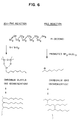
- Figure 6 is a comparison of PAO and HVI-PAO, production.
- Figure 7 shows C-13 NMR calculated vs. observed chemical shifts for HVI-PAO 1-decene trimer components.
- the sulfide derivatives of oligomers are the reaction products of the alpha-olefin oligomers with methyl to methylene branch ratio of less than 0.19 formed of alphaolefins and sulfur or sources of sulfur.
- the alpha-olefin oligomers which are designated below by the abbrevition HVI-PAO for high viscosity index polyalpha olefins are liquid hydrocarbons. That abbreviation is to be distinguished from PAO which refers to conventional polyalphaolefins.
- PAO include Mobil 1, referenced above.
- the HVI-PAO can be distinguished from the PAO inter alia on methyl group methylene branch ratio, discussed below.
- HVI-PAO oligomers can be controlled to yield oligomers having weight average molecular weight between 300 and 45,000 and number average molecular weight between 300 and 18,000. Measured in carbon numbers, molecular weights range from C30 to C1300 and viscosity up to 750mm2/s at 100°C, with a preferred range of C30 to C1000 and a viscosity of 500mm2/s at 100°C. Molecular weight distributions (NWD), defined as the ratio of weight average molecular weight to number average molecular weight, range from 1.00 to 5, with a preferred range of 1.01 to 3 and a more preferred MWD of about 2.5. Compared to conventional PAO derived from BF3 or AlCl3 catalyzed polymerization of 1-alkene, HVI-PAO of the present invention has been found to have a higher proportion of higher molecular weight polymer molecules in the product.
- Viscosities of the novel HVI-PAO oligomers measured at 100°C range from 3mm2/s to 5000mm2/s.
- novel oligomer compositions disclosed herein have been examined to define their unique structure beyond the important characteristics of branch ratio and molecular weight already noted. Dimer and trimer fractions have been separated by distillation and components thereof further separated by gas chromatography. These lower oligomers and components along with complete reaction mixtures of HVI-PAO oligomers have been studied using infra-red spectroscopy and C-13 NMR. The studies confirmed the highly uniform structural composition of the products of the invention, particularly when compared to conventional polyalphaolefins produced by BF3, AlCl3 or Ziegler-type catalysts.
- the oligomers used in the present invention are formed from olefins containing from 6 to about 20 carbon atoms such as 1-hexene, 1-octene, 1-decene, 1-dodecene and 1-tetradecene and branched chain isomers such as 4-methyl-1-pentene. Also suitable for use are olefin-containing refinery feedstocks or effluents. However, the olefins used in this invention are preferably alpha olefinic as for example 1-heptene to 1-hexadecene and more preferably 1-octene to 1-tetradecene, or mixtures of such olefins.
- Oligomers of alpha-olefins in accordance with the invention have a low branch ratio of less than 0.19 and superior lubricating properties compared to the alpha-olefin oligomers with a high branch ratio, as produced in known commercial methods.
- This new class of alpha-olefin oligomers are prepared by oligomerization reactions in which a major proportion of the double bonds of the alphaolefins are not isomerized.
- These reactions include alpha-olefin oligomerization by supported metal oxide catalysts, such as Cr compounds on silica or other supported IUPAC Periodic Table Group VIB compounds.
- the catalyst most preferred is a lower valence Group VIB metal oxide on an inert support.
- Preferred supports include silica, alumina, titania, silica-alumina, magnesia and the like.
- the support material binds the metal oxide catalyst. Those porous substrates having a pore opening of at least 40 x10 ⁇ 7mm are preferred.
- the support material usually has high surface area and large pore volumes with average pore size of 40 x10 ⁇ 7mm to 350 x10 ⁇ 7mm.
- the high surface area is beneficial for supporting large amount of highly dispersive, active chromium metal centers and to give maximum efficiency of metal usage, resulting in very high activity catalyst.
- the support should have large average pore openings of at least 40 x10 ⁇ 7mm, with an average pore opening of greater than about 60 x10 ⁇ 7 mm to 300 x10 ⁇ 7mm being preferred. This large pore opening will not impose any diffusional restriction of the reactant and product to and away from the active catalytic metal centers, thus further optimizing the catalyst productivity.
- a silica support with good physical strength is preferred to prevent catalyst particle attrition or disintegration during handling or reaction.
- the supported metal oxide catalysts are preferably prepared by impregnating metal salts in water or organic solvents onto the support. Any suitable organic solvent known to the art may be used, for example, ethanol,methanol, or acetic acid.
- the solid catalyst precursor is then dried and calcined at 200 to 900°C by air or other oxygen-containing gas. Thereafter the catalyst is reduced by any of several various and well known reducing agents such as, for example, CO, H2, NH3, H2S, CS2, CH3SCH3, CH3SSCH3, metal alkyl containing compounds such as R3Al, R3B,R2Mg, RLi, R2Zn, where R is alkyl, alkoxy, aryl and the like. Preferred are CO or H2 or metal alkyl containing compounds.
- the Group VIB metal may be applied to the substrate in reduced form, such as Cr(II) compounds.
- the resultant catalyst is very active for oligomerizing olefins at a temperature range from below room temperature to about 250°C at a pressure of 13 Pa (0.1 atmosphere) to 34600 KPa (5000 psi). Contact time of both the olefin and the catalyst can vary from one second to 24 hours.
- the catalyst can be used in a batch type reactor or in a fixed bed, continuous-flow reactor.
- the support material may be added to a solution of the metal compounds, e.g., acetates or nitrates, etc., and the mixture is then mixed and dried at room temperature.
- the dry solid gel is purged at successively higher temperatures to about 600° for a period of about 16 to 20 hours.
- the catalyst is cooled down under an inert atmosphere to a temperature of 250° to 450°C and a stream of pure reducing agent is contacted therewith for a period when enough CO has passed through to reduce the catalyst as indicated by a distinct color change from bright orange to pale blue.
- the catalyst is treated with an amount of CO equivalent to a two-fold stoichiometric excess to reduce the catalyst to a lower valence CrII state.
- the catalyst is cooled down to room temperature and is ready for use.
- the product oligomers have a very wide range of viscosities with high viscosity indices suitable for high performance lubrication use.
- the product oligomers also have atactic molecular structure of mostly uniform head-to-tail connections with some head-to-head type connections in the structure.
- These low branch ratio oligomers have high viscosity indices at least 15 to 20 units and typically 30-40 units higher than equivalent viscosity prior art oligomers, which regularly have higher branch ratios and correspondingly lower viscosity indices. These low branch oligomers maintain better or comparable pour points.
- supported Cr metal oxide in different oxidation states is known to polymerize alpha olefins from C3 to C20 (DE 3427319 to H. L. Krauss and Journal of Catalysis 88, 424-430, 1984) using a catalyst prepared by CrO3 on silica.
- the referenced disclosures teach that polymerization takes place at low temperature, usually less than 100°C, to give adhesive polymers and that at high temperature, the catalyst promotes isomerization, cracking and hydrogen transfer reactions.
- the present inventions produce low molecular weight oligomeric products under reaction conditions and using catalysts which minimize side reactions such as 1-olefin isomerization, cracking, hydrogen transfer and aromatization.
- the reaction of the present invention is carried out at a temperature higher (90-250°C) than the temperature suitable to produce high molecular weight polyalpha-olefins.
- the catalysts used in the present invention do not cause a significant amount of side reactions even at high temperature when oligomeric, low molecular weight fluids are produced.
- the catalysts for this invention thus minimize all side reactions but oligomerize alpha olefins to give low molecular weight polymers with high efficiency.
- chromium oxides especially chromia with average +3 oxidation states, either pure or supported, catalyze double bond isomerization, dehydrogenation, craking, etc.
- the catalyst of the present invention is rich in Cr(II) supported on silica, which is more active to catalyze alpha-olefin oligomerization at high reaction temperature without causing significant amounts of isomerization, cracking or hydrogenation reactions, etc.
- catalysts as prepared in the cited references can be richer in Cr (III). They catalyze alpha-olefin polymerization at low reaction temperature to produce high molecular weight polymers.
- undesirable isomerization, cracking and hydrogenation reaction take place at higher temperatures.
- high temperatures are needed in this invention to produce lubricant products.
- supported Cr catalysts rich in Cr(III) or higher oxidation states catalyze 1-butene isomerization with 103 higher activity than polymerization of 1-butene.
- the quality of the catalyst, method of preparation, treatments and reaction conditions are critical to the catalyst performance and composition of the product produced and distinguish the present invention over the prior art.
- the oligomers of 1-olefins prepared in this invention usually have much lower molecular weights than the polymers produced according to prior art which are semi-solids, with very high molecular weights.
- the higher molecular weight polymers are not suitable as lubricant basestocks.
- These high polymers usually have no detectable amount of dimer or trimer (C10-C30) components from synthesis. These high polymers also have very low unsaturations.
- products in this invention are free-flowing liquids at room temperature, suitable for lube basestock, containing significant amount of dimer or trimer and have high unsaturations.
- Sulfur reacts with unsaturated materials in the liquid phase, at temperature above its melting point, at which a solution-dispersion is formed.
- the oligomer products may be hydrogenated prior to use per se , the oligomers are not hydrogenated prior to reaction herein described. Practically, the temperature of reaction will range from 140°C to 180°C. Generally, sulfides, disulfides, polysulfides and admixtures thereof are formed.
- Sulfurization of chromium-catalyzed polyalphaolefins with sulfur and/or hydrogen sulfide in the presence of a sulfur-containing heterocycle, e.g. dimercaptothiadiazole, mercapto-benzimidazole, mercaptobenzothiazole, can lead to products with enhanced sulfur content and low corrosivity.
- the sulfur content will range from 0.01 to 5, and preferably from 0.1 to 1 moles based on the oligomer.
- the sulfur adducts of the invention can contain 0.01 to 10 weight percent sulfur, preferably 0.1 to 5 weight percent sulfur. These adducts should possess good antiwear and antioxidant properties.
- Adducts derived from the chromium-catalyzed olefin and phosphorus sulfides should provide enhanced antioxidant antiwear properties from the synergism between the sulfur and phosphorus. Sulfurization with sulfur halides, (e.g., S2Cl, S2Cl2, etc.) leads to sulfochlorinated intermediates capable of undergoing additional chemistries.
- the sulfochlorinated intermediate can be reacted with any mercaptan or heterocycle, as mentioned above, or undergo dehydrohalogenation.
- the intermediates may also be reacted with amines, functionalized amines, phosphorus containing compounds in order to achieve desired properties, e.g., dispersancy, detergency, extreme pressure/antiwear, antioxidant, emulsifier, demulsifier, corrosion inhibiting, antirust inhibitor, antistaining, friction reducing and the like.
- the products obtained from the reaction of a chromium-catalyzed polyalphaolefin and various distinct sulfur sources are unique not only in composition and structure but in utility. Part of the uniqueness is derived from the chromium-catalyzed olefin oligomers themselves; generally they have a higher VI at a given viscosity and have enhanced reactivity over traditional high VI lube olefin. In addition, the chromium-catalyzed olefin oligomers have improved thermal stability over comparable polyisobutylene olefins.
- a HVI-PAO having a nominal viscosity of 20 mm2/s at 100°C was prepared by the following procedure. 100 parts by weight of 1-decene which had been purified by nitrogen sparging and passing over a 4A molecular sieve was charged to a dry nitrogen blanketed reactor. The decene was then heated to 185°C and 3.0 parts by weight of a prereduced 1% Chromium on silica catalyst added together with an additional 500 parts by weight of purified 1-decene continuously over a period of 7.0 hr with the reaction temperature maintained at 185°C. The reactants were held for an additional 5.0 hr at 185°C after completion of the 1-decene and catalyst addition to complete the reacton. The product was then filtered to remove the catalyst and stripped to 270°C and 267 Pa (2 mm Hg) pressure to remove unreacted 1-decene and unwanted low molecular weight oligomers.
- a HVI-PAO having a nominal viscosity of 149 mm2/s at 100°C was prepared by a procedure similar to the above except that the 1-decene/catalyst addition time was 9.0 hr, the hold time after 1-decene/catalyst addition was 2.0 hr, and the reaction temperature was 123°C.
- a suspension of 100g (0.100 mole) of a 20 mm2/s lube olefin and 3.2g (0.100 mole) of sulfur was heated to 140°C in a stirred, glass reactor under a nitrogen sparge. The reaction mixture was held at 140°C for 2.5 h. The reaction mixture was then cooled to room temperature at which time 100 ml of hexane was added and stirred for 0.5 h. The reaction mixture was filtered to remove any unreacted sulfur (1,82g). The product was then vacuum filtered through diatomaceous clay and volatiles were removed in-vacuo to yield a clear yellow oil (94.5g).
- the product had the following elemental analysis:
- Example 2 The procedure of Example 1 was repeated using 100.0g (0.100 mole) of a 20 mm2/s lube olefin and 1.6g (0.05 mole) of sulfur.
- the product was a clear yellow oil (92.39g) and had the following elemental analysis:
- Example 2 The procedure of Example 1 was repeated using 100g (0.100 mole) of a 20 mm2/s lube olefin and 0.32g (0.01 mole) of sulfur.
- the product was a clear yellow oil (95.34g) and had the following elemental analysis:
- Example 2 The procedure of Example 1 was repeated using 30g (0.030 mole) of a 20 mm2/s lube olefin, 0.48g (0.015 mole) of sulfur and 0.45g (0.003mole) of 2,5-dimercapto- 1,3,4,-thiadiazole.
- the product was a clear yellow oil (26.95g).
- Example 2 The procedure of Example 1 was repeated using 100g (0.03 mole) of a 145 mm2/s lube olefin and 1.0g (0.03 mole) of sulfur.
- the product was a clear yellow oil (97.46g) and had the following elemental analysis:
- Example 2 The procedure of Example 1 was repeated using 100g (0.03 mole) of a 145 mm2/s lube olefin and 0.5g (0.015 mole) of sulfur.
- the product was a clear light yellow oil (99.73g) and had the following elemental analysis:
- Example 2 The procedure of Example 1 was repeated using 100g (0.03 mole) of a 145 mm2/s lube olefin and 0.1g (0.003 mole) of sulfur.
- the product was a clear colorless oil (94.96g) and had the following elemental analysis:
- Example 2 The procedure of Example 1 was repeated using 30g (0.0094 mole) of a 145 mm2/s lube olefin, 0.15g (0.0046 mole) of sulfur and 0.14g (0.00094 mole) of 2,5-dimercapto- 1,3,4-thiadiazole.
- the product was a clear yellow oil (26.55g).
- non-zinc antiwear additive as a suitable replacement for zinc dithiophosphate is highly desirable.
- hydraulic fluids formulated with Zn dithiophosphate are becoming environmentally unacceptable.
- non-zinc antiwear additives are required for use in synthetic automotive engine oils.
- Sulfurized additives derived from high-VI lube olefins have very light colors and better odor compared to traditional sulfurized olefins.
- This new generation of antiwear additives is expected to have good solubility in synthetic base stocks, e.g., extra-high VI base stocks, as well as low corrosivity.
- Sulfurized multi-functional lubricant fluids are expected to excel in performance features as a result of the multifaceted initial synergism.
- the temperature is then set at 600°C with dry air purging for 16 hours. At this time the catalyst is cooled down under N2 to a temperature of 300°C. Then a stream of pure CO (99.99% from Matheson) is introduced for one hour. Finally, the catalyst is cooled down to room temperature under N2 and ready for use.
- Example 1 The catalyst prepared in Example 1 (3.2 g ) is packed in a 9.5 mm (3/8'') stainless steel tubular reactor inside an N2 blanketed dry box. The reactor under N2 atmosphere is then heated to 150°C by a single-zone Lindberg furnace. Pre-purified 1-hexene is pumped into the reactor at 965 KPa (140 psi) and 20 ml/hr. The liquid effluent is collected and stripped of the unreacted starting material and the low boiling material at 7 Pa (0.05 mm Hg). The residual clear, colorless liquid has viscosities and VI's suitable as a lubricant base stock.
- Example 2 Similar to Example 2, a fresh catalyst sample is charged into the reactor and 1-hexene is pumped to the reactor at 101 KPa (1 atm) and 10 ml per hour. As shown below, a lube of high viscosities and high VI's is obtained. These runs show that at different reaction conditions, a lube product of high viscosities can be obtained.
- a commercial chrome/silica catalyst rich contains 1% Cr on a large-pore volume synthetic silica gel is used.
- the catalyst is first calcined with air at 800°C for 16 hours and reduced with CO at 300°C for 1.5 hours. Then 3.5 g of the catalyst is packed into a tubular reactor and heated to 100°C under the N2 atmosphere. 1-Hexene is pumped through at 28 ml per hour at 1 atmosphere. The products are collected and analyzed as follows:
- Example 4 purified 1-decene is pumped through the reactor at 1720 to 2210 KPa (250 to 320 psi). The product is collected periodically and stripped of light products boiling points below 343°C (650°F). High quality lubes with high VI are obtained (see following table).
- the 1-decene oligomers as described below were synthesized by reacting purified 1-decene with an activated chromium on silica catalyst.
- the activated catalyst was prepared by calcining chromium acetate (1 or 3% Cr) on silica gel at 500-800°C for 16 hours, followed by treating the catalyst with CO at 300-350°C for 1 hour.
- 1-Decene was mixed with the activated catalyst and heated to reaction temperature for 16-21 hours. The catalyst was then removed and the viscous product was distilled to remove low boiling components at 200°C and 13 Pa.
- the examples prepared in accordance with this invention have branch ratios of 0.14 to 0.16, providing lube oils of excellent quality which have a wide range of viscosities from 3 to 483.1 mm2/s at 100°C with viscosity indices of 130 to 280.
- a commercial Cr on silica catalyst which contains 1% Cr on a large pore volume synthetic silica gel is used.
- the catalyst is first calcined with air at 700°C for 16 hours and reduced with CO at 350°C for one to two hours.
- 1.0 part by weight of the activated catalyst is added to 1-decene of 200 parts by weight in a suitable reactor and heated to 185°C.
- 1-Decene is continuously fed to the reactor at 2-3.5 parts/minute and 0.5 parts by weight of catalyst is added for every 100 parts of 1-decene feed.
- the slurry is stirred for 8 hours.
- the catalyst is filtered and light product boiled below 150°C at 13 Pa is stripped.
- the residual product is hydrogenated with a Ni on Kieselguhr catalyst at 200°C.
- the finished product has a viscosity at 100°C of 18.5 mm2/s, VI of 165 and pour point of -55°C.
- reaction temperature is 125°C.
- the finished product has a viscosity at 100°C of 145 mm2/s, VI of 214, pour point of -40°C.
- reaction temperature is 100°C.
- the finished product has a viscosity at 100°C of 298 mm2/s, VI of 246 and pour point of -32°C.
- the final lube products in Example 16 to 18 contain the following amounts of dimer and trimer and isomeric distribution (distr.).
- the molecular weights and molecular weight distributions are analyzed by a high pressure liquid chromatography, composed of a Constametric II high pressure, dual piston pump from Milton Roy Co. and a Tracor 945 LC detector.
- the system pressure is 4500 KPa (650 psi) and THF solvent (HPLC grade) deliver rate is 1 ml per minute.
- the detector block temperature is set at 145°C. ml of sample, prepared by dissolving 1 grin PAO sample in ml THF solvent, is injected into the chromatograph.
- the sample is eluted over the following columns in series,all from Waters Associates: Utrastyragel 105 A, P/N 10574, Utrastyragel 104 A, P/N 10573, Utrastyragel 103 A, P/N 10572, Utrastyragel 500 A, P/N 10571.
- the molecular weights are calibrated against commercially available PAO from Mobil Chemical Co, Mobil SHF-61 and SHF-81 and SHF-401.
- HVI-PAO product with viscosity as low as 3mm2/s and as high as 500 mm2/s, with VI between 130 and 280, can be produced.
- 1-hexene HVI-PAO oligomers of the present invention have been shown to have a very uniform linear C4 branch and contain regular head-to-tail connections.
- the backbone structures have some head-to-head connection, indicative of the following structure as confirmed by NMR:
- the oligomerization of 1-decene by reduced valence state, supported chromium also yields a HVI-PAO with a structure analogous to that of 1-hexene oligomer.
- the lubricant products after distillation to remove light fractions and hydrogenation have characteristic C-13 NMR spectra.
- Figures 2, 3 and 4 are the C-13 NMR spectra of typical HVI-PAO lube products with viscosities of 5mm2/s, 5mm2/s and 145mm2/s at 100°C.
- Table A presents the NMR data for Figure 2
- Table B presents the NMR data for Figure 3
- Table C presents the NMR data for Figure 4.
- novel oligomers have the following regular head-to-tail structure where n can be 3 to 17: with some head-to-head connections.
- trimer of 1-decene HVI-PAO oligomer is separated from the oligomerization mixture by distillation from a 20mm2/s as-synthesized HVI-PAO in a short-path apparatus in the range of 165-210°C at 0.1-0.2 torr.
- trimer Gas chromatographic analysis of the trimer reveals that it is composed of essentially two components having retention times of 1810 seconds and 1878 seconds under the following conditions:
- the process used in the present invention produces a surprisingly simpler and useful dimer compared to the dimer produced by 1-alkene oligomerization with BF3 or AlCl3 as commercially practiced.
- 1-decene dimer of the invention has been found to contain only three major components, as determined by GC.
- the unhydrogenated components were found to be 8-eicosene, 9-eicosene, 2-octyldodecene and 9-methyl-8 or 9-methyl-9-nonadecene.
- the hydrogenated dimer components were found to be n-eicosane and 9-methylnonacosane.
Landscapes
- Chemical & Material Sciences (AREA)
- Chemical Kinetics & Catalysis (AREA)
- General Chemical & Material Sciences (AREA)
- Oil, Petroleum & Natural Gas (AREA)
- Organic Chemistry (AREA)
- Lubricants (AREA)
- Organic Low-Molecular-Weight Compounds And Preparation Thereof (AREA)
Claims (15)
- Flüssiges Schwefel-Addukt einer ungesättigten Oligomerzusammensetzung, die von einem α-Olefin mit sechs bis zwanzig Kohlenstoffatomen gebildet wurde, wobei das Oligomer ein Verzweigungsverhältnis von Methylgruppe/Methylengruppe von weniger als 0,19 hat und das Oligomerisierungsprodukt des α-Olefins in Kontakt mit einem reduzierten Chromoxidkatalysator auf einem porösen Träger umfaßt, wobei der Katalysator durch Oxidation bei einer Temperatur von 200 bis 900°C in Gegenwart eines oxidierenden Gases und anschließend durch Behandlung mit einem Reduktionsmittel bei einer ausreichenden Temperatur und während eines ausreichenden Zeitraums behandelt wurde, um den Katalysator zu reduzieren; wobei das Schwefel-Addukt einen Schwefelgehalt von 0,01 bis 5 Mol auf der Molbasis des Oligomers aufweist und aus Sulfid, Disulfid, Polysulfiden und Mischungen davon ausgewählt ist.
- Schwefel-Addukt nach Anspruch 1, worin das Derivat einen Schwefelgehalt im Bereich von 0,1 bis 1 Mol auf der Molbasis des Oligomers aufweist.
- Schwefel-Addukt nach Anspruch 1, worin das α-Olefin 1-Decen ist.
- Schwefel-Addukt nach einem der vorstehenden Ansprüche, worin das Oligomer 30 bis 1500 Kohlenstoffatome aufweist.
- Schwefel-Addukt nach einem der vorstehenden Ansprüche, gekennzeichnet durch eine Viskosität bei 100°C im Bereich von 3 bis 5000 mm²/s.
- Flüssiges Schmiermittel, das das Schwefel-Addukt nach einem der vorstehenden Ansprüche umfaßt.
- Schmiermittel nach einem der vorstehenden Ansprüche, wobei die Mischung einen Schwefelgehalt von 0,1 bis 1 Mol auf der Molbasis des Oligomers aufweist.
- Schmiermittel nach Anspruch 6, das frei von Zink und Phosphor ist.
- Schmiermittel, das ein Schmieröl und als verschleißhemmenden Zusatz das Sulfid-Addukt von Anspruch 6, 7 oder 8 umfaßt.
- Schmiermittel nach Anspruch 9, worin das Schmieröl ein Mineralöl ist.
- Schmiermittel nach Anspruch 9, worin das Schmieröl ein synthetisches Schmieröl ist.
- Schmiermittel nach Anspruch 6, 7, 8, 9, 10 oder 11, worin das Oligomer den Anteil

- Schmiermittel nach Anspruch 9, worin das Schmieröl aus Mineralöl, einem synthetischen Schmiermittel, Fett, einem eingedickten Schmiermittel und Mischungen davon ausgewählt ist.
- Schmiermittel nach Anspruch 6, 7, 8, 9, 10, 11, 12 oder 13, worin das Addukt 50 bis 100 Gew.-% des Schmiermittels umfaßt.
- Schmiermittel nach Anspruch 14, das ein Additiv umfaßt, das aus Dispersionsmitteln, Detergentien, extremem Druck/Verschleißminderern, Antioxidationsmitteln, Emulgatoren, Deemulgatoren, Korrosionsinhibitoren, Rostinhibitoren, verfärbungshemmenden Reagenzien, Reibungsminderern und Mischungen davon ausgewählt ist.
Priority Applications (1)
| Application Number | Priority Date | Filing Date | Title |
|---|---|---|---|
| AT89907613T ATE89596T1 (de) | 1988-06-23 | 1989-06-21 | Schwefelhaltige polyalphaolefine mit hohem viskositaetsindex. |
Applications Claiming Priority (2)
| Application Number | Priority Date | Filing Date | Title |
|---|---|---|---|
| US07/210,598 US5116523A (en) | 1988-06-23 | 1988-06-23 | Sulfide adducts of high viscosity index polyalphaolefins |
| US210598 | 1988-06-23 |
Publications (2)
| Publication Number | Publication Date |
|---|---|
| EP0432165A1 EP0432165A1 (de) | 1991-06-19 |
| EP0432165B1 true EP0432165B1 (de) | 1993-05-19 |
Family
ID=22783527
Family Applications (1)
| Application Number | Title | Priority Date | Filing Date |
|---|---|---|---|
| EP89907613A Expired - Lifetime EP0432165B1 (de) | 1988-06-23 | 1989-06-21 | Schwefelhaltige Polyalphaolefine mit hohem Viskositätsindex |
Country Status (6)
| Country | Link |
|---|---|
| US (1) | US5116523A (de) |
| EP (1) | EP0432165B1 (de) |
| JP (1) | JPH04504269A (de) |
| AU (1) | AU636297B2 (de) |
| CA (1) | CA1321191C (de) |
| WO (1) | WO1989012670A1 (de) |
Families Citing this family (4)
| Publication number | Priority date | Publication date | Assignee | Title |
|---|---|---|---|---|
| US5427703A (en) * | 1992-07-17 | 1995-06-27 | Shell Oil Company | Process for the preparation of polar lubricating base oils |
| EP0849282A3 (de) * | 1996-12-19 | 1998-09-23 | Ciba SC Holding AG | Polymere multifunktionelle Schmierstoffadditive |
| US6472355B2 (en) * | 1997-08-22 | 2002-10-29 | The Procter & Gamble Company | Cleansing compositions |
| AU2002329225A1 (en) * | 2002-07-31 | 2004-02-25 | Pirelli Pneumatici S.P.A. | Tyre for vehicle wheels and elastomeric composition used therein |
Family Cites Families (26)
| Publication number | Priority date | Publication date | Assignee | Title |
|---|---|---|---|---|
| US411659A (en) * | 1889-09-24 | Washing-machine | ||
| US2016479A (en) * | 1934-04-30 | 1935-10-08 | Christensen Machine Co | Sheet feeder |
| GB748299A (en) * | 1952-08-01 | 1956-04-25 | Bayer Ag | Neutral esters of dithiophosphoric acid |
| GB873068A (en) * | 1959-10-15 | 1961-07-19 | Shell Res Ltd | Halogen-containing hydrocarbon polymers |
| US3265023A (en) * | 1961-11-22 | 1966-08-09 | Jr Herbert M Hollingsworth | Device for preventing wire entanglement |
| GB961009A (en) * | 1964-07-14 | 1964-06-17 | Sun Oil Co | Preparation of synthetic lubricating oil |
| US3350348A (en) * | 1965-04-05 | 1967-10-31 | Mobil Oil Corp | Lubricating oil additives |
| US3574795A (en) * | 1967-05-22 | 1971-04-13 | Exxon Research Engineering Co | Cationic addition of dihydrocarbyl thiophosphoric acids to conjugated dienes and product |
| US3544465A (en) * | 1968-06-03 | 1970-12-01 | Mobil Oil Corp | Esters of phosphorodithioates |
| US3644206A (en) * | 1968-11-14 | 1972-02-22 | Mobil Oil Corp | Lubricating oils or fuels containing adducts of phosphorodithioate esters |
| US3600327A (en) * | 1969-02-26 | 1971-08-17 | Exxon Research Engineering Co | Lubricating oil compositions having improved sludge dispersancy |
| US3972243A (en) * | 1971-04-19 | 1976-08-03 | Sun Research And Development Co. | Traction drive with a traction fluid containing gem-structured polar organo compound |
| US3793203A (en) * | 1971-05-17 | 1974-02-19 | Sun Oil Co | Lubricant comprising gem-structured organo compound |
| US4119550A (en) * | 1975-03-21 | 1978-10-10 | The Lubrizol Corporation | Sulfurized compositions |
| GB1560667A (en) * | 1976-09-24 | 1980-02-06 | Cooper & Co Ltd Edwin | Sulphurize olefins and their use as lubricant additives |
| GB2016479B (en) * | 1978-03-15 | 1982-09-02 | Bp Chem Int Ltd | Sulphurised polybutens |
| US4240958A (en) * | 1978-12-20 | 1980-12-23 | Mobil Oil Corporation | Process of preparing sulfurized olefins |
| US4212753A (en) * | 1979-03-01 | 1980-07-15 | Mobil Oil Corporation | Reaction products of sulfurized olefin adducts of phosphorodithioic acids and organic compositions containing same |
| DE3427319A1 (de) * | 1984-07-25 | 1986-01-30 | Hans-Ludwig Prof. Dipl.-Chem. Dr. 8600 Bamberg Krauss | Verfahren zur herstellung von ueberwiegend ataktischen polymeren aus olefinen |
| US4584113A (en) * | 1984-10-25 | 1986-04-22 | The Lubrizol Corporation | Sulfurized compositions and lubricants containing them |
| US4613712A (en) * | 1984-12-31 | 1986-09-23 | Mobil Oil Corporation | Alpha-olefin polymers as lubricant viscosity properties improvers |
| FR2588881B1 (fr) * | 1985-10-18 | 1988-01-15 | Inst Francais Du Petrole | Compositions d'olefines polysulfurees, leur preparation et leur utilisation comme additifs pour lubrifiants |
| JPS62107842A (ja) * | 1985-11-04 | 1987-05-19 | アルミナム カンパニ− オブ アメリカ | 離型組成物 |
| FR2605328B1 (fr) * | 1986-10-17 | 1989-08-04 | Inst Francais Du Petrole | Compositions d'olefines polysulfurees, leur preparation et leur utilisation comme additifs pour lubrifiants. |
| US4827064A (en) * | 1986-12-24 | 1989-05-02 | Mobil Oil Corporation | High viscosity index synthetic lubricant compositions |
| US4827073A (en) * | 1988-01-22 | 1989-05-02 | Mobil Oil Corporation | Process for manufacturing olefinic oligomers having lubricating properties |
-
1988
- 1988-06-23 US US07/210,598 patent/US5116523A/en not_active Expired - Fee Related
-
1989
- 1989-06-21 JP JP1507161A patent/JPH04504269A/ja active Pending
- 1989-06-21 WO PCT/US1989/002735 patent/WO1989012670A1/en not_active Ceased
- 1989-06-21 AU AU38486/89A patent/AU636297B2/en not_active Ceased
- 1989-06-21 EP EP89907613A patent/EP0432165B1/de not_active Expired - Lifetime
- 1989-06-22 CA CA000603659A patent/CA1321191C/en not_active Expired - Fee Related
Also Published As
| Publication number | Publication date |
|---|---|
| AU636297B2 (en) | 1993-04-29 |
| CA1321191C (en) | 1993-08-10 |
| WO1989012670A1 (en) | 1989-12-28 |
| AU3848689A (en) | 1990-01-12 |
| EP0432165A1 (de) | 1991-06-19 |
| US5116523A (en) | 1992-05-26 |
| JPH04504269A (ja) | 1992-07-30 |
Similar Documents
| Publication | Publication Date | Title |
|---|---|---|
| US4827064A (en) | High viscosity index synthetic lubricant compositions | |
| CA1339453C (en) | Phosphonate adducts of olefinic lubricants having enhanced properties | |
| US4827073A (en) | Process for manufacturing olefinic oligomers having lubricating properties | |
| JP2850147B2 (ja) | 潤滑剤 | |
| US5264642A (en) | Molecular weight control of olefin oligomers | |
| EP0422111B1 (de) | Schwefel- und phosphorhaltige derivate von chrom katalysierten alpha-olefinpolymeren | |
| AU633094B2 (en) | Novel vi enhancing compositions and newtonian lube blends | |
| JP2808464B2 (ja) | 高粘度指数をもつ潤滑油ブレンド | |
| US5254274A (en) | Alkylaromatic lubricant fluids | |
| US5146021A (en) | VI enhancing compositions and Newtonian lube blends | |
| US5157177A (en) | VI enhancing compositions and newtonian lube blends | |
| US4906799A (en) | Process for the production of reduced viscosity high VI hydrocarbon lubricant | |
| EP0454798B1 (de) | Verfahren zur herstellung flüssiger schmiermittel aus mischpolymeren von alpha-olefin und styrol | |
| US3972243A (en) | Traction drive with a traction fluid containing gem-structured polar organo compound | |
| EP0422019B1 (de) | Olefinoligomere mit schmierungseigenschaften und verfahren zu ihrer herstellung | |
| US5116523A (en) | Sulfide adducts of high viscosity index polyalphaolefins | |
| DE68906678T2 (de) | Schwefelhaltige polyalphaolefine mit hohem viskositaetsindex. | |
| DE68906024T2 (de) | Schwefel- und phosphorhaltige derivate von chrom katalysierten alpha-olefinpolymeren. | |
| WO1989012663A1 (en) | Synthetic lubricants containing polar groups |
Legal Events
| Date | Code | Title | Description |
|---|---|---|---|
| PUAI | Public reference made under article 153(3) epc to a published international application that has entered the european phase |
Free format text: ORIGINAL CODE: 0009012 |
|
| 17P | Request for examination filed |
Effective date: 19901210 |
|
| AK | Designated contracting states |
Kind code of ref document: A1 Designated state(s): AT BE DE FR GB IT NL SE |
|
| 17Q | First examination report despatched |
Effective date: 19910729 |
|
| GRAA | (expected) grant |
Free format text: ORIGINAL CODE: 0009210 |
|
| AK | Designated contracting states |
Kind code of ref document: B1 Designated state(s): AT BE DE FR GB IT NL SE |
|
| REF | Corresponds to: |
Ref document number: 89596 Country of ref document: AT Date of ref document: 19930615 Kind code of ref document: T |
|
| REF | Corresponds to: |
Ref document number: 68906678 Country of ref document: DE Date of ref document: 19930624 |
|
| ET | Fr: translation filed | ||
| ITF | It: translation for a ep patent filed | ||
| PLBE | No opposition filed within time limit |
Free format text: ORIGINAL CODE: 0009261 |
|
| STAA | Information on the status of an ep patent application or granted ep patent |
Free format text: STATUS: NO OPPOSITION FILED WITHIN TIME LIMIT |
|
| 26N | No opposition filed | ||
| EAL | Se: european patent in force in sweden |
Ref document number: 89907613.7 |
|
| PGFP | Annual fee paid to national office [announced via postgrant information from national office to epo] |
Ref country code: SE Payment date: 19970313 Year of fee payment: 9 |
|
| PGFP | Annual fee paid to national office [announced via postgrant information from national office to epo] |
Ref country code: GB Payment date: 19970324 Year of fee payment: 9 Ref country code: FR Payment date: 19970324 Year of fee payment: 9 |
|
| PGFP | Annual fee paid to national office [announced via postgrant information from national office to epo] |
Ref country code: NL Payment date: 19970331 Year of fee payment: 9 |
|
| PGFP | Annual fee paid to national office [announced via postgrant information from national office to epo] |
Ref country code: DE Payment date: 19970403 Year of fee payment: 9 |
|
| PGFP | Annual fee paid to national office [announced via postgrant information from national office to epo] |
Ref country code: BE Payment date: 19970428 Year of fee payment: 9 |
|
| PGFP | Annual fee paid to national office [announced via postgrant information from national office to epo] |
Ref country code: AT Payment date: 19970630 Year of fee payment: 9 |
|
| PG25 | Lapsed in a contracting state [announced via postgrant information from national office to epo] |
Ref country code: GB Free format text: LAPSE BECAUSE OF NON-PAYMENT OF DUE FEES Effective date: 19980621 Ref country code: AT Free format text: LAPSE BECAUSE OF NON-PAYMENT OF DUE FEES Effective date: 19980621 |
|
| PG25 | Lapsed in a contracting state [announced via postgrant information from national office to epo] |
Ref country code: SE Free format text: LAPSE BECAUSE OF NON-PAYMENT OF DUE FEES Effective date: 19980622 |
|
| PG25 | Lapsed in a contracting state [announced via postgrant information from national office to epo] |
Ref country code: BE Free format text: LAPSE BECAUSE OF NON-PAYMENT OF DUE FEES Effective date: 19980630 |
|
| BERE | Be: lapsed |
Owner name: MOBIL OIL CORP. Effective date: 19980630 |
|
| PG25 | Lapsed in a contracting state [announced via postgrant information from national office to epo] |
Ref country code: NL Free format text: LAPSE BECAUSE OF NON-PAYMENT OF DUE FEES Effective date: 19990101 |
|
| GBPC | Gb: european patent ceased through non-payment of renewal fee |
Effective date: 19980621 |
|
| PG25 | Lapsed in a contracting state [announced via postgrant information from national office to epo] |
Ref country code: FR Free format text: LAPSE BECAUSE OF NON-PAYMENT OF DUE FEES Effective date: 19990226 |
|
| EUG | Se: european patent has lapsed |
Ref document number: 89907613.7 |
|
| NLV4 | Nl: lapsed or anulled due to non-payment of the annual fee |
Effective date: 19990101 |
|
| PG25 | Lapsed in a contracting state [announced via postgrant information from national office to epo] |
Ref country code: DE Free format text: LAPSE BECAUSE OF NON-PAYMENT OF DUE FEES Effective date: 19990401 |
|
| REG | Reference to a national code |
Ref country code: FR Ref legal event code: ST |
|
| PG25 | Lapsed in a contracting state [announced via postgrant information from national office to epo] |
Ref country code: IT Free format text: LAPSE BECAUSE OF NON-PAYMENT OF DUE FEES;WARNING: LAPSES OF ITALIAN PATENTS WITH EFFECTIVE DATE BEFORE 2007 MAY HAVE OCCURRED AT ANY TIME BEFORE 2007. THE CORRECT EFFECTIVE DATE MAY BE DIFFERENT FROM THE ONE RECORDED. Effective date: 20050621 |