EP0432504A1 - Verfahren zur Herstellung von 1-(Aminomethyl)cyclohexanessigsäure - Google Patents
Verfahren zur Herstellung von 1-(Aminomethyl)cyclohexanessigsäure Download PDFInfo
- Publication number
- EP0432504A1 EP0432504A1 EP90121827A EP90121827A EP0432504A1 EP 0432504 A1 EP0432504 A1 EP 0432504A1 EP 90121827 A EP90121827 A EP 90121827A EP 90121827 A EP90121827 A EP 90121827A EP 0432504 A1 EP0432504 A1 EP 0432504A1
- Authority
- EP
- European Patent Office
- Prior art keywords
- cyanocyclohexyl
- acetic acid
- general formula
- temperatures
- ester
- Prior art date
- Legal status (The legal status is an assumption and is not a legal conclusion. Google has not performed a legal analysis and makes no representation as to the accuracy of the status listed.)
- Granted
Links
- UGJMXCAKCUNAIE-UHFFFAOYSA-N Gabapentin Chemical compound OC(=O)CC1(CN)CCCCC1 UGJMXCAKCUNAIE-UHFFFAOYSA-N 0.000 title claims description 16
- 238000004519 manufacturing process Methods 0.000 title description 4
- WVDDGKGOMKODPV-UHFFFAOYSA-N Benzyl alcohol Chemical compound OCC1=CC=CC=C1 WVDDGKGOMKODPV-UHFFFAOYSA-N 0.000 claims abstract description 36
- 238000000034 method Methods 0.000 claims abstract description 29
- XLYOFNOQVPJJNP-UHFFFAOYSA-N water Substances O XLYOFNOQVPJJNP-UHFFFAOYSA-N 0.000 claims abstract description 15
- CYMZDPHCBAWUHZ-UHFFFAOYSA-N 1-(cyanomethyl)cyclohexane-1-carbonitrile Chemical compound N#CCC1(C#N)CCCCC1 CYMZDPHCBAWUHZ-UHFFFAOYSA-N 0.000 claims abstract description 13
- 239000002253 acid Substances 0.000 claims abstract description 12
- 235000019445 benzyl alcohol Nutrition 0.000 claims abstract description 12
- 229910052500 inorganic mineral Inorganic materials 0.000 claims abstract description 10
- 239000011707 mineral Substances 0.000 claims abstract description 10
- 238000002360 preparation method Methods 0.000 claims abstract description 8
- NBKPRJBZEOLUBQ-UHFFFAOYSA-N benzyl 2-(1-cyanocyclohexyl)acetate Chemical compound C=1C=CC=CC=1COC(=O)CC1(C#N)CCCCC1 NBKPRJBZEOLUBQ-UHFFFAOYSA-N 0.000 claims abstract description 6
- 150000002148 esters Chemical class 0.000 claims abstract description 6
- 239000007795 chemical reaction product Substances 0.000 claims abstract description 5
- GDJJXPHLLWAAFG-UHFFFAOYSA-N 2-(1-cyanocyclohexyl)propanedioic acid Chemical compound OC(=O)C(C(O)=O)C1(C#N)CCCCC1 GDJJXPHLLWAAFG-UHFFFAOYSA-N 0.000 claims abstract description 3
- 230000007062 hydrolysis Effects 0.000 claims abstract 6
- 238000006460 hydrolysis reaction Methods 0.000 claims abstract 6
- DNIAPMSPPWPWGF-GSVOUGTGSA-N (R)-(-)-Propylene glycol Chemical compound C[C@@H](O)CO DNIAPMSPPWPWGF-GSVOUGTGSA-N 0.000 claims abstract 3
- -1 (1-cyanocyclohexyl) benzyl Chemical group 0.000 claims description 25
- LFQSCWFLJHTTHZ-UHFFFAOYSA-N Ethanol Chemical compound CCO LFQSCWFLJHTTHZ-UHFFFAOYSA-N 0.000 claims description 16
- 239000003054 catalyst Substances 0.000 claims description 14
- OKKJLVBELUTLKV-UHFFFAOYSA-N Methanol Chemical compound OC OKKJLVBELUTLKV-UHFFFAOYSA-N 0.000 claims description 12
- CPELXLSAUQHCOX-UHFFFAOYSA-N Hydrogen bromide Chemical compound Br CPELXLSAUQHCOX-UHFFFAOYSA-N 0.000 claims description 8
- 229910052739 hydrogen Inorganic materials 0.000 claims description 7
- VEXZGXHMUGYJMC-UHFFFAOYSA-N Hydrochloric acid Chemical compound Cl VEXZGXHMUGYJMC-UHFFFAOYSA-N 0.000 claims description 6
- 229940007550 benzyl acetate Drugs 0.000 claims description 6
- QUKGYYKBILRGFE-UHFFFAOYSA-N benzyloxyacetoaldehyde Natural products CC(=O)OCC1=CC=CC=C1 QUKGYYKBILRGFE-UHFFFAOYSA-N 0.000 claims description 6
- IXCSERBJSXMMFS-UHFFFAOYSA-N hydrogen chloride Substances Cl.Cl IXCSERBJSXMMFS-UHFFFAOYSA-N 0.000 claims description 6
- 229910000041 hydrogen chloride Inorganic materials 0.000 claims description 6
- 239000000010 aprotic solvent Substances 0.000 claims description 5
- 239000002904 solvent Substances 0.000 claims description 5
- 238000005809 transesterification reaction Methods 0.000 claims description 5
- KDLHZDBZIXYQEI-UHFFFAOYSA-N Palladium Chemical compound [Pd] KDLHZDBZIXYQEI-UHFFFAOYSA-N 0.000 claims description 4
- QAOWNCQODCNURD-UHFFFAOYSA-N Sulfuric acid Chemical compound OS(O)(=O)=O QAOWNCQODCNURD-UHFFFAOYSA-N 0.000 claims description 4
- 229910052784 alkaline earth metal Inorganic materials 0.000 claims description 4
- 125000003545 alkoxy group Chemical group 0.000 claims description 4
- 229910052736 halogen Inorganic materials 0.000 claims description 4
- 150000002367 halogens Chemical class 0.000 claims description 4
- 229910000042 hydrogen bromide Inorganic materials 0.000 claims description 4
- 125000000449 nitro group Chemical group [O-][N+](*)=O 0.000 claims description 4
- BASFCYQUMIYNBI-UHFFFAOYSA-N platinum Chemical compound [Pt] BASFCYQUMIYNBI-UHFFFAOYSA-N 0.000 claims description 4
- UFHFLCQGNIYNRP-UHFFFAOYSA-N Hydrogen Chemical compound [H][H] UFHFLCQGNIYNRP-UHFFFAOYSA-N 0.000 claims description 3
- 239000007868 Raney catalyst Substances 0.000 claims description 3
- 125000000217 alkyl group Chemical group 0.000 claims description 3
- 125000004432 carbon atom Chemical group C* 0.000 claims description 3
- 239000001257 hydrogen Substances 0.000 claims description 3
- 239000010948 rhodium Substances 0.000 claims description 3
- YGFXLCAKCKPSQQ-UHFFFAOYSA-N 2-(1-cyanocyclohexyl)acetic acid Chemical compound OC(=O)CC1(C#N)CCCCC1 YGFXLCAKCKPSQQ-UHFFFAOYSA-N 0.000 claims description 2
- KJTLSVCANCCWHF-UHFFFAOYSA-N Ruthenium Chemical compound [Ru] KJTLSVCANCCWHF-UHFFFAOYSA-N 0.000 claims description 2
- 239000003513 alkali Substances 0.000 claims description 2
- 238000009835 boiling Methods 0.000 claims description 2
- JKWMSGQKBLHBQQ-UHFFFAOYSA-N diboron trioxide Chemical compound O=BOB=O JKWMSGQKBLHBQQ-UHFFFAOYSA-N 0.000 claims description 2
- 229910044991 metal oxide Inorganic materials 0.000 claims description 2
- 150000004706 metal oxides Chemical class 0.000 claims description 2
- 229910052763 palladium Inorganic materials 0.000 claims description 2
- 229910052697 platinum Inorganic materials 0.000 claims description 2
- 229910052703 rhodium Inorganic materials 0.000 claims description 2
- MHOVAHRLVXNVSD-UHFFFAOYSA-N rhodium atom Chemical compound [Rh] MHOVAHRLVXNVSD-UHFFFAOYSA-N 0.000 claims description 2
- 229910052707 ruthenium Inorganic materials 0.000 claims description 2
- 150000003512 tertiary amines Chemical class 0.000 claims description 2
- 238000005984 hydrogenation reaction Methods 0.000 claims 4
- 229910052783 alkali metal Inorganic materials 0.000 claims 2
- SLRMQYXOBQWXCR-UHFFFAOYSA-N 2154-56-5 Chemical compound [CH2]C1=CC=CC=C1 SLRMQYXOBQWXCR-UHFFFAOYSA-N 0.000 claims 1
- PXHVJJICTQNCMI-UHFFFAOYSA-N Nickel Chemical compound [Ni] PXHVJJICTQNCMI-UHFFFAOYSA-N 0.000 claims 1
- 125000004202 aminomethyl group Chemical group [H]N([H])C([H])([H])* 0.000 abstract description 2
- 230000001773 anti-convulsant effect Effects 0.000 abstract description 2
- 239000001961 anticonvulsive agent Substances 0.000 abstract description 2
- 229960003965 antiepileptics Drugs 0.000 abstract description 2
- XEKOWRVHYACXOJ-UHFFFAOYSA-N Ethyl acetate Chemical compound CCOC(C)=O XEKOWRVHYACXOJ-UHFFFAOYSA-N 0.000 description 18
- RTZKZFJDLAIYFH-UHFFFAOYSA-N Diethyl ether Chemical compound CCOCC RTZKZFJDLAIYFH-UHFFFAOYSA-N 0.000 description 12
- YXFVVABEGXRONW-UHFFFAOYSA-N Toluene Chemical compound CC1=CC=CC=C1 YXFVVABEGXRONW-UHFFFAOYSA-N 0.000 description 9
- 238000006136 alcoholysis reaction Methods 0.000 description 5
- 239000000203 mixture Substances 0.000 description 5
- IAZDPXIOMUYVGZ-UHFFFAOYSA-N Dimethylsulphoxide Chemical compound CS(C)=O IAZDPXIOMUYVGZ-UHFFFAOYSA-N 0.000 description 4
- 238000006243 chemical reaction Methods 0.000 description 4
- 238000004821 distillation Methods 0.000 description 4
- 150000002825 nitriles Chemical class 0.000 description 4
- 239000000047 product Substances 0.000 description 4
- 238000005160 1H NMR spectroscopy Methods 0.000 description 3
- QTBSBXVTEAMEQO-UHFFFAOYSA-N Acetic acid Chemical compound CC(O)=O QTBSBXVTEAMEQO-UHFFFAOYSA-N 0.000 description 3
- ZMANZCXQSJIPKH-UHFFFAOYSA-N Triethylamine Chemical compound CCN(CC)CC ZMANZCXQSJIPKH-UHFFFAOYSA-N 0.000 description 3
- 150000001338 aliphatic hydrocarbons Chemical class 0.000 description 3
- 150000004945 aromatic hydrocarbons Chemical class 0.000 description 3
- 229960002870 gabapentin Drugs 0.000 description 3
- VLKZOEOYAKHREP-UHFFFAOYSA-N n-Hexane Chemical compound CCCCCC VLKZOEOYAKHREP-UHFFFAOYSA-N 0.000 description 3
- 239000012074 organic phase Substances 0.000 description 3
- QGZKDVFQNNGYKY-UHFFFAOYSA-N Ammonia Chemical compound N QGZKDVFQNNGYKY-UHFFFAOYSA-N 0.000 description 2
- OKTJSMMVPCPJKN-UHFFFAOYSA-N Carbon Chemical compound [C] OKTJSMMVPCPJKN-UHFFFAOYSA-N 0.000 description 2
- OKKJLVBELUTLKV-MZCSYVLQSA-N Deuterated methanol Chemical compound [2H]OC([2H])([2H])[2H] OKKJLVBELUTLKV-MZCSYVLQSA-N 0.000 description 2
- OFBQJSOFQDEBGM-UHFFFAOYSA-N Pentane Chemical compound CCCCC OFBQJSOFQDEBGM-UHFFFAOYSA-N 0.000 description 2
- WQDUMFSSJAZKTM-UHFFFAOYSA-N Sodium methoxide Chemical compound [Na+].[O-]C WQDUMFSSJAZKTM-UHFFFAOYSA-N 0.000 description 2
- WYURNTSHIVDZCO-UHFFFAOYSA-N Tetrahydrofuran Chemical compound C1CCOC1 WYURNTSHIVDZCO-UHFFFAOYSA-N 0.000 description 2
- HEDRZPFGACZZDS-MICDWDOJSA-N Trichloro(2H)methane Chemical compound [2H]C(Cl)(Cl)Cl HEDRZPFGACZZDS-MICDWDOJSA-N 0.000 description 2
- 229940022663 acetate Drugs 0.000 description 2
- 239000002585 base Substances 0.000 description 2
- 230000015572 biosynthetic process Effects 0.000 description 2
- JHIVVAPYMSGYDF-UHFFFAOYSA-N cyclohexanone Chemical compound O=C1CCCCC1 JHIVVAPYMSGYDF-UHFFFAOYSA-N 0.000 description 2
- RVQLJKLQQYFQSS-UHFFFAOYSA-N diethyl 2-(1-cyanocyclohexyl)propanedioate Chemical compound CCOC(=O)C(C(=O)OCC)C1(C#N)CCCCC1 RVQLJKLQQYFQSS-UHFFFAOYSA-N 0.000 description 2
- 239000003814 drug Substances 0.000 description 2
- 238000000921 elemental analysis Methods 0.000 description 2
- CEIPQQODRKXDSB-UHFFFAOYSA-N ethyl 3-(6-hydroxynaphthalen-2-yl)-1H-indazole-5-carboximidate dihydrochloride Chemical compound Cl.Cl.C1=C(O)C=CC2=CC(C3=NNC4=CC=C(C=C43)C(=N)OCC)=CC=C21 CEIPQQODRKXDSB-UHFFFAOYSA-N 0.000 description 2
- 239000007789 gas Substances 0.000 description 2
- 150000008282 halocarbons Chemical class 0.000 description 2
- 239000013067 intermediate product Substances 0.000 description 2
- KWGKDLIKAYFUFQ-UHFFFAOYSA-M lithium chloride Chemical compound [Li+].[Cl-] KWGKDLIKAYFUFQ-UHFFFAOYSA-M 0.000 description 2
- NNFCIKHAZHQZJG-UHFFFAOYSA-N potassium cyanide Chemical compound [K+].N#[C-] NNFCIKHAZHQZJG-UHFFFAOYSA-N 0.000 description 2
- 229920006395 saturated elastomer Polymers 0.000 description 2
- 238000003786 synthesis reaction Methods 0.000 description 2
- 0 *CC1(CCCCC1)C#N Chemical compound *CC1(CCCCC1)C#N 0.000 description 1
- JXABSBITAULAME-UHFFFAOYSA-N CC1(CC#N)CCCCC1 Chemical compound CC1(CC#N)CCCCC1 JXABSBITAULAME-UHFFFAOYSA-N 0.000 description 1
- IAZDPXIOMUYVGZ-WFGJKAKNSA-N Dimethyl sulfoxide Chemical compound [2H]C([2H])([2H])S(=O)C([2H])([2H])[2H] IAZDPXIOMUYVGZ-WFGJKAKNSA-N 0.000 description 1
- NPXOKRUENSOPAO-UHFFFAOYSA-N Raney nickel Chemical compound [Al].[Ni] NPXOKRUENSOPAO-UHFFFAOYSA-N 0.000 description 1
- 229910000564 Raney nickel Inorganic materials 0.000 description 1
- 150000001242 acetic acid derivatives Chemical class 0.000 description 1
- 229910001514 alkali metal chloride Inorganic materials 0.000 description 1
- 150000001340 alkali metals Chemical class 0.000 description 1
- 229910001617 alkaline earth metal chloride Inorganic materials 0.000 description 1
- 125000005907 alkyl ester group Chemical group 0.000 description 1
- 229910021529 ammonia Inorganic materials 0.000 description 1
- 150000001732 carboxylic acid derivatives Chemical class 0.000 description 1
- 230000003197 catalytic effect Effects 0.000 description 1
- 238000009903 catalytic hydrogenation reaction Methods 0.000 description 1
- 229910017052 cobalt Inorganic materials 0.000 description 1
- 239000010941 cobalt Substances 0.000 description 1
- GUTLYIVDDKVIGB-UHFFFAOYSA-N cobalt atom Chemical compound [Co] GUTLYIVDDKVIGB-UHFFFAOYSA-N 0.000 description 1
- 150000001875 compounds Chemical class 0.000 description 1
- 229940079593 drug Drugs 0.000 description 1
- 125000004494 ethyl ester group Chemical group 0.000 description 1
- 239000000706 filtrate Substances 0.000 description 1
- 238000004817 gas chromatography Methods 0.000 description 1
- 239000000543 intermediate Substances 0.000 description 1
- 239000000463 material Substances 0.000 description 1
- 125000002496 methyl group Chemical group [H]C([H])([H])* 0.000 description 1
- PSHKMPUSSFXUIA-UHFFFAOYSA-N n,n-dimethylpyridin-2-amine Chemical compound CN(C)C1=CC=CC=N1 PSHKMPUSSFXUIA-UHFFFAOYSA-N 0.000 description 1
- 229910000480 nickel oxide Inorganic materials 0.000 description 1
- 229910000510 noble metal Inorganic materials 0.000 description 1
- TWNQGVIAIRXVLR-UHFFFAOYSA-N oxo(oxoalumanyloxy)alumane Chemical compound O=[Al]O[Al]=O TWNQGVIAIRXVLR-UHFFFAOYSA-N 0.000 description 1
- GNRSAWUEBMWBQH-UHFFFAOYSA-N oxonickel Chemical compound [Ni]=O GNRSAWUEBMWBQH-UHFFFAOYSA-N 0.000 description 1
- MUMZUERVLWJKNR-UHFFFAOYSA-N oxoplatinum Chemical compound [Pt]=O MUMZUERVLWJKNR-UHFFFAOYSA-N 0.000 description 1
- WVDDGKGOMKODPV-ZQBYOMGUSA-N phenyl(114C)methanol Chemical compound O[14CH2]C1=CC=CC=C1 WVDDGKGOMKODPV-ZQBYOMGUSA-N 0.000 description 1
- 229910003446 platinum oxide Inorganic materials 0.000 description 1
- LPNYRYFBWFDTMA-UHFFFAOYSA-N potassium tert-butoxide Chemical compound [K+].CC(C)(C)[O-] LPNYRYFBWFDTMA-UHFFFAOYSA-N 0.000 description 1
- 239000012429 reaction media Substances 0.000 description 1
- 238000001953 recrystallisation Methods 0.000 description 1
- 238000010992 reflux Methods 0.000 description 1
- 239000000725 suspension Substances 0.000 description 1
- YLQBMQCUIZJEEH-UHFFFAOYSA-N tetrahydrofuran Natural products C=1C=COC=1 YLQBMQCUIZJEEH-UHFFFAOYSA-N 0.000 description 1
Classifications
-
- C—CHEMISTRY; METALLURGY
- C07—ORGANIC CHEMISTRY
- C07C—ACYCLIC OR CARBOCYCLIC COMPOUNDS
- C07C255/00—Carboxylic acid nitriles
- C07C255/45—Carboxylic acid nitriles having cyano groups bound to carbon atoms of rings other than six-membered aromatic rings
- C07C255/46—Carboxylic acid nitriles having cyano groups bound to carbon atoms of rings other than six-membered aromatic rings to carbon atoms of non-condensed rings
-
- C—CHEMISTRY; METALLURGY
- C07—ORGANIC CHEMISTRY
- C07C—ACYCLIC OR CARBOCYCLIC COMPOUNDS
- C07C227/00—Preparation of compounds containing amino and carboxyl groups bound to the same carbon skeleton
- C07C227/04—Formation of amino groups in compounds containing carboxyl groups
-
- C—CHEMISTRY; METALLURGY
- C07—ORGANIC CHEMISTRY
- C07C—ACYCLIC OR CARBOCYCLIC COMPOUNDS
- C07C229/00—Compounds containing amino and carboxyl groups bound to the same carbon skeleton
- C07C229/02—Compounds containing amino and carboxyl groups bound to the same carbon skeleton having amino and carboxyl groups bound to acyclic carbon atoms of the same carbon skeleton
- C07C229/28—Compounds containing amino and carboxyl groups bound to the same carbon skeleton having amino and carboxyl groups bound to acyclic carbon atoms of the same carbon skeleton the carbon skeleton being saturated and containing rings
-
- C—CHEMISTRY; METALLURGY
- C07—ORGANIC CHEMISTRY
- C07C—ACYCLIC OR CARBOCYCLIC COMPOUNDS
- C07C2601/00—Systems containing only non-condensed rings
- C07C2601/12—Systems containing only non-condensed rings with a six-membered ring
- C07C2601/14—The ring being saturated
Definitions
- the invention relates to a new process for the preparation of 1- (aminomethyl) cyclohexanoacetic acid and (1-cyanocyclohexyl) acetic acid ester as new intermediates in the process according to the invention.
- the 1- (aminomethyl) cyclohexane acetic acid is used under the name gabapentin in medicine as an anticonvulsant. Gabapentin, its use and manufacture are described in Drugs of the Future, vol. 9, No. 6, 1984, pp. 418-419, and in U.S. Patents 4,024,175 and 4,152,326. This known production is very complex and runs over 7 to 8, sometimes technically delicate stages.
- the object was therefore to find a process which eliminates the disadvantages mentioned.
- the object could be achieved with a method according to claim 1.
- the methyl or ethyl esters were preferably used for the process according to the invention.
- the starting product becomes an (1-cyanocyclohexyl) acetic acid alkyl ester of the general formula wherein R has the meaning given, decarbalkoxylated.
- the decarbalkoxylation can be carried out according to methods known from the literature, for example according to Krapcho et al, Synthesis 1982, p. 805, or according to Aneya et al, Tetrahedron Letters 1983, Vol. 24, p. 4641. It is then expedient to work in boric anhydride or in dipolar aprotic solvents, such as, for example, dimethyl sulfoxide, in conjunction with water as the reaction medium at temperatures between 100 and 250.degree.
- the reaction can optionally be carried out in the presence of alkali or alkaline earth metal salts, such as alkali metal or alkaline earth metal chlorides, cyanides or acetates.
- the resulting (1-cyanocyclohexyl) alkyl acetate is expediently isolated and purified by distillation.
- the alcoholysis is carried out with a lower alcohol, preferably with methanol or ethanol, in the presence of a mineral acid from the series consisting of hydrogen chloride, hydrogen bromide or anhydrous sulfuric acid. Based on the nitrile, both the alcohol and the mineral acid are expediently used in amounts of 1 to 100 equivalents.
- the reaction temperature is advantageously between -20 and 50 ° C, the pressure between 1 and 10 bar.
- an additional aprotic solvent such as, for example, an aliphatic or aromatic hydrocarbon, an ether, ester, or a halogenated hydrocarbon can be used.
- the intermediate product (imidate) which occurs in the alcoholysis is not isolated, but instead is hydrolyzed directly with water, preferably in excess, at temperatures between -20 to 100 ° C. to give the (1-cyanocyclohexyl) acetic acid alkyl ester.
- the transesterification is preferably carried out with benzyl alcohol in the presence of a base as a catalyst.
- bases are the cyanides such as potassium cyanide, Alcoholates such as sodium methylate or potassium tert-butoxide, or tertiary amines such as triethylamine or N, N-dimethylaminopyridine.
- the catalytic is expediently used in amounts between 0.01 and 10 mol%, preferably between 0.2 and 3 mol%.
- an aprotic solvent such as diethyl ether or tetrahydrofuran
- an aromatic or aliphatic hydrocarbon such as toluene or hexane
- the reaction temperature for the transesterification is advantageously between 0 ° C and the boiling point of the benzyl alcohol used.
- the reaction product is expediently isolated and purified by distillation.
- Both the benzyl alcohol and the mineral acid are expediently used in amounts of 1 to 100 equivalents, based on the nitrile.
- the reaction temperature is advantageously between -20 and 50 ° C, the pressure between 1 and 10 bar.
- an additional aprotic solvent e.g. an aliphatic or aromatic hydrocarbon, an ether, ester, or a halogenated hydrocarbon can be used.
- the intermediate product (imidate) which occurs during the alcoholysis is not isolated, but instead is hydrolyzed directly with water, preferably in excess, at temperatures between -20 to 100 ° C. to give the (1-cyanocyclohexyl) acetic acid benzyl ester.
- Noble metal catalysts such as platinum, palladium, rhodium, ruthenium catalysts, optionally applied to inert support materials, such as e.g. Activated carbon or aluminum oxide, or Raney catalysts such as e.g. Raney nickel or Raney cobalt catalysts, or (noble) metal oxides such as e.g. Nickel oxide or platinum oxide can be used.
- the amount of catalyst expediently ranges from 1 to 50% by weight, based on the benzyl ester used.
- a suitable solvent such as a lower alcohol, e.g. Ethanol, methanol, a carboxylic acid, e.g. Acetic acid, an ester, e.g. Ethyl acetate, or an ether or alcohol combined with ammonia.
- a suitable solvent such as a lower alcohol, e.g. Ethanol, methanol, a carboxylic acid, e.g. Acetic acid, an ester, e.g. Ethyl acetate, or an ether or alcohol combined with ammonia.
- the pressure suitably ranges from 1 to 100 bar, preferably between 2 and 10 bar, the temperature between 0 and 100 ° C.
- the optimal temperature largely depends on the catalyst used.
- the desired end product is obtained in high purity, but can optionally be further purified by recrystallization.
Landscapes
- Chemical & Material Sciences (AREA)
- Organic Chemistry (AREA)
- Organic Low-Molecular-Weight Compounds And Preparation Thereof (AREA)
- Medicines Containing Antibodies Or Antigens For Use As Internal Diagnostic Agents (AREA)
- Low-Molecular Organic Synthesis Reactions Using Catalysts (AREA)
- Catalysts (AREA)
Abstract
Description
- Die Erfindung betrifft ein neues Verfahren zur Herstellung von 1-(Aminomethyl)cyclohexanessigsäure sowie (1-Cyanocyclohexyl)essigsäureester als neue Zwischenprodukte im erfindungsgemässen Verfahren.
- Die 1-(Aminomethyl)cyclohexanessigsäure wird unter dem Namen Gabapentin in der Medizin als Anticonvulsivum eingesetzt. Gabapentin, seine Anwendung und Herstellung werden in Drugs of the Future, vol.9 Nr.6, 1984, S.418-419, sowie in den US-Patenten 4 024 175 und 4 152 326 beschrieben. Diese bekannte Herstellung ist sehr aufwendig und verläuft über 7 bis 8, zum Teil technisch heikle Stufen.
- Es bestand daher die Aufgabe, ein Verfahren zu finden, das die genannten Nachteile ausschliesst.
Die Aufgabe konnte gelöst werden mit einem Verfahren gemäss Patentanspruch 1. - Ausgangsprodukt im erfindungsgemässen Verfahren sind die (1-Cyanocyclohexyl)malonsäuredialkylester der allgemeinen Formel

- Für das erfindungsgemässe Verfahren wurden vorzugsweise die Methyl- oder Ethylester eingesetzt.
- In der ersten Verfahrensstufe wird das Ausgangsprodukt zu einem (1-Cyanocyclohexyl)essigsäurealkylester der allgemeinen Formel

- Die Decarbalkoxylierung kann nach literaturbekannten Methoden, z.B. nach Krapcho et al, Synthesis 1982, S.805, oder nach Aneya et al, Tetrahedron Letters 1983, Vol.24, S.4641 durchgeführt werden.
Danach wird zweckmässig in Borsäureanhydrid oder in dipolar aprotischen Lösungsmitteln, wie z.B. Dimethylsulfoxid, in Verbindung mit Wasser als Reaktionsmedium bei Temperaturen zwischen 100 und 250°C gearbeitet. Wahlweise kann die Reaktion in Gegenwart von Alkali- oder Erdalkalisalzen, wie Alkali- oder Erdalkalichloride, -cyanide oder -acetate, durchgeführt werden. - Der resultierende (1-Cyanocyclohexyl)essigsäurealkylester wird zweckmässig isoliert und durch Destillation gereinigt.
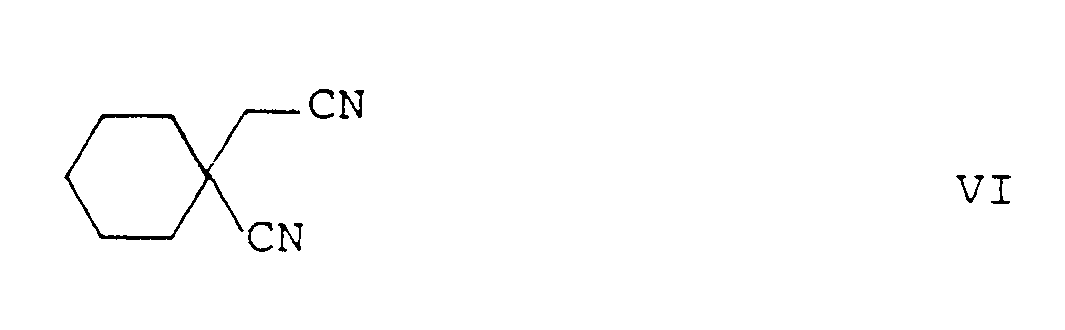
- Gemäss Patentanspruch 3 besteht alternativ die Möglichkeit, die (1-Cyanocyclohexyl)essigsäurealkylester durch Alkoholyse von (1-Cyanocyclohexyl)acetonitril der allgemeinen Formel

- Die Alkoholyse wird mit einem niederen Alkohol, vorzugsweise mit Methanol oder Ethanol, in Gegenwart einer Mineralsäure aus der Reihe Chlorwasserstoff, Bromwasserstoff oder wasserfreie Schwefelsäure durchgeführt.
Bezogen auf das Nitril wird sowohl der Alkohol als auch die Mineralsäure zweckmässig in Mengen von 1 bis 100 Aequivalenten eingesetzt. - Die Reaktionstemperatur liegt zweckmässig zwischen -20 und 50°C, der Druck zwischen 1 und 10 bar.
- Gegebenenfalls kann zum Alkohol als Reaktand ein zusätzliches aprotisches Lösungsmittel, wie z.B. ein aliphatischer oder aromatischer Kohlenwasserstoff, ein Ether, Ester, oder ein halogenierter Kohlenwasserstoff eingesetzt werden.
- Das bei der Alkoholyse auftretende Zwischenprodukt (Imidat) wird nicht isoliert, sondern direkt mit Wasser, vorzugsweise im Ueberschuss, bei Temperaturen zwischen -20 bis 100°C zum (1-Cyanocyclohexyl)essigsäurealkylester hydrolysiert.
- In der Folgestufe erfolgt die Umesterung des Alkylesters mit einem Benzylalkohol der allgemeinen Formel


- Diese Verbindungen sind bisher nicht beschrieben.
- Die Umesterung wird vorzugsweise mit Benzylalkohol in Gegenwart einer Base als Katalysator durchgeführt. Geeignete Basen sind die Cyanide wie z.B. Kaliumcyanid, Alkoholate wie z.B. Natriummethylat oder Kalium-tert.butylat, oder tertiäre Amine wie z.B. Triethylamin oder N,N-Dimethylaminopyridin.
- Der Katalyt gelangt zweckmässig in Mengen zwischen 0,01 und 10 mol%, vorzugsweise zwischen 0,2 und 3 mol% zum Einsatz.
- Vorteilhaft wird in Gegenwart eines aprotischen Lösungsmittels, wie Diethylether oder Tetrahydrofuran, oder eines aromatischen oder aliphatischen Kohlenwasserstoffs, wie Toluol oder Hexan, gearbeitet.
- Die Reaktionstemperatur für die Umesterung liegt zweckmässig zwischen 0°C und der Siedetemperatur des eingesetzten Benzylalkohols.
Das Reaktionsprodukt wird zweckmässig isoliert und durch Destillation gereinigt. - Gemäss Patentanspruch 2 besteht alternativ die Möglichkeit, den (1-Cyanocyclohexyl)essigsäurebenzylester durch Alkoholyse von (1-Cyanocyclohexyl)acetonitril der allgemeinen Formel


- Sowohl der Benzylalkohol als auch die Mineralsäure werden zweckmässig in Mengen von 1 bis 100 Aequivalenten, bezogen auf das Nitril, eingesetzt.
- Die Reaktionstemperatur liegt zweckmässig zwischen -20 und 50°C, der Druck zwischen 1 und 10 bar.
- Gegebenenfalls kann zum Alkohol als Reaktand ein zusätzliches aprotisches Lösungsmittel, wie z.B. ein aliphatischer oder aromatischer Kohlenwasserstoff, ein Ether, Ester, oder ein halogenierter Kohlenwasserstoff eingesetzt werden.
- Das bei der Alkoholyse auftretende Zwischenprodukt (Imidat) wird nicht isoliert, sondern direkt mit Wasser, vorzugsweise im Ueberschuss, bei Temperaturen zwischen -20 bis 100°C zum (1-Cyanocyclohexyl)essigsäurebenzylester hydrolysiert.
- In der letzten Stufe erfolgt die katalytische Hydrierung des Benzylesters mit Wasserstoff zum gewünschten Endprodukt, der 1-(Aminomethyl)cyclohexanessigsäure.
- Als Hydrierkatalysator können Edelmetallkatalysatoren, wie Platin-, Palladium-, Rhodium-, Rutheniumkatalysatoren, gegebenenfalls aufgebracht auf inerten Trägermaterialien wie z.B. Aktivkohle oder Aluminiumoxid, oder Raney-Katalysatoren wie z.B. Raney-Nickel oder Raney-Cobalt-Katalysatoren, oder (Edel) Metalloxiden wie z.B. Nickeloxid oder Platinoxid verwendet werden.
- Zweckmässig bewegt sich die Menge Katalysator zwischen 1 und 50 Gew.%, bezogen auf den eingesetzten Benzylester.
- Vorteilhaft wird in Gegenwart eines geeigneten Lösungsmittels, wie eines niederen Alkohols, z.B. Ethanol, Methanol, einer Carbonsäure, z.B. Essigsäure, eines Esters, z.B. Ethylacetat, oder eines Ethers oder Alkohols in Verbindung mit Ammoniak, hydriert.
- Der Druck bewegt sich zweckmässig im Bereich von 1 bis 100 bar, vorzugsweise zwischen 2 und 10 bar, die Temperatur zwischen 0 und 100°C. Die optimale Temperatur ist weitgehend abhängig vom eingesetzten Katalysator.
- Das gewünschte Endprodukt fällt bereits in hoher Reinheit an, kann aber gegebenenfalls durch Umkristallisation weiter gereinigt werden.
- 26,9 g (100 mol) (1-Cyanocyclohexyl)malonsäurediethylester, 4,3 g (100 mol) Lithiumchlorid und 3,6 g (200 mol) Wasser wurden in 300 ml Dimethylsulfoxid während 22 h auf 150°C erhitzt. Anschliessend wurde abgekühlt, mit 700 ml Wasser vermischt und mit 1000 ml Pentan extrahiert.
Durch Destillation der organischen Phase erhielt man 14,4 g (1-Cyanocyclohexyl)essigsäureethylester.
Ausbeute: 74%, bezogen auf eingesetzten (1-Cyanocyclohexyl) malonsäurediethylester.
Sdp.: 125-130°C/2-4 mbarElementaranalyse für C₁₁H₁₇NO₂(195,3): ber. C 67,7% H 8,8% N 7,2% gef. C 67,7% H 8,7% N 7,0%
1,20 (t, 3H)
1,10-1,25 (m, 1H)
1,34-1,56 (m, 4H)
1,61-1,77 (m, 3H)
1,93-2,03 (m, 2H)
2,69 (s, 2H)
4,11 (q, 2H) - 401 mg (2 mmol) (1-Cyanocyclohexyl)essigsäureethylester, 1,09 g (10 mmol) Benzylalkohol und 6 mg (0,1 mmol) Kaliumcyanid wurden in 5 ml Toluol während 24 h zum Rückfluss erhitzt. Anschliessend wurde die Lösung mit 25 ml Wasser gewaschen, vom Lösungsmittel befreit und am Hochvakuum destilliert. Man erhielt 350 mg (1-Cyanocyclohexyl)essigsäurebenzylester. Ausbeute: 68%, bezogen auf eingesetzten (1-Cyanocyclohexyl) essigsäureethylester.
Sdp.: 148-152°C/0,1-0,2 mbarElementaranalyse für C₁₆H₁₉NO₂(257,3): ber. C 74,7% H 7,4% 5,4% gef. C 74,9% H 7,4% 5,5%
1,13-1,27 (m, 1H)
1,28-1,42 (m, 2H)
1,59-1,80 (m, 5H)
2,04-2,12 (m, 2H)
2,59 (s, 2H)
5,12 (s, 2H)
7,30-7,41 (m, 5H) - 1,0 g (3,8 mmol) (1-Cyanocyclohexyl)essigsäurebenzylester wurde in 20 ml Methanol gelöst, mit 0,2 g Rh/C 5% versetzt und bei 10 bar Wasserstoffdruck hydriert. Nach 23 h bei Raumtemperatur wurde die Suspension filtriert, das Filtrat auf 3 ml eingeengt, mit 25 ml Ethanol versetzt, auf 4 ml aufkonzentriert und kühlgestellt. Das ausgefallene Produkt wurde abfiltriert, mit Ethanol gewaschen und getrocknet. Man erhielt 0,18 g Gabapentin.
Ausbeute: 27%, bezogen auf eingesetzten (1-Cyanocyclohexyl)essigsäurebenzylester.
Smp.: 148-151°C
¹H-NMR: (CD₃OD, 300 MHz) δ
1,30-1,67 (m, 10H)
2,47 (s, 2H)
2,89 (s, 2H) - 1,52 g (10 mmol) (1-Cyanocyclohexyl)acetonitril und 13,1 g (120 mmol) Benzylalkohol wurden in 20 ml Toluol bei 0°C mit HCl-Gas gesättigt. Nach 22 h wurde mit 25 ml Wasser und 100 ml Diethylether versetzt, 30 min gut gerührt und filtriert. Die organische Phase wurde abgetrennt und eingeengt. Man erhielt 13 g Produkt, das gemäss Gaschromatographie 2,22% (1-Cyanocyclohexyl)essigsäurebenzylester enthielt.
Ausbeute: 11%, bezogen auf eingesetztes (1-Cyanocyclohexyl)acetonitril. - (1-Cyanocyclohexyl)acetonitril (7,60 g, 50 mmol) wurden in 30 ml Ethanol suspendiert und im Autoklav bei 0°C mit HCl-Gas gesättigt (3 bar). Nach 22 Stunden wurde entspannt, 30 Min. evakuiert (18 mbar), mit 150 ml Wasser vermischt und 3 Stunden bei 10°C gerührt. Anschliessend wurde am Rotationsverdampfer auf 168 g aufkonzentriert und mit 50 ml Ethylacetat extrahiert. Aus der organischen Phase liessen sich mittels Destillation 4,04 g (1-Cyanocyclohexyl)essigsäureethylester isolieren.
Ausbeute: 41% (bezogen auf eingesetztes (1-Cyanocyclohexyl)acetonitril)
Claims (21)




Applications Claiming Priority (2)
| Application Number | Priority Date | Filing Date | Title |
|---|---|---|---|
| CH412889 | 1989-11-16 | ||
| CH4128/89 | 1989-11-16 |
Publications (2)
| Publication Number | Publication Date |
|---|---|
| EP0432504A1 true EP0432504A1 (de) | 1991-06-19 |
| EP0432504B1 EP0432504B1 (de) | 1994-06-08 |
Family
ID=4270351
Family Applications (1)
| Application Number | Title | Priority Date | Filing Date |
|---|---|---|---|
| EP90121827A Expired - Lifetime EP0432504B1 (de) | 1989-11-16 | 1990-11-14 | Verfahren zur Herstellung von 1-(Aminomethyl)cyclohexanessigsäure |
Country Status (14)
| Country | Link |
|---|---|
| US (2) | US5095148A (de) |
| EP (1) | EP0432504B1 (de) |
| JP (1) | JPH03176459A (de) |
| AT (1) | ATE106861T1 (de) |
| CA (1) | CA2030107A1 (de) |
| DE (1) | DE59006037D1 (de) |
| DK (1) | DK0432504T3 (de) |
| ES (1) | ES2057334T3 (de) |
| FI (1) | FI905584A7 (de) |
| IL (1) | IL96360A0 (de) |
| NO (1) | NO177531C (de) |
| PT (1) | PT95894B (de) |
| RU (1) | RU2029761C1 (de) |
| YU (1) | YU215290A (de) |
Cited By (2)
| Publication number | Priority date | Publication date | Assignee | Title |
|---|---|---|---|---|
| WO2000039074A1 (en) * | 1998-12-29 | 2000-07-06 | Richter Gedeon Vegyészeti Gyár Rt. | Process for the synthesis of 1-(aminomethyl)cyclohexyl-acetic acid |
| US7098362B2 (en) | 2004-07-20 | 2006-08-29 | Sandoz Ag | Processes for the preparation of gabapentin |
Families Citing this family (16)
| Publication number | Priority date | Publication date | Assignee | Title |
|---|---|---|---|---|
| UA49011C2 (uk) * | 1996-03-14 | 2002-09-16 | Варнер-Ламберт Компані | Похідні циклічної амінокислоти, фармацевтична композиція та спосіб лікування |
| US6372792B1 (en) | 1996-04-26 | 2002-04-16 | Guy Chouinard | Method for treating anxiety, anxiety disorders and insomnia |
| US6255526B1 (en) | 1996-12-24 | 2001-07-03 | Teva Pharmaceutical Industries Ltd. | Preparation of gabapentin |
| WO1999018063A2 (en) | 1997-10-07 | 1999-04-15 | Warner-Lambert Company | Process for preparing a cyclic amino acid anticonvulsant compound |
| CN1447684A (zh) * | 2000-06-16 | 2003-10-08 | 特瓦制药工业有限公司 | 具有在可控制范围内的pH值的稳定的加巴喷丁 |
| IT1319674B1 (it) * | 2000-12-01 | 2003-10-23 | Erregierre Spa | Processo per la preparazione dell'acido1-(aminometil)cicloesanacetico. |
| WO2003089403A1 (en) * | 2002-04-16 | 2003-10-30 | Taro Pharmaceutical Industries Ltd. | Process for preparing gabapentin |
| ITMI20022071A1 (it) * | 2002-10-01 | 2004-04-02 | Erregierre Spa | Processo di sintesi dell'acido 1-(aminometil)cicloesanacetico cloridato. |
| CA2472815A1 (en) | 2002-11-18 | 2004-06-03 | Nicholas Piramal India Limited | Improved process for preparation of gabapentin |
| DE602004017166D1 (de) * | 2003-03-25 | 2008-11-27 | Kiel Lab Inc | Gabapentintannat in flüssigen und/oder halbfesten dosierformen |
| WO2004093866A1 (en) * | 2003-03-25 | 2004-11-04 | Kiel Laboratories, Inc. | Process for preparing phenolic acid salts of gabapentin |
| EP1622603A4 (de) | 2003-03-25 | 2010-03-24 | Kiel Lab Inc | Phenolsäuresalze von gabapentin in festen dosierformen und anwendungsverfahren |
| US7439387B2 (en) * | 2003-04-21 | 2008-10-21 | Matrix Laboratories Ltd. | Process for the preparation of Gabapentin form-II |
| US20050187295A1 (en) * | 2004-02-19 | 2005-08-25 | Surendra Kalyan | Processes for the preparation of gabapentin |
| JP5144656B2 (ja) * | 2006-06-30 | 2013-02-13 | ザック システム エス.ピー.エー. | ガバペンチンの調製プロセス |
| CN101585778B (zh) * | 2008-05-19 | 2014-08-13 | 上海臣邦医药科技有限公司 | 一种普瑞巴林制备方法 |
Citations (2)
| Publication number | Priority date | Publication date | Assignee | Title |
|---|---|---|---|---|
| DE2044216A1 (de) * | 1969-09-12 | 1971-04-29 | Danchi Seiyaku Co Ltd , Tokio | Verfahren zum Herstellen von 4 Cy anocyclohexancar bonsaure |
| EP0358092A1 (de) * | 1988-09-01 | 1990-03-14 | Lonza A.G. | 2-Aza-4-(alkoxycarbonyl)spiro-[4,5]decan-3-on |
Family Cites Families (5)
| Publication number | Priority date | Publication date | Assignee | Title |
|---|---|---|---|---|
| US2264354A (en) * | 1937-12-22 | 1941-12-02 | Ig Farbenindustrie Ag | Addition products of dienes and unsaturated esters, ketones, or nitriles |
| US2467927A (en) * | 1947-05-29 | 1949-04-19 | Goodrich Co B F | Preparation of monomeric alkyl alpha-cyano-acrylates |
| DE2460891C2 (de) * | 1974-12-21 | 1982-09-23 | Gödecke AG, 1000 Berlin | 1-Aminomethyl-1-cycloalkanessigsäuren und deren Ester, Verfahren zu deren Herstellung und diese Verbindungen enthaltende Arzneimittel |
| DE2611690A1 (de) * | 1976-03-19 | 1977-09-22 | Goedecke Ag | Cyclische sulfonyloxyimide |
| PH27359A (en) * | 1989-08-25 | 1993-06-21 | Warner Lambert Co | Process for cyclic amino acid anticonvulsant compounds |
-
1990
- 1990-11-12 FI FI905584A patent/FI905584A7/fi not_active IP Right Cessation
- 1990-11-13 YU YU215290A patent/YU215290A/sh unknown
- 1990-11-14 DE DE59006037T patent/DE59006037D1/de not_active Expired - Fee Related
- 1990-11-14 EP EP90121827A patent/EP0432504B1/de not_active Expired - Lifetime
- 1990-11-14 DK DK90121827.1T patent/DK0432504T3/da active
- 1990-11-14 ES ES90121827T patent/ES2057334T3/es not_active Expired - Lifetime
- 1990-11-14 JP JP2306361A patent/JPH03176459A/ja active Pending
- 1990-11-14 AT AT90121827T patent/ATE106861T1/de not_active IP Right Cessation
- 1990-11-15 RU SU904831479A patent/RU2029761C1/ru active
- 1990-11-15 NO NO904953A patent/NO177531C/no unknown
- 1990-11-15 CA CA002030107A patent/CA2030107A1/en not_active Abandoned
- 1990-11-15 US US07/612,985 patent/US5095148A/en not_active Expired - Fee Related
- 1990-11-15 IL IL96360A patent/IL96360A0/xx unknown
- 1990-11-15 PT PT95894A patent/PT95894B/pt not_active IP Right Cessation
-
1991
- 1991-07-10 US US07/727,939 patent/US5130455A/en not_active Expired - Fee Related
Patent Citations (2)
| Publication number | Priority date | Publication date | Assignee | Title |
|---|---|---|---|---|
| DE2044216A1 (de) * | 1969-09-12 | 1971-04-29 | Danchi Seiyaku Co Ltd , Tokio | Verfahren zum Herstellen von 4 Cy anocyclohexancar bonsaure |
| EP0358092A1 (de) * | 1988-09-01 | 1990-03-14 | Lonza A.G. | 2-Aza-4-(alkoxycarbonyl)spiro-[4,5]decan-3-on |
Non-Patent Citations (1)
| Title |
|---|
| DRUGS OF THE FUTURE, Band IX, Nr. 6, 1984 "Gabapentin" Seiten 418,419 * Fig. 1 * * |
Cited By (2)
| Publication number | Priority date | Publication date | Assignee | Title |
|---|---|---|---|---|
| WO2000039074A1 (en) * | 1998-12-29 | 2000-07-06 | Richter Gedeon Vegyészeti Gyár Rt. | Process for the synthesis of 1-(aminomethyl)cyclohexyl-acetic acid |
| US7098362B2 (en) | 2004-07-20 | 2006-08-29 | Sandoz Ag | Processes for the preparation of gabapentin |
Also Published As
| Publication number | Publication date |
|---|---|
| FI905584L (fi) | 1991-05-17 |
| NO904953D0 (no) | 1990-11-15 |
| FI905584A0 (fi) | 1990-11-12 |
| JPH03176459A (ja) | 1991-07-31 |
| FI905584A7 (fi) | 1991-05-17 |
| PT95894B (pt) | 1998-01-30 |
| US5095148A (en) | 1992-03-10 |
| RU2029761C1 (ru) | 1995-02-27 |
| YU215290A (sh) | 1993-05-28 |
| NO904953L (no) | 1991-05-21 |
| EP0432504B1 (de) | 1994-06-08 |
| PT95894A (pt) | 1991-09-13 |
| NO177531C (no) | 1995-10-04 |
| ATE106861T1 (de) | 1994-06-15 |
| CA2030107A1 (en) | 1991-05-17 |
| DE59006037D1 (de) | 1994-07-14 |
| DK0432504T3 (da) | 1994-07-04 |
| NO177531B (no) | 1995-06-26 |
| ES2057334T3 (es) | 1994-10-16 |
| IL96360A0 (en) | 1991-08-16 |
| US5130455A (en) | 1992-07-14 |
Similar Documents
| Publication | Publication Date | Title |
|---|---|---|
| EP0432504B1 (de) | Verfahren zur Herstellung von 1-(Aminomethyl)cyclohexanessigsäure | |
| DE69207601T2 (de) | Verfahren zur herstellung von sertralin-zwischenprodukten | |
| DE69109514T2 (de) | 4-(4-Alkoxyphenyl)-2-Butylaminderivate und deren Herstellungsverfahren. | |
| EP1309562B1 (de) | 4-alkoxy-cyclohexan-1-amino-carbonsäureester und verfahren zu ihrer herstellung | |
| DE69808092T2 (de) | Verfahren zur herstellung eines substituiertes perhydroisoindols | |
| CH622235A5 (de) | ||
| DE2903891C2 (de) | ||
| EP0678502A1 (de) | Verfahren zur Herstellung von Glykoloylaniliden | |
| DE60104704T2 (de) | Verfahren zur herstellung einer substituierten imidazopyridinverbindung | |
| DE3642105A1 (de) | Substituierte aminomethyl-5,6,7,8-tetrahydronaphtyl-oxyessigsaeuren, neue zwischenprodukte, verfahren zu ihrer herstellung sowie ihre verwendung in arzneimitteln | |
| DE69623117T2 (de) | Verfahren zur herstellung von 4-hydroxy-2-pyrrolidon | |
| EP0397042B1 (de) | Herstellung von Isochinolinderivaten | |
| DE69109258T2 (de) | Verfahren zur stereoselektiven Umwandlung eines Diols in einen Alkohol. | |
| EP0006180B1 (de) | 3-Phenoxybenzylidenamine und 3-Benzylbenzylidenamine, ein Verfahren zu deren Herstellung sowie deren Verwendung zur Herstellung der entsprechenden Aldehyde | |
| US5136091A (en) | Process for the production of 1-(aminomethyl) cyclohexane acetic acid | |
| DE19524337C1 (de) | Verfahren zur Herstellung von beta-Amino-alpha-hydroxycarbonsäuren und deren Derivaten | |
| EP0854857A1 (de) | Verfahren zur herstellung von optisch aktiven alpha-aminosäuren und alpha-aminosäure-derivaten | |
| US5149870A (en) | Process for the production of 1-(aminomethyl)cyclohexane acetic acid | |
| DE69323087T2 (de) | Verfahren zur herstellung von anilin-derivaten | |
| EP1268400B1 (de) | Verfahren zur herstellung von n-butyryl-4-amino-3-methyl-benzoesäuremethylester und die neue verbindung n-(4-brom-2-methylphenyl)-butanamid | |
| DE69702165T2 (de) | Verfahren zur Herstellung eines Naphthylbutanons | |
| DE69722565T2 (de) | Verfahren zur Herstellung von 4-Hydroxy-2-Pyrrolidinon und Verfahren zu deren Reinigung | |
| EP0090769B1 (de) | Verfahren zur Herstellung von 1,2,5,6-Tetrahydro-4H-pyrrolo(3,2,1-ij)-chinolin-4-on und neue 5-Halogen-1,2,3-(1,2-dihydropyrrolo)-4-chinolone als Zwischenprodukte zur Durchführung des Verfahrens | |
| CH409903A (de) | Verfahren zur Herstellung von organischen Fluor-Verbindungen | |
| JPS62126164A (ja) | 4−アルコキシ−2−オキソ−ピロリジン−1−酢酸アルキルエステルおよびその製法 |
Legal Events
| Date | Code | Title | Description |
|---|---|---|---|
| PUAI | Public reference made under article 153(3) epc to a published international application that has entered the european phase |
Free format text: ORIGINAL CODE: 0009012 |
|
| AK | Designated contracting states |
Kind code of ref document: A1 Designated state(s): AT BE CH DE DK ES FR GB IT LI NL SE |
|
| 17P | Request for examination filed |
Effective date: 19911216 |
|
| 17Q | First examination report despatched |
Effective date: 19930903 |
|
| GRAA | (expected) grant |
Free format text: ORIGINAL CODE: 0009210 |
|
| AK | Designated contracting states |
Kind code of ref document: B1 Designated state(s): AT BE CH DE DK ES FR GB IT LI NL SE |
|
| REF | Corresponds to: |
Ref document number: 106861 Country of ref document: AT Date of ref document: 19940615 Kind code of ref document: T |
|
| REG | Reference to a national code |
Ref country code: DK Ref legal event code: T3 |
|
| GBT | Gb: translation of ep patent filed (gb section 77(6)(a)/1977) |
Effective date: 19940610 |
|
| REF | Corresponds to: |
Ref document number: 59006037 Country of ref document: DE Date of ref document: 19940714 |
|
| ITF | It: translation for a ep patent filed | ||
| ET | Fr: translation filed | ||
| REG | Reference to a national code |
Ref country code: ES Ref legal event code: FG2A Ref document number: 2057334 Country of ref document: ES Kind code of ref document: T3 |
|
| EAL | Se: european patent in force in sweden |
Ref document number: 90121827.1 |
|
| PLBE | No opposition filed within time limit |
Free format text: ORIGINAL CODE: 0009261 |
|
| STAA | Information on the status of an ep patent application or granted ep patent |
Free format text: STATUS: NO OPPOSITION FILED WITHIN TIME LIMIT |
|
| 26N | No opposition filed | ||
| PGFP | Annual fee paid to national office [announced via postgrant information from national office to epo] |
Ref country code: GB Payment date: 19961021 Year of fee payment: 7 |
|
| PGFP | Annual fee paid to national office [announced via postgrant information from national office to epo] |
Ref country code: ES Payment date: 19961107 Year of fee payment: 7 |
|
| PGFP | Annual fee paid to national office [announced via postgrant information from national office to epo] |
Ref country code: AT Payment date: 19961108 Year of fee payment: 7 |
|
| PGFP | Annual fee paid to national office [announced via postgrant information from national office to epo] |
Ref country code: FR Payment date: 19961114 Year of fee payment: 7 |
|
| PGFP | Annual fee paid to national office [announced via postgrant information from national office to epo] |
Ref country code: DK Payment date: 19961120 Year of fee payment: 7 Ref country code: BE Payment date: 19961120 Year of fee payment: 7 |
|
| PGFP | Annual fee paid to national office [announced via postgrant information from national office to epo] |
Ref country code: SE Payment date: 19961122 Year of fee payment: 7 |
|
| PGFP | Annual fee paid to national office [announced via postgrant information from national office to epo] |
Ref country code: NL Payment date: 19961126 Year of fee payment: 7 |
|
| PGFP | Annual fee paid to national office [announced via postgrant information from national office to epo] |
Ref country code: DE Payment date: 19961213 Year of fee payment: 7 |
|
| PGFP | Annual fee paid to national office [announced via postgrant information from national office to epo] |
Ref country code: CH Payment date: 19970221 Year of fee payment: 7 |
|
| PG25 | Lapsed in a contracting state [announced via postgrant information from national office to epo] |
Ref country code: GB Free format text: LAPSE BECAUSE OF NON-PAYMENT OF DUE FEES Effective date: 19971114 Ref country code: AT Free format text: LAPSE BECAUSE OF NON-PAYMENT OF DUE FEES Effective date: 19971114 |
|
| PG25 | Lapsed in a contracting state [announced via postgrant information from national office to epo] |
Ref country code: SE Free format text: LAPSE BECAUSE OF NON-PAYMENT OF DUE FEES Effective date: 19971115 Ref country code: ES Free format text: LAPSE BECAUSE OF NON-PAYMENT OF DUE FEES Effective date: 19971115 |
|
| PG25 | Lapsed in a contracting state [announced via postgrant information from national office to epo] |
Ref country code: LI Free format text: LAPSE BECAUSE OF NON-PAYMENT OF DUE FEES Effective date: 19971130 Ref country code: FR Free format text: THE PATENT HAS BEEN ANNULLED BY A DECISION OF A NATIONAL AUTHORITY Effective date: 19971130 Ref country code: CH Free format text: LAPSE BECAUSE OF NON-PAYMENT OF DUE FEES Effective date: 19971130 Ref country code: BE Free format text: LAPSE BECAUSE OF NON-PAYMENT OF DUE FEES Effective date: 19971130 |
|
| PG25 | Lapsed in a contracting state [announced via postgrant information from national office to epo] |
Ref country code: DK Free format text: LAPSE BECAUSE OF NON-PAYMENT OF DUE FEES Effective date: 19971231 |
|
| BERE | Be: lapsed |
Owner name: LONZA A.G. Effective date: 19971130 |
|
| PG25 | Lapsed in a contracting state [announced via postgrant information from national office to epo] |
Ref country code: NL Free format text: LAPSE BECAUSE OF NON-PAYMENT OF DUE FEES Effective date: 19980601 |
|
| GBPC | Gb: european patent ceased through non-payment of renewal fee |
Effective date: 19971114 |
|
| REG | Reference to a national code |
Ref country code: CH Ref legal event code: PL |
|
| PG25 | Lapsed in a contracting state [announced via postgrant information from national office to epo] |
Ref country code: DE Free format text: LAPSE BECAUSE OF NON-PAYMENT OF DUE FEES Effective date: 19980801 |
|
| EUG | Se: european patent has lapsed |
Ref document number: 90121827.1 |
|
| NLV4 | Nl: lapsed or anulled due to non-payment of the annual fee |
Effective date: 19980601 |
|
| REG | Reference to a national code |
Ref country code: FR Ref legal event code: ST |
|
| REG | Reference to a national code |
Ref country code: DK Ref legal event code: EBP |
|
| REG | Reference to a national code |
Ref country code: ES Ref legal event code: FD2A Effective date: 19981212 |
|
| PG25 | Lapsed in a contracting state [announced via postgrant information from national office to epo] |
Ref country code: IT Free format text: LAPSE BECAUSE OF NON-PAYMENT OF DUE FEES;WARNING: LAPSES OF ITALIAN PATENTS WITH EFFECTIVE DATE BEFORE 2007 MAY HAVE OCCURRED AT ANY TIME BEFORE 2007. THE CORRECT EFFECTIVE DATE MAY BE DIFFERENT FROM THE ONE RECORDED. Effective date: 20051114 |