EP0434113A2 - Legierungsadditive in niedrigen Konzentrationen für in Hitze bearbeitete Nd-Fe-B-Magnete - Google Patents
Legierungsadditive in niedrigen Konzentrationen für in Hitze bearbeitete Nd-Fe-B-Magnete Download PDFInfo
- Publication number
- EP0434113A2 EP0434113A2 EP90203171A EP90203171A EP0434113A2 EP 0434113 A2 EP0434113 A2 EP 0434113A2 EP 90203171 A EP90203171 A EP 90203171A EP 90203171 A EP90203171 A EP 90203171A EP 0434113 A2 EP0434113 A2 EP 0434113A2
- Authority
- EP
- European Patent Office
- Prior art keywords
- alloy
- room temperature
- magnetic properties
- zinc
- making
- Prior art date
- Legal status (The legal status is an assumption and is not a legal conclusion. Google has not performed a legal analysis and makes no representation as to the accuracy of the status listed.)
- Granted
Links
Images
Classifications
-
- H—ELECTRICITY
- H01—ELECTRIC ELEMENTS
- H01F—MAGNETS; INDUCTANCES; TRANSFORMERS; SELECTION OF MATERIALS FOR THEIR MAGNETIC PROPERTIES
- H01F1/00—Magnets or magnetic bodies characterised by the magnetic materials therefor; Selection of materials for their magnetic properties
- H01F1/01—Magnets or magnetic bodies characterised by the magnetic materials therefor; Selection of materials for their magnetic properties of inorganic materials
- H01F1/03—Magnets or magnetic bodies characterised by the magnetic materials therefor; Selection of materials for their magnetic properties of inorganic materials characterised by their coercivity
- H01F1/032—Magnets or magnetic bodies characterised by the magnetic materials therefor; Selection of materials for their magnetic properties of inorganic materials characterised by their coercivity of hard-magnetic materials
- H01F1/04—Magnets or magnetic bodies characterised by the magnetic materials therefor; Selection of materials for their magnetic properties of inorganic materials characterised by their coercivity of hard-magnetic materials metals or alloys
- H01F1/047—Alloys characterised by their composition
- H01F1/053—Alloys characterised by their composition containing rare earth metals
- H01F1/055—Alloys characterised by their composition containing rare earth metals and magnetic transition metals, e.g. SmCo5
- H01F1/057—Alloys characterised by their composition containing rare earth metals and magnetic transition metals, e.g. SmCo5 and IIIa elements, e.g. Nd2Fe14B
- H01F1/0571—Alloys characterised by their composition containing rare earth metals and magnetic transition metals, e.g. SmCo5 and IIIa elements, e.g. Nd2Fe14B in the form of particles, e.g. rapid quenched powders or ribbon flakes
- H01F1/0575—Alloys characterised by their composition containing rare earth metals and magnetic transition metals, e.g. SmCo5 and IIIa elements, e.g. Nd2Fe14B in the form of particles, e.g. rapid quenched powders or ribbon flakes pressed, sintered or bonded together
- H01F1/0576—Alloys characterised by their composition containing rare earth metals and magnetic transition metals, e.g. SmCo5 and IIIa elements, e.g. Nd2Fe14B in the form of particles, e.g. rapid quenched powders or ribbon flakes pressed, sintered or bonded together pressed, e.g. hot working
Definitions
- This invention relates to permanent magnetic alloys and a method for making these alloys. Particularly, this invention relates to permanent magnet alloys having high room temperature coercivity and to a method for forming such magnetic alloys as specified in the preamble of Claim 1, for example as disclosed in EP-A-0133758.
- Rapidly solidified neodymium, iron, boron (Nd-Fe-B) alloys yield high performance, essentially isotropic, permanent magnet materials whose principal component is a tetragonal Nd2Fe14B phase.
- the ribbons or flakes produced by rapid solidification, i.e., melt-spinning may be hot-worked by isostatically pressing at elevated temperatures to produce fully dense, or hot-pressed, magnets with essentially the same magnetic properties as the original ribbons.
- specifically die-upsetting, magnetically-aligned magnets are produced with approximately 50 percent higher remanences (B r ) and approximately 200 percent higher energy products [(BH) max ] compared to the hot-pressed precursor material.
- the process of magnetic alignment achieved during die-upsetting has been described as a diffusion slip mechanism which requires small grain sizes, approximately 50 nanometres, and a ductile grain boundary phase.
- the combination of small grain size and a ductile grain boundary phase allows an orientation of the c-axis of the grains to take place along the press direction during plastic deformation of the alloy. Since the c-axis is also the preferred orientation of the magnetization, the magnetic properties are enhanced along the pressed direction of the die-upset magnets.
- Another approach to limiting grain growth is to introduce into the alloy impurities or additives which collect in the grain boundaries. If the additive is foreign to the 2-14-1 phase present inside the grain it must migrate with the boundary as the grain grows in size, resulting in slower grain boundary movement, and thereby slowing grain growth.
- a method for making an alloy with permanent magnetic properties at room temperature is characterised by the features specified in the characterising portion of Claim 1.
- the state-of-the-art knowledge concludes that additives in the Nd2Fe14B-type magnets must be added into the alloy at the initial melting and casting of the ingot, prior to melt-spinning and hot-working.
- the method of the present invention introduces the additive into the magnetic alloy during a hot-pressing step, therefore permitting the additive and its concentration to be adjusted during this final step.
- the relatively low temperatures used in hot-working compared to either melt-spinning or sintering, probably would help limit the additive to the neodymium-rich grain boundaries where they would most likely affect grain growth and therefore magnetic coercivity.
- such a magnet be formed by a method wherein the metal additive is introduced into the magnet immediately prior to a hot-working step.
- the applicants are the first to diffusion-alloy a metal additive into a magnetic alloy during hot-working, thus permitting the additive and its concentration, and correspondingly, the magnetic properties, to be adjusted during this final processing step.
- the relatively low temperatures used in hot-working as compared to other techniques, such as melt-spinning or sintering, helps limit the additives to the neodymium-rich grain boundaries where they are most likely to effect grain growth and thus magnetic coercivity.
- the elemental additives are introduced into the alloy by first stirring a fine powder of the additive into the crushed, rapidly solidified ribbons prior to hot-pressing of the alloy. Pure elements were used, however it is foreseeable that compounds may also be used, as well as other techniques for adding the additive such as plating or spraying techniques.
- Eleven metal elemental additives have been determined to diffuse thoroughly through the Nd-Fe-B magnets thereby resulting in an alloy having homogeneous magnetic properties throughout, these additives being cadmium, copper, gold, iridium, magnesium, nickel, palladium, platinum, ruthenium, silver and zinc. Other elemental additives were also tested, however they tended to only diffuse over short distances (approximately 100 micrometres) and/or react with the Nd-Fe-B matrix to form intermetallic phases.
- a primary inventive feature of this invention is the diffusion-alloying of zinc, in concentrations ranging from approximately 0.1 weight percent to approximately 10 weight percent, throughout the Nd-Fe-B magnets.
- the resulting magnetic alloys are characterized by enhanced magnetic properties as compared to conventionally formed Nd-Fe-B magnets. For instance, the addition of these individual elements to the rapidly solidified ribbons enhanced the magnetic coercivity of the alloy by as much as 100 percent when the magnetic alloys were die-upset.
- Crushed ribbon flakes of rapidly solidified material having an approximate composition of Nd 13.7 Fe 81.0 B 5.3 were used as the starting material.
- the rapidly solidified ribbons were formed using conventional techniques wherein first a mixture is formed of neodymium, iron and boron, then the constituents are melted to form a homogeneous melt, and lastly the homogeneous mixture is rapidly quenched at a rate sufficient to form ribbons of an alloy having a very fine crystalline microstructure.
- Hot-pressed magnets were formed from these ribbons by crushing these ribbons, adding the requisite quantity of metal additive to the crushed ribbons and then heating the resultant mixture quickly to about 750°-800°C in a vacuum and pressing isostatically at approximately 100 MegaPascals.
- Die-upset magnets were produced by pressing these hot-pressed precursors in an over-sized die at 750°C until their original height was reduced by approximately 60 percent.
- Graphite dies were used in both hot-working steps, and boron nitride was used as a die-wall lubricant.
- the magnets were sliced with a high-speed diamond saw, yielding both (1) cross-sections for microscopy analysis and (2) 50 milligram cubes for demagnetization measurements on a vibrating sample magnetometer (VSM). All samples were pre-magnetized in a pulsed field of 120 kiloOersteds (kOe) and then measured with the VSM in directions parallel and perpendicular to the pressed direction. A self-demagnetization factor of one-third was used to correct for the geometry of the sample. Unless otherwise indicated, the values given throughout this specification for magnetic remanence (B r ), magnetic coercivity (H ci ) and magnetic energy product [(BH) max ] of the magnetic alloy will always refer to the direction parallel to the pressing. Densities of the alloys were also measured using the standard water displacement technique.
- the powdered elemental additives used were characterized by a fine particle size, i.e., less than 75 micrometres for zinc, less than 45 micrometres for the copper and manganese, and less than 10 micrometres for the nickel.
- the powdered elemental additives were individually added to the rapidly solidified and crushed Nd-Fe-B ribbons by weight. Therefore, for example, 1 weight percent zinc additive corresponds to a mixture containing about 1 weight percent powdered zinc and 99 weight percent crushed Nd-Fe-B ribbons.
- Die-upset Nd-Fe-B magnets were formed from the hot-pressed precursors containing the various elemental additives as described by the method above.
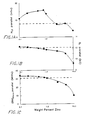
- the densities and magnetic properties of die-upset, zinc-containing magnets are summarized in Table I.
- Figures 1A, 1B and 1C illustrate various magnetic properties versus weight percent zinc in die-upset Nd-Fe-B magnets.
- Figure 1A shows coercivity (H ci ) vs. weight percent zinc
- Figure 1B shows remanence (B r ) vs. weight percent zinc
- Figure 1C shows energy product [(BH) max ] vs. weight percent zinc.
- H ci coercivity
- B r remanence
- Figure 1C shows energy product [(BH) max ] vs. weight percent zinc.
- the corresponding magnetic properties of the zinc-free Nd-Fe-B magnet are indicated with dashed lines in each Figure.
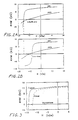
- Figures 2A and 2B illustrate the demagnetization curves for die-upset Nd-Fe-B magnets.
- Figure 2A containing about 0.5 weight percent zinc, and Figure 2B being zinc-free. Measurements were made parallel (par.) and perpendicular (perp.) to the press direction. Again, for comparative purposes, a vertical dashed line is provided corresponding to the parallel direction magnetic coercivity measurement of the 0.5 weight percent zinc-containing Nd-Fe-B magnet.
- the diffusion of manganese approximately 0.5 weight percent, was limited to a region within 100-200 micrometers of the original grains of powdered additive. Without the ability to diffuse, manganese was less able to influence the coercivity of the magnet.
- gallium which has resulted in the largest coercivity enhancement when added to an ingot, was difficult to obtain and handle as a powder because of its low melting temperature.
- initial tests with a coarse gallium powder revealed that although it diffused into nearby ribbons, the bulk of the gallium was tied up as intermetallic phases, and, just as with the manganese, adding the gallium did not alter significantly the magnetic coercivity of the alloy.
- Diffusion-alloying has been shown to be an effective process of introducing low-level additives into hot-worked Nd-Fe-B magnets. Although similar magnetic coercivities have been previously obtained by adding elements to the initial ingot, diffusion-alloying during hot-working permits the final chemistry of the magnet and, more specifically, the grain boundaries to be determined during the final processing steps. Elements which diffuse into the matrix, such as zinc, copper and nickel, enhance the coercivity by as much as 100 percent in die-upset Nd-Fe-B magnetic alloys. The coercivity was less affected by elements which did not diffuse readily, such as manganese. At optimum levels, approximately 0.5-0.8 weight percent, the additives did not diminish the magnetic remanence or the magnetic energy product of the alloy.
Landscapes
- Chemical & Material Sciences (AREA)
- Crystallography & Structural Chemistry (AREA)
- Inorganic Chemistry (AREA)
- Engineering & Computer Science (AREA)
- Power Engineering (AREA)
- Hard Magnetic Materials (AREA)
- Manufacturing Cores, Coils, And Magnets (AREA)
- Powder Metallurgy (AREA)
Applications Claiming Priority (2)
| Application Number | Priority Date | Filing Date | Title |
|---|---|---|---|
| US45343489A | 1989-12-19 | 1989-12-19 | |
| US453434 | 1989-12-19 |
Publications (3)
| Publication Number | Publication Date |
|---|---|
| EP0434113A2 true EP0434113A2 (de) | 1991-06-26 |
| EP0434113A3 EP0434113A3 (en) | 1992-04-08 |
| EP0434113B1 EP0434113B1 (de) | 1994-03-02 |
Family
ID=23800570
Family Applications (1)
| Application Number | Title | Priority Date | Filing Date |
|---|---|---|---|
| EP90203171A Expired - Lifetime EP0434113B1 (de) | 1989-12-19 | 1990-12-01 | Legierungsadditive in niedrigen Konzentrationen für in Hitze bearbeitete Nd-Fe-B-Magnete |
Country Status (4)
| Country | Link |
|---|---|
| EP (1) | EP0434113B1 (de) |
| JP (1) | JPH0739618B2 (de) |
| CA (1) | CA2023924A1 (de) |
| DE (1) | DE69007048T2 (de) |
Families Citing this family (3)
| Publication number | Priority date | Publication date | Assignee | Title |
|---|---|---|---|---|
| CN103282976B (zh) * | 2010-12-27 | 2017-02-08 | Tdk株式会社 | 磁性体 |
| JP5729051B2 (ja) * | 2011-03-18 | 2015-06-03 | Tdk株式会社 | R−t−b系希土類焼結磁石 |
| CN112863848B (zh) | 2021-01-15 | 2023-04-11 | 烟台东星磁性材料股份有限公司 | 高矫顽力烧结钕铁硼磁体的制备方法 |
Family Cites Families (5)
| Publication number | Priority date | Publication date | Assignee | Title |
|---|---|---|---|---|
| JPH01139738A (ja) * | 1987-11-27 | 1989-06-01 | Hitachi Metals Ltd | 磁気異方性磁石材料の製造方法及びその装置 |
| JPH01175705A (ja) * | 1987-12-29 | 1989-07-12 | Daido Steel Co Ltd | 希土類磁石の製造方法 |
| JPH01196104A (ja) * | 1988-02-01 | 1989-08-07 | Tdk Corp | 希土類合金磁石の製造方法 |
| US4950450A (en) * | 1988-07-21 | 1990-08-21 | Eastman Kodak Company | Neodymium iron boron magnets in a hot consolidation process of making the same |
| US4881985A (en) * | 1988-08-05 | 1989-11-21 | General Motors Corporation | Method for producing anisotropic RE-FE-B type magnetically aligned material |
-
1990
- 1990-08-23 CA CA002023924A patent/CA2023924A1/en not_active Abandoned
- 1990-12-01 DE DE69007048T patent/DE69007048T2/de not_active Expired - Fee Related
- 1990-12-01 EP EP90203171A patent/EP0434113B1/de not_active Expired - Lifetime
- 1990-12-19 JP JP2403786A patent/JPH0739618B2/ja not_active Expired - Lifetime
Also Published As
| Publication number | Publication date |
|---|---|
| EP0434113A3 (en) | 1992-04-08 |
| CA2023924A1 (en) | 1991-06-20 |
| DE69007048D1 (de) | 1994-04-07 |
| JPH03267346A (ja) | 1991-11-28 |
| JPH0739618B2 (ja) | 1995-05-01 |
| DE69007048T2 (de) | 1994-06-01 |
| EP0434113B1 (de) | 1994-03-02 |
Similar Documents
| Publication | Publication Date | Title |
|---|---|---|
| KR960008185B1 (ko) | 희토류-철계 영구자석 및 이의 제조방법 | |
| EP0302395B1 (de) | Dauermagnete | |
| EP0239031B2 (de) | Verfahren zur herstellung von magnetpulver fuer einen megnetisch anisotropen gebundenen magneten | |
| EP0242187B1 (de) | Dauermagnet und Verfahren zu seiner Herstellung | |
| US4898625A (en) | Method for producing a rare earth metal-iron-boron permanent magnet by use of a rapidly-quenched alloy powder | |
| US5022939A (en) | Permanent magnets | |
| EP0801402B1 (de) | Gusslegierung für die Herstellung von Dauermagneten mit seltenen Erden und Verfahren zur Herstellung dieser Legierung und dieser Dauermagneten | |
| US5009706A (en) | Rare-earth antisotropic powders and magnets and their manufacturing processes | |
| EP0249973B1 (de) | Dauermagnet-Material und Verfahren zur Herstellung | |
| JP4389427B2 (ja) | 希土類−鉄−硼素系磁石用合金粉末を用いた焼結磁石 | |
| Fuerst et al. | Enhanced coercivities in die‐upset Nd‐Fe‐B magnets with diffusion‐alloyed additives (Zn, Cu, and Ni) | |
| US5037492A (en) | Alloying low-level additives into hot-worked Nd-Fe-B magnets | |
| US6019859A (en) | Iron-based permanent magnets and their fabrication as well as iron-based permanent magnet alloy powders for permanent bonded magnets and iron-based bonded magnets | |
| US5069713A (en) | Permanent magnets and method of making | |
| US5447578A (en) | Corrosion-resistant rare earth metal-transition metal series magnets and method of producing the same | |
| Fuerst et al. | Diffusion‐alloyed additives in die‐upset Nd‐Fe‐B magnets | |
| DE68927203T2 (de) | Herstellungsverfahren eines Dauermagnetes | |
| US6136099A (en) | Rare earth-iron series permanent magnets and method of preparation | |
| EP1961506A1 (de) | Gesintertes seltenerdenmagnet und herstellungsverfahren dafür | |
| EP0362805B1 (de) | Dauermagnet und Herstellungsverfahren | |
| EP1632299B1 (de) | Verfahren zur herstellung eines auf seltenen erden basierenden legierungspulvers und verfahren zur herstellung eines gesinterten magneten auf basis seltener erden | |
| EP0434113B1 (de) | Legierungsadditive in niedrigen Konzentrationen für in Hitze bearbeitete Nd-Fe-B-Magnete | |
| US4099995A (en) | Copper-hardened permanent-magnet alloy | |
| JPH01100242A (ja) | 永久磁石材料 | |
| JP3488354B2 (ja) | 微細結晶永久磁石合金及び等方性永久磁石粉末の製造方法 |
Legal Events
| Date | Code | Title | Description |
|---|---|---|---|
| PUAI | Public reference made under article 153(3) epc to a published international application that has entered the european phase |
Free format text: ORIGINAL CODE: 0009012 |
|
| AK | Designated contracting states |
Kind code of ref document: A2 Designated state(s): DE FR GB NL |
|
| PUAL | Search report despatched |
Free format text: ORIGINAL CODE: 0009013 |
|
| AK | Designated contracting states |
Kind code of ref document: A3 Designated state(s): DE FR GB NL |
|
| 17P | Request for examination filed |
Effective date: 19920427 |
|
| 17Q | First examination report despatched |
Effective date: 19930401 |
|
| GRAA | (expected) grant |
Free format text: ORIGINAL CODE: 0009210 |
|
| AK | Designated contracting states |
Kind code of ref document: B1 Designated state(s): DE FR GB NL |
|
| REF | Corresponds to: |
Ref document number: 69007048 Country of ref document: DE Date of ref document: 19940407 |
|
| ET | Fr: translation filed | ||
| PG25 | Lapsed in a contracting state [announced via postgrant information from national office to epo] |
Ref country code: GB Effective date: 19941201 |
|
| PLBE | No opposition filed within time limit |
Free format text: ORIGINAL CODE: 0009261 |
|
| STAA | Information on the status of an ep patent application or granted ep patent |
Free format text: STATUS: NO OPPOSITION FILED WITHIN TIME LIMIT |
|
| 26N | No opposition filed | ||
| PG25 | Lapsed in a contracting state [announced via postgrant information from national office to epo] |
Ref country code: NL Effective date: 19950701 |
|
| GBPC | Gb: european patent ceased through non-payment of renewal fee |
Effective date: 19941201 |
|
| PG25 | Lapsed in a contracting state [announced via postgrant information from national office to epo] |
Ref country code: FR Effective date: 19950831 |
|
| NLV4 | Nl: lapsed or anulled due to non-payment of the annual fee |
Effective date: 19950701 |
|
| PG25 | Lapsed in a contracting state [announced via postgrant information from national office to epo] |
Ref country code: DE Effective date: 19950901 |
|
| REG | Reference to a national code |
Ref country code: FR Ref legal event code: ST |