EP0435542A2 - Verfahren zur Herstellung von mit Latex verklebten Polgeweben - Google Patents
Verfahren zur Herstellung von mit Latex verklebten Polgeweben Download PDFInfo
- Publication number
- EP0435542A2 EP0435542A2 EP90313777A EP90313777A EP0435542A2 EP 0435542 A2 EP0435542 A2 EP 0435542A2 EP 90313777 A EP90313777 A EP 90313777A EP 90313777 A EP90313777 A EP 90313777A EP 0435542 A2 EP0435542 A2 EP 0435542A2
- Authority
- EP
- European Patent Office
- Prior art keywords
- yarn
- latex adhesive
- pile
- base layers
- base layer
- Prior art date
- Legal status (The legal status is an assumption and is not a legal conclusion. Google has not performed a legal analysis and makes no representation as to the accuracy of the status listed.)
- Granted
Links
Images


Classifications
-
- D—TEXTILES; PAPER
- D04—BRAIDING; LACE-MAKING; KNITTING; TRIMMINGS; NON-WOVEN FABRICS
- D04H—MAKING TEXTILE FABRICS, e.g. FROM FIBRES OR FILAMENTARY MATERIAL; FABRICS MADE BY SUCH PROCESSES OR APPARATUS, e.g. FELTS, NON-WOVEN FABRICS; COTTON-WOOL; WADDING ; NON-WOVEN FABRICS FROM STAPLE FIBRES, FILAMENTS OR YARNS, BONDED WITH AT LEAST ONE WEB-LIKE MATERIAL DURING THEIR CONSOLIDATION
- D04H11/00—Non-woven pile fabrics
-
- D—TEXTILES; PAPER
- D06—TREATMENT OF TEXTILES OR THE LIKE; LAUNDERING; FLEXIBLE MATERIALS NOT OTHERWISE PROVIDED FOR
- D06N—WALL, FLOOR, OR LIKE COVERING MATERIALS, e.g. LINOLEUM, OILCLOTH, ARTIFICIAL LEATHER, ROOFING FELT, CONSISTING OF A FIBROUS WEB COATED WITH A LAYER OF MACROMOLECULAR MATERIAL; FLEXIBLE SHEET MATERIAL NOT OTHERWISE PROVIDED FOR
- D06N7/00—Flexible sheet materials not otherwise provided for, e.g. textile threads, filaments, yarns or tow, glued on macromolecular material
- D06N7/0063—Floor covering on textile basis comprising a fibrous top layer being coated at the back with at least one polymer layer, e.g. carpets, rugs, synthetic turf
- D06N7/0071—Floor covering on textile basis comprising a fibrous top layer being coated at the back with at least one polymer layer, e.g. carpets, rugs, synthetic turf characterised by their backing, e.g. pre-coat, back coating, secondary backing, cushion backing
- D06N7/0073—Floor covering on textile basis comprising a fibrous top layer being coated at the back with at least one polymer layer, e.g. carpets, rugs, synthetic turf characterised by their backing, e.g. pre-coat, back coating, secondary backing, cushion backing the back coating or pre-coat being applied as an aqueous dispersion or latex
-
- D—TEXTILES; PAPER
- D06—TREATMENT OF TEXTILES OR THE LIKE; LAUNDERING; FLEXIBLE MATERIALS NOT OTHERWISE PROVIDED FOR
- D06N—WALL, FLOOR, OR LIKE COVERING MATERIALS, e.g. LINOLEUM, OILCLOTH, ARTIFICIAL LEATHER, ROOFING FELT, CONSISTING OF A FIBROUS WEB COATED WITH A LAYER OF MACROMOLECULAR MATERIAL; FLEXIBLE SHEET MATERIAL NOT OTHERWISE PROVIDED FOR
- D06N7/00—Flexible sheet materials not otherwise provided for, e.g. textile threads, filaments, yarns or tow, glued on macromolecular material
- D06N7/0063—Floor covering on textile basis comprising a fibrous top layer being coated at the back with at least one polymer layer, e.g. carpets, rugs, synthetic turf
- D06N7/0071—Floor covering on textile basis comprising a fibrous top layer being coated at the back with at least one polymer layer, e.g. carpets, rugs, synthetic turf characterised by their backing, e.g. pre-coat, back coating, secondary backing, cushion backing
- D06N7/0081—Floor covering on textile basis comprising a fibrous top layer being coated at the back with at least one polymer layer, e.g. carpets, rugs, synthetic turf characterised by their backing, e.g. pre-coat, back coating, secondary backing, cushion backing with at least one extra fibrous layer at the backing, e.g. stabilizing fibrous layer, fibrous secondary backing
-
- D—TEXTILES; PAPER
- D06—TREATMENT OF TEXTILES OR THE LIKE; LAUNDERING; FLEXIBLE MATERIALS NOT OTHERWISE PROVIDED FOR
- D06B—TREATING TEXTILE MATERIALS USING LIQUIDS, GASES OR VAPOURS
- D06B1/00—Applying liquids, gases or vapours onto textile materials to effect treatment, e.g. washing, dyeing, bleaching, sizing or impregnating
- D06B1/02—Applying liquids, gases or vapours onto textile materials to effect treatment, e.g. washing, dyeing, bleaching, sizing or impregnating by spraying or projecting
-
- D—TEXTILES; PAPER
- D06—TREATMENT OF TEXTILES OR THE LIKE; LAUNDERING; FLEXIBLE MATERIALS NOT OTHERWISE PROVIDED FOR
- D06B—TREATING TEXTILE MATERIALS USING LIQUIDS, GASES OR VAPOURS
- D06B1/00—Applying liquids, gases or vapours onto textile materials to effect treatment, e.g. washing, dyeing, bleaching, sizing or impregnating
- D06B1/10—Applying liquids, gases or vapours onto textile materials to effect treatment, e.g. washing, dyeing, bleaching, sizing or impregnating by contact with a member carrying the treating material
- D06B1/14—Applying liquids, gases or vapours onto textile materials to effect treatment, e.g. washing, dyeing, bleaching, sizing or impregnating by contact with a member carrying the treating material with a roller
-
- D—TEXTILES; PAPER
- D06—TREATMENT OF TEXTILES OR THE LIKE; LAUNDERING; FLEXIBLE MATERIALS NOT OTHERWISE PROVIDED FOR
- D06B—TREATING TEXTILE MATERIALS USING LIQUIDS, GASES OR VAPOURS
- D06B1/00—Applying liquids, gases or vapours onto textile materials to effect treatment, e.g. washing, dyeing, bleaching, sizing or impregnating
- D06B1/10—Applying liquids, gases or vapours onto textile materials to effect treatment, e.g. washing, dyeing, bleaching, sizing or impregnating by contact with a member carrying the treating material
- D06B1/14—Applying liquids, gases or vapours onto textile materials to effect treatment, e.g. washing, dyeing, bleaching, sizing or impregnating by contact with a member carrying the treating material with a roller
- D06B1/141—Applying liquids, gases or vapours onto textile materials to effect treatment, e.g. washing, dyeing, bleaching, sizing or impregnating by contact with a member carrying the treating material with a roller where an element is used to mitigate the quantity of treating material on the roller
-
- D—TEXTILES; PAPER
- D06—TREATMENT OF TEXTILES OR THE LIKE; LAUNDERING; FLEXIBLE MATERIALS NOT OTHERWISE PROVIDED FOR
- D06B—TREATING TEXTILE MATERIALS USING LIQUIDS, GASES OR VAPOURS
- D06B3/00—Passing of textile materials through liquids, gases or vapours to effect treatment, e.g. washing, dyeing, bleaching, sizing, impregnating
- D06B3/10—Passing of textile materials through liquids, gases or vapours to effect treatment, e.g. washing, dyeing, bleaching, sizing, impregnating of fabrics
-
- D—TEXTILES; PAPER
- D06—TREATMENT OF TEXTILES OR THE LIKE; LAUNDERING; FLEXIBLE MATERIALS NOT OTHERWISE PROVIDED FOR
- D06N—WALL, FLOOR, OR LIKE COVERING MATERIALS, e.g. LINOLEUM, OILCLOTH, ARTIFICIAL LEATHER, ROOFING FELT, CONSISTING OF A FIBROUS WEB COATED WITH A LAYER OF MACROMOLECULAR MATERIAL; FLEXIBLE SHEET MATERIAL NOT OTHERWISE PROVIDED FOR
- D06N2201/00—Chemical constitution of the fibres, threads or yarns
- D06N2201/02—Synthetic macromolecular fibres
-
- D—TEXTILES; PAPER
- D06—TREATMENT OF TEXTILES OR THE LIKE; LAUNDERING; FLEXIBLE MATERIALS NOT OTHERWISE PROVIDED FOR
- D06N—WALL, FLOOR, OR LIKE COVERING MATERIALS, e.g. LINOLEUM, OILCLOTH, ARTIFICIAL LEATHER, ROOFING FELT, CONSISTING OF A FIBROUS WEB COATED WITH A LAYER OF MACROMOLECULAR MATERIAL; FLEXIBLE SHEET MATERIAL NOT OTHERWISE PROVIDED FOR
- D06N2201/00—Chemical constitution of the fibres, threads or yarns
- D06N2201/02—Synthetic macromolecular fibres
- D06N2201/0245—Acrylic resin fibres
-
- D—TEXTILES; PAPER
- D06—TREATMENT OF TEXTILES OR THE LIKE; LAUNDERING; FLEXIBLE MATERIALS NOT OTHERWISE PROVIDED FOR
- D06N—WALL, FLOOR, OR LIKE COVERING MATERIALS, e.g. LINOLEUM, OILCLOTH, ARTIFICIAL LEATHER, ROOFING FELT, CONSISTING OF A FIBROUS WEB COATED WITH A LAYER OF MACROMOLECULAR MATERIAL; FLEXIBLE SHEET MATERIAL NOT OTHERWISE PROVIDED FOR
- D06N2201/00—Chemical constitution of the fibres, threads or yarns
- D06N2201/02—Synthetic macromolecular fibres
- D06N2201/0263—Polyamide fibres
-
- D—TEXTILES; PAPER
- D06—TREATMENT OF TEXTILES OR THE LIKE; LAUNDERING; FLEXIBLE MATERIALS NOT OTHERWISE PROVIDED FOR
- D06N—WALL, FLOOR, OR LIKE COVERING MATERIALS, e.g. LINOLEUM, OILCLOTH, ARTIFICIAL LEATHER, ROOFING FELT, CONSISTING OF A FIBROUS WEB COATED WITH A LAYER OF MACROMOLECULAR MATERIAL; FLEXIBLE SHEET MATERIAL NOT OTHERWISE PROVIDED FOR
- D06N2201/00—Chemical constitution of the fibres, threads or yarns
- D06N2201/04—Vegetal fibres
- D06N2201/042—Cellulose fibres, e.g. cotton
-
- D—TEXTILES; PAPER
- D06—TREATMENT OF TEXTILES OR THE LIKE; LAUNDERING; FLEXIBLE MATERIALS NOT OTHERWISE PROVIDED FOR
- D06N—WALL, FLOOR, OR LIKE COVERING MATERIALS, e.g. LINOLEUM, OILCLOTH, ARTIFICIAL LEATHER, ROOFING FELT, CONSISTING OF A FIBROUS WEB COATED WITH A LAYER OF MACROMOLECULAR MATERIAL; FLEXIBLE SHEET MATERIAL NOT OTHERWISE PROVIDED FOR
- D06N2201/00—Chemical constitution of the fibres, threads or yarns
- D06N2201/06—Animal fibres, e.g. hair, wool, silk
-
- D—TEXTILES; PAPER
- D06—TREATMENT OF TEXTILES OR THE LIKE; LAUNDERING; FLEXIBLE MATERIALS NOT OTHERWISE PROVIDED FOR
- D06N—WALL, FLOOR, OR LIKE COVERING MATERIALS, e.g. LINOLEUM, OILCLOTH, ARTIFICIAL LEATHER, ROOFING FELT, CONSISTING OF A FIBROUS WEB COATED WITH A LAYER OF MACROMOLECULAR MATERIAL; FLEXIBLE SHEET MATERIAL NOT OTHERWISE PROVIDED FOR
- D06N2201/00—Chemical constitution of the fibres, threads or yarns
- D06N2201/08—Inorganic fibres
- D06N2201/082—Glass fibres
-
- D—TEXTILES; PAPER
- D06—TREATMENT OF TEXTILES OR THE LIKE; LAUNDERING; FLEXIBLE MATERIALS NOT OTHERWISE PROVIDED FOR
- D06N—WALL, FLOOR, OR LIKE COVERING MATERIALS, e.g. LINOLEUM, OILCLOTH, ARTIFICIAL LEATHER, ROOFING FELT, CONSISTING OF A FIBROUS WEB COATED WITH A LAYER OF MACROMOLECULAR MATERIAL; FLEXIBLE SHEET MATERIAL NOT OTHERWISE PROVIDED FOR
- D06N2203/00—Macromolecular materials of the coating layers
- D06N2203/02—Natural macromolecular compounds or derivatives thereof
-
- D—TEXTILES; PAPER
- D06—TREATMENT OF TEXTILES OR THE LIKE; LAUNDERING; FLEXIBLE MATERIALS NOT OTHERWISE PROVIDED FOR
- D06N—WALL, FLOOR, OR LIKE COVERING MATERIALS, e.g. LINOLEUM, OILCLOTH, ARTIFICIAL LEATHER, ROOFING FELT, CONSISTING OF A FIBROUS WEB COATED WITH A LAYER OF MACROMOLECULAR MATERIAL; FLEXIBLE SHEET MATERIAL NOT OTHERWISE PROVIDED FOR
- D06N2203/00—Macromolecular materials of the coating layers
- D06N2203/04—Macromolecular compounds obtained by reactions only involving carbon-to-carbon unsaturated bonds
- D06N2203/041—Polyacrylic
-
- D—TEXTILES; PAPER
- D06—TREATMENT OF TEXTILES OR THE LIKE; LAUNDERING; FLEXIBLE MATERIALS NOT OTHERWISE PROVIDED FOR
- D06N—WALL, FLOOR, OR LIKE COVERING MATERIALS, e.g. LINOLEUM, OILCLOTH, ARTIFICIAL LEATHER, ROOFING FELT, CONSISTING OF A FIBROUS WEB COATED WITH A LAYER OF MACROMOLECULAR MATERIAL; FLEXIBLE SHEET MATERIAL NOT OTHERWISE PROVIDED FOR
- D06N2203/00—Macromolecular materials of the coating layers
- D06N2203/06—Macromolecular compounds obtained otherwise than by reactions only involving carbon-to-carbon unsaturated bonds
- D06N2203/068—Polyurethanes
-
- D—TEXTILES; PAPER
- D06—TREATMENT OF TEXTILES OR THE LIKE; LAUNDERING; FLEXIBLE MATERIALS NOT OTHERWISE PROVIDED FOR
- D06N—WALL, FLOOR, OR LIKE COVERING MATERIALS, e.g. LINOLEUM, OILCLOTH, ARTIFICIAL LEATHER, ROOFING FELT, CONSISTING OF A FIBROUS WEB COATED WITH A LAYER OF MACROMOLECULAR MATERIAL; FLEXIBLE SHEET MATERIAL NOT OTHERWISE PROVIDED FOR
- D06N2205/00—Condition, form or state of the materials
- D06N2205/06—Melt
-
- D—TEXTILES; PAPER
- D06—TREATMENT OF TEXTILES OR THE LIKE; LAUNDERING; FLEXIBLE MATERIALS NOT OTHERWISE PROVIDED FOR
- D06N—WALL, FLOOR, OR LIKE COVERING MATERIALS, e.g. LINOLEUM, OILCLOTH, ARTIFICIAL LEATHER, ROOFING FELT, CONSISTING OF A FIBROUS WEB COATED WITH A LAYER OF MACROMOLECULAR MATERIAL; FLEXIBLE SHEET MATERIAL NOT OTHERWISE PROVIDED FOR
- D06N2209/00—Properties of the materials
- D06N2209/12—Permeability or impermeability properties
- D06N2209/126—Permeability to liquids, absorption
-
- D—TEXTILES; PAPER
- D06—TREATMENT OF TEXTILES OR THE LIKE; LAUNDERING; FLEXIBLE MATERIALS NOT OTHERWISE PROVIDED FOR
- D06N—WALL, FLOOR, OR LIKE COVERING MATERIALS, e.g. LINOLEUM, OILCLOTH, ARTIFICIAL LEATHER, ROOFING FELT, CONSISTING OF A FIBROUS WEB COATED WITH A LAYER OF MACROMOLECULAR MATERIAL; FLEXIBLE SHEET MATERIAL NOT OTHERWISE PROVIDED FOR
- D06N2209/00—Properties of the materials
- D06N2209/16—Properties of the materials having other properties
- D06N2209/1628—Dimensional stability
Definitions
- the present invention relates to pile fabrics. More particularly, the present invention relates to latex adhesive bonded pile fabrics and latex adhesive bonded carpet tiles.
- Pile fabrics such as carpeting may be manufactured in several ways such as by weaving, tufting, needling or bonding. In each method the pile must be secured to a base or support layer in one way or another.
- the present invention is particularly concerned in one aspect with a method of manufacture wherein the pile is bonded by means of a latex adhesive to a base layer.
- Such fabrics will herein be referred to variously as latex adhesive bonded pile fabrics, or latex adhesive bonded carpets.
- a number of techniques are known for the manufacture of bonded pile fabrics which involve the coating of a preformed base layer with a layer of an adhesive and thereafter pressing pile-forming lengths of a yarn into the adhesive to adhere pile-forming lengths to the base layer.
- PVC polyvinyl chloride
- a polyvinyl chloride plastisol is applied to the base layer prior to positioning the pile-forming yarn relative to the base layer. Then the pile yarn may be positioned into contact with the base layer and the plastisol may then be fused or cured, typically by heating.
- other adhesives such as hot melt adhesives for the PVC plastisol in this process difficulties were encountered.
- hot melt adhesives it has generally been thought that the apparatus employed for positioning the yarn may become coated with the adhesive requiring frequent shut downs of the apparatus for cleaning which is, of course, commercially unattractive.
- PVC plastisol has been the bonding agent of choice in the preparation of bonded pile fabrics
- PVC plastisols generally may not penetrate to the desired extent into the yarn bundles to effect complete adhesion of all pile yarn fibers of the pile yarn bundle to the pile fabric structure.
- Other disadvantages typically associated with the use of PVC plastisol as the bonding agent in the manufacture of bonded pile fabrics are detailed in U. S. Patent Number RE31,826 to Machell (assigned to Milliken Research Corporation) incorporated by reference herein.
- bonded pile fabrics wherein the bonding of the pile-forming yarn to the base layer may be accomplished by means of a hot melt adhesive.
- a process and apparatus are also disclosed therein where the hot melt adhesive is applied to a liquid-permeable layer from the back of the base layer and it may be forced through the base layer so that a one step adhesive layer application may both provide a means for bonding the pile yarn to the base layer and also provide a means by which a backing layer may be integrally affixed to the base layer.
- the resulting product may be less complicated and costly to manufacture and may have fewer separate and distinct layers in the final product where undesired separation may occur.
- Latex adhesive based products typically also have a relatively soft hand and are, therefore, easy to handle as compared to conventional products.
- hot melt adhesives are typically applied at temperatures in the range of about 300°F to 400°F. They are difficult to handle in the hot state and the equipment used to apply the adhesives must be heated which may be dangerous and energy consumptive. Latex adhesives by contrast may be applied at room temperature greatly facilitating production operations especially safety and cost considerations.
- latex adhesives typically contain a significant aqueous component by contrast to conventional adhesives used to manufacture bonded carpet tiles, they may be applied at significantly lower viscosities, greatly facilitating yarn bundle penetration which is desired to achieve desired tuft bind and minimize fuzzing and other undesirable properties in the final product. Latex adhesives may, furthermore, be stored for lengthy periods of time without degrading and without the necessity of being heated prior to being put into use in production.
- the pile fabrics of the present invention are latex adhesive bonded fabrics which may be comprised of a liquid-permeable base layer, a pile forming yarn adjacent to but not tufted through the base layer, in pile forming, preferably folded, fashion; the pile forming yarn having been bonded to the base layer by means of a latex adhesive.
- the latex adhesive is applied to the back of said base layer and forced through said base layer into contact with said pile forming yarn. It should be understood, however, that the latex adhesive may also be applied to the front surface of the backing prior to bringing it into contact with the yarn, or it may even be applied to the folded yarn prior to contacting it with the backing layer.
- Pile forming configurations may include the so-called I-tuft configuration, e.g., a non-folded configuration, U-tuft configurations, and loop pile configurations, among others.
- folded, pile forming fashion which refers to a preferred embodiment, it should be understood that what is intended is a configuration of the pile yarns where the yarns are provided with at least one fold at the portion of the yarn generally most nearly adjacent to the base layer, e.g., a cut pile configuration.
- Another "folded" configuration which is contemplated is a loop pile configuration where the pile yarns remain uncut in the form of substantially continuous folded yarns in the final product.
- pile yarns are cut to form a folded, cut pile product.
- a pile forming yarn is positioned in pile forming fashion adjacent to one side of a liquid-permeable base layer.
- a latex adhesive is applied to the base layer on the opposite side of the base layer from the side adjacent to the pile forming yarn.
- the latex adhesive may be forced, either simultaneously with its application or in a separate step, through the base layer into bond forming contact with the pile forming yarn, and the adhesive is then cured by heating it to a temperature of from about 2OO°F to about 4OO0F for about 60 seconds to about 500 seconds thereby bonding the pile forming yarn to the base layer.
- the apparatus includes a means for applying the adhesive and forcing it through the base layer.
- a method and apparatus wherein two continuous, liquid-permeable base layers are positioned in a passage where they lie in substantial parallel relationship to one another at a predetermined distance from one another; at least one continuous pile forming yarn is driven by folder blades alternatively against the opposing surfaces of said base layers when they are at or near the entrance to the above mentioned passage in such a way as to position the pile forming yarn relative to the base layers and to fold it zig-zag; thereafter applying to the back of said base layers a latex adhesive; forcing said latex adhesive through said base layers so that said latex adhesive contacts said pile forming yarn; and curing said latex adhesive to thereby bond said pile forming yarn to said base layers.
- This step in the method may accomplish an additional function, namely that of bonding the individual pile forming yarns to themselves typically at or near the portion of the yarns nearest the base layer, thereby imparting improved performance characteristics to the pile fabric product.
- the base layers may be separated from one another to form two continuous, latex adhesive bonded products. Typically such separation may be accomplished by means of a stationary or moving knife blade positioned between the base layers which cuts the pile yarns along the entire width of the joined base layers to provide the latex adhesive bonded products.
- the yarn used in forming the pile may be made of any type of fiber known to be useful for fusion bonded fabrics such as carpets, for example nylon, acrylics, polyester, wool, cotton and rayon.
- any of a wide variety of latex adhesives used as carpet backing adhesives for many years may be employed in connection with the present invention. Examples include styrenebutadiene (SBR), acrylics, vinyl acetate, vinyl acrylate, water-based urethanes and the like. SBR latex emulsions may be preferred.
- the SBR latex emulsion may be prepared in accordance with known procedures such as, for example, the polymerization of the respective monomers in appropriate proportions in an aqueous medium containing an emulsifying agent and a peroxide catalyst.
- An emulsion stabilizer such as an anionic surface-active agent, is usually added during the polymerization process.
- the SBR latex is usually a binary copolymer of styrene and butadiene but copolymers incorporating a third or fourth monomer may also be utilized in this invention.
- a preferred latex in the carpet adhesive industry is a carboxylated styrene-butadiene polymer having a fairly high styrene content.
- the emulsion usually contains about 50% water, by weight, but may contain more or less, e.g. from about 40% to about 60%. Extra water may be added in order to attain the desired working properties of the adhesive composition.
- additives commonly used in carpet backing adhesives such as fillers, thickeners, anti-oxidants, anti-freeze compositions, fungicides, corrosion inhibitors and colorants may be present in the carpet backing adhesives of this invention.
- Sodium polyacrylate is representative of one type of thickener that may be used.
- Each additive must be selected carefully so that it is compatible with the prime ingredients of the composition and does not adversely affect the function of the other additives.
- the carpet backing adhesive of this invention may be applied to the carpet by the techniques usually employed in the industry.
- a lick-roll technique, a spreading technique and a spraying technique are described in "High Polymer Latices" (Applied Science Publishers, Ltd., 1966).
- the lick-roll application comprises pulling the carpet under tension through an assembly of rollers, brushing and steaming the carpet back, pressing the back with a lick-roller carrying the adhesive from a bath of adhesive in which the lick-roller revolves, passing the adhesive-coated carpet back under a doctor blade to control the thickness of the adhesive and drying the adhesive with heat to cure the adhesive.
- Suitable liquid-permeable base layers which may be employed in the product and process of the invention include woven fabrics, knitted fabrics, non-woven mats or scrims, felted materials, or even flexible, foraminous materials.
- the composite After the latex adhesive is applied the composite then travels into a curing oven where the latex adhesive is cured and water is removed.
- the latex adhesive In the past it was considered to be impossible to remove large amounts of water from the adhesive during the manufacture of a bonded type floorcovering product. It has been found, however, quite to the contrary, that the majority of the moisture actually travels into the yarn thereby causing the yarn to bulk as the liquid phase water is converted into steam in the curing oven just prior to removal of the steam through the exhaust fans.
- the moisture present in the latex adhesive is a benefit in terms of the properties of the final floorcovering product rather than a detriment.
- the backing layer may be formed, for example, from a suitable thermoplastic or thermoset material such as blends containing ethylene/vinyl acetate copolymers, atactic polypropylene, bitumen, hydrocarbon resins, waxes, polyvinyl chloride compounds, synthetic and natural rubbers.
- latex adhesives in the manufacture of bonded carpet tiles in particular was discarded because it was believed that the resilient backing layer, whether it be polyvinyl chloride, ethylene vinyl acetate, or even hot melt backing materials, would be incompatible with the latex adhesive. It has been found, however, quite to the contrary, that latex adhesives may be quite compatible with a wide variety of resilient backing layers by selecting the proper combination of latex adhesive composition, resilient backing layer composition and, furthermore, by imparting as much mechanical bond as possible by adding only the exact amount adhesive to the yarns as may be necessary to achieve desired yarn bundle penetration. By so doing voids are left between and around the yarn bundles for mechanical adhesion of the secondary backing material to the preformed composite.
- the backing layer which may be bonded to the pile layer by means of a separate hot melt adhesive, may be provided with at least one stiffening and stabilizing membrane, such as woven or nonwoven glass fibers. After the backing has been applied the consolidated material may then be severed by suitable cutting means into a carpet tile by any of a variety of techniques which are well-known to those skilled in the art.
- the resulting carpet tile product may be printed and even subjected to further textile processing operations at relatively high temperatures without adversely affecting its physical properties. It is suitable for use as a floor covering in home and/or commercial use in an office environment where substantial high stress conditions (e.g., wheeled traffic) are applied across the tiles.
- the tiles typically have a dense pile and may not require adhesives for installation.
- the individual modules may be replaced or rotated as necessary or desired.
- the carpet tiles may also have excellent dimensional stability with substantially no curling, slipping, buckling, stretching or shrinking.
- the carpet tiles may have low smoke emission and low "fuzzing" characteristics.
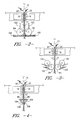
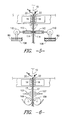
- Figure 1 is an elevation view of the apparatus; and Figures 2 through 6 illustrate various embodiments for forcing the latex adhesive through the base layer.
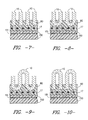
- Figures 7 through 10 illustrate various pile forming configurations which may be employed in the hot melt adhesive bonded pile fabrics of the present invention.
- Figure 11 is a photomicrograph of the base of a pile yarn that was bonded to a base layer by means of the latex adhesive compositions of the present invention.
- Figure 12 is a representation of a pile yarn bonded to a base layer by conventional techniques.
- carpet yarn 10 is supplied from a yarn source (not shown) over and around guide rolls 12 and 14 and down to the vertical guides 16.
- Base layer 17 is supplied from rolls 18 into position between the guides 16.
- the folding blades 20 and 22 alternately displace the yarn in a zig-zag fashion into one or the other of the base layer sheets 17 as the carpet backing is being drawn downwardly.
- Pivotally mounted bladelets 24 and 26 may assist in the folding of the yarn.
- Folding blades 20 and 22 are mounted, respectively, to connecting rods 28 and 30.
- Connecting rod 28 is pivotally connected to pivot shafts 36 and 38 through suitable links (not shown).
- the shafts 32 and 38 are oscillated by an oscillating crank arm mechanism (not shown).
- the blade 20 is out of phase with the blade 22 so that when the blade 22 is being pivoted inwardly as shown in Figure 1 the blade 20 is being pivoted outwardly and vice versa to provide a zig-zag configuration of the yarn between the carpet base layers 17 which are liquid-permeable, that is permeable to the adhesive to be applied.
- latex adhesive 80 contained in trough 88 is forced through the liquid carpet base layers 17 by rotation of applicator rolls 84 into contact with the carpet yarns 10.
- the latex adhesive After the latex adhesive has been applied to the carpet base layer and forced through it into contact with the carpet yarn, it may be converted into the solid phase by heating means 90 to form a bond between the carpet yarn 10 and the carpet base layer 17. Heating means 90 may be supplied with infrared heater 92 to heat the latex adhesive causing it to cure. The yarn 10 may then be severed, generally in the middle of the base layers 17 by cutting blade 98 to provide, simultaneously, two sheets of carpet.
- Figure 2 is an alternate latex adhesive applicator means of the embodiment 78 shown in Figure 1.
- the trough 100 is positioned underneath the applicator rolls 84 which are rotated in the direction of the movement of the fabric. Rate of application of the latex is controlled by doctor knife 102.
- Figure 3 is yet another embodiment showing a trough 103 located at the side of applicator rolls 84. Rate of application of latex adhesive is controlled by doctor rolls 105.
- Figure 4 illustrates an alternative embodiment wherein the latex adhesive is maintained in a reservoir sided on one side by base layers 17 and on the other side by doctor blades 104.
- the adhesive 80 is allowed to contact the carpet backings and is forced therethrough by the tips 106 of doctor blades 104.
- Figure 5 illustrates yet another embodiment of the invention where the latex adhesive is maintained in tanks 108.
- Application of the adhesive to the base layers 17 is accomplished by drawing the adhesive out of the tank 80 through pumps 110 into manifolds 112. The adhesive is then forced from the opening 114 in manifolds 112 under sufficient pressure to force the adhesive through the carpet base layers 17 into contact with carpet yarn 10.
- Figure 6 shows a spray application of latex adhesive by means of spray applicator 107. After spraying the latex it is forced through the base layer 17 into contact with pile yarns 10 by means of penetration rolls 109.
- FIG 7 illustrates an embodiment of the present invention showing an I-tuft configuration of the pile yarns.
- Latex adhesive 80 is shown as a continuous layer into which the base layer 17 of a relatively open-weave, adhesive permeable fabric has become embedded at the base thereof.
- Backing layer 150 is made of a thermoplastic material having a stabilizing layer of glass fibers 151 and is shown as having been bonded to the pile fabric by means of thermoplastic material.
- Figures 8, 9 and 10 illustrate some folded configurations of the pile forming yarns which may be preferred. Identifying numbers refer to the same structural components as in Figure 7.
- Figure 8 shows a folded, cut pile configuration.
- Figure 9 shows a loop pile configuration.
- Figure 10 shows another folded pile configuration where the folded portion of the yarn is on the surface giving the appearance of a loop pile, although the loops are not joined to one another at their base.
- This configuration provides in essence a loop pile product while simultaneously offering the advantages of, for instance, yarn savings of the so-called I-tuft configuration.
- Figure 11 is a photomicrograph (20X) of a tuft bonded by means of the process described in Example I.
- the tuft was pulled out of the latex adhesive and a cross-section was cut at its base to show adhesive penetration.
- the latex adhesive showed excellent penetration contacting all of the fibers of the yarn bundle.
- Figure 12 is a yarn from a conventional, bonded product taken and cut in the same way as the yarn from Figure 11. Adhesive has penetrated only through the surface layer leaving many loose fibers which may result in undesired fuzzing and pilling.
- liquid-permeable base layers were provided of non-woven glass scrim of 10 ends by 8 ends per inch.
- pile forming yarns of stock-dyed Nylon 6,6, 2.00/2 spun yarn were positioned into these base layers.
- the yarn was folded at about 8 folds per inch by 9 ends per inch construction.
- Fabric traveled at about 1 ft./minute linear speed.
- a latex adhesive composition (a 50% aqueous composition of styrene butadiene supplied by Reichhold Chemical) was applied at the rate of about 50 ozs./sq. yd.
- the latex adhesive composition also contained filler at the level of about 150 parts filler per 100 parts polymer.
- Viscosity of the latex adhesive composition was about 3,000 centipoise which provided optimum yarn penetration and maximum surface area form a mechanical bond to the tie coat.
- the adhesive was then cured using infrared heaters (three - 18" strips at 100% output were used followed by one bank at 50% output). Excess moisture was drawn off by exhaust fans not shown. The carpet was then cooled and slit.
- a pre-formed backing layer of filled atactic polypropylene (weighing about 50 ozs./sq. yd.) was cast on a non-woven glass mat which was then laminated to the slit, latex adhesive bonded carpet by casting about 20 ozs./sq. yd. of filled atactic polypropylene onto the backing layer and then immediately pressing the carpeting into this molten material by conventional means.
- the resulting product was allowed to cool and was then cut into carpet tiles and was suitable at that time for further processing, e.g. printing, steaming, washing and drying.
- carpet tile properties of tuft lock, pilling and fuzzing were determined for the carpet tile made as described in Example I and, furthermore, a comparison was made to those same properties in a polyvinyl chloride bonded tile manufactured by means of the equipment essentially as described in U. S. Patent No. 3,411,966.
- the PVC was applied at the rate of 55 ozs./sq. yd. (100% solids).
- the tuft bond was measured by ASTM Standard Test Measure D1335, filling and fuzzing were measured by DuPont random filling and fuzzing tests which is the conventional test in the industry. The results for this latter test are measured on a scale of one to five with one being poor and five being excellent. The results are summarized in the table below.
Landscapes
- Engineering & Computer Science (AREA)
- Textile Engineering (AREA)
- Chemical & Material Sciences (AREA)
- Dispersion Chemistry (AREA)
- Carpets (AREA)
- Treatments For Attaching Organic Compounds To Fibrous Goods (AREA)
- Treatment Of Fiber Materials (AREA)
- Woven Fabrics (AREA)
- Adhesives Or Adhesive Processes (AREA)
- Addition Polymer Or Copolymer, Post-Treatments, Or Chemical Modifications (AREA)
- Synthetic Leather, Interior Materials Or Flexible Sheet Materials (AREA)
- Manufacturing Of Multi-Layer Textile Fabrics (AREA)
- Knitting Of Fabric (AREA)
Applications Claiming Priority (2)
| Application Number | Priority Date | Filing Date | Title |
|---|---|---|---|
| US45761289A | 1989-12-27 | 1989-12-27 | |
| US457612 | 1989-12-27 |
Publications (3)
| Publication Number | Publication Date |
|---|---|
| EP0435542A2 true EP0435542A2 (de) | 1991-07-03 |
| EP0435542A3 EP0435542A3 (en) | 1991-08-28 |
| EP0435542B1 EP0435542B1 (de) | 1994-08-10 |
Family
ID=23817428
Family Applications (1)
| Application Number | Title | Priority Date | Filing Date |
|---|---|---|---|
| EP90313777A Expired - Lifetime EP0435542B1 (de) | 1989-12-27 | 1990-12-17 | Verfahren zur Herstellung von mit Latex verklebten Polgeweben |
Country Status (7)
| Country | Link |
|---|---|
| EP (1) | EP0435542B1 (de) |
| JP (1) | JP2918701B2 (de) |
| AT (1) | ATE109638T1 (de) |
| AU (1) | AU631708B2 (de) |
| CA (1) | CA2032345C (de) |
| DE (1) | DE69011490T2 (de) |
| NZ (1) | NZ236677A (de) |
Cited By (6)
| Publication number | Priority date | Publication date | Assignee | Title |
|---|---|---|---|---|
| US5567257A (en) * | 1989-12-27 | 1996-10-22 | Milliken Research Corporation | Method for forming heat stabilized pile fabric |
| WO1998041681A1 (en) * | 1997-03-17 | 1998-09-24 | The Dow Chemical Company | Process for preparing carpets having polyurethane backings obtained from polyurethane latex formulations |
| US6271276B1 (en) | 1998-12-29 | 2001-08-07 | The Dow Chemical Company | Polyurethane foams prepared from mechanically frothed polyurethane dispersions |
| US6524978B1 (en) | 1998-12-18 | 2003-02-25 | The Dow Chemical Company | Aqueous polyurethane dispersions useful for preparing polymers with improved moisture resistance properties |
| WO2002007958A3 (en) * | 2000-07-21 | 2003-09-25 | Milliken & Co | Patterned bonded carpet and method |
| EP1654117A4 (de) * | 2003-08-15 | 2007-06-20 | Mohawk Brands Inc | Offene maschen in getuftetem wand- oder fussbodenbelag |
Family Cites Families (8)
| Publication number | Priority date | Publication date | Assignee | Title |
|---|---|---|---|---|
| US2101906A (en) * | 1929-11-02 | 1937-12-14 | Us Rubber Co | Pile fabric and machine for making the same |
| GB1191640A (en) * | 1966-11-21 | 1970-05-13 | Doverstrand Ltd | Latex Backing of Tufted Carpets |
| GB1409068A (en) * | 1972-07-27 | 1975-10-08 | Synthetic Fab Scotland Ltd | Preparation of seconcary backed carpets |
| US4009310A (en) * | 1976-07-01 | 1977-02-22 | The General Tire & Rubber Company | Method of improving adhesion of secondary backings on carpets |
| US4363694A (en) * | 1980-09-15 | 1982-12-14 | Milliken Research Corporation | Bonded fabric machine |
| US4371576A (en) * | 1981-09-22 | 1983-02-01 | Milliken Research Corporation | Hot melt adhesive bonded pile fabrics |
| JP2593945B2 (ja) * | 1988-07-25 | 1997-03-26 | インターフェイス,インコーポレイテッド | ラテックス接着されたパイルカ−ペット |
| JP6311142B2 (ja) | 2013-12-03 | 2018-04-18 | 国立大学法人電気通信大学 | ハイブリッド車両の制御システム及びハイブリッド車両の制御方法 |
-
1990
- 1990-12-14 CA CA002032345A patent/CA2032345C/en not_active Expired - Fee Related
- 1990-12-17 AT AT90313777T patent/ATE109638T1/de not_active IP Right Cessation
- 1990-12-17 EP EP90313777A patent/EP0435542B1/de not_active Expired - Lifetime
- 1990-12-17 DE DE69011490T patent/DE69011490T2/de not_active Expired - Fee Related
- 1990-12-27 JP JP2414854A patent/JP2918701B2/ja not_active Expired - Fee Related
- 1990-12-27 AU AU68444/90A patent/AU631708B2/en not_active Ceased
-
1991
- 1991-01-04 NZ NZ236677A patent/NZ236677A/xx unknown
Cited By (9)
| Publication number | Priority date | Publication date | Assignee | Title |
|---|---|---|---|---|
| US5567257A (en) * | 1989-12-27 | 1996-10-22 | Milliken Research Corporation | Method for forming heat stabilized pile fabric |
| WO1998041681A1 (en) * | 1997-03-17 | 1998-09-24 | The Dow Chemical Company | Process for preparing carpets having polyurethane backings obtained from polyurethane latex formulations |
| US6524978B1 (en) | 1998-12-18 | 2003-02-25 | The Dow Chemical Company | Aqueous polyurethane dispersions useful for preparing polymers with improved moisture resistance properties |
| US6864312B2 (en) | 1998-12-18 | 2005-03-08 | Dow Global Technologies, Inc. | Aqueous polyurethane dispersions useful for preparing polymers with improved moisture resistance properties |
| US6271276B1 (en) | 1998-12-29 | 2001-08-07 | The Dow Chemical Company | Polyurethane foams prepared from mechanically frothed polyurethane dispersions |
| WO2002007958A3 (en) * | 2000-07-21 | 2003-09-25 | Milliken & Co | Patterned bonded carpet and method |
| AU2002224538B2 (en) * | 2000-07-21 | 2005-10-06 | Milliken & Company | Patterned bonded carpet and method |
| US7374808B2 (en) | 2000-07-21 | 2008-05-20 | Milliken & Company | Patterned bonded carpet and method |
| EP1654117A4 (de) * | 2003-08-15 | 2007-06-20 | Mohawk Brands Inc | Offene maschen in getuftetem wand- oder fussbodenbelag |
Also Published As
| Publication number | Publication date |
|---|---|
| JPH04245954A (ja) | 1992-09-02 |
| EP0435542B1 (de) | 1994-08-10 |
| NZ236677A (en) | 1992-10-28 |
| AU6844490A (en) | 1991-07-04 |
| CA2032345C (en) | 1995-02-21 |
| ATE109638T1 (de) | 1994-08-15 |
| DE69011490D1 (de) | 1994-09-15 |
| JP2918701B2 (ja) | 1999-07-12 |
| EP0435542A3 (en) | 1991-08-28 |
| DE69011490T2 (de) | 1994-12-08 |
| AU631708B2 (en) | 1992-12-03 |
Similar Documents
| Publication | Publication Date | Title |
|---|---|---|
| US4576665A (en) | Method for making a hot melt adhesive bonded pile fabric | |
| US4371576A (en) | Hot melt adhesive bonded pile fabrics | |
| US5560972A (en) | Latex fusion bonded pile carpets and carpet tile | |
| AU676757B2 (en) | Heat stabilized pile fabric | |
| AU658684B2 (en) | Pattern-tufted, fusion-bonded carpet and carpet tile and method of preparation | |
| US5380574A (en) | Mats and rugs and process for producing the same | |
| USRE31826E (en) | Hot melt adhesive bonded pile fabrics | |
| AU634172B2 (en) | Latex fusion bonded pile carpets and carpet tile | |
| US20150299947A1 (en) | Carpet, carpet backings and methods | |
| US4305986A (en) | Tufted carpeting | |
| US3414458A (en) | Non-cracking tufted carpet with nonwoven secondary backing and method of making same | |
| CA2032345C (en) | Non-tufted latex adhesive bonded pile fabrics, carpets and tiles | |
| US3075865A (en) | Tufted products | |
| US3554824A (en) | Method of making a tufted fabric | |
| CN110637118A (zh) | 针刺丝绒地毯的生产方法 | |
| GB2106154A (en) | Adhesive bonded pile fabrics | |
| CA1212607A (en) | Apparatus for making hot melt adhesive bonded pile fabrics | |
| CA1212610A (en) | Method for making hot melt adhesive bonded pile fabrics | |
| JPH067240A (ja) | 置き敷きカーペット及びその製造方法 |
Legal Events
| Date | Code | Title | Description |
|---|---|---|---|
| PUAI | Public reference made under article 153(3) epc to a published international application that has entered the european phase |
Free format text: ORIGINAL CODE: 0009012 |
|
| AK | Designated contracting states |
Kind code of ref document: A2 Designated state(s): AT BE CH DE DK ES FR GB GR IT LI LU NL SE |
|
| PUAL | Search report despatched |
Free format text: ORIGINAL CODE: 0009013 |
|
| AK | Designated contracting states |
Kind code of ref document: A3 Designated state(s): AT BE CH DE DK ES FR GB GR IT LI LU NL SE |
|
| 17P | Request for examination filed |
Effective date: 19920116 |
|
| 17Q | First examination report despatched |
Effective date: 19921218 |
|
| GRAA | (expected) grant |
Free format text: ORIGINAL CODE: 0009210 |
|
| AK | Designated contracting states |
Kind code of ref document: B1 Designated state(s): AT BE CH DE DK ES FR GB GR IT LI LU NL SE |
|
| PG25 | Lapsed in a contracting state [announced via postgrant information from national office to epo] |
Ref country code: DK Effective date: 19940810 Ref country code: AT Effective date: 19940810 Ref country code: LI Effective date: 19940810 Ref country code: GR Free format text: LAPSE BECAUSE OF FAILURE TO SUBMIT A TRANSLATION OF THE DESCRIPTION OR TO PAY THE FEE WITHIN THE PRESCRIBED TIME-LIMIT Effective date: 19940810 Ref country code: NL Effective date: 19940810 Ref country code: ES Free format text: THE PATENT HAS BEEN ANNULLED BY A DECISION OF A NATIONAL AUTHORITY Effective date: 19940810 Ref country code: CH Effective date: 19940810 Ref country code: IT Free format text: LAPSE BECAUSE OF FAILURE TO SUBMIT A TRANSLATION OF THE DESCRIPTION OR TO PAY THE FEE WITHIN THE PRESCRIBED TIME-LIMIT;WARNING: LAPSES OF ITALIAN PATENTS WITH EFFECTIVE DATE BEFORE 2007 MAY HAVE OCCURRED AT ANY TIME BEFORE 2007. THE CORRECT EFFECTIVE DATE MAY BE DIFFERENT FROM THE ONE RECORDED. Effective date: 19940810 |
|
| REF | Corresponds to: |
Ref document number: 109638 Country of ref document: AT Date of ref document: 19940815 Kind code of ref document: T |
|
| REF | Corresponds to: |
Ref document number: 69011490 Country of ref document: DE Date of ref document: 19940915 |
|
| PG25 | Lapsed in a contracting state [announced via postgrant information from national office to epo] |
Ref country code: SE Effective date: 19941110 |
|
| REG | Reference to a national code |
Ref country code: CH Ref legal event code: PL |
|
| ET | Fr: translation filed | ||
| PG25 | Lapsed in a contracting state [announced via postgrant information from national office to epo] |
Ref country code: LU Free format text: LAPSE BECAUSE OF NON-PAYMENT OF DUE FEES Effective date: 19941231 |
|
| NLV1 | Nl: lapsed or annulled due to failure to fulfill the requirements of art. 29p and 29m of the patents act | ||
| PLBE | No opposition filed within time limit |
Free format text: ORIGINAL CODE: 0009261 |
|
| STAA | Information on the status of an ep patent application or granted ep patent |
Free format text: STATUS: NO OPPOSITION FILED WITHIN TIME LIMIT |
|
| 26N | No opposition filed | ||
| REG | Reference to a national code |
Ref country code: GB Ref legal event code: IF02 |
|
| PGFP | Annual fee paid to national office [announced via postgrant information from national office to epo] |
Ref country code: BE Payment date: 20031007 Year of fee payment: 14 |
|
| PGFP | Annual fee paid to national office [announced via postgrant information from national office to epo] |
Ref country code: FR Payment date: 20031124 Year of fee payment: 14 |
|
| PGFP | Annual fee paid to national office [announced via postgrant information from national office to epo] |
Ref country code: DE Payment date: 20031203 Year of fee payment: 14 |
|
| PGFP | Annual fee paid to national office [announced via postgrant information from national office to epo] |
Ref country code: GB Payment date: 20041208 Year of fee payment: 15 |
|
| PG25 | Lapsed in a contracting state [announced via postgrant information from national office to epo] |
Ref country code: BE Free format text: LAPSE BECAUSE OF NON-PAYMENT OF DUE FEES Effective date: 20041231 |
|
| BERE | Be: lapsed |
Owner name: *MILLIKEN RESEARCH CORP. Effective date: 20041231 |
|
| PG25 | Lapsed in a contracting state [announced via postgrant information from national office to epo] |
Ref country code: DE Free format text: LAPSE BECAUSE OF NON-PAYMENT OF DUE FEES Effective date: 20050701 |
|
| PG25 | Lapsed in a contracting state [announced via postgrant information from national office to epo] |
Ref country code: FR Free format text: LAPSE BECAUSE OF NON-PAYMENT OF DUE FEES Effective date: 20050831 |
|
| REG | Reference to a national code |
Ref country code: FR Ref legal event code: ST |
|
| PG25 | Lapsed in a contracting state [announced via postgrant information from national office to epo] |
Ref country code: GB Free format text: LAPSE BECAUSE OF NON-PAYMENT OF DUE FEES Effective date: 20051217 |
|
| GBPC | Gb: european patent ceased through non-payment of renewal fee |
Effective date: 20051217 |
|
| BERE | Be: lapsed |
Owner name: *MILLIKEN RESEARCH CORP. Effective date: 20041231 |