EP0435659B1 - Herstellungsverfahren für eine bis(3-Nitrophenoxy)-Verbindung - Google Patents
Herstellungsverfahren für eine bis(3-Nitrophenoxy)-Verbindung Download PDFInfo
- Publication number
- EP0435659B1 EP0435659B1 EP90314290A EP90314290A EP0435659B1 EP 0435659 B1 EP0435659 B1 EP 0435659B1 EP 90314290 A EP90314290 A EP 90314290A EP 90314290 A EP90314290 A EP 90314290A EP 0435659 B1 EP0435659 B1 EP 0435659B1
- Authority
- EP
- European Patent Office
- Prior art keywords
- reaction
- dinitrobenzene
- bisphenol
- bis
- amount
- Prior art date
- Legal status (The legal status is an assumption and is not a legal conclusion. Google has not performed a legal analysis and makes no representation as to the accuracy of the status listed.)
- Expired - Lifetime
Links
- IWDCLRJOBJJRNH-UHFFFAOYSA-N Cc(cc1)ccc1O Chemical compound Cc(cc1)ccc1O IWDCLRJOBJJRNH-UHFFFAOYSA-N 0.000 description 1
- QTJSTTBYEOELOW-UHFFFAOYSA-N Cc(cc1)ccc1ON Chemical compound Cc(cc1)ccc1ON QTJSTTBYEOELOW-UHFFFAOYSA-N 0.000 description 1
- 0 OC1CCC(*c(cc2)ccc2O)CC1 Chemical compound OC1CCC(*c(cc2)ccc2O)CC1 0.000 description 1
Classifications
-
- C—CHEMISTRY; METALLURGY
- C07—ORGANIC CHEMISTRY
- C07C—ACYCLIC OR CARBOCYCLIC COMPOUNDS
- C07C201/00—Preparation of esters of nitric or nitrous acid or of compounds containing nitro or nitroso groups bound to a carbon skeleton
- C07C201/06—Preparation of nitro compounds
- C07C201/12—Preparation of nitro compounds by reactions not involving the formation of nitro groups
-
- C—CHEMISTRY; METALLURGY
- C07—ORGANIC CHEMISTRY
- C07C—ACYCLIC OR CARBOCYCLIC COMPOUNDS
- C07C205/00—Compounds containing nitro groups bound to a carbon skeleton
- C07C205/39—Compounds containing nitro groups bound to a carbon skeleton the carbon skeleton being further substituted by esterified hydroxy groups
- C07C205/42—Compounds containing nitro groups bound to a carbon skeleton the carbon skeleton being further substituted by esterified hydroxy groups having nitro groups or esterified hydroxy groups bound to carbon atoms of six-membered aromatic rings of the carbon skeleton
-
- C—CHEMISTRY; METALLURGY
- C07—ORGANIC CHEMISTRY
- C07C—ACYCLIC OR CARBOCYCLIC COMPOUNDS
- C07C315/00—Preparation of sulfones; Preparation of sulfoxides
- C07C315/04—Preparation of sulfones; Preparation of sulfoxides by reactions not involving the formation of sulfone or sulfoxide groups
-
- C—CHEMISTRY; METALLURGY
- C07—ORGANIC CHEMISTRY
- C07C—ACYCLIC OR CARBOCYCLIC COMPOUNDS
- C07C319/00—Preparation of thiols, sulfides, hydropolysulfides or polysulfides
- C07C319/14—Preparation of thiols, sulfides, hydropolysulfides or polysulfides of sulfides
- C07C319/20—Preparation of thiols, sulfides, hydropolysulfides or polysulfides of sulfides by reactions not involving the formation of sulfide groups
Definitions
- the present invention relates to an improved process for preparing a bis(3-nitrophenoxy) represented by the formula II: in which X is a direct bond, a divalent hydrocarbon having from 1 to 10 carbon atoms, -C(CF3 )2-, -CO-, -S-, -SO-, -SO2- or -O-.
- the bis (3-nitrophenoxy) compound is an important compound used as a material for preparing a monomer which is in turn used in the preparation of heat resistant high molecular weight polymers, polyamides and polyimides in particular.
- ether diamine obtained by reducing the compound can he used as a diamine component for preparing a polyimide which can provide adhesives having excellent heat resistance.
- a process for the condensation of a 4,4'-bisphenol represented by the formula I : wherein X is as defined above with m-dinitrobenzene to prepare a bis(3-nitrophenoxy) compound represented by the formula II has already been known in Japanese Laid-Open Patent SHO 61-194050(1986) and 62-45563(1987) which are family members of document EP-A-192480.
- Japanese Laid-Open Patent SHO 61-194050 the condensation reaction can be carried out in an aprotic polar solvent in the presence of a base, while according to Japanese Laid-Open Patent SHO 62-45563, the condensation reaction can he further accelerated by using a phase transfer catalyst under the same conditions.
- One object of the present invention is to provide an improved process for the preparation of a bis(3-nitrophenoxy) compound, with a high purity and without a decrease in the yield and consistently as compared with already known processes.
- the base having a particle size of 250 »m or less, adding the 4,4' -bisphenol and the m-dinitrobenzene to the reaction vessel at the same time with a constant feeding ratio of from 2.0 to 2.1 moles of m-dinitrobenzene per mole of the 4,4'- bisphenol, and reacting the 4,4' -bisphenol and the m-dinitrobenzene in the reaction vessel while removing water formed during the reaction.
- the amount of alkali metal hydrogen carbonate used as the base can be reduced to 2.0 to 3.0 moles per mole of the raw 4,4'-bisphenol material or the amount of alkali metal carbonate to 1.0% 1.5 moles per mole of the raw 4,4'-bisphenol material.
- the raw materials used in the present invention are m-dinitrobenzene and 4,4'-bisphenol represented by the above formula I.
- Exemplary 4,4'-bisphenols which can he used include 4,4'-dihydroxybiphenyl, 4,4'-dihydroxydiphenylmethane, 2,2-bis(4-hydroxyphenyl)propane, 2,4-bis(4-hydroxyphenyl)-2-methylpentane, 2,4-bis(4-hydroxyphenyl)-4-methyl-1-pentene, 2,2-bis(4-hydroxyphenyl)hexafluoropropane, 4,4'-dihydroxybenzophenone, 4,4'-dihydroxydiphenyl sulphide, 4,4'-dihydroxydiphenyl sulphoxide, 4,4'-dihydroxydiphenyl sulphone and 4,4'-dihydroxydiphenyl ether.
- the base used in the invention is an alkali metal carbonate or an alkali metal hydrogen carbonate and includes, for example, calcium carbonate, sodium carbonate, lithium carbonate, potassium hydrogen carbonate and sodium hydrogen carbonate.
- Preferred bases are potassium carbonate and potassium hydrogen carbonate.
- the base can be used singly or as a mixture.
- alkali metal carbonates or alkali metal hydrogen carbonates contain various sizes of particles.
- most of the alkali metal carbonate or alkali metal hydrogen carbonate is not dissolved in the solvent and exist in a suspended state.
- a particle size exceeding 250 »m lowers dissolution rate of the particle into the reaction system and unfavorably decreases the overall rate of the condensation reaction.
- a large sized particle is contained in a particle size distribution, for example, when a commercial base is used as such, a satisfactory reaction rate cannot be obtained unless the amount of the base is increased. It is accordingly required to use an excess amount of the base, and additionally the particle size varies widely. As a result, reproducibility of the reaction is poor.
- the alkali metal carbonate or alkali metal hydrogen carbonate used has a particle size of 250 »m or less, and the reaction is carried out while removing generated water from the reaction system during the reaction.
- the amount of the base used can be decreased and the desired bis(3-nitrophenoxy) compound can be obtained in an increased yield and with excellent reproducibility.
- the amount of the base alkali metal carbonate used is preferably in the range of from 1.0 to 1.5, and the amount of alkali metal hydrogen carbonate used is preferably in the range of from 2.0 to 3.0 mole per mole of the raw 4,4'-bisphenol material.
- an equivalent amount or more of the base is required. It is, however, satisfactory to use 1.5 mole equivalent of alkali metal carbonate or to use 3.0 mole equivalent of alkali metal hydrogen carbonate.
- the process of the present invention may use as a reaction accelerator an ether containing chain alkylamine as disclosed in Japanese Laid-Open Patent SHO 62-45563(1987), quaternary ammonium salt, quaternary phosphoric acid salt, large ring polyether such as a crown ether, nitrogen containing large ring polyether such as crypltate, nitrogen containing chain polyether, phase transfer catalyst such as polyethylene glycol and its alkyl ether, copper powder and copper salt.
- a reaction accelerator an ether containing chain alkylamine as disclosed in Japanese Laid-Open Patent SHO 62-45563(1987), quaternary ammonium salt, quaternary phosphoric acid salt, large ring polyether such as a crown ether, nitrogen containing large ring polyether such as crypltate, nitrogen containing chain polyether, phase transfer catalyst such as polyethylene glycol and its alkyl ether, copper powder and copper salt.
- the aprotic polar solvent which can be used for the reaction includes, for example, N-methylformamide, N,N-dimethylformamide, N,N-dimethylacetamide, dimethyl sulphoxide, dimethyl sulphone, sulpholane, 1-methyl-2-pyrolidinone, 1,3-dimethyl-2-imidazolidinone, N,N,N',N'-tetramethylurea, hexamethylphosphotriamide and 1,3-dimethyl-3,4,5,6-tetrahydro-2(1H)-pyrimidine.
- No particular limitation is imposed on the total amount of the aprotic polar solvent. The satisfactory total amount is usually from 1 to 10 times the total weight of the raw materials used.
- a particularly preferred embodiment is a method for previously charging the base and the solvent and then adding the raw materials, i.e., bisphenol and m-dinitrobenzene at the same time. This particularly preferred embodiment will hereinafter be illustrated in detail.
- m-Dinitrobenzene has poor thermal stability under basic conditions and leads to unfavorable side reactions such as the generation of tarry materials due to decomposition and formation of 3,3'-dinitroazoxybenzene by condensation of two molecules.
- the base and the aprotic polar solvent are previously charged into a reaction vessel and then the reaction is carried out while simultaneously adding the 4,4' -bisphenol arid m-dinitrobenzene, whereby the side-reactions are inhibited and the desired bis(3-nitrophenoxy) compound are prepared in good yield and high purity.
- both raw materials of the condensation are gradually added into the system during the reaction and immediately reacted with each other without accumulation in the system.
- the amount of m-dinitrobenzene is in the range of from 2.0 to 2.1 moles per mole of bisphenols and both materials are simultaneously added to the reaction system, so that an excess of the bisphenol in the reaction system does not occur during the reaction.
- the reaction can progress without accumulation of the mono-nitrophenoxy derivative as compared with the above mentioned method of adding m-dinitrobenzene alone.
- the reaction can be carried out while maintaining both m-dinitrobenzene and bisphenols at low concentrations during the reaction.
- the process can inhibit any unfavorable side reactions such as decomposition and azoxylation of m-dinitrobenzene and decomposition of the mononitrophenoxy derivative.
- m-dinitrobenzene used in the process can be reduced to a minimum amount as compared with conventional processes and the desired bis(3-nitrophenoxy) compound can be prepared in good yield and high purity.
- Each raw material is separately dissolved in the solvent and the resultant two kinds of solution may be respectively added dropwise. It is however, desirable to add dropwise in the form of a one component type raw material solution which is a uniform solution of both materials.
- the mole ratio of m-dinitrobenzene added per unit time is preferably in the range of from 2.00 to 2.06 moles per mole of bisphenols.
- mole ratio of m-dinitrobenzene added is higher than the range, m-dinitrobenzene is present in excess and accumulates in the reaction system.
- a mole ratio lower than this range leads to shortage of m-dinitrobenzene and the mononitrophenoxy derivative accumulates in the reaction system to cause a decrease in the yield.
- the addition mole ratio per unit time of m-dinitrobenzene to the bisphenol must be maintained within the above narrow range. It is thus preferable to add in the form of the one component type raw material solution obtained by uniformly dissolving both materials.
- the condensation reaction of the invention is carried out while removing the generated water from the reaction system by using a small amount of an azeotropic solvent such as benzene, toluene, xylene or monochlorobenzene, by blowing an inert gas such as nitrogen gas or argon gas, or by combination of both procedures.
- an azeotropic solvent such as benzene, toluene, xylene or monochlorobenzene
- an inert gas such as nitrogen gas or argon gas
- Water remaining in the system inhibits the condensation reaction, slows down reaction velocity, causes accumulation of the raw material m-dinitrobenzene arid intermediate mononitrophenoxy derivative, and leads to a decrease in the yield.
- the amount of the azeotropic solvent may be in a small amount and is usually from 2 to 5% of the total amount of the aprotic polar solvent used for the reaction.
- packing is filled in the passageway to the reflux condenser fitted with a water separator, a vapour mixture of water, azeotropic solvent and reaction solvent is introduced into the passageway, and a rectification/separation effect of water and the azeotropic solvent from the aprotic polar solvent is desirably enhanced by causing a reflux in the passageway.
- the aprotic polar solvent used for the reaction solvent usually has high affinity for water and the above azeotropic solvent.
- the aprotic polar solvent arrives in the reflux condenser together with generated water and the azeotropic solvent, the aprotic polar solvent partitions itself between the water which is removed in the separator and the azeotropic solvent which flows back to the reaction system.
- the aprotic solvent When the aprotic solvent is present in the azeotropic solvent, the water which is to be removed has increased solubility in the azeotropic solvent and a larger amount of the water circulates to the reaction system accompanied by the azeotropic solvent. Thus the effect for removing the generated water is decreased which gives adverse effects on the reaction.
- the reaction of the invention can be carried out under atmospheric pressure. In order to enhance the reaction rate, the reaction can also be conducted at a temperature above the boiling point of the solvents or under increased pressure.
- the reaction temperature is in the range of usually from 100 to 240 °C, preferably from 140 to 180 °C.
- a reaction temperature lower than 100 °C leads to a very slow rate of reaction or no reaction at all.
- reaction conditions exceeding 240 °C accelerate formation of tarry materials from the raw materials, intermediate and reaction product and thus decrease the yield.
- a reaction temperature in the range of from 180 to 240 °C is suitable for increasing the reaction rate.
- the reaction must be conducted under increased pressure and requires excessive equipment which circumstances are not so advantageous in industry.
- the rate of adding the raw materials into the reaction system must be equal to the reaction rate.
- the addition rate is too high, the added raw materials do not react, accumulate in the reaction system, and lead to a decrease in the yield.
- too low a rate of addition causes accumulation of the intermediate mononitrophenoxy derivative in the reaction system for a long time and results in a decrease in the yield.
- the optimum addition rate varies depending upon the reactivity of the raw material bisphenol. For example, 4,4'-dihydroxybiphenyl is preferably added in such a rate that the whole amount is added over 3 to 6 hours.
- a reaction vessel equipped with a reflux condenser connected with the reaction vessel through a packed column and fitted with a separator, a thermometer, a dropping device and a stirrer is charged with the base mentioned above, the aprotic polar solvent and a small amount of the azeotropic solvent.
- a solution of the aprotic polar solvent containing prescribed amounts of m-dinitrobenzene and 4,4'-bisphenol is charged to the dropping device.
- the reaction vessel is heated with stirring to the prescribed temperature and the solution in the dropping device is added dropwise to the reaction vessel over a prescribed period of time. After finishing dropwise addition, stirring is continued at the prescribed temperature until residual mononitrophenoxy derivative and m-dinitrobenzene are completely reacted and the desired bis(3-nitrophenoxy) compound is formed.
- Exemplary bis(3-nitrophenoxy) compounds which can be prepared by the process of the invention include: 4,4'-bis(3-nitrophenoxy)-biphenyl, 4,4'-bis(3-nitrophenoxy)diphenylmethane, 2,2-bis [4-(3-nitrophenoxy)phenyl] propane, 2,4-bis [4-(3-nitrophenoxy)phenyl) -2-methylpentane, 2,4-bis [4-(3-nitrophenoxy)phenyl] -4-methyl-1-pentene, 2,2-bis [4-(3-nitrophenoxy)phenyl] hexafluoropropane, 4,4'-bis(3-nitrophenoxy)benzophenone, 4,4'-bis(3-nitrophenoxy)diphenyl sulphide, 4,4'-bis(3-nitrophenoxy)diphenyl sulphoxide, 4,4'-bis(3-nitrophenoxy)diphenyl sulphone and 4,4'-bis(3-nitro
- the reaction mixture was cooled to 60 °C . Solid matter in the reaction mixture was filtered and washed with 100 g of DMF and 100 g of toluene. Filtrate and washings were charged to a 3 l crystallization vessel equipped with a stirrer and maintained at 90 °C . To the resultant mixture in the vessel, 420 g of water was added dropwise with stirring over an hour and cooled to 30 °C . The precipitated crystals were filtered to obtain 313.4 g of 4,4'-bis(3-nitrophenoxy)biphenyl. The crystals obtained had a purity of 96.1 %. Yield after purity conversion was 93.7 %.
- Comparative Example 1 269.5 g of unsieved potassium carbonate was used, toluene was omitted, and the whole evaporated vapours were refluxed(a trace test of Japanese Laid-Open Patent SHO 61-194050).
- Example 2 The same procedures as described in Example 1 were carried out except that 4,4'-dihydroxybiphenyl was replaced with 171.2g (0.75 mole) of 2,2-bis(4-hydroxyphenyl)propane in Example 2, 204.3g (0.75 mole) of 2,4-bis(4-hydroxyphenyl)-2-methylpentane in Example 3, 252.2g (0.75 mole) of 2,2-bis(4-hydroxyphenyl)-2-hexafluoropropane in Example 4, 160.7g (0.75 mole) of 4,4'-dihydroxybenzophenone in Example 5, and 187.7 g (0.75 mole) of 4,4'-dihydroxydiphenyl sulfone in Example 6. Results are illustrated in Table 2.
- the reaction vessel was heated to 150 °C with stirring and the solution in the dropping device was added dropwise at 150 to 154 °C over 6 hours. After finishing the addition, the reaction mixture was stirred for 2 hours at the same temperature. Generated water during the reaction was azeotropically distilled off with toluene, condensed in the condenser and separated in the separator.
- the reaction mixture was cooled to 60°C. Solid matter in the reaction mixture was filtered and washed with 100 g of DMF and 100 g of toluene. Filtrate and washings were charged to a 3 l crystallization vessel equipped with a stirrer and maintained at 90 °C. To the resultant mixture in the vessel, 420g of water was added drop-wise with stirring over an hour and cooled to 30 °C. The precipitated crystals were filtered to obtain 323.7 g of 4,4'-bis(3-nitrophenoxy)biphenyl. The crystals obtained had a purity of 99.1 %. Yield after purity conversion was 99.8 %. DMF was recovered by distillation from crystallization mother liquor) with a recovery of 97.5 %.
- Example 7 The same reaction procedures as described in Example 7 were carried out by using a 1 l reaction vessel equipped with a reflux condenser connected with the reaction vessel through a packed column and fitted with a separator, a thermometer, a stirrer and a dropping device, if necessary.
- Raw materials used were 35.9g (0.26 mole) of 60 mesh(250 »m) minus sieve potassium carbonate, 400g of the whole amount of DMF 20 g of toluene, from 74.0g (0.44 mole) to 68.1g(0.405 mole) of DNB, and 37.2g (0.2 mole) of BIP.
- Comparative Example 5 74.0g of DNB was used and a solution obtained by dissolving BIP in 60g of DMF was added dropwise.
- Comparative Example 6 the same reaction procedures were carried out as described in Comparative Example 5 except that 68.1g of DNB was used.
- Comparative Example 8 the same reaction procedures as described in Comparative Example 7 were carried out except that 68.1g of DNB was used.
- Comparative Example 9 the same reaction procedures as described in Example 7 were carried out except that a solution obtained by dissolving 74.0 g of DNB in 60 g of DMF was added dropwise.
- Example 7 In any of the Comparative Examples 5 - 10, the same post treatment procedures as described in Example 7 were carried out. Results of Example 7 and Comparative Examples 5 - 10 are illustrated in Table 3. Table 3 4,4'-Bis(3-nitrophenoxy)biphenyl Reaction procedure DNB (mole/BIP) Yield (mol%/BIP) Ex. 7 Both materials dropwise addition 2.03 99.8 Comp. Ex. 5 BIP dropwise addition 2.2 94.0 Comp. Ex. 6 ⁇ 2.025 89.3 Comp. Ex. 7 All materials charged at one time 2.2 92.2 Comp. Ex. 8 ⁇ 2.025 87.4 Comp. Ex. 9 DNB dropwise addition 2.2 87.9 Comp. Ex. 10 Both materials dropwise addition 1.95 85.9
- Example 7 400g of the solvent was charged to the reaction and 500g of the solvent was used for dissolving the raw materials.
- 4,4'-Bisphenols used were 171.2g(0.75 mole) of 2,2-bis(4-hydroxyphenyl)propane in Example 8, 204.3g (0.75 mole) of 2,4-bis(4-hydroxyphenyl)-2-methylpentane in Example 9, 252.2g (0.75 mole) of 2,2-bis(4-hydroxyphenyl)hexafluoropropane in Example 10, 160.7g (0.75 mole) of 4,4'-dihydroxybenzophenone in Example 11, and 187.7 g (0.75 mole) of 4,4'-dihydroxydiphenyl sulphone in Example 12.
- the time for dropwise addition of the raw material solution was 9 hours in Example 8, 11 hours in Example 9, 8 hours in Example 10, 7 hours in Example 11, and 5 hours in Example 12. Other procedures conducted were the same as described in Example 7.
Landscapes
- Chemical & Material Sciences (AREA)
- Organic Chemistry (AREA)
- Chemical Kinetics & Catalysis (AREA)
- Organic Low-Molecular-Weight Compounds And Preparation Thereof (AREA)
Claims (5)
- Verfahren zur Herstellung einer Bis(3-nitrophenoxy)verbindung der Formel

durch Kondensation eines 4,4-Bisphenols der Formel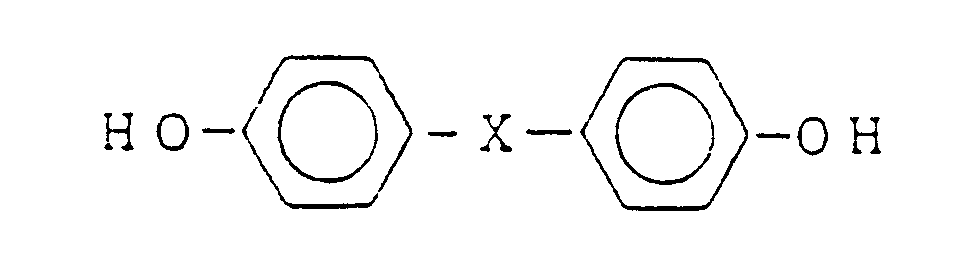
mit m-Dinitrobenzen, wobei dieses Verfahren die folgenden Schritte umfaßt: die Beschickung eines Reaktionsgefäßes mit einem aprotischen polaren Lösungsmittel und einer Base eines Alkalimetallcarbonats bzw. eines Alkalimetallhydrogencarbonats, wobei die Base eine Teilchengröße von 250 »m oder weniger aufweist; die gleichzeitige Zugabe des 4,4'-Bisphenols und des m-Dinitrobenzens in das Reaktionsgefäß bei einem konstanten Zudosierungsverhältnis von 2,0 bis 2,1 mol m-Dinitrobenzen pro Mol 4,4'-Bisphenol sowie die Reaktion zwischen dem 4,4'-Bisphenol und dem m-Dinitrobenzen im Reaktionsgefäß, wobei gleichzeitig das bei der Reaktion entstehende Wasser entfernt wird. - Verfahren nach Anspruch 1, bei dem ein Alkalimetallhydrogencarbonat in einer Menge von 2,0 bis 3,0 mol pro Mol 4,4'-Bisphenol eingesetzt wird.
- Verfahren nach Anspruch 1, bei dem ein Alkalimetallcarbonat in einer Menge von 1,0 bis 1,5 mol pro Mol 4,4'-Bisphenol eingesetzt wird.
- Verfahren nach einem der vorhergehenden Ansprüche, bei dem die m-Dinitrobenzenmenge 2,0 bis 2,6 mol pro Mol 4,4'-Bisphenol beträgt.
- Verfahren nach Anspruch 4, bei dem die m-Dinitrobenzenmenge zwischen 2,0 und 2,1 pro Mol 4,4'-Bisphenol beträgt.
Applications Claiming Priority (4)
| Application Number | Priority Date | Filing Date | Title |
|---|---|---|---|
| JP338211/89 | 1989-12-28 | ||
| JP33821089 | 1989-12-28 | ||
| JP338210/89 | 1989-12-28 | ||
| JP33821189 | 1989-12-28 |
Publications (3)
| Publication Number | Publication Date |
|---|---|
| EP0435659A2 EP0435659A2 (de) | 1991-07-03 |
| EP0435659A3 EP0435659A3 (en) | 1992-04-01 |
| EP0435659B1 true EP0435659B1 (de) | 1995-02-22 |
Family
ID=26576039
Family Applications (1)
| Application Number | Title | Priority Date | Filing Date |
|---|---|---|---|
| EP90314290A Expired - Lifetime EP0435659B1 (de) | 1989-12-28 | 1990-12-24 | Herstellungsverfahren für eine bis(3-Nitrophenoxy)-Verbindung |
Country Status (5)
| Country | Link |
|---|---|
| US (1) | US5296635A (de) |
| EP (1) | EP0435659B1 (de) |
| JP (1) | JP2854959B2 (de) |
| KR (1) | KR940000654B1 (de) |
| DE (1) | DE69017170T2 (de) |
Families Citing this family (5)
| Publication number | Priority date | Publication date | Assignee | Title |
|---|---|---|---|---|
| JP2624433B2 (ja) * | 1992-12-22 | 1997-06-25 | セントラル硝子株式会社 | 芳香族ジニトロ化合物類の製造方法 |
| KR20010087502A (ko) * | 2000-03-07 | 2001-09-21 | 윤종용 | 광학용 폴리이미드 단량체, 폴리이미드 화합물 및 그 제조방법 |
| US7166235B2 (en) * | 2002-05-09 | 2007-01-23 | The Procter & Gamble Company | Compositions comprising anionic functionalized polyorganosiloxanes for hydrophobically modifying surfaces and enhancing delivery of active agents to surfaces treated therewith |
| JP2006169154A (ja) * | 2004-12-15 | 2006-06-29 | Sumitomo Chemical Co Ltd | 第四級アンモニウム塩の製造方法 |
| CN113563240A (zh) * | 2021-06-28 | 2021-10-29 | 常州市阳光药业有限公司 | 4,4`-双(3-氨基苯氧基)二苯砜的合成方法 |
Family Cites Families (5)
| Publication number | Priority date | Publication date | Assignee | Title |
|---|---|---|---|---|
| BE679318A (de) * | 1966-04-08 | 1966-09-16 | ||
| AU568789B2 (en) * | 1985-02-22 | 1988-01-07 | Mitsui Toatsu Chemicals Inc. | 3,3'-dinitrodiphenylether from m-dinitrobenzene |
| JPH0710812B2 (ja) * | 1985-02-22 | 1995-02-08 | 三井東圧化学株式会社 | ビス(3−ニトロフエノキシ)化合物の製造方法 |
| DE3650142T2 (de) * | 1985-02-22 | 1995-05-04 | Mitsui Toatsu Chemicals | Bis(3-aminophenoxy)aromaten und Verfahren zu ihrer Herstellung. |
| JPH01190652A (ja) * | 1988-01-25 | 1989-07-31 | Central Glass Co Ltd | 新規な含フッ素芳香族化合物およびその製造方法 |
-
1990
- 1990-11-14 JP JP2306138A patent/JP2854959B2/ja not_active Expired - Lifetime
- 1990-12-24 DE DE69017170T patent/DE69017170T2/de not_active Expired - Fee Related
- 1990-12-24 EP EP90314290A patent/EP0435659B1/de not_active Expired - Lifetime
- 1990-12-28 KR KR1019900022178A patent/KR940000654B1/ko not_active Expired - Fee Related
-
1992
- 1992-11-13 US US07/975,952 patent/US5296635A/en not_active Expired - Fee Related
Also Published As
| Publication number | Publication date |
|---|---|
| EP0435659A2 (de) | 1991-07-03 |
| EP0435659A3 (en) | 1992-04-01 |
| KR910011756A (ko) | 1991-08-07 |
| JP2854959B2 (ja) | 1999-02-10 |
| US5296635A (en) | 1994-03-22 |
| KR940000654B1 (ko) | 1994-01-26 |
| DE69017170D1 (de) | 1995-03-30 |
| JPH03232842A (ja) | 1991-10-16 |
| DE69017170T2 (de) | 1995-07-27 |
Similar Documents
| Publication | Publication Date | Title |
|---|---|---|
| US3865814A (en) | Process for preparing n-substituted lactams | |
| US2706733A (en) | Fluorinated isocyanates and carbamyl chlorides | |
| US4196289A (en) | Process for producing triallyl isocyanurate | |
| US5008469A (en) | Process for producing tetrabromobisphenol A | |
| US5296635A (en) | Preparation of bis(3-nitrophenoxy) compound | |
| US4382039A (en) | Process for the preparation of 4-nitrotoluene-2-sulphonic acid | |
| EP0371271B1 (de) | Verfahren zur Herstellung von Alkansulfonamiden | |
| EP0088223A1 (de) | Herstellung von Isocyanaten | |
| US20070286789A1 (en) | Method for Producing Chlorosulfonyl Isocyanate | |
| JPH0832697B2 (ja) | ポリグリシジルアミノ化合物の製造方法 | |
| JPS5949217B2 (ja) | 置換ジフェニルエ−テルの製造方法 | |
| US4739117A (en) | Process for the isolation of diaryl guanidines | |
| US5166431A (en) | Preparation of alkanesulfonamides | |
| EP0351954B1 (de) | Verfahren zur Herstellung von Dihalogenobenzoldisulfonverbindungen | |
| EP0495097A4 (en) | Preparation of relatively pure p, p-bisphenol s | |
| JPS6038335A (ja) | ビスフエノ−ルaの製造方法 | |
| US3917723A (en) | Process for the continuous manufacture of m-chloronitrobenzene from m-dinitrobenzene | |
| EP0050885A2 (de) | Verfahren zur Herstellung von 1-Amino-3-aryloxy-2-propanolen und 1-Amino-2-aryl-äthanolen | |
| KR890005300B1 (ko) | 4,4-비스(4-히드록시페닐)시클로헥산카르복실산유도체의 제조방법 | |
| EP0148145A1 (de) | Verfahren zur Herstellung von Nitrodiarylaminen | |
| JPH05201903A (ja) | 2−(2,4−ジヒドロキシフェニル)−2−(4−ヒドロキシフェニル)プロパンの製造方法 | |
| US4288594A (en) | Caustic-free process for the production of monochloro-diamino-s-triazines | |
| EP0164409B1 (de) | Verfahren zur herstellung von nitrophthalimid | |
| JP2729346B2 (ja) | トリス(トリブロモフェノキシ)−s−トリアジンの製造方法 | |
| US5279719A (en) | Method for chlorination of methylated aromatic compounds |
Legal Events
| Date | Code | Title | Description |
|---|---|---|---|
| PUAI | Public reference made under article 153(3) epc to a published international application that has entered the european phase |
Free format text: ORIGINAL CODE: 0009012 |
|
| 17P | Request for examination filed |
Effective date: 19901224 |
|
| AK | Designated contracting states |
Kind code of ref document: A2 Designated state(s): DE FR GB |
|
| PUAL | Search report despatched |
Free format text: ORIGINAL CODE: 0009013 |
|
| AK | Designated contracting states |
Kind code of ref document: A3 Designated state(s): DE FR GB |
|
| 17Q | First examination report despatched |
Effective date: 19930922 |
|
| GRAA | (expected) grant |
Free format text: ORIGINAL CODE: 0009210 |
|
| AK | Designated contracting states |
Kind code of ref document: B1 Designated state(s): DE FR GB |
|
| REF | Corresponds to: |
Ref document number: 69017170 Country of ref document: DE Date of ref document: 19950330 |
|
| ET | Fr: translation filed | ||
| PLBE | No opposition filed within time limit |
Free format text: ORIGINAL CODE: 0009261 |
|
| STAA | Information on the status of an ep patent application or granted ep patent |
Free format text: STATUS: NO OPPOSITION FILED WITHIN TIME LIMIT |
|
| 26N | No opposition filed | ||
| REG | Reference to a national code |
Ref country code: GB Ref legal event code: 732E |
|
| REG | Reference to a national code |
Ref country code: FR Ref legal event code: TP |
|
| REG | Reference to a national code |
Ref country code: GB Ref legal event code: IF02 |
|
| PGFP | Annual fee paid to national office [announced via postgrant information from national office to epo] |
Ref country code: FR Payment date: 20031210 Year of fee payment: 14 |
|
| PGFP | Annual fee paid to national office [announced via postgrant information from national office to epo] |
Ref country code: GB Payment date: 20031224 Year of fee payment: 14 |
|
| PGFP | Annual fee paid to national office [announced via postgrant information from national office to epo] |
Ref country code: DE Payment date: 20040102 Year of fee payment: 14 |
|
| PG25 | Lapsed in a contracting state [announced via postgrant information from national office to epo] |
Ref country code: GB Free format text: LAPSE BECAUSE OF NON-PAYMENT OF DUE FEES Effective date: 20041224 |
|
| PG25 | Lapsed in a contracting state [announced via postgrant information from national office to epo] |
Ref country code: DE Free format text: LAPSE BECAUSE OF NON-PAYMENT OF DUE FEES Effective date: 20050701 |
|
| GBPC | Gb: european patent ceased through non-payment of renewal fee |
Effective date: 20041224 |
|
| PG25 | Lapsed in a contracting state [announced via postgrant information from national office to epo] |
Ref country code: FR Free format text: LAPSE BECAUSE OF NON-PAYMENT OF DUE FEES Effective date: 20050831 |
|
| REG | Reference to a national code |
Ref country code: FR Ref legal event code: ST |