EP0437094A2 - Matériau en mousse de la série des résines de polyester thermoplastique et leur procédé de préparation - Google Patents
Matériau en mousse de la série des résines de polyester thermoplastique et leur procédé de préparation Download PDFInfo
- Publication number
- EP0437094A2 EP0437094A2 EP90314265A EP90314265A EP0437094A2 EP 0437094 A2 EP0437094 A2 EP 0437094A2 EP 90314265 A EP90314265 A EP 90314265A EP 90314265 A EP90314265 A EP 90314265A EP 0437094 A2 EP0437094 A2 EP 0437094A2
- Authority
- EP
- European Patent Office
- Prior art keywords
- resin
- foamed material
- foamed
- pat
- thermoplastic polyester
- Prior art date
- Legal status (The legal status is an assumption and is not a legal conclusion. Google has not performed a legal analysis and makes no representation as to the accuracy of the status listed.)
- Granted
Links
Images
Classifications
-
- C—CHEMISTRY; METALLURGY
- C08—ORGANIC MACROMOLECULAR COMPOUNDS; THEIR PREPARATION OR CHEMICAL WORKING-UP; COMPOSITIONS BASED THEREON
- C08J—WORKING-UP; GENERAL PROCESSES OF COMPOUNDING; AFTER-TREATMENT NOT COVERED BY SUBCLASSES C08B, C08C, C08F, C08G or C08H
- C08J9/00—Working-up of macromolecular substances to porous or cellular articles or materials; After-treatment thereof
- C08J9/04—Working-up of macromolecular substances to porous or cellular articles or materials; After-treatment thereof using blowing gases generated by a previously added blowing agent
-
- C—CHEMISTRY; METALLURGY
- C08—ORGANIC MACROMOLECULAR COMPOUNDS; THEIR PREPARATION OR CHEMICAL WORKING-UP; COMPOSITIONS BASED THEREON
- C08J—WORKING-UP; GENERAL PROCESSES OF COMPOUNDING; AFTER-TREATMENT NOT COVERED BY SUBCLASSES C08B, C08C, C08F, C08G or C08H
- C08J9/00—Working-up of macromolecular substances to porous or cellular articles or materials; After-treatment thereof
-
- B—PERFORMING OPERATIONS; TRANSPORTING
- B29—WORKING OF PLASTICS; WORKING OF SUBSTANCES IN A PLASTIC STATE IN GENERAL
- B29C—SHAPING OR JOINING OF PLASTICS; SHAPING OF MATERIAL IN A PLASTIC STATE, NOT OTHERWISE PROVIDED FOR; AFTER-TREATMENT OF THE SHAPED PRODUCTS, e.g. REPAIRING
- B29C44/00—Shaping by internal pressure generated in the material, e.g. swelling or foaming ; Producing porous or cellular expanded plastics articles
- B29C44/20—Shaping by internal pressure generated in the material, e.g. swelling or foaming ; Producing porous or cellular expanded plastics articles for articles of indefinite length
- B29C44/22—Shaping by internal pressure generated in the material, e.g. swelling or foaming ; Producing porous or cellular expanded plastics articles for articles of indefinite length consisting of at least two parts of chemically or physically different materials, e.g. having different densities
-
- B—PERFORMING OPERATIONS; TRANSPORTING
- B29—WORKING OF PLASTICS; WORKING OF SUBSTANCES IN A PLASTIC STATE IN GENERAL
- B29C—SHAPING OR JOINING OF PLASTICS; SHAPING OF MATERIAL IN A PLASTIC STATE, NOT OTHERWISE PROVIDED FOR; AFTER-TREATMENT OF THE SHAPED PRODUCTS, e.g. REPAIRING
- B29C48/00—Extrusion moulding, i.e. expressing the moulding material through a die or nozzle which imparts the desired form; Apparatus therefor
- B29C48/03—Extrusion moulding, i.e. expressing the moulding material through a die or nozzle which imparts the desired form; Apparatus therefor characterised by the shape of the extruded material at extrusion
- B29C48/07—Flat, e.g. panels
- B29C48/08—Flat, e.g. panels flexible, e.g. films
-
- B—PERFORMING OPERATIONS; TRANSPORTING
- B29—WORKING OF PLASTICS; WORKING OF SUBSTANCES IN A PLASTIC STATE IN GENERAL
- B29C—SHAPING OR JOINING OF PLASTICS; SHAPING OF MATERIAL IN A PLASTIC STATE, NOT OTHERWISE PROVIDED FOR; AFTER-TREATMENT OF THE SHAPED PRODUCTS, e.g. REPAIRING
- B29C48/00—Extrusion moulding, i.e. expressing the moulding material through a die or nozzle which imparts the desired form; Apparatus therefor
- B29C48/25—Component parts, details or accessories; Auxiliary operations
- B29C48/88—Thermal treatment of the stream of extruded material, e.g. cooling
- B29C48/91—Heating, e.g. for cross linking
-
- B—PERFORMING OPERATIONS; TRANSPORTING
- B29—WORKING OF PLASTICS; WORKING OF SUBSTANCES IN A PLASTIC STATE IN GENERAL
- B29C—SHAPING OR JOINING OF PLASTICS; SHAPING OF MATERIAL IN A PLASTIC STATE, NOT OTHERWISE PROVIDED FOR; AFTER-TREATMENT OF THE SHAPED PRODUCTS, e.g. REPAIRING
- B29C48/00—Extrusion moulding, i.e. expressing the moulding material through a die or nozzle which imparts the desired form; Apparatus therefor
- B29C48/25—Component parts, details or accessories; Auxiliary operations
- B29C48/88—Thermal treatment of the stream of extruded material, e.g. cooling
- B29C48/911—Cooling
-
- B—PERFORMING OPERATIONS; TRANSPORTING
- B29—WORKING OF PLASTICS; WORKING OF SUBSTANCES IN A PLASTIC STATE IN GENERAL
- B29C—SHAPING OR JOINING OF PLASTICS; SHAPING OF MATERIAL IN A PLASTIC STATE, NOT OTHERWISE PROVIDED FOR; AFTER-TREATMENT OF THE SHAPED PRODUCTS, e.g. REPAIRING
- B29C48/00—Extrusion moulding, i.e. expressing the moulding material through a die or nozzle which imparts the desired form; Apparatus therefor
- B29C48/25—Component parts, details or accessories; Auxiliary operations
- B29C48/88—Thermal treatment of the stream of extruded material, e.g. cooling
- B29C48/911—Cooling
- B29C48/9135—Cooling of flat articles, e.g. using specially adapted supporting means
- B29C48/914—Cooling drums
-
- B—PERFORMING OPERATIONS; TRANSPORTING
- B29—WORKING OF PLASTICS; WORKING OF SUBSTANCES IN A PLASTIC STATE IN GENERAL
- B29C—SHAPING OR JOINING OF PLASTICS; SHAPING OF MATERIAL IN A PLASTIC STATE, NOT OTHERWISE PROVIDED FOR; AFTER-TREATMENT OF THE SHAPED PRODUCTS, e.g. REPAIRING
- B29C70/00—Shaping composites, i.e. plastics material comprising reinforcements, fillers or preformed parts, e.g. inserts
- B29C70/04—Shaping composites, i.e. plastics material comprising reinforcements, fillers or preformed parts, e.g. inserts comprising reinforcements only, e.g. self-reinforcing plastics
- B29C70/06—Fibrous reinforcements only
- B29C70/08—Fibrous reinforcements only comprising combinations of different forms of fibrous reinforcements incorporated in matrix material, forming one or more layers, and with or without non-reinforced layers
- B29C70/086—Fibrous reinforcements only comprising combinations of different forms of fibrous reinforcements incorporated in matrix material, forming one or more layers, and with or without non-reinforced layers and with one or more layers of pure plastics material, e.g. foam layers
-
- B—PERFORMING OPERATIONS; TRANSPORTING
- B29—WORKING OF PLASTICS; WORKING OF SUBSTANCES IN A PLASTIC STATE IN GENERAL
- B29K—INDEXING SCHEME ASSOCIATED WITH SUBCLASSES B29B, B29C OR B29D, RELATING TO MOULDING MATERIALS OR TO MATERIALS FOR MOULDS, REINFORCEMENTS, FILLERS OR PREFORMED PARTS, e.g. INSERTS
- B29K2105/00—Condition, form or state of moulded material or of the material to be shaped
- B29K2105/06—Condition, form or state of moulded material or of the material to be shaped containing reinforcements, fillers or inserts
- B29K2105/12—Condition, form or state of moulded material or of the material to be shaped containing reinforcements, fillers or inserts of short lengths, e.g. chopped filaments, staple fibres or bristles
-
- C—CHEMISTRY; METALLURGY
- C08—ORGANIC MACROMOLECULAR COMPOUNDS; THEIR PREPARATION OR CHEMICAL WORKING-UP; COMPOSITIONS BASED THEREON
- C08J—WORKING-UP; GENERAL PROCESSES OF COMPOUNDING; AFTER-TREATMENT NOT COVERED BY SUBCLASSES C08B, C08C, C08F, C08G or C08H
- C08J2367/00—Characterised by the use of polyesters obtained by reactions forming a carboxylic ester link in the main chain; Derivatives of such polymers
- C08J2367/02—Polyesters derived from dicarboxylic acids and dihydroxy compounds
-
- Y—GENERAL TAGGING OF NEW TECHNOLOGICAL DEVELOPMENTS; GENERAL TAGGING OF CROSS-SECTIONAL TECHNOLOGIES SPANNING OVER SEVERAL SECTIONS OF THE IPC; TECHNICAL SUBJECTS COVERED BY FORMER USPC CROSS-REFERENCE ART COLLECTIONS [XRACs] AND DIGESTS
- Y10—TECHNICAL SUBJECTS COVERED BY FORMER USPC
- Y10T—TECHNICAL SUBJECTS COVERED BY FORMER US CLASSIFICATION
- Y10T428/00—Stock material or miscellaneous articles
- Y10T428/249921—Web or sheet containing structurally defined element or component
- Y10T428/249953—Composite having voids in a component [e.g., porous, cellular, etc.]
- Y10T428/249981—Plural void-containing components
-
- Y—GENERAL TAGGING OF NEW TECHNOLOGICAL DEVELOPMENTS; GENERAL TAGGING OF CROSS-SECTIONAL TECHNOLOGIES SPANNING OVER SEVERAL SECTIONS OF THE IPC; TECHNICAL SUBJECTS COVERED BY FORMER USPC CROSS-REFERENCE ART COLLECTIONS [XRACs] AND DIGESTS
- Y10—TECHNICAL SUBJECTS COVERED BY FORMER USPC
- Y10T—TECHNICAL SUBJECTS COVERED BY FORMER US CLASSIFICATION
- Y10T428/00—Stock material or miscellaneous articles
- Y10T428/249921—Web or sheet containing structurally defined element or component
- Y10T428/249953—Composite having voids in a component [e.g., porous, cellular, etc.]
- Y10T428/249986—Void-containing component contains also a solid fiber or solid particle
-
- Y—GENERAL TAGGING OF NEW TECHNOLOGICAL DEVELOPMENTS; GENERAL TAGGING OF CROSS-SECTIONAL TECHNOLOGIES SPANNING OVER SEVERAL SECTIONS OF THE IPC; TECHNICAL SUBJECTS COVERED BY FORMER USPC CROSS-REFERENCE ART COLLECTIONS [XRACs] AND DIGESTS
- Y10—TECHNICAL SUBJECTS COVERED BY FORMER USPC
- Y10T—TECHNICAL SUBJECTS COVERED BY FORMER US CLASSIFICATION
- Y10T428/00—Stock material or miscellaneous articles
- Y10T428/249921—Web or sheet containing structurally defined element or component
- Y10T428/249953—Composite having voids in a component [e.g., porous, cellular, etc.]
- Y10T428/249987—With nonvoid component of specified composition
- Y10T428/249991—Synthetic resin or natural rubbers
-
- Y—GENERAL TAGGING OF NEW TECHNOLOGICAL DEVELOPMENTS; GENERAL TAGGING OF CROSS-SECTIONAL TECHNOLOGIES SPANNING OVER SEVERAL SECTIONS OF THE IPC; TECHNICAL SUBJECTS COVERED BY FORMER USPC CROSS-REFERENCE ART COLLECTIONS [XRACs] AND DIGESTS
- Y10—TECHNICAL SUBJECTS COVERED BY FORMER USPC
- Y10T—TECHNICAL SUBJECTS COVERED BY FORMER US CLASSIFICATION
- Y10T428/00—Stock material or miscellaneous articles
- Y10T428/249921—Web or sheet containing structurally defined element or component
- Y10T428/249953—Composite having voids in a component [e.g., porous, cellular, etc.]
- Y10T428/249987—With nonvoid component of specified composition
- Y10T428/249991—Synthetic resin or natural rubbers
- Y10T428/249992—Linear or thermoplastic
-
- Y—GENERAL TAGGING OF NEW TECHNOLOGICAL DEVELOPMENTS; GENERAL TAGGING OF CROSS-SECTIONAL TECHNOLOGIES SPANNING OVER SEVERAL SECTIONS OF THE IPC; TECHNICAL SUBJECTS COVERED BY FORMER USPC CROSS-REFERENCE ART COLLECTIONS [XRACs] AND DIGESTS
- Y10—TECHNICAL SUBJECTS COVERED BY FORMER USPC
- Y10T—TECHNICAL SUBJECTS COVERED BY FORMER US CLASSIFICATION
- Y10T428/00—Stock material or miscellaneous articles
- Y10T428/26—Web or sheet containing structurally defined element or component, the element or component having a specified physical dimension
Definitions
- This invention relates to a structural material composed of a foamed material of a thermoplastic polyester series resin (hereinafter, is referred to as PAT) and a production process thereof, and in particular, the invention relates to a PAT foamed material capable of being used as building materials such as floor materials, wainscots, etc., a furniture such as shelves, desks, tables, etc., and electric housing materials and a production process thereof.
- PAT thermoplastic polyester series resin
- a foamed material In the case of making a light weight structural material using a synthetic resin, it has bee conducted to form a foamed material by foaming a synthetic resin.
- a foamed material for structural materials a polystyrene resin, a polyethylene resin, or a vinyl chloride series resin has hitherto been used as the material therefor.
- thermosetting resin layer such as a resorcinol series resin, etc.
- a foamed material of a synthetic resin as a base material as described in JP-A-1-156051 (the term "JP-A” as used herein means an "unexamined published Japanese patent application”).
- a foamed material of polystyrene or a soft polyurethane is used as the foamed material of a synthetic resin.
- the foamed material is originally soft or even if the foamed material is hard, the material is softened at about 100°C, and also in the case of using a thermosetting resorcinol series resin, it is usually required to heat it to a temperature of at least 100°C while pressing for forming the layer of the resin, then by the aforesaid proposal, it is impossible to adhere the fiber-reinforced resin layer to the surface(s) of the foamed material while keeping the original form of the foamed material. Accordingly, a tough and lightweight synthetic resin structural material can not be obtained by the aforesaid proposal.
- a foamed material of PAT thermoplastic polyester resin
- PAT thermoplastic polyester resin
- PAT thermoplastic polyester resin
- thermoplastic resin thermoplastic resin, it may be considered, that a foamed material of PAT can be easily obtained only by mixing a foaming agent with PAT and extruding the mixture through an extruding machine.
- JP-B-56-8858 (the term "JP-B” as used herein means an "examined published Japanese Patent application") or U.S. Patent 4,462,947 proposes that PAT is mixed with a polycarbonate resin and the mixture is heated to a temperature of from 150°C to 250°C to generate carbon dioxide, whereby a foamed material of PAT is formed.
- the foamed material thus obtained contains a polycarbonate resin, the foamed material is soft and pliable, and hence is not suitable as a structural material.
- JP-B-61-48409 proposes that the PAT is mixed with a diglycidyl ester and the mixture is foamed by extruding.
- the aforesaid patent publication shows only that a foamed material is obtained at a high expansion ratio of 15 times but any properties of the foamed material obtained are not clarified.
- JP-B-61-484410 teaches that a PAT composition shall be foamed by extruding on considering the crystallizing speed of PAT.
- the method is limited to the case of obtaining strings having a sectional area of from 1 mm2 to 200 mm2 and also since the patent describes that the strings obtained can be easily drawn and heatworked, it is clear that the invention of the aforesaid patent does not aim at a structural material.
- JP-B-61-484411 teaches that a PAT composition shall be foamed by extruding under the condition that the crystallinity of PAT becomes at least 30%.
- the method is also limited to the case of obtaining strings having sectional area of 1 mm2 to 200 mm2 as in the aforesaid patent and it is described that it is required to increase the crystallinity and the strings obtained can be easily bent and they can be easily knitted and woven.
- the teachings of the aforesaid patent is useless for the production of structural materials.
- PAT is a crystalline resin and PAT having a different crystallinity is obtained according to the manner of producing the resin. Also, it is known that as PAT having a larger crystallinity is used, a foamed material having larger roughness and heat resistance is obtained. Accordingly, it has only been attempted to obtain foamed materials having a large crystallinity.
- the crystallinity of PAT can be generally measured by the density, X-ray diffraction patterns, nuclear magnetic resonance spectra, etc., of the PAT resin.
- a foamed material of PAT contains a large number of small bubbles therein, the crystallinity thereof can not be measured by these methods. Accordingly, the crystallinity of a foamed material of PAT was discussed but the method which could practically measure the crystallinity thereof was indistinct.
- the inventor has paid special attention to the characteristics of PAT that PAT is enriched with rigidity and toughness, has an excellent mechanical strength, has a good dimensional stability, and is also enriched with heat resistance as well as to that PAT has a good adhesive property to a thermosetting resin and has investigated to obtained a light-weight structural material which is enriched with a heat resistance and a toughness, and is reluctant to be corroded by foaming PAT to form a light-weight foamed material.
- the present invention has been made as the result of the investigations.
- an object of this invention is to provide a foamed material of PAT capable of being used as a structural material having an excellent mechanical strength such as a bending strength, etc., by controlling the crystallinities in the surface portion and the central portion of the foamed material of PAT.
- object of this invention is to provide PAT foamed material which is used as a structural material capable of being nailed by lowering the crystallinity of the surface portion of the PAT foamed material than that of the central portion thereof.
- a further object of this invention is to provide a process of producing a PAT foamed material which can be used as a structural material having an excellent mechanical strength or a structural material capable of being nailed.
- Another object of this invention is to provide a PAT foamed material capable of being used as a structural material having an excellent mechanical strength by laminating a thermosetting resin reinforced with fibers on the surface of the PAT roamed material.
- a still other object of this invention is to provide a PAT foamed material capable of being used as a lightweight structural material having an excellent mechanical strength by laminating a foamed thermosetting resin reinforced with fibers on the surface of the PAT foamed material.
- the inventors have confirmed that by a method of utilizing the thermal characteristics of PAT, the crystallinity of PAT can be accurately measured to an order of less than 1%.
- the method of utilizing the thermal characteristics of the PAT foamed material is a method of measuring the melting heat quantity and the heat quantity of the cool crystallization of the PAT foamed material.
- the principle is that when a PAT foamed material is heated and the temperature of the PAT foamed material teaches the crystallizing temperature, the crystals thereof are grown, when the PAT foamed material is further heated, the formed material is melted at the melting point of the crystal, and in this case, it is utilized that the foamed material generates heat at growing the crystal and absorbs heat at melting. Practically, the heat quantity of cool crystallization generating at the crystallization at temperature raising and the melting heat quantity absorbed at melting are measured and then the crystallinity is calculated by comparing the values thus obtained with the melting heat induced from the theory of complete crystal.
- the inventor has attempted to form a PAT foamed material by mixing PAT with a foaming agent and by extruding the mixture from an extruding machine in a molten state, and it has been confirmed that in this case, when the mixture is foamed with the addition of additives such as a foaming aid, etc., to the mixture by extruding the mixture in a high-temperature molten state, a foamed material having a thickness of at least 3 mm and an apparent density of from about 0.05 to 0.7 g/cm2 is obtained.
- the foamed material is produced by utilizing the behavior of the crystal at lowering the temperature of PAT in the course of cooling it from the molten state to a normal temperature state.
- the inventor investigated various cooling methods for the PAT foamed material directly after being extruded and also the properties of the PAT foamed materials thus obtained. As the results thereof, it has been discovered that when, in this case, the crystallinity of the surface portion of the PAT foamed material is kept at a low value, a PAT foamed material having a large bending strength and mechanical strength, and being excellent as a structural material is obtained in PAT foamed materials obtained by forming at a same expansion ratio. This is utterly astonishing on considering the conventional intention of obtaining the foamed material having a high rigidity by increasing the crystallinity.
- the inventor has found that when the resin constituting a foamed material is polystyrene or soft polyurethane, the foamed material is heated for curing a resorcinol series resin, the formed material is deformed and can not keep the original form but when a thermoplastic polyester resin is used as the resin of constituting a foamed material, even when the foamed material is heated to a temperature of curing a resorcinol series resin or other thermosetting resin, the foamed material is not deformed.
- thermosetting resin fits to the unevenness formed by the foams on the surface of the foamed material and the thermosetting resin strongly adheres to the PAT foamed material.
- thermosetting resin when a fiber-containing thermosetting resin is foamed, synthetic resin-made structural materials which are lighter in weight, excellent in heat insulation, and high in strength are obtained.
- the present invention has been accomplished based on the aforesaid various knowledges.
- thermoplastic polyester series resin foamed material having a thickness of at least 3 mm and an apparent density of from 0.05 to 0.7 g/cm3, wherein the crystallinity of the resin in the surface portion within 0.5 mm from the surface of the foamed material is not more than 30% and is at least 1% lower than the crystallinity of the resin in the central portion of the foamed material.
- thermoplastic polyester series resin foamed material which comprises extruding a thermoplastic polyester series resin containing a foaming agent from an extruding machine in a molten state of at least 200°C and while the extruded resin is foamed and has a surface temperature of at least the crystal melting point, bringing the surface of the foamed material into contact with a light or a solid having a temperature of lower than the glass transition point of the resin to forcibly suddenly cool the resin.
- thermosetting resin structural material formed by bringing at least the surface of the thermoplastic polyester series resin foamed material (PAT foamed material) into contact with an uncured thermosetting resin containing fibers and then curing the thermosetting resin.
- thermosetting resin structural material formed by bringing at least the surface of the surface of the PAT foamed material into contact with an uncured thermosetting resin containing fibers and a foaming agent and forming and curing the thermosetting resin to unify them.
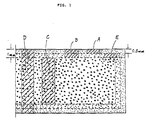
- Fig. 1 is an enlarged sectional view showing an example of the PAT foamed material of this invention.
- thermoplastic polyester series resin i.e., PAT
- PAT is a high molecular weight chain polyester obtained by reacting an aromatic dicarboxylic acid with a dihydric alcohol.
- dicarboxylic acid terephthalic acid is most frequently used but isophthalic acid or 2,6-naphthalenedicarboxylic acid can be also used. Furthermore, diphenyl ether dicarboxylic acid, diphenylsulfondicarboxylic acid, and diphenoxydicarboxylic acid can be also used.
- ethylene glycol is mainly used but trimethylene glycol, tetramethylene glycol, neopentylene glycol, hexamethylene glycol, cyclohexanedimethylol, trichlorodecanedimethylol, 2,2'bis(4- ⁇ -hydroxyethoxyphenyl)propane, 4,4'-bis( ⁇ -hydroxyethoxy)diphenylsulfone, or diethylene glycol can be also used.
- PAT polyethylene terephthalate, polybutylene terephthalate, a polybutylene terephthalate elastomer, polycyclohexane terephthalate, and polyethylene naphthalate.
- Such PAT is commercially available and such a commercially available PAT can be used in this invention.
- PAT is a resin which is liable to be hydrolyzed at a high temperature
- a dehumidifying dryer is preferably used for drying the resin.
- air having a dew point of, e.g., -30°C is heated to 160°C and PAT can be dried by exposing PAT to the air for about 4 hours.
- foaming agent for foaming PAT various foaming agents can be used in this invention. They can be generally classified into a solid compound which is decomposed at a temperature of higher than the softening point of PAT to generate a gas, a liquid which is vaporized in PAT by heating, and an inert gas capable of dissolving PAT under pressure.
- the materials classified as above can be all used in this invention.
- Examples of the aforesaid solid compound are azodicarbonamide, dinitrosopentamethylenetetramine, hydrazocarbonamide, and sodium hydrogencarbonate.
- Examples of the aforesaid liquid being vaporized in PAT are saturated aliphatic hydrocarbons such as hexane, n-pentane, n-butane, isobutane, etc.” saturated alicyclic hydrocarbons such as cyclohexane etc.; and halogenated hydrocarbons such as methylene chloride, Freon (trade name, made by E.I. du Pont de Nemours & Co., Ltd.), etc.
- examples of the aforesaid inert gas are carbon dioxide, nitrogen, etc.
- PAT containing a foaming agent it is required to foam PAT containing a foaming agent by extrusion.
- PAT containing a foaming agent is previously prepared and the mixture may be extruded by an extruding machine or a foaming agent may be incorporated in PAT in an extruding machine.
- a mouthpiece having an extrusion hole or slit is equipped to the end of the extruding machine and PAT containing a foaming agent is extruded through the extruding hole or slit.
- the extrusion temperature of PAT is a high temperature as 200°C or higher for forming a molten state of PAT. That is, PAT is extruded at the temperature of melt-kneading PAT and a foaming agent or at a high temperature of slightly lower than the aforesaid temperature.
- PET polyethylene terephthalate
- PET is melt-kneaded with a foaming agent at 280°C and by extruding the mixture from a extruding machine at 280°C as it was, a foamed material having a density of from 0.05 to 0.7 g/cm3 can be obtained.
- PBT polybutylene terephthalate
- PAT polybutylene terephthalate
- PBT is melt-kneaded with a foaming agent at 260°C
- PBT is extruded from an extruding machine at 240°C, i.e., 20°C lower than the melt-kneading temperature to provide a foamed material having the aforesaid density.
- PAT is extruded such a high temperature.
- a high temperature is not a temperature at which PAT shows a particularly suitable viscosity for foaming PAT and such a high temperature is not employed for other resins. That is, in the case of other resin such as, for example, polyethylene, the resin is melt-kneaded with a foaming agent at 220°C and it is required that the temperature is lowered at a temperature width of 110°C and the resin is foamed by extruding at about 110°C.
- the resin is melt-kneaded with a foaming agent at 250°C and it is required that the temperature is lowered at a temperature width of 80°C and is formed by extruding at about 170°C.
- the foamed resin when extruded PAT is foamed and the surface temperature of the foamed resin is at a high temperature of higher than the crystal melting point, the foamed resin is suddenly cooled. For sudden cooling the foamed resin is brought into contact with a liquid or a solid which is at a temperature of lower than the glass transition point of PAT.
- the crystal melting point and the glass transition point of PAT differ according to the kinds of the carboxylic acid and the alcohol constituting the PAT but the crystal melting point of PAT is generally in the range of from 220°C to 290°C and the glass transition point thereof is generally in the range of from 30°C to 90°C. Accordingly, for practicing sudden cooling, the foamed resin is usually brought into contact with a liquid or a solid which is at a temperature of lower than 60°C.
- the solid for sudden cooling has a form the surface of which can be brought into contact well with the surface of the PAT foamed material.
- a mandrel is used as the solid for sudden cooling
- the foamed PAT cylindrical sheet is advanced along the mandrel and the mandrel is cooled by water.
- the length of the mandrel is as long as possible.
- a pair of rolls is used as the solid for sudden cooling
- the foamed PAT sheet is advanced while it is in a close contact state with the roll surfaces and the rolls are cooled with water.
- the diameter of each roll is as large as possible.
- the crystallinity of the surface portion of the PAT foamed material is kept low.
- the foamed material Since when the extruded PAT foamed material is suddenly cooled, the foamed material is solidified without a time of crystallizing, the crystallinity of the foamed material is low.
- the foamed material is usually not suddenly cooled. This is because if the foamed material is suddenly cooled, foams are shrinked to reduce the surface state of the foamed material.
- the crystallization occurs at the surface to increase the crystallinity to usually about 30%.
- the central portion thereof can not be suddenly cooled, which results in increasing the crystallinity thereof.
- the surface of the PAT foamed material when the surface of the PAT foamed material is at a temperature of above the crystal melting point, the surface is brought into contact with a liquid or a solid which is at a temperature of lower than the glass transition point of the PAT foamed material to suddenly cool, whereby the crystallinity can be kept low.
- the portion having the crystallinity of not more than 30% is the surface portion of the PAT foamed material.
- surface portion in this invention means the portion within 0.5 mm (perpendicular to the surface) from the surface of the foamed material.
- central portion means the portion excluding the portion within 1.0 mm (perpendicular to the surface) from the surface of the foamed material.
- the crystallinity of a PAT foamed material is practically measured as follows.
- the portion of 0.5 mm in depth from the surface of the PAT foamed material is teared off and then the heat quantity of the cool crystallization and the melting heat quantity of the portion as a sample are measured. It is desirable that the measurement is made by a differential scanning heat quantity measuring method.
- heaters for the sample being measured and a standard sample function independently and since if a temperature difference occurs between both the samples during heating at a constant rate, the heat quantity increasing or restraining mechanism of either of them acts to negate the temperature difference, the difference of the heat stream rates is directly recorded.
- Crystallinity (%) (A)/(B) x 100
- the surface of the PAT foamed material extruded is suddenly cooled to hold the crystallinity of the surface portion thereof not more than 30%.
- the inside of the foamed material is not suddenly cooled by the existence of foams and is gradually cooled, whereby the crystallinity of the inside is usually higher than that of the surface portion.
- the crystallinity of the surface portion of the PAT foamed material is at least 1% lower than the crystallinity of the central portion. Furthermore, it is more preferred that the crystallinity of the surface portion is at least 1.5% lower than that of the central portion.
- the whole mean crystallinity of the preferred foamed materials is from 15% to 50%, and preferably from 20% to 40%. Also, it is preferable that the crystallinity of the surface portion of the PAT foamed materials is from 14% to 30%.
- Fig. 1 shows an enlarged sectional view of a part of an example of the PAT foamed sheet of this invention.
- A shows the surface portion within 0.5 mm (perpendicular to the surface) from the surface of the foamed material.
- B shows the shell portion existing within 1 mm (perpendicular to the surface) from the surface of the foamed material.
- C shows the central portion of the foamed material and D shows the portion for calculating the whole mean crystallinity of the foamed material.
- the surface portion A has a structure that very fine bubbles are densely distributed
- the inside portion E succeeding the surface portion has a structure that bubbles coarser than the bubbles in the surface portion A are roughly distributed
- the central portion C has a structure that more coarser bubbles are more roughly distributed.
- various additives can be added to PAT.
- small amount of a talc powder an a nulceating agent; epoxy compounds such as diglycidyl terephthalate, etc., acid dianhydrides such as pyromellitic dianhydride, benzophenonetetracarboxylic acid dianhydride, cyclopentanetetracarboxylic acid dianhydride, diphenylsulfonetetracarboxylic acid dianhydride, etc., and compounds of metals belonging to groups Ia and IIa of the periodic table or sodium carbonate for improving the melting characteristics of PAT can be added singly or as a mixture thereof.
- the amount of the additives is selected in the range of from 0.1 to 5 parts by weight to 100 parts by weight of PAT.
- the foamed material obtained by extrusion-foaming the resin when the foamed material obtained by extrusion-foaming the resin has a too low expansion ratio, the foamed material can be further heated to cause secondary foaming.
- the heating means there is no specific restriction on the heating means. That is, a heating means by conduction, a heating means by radiation, or a heating means by high frequency electric power can be used. Also, any heating medium which can immerse PAT can be used in this case.
- the PAT foamed material obtained by extrusion-foaming is brought into contact with steam or heated water.
- the foamed material can be immediately subjected to secondary foaming successive to extrusion-foaming.
- the temperature of steam or water is from 60 to 125°C and the contact time is from 10 seconds to 5 minutes. If the temperature of the heating medium is over 125°C, there is a possibility that steam or water having such a high temperature hydrolyzes the PAT foamed material. Thus, it is better to avoid the employment of such a high temperature.
- thermosetting resin which is laminated on the PAT foamed material obtained as described above or other PAT foamed material
- various kinds of resins can be used.
- unsaturated polyester resins epoxy resins, and phenol resins. These resins are in uncured states and used as a powder or a liquid.
- the unsaturated polyester resin is a thermosetting resin formed by dissolving a vinylic monomer in a resin (base resin) obtained by the condensation reaction of an unsaturated or saturated dicarboxylic acid and a dihydric alcohol.
- the main chain of the base resin contain an unsaturated group and the unsaturated group causes a copolymerization reaction with the vinylic monomer to cause crosslinking and curing.
- the dicarboxylic acid maleic anhydride or phthalic anhydride is frequently used, as a dihydric alcohol, ethylene glycol or propylene glycol is used, and as a vinylic monomer, styrene is used.
- the uncured resin is obtained as a powdery material or a liquid having a low viscosity.
- the resin When an organic peroxide such as benzoyl peroxide is added to the unsaturated polyester resin and the mixture is heated, the resin is cured to form a solid resin.
- a curing accelerator such as dimethylaniline and cobalt naphthenate is added to the system, the resin is cured without need of heating. Also, the resin forms a layer without pressing.
- the aforesaid epoxy resin is a resin having two or more epoxy groups in the molecule.
- the resin is classified into various types such as bisphenol A type resins, alicyclic resins, and resins induced from polybutadiene but in these resins, bisphenol A type resins are frequently used.
- the bisphenol A type resins are generally shown by the following formulae; wherein n represents an integer of from 0 to 12. According to the number of n, the resins take various states from liquid to solid. They are uncured epoxy resins.
- a curing agent When, a curing agent is added to the uncured epoxy resin, the resin is cured to form a solid resin.
- a curing agent an aliphatic diamine, an aromatic diamine, an aromatic acid anhydride, an aliphatic polyamine, etc., can be used.
- the resin When an aliphatic polyamine is added to the uncured epoxy resin, the resin can be cured at normal temperature without need of heating, while when an aromatic diamine or an aromatic acid anhydride is added to the uncured epoxy resin, the resin is cured by heating.
- the resin may be cured by applying pressure or may be cured at normal pressure without applying pressure.
- the phenol resin is a resin formed by the reaction of phenol and formaldehyde.
- two kinds of resins each having a different chemical structure are obtained. That is, the phenol resin obtained by using an alkali as the catalyst is called “resol” and the phenol resin obtained by using an acid as the catalyst is called “novolak".
- Resol is initially in a liquid state but when resol is heated, it becomes a solid state.
- Novolak is a brittle solid and when hexamethylenetetramine is added thereto as a curing agent and the mixture is heated, novolak is cured to form a solid resin.
- fibers are used for reinforcing the thermosetting resin.
- the fibers there are glass fibers, carbon fibers, aromatic polyamide fibers, metal fibers, potassium titanate fibers, silicon carbide fibers, etc.
- the diameters of the fibers are from several microns to several tens microns and fibers having various lengths can be used according to the requirement.
- the state of the fibers may be single fiber or may be yarn, strand, roving, chopped strand, mat, cloth, etc.
- the uncured thermosetting resin containing fibers can be easily prepared by mixing the fibers and the resin.
- thermosetting resin When an unsaturated polyester resin is used as the thermosetting resin, the resin generally called “sheet molding compound” and generally abbreviated as “SMC” can be used as it is.
- the structural material of this invention can be prepared by bringing the uncured thermosetting resin containing fibers into contact with the surface of a PAT foamed material and thereafter curing the resin.
- the resin is heated and also when pressing is required, the laminate formed is pressured in a press.
- the PAT foamed material is not usually softened at a temperature lower than 200°C and hence when the laminate is heated for curing the thermosetting resin, the foamed material is not deformed.
- the PAT foamed material is scarcely deformed even by applying thereto a slight pressure, the foamed material is scarcely deformed even when the laminated is pressed for curing the thermosetting resin. If the laminate of the foamed material and the thermosetting resin is strongly pressed, the PAT foamed material causes an elastic deformation only and does not lose the foamed structure.
- thermosetting resin thermosetting resin
- PAT foamed material in a unitary body
- the fiber-containing thermosetting resin can be formed at one surface of the PAT foamed material but may be formed on both the surfaces of the PAT foamed material to provide a sandwich structure of inserting the PAT foamed material between two sheets of the fiber containing thermoplastic resin.
- thermosetting resin for foaming the thermosetting resin, a foaming agent is added to the resin while the resin is in an uncured state and the resin is foamed and cured.
- various kinds of materials can be used as the foaming agent.
- the foaming agent being used for the thermosetting resin is generally classified into a solid compound which is decomposed at a temperature of higher than the curing temperature of the resin to generate a gas and a liquid or a gas which is dissolved in the resin at a temperature of lower than the curing temperature of the resin but is vaporized in the resin when the temperature becomes higher than the curing temperature of the resin.
- Examples of the aforesaid solid compound are 2,2'-azoisobutyronitrile, diazoaminobenzene, and tetraphthalazide and also examples of the aforesaid liquid or gas are petroleum ether and acetone.
- the uncured thermosetting resin containing fibers and a foaming agent can be easily prepared by mixing the resin with the fibers and the foaming agent.
- a mixture of a resin called “sheet molding compound” and generally abbreviated as "SMC” and a foaming agent impregnated therein can be used as it is.
- the aforesaid structural material of this invention can be prepared by bringing the thermosetting resin containing fibers and a foaming agent into contact with the surface of the PAT foamed material, forming a space capable of foaming the resin in the direction perpendicular to the contact surface between the PAT foamed material and the thermosetting resin, and only heating the resin.
- the adhesion between the foamed material and the thermosetting resin is better. Anyhow, in this case, it is unnecessary to use a specific adhesive on the foamed material. If it is required to press the laminate for adjusting the form at curing the thermosetting resin, the laminate is pressed in a press.
- the foamed material is not usually softened at a temperature of lower than 200°C, the foamed material is not deformed at heating for curing the thermosetting resin. Also, since the PAT foamed material is scarcely deformed by the application of a slight pressure, the foamed material is scarcely deformed when a pressure is applied at curing the thermosetting resin. Also, even when the laminate is strongly pressed, the PAT foamed material causes an elastic deformation only and does not lose the foamed structure.
- a structural material wherein the fiber-containing foamed thermosetting resin and the PAT foamed material are laminated in a unitary body can be easily and surely prepared.
- the fiber-containing foamed thermosetting resin may be formed on one surface of the PAT foamed material but may be farmed on both the surfaces of the PAT foamed material to form a sandwich structure that the PAT foamed material is inserted between two sheets of the fiber-containing foamed resin.
- the PAT foamed material of this invention has a thickness of at least 3 mm, preferably from 3 to 50 mm, and an apparent density of from 0.05 to 0.7 g/cm3, the PAT foamed material has sufficient strength and heat resistance and further is light-weight. Furthermore, since in the PAT foamed material, the crystallinity of the surface portion within 0.5 mm from the surface of the foamed material is held low as not more than 30% and also is at least 1% lower than the crystallinity of the central portion of the foamed material, the PAT foamed material has a high bending strength and a high nail pulling out strength.
- the nail pulling out strength is the resisting power in the case of pulling out a nail after nailing.
- the high nail pulling out strength means that the nail is reluctant to be pulled out, which is suitable for a construction work.
- the PAT foamed material of this invention is suitable as a structural material.
- PAT containing a foaming agent is extruded from an extruding machine in a molten state of a temperature of at least 200°C, PAT is foamed at a low expansion ratio and a PAT foamed material having an apparent density of from 0.05 to 0.7 g/cm3 can be easily obtained.
- the foamed material having high bending strength e.g., 50 to 100 kg ⁇ f/cm2
- nail pulling out strength e.g., 9.5 to 25.0 kg ⁇ f
- the foamed material is suitable for use as a structural material.
- the process of this invention gives large industrial advantages in the point of easily making the aforesaid structural material.
- PAT is used as the material for forming the foamed material and PAT has a high heat resistance such that PAT is not softened at a temperature lower than 200°C, thereby even when a thermosetting resin is cured on the surface of the foamed material, the foamed material does not lose the foamed structure and hence the layer of the thermosetting resin can be directly formed on the foamed material. Furthermore, in this case, the surface of the foamed material is uneven based on the existence of bubbles and hence the thermosetting resin strongly adhere to the foamed material, whereby the product obtained is reluctant to be peeled off.
- the thermoplastic resin contains fibers
- the product is reinforced by the fibers and has a sufficient mechanical strength. Furthermore, for making the aforesaid product or laminate, a specific adhesive is not required and hence the production thereof is easy.
- the product thus produced contains the PAT foamed material
- the product is light weight and has a high heat resistance.
- the PAT foamed material and the fiber-containing thermosetting resin have sufficient heat resistance and mechanical strength, the whole product is light-weight and has high heat resistance and high mechanical strength. Accordingly, the product is suitably used as a structural material for motor cars, airplanes, ships, etc.
- PAT is used as the material for the foamed material and since PAT has a heat resistance that the foamed material is not softened at a temperature of up to 200°C, when the thermosetting resin is foamed and cured on the surface of the foamed material, the foamed material does not lose the foamed structure and hence the layer of the thermosetting resin can be directly formed on the foamed material. Furthermore, in this case, since the surface of the foamed material is uneven based on the existence of bubbles, the thermosetting resin strongly adhere to the foamed material and thus, the product obtained is reluctant to be peeled off. Also, in this case, since the thermosetting resin contains fibers, the product is reinforced by the fibers and has a sufficient mechanical strength.
- the product for making the product, a specific adhesive is not required and hence the production thereof is easy.
- the thermoplastic resin and PAT are foamed, the product is light-weight and has a high heat resistance.
- the PAT foamed material and the fiber-containing thermosetting resin have sufficient heat resistance and mechanical strength, the whole product is light-weight and has high heat resistance and mechanical strength.
- the product is also suitable as a structural material for motor cars, airplanes, ships, etc.
- the bending strength and bend-flexed amount were measured according to JIS K 7203.
- the measurement conditions are as follows.
- the bending rate is 10 mm/min
- the distance between supporting points is 70 mm
- the width of a sample is 15 mm
- the thickness of a sample is the thickness of the original sample.
- the bending rate is 2.3 m/min.
- the distance between the supporting points is 80 mm
- the width of a sample is 30 mm
- the thickness of a sample is the thickness of the original sample.
- a nail pulling off strength is the value measured as follows.
- a wire nail having a length below a head of 49 mm and an outside diameter of 2.5 mm was used, the nail was hold perpendicularly on the surface of a PAT foamed sheet, the nail was nailed to a depth of 15 mm from the surface by an oil pressure press, thereafter, the nail was pulled off from the PAT foamed sheet by using a tension test machine, and the value of maximum load (kg ⁇ f) by which the nail was pulled off under the condition of the pulling off rate of 10 mm/min. was employed as the nail pulling off strength.
- PET Polyethylene terephthalate
- PET was placed in a dehumidifying dryer and PET was dried for 4 hours at 160°C while circulating air having a dew point of -30°C.
- the mixture was placed in an extruding machine having an aperture of 65 mm and L/D of 35, mixed well at a screw rotation number of 25 r.p.m. and at a barrel temperature of from 270°C to 290°C, butane was pressed in the mixture as a foaming agent at an intermediate of the barrel in an amount of 1% by weight to the mixture, and the pushing out pressure was 55 kg/cm2.
- PET containing the foaming agent was extruded in the air of 30°C in a tabular form from a flat die.
- the die had a slit width of 75 mm and an interval of 1.5 mm, and kept at 265°C. PET extruded in the air was immediately foamed.
- the PET foamed sheet was immediately inserted between metal plates for cooling and advanced while closing contacting the cooling metal plates. The cooling metal plates were cooled by passing water of 20°C through the inside of each plate.
- a PET foamed board having a width of 180 mm and a thickness of 39 mm was obtained.
- the foamed board was cut perpendicularly to the extruding direction and the section was observed. As the result thereof, a shell having a different foamed state was observed within the range of 2 mm (perpendicular o the surface) from the surface.
- the mean density was 0.35 g/cm3
- the density of the surface portion was 0.38 g/cm3
- the density of the central portion was 0.35 g/cm3
- the whole mean crystallinity was 30.7%
- the crystallinity of the surface portion was 26.7%
- the crystallinity of the central portion was 30.8%.
- the bending strength thereof was 95.3 kg ⁇ f/cm3
- the bend-flexed amount was 2 mm
- the nailing off strength was 20 kg ⁇ f.
- Example 2 a PET foamed board having almost the same density as that in Example 1 was prepared for comparing with the foamed board formed in Example 1 and the properties of both the foamed boards were compared.
- PET was foamed as in Example 1 except that the cooling metal plates were not used for forcively cooling the extruded PET foamed board and the foamed board was allowed to naturally cool in the air of 30°C.
- the mean density was 0.35 g/cm3
- the density of the portion corresponding the surface portion within 0.5 mm from the surface and the density of the central portion were all 0.35 g/cm3
- the whole mean crystallinity, the crystallinity of the portion corresponding to the shell portion, and the crystallinity of the central portion were all 30.8%.
- the bending strength was 80.0 kg ⁇ f/cm3
- the bend-flexed amount was 1.2 mm
- the nail pulling off strength was 9,5 kg ⁇ f.
- Example 1 On comparing the foamed board obtained in Comparison Example 1 with the foamed board obtained in Example 1, it can be seen that the foamed board of this invention (Example 1) are excellent in the bending strength and the nail pulling off strength as compared with the foamed board in the comparison example although the expansion ratio was almost same in both cases.
- the PET foamed sheet obtained had a width of 180 mm and a thickness of 5 mm.
- a shell portion having a different foamed state than the central portion was observed within 1 mm (perpendicular to the surface) from the surface.
- the mean density was 0.22 g/cm3
- the density of the surface portion was 0.24 g/cm3
- the density of the central portion was 0.21 g/cm3
- the whole mean crystallinity was 22.3%
- the crystallinity of the surface portion (thickness of 0.5 mm) was 18.7%
- the crystallinity of the central portion was 22.7%
- the bend-flexed amount was 12 mm
- the nail pulling off strength was 9.8 kg ⁇ f.
- Example 2 a PET foamed sheet having almost the same density as that in Example 2 was prepared for comparing with the foamed sheet in Example 2 and the properties of the foamed sheet were compared.
- the PET foamed sheet was prepared by the same manner as Example 2 except that the cooling metal plates were not used and the extruded PET foamed sheet was allowed ta naturally cool without forcibly cooling the foamed sheet.
- the mean density was 0.22 g/cm3
- the density of the portion corresponding to the surface portion within 0.5 mm from the surface and the density of the central portion were all 0.22 g/cm3 and the whole mean crystallinity, the crystallinity of the portion corresponding to the surface portion, and the crystallinity of the central portion were all 22.5%.
- the bending strength was 41.6 kg ⁇ f/cm2
- nail pulling off strength was 4.6 kg ⁇ f.
- Example 2 On comparing the foamed sheet obtained in Comparison Example 2 with the foamed sheet obtained in Example 2, it can be seen that the foamed sheet of this invention in Example 2 was excellent in the bending strength, the nail pulling off strength, and the bend-flexed amount as compared with the comparison foamed sheet although the expansion ratios (densities) of them were almost same.
- Example 2 By following the same procedure as Example 2 except that the extruded foamed sheet was cooled by immersing in water of 35°C in place of using the cooling metal plates, a PET foamed sheet was prepared.
- the foamed sheet obtained had a width of 180 mm and a thickness of 5 mm.
- a shell portion having a different foamed state from that of the central portion was observed within 1 mm (perpendicular to the surface) from the surface.
- the mean density was 0.22 g/cm3
- the density of the surface portion was 0,24 g/cm3
- the density of the control portion was 0.21 g/cm3
- the whole mean crystallinity was 22.1%
- the crystallinity of the surface portion was 18.5%
- the crystallinity of the central portion was 22.6%
- the bending strength was 50.2 kg ⁇ f/cm2
- the nail pulling off strength was 9.3 kg ⁇ f.
- n-pentane was used as a foaming agent in an amount of 4% by weight of the resin mixture, and the pushing out pressure was changed to 120 kg/cm3, a PET foamed plate was prepared.
- the foamed plate obtained had a width of 185 mm, a thickness of 20 mm, and a mean density of 12 g/cm3.
- the foamed plate was contact-heated with steam of 100°C for 5 minutes to cause secondary foaming and immediately cooled by placing the foamed plate between two cooling metal plates kept at 20°C.
- the thickness of the foamed board obtained by the secondary foaming was 52 mm.
- the mean density was 0.05 g/cm3
- the density of the surface portion was 0.056 g/cm3
- the density of the central portion was 0.049 g/cm3
- the whole mean crystallinity was 26.3%
- the crystallinity of the surface portion was 23.4%
- the crystallinity of the central portion was 26.7%.
- the bending strength was 15.6 kg ⁇ f/cm2 and the nail pulling off strength was 5.2 kg ⁇ f.
- PBT Polybutylene terephthalate
- the mixture was placed in an extruding machine having an aperture of 65 mm and L/D of 35, mixed well at a screw rotation number of 25 r.p.m., and barrel temperature of from 235 to 265°C, butane was pressed in as a foaming agent from a middle portion of the barrel in an amount of 1% by weight of the mixture and the mixture was extruded at a pushing out force of 50 kg/cm2.
- PBT containing the foaming agent was extruded from a flat die into the air of 30°C in a tabular form.
- the die has a slit width of 75 mm, a distance of 1.5 mm, and kept at 225°C.
- PBT extruded in the air foamed immediately.
- the foamed PBT sheet was immediately place between cooling metal plates and advanced while contacting with the cooling metal plates.
- the cooling metal plates were cooled by passing water of 15°C through the inside of each metal plate.
- a PBT foamed sheet having a width of 130 mm and a thickness of 5 mm was obtained.
- the foamed sheet When the foamed sheet was cut perpendicularly to the extruding direction and the section was observed, a shell portion having a different foamed state from that in the central portion was observed within 1 mm (perpendicular to the surface) from the surface.
- the mean density was 0.17 g/cm3
- the density of the surface portion was 0.19 g/cm3
- the density of the central portion was 0.17 g/cm3
- the whole mean crystallinity was 24.3%
- the crystallinity of the surface portion was 22.7%
- the crystallinity of the central portion was 24.8%.
- the bending strength was 57 kg ⁇ f/cm2 and the nail pulling off strength was 16 kg ⁇ f.
- PET 100 parts of polyethylene terephthalate pellets having an intrinsic viscosity of 0.81 (TR 8380, trade name, made by Teijin Limited) were used, after drying the pellets for 5 hours with hot blast of 160°C having a dew pint of -20°C, 0.3 part of pyromellitic anhydride, 0.1 part of sodium carbonate (both components were viscosity controlling agent of PET), and 0.6 part of a talc powder (bubble controlling agent) were added to the pellets, and after mixing well the resultant mixture in a tumbler, the mixture was placed in an extruding machine.
- TR 8380 trade name, made by Teijin Limited
- the cylinder temperature of the extruding machine was from 274°C to 287°C and the mouthpiece temperature thereof was 277°C. Also, butane was pressed in from an intermediate portion of the cylinder as a foaming agent in an amount of about 1.0 part.
- the cylindrical foamed sheet was cut open to form a flat sheet and the sheet was wound into a roll.
- the foamed sheet obtained had a density of 0.262 g/cm3, a thickness of 1.45 mm, and a width of 640 mm. (Fiber-containing thermosetting resin)
- thermosetting resin As a fiber-containing thermosetting resin, SMC (DIC MAT 2454A, trade name, made by Dainippon Ink and Chemicals, Inc.) was used.
- the PET foamed sheet of 200 mm square was placed between the sheets of aforesaid SMC of 150 mm square and the assembly was placed in a mold frame.
- the mold frame was prepared by punching a regular square having on side length of 200 mm in a regular square metal plate having a thickness of 2 mm and one side length of 250 mm and was composed of a square frame having a width of 25 mm.
- the aforesaid assembly was placed in a press together with the mold frame and heated to 150°C for 5 minutes while applying a pressure of 30 kg/cm2. Thus, a structural material was obtained.
- the structural material had a thickness of 2.7 mm and a density of 1.17 g/cm2. The reason that the thickness of the structural material became larger than the thickness of the mold frame was that the PAT foamed material was further foamed when it is taken out from the press.
- the bending strength of the structural material measured according to JIS K 7203 was 9.64 kg ⁇ f in bending load and 14.6 mm in the flexed amount. Also, when it was tried to peel off SMC from the PAT foamed material at the interface, SMC could not be easily peeled off and when SMC was forcibly peeled off, the PET foamed material was broken.
- Example 6 On both surfaces of the PET foamed material prepared by the same manner as Example 6 were placed 150 mm square of a glass fiber mat (FEM-300-04, trade name, made by Fuji Fiber Glass Co.) having 300 g in weight per 1 m2 (basis weight), 52 g of a phenol resin (PF-0015m trade name, made by Asahi Yuuki Zai K,K., viscosity 5300 cp/35°C) and 4 g of a curing agent (AD-14, trade name, made by the aforesaid company) and the laminate was placed in a mold frame.
- FEM-300-04 trade name, made by Fuji Fiber Glass Co.
- PF-0015m trade name made by Asahi Yuuki Zai K,K., viscosity 5300 cp/35°C
- AD-14 trade name, made by the aforesaid company
- the mold frame was made by punching a regular square having one side length of 150 mm in a regular square metal plate having a thickness of 5 mm and a one side length of 180 mm and was composed of square frame having a width of 15 mm.
- the aforesaid laminate (assembly) was placed in a press together with the mold frame and heated to 80°C for 30 minutes while applying a pressure of 30 kg/cm2 to provide a structural material.
- the structural material had a thickness of 5.8 mm and a density of 0.88 g/cm3.
- the bending load was measured as in Example 6, the bending load was 27.7 kg ⁇ f and the flexed amount was 6.9 mm.
- the laminate When it was tried to peel off the laminate at the interface, the laminate could not be peeled off until the PET foamed material was broken, which showed a very good adhere.
- Example 6 When the same procedure as Example 6 was followed except that a heat-resisting polystyrene foamed material having a basis weight of 200 g and a thickness of 1.85 mm was used in place of the PET foamed material, the polystyrene foamed material was melted and had no trace of the original form.
- Example 6 When the same procedure as Example 6 was followed except that a polypropylene resin foamed sheet having a basis weight of 567 g and a thickness of 0.7 mm was used in place of the PET foamed material, any deformation of the polypropylene resin foamed sheet was not observed but the adhesion at the interface was poor and the laminate was easily peeled off.
- Example 7 When the same procedure as Example 7 was followed except that a polystyrene foamed sheet having a basic weight of 200 g and a thickness of 1.85 mm was used in place of the PET foamed material, any deformation of the polystyrene resin foamed layer was not observed but the adhesion at the interface was poor and the laminate was easily peeled off.
- PET 100 parts of polyethylene terephthalate pellets having an intrinsic viscosity of 0.81 (TR 8580, trade name, made by Teijin Limited) were used. After drying the aforesaid pellets for 5 hours with hot blast having a temperature of 160°C and a dew point of -20°C, 0.33 part of pyromellitic anhydride, 0.1 part of sodium carbonate (both being viscosity controlling agents for PET), and 0.6 part of a talc powder (bubble controlling agent) were added to the pellets, and after mixing well the mixture in a tumbler, the mixture was placed in an extruding machine.
- TR 8580 trade name, made by Teijin Limited
- the cylinder temperature of the extruding machine was from 275°C to 287°C and the die temperature thereof was 277°C. Also, about 1.0 part of butane was pressed in the system from a middle portion of the cylinder as a foaming agent.
- the extruding machine To the end of the extruding machine was equipped a die having an annular fine slit, PET containing butane was extruded through the annular fine slit as a cylindrical form, the cylindrical sheet was advanced along the surface of a cylindrical mandrel while foaming PET to provide a foamed cylindrical sheet. The cylindrical sheet was cut open to form a flat sheet and the sheet was wound into a roll form.
- the foamed sheet obtained had a density of 0.2 g/cm3 and a thickness of 3 mm.
- thermosetting resin sheet containing glass fibers and a foaming agent was prepared. Two such thermosetting resin sheets were prepared.
- the aforesaid PET foamed sheet was placed between the aforesaid uncured thermosetting resin sheets containing the fibers and the foaming agent and the assembly was placed in a mold frame.
- the mold frame was a frame formed by punching a regular square having one side length of 150 mm at the center of a regular square metal plate having a thickness of 5 mm and a one side length of 180 mm and was a square frame having a width of 15 mm.
- the laminated assembly placed in the mold frame had a space in the thickness direction of the sheet for allowing the expansion.
- the mold frame containing the assembly was placed in a press and heated to 90°C for 20 minutes while applying a pressure of 40 kg/cm2 to provide a structural material.
- the structural material had a thickness of 5 mm and a density of 0.75 g/cm3.
- the bending strength of the structural material was measured according to JIS K 7203, the bending strength of 292 kg ⁇ f/cm2 and the flexed amount was 12.4 mm. Also, the elasticity was 19400 kg ⁇ f/cm2.
- Example 8 By following the same procedure as Example 8 except that the foaming agent mixed with the phenol resin was not used, a structural material was prepared.
- the structural material obtained had a thickness of 5 mm and the density of 0.75 g/cm3.
- the bending strength of the structural material was 254 kg ⁇ f/cm2, the flexed amount thereof was 6.93 mm, and the elasticity was 22800 kg ⁇ f/cm2.
- the aforesaid material could be used as a structural material but the flexibility was poor as compared with the product in Example 8.
- Example 8 the compounding ratio of the fibers and foaming agent-containing thermosetting resin in Example 8 was changed, the same PET foamed material as in Example 8 was used, and the sticking condition of the PET foamed material and the thermosetting resin sheet was changed.
- the glass fiber mat (FEM-300-04) as used in Example 8 was impregnated with a mixture of 19 g of the phenol resin (PF-0015), 2.8 g of the curing agent (CA-645), and 1 g of the foaming agent (AA-30) each being used in Example 8 to provide an uncured thermosetting resin sheet.
- PF-0015 the phenol resin
- CA-645 the curing agent
- AA-30 the foaming agent
- the PET foamed material as used in Example 8 was placed between the thermosetting resin sheets and the laminated assembly was pressed in a press for 30 minutes at 80°C and at a pressing pressure of 35 kg/cm2 to provide a structural material.
- the structural material had a thickness of 5 mm and the density of 0.59 g/cm3. Also, the bending load was 21.2 kg ⁇ f, the bending strength was 302 kg ⁇ f/cm2, the flexed amount was 10.9, and the elasticity was 14900 kg ⁇ f/cm2.
- Example 10 By following the same procedure as Example 10 except that the foaming agent mixed with the phenol resin was not used, a structural material was prepared.
- the structural material obtained had a thickness of 5 mm and a density of 0.59 g/cm3. Also, the bending load was 15.3 kg ⁇ f, the bending strength was 222 kg ⁇ f/cm2, the flexed amount was 7.64 mm, and the elasticity was 21400 kg ⁇ f/cm2.
- Example 8 From the foamed sheet (having the density of 0.2 g/cm3 and the thickness of 3 mm) obtained in Example 8, five regular square sheets each having one side length of 250 mm were cut. Three such sheets were superposed to each other, a regular square polyester series hot melt film (PS-2810, trade name, made by Daicel Chemical Industries, Ltd.) having one side length of 250 mm and a thickness of 50 ⁇ m was inserted between each two sheets and the assembly thus obtained was placed in a press. The assembly was heated to 180°C for 2 minutes while applying a pressure of 0.2 kg/cm2 to provide a primary PET laminate.
- PS-2810 regular square polyester series hot melt film
- thermosetting resin sheets each was applied to both the surface of the primary PET laminate, a regular square polyester series hot melt film (PS-2810, trade name, made by Daicel Chemical Industries, Ltd.) having one side length of 250 mm and a thickness of 50 ⁇ m was inserted between the primary PET laminate and each sheet as described above, the assembly was placed in a press, and heated to 180°C for 2 minutes while applying thereto a pressure of 0.2 kg/cm2 to provide a secondary PET laminate.
- PS-2810 regular square polyester series hot melt film having one side length of 250 mm and a thickness of 50 ⁇ m
- the reason of laminating in twice as described above is that since the PET sheet itself is a heat-insulating material, if large sheets are laminated once, the inside layers are not adhere to each other.
- thermosetting resin containing fibers and foaming agent (Thermosetting resin containing fibers and foaming agent)
- the PET foamed sheet was placed between the aforesaid uncured thermosetting resin sheets containing the fibers and the foaming agent and the laminated assembly was placed in a mold frame.
- the mold frame was a frame prepared by punching a regular square having one side length of 250 mm at the center of a regular square metal plate having a thickness of 28 mm and one side length of 280 mm and was a square frame having a width of 15 mm.
- the laminate assembly placed in the mold frame had a space capable of expanding in the thickness direction of the sheet.
- the mold frame containing the assembly was placed in a press and heated to 80°C for 30 minutes while applying thereto a pressure of 45 kg/cm2 to provide a structural material.
- the structural material had a thickness of 28 mm and a density of 0.41 g/cm3. Also, the heat conductivity thereof was 0.0339 Kcal/m ⁇ hr ⁇ °C at 20°C.
- thermosetting resin containing fibers and foaming agent (Thermosetting resin containing fibers and foaming agent)
- the aforesaid two uncured thermosetting resin sheets containing the fibers and the foaming agent were superposed to each other and placed in the mold frame as used in Example 12.
- the laminate placed in the mold frame had a space capable of expanding in the thickness direction of the sheet,
- the mold frame containing the laminate was placed in a press and heated to 80°C for 30 minutes while applying thereto a pressure of 45 kg/cm2 to provide a structural material.
- the structural material obtained had a thickness of 28 mm and a density of 0.42 g/cm3. Also, the heat conductivity thereof was 0.0494 Kcal/m ⁇ hr ⁇ °C at 20°C.
Landscapes
- Engineering & Computer Science (AREA)
- Chemical & Material Sciences (AREA)
- Mechanical Engineering (AREA)
- Thermal Sciences (AREA)
- Physics & Mathematics (AREA)
- Polymers & Plastics (AREA)
- Medicinal Chemistry (AREA)
- Organic Chemistry (AREA)
- Chemical Kinetics & Catalysis (AREA)
- Health & Medical Sciences (AREA)
- Materials Engineering (AREA)
- Composite Materials (AREA)
- Manufacture Of Porous Articles, And Recovery And Treatment Of Waste Products (AREA)
- Extrusion Moulding Of Plastics Or The Like (AREA)
- Laminated Bodies (AREA)
Applications Claiming Priority (6)
| Application Number | Priority Date | Filing Date | Title |
|---|---|---|---|
| JP344249/89 | 1989-12-27 | ||
| JP344250/89 | 1989-12-27 | ||
| JP34425089A JPH0622963B2 (ja) | 1989-12-27 | 1989-12-27 | 合成樹脂製構造材 |
| JP1344249A JPH03199243A (ja) | 1989-12-27 | 1989-12-27 | 熱可塑性ポリエステル系樹脂発泡体及びその製造方法 |
| JP182371/90 | 1990-07-09 | ||
| JP2182371A JPH085154B2 (ja) | 1990-07-09 | 1990-07-09 | 合成樹脂製構造材 |
Publications (3)
| Publication Number | Publication Date |
|---|---|
| EP0437094A2 true EP0437094A2 (fr) | 1991-07-17 |
| EP0437094A3 EP0437094A3 (en) | 1992-02-05 |
| EP0437094B1 EP0437094B1 (fr) | 1995-05-03 |
Family
ID=27325149
Family Applications (1)
| Application Number | Title | Priority Date | Filing Date |
|---|---|---|---|
| EP19900314265 Expired - Lifetime EP0437094B1 (fr) | 1989-12-27 | 1990-12-24 | Matériau en mousse de la série des résines de polyester thermoplastique et leur procédé de préparation |
Country Status (9)
| Country | Link |
|---|---|
| US (3) | US5134028C1 (fr) |
| EP (1) | EP0437094B1 (fr) |
| KR (1) | KR0178523B1 (fr) |
| AT (1) | ATE121986T1 (fr) |
| AU (1) | AU632394B2 (fr) |
| CA (1) | CA2033133C (fr) |
| DE (1) | DE69019135T2 (fr) |
| ES (1) | ES2071791T3 (fr) |
| MY (1) | MY104580A (fr) |
Cited By (4)
| Publication number | Priority date | Publication date | Assignee | Title |
|---|---|---|---|---|
| WO1992018561A1 (fr) * | 1991-04-12 | 1992-10-29 | E.I. Du Pont De Nemours And Company | Procede de production d'une couche plastique amorphe et article en mousse ainsi produit |
| US5536793A (en) * | 1993-01-29 | 1996-07-16 | Amoco Corporation | Concentrate for use in the melt fabrication of polyester |
| WO1998051467A1 (fr) * | 1997-05-09 | 1998-11-19 | B.C. Foam S.R.L. | Procede de production de polyester expanse, notamment de pet |
| DE19800166A1 (de) * | 1998-01-05 | 1999-07-08 | Buehler Ag | Verfahren und Vorrichtung zur Herstellung von Polyester-Schaumstoffen |
Families Citing this family (37)
| Publication number | Priority date | Publication date | Assignee | Title |
|---|---|---|---|---|
| CA2004300C (fr) * | 1988-12-01 | 1999-05-11 | Motoshige Hayashi | Mode de fabrication de mousse de resine de polyester et de feuilles en mousse de resine de polyester |
| DE69019135T2 (de) * | 1989-12-27 | 1995-11-30 | Sekisui Plastics | Thermoplastischer Polyesterharzschaumstoff und Herstellungsverfahren. |
| AU642962B2 (en) * | 1990-02-16 | 1993-11-04 | Sekisui Kaseihin Kogyo Kabushiki Kaisha | Process of producing thermoplastic polyester series resin foamed material |
| TW234703B (fr) * | 1991-10-10 | 1994-11-21 | Hoechst Ag | |
| US5223545A (en) * | 1992-02-03 | 1993-06-29 | The Board Of Regents Of The University Of Washington | Polyethylene terephthalate foams with integral crystalline skins |
| US5229432A (en) * | 1992-11-24 | 1993-07-20 | E. I. Du Pont De Nemours And Company | High melt strength pet polymers for foam applications and methods relating thereto |
| US5288764A (en) * | 1993-01-29 | 1994-02-22 | Amoco Corporation | Increased throughput in foaming and other melt fabrication of polyester |
| IL110514A0 (en) * | 1993-10-04 | 1994-10-21 | Eastman Chem Co | Concentrates for improving polyester compositions and a method for preparing such compositions |
| US5482977A (en) * | 1995-05-08 | 1996-01-09 | Eastman Chemical Company | Foamable branched polyesters |
| US5696176A (en) * | 1995-09-22 | 1997-12-09 | Eastman Chemical Company | Foamable polyester compositions having a low level of unreacted branching agent |
| US5661193A (en) * | 1996-05-10 | 1997-08-26 | Eastman Chemical Company | Biodegradable foamable co-polyester compositions |
| US5922782A (en) * | 1997-07-23 | 1999-07-13 | Eastman Chemical Company | Foamable copolyesters prepared from divalent metal containing co-ionomers |
| US5985190A (en) * | 1998-04-28 | 1999-11-16 | Genpak, L.L.C. | Method and system for forming low-density polymer foam article |
| CN1124194C (zh) * | 1998-12-11 | 2003-10-15 | 积水化成品工业株式会社 | 芳香族聚酯类树脂模内发泡成型体的制造方法 |
| US7951449B2 (en) * | 2002-06-27 | 2011-05-31 | Wenguang Ma | Polyester core materials and structural sandwich composites thereof |
| US7625994B2 (en) | 2002-07-30 | 2009-12-01 | E.I. Du Pont De Nemours And Company | Sulfonated aliphatic-aromatic copolyetheresters |
| US7327443B2 (en) * | 2004-07-01 | 2008-02-05 | Gambro Bct, Inc | Stroboscopic LED light source for blood processing apparatus |
| US7888405B2 (en) | 2004-01-30 | 2011-02-15 | E. I. Du Pont De Nemours And Company | Aliphatic-aromatic polyesters, and articles made therefrom |
| EP1570976A1 (fr) * | 2004-03-04 | 2005-09-07 | Alcan Technology & Management Ltd. | Méthodes pour convertir des oligomères cycliques en produits thermoplastiques de PBT |
| US20070059511A1 (en) * | 2004-03-31 | 2007-03-15 | Edwards Walter L | Low density foamed polymers |
| US7671975B2 (en) * | 2004-07-01 | 2010-03-02 | Caridianbct, Inc. | Blood processing apparatus with dedicated stroboscopic controller for LED source |
| US20080280118A1 (en) * | 2005-03-30 | 2008-11-13 | Katsuhiro Fujimoto | Polyester Foamed Sheet |
| US8080191B2 (en) * | 2006-10-20 | 2011-12-20 | Pepsico, Inc. | Extrudable polyethylene terephthalate blend |
| US8877331B2 (en) * | 2007-01-17 | 2014-11-04 | MicroGREEN Polymers | Multi-layered foamed polymeric objects having segmented and varying physical properties and related methods |
| EP2220477B1 (fr) * | 2007-12-18 | 2011-09-21 | CaridianBCT, Inc. | Appareil de traitement de sang avec diffuseur scellé dans un appareil de commande optique |
| TR201904238T4 (tr) * | 2008-04-18 | 2019-04-22 | Pepsico Inc | Ekstrüzyon üflemeli kalıplama ile ürünlerin hazırlanmasına yönelik polyester bileşimleri ve yöntem. |
| TW201022328A (en) | 2008-06-25 | 2010-06-16 | Metabolix Inc | Branched PHA compositions, methods for their production, and use in applications |
| US20110162263A1 (en) * | 2008-07-10 | 2011-07-07 | The Lubrizol Corportation | Carboxylic acid derivatives as friction modifiers in fuels |
| EP2345538B8 (fr) * | 2010-01-13 | 2014-07-23 | Armacell Enterprise GmbH & Co. KG | Procédé pour protection contre le feu et modification des propriétés de polyesters étendus |
| CN104755538B (zh) | 2012-08-17 | 2018-08-31 | Cj 第一制糖株式会社 | 用于聚合物共混物的生物基橡胶改性剂 |
| US10669417B2 (en) | 2013-05-30 | 2020-06-02 | Cj Cheiljedang Corporation | Recyclate blends |
| US10611903B2 (en) | 2014-03-27 | 2020-04-07 | Cj Cheiljedang Corporation | Highly filled polymer systems |
| WO2017026716A1 (fr) * | 2015-08-13 | 2017-02-16 | 주식회사 휴비스 | Composite de structure multicouche comprenant une couche de mousse de polyester et de résine polyester, et son utilisation |
| WO2017057826A1 (fr) | 2015-09-30 | 2017-04-06 | 주식회사 휴비스 | Composite comprenant une feuille de mousse de polyester et couche de résine de polyester, et matériaux d'intérieur et d'extérieur de véhicule les comprenant |
| KR102051463B1 (ko) * | 2019-01-07 | 2019-12-04 | 주식회사 골드이엔지 | 공동주택 전기의 배전함 |
| RU2710907C1 (ru) * | 2019-07-29 | 2020-01-14 | Дмитрий Сергеевич Расторгуев | Многослойный материал на основе вспененного вторичного полиэтилентерефталата и способ его производства |
| KR20230088438A (ko) * | 2020-10-16 | 2023-06-19 | 도요보 가부시키가이샤 | 가교 폴리에스테르 수지 |
Family Cites Families (26)
| Publication number | Priority date | Publication date | Assignee | Title |
|---|---|---|---|---|
| NL246064A (fr) * | 1958-12-05 | |||
| GB936232A (en) * | 1958-12-17 | 1963-09-04 | Lonza Ag | Improvements in or relating to light-weight laminated structural materials |
| US3299192A (en) * | 1963-06-11 | 1967-01-17 | Haveg Industries Inc | Method of extruding a foamed plastic tube having internal and external skins thereon |
| GB1008137A (en) * | 1963-08-29 | 1965-10-27 | Haveg Industries Inc | Skinned foam plastic sheets |
| US3317363A (en) * | 1963-11-29 | 1967-05-02 | Haveg Industries Inc | Corrugated product |
| NL6915186A (en) * | 1969-10-08 | 1970-10-26 | Extrusion of foam backed oblong objects | |
| US4097421A (en) * | 1974-04-08 | 1978-06-27 | The Goodyear Tire & Rubber Company | Foamable structural thermoplastic polyester resins |
| US3988403A (en) * | 1974-07-09 | 1976-10-26 | Union Carbide Corporation | Process for producing molded structural foam article having a surface that reproducibly and faithfully replicates the surface of the mold |
| US3993265A (en) * | 1975-03-17 | 1976-11-23 | Steel Heddle Manufacturing Company | Plastic bobbin or quill |
| JPS5399268A (en) * | 1977-02-12 | 1978-08-30 | Shiyouki Chiyou | Low temperature fabrication process of polyethylene telephthalate |
| US4312960A (en) * | 1979-01-18 | 1982-01-26 | Monsanto Company | Foam crystallization of condensation polymers |
| US4224264A (en) * | 1979-01-18 | 1980-09-23 | Monsanto Company | Foam crystallization of condensation polymers |
| JPS5720333A (en) * | 1980-07-11 | 1982-02-02 | Teijin Ltd | Production of extruded and expanded body of polyester |
| DE3264767D1 (en) * | 1981-06-30 | 1985-08-22 | Ciba Geigy Ag | Method of producing a composite body with a hard foam core and a skin of hard foam with a higher density |
| US4429060A (en) * | 1981-07-13 | 1984-01-31 | Celanese Corporation | Lightweight high performance foams of thermotropic liquid crystal polymers comprising recurring 6-oxy-2-naphthoyl moieties |
| US4456571A (en) * | 1982-12-13 | 1984-06-26 | Mobil Oil Corporation | Process and apparatus for forming a composite foamed polymeric sheet structure having comparatively high density skin layers and a comparatively low density core layer |
| US4462947A (en) * | 1982-12-28 | 1984-07-31 | Mobil Oil Corporation | Heat-resistant foamed polyesters |
| JPS60155243A (ja) * | 1984-01-24 | 1985-08-15 | Toyobo Co Ltd | 発泡剤組成物 |
| DD246727A1 (de) * | 1986-03-24 | 1987-06-17 | Bauakademie Ddr | Konditioniervorrichtung zur herstellung von thermoplastschaeumen |
| GB8618726D0 (en) * | 1986-07-31 | 1986-09-10 | Wiggins Teape Group Ltd | Thermoplastics material |
| IT1210837B (it) * | 1987-06-26 | 1989-09-29 | Pianfei Ipa Spa | Procedimento perfezionato di fabbricazione di manufatti stampabili leggeri autoportanti e fonoassorbenti e manufatti ottenuti con detto procedimento |
| US4844944A (en) * | 1987-12-18 | 1989-07-04 | American Standard, Inc. | Lightweight, durable plumbing fixture fabricated from a delamination-resistant multilayer polymeric composite |
| NL8900398A (nl) * | 1989-02-17 | 1990-09-17 | Schreiner Luchtvaart | Werkwijze voor het aanbrengen van een plaatselijke versterking in een sandwichconstructie. |
| US5087514A (en) * | 1989-08-30 | 1992-02-11 | Intellex Corporation | Thermoplastic resin layer chemically bonded to thermoset resin layer |
| DE69019135T2 (de) * | 1989-12-27 | 1995-11-30 | Sekisui Plastics | Thermoplastischer Polyesterharzschaumstoff und Herstellungsverfahren. |
| US5128202A (en) * | 1991-04-12 | 1992-07-07 | E. I. Du Pont De Nemours And Company | Melt fabrication of foam articles |
-
1990
- 1990-12-24 DE DE69019135T patent/DE69019135T2/de not_active Expired - Lifetime
- 1990-12-24 AT AT90314265T patent/ATE121986T1/de not_active IP Right Cessation
- 1990-12-24 CA CA 2033133 patent/CA2033133C/fr not_active Expired - Lifetime
- 1990-12-24 MY MYPI90002258A patent/MY104580A/en unknown
- 1990-12-24 ES ES90314265T patent/ES2071791T3/es not_active Expired - Lifetime
- 1990-12-24 EP EP19900314265 patent/EP0437094B1/fr not_active Expired - Lifetime
- 1990-12-26 US US07633851 patent/US5134028C1/en not_active Expired - Lifetime
- 1990-12-27 AU AU68540/90A patent/AU632394B2/en not_active Ceased
- 1990-12-27 KR KR1019900022555A patent/KR0178523B1/ko not_active Expired - Fee Related
-
1991
- 1991-12-05 US US07/802,668 patent/US5389319A/en not_active Expired - Lifetime
-
1993
- 1993-01-19 US US08/005,259 patent/US5332620A/en not_active Expired - Lifetime
Cited By (5)
| Publication number | Priority date | Publication date | Assignee | Title |
|---|---|---|---|---|
| WO1992018561A1 (fr) * | 1991-04-12 | 1992-10-29 | E.I. Du Pont De Nemours And Company | Procede de production d'une couche plastique amorphe et article en mousse ainsi produit |
| US5536793A (en) * | 1993-01-29 | 1996-07-16 | Amoco Corporation | Concentrate for use in the melt fabrication of polyester |
| WO1998051467A1 (fr) * | 1997-05-09 | 1998-11-19 | B.C. Foam S.R.L. | Procede de production de polyester expanse, notamment de pet |
| US6409948B1 (en) | 1997-05-09 | 2002-06-25 | B.C. Foam S.R.L. | Process and apparatus for the production of expanded polyester, in particular pet |
| DE19800166A1 (de) * | 1998-01-05 | 1999-07-08 | Buehler Ag | Verfahren und Vorrichtung zur Herstellung von Polyester-Schaumstoffen |
Also Published As
| Publication number | Publication date |
|---|---|
| US5389319A (en) | 1995-02-14 |
| US5134028C1 (en) | 2001-12-11 |
| CA2033133C (fr) | 2001-12-11 |
| EP0437094B1 (fr) | 1995-05-03 |
| CA2033133A1 (fr) | 1991-06-28 |
| AU632394B2 (en) | 1992-12-24 |
| EP0437094A3 (en) | 1992-02-05 |
| DE69019135T2 (de) | 1995-11-30 |
| US5332620A (en) | 1994-07-26 |
| US5134028A (en) | 1992-07-28 |
| AU6854090A (en) | 1991-07-11 |
| KR910011961A (ko) | 1991-08-07 |
| DE69019135D1 (de) | 1995-06-08 |
| MY104580A (en) | 1994-04-30 |
| ATE121986T1 (de) | 1995-05-15 |
| KR0178523B1 (ko) | 1999-05-15 |
| ES2071791T3 (es) | 1995-07-01 |
Similar Documents
| Publication | Publication Date | Title |
|---|---|---|
| US5332620A (en) | Thermoplastic polyester series resin foamed material and production process thereof | |
| US5397611A (en) | Expandable films and molded products therefrom | |
| CA2330922C (fr) | Feuille en mousse de polypropylene thermoformable | |
| US5234640A (en) | Process of producing thermoplastic polyester series resin foamed | |
| US4830908A (en) | Vehicle outer panel structure and method of producing same | |
| US3644168A (en) | Varied density polyisocyanurate foam structure | |
| US5360829A (en) | Foamed polyester sheet and process for the production thereof | |
| US4629745A (en) | Expandable polyetherimide compositions and foamed materials obtained therefrom | |
| US4224264A (en) | Foam crystallization of condensation polymers | |
| US20180257345A1 (en) | Fiber-reinforcement of blowing-agent containing foam materials | |
| EP1160274A1 (fr) | Particules pre-expansees en resine de polyester aromatique cristallin, produit expanse dans le moule et lamine expanse ainsi realise | |
| US6054500A (en) | Flexible polyester foams | |
| JPH08333470A (ja) | 発泡体およびその製法 | |
| US5077319A (en) | Cyanate resin-based foams | |
| US5854294A (en) | Process for producing foamed body of polycarbonate resin and foamed body obtained thereby | |
| JPH03199243A (ja) | 熱可塑性ポリエステル系樹脂発泡体及びその製造方法 | |
| JPH0467944A (ja) | 合成樹脂製構造材 | |
| JP2801483B2 (ja) | 熱可塑性ポリエステル樹脂発泡体の製造方法 | |
| JPH0622963B2 (ja) | 合成樹脂製構造材 | |
| JPH10130413A (ja) | 繊維強化合成樹脂積層用ポリカーボネート系発泡体及び該発泡体と繊維強化合成樹脂との複合体並びに該複合体の製造方法 | |
| JPH03179042A (ja) | 発泡成形品の製造方法 | |
| JPS6225135A (ja) | 接着強度に優れたポリエ−テルイミド発泡体 | |
| JPH05310981A (ja) | 複合材料用樹脂組成物、中間体および複合材料 | |
| JPH05239247A (ja) | ポリアリレート樹脂発泡体及びその製造法 | |
| JPH0547570B2 (fr) |
Legal Events
| Date | Code | Title | Description |
|---|---|---|---|
| PUAI | Public reference made under article 153(3) epc to a published international application that has entered the european phase |
Free format text: ORIGINAL CODE: 0009012 |
|
| AK | Designated contracting states |
Kind code of ref document: A2 Designated state(s): AT BE CH DE ES FR GB IT LI SE |
|
| RHK1 | Main classification (correction) |
Ipc: B29C 67/22 |
|
| PUAL | Search report despatched |
Free format text: ORIGINAL CODE: 0009013 |
|
| AK | Designated contracting states |
Kind code of ref document: A3 Designated state(s): AT BE CH DE ES FR GB IT LI SE |
|
| 17P | Request for examination filed |
Effective date: 19920626 |
|
| 17Q | First examination report despatched |
Effective date: 19931026 |
|
| GRAA | (expected) grant |
Free format text: ORIGINAL CODE: 0009210 |
|
| AK | Designated contracting states |
Kind code of ref document: B1 Designated state(s): AT BE CH DE ES FR GB IT LI SE |
|
| REF | Corresponds to: |
Ref document number: 121986 Country of ref document: AT Date of ref document: 19950515 Kind code of ref document: T |
|
| REF | Corresponds to: |
Ref document number: 69019135 Country of ref document: DE Date of ref document: 19950608 |
|
| REG | Reference to a national code |
Ref country code: ES Ref legal event code: FG2A Ref document number: 2071791 Country of ref document: ES Kind code of ref document: T3 |
|
| ITF | It: translation for a ep patent filed | ||
| ET | Fr: translation filed | ||
| PLBE | No opposition filed within time limit |
Free format text: ORIGINAL CODE: 0009261 |
|
| STAA | Information on the status of an ep patent application or granted ep patent |
Free format text: STATUS: NO OPPOSITION FILED WITHIN TIME LIMIT |
|
| 26N | No opposition filed | ||
| REG | Reference to a national code |
Ref country code: GB Ref legal event code: IF02 |
|
| PGFP | Annual fee paid to national office [announced via postgrant information from national office to epo] |
Ref country code: CH Payment date: 20091215 Year of fee payment: 20 Ref country code: AT Payment date: 20091211 Year of fee payment: 20 Ref country code: ES Payment date: 20091229 Year of fee payment: 20 Ref country code: SE Payment date: 20091207 Year of fee payment: 20 |
|
| PGFP | Annual fee paid to national office [announced via postgrant information from national office to epo] |
Ref country code: IT Payment date: 20091219 Year of fee payment: 20 Ref country code: FR Payment date: 20091221 Year of fee payment: 20 Ref country code: GB Payment date: 20091223 Year of fee payment: 20 |
|
| PGFP | Annual fee paid to national office [announced via postgrant information from national office to epo] |
Ref country code: BE Payment date: 20091130 Year of fee payment: 20 Ref country code: DE Payment date: 20091217 Year of fee payment: 20 |
|
| BE20 | Be: patent expired |
Owner name: *SEKISUI KASEIHIN KOGYO K.K. Effective date: 20101224 |
|
| REG | Reference to a national code |
Ref country code: CH Ref legal event code: PL |
|
| REG | Reference to a national code |
Ref country code: GB Ref legal event code: PE20 Expiry date: 20101223 |
|
| EUG | Se: european patent has lapsed | ||
| PG25 | Lapsed in a contracting state [announced via postgrant information from national office to epo] |
Ref country code: GB Free format text: LAPSE BECAUSE OF EXPIRATION OF PROTECTION Effective date: 20101223 |
|
| PG25 | Lapsed in a contracting state [announced via postgrant information from national office to epo] |
Ref country code: DE Free format text: LAPSE BECAUSE OF EXPIRATION OF PROTECTION Effective date: 20101224 |
|
| REG | Reference to a national code |
Ref country code: ES Ref legal event code: FD2A Effective date: 20130725 |
|
| PG25 | Lapsed in a contracting state [announced via postgrant information from national office to epo] |
Ref country code: ES Free format text: LAPSE BECAUSE OF EXPIRATION OF PROTECTION Effective date: 20101225 |