EP0440113A2 - Chemin de tuyères à gaz à forte convection pour matériaux plats transportés sur des rouleaux - Google Patents
Chemin de tuyères à gaz à forte convection pour matériaux plats transportés sur des rouleaux Download PDFInfo
- Publication number
- EP0440113A2 EP0440113A2 EP91100999A EP91100999A EP0440113A2 EP 0440113 A2 EP0440113 A2 EP 0440113A2 EP 91100999 A EP91100999 A EP 91100999A EP 91100999 A EP91100999 A EP 91100999A EP 0440113 A2 EP0440113 A2 EP 0440113A2
- Authority
- EP
- European Patent Office
- Prior art keywords
- nozzle
- ribs
- gas jet
- section according
- convection gas
- Prior art date
- Legal status (The legal status is an assumption and is not a legal conclusion. Google has not performed a legal analysis and makes no representation as to the accuracy of the status listed.)
- Granted
Links
Images




Classifications
-
- C—CHEMISTRY; METALLURGY
- C03—GLASS; MINERAL OR SLAG WOOL
- C03B—MANUFACTURE, SHAPING, OR SUPPLEMENTARY PROCESSES
- C03B27/00—Tempering or quenching glass products
- C03B27/04—Tempering or quenching glass products using gas
- C03B27/0404—Nozzles, blow heads, blowing units or their arrangements, specially adapted for flat or bent glass sheets
-
- C—CHEMISTRY; METALLURGY
- C03—GLASS; MINERAL OR SLAG WOOL
- C03B—MANUFACTURE, SHAPING, OR SUPPLEMENTARY PROCESSES
- C03B27/00—Tempering or quenching glass products
- C03B27/04—Tempering or quenching glass products using gas
- C03B27/0417—Controlling or regulating for flat or bent glass sheets
-
- C—CHEMISTRY; METALLURGY
- C03—GLASS; MINERAL OR SLAG WOOL
- C03B—MANUFACTURE, SHAPING, OR SUPPLEMENTARY PROCESSES
- C03B27/00—Tempering or quenching glass products
- C03B27/04—Tempering or quenching glass products using gas
- C03B27/044—Tempering or quenching glass products using gas for flat or bent glass sheets being in a horizontal position
-
- C—CHEMISTRY; METALLURGY
- C03—GLASS; MINERAL OR SLAG WOOL
- C03B—MANUFACTURE, SHAPING, OR SUPPLEMENTARY PROCESSES
- C03B40/00—Preventing adhesion between glass and glass or between glass and the means used to shape it, hold it or support it
- C03B40/005—Fabrics, felts or loose covers
Definitions
- the invention relates to a high-convection gas jet nozzle section for flat material guided over rollers, in particular for the thermal tempering of thin flat glass panes, with a lower nozzle array with centrically and parallel to one another or to the rollers between the rollers, provided with nozzle openings, and with one upper nozzle field, the nozzle ribs provided with nozzle openings are arranged symmetrically to the vertical axis of the opposite, lower nozzle ribs.
- Such high-convection gas jet nozzle sections can be used to heat or cool the sheet-like material guided over rollers, for example a metal plate, a band of metal, plastic, fibers, textiles, and sections of such materials.
- the heat transfer coefficient to be achieved in a cooling section for the thermal tempering of glass is approximately inversely proportional to the glass thickness.
- the heat transfer is usually achieved by blowing the glass pane, which has been heated to its softening temperature, with air from a nozzle system which is supplied by a fan.
- the heat transfer coefficient only increases with the 0.7th power of the nozzle outlet speed.
- the flow rate required for this increases with the third power of the nozzle outlet speed. So for example tempered in a cooling section of glass with a thickness of 3 mm instead of a thickness of 5 mm, the nozzle outlet speed would have to be increased approximately 2.1 times and the flow rate by 9 times in order to achieve the same heat transfer .
- the pressure on the underside must be increased compared to the pressure on the top of the pane in order to compensate for the heat transfer difference caused thereby.
- this pressure difference can be compensated for by the comparatively high weight of the disk, so that despite a pressure difference there is still sufficient guidance of the disk through the rollers.
- the significantly higher nozzle pressure required on the underside leads to this generated, from bottom to top pressure differential force to lift the panes from the roller hearth and thus to significant production problems, if the tempering of thin glass is possible with such a system.
- roll dummies e.g. B. cylindrical tubes are used which generate a similar accumulation effect for the bias air applied to the disc, as is caused by the rollers below the disc.
- these dummy rolls unlike the rollers, do not touch the surface of the pane, but must be kept at a certain minimum distance above the glass surface, the flow field and consequently also the pressure field differ, and with it the heat transfer at the top and on the underside of the glass pane is so considerable that a pane safety glass with a thickness of less than 3.2 mm can be produced with such systems only with considerable restrictions with regard to the requirements for the optical quality and the fracture pattern.
- the invention has for its object to provide a high convection gas jet nozzle section of the specified type in which the above-mentioned disadvantages do not occur.
- a nozzle section is to be proposed in which the same heat transfer and the same pressurization result on the top and on the bottom of the material even without the use of roller dummy.
- the nozzle bottoms of the upper nozzle ribs have the cross section of a letter "M" extended by a median strip, that the width of the nozzle bottoms of the upper nozzle ribs is greater than the horizontal distance between the rollers and smaller than the roller pitch that the median strip and the two inner legs of the expanded M cross section of the nozzle bottoms, which are bent upward, are provided with nozzle openings, and that the smallest distance between the upper nozzle ribs and the top of the product is greater than the smallest distance between the lower nozzle ribs and the underside of the product.
- the advantages achieved by the invention are based on the fact that the desired, high heat transfer is achieved by means of a nozzle field which is considerably finer and more filigree in comparison with conventional prestressing nozzle systems while the entire glass surface is applied as uniformly as possible.
- the nozzle ribs on the top of the goods are shaped such that they produce the same heat transfer and the same pressure on the goods as the nozzle ribs provided on the underside of the goods, their flow behavior and ultimately also the heat transfer influenced by the rollers arranged between them becomes.
- This uniform heat transfer on the top and bottom of the goods is achieved in that the jet streams all strike the surface of the goods at approximately the same arrival speed.
- inclined beams the beam path of which is larger up to the point of impact on the surface of the material, must be provided with a larger diameter. This larger diameter and the associated larger volume flow make it necessary to change the nozzle pitch for these larger diameter jet streams.
- the jamming effect of the rollers on the underside of the goods is compensated for by the shape of the nozzle ribs on the top of the goods, without having to use the otherwise usual roller dummy on the top of the goods. This is due to the downward-facing, outer legs of the M-shaped cross section of the nozzle bottoms of the upper nozzle ribs, which narrow the outflow area for the gas escaping from the nozzle bores of the upper nozzle ribs on both sides of the upper nozzle ribs and thereby for a defined impact pattern on the top care of the good.
- Fig. 1 shows a longitudinal section of a section of a high convection gas jet nozzle section as a cooling and thus tempering section for flat glass panes 7 guided over rollers 1.
- the nozzle ribs 2a of the lower nozzle array 2 are arranged between the rollers 1, i. H. these nozzle ribs 2a of the lower nozzle array 2 blow the free underside of the glass pane 7 between the rollers 1.
- the nozzle ribs 3b of the upper nozzle array 3, which blow the top of the glass pane 7, are arranged exactly above the lower nozzle ribs 2a.
- the distance of the lower nozzle ribs 2a from the glass surface is preferably between 4 mm and 12 mm, while the distance of the upper nozzle ribs 3b from the surface of the glass can be approximately twice as large, that is to say should be in the range between 8 mm and 24 mm.
- the rollers 1 have the core shown in the drawing, usually a metal core or a metal tube, which is wrapped with a band of a material (“bandaged”) that withstands the comparatively high temperature of the glass pane 7. That comes as a material, for example aromatic polyamide sold under the trademark "Kevlar”, but also other high-temperature resistant materials from which strips or tapes can be produced.
- a material for example aromatic polyamide sold under the trademark "Kevlar”, but also other high-temperature resistant materials from which strips or tapes can be produced.
- the solid cores of the rollers 1 can also be provided with rings.
- rings In particular, the mounting of O-rings from the fluororubbers marketed under the name "Viton" or the use of rings made of silicate fiber material, for example calcium silicate fiber material, has proven successful.
- nozzle cap shape with a parallel to the transport plane central area 2a1, on each side of which a beveled area 2a2 connects ("hipped roof").
- the size of the nozzle openings is distributed over the three areas, the largest nozzle openings 2b being located at the outer edge of the chamfered areas 2a2; As can be seen in FIG. 2, a row of nozzle openings 2b with a relatively large diameter is arranged in this edge region.
- the next, inward row of nozzle openings 2c has a smaller diameter, while in the central region 2a1 there are only nozzle openings 2c with the smallest diameter of the three different nozzle opening sizes.
- the side view of the nozzle bottom of the upper nozzle ribs 3b has the shape of an elongated letter "M" with an additional central strip 4a; starting from this median strip 4a, which runs approximately parallel to the transport plane of the glass pane 7, the two adjoining legs 4b1 and 4b2 of the nozzle base 4 extend somewhat up to the edge at which the nozzle base is closed by downward-pointing, outer legs 4c. These legs 4c narrow the outflow area for the gas emerging from the nozzle bores of the upper nozzle ribs 3b on both sides of the upper nozzle ribs 3b, so that the gas flowing back is deflected there, as indicated by the flow arrows in FIG. 1.
- nozzle openings 4d there is a row of nozzle openings 4d with the largest diameter of all nozzle openings in the upper nozzle ribs 3b in the chamfered areas 4b1 and 4b2, and approximately in the middle of these areas.
- a second row of nozzle openings 4e with a smaller diameter is located on the inner edge of the chamfered areas 4b1 or 4b2, while nozzle openings 4f with the smallest diameter are formed in the median strip 4a.
- FIG. 1 also shows the jet directions of the gas jets emerging from the various nozzle openings; It can be seen that the gas jets emerging from the respective central regions of the nozzle ribs strike the glass pane 7 approximately perpendicularly, while the gas jets coming from the edge regions are inclined to different degrees, namely the gas jets coming from the lower nozzle ribs 2a more than those from the lateral ones Legs of the upper nozzle ribs 3b coming gas jets.
- the nozzle ribs are not designed as a welded construction from one piece, but rather the nozzle caps 2d of the lower nozzle ribs 2a are slidably attached to the base parts 2f of the nozzle ribs 2a with the aid of the screw connection 2e shown in FIG. 1, so that manufacturing inaccuracies can still be compensated for during assembly; this contributes to the fact that the exposure images of the upper nozzle field 3 and the lower nozzle field 2 can be brought very closely to cover.
- FIG. 2 A development of those surfaces of the nozzle ribs 2a or 2b in which the nozzle openings are formed, namely the nozzle bottoms 4 on the one hand and the nozzle caps 2d on the other hand, can be seen in FIG. 2. It can be seen that the diameter of the nozzle openings 2b, 2c and 2d or 4d, 4e and 4f and the division of the rows of nozzle openings each from the Increase outwards in the middle of a nozzle rib. The inner rows of nozzle openings are each offset by half a division. The division of the outer rows of nozzle openings is chosen larger in accordance with the larger diameter of the nozzle openings due to the larger jet path.
- the distance between the individual rows of nozzle openings is greater for the nozzle bottom 4 of the upper nozzle rib 3b shown on the left in FIG. 2, in accordance with the shape of the nozzle bottom different from the lower nozzle rib 2a, than for the lower nozzle rib 2a.
- the width of the nozzle bottom 4 of the upper nozzle ribs 3b is greater than the horizontal distance between the rollers 1 and smaller than the roller pitch, so that the downward legs 4b1 and 4b2 are above the rollers 1 , while the central areas 2a1 and 4a of the respective nozzle bottoms are directly opposite one another.
- the width BP of the essentially flat central strip 4a of the upper nozzle bottoms 4 should lie within the following limits: 0.5 BU ⁇ BP ⁇ 0.75 BU
- the edging angle of the two legs 4b1 and 4b2 of the upper nozzle bases 4, that is the angle at which the two legs 4b1 and 4b2 extend from the horizontal median strip 4a upwards, should be in the range from 5 ° to 10 °.
- the width BK of the two inner flared legs 4b1 and 4b2 of the nozzle bottoms 4 of the upper nozzle ribs 3b should be within the following limits: 0.6 BU ⁇ BK ⁇ 0.9 BU.
- the inclination of the two downward bent outer legs 4c of the nozzle bottoms 4 of the upper nozzle ribs 3b against the horizontal should be between 40 ° and 50 °, in particular approximately 45 °.
- the width BR of the two outer legs of the nozzle bottoms 4 bent downward should be within the following limits: 0.1 BU ⁇ BR ⁇ 0.25 BU.
- the flat central strip 4a of the upper nozzle bases 4 has an odd number of rows of nozzle openings 4f with comparatively small hole divisions; the rows of nozzle openings are spaced from one another by approximately one hole pitch and are offset from one another in the longitudinal direction by half the hole pitch.
- the upwardly inclined regions 4b1 and 4b2 of the nozzle bases 4 have further rows of nozzle openings with a larger diameter and with a larger hole division, the diameter and / or the hole division increasing with the atomic number of the rows of nozzle openings from the inside to the outside.
- the middle strips 4a of the upper nozzle bases 4 have three rows of nozzle openings and the two adjacent, upwardly inclined regions 4b 1 and 4b 2 each have two rows of nozzle openings with the double hole division.
- the width BP of the central strip 4a is 0.67 times the total width BU of the lower nozzle ribs 2a; the edging angle of the two legs 4b1 and 4b2 is 8 °; the width BK of the two legs 4b1 and 4b2 is 0.8 times the total width BU; and the width BR corresponds to 0.14 times the total width BU.
- the upper nozzle bases 4 have a central strip 4a with three rows of nozzle openings 4f and adjacent, upwardly inclined legs 4b1 and 4b2, each with two rows of nozzle openings 4d and 4e, each with a decreasing diameter and with the double hole pitch.
- an exposure image can be generated on the underside of the glass pane 7, which is a mirror image of that on the upper side of the glass pane 7.
- the geometric exit area of the nozzle openings which is unilaterally related to the blown area, is about 2% to about 5%; the exit area of the nozzle openings should be the same for the upper and lower nozzle ribs 3b and 2a.
- the pitch of rollers 1 and nozzle ribs 2a or 3b should be in the range from 60 mm to 150 mm.
- the nozzle caps 2d of the lower nozzle ribs 2a are chamfered in the manner of a hipped roof and screwed to the base part 2f (2e), both the horizontal central region 2a1 and the two chamfered edge regions 2a2 having nozzle openings .
- FIG. 3 A cross-section through a high-convection gas jet nozzle section for the thermal tempering of flat glass panes is shown in FIG. 3.
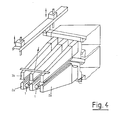
- This large free space for outflow of the air blown onto the glass pane 7 for cooling is also shown in the perspective view according to FIG. 4, in which the corresponding flow arrows are entered.
- the upper nozzle hearth 19o or its nozzle ribs 3b are pivotally mounted on a frame 11 about an axis of rotation 10.
- the height of the frame 11 can be finely adjusted by means of lifting elements 12 which are fastened to a stationary frame and are actuated by spindles, which are indicated in FIG. 3 by the rotating arrows, by means of an electric motor 13.
- the entire upper nozzle range 3 can be swiveled out rapidly about the axis of rotation 10 by means of a compressed air cylinder 14.
- This double-acting compressed air cylinder 14 causes this pivoting movement during normal operation of the nozzle hearth.
- a special locking mechanism can also be provided, which is triggered by the lifting movement of the compressed air cylinder 14. Such locking is particularly useful when the nozzle section must be operated at high pressures.
- the lower nozzle hearth 19u or nozzle ribs 2a is pivoted away by means of a compressed air cylinder 17 about a swivel joint 15 possible, which is also designed to be adjustable in height, as indicated by the double arrow in FIG. 3.
- a swivel joint 15 which is also designed to be adjustable in height, as indicated by the double arrow in FIG. 3.
- only a fine adjustment of the height by means of a stop 16 and the height-adjustable swivel joint 15 is necessary, since the distance of the lower nozzles from the underside of the glass pane 7 depends only on the position of the lower nozzle ribs 2a with respect to the rollers 1 and for all glass thicknesses is equal to.
- the route shown in FIG. 3 is suitable for automation if appropriate computer-controlled motors and displacement sensors are installed.
- the distance 5.6 of the upper nozzle field 19o and the lower nozzle field 19u from the roller hearth surface can be set in the manner described depending on the respective operating condition requirements. As a rule, it can be assumed that the distance of the upper nozzle ribs 3b from the top of the glass pane 7 should be approximately twice as large as the distance of the lower nozzle ribs 2a from the underside of the glass pane.
- thermally toughened single-pane safety glass is, in addition to the satisfactory appearance, guaranteed by good flatness and a damage-free surface, also the achievement of a fracture pattern that complies with the relevant regulations and, on the one hand, from the height of the rugged ones Cooling process achieved prestress and on the other hand depends on the distribution of this prestress, since the propagation of fracture lines is based on the stress distribution in the glass, see German Patent No. 28 27 754, according to which the formation of splinters can be influenced favorably by appropriate gradation of the stress.
- Such an influence on the voltage is possible, for example, by changing the cooling, as has been practiced for a long time for coarse crumb fields of view of windshields made of single-pane safety glass for passenger cars through a coarser nozzle field.
- the disc length and thus the position of the front edge of the disc at the beginning of the first reversing stroke are indicated under the X axis.
- the disk 7 is first moved very quickly into the cooling section until its front edge has reached the indicated position.
- the disc is held in this position for a short time before the first reversing stroke begins, in which the disc is pushed back a little against the original direction of movement.
- This reversing stroke is a multiple of the nozzle pitch T, as a result of which the prestress in the glass changes in accordance with the nozzle or roller pitch T.
- the glass pane then remains in this position for a short time before the second reversing stroke begins in the opposite direction, namely over the distance 2.5 T.
- the pane then remains in this new position for a short time before the third reversing stroke with the length 3.5 T against the entry direction begins. If necessary, further reversing strokes can follow this.
- the length of the skewers can be shortened in that the strip-like cooling which is produced during reversing is refined by reversing with strokes of an odd multiple of half the division. This can also be combined with the change in the size of the reversing path from stroke to stroke shown in FIG. 5.
- the heat transfer for. B. by reducing the nozzle area, reduced in the direction of passage of the pretensioning line or reduced in total synchronously with the running-in of the disc, the nozzle pressure.
- This reduction in the nozzle pressure can be achieved, for example, by reducing the speed of the fan (s) supplying the nozzle fields (not shown).
- the flow can be individually throttled when entering the nozzle ribs, thereby reducing the nozzle pressure.
- the gas pressure in both the upper and lower nozzle ribs of the two nozzle fields can be reduced in the direction of passage of the glass pane from nozzle rib to nozzle rib.
Landscapes
- Chemical & Material Sciences (AREA)
- Engineering & Computer Science (AREA)
- Materials Engineering (AREA)
- Organic Chemistry (AREA)
- Physics & Mathematics (AREA)
- Thermal Sciences (AREA)
- Re-Forming, After-Treatment, Cutting And Transporting Of Glass Products (AREA)
- Advancing Webs (AREA)
- Chemical Vapour Deposition (AREA)
- Rollers For Roller Conveyors For Transfer (AREA)
- Coating With Molten Metal (AREA)
- Tunnel Furnaces (AREA)
Applications Claiming Priority (2)
| Application Number | Priority Date | Filing Date | Title |
|---|---|---|---|
| DE4002546A DE4002546C2 (de) | 1990-01-29 | 1990-01-29 | Hochkonvektions-Gasstrahldüsenstrecke für über Rollen geführtes, flächenhaftes Gut, sowie Verfahren zu deren Betrieb |
| DE4002546 | 1990-01-29 |
Publications (3)
| Publication Number | Publication Date |
|---|---|
| EP0440113A2 true EP0440113A2 (fr) | 1991-08-07 |
| EP0440113A3 EP0440113A3 (en) | 1992-07-15 |
| EP0440113B1 EP0440113B1 (fr) | 1995-09-27 |
Family
ID=6398985
Family Applications (1)
| Application Number | Title | Priority Date | Filing Date |
|---|---|---|---|
| EP91100999A Expired - Lifetime EP0440113B1 (fr) | 1990-01-29 | 1991-01-25 | Chemin de tuyères à gaz à forte convection pour matériaux plats transportés sur des rouleaux |
Country Status (5)
| Country | Link |
|---|---|
| US (1) | US5094678A (fr) |
| EP (1) | EP0440113B1 (fr) |
| AT (1) | ATE128442T1 (fr) |
| DE (2) | DE4002546C2 (fr) |
| ES (1) | ES2078359T3 (fr) |
Cited By (5)
| Publication number | Priority date | Publication date | Assignee | Title |
|---|---|---|---|---|
| WO1994006726A1 (fr) * | 1992-09-23 | 1994-03-31 | Vaelimaeki Yrjoe | Procede et appareil de traitement thermique pour le verre |
| WO1995020546A1 (fr) * | 1994-01-28 | 1995-08-03 | Schott Glaswerke | Dispositif de trempe thermique de plaques de verres par injection d'air assurant un transfert thermique par convection eleve |
| EP0776866A1 (fr) * | 1995-12-02 | 1997-06-04 | Ingenieurgemeinschaft WSP Prof. Dr.-Ing. C.Kramer Prof. H.J. Gerhardt, M.Sc. | Machine de trempe horizontale à grande largeur de travail pour les feuilles de verre |
| WO2004087593A1 (fr) * | 2003-03-31 | 2004-10-14 | Glassrobots Oy | Four a chauffage a convection pour feuille de verre trempe |
| WO2014044516A1 (fr) * | 2012-09-21 | 2014-03-27 | Agc Glass Europe | Bombage de vitrages |
Families Citing this family (25)
| Publication number | Priority date | Publication date | Assignee | Title |
|---|---|---|---|---|
| US5672191A (en) * | 1994-06-20 | 1997-09-30 | Gas Research Institute | Forced convection heating apparatus and process for heating glass sheets therewithin |
| US5746799A (en) * | 1994-06-20 | 1998-05-05 | Gas Research Institute | Process for heating glass sheets within a forced convection heating apparatus by mixing and distributing spent working fluid and combustion gases |
| US5669954A (en) * | 1994-06-20 | 1997-09-23 | Gas Research Institute | Forced convection heating apparatus and process for heating glass sheets therewithin |
| US6045358A (en) * | 1996-01-19 | 2000-04-04 | Glasstech, Inc. | Forced convection heating apparatus and process for heating glass sheets therewithin |
| DE29603022U1 (de) * | 1996-02-21 | 1996-04-18 | Ipsen Industries International GmbH, 47533 Kleve | Vorrichtung zum Abschrecken metallischer Werkstücke |
| US6295842B1 (en) | 1998-10-21 | 2001-10-02 | Glasstech, Inc. | Uniform distribution quenching of formed glass sheets |
| US6050814A (en) * | 1998-12-09 | 2000-04-18 | Glasstech, Inc. | Forced convection furnace for heating glass sheets |
| US20050098622A1 (en) * | 2001-10-09 | 2005-05-12 | Gregory Jantsch | Dispensing of currency |
| US7387236B2 (en) * | 2001-10-09 | 2008-06-17 | Delaware Capital Formation, Inc. | Dispensing of currency |
| ITMI20021506A1 (it) * | 2002-07-10 | 2004-01-12 | Danieli Off Mecc | Dispositivo di regolazione della temperatura del nastro in un impianto di colata continua di nastro metallico |
| US20060150683A1 (en) * | 2005-01-11 | 2006-07-13 | Glasstech, Inc. | Apparatus and method for glass sheet quenching |
| US20070001383A1 (en) * | 2005-06-20 | 2007-01-04 | Gregory Jantsch | Dispensing of currency |
| US20090173106A1 (en) * | 2008-01-04 | 2009-07-09 | Boisselle Robert J | Glass tempering method and apparatus |
| FI124601B (fi) * | 2010-09-22 | 2014-10-31 | Glaston Services Ltd Oy | Suutinkotelorakenne |
| CN102757173B (zh) * | 2012-06-22 | 2014-11-12 | 杭州精工机械有限公司 | 超薄钢化玻璃生产线及生产方法 |
| WO2014111622A1 (fr) * | 2013-01-18 | 2014-07-24 | Feracitas Oy | Procédé pour améliorer une circulation d'air et moyen pour chauffer de l'air dans un four de trempage de verre |
| US9423177B2 (en) * | 2013-02-22 | 2016-08-23 | Ricoh Company, Ltd. | Force-balancing gas flow in dryers for printing systems |
| US9573833B2 (en) * | 2014-03-31 | 2017-02-21 | Corning Incorporated | Method and lift jet floatation system for shaping thin glass |
| CN103951176B (zh) * | 2014-04-11 | 2016-06-15 | 洛阳兰迪玻璃机器股份有限公司 | 一种快速加热玻璃板的加热炉 |
| DE202016006191U1 (de) | 2016-09-28 | 2018-01-02 | FASA GmbH Gesellschaft für Management, Innovation und Consulting | Schwibbogen nach Art des Erzgebirgischen Kunsthandwerks |
| CN107661829A (zh) * | 2017-09-30 | 2018-02-06 | 江苏云端重工科技有限公司 | 一种沥青回收专用清洗喷头 |
| DE202017006469U1 (de) | 2017-12-16 | 2018-03-15 | Thomas Achatz | Schwibbogen nach Art der Erzgebirgischen Volkskunst |
| US20220169552A1 (en) * | 2020-12-01 | 2022-06-02 | Tung Chang Machinery And Engineering Co., Ltd. | Wind outlet structure and cooling device |
| DE202021002276U1 (de) | 2021-06-21 | 2021-07-12 | Kleinkunst aus dem Erzgebirge Müller GmbH | Lichterspitze nach Art der Erzgebirgischen Volkskunst |
| CN116924667B (zh) * | 2022-03-29 | 2025-07-01 | 洛阳兰迪玻璃机器股份有限公司 | 一种玻璃钢化冷却工艺中减弱玻璃风斑的方法 |
Family Cites Families (16)
| Publication number | Priority date | Publication date | Assignee | Title |
|---|---|---|---|---|
| US3353946A (en) * | 1964-01-29 | 1967-11-21 | Permaglass | Blasthead structure for tempering glass sheets |
| US3404974A (en) * | 1965-04-21 | 1968-10-08 | Corning Glass Works | Cooling arrangement for glass forming equipment |
| US3595636A (en) * | 1968-05-03 | 1971-07-27 | Ppg Industries Inc | Apparatus for shaping and cooling glass sheets |
| DE2256087C3 (de) * | 1972-11-16 | 1982-06-24 | Vits-Maschinenbau Gmbh, 4018 Langenfeld | Vorrichtung zum Trocknen einer auf einem im wesentlichen eben geführten Träger aufliegenden Warenbahn |
| US3875766A (en) * | 1973-12-20 | 1975-04-08 | Fifth Res | Method for the direct manufacture of discrete tempered glass sheets |
| AT359229B (de) * | 1975-03-07 | 1980-10-27 | Siemens Ag Oesterreich | Transportvorrichtung fuer auf erweichungs- temperatur erhitzte glastafeln |
| IE47093B1 (en) * | 1977-06-23 | 1983-12-14 | Triplex Safety Glass Co | Improvements in or relating to toughened glass sheets and method for their production |
| DE2827757A1 (de) * | 1978-06-24 | 1980-01-10 | Johannes Heyen | Tunnelabdichtung mit selbstklebender dichtungsbahn |
| GB2064507B (en) * | 1979-11-21 | 1983-06-02 | Bfg Glassgroup | Removing broken fragments formed during glass treatment eg tempering |
| US4323385A (en) * | 1980-07-21 | 1982-04-06 | Ppg Industries, Inc. | Nozzle arrangement for glass sheet tempering apparatus |
| US4363163A (en) * | 1980-11-13 | 1982-12-14 | Mcmaster Harold | Quench roll including helically wrapped support |
| DE3150859C1 (de) * | 1981-12-22 | 1983-03-10 | Karl-Heinz Dipl.-Ing. 5107 Lammersdorf Dicks | Vorrichtung zum Wölben von Glasscheiben |
| EP0114168B1 (fr) * | 1983-01-21 | 1987-07-29 | Karl-Heinz Dipl.-Ing. Dicks | Appareil de bombage de plaques en verre |
| FR2547575B1 (fr) * | 1983-06-14 | 1985-10-04 | Saint Gobain Vitrage | Perfectionnement a la trempe du verre |
| FI76314C (fi) * | 1986-10-29 | 1988-10-10 | Kyro Oy | Stroemningshinder i kylavdelningen till en glashaerdningsanlaeggning. |
| FI76315C (fi) * | 1986-10-29 | 1988-10-10 | Kyro Oy | Anordning i kylavdelningen till en glashaerdningsanlaeggning. |
-
1990
- 1990-01-29 DE DE4002546A patent/DE4002546C2/de not_active Expired - Lifetime
-
1991
- 1991-01-25 DE DE59106563T patent/DE59106563D1/de not_active Expired - Fee Related
- 1991-01-25 ES ES91100999T patent/ES2078359T3/es not_active Expired - Lifetime
- 1991-01-25 EP EP91100999A patent/EP0440113B1/fr not_active Expired - Lifetime
- 1991-01-25 AT AT91100999T patent/ATE128442T1/de not_active IP Right Cessation
- 1991-01-28 US US07/646,035 patent/US5094678A/en not_active Expired - Lifetime
Cited By (8)
| Publication number | Priority date | Publication date | Assignee | Title |
|---|---|---|---|---|
| WO1994006726A1 (fr) * | 1992-09-23 | 1994-03-31 | Vaelimaeki Yrjoe | Procede et appareil de traitement thermique pour le verre |
| WO1995020546A1 (fr) * | 1994-01-28 | 1995-08-03 | Schott Glaswerke | Dispositif de trempe thermique de plaques de verres par injection d'air assurant un transfert thermique par convection eleve |
| EP0776866A1 (fr) * | 1995-12-02 | 1997-06-04 | Ingenieurgemeinschaft WSP Prof. Dr.-Ing. C.Kramer Prof. H.J. Gerhardt, M.Sc. | Machine de trempe horizontale à grande largeur de travail pour les feuilles de verre |
| WO2004087593A1 (fr) * | 2003-03-31 | 2004-10-14 | Glassrobots Oy | Four a chauffage a convection pour feuille de verre trempe |
| WO2014044516A1 (fr) * | 2012-09-21 | 2014-03-27 | Agc Glass Europe | Bombage de vitrages |
| BE1024010B1 (fr) * | 2012-09-21 | 2017-10-27 | Agc Glass Europe | Bombage de vitrages |
| EA029529B1 (ru) * | 2012-09-21 | 2018-04-30 | Агк Гласс Юроп | Способ сгибания элементов остекления |
| US10486999B2 (en) | 2012-09-21 | 2019-11-26 | Agc Glass Europe | Method for cambering glass sheets |
Also Published As
| Publication number | Publication date |
|---|---|
| EP0440113A3 (en) | 1992-07-15 |
| ATE128442T1 (de) | 1995-10-15 |
| US5094678A (en) | 1992-03-10 |
| ES2078359T3 (es) | 1995-12-16 |
| DE4002546A1 (de) | 1991-08-01 |
| DE59106563D1 (de) | 1995-11-02 |
| DE4002546C2 (de) | 1994-07-14 |
| EP0440113B1 (fr) | 1995-09-27 |
Similar Documents
| Publication | Publication Date | Title |
|---|---|---|
| EP0440113B1 (fr) | Chemin de tuyères à gaz à forte convection pour matériaux plats transportés sur des rouleaux | |
| EP0541630B1 (fr) | Dispositif de refroidissement de profiles extrudes | |
| EP0649821B1 (fr) | Dispositif pour l'échauffement ou le refroidissement de feuilles ou de rubans de verre | |
| DE69833871T2 (de) | Vorrichtung zur härtung gebogenen glasscheiben | |
| DE2639512B2 (de) | Vorrichtung zum Herstellen eines dicken Tafelstranges aus thermoplastischem Kunststoff | |
| DE19649073C2 (de) | Vorrichtung zur Abkühlung von Strangpreßprofilen | |
| DE2947767A1 (de) | Verfahren und vorrichtung zum biegen und vorspannen von platten in plastisch verformbarem zustand | |
| DE69312169T2 (de) | Verfahren und Vorrichtung zum Herstellen von gebogenen Glasscheiben | |
| DE2951267C2 (fr) | ||
| DE69524118T2 (de) | Verfahren und vorrichtung zum justieren der abschreckeinrichtung einer vorrichtung zum vorspannen von gebogenen glasplatten | |
| EP0114168B1 (fr) | Appareil de bombage de plaques en verre | |
| EP3583078B1 (fr) | Support de trempe thermique pour une feuille de verre | |
| DE2163268C3 (de) | Ofen zum Erwärmen von Glasplatten | |
| DE69113276T2 (de) | Verfahren und vorrichtung zur entwicklung von seitenspannung in einer windscheibe in einem biegeofen für windscheiben. | |
| DE1471981B2 (fr) | ||
| EP3655367A1 (fr) | Caisson de soufflage pour la trempe thermique de vitres | |
| DE102018123284A1 (de) | Vorrichtung zum Tempern von Glasscheiben | |
| EP3487817B1 (fr) | Rampe de buses pour caisson de soufflage destiné à la trempe thermique de feuilles de verre | |
| DE2118589A1 (de) | Verfahren und Vorrichtung zum fortlaufenden Umlenken eines Glasbandes in plastischem Zustand | |
| DE2546452A1 (de) | Transportvorrichtung fuer auf erweichungstemperatur erhitzte glastafeln | |
| DE3150859C1 (de) | Vorrichtung zum Wölben von Glasscheiben | |
| DE19653667C2 (de) | Kalibrier- und Kühlvorrichtung für Kunststoffprofile | |
| DE19642876C1 (de) | Biegevorrichtung für auf Erweichungstemperatur erwärmte Glasscheiben | |
| DE2840834B2 (de) | Vorrichtung zum Vorspannen der obenliegenden der beiden gleichzeitig gebogenen Einzelscheiben einer Verbundsicherheitsscheibe im Biegeofen | |
| EP0425998B1 (fr) | Barrière pour empêcher des coups en arrière |
Legal Events
| Date | Code | Title | Description |
|---|---|---|---|
| PUAI | Public reference made under article 153(3) epc to a published international application that has entered the european phase |
Free format text: ORIGINAL CODE: 0009012 |
|
| AK | Designated contracting states |
Kind code of ref document: A2 Designated state(s): AT BE CH DE ES FR GB IT LI NL |
|
| PUAL | Search report despatched |
Free format text: ORIGINAL CODE: 0009013 |
|
| AK | Designated contracting states |
Kind code of ref document: A3 Designated state(s): AT BE CH DE ES FR GB IT LI NL |
|
| 17P | Request for examination filed |
Effective date: 19921229 |
|
| 17Q | First examination report despatched |
Effective date: 19941017 |
|
| GRAA | (expected) grant |
Free format text: ORIGINAL CODE: 0009210 |
|
| ITF | It: translation for a ep patent filed | ||
| AK | Designated contracting states |
Kind code of ref document: B1 Designated state(s): AT BE CH DE ES FR GB IT LI NL |
|
| REF | Corresponds to: |
Ref document number: 128442 Country of ref document: AT Date of ref document: 19951015 Kind code of ref document: T |
|
| GBT | Gb: translation of ep patent filed (gb section 77(6)(a)/1977) |
Effective date: 19950928 |
|
| REF | Corresponds to: |
Ref document number: 59106563 Country of ref document: DE Date of ref document: 19951102 |
|
| REG | Reference to a national code |
Ref country code: ES Ref legal event code: FG2A Ref document number: 2078359 Country of ref document: ES Kind code of ref document: T3 |
|
| ET | Fr: translation filed | ||
| PLBE | No opposition filed within time limit |
Free format text: ORIGINAL CODE: 0009261 |
|
| STAA | Information on the status of an ep patent application or granted ep patent |
Free format text: STATUS: NO OPPOSITION FILED WITHIN TIME LIMIT |
|
| 26N | No opposition filed | ||
| REG | Reference to a national code |
Ref country code: GB Ref legal event code: IF02 |
|
| PGFP | Annual fee paid to national office [announced via postgrant information from national office to epo] |
Ref country code: DE Payment date: 20050119 Year of fee payment: 15 |
|
| PGFP | Annual fee paid to national office [announced via postgrant information from national office to epo] |
Ref country code: GB Payment date: 20050120 Year of fee payment: 15 |
|
| PGFP | Annual fee paid to national office [announced via postgrant information from national office to epo] |
Ref country code: NL Payment date: 20050121 Year of fee payment: 15 Ref country code: CH Payment date: 20050121 Year of fee payment: 15 Ref country code: AT Payment date: 20050121 Year of fee payment: 15 |
|
| PGFP | Annual fee paid to national office [announced via postgrant information from national office to epo] |
Ref country code: FR Payment date: 20050124 Year of fee payment: 15 |
|
| PGFP | Annual fee paid to national office [announced via postgrant information from national office to epo] |
Ref country code: ES Payment date: 20050128 Year of fee payment: 15 |
|
| PGFP | Annual fee paid to national office [announced via postgrant information from national office to epo] |
Ref country code: BE Payment date: 20050302 Year of fee payment: 15 |
|
| PG25 | Lapsed in a contracting state [announced via postgrant information from national office to epo] |
Ref country code: GB Free format text: LAPSE BECAUSE OF NON-PAYMENT OF DUE FEES Effective date: 20060125 Ref country code: AT Free format text: LAPSE BECAUSE OF NON-PAYMENT OF DUE FEES Effective date: 20060125 |
|
| PG25 | Lapsed in a contracting state [announced via postgrant information from national office to epo] |
Ref country code: ES Free format text: LAPSE BECAUSE OF NON-PAYMENT OF DUE FEES Effective date: 20060126 |
|
| PG25 | Lapsed in a contracting state [announced via postgrant information from national office to epo] |
Ref country code: LI Free format text: LAPSE BECAUSE OF NON-PAYMENT OF DUE FEES Effective date: 20060131 Ref country code: FR Free format text: LAPSE BECAUSE OF NON-PAYMENT OF DUE FEES Effective date: 20060131 Ref country code: CH Free format text: LAPSE BECAUSE OF NON-PAYMENT OF DUE FEES Effective date: 20060131 Ref country code: BE Free format text: LAPSE BECAUSE OF NON-PAYMENT OF DUE FEES Effective date: 20060131 |
|
| PGFP | Annual fee paid to national office [announced via postgrant information from national office to epo] |
Ref country code: IT Payment date: 20060131 Year of fee payment: 16 |
|
| PG25 | Lapsed in a contracting state [announced via postgrant information from national office to epo] |
Ref country code: NL Free format text: LAPSE BECAUSE OF NON-PAYMENT OF DUE FEES Effective date: 20060801 Ref country code: DE Free format text: LAPSE BECAUSE OF NON-PAYMENT OF DUE FEES Effective date: 20060801 |
|
| REG | Reference to a national code |
Ref country code: CH Ref legal event code: PL |
|
| GBPC | Gb: european patent ceased through non-payment of renewal fee |
Effective date: 20060125 |
|
| NLV4 | Nl: lapsed or anulled due to non-payment of the annual fee |
Effective date: 20060801 |
|
| REG | Reference to a national code |
Ref country code: FR Ref legal event code: ST Effective date: 20060929 |
|
| REG | Reference to a national code |
Ref country code: ES Ref legal event code: FD2A Effective date: 20060126 |
|
| BERE | Be: lapsed |
Owner name: INGENIEURGESELLSCHAFT FUR WARMETECHNIK STROMUNGSTE Effective date: 20060131 |
|
| PG25 | Lapsed in a contracting state [announced via postgrant information from national office to epo] |
Ref country code: IT Free format text: LAPSE BECAUSE OF NON-PAYMENT OF DUE FEES Effective date: 20070125 |