EP0440548A2 - Migrationsresistente Kupferlegierung mit hervorragenden Federeigenschaften, Festigkeit und Leitfähigkeit zur Anwendung bei Steckverbindern - Google Patents
Migrationsresistente Kupferlegierung mit hervorragenden Federeigenschaften, Festigkeit und Leitfähigkeit zur Anwendung bei Steckverbindern Download PDFInfo
- Publication number
- EP0440548A2 EP0440548A2 EP91400200A EP91400200A EP0440548A2 EP 0440548 A2 EP0440548 A2 EP 0440548A2 EP 91400200 A EP91400200 A EP 91400200A EP 91400200 A EP91400200 A EP 91400200A EP 0440548 A2 EP0440548 A2 EP 0440548A2
- Authority
- EP
- European Patent Office
- Prior art keywords
- weight
- migration
- strength
- conductivity
- copper alloy
- Prior art date
- Legal status (The legal status is an assumption and is not a legal conclusion. Google has not performed a legal analysis and makes no representation as to the accuracy of the status listed.)
- Withdrawn
Links
- 230000005012 migration Effects 0.000 title claims abstract description 25
- 238000013508 migration Methods 0.000 title claims abstract description 25
- 229910000881 Cu alloy Inorganic materials 0.000 title claims abstract description 18
- 239000010949 copper Substances 0.000 claims abstract description 11
- 229910052804 chromium Inorganic materials 0.000 claims abstract description 6
- 229910052719 titanium Inorganic materials 0.000 claims abstract description 6
- 229910052726 zirconium Inorganic materials 0.000 claims abstract description 5
- 239000012535 impurity Substances 0.000 claims abstract description 3
- 230000007797 corrosion Effects 0.000 abstract description 7
- 238000005260 corrosion Methods 0.000 abstract description 7
- 229910045601 alloy Inorganic materials 0.000 description 29
- 239000000956 alloy Substances 0.000 description 29
- 238000012360 testing method Methods 0.000 description 17
- PXHVJJICTQNCMI-UHFFFAOYSA-N nickel Substances [Ni] PXHVJJICTQNCMI-UHFFFAOYSA-N 0.000 description 12
- 229910001369 Brass Inorganic materials 0.000 description 8
- 229910000906 Bronze Inorganic materials 0.000 description 8
- OAICVXFJPJFONN-UHFFFAOYSA-N Phosphorus Chemical compound [P] OAICVXFJPJFONN-UHFFFAOYSA-N 0.000 description 8
- 239000010951 brass Substances 0.000 description 8
- 239000011777 magnesium Substances 0.000 description 8
- 238000000137 annealing Methods 0.000 description 7
- 239000011701 zinc Substances 0.000 description 7
- 239000011651 chromium Substances 0.000 description 5
- 238000001816 cooling Methods 0.000 description 5
- 239000000463 material Substances 0.000 description 5
- 238000004881 precipitation hardening Methods 0.000 description 5
- 238000010791 quenching Methods 0.000 description 5
- 239000010936 titanium Substances 0.000 description 5
- 238000005336 cracking Methods 0.000 description 4
- 230000006872 improvement Effects 0.000 description 4
- 230000000171 quenching effect Effects 0.000 description 4
- FYYHWMGAXLPEAU-UHFFFAOYSA-N Magnesium Chemical compound [Mg] FYYHWMGAXLPEAU-UHFFFAOYSA-N 0.000 description 3
- ATJFFYVFTNAWJD-UHFFFAOYSA-N Tin Chemical compound [Sn] ATJFFYVFTNAWJD-UHFFFAOYSA-N 0.000 description 3
- 238000005266 casting Methods 0.000 description 3
- 238000000151 deposition Methods 0.000 description 3
- 230000008021 deposition Effects 0.000 description 3
- 229910052749 magnesium Inorganic materials 0.000 description 3
- 238000002844 melting Methods 0.000 description 3
- 230000008018 melting Effects 0.000 description 3
- 238000000034 method Methods 0.000 description 3
- 229910052759 nickel Inorganic materials 0.000 description 3
- 238000001556 precipitation Methods 0.000 description 3
- 229910052710 silicon Inorganic materials 0.000 description 3
- 229910000679 solder Inorganic materials 0.000 description 3
- XLYOFNOQVPJJNP-UHFFFAOYSA-N water Substances O XLYOFNOQVPJJNP-UHFFFAOYSA-N 0.000 description 3
- 229910005487 Ni2Si Inorganic materials 0.000 description 2
- NINIDFKCEFEMDL-UHFFFAOYSA-N Sulfur Chemical compound [S] NINIDFKCEFEMDL-UHFFFAOYSA-N 0.000 description 2
- 239000010974 bronze Substances 0.000 description 2
- 230000000052 comparative effect Effects 0.000 description 2
- 150000001875 compounds Chemical class 0.000 description 2
- 230000010485 coping Effects 0.000 description 2
- 229910052802 copper Inorganic materials 0.000 description 2
- KUNSUQLRTQLHQQ-UHFFFAOYSA-N copper tin Chemical compound [Cu].[Sn] KUNSUQLRTQLHQQ-UHFFFAOYSA-N 0.000 description 2
- 238000006073 displacement reaction Methods 0.000 description 2
- 238000001035 drying Methods 0.000 description 2
- 238000010438 heat treatment Methods 0.000 description 2
- 238000005259 measurement Methods 0.000 description 2
- 230000035515 penetration Effects 0.000 description 2
- 239000002244 precipitate Substances 0.000 description 2
- 239000000047 product Substances 0.000 description 2
- 238000005096 rolling process Methods 0.000 description 2
- 229910052717 sulfur Inorganic materials 0.000 description 2
- 239000011593 sulfur Substances 0.000 description 2
- 238000009864 tensile test Methods 0.000 description 2
- 229910052725 zinc Inorganic materials 0.000 description 2
- VYZAMTAEIAYCRO-UHFFFAOYSA-N Chromium Chemical compound [Cr] VYZAMTAEIAYCRO-UHFFFAOYSA-N 0.000 description 1
- RYGMFSIKBFXOCR-UHFFFAOYSA-N Copper Chemical compound [Cu] RYGMFSIKBFXOCR-UHFFFAOYSA-N 0.000 description 1
- XUIMIQQOPSSXEZ-UHFFFAOYSA-N Silicon Chemical compound [Si] XUIMIQQOPSSXEZ-UHFFFAOYSA-N 0.000 description 1
- RTAQQCXQSZGOHL-UHFFFAOYSA-N Titanium Chemical compound [Ti] RTAQQCXQSZGOHL-UHFFFAOYSA-N 0.000 description 1
- HCHKCACWOHOZIP-UHFFFAOYSA-N Zinc Chemical compound [Zn] HCHKCACWOHOZIP-UHFFFAOYSA-N 0.000 description 1
- 239000003610 charcoal Substances 0.000 description 1
- 238000006243 chemical reaction Methods 0.000 description 1
- 238000005097 cold rolling Methods 0.000 description 1
- 238000009833 condensation Methods 0.000 description 1
- 230000005494 condensation Effects 0.000 description 1
- 239000000470 constituent Substances 0.000 description 1
- 238000009749 continuous casting Methods 0.000 description 1
- 239000013078 crystal Substances 0.000 description 1
- 230000003247 decreasing effect Effects 0.000 description 1
- 230000006866 deterioration Effects 0.000 description 1
- 238000011161 development Methods 0.000 description 1
- 230000000694 effects Effects 0.000 description 1
- 238000004070 electrodeposition Methods 0.000 description 1
- 230000002708 enhancing effect Effects 0.000 description 1
- 238000007654 immersion Methods 0.000 description 1
- 230000005764 inhibitory process Effects 0.000 description 1
- 238000004519 manufacturing process Methods 0.000 description 1
- 229910052751 metal Inorganic materials 0.000 description 1
- 239000002184 metal Substances 0.000 description 1
- 239000000203 mixture Substances 0.000 description 1
- 230000003647 oxidation Effects 0.000 description 1
- 238000007254 oxidation reaction Methods 0.000 description 1
- 238000007747 plating Methods 0.000 description 1
- 230000008569 process Effects 0.000 description 1
- 239000002994 raw material Substances 0.000 description 1
- 230000009467 reduction Effects 0.000 description 1
- 238000003303 reheating Methods 0.000 description 1
- 230000004044 response Effects 0.000 description 1
- 229920006395 saturated elastomer Polymers 0.000 description 1
- VSZWPYCFIRKVQL-UHFFFAOYSA-N selanylidenegallium;selenium Chemical compound [Se].[Se]=[Ga].[Se]=[Ga] VSZWPYCFIRKVQL-UHFFFAOYSA-N 0.000 description 1
- 239000010703 silicon Substances 0.000 description 1
- 238000005482 strain hardening Methods 0.000 description 1
- 239000000126 substance Substances 0.000 description 1
- 239000008399 tap water Substances 0.000 description 1
- 235000020679 tap water Nutrition 0.000 description 1
- JBQYATWDVHIOAR-UHFFFAOYSA-N tellanylidenegermanium Chemical compound [Te]=[Ge] JBQYATWDVHIOAR-UHFFFAOYSA-N 0.000 description 1
- 238000009736 wetting Methods 0.000 description 1
Images
Classifications
-
- H—ELECTRICITY
- H01—ELECTRIC ELEMENTS
- H01R—ELECTRICALLY-CONDUCTIVE CONNECTIONS; STRUCTURAL ASSOCIATIONS OF A PLURALITY OF MUTUALLY-INSULATED ELECTRICAL CONNECTING ELEMENTS; COUPLING DEVICES; CURRENT COLLECTORS
- H01R13/00—Details of coupling devices of the kinds covered by groups H01R12/70 or H01R24/00 - H01R33/00
- H01R13/02—Contact members
- H01R13/03—Contact members characterised by the material, e.g. plating, or coating materials
-
- C—CHEMISTRY; METALLURGY
- C22—METALLURGY; FERROUS OR NON-FERROUS ALLOYS; TREATMENT OF ALLOYS OR NON-FERROUS METALS
- C22C—ALLOYS
- C22C9/00—Alloys based on copper
- C22C9/06—Alloys based on copper with nickel or cobalt as the next major constituent
-
- H—ELECTRICITY
- H01—ELECTRIC ELEMENTS
- H01B—CABLES; CONDUCTORS; INSULATORS; SELECTION OF MATERIALS FOR THEIR CONDUCTIVE, INSULATING OR DIELECTRIC PROPERTIES
- H01B1/00—Conductors or conductive bodies characterised by the conductive materials; Selection of materials as conductors
- H01B1/02—Conductors or conductive bodies characterised by the conductive materials; Selection of materials as conductors mainly consisting of metals or alloys
- H01B1/026—Alloys based on copper
Definitions
- This invention relates to a migration-resistant copper alloy for terminal and connector uses which has excellent spring characteristics, strength and conductivity.
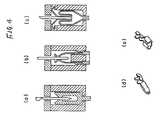
- terminals and connectors There have been various types of terminals and connectors, for example, those as shown in Figure 4.
- the component parts used for electric and electronic apparatus have also come to be reduced in size.
- the reduction in size of the component parts has been accompanied by a closer pitch of electrodes, an increase in the number of electrodes and, further, an increased current capacity, in designing the terminals and connectors.
- brass or phosphor bronze alloys have been used as materials for terminals and connectors.
- the brass or phosphor bronze alloys when used as a terminal or connector material, have the following drawbacks.
- the conductivity of brass is as low as 28% IACS, and that of phosphor bronze alloys is as low as 22% IACS. In addition, these materials are poor in heat resistance.
- terminals or connectors made of brass or a phosphor bronze alloy become unable to exhibit their intended function, because of a lowering in the fitting force at the joint portion in use. Such a lowering of fitting force is probably due to the vast quantity of Joule heat generated by an increased current flowing through the terminal or connector.
- the phosphor bronze alloys have the problem of poor resistance to migration.
- the migration here, is a phenomenon in which copper (Cu) ionized upon dew deposition or the like between electrodes is urged by the Coulomb force between the electrodes to deposit on the cathode, and crystals of the deposited metal grows in a dendritic form from the cathode, in the same manner as in electrodeposition, to eventually reach the anode, resulting in short-circuit.
- Cu copper
- Such a phenomenon arises from repeated dew deposition and drying.
- the migration has formerly known to occur on Ag, it has been known that the migration also occurs on phosphor bronze alloys, according to the above-mentioned closer electrode spacing or the like.
- brass has the problem of poor resistance to stress corrosion cracking, it has excellent migration resistance.
- a migration-resistant copper alloy for terminal and connector uses having excellent spring characteristics, strength and conductivity which contains 0.4 to 4.0% by weight of Ni, 0.1 to 1.0% by weight of Si, 1.0% (exclusive) to 5.0% (inclusive) by weight of Zn, 0.05 to 0.5% by weight of Mg, 0.1 to 0.5% by weight of Sn, and 0.001% (inclusive) to 0.01% (exclusive) by weight of at least one of Cr, Ti and Zr, the balance being Cu and unavoidable impurities.
- the alloy of this invention is excellent in spring limit, conductivity, softening resistance, migration resistance, relaxation properties, etc. as well as strength, and is therefore suitable for terminals and connectors.
- the aforementioned constituents are contained in the aforementioned respective amounts, the limits of which are set on the grounds as follows.
- Ni content of the alloy is less than 0.4% by weight, an improved strength cannot be expected even if the alloy contains Si in an amount of 0.1 to 1.0% by weight.
- the Ni content is more than 4.0% by weight, the workability of the copper alloy is worsened, and the strength of the alloy is little improved. Therefore, the Ni content is set in the range of 0.4 to 4.0% by weight.
- Si improves the strength of the copper alloy by forming a compound with Ni.
- Si content is less than 0.1% by weight, improvement of strength is not expectable even if the alloy contains 0.4 to 4.0% by weight of Ni.
- the Si content is set in the range from 0.1 to 1.0% by weight.
- Zinc (Zn) is an indispensable element for inhibition of peeling of solder and Sn platings and for improvement of migration resistance.
- the Zn content is not more than 1.0% by weight, the cooper alloy cannot have properties comparable to those of brass.
- an addition of more than 5.0% by weight of Zn leads to unfavorable results such as a lower conductivity and lower resistance to stress corrosion cracking, though the migration resistance of the alloy is improved. Therefore, the Zn content is set in the range from 1.0% (exclusive) to 5.0% (inclusive) by weight.
- Magnesium (Mg) is an indispensable element for improving the hot workability and strength, particularly spring limit, of the copper alloy.
- Mg Magnesium
- MgS which has a high melting point.
- magnesium fixes sulfur, thereby improving hot workability of the copper alloy and, further, enhancing the spring limit of the alloy.
- the Mg content exceeds 0.5% by weight, however, the improvement of spring limit is saturated and, rather, there results a lowering in the fluidity and casting qualities at the time of melting and casting the cooper alloy. Therefore, the Mg content is set in the range of 0.05 to 0.5% by weight.
- Tin (Sn) improves the strength and spring limit of the copper alloy, by dissolving in Cu.
- Sn content is set in the range of 0.1 to 0.5% by weight.
- Chromium (Cr), titanium (Ti) and zirconium (Zr) each function to strengthen the grain boundaries of an ingot of the copper alloy and to improve the hot workability of the alloy.
- the amount of these elements added is less than 0.001% by weight, the effect of the addition is slight, whereas an addition of more than 0.01% by weight of these elements leads to easier oxidation of the molten alloy, thereby making it impossible to obtain a sound ingot. Therefore, at least one of Cr, Ti and Zr is contained in an amount of 0.001% (inclusive) to 0.01% (exclusive) by weight.
- the copper alloy of this invention can be produced, for example, by the following process.
- An ingot of the alloy of this invention is made by the conventional semi-continuous casting method, and is hot worked at a temperature of 900 to 970°C.
- the hot working is followed by quenching from a temperature of not lower than 650°C, at a cooling rate of at least 15°C/sec.
- the temperature from which to quench the hot-worked alloy is lower than 600°C, both Ni and Si fail to dissolve in the Cu phase even if the cooling rate is 15°C/sec or above.
- the cooling rate is below 15°C/sec, both Ni and Si fail to dissolve in the Cu phase even if the alloy is quenched from a temperature of 650°C or above.
- the intended precipitation starts before a precipitation hardening treatment, and the precipitates are aggregated and coarsened, so that the contribution of the precipitates to strength of the alloy is reduced.
- the quenching temperature is 600°C or above, and the cooling rate is at least 15°C/sec.
- a precipitation hardening treatment is carried out.
- the temperature at which a maximum amount of Ni2Si is precipitated namely, the temperature which leads to a highest conductance is 500°C.
- the precipitation amount of the Ni2Si compound is small at temperatures below 400°C. Therefore, annealing for precipitation hardening is carried out a temperature of 400 to 550°C. When the annealing time is less than 5 minutes, satisfactory precipitation is not effected. On the other hand, an annealing for more than 4 hours is of no use, on an economical basis. Thus, the annealing is carried out for a period of 5 minutes to 4 hours.
- each ingot was faced about 2 mm, followed by heating to 950°C, hot working down to a 15 mm thickness, reheating to 700°C, and quenching in water.
- the cooling rate of the quenching was 30°C/sec.
- the specimens prepared as above were subjected to senile tests and to measurement of stress relaxation, spring characteristics, conductivity and softening resistance.
- Test pieces for tensile test and measurement of spring characteristics, stress relaxation and conductivity were made to have the longitudinal direction in the rolling direction.
- the tensile test was carried out by use of JIS No. 13B test pieces on a 2-ton universal testing machine. spring limit was tested according to JIS H3130.
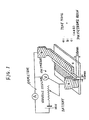
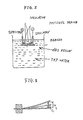
- Migration resistance was tested as follows. A pair of test pieces as shown in Figure 1, 0.64 mm x 3.0 mm x 80 mm, were prepared from each specimen. With a DC voltage of 14 V applied to the pair of test pieces, a drying-wetting test cycle consisting of 5-min immersion in tap water and 10-min drying was repeated 50 times, as shown in Figure 2, and the maximum leak current during the 50 test cycles was measured by a high-sensitivity recorder.
- the stress relaxation was determined by measuring the deformation (residual bend) of each test piece after the test piece was maintained at 150°C for 500 hours, with a stress of 80% based on the yield stress of the test piece being exerted thereon, in a cantilever condition, as shown in Figure 3.
- the stress relaxation was calculated according to the following formula:
- the alloys of this invention are superior in electrical conductivity and softening resistance to brass of No. 14 and phosphor bronze of No. 15, which are comparative alloys.
- the alloys of this invention are comparable to phosphor bronze as to strength and spiring limit, and are as high a brass in terms of migration resistance.
- the migration-resistant copper alloy for terminal and connector uses having excellent strength and conductivity according to this invention is capable of coping with the decreasing size of terminals and connectors, because of its excellent spring limit, electrical conductivity, softening resistance, migration resistance, etc., and ensures less deterioration in the function of the terminals and connectors due to lowered fitting forces at joint portions upon increases in current capacity.
- the alloy of this invention has a well-balanced combination of conductivity stress relaxation characteristics and migration resistance, as well as excellent spring limit, and is suitable for terminals and connectors.
- the alloy of this invention therefore, contributes greatly to electronic and electric machinery industries.
Landscapes
- Chemical & Material Sciences (AREA)
- Engineering & Computer Science (AREA)
- Materials Engineering (AREA)
- Mechanical Engineering (AREA)
- Metallurgy (AREA)
- Organic Chemistry (AREA)
- Conductive Materials (AREA)
Applications Claiming Priority (2)
| Application Number | Priority Date | Filing Date | Title |
|---|---|---|---|
| JP19719/90 | 1990-01-30 | ||
| JP2019719A JP2977845B2 (ja) | 1990-01-30 | 1990-01-30 | ばね特性、強度及び導電性に優れた耐マイグレーション性端子・コネクタ用銅合金 |
Publications (2)
| Publication Number | Publication Date |
|---|---|
| EP0440548A2 true EP0440548A2 (de) | 1991-08-07 |
| EP0440548A3 EP0440548A3 (en) | 1993-12-08 |
Family
ID=12007112
Family Applications (1)
| Application Number | Title | Priority Date | Filing Date |
|---|---|---|---|
| EP19910400200 Withdrawn EP0440548A3 (en) | 1990-01-30 | 1991-01-29 | Migration-resistant copper alloy for terminal and connector uses having excellent spring characteristics, strength and conductivity |
Country Status (2)
| Country | Link |
|---|---|
| EP (1) | EP0440548A3 (de) |
| JP (1) | JP2977845B2 (de) |
Cited By (8)
| Publication number | Priority date | Publication date | Assignee | Title |
|---|---|---|---|---|
| EP0660444A1 (de) * | 1993-12-22 | 1995-06-28 | CMC Carl Maier + Cie AG | Niederspannungsverteiler |
| KR19990045261A (ko) * | 1997-11-22 | 1999-06-25 | 쉬바르쯔 만프레드 | 전기 전도성 금속 밴드 및 그로 제조된 플러그 커넥터 |
| EP1158618A3 (de) * | 2000-05-20 | 2002-03-20 | STOLBERGER METALLWERKE GMBH & CO. KG | Elektrisch leitfähiges Metallband und Steckverbinder hieraus |
| EP1325964A4 (de) * | 2000-07-25 | 2003-07-30 | Furukawa Electric Co Ltd | Material aus kupferlegierung für elektronik oder elektronische bauteile |
| US6893514B2 (en) | 2000-12-15 | 2005-05-17 | The Furukawa Electric Co., Ltd. | High-mechanical strength copper alloy |
| GB2405752B (en) * | 2002-05-29 | 2006-03-22 | Textron Fastening Systems | Contact pin |
| US7090732B2 (en) | 2000-12-15 | 2006-08-15 | The Furukawa Electric, Co., Ltd. | High-mechanical strength copper alloy |
| US8361255B2 (en) | 2005-09-02 | 2013-01-29 | Hitachi Cable, Ltd. | Copper alloy material and method of making same |
Families Citing this family (2)
| Publication number | Priority date | Publication date | Assignee | Title |
|---|---|---|---|---|
| JP2780584B2 (ja) * | 1992-11-13 | 1998-07-30 | 三菱伸銅株式会社 | 熱間加工性および打抜き加工性に優れた電気電子部品用Cu合金 |
| JP5342315B2 (ja) * | 2009-04-24 | 2013-11-13 | パナソニック株式会社 | 信号用電気接続端子装置及びその製造方法 |
Family Cites Families (7)
| Publication number | Priority date | Publication date | Assignee | Title |
|---|---|---|---|---|
| CA1085654A (en) * | 1976-01-19 | 1980-09-16 | Ronald N. Caron | Electrical contact |
| US4656003A (en) * | 1984-10-20 | 1987-04-07 | Kabushiki Kaisha Kobe Seiko Sho | Copper alloy and production of the same |
| JPS62199741A (ja) * | 1986-02-25 | 1987-09-03 | Kobe Steel Ltd | 耐マイグレ−シヨン性に優れた端子・コネクタ−用銅合金。 |
| JPS648237A (ja) * | 1987-06-29 | 1989-01-12 | 三菱電機株式会社 | 端子、コネクタ−用銅合金 |
| JPH01172539A (ja) * | 1987-12-26 | 1989-07-07 | Mitsubishi Electric Corp | 電子機器用銅合金 |
| JPH01242740A (ja) * | 1988-03-23 | 1989-09-27 | Mitsubishi Electric Corp | 電子機器用銅合金 |
| JPH0776397B2 (ja) * | 1989-07-25 | 1995-08-16 | 三菱伸銅株式会社 | Cu合金製電気機器用コネクタ |
-
1990
- 1990-01-30 JP JP2019719A patent/JP2977845B2/ja not_active Expired - Fee Related
-
1991
- 1991-01-29 EP EP19910400200 patent/EP0440548A3/en not_active Withdrawn
Cited By (10)
| Publication number | Priority date | Publication date | Assignee | Title |
|---|---|---|---|---|
| EP0660444A1 (de) * | 1993-12-22 | 1995-06-28 | CMC Carl Maier + Cie AG | Niederspannungsverteiler |
| KR19990045261A (ko) * | 1997-11-22 | 1999-06-25 | 쉬바르쯔 만프레드 | 전기 전도성 금속 밴드 및 그로 제조된 플러그 커넥터 |
| EP1158618A3 (de) * | 2000-05-20 | 2002-03-20 | STOLBERGER METALLWERKE GMBH & CO. KG | Elektrisch leitfähiges Metallband und Steckverbinder hieraus |
| EP1325964A4 (de) * | 2000-07-25 | 2003-07-30 | Furukawa Electric Co Ltd | Material aus kupferlegierung für elektronik oder elektronische bauteile |
| US7172662B2 (en) | 2000-07-25 | 2007-02-06 | The Furukawa Electric Co., Ltd. | Copper alloy material for parts of electronic and electric machinery and tools |
| US6893514B2 (en) | 2000-12-15 | 2005-05-17 | The Furukawa Electric Co., Ltd. | High-mechanical strength copper alloy |
| DE10147968B4 (de) * | 2000-12-15 | 2005-08-18 | Furukawa Electric Co., Ltd., | Kupferlegierung von hoher mechanischer Festigkeit |
| US7090732B2 (en) | 2000-12-15 | 2006-08-15 | The Furukawa Electric, Co., Ltd. | High-mechanical strength copper alloy |
| GB2405752B (en) * | 2002-05-29 | 2006-03-22 | Textron Fastening Systems | Contact pin |
| US8361255B2 (en) | 2005-09-02 | 2013-01-29 | Hitachi Cable, Ltd. | Copper alloy material and method of making same |
Also Published As
| Publication number | Publication date |
|---|---|
| EP0440548A3 (en) | 1993-12-08 |
| JP2977845B2 (ja) | 1999-11-15 |
| JPH03226536A (ja) | 1991-10-07 |
Similar Documents
| Publication | Publication Date | Title |
|---|---|---|
| JP4068626B2 (ja) | 電子材料用Cu−Ni−Si−Co−Cr系銅合金及びその製造方法 | |
| JP3739214B2 (ja) | 電子部品用銅合金板 | |
| KR890004537B1 (ko) | 석출경화성 Cu합금 및 그 처리방법 | |
| JPH0776397B2 (ja) | Cu合金製電気機器用コネクタ | |
| EP0189637B1 (de) | Kupferlegierung und deren Herstellung | |
| US4046596A (en) | Process for producing spectacle frames using an age-hardenable nickel-bronze alloy | |
| US20030047259A1 (en) | Copper alloy with excellent stress relaxation resistance property and production method therefor | |
| CN1287392C (zh) | 表面特性优良的电子材料用的铜合金及其制法 | |
| JP2977845B2 (ja) | ばね特性、強度及び導電性に優れた耐マイグレーション性端子・コネクタ用銅合金 | |
| JP7537643B2 (ja) | 銅合金材および銅合金材の製造方法 | |
| JP3904118B2 (ja) | 電気、電子部品用銅合金とその製造方法 | |
| JP3413864B2 (ja) | Cu合金製電気電子機器用コネクタ | |
| JPS61272339A (ja) | 繰返し曲げ性に優れた電子部品用リ−ド材およびその製造法 | |
| JP2007126739A (ja) | 電子材料用銅合金 | |
| JP2007051370A (ja) | Snめっきの耐熱剥離性に優れるCu−Zn−Sn系合金条及びそのSnめっき条 | |
| JPH06212374A (ja) | 強度及び曲げ加工性が優れた銅合金材の製造方法 | |
| JP2514234B2 (ja) | 強度と導電性に優れる端子・コネクタ―用銅合金 | |
| JPH02149626A (ja) | 強度、導電性および耐マイグレーション性に優れた端子・コネクター用銅合金 | |
| JP7630327B2 (ja) | 電気・電子部品用材料及び電気・電子部品用材料の製造方法 | |
| JPH0310035A (ja) | 電気・電子部品用銅合金 | |
| JPH01222031A (ja) | 耐マイグレーション性に優れた電気接続具用銅合金 | |
| JP2514234C (de) | ||
| JPH03100132A (ja) | 電気・電子部品用銅合金 | |
| JPS6086230A (ja) | 高力導電銅合金 | |
| JPH05311289A (ja) | 導電性ばね用銅合金 |
Legal Events
| Date | Code | Title | Description |
|---|---|---|---|
| PUAI | Public reference made under article 153(3) epc to a published international application that has entered the european phase |
Free format text: ORIGINAL CODE: 0009012 |
|
| AK | Designated contracting states |
Kind code of ref document: A2 Designated state(s): FR GB NL |
|
| PUAL | Search report despatched |
Free format text: ORIGINAL CODE: 0009013 |
|
| AK | Designated contracting states |
Kind code of ref document: A3 Designated state(s): FR GB NL |
|
| STAA | Information on the status of an ep patent application or granted ep patent |
Free format text: STATUS: THE APPLICATION IS DEEMED TO BE WITHDRAWN |
|
| 18D | Application deemed to be withdrawn |
Effective date: 19940609 |