EP0441941B1 - Verfahren und gerät zur schätzung und hierarchischen kodierung von bewegung in bildfolgen - Google Patents
Verfahren und gerät zur schätzung und hierarchischen kodierung von bewegung in bildfolgen Download PDFInfo
- Publication number
- EP0441941B1 EP0441941B1 EP90913705A EP90913705A EP0441941B1 EP 0441941 B1 EP0441941 B1 EP 0441941B1 EP 90913705 A EP90913705 A EP 90913705A EP 90913705 A EP90913705 A EP 90913705A EP 0441941 B1 EP0441941 B1 EP 0441941B1
- Authority
- EP
- European Patent Office
- Prior art keywords
- motion
- level
- blocks
- field
- block
- Prior art date
- Legal status (The legal status is an assumption and is not a legal conclusion. Google has not performed a legal analysis and makes no representation as to the accuracy of the status listed.)
- Expired - Lifetime
Links
Images



Classifications
-
- G—PHYSICS
- G06—COMPUTING OR CALCULATING; COUNTING
- G06T—IMAGE DATA PROCESSING OR GENERATION, IN GENERAL
- G06T9/00—Image coding
- G06T9/40—Tree coding, e.g. quadtree, octree
-
- G—PHYSICS
- G06—COMPUTING OR CALCULATING; COUNTING
- G06T—IMAGE DATA PROCESSING OR GENERATION, IN GENERAL
- G06T7/00—Image analysis
- G06T7/20—Analysis of motion
- G06T7/223—Analysis of motion using block-matching
- G06T7/238—Analysis of motion using block-matching using non-full search, e.g. three-step search
-
- H—ELECTRICITY
- H04—ELECTRIC COMMUNICATION TECHNIQUE
- H04N—PICTORIAL COMMUNICATION, e.g. TELEVISION
- H04N19/00—Methods or arrangements for coding, decoding, compressing or decompressing digital video signals
- H04N19/50—Methods or arrangements for coding, decoding, compressing or decompressing digital video signals using predictive coding
- H04N19/503—Methods or arrangements for coding, decoding, compressing or decompressing digital video signals using predictive coding involving temporal prediction
- H04N19/51—Motion estimation or motion compensation
- H04N19/53—Multi-resolution motion estimation; Hierarchical motion estimation
-
- H—ELECTRICITY
- H04—ELECTRIC COMMUNICATION TECHNIQUE
- H04N—PICTORIAL COMMUNICATION, e.g. TELEVISION
- H04N19/00—Methods or arrangements for coding, decoding, compressing or decompressing digital video signals
- H04N19/90—Methods or arrangements for coding, decoding, compressing or decompressing digital video signals using coding techniques not provided for in groups H04N19/10-H04N19/85, e.g. fractals
- H04N19/96—Tree coding, e.g. quad-tree coding
Definitions
- the invention relates to the field of image processing, and more particularly to motion estimation used in image transmission chains, in particular with a view to reducing the bit rate of information, and relates to a method and the corresponding device, hierarchical estimation and coding and movement of image sequences.
- Such hierarchical estimation and coding methods are well known to those skilled in the art (see in particular patent EP-A-293,644).
- Motion estimation therefore becomes an important function in the image transmission chain, particularly in high definition.
- each piece of equipment in the transmission chain has its own motion estimator. It therefore seems very interesting to provide a single motion estimator, in the production studio, which is capable of powering each item of equipment in the high definition television channel. But since each piece of equipment does not require the same characteristics for the movement information, the single movement estimator must have several possible outputs, or be configurable.
- the subject of the invention is a method and the corresponding device for estimating and coding movement, developed to allow coding of image sequences in a simple manner, this movement information being exactly suited to coding of the "quadtree" type. "to which, moreover, flow control is easily applicable.
- This algorithm supposes that all the elements of elementary images or "pixels" of the same block have the same displacement.
- This algorithm is recursive, and uses the motion field calculated in the previous iteration for the next iteration from the Taylor expansion of an amount which is the sum over one block of the differences in luminance of the pixels of two blocks of two consecutive frames corresponding to each other by the displacement estimated in the previous iteration.
- the algorithm used according to the invention is derived from this spatio-temporal algorithm to allow a so-called "symmetrical" motion estimation. Indeed, as indicated above, the formulas recalled lead to the estimation of the movement of the blocks of the current frame at iteration i from the movements estimated for the same blocks at iteration i-1 and by calculating the differences in luminance between the current block and the corresponding block after displacement in the previous frame.
- a "symmetrical" motion estimation uses, for the estimation of the motion in a current frame at iteration i, the preceding frame, the current frame and the following frame.
- the gradients are calculated in the preceding and following frames and the displacement vector at iteration i is then calculated from the displacement vector of the current block estimated at the previous iteration i-1 by the following equations (which take account of the differences of luminance between the pixels of the current block and the pixels of the corresponding blocks, displaced by this vector estimated previously, on the one hand in the previous frame and on the other hand in the following frame):
- D x i D x i-1 - ⁇ DFD zD i-1 , t-1 sg grad x zD i-1 , t-1 -DFD z + D i-1 , t + 1 sg grad x z + D i-1 , t + 1 ⁇ grad x zD i-1 , t-1 + grad x z + D
- the components of the vectors can be non-integer components and an interpolation is necessary to calculate the displaced inter-frame difference, DFD, and the gradients. For this, the four image elements closest to the current image element z are used.
- FIG. 2 shows the position of the blocks moved in the previous frame and in the next frame, corresponding to a current block for which the displacement vector estimated at the previous iteration is D i-1 from the previous frame to the current frame and therefore -D i-1 from the next frame to the current frame if we assume symmetrical displacements.
- a detail of the neighborhood of zD i-1 shows that, in general, the displacement vector leads to a displaced pixel zD i-1 (or z + D i-1 ) having a position which does not correspond to integer values of x and y . Consequently, the luminance values of the four points in the vicinity of zD i-1 (or z + D i-1 ), I1, I2, I3 and I4 are taken into account for the luminance calculations of the displaced pixels and for the calculation of the gradients.
- the interpolation of luminance I is bilinear, that is to say that it is a weighted sum of I1, I2, I3 and I4.
- I (zD i-1 ) (i- ⁇ ) (1- ⁇ ) I 1 + ⁇ (1- ⁇ ) I 2 + (1- ⁇ ) ⁇ I 3 + ⁇ I 4
- I (zD i-1 ) will be noted I (t-1) and I (z + D i + 1 ) will be noted I (t + 1) and similarly grad X (zD i -1 , t-1) will be denoted grad X (t-1), grad X (z + D i-1 , t + 1) will be denoted grad X (t + 1), the components according to y being denoted by the same way, and the displaced interframe differences being noted DFD (t-1) and DFD (t + 1).
- the motion estimation algorithm assumes that a constant translation occurs for all the pixels included within a measurement window.
- An ideal solution would be to have a window of variable size depending on the size of the image areas considered: large windows could be used for global displacements, of the panoramic type. or tilting for example, while small windows would be used for elements of smaller objects.
- Such a hierarchical structure is interesting because it makes it possible to refine the motion estimation where the motion information has the greatest density.
- the field of motion vectors resulting from a motion estimation according to one of the known algorithms is formed of zones with constant displacement having any different sizes, only related to the content of the image.
- a classic hierarchical type motion estimation as described above generates motion fields therefore corresponding to blocks of any size and the problem is then to combine these different motion information in order to obtain for each frame a field of movement associated with blocks of sizes as large as possible, corresponding to areas with constant movement.
- this approach is close to that used for the construction of a coding tree in particular for coding by quadrant or "quadtree” as described in an article by CA SHAFFER and H. SAMET entitled "Optimal quadtree construction algorithm” in -Computer vision graphics and image processing, vol. 37, 402-419 from 1987-.
- the hierarchical motion estimation method is used to increase the convergence of the recursive motion estimation algorithm, but it is adapted to the decomposition into quadrants so as to obtain the estimate simultaneously. motion and the corresponding coding of this motion information, optimally.
- the blocks of one level are the result of sharing a block of the immediately higher level in four as shown in Figure 3 which illustrates the different sizes of blocks resulting from the partition.
- recursion is obtained by using the field of movement obtained at a given level of the hierarchy to calculate the field of movement of the level immediately below; thus for calculations inside a given level, the motion estimate for a block is independent of that of the other blocks of the neighborhood at the same level.
- the maximum size of the blocks of picture elements recognized for coding being 128 ⁇ 128 pixels and the minimum size being 8 ⁇ 8 by successive partitions of each block in 4 quadrants, the a priori calculation of the displacement vectors is carried out according to the invention first for blocks of 128,128 pixels (level 1), then of 64.64 (level 2) then of 32.32 (level 3), then 16.16 (level 4) and finally 8.8 pixels (level 5), regardless of the content of the image.
- the four initial values for the largest blocks, at the first level (128.128) are zero or arbitrary for the first image of the sequence, then equal to the motion vectors of the blocks 64.64 (resulting from the partition into 4 of blocks 128.128) of the previous image of the sequence, for the following images. Then the four initial values collected for a block of size nn come from the previous level, therefore at a block size 2n.2n. These values are the displacements estimated for the four nearest blocks of larger size, as represented in FIGS.
- a first step of calculation by point gives the values of the displaced interframe differences and of the gradients from the luminance values coming from the memories and the initial displacement vectors, relative to the previous image t-1, and relative to the image next to t + 1.
- the next step then consists in calculating the components of the displacement vector according to the iterative formulas given above, D i x and D i y after calculating the partial sums of the differences such as CA and DB over the whole of the corresponding block of level n.
- the four initial values for each current block make it possible to initialize four separate motion estimates for this block (only one has been represented) and give when the iterative formulas of the algorithm converged four values of updated motion vectors, independent, which supplement the values of the vectors of the previous levels.
- the squares of the intermediate DFD interframe differences used for the updates are calculated, stored in memory and added for the whole block, so as to choose for each block at the end of the 4 calculations, the "best" displacement among the four new updated displacement vectors, that is to say the one for which the sum S of the interframe differences squared for this block is minimal. This best vector then constitutes one of the vectors of the motion field calculated at level n.
- the displacement vector correct of each zone can be found among the five motion fields available for block sizes varying between 128.128 and 8.8.
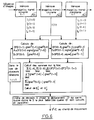
- the problem is to find the criterion which makes it possible to determine the final field of movement, stage 6 figure 4, starting from the five fields of movement thus calculated, with blocks of sizes as large as possible, to decrease the flow coding when coding performed next.
- a sum value of the interframe differences displaced squared SURS is stored for each block, as well as the corresponding displacement vector, with 2 components, DV128; at level 2, each macroblock having been divided into 4 blocks of 64.64 pixels, 4 values of sums of differences displaced in the square S64 and four displacement vectors corresponding to two components DV64 are stored for each of the macroblocks; etc ...; at level 5, a macroblock having been divided into 256 blocks of 8.8.
- a sum value of differences displaced squared, S8 and a displacement vector DV8 with 2 components corresponding to each of the elementary blocks are stored in memory, that is to say 256 values of S8 and 256 vectors DV8 with two components for a macroblock.
- the last step then implemented is the step of "quadtree" coding, 7, and of regulation of the bit rate 8 (if necessary), as shown in FIG. 4.
- Knowledge of the information decreases the execution time of the construction. of the coding tree which can thus be less costly if the motion vectors of elementary blocks are known.
- the regulation of the coding rate of the movement information can be easily done.
- a histogram of the displacement vector field resulting from the previous step is established.
- the displacement vectors corresponding to peaks in the histogram greater than a given threshold (this threshold corresponding to an estimate movement considered correct) are selected. These vectors are transmitted for each frame and their number determines the number of bits necessary for a code word to be assigned to each of them.
- the "quadtree" coding is performed on the basis of the 128 ⁇ 128 macroblocks, and a tree characterizes the decomposition of each of these macroblocks as it results from the corresponding final motion field.
- a node can be a root or a leaf.
- a special code word indicates a root, and a leaf corresponds to a displacement vector.
- the coding speed for a tree is equal to the number of nodes multiplied by the number of bits of the code words: for a high definition image made up of 1152 lines each having 1440 image elements or pixels, 108 macroblocks make it possible to cover the whole picture.
- a procedure for regulating the coding rate can be easily carried out by eliminating the least probable motion vectors or in a more brutal manner by stopping the division of the blocks at the minimum dimension 16 ⁇ 16 for example.
- French patent application n ° 89 08547 in the name of the Applicant describes in more detail a procedure for analyzing the field of movement and allocating corresponding codes from the coding trees corresponding to the decomposition into quadrants and the corresponding regulation when the required bit rate is exceeded, also applicable to the coding and the regulation of the motion field as it results from the estimation method described above.
- results obtained by following such a hierarchical motion estimation method associated with a coding technique "quadtree" were evaluated for television signals resulting from an interlaced analysis. Motion estimation is performed for each even frame, and this motion information is encoded and transmitted for odd frames. On reception, after the decoding of the motion information, the odd frames are interpolated from the even frames and the motion information.
- the processing of a block is independent of that of the other blocks and only the displacement vectors of the neighborhood defined at the previous level are used as initial values.
- the decomposition into trees of the motion field can be constructed quickly because it uses an already existing structure at the end of the motion estimation.
- This motion estimation process can be configured as required to be adapted to the different functions of the transmission chain. Indeed, the size of the minimum dimension block and the maximum flow rate are variable parameters.
- the possibility of obtaining a displacement vector for each pixel, that is to say a point motion vector field, has even been tested. For this we assume that all the motion vectors of the real motion field of the image belong to the final motion field resulting from the estimator after a priori determination of the motion fields of the different levels, that is to say that the estimation is not carried out at a finer level than that of the blocks 8.8. Then, for each pixel, the vector which leads to the lowest interframe difference is selected in this movement field. This vector is then an element of the point motion field.
- the estimation device within the reach of those skilled in the art, is not shown since it mainly comprises image memories of the sequence, calculation means and storage memories for intermediate results and for final results. It should however be noted that the implementation of the motion estimation method according to the invention is facilitated by the fact that the calculations, for the different macroblocks of a frame (typically 108), then at each intermediate level, can be performed in parallel since, as indicated above, the calculations for a block at a given level only use the values already calculated at the previous level. Likewise, in a given level, the four separate estimates carried out for each of the blocks from four different initial values can be carried out in parallel since they are independent. The parallelization of the estimation device can therefore be significant provided that the calculation means allow it.
- the motion estimator can feed each piece of equipment in the studio that requires motion information or coded motion information.
Landscapes
- Engineering & Computer Science (AREA)
- Multimedia (AREA)
- Signal Processing (AREA)
- Physics & Mathematics (AREA)
- General Physics & Mathematics (AREA)
- Theoretical Computer Science (AREA)
- Computer Vision & Pattern Recognition (AREA)
- Compression Or Coding Systems Of Tv Signals (AREA)
- Compression, Expansion, Code Conversion, And Decoders (AREA)
- Image Processing (AREA)
Claims (12)
- Verfahren zur Schätzung und hierarchische. Codierung der Bewegung von Halbbildfolgen mit folgenden Schritten:- auf einer ersten Teilungsebene, dem Zerlegen des aktuellen Bildes in Makroblöcke mit 2p+1.2p+1 Pixeln und dem Bestimmen eines ersten Feldes von Bewegungsvektoren, wobei jeder Bewegungsvektor einem Makroblock zugeordnet ist, durch Verwendung eines iterativen und rekursiven Schätzungsalgorithmus, der von für das vorhergehende Bild geschätzten Bewegungsvektoren initialisiert wird,- danach, auf einer zweiten Teilungsebene, dem Zerlegen jedes der Makroblöcke in Quadranten und dem Bestimmen für die sich daraus ergebenden Blöcke eines zweiten Bewegungsvektorfeldes durch Verwendung desselben Schätzungsalgorithmus, der jedoch von dem auf der vorhergehenden Ebene geschätzten Feld von Bewegungsvektoren initialisiert wird,- danach, auf einer i-ten Teilungsebene, i = 3 bis p, dem Zerlegen jedes der auf Ebene i-1 in Betracht gezogenen Blöcke in Quadranten und dem Bestimmen für die sich daraus ergebenden Blöcke eines i-ten Feldes von Bewegungsvektoren unter Verwendung desselben Schätzungsalgorithmus, initialisiert durch das auf der vorhergehenden Ebene geschätzte Feld von Bewegungsvektoren, wobei die Blöcke mit Mindestgröße Blöcke mit 2¹⁺¹.2¹⁺¹ Pixeln sind, gekennzeichnet durch das Bestimmen eines Bewegungsvektorendfeldes aus den sich ergebenden p Bewegungsvektorfeldern durch Wählen des dem Block der Ebene mit der größten Blockgröße zugeordneten Bewegungsvektors (DV₁₂₈, DV₆₄, DV₃₂, DV₁₆, und DV₈), für welchen Block die Summe (S₁₂₈, S₆₄, S₃₂,..., S₈,) der kleiner als die Gesamtsumme der Zwischenbildluminanzdifferenzen über alle Blöcke jeder Teilungsebene im besagten Block Zwischenbildluminanzdifferenzen ist.
- Verfahren nach Anspruch 1, dadurch gekennzeichnet, daß der benutzte Bewegungsschätzungsalgorithmus symmetrisch ist und für die Bestimmung eines Bewegungsvektors auf einem Iterationsrang i den bei der Iteration i-l bestimmten Bewegungsvektor abzüglich von Größen als Funktion von verschobenen zwischenbildluminanzdifferenzen benutzt, d.h. der Summen der Luminanzdifferenzen zwischen den Pixeln des aktuellen Blocks und den Pixeln der Blöcke, die dem aktuellen Block verschoben um den Bewegungsvektor im vorhergehenden Halbbild bzw. im nachfolgenden Halbbild der Folge entsprechen.
- Verfahren nach einem der Ansprüche 1 und 2, dadurch gekennzeichnet, daß für jeden Block der Bewegungsschätzungsalgorithmus viermal angelegt wird, initialisiert durch vier Bewegungsvektoren, die jeweils verbunden sind mit- im ersten Schritt, den vier Blöcken einer unteren Ebene, die jeden Makroblock bilden, entnommen dem Bewegungsfeld der zweiten Ebene des vorhergehenden Bildes,- in den folgenden Schritten, vier Blöcken der vorhergehenden Ebene, die einer Umgebung des aktuellen Blocks zugehören, im selben Bild,- und dadurch, daß der unter den vier resultierenden Vektoren ausgewählte Vektor zum Bilden des entsprechenden Bewegungsfeldvektors derjenige ist, der der Minimierung des Wahlkriteriums entspricht, nämlich derjenige, der die geringste Differenz an verschobenen Zwischenbildluminanzen ergibt.
- Verfahren nach Anspruch 3, dadurch gekennzeichnet, daß die vier Bewegungsvektoren zur Initialisierung der Blöcke der vorhergehenden Ebene, die als Anfangswerte für die Schätzung eines aktuellen Blocks benutzt werden, den Vektor, der mit dem Block der vorangehenden Ebene, von der er kommt, verbunden ist und die drei Vektoren, die mit den mit diesem aktuellen Block zusammenhängenden Blöcken der vorangehenden Ebene verbunden sind, darstellen.
- Verfahren nach einem der Ansprüche 1 bis 4, dadurch gekennzeichnet, daß das hierarchische Bewegungsendfeld unmittelbar mit einem Codierbaum der "quadtree" - Art verbunden ist, entsprechend der Hierarchie der Blöcke und der entsprechenden Bewegungsvektoren der verschiedenen Ebenen, die für das Bewegungsendfeld ausgewählt worden sind, und daß durch Auswahl des an den erforderlichen Durchsatz angepaßten Bewegungsendfeldes eine Regelung des resultierenden Codierungsdurchsatzes ausgeführt wird.
- Verfahren nach Anspruch 5, dadurch gekennzeichnet, daß die Regelung dann durchgeführt wird, wenn der erforderliche Durchsatz überschritten ist, indem die seltensten Vektoren vom Bewegungsvektorendfeld eliminiert werden und durch die nahesten und häufigsten Vektoren ersetzt werden.
- Verfahren nach Anspruch 5, dadurch gekennzeichnet, daß die Regelung dann ausgeführt wird, wenn der erforderliche Durchsatz überschritten ist, indem die Vektoren des Bewegungsfeldes, die mit den Blöcken mit Mindestgröße verbunden sind, aus der Auswahl des Bewegungsendfeldes entfernt werden.
- Verfahren nach Anspruch 1, dadurch gekennzeichnet, daß die auf einer gegebenen Ebene eingesetzten iterativen Berechnungen parallel zueinander ausgeführt werden, wobei die Berechnungen einer gegebenen Ebene ihre Initialisierungswerte einer vorangehenden Ebene entnehmen.
- Verfahren nach einem der Ansprüche 3 und 4, dadurch gekennzeichnet, daß die vier Berechnungen der Bewegungsvektoren, die für jeden Block ausgeführt werden, parallel zueinander ausgeführt werden, wobei diese Berechnungen ihre Initialisierungswerte einer vorangehenden Ebene entnehmen.
- Verfahren nach Anspruch 1, dadurch gekennzeichnet, daß p gleich 5 und 1 gleich 2 ist, wobei die Makroblöcke Blöcke mit 128.128 Pixeln sind und die Blöcke mit Mindestgröße Blöcke mit 8.8 Pixeln sind, wobei das Schätzungsverfahren hierarchisch in 5 Ebenen gegliedert ist.
- Verfahren nach Anspruch 1, dadurch gekennzeichnet, daß ein Punktbewegungsfeld aus dem Bewegungsendfeld hergestellt wird, indem jedem Pixel der Bewegungsvektor des Endfeldes zugeordnet wird, für den eine Zwischenbildluminanzdifferenz zwischen diesem Pixel und dem um den entsprechenden Bewegungsvektor verschobenen Pixel im vorangehenden Halbbild minimiert ist.
- Vorrichtung zur Schätzung und hierarchischen Codierung der Bewegung von Halbbildfolgen mit folgenden:- Mittel zum Zerlegen, auf einer ersten Teilungsebene, des aktuellen Bildes in Makroblöcke mit 2p+1.2p+1 Pixeln und zum Bestimmen eines ersten Feldes von Bewegungsvektoren, wobei jeder Bewegungsvektor einem Makroblock zugeordnet ist, durch Verwendung eines iterativen und rekursiven Schätzungsalgorithmus, der von für das vorhergehende Bild geschätzten Bewegungsvektoren initialisert wird,- Mittel zum Zerlegen, auf einer zweiten Teilungsebene, jedes der Makroblöcke in Quadranten und zum Bestimmen für die sich daraus ergebenden Blöcke eines zweiten Bewegungsvektorfeldes durch Verwendung desselben Schätzungsalgorithmus, der jedoch von dem auf der vorhergehenden Ebene geschätzten Bewegungsvektorfeld initialisiert wird,- Mittel zum Zerlegen, auf einer i-ten Teilungsebene, i = 3 bis p, jedes der auf Ebene i-1 in Betracht gezogenen Blöcke in Quadranten und zum Bestimmen für die sich daraus ergebenden Blöcke eines i-ten Bewegungsvektorfeldes unter Verwendung desselben Schätzungsalgorithmus, intialisiert von dem auf der vorhergehenden Ebene geschätzten Bewegungsvektorfeld, wobei die Blöcke mit Mindestgröße Blöcke mit 2¹⁺¹.2¹⁺¹ Pixeln sind, dadurch gekennzeichnet, daß sie folgendes umfaßt:- Mittel zum Bestimmen eines Bewegungsvektorendfeldes aus den sich ergebenden p Bewegungsvektorfeldern durch Wählen des dem Block der Ebene mit der größten Blockgröße zugeordneten Bewegungsvektors (DV₁₂₈, DV₆₄, DV₃₂, DV₁₆ und DV₈), für welchen Block die Summe (S₁₂₈, S₆₄, S₃₂,..., S₈,) der Zwischenbildluminanzdifferenzen kleiner als die Gesamtsumme der über alle Blöcke jeder Teilungsebene im besagten Block realisierten Zwischenbildluminanzdifferenzen ist, und daß sie einen Bildspeicher, Rechenmittel und Arbeitsspeicher umfaßt, wobei die Rechenmittel zur parallelen Ausführung der iterativen Berechnungen, die auf einer gegebenen Ebene eingesetzt werden, vorgesehen sind, wobei die Berechnungen auf einer gegebenen Ebene ihre Initialisierungswerte einer vorhergehenden Ebene entnehmen.
Applications Claiming Priority (3)
| Application Number | Priority Date | Filing Date | Title |
|---|---|---|---|
| FR8911328A FR2651399B1 (fr) | 1989-08-29 | 1989-08-29 | Procede et dispositif d'estimation et de codage hierarchise du mouvement de sequences d'images. |
| FR8911328 | 1989-08-29 | ||
| PCT/FR1990/000628 WO1991003797A1 (fr) | 1989-08-29 | 1990-08-24 | Procede et dispositif d'estimation et de codage hierarchise du mouvement de sequences d'images |
Publications (2)
| Publication Number | Publication Date |
|---|---|
| EP0441941A1 EP0441941A1 (de) | 1991-08-21 |
| EP0441941B1 true EP0441941B1 (de) | 1996-02-14 |
Family
ID=9384960
Family Applications (1)
| Application Number | Title | Priority Date | Filing Date |
|---|---|---|---|
| EP90913705A Expired - Lifetime EP0441941B1 (de) | 1989-08-29 | 1990-08-24 | Verfahren und gerät zur schätzung und hierarchischen kodierung von bewegung in bildfolgen |
Country Status (9)
| Country | Link |
|---|---|
| US (1) | US5351095A (de) |
| EP (1) | EP0441941B1 (de) |
| JP (1) | JP2968838B2 (de) |
| KR (1) | KR920701916A (de) |
| AT (1) | ATE134274T1 (de) |
| DE (1) | DE69025392T2 (de) |
| ES (1) | ES2084035T3 (de) |
| FR (1) | FR2651399B1 (de) |
| WO (1) | WO1991003797A1 (de) |
Families Citing this family (76)
| Publication number | Priority date | Publication date | Assignee | Title |
|---|---|---|---|---|
| SE469866B (sv) * | 1991-04-12 | 1993-09-27 | Dv Sweden Ab | Metod för estimering av rörelseinnehåll i videosignaler |
| FR2684258B1 (fr) * | 1991-11-27 | 1998-06-05 | Thomson Consumer Electronics | Procede d'estimation et de codage hierarchise du mouvement de sequences d'images. |
| US5309237A (en) * | 1992-03-31 | 1994-05-03 | Siemens Corporate Research, Inc. | Apparatus and method of compensating image-sequences for motion |
| FR2700037B1 (fr) * | 1992-12-24 | 1995-01-27 | Thomson Csf | Dispositif d'estimation hiérarchique du mouvement de séquence d'images. |
| WO1994018799A1 (en) * | 1993-02-03 | 1994-08-18 | Qualcomm Incorporated | Interframe video encoding and decoding system |
| KR960015395B1 (ko) * | 1993-04-09 | 1996-11-11 | 대우전자 주식회사 | 움직임벡터 검출장치 |
| US5537529A (en) * | 1993-04-22 | 1996-07-16 | Apple Computer, Inc. | Apparatus and method for creating versions of computer models and creating communications incorporating created versions therefrom |
| US5585852A (en) * | 1993-06-16 | 1996-12-17 | Intel Corporation | Processing video signals for scalable video playback using independently encoded component-plane bands |
| JPH0799658A (ja) * | 1993-08-03 | 1995-04-11 | Sony Corp | 動きベクトル検出装置 |
| EP0667716B1 (de) * | 1993-08-30 | 1999-11-24 | Sony Corporation | Vorrichtung und verfahren zur kodierung von bildern |
| JPH07135663A (ja) * | 1993-09-17 | 1995-05-23 | Oki Electric Ind Co Ltd | 動きベクトル検出方法および動きベクトル検出装置 |
| KR950024600A (ko) * | 1994-01-31 | 1995-08-21 | 김광호 | 휘도신호적응 움직임 평가방법 |
| JP3846642B2 (ja) * | 1994-01-31 | 2006-11-15 | ソニー株式会社 | 動き量検出方法及び動き量検出装置 |
| TW321748B (de) * | 1994-02-23 | 1997-12-01 | Rca Thomson Licensing Corp | |
| US5729484A (en) * | 1994-02-28 | 1998-03-17 | Intel Corporation | Processes, apparatuses, and systems of encoding and decoding signals using transforms |
| US5594504A (en) * | 1994-07-06 | 1997-01-14 | Lucent Technologies Inc. | Predictive video coding using a motion vector updating routine |
| KR100287211B1 (ko) * | 1994-08-30 | 2001-04-16 | 윤종용 | 양방향 움직임 추정방법 및 장치 |
| JP3889040B2 (ja) * | 1994-09-02 | 2007-03-07 | メディアテック インコーポレイション | 広域−局所ブロック動き推定用の方法及び装置 |
| US6178265B1 (en) * | 1994-09-22 | 2001-01-23 | Intel Corporation | Method and apparatus for motion vector compression |
| US5617149A (en) * | 1994-11-22 | 1997-04-01 | Electronics And Telecommunications Research Institute | Apparatus and method for detecting scene changes using the difference of mad between image frames |
| US5706059A (en) * | 1994-11-30 | 1998-01-06 | National Semiconductor Corp. | Motion estimation using a hierarchical search |
| EP0731614B1 (de) * | 1995-03-10 | 2002-02-06 | Kabushiki Kaisha Toshiba | Bildkodierungs-/-dekodierungsvorrichtung |
| US5696836A (en) * | 1995-03-17 | 1997-12-09 | Lsi Logic Corporation | Motion estimation processor architecture for full search block matching |
| JP3764505B2 (ja) * | 1995-03-20 | 2006-04-12 | 株式会社大宇エレクトロニクス | 階層的動き推定を採用した動きベクトル決定方法 |
| US5650823A (en) * | 1995-03-27 | 1997-07-22 | International Business Machines Corporation | Half pel motion estimation method for B pictures |
| US5757668A (en) * | 1995-05-24 | 1998-05-26 | Motorola Inc. | Device, method and digital video encoder of complexity scalable block-matching motion estimation utilizing adaptive threshold termination |
| US5612745A (en) * | 1995-07-24 | 1997-03-18 | Motorola, Inc. | Method and apparatus for detecting occlusion |
| US5717463A (en) * | 1995-07-24 | 1998-02-10 | Motorola, Inc. | Method and system for estimating motion within a video sequence |
| KR100207390B1 (ko) * | 1995-09-15 | 1999-07-15 | 전주범 | 계층적인 움직임 추정기법을 이용하는 음직임 벡터 검출방법 |
| US6873738B2 (en) * | 1995-10-02 | 2005-03-29 | Sony Corporation | Hierarchical image processor for encoding or decoding, and memory on the same chip |
| US5682209A (en) * | 1995-11-13 | 1997-10-28 | Tektronix, Inc. | Motion estimation using limited-time early exit with prequalification matrices and a predicted search center |
| FR2742901B1 (fr) * | 1995-12-22 | 1998-02-13 | Thomson Multimedia Sa | Procede de correction d'estimation de mouvement dans des images a structures periodiques |
| US6571016B1 (en) | 1997-05-05 | 2003-05-27 | Microsoft Corporation | Intra compression of pixel blocks using predicted mean |
| US6215910B1 (en) | 1996-03-28 | 2001-04-10 | Microsoft Corporation | Table-based compression with embedded coding |
| US6404923B1 (en) | 1996-03-29 | 2002-06-11 | Microsoft Corporation | Table-based low-level image classification and compression system |
| US6115420A (en) | 1997-03-14 | 2000-09-05 | Microsoft Corporation | Digital video signal encoder and encoding method |
| US5903673A (en) * | 1997-03-14 | 1999-05-11 | Microsoft Corporation | Digital video signal encoder and encoding method |
| US6584226B1 (en) | 1997-03-14 | 2003-06-24 | Microsoft Corporation | Method and apparatus for implementing motion estimation in video compression |
| US6118817A (en) * | 1997-03-14 | 2000-09-12 | Microsoft Corporation | Digital video signal encoder and encoding method having adjustable quantization |
| US6639945B2 (en) | 1997-03-14 | 2003-10-28 | Microsoft Corporation | Method and apparatus for implementing motion detection in video compression |
| US6786420B1 (en) | 1997-07-15 | 2004-09-07 | Silverbrook Research Pty. Ltd. | Data distribution mechanism in the form of ink dots on cards |
| US6067322A (en) | 1997-06-04 | 2000-05-23 | Microsoft Corporation | Half pixel motion estimation in motion video signal encoding |
| US6618117B2 (en) | 1997-07-12 | 2003-09-09 | Silverbrook Research Pty Ltd | Image sensing apparatus including a microcontroller |
| US6879341B1 (en) | 1997-07-15 | 2005-04-12 | Silverbrook Research Pty Ltd | Digital camera system containing a VLIW vector processor |
| US6624848B1 (en) | 1997-07-15 | 2003-09-23 | Silverbrook Research Pty Ltd | Cascading image modification using multiple digital cameras incorporating image processing |
| US7110024B1 (en) | 1997-07-15 | 2006-09-19 | Silverbrook Research Pty Ltd | Digital camera system having motion deblurring means |
| US20040119829A1 (en) | 1997-07-15 | 2004-06-24 | Silverbrook Research Pty Ltd | Printhead assembly for a print on demand digital camera system |
| US6690419B1 (en) | 1997-07-15 | 2004-02-10 | Silverbrook Research Pty Ltd | Utilising eye detection methods for image processing in a digital image camera |
| EP0961523B1 (de) * | 1998-05-27 | 2010-08-25 | Sony France S.A. | Musik-Raumklangeffekt-System und -Verfahren |
| US6259737B1 (en) * | 1998-06-05 | 2001-07-10 | Innomedia Pte Ltd | Method and apparatus for fast motion estimation in video coding |
| AUPP702098A0 (en) | 1998-11-09 | 1998-12-03 | Silverbrook Research Pty Ltd | Image creation method and apparatus (ART73) |
| US6081209A (en) * | 1998-11-12 | 2000-06-27 | Hewlett-Packard Company | Search system for use in compression |
| US7006569B1 (en) * | 1999-02-05 | 2006-02-28 | Samsung Electronics Co., Ltd. | Digital video processing method and apparatus thereof |
| AUPQ056099A0 (en) | 1999-05-25 | 1999-06-17 | Silverbrook Research Pty Ltd | A method and apparatus (pprint01) |
| US6442203B1 (en) * | 1999-11-05 | 2002-08-27 | Demografx | System and method for motion compensation and frame rate conversion |
| US6804356B1 (en) * | 2000-03-20 | 2004-10-12 | Koninklijke Philips Electronics N.V. | Hierarchical authentication system for images and video |
| US6707932B1 (en) * | 2000-06-30 | 2004-03-16 | Siemens Corporate Research, Inc. | Method for identifying graphical objects in large engineering drawings |
| GB2379821A (en) * | 2001-09-18 | 2003-03-19 | British Broadcasting Corp | Image compression method for providing a serially compressed sequence |
| US7639741B1 (en) * | 2002-12-06 | 2009-12-29 | Altera Corporation | Temporal filtering using object motion estimation |
| US8588513B2 (en) * | 2005-07-18 | 2013-11-19 | Broadcom Corporation | Method and system for motion compensation |
| JP4853199B2 (ja) * | 2006-09-25 | 2012-01-11 | 株式会社ニコン | 画像圧縮方法、装置、電子カメラ、およびプログラム |
| KR100912429B1 (ko) * | 2006-11-09 | 2009-08-14 | 삼성전자주식회사 | 고속 움직임 추정을 위한 영상 검색 방법 |
| GB2443667A (en) * | 2006-11-10 | 2008-05-14 | Tandberg Television Asa | Obtaining a motion vector for a partition of a macroblock in block-based motion estimation |
| CN101221665A (zh) * | 2008-01-29 | 2008-07-16 | 周崭 | 利用索引树或数值树或编码树快速绘制曲线的方法 |
| US20110135001A1 (en) * | 2009-12-07 | 2011-06-09 | Silicon Integrated Systems Corp. | Hierarchical motion estimation method using dynamic search range determination |
| FR2992815A1 (fr) | 2012-06-27 | 2014-01-03 | France Telecom | Procede de codage d'un bloc courant d'une premiere composante d'image par rapport a un bloc de reference d'au moins une deuxieme composante d'image, dispositif de codage et programme d'ordinateur correspondant |
| FR2993084A1 (fr) * | 2012-07-09 | 2014-01-10 | France Telecom | Procede de codage video par prediction du partitionnement d'un bloc courant, procede de decodage, dispositifs de codage et de decodage et programmes d'ordinateur correspondants |
| US10638221B2 (en) | 2012-11-13 | 2020-04-28 | Adobe Inc. | Time interval sound alignment |
| US9355649B2 (en) | 2012-11-13 | 2016-05-31 | Adobe Systems Incorporated | Sound alignment using timing information |
| US10249321B2 (en) | 2012-11-20 | 2019-04-02 | Adobe Inc. | Sound rate modification |
| US9025822B2 (en) | 2013-03-11 | 2015-05-05 | Adobe Systems Incorporated | Spatially coherent nearest neighbor fields |
| US9129399B2 (en) | 2013-03-11 | 2015-09-08 | Adobe Systems Incorporated | Optical flow with nearest neighbor field fusion |
| US9031345B2 (en) | 2013-03-11 | 2015-05-12 | Adobe Systems Incorporated | Optical flow accounting for image haze |
| US9165373B2 (en) * | 2013-03-11 | 2015-10-20 | Adobe Systems Incorporated | Statistics of nearest neighbor fields |
| JP6315911B2 (ja) | 2013-07-09 | 2018-04-25 | キヤノン株式会社 | 画像符号化装置、画像符号化方法及びプログラム、画像復号装置、画像復号方法及びプログラム |
| CN114708261A (zh) * | 2022-06-01 | 2022-07-05 | 浙江大华技术股份有限公司 | 图像采集设备的运动估计方法、装置、终端及存储介质 |
Family Cites Families (4)
| Publication number | Priority date | Publication date | Assignee | Title |
|---|---|---|---|---|
| DE3869475D1 (de) * | 1987-06-02 | 1992-04-30 | Siemens Ag | Verfahren zur ermittlung von bewegungsvektorfeldern aus digitalen bildsequenzen. |
| US4849810A (en) | 1987-06-02 | 1989-07-18 | Picturetel Corporation | Hierarchial encoding method and apparatus for efficiently communicating image sequences |
| US5155594A (en) * | 1990-05-11 | 1992-10-13 | Picturetel Corporation | Hierarchical encoding method and apparatus employing background references for efficiently communicating image sequences |
| US5150209A (en) * | 1990-05-11 | 1992-09-22 | Picturetel Corporation | Hierarchical entropy coded lattice threshold quantization encoding method and apparatus for image and video compression |
-
1989
- 1989-08-29 FR FR8911328A patent/FR2651399B1/fr not_active Expired - Fee Related
-
1990
- 1990-08-24 DE DE69025392T patent/DE69025392T2/de not_active Expired - Lifetime
- 1990-08-24 AT AT90913705T patent/ATE134274T1/de active
- 1990-08-24 US US07/678,278 patent/US5351095A/en not_active Expired - Lifetime
- 1990-08-24 ES ES90913705T patent/ES2084035T3/es not_active Expired - Lifetime
- 1990-08-24 EP EP90913705A patent/EP0441941B1/de not_active Expired - Lifetime
- 1990-08-24 KR KR1019910700410A patent/KR920701916A/ko not_active Withdrawn
- 1990-08-24 WO PCT/FR1990/000628 patent/WO1991003797A1/fr not_active Ceased
- 1990-08-24 JP JP2512872A patent/JP2968838B2/ja not_active Expired - Lifetime
Also Published As
| Publication number | Publication date |
|---|---|
| WO1991003797A1 (fr) | 1991-03-21 |
| FR2651399A1 (fr) | 1991-03-01 |
| KR920701916A (ko) | 1992-08-12 |
| ES2084035T3 (es) | 1996-05-01 |
| DE69025392D1 (de) | 1996-03-28 |
| JPH04501648A (ja) | 1992-03-19 |
| ATE134274T1 (de) | 1996-02-15 |
| US5351095A (en) | 1994-09-27 |
| EP0441941A1 (de) | 1991-08-21 |
| DE69025392T2 (de) | 1996-07-25 |
| FR2651399B1 (fr) | 1996-05-15 |
| JP2968838B2 (ja) | 1999-11-02 |
Similar Documents
| Publication | Publication Date | Title |
|---|---|---|
| FR2651399A1 (fr) | Procede et dispositif d'estimation et de codage hierarchise du mouvement de sequences d'images. | |
| CN1103166C (zh) | 利用基于特征点的运动估算编码视频信号的方法 | |
| EP0568694B1 (de) | Verfahren zur schaetzung und hierarchischen kodierung von bewegung in bildfolgen | |
| EP0349454B1 (de) | Verfahren zur Kodierung von Hilfsdaten für die Rekonstruktion eines unterabgetasteten, elektronischen Bildes | |
| EP0492702B1 (de) | Korrelationsvorrichtung | |
| JP2022514566A (ja) | 画像復元方法及びその装置、電子機器並びに記憶媒体 | |
| EP3997864A1 (de) | Echtzeitbilderzeugung in bewegten szenen | |
| FR2724083A1 (fr) | Procede d'estimation du mouvement bidirectionnel et dispositif correspondant | |
| WO1997010677A1 (en) | Method and apparatus for detecting optimum motion vectors based on a hierarchical motion estimation approach | |
| US7342963B2 (en) | Method for calculating an image interpolated between two images of a video sequence | |
| KR100920227B1 (ko) | 신념 전파 기반의 고속 시스톨릭 어레이 장치 및 그 방법 | |
| CN113096032A (zh) | 一种基于图像区域划分的非均匀一致模糊去除方法 | |
| EP0676114B1 (de) | Vorrichtung zur hierarchischen bewegungsschätzung in bildsequenzen | |
| EP2368367B1 (de) | Interaktives system und verfahren zum übertragen von aus einem videostrom ausgewählten schlüsselbildern über ein netzwerk mit niedriger bandbreite | |
| EP1223554A1 (de) | Verfahren zur Rauschverminderung | |
| Shinde et al. | Efficient direction‐oriented search algorithm for block motion estimation | |
| FR2699780A1 (fr) | Dispositif de traitement récursif de signal vidéo comprenant une pluralité de branches. | |
| CN115512135B (zh) | 一种图像显著目标检测方法 | |
| WO1994022267A1 (fr) | Codage/decodage compatibles sous-bandes d'images de television | |
| EP1603341A1 (de) | Verfahren und Anordnung für Bildinterpolierungssysteme mit Bewegungsschätzung und -kompensation | |
| Barner et al. | On the performance of stack filters and vector detection in image restoration | |
| EP1596607B1 (de) | Verfahren und Anordnung zur Erzeugung von Kandidatenvektoren für Bildinterpolierungssyteme, die Bewegungsabschätzung und -kompensation verwenden | |
| FR2624680A1 (fr) | Procede et dispositif de reduction de la visibilite du bruit sur les images de television | |
| EP0321357B1 (de) | Verfahren zur Unterabtastung einer Folge von elektronischen Bildern in der Achse der Bewegung | |
| EP0348321B1 (de) | Verfahren zur Regelung von Hilfsdatenraten für die Rekonstruktion unterabgetasteter, elektronischer Bilder |
Legal Events
| Date | Code | Title | Description |
|---|---|---|---|
| PUAI | Public reference made under article 153(3) epc to a published international application that has entered the european phase |
Free format text: ORIGINAL CODE: 0009012 |
|
| 17P | Request for examination filed |
Effective date: 19910326 |
|
| AK | Designated contracting states |
Kind code of ref document: A1 Designated state(s): AT BE CH DE DK ES FR GB IT LI LU NL SE |
|
| 17Q | First examination report despatched |
Effective date: 19940325 |
|
| RAP1 | Party data changed (applicant data changed or rights of an application transferred) |
Owner name: THOMSON MULTIMEDIA |
|
| GRAA | (expected) grant |
Free format text: ORIGINAL CODE: 0009210 |
|
| AK | Designated contracting states |
Kind code of ref document: B1 Designated state(s): AT BE CH DE DK ES FR GB IT LI LU NL SE |
|
| PG25 | Lapsed in a contracting state [announced via postgrant information from national office to epo] |
Ref country code: DK Effective date: 19960214 Ref country code: NL Free format text: LAPSE BECAUSE OF FAILURE TO SUBMIT A TRANSLATION OF THE DESCRIPTION OR TO PAY THE FEE WITHIN THE PRESCRIBED TIME-LIMIT Effective date: 19960214 Ref country code: AT Effective date: 19960214 |
|
| REF | Corresponds to: |
Ref document number: 134274 Country of ref document: AT Date of ref document: 19960215 Kind code of ref document: T |
|
| REF | Corresponds to: |
Ref document number: 69025392 Country of ref document: DE Date of ref document: 19960328 |
|
| GBT | Gb: translation of ep patent filed (gb section 77(6)(a)/1977) |
Effective date: 19960305 |
|
| ITF | It: translation for a ep patent filed | ||
| REG | Reference to a national code |
Ref country code: ES Ref legal event code: FG2A Ref document number: 2084035 Country of ref document: ES Kind code of ref document: T3 |
|
| PG25 | Lapsed in a contracting state [announced via postgrant information from national office to epo] |
Ref country code: SE Effective date: 19960514 |
|
| NLV1 | Nl: lapsed or annulled due to failure to fulfill the requirements of art. 29p and 29m of the patents act | ||
| PG25 | Lapsed in a contracting state [announced via postgrant information from national office to epo] |
Ref country code: LU Free format text: LAPSE BECAUSE OF NON-PAYMENT OF DUE FEES Effective date: 19960831 Ref country code: LI Effective date: 19960831 Ref country code: BE Effective date: 19960831 Ref country code: CH Effective date: 19960831 |
|
| PLBE | No opposition filed within time limit |
Free format text: ORIGINAL CODE: 0009261 |
|
| STAA | Information on the status of an ep patent application or granted ep patent |
Free format text: STATUS: NO OPPOSITION FILED WITHIN TIME LIMIT |
|
| BECN | Be: change of holder's name |
Effective date: 19960214 |
|
| 26N | No opposition filed | ||
| BERE | Be: lapsed |
Owner name: S.A. THOMSON MULTIMEDIA Effective date: 19960831 |
|
| REG | Reference to a national code |
Ref country code: CH Ref legal event code: PL |
|
| REG | Reference to a national code |
Ref country code: GB Ref legal event code: 746 Effective date: 20011123 |
|
| REG | Reference to a national code |
Ref country code: GB Ref legal event code: IF02 |
|
| REG | Reference to a national code |
Ref country code: FR Ref legal event code: D6 |
|
| PGFP | Annual fee paid to national office [announced via postgrant information from national office to epo] |
Ref country code: ES Payment date: 20050829 Year of fee payment: 16 |
|
| PGFP | Annual fee paid to national office [announced via postgrant information from national office to epo] |
Ref country code: IT Payment date: 20060831 Year of fee payment: 17 |
|
| REG | Reference to a national code |
Ref country code: ES Ref legal event code: FD2A Effective date: 20060825 |
|
| PG25 | Lapsed in a contracting state [announced via postgrant information from national office to epo] |
Ref country code: ES Free format text: LAPSE BECAUSE OF NON-PAYMENT OF DUE FEES Effective date: 20060825 |
|
| PG25 | Lapsed in a contracting state [announced via postgrant information from national office to epo] |
Ref country code: IT Free format text: LAPSE BECAUSE OF NON-PAYMENT OF DUE FEES Effective date: 20070824 |
|
| PGFP | Annual fee paid to national office [announced via postgrant information from national office to epo] |
Ref country code: FR Payment date: 20090821 Year of fee payment: 20 |
|
| PGFP | Annual fee paid to national office [announced via postgrant information from national office to epo] |
Ref country code: GB Payment date: 20090727 Year of fee payment: 20 Ref country code: DE Payment date: 20090820 Year of fee payment: 20 |
|
| REG | Reference to a national code |
Ref country code: GB Ref legal event code: PE20 Expiry date: 20100823 |
|
| PG25 | Lapsed in a contracting state [announced via postgrant information from national office to epo] |
Ref country code: GB Free format text: LAPSE BECAUSE OF EXPIRATION OF PROTECTION Effective date: 20100823 |
|
| PG25 | Lapsed in a contracting state [announced via postgrant information from national office to epo] |
Ref country code: DE Free format text: LAPSE BECAUSE OF EXPIRATION OF PROTECTION Effective date: 20100824 |