EP0442194A2 - Zylindrischer Stopfen zum Abdichten eines Führungsdrahtes - Google Patents
Zylindrischer Stopfen zum Abdichten eines Führungsdrahtes Download PDFInfo
- Publication number
- EP0442194A2 EP0442194A2 EP90311214A EP90311214A EP0442194A2 EP 0442194 A2 EP0442194 A2 EP 0442194A2 EP 90311214 A EP90311214 A EP 90311214A EP 90311214 A EP90311214 A EP 90311214A EP 0442194 A2 EP0442194 A2 EP 0442194A2
- Authority
- EP
- European Patent Office
- Prior art keywords
- plug
- face
- opening
- slit
- hemostasis
- Prior art date
- Legal status (The legal status is an assumption and is not a legal conclusion. Google has not performed a legal analysis and makes no representation as to the accuracy of the status listed.)
- Withdrawn
Links
Images
Classifications
-
- A—HUMAN NECESSITIES
- A61—MEDICAL OR VETERINARY SCIENCE; HYGIENE
- A61M—DEVICES FOR INTRODUCING MEDIA INTO, OR ONTO, THE BODY; DEVICES FOR TRANSDUCING BODY MEDIA OR FOR TAKING MEDIA FROM THE BODY; DEVICES FOR PRODUCING OR ENDING SLEEP OR STUPOR
- A61M39/00—Tubes, tube connectors, tube couplings, valves, access sites or the like, specially adapted for medical use
- A61M39/02—Access sites
- A61M39/06—Haemostasis valves, i.e. gaskets sealing around a needle, catheter or the like, closing on removal thereof
- A61M39/0606—Haemostasis valves, i.e. gaskets sealing around a needle, catheter or the like, closing on removal thereof without means for adjusting the seal opening or pressure
-
- A—HUMAN NECESSITIES
- A61—MEDICAL OR VETERINARY SCIENCE; HYGIENE
- A61M—DEVICES FOR INTRODUCING MEDIA INTO, OR ONTO, THE BODY; DEVICES FOR TRANSDUCING BODY MEDIA OR FOR TAKING MEDIA FROM THE BODY; DEVICES FOR PRODUCING OR ENDING SLEEP OR STUPOR
- A61M39/00—Tubes, tube connectors, tube couplings, valves, access sites or the like, specially adapted for medical use
- A61M39/02—Access sites
- A61M39/06—Haemostasis valves, i.e. gaskets sealing around a needle, catheter or the like, closing on removal thereof
- A61M2039/062—Haemostasis valves, i.e. gaskets sealing around a needle, catheter or the like, closing on removal thereof used with a catheter
-
- A—HUMAN NECESSITIES
- A61—MEDICAL OR VETERINARY SCIENCE; HYGIENE
- A61M—DEVICES FOR INTRODUCING MEDIA INTO, OR ONTO, THE BODY; DEVICES FOR TRANSDUCING BODY MEDIA OR FOR TAKING MEDIA FROM THE BODY; DEVICES FOR PRODUCING OR ENDING SLEEP OR STUPOR
- A61M39/00—Tubes, tube connectors, tube couplings, valves, access sites or the like, specially adapted for medical use
- A61M39/02—Access sites
- A61M39/06—Haemostasis valves, i.e. gaskets sealing around a needle, catheter or the like, closing on removal thereof
- A61M2039/0633—Haemostasis valves, i.e. gaskets sealing around a needle, catheter or the like, closing on removal thereof the seal being a passive seal made of a resilient material with or without an opening
-
- A—HUMAN NECESSITIES
- A61—MEDICAL OR VETERINARY SCIENCE; HYGIENE
- A61M—DEVICES FOR INTRODUCING MEDIA INTO, OR ONTO, THE BODY; DEVICES FOR TRANSDUCING BODY MEDIA OR FOR TAKING MEDIA FROM THE BODY; DEVICES FOR PRODUCING OR ENDING SLEEP OR STUPOR
- A61M39/00—Tubes, tube connectors, tube couplings, valves, access sites or the like, specially adapted for medical use
- A61M39/02—Access sites
- A61M39/06—Haemostasis valves, i.e. gaskets sealing around a needle, catheter or the like, closing on removal thereof
- A61M2039/0633—Haemostasis valves, i.e. gaskets sealing around a needle, catheter or the like, closing on removal thereof the seal being a passive seal made of a resilient material with or without an opening
- A61M2039/064—Slit-valve
-
- A—HUMAN NECESSITIES
- A61—MEDICAL OR VETERINARY SCIENCE; HYGIENE
- A61M—DEVICES FOR INTRODUCING MEDIA INTO, OR ONTO, THE BODY; DEVICES FOR TRANSDUCING BODY MEDIA OR FOR TAKING MEDIA FROM THE BODY; DEVICES FOR PRODUCING OR ENDING SLEEP OR STUPOR
- A61M39/00—Tubes, tube connectors, tube couplings, valves, access sites or the like, specially adapted for medical use
- A61M39/02—Access sites
- A61M39/06—Haemostasis valves, i.e. gaskets sealing around a needle, catheter or the like, closing on removal thereof
- A61M2039/0633—Haemostasis valves, i.e. gaskets sealing around a needle, catheter or the like, closing on removal thereof the seal being a passive seal made of a resilient material with or without an opening
- A61M2039/0653—Perforated disc
Definitions
- This invention relates to medical instruments. More particularly, this invention relates to hemostasis plugs, or the like which may be used in a wide variety of medical procedures.
- catheters into blood vessels for a variety of purposes such as coronary angiography has been known for many years.
- Several techniques for introducing these catheters are available.
- One such technique is the cut-down method.
- Another is the Seldinger technique. This technique involves surgically opening a vein or artery with a needle, inserting a guidewire into the vein or artery through the lumen of the needle, withdrawing the needle, inserting over the guidewire a dilator located inside an associated hemostasis valve and sheath, removing the dilator and inserting a catheter through the hemostasis valve and sheath and into the blood vessel.
- U.S. Patent No. 4,000,739 suffers from both of these deficiencies. Specifically, the hole (26), is described as being similar in size to the body of the cannula (46) which is introduced into the body. Since, as shown in Fig. 3, the guidewire is several orders of magnitude smaller than the cannula body, any guidewire inserted through the valve is not sealed by the disc (22). While some sealing does occur with the disc (24), the sealing is often not sufficient to stop a reverse flow of blood when only the guidewire is present. Because the discs (22) and (24) function independently, it is often possible for the guidewire to move off center of the disc (24), thereby causing a further leakage of blood.
- independent movement between discs (22) and (24) permits the formation of a small recess around the cannula body where it meets the disc (22).
- blood can be forced into the interstices between (22) and (24).
- the clots which have formed in this area may be inadvertently introduced into the patient's blood stream.
- U.S. Patent No. 4,655,752 discloses a surgical cannula which again suffers from the deficiency that the first sealing member (79) will not center a guidewire.
- an area between the first and second sealing members is provided in which blood can build up and ultimately form clots.
- U.S. Patent No. 4,634,432 describes an introducer sheath assembly which contains a single disc (52) having a single slit therein. This disc suffers from the same deficiency that prior slit discs suffer from in that they permit movement of a guidewire to an off-center position which in turn will permit reverse leakage of blood.
- U.S. Patent No. 4,424,833 discloses a self-sealing gasket assembly which contains a space between the seals (42) and (44). Within this space, blood may accumulate, particularly when a cannula is withdrawn. In addition, as the cannula is inserted, the disc (44) is caused to expand along the cannula wall, thus increasing the size of the space (53) and providing a greater area for the accumulation of undesirable clots. Finally, the opening (48) is of sufficiently large size to permit a great deal of movement of a guidewire which in turn will permit increased leakage of blood. Because of the separate nature of the discs, the valve described in the '833 patent functions in a very similar fashion to the valve described in the '739 patent and thereby possesses both the deficiencies described above.
- U.S. Patent No. 4,798,594 discloses a hemostasis valve comprised of a plurality of helical slits. Because a pilot or other guiding hole is not present, the guidewire introduced into this valve can readily be skewed off-center, thereby permitting the reverse flow of blood.
- U.S. Patent No. 4,626,245 describes a valve body containing two Y-shaped slits which are offset one from the other. This offset alignment permits a guidewire inserted into the cannula to move into an off-center position and thereby encourages the reverse leakage of blood.
- U.S. Patent No. 4,430,081 discloses the use of three essentially flat discs, one containing a slit, one containing a hole, and one containing a C-shaped cut. As a catheter is inserted into the discs, each of the discs is displaced in the direction of insertion, thereby creating undesirable spaces in which blood may accumulate and clots may form.
- a cylindrical hemostasis plug for use in conjunction with a catheter introducer set.
- the plug has first and second parallel, generally circular faces.
- the first face is provided with a pilot opening having a diameter of less than that of the guidewire.
- the opening partially penetrates the body of the plug in a direction generally perpendicular to the first face.
- the plug also has a second face which is provided with a slit or slits generally aligned with the pilot opening.
- the slit itself is perpendicular to the second face and partially penetrates the plug body.
- the pilot opening forces the guidewire to remain in a centered position within the plug, thereby controlling the leakage of blood which often occurs when the guidewire slips to an off-center position.
- this hemostasis plug because of its solid, one-piece nature, does not permit the creation of undesirable blood clots.
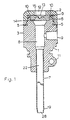
- the cannula unit (1) is formed from four major parts.
- the first is the cap means (2) which is attached to the top of the longitudinally extended, valve housing (3) and is provided with a first opening (12) which cooperates with a second opposing opening (22) located in the valve housing (3) to permit insertion of a catheter into and out of the interior of the valve housing (3).
- the cap means (2) and the valve housing (3) are formed from a relatively hard plastic such as a polycarbonate or a polyurethane.
- the cap means (2) may be secured to the valve housing (3) by mechanically attaching to the housing using threads, clips or, as shown in the drawings, by snap fittings, gluing or welding.
- the third major element of the hemostasis cannula unit of the instant invention is formed from a pliant, resilient rubber such as silicone rubber or latex rubber, which can be shaped to readily admit passage of catheters.
- the final major element of the hemostasis cannula unit of the instant invention is a tubular sheath (7) which is formed from a relatively rigid plastic such as teflon or polyethylene. The sheath is inserted within the valve housing (3) and cooperates to provide an exit from the interior of the valve housing (8).
- the hemostasis plug (6), the cap means (2) and the valve housing (3) are joined together by inserting the plug (6) into the valve housing (3) such that the uppermost edge of the plug is in contact with the rib (10), which is preferably circular in nature.
- the cap means (2) is then attached to the valve housing (3).
- the cap means may be attached to the valve housing by snap fittings or by the use of suitable adhesives, or by otherwise causing the plastic in the cap to melt onto the valve housing.
- the circular groove (5) provides a space for the plastic material from the cap means (2) and the housing (3) to flow into as these materials flow together during the attachment process.
- the cap means (2) is provided with a first opening (12) at the top, and may also be provided with a Luer taper (not shown) which can receive corresponding male Luer taper fittings (not shown).
- the plug (6) has a pilot opening (13) which leads into the center of a slit (14) which is preferably Y-shaped, as shown in Figure 3, but may also be bent Y-shaped, as shown in Figure 5.
- the slit (14) may be in the form of a cross or a single slit.
- the pilot hole leads directly to the center of the Y.
- the diameter of the pilot opening (13) is slightly smaller than the diameter of a guidewire (not shown) which will be used with the hemostasis cannula unit.
- the hemostasis plug (6) is provided with a target receiving area (15) to aid in inserting catheters and guidewires. If the catheter is inserted slightly off-center, it will be readily guided into the pilot opening (13) and through the slits (14).
- the valve housing itself (3) is generally longitudinally extended to form a valve chamber (8) and having a second opening (22) opposing the first opening (12) in the cap means (2).
- This arrangement allows a catheter to be inserted through the cap means (2), and into and out of the valve chamber (8). preferably access to the interior of the chamber is also provided through a port (9) which facilitates insertion or withdrawal of fluids from the chamber (8).
- the valve housing (3) of the hemostasis cannula unit (1) is also provided with a suture loop (11) to allow temporary attachment of the cannula unit directly to a patient's body to provide stabilization of the hemostasis cannula unit.
- the final element of the hemostasis cannula unit of the instant invention is the sheath (7) onto which the valve housing (3) may be attached.
- the sheath preferably is provided with a tapered distal tip (19), in the preferred use to closely fit onto a dilator which is inserted through the cannula for initial introduction into a blood vessel.
- a needle is inserted into a patient's blood vessel.
- a guidewire is in turn inserted into the blood vessel.
- the hemostasis cannula unit of the instant invention is then prepared by inserting a dilator through the first opening (12), the plug (6), out the second opening (22), through the sheath (7), and out the distal end of the sheath (28).
- the sheath (7) and dilator are designed such that the tapered distal tip (19) snugly fits around the dilator.
- the dilator and hemostasis cannula unit are advanced as a single unit onto the guidewire and into the blood vessel.
- the dilator tip which is tapered, increases the size of the opening in the blood vessel as it enters the vessel.
- Sheath (7) continues to increase the opening in the vessel as it is further inserted.
- the dilator is removed, leaving in place the hemostasis cannula unit of the instant invention with the guidewire protruding therefrom, sealed by the pilot opening (13) and the slits (14).
- a catheter may then be inserted through the first opening (12) in the cap means (2) and into the plug (6) through the pilot opening (13) and slits (14). After exiting the slits (14), the catheter is advanced out the second opening (22) down through the sheath (7) and into the blood vessel. Any blood which flows between the sheath and the catheter and up into the interior of the valve body (8) is not permitted to escape to the exterior because of the strong sealing action of the slits (14).
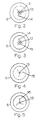
- Figure 2 provides a top view of the plug of the instant invention.
- the pilot opening (13) is shown as are the slits (14) and the target receiving area (15).
- Figure 3 is a bottom view of the plug shown in Figure 2 with the slits (14), the pilot opening (13) and the target receiving area (15) shown.
- FIGS 4 and 5 illustrate respectively top and bottom views of a hemostasis plug according to the instant invention in which a bent Y-shaped slit (16) is employed. The pilot opening (13) is also shown.
- the illustrated hemostasis plug is not provided with a target receiving area.
- the hemostasis plug of the instant invention provides several advantages not found in prior art sealing valves.
- a major advantage of the plug of the instant invention is that because of its one-piece nature there is a significantly reduced possibility for clots to form within it.
- Many prior art hemostasis cannulas are constructed utilizing multiple valves placed in face-to-face or nearly face-to-face proximity. However, small amounts of blood which can form clots can easily accumulate between the valve faces.
- the plug of the instant invention does not permit the accumulation of blood within its structure.
- Another major problem faced by hemostasis cannulas of the prior art is that they are unable to effectively seal around guidewires.
- hemostasis valves permit guidewires to be displaced toward the edge of slitted valve bodies.
- the structure of the instant invention precludes displacement of this type. Because the guidewire is held in place by the pilot opening, it cannot readily be displaced to the side into one of the arms of the slits.
- the hemostasis plug of the instant invention finds particular importance because, unlike prior art hemostasis valves, it provides effective sealing action against high pressure arterial blood, even when only a guidewire is in place.
Landscapes
- Health & Medical Sciences (AREA)
- Heart & Thoracic Surgery (AREA)
- Pulmonology (AREA)
- Engineering & Computer Science (AREA)
- Anesthesiology (AREA)
- Biomedical Technology (AREA)
- Hematology (AREA)
- Life Sciences & Earth Sciences (AREA)
- Animal Behavior & Ethology (AREA)
- General Health & Medical Sciences (AREA)
- Public Health (AREA)
- Veterinary Medicine (AREA)
- Surgical Instruments (AREA)
- Infusion, Injection, And Reservoir Apparatuses (AREA)
Applications Claiming Priority (2)
| Application Number | Priority Date | Filing Date | Title |
|---|---|---|---|
| US47938790A | 1990-02-13 | 1990-02-13 | |
| US479387 | 1990-02-13 |
Publications (2)
| Publication Number | Publication Date |
|---|---|
| EP0442194A2 true EP0442194A2 (de) | 1991-08-21 |
| EP0442194A3 EP0442194A3 (en) | 1991-10-30 |
Family
ID=23903802
Family Applications (1)
| Application Number | Title | Priority Date | Filing Date |
|---|---|---|---|
| EP19900311214 Withdrawn EP0442194A3 (en) | 1990-02-13 | 1990-10-12 | Cylindrical plug for sealing around guidewire |
Country Status (2)
| Country | Link |
|---|---|
| EP (1) | EP0442194A3 (de) |
| JP (1) | JPH03242153A (de) |
Cited By (18)
| Publication number | Priority date | Publication date | Assignee | Title |
|---|---|---|---|---|
| WO1994026349A1 (en) * | 1993-05-07 | 1994-11-24 | C.R. Bard, Inc. | Vascular introducer valve with proximal self-lubrication |
| WO1995034341A1 (en) * | 1994-05-12 | 1995-12-21 | C.R. Bard, Inc. | Catheter introducer |
| EP0692278A1 (de) * | 1994-07-15 | 1996-01-17 | Cordis Corporation | Katheter hämostatisches Ventil |
| EP0709108A3 (de) * | 1994-10-24 | 1996-06-05 | Cardiovascular Concepts Inc | |
| US5613956A (en) * | 1993-05-07 | 1997-03-25 | C. R. Bard, Inc. | Catheter introducer |
| EP0751793A4 (de) * | 1994-02-28 | 1997-11-19 | Ronald D Russo | Gastrostomieernährungsport mit einem einwegventil |
| US5702370A (en) * | 1988-06-02 | 1997-12-30 | C. R. Bard, Inc. | Self-sealing guidewire and catheter introducer |
| US6322541B2 (en) | 1999-09-10 | 2001-11-27 | Scimed Life Systems, Inc. | Vascular introducer sheath and hemostasis valve for use therewith |
| US6520939B2 (en) | 2001-02-13 | 2003-02-18 | Scimed Life Systems, Inc. | Hemostasis valve |
| US6776774B2 (en) | 2001-07-16 | 2004-08-17 | Scimed Life Systems, Inc. | Hemostasis gasket valve |
| WO2005107843A1 (en) * | 2004-04-30 | 2005-11-17 | C.R. Bard, Inc. | Valved sheath introducer for venous cannulation |
| CN102038526A (zh) * | 2010-12-14 | 2011-05-04 | 赵百秋 | 可调式戳卡 |
| US8403890B2 (en) | 2004-11-29 | 2013-03-26 | C. R. Bard, Inc. | Reduced friction catheter introducer and method of manufacturing and using the same |
| US8608702B2 (en) | 2007-10-19 | 2013-12-17 | C. R. Bard, Inc. | Introducer including shaped distal region |
| US8926564B2 (en) | 2004-11-29 | 2015-01-06 | C. R. Bard, Inc. | Catheter introducer including a valve and valve actuator |
| US8932260B2 (en) | 2004-11-29 | 2015-01-13 | C. R. Bard, Inc. | Reduced-friction catheter introducer and method of manufacturing and using the same |
| US9597483B2 (en) | 2004-11-29 | 2017-03-21 | C. R. Bard, Inc. | Reduced-friction catheter introducer and method of manufacturing and using the same |
| WO2017178256A1 (de) * | 2016-04-11 | 2017-10-19 | Joline Gmbh & Co. Kg | Einführkatheter mit einem ventilkörper |
Family Cites Families (2)
| Publication number | Priority date | Publication date | Assignee | Title |
|---|---|---|---|---|
| US4895565A (en) * | 1987-09-21 | 1990-01-23 | Cordis Corporation | Medical instrument valve |
| CA1336060C (en) * | 1988-06-02 | 1995-06-27 | George W. Bourne, Iv | Self-sealing guidewire and catheter introducer |
-
1990
- 1990-09-18 JP JP24858190A patent/JPH03242153A/ja active Pending
- 1990-10-12 EP EP19900311214 patent/EP0442194A3/en not_active Withdrawn
Cited By (32)
| Publication number | Priority date | Publication date | Assignee | Title |
|---|---|---|---|---|
| US5702370A (en) * | 1988-06-02 | 1997-12-30 | C. R. Bard, Inc. | Self-sealing guidewire and catheter introducer |
| WO1994026349A1 (en) * | 1993-05-07 | 1994-11-24 | C.R. Bard, Inc. | Vascular introducer valve with proximal self-lubrication |
| US5549576A (en) * | 1993-05-07 | 1996-08-27 | C. R. Bard, Inc. | Vascular introducer valve with proximal self-lubrication |
| US5613956A (en) * | 1993-05-07 | 1997-03-25 | C. R. Bard, Inc. | Catheter introducer |
| EP1249220B1 (de) * | 1994-02-28 | 2005-05-18 | Ronald D. Russo | Gastrostomieernährungsport mit einem Einwegventil |
| EP0751793A4 (de) * | 1994-02-28 | 1997-11-19 | Ronald D Russo | Gastrostomieernährungsport mit einem einwegventil |
| WO1995034341A1 (en) * | 1994-05-12 | 1995-12-21 | C.R. Bard, Inc. | Catheter introducer |
| EP0692278A1 (de) * | 1994-07-15 | 1996-01-17 | Cordis Corporation | Katheter hämostatisches Ventil |
| EP0709108A3 (de) * | 1994-10-24 | 1996-06-05 | Cardiovascular Concepts Inc | |
| US6338725B1 (en) | 1994-10-24 | 2002-01-15 | Medtronic Ave, Inc. | Large-diameter introducer sheath having hemostasis valve and removable steering mechanism |
| US5599305A (en) * | 1994-10-24 | 1997-02-04 | Cardiovascular Concepts, Inc. | Large-diameter introducer sheath having hemostasis valve and removable steering mechanism |
| US6322541B2 (en) | 1999-09-10 | 2001-11-27 | Scimed Life Systems, Inc. | Vascular introducer sheath and hemostasis valve for use therewith |
| US6520939B2 (en) | 2001-02-13 | 2003-02-18 | Scimed Life Systems, Inc. | Hemostasis valve |
| US6776774B2 (en) | 2001-07-16 | 2004-08-17 | Scimed Life Systems, Inc. | Hemostasis gasket valve |
| US9108033B2 (en) | 2004-04-30 | 2015-08-18 | C. R. Bard, Inc. | Valved sheath introducer for venous cannulation |
| US8720065B2 (en) | 2004-04-30 | 2014-05-13 | C. R. Bard, Inc. | Valved sheath introducer for venous cannulation |
| US10307182B2 (en) | 2004-04-30 | 2019-06-04 | C. R. Bard, Inc. | Valved sheath introducer for venous cannulation |
| WO2005107843A1 (en) * | 2004-04-30 | 2005-11-17 | C.R. Bard, Inc. | Valved sheath introducer for venous cannulation |
| US9101737B2 (en) | 2004-11-29 | 2015-08-11 | C. R. Bard, Inc. | Reduced friction catheter introducer and method of manufacturing and using the same |
| US9278188B2 (en) | 2004-11-29 | 2016-03-08 | C. R. Bard, Inc. | Catheter introducer including a valve and valve actuator |
| US8926564B2 (en) | 2004-11-29 | 2015-01-06 | C. R. Bard, Inc. | Catheter introducer including a valve and valve actuator |
| US8932260B2 (en) | 2004-11-29 | 2015-01-13 | C. R. Bard, Inc. | Reduced-friction catheter introducer and method of manufacturing and using the same |
| US9078998B2 (en) | 2004-11-29 | 2015-07-14 | C. R. Bard, Inc. | Catheter introducer including a valve and valve actuator |
| US10398879B2 (en) | 2004-11-29 | 2019-09-03 | C. R. Bard, Inc. | Reduced-friction catheter introducer and method of manufacturing and using the same |
| US8403890B2 (en) | 2004-11-29 | 2013-03-26 | C. R. Bard, Inc. | Reduced friction catheter introducer and method of manufacturing and using the same |
| US9597483B2 (en) | 2004-11-29 | 2017-03-21 | C. R. Bard, Inc. | Reduced-friction catheter introducer and method of manufacturing and using the same |
| US9283351B2 (en) | 2004-11-29 | 2016-03-15 | C. R. Bard, Inc. | Reduced friction catheter introducer and method of manufacturing and using the same |
| US8608702B2 (en) | 2007-10-19 | 2013-12-17 | C. R. Bard, Inc. | Introducer including shaped distal region |
| CN102038526B (zh) * | 2010-12-14 | 2012-06-27 | 赵百秋 | 可调式戳卡 |
| CN102038526A (zh) * | 2010-12-14 | 2011-05-04 | 赵百秋 | 可调式戳卡 |
| WO2017178256A1 (de) * | 2016-04-11 | 2017-10-19 | Joline Gmbh & Co. Kg | Einführkatheter mit einem ventilkörper |
| US10857332B2 (en) | 2016-04-11 | 2020-12-08 | Joline Gmbh & Co. Kg | Insertion catheter having a valve body |
Also Published As
| Publication number | Publication date |
|---|---|
| JPH03242153A (ja) | 1991-10-29 |
| EP0442194A3 (en) | 1991-10-30 |
Similar Documents
| Publication | Publication Date | Title |
|---|---|---|
| US5114408A (en) | Universal hemostasis valve having improved sealing characteristics | |
| CA1322927C (en) | Universal hemostasis cannula | |
| EP0513969B1 (de) | Hämostatisches Ventil | |
| US11135399B2 (en) | Activator attachment for blood control catheters | |
| US7335182B1 (en) | Valved connector with closure operated by axial movement of the valve | |
| US5000745A (en) | Hemostatis valve | |
| EP0900105B1 (de) | Hämostatisches ventil | |
| US6551283B1 (en) | Hemostasis valve | |
| US7985232B2 (en) | Detachable hemostasis valve and splittable sheath assembly | |
| US5125903A (en) | Hemostasis valve | |
| US7377909B2 (en) | Connection assembly for use with splittable sheath | |
| US5273546A (en) | Hemostasis valve | |
| US4387879A (en) | Self-sealing connector for use with plastic cannulas and vessel catheters | |
| US6083207A (en) | Partitioned hemostasis valve system | |
| US9155864B2 (en) | Multiple use blood control valve with center and circumferential slits | |
| JP2003520652A (ja) | 止血バルブ | |
| EP1791591A2 (de) | Lösbar arretierbarer dilatator und schleusenanordnung | |
| JPH03242153A (ja) | 誘導鋼線シール用円筒形プラグ |
Legal Events
| Date | Code | Title | Description |
|---|---|---|---|
| PUAI | Public reference made under article 153(3) epc to a published international application that has entered the european phase |
Free format text: ORIGINAL CODE: 0009012 |
|
| AK | Designated contracting states |
Kind code of ref document: A2 Designated state(s): DE ES FR GB IT |
|
| PUAL | Search report despatched |
Free format text: ORIGINAL CODE: 0009013 |
|
| RHK1 | Main classification (correction) |
Ipc: A61M 39/00 |
|
| AK | Designated contracting states |
Kind code of ref document: A3 Designated state(s): DE ES FR GB IT |
|
| STAA | Information on the status of an ep patent application or granted ep patent |
Free format text: STATUS: THE APPLICATION IS DEEMED TO BE WITHDRAWN |
|
| 18D | Application deemed to be withdrawn |
Effective date: 19920411 |