EP0442430B1 - Mikrobiologische Oxidation von Methylgruppen in Heterocyclen - Google Patents
Mikrobiologische Oxidation von Methylgruppen in Heterocyclen Download PDFInfo
- Publication number
- EP0442430B1 EP0442430B1 EP91101902A EP91101902A EP0442430B1 EP 0442430 B1 EP0442430 B1 EP 0442430B1 EP 91101902 A EP91101902 A EP 91101902A EP 91101902 A EP91101902 A EP 91101902A EP 0442430 B1 EP0442430 B1 EP 0442430B1
- Authority
- EP
- European Patent Office
- Prior art keywords
- process according
- carried out
- conversion
- substrate
- methylated
- Prior art date
- Legal status (The legal status is an assumption and is not a legal conclusion. Google has not performed a legal analysis and makes no representation as to the accuracy of the status listed.)
- Expired - Lifetime
Links
- 125000002496 methyl group Chemical group [H]C([H])([H])* 0.000 title claims abstract description 20
- 230000002906 microbiologic effect Effects 0.000 title claims abstract description 12
- 150000002391 heterocyclic compounds Chemical class 0.000 title claims 5
- 230000003647 oxidation Effects 0.000 title abstract description 15
- 238000007254 oxidation reaction Methods 0.000 title abstract description 15
- 108090000790 Enzymes Proteins 0.000 claims abstract description 34
- 102000004190 Enzymes Human genes 0.000 claims abstract description 34
- 238000000034 method Methods 0.000 claims abstract description 33
- 239000000758 substrate Substances 0.000 claims abstract description 33
- 238000006243 chemical reaction Methods 0.000 claims abstract description 31
- 230000008569 process Effects 0.000 claims abstract description 29
- 244000005700 microbiome Species 0.000 claims abstract description 23
- 125000001424 substituent group Chemical group 0.000 claims abstract description 6
- 241000589516 Pseudomonas Species 0.000 claims abstract description 5
- 150000001732 carboxylic acid derivatives Chemical class 0.000 claims abstract description 4
- 241000589776 Pseudomonas putida Species 0.000 claims description 18
- 229910052799 carbon Inorganic materials 0.000 claims description 14
- 150000001875 compounds Chemical class 0.000 claims description 12
- OKTJSMMVPCPJKN-UHFFFAOYSA-N Carbon Chemical compound [C] OKTJSMMVPCPJKN-UHFFFAOYSA-N 0.000 claims description 8
- 230000006698 induction Effects 0.000 claims description 8
- 239000001963 growth medium Substances 0.000 claims description 6
- 150000001721 carbon Chemical group 0.000 claims description 5
- IJGRMHOSHXDMSA-UHFFFAOYSA-N Atomic nitrogen Chemical compound N#N IJGRMHOSHXDMSA-UHFFFAOYSA-N 0.000 claims description 4
- 125000005842 heteroatom Chemical group 0.000 claims description 4
- 230000033228 biological regulation Effects 0.000 claims description 3
- 150000003222 pyridines Chemical class 0.000 claims description 3
- 230000001105 regulatory effect Effects 0.000 claims description 3
- 150000003577 thiophenes Chemical class 0.000 claims description 3
- NINIDFKCEFEMDL-UHFFFAOYSA-N Sulfur Chemical compound [S] NINIDFKCEFEMDL-UHFFFAOYSA-N 0.000 claims description 2
- QVGXLLKOCUKJST-UHFFFAOYSA-N atomic oxygen Chemical compound [O] QVGXLLKOCUKJST-UHFFFAOYSA-N 0.000 claims description 2
- 229910052757 nitrogen Inorganic materials 0.000 claims description 2
- 125000004433 nitrogen atom Chemical group N* 0.000 claims description 2
- 229910052760 oxygen Inorganic materials 0.000 claims description 2
- 239000001301 oxygen Substances 0.000 claims description 2
- RAXXELZNTBOGNW-UHFFFAOYSA-N imidazole Natural products C1=CNC=N1 RAXXELZNTBOGNW-UHFFFAOYSA-N 0.000 claims 3
- KYQCOXFCLRTKLS-UHFFFAOYSA-N Pyrazine Chemical compound C1=CN=CC=N1 KYQCOXFCLRTKLS-UHFFFAOYSA-N 0.000 claims 2
- KAESVJOAVNADME-UHFFFAOYSA-N Pyrrole Chemical compound C=1C=CNC=1 KAESVJOAVNADME-UHFFFAOYSA-N 0.000 claims 2
- 125000003944 tolyl group Chemical group 0.000 claims 2
- YLQBMQCUIZJEEH-UHFFFAOYSA-N Furan Chemical compound C=1C=COC=1 YLQBMQCUIZJEEH-UHFFFAOYSA-N 0.000 claims 1
- PCNDJXKNXGMECE-UHFFFAOYSA-N Phenazine Natural products C1=CC=CC2=NC3=CC=CC=C3N=C21 PCNDJXKNXGMECE-UHFFFAOYSA-N 0.000 claims 1
- WTKZEGDFNFYCGP-UHFFFAOYSA-N Pyrazole Chemical compound C=1C=NNC=1 WTKZEGDFNFYCGP-UHFFFAOYSA-N 0.000 claims 1
- CZPWVGJYEJSRLH-UHFFFAOYSA-N Pyrimidine Chemical compound C1=CN=CN=C1 CZPWVGJYEJSRLH-UHFFFAOYSA-N 0.000 claims 1
- 239000005864 Sulphur Substances 0.000 claims 1
- FZWLAAWBMGSTSO-UHFFFAOYSA-N Thiazole Chemical compound C1=CSC=N1 FZWLAAWBMGSTSO-UHFFFAOYSA-N 0.000 claims 1
- 230000001276 controlling effect Effects 0.000 claims 1
- PBMFSQRYOILNGV-UHFFFAOYSA-N pyridazine Chemical compound C1=CC=NN=C1 PBMFSQRYOILNGV-UHFFFAOYSA-N 0.000 claims 1
- YXFVVABEGXRONW-UHFFFAOYSA-N Toluene Chemical compound CC1=CC=CC=C1 YXFVVABEGXRONW-UHFFFAOYSA-N 0.000 abstract description 24
- 125000000623 heterocyclic group Chemical group 0.000 abstract description 19
- HFPZCAJZSCWRBC-UHFFFAOYSA-N p-cymene Chemical compound CC(C)C1=CC=C(C)C=C1 HFPZCAJZSCWRBC-UHFFFAOYSA-N 0.000 abstract description 8
- CTQNGGLPUBDAKN-UHFFFAOYSA-N O-Xylene Chemical compound CC1=CC=CC=C1C CTQNGGLPUBDAKN-UHFFFAOYSA-N 0.000 abstract description 7
- 239000008096 xylene Substances 0.000 abstract description 7
- 125000003118 aryl group Chemical group 0.000 abstract description 6
- 229930007927 cymene Natural products 0.000 abstract description 2
- 125000004432 carbon atom Chemical group C* 0.000 abstract 1
- LCZUOKDVTBMCMX-UHFFFAOYSA-N 2,5-Dimethylpyrazine Chemical compound CC1=CN=C(C)C=N1 LCZUOKDVTBMCMX-UHFFFAOYSA-N 0.000 description 26
- ITQTTZVARXURQS-UHFFFAOYSA-N 3-methylpyridine Chemical compound CC1=CC=CN=C1 ITQTTZVARXURQS-UHFFFAOYSA-N 0.000 description 18
- 239000001934 2,5-dimethylpyrazine Substances 0.000 description 14
- URLKBWYHVLBVBO-UHFFFAOYSA-N Para-Xylene Chemical group CC1=CC=C(C)C=C1 URLKBWYHVLBVBO-UHFFFAOYSA-N 0.000 description 14
- PVNIIMVLHYAWGP-UHFFFAOYSA-N Niacin Chemical compound OC(=O)C1=CC=CN=C1 PVNIIMVLHYAWGP-UHFFFAOYSA-N 0.000 description 10
- SNRUBQQJIBEYMU-UHFFFAOYSA-N dodecane Chemical compound CCCCCCCCCCCC SNRUBQQJIBEYMU-UHFFFAOYSA-N 0.000 description 10
- RBYJWCRKFLGNDB-UHFFFAOYSA-N 5-methylpyrazine-2-carboxylic acid Chemical compound CC1=CN=C(C(O)=O)C=N1 RBYJWCRKFLGNDB-UHFFFAOYSA-N 0.000 description 8
- IVSZLXZYQVIEFR-UHFFFAOYSA-N m-xylene Chemical group CC1=CC=CC(C)=C1 IVSZLXZYQVIEFR-UHFFFAOYSA-N 0.000 description 8
- 239000000203 mixture Substances 0.000 description 8
- 239000000411 inducer Substances 0.000 description 7
- 241000187654 Nocardia Species 0.000 description 6
- 239000002253 acid Substances 0.000 description 6
- 230000036983 biotransformation Effects 0.000 description 6
- -1 heterocyclic carboxylic acids Chemical class 0.000 description 6
- 238000004519 manufacturing process Methods 0.000 description 6
- 239000007003 mineral medium Substances 0.000 description 6
- SIOXPEMLGUPBBT-UHFFFAOYSA-N picolinic acid Chemical compound OC(=O)C1=CC=CC=N1 SIOXPEMLGUPBBT-UHFFFAOYSA-N 0.000 description 6
- QGZKDVFQNNGYKY-UHFFFAOYSA-N Ammonia Chemical compound N QGZKDVFQNNGYKY-UHFFFAOYSA-N 0.000 description 5
- KWYUFKZDYYNOTN-UHFFFAOYSA-M Potassium hydroxide Chemical compound [OH-].[K+] KWYUFKZDYYNOTN-UHFFFAOYSA-M 0.000 description 5
- 150000004945 aromatic hydrocarbons Chemical class 0.000 description 5
- 239000002609 medium Substances 0.000 description 5
- 229960003512 nicotinic acid Drugs 0.000 description 5
- 235000001968 nicotinic acid Nutrition 0.000 description 5
- 239000011664 nicotinic acid Substances 0.000 description 5
- 230000003287 optical effect Effects 0.000 description 5
- XCYJPXQACVEIOS-UHFFFAOYSA-N 1-isopropyl-3-methylbenzene Chemical compound CC(C)C1=CC=CC(C)=C1 XCYJPXQACVEIOS-UHFFFAOYSA-N 0.000 description 4
- YGYNBBAUIYTWBF-UHFFFAOYSA-N 2,6-dimethylnaphthalene Chemical compound C1=C(C)C=CC2=CC(C)=CC=C21 YGYNBBAUIYTWBF-UHFFFAOYSA-N 0.000 description 4
- BSKHPKMHTQYZBB-UHFFFAOYSA-N 2-methylpyridine Chemical compound CC1=CC=CC=N1 BSKHPKMHTQYZBB-UHFFFAOYSA-N 0.000 description 4
- 150000001335 aliphatic alkanes Chemical class 0.000 description 4
- 239000006285 cell suspension Substances 0.000 description 4
- XLYOFNOQVPJJNP-ZSJDYOACSA-N heavy water Substances [2H]O[2H] XLYOFNOQVPJJNP-ZSJDYOACSA-N 0.000 description 4
- QENGPZGAWFQWCZ-UHFFFAOYSA-N Methylthiophene Natural products CC=1C=CSC=1 QENGPZGAWFQWCZ-UHFFFAOYSA-N 0.000 description 3
- 150000007513 acids Chemical class 0.000 description 3
- 238000011534 incubation Methods 0.000 description 3
- 239000000543 intermediate Substances 0.000 description 3
- KGLCZTRXNNGESL-REDYYMJGSA-N (2E,4Z)-2-hydroxy-6-oxohexa-2,4-dienoic acid Chemical compound OC(=O)C(\O)=C/C=C\C=O KGLCZTRXNNGESL-REDYYMJGSA-N 0.000 description 2
- QSSXJPIWXQTSIX-UHFFFAOYSA-N 1-bromo-2-methylbenzene Chemical compound CC1=CC=CC=C1Br QSSXJPIWXQTSIX-UHFFFAOYSA-N 0.000 description 2
- IBSQPLPBRSHTTG-UHFFFAOYSA-N 1-chloro-2-methylbenzene Chemical compound CC1=CC=CC=C1Cl IBSQPLPBRSHTTG-UHFFFAOYSA-N 0.000 description 2
- JYYNAJVZFGKDEQ-UHFFFAOYSA-N 2,4-Dimethylpyridine Chemical compound CC1=CC=NC(C)=C1 JYYNAJVZFGKDEQ-UHFFFAOYSA-N 0.000 description 2
- PAPNRQCYSFBWDI-UHFFFAOYSA-N 2,5-Dimethyl-1H-pyrrole Chemical compound CC1=CC=C(C)N1 PAPNRQCYSFBWDI-UHFFFAOYSA-N 0.000 description 2
- GWQOOADXMVQEFT-UHFFFAOYSA-N 2,5-Dimethylthiophene Chemical compound CC1=CC=C(C)S1 GWQOOADXMVQEFT-UHFFFAOYSA-N 0.000 description 2
- GSNUFIFRDBKVIE-UHFFFAOYSA-N 2,5-dimethylfuran Chemical compound CC1=CC=C(C)O1 GSNUFIFRDBKVIE-UHFFFAOYSA-N 0.000 description 2
- XWKFPIODWVPXLX-UHFFFAOYSA-N 2,5-dimethylpyridine Chemical compound CC1=CC=C(C)N=C1 XWKFPIODWVPXLX-UHFFFAOYSA-N 0.000 description 2
- HJFZAYHYIWGLNL-UHFFFAOYSA-N 2,6-Dimethylpyrazine Chemical compound CC1=CN=CC(C)=N1 HJFZAYHYIWGLNL-UHFFFAOYSA-N 0.000 description 2
- FKNQCJSGGFJEIZ-UHFFFAOYSA-N 4-methylpyridine Chemical compound CC1=CC=NC=C1 FKNQCJSGGFJEIZ-UHFFFAOYSA-N 0.000 description 2
- QMHIMXFNBOYPND-UHFFFAOYSA-N 4-methylthiazole Chemical compound CC1=CSC=N1 QMHIMXFNBOYPND-UHFFFAOYSA-N 0.000 description 2
- 229940127463 Enzyme Inducers Drugs 0.000 description 2
- 241000192125 Firmicutes Species 0.000 description 2
- DFPAKSUCGFBDDF-UHFFFAOYSA-N Nicotinamide Chemical compound NC(=O)C1=CC=CN=C1 DFPAKSUCGFBDDF-UHFFFAOYSA-N 0.000 description 2
- 229910021529 ammonia Inorganic materials 0.000 description 2
- 230000000507 anthelmentic effect Effects 0.000 description 2
- WPYMKLBDIGXBTP-UHFFFAOYSA-N benzoic acid Chemical compound OC(=O)C1=CC=CC=C1 WPYMKLBDIGXBTP-UHFFFAOYSA-N 0.000 description 2
- 230000015556 catabolic process Effects 0.000 description 2
- 230000000052 comparative effect Effects 0.000 description 2
- 238000006731 degradation reaction Methods 0.000 description 2
- 150000002240 furans Chemical class 0.000 description 2
- 239000007789 gas Substances 0.000 description 2
- CAWHJQAVHZEVTJ-UHFFFAOYSA-N methylpyrazine Chemical compound CC1=CN=CC=N1 CAWHJQAVHZEVTJ-UHFFFAOYSA-N 0.000 description 2
- 235000015097 nutrients Nutrition 0.000 description 2
- 229940081066 picolinic acid Drugs 0.000 description 2
- 239000013612 plasmid Substances 0.000 description 2
- 238000002360 preparation method Methods 0.000 description 2
- 150000003216 pyrazines Chemical class 0.000 description 2
- 150000003230 pyrimidines Chemical class 0.000 description 2
- 150000003233 pyrroles Chemical class 0.000 description 2
- 150000003557 thiazoles Chemical class 0.000 description 2
- 239000011573 trace mineral Substances 0.000 description 2
- 235000013619 trace mineral Nutrition 0.000 description 2
- IAEGWXHKWJGQAZ-UHFFFAOYSA-N trimethylpyrazine Chemical compound CC1=CN=C(C)C(C)=N1 IAEGWXHKWJGQAZ-UHFFFAOYSA-N 0.000 description 2
- HMVYYTRDXNKRBQ-UHFFFAOYSA-N 1,3-thiazole-4-carboxylic acid Chemical compound OC(=O)C1=CSC=N1 HMVYYTRDXNKRBQ-UHFFFAOYSA-N 0.000 description 1
- YVYJOAKJQRTIDH-UHFFFAOYSA-N 2-chloro-3-ethyl-6-methylpyridine Chemical compound CCC1=CC=C(C)N=C1Cl YVYJOAKJQRTIDH-UHFFFAOYSA-N 0.000 description 1
- VXLYOURCUVQYLN-UHFFFAOYSA-N 2-chloro-5-methylpyridine Chemical compound CC1=CC=C(Cl)N=C1 VXLYOURCUVQYLN-UHFFFAOYSA-N 0.000 description 1
- XQQBUAPQHNYYRS-UHFFFAOYSA-N 2-methylthiophene Chemical compound CC1=CC=CS1 XQQBUAPQHNYYRS-UHFFFAOYSA-N 0.000 description 1
- SDXAWLJRERMRKF-UHFFFAOYSA-N 3,5-dimethyl-1h-pyrazole Chemical compound CC=1C=C(C)NN=1 SDXAWLJRERMRKF-UHFFFAOYSA-N 0.000 description 1
- NNBALVIZMGWZHS-UHFFFAOYSA-N 3-chloro-2,5-dimethylpyrazine Chemical compound CC1=CN=C(C)C(Cl)=N1 NNBALVIZMGWZHS-UHFFFAOYSA-N 0.000 description 1
- LSBIUXKNVUBKRI-UHFFFAOYSA-N 4,6-dimethylpyrimidine Chemical compound CC1=CC(C)=NC=N1 LSBIUXKNVUBKRI-UHFFFAOYSA-N 0.000 description 1
- AVPYQKSLYISFPO-UHFFFAOYSA-N 4-chlorobenzaldehyde Chemical compound ClC1=CC=C(C=O)C=C1 AVPYQKSLYISFPO-UHFFFAOYSA-N 0.000 description 1
- RLYUNPNLXMSXAX-UHFFFAOYSA-N 5-methylthiazole Chemical compound CC1=CN=CS1 RLYUNPNLXMSXAX-UHFFFAOYSA-N 0.000 description 1
- VOCNMTIGMYPFPY-UHFFFAOYSA-N 6-methylnaphthalene-2-carboxylic acid Chemical compound C1=C(C(O)=O)C=CC2=CC(C)=CC=C21 VOCNMTIGMYPFPY-UHFFFAOYSA-N 0.000 description 1
- 102000005369 Aldehyde Dehydrogenase Human genes 0.000 description 1
- 108020002663 Aldehyde Dehydrogenase Proteins 0.000 description 1
- 241000894006 Bacteria Species 0.000 description 1
- 239000005711 Benzoic acid Substances 0.000 description 1
- 229910021580 Cobalt(II) chloride Inorganic materials 0.000 description 1
- 229910021592 Copper(II) chloride Inorganic materials 0.000 description 1
- MYMOFIZGZYHOMD-UHFFFAOYSA-N Dioxygen Chemical compound O=O MYMOFIZGZYHOMD-UHFFFAOYSA-N 0.000 description 1
- 102000016680 Dioxygenases Human genes 0.000 description 1
- 108010028143 Dioxygenases Proteins 0.000 description 1
- LFQSCWFLJHTTHZ-UHFFFAOYSA-N Ethanol Chemical compound CCO LFQSCWFLJHTTHZ-UHFFFAOYSA-N 0.000 description 1
- 229910021380 Manganese Chloride Inorganic materials 0.000 description 1
- 241001465754 Metazoa Species 0.000 description 1
- 241000186359 Mycobacterium Species 0.000 description 1
- 229910004619 Na2MoO4 Inorganic materials 0.000 description 1
- 239000007832 Na2SO4 Substances 0.000 description 1
- 229910021586 Nickel(II) chloride Inorganic materials 0.000 description 1
- 241000589540 Pseudomonas fluorescens Species 0.000 description 1
- 230000009471 action Effects 0.000 description 1
- 229910001854 alkali hydroxide Inorganic materials 0.000 description 1
- 229910052783 alkali metal Inorganic materials 0.000 description 1
- 150000008044 alkali metal hydroxides Chemical class 0.000 description 1
- 150000001447 alkali salts Chemical class 0.000 description 1
- 235000019270 ammonium chloride Nutrition 0.000 description 1
- 239000000921 anthelmintic agent Substances 0.000 description 1
- 230000003266 anti-allergic effect Effects 0.000 description 1
- 230000008901 benefit Effects 0.000 description 1
- 235000010233 benzoic acid Nutrition 0.000 description 1
- 235000019445 benzyl alcohol Nutrition 0.000 description 1
- 150000003938 benzyl alcohols Chemical class 0.000 description 1
- KCXMKQUNVWSEMD-UHFFFAOYSA-N benzyl chloride Chemical class ClCC1=CC=CC=C1 KCXMKQUNVWSEMD-UHFFFAOYSA-N 0.000 description 1
- 229960003475 cambendazole Drugs 0.000 description 1
- 150000001735 carboxylic acids Chemical class 0.000 description 1
- 239000007795 chemical reaction product Substances 0.000 description 1
- 239000003795 chemical substances by application Substances 0.000 description 1
- 230000008878 coupling Effects 0.000 description 1
- 238000010168 coupling process Methods 0.000 description 1
- 238000005859 coupling reaction Methods 0.000 description 1
- 229910001882 dioxygen Inorganic materials 0.000 description 1
- 229910000397 disodium phosphate Inorganic materials 0.000 description 1
- 235000019800 disodium phosphate Nutrition 0.000 description 1
- 239000003814 drug Substances 0.000 description 1
- 125000001495 ethyl group Chemical group [H]C([H])([H])C([H])([H])* 0.000 description 1
- 238000002474 experimental method Methods 0.000 description 1
- 238000000605 extraction Methods 0.000 description 1
- 239000012467 final product Substances 0.000 description 1
- 150000002460 imidazoles Chemical class 0.000 description 1
- 230000002401 inhibitory effect Effects 0.000 description 1
- 239000011565 manganese chloride Substances 0.000 description 1
- 235000002867 manganese chloride Nutrition 0.000 description 1
- 238000005259 measurement Methods 0.000 description 1
- 239000013028 medium composition Substances 0.000 description 1
- 230000000813 microbial effect Effects 0.000 description 1
- 238000002156 mixing Methods 0.000 description 1
- RXOHFPCZGPKIRD-UHFFFAOYSA-N naphthalene-2,6-dicarboxylic acid Chemical compound C1=C(C(O)=O)C=CC2=CC(C(=O)O)=CC=C21 RXOHFPCZGPKIRD-UHFFFAOYSA-N 0.000 description 1
- 235000005152 nicotinamide Nutrition 0.000 description 1
- 239000011570 nicotinamide Substances 0.000 description 1
- 235000016709 nutrition Nutrition 0.000 description 1
- 230000035764 nutrition Effects 0.000 description 1
- 239000003960 organic solvent Substances 0.000 description 1
- 239000007800 oxidant agent Substances 0.000 description 1
- 125000001997 phenyl group Chemical group [H]C1=C([H])C([H])=C(*)C([H])=C1[H] 0.000 description 1
- WVDDGKGOMKODPV-ZQBYOMGUSA-N phenyl(114C)methanol Chemical compound O[14CH2]C1=CC=CC=C1 WVDDGKGOMKODPV-ZQBYOMGUSA-N 0.000 description 1
- XAEFZNCEHLXOMS-UHFFFAOYSA-M potassium benzoate Chemical compound [K+].[O-]C(=O)C1=CC=CC=C1 XAEFZNCEHLXOMS-UHFFFAOYSA-M 0.000 description 1
- 125000002924 primary amino group Chemical class [H]N([H])* 0.000 description 1
- QZWHWHNCPFEXLL-UHFFFAOYSA-N propan-2-yl n-[2-(1,3-thiazol-4-yl)-3h-benzimidazol-5-yl]carbamate Chemical compound N1C2=CC(NC(=O)OC(C)C)=CC=C2N=C1C1=CSC=N1 QZWHWHNCPFEXLL-UHFFFAOYSA-N 0.000 description 1
- 108090000623 proteins and genes Proteins 0.000 description 1
- XEAOMHDITWFRFL-UHFFFAOYSA-N pyrazine-2-carboxamide Chemical compound NC(=O)C1=CN=CC=N1.NC(=O)C1=CN=CC=N1 XEAOMHDITWFRFL-UHFFFAOYSA-N 0.000 description 1
- NIPZZXUFJPQHNH-UHFFFAOYSA-N pyrazine-2-carboxylic acid Chemical compound OC(=O)C1=CN=CC=N1 NIPZZXUFJPQHNH-UHFFFAOYSA-N 0.000 description 1
- 150000003217 pyrazoles Chemical class 0.000 description 1
- 150000004892 pyridazines Chemical class 0.000 description 1
- OYSBZLVHMPNJMR-UHFFFAOYSA-N pyridine-3-carboxylic acid Chemical compound OC(=O)C1=CC=CN=C1.OC(=O)C1=CC=CN=C1 OYSBZLVHMPNJMR-UHFFFAOYSA-N 0.000 description 1
- 239000011684 sodium molybdate Substances 0.000 description 1
- 235000015393 sodium molybdate Nutrition 0.000 description 1
- 229910052938 sodium sulfate Inorganic materials 0.000 description 1
- 235000011152 sodium sulphate Nutrition 0.000 description 1
- 239000007858 starting material Substances 0.000 description 1
- 229910052717 sulfur Inorganic materials 0.000 description 1
- 239000011593 sulfur Substances 0.000 description 1
- WJCNZQLZVWNLKY-UHFFFAOYSA-N thiabendazole Chemical compound S1C=NC(C=2NC3=CC=CC=C3N=2)=C1 WJCNZQLZVWNLKY-UHFFFAOYSA-N 0.000 description 1
- 239000004308 thiabendazole Substances 0.000 description 1
- 235000010296 thiabendazole Nutrition 0.000 description 1
- 229960004546 thiabendazole Drugs 0.000 description 1
- 229930192474 thiophene Natural products 0.000 description 1
- QERYCTSHXKAMIS-UHFFFAOYSA-N thiophene-2-carboxylic acid Chemical compound OC(=O)C1=CC=CS1 QERYCTSHXKAMIS-UHFFFAOYSA-N 0.000 description 1
- 230000001549 tubercolostatic effect Effects 0.000 description 1
- 239000000814 tuberculostatic agent Substances 0.000 description 1
- 235000013343 vitamin Nutrition 0.000 description 1
- 239000011782 vitamin Substances 0.000 description 1
- 229940088594 vitamin Drugs 0.000 description 1
- 229930003231 vitamin Natural products 0.000 description 1
- 150000003722 vitamin derivatives Chemical class 0.000 description 1
Images
Classifications
-
- C—CHEMISTRY; METALLURGY
- C12—BIOCHEMISTRY; BEER; SPIRITS; WINE; VINEGAR; MICROBIOLOGY; ENZYMOLOGY; MUTATION OR GENETIC ENGINEERING
- C12P—FERMENTATION OR ENZYME-USING PROCESSES TO SYNTHESISE A DESIRED CHEMICAL COMPOUND OR COMPOSITION OR TO SEPARATE OPTICAL ISOMERS FROM A RACEMIC MIXTURE
- C12P7/00—Preparation of oxygen-containing organic compounds
- C12P7/02—Preparation of oxygen-containing organic compounds containing a hydroxy group
- C12P7/04—Preparation of oxygen-containing organic compounds containing a hydroxy group acyclic
- C12P7/18—Preparation of oxygen-containing organic compounds containing a hydroxy group acyclic polyhydric
- C12P7/20—Glycerol
-
- C—CHEMISTRY; METALLURGY
- C12—BIOCHEMISTRY; BEER; SPIRITS; WINE; VINEGAR; MICROBIOLOGY; ENZYMOLOGY; MUTATION OR GENETIC ENGINEERING
- C12P—FERMENTATION OR ENZYME-USING PROCESSES TO SYNTHESISE A DESIRED CHEMICAL COMPOUND OR COMPOSITION OR TO SEPARATE OPTICAL ISOMERS FROM A RACEMIC MIXTURE
- C12P7/00—Preparation of oxygen-containing organic compounds
- C12P7/40—Preparation of oxygen-containing organic compounds containing a carboxyl group including Peroxycarboxylic acids
-
- C—CHEMISTRY; METALLURGY
- C12—BIOCHEMISTRY; BEER; SPIRITS; WINE; VINEGAR; MICROBIOLOGY; ENZYMOLOGY; MUTATION OR GENETIC ENGINEERING
- C12P—FERMENTATION OR ENZYME-USING PROCESSES TO SYNTHESISE A DESIRED CHEMICAL COMPOUND OR COMPOSITION OR TO SEPARATE OPTICAL ISOMERS FROM A RACEMIC MIXTURE
- C12P17/00—Preparation of heterocyclic carbon compounds with only O, N, S, Se or Te as ring hetero atoms
-
- Y—GENERAL TAGGING OF NEW TECHNOLOGICAL DEVELOPMENTS; GENERAL TAGGING OF CROSS-SECTIONAL TECHNOLOGIES SPANNING OVER SEVERAL SECTIONS OF THE IPC; TECHNICAL SUBJECTS COVERED BY FORMER USPC CROSS-REFERENCE ART COLLECTIONS [XRACs] AND DIGESTS
- Y10—TECHNICAL SUBJECTS COVERED BY FORMER USPC
- Y10S—TECHNICAL SUBJECTS COVERED BY FORMER USPC CROSS-REFERENCE ART COLLECTIONS [XRACs] AND DIGESTS
- Y10S435/00—Chemistry: molecular biology and microbiology
- Y10S435/8215—Microorganisms
- Y10S435/822—Microorganisms using bacteria or actinomycetales
- Y10S435/874—Pseudomonas
- Y10S435/877—Pseudomonas putida
Definitions
- the invention relates to a new microbiological process for the oxidation of methyl groups in aromatic 5- or 6-ring heterocycles to the corresponding carboxylic acid, the heterocycle having no substituent on the adjacent carbon atom of the methyl group to be oxidized.
- This heterocycle serves as a substrate for the reaction, which is carried out using toluene, xylene or cymene-utilizing microorganisms of the genus Pseudomonas , the enzymes of which have previously been induced.
- heterocyclic carboxylic acids are, for example, important intermediates for the production of pharmaceuticals.
- nicotinic acid (3-pyridinecarboxylic acid) is an important intermediate for the production of nicotinic acid amide, which is a vitamin of the B group and has an essential importance for the nutrition of humans and animals (Ullmann, vol. 19, 1980, p. 603).
- 2-pyrazine carboxylic acid is an important intermediate for the preparation of the tuberculostatic pyrazinamide (2-pyrazine carboxamide) (Römpps Chemie Lexikon, Vol. 5, 1987).
- 4-thiazolecarboxylic acid is used to produce thiabendazole, a highly effective antihelmintic (worming agent), which in turn is the starting material for other, newer antihelmintics, such as cambendazole (Ullmann, Vol. 23, 1980, p.46).
- 2-thiophene carboxylic acid has an anti-allergic effect (Ullmann, Vol. 23, 1980, p. 219).
- SU-PS 487 111 describes a process for the microbiological oxidation of 2,6-dimethylnaphthalene to 6-methyl-2-naphthalic acid using microorganisms of the species Pseudomonas putida and Pseudomonas fluorescens . The final product is obtained in a yield of approximately 50%.
- SU-PS 370 228 also describes the microbiological oxidation of 2,6-dimethylnaphthalene, the reaction conditions being chosen specifically so that 2,6-naphthalenedicarboxylic acid is obtained as the end product.
- Microbiological processes for the oxidation of methyl groups of an N-heterocycle are also known from the literature.
- 2-methylpyridine is oxidized to a corresponding acid with a gram-positive microorganism strain of the genus Nocardia .
- SU-PS 228 688 describes a microbiological process for the production of nicotinic acid from 3-methylpyridine with a gram-positive microorganism of the genus Mycobacterium .
- From SU-PS 302 341 a microbiological process for the production of nicotinic acid with gram-positive bacteria of the genus Nocardia is known.
- US Pat. No. 4,859,592 describes a process for the preparation of picolinic acid with Pseudomonas putida in which an alkyl-substituted aromatic hydrocarbon in the presence of molecular oxygen is formed in a first stage by a dioxygenase, a 2-hydroxymuconic semialdehyde, which is then produced in one second stage with ammonia or a primary amine to 2-picolinic acid.
- the object of the present invention was to eliminate these disadvantages and to develop a simple and one-step process for microbiological methyl group oxidation with which the corresponding acids can be isolated in good yield and purity and the aromatic heterocycle is not cleaved. Another object was to provide a process in which the compound used for induction, after induction of the enzymes, no longer has to be present during the reaction of the substrate and thus the reaction does not depend on the amount of the enzyme inducer.
- the invention relates to a microbiological process for the oxidation of methyl groups in aromatic 5- or 6-ring heterocycles, the heterocycle having no substituent on the adjacent carbon atom of the methyl group to be oxidized, for the corresponding carboxylic acid, the methylated heterocycle being used as the substrate for the reaction and the reaction is carried out using toluene, xylene or cymene-utilizing microorganisms of the genus Pseudomonas , the enzymes of which have been previously induced.
- reaction is expediently carried out using microorganisms of the species Pseudomonas putida which utilize toluene, xylene or cymene.
- the xylene-utilizing microorganism strain Pseudomonas putida with the designation ATCC 33015 or an effective mutant thereof or the Cymol-utilizing microorganism strain Pseudomonas putida with the designation DSM 5709 or an effective mutant thereof is used.
- the reaction with the microorganism strain Pseudomonas putida ATCC 33105 is carried out.
- the microorganism strain Pseudomonas putida (DSM 5709) was deposited with the German Collection of Microorganisms (DSM) and Zellkulturen GmbH, Mascheroderweg 1b, 3300 Braunschweig, FRG, on December 22, 1989 under the number DSM 5709.
- the microorganism strain Pseudomonas putida with the designation ATCC 33015 is deposited with the American Type Culture Collection 12301 Parklawn Drive Rockville, Maryland 20852, USA, under the number ATCC 33015.
- the enzyme induction can expediently be carried out both with compounds which serve the microorganism as a source of carbon and energy, such as, for example, p-xylene, m-xylene, p-cymene, m-cymene and toluene, and with compounds which the microorganism does not consider Serve carbon and energy sources, such as mono- and disubstituted methyl, ethyl and chlorotoluenes, benzyl alcohols and p-chlorobenzaldehyde, which have already been described as enzyme inducers for the degradation of aromatic hydrocarbons (Abril M.-A. et al., J. Bacteriol., Vol. 171, 1989, pp.6782-6789).
- the enzyme induction is preferably carried out with p-xylene, m-xylene, 2-chlorotoluene or 2-bromotoluene.
- the compounds used for induction can either be present during the reaction of the substrate or their supply can be stopped before the reaction of the substrate.
- the inductor concentration is usually chosen so that it is lower than the minimum inhibitory concentration of the enzymes responsible for the implementation.
- the supply of the compounds used for induction is preferably during the Implementation of the substrate is prevented either by stopping the supply or by centrifuging off the cells.
- the strains mentioned usually grow with p-xylene, m-xylene, p-cymene, m-cymene or with toluene as the only source of carbon and energy in a mineral medium (Kulla et al., Arch. Microbiol 135, 1983, p.1- 7) or in a complex medium ("Nutrient Broth No. 2" Oxoid Ltd., GB) or in a minimal medium, the composition of which is given in Table 3.
- the growth substrate was added to the medium in gaseous form according to the information provided by Claus and Walker (J. Gen. Microbiol. 36, 1964, pp. 107-122), the gassing rate being 0.5 V / min.
- the cells are grown to an optical density of 1 to 200 at 650 nm in the culture medium, preferably up to an optical density of 5 to 100 at 650 nm.
- the reaction can expediently be carried out either with a single or continuous addition of substrate, so that the substrate concentration in the culture medium does not exceed 20% (w / v).
- the substrate is preferably added such that the substrate concentration in the culture medium does not exceed 5% (w / v).
- the substrate can also be added simultaneously with the enzyme inductor, for example by using a mixture of enzyme inductor and substrate.
- the reaction is expediently carried out in a pH range from 4 to 11, preferably from 6 to 10.
- the reaction is expediently usually carried out at a temperature of 15 to 50 ° C., preferably at a temperature of 25 to 40 ° C.
- the reaction is usually carried out in a time of 1 to 24 hours.
- Suitable substrates for the reaction can advantageously be methylated aromatic 5-ring heterocycles which contain one or more heteroatoms from the series consisting of oxygen, nitrogen and sulfur, such as, for example, methylated thiophenes, furans, pyrroles, thiazoles, pyrazoles or imidazoles which have no substituents have on the adjacent carbon atom of the methyl group to be oxidized; Furans, thiophenes, pyrroles and thiazoles are preferably used.
- 3,5-dimethylpyrazole, 5-methylthiazole, 4-methylthiazole, 2,5-dimethylthiophene, 2-methylthiophene, 3-methylthiophene, 2,5-dimethylfuran and 2,5-dimethylpyrrole are used as 5-ring heterocycles.
- the reaction with aromatic methylated 6-ring heterocycles with one or more nitrogen atoms as the heteroatom can expediently be carried out, such as, for example, methylated pyridines, pyrimidines, pyrazines or pyridazines which have no substituents on the adjacent carbon atom of the oxidized
- methyl group preferably pyridines, pyrazines and pyrimidines such as 2-methylpyridine, 3-methylpyridine, 4-methylpyridine, 2,5-dimethylpyridine, 2,4-dimethylpyridine, 6-chloro-3-methylpyridine, 2-chloro-3- ethyl-6-methylpyridine, 4,6-dimethylpyrimidine, 2-methylpyrazine, 2,5-dimethylpyrazine, 2,6-dimethylpyrazine, 2,3,5-trimethylpyrazine and 2-chloro-3,6-dimethylpyrazine were used.
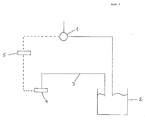
- the enzyme inductor and / or the methylated heterocycle can be fed as substrate into a bioreactor (2), the feed amount being regulated via the concentration of the enzyme inductor in the exhaust air (3) from the bioreactor (2).
- the concentration of the enzyme inductor in the exhaust air (3) is preferably measured with a measuring device (4).
- a photometer for ultraviolet light, a gas chromatograph or a gas chromatograph coupled to a mass spectrometer can be used as the measuring device for the enzyme inductor concentration.
- This measuring device (4) is expedient via a control (5) which regulates the feed quantity of the enzyme inductor and / or the methylated heterocycle with a pump (1) via which the feed of the enzyme inductor and / or the methylated heterocycle into the bioreactor (2 ) is done, coupled.
- This coupling expediently regulates the supply of the enzyme inductor and / or the methylated heterocycle. This regulation preferably keeps the concentration of the enzyme inductor in the exhaust air (3) constant.
- the control is expediently such that the concentration of the enzyme inducer in the exhaust air (3) is between 0.001 mmol / l exhaust air and 10 mmol / l exhaust air, preferably between 0.01 mmol / l exhaust air and 3 mmol / l exhaust air.
- the enzyme inductor and / or the methylated heterocycle is preferably fed as a substrate in the form of a mixture into the bioreactor (2).
- the ratio of enzyme inducer to substrate is advantageously between 5: 1 and 3: 1.
- the enzyme inductor and / or the methylated heterocycle is expediently fed to the bioreactor (2) via the supply air.
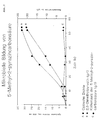
- Fig. 2 shows the results of the biotransformation in the preferred embodiment.
- the corresponding acids can be isolated in a known manner, for example by extraction with organic solvents or, if the alkali metal salt of the heterocycle carboxylic acid is formed, by concentrating the cell-free culture medium.
- the alkali salt of the heterocycle carboxylic acid can be formed, for example, by adding an alkali hydroxide to adjust the pH of the culture medium.
- a simple and one-stage microbiological process for the oxidation of methyl groups in aromatic 5- or 6-ring heterocycles is provided, with which the corresponding acids are isolated in good yield and purity.
- Another advantage of this process is that the aromatic heterocycle is not cleaved and the rate of conversion does not depend on the amount of the enzyme inducer.
- Pseudomonas putida ATCC 33015 was grown in a complex medium (100 ml) "Nutrient Broth No. 2" (Oxoid Ltd., England) in a fermenter at pH 7.0 and a temperature of 30 ° C., the enzyme inducer p-xylene being gaseous according to the information provided by Claus and Walker (J. Gen. Microbiol. 36, 1964, pp. 107-122) up to a concentration of 1 mmol / liter.
- the cells were then washed twice with mineral medium (Kulla et al., Arch. Microbiol. 135, 1983, pp. 1-7) and an optical density of 10 at 650 nm was set in 100 ml of mineral medium.
- Example 1 the following compounds were also used as enzyme inducers, which are summarized in Table 1 with the corresponding concentration.
- Table 1 Enzyme inducer Concentr. [Moles in 100 ml cells] Amount of substrate [1 mmol in 100 ml cells corresponds to 0.108% (w / v)] % Yield of 5-methyl-2-pyrazine carboxylic acid o-xylene 0.1 mmol 2,5-dimethylpyrazine 90 m-xylene 0.1 mmol 2,5-dimethylpyrazine 90 2-chlorotoluene 0.1 mmol 2,5-dimethylpyrazine 90 2-bromotoluene 0.1 mmol 2,5-dimethylpyrazine 90
- Pseudomonas putida ATCC 33015 was, however, grown according to Example 1 in mineral medium (Kulla et al., Arch. Microbiol. 135, 1983, pp. 1-7) with p-xylene as the only source of carbon and energy.
- mineral medium Kerla et al., Arch. Microbiol. 135, 1983, pp. 1-7
- p-xylene As the only source of carbon and energy.
- Pseudomonas putida DSM 5709 was grown analogously to Example 3, but with p-cymene as the only source of carbon and energy. After a period of 16 hours, 0.5 mmol of 5-methyl-2-pyrazinecarboxylic acid, corresponding to a yield of 50%, were on 2,5-dimethylpyrazine.
- Examples 5 to 28 were carried out in accordance with Example 3 with an amount of 1 mmol of substrate per 100 ml of cell suspension and are summarized in Table 2.
- Pseudomonas putida ATCC 33015 was grown to a minimal medium, the composition of which is given in Table 3, in a 20 l bioreactor (2) at a working volume of 15 l.
- the temperature was 30 ° C; the pH was kept constant by metering in potassium hydroxide to a value of 7.0.
- the gassing rate was 20 l per minute.
- a mixture of 4 parts (v / v) p-xylene and 1 part 2,5-dimethylpyrazine was used as the growth substrate. This mixture was fed into the bioreactor (2) via the pump (1).
- the dosage of the growth substrate was coupled to a controller (5) via a xylene measurement (4) in the bioreactor exhaust air (3).
- the control (5) kept the xylene concentration in the exhaust air (3) constant at a value of 0.2 mmol / l.
- Fig. 1 The biotransformation was only stopped when growth was no longer detectable.
- Fig. 2 shows the results of such a biotransformation.
- Curve A in Fig. 2 represents the optical density at 650 nm.
- Curve B in Fig. 2 represents the concentration in g / l of 2,5-dimethylpyrazine.
- Curve C of Fig. 2 represents the concentration in g / l of potassium salt of 5-methyl-2-pyrazinecarboxylic acid.
Landscapes
- Organic Chemistry (AREA)
- Chemical & Material Sciences (AREA)
- Engineering & Computer Science (AREA)
- Zoology (AREA)
- Life Sciences & Earth Sciences (AREA)
- Wood Science & Technology (AREA)
- Chemical Kinetics & Catalysis (AREA)
- Microbiology (AREA)
- General Chemical & Material Sciences (AREA)
- Biotechnology (AREA)
- Health & Medical Sciences (AREA)
- Biochemistry (AREA)
- Bioinformatics & Cheminformatics (AREA)
- General Engineering & Computer Science (AREA)
- General Health & Medical Sciences (AREA)
- Genetics & Genomics (AREA)
- Preparation Of Compounds By Using Micro-Organisms (AREA)
- Enzymes And Modification Thereof (AREA)
Description
- Die Erfindung betrifft ein neues mikrobiologisches Verfahren zur Oxidation von Methylgruppen in aromatischen 5- oder 6-Ring-Heterocyclen zur entsprechenden Carbonsäure, wobei der Heterocyclus keinen Substituenten am benachbarten Kohlenstoffatom der zu oxidierenden Methylgruppe aufweist. Dieser Heterocyclus dient als Substrat für die Umsetzung, die mittels Toluol-, Xylol- oder Cymol-verwertender Mikroorganismen der Gattung Pseudomonas durchgeführt wird, deren Enzyme zuvor induziert wurden.
- Diese Heterocyclencarbonsäuren sind beispielsweise wichtige Zwischenprodukte zur Herstellung für Pharmazeutika. Beispielsweise ist Nikotinsäure (3-Pyridincarbonsäure) ein wichtiges Zwischenprodukt zur Herstellung von Nikotinsäureamid, welches ein Vitamin der B-Gruppe darstellt und eine wesentliche Bedeutung für die Ernährung von Mensch und Tier hat (Ullmann, Bd.19, 1980, S.603).
2-Pyrazincarbonsäure ist z.B. ein wichtiges Zwischenprodukt zur Herstellung des Tuberkulostatikums Pyrazinamid (2-Pyrazincarbonsäureamid) (Römpps Chemie Lexikon, Bd.5, 1987). 4-Thiazolcarbonsäure dient zur Herstellung von Thiabendazol, einem hochwirksamen Antihelmintikum (Wurmmittel), das wiederum Ausgangsmaterial für andere, neuere Antihelmintika, wie z.B. das Cambendazol, ist (Ullmann, Bd.23, 1980, S.46). 2-Thiophencarbonsäure besitzt antiallergische Wirkung (Ullmann, Bd.23, 1980, S.219). - Eingehende Untersuchungen zur Oxidation von Methylgruppen wurden bis jetzt mit aromatischen Kohlenwasserstoffen durchgeführt.
- Die Produktion von Carbonsäuren durch mikrobielle Oxidation von methylierten Aromaten wurde ausführlich in den Arbeiten von Raymond und Mitarbeitern beschrieben (Raymond et al., Process Biochem., 1969, S.71-74).
Die US-PS 3 383 289 beschreibt ein Verfahren zur biochemischen Oxidation von Methylgruppen in aromatischen Kohlenwasserstoffen mit einem gram-positiven Mikroorganismenstamm der Gattung Nocardia. - Nachteile dieser Verfahren sind, dass beispielsweise bei der Methylgruppenoxidation von aromatischen Kohlenwasserstoffen der Benzolring der entsprechenden Säure gespalten wird.
- In Pseudomonas putida ATCC 33015 ist bekannt, dass die biochemische Oxidation der Methylgruppe von Toluol in 3 Schritten zur Benzoesäure verläuft. Durch Einwirkung der Toluol-monoxygenase entsteht zuerst Benzylalkohol, welcher dann in zwei weiteren Schritten, katalysiert durch eine Alkohol- und eine Aldehyddehydrogenase, zur Säure überführt wird.
In diesem Stamm liegen sowohl die Xyl-Gene, die für Enzyme des Xylol-Abbaus kodieren, als auch die Gene, welche für die Regulation der Xyl-Gene verantwortlich sind, auf dem Plasmid pWWO. Dieses archaetypische Tol-Plasmid wurde molekularbiologisch bereits eingehend untersucht (Harayama et al., J. Bacteriol. 171, 1989, S. 5048-5055; Burlage et al., Appl. Environ Microbiol. 55, 1989, S. 1323-1328) - Die SU-PS 487 111 beschreibt ein Verfahren zur mikrobiologischen Oxidation von 2,6-Dimethylnaphthalin zu 6-Methyl-2-naphthalinsäure mit Hilfe von Mikroorganismen der Spezies Pseudomonas putida und Pseudomonas fluorescens. Das Endprodukt wird in einer Ausbeute von ungefähr 50% erhalten. Auch in der SU-PS 370 228 wird die mikrobiologische Oxidation von 2,6-Dimethylnaphthalin beschrieben, wobei die Umsetzungsbedingungen gezielt so gewählt werden, daß als Endprodukt 2,6-Naphthalindicarbonsäure erhalten wird.
- Ebenso sind aus der Literatur mikrobiologische Verfahren zur Oxidation von Methylgruppen eines N-Heterocyclus bekannt. Nach der SU-PS 417 468 wird 2-Methylpyridin mit einem gram-positiven Mikroorganismenstamm der Gattung Nocardia zur entsprechenden Säure oxidiert.
Die SU-PS 228 688 beschreibt ein mikrobiologisches Verfahren zur Herstellung von Nikotinsäure aus 3-Methylpyridin mit einem gram-positiven Mikroorganismus der Gattung Mycobakterium. Aus der SU-PS 302 341 ist ein mikrobiologisches Verfahren zur Herstellung von Nikotinsäure mit gram-positiven Bakterien der Gattung Nocardia bekannt. - Die Nachteile der Methylgruppenoxidation von N-Heterocyclen mit gram-positiven Bakterien bestehen darin, dass bei diesen Alkan-verwertenden Bakterien das Mischungsverhältnis des Alkans zur oxidierenden Substanz genau abgestimmt sein muss, um eine Biotransformation zu erreichen, und dass keine Biotransformation des Substrates in Abwesenheit des Alkans stattfindet, d.h., das zur Induktion verwendete Alkan muss immer, auch bei der Umsetzung des Substrates, anwesend sein. Durch Vergleichsversuche mit dem gram-positiven Bakterium Nocardia und unserem gram-negativen Pseudomonas konnte eindeutig gezeigt werden, dass Nocardia sogar in Gegenwart eines Alkans, wie z.B. Dodecan, 3-Methylpyridin nicht zur Nikotinsäure oxidiert.
- Des weiteren beschreibt die US-PS 4 859 592 ein Verfahren zur Herstellung von Picolinsäure mit Pseudomonas putida, indem ein Alkyl-substituierter aromatischer Kohlenwasserstoff in Gegenwart von molekularem Sauerstoff in einer ersten Stufe durch eine Dioxygenase ein 2-Hydroxymuconsäuresemialdehyd gebildet wird, dieser dann in einer zweiten Stufe mit Ammoniak oder einem primären Amin zur 2-Picolinsäure umgesetzt wird.
- Der Nachteil dieses Verfahrens besteht darin, dass die entsprechende Picolinsäure erst in der zweiten Stufe durch die Umsetzung des 2-Hydroxymuconsäuresemialdehyds mit Ammoniak gebildet wird.
- Die Aufgabe der vorliegenden Erfindung bestand darin, diese Nachteile auszuschalten und ein einfaches und einstufiges Verfahren zur mikrobiologischen Methylgruppenoxidation zu entwickeln mit dem die entsprechenden Säuren in guter Ausbeute und Reinheit isoliert werden können und der aromatische Heterocyclus nicht gespalten wird.
Eine weitere Aufgabe bestand darin, ein Verfahren zur Verfügung zu stellen, bei dem die zur Induktion verwendete Verbindung, nach erfolgter Induktion der Enzyme, während der Umsetzung des Substrates nicht mehr anwesend sein muss und damit die Umsetzung nicht von der Menge des Enzyminduktors abhängt. - Diese Aufgabe wurde gemäss Patentanspruch 1 gelöst.
- Gegenstand der Erfindung ist ein mikrobiologisches Verfahren zur Oxidation von Methylgruppen in aromatischen 5- oder 6-Ring-Heterocyclen, wobei der Heterocyclus keinen Substituenten am benachbarten Kohlenstoffatom der zu oxidierenden Methylgruppe aufweist, zur entsprechenden Carbonsäure, wobei der methylierte Heterocyclus als Substrat für die Umsetzung eingesetzt wird und die Umsetzung mittels Toluol-, Xylol- oder Cymol-verwertender Mikroorganismen der Gattung Pseudomonas durchgeführt wird, deren Enzyme zuvor induziert wurden.
- Zweckmässig wird die Umsetzung mittels Toluol-, Xylol- oder Cymol-verwertender Mikroorganismen der Spezies Pseudomonas putida durchgeführt.
- Vorzugsweise wird der Xylol-verwertende Mikroorganismenstamm Pseudomonas putida mit der Bezeichnung ATCC 33015 oder eine wirksame Mutante von diesem oder der Cymol-verwertende Mikroorganismenstamm Pseudomonas putida mit der Bezeichnung DSM 5709 oder eine wirksame Mutante von diesem, angewendet. Insbesondere wird die Umsetzung mit dem Mikroorganismenstamm Pseudomonas putida ATCC 33105 durchgeführt.
Der Mikroorganismenstamm Pseudomonas putida (DSM 5709) wurde bei der Deutschen Sammlung von Mikroorganismen (DSM) und Zellkulturen GmbH, Mascheroderweg 1b, 3300 Braunschweig, BRD, am 22.12.1989 unter der Nummer DSM 5709 hinterlegt. - Der Mikroorganismenstamm Pseudomonas putida mit der Bezeichnung ATCC 33015 ist bei der American Type Culture Collection 12301 Parklawn Drive Rockville, Maryland 20852, USA, unter der Nummer ATCC 33015 hinterlegt.
- Die Enzyminduktion kann zweckmässig sowohl mit Verbindungen durchgeführt werden, die dem Mikroorganismus als Kohlenstoff- und Energiequelle dienen, wie beispielsweise p-Xylol, m-Xylol, p-Cymol, m-Cymol und Toluol, als auch mit Verbindungen, die dem Mikroorganismus nicht als Kohlenstoff- und Energiequelle dienen, wie beispielsweise mono- und disubstituierte Methyl-, Ethyl- und Chlortoluole, Benzylalkohole und p-Chlorbenzaldehyd, die schon als Enzyminduktoren für den Abbau aromatischer Kohlenwasserstoffe beschrieben sind (Abril M.-A. et al., J.Bacteriol., Vol. 171, 1989, S.6782-6789).
Vorzugsweise wird die Enzyminduktion mit p-Xylol, m-Xylol, 2-Chlortoluol oder 2-Bromtoluol durchgeführt. - Die zur Induktion verwendeten Verbindungen können entweder während der Umsetzung des Substrats anwesend sein oder deren Zufuhr kann vor der Umsetzung des Substrats unterbunden werden.
Die Induktorkonzentration wird üblicherweise so gewählt, dass sie tiefer als die minimale Hemmkonzentration der für die Umsetzung verantwortlichen Enzyme liegt. - Vorzugsweise wird je nach Ausführungsform des Verfahrens die Zufuhr der zur Induktion verwendeten Verbindungen während der Umsetzung des Substrates entweder durch Stoppen der Zufuhr oder durch Abzentrifugieren der Zellen unterbunden.
- Die genannten Stämme wachsen üblicherweise mit p-Xylol, m-Xylol, p-Cymol, m-Cymol oder mit Toluol als einzige Kohlenstoff- und Energiequelle in einem Mineralmedium (Kulla et al., Arch. Microbiol 135, 1983, S.1-7) oder in einem Komplexmedium ("Nutrient Broth Nr.2" Oxoid Ltd., GB) oder in einem Minimalmedium, dessen Zusammensetzung in Tabelle 3 angegeben ist. Das Wachstumssubstrat wurde gemäss den Angaben von Claus und Walker (J. Gen. Microbiol. 36, 1964, S.107-122) gasförmig dem Medium zugeführt, wobei die Begasungsrate 0,5 V/min betrug.
- Vor der Substratzugabe werden die Zellen bis zu einer optischen Dichte von 1 bis 200 bei 650 nm im Kulturmedium angezogen, vorzugsweise bis zu einer optischen Dichte von 5 bis 100 bei 650 nm.
- Die Umsetzung kann zweckmässig entweder unter einmaliger oder kontinuierlicher Substratzugabe erfolgen, so dass die Substratkonzentration im Kulturmedium 20% (w/v) nicht übersteigt. Vorzugsweise erfolgt die Substratzugabe so, dass die Substratkonzentration im Kulturmedium 5% (w/v) nicht übersteigt.
Die Substratzugabe kann auch, je nach Ausführungsform des Verfahrens, gleichzeitig mit dem Enzyminduktor erfolgen, beispielsweise indem ein Gemisch von Enzyminduktor und Substrat eingesetzt wird. - Die Umsetzung wird zweckmässig in einem pH-Bereich von 4 bis 11, vorzugsweise von 6 bis 10 durchgeführt.
- Zweckmässig wird die Umsetzung üblicherweise bei einer Temperatur von 15 bis 50°C, vorzugsweise bei einer Temperatur von 25 bis 40°C durchgeführt.
- Die Umsetzung wird üblicherweise in einer Zeit von 1 bis 24 Stunden durchgeführt.
- Als Substrate können für die Umsetzung zweckmässig methylierte aromatische 5-Ring-Heterocyclen verwendet werden, die ein oder mehrere Heteroatome aus der Reihe Sauerstoff, Stickstoff, Schwefel enthalten, wie beispielsweise methylierte Thiophene, Furane, Pyrrole, Thiazole, Pyrazole oder Imidazole, die keinen Substituenten am benachbarten Kohlenstoffatom der zu oxidierenden Methylgruppe aufweisen; vorzugsweise werden Furane, Thiophene, Pyrrole und Thiazole angewendet. Insbesondere werden als 5-Ring-Heterocyclen 3,5-Dimethylpyrazol, 5-Methylthiazol, 4-Methylthiazol, 2,5-Dimethylthiophen, 2-Methylthiophen, 3-Methylthiophen, 2,5-Dimethylfuran und 2,5-Dimethylpyrrol angewendet .
- Zweckmässig kann die Umsetzung mit aromatischen methylierten 6-Ring-Heterocyclen mit ein oder mehreren Stickstoffatomen als Heteroatom durchgeführt werden, wie beispielsweise methylierte Pyridine, Pyrimidine, Pyrazine oder Pyridazine, die keinen Substituenten am benachbarten Kohlenstoffatom der zu oxidierenden Methylgruppe aufweisen, vorzugsweise werden Pyridine, Pyrazine und Pyrimidine wie beispielsweise 2-Methylpyridin, 3-Methylpyridin, 4-Methylpyridin, 2,5-Dimethylpyridin, 2,4-Dimethylpyridin, 6-Chlor-3-methylpyridin, 2-Chlor-3-ethyl-6-methylpyridin, 4,6-Dimethylpyrimidin, 2-Methylpyrazin, 2,5-Dimethylpyrazin, 2,6-Dimethylpyrazin, 2,3,5-Trimethylpyrazin und 2-Chlor-3,6-dimethylpyrazin angewendet.
- Eine vorzugsweise Ausführungsform des Verfahrens ist in Abb. 1 dargestellt.
Nach dieser Ausführungsform kann der Enzyminduktor und/oder der methylierte Heterocyclus als Substrat in einen Bioreaktor (2) zugeführt werden, wobei die Zufuhrmenge über die Konzentration des Enzyminduktors in der Abluft (3) des Bioreaktors (2) geregelt wird.
Vorzugsweise wird die Konzentration des Enzyminduktors in der Abluft (3) mit einer Messvorrichtung (4) gemessen.
Als Messvorrichtung für die Enzyminduktor-Konzentration kann beispielsweise ein Photometer für ultraviolettes Licht, ein Gaschromatograph oder ein Gaschromatograph gekoppelt mit einem Massenspektrometer dienen.
Diese Messvorrichtung (4) ist zweckmässig über eine Steuerung (5), die die Zufuhrmenge des Enzyminduktors und/oder des methylierten Heterocyclus regelt mit einer Pumpe (1), über die die Zufuhr des Enzyminduktors und/oder des methylierten Heterocyclus in den Bioreaktor (2) erfolgt, gekoppelt. - Durch diese Kopplung wird zweckmässig die Zufuhr des Enzyminduktors und/oder des methylierten Heterocyclus geregelt. Vorzugsweise wird durch diese Regelung die Konzentration des Enzyminduktors in der Abluft (3) konstant gehalten.
- Zweckmässig erfolgt die Regelung so, dass die Konzentration des Enzyminduktors in der Abluft (3) zwischen 0,001 mMol/l Abluft und 10 mMol/l Abluft , vorzugsweise zwischen 0,01 mMol/l Abluft und 3 mMol/l Abluft liegt.
- Vorzugsweise wird der Enzyminduktor und/oder der methylierte Heterocyclus als Substrat in Form einer Mischung in den Bioreaktor (2) zugeführt.
- Das Verhältnis von Enzyminduktor zu Substrat liegt zweckmässig zwischen 5:1 und 3:1.
- Zweckmässig wird nach dieser Ausführungsform der Enzyminduktor und/oder der methylierte Heterocyclus über die Zuluft dem Bioreaktor (2) zugeführt.
- Die Abb. 2 zeigt die Resultate der Biotransformation in der vorzugsweisen Ausführungsform.
- Nach der Umsetzung können die entsprechenden Säuren auf bekannte Art und Weise isoliert werden, beispielsweise durch Extraktion mit organischen Lösungsmitteln oder, falls das Alkalisalz der Heterocycluscarbonsäure gebildet wird, durch Einengen des zellfreien Kulturmediums.
Das Alkalisalz der Heterocycluscarbonsäure kann beispielsweise durch Zugabe eines Alkalihydroxids zur pH-Wert-Einstellung des Kulturmediums gebildet werden. - Erfindungsgemäss wird ein einfaches und einstufiges mikrobiologisches Verfahren zur Oxidation von Methylgruppen in aromatischen 5- oder 6-Ring-Heterocyclen zur Verfügung gestellt, mit dem die entsprechenden Säuren in guter Ausbeute und Reinheit isoliert werden.
Ein weiterer Vorteil dieses Verfahrens besteht darin, dass der aromatische Heterocyclus nicht gespalten wird und die Umsetzungsrate nicht von der Menge des Enzyminduktors abhängt. - Pseudomonas putida ATCC 33015 wurde in einem Komplexmedium (100 ml) "Nutrient Broth Nr. 2" (Oxoid Ltd., England) in einem Fermenter bei pH 7,0 und einer Temperatur von 30°C angezogen, wobei der Enzyminduktor p-Xylol gasförmig gemäss den Angaben von Claus und Walker (J. Gen. Microbiol. 36, 1964, S.107-122) bis zu einer Konzentration von 1 mMol/Liter zugeführt wurde.
Anschliessend wurden die Zellen zweimal mit Mineralmedium (Kulla et al., Arch. Microbiol. 135, 1983, S.1-7) gewaschen und eine optische Dichte von 10 bei 650 nm in 100 ml Mineralmedium eingestellt. Zu dieser Zellsuspension wurde 1 mMol 2,5-Dimethylpyrazin hinzugegeben, was einer Substratkonzentration von 0,108% (w/v) in 100 ml entspricht. Nach einer Inkubation von 4 Stunden bei 30°C wurden in Abwesenheit vom Enzyminduktor 0,9 mMol 5-Methyl-2-pyrazincarbonsäure entsprechend einer Ausbeute von 90%, bezogen auf eingesetztes 2,5-Dimethylpyrazin, erhalten. - Entsprechend zu Beispiel 1 wurden auch folgende Verbindungen als Enzyminduktor angewendet, die mit der entsprechenden Konzentration in Tabelle 1 zusammengefasst sind.
Tabelle 1 Enzyminduktor Konzentr. [Mole in 100 ml Zellen] Substratmenge [1 mMol in 100 ml Zellen entspr. 0,108% (w/v)] % Ausbeute an 5-Methyl-2-pyrazin-carbonsäure o-Xylol 0,1 mMol 2,5-Dimethylpyrazin 90 m-Xylol 0,1 mMol 2,5-Dimethylpyrazin 90 2-Chlortoluol 0,1 mMol 2,5-Dimethylpyrazin 90 2-Bromtoluol 0,1 mMol 2,5-Dimethylpyrazin 90 - Pseudomonas putida ATCC 33015 wurde entsprechend zu Bsp. 1 jedoch in Mineralmedium (Kulla et al., Arch. Microbiol. 135, 1983, S.1-7) mit p-Xylol als einziger Kohlenstoff- und Energiequelle angezogen. Zur Zellsuspension (100 ml) mit einer opt. Dichte von 10 wurde 1 mMol 2,5-Dimethylpyrazin, was einer Konzentration von 0,108% (w/v) entspricht, hinzugegeben. Während der Umsetzung des Substrates wurde die p-Xylol-Zugabe unterbunden. Unter diesen Bedingungen wurde 1 mMol 2,5-Dimethylpyrazin in einem Zeitraum von 4 Stunden zu 0,9 mMol 5-Methyl-2-pyrazincarbonsäure, entsprechend einer Ausbeute von 90%, bez. auf einges. 2,5-Dimethylpyrazin, umgesetzt.
- Pseudomonas putida DSM 5709 wurde analog zu Beispiel 3, jedoch mit p-Cymol als einziger Kohlenstoff- und Energiequelle, angezogen. Nach einem Zeitraum von 16 Stunden wurden 0,5 mMol 5-Methyl-2-pyrazincarbonsäure, entsprechend einer Ausbeute von 50%, bez. auf einges. 2,5-Dimethylpyrazin, erhalten.
- Die Beispiele 5 bis 28 wurden entsprechend zu Beispiel 3 mit einer Menge von 1 mMol Substrat pro 100 ml Zellsuspension durchgeführt und sind in Tabelle 2 zusammengefasst.


- Pseudomonas putida ATCC 33015 wurde einem Minimalmedium, dessen Zusammensetzung in der Tabelle 3 angegeben ist, in einem 20 l Bioreaktor (2) bei einem Arbeitsvolumen von 15 l angezogen.
Die Temperatur betrug 30°C; der pH-Wert wurde durch Dosierung von Kaliumhydroxid auf einen Wert von 7,0 konstant gehalten. Die Begasungsrate betrug 20 l pro Minute. Als Wachstumssubstrat diente ein Gemisch aus 4 Teilen (v/v) p-Xylol und 1 Teil 2,5-Dimethylpyrazin. Die Zufuhr dieser Mischung erfolgte über die Pumpe (1) in den Bioreaktor (2). Die Dosierung des Wachstumssubstrates wurde über eine Xylol-Messung (4) in der Bioreaktor-Abluft (3) mit einer Steuerung (5) gekoppelt. Dabei wurde durch die Steuerung (5) die Xylol-Konzentration in der Abluft (3) auf einen Wert von 0,2 mMol/l konstant gehalten. (Abb. 1)
Die Biotransformation wurde erst dann abgebrochen, wenn kein Wachstum mehr feststellbar war. Abb. 2 zeigt die Resultate einer solchen Biotransformation.
Die Kurve A der Abb. 2 stellt die optische Dichte bei 650 nm dar.
Die Kurve B der Abb. 2 stellt die Konzentration in g/l von 2,5-Dimethylpyrazin dar.
Die Kurve C der Abb. 2 stellt die Konzentration in g/l von Kaliumsalz der 5-Methyl-2-pyrazincarbonsaure dar. - Mit dieser Technik wurden 5-Methyl-2-pyrazincarbonsäure-Konzentrationen von 38 g/l erhalten.
Tabelle 3 Mediumzusammensetzung: - Mg Cl₂ · 6H₂O 0,8 g/l - Ca Cl₂ 0,16 g/l - (NH₄)SO₄ 2 g/l - NH₄Cl 5 g/l - Na₂SO₄ 0,25 g/l - KH₂SO₄ 0,4 g/l - Na₂HPO₄ 0,9 g/l - Spurenelemente 1 ml/l - FeEDTA 15 ml/l Zusammensetzung der Spurenelementlösung: - KOH 15 g/l - EDTANa₂ · 2H₂O 10 g/l - ZnSO₄ · 7H₂O 9 g/l - MnCl₂ · 4H₂O 4 g/l - H₃BO₃ 2,7 g/l - CoCl₂ · 6H₂O 1,8 g/l - CuCl₂ · 2H₂O 1,5 g/l - NiCl₂ · 6H₂O 0,18 g/l - Na₂MoO₄ · 2H₂O 0,2 g/l Zusammensetzung von FeEDTA: - EDTA Na₂ · 2H₂O 5 g/l - FeSO₄ · 7H₂O 2 g/l -
- a) Pseudomonas putida ATCC 33015
Die Biotransformation von 3-Methylpyridin mit Pseudomonas putida ATCC 33015 wurde gemäss Beispiel 3 mit 1 mMol 3-Methylpyridin durchgeführt. Nach einer Inkubationszeit von 8 Stunden wurden 0,25 mMol Nikotinsäure entsprechend einer Ausbeute von 25%, bez. auf einges. 3-Methylpyridin, erhalten. - b) Rhodoccocus rhodochrous bzw. Nocardia
Rhodoccocus rhodochrous DSM 43002 (ATCC 19149) wurde im Mineralmedium gemäss Beispiel 3 mit 0,4% Dodecan als Kohlenstoff- und Energiequelle angezogen und anschliessend im gleichen Mineralmedium, jedoch ohne Dodecan, gewaschen. Die Zellsuspensionen (100 ml) mit einer optischen Dichte bei 650 nm von 10 wurden in drei getrennten Kolben mit folgenden Verbindungen versetzt:
a) 1 mMol 3-Methylpyridin, b) 1 mMol 3-Methylpyridin und 0,055 mMol Dodecan, c) 1 mMol 3-Methylpyridin und 5,5 mMol Dodecan.
Nach 8 Stunden Inkubationszeit bei 30°C konnte in keinem der Ansätze Nikotinsäure nachgewiesen werden.
Claims (13)
- Mikrobiologisches Verfahren zur Oxidation von Methylgruppen in aromatischen 5- oder 6-Ring-Heterocyclen, wobei der Heterocyclus keinen Substituenten am benachbarten Kohlenstoffatom der zu oxidierenden Methylgruppe aufweist, zur entsprechenden Carbonsäure, dadurch gekennzeichnet, dass man den methylierten Heterocyclus als Substrat für die Umsetzung einsetzt und die Umsetzung mittels Toluol-, Xylol- oder Cymol-verwertender Mikroorganismen der Gattung Pseudomonas durchgeführt wird, deren Enzyme zuvor induziert wurden.
- Verfahren nach Patentanspruch 1, dadurch gekennzeichnet, dass die Enzyminduktion entweder mit Verbindungen durchgeführt wird, die dem Mikroorganismus als Kohlenstoff- und Energiequelle dienen, oder mit Verbindungen, die dem Mikroorganismus nicht als Kohlenstoff- und Energiequelle dienen.
- Verfahren nach mindestens einem der Patentansprüche 1 bis 2, dadurch gekennzeichnet, daß die Umsetzung mittels Toluol-, Xylol- oder Cymol-verwertender Mikroorganismen der Spezies Pseudomonas putida durchgeführt wird.
- Verfahren nach mindestens einem der Patentansprüche 1 bis 3, dadurch gekennzeichnet, daß die Umsetzung mit dem Xylol-verwertenden Mikroorganismenstamm Pseudomonas putida mit der Bezeichnung ATCC 33015 oder einer wirksamen Mutante von diesem durchgeführt wird.
- Verfahren nach mindestens einem der Patentansprüche 1 bis 3, dadurch gekennzeichnet, daß die Umsetzung mit dem Cymol-verwertenden Mikroorganismenstamm Pseudomonas putida mit der Bezeichnung DSM 5709 oder einer wirksamen Mutante von diesem durchgeführt wird.
- Verfahren nach mindestens einem der Patentansprüche 1 bis 5, dadurch gekennzeichnet, daß die Umsetzung entweder unter einmaliger oder unter kontinuierlicher Substratzugabe durchgeführt wird, so daß die Substratkonzentration im Kulturmedium 20% (w/v) nicht übersteigt.
- Verfahren nach mindestens einem der Patentansprüche 1 bis 6, dadurch gekennzeichnet, daß die Umsetzung bei einem pH von 4 bis 11 durchgeführt wird.
- Verfahren nach mindestens einem der Patentansprüche 1 bis 7, dadurch gekennzeichnet, daß man die Umsetzung bei einer Temperatur von 15 bis 50°C durchführt.
- Verfahren nach mindestens einem der Patentansprüche 1 bis 8, dadurch gekennzeichnet, daß man die Umsetzung mit einem methylierten aromatischen 5-Ring-Heterocyclus als Substrat durchführt, der ein oder mehrere Heteroatome aus der Reihe Sauerstoff, Stickstoff, Schwefel enthält, z.B. mit einem methylierten Thiophen, Furan, Pyrrol, Thiazol, Pyrazol oder mit einem Imidazol.
- Verfahren nach mindestens einem der Patentansprüche 1 bis 8, dadurch gekennzeichnet, daß man die Umsetzung mit einem methylierten 6-Ring-Heterocyclus als Substrat durchführt, der ein oder mehrere Stickstoffatome als Heteroatom enthält, z.B. mit einem methylierten Pyridin, Pyrimidin, Pyrazin oder mit einem Pyridazin.
- Verfahren nach mindestens einem der Patentansprüche 1 bis 10, dadurch gekennzeichnet, daß man den Enzyminduktor und/oder den methylierten Heterocyclus als Substrat in einen Bioreaktor (2) zuführt, wobei die Zufuhrmenge über die Konzentration des Enzyminduktors in der Abluft (3) des Bioreaktors (2) geregelt wird.
- Verfahren nach Patentanspruch 11, dadurch gekennzeichnet, daß die Konzentration des Enzyminduktors in der Abluft (3) mit einer Messvorrichtung (4) gemessen wird und die Zufuhrmenge des Enzyminduktors und/oder des methylierten Heterocyclus über eine Steuerung (5), die an die Messvorrichtung (4) gekoppelt ist, geregelt wird.
- Verfahren nach mindestens einem der Patentansprüche 11 bis 12, dadurch gekennzeichnet, daß die Regelung so erfolgt, daß die Konzentration des Enzyminduktors in der Abluft (3) konstant gehalten wird und zwischen 0,001 mMol/l Abluft und 10 mMol/l Abluft liegt.
Applications Claiming Priority (2)
| Application Number | Priority Date | Filing Date | Title |
|---|---|---|---|
| CH45890 | 1990-02-13 | ||
| CH458/90 | 1990-02-13 |
Publications (3)
| Publication Number | Publication Date |
|---|---|
| EP0442430A2 EP0442430A2 (de) | 1991-08-21 |
| EP0442430A3 EP0442430A3 (en) | 1992-01-02 |
| EP0442430B1 true EP0442430B1 (de) | 1995-08-30 |
Family
ID=4187478
Family Applications (1)
| Application Number | Title | Priority Date | Filing Date |
|---|---|---|---|
| EP91101902A Expired - Lifetime EP0442430B1 (de) | 1990-02-13 | 1991-02-11 | Mikrobiologische Oxidation von Methylgruppen in Heterocyclen |
Country Status (11)
| Country | Link |
|---|---|
| US (1) | US5104798A (de) |
| EP (1) | EP0442430B1 (de) |
| JP (1) | JP3129748B2 (de) |
| KR (1) | KR100190550B1 (de) |
| AT (1) | ATE127157T1 (de) |
| CA (1) | CA2036139C (de) |
| DE (1) | DE59106337D1 (de) |
| DK (1) | DK0442430T3 (de) |
| ES (1) | ES2076384T3 (de) |
| IE (1) | IE70430B1 (de) |
| RU (1) | RU2037523C1 (de) |
Families Citing this family (21)
| Publication number | Priority date | Publication date | Assignee | Title |
|---|---|---|---|---|
| US5236832A (en) * | 1990-02-13 | 1993-08-17 | Lonza, Ltd. | Microbiological oxidation of methyl groups in heterocycles |
| US5213973A (en) * | 1990-06-06 | 1993-05-25 | Lonza Ltd. | Microbiological process for oxidation of methyl groups |
| CZ279488B6 (cs) * | 1990-09-25 | 1995-05-17 | Lonza A.G. | Způsob mikrobiologické výroby hydroxylovaných heterocyklů |
| US5173412A (en) * | 1990-11-08 | 1992-12-22 | Lonza, Ltd. | Microbiological process for the production of hydroxylated pyrazine derivatives |
| US5238830A (en) * | 1991-02-04 | 1993-08-24 | Lonza Ltd. | Microbiological process for the production of 6-hydroxypicolinic acid |
| US5268294A (en) * | 1991-02-04 | 1993-12-07 | Lonza Ltd. | Alcaligenes faecalis strains useful for the microbiological process for the production of 6-hydroxypicolinic acid |
| KR100233330B1 (ko) * | 1991-02-04 | 1999-12-01 | 하인즈 모제르 | 6-히드록시피콜린산을 제조하기 위한 미생물학적 방법 |
| US5266469A (en) * | 1991-03-18 | 1993-11-30 | Lonza Ltd. | Microbiological process for the production of 6-hydroxynicotinic acid |
| US5264362A (en) * | 1991-03-18 | 1993-11-23 | Lonza Ltd. | Microbiological process for the production of 6-hydroxynicotinic acid |
| CZ279305B6 (cs) * | 1992-01-24 | 1995-04-12 | Lonza A.G. | Kyseliny 2-halogen pyrimidin-4-karboxylové, způsob jejich přípravy a jejich použití pro přípravu derivátů substituovaných pyrimidinů-4-karboxylový ch kyselin |
| EP0707656B1 (de) * | 1993-07-05 | 1998-09-02 | Basf Aktiengesellschaft | Verfahren zur biotechnologischen herstellung von alkoholen, aldehyden und carbonsäuren |
| SE518099C2 (sv) | 1997-11-21 | 2002-08-27 | Claes Johansson Automotive Ab | Inställbart pedalställ för ett fordon |
| US6361979B1 (en) * | 1999-02-12 | 2002-03-26 | Pfizer Inc. | Microbial conversion of 2-methylquinoxaline |
| DE19951768A1 (de) * | 1999-10-27 | 2001-05-03 | Basf Ag | Mikrobiologisches Verfahren zur Herstellung aromatischer Aldehyde und/oder Carbonsäuren |
| US6746856B2 (en) | 2000-08-09 | 2004-06-08 | Pfizer Inc. | Microbial conversion of bicyclic heteroaromatic compounds |
| US7054430B2 (en) * | 2001-08-23 | 2006-05-30 | Paymentone Corporation | Method and apparatus to validate a subscriber line |
| RU2292391C2 (ru) * | 2004-12-23 | 2007-01-27 | Научно-исследовательский центр токсикологии и гигиенической регламентации биопрепаратов (НИЦ ТБП) | ШТАММ БАКТЕРИЙ Pseudomonas putida, ИСПОЛЬЗУЕМЫЙ ДЛЯ ОЧИСТКИ ПОЧВ, ГРУНТОВЫХ И ПОВЕРХНОСТНЫХ ВОД ОТ ТРИНИТРОТОЛУОЛА |
| RU2292392C2 (ru) * | 2004-12-23 | 2007-01-27 | Научно-исследовательский центр токсикологии и гигиенической регламентации биопрепаратов (НИЦ ТБП) | ШТАММ БАКТЕРИЙ Pseudomonas alcaligenes, ИСПОЛЬЗУЕМЫЙ ДЛЯ ОЧИСТКИ ПОЧВ, ГРУНТОВЫХ И ПОВЕРХНОСТНЫХ ВОД ОТ ТРИНИТРОТОЛУОЛА |
| EP2427416B1 (de) | 2009-05-04 | 2016-03-09 | Prometic Pharma Smt Limited | Substituierte aromatische verbindungen und pharmazeutische anwendungen davon |
| EP2428505B1 (de) | 2010-09-13 | 2016-08-10 | Jubilant Life Sciences Limited | Verfahren zur Herstellung von Pyridincarboxylsäuren |
| CN103017421B (zh) * | 2012-12-27 | 2015-08-26 | 合肥美的电冰箱有限公司 | 丝管蒸发器和具有该丝管蒸发器的冰箱 |
Family Cites Families (8)
| Publication number | Priority date | Publication date | Assignee | Title |
|---|---|---|---|---|
| US3393289A (en) * | 1964-11-12 | 1968-07-16 | United Aircraft Corp | Self-cleaning electron beam exit orifice |
| SU417468A1 (de) * | 1972-02-09 | 1974-02-28 | ||
| US4859592A (en) * | 1985-07-26 | 1989-08-22 | Hagedorn Scott R | Production of picolinic acid and pyridine products via pseudomonas |
| GB8600245D0 (en) * | 1986-01-07 | 1986-02-12 | Shell Int Research | Preparation of 2-arylpropionic acids |
| JPH01120292A (ja) * | 1987-11-04 | 1989-05-12 | Sumitomo Metal Ind Ltd | 芳香族縮合環炭化水素の微生物酸化方法 |
| JPH084515B2 (ja) * | 1987-11-09 | 1996-01-24 | 出光興産株式会社 | 有機化合物の製造方法 |
| JPH02207795A (ja) * | 1989-02-08 | 1990-08-17 | Kanagawa Pref Gov | 新規微生物およびそれを用いる2―チオフェン酢酸の製造方法 |
| JPH03291575A (ja) * | 1990-04-10 | 1991-12-20 | Shikoku Sogo Kenkyusho:Kk | 電力ケーブルの絶縁劣化診断方法 |
-
1991
- 1991-01-29 IE IE30991A patent/IE70430B1/en not_active IP Right Cessation
- 1991-02-05 US US07/650,589 patent/US5104798A/en not_active Expired - Lifetime
- 1991-02-11 DE DE59106337T patent/DE59106337D1/de not_active Expired - Fee Related
- 1991-02-11 DK DK91101902.4T patent/DK0442430T3/da active
- 1991-02-11 ES ES91101902T patent/ES2076384T3/es not_active Expired - Lifetime
- 1991-02-11 EP EP91101902A patent/EP0442430B1/de not_active Expired - Lifetime
- 1991-02-11 AT AT91101902T patent/ATE127157T1/de not_active IP Right Cessation
- 1991-02-12 RU SU914894481A patent/RU2037523C1/ru active
- 1991-02-12 KR KR1019910002357A patent/KR100190550B1/ko not_active Expired - Fee Related
- 1991-02-12 CA CA002036139A patent/CA2036139C/en not_active Expired - Lifetime
- 1991-02-12 JP JP03018999A patent/JP3129748B2/ja not_active Expired - Fee Related
Non-Patent Citations (4)
| Title |
|---|
| SOVIET INVENTIONS ILLUSTRATED, Ch Sektion, Band V, Nr. 44, 06 Dezember 1973, Derwent Publications LTD., London (GB); D 16 - E 14, Seite 4 * |
| SOVIET INVENTIONS ILLUSTRATED, Ch Sektion, Band W, Nr. 2, 18 Februar 1975, Derwent Publications LTD., London (GB); D 16 - E 13 * |
| SOVIET INVENTIONS ILLUSTRATED, Ch Sektion, Mai 1969, Derwent Publications LTD., London (GB); Seite 3 * |
| SOVIET INVENTIONS ILLUSTRATED, Ch Sektion, Woche Y-08, 05 April 1977, Derwent Publications LTD., London (GB); D 15, Seite 2 * |
Also Published As
| Publication number | Publication date |
|---|---|
| US5104798A (en) | 1992-04-14 |
| CA2036139A1 (en) | 1991-08-14 |
| KR100190550B1 (ko) | 1999-06-01 |
| IE910309A1 (en) | 1991-08-14 |
| ES2076384T3 (es) | 1995-11-01 |
| IE70430B1 (en) | 1996-11-27 |
| JPH057494A (ja) | 1993-01-19 |
| DE59106337D1 (de) | 1995-10-05 |
| ATE127157T1 (de) | 1995-09-15 |
| RU2037523C1 (ru) | 1995-06-19 |
| EP0442430A3 (en) | 1992-01-02 |
| JP3129748B2 (ja) | 2001-01-31 |
| CA2036139C (en) | 2000-01-11 |
| DK0442430T3 (da) | 1995-09-25 |
| KR910015703A (ko) | 1991-09-30 |
| EP0442430A2 (de) | 1991-08-21 |
Similar Documents
| Publication | Publication Date | Title |
|---|---|---|
| EP0442430A2 (de) | Mikrobiologische Oxidation von Methylgruppen in Heterocyclen | |
| EP0099517B1 (de) | Verfahren zur Durchführung elektromikrobieller Reduktionen | |
| US5236832A (en) | Microbiological oxidation of methyl groups in heterocycles | |
| EP0498316B1 (de) | Mikrobielles Verfahren zur Herstellung von 6-Hydroxypicolinsäure | |
| US5213973A (en) | Microbiological process for oxidation of methyl groups | |
| EP0559116B1 (de) | Mikrobiologisches Verfahren zur Hydroxylierung von Stickstoff-Heterocyclus-Carbonsäuren | |
| EP0529653B1 (de) | Mikrobiologisches Verfahren zur Herstellung von 6-Hydroxypyrazincarbonsäure | |
| EP0466115A1 (de) | Mikrobiologische Oxidation von Ethylgruppen in Heterocyclen | |
| EP0519512B1 (de) | Mikrobiologisches Verfahren zur Herstellung von 5-Hydroxypyrazincarbonsäure | |
| DE3801450A1 (de) | Verfahren fuer die synthese von vinblastin und vincristin | |
| DE3882156T2 (de) | Pseudomonasstamm. | |
| DE3689174T2 (de) | Verfahren zur Herstellung von Riboflavin. | |
| Berson et al. | Cis-Addition in the Bromination of a Bicyclic Olefin | |
| EP0578137B1 (de) | Mikrobiologisches Verfahren zur Herstellung von 5-Hydroxy-2-pyrazincarbonsäure | |
| EP0556465B1 (de) | Mikrobiologisches Verfahren zur Herstellung von aromatischen Hydroxy-Heterocyclus-Carbonsäuren | |
| EP0502524B1 (de) | Mikrobiologisches Verfahren zur terminalen Hydroxylierung von Ethylgruppen an aromatischen 5- oder 6-Ring-Heterocyclen | |
| Singh | Role of carbon and nitrogen sources in bacterial growth and sporulation | |
| SK236691A3 (en) | Microbiologic oxidation of methyl groups in heterocycles | |
| EP0713869B1 (de) | Di- und trisubstituierte Pyridine und Verfahren zu ihrer Herstellung | |
| EP0505514B1 (de) | VERFAHREN ZUR HERSTELLUNG VON $g(b)-CARBOLIN-DERIVATEN | |
| DE1015796B (de) | Verfahren zur Herstellung von N-Mono- und N-Di-(tertiaeren butyl)-anhydrotetracyclinen | |
| DE1128854B (de) | Verfahren zur Herstellung von 11-hydroxylierten Steroiden der Pregnanreihe | |
| DE2166092C3 (de) | Mikrobiologisches Verfahren zur Herstellung von d-Threo-2-isobutyramidol-p-nitrophenyl-l,3-propandiol. Ausscheidung aus: 2120153 | |
| DE1470232A1 (de) | 4-Nitropyridazin-Derivate und Verfahren zu deren Herstellung | |
| DD222310A1 (de) | Verfahren zur herstellung von 5-cyan-1,3-thiazin-6-onen |
Legal Events
| Date | Code | Title | Description |
|---|---|---|---|
| PUAI | Public reference made under article 153(3) epc to a published international application that has entered the european phase |
Free format text: ORIGINAL CODE: 0009012 |
|
| AK | Designated contracting states |
Kind code of ref document: A2 Designated state(s): AT BE CH DE DK ES FR GB IT LI LU NL SE |
|
| PUAL | Search report despatched |
Free format text: ORIGINAL CODE: 0009013 |
|
| AK | Designated contracting states |
Kind code of ref document: A3 Designated state(s): AT BE CH DE DK ES FR GB IT LI LU NL SE |
|
| 17P | Request for examination filed |
Effective date: 19920701 |
|
| 17Q | First examination report despatched |
Effective date: 19940704 |
|
| RAP1 | Party data changed (applicant data changed or rights of an application transferred) |
Owner name: LONZA AG |
|
| GRAA | (expected) grant |
Free format text: ORIGINAL CODE: 0009210 |
|
| AK | Designated contracting states |
Kind code of ref document: B1 Designated state(s): AT BE CH DE DK ES FR GB IT LI LU NL SE |
|
| REF | Corresponds to: |
Ref document number: 127157 Country of ref document: AT Date of ref document: 19950915 Kind code of ref document: T |
|
| REG | Reference to a national code |
Ref country code: DK Ref legal event code: T3 |
|
| REF | Corresponds to: |
Ref document number: 59106337 Country of ref document: DE Date of ref document: 19951005 |
|
| ITF | It: translation for a ep patent filed | ||
| REG | Reference to a national code |
Ref country code: ES Ref legal event code: FG2A Ref document number: 2076384 Country of ref document: ES Kind code of ref document: T3 |
|
| GBT | Gb: translation of ep patent filed (gb section 77(6)(a)/1977) |
Effective date: 19951113 |
|
| ET | Fr: translation filed | ||
| PLBE | No opposition filed within time limit |
Free format text: ORIGINAL CODE: 0009261 |
|
| STAA | Information on the status of an ep patent application or granted ep patent |
Free format text: STATUS: NO OPPOSITION FILED WITHIN TIME LIMIT |
|
| 26N | No opposition filed | ||
| PGFP | Annual fee paid to national office [announced via postgrant information from national office to epo] |
Ref country code: LU Payment date: 19990219 Year of fee payment: 9 |
|
| PG25 | Lapsed in a contracting state [announced via postgrant information from national office to epo] |
Ref country code: LU Free format text: LAPSE BECAUSE OF NON-PAYMENT OF DUE FEES Effective date: 20000211 |
|
| REG | Reference to a national code |
Ref country code: CH Ref legal event code: PFA Free format text: LONZA AG, GAMPEL/WALLIS. GESCHAEFTSLEITUNG,,4002 BASEL (CH) TRANSFER- LONZA AG,LONZASTRASSE,3930 VISP (CH) |
|
| REG | Reference to a national code |
Ref country code: GB Ref legal event code: IF02 |
|
| PGFP | Annual fee paid to national office [announced via postgrant information from national office to epo] |
Ref country code: DK Payment date: 20081229 Year of fee payment: 19 Ref country code: CH Payment date: 20081229 Year of fee payment: 19 |
|
| PGFP | Annual fee paid to national office [announced via postgrant information from national office to epo] |
Ref country code: BE Payment date: 20081229 Year of fee payment: 19 Ref country code: SE Payment date: 20081223 Year of fee payment: 19 |
|
| PGFP | Annual fee paid to national office [announced via postgrant information from national office to epo] |
Ref country code: ES Payment date: 20090216 Year of fee payment: 19 Ref country code: AT Payment date: 20081229 Year of fee payment: 19 |
|
| PGFP | Annual fee paid to national office [announced via postgrant information from national office to epo] |
Ref country code: NL Payment date: 20081229 Year of fee payment: 19 Ref country code: DE Payment date: 20081229 Year of fee payment: 19 |
|
| PGFP | Annual fee paid to national office [announced via postgrant information from national office to epo] |
Ref country code: GB Payment date: 20081219 Year of fee payment: 19 |
|
| PGFP | Annual fee paid to national office [announced via postgrant information from national office to epo] |
Ref country code: FR Payment date: 20081219 Year of fee payment: 19 |
|
| BERE | Be: lapsed |
Owner name: *LONZA A.G. Effective date: 20100228 |
|
| REG | Reference to a national code |
Ref country code: NL Ref legal event code: V1 Effective date: 20100901 |
|
| REG | Reference to a national code |
Ref country code: CH Ref legal event code: PL |
|
| REG | Reference to a national code |
Ref country code: DK Ref legal event code: EBP |
|
| EUG | Se: european patent has lapsed | ||
| GBPC | Gb: european patent ceased through non-payment of renewal fee |
Effective date: 20100211 |
|
| PG25 | Lapsed in a contracting state [announced via postgrant information from national office to epo] |
Ref country code: CH Free format text: LAPSE BECAUSE OF NON-PAYMENT OF DUE FEES Effective date: 20100228 Ref country code: LI Free format text: LAPSE BECAUSE OF NON-PAYMENT OF DUE FEES Effective date: 20100228 |
|
| REG | Reference to a national code |
Ref country code: FR Ref legal event code: ST Effective date: 20101029 |
|
| PG25 | Lapsed in a contracting state [announced via postgrant information from national office to epo] |
Ref country code: AT Free format text: LAPSE BECAUSE OF NON-PAYMENT OF DUE FEES Effective date: 20100211 |
|
| PG25 | Lapsed in a contracting state [announced via postgrant information from national office to epo] |
Ref country code: DK Free format text: LAPSE BECAUSE OF NON-PAYMENT OF DUE FEES Effective date: 20100228 Ref country code: FR Free format text: LAPSE BECAUSE OF NON-PAYMENT OF DUE FEES Effective date: 20100301 Ref country code: NL Free format text: LAPSE BECAUSE OF NON-PAYMENT OF DUE FEES Effective date: 20100901 |
|
| PG25 | Lapsed in a contracting state [announced via postgrant information from national office to epo] |
Ref country code: BE Free format text: LAPSE BECAUSE OF NON-PAYMENT OF DUE FEES Effective date: 20100228 Ref country code: DE Free format text: LAPSE BECAUSE OF NON-PAYMENT OF DUE FEES Effective date: 20100901 |
|
| PG25 | Lapsed in a contracting state [announced via postgrant information from national office to epo] |
Ref country code: GB Free format text: LAPSE BECAUSE OF NON-PAYMENT OF DUE FEES Effective date: 20100211 Ref country code: IT Free format text: LAPSE BECAUSE OF NON-PAYMENT OF DUE FEES Effective date: 20090211 |
|
| REG | Reference to a national code |
Ref country code: ES Ref legal event code: FD2A Effective date: 20110407 |
|
| PG25 | Lapsed in a contracting state [announced via postgrant information from national office to epo] |
Ref country code: ES Free format text: LAPSE BECAUSE OF NON-PAYMENT OF DUE FEES Effective date: 20110324 |
|
| PGFP | Annual fee paid to national office [announced via postgrant information from national office to epo] |
Ref country code: IT Payment date: 20090112 Year of fee payment: 19 |
|
| PGRI | Patent reinstated in contracting state [announced from national office to epo] |
Ref country code: IT Effective date: 20110616 |
|
| PG25 | Lapsed in a contracting state [announced via postgrant information from national office to epo] |
Ref country code: ES Free format text: LAPSE BECAUSE OF NON-PAYMENT OF DUE FEES Effective date: 20100212 |
|
| PG25 | Lapsed in a contracting state [announced via postgrant information from national office to epo] |
Ref country code: SE Free format text: LAPSE BECAUSE OF NON-PAYMENT OF DUE FEES Effective date: 20100212 |
|
| PGRI | Patent reinstated in contracting state [announced from national office to epo] |
Ref country code: IT Effective date: 20110616 |