EP0442653B1 - Aufnahme von Gruppen in Polymere, hergestellte Polymere und diese Polymere enthaltende Zusammensetzungen - Google Patents
Aufnahme von Gruppen in Polymere, hergestellte Polymere und diese Polymere enthaltende Zusammensetzungen Download PDFInfo
- Publication number
- EP0442653B1 EP0442653B1 EP91300953A EP91300953A EP0442653B1 EP 0442653 B1 EP0442653 B1 EP 0442653B1 EP 91300953 A EP91300953 A EP 91300953A EP 91300953 A EP91300953 A EP 91300953A EP 0442653 B1 EP0442653 B1 EP 0442653B1
- Authority
- EP
- European Patent Office
- Prior art keywords
- polymer
- groups
- group
- process according
- precursor
- Prior art date
- Legal status (The legal status is an assumption and is not a legal conclusion. Google has not performed a legal analysis and makes no representation as to the accuracy of the status listed.)
- Expired - Lifetime
Links
Classifications
-
- C—CHEMISTRY; METALLURGY
- C08—ORGANIC MACROMOLECULAR COMPOUNDS; THEIR PREPARATION OR CHEMICAL WORKING-UP; COMPOSITIONS BASED THEREON
- C08F—MACROMOLECULAR COMPOUNDS OBTAINED BY REACTIONS ONLY INVOLVING CARBON-TO-CARBON UNSATURATED BONDS
- C08F8/00—Chemical modification by after-treatment
-
- C—CHEMISTRY; METALLURGY
- C08—ORGANIC MACROMOLECULAR COMPOUNDS; THEIR PREPARATION OR CHEMICAL WORKING-UP; COMPOSITIONS BASED THEREON
- C08F—MACROMOLECULAR COMPOUNDS OBTAINED BY REACTIONS ONLY INVOLVING CARBON-TO-CARBON UNSATURATED BONDS
- C08F8/00—Chemical modification by after-treatment
- C08F8/10—Acylation
-
- C—CHEMISTRY; METALLURGY
- C08—ORGANIC MACROMOLECULAR COMPOUNDS; THEIR PREPARATION OR CHEMICAL WORKING-UP; COMPOSITIONS BASED THEREON
- C08F—MACROMOLECULAR COMPOUNDS OBTAINED BY REACTIONS ONLY INVOLVING CARBON-TO-CARBON UNSATURATED BONDS
- C08F8/00—Chemical modification by after-treatment
- C08F8/30—Introducing nitrogen atoms or nitrogen-containing groups
Definitions
- the present invention relates to a process for the production of polymers having desired groups incorporated therein, to the polymers so produced, and to compositions containing these polymers.
- desired groups may be incorporated either by employing as a monomer in the preparation of the polymer a compound which already has such groups, or by post-reacting a precursor polymer having precursor groups which may be converted by reaction(s) with a suitable reagent(s) to the desired groups.
- a process for the production of a polymer having desired groups herein denoted by Y, incorporated therein which process comprises reacting a precursor polymer having carbon- or nitrogen-bound -NH 2 and/or -NH- precursor groups, which groups are reactable with enolic carbonyl groups, with at least one compound having a single enolic carbonyl group and at least one group Y, where by an enolic carbonyl group is mean herein a carbonyl group having enolic character by virtue of being bonded to an alpha methylene or methine group which is itself bonded alpha to an electron withdrawing group, and wherein further Y is selected from an olefinically unsaturated double bond, a thiol group, a nonionic dispersing group, a siloxane group, an epoxide group, a phosphonate group, and a phosphate group.
- DE-A-2831302 there is disclosed a crosslinkable polymer which is prepared by reacting a precursor polymer having hydroxyl and/or primary or secondary amino groups with a compound which retains an active methylene group after the reaction has taken place.
- the reactant compound is preferably one in which the active methylene group lies between two carbonyl groups, more preferably being a lower alkyl acetoacetate and in particular being ethyl acetoacetate.
- Y groups as defined herein into an amino-containing polymer by reaction of such amino groups with the acetoacetate group of a compound which also has a group(s) Y.
- the groups Y in the polymer made by the invention process may be disposed as chain-pendant (lateral) or terminal groups in the polymer according to the disposition of the precursor groups in the precursor polymer.
- the group Y will also be chain-pendant in the final polymer.
- the groups Y will also be terminal in the final polymer.
- a group Y is still considered as a terminal group in the polymer if it has been incorporated via a terminal precursor group of the precursor polymer, ie irrespective of whether it is actually an end or capping group of the final polymer or whether it is separated from the end of the final polymer by intermediate chemical species).
- an enolic carbonyl group is meant a carbonyl group (normally a ketonic carbonyl but possibly an aldehydic carbonyl) having enolic character by virtue of being bonded to an alpha (i.e. adjacent) methylene group (-CH 2 -) or methine group with there being an electron withdrawing group which is itself bonded alpha (i.e. adjacent) to the methylene or methine group, or in other words bonded beta to the carbonyl group.
- Such a carbonyl group also exists (to a significant degree) in its tautomeric enol structure.
- the enolising tautomerism may be represented as the following equilibrium.
- the facile enolisability of the carbonyl group is due to the presence of the electron withdrawing grouping.
- electron withdrawing groups in enolic carbonyl groups include acid ester groups (the methylene or methine being bonded to the carbonyl carbon atom of the ester), acid amide groups (the methylene or methine groups being bonded to the carbonyl carbon atom of the acid amide), aryl groups (eg phenyl or phenylene groups), and ketonic carbonyl groups.
- the electron withdrawing group as a whole may be univalent (ie capping the methylene or methine group ) or, (as is also quite usual) may be divalent or multivalent (ie being bonded to a further moeity or moeities in the compound).
- the enolic carbonyl grouping having a methine group (rather than a methylene group) the remaining bond of this methine carbon atom (the others being attached to H, the carbonyl carbon atom, and the electron withdrawing group) should be attached to a group which does not affect the enolisability of the carbonyl group (eg.
- alkyl or substituted alkyl alkylene or substituted alkylene, alkanetriyl or substituted alkanetriyl, aryl or substituted aryl).
- Such a group can be monovalent (eg alkyl), divalent (eg alkylene) or multivalent (eg. trivalent eg alkanetriyl).
- alkylene group the divalent radical derived from the removal of any hydrogen atom from an alkyl radical and by an alkanetriyl group the trivalent radical derived from the removal of any hydrogen atom from an alkylene radical.
- the simplest alkylene radical is therefore methylene -CH 2 - and the simplest alkanetriyl radical is therefore methine
- keto ester groups eg keto amide groups, eg 1,3-diketone groups, eg keto alkaryl groups, eg where R 1 , R 2 and R 3 are hydrocarbyl radicals (optionally substituted) such as alkylene or alkanetriyl (usually of 1 to 10 carbons and typically methylene) and Ar is an arylene group (optionally substituted) such as ortho or para phenylene.
- R 1 , R 2 and R 3 are hydrocarbyl radicals (optionally substituted) such as alkylene or alkanetriyl (usually of 1 to 10 carbons and typically methylene) and Ar is an arylene group (optionally substituted) such as ortho or para phenylene.
- R 1 , R 2 and R 3 are hydrocarbyl radicals (optionally substituted) such as alkylene or alkanetriyl (usually of 1 to 10 carbons and typically methylene) and Ar is an arylene group (optionally substituted) such as ortho or para pheny
- a group Y may be monovalent as a whole, so that it (in effect) caps the chemical species to which it is attached ( ⁇ -Y) or it may be divalent (or multivalent) so that it is bonded at two or more sites to other chemical species (eg ⁇ -Y- ⁇ ).
- a group Y may be lateral or terminal in the resulting final polymer according to whether the precursor group is lateral or terminal.
- the groups Y employed in the present invention are as follows :
- the groups Y should not of course be of a type which will unacceptably interfere with the reaction of the -NH 2 or -NH- groups with the enolic carbonyl groups under the prevailing conditions of the process - thereby unacceptably interfering with the attachment of the Y groups to the polymer (eg. by competing too successfully with the enolic carbonyls for reaction with the -NH 2 or -NH- groups).
- the basic polymer structure of a polymer according to the present invention may be derived by the use of any suitable polymerisation technique.
- the polymer structure may be that of an olefinic addition polymer, ie. formed by the free-radical addition polymerisation of at least one (usually 2 or more) olefinically unsaturated monomer(s).
- the polymer structure may also be formed by a non-free radical addition polymerisation process or a condensation polymerisation process; examples of polymers formed in this way are polyurethane polymers [including poly(urethane-urea) polymers], polyester polymers, polyether polymers, polyimide polymers, and polyepoxide polymers.
- the techniques used for such polymerisation processes are well known and a detailed discussion thereof is not necessary here.
- olefinically unsaturated monomers may be used to provide polymerised units of the polymer.
- an -NH 2 terminated polyurethane polymer may be prepared by taking an isocyanate-terminated polyurethane polymer (eg an isocyanate-terminated prepolymer) and converting the terminal isocyanate groups thereof to groups providing carbon-or nitrogen-bound -NH 2 and/or -NH- groups which are capable of reaction with enolic carbonyl groups (instead of eg in the case of using an isocyanate-terminated prepolymer, chain-extending with an active hydrogen chain-extending material).
- an isocyanate-terminated polyurethane polymer eg an isocyanate-terminated prepolymer
- Such a conversion may be affected by using an appropriate amount of a reagent such as hydrazine hydrate or a polyamino compound (eg a diamine or triamine). Water itself may be used, the terminal NCO groups being converted to -NH 2 groups by hydrolysis.
- a reagent such as hydrazine hydrate or a polyamino compound (eg a diamine or triamine).
- Water itself may be used, the terminal NCO groups being converted to -NH 2 groups by hydrolysis.
- the relevant reaction involved is the conversion of the terminal isocyanate groups of the polyurethane to terminal semicarbazide groups as follows:
- the resulting polymer (now a precursor polymer for producing a polymer according to the invention) could then be reacted with a compound having a single enolic carbonyl group and at least one group Y (thereby yielding a polymer according to the invention having terminal groups Y) according to the following possible schematic reaction: where Y is a desired group as defined herein, such as an olefinic double bond.
- the amount of reagent for introducing -NH 2 or -NH- groups into an isocyanate terminated polyurethane polymer may (if desired) be such as to effect a substantial proportion of chain extension (since it will of course be appreciated that such reagents are equally effective as chain-extension agents if used in sufficient quantity) as well as providing the desired level of termination required for subsequent functionalisation.
- an -NH 2 terminated polyurethane polymer could also (perhaps more simply) be formed by first forming an NCO terminated prepolymer and then chain extending conventionally with a stoichoimetric excess of an active hydrogen chain extending material such as hydrazine or a polyamine so as to produce an -NH 2 terminated polyurethane after chain- extension; the terminal -NH 2 groups could then be reacted with a compound having a single enolic carbonyl group and at least one group Y as defined herein thereby to form a polymer according to the invention having terminal groups Y].
- Suitable reagents either for converting the terminal NCO groups of a polyurethane prepolymer to -NH 2 groups and/or for effecting chain - extension of a polyurethane prepolymer so as to yield an -NH 2 terminated polymer after chain extension, include ethylene diamine, propylene diamine, butylene diamine, hexamethylene diamine, cyclohexylene diamine, piperazine, 2-methyl piperazine, phenylene diamine, tolylene diamine, xylene diamine, 4,4'-diaminodiphenyl -methane, menthane diamine, m-xylene diamine, isophorone diamine.
- hydrazine or hydrazine hydrate, azines such as acetone azine, substituted hydrazines such as, for example, dimethyl hydrazine, 1,6-hexamethylene-bis-hydrazine, carbodihydrazine, hydrazides of dicarboxylic acids and sulfonic acids such as adipic acid mono- or dihydrazide, oxalic acid dihydrazide, isophthalic acid dihydrazide, hydrazides made by reacting lactones with hydrazine such as gamma-hydroxylbutyric hydrazide, bis-semi-carbazide, and bis-hydrazide carbonic esters of glycols.
- water itself may be used
- an olefinic addition polymer ie a polymer derived by the free-radical addition polymerisation of at least one olefinically unsaturated monomer bearing chain-pendant (lateral) amino groups (precursor polymer) may be prepared by first preparing an olefinic addition polymer bearing chain-pendant (lateral) carboxyl groups (preprecursor polymer), and then converting at least a proportion of the lateral carboxyl groups of the preprecursor polymer to groups providing lateral amino groups (precursor polymer).
- a preprecursor olefinic addition polymer bearing lateral carboxyl groups is conveniently prepared by polymerising at least one olefinically unsaturated monomer bearing at least one carboxyl group and optionally (but normally) at least one other olefinically unsaturated monomer (ie not bearing a carboxyl group).
- Monomers which can be used to provide carboxyl groups in a preprecursor polymer are particularly ⁇ , ⁇ -monoolefinically unsaturated monocarboxylic acids and/or dicarboxylic acids, mostly of 3 to 6 carbon atoms, especially acrylic acid, methacrylic acid, beta-carboxyethylacrylate, fumaric acid and itaconic acid.
- the chain pendant carboxyl groups of a preprecursor olefinic addition polymer may, for example, conveniently be converted to the lateral amino groups of a precursor polymer by means of an immination reaction involving the carboxyl (or derived carboxylate salt) group and an added aziridine compound.
- the aziridine compound is commonly referred to an alkylene imine and preferably has the formula where R 8 and R 9 which may be the same or different are selected from hydrogen, benzyl, aryl, and C1 to C5 alkyl; and where R 10 is hydrogen or C1 to C5 alkyl. More preferably R 8 is hydrogen, R 9 is hydrogen or C1 to C5 alkyl (particularly methyl) and R 10 is hydrogen.
- the corresponding chain pendant amino ester groups (providing the chain pendant amino groups) formed by the immination reaction can be represented in the following schematic formulae: and possibly (the latter being formed by further reaction of some of the pendant primary amine groups with the aziridine) where R 8 , R 9 and R 10 are as defined above.
- the amount of alkylene imine used should be sufficient to imminate the desired proportion of the carboxyl groups to aminoalkyl ester groups. Preferably the amount used should be sufficient to imminate about 5% to 95%, preferably 20% to 80% (more preferably 34-70%), of the carboxyl groups on the preprecursor polymer.
- the immination technique is in itself well-known and may be performed by techniques known to the art.
- Useful precursor olefinic polymers for the present invention are imminated acrylic polymers (i.e. having at least a proportion, usually a high level, of acrylic or methacrylic ester units as defined above as well as imminised units providing lateral amino groups). Such polymers could, for example, be reacted with enolic compounds having a desired group Y (e.g. 2-(acetoacetoxy)ethyl methacrylate) to yield the desired functionalised polymer having the groups Y incorporated therein.
- a desired group Y e.g. 2-(acetoacetoxy)ethyl methacrylate
- the chain-pendant amine functionality could of course be introduced into the olefinic addition precursor polymer by techniques other than immination (eg by using as a monomer an olefinically unsaturated oxazoline monomer, such as 2-isopropenyl oxazoline followed by hydrolysis of the oxazoline groups to aminoalkyl ester groups).
- non-free radical addition-type precursor polymer such as a polyurethane, bearing lateral amino groups could be employed (ie instead of an olefinic polymer).
- Such a polyurethane polymer could eg be made by employing as a reactant in the polyurethane prepolymer formation an isocyanate-reactive compound having at least one carboxyl group and at least two isocyanate-reactive groups, such as 2,2-dimethylolpropionic acid, thereby to provide lateral carboxyl groups in the prepolymer, and converting the lateral carboxyl groups to groups providing lateral amino groups (eg by immination as described supra for olefinic polymers) whether before or after chain-extension (whichever is more appropriate or convenient).
- an isocyanate-reactive compound having at least one carboxyl group and at least two isocyanate-reactive groups, such as 2,2-dimethylolpropionic acid
- the polymerisation to form the basic polymer structure may be carried out in an aqueous medium or in an organic liquid medium (sometimes in bulk) as appropriate or desired, giving rise to aqueous- or organic liquid- based dispersions (eg latices, suspensions or solutions).
- the conversions of preprecursor polymer (where used) to precursor polymer, and precursor polymer to final polymer may likewise be carried out in an aqueous or organic liquid medium as desired or appropriate, and the medium employed for the polymerisation process to form the basic polymer structure may be basically the same as that used for the conversion(s). However, the medium employed for the polymerisation could if desired or if appropriate be changed for the conversion(s).
- the organic liquid medium used for making a polyurethane polymer may be changed if desired to an aqueous-based medium for the purpose of forming -NH 2 groups on the polyurethane polymer and subsequent conversion to a final polymer containing the desired groups Y.
- the (final) polymer of the invention may be formed as, or subsequently be converted to, an aqueous-based or organic liquid-based dispersion, and particularly the former since many preferred applications of the polymers of the invention involve their use as aqueous dispersions.
- an "aqueous dispersion" of a polymer means a dispersion of the polymer in an aqueous medium of which water is the principal component. Minor amounts of organic liquid may optionally be present)
- the polymers of the invention may have appropriate ionic and/or non-ionic lateral dispersing groups; these can be incorporated at any suitable stage of the synthesis.
- the polymers of the present invention are usefully employed as organic (or more preferably) as aqueous dispersions.
- Such dispersions may be used "as is” (apart from optional dilution with water and/or organic liquid or concentration by evaporation of water and/or organic liquid) in various applications or (more usually) may be used as a component of organic-based or (more usually) aqueous-based compositions incorporating other additional components, for example coreactant materials (appropriate to the Y groups) which will take part in (or assist with) a reaction involving the Y groups under certain conditions - as for example when the composition is a coating composition and the coreactant takes part in (or assists) a reaction involving the Y groups such as crosslinking during and/or after film formation from the composition (when the dispersing medium is being or has been removed).
- a coreactant material which is intended for inclusion in an eventual composition, to be present in the system when the -NH 2 and/or -NH- groups of the precursor polymer are reacted with the enolic carbonyl compound.
- the coreactant material may be admixed subsequent to the reaction with the enolic compound.
- the polymer may be used for crosslinking purposes eg as a component of a coating composition (preferably aqueous-based) which is cross-linkable during and/or after film formation.
- a coating composition preferably aqueous-based
- the polymer can be crosslinked by exposure to ultraviolet radiation in the presence of a suitable photoinitiator, or by exposure to electron beam radiation, or by thermal curing using eg. a peroxy curing agent.
- the olefinic double bond is that of a (meth) allyl group
- the polymer can be crosslinked by air oxidation in the presence of suitable metal drier salts (autoxidation).
- the polymer may likewise be employed for crosslinking purposes, e.g. as a component of a coating composition (preferably aqueous-based) which is crosslinkable during and/or after film formation by virtue of forming disulphide links on air oxidation (this could be speeded up by using a mild oxidising catalyst).
- a coating composition preferably aqueous-based
- Siloxane and epoxide groups are other types of groups which can be employed for crosslinking purposes.
- the polymer has increased utility in aqueous-based compositions (particularly coating compositions) by virtue of having enhanced stability.
- a polymer according to the invention will usually contain 0.1 to 1000 millimole of groups Y per 100g of polymer, more usually 5 to 100 millimole per 100g of polymer, although the particular proportions of Y groups will naturally be selected with their nature and the intended application of the polymer in mind.
- composition comprising a polymer according to the invention incorporates a coreactant (e.g. for crosslinking)
- a coreactant e.g. for crosslinking
- the level of such a material is often that to provide a range of 0.25 of to 4.0 moles of the relevant functional groups of the coreactant per mole of Y groups present in the polymer, more usually 0.5 to 2.0 moles per mole (especially 0.5 to 1.5 moles per mole).
- the polymers of the invention are particularly useful as components of coating compositions (e.g. protective or adhesive coating compositions), and especially aqueous-based coating compositions.
- coating compositions e.g. protective or adhesive coating compositions
- aqueous-based coating compositions e.g. provide film coatings (using an appropriate polymer type) of improved properties such as film hardness, solvent resistance, corrosion resistance, or decreased water permeability.
- Such coating compositions may be applied to a variety of substrates including wood, metals, glass, cloth, leather, paper, plastics, and foam, by any conventional method including brushing, dipping, flow coating, and spraying.
- the compositions may contain other conventional ingredients including organic solvents (eg. coalescing solvents), pigments, dyes, emulsifiers, surfactants, thickeners, heat stabilizers, levelling agents, anti-cratering agents, fillers, sedimentation inhibitors, UV absorbers and antioxidants introduced at any stage of the production process or subsequently as appropriate or desired. It is possible to include an amount of antimony oxide in the dispersions to enhance the fire retardant properties.
- compositions could, if desired and if appropriate, include other polymer dispersions (ie polymers other than polymers bearing Y groups), for example polyvinyl acetate, polyethylene, polystyrene, polybutadiene, polyvinyl chloride, polyacrylate, polyurethanes, polyesters, polyimides, polyepoxides, and other homopolymer and copolymer dispersions.
- polymer dispersions ie polymers other than polymers bearing Y groups
- polyvinyl acetate polyethylene, polystyrene, polybutadiene, polyvinyl chloride, polyacrylate, polyurethanes, polyesters, polyimides, polyepoxides, and other homopolymer and copolymer dispersions.
- the double rub test assesses the solvent resistance of a film and is effected by rubbing the film with a rag soaked with a solvent (e.g. methyl ethyl ketone MEK) until the film fails (i.e. is showing through) or until 200 double rubs is achieved before failure, when the film is rated as follows:
- a solvent e.g. methyl ethyl ketone MEK
- Irgacure 651 (a photoinitiator ex Ciba Geigy, structure C 6 H 5 COC(OCH 3 ) 2 C 6 H 5 ) was dissolved in 30 g 2-(acetoacetoxy) ethyl methacrylate (AAEM).
Landscapes
- Chemical & Material Sciences (AREA)
- General Chemical & Material Sciences (AREA)
- Health & Medical Sciences (AREA)
- Chemical Kinetics & Catalysis (AREA)
- Medicinal Chemistry (AREA)
- Polymers & Plastics (AREA)
- Organic Chemistry (AREA)
- Addition Polymer Or Copolymer, Post-Treatments, Or Chemical Modifications (AREA)
- Compositions Of Macromolecular Compounds (AREA)
- Other Resins Obtained By Reactions Not Involving Carbon-To-Carbon Unsaturated Bonds (AREA)
- Paints Or Removers (AREA)
Claims (24)
- Verfahren zur Herstellung eines Polymeren, das gewünschte Gruppen, die mit Y bezeichnet sind, enthält, wobei das Verfahren ein Umsetzen eines Vorstufenpolymeren, das an Kohlenstoff oder Stickstoff gebundene NH2- und/oder -NH-Vorstufengruppen, die gegenüber enolischen Carbonyl-Gruppen reaktionsfähig sind, enthält, mit mindestens einer Verbindung, die eine einzelne enolische Carbonyl-Gruppe und mindestens eine Gruppe Y aufweist, wobei mit einer enolischen Carbonyl-Gruppe eine Carbonyl-Gruppe gemeint ist, die aufgrund der Tatsache, daß sie an eine α-Methylen-oder Methin-Gruppe, welche selbst in α-Stellung an eine elektronenanziehende Gruppe gebunden ist, gebunden ist, enolischen Charakter hat, und wobei ferner Y unter einer olefinisch ungesättigten Doppelbindung, einer Thiol-Gruppe, einer nichtionischen dispergierenden Gruppe, einer Siloxan-Gruppe, einer Epoxid-Gruppe, einer Phosphonat-Gruppe und einer Phosphat-Gruppe ausgewählt wird, umfaßt.
- Verfahren nach Anspruch 1, wobei die Gruppen Y als an der Kette hängende oder terminale Gruppen in dem Polymer angeordnet sind.
- Verfahren nach Anspruch 1 oder Anspruch 2, wobei die elektronenanziehende Gruppe eine Säureester-Gruppe, eine Säureamid-Gruppe, eine Aryl-Gruppe oder eine Ketoncarbonyl-Gruppe ist.
- Verfahren nach einem der Ansprüche 1 bis 3, wobei die enolische Carbonyl-Gruppe als Teil einer größeren Gruppierung, die unter denen der Formeln:


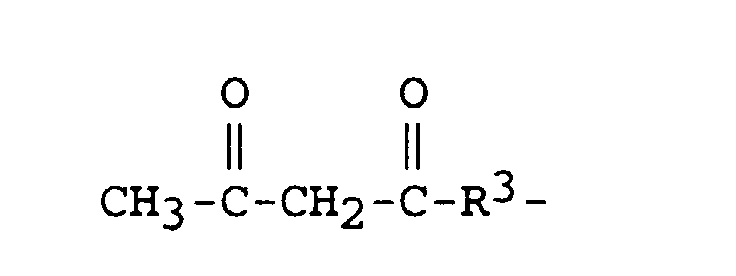
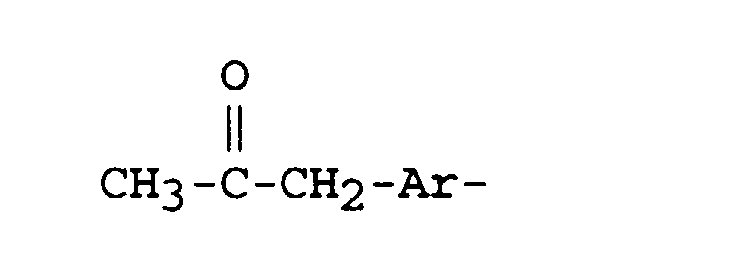
R1, R2 oder R3 optional substituierte Kohlenwasserstoff-Radikale sind, und Ar eine optional substituierte Arylen-Gruppe ist, ausgewählt ist, bereitgestellt wird. - Verfahren nach Anspruch 4, wobei Y eine olefinisch ungesättigte Doppelbindung ist, die durch eine Gruppe, welche unter Acryloyl, Methacryloyl, Allyl und Methallyl oder einem substituierten Derivat der genannten ausgewählt ist, bereitgestellt wird.
- Verfahren nach Anspruch 4, wobei Y eine Siloxan-Gruppe der Formel
-Si(OR4)k(R5)i
in der i 0, 1 oder 2 ist, und k 1, 2 oder 3 ist, vorausgesetzt, daß k plus i gleich 3 ist, und R4 und R5, die gleich oder verschieden sein können, Kohlenstoff-Gruppen sind, ist. - Verfahren nach einem der vorangehenden Ansprüche, wobei die Grundstruktur des Polymeren, das die gewünschten Gruppen Y aufweist, die eines olefinischen Additionspolymeren ist, das durch ein Verfahren der Additionspolymerisation mit freien Radikalen hergestellt wird.
- Verfahren nach Anspruch 7, wobei das olefinische Additionspolymer hergestellt wird, indem ein olefinisches Additionspolymer, das an der Kette hängende Carboxyl-Gruppe trägt, gebildet wird (Vor-Vorstufenpolymer), mindestens ein Teil der an der Kette hängenden Carboxyl-Gruppe des Vor-Vorstufenpolymers in Gruppen, die an der Kette hängende Vorstufen-Amino-Gruppen bereitstellen, umgewandelt wird (das Polymer ist dann ein Vorstufenpolymer) und die Vorstufen-Amino-Gruppen dann mit der enolischen Verbindung umgesetzt werden.
- Verfahren nach Anspruch 8, wobei die Umwandlung von Carboxyl- in Amino-Gruppen durch eine Iminierungs-Reaktion erfolgt.
- Verfahren nach einem der Ansprüche 7 bis 9, wobei das in den Verfahren angesetzte Vorstufenpolymer ein iminiertes Acryl-Polymer ist.
- Verfahren nach einem der Ansprüche 1 bis 6, wobei die Basistruktur des Polymeren, das die gewünschten Y-Gruppen enthält, die eines Additionspolymeren aus Polymerisation mit nicht freien Radikalen oder eines Kondensations-Polymeren ist.
- Verfahren nach Anspruch 11, wobei die Basisstruktur des Polymeren die eines Polyurethan-Polymeren, eines Polyether-Polymeren, eines Polyester-Polymeren, eines Polyimid-Polymeren oder eines Polyepoxid-Polymeren ist.
- Verfahren nach Anspruch 12, wobei die Basistruktur die eines Polyurethan-Polymeren ist.
- Verfahren nach einem der vorangehenden Ansprüche, wobei das resultierende Polymer 0,1 bis 1000 mmol Y-Gruppen pro 100 g Polymer enthält.
- Verfahren nach einem der vorangehenden Ansprüche, wobei das Polymer, das die gewünschte Y-Gruppe enthält, nach dem Verfahren in Form einer wäßrigen Dispersion des Polymeren oder in Form einer Dispersion auf organischer Basis hergestellt wird oder anschließend in die Form einer wäßrigen Dispersion des Polymeren oder in eine Dispersion des Polymeren auf organischer Basis übergeführt wird.
- Polymer, das unter Verwendung eines Verfahrens nach einem der vorangehenden Ansprüche hergestellt wird.
- Eine wäßrige Dispersion eines Polymeren oder Dispersion eines Polymeren nach Anspruch 16 auf organischer Basis.
- Eine wäßrige Zusammensetzung oder eine Zusammensetzung auf organischer Basis, die ein Polymer nach Anspruch 16 enthält.
- Zusammensetzung nach Anspruch 18, die eine Zusammensetzung auf Wasserbasis ist und eine wäßrige Dispersion des Polymeren enthält.
- Zusammensetzung nach Anspruch 17 oder 18, wobei die Zusammensetzung eine Beschichtungszusammensetzung ist.
- Zusammensetzung nach Anspruch 20, wobei die Y-Gruppen zu einem Typ gehören, der an einer Vernetzungsreaktion während und/oder nach Filmbildung durch die Zusammensetzung teilnimmt.
- Zusammensetzung nach Anspruch 21, wobei diese Zusammensetzung zu den Y-Gruppen im Polymer passendes mitreagierendes Material enthält, das an der Vernetzungsreaktion während und/oder nach Filmbildung teilnimmt oder diese unterstützt.
- Zusammensetzung nach Anspruch 22, wobei das mitreagierende Material ein oxidierender Katalysator, ein Photoinitiator, ein Peroxy-Härtemittel oder ein Metalltrocknersalz ist.
- Filmbeschichtung, die durch eine Zusammensetzung nach einem der Ansprüche 18 bis 23 erhalten wird.
Applications Claiming Priority (4)
| Application Number | Priority Date | Filing Date | Title |
|---|---|---|---|
| GB909003348A GB9003348D0 (en) | 1990-02-14 | 1990-02-14 | Incorporation of desired groups into polymers |
| GB9003348 | 1990-02-14 | ||
| GB9013480 | 1990-06-15 | ||
| GB909013480A GB9013480D0 (en) | 1990-06-15 | 1990-06-15 | Incorporation of desired groups into polymers |
Publications (3)
| Publication Number | Publication Date |
|---|---|
| EP0442653A2 EP0442653A2 (de) | 1991-08-21 |
| EP0442653A3 EP0442653A3 (en) | 1992-08-05 |
| EP0442653B1 true EP0442653B1 (de) | 1997-08-20 |
Family
ID=26296662
Family Applications (1)
| Application Number | Title | Priority Date | Filing Date |
|---|---|---|---|
| EP91300953A Expired - Lifetime EP0442653B1 (de) | 1990-02-14 | 1991-02-06 | Aufnahme von Gruppen in Polymere, hergestellte Polymere und diese Polymere enthaltende Zusammensetzungen |
Country Status (8)
| Country | Link |
|---|---|
| US (1) | US5364891A (de) |
| EP (1) | EP0442653B1 (de) |
| JP (1) | JPH05345808A (de) |
| AT (1) | ATE157104T1 (de) |
| CA (1) | CA2034856A1 (de) |
| DE (1) | DE69127304T2 (de) |
| GB (1) | GB9101205D0 (de) |
| ZW (1) | ZW691A1 (de) |
Families Citing this family (28)
| Publication number | Priority date | Publication date | Assignee | Title |
|---|---|---|---|---|
| US5306744A (en) * | 1992-12-18 | 1994-04-26 | Rohm And Haas Company | Functionalized multistage polymers |
| US5525662A (en) * | 1993-07-14 | 1996-06-11 | Rohm And Haas Company | Functionalization of polymers via enamine of acetoacetate |
| US5426142A (en) * | 1993-08-25 | 1995-06-20 | Rohm And Haas Company | Single package ambient curing polymers |
| ZA947530B (en) * | 1993-09-29 | 1995-05-29 | Ici Australia Operations | Water-borne crosslinkable aminoalkyl-alkoxysilane coatings |
| US5428107A (en) * | 1993-10-29 | 1995-06-27 | Rohm And Haas Company | Silane-modified floor finish vehicles |
| JP3511306B2 (ja) * | 1994-02-17 | 2004-03-29 | 旭化成ケミカルズ株式会社 | 水系被覆組成物 |
| US5783626A (en) * | 1995-04-12 | 1998-07-21 | Taylor; James Wayne | Waterborne polymers with pendant crosslinkable groups |
| US5663266A (en) * | 1995-04-12 | 1997-09-02 | Eastman Chemical Company | Waterborne coating compositions |
| NZ314294A (en) * | 1996-03-06 | 1998-07-28 | Rohm & Haas | Fast drying coating composition having early water resistance comprising a latex derivative, use thereof |
| US5891950A (en) * | 1996-05-28 | 1999-04-06 | Eastman Chemical Company | Use of stable amino-functional latexes in water-based inks |
| US6417267B1 (en) | 1996-05-28 | 2002-07-09 | Eastman Chemical Company | Adhesive compositions containing stable amino-containing polymer latex blends |
| US6028155A (en) * | 1997-05-21 | 2000-02-22 | Eastman Chemical Company | Surfactant-containing acetoacetoxy-functional and enamine-functional polymers |
| US5998543A (en) * | 1996-05-28 | 1999-12-07 | Eastman Chemical Company | Stable amino-containing polymer latex blends |
| US5962556A (en) * | 1996-10-22 | 1999-10-05 | Eastman Chemical Company | Functional latexes resistant to hydrolysis |
| ES2178215T3 (es) * | 1997-05-21 | 2002-12-16 | Eastman Chem Co | Procedimiento para preparar mezclas de latex reactivo que son quimica y fisicamente estables en la formacion de peliculas. |
| US6649679B1 (en) | 1997-09-18 | 2003-11-18 | Eastman Chemical Company | Stable waterborne polymer compositions containing poly(alkylenimines) |
| US6337106B1 (en) | 1999-06-01 | 2002-01-08 | Rohm And Haas | Method of producing a two-pack fast-setting waterborne paint composition and the paint composition therefrom |
| NZ551339A (en) | 2004-06-11 | 2009-06-26 | Nuplex Resins Bv | Waterborne multistage polymer dispersion |
| DE102004043363A1 (de) * | 2004-09-08 | 2006-03-09 | Bayer Materialscience Ag | Abspalterfrei-härtende blockierte Polyisocyanate für Dual Cure Systeme |
| DE102006020816A1 (de) * | 2006-05-04 | 2007-11-08 | Wacker Chemie Ag | Organosiliciumverbindungen, die beta-Ketoamidgruppen und über Enamin-Bindungen gebundene organische Polymere enthalten, und Verfahren zu ihrer Herstellung |
| DE102006020815A1 (de) * | 2006-05-04 | 2007-11-08 | Wacker Chemie Ag | Verfahren zur Herstellung von beta-Ketocarbonyl-funktionellen Organosiliciumverbindungen |
| DE102006039940A1 (de) * | 2006-08-25 | 2008-03-06 | Wacker Chemie Ag | ß-Ketocarbonyl-funktionelle Siloxanpolymere enthaltende Zusammensetzungen |
| DE102007023934A1 (de) * | 2007-05-23 | 2008-11-27 | Wacker Chemie Ag | Verfahren zur Herstellung von ß-Ketocarbonyl-funktionellen Organosiliciumverbindungen |
| US8722187B2 (en) | 2011-10-31 | 2014-05-13 | Sabic Innovative Plastics Ip B.V. | Solventless process for the preparation of amine functional polyetherimide resins with improved melt flow |
| TWI572640B (zh) * | 2012-03-29 | 2017-03-01 | 東麗股份有限公司 | 聚醯胺酸及含有其之樹脂組成物 |
| EP3209726B1 (de) * | 2014-10-21 | 2020-07-01 | DSM IP Assets B.V. | Polymer, verfahren und verwendung |
| TW201700506A (zh) * | 2015-06-19 | 2017-01-01 | 羅門哈斯公司 | 磷酸官能化塗料組合物 |
| WO2025098970A1 (en) | 2023-11-06 | 2025-05-15 | Allnex Netherlands B.V. | Waterborne coating composition |
Family Cites Families (8)
| Publication number | Priority date | Publication date | Assignee | Title |
|---|---|---|---|---|
| US3312665A (en) * | 1962-11-15 | 1967-04-04 | Eastman Kodak Co | Polymers containing aromatic sulfonic acid groups |
| US4135969A (en) * | 1974-02-25 | 1979-01-23 | Nalco Chemical Company | Glycidaldehyde modified cationic polyacrylamide polymers used in paper |
| DE2831302A1 (de) * | 1977-07-29 | 1979-02-08 | Herberts Gmbh | Vernetzungsfaehige polymere verbindungen mit verminderter viskositaet |
| DE2806098C2 (de) * | 1978-02-14 | 1984-08-30 | Hoechst Ag, 6230 Frankfurt | Verwendung von vernetzten Polymeren zur Erhöhung der Viskosität bei kosmetischen, pharmazeutischen und technischen Präparaten |
| DE3710343A1 (de) * | 1987-03-28 | 1988-10-06 | Basf Lacke & Farben | Verzweigtes acrylatcopolymerisat mit polisierbaren doppelbindungen und verfahren zur herstellung des acrylatcopolymerisats |
| JPH0757863B2 (ja) * | 1987-12-29 | 1995-06-21 | 日本合成化学工業株式会社 | 感圧性接着剤組成物 |
| GB9005838D0 (en) * | 1989-03-29 | 1990-05-09 | Ici Plc | Aqueous coating compositions |
| US5017676A (en) * | 1989-12-18 | 1991-05-21 | Texaco Chemical Company | Acetoacetoxyethyl methacrylate in the cure of epoxy resins |
-
1991
- 1991-01-18 GB GB919101205A patent/GB9101205D0/en active Pending
- 1991-01-24 CA CA002034856A patent/CA2034856A1/en not_active Abandoned
- 1991-01-28 ZW ZW6/91A patent/ZW691A1/xx unknown
- 1991-02-06 EP EP91300953A patent/EP0442653B1/de not_active Expired - Lifetime
- 1991-02-06 DE DE69127304T patent/DE69127304T2/de not_active Expired - Fee Related
- 1991-02-06 AT AT91300953T patent/ATE157104T1/de not_active IP Right Cessation
- 1991-02-14 US US07/654,969 patent/US5364891A/en not_active Expired - Fee Related
- 1991-02-14 JP JP3042727A patent/JPH05345808A/ja active Pending
Also Published As
| Publication number | Publication date |
|---|---|
| CA2034856A1 (en) | 1991-08-15 |
| DE69127304T2 (de) | 1997-12-18 |
| DE69127304D1 (de) | 1997-09-25 |
| ZW691A1 (en) | 1991-10-02 |
| EP0442653A2 (de) | 1991-08-21 |
| ATE157104T1 (de) | 1997-09-15 |
| EP0442653A3 (en) | 1992-08-05 |
| US5364891A (en) | 1994-11-15 |
| JPH05345808A (ja) | 1993-12-27 |
| GB9101205D0 (en) | 1991-02-27 |
Similar Documents
| Publication | Publication Date | Title |
|---|---|---|
| EP0442653B1 (de) | Aufnahme von Gruppen in Polymere, hergestellte Polymere und diese Polymere enthaltende Zusammensetzungen | |
| EP0390370B1 (de) | Wässrige Beschichtungsmassen | |
| EP0341886B1 (de) | Wässerige Beschichtungszusammensetzungen | |
| EP0189945B1 (de) | Wässrige Polyurethan-Polyolefin-Zusammensetzung | |
| EP0619342B1 (de) | In Wasser dispergierte Harzzusammensetzung | |
| US6048667A (en) | Heterogeneous photo-initiators, photopolymerizable compositions and their use | |
| WO1997023516A1 (en) | Aqueous cross-linkable coating composition | |
| JP2002502442A (ja) | 界面活性剤含有アセトアセトキシ官能及びエナミン官能ポリマー | |
| EP0442652A2 (de) | Herstellung von Polyurethan-Polymeren, die so erhaltenen Polymere und diese enthaltende Massen | |
| US4956433A (en) | Telechelic polymers from thiuram disulfide or dithiocarbamates | |
| GB2107338A (en) | Stabilization of polyurethanes against thermal discoloration | |
| KR100689345B1 (ko) | 휘발성 삼차 아민을 함유하지 않은 음이온 수성 폴리머분산액의 제조방법, 상기 방법에 의해 얻어진 분산액 및상기 분산액으로부터 얻어진 코팅 | |
| CN1010318B (zh) | 液体涂料组合物和用其涂布基体的方法 | |
| HK89989A (en) | Use of hydroxyalkylphenones as photoinitiators in the curing of aqueous dispersions of prepolymers | |
| US2122707A (en) | Nitrogen-containing resins | |
| JP4073047B2 (ja) | 水系セミカルバジド化合物の製造方法 | |
| DE4031732A1 (de) | Strahlenhaertbare, waessrige bindemitteldispersionen | |
| JPH04342715A (ja) | ポリウレタン、ポリウレア及びポリウレタン−ポリウレアポリマーを安定化するためのヒンダードアミン光安定剤ヒドラジド | |
| JP4033518B2 (ja) | 新規なセミカルバジド系化合物及びそれを用いた被覆組成物 | |
| JPH03149269A (ja) | 顔料分散剤、その製造法及びそれを含有してなる陰極電着被覆組成物 | |
| JPH06136085A (ja) | 内部架橋型水性ウレタン樹脂の製造方法 | |
| JP3889852B2 (ja) | 無機多孔質基材促進養生用の水性下塗剤 | |
| DE4314623A1 (de) | Carbamoylhydroxylamine | |
| JP2539920B2 (ja) | 熱硬化性水性樹脂組成物 | |
| JP2003252847A (ja) | 新規セミカルバジド誘導体及び組成物 |
Legal Events
| Date | Code | Title | Description |
|---|---|---|---|
| PUAI | Public reference made under article 153(3) epc to a published international application that has entered the european phase |
Free format text: ORIGINAL CODE: 0009012 |
|
| AK | Designated contracting states |
Kind code of ref document: A2 Designated state(s): AT BE DE DK ES FR GB GR IT LU NL SE |
|
| PUAL | Search report despatched |
Free format text: ORIGINAL CODE: 0009013 |
|
| 17P | Request for examination filed |
Effective date: 19920505 |
|
| AK | Designated contracting states |
Kind code of ref document: A3 Designated state(s): AT BE DE DK ES FR GB GR IT LU NL SE |
|
| RAP1 | Party data changed (applicant data changed or rights of an application transferred) |
Owner name: ZENECA LIMITED Owner name: ICI RESINS BV |
|
| 17Q | First examination report despatched |
Effective date: 19941019 |
|
| GRAG | Despatch of communication of intention to grant |
Free format text: ORIGINAL CODE: EPIDOS AGRA |
|
| GRAH | Despatch of communication of intention to grant a patent |
Free format text: ORIGINAL CODE: EPIDOS IGRA |
|
| GRAH | Despatch of communication of intention to grant a patent |
Free format text: ORIGINAL CODE: EPIDOS IGRA |
|
| GRAA | (expected) grant |
Free format text: ORIGINAL CODE: 0009210 |
|
| AK | Designated contracting states |
Kind code of ref document: B1 Designated state(s): AT BE DE DK ES FR GB GR IT LU NL SE |
|
| PG25 | Lapsed in a contracting state [announced via postgrant information from national office to epo] |
Ref country code: IT Free format text: LAPSE BECAUSE OF FAILURE TO SUBMIT A TRANSLATION OF THE DESCRIPTION OR TO PAY THE FEE WITHIN THE PRE;WARNING: LAPSES OF ITALIAN PATENTS WITH EFFECTIVE DATE BEFORE 2007 MAY HAVE OCCURRED AT ANY TIME BEFORE 2007. THE CORRECT EFFECTIVE DATE MAY BE DIFFERENT FROM THE ONE RECORDED.SCRIBED TIME-LIMIT Effective date: 19970820 Ref country code: GR Free format text: LAPSE BECAUSE OF FAILURE TO SUBMIT A TRANSLATION OF THE DESCRIPTION OR TO PAY THE FEE WITHIN THE PRESCRIBED TIME-LIMIT Effective date: 19970820 Ref country code: DK Free format text: LAPSE BECAUSE OF NON-PAYMENT OF DUE FEES Effective date: 19970820 Ref country code: BE Effective date: 19970820 Ref country code: AT Effective date: 19970820 Ref country code: ES Free format text: THE PATENT HAS BEEN ANNULLED BY A DECISION OF A NATIONAL AUTHORITY Effective date: 19970820 Ref country code: FR Free format text: LAPSE BECAUSE OF FAILURE TO SUBMIT A TRANSLATION OF THE DESCRIPTION OR TO PAY THE FEE WITHIN THE PRESCRIBED TIME-LIMIT Effective date: 19970820 |
|
| REF | Corresponds to: |
Ref document number: 157104 Country of ref document: AT Date of ref document: 19970915 Kind code of ref document: T |
|
| REF | Corresponds to: |
Ref document number: 69127304 Country of ref document: DE Date of ref document: 19970925 |
|
| PG25 | Lapsed in a contracting state [announced via postgrant information from national office to epo] |
Ref country code: SE Effective date: 19971120 |
|
| EN | Fr: translation not filed | ||
| PG25 | Lapsed in a contracting state [announced via postgrant information from national office to epo] |
Ref country code: LU Free format text: LAPSE BECAUSE OF NON-PAYMENT OF DUE FEES Effective date: 19980206 |
|
| PLBE | No opposition filed within time limit |
Free format text: ORIGINAL CODE: 0009261 |
|
| 26N | No opposition filed | ||
| REG | Reference to a national code |
Ref country code: GB Ref legal event code: 732E |
|
| REG | Reference to a national code |
Ref country code: GB Ref legal event code: IF02 |
|
| PGFP | Annual fee paid to national office [announced via postgrant information from national office to epo] |
Ref country code: GB Payment date: 20020206 Year of fee payment: 12 |
|
| PGFP | Annual fee paid to national office [announced via postgrant information from national office to epo] |
Ref country code: DE Payment date: 20020227 Year of fee payment: 12 |
|
| PGFP | Annual fee paid to national office [announced via postgrant information from national office to epo] |
Ref country code: NL Payment date: 20020228 Year of fee payment: 12 |
|
| NLS | Nl: assignments of ep-patents |
Owner name: AVECIA LIMITED;ZENECA RESINS B.V. |
|
| NLT1 | Nl: modifications of names registered in virtue of documents presented to the patent office pursuant to art. 16 a, paragraph 1 |
Owner name: AVECIA B.V.;AVECIA LIMITED;SYNGENTA LIMITED;ZENECA |
|
| PG25 | Lapsed in a contracting state [announced via postgrant information from national office to epo] |
Ref country code: GB Free format text: LAPSE BECAUSE OF NON-PAYMENT OF DUE FEES Effective date: 20030206 |
|
| PG25 | Lapsed in a contracting state [announced via postgrant information from national office to epo] |
Ref country code: NL Free format text: LAPSE BECAUSE OF NON-PAYMENT OF DUE FEES Effective date: 20030901 |
|
| PG25 | Lapsed in a contracting state [announced via postgrant information from national office to epo] |
Ref country code: DE Free format text: LAPSE BECAUSE OF NON-PAYMENT OF DUE FEES Effective date: 20030902 |
|
| GBPC | Gb: european patent ceased through non-payment of renewal fee | ||
| NLV4 | Nl: lapsed or anulled due to non-payment of the annual fee |
Effective date: 20030901 |