EP0442844B1 - Procédé de teinture de la laine avec des colorants réactifs - Google Patents
Procédé de teinture de la laine avec des colorants réactifs Download PDFInfo
- Publication number
- EP0442844B1 EP0442844B1 EP91810078A EP91810078A EP0442844B1 EP 0442844 B1 EP0442844 B1 EP 0442844B1 EP 91810078 A EP91810078 A EP 91810078A EP 91810078 A EP91810078 A EP 91810078A EP 0442844 B1 EP0442844 B1 EP 0442844B1
- Authority
- EP
- European Patent Office
- Prior art keywords
- component
- hydrogen
- formula
- compound
- process according
- Prior art date
- Legal status (The legal status is an assumption and is not a legal conclusion. Google has not performed a legal analysis and makes no representation as to the accuracy of the status listed.)
- Expired - Lifetime
Links
Classifications
-
- D—TEXTILES; PAPER
- D06—TREATMENT OF TEXTILES OR THE LIKE; LAUNDERING; FLEXIBLE MATERIALS NOT OTHERWISE PROVIDED FOR
- D06P—DYEING OR PRINTING TEXTILES; DYEING LEATHER, FURS OR SOLID MACROMOLECULAR SUBSTANCES IN ANY FORM
- D06P3/00—Special processes of dyeing or printing textiles, or dyeing leather, furs, or solid macromolecular substances in any form, classified according to the material treated
- D06P3/02—Material containing basic nitrogen
- D06P3/04—Material containing basic nitrogen containing amide groups
- D06P3/14—Wool
-
- D—TEXTILES; PAPER
- D06—TREATMENT OF TEXTILES OR THE LIKE; LAUNDERING; FLEXIBLE MATERIALS NOT OTHERWISE PROVIDED FOR
- D06P—DYEING OR PRINTING TEXTILES; DYEING LEATHER, FURS OR SOLID MACROMOLECULAR SUBSTANCES IN ANY FORM
- D06P1/00—General processes of dyeing or printing textiles, or general processes of dyeing leather, furs, or solid macromolecular substances in any form, classified according to the dyes, pigments, or auxiliary substances employed
- D06P1/44—General processes of dyeing or printing textiles, or general processes of dyeing leather, furs, or solid macromolecular substances in any form, classified according to the dyes, pigments, or auxiliary substances employed using insoluble pigments or auxiliary substances, e.g. binders
- D06P1/60—General processes of dyeing or printing textiles, or general processes of dyeing leather, furs, or solid macromolecular substances in any form, classified according to the dyes, pigments, or auxiliary substances employed using insoluble pigments or auxiliary substances, e.g. binders using compositions containing polyethers
- D06P1/607—Nitrogen-containing polyethers or their quaternary derivatives
- D06P1/6076—Nitrogen-containing polyethers or their quaternary derivatives addition products of amines and alkylene oxides or oxiranes
-
- D—TEXTILES; PAPER
- D06—TREATMENT OF TEXTILES OR THE LIKE; LAUNDERING; FLEXIBLE MATERIALS NOT OTHERWISE PROVIDED FOR
- D06P—DYEING OR PRINTING TEXTILES; DYEING LEATHER, FURS OR SOLID MACROMOLECULAR SUBSTANCES IN ANY FORM
- D06P3/00—Special processes of dyeing or printing textiles, or dyeing leather, furs, or solid macromolecular substances in any form, classified according to the material treated
- D06P3/02—Material containing basic nitrogen
- D06P3/04—Material containing basic nitrogen containing amide groups
- D06P3/14—Wool
- D06P3/148—Wool using reactive dyes
-
- Y—GENERAL TAGGING OF NEW TECHNOLOGICAL DEVELOPMENTS; GENERAL TAGGING OF CROSS-SECTIONAL TECHNOLOGIES SPANNING OVER SEVERAL SECTIONS OF THE IPC; TECHNICAL SUBJECTS COVERED BY FORMER USPC CROSS-REFERENCE ART COLLECTIONS [XRACs] AND DIGESTS
- Y10—TECHNICAL SUBJECTS COVERED BY FORMER USPC
- Y10S—TECHNICAL SUBJECTS COVERED BY FORMER USPC CROSS-REFERENCE ART COLLECTIONS [XRACs] AND DIGESTS
- Y10S516/00—Colloid systems and wetting agents; subcombinations thereof; processes of
- Y10S516/01—Wetting, emulsifying, dispersing, or stabilizing agents
- Y10S516/07—Organic amine, amide, or n-base containing
-
- Y—GENERAL TAGGING OF NEW TECHNOLOGICAL DEVELOPMENTS; GENERAL TAGGING OF CROSS-SECTIONAL TECHNOLOGIES SPANNING OVER SEVERAL SECTIONS OF THE IPC; TECHNICAL SUBJECTS COVERED BY FORMER USPC CROSS-REFERENCE ART COLLECTIONS [XRACs] AND DIGESTS
- Y10—TECHNICAL SUBJECTS COVERED BY FORMER USPC
- Y10S—TECHNICAL SUBJECTS COVERED BY FORMER USPC CROSS-REFERENCE ART COLLECTIONS [XRACs] AND DIGESTS
- Y10S8/00—Bleaching and dyeing; fluid treatment and chemical modification of textiles and fibers
- Y10S8/916—Natural fiber dyeing
- Y10S8/917—Wool or silk
Definitions
- the present invention relates to a new method for fiber and flat level dyeing of wool with reactive dyes, the material dyed by the new method and a means for carrying out the method.
- the present method is particularly suitable for producing light to medium shades.
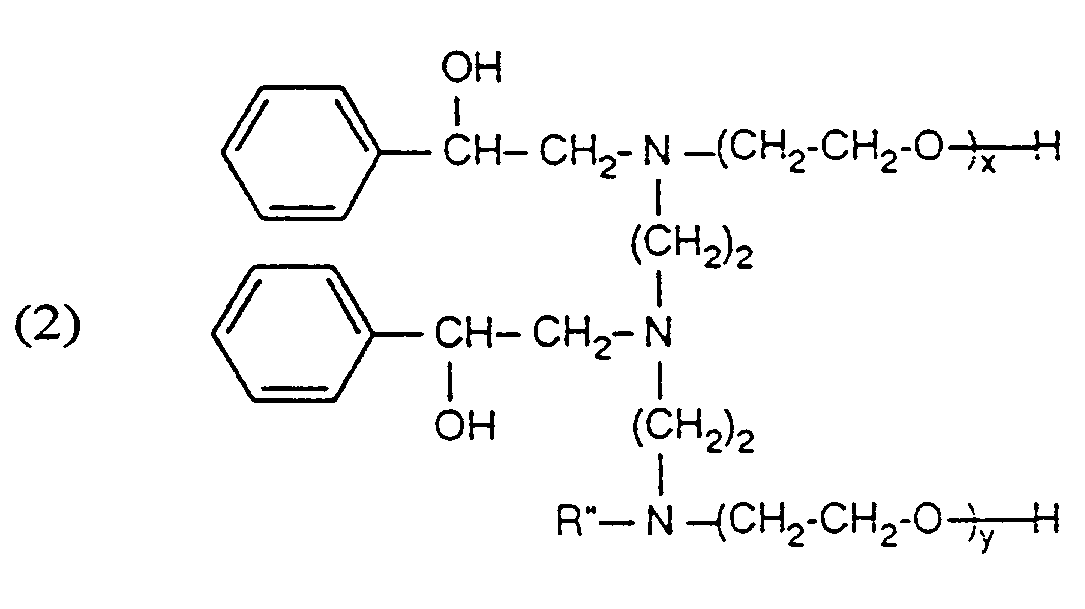
- auxiliary mixture as component (c) can be a nonionic compound of the formula wherein R "is an alkyl or alkenyl radical having 12 to 22 carbon atoms and x and y are integers, the sum of x and y being 80 to 140.
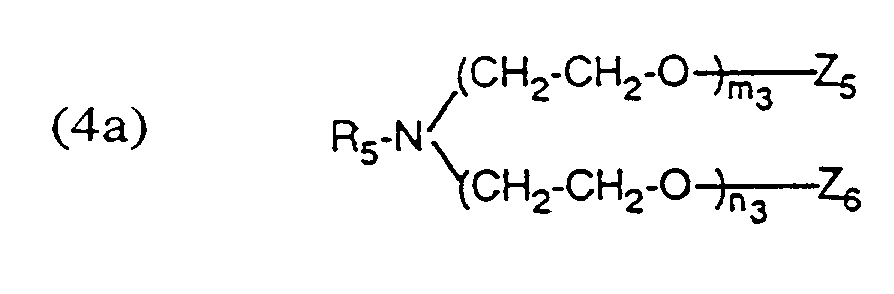
- auxiliary mixtures which comprise a compound of the formula (3a) as component (a) and a compound of the formula (4b) as component (b) or auxiliary mixtures which comprise a compound of the formula (3b) as component (a) and as a component (b) contain a compound of formula (4a).
- M in the formulas (1), (3) and (4) denotes hydrogen, alkali metal, such as sodium, potassium and in particular ammonium.
- the radicals Q, Q ', Q 1 and Q' 1 and A 8 , A ' 8 , A 1 ⁇ and A 2 8 in the formulas (1) and (3) are derived from quaternizing agents , QC 1 to C 4 -Alkyl, -CH 2 -CO-NH 2 , or is.
- quaternizing agents are e.g. Acetyl bromides, ethyl bromides, ethylene chlorohydrin, ethylene bromohydrin, epichlorohydrin, epibromohydrin, dimethyl sulfate, diethyl sulfate and especially chloroacetamide.
- the aliphatic radicals R 1 , R 2 , R 3 , R 4 , R 5 and R 6 in the formulas (1), (3) and (4) are alkyl or alkenyl radicals having 12 to 24, preferably 16 to 22, carbon atoms Consideration. Examples include: the n-dodecyl, myristyl, n-hexadecyl, n-heptadecyl, n-octadecyl, arachidyl, behenyl, dodecenyl, hexadecenyl, oleyl and octadecenyl radical.
- the compounds of components (a), (b) and (c) are e.g. known (in part) from US-A-4,444,564.
- the compounds of component (a) according to formula (1a) are prepared by adding 2 to 15 moles of ethylene oxide to aliphatic amines which have an aliphatic radical with 12 to 24 carbon atoms and optionally the adduct in the acidic monoester and optionally the acidic one Monoesters converted into the alkali or ammonium salts or reacting the adduct with one of the quaternizing agents mentioned above.
- the connections of component (b) correspond Chend formula (1 b) are prepared by adding 25 to 200 mol of ethylene oxide onto aliphatic amines which have an aliphatic radical with 12 to 24 carbon atoms, and optionally the adduct in the acidic ester and optionally the acidic ester in the alkali or Converted ammonium salts or reacted the adduct with one of the quaternizing agents mentioned above.
- the compounds of formula (2) are prepared by adding 80 to 140 moles of ethylene oxide to a compound of formula where R "has the meaning given under formula (2).
- the amines which are required as starting materials for the preparation of the compounds of the formulas (1), (3) and (4) can have saturated or unsaturated, branched or unbranched hydrocarbon radicals having 12 to 24, preferably 16 to 22, carbon atoms.
- the amines can be chemically uniform or in the form of mixtures.
- the amine mixtures used are preferably those which arise when natural fats or oils, such as tallow fat, soybean or coconut oil, are converted into the corresponding amines.
- Dodecylamine, hexadecylamine, octadecylamine, arachidylamine, behenylamine and octadecenylamine may be mentioned as amines.
- Tallow fatty amine is a mixture of approx. 30% hexadecylamine, 25% octadecylamine and 45% octadecenylamine.
- Both the ethylene oxide addition and the esterification can be carried out according to methods known per se.
- sulfuric acid or its functional derivatives such as e.g. Chlorosulfonic acid and especially sulfamic acid.
- the esterification is generally carried out by simply mixing the reactants with heating, advantageously to a temperature between 50 and 100 ° C.
- the free acids can then be converted into the alkali metal or ammonium salts by adding bases such as ammonia, sodium or potassium hydroxide in a conventional manner.
- An auxiliary mixture comprising 10 to 80 parts, preferably 20 to 70 parts of component (a), 5 to 70 parts, preferably 5 to 50 parts of component (b) and 0 to 70, preferably 0 to 50, is used for the process according to the invention
- Parts of the compound of component (c) and ad contains 100 parts of water.
- auxiliary mixture consisting of components (a), (b) and optionally (c) are added to the dyebath range from 0.5 to 4 percent by weight, based on the fiber material to be dyed. 1 to 2 percent by weight of the auxiliary mixture, based on the fiber material, is preferably used.
- the weight ratio of components (a) and (b) is between 1: 5 and 10: 1, preferably between 1: 2 and 5: 1.
- Wool can be considered as the fiber material that can be dyed according to the invention.
- the fiber material can be in various forms. Examples include: flake, sliver, yarn, fabric, knitwear or carpets.
- the wool can be finished normally or without felt.
- dyes This class of dyes is referred to in the Color Index 3rd edition 1971 as "reactive dyes". These are predominantly those dyes which contain at least one group which is reactive with polyhydroxyl fibers (cellulose fibers) or polyamide fibers, in particular wool, a precursor for this or a substituent which is reactive with polyhydroxyl fibers or polyamide fibers.
- Suitable bases for the reactive dyes are, in particular, those from the series of mono-, dis- or polyazo dyes including formazan dyes and anthraquinone, xanthene, nitro, triphenylmethane, naphthoquinonimine, dioxazine and phthalocyanine dyes, the azo and phthalocyanine dyes can be both metal-free and metal-containing.
- Reactive groups and precursors which form such reactive groups include, for example, epoxy groups, the ethyleneimide group, the vinyl grouping in vinylsulfone or in acrylic acid residues and the ⁇ -sulfatoethylsulfone group, the ⁇ -chloroethylsulfone group or the ⁇ -dialkylaminoethylsulfone group.
- the reactive substituents in reactive dyes are those which are easily removable and leave an electrophilic residue.
- substituents are 1 or 2 halogen atoms in an aliphatic acyl radical, e.g. in the ⁇ -position or a- and ⁇ -position of a propionyl radical or in the a- and / or ⁇ -position of an acrylic acid radical, or 1 to 3 halogen atoms on the following ring system into consideration: pyridazine, pyrimidine, pyridazone, triazine, quinoxaline or phthalazine.
- Dyes with two or more identical or different reactive groups can also be used.
- Preferred reactive dyes contain chloroacetyl, bromoacrylic or dibromopropionyl as reactive substituents.
- the reactive dyes can be acidic, salt-forming substituents, e.g. Contain carboxylic acid groups, sulfuric acid and phosphonic acid ester groups, phosphonic acid groups or preferably sulfonic acid groups.
- Reactive dyes with at least one sulfonic acid group are preferred, in particular reactive dyes with an azo or anthraquinone base which preferably has two to three sulfonic acid groups.
- Mixtures of reactive dyes can also be used, it being possible to produce bichromatic or trichromatic dyes.
- the coloring takes place after the pull-out procedure.
- the amount of dyes added to the dye liquor depends on the desired color strength. In general, amounts of 0.01 to 10 percent by weight, preferably 0.01 to 2 percent by weight, based on the fiber material used, have proven successful.
- the liquor ratio can be chosen within a wide range e.g. 1: 3 to 1: 100, preferably 1: 8 to 1:30.
- the dye baths can contain mineral acids, e.g. Sulfuric acid or phosphoric acid, organic acids, suitably contain aliphatic carboxylic acids such as formic acid, acetic acid, oxalic acid or citric acid and / or salts such as ammonium acetate, ammonium sulfate or sodium acetate.
- mineral acids e.g. Sulfuric acid or phosphoric acid
- organic acids suitably contain aliphatic carboxylic acids such as formic acid, acetic acid, oxalic acid or citric acid and / or salts such as ammonium acetate, ammonium sulfate or sodium acetate.
- the acids are used primarily to adjust the pH of the liquors used according to the invention, which is between 4 and 5.
- the dye liquors can also contain other additives, e.g. Wool protection, dispersing and wetting agents as well as defoamers included.
- the usual dyeing apparatuses such as, for example, open baths, combed, strand yarn or packing apparatuses, jiggers, paddle apparatuses, tree dyeing apparatuses, circulation or jet dyeing apparatuses or reel runners can be used.
- the dyeing is advantageously carried out at a temperature in the range from 60 to 120 ° C., preferably from 70 to 105 ° C.
- the dyeing time is within the usual range and is generally 20 to 120 minutes.
- the dyeing process can be followed by an alkaline after-treatment, e.g. with aqueous ammonia, alkali metal hydroxides, alkali metal carbonates, bicarbonates or hexamethylenetetraamine.
- the pH of the dye baths containing alkali is expediently 7.5 to 9, preferably 8 to 8.5.
- the dyeing of the fiber material is expediently carried out in such a way that the material to be dyed with an aqueous liquor which contains the acid, the auxiliary mixture of components (a) and (b) and, if appropriate, component (c) and a temperature of 30 to 60 ° C, treated briefly and adding the reactive dye to the same bath.
- the temperature is then slowly increased in order to dye in a range from 80 to 100 ° C. and for 20 to 90 minutes, preferably 30 to 60 minutes.
- the material to be dyed is then treated for a further 10 to 20 minutes at 70 to 90 ° C. after the addition of alkalis, preferably sodium hydrogen carbonate or sodium carbonate. Finally, the colored material is pulled out and rinsed, acidified and dried as usual.
- the dyeing process according to the invention gives fiber and flat dyeings, especially in light to medium shades with good light and wet fastness properties.
- the pH of the liquor is 4.5.
- the 12 mg of the dye of the formula 24 mg of the dye of the formula and 44 mg of the dye of the formula contains, the dyebath is kept at 40 ° for about 5 minutes and then heated to 60 at a rate of 1 ° / min and held at 60 ° for 20 minutes. The mixture is then heated to 98 at 1 ° / min and dyed for 30 minutes. After the liquor has cooled to 70, it is rinsed as usual. A fiber-uniform and flat-level dyeing with good fastness properties is obtained.
- EXAMPLE 3 The procedure is as described in Example 1 with the difference that 0.2 g of the adduct of 34 moles of ethylene oxide and 1 mole of a C 2 oC 22 fatty amine is used instead of auxiliary B 2 . A fiber- and flat-level dyeing with good fastness properties is obtained.
- EXAMPLE 4 The procedure is as described in Example 1, with the difference that, instead of auxiliary B 2, 0.2 g of the quaternized adduct of 34 mol of ethylene oxide and 1 mol of a C 2 oC 22 fatty amine is used. A fiber- and flat-level dyeing with good fastness properties is obtained.
- EXAMPLE 5 The procedure is as described in Example 1, with the difference that 0.2 g of the adduct of 30 mol of ethylene oxide and 1 mol of tallow fatty amine is used instead of B 2 . A fiber- and flat-level dyeing with good fastness properties is obtained.
- EXAMPLE 9 The procedure is as described in Example 2, with the difference that, instead of the dye mixture, 80 mg of the dye of the formula is used.
- EXAMPLE 10 The procedure is as described in Example 9, with the difference that instead of 80 mg of the dye of the formula (105), 80 mg of the dye of the formula starts.
- EXAMPLE 11 The procedure is as described in Example 9, with the difference that instead of 80 mg of the dye of the formula (105), 200 mg of the dye of the formula used.
- EXAMPLE 12 The procedure is as described in Example 9, with the difference that instead of 80 mg of the dye of the formula (105), 320 mg of the dye of the formula used.
- EXAMPLE 13 The procedure is as described in Example 9, with the difference that instead of 80 mg of the dye of the formula (105), 100 mg of the dye of the formula used.
Landscapes
- Engineering & Computer Science (AREA)
- Textile Engineering (AREA)
- Coloring (AREA)
Claims (15)


et la teinture est terminée, indépendamment de l'intensité de couleur, à un pH compris entre 4,0 et 5,0.



une quantité suffisante d'eau pour arriver à 100 parties.


et, comme composant (c), de 0 à 70 parties du composé de formule (2)
Applications Claiming Priority (2)
| Application Number | Priority Date | Filing Date | Title |
|---|---|---|---|
| CH47790 | 1990-02-14 | ||
| CH477/90 | 1990-02-14 |
Publications (3)
| Publication Number | Publication Date |
|---|---|
| EP0442844A1 EP0442844A1 (fr) | 1991-08-21 |
| EP0442844B1 true EP0442844B1 (fr) | 1995-02-01 |
| EP0442844B2 EP0442844B2 (fr) | 1998-01-21 |
Family
ID=4187901
Family Applications (1)
| Application Number | Title | Priority Date | Filing Date |
|---|---|---|---|
| EP91810078A Expired - Lifetime EP0442844B2 (fr) | 1990-02-14 | 1991-02-05 | Procédé de teinture de la laine avec des colorants réactifs |
Country Status (9)
| Country | Link |
|---|---|
| US (1) | US5145486A (fr) |
| EP (1) | EP0442844B2 (fr) |
| JP (1) | JPH04214476A (fr) |
| KR (1) | KR910015749A (fr) |
| AU (1) | AU638793B2 (fr) |
| CA (1) | CA2036224A1 (fr) |
| DE (1) | DE59104446D1 (fr) |
| ES (1) | ES2067902T5 (fr) |
| NZ (1) | NZ237087A (fr) |
Families Citing this family (7)
| Publication number | Priority date | Publication date | Assignee | Title |
|---|---|---|---|---|
| EP0548013A1 (fr) * | 1991-12-16 | 1993-06-23 | Ciba-Geigy Ag | Procédé de teinture de la laine avec l'aide d'un pétraitement avec un plasma basse température ou Corona |
| IT1261839B (it) * | 1992-08-03 | 1996-06-03 | Sandoz Ag | Procedimento per la produzione di effetti speciali di coloritura su prodotti tessili e miscele di coloranti impiegate. |
| DE59409028D1 (de) * | 1993-07-28 | 2000-02-03 | Ciba Sc Holding Ag | Verfahren zum Färben von wollhaltigen Fasermaterialien |
| DE19848894A1 (de) * | 1998-10-23 | 2000-04-27 | Bayer Ag | Phosphorsäureester |
| CN100449054C (zh) * | 2003-06-26 | 2009-01-07 | 西巴特殊化学品控股有限公司 | 环糊精或环糊精衍生物的含水液体组合物及使用该组合物的方法 |
| EP1777337A1 (fr) * | 2005-10-07 | 2007-04-25 | Clariant International Ltd. | Procédé pour la teinture de fibres de polyamide |
| DE102008058921A1 (de) * | 2008-11-25 | 2010-05-27 | Henkel Ag & Co. Kgaa | Neue Färbemittel |
Family Cites Families (7)
| Publication number | Priority date | Publication date | Assignee | Title |
|---|---|---|---|---|
| US3919283A (en) * | 1965-03-18 | 1975-11-11 | Ciba Geigy Ag | Sulfate derivatives of polyglycol compounds |
| DE2847913B1 (de) * | 1978-11-04 | 1980-02-07 | Hoechst Ag | Verfahren zum Faerben von Wolle mit Reaktivfarbstoffen |
| EP0089004B1 (fr) * | 1982-03-12 | 1986-04-16 | Ciba-Geigy Ag | Procédé de teinture de matière fibreuse de polyamides naturels |
| FR2574791A1 (fr) * | 1984-12-14 | 1986-06-20 | Sandoz Sa | Sulfates d'amines grasses, leur preparation et leur utilisation comme produits auxiliaires |
| EP0312493B1 (fr) * | 1987-10-14 | 1992-07-15 | Ciba-Geigy Ag | Procédé de teinture de fibres en polyamide naturelles avec des colorants réactifs |
| EP0414631A1 (fr) * | 1989-02-22 | 1991-02-27 | Ciba-Geigy Ag | Mélange d'agents auxiliaires et son utilisation pendant la teinture de matériaux fibreux en polyesters |
| EP0417040A1 (fr) * | 1989-09-06 | 1991-03-13 | Ciba-Geigy Ag | Procédé pour teindre la laine |
-
1991
- 1991-02-05 EP EP91810078A patent/EP0442844B2/fr not_active Expired - Lifetime
- 1991-02-05 DE DE59104446T patent/DE59104446D1/de not_active Expired - Fee Related
- 1991-02-05 ES ES91810078T patent/ES2067902T5/es not_active Expired - Lifetime
- 1991-02-11 US US07/654,139 patent/US5145486A/en not_active Expired - Fee Related
- 1991-02-12 CA CA002036224A patent/CA2036224A1/fr not_active Abandoned
- 1991-02-12 AU AU70994/91A patent/AU638793B2/en not_active Ceased
- 1991-02-12 KR KR1019910002313A patent/KR910015749A/ko not_active Withdrawn
- 1991-02-12 NZ NZ237087A patent/NZ237087A/xx unknown
- 1991-02-14 JP JP3020240A patent/JPH04214476A/ja active Pending
Also Published As
| Publication number | Publication date |
|---|---|
| DE59104446D1 (de) | 1995-03-16 |
| AU7099491A (en) | 1991-08-15 |
| NZ237087A (en) | 1993-04-28 |
| EP0442844A1 (fr) | 1991-08-21 |
| CA2036224A1 (fr) | 1991-08-15 |
| EP0442844B2 (fr) | 1998-01-21 |
| ES2067902T3 (es) | 1995-04-01 |
| ES2067902T5 (es) | 1998-04-16 |
| US5145486A (en) | 1992-09-08 |
| KR910015749A (ko) | 1991-09-30 |
| JPH04214476A (ja) | 1992-08-05 |
| AU638793B2 (en) | 1993-07-08 |
Similar Documents
| Publication | Publication Date | Title |
|---|---|---|
| EP0089004B1 (fr) | Procédé de teinture de matière fibreuse de polyamides naturels | |
| EP0074923B1 (fr) | Adjuvant de teinture et son utilisation dans la teinture ou l'impression de matériaux en fibres de polyamide synthétique | |
| DE1940178A1 (de) | AEthansulfonsaeurederivate | |
| EP0135198A2 (fr) | Procédé de teinture de matière fibreuse en polyamides synthétiques | |
| EP0197005B1 (fr) | Hémiesters d'acide maléique ou d'acide phtalique et d'amines grasses alkoxylées | |
| EP0309405B1 (fr) | Procédé de teinture ou d'impression de matières fibreuses en polyamides naturels ou synthétiques avec des colorants réactifs | |
| EP0442844B2 (fr) | Procédé de teinture de la laine avec des colorants réactifs | |
| EP0312493B1 (fr) | Procédé de teinture de fibres en polyamide naturelles avec des colorants réactifs | |
| DE1924765B2 (de) | Polyoxyalkylierte Amine und deren Verwendung beim Färben mit Reaktivfarbstoffen | |
| EP0235088B1 (fr) | Hémi-esters d'acide maléique ou phthalique et d'amines grasses alkoxylées | |
| EP0745720B1 (fr) | Utilisation des préparations d'agents auxiliaires pour la teinture de la laine | |
| EP0163608B1 (fr) | Procédé de teinture de matières fibreuses en polyamides naturelles ou synthétiques avec des colorants à complexes métallifères 1:1 | |
| EP0225282B1 (fr) | Procédé de post-traitement de matière fibreuse cellulosique teinte | |
| EP0593392B1 (fr) | Procédé de teinture de fibres polyamides naturelles et synthétiques avec des mélanges de colorants | |
| EP0302013A1 (fr) | Procédé de teinture de produits textiles en polyamide | |
| EP0203890B1 (fr) | Procédé de teinture de matières en polyamides naturels avec des mélanges de colorants | |
| EP0474594B1 (fr) | Procédé de teinture de la laine et ses mélanges avec d'autres fibres avec des colorants réactifs | |
| EP0040780A1 (fr) | Procédé d'impression de matière fibreuse synthétique hydrophobe | |
| EP0264346B1 (fr) | Procédé de teinture de matières fibreuses en polyamides naturels ou synthétiques avec des colorants à complexes métallifères 1:1 | |
| DE2841800C2 (fr) | ||
| EP1123300A1 (fr) | Esters d'acide phosphorique | |
| DE1568258C3 (de) | Verwendung von amphoteren Polyglykolverbindungen als Egalisiermittel | |
| DE2405057C3 (de) | Verfahren zum Klotzfärben oder Bedrucken von Textilmischmaterial aus Cellulose- und Polyesterfasern | |
| DE1901165A1 (de) | N-Alkyl-aminoalkansulfonsaeuren | |
| DE1901411A1 (de) | Verfahren zum kontinuierlichen Faerben von Polyester-Textilmaterialien |
Legal Events
| Date | Code | Title | Description |
|---|---|---|---|
| PUAI | Public reference made under article 153(3) epc to a published international application that has entered the european phase |
Free format text: ORIGINAL CODE: 0009012 |
|
| 17P | Request for examination filed |
Effective date: 19910207 |
|
| AK | Designated contracting states |
Kind code of ref document: A1 Designated state(s): BE CH DE ES FR GB IT LI |
|
| 17Q | First examination report despatched |
Effective date: 19930622 |
|
| GRAA | (expected) grant |
Free format text: ORIGINAL CODE: 0009210 |
|
| AK | Designated contracting states |
Kind code of ref document: B1 Designated state(s): BE CH DE ES FR GB IT LI |
|
| ET | Fr: translation filed | ||
| REF | Corresponds to: |
Ref document number: 59104446 Country of ref document: DE Date of ref document: 19950316 |
|
| REG | Reference to a national code |
Ref country code: ES Ref legal event code: FG2A Ref document number: 2067902 Country of ref document: ES Kind code of ref document: T3 |
|
| ITF | It: translation for a ep patent filed | ||
| GBT | Gb: translation of ep patent filed (gb section 77(6)(a)/1977) |
Effective date: 19950314 |
|
| PLBI | Opposition filed |
Free format text: ORIGINAL CODE: 0009260 |
|
| 26 | Opposition filed |
Opponent name: BAYER AG, LEVERKUSEN KONZERNVERWALTUNG RP PATENTE Effective date: 19951027 |
|
| PLBF | Reply of patent proprietor to notice(s) of opposition |
Free format text: ORIGINAL CODE: EPIDOS OBSO |
|
| ITTA | It: last paid annual fee | ||
| PLBF | Reply of patent proprietor to notice(s) of opposition |
Free format text: ORIGINAL CODE: EPIDOS OBSO |
|
| PLBF | Reply of patent proprietor to notice(s) of opposition |
Free format text: ORIGINAL CODE: EPIDOS OBSO |
|
| PLBF | Reply of patent proprietor to notice(s) of opposition |
Free format text: ORIGINAL CODE: EPIDOS OBSO |
|
| REG | Reference to a national code |
Ref country code: CH Ref legal event code: PUE Owner name: CIBA-GEIGY AG TRANSFER- CIBA SC HOLDING AG |
|
| BECN | Be: change of holder's name |
Effective date: 19961129 |
|
| PGFP | Annual fee paid to national office [announced via postgrant information from national office to epo] |
Ref country code: ES Payment date: 19970214 Year of fee payment: 7 |
|
| REG | Reference to a national code |
Ref country code: FR Ref legal event code: TP Ref country code: CH Ref legal event code: PFA Free format text: CIBA SC HOLDING AG TRANSFER- CIBA SPECIALTY CHEMICALS HOLDING INC. |
|
| RAP2 | Party data changed (patent owner data changed or rights of a patent transferred) |
Owner name: CIBA SPECIALTY CHEMICALS HOLDING INC. |
|
| PLAW | Interlocutory decision in opposition |
Free format text: ORIGINAL CODE: EPIDOS IDOP |
|
| REG | Reference to a national code |
Ref country code: GB Ref legal event code: 732E |
|
| PLAW | Interlocutory decision in opposition |
Free format text: ORIGINAL CODE: EPIDOS IDOP |
|
| PUAH | Patent maintained in amended form |
Free format text: ORIGINAL CODE: 0009272 |
|
| PGFP | Annual fee paid to national office [announced via postgrant information from national office to epo] |
Ref country code: FR Payment date: 19971223 Year of fee payment: 8 |
|
| PGFP | Annual fee paid to national office [announced via postgrant information from national office to epo] |
Ref country code: DE Payment date: 19980108 Year of fee payment: 8 Ref country code: CH Payment date: 19980108 Year of fee payment: 8 |
|
| 27A | Patent maintained in amended form |
Effective date: 19980121 |
|
| AK | Designated contracting states |
Kind code of ref document: B2 Designated state(s): BE CH DE ES FR GB IT LI |
|
| PGFP | Annual fee paid to national office [announced via postgrant information from national office to epo] |
Ref country code: GB Payment date: 19980121 Year of fee payment: 8 |
|
| REG | Reference to a national code |
Ref country code: CH Ref legal event code: AEN Free format text: AUFRECHTERHALTUNG DES PATENTES IN GEAENDERTER FORM |
|
| ITF | It: translation for a ep patent filed | ||
| GBTA | Gb: translation of amended ep patent filed (gb section 77(6)(b)/1977) | ||
| REG | Reference to a national code |
Ref country code: FR Ref legal event code: CD |
|
| ET3 | Fr: translation filed ** decision concerning opposition | ||
| PGFP | Annual fee paid to national office [announced via postgrant information from national office to epo] |
Ref country code: BE Payment date: 19980403 Year of fee payment: 8 |
|
| REG | Reference to a national code |
Ref country code: ES Ref legal event code: DC2A Kind code of ref document: T5 Effective date: 19980310 |
|
| REG | Reference to a national code |
Ref country code: ES Ref legal event code: PC2A |
|
| PG25 | Lapsed in a contracting state [announced via postgrant information from national office to epo] |
Ref country code: GB Free format text: LAPSE BECAUSE OF NON-PAYMENT OF DUE FEES Effective date: 19990205 |
|
| PG25 | Lapsed in a contracting state [announced via postgrant information from national office to epo] |
Ref country code: ES Free format text: LAPSE BECAUSE OF NON-PAYMENT OF DUE FEES Effective date: 19990206 |
|
| PG25 | Lapsed in a contracting state [announced via postgrant information from national office to epo] |
Ref country code: LI Free format text: LAPSE BECAUSE OF NON-PAYMENT OF DUE FEES Effective date: 19990228 Ref country code: CH Free format text: LAPSE BECAUSE OF NON-PAYMENT OF DUE FEES Effective date: 19990228 Ref country code: BE Free format text: LAPSE BECAUSE OF NON-PAYMENT OF DUE FEES Effective date: 19990228 |
|
| BERE | Be: lapsed |
Owner name: CIBA SPECIALTY CHEMICALS HOLDING INC. Effective date: 19990228 |
|
| GBPC | Gb: european patent ceased through non-payment of renewal fee |
Effective date: 19990205 |
|
| REG | Reference to a national code |
Ref country code: CH Ref legal event code: PL |
|
| PG25 | Lapsed in a contracting state [announced via postgrant information from national office to epo] |
Ref country code: FR Free format text: LAPSE BECAUSE OF NON-PAYMENT OF DUE FEES Effective date: 19991029 |
|
| PG25 | Lapsed in a contracting state [announced via postgrant information from national office to epo] |
Ref country code: DE Free format text: LAPSE BECAUSE OF NON-PAYMENT OF DUE FEES Effective date: 19991201 |
|
| REG | Reference to a national code |
Ref country code: FR Ref legal event code: ST |
|
| REG | Reference to a national code |
Ref country code: ES Ref legal event code: FD2A Effective date: 20010503 |
|
| PG25 | Lapsed in a contracting state [announced via postgrant information from national office to epo] |
Ref country code: IT Free format text: LAPSE BECAUSE OF NON-PAYMENT OF DUE FEES;WARNING: LAPSES OF ITALIAN PATENTS WITH EFFECTIVE DATE BEFORE 2007 MAY HAVE OCCURRED AT ANY TIME BEFORE 2007. THE CORRECT EFFECTIVE DATE MAY BE DIFFERENT FROM THE ONE RECORDED. Effective date: 20050205 |