EP0443845A1 - Staubsauger - Google Patents
Staubsauger Download PDFInfo
- Publication number
- EP0443845A1 EP0443845A1 EP91301369A EP91301369A EP0443845A1 EP 0443845 A1 EP0443845 A1 EP 0443845A1 EP 91301369 A EP91301369 A EP 91301369A EP 91301369 A EP91301369 A EP 91301369A EP 0443845 A1 EP0443845 A1 EP 0443845A1
- Authority
- EP
- European Patent Office
- Prior art keywords
- section
- dust
- light
- vacuum cleaner
- intake section
- Prior art date
- Legal status (The legal status is an assumption and is not a legal conclusion. Google has not performed a legal analysis and makes no representation as to the accuracy of the status listed.)
- Granted
Links
Images




Classifications
-
- A—HUMAN NECESSITIES
- A47—FURNITURE; DOMESTIC ARTICLES OR APPLIANCES; COFFEE MILLS; SPICE MILLS; SUCTION CLEANERS IN GENERAL
- A47L—DOMESTIC WASHING OR CLEANING; SUCTION CLEANERS IN GENERAL
- A47L9/00—Details or accessories of suction cleaners, e.g. mechanical means for controlling the suction or for effecting pulsating action; Storing devices specially adapted to suction cleaners or parts thereof; Carrying-vehicles specially adapted for suction cleaners
- A47L9/28—Installation of the electric equipment, e.g. adaptation or attachment to the suction cleaner; Controlling suction cleaners by electric means
- A47L9/2889—Safety or protection devices or systems, e.g. for prevention of motor over-heating or for protection of the user
-
- A—HUMAN NECESSITIES
- A47—FURNITURE; DOMESTIC ARTICLES OR APPLIANCES; COFFEE MILLS; SPICE MILLS; SUCTION CLEANERS IN GENERAL
- A47L—DOMESTIC WASHING OR CLEANING; SUCTION CLEANERS IN GENERAL
- A47L9/00—Details or accessories of suction cleaners, e.g. mechanical means for controlling the suction or for effecting pulsating action; Storing devices specially adapted to suction cleaners or parts thereof; Carrying-vehicles specially adapted for suction cleaners
- A47L9/28—Installation of the electric equipment, e.g. adaptation or attachment to the suction cleaner; Controlling suction cleaners by electric means
- A47L9/2805—Parameters or conditions being sensed
- A47L9/281—Parameters or conditions being sensed the amount or condition of incoming dirt or dust
- A47L9/2815—Parameters or conditions being sensed the amount or condition of incoming dirt or dust using optical detectors
-
- A—HUMAN NECESSITIES
- A47—FURNITURE; DOMESTIC ARTICLES OR APPLIANCES; COFFEE MILLS; SPICE MILLS; SUCTION CLEANERS IN GENERAL
- A47L—DOMESTIC WASHING OR CLEANING; SUCTION CLEANERS IN GENERAL
- A47L9/00—Details or accessories of suction cleaners, e.g. mechanical means for controlling the suction or for effecting pulsating action; Storing devices specially adapted to suction cleaners or parts thereof; Carrying-vehicles specially adapted for suction cleaners
- A47L9/28—Installation of the electric equipment, e.g. adaptation or attachment to the suction cleaner; Controlling suction cleaners by electric means
- A47L9/2836—Installation of the electric equipment, e.g. adaptation or attachment to the suction cleaner; Controlling suction cleaners by electric means characterised by the parts which are controlled
- A47L9/2842—Suction motors or blowers
-
- A—HUMAN NECESSITIES
- A47—FURNITURE; DOMESTIC ARTICLES OR APPLIANCES; COFFEE MILLS; SPICE MILLS; SUCTION CLEANERS IN GENERAL
- A47L—DOMESTIC WASHING OR CLEANING; SUCTION CLEANERS IN GENERAL
- A47L9/00—Details or accessories of suction cleaners, e.g. mechanical means for controlling the suction or for effecting pulsating action; Storing devices specially adapted to suction cleaners or parts thereof; Carrying-vehicles specially adapted for suction cleaners
- A47L9/28—Installation of the electric equipment, e.g. adaptation or attachment to the suction cleaner; Controlling suction cleaners by electric means
- A47L9/2857—User input or output elements for control, e.g. buttons, switches or displays
Definitions
- the present invention relates to a vacuum cleaner for industrial or household use.
- a conventional vacuum cleaner of the upright type is disclosed in, for instance, West German Patent Auslegeschrift DE 3431164C2.
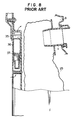
- the disclosed vacuum cleaner is a cylinder-type vacuum cleaner such as that shown in Fig. 6, in which an infrared sensor is employed though its specific construction is not described in detail.
- the dust collected by the cleaner brings forth the condition shown in Figs. 7 and 8.
- a certain amount of dust has been collected in a paper bag 25 fixed to an end portion of an intake section 11 projecting into a dust collecting section 8
- the rotation of an electric blower 9 at a certain number of revolutions per unit time causes the air within the dust collecting section 8 to be sent to the outside. Therefore, when the amount of the dust collected increases to a certain amount, the internal pressure within the dust collecting section 8 drops, and the pressure within a passage 35 defined by a member fixed to a position of the section 8 by screws also drops.
- a movable member 37 remains motionless while being held in place by a spring 36 disposed in the passage 35 when the internal pressure is above a certain level. However, when the internal pressure becomes lower than this level, the movable member 37 moves compressing the spring 36, so as to allow an inflow of air (indicated by the arrows in Fig. 8) from the outside of the section 8 to the inside thereof. This inflow of air prevents generation of a vacuum within the body of the cleaner, thereby preventing overheating of members such as the motor for the blower, and the resultant deformation of the resin materials used in the cleaner.
- the movement of the movable member 37 allows the user to be informed of whether the paper bag 25 is filled with dust or not.
- a detecting means 30 is provided in a handle 17 between a flexible hose 31 extending from a cleaner body 34 and a rigid pipe 32 provided with a suction brush 33 at one end thereof.
- This is an arrangement applicable to a cylinder-type vacuum cleaner.
- the above-described arrangement of the upright vacuum cleaner has experienced a problem arising from the increase of fibrous dust, such as lint, resulting from changes in the living or working environment.
- Fibrous dust is, when received in the paper bag 25, bulkier than such dust as earth and sand.
- the internal pressure does not easily become low enough to cause the movement of the movable member 37. This is because the fibrous dust filling the bag 25 has a lot of voids or vacancies between its specks of dust. If the cleaner in this condition is continuously used, dust will be accumulated in the intake section 11 or in a hose 10. In the end, the vacuum cleaner will not be able to suck dust any more. What is worse is that the dust-filled condition of the cleaner may not be found out until the bag 25 is removed.
- Some vacuum cleaners have a sensor employing a light-emitting element and a light-receiving element. These elements are usually protected by a transparent protective cover. However, when substances such as dry sand or earth, or moist fiber, earth or sand have adhered to the cover, the light used in the sensor is blocked by the adhering substance, thereby deteriorating the sensitivity of the sensor. In order to avoid this problem, it is necessary that the sensor is cleaned frequently by, for instance, wiping it with a piece of cloth or the like. However, with the conventional vacuum cleaners, it is impossible to clean the sensor positively and easily because only one side of the sensor can be wiped and because the way the sensor is contaminated cannot exactly be known.
- a first object of the present invention is to provide a vacuum cleaner which is, when the bag is filled with dust, capable of reliably informing the user of the dust condition.
- a second object of the present invention is to provide a vacuum cleaner which allows a sensor portion to be easily cleaned, and which enables the user to know with ease the way the sensor portion is contaminated.
- a third object of the present invention is to provide a vacuum cleaner having a sensor capable of uniformly detecting an amount of dust without being affected by variations in the intensity of the inflow of air from the hose.
- a fourth object of the present invention is to provide a vacuum cleaner having a sensor portion which does not easily become contaminated, thereby providing a more accurate sensor operation.
- a fifth object of the present invention is to provide a vacuum cleaner in which damage to the lower surface of a nozzle section is prevented.
- a vacuum cleaner comprising a cleaner body, a dust collecting section provided in the cleaner body, an intake section projecting into the dust collecting section, a hose connecting a nozzle section rotatably disposed on the suction side of the cleaner body with the dust collecting section through the intake section, a detecting means for detecting dust flowing through the hose, and a control section for controlling the output of an electric blower in accordance with a signal from the detecting means and for indicating the amount of dust on a display section.
- the detecting means comprises a light-emitting element and a light-receiving element which are provided at mutually opposing positions of the intake section.
- the intake section comprises a first tubular member which is straight and a second tubular member which is bent at an angle of approximately 90°, the second tubular member having a lid which can be freely opened and closed.
- the light-emitting element and the light-receiving element are disposed at mutually opposing positions which are downstream of the bend of the intake section according to the second aspect, and which are substantially normal to the inflow of air from the hose.
- transparent members for protecting the light-emitting element and the light-receiving element are protruded from the inner wall of the associated tubular member of the intake section.
- the nozzle section has a lower surface made of a resin, the lower surface being provided with sheet-metal protector members at least on the portion thereof that is to be brought into contact with a floor surface.
- the first aspect directed to achieving the first object, since a sensor section is provided in the intake section connected with the dust collecting section, when dust already filling the dust collecting section enters the intake section, this dust condition is immediately detected by the sensor so that the user can be reliably informed of the condition.
- the second aspect directed to achieving the second object, when the sensor section is contaminated, it can be easily cleaned by either removing the paper bag or opening the lid openably provided on the second tubular member, that is, from either the front or back side of the intake section. Further, since light can enter from either side, the user can know with ease the way the sensor section is contaminated.
- the light-emitting and light-receiving elements are provided at a location at which variations in the inflow of air caused by variations in the suction force are at their minimum. Therefore, the sensor section is capable of invariably detecting an amount of dust without being affected by variations in the intensity of the inflow of air from the hose.
- the protecting members protecting the light-emitting and light-receiving elements are slightly protruded from the inner wall of the first tubular member. This allows some of the dust sucked up and flowing toward the dust-collecting section to impinge against the protecting members, thereby removing any dust adhering to the protecting members. Therefore, the sensor section is prevented from easily being contaminated.
- the protector members provided at least on the portion where the lower surface of the nozzle section contacts the floor surface serve to increase the strength of the lower surface. This makes the lower surface of the nozzle section hardly vulnerable to damage by wear, etc.
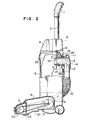
- a vacuum cleaner according to the present invention has a handle 2 with a grip 1, and a power supply cord 3.
- a cleaner body includes a dust collecting section 8 accommodating a paper bag 25, and two covers defining the front surface of the cleaner body, namely, an upper cover 4, and a cover 5 for the dust collecting section 8 which is detachably mounted thereon.
- a nozzle section 6 having a floor nozzle 7 provided therein is positioned on the suction side of the cleaner body and rotatably mounted on a lower portion of the body.
- An electric blower 9 is rotatably provided, and a belt 17 is provided for transmitting the rotation of the blower 9 to the floor nozzle 7.
- a hose 10 connects the nozzle section 6 with the dust collecting portion 8.
- An intake section 11 projects into the dust collecting section 8, and it comprises a first tubular member 12 and a second tubular member 13.
- the open end of the paper bag 25 is detachably fixed to the first tubular member 12.
- the second tubular member 13 is connected to the proximal end of the hose 10.
- the member 13 is bent at approximately 90°, and it has, on an outer wall thereof, a lid 14 which can be freely closed (as shown in Fig. 2) and opened (as shown in Fig. 3).
- a detecting means 38 comprising a light-emitting element 15 and a light-receiving element 16 is provided in the intake section 11, more specifically, on the first tubular member 12.
- printed circuit boards 19 with light emitters 20, a control section 21, etc. mounted thereon are provided inside the upper cover 4, and they are connected with the light-emitting and light-receiving elements 15 and 16 by a first group of leads 18.
- transparent protecting members 26 are provided for the light-emitting and light-receiving elements 15 and 16.
- a second group of leads 24, described later, are extended to the handle 2.
- a display section 27 is provided on the upper cover 4, as shown in Fig. 3.
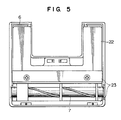
- the nozzle section 6 includes a reverse cover 22, and sheet-metal protector members 23 fixed to the reverse cover 22 by screws.
- the vacuum cleaner having the above-described construction operates in the following manner.
- the electric blower 9 starts to rotate.
- the shaft of the blower 9 causes, through the belt 17, the floor nozzle 7 of the nozzle section 6 to rotate so that dust on the floor surface is stirred up.
- the blower 9 causes the air inside the dust collecting section 8 to be discharged to the outside so that the dust stirred up by the floor nozzle 7 is passed through the hose 10 and the intake section 11, then collected into the paper bag 25 within the dust collecting section 8.
- the control section 21 on the printed circuit boards 19 inside the upper cover 4 changes the output of the electric blower 9. Also, the volume of the dust collected is displayed, by light emitters 20, as one of various levels of dust-amount indications on the display section 27. The flow of air is shown by the arrows in Fig. 2.
- the lid 14 provided on the second tubular member 13 is also opened, the user can exactly know the way the contamination is taken place, and what is more is that the members 26 can be wiped not only via an opening of the first tubular member 12 but also via an opening of the second tubular member 13, as shown in Fig. 3. Because light can enter from the two openings in the intake section 11, the contamination of the sensor section can be observed more easily than in the case of the conventional cleaners. A wiping operation may be performed during a cleaning operation when the sensitivity is found to be dull. If the lid 14 is opened in order to perform such wiping, the contaminating substances can be wiped off without removing the cover 5 and the paper bag 25.
- the control section 21 operates in such a manner as to cause, if the detection of the same number of specks of dust, and the same size of dust, is repeated for a certain period of time, the light emitters 21 to display an indication of a bag-filled condition, and stop the electric blower 9, thereby enabling the user to be informed of the condition.
- this condition can be determined in a similar manner because, in this case also, the light projected by the element 15 does not reach the opposing element 16.
- a similar indication is displayed when the protecting members 26 are soiled, thereby making it possible to positively inform the user of a condition requiring a sensor cleaning.
- the hose 10 is clogged with foreign matter, the light projected by the element 15 continues to reach the other element 16, while dust continues not to be detected. Therefore, this condition can be determined and displayed in a similar manner.
- the first tubular member 12 of the intake section 11 is made of an electrically conductive material so that the light-emitting and light-receiving elements 15 and 16 will not be charged with static electricity generated when dust is sucked up.
- the second group of leads 24 are extended from the first tubular member 12 to the handle 2 which is made of a metal material. If the grip 1, screwed onto the handle 2, is also made of an electrically conductive material, the static electricity generated in the intake section 11 is allowed to escape to the person holding the grip 1, thereby preventing erroneous operation of the control section 21 which can be caused by static electricity.
- the reverse cover 22 used on the lower surface of the nozzle section 6 is made of a resin material for the following reason.
- a reverse cover has been a sheet-metal member.
- a wide bristle portion is provided on the floor nozzle 7 in order to have the nozzle 7 cover a large area of a floor surface, it is sometimes impossible to form, in a sheet-metal member, a narrow portion permitting a wide bristle portion.
- forming the cover 22 with only a resin material involves the risk of friction occurring between the resin cover and the floor surface as well as the risk of the resin cover being abraded or worn by metal members such as screws.
- a certain portion of the lower surface of the nozzle section 6 which contacts the floor surface is formed as the sheet-metal protector members 23.
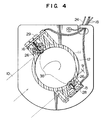
- the light-emitting element 15 and the light-receiving element 16 are mounted on printed circuit boards 28 and 29, respectively.
- the hose 10, indicated by the broken lines in Fig. 4 extends from the nozzle section 6 to the intake section 11, and air flows through the hose 10 and the section 11, as indicated by the broken-line arrow and the solid-line arrow, respectively.
- the flow of air is changed in various ways.
- the suction force is strong, the air collides against the inner wall of the second tubular member 13 approximately normally bent, then advances while forming a turbulent flow, as indicated by the arrow A in Fig. 2.
- the suction force is weak, there is not much turbulence, and the air flows along the bend of the second tubular member 13 into the first tubular member 12, as indicated by the arrow B.
- the flow of air is varied by variations in the suction force.
- the transparent members 26 for protecting the light- emitting and light-receiving elements 15 and 16 are protruded from the inner surface of the first tubular member 12 of the intake section 11 for the following reason. Even when dust such as powdery dust or fiber wet with water adheres to the protecting members 26, this arrangement of the members 26 allows fibrous dust such as lint sucked up under the suction force of the cleaner to impinge against the protecting members 26, thereby removing the adhering substances. However, if the dimension by which the members 26 are protruded exceeds the value a shown in Fig. 4, this may lead to clogging with foreign matter.
- the allowable upper limit of protrusion is considered to be 1 mm.
- the present invention provides the following effects:
Landscapes
- Engineering & Computer Science (AREA)
- Mechanical Engineering (AREA)
- Electric Vacuum Cleaner (AREA)
- Filters For Electric Vacuum Cleaners (AREA)
Applications Claiming Priority (2)
| Application Number | Priority Date | Filing Date | Title |
|---|---|---|---|
| JP41771/90 | 1990-02-22 | ||
| JP04177190A JP3149430B2 (ja) | 1990-02-22 | 1990-02-22 | アップライト型掃除機 |
Publications (2)
| Publication Number | Publication Date |
|---|---|
| EP0443845A1 true EP0443845A1 (de) | 1991-08-28 |
| EP0443845B1 EP0443845B1 (de) | 1994-06-08 |
Family
ID=12617653
Family Applications (1)
| Application Number | Title | Priority Date | Filing Date |
|---|---|---|---|
| EP91301369A Expired - Lifetime EP0443845B1 (de) | 1990-02-22 | 1991-02-20 | Staubsauger |
Country Status (6)
| Country | Link |
|---|---|
| US (1) | US5144714A (de) |
| EP (1) | EP0443845B1 (de) |
| JP (1) | JP3149430B2 (de) |
| CA (1) | CA2036826C (de) |
| DE (1) | DE69102304T2 (de) |
| ES (1) | ES2055526T3 (de) |
Cited By (4)
| Publication number | Priority date | Publication date | Assignee | Title |
|---|---|---|---|---|
| EP0904723A1 (de) * | 1997-09-15 | 1999-03-31 | YASHIMA ELECTRIC CO., Ltd. | Staubsauger |
| WO2002011599A1 (en) | 2000-08-07 | 2002-02-14 | Arçelik A.S. | A cleaning device for a sensor and a vacuum cleaner comprising such a cleaning device |
| EP1514505A3 (de) * | 2003-09-09 | 2006-04-05 | Samsung Gwangju Electronics Co., Ltd. | Vorrichtung zum Vermeiden einer Überbelastung des Motors eines Staubsaugers |
| EP2659260B1 (de) * | 2010-12-30 | 2019-11-20 | iRobot Corporation | Überwachung von debris |
Families Citing this family (42)
| Publication number | Priority date | Publication date | Assignee | Title |
|---|---|---|---|---|
| US5448794A (en) * | 1993-09-16 | 1995-09-12 | Electrolux Corporation | Corded handheld vacuum cleaner |
| US5507067A (en) * | 1994-05-12 | 1996-04-16 | Newtronics Pty Ltd. | Electronic vacuum cleaner control system |
| KR200155821Y1 (ko) * | 1997-05-12 | 1999-10-01 | 최진호 | 원격제어 진공청소기 |
| US8412377B2 (en) | 2000-01-24 | 2013-04-02 | Irobot Corporation | Obstacle following sensor scheme for a mobile robot |
| US8788092B2 (en) | 2000-01-24 | 2014-07-22 | Irobot Corporation | Obstacle following sensor scheme for a mobile robot |
| CN1225222C (zh) | 2000-01-31 | 2005-11-02 | 松下电器产业株式会社 | 电动吸尘器 |
| US6956348B2 (en) | 2004-01-28 | 2005-10-18 | Irobot Corporation | Debris sensor for cleaning apparatus |
| US6812847B1 (en) * | 2000-08-25 | 2004-11-02 | The Hoover Company | Moisture indicator for wet pick-up suction cleaner |
| US6690134B1 (en) | 2001-01-24 | 2004-02-10 | Irobot Corporation | Method and system for robot localization and confinement |
| US7571511B2 (en) | 2002-01-03 | 2009-08-11 | Irobot Corporation | Autonomous floor-cleaning robot |
| US7429843B2 (en) | 2001-06-12 | 2008-09-30 | Irobot Corporation | Method and system for multi-mode coverage for an autonomous robot |
| US8396592B2 (en) | 2001-06-12 | 2013-03-12 | Irobot Corporation | Method and system for multi-mode coverage for an autonomous robot |
| US9128486B2 (en) | 2002-01-24 | 2015-09-08 | Irobot Corporation | Navigational control system for a robotic device |
| US8428778B2 (en) | 2002-09-13 | 2013-04-23 | Irobot Corporation | Navigational control system for a robotic device |
| US8386081B2 (en) | 2002-09-13 | 2013-02-26 | Irobot Corporation | Navigational control system for a robotic device |
| US7332890B2 (en) | 2004-01-21 | 2008-02-19 | Irobot Corporation | Autonomous robot auto-docking and energy management systems and methods |
| DE112005000738T5 (de) | 2004-03-29 | 2007-04-26 | Evolution Robotics, Inc., Pasadena | Verfahren und Vorrichtung zur Positionsbestimmung unter Verwendung von reflektierten Lichtquellen |
| KR101214723B1 (ko) | 2004-06-24 | 2012-12-24 | 아이로보트 코퍼레이션 | 자동 로봇 장치용의 원격 제어 스케줄러 및 방법 |
| US7706917B1 (en) | 2004-07-07 | 2010-04-27 | Irobot Corporation | Celestial navigation system for an autonomous robot |
| US8972052B2 (en) | 2004-07-07 | 2015-03-03 | Irobot Corporation | Celestial navigation system for an autonomous vehicle |
| US7620476B2 (en) | 2005-02-18 | 2009-11-17 | Irobot Corporation | Autonomous surface cleaning robot for dry cleaning |
| ES2346343T3 (es) | 2005-02-18 | 2010-10-14 | Irobot Corporation | Robot autonomo de limpieza de superficies para una limpieza en seco y en mojado. |
| US8392021B2 (en) | 2005-02-18 | 2013-03-05 | Irobot Corporation | Autonomous surface cleaning robot for wet cleaning |
| US8930023B2 (en) | 2009-11-06 | 2015-01-06 | Irobot Corporation | Localization by learning of wave-signal distributions |
| US20060272122A1 (en) * | 2005-06-07 | 2006-12-07 | Dennis Butler | Vacuum brushroll edge cleaner |
| KR101300492B1 (ko) | 2005-12-02 | 2013-09-02 | 아이로보트 코퍼레이션 | 커버리지 로봇 이동성 |
| EP2816434A3 (de) | 2005-12-02 | 2015-01-28 | iRobot Corporation | Roboter mit autonomem Wirkungsbereich |
| EP2533120B1 (de) | 2005-12-02 | 2019-01-16 | iRobot Corporation | Robotersystem |
| US8584305B2 (en) | 2005-12-02 | 2013-11-19 | Irobot Corporation | Modular robot |
| EP2829939B1 (de) | 2005-12-02 | 2019-11-13 | iRobot Corporation | Roboternavigationssystem mit autonomer Abdeckung |
| US8528157B2 (en) | 2006-05-19 | 2013-09-10 | Irobot Corporation | Coverage robots and associated cleaning bins |
| US8417383B2 (en) | 2006-05-31 | 2013-04-09 | Irobot Corporation | Detecting robot stasis |
| ES2559128T3 (es) | 2007-05-09 | 2016-02-10 | Irobot Corporation | Robot autónomo de cubrimiento compacto |
| US20100236013A1 (en) * | 2009-03-17 | 2010-09-23 | Electrolux Home Care Products, Inc. | Vacuum Cleaner Sensor |
| KR101497197B1 (ko) | 2010-02-16 | 2015-02-27 | 아이로보트 코퍼레이션 | 진공 브러쉬 |
| JP5620127B2 (ja) * | 2010-03-12 | 2014-11-05 | 株式会社東芝 | 電気掃除機 |
| SE534963C2 (sv) * | 2010-06-29 | 2012-02-28 | Electrolux Ab | Dammindikator för en dammsugare |
| SE534962C2 (sv) | 2010-06-29 | 2012-02-28 | Electrolux Ab | Dammdetekteringssystem för en dammsugare |
| EP2916705B1 (de) | 2012-11-09 | 2020-06-03 | Aktiebolaget Electrolux | Zyklonstaubabscheideranordnung, zyklonstaubabscheider und zyklonstaubsauger |
| WO2017136848A1 (en) * | 2016-02-04 | 2017-08-10 | Haws Corporation | Integrated water detection sensor |
| CN110179399B (zh) * | 2019-06-28 | 2023-11-28 | 小狗电器互联网科技(北京)股份有限公司 | 一种用于吸尘器中的灰尘通道及吸尘器 |
| CN112603197B (zh) * | 2020-12-10 | 2022-05-10 | 江苏美的清洁电器股份有限公司 | 地刷及地刷的控制方法 |
Citations (5)
| Publication number | Priority date | Publication date | Assignee | Title |
|---|---|---|---|---|
| US3199138A (en) * | 1963-04-22 | 1965-08-10 | Whirlpool Co | Cleaner |
| DE2900433B1 (de) * | 1979-01-08 | 1980-06-26 | Vorwerk Co Interholding | Optische Fuellstandsanzeige fuer den Staubbeutel eines Staubsaugers |
| DE3431175A1 (de) * | 1984-02-08 | 1985-08-14 | Gerhard 7262 Althengstett Kurz | Schutzvorrichtung fuer staubsammeleinrichtungen |
| EP0217216A2 (de) * | 1985-09-28 | 1987-04-08 | Interlava AG | Staubsauger |
| EP0347223A2 (de) * | 1988-06-15 | 1989-12-20 | Matsushita Electric Industrial Co., Ltd. | Staub-Anzeigevorrichtung für Staubsauger |
Family Cites Families (10)
| Publication number | Priority date | Publication date | Assignee | Title |
|---|---|---|---|---|
| NL7212108A (de) * | 1972-09-06 | 1974-03-08 | ||
| US4199839A (en) * | 1978-10-12 | 1980-04-29 | Health-Mor, Inc. | Suction cleaner power nozzle construction |
| DE3431164A1 (de) * | 1984-02-08 | 1985-08-14 | Gerhard 7262 Althengstett Kurz | Staubsauger |
| EP0231419A1 (de) * | 1986-02-05 | 1987-08-12 | Interlava AG | Optische Anzeige- und Funktionskontrolleinheit für Staubsauger |
| JPS63246125A (ja) * | 1987-04-02 | 1988-10-13 | 松下電器産業株式会社 | 電気掃除機 |
| DE3803824A1 (de) * | 1988-02-09 | 1989-08-17 | Gerhard Kurz | Einbauvorrichtung fuer sensoren und geber |
| JPH01214324A (ja) * | 1988-02-23 | 1989-08-28 | Matsushita Electric Ind Co Ltd | アプライト形電気掃除機 |
| JPH01285236A (ja) * | 1988-05-13 | 1989-11-16 | Matsushita Electric Ind Co Ltd | 電気掃除機の塵埃検出装置 |
| JPH01299525A (ja) * | 1988-05-26 | 1989-12-04 | Matsushita Electric Ind Co Ltd | 電気掃除機の床ノズル |
| JP2547630B2 (ja) * | 1988-12-19 | 1996-10-23 | 三洋電機株式会社 | 電気掃除機 |
-
1990
- 1990-02-22 JP JP04177190A patent/JP3149430B2/ja not_active Expired - Fee Related
-
1991
- 1991-02-19 US US07/657,059 patent/US5144714A/en not_active Expired - Lifetime
- 1991-02-20 ES ES91301369T patent/ES2055526T3/es not_active Expired - Lifetime
- 1991-02-20 EP EP91301369A patent/EP0443845B1/de not_active Expired - Lifetime
- 1991-02-20 DE DE69102304T patent/DE69102304T2/de not_active Expired - Fee Related
- 1991-02-21 CA CA002036826A patent/CA2036826C/en not_active Expired - Lifetime
Patent Citations (5)
| Publication number | Priority date | Publication date | Assignee | Title |
|---|---|---|---|---|
| US3199138A (en) * | 1963-04-22 | 1965-08-10 | Whirlpool Co | Cleaner |
| DE2900433B1 (de) * | 1979-01-08 | 1980-06-26 | Vorwerk Co Interholding | Optische Fuellstandsanzeige fuer den Staubbeutel eines Staubsaugers |
| DE3431175A1 (de) * | 1984-02-08 | 1985-08-14 | Gerhard 7262 Althengstett Kurz | Schutzvorrichtung fuer staubsammeleinrichtungen |
| EP0217216A2 (de) * | 1985-09-28 | 1987-04-08 | Interlava AG | Staubsauger |
| EP0347223A2 (de) * | 1988-06-15 | 1989-12-20 | Matsushita Electric Industrial Co., Ltd. | Staub-Anzeigevorrichtung für Staubsauger |
Non-Patent Citations (3)
| Title |
|---|
| PATENT ABSTRACTS OF JAPAN vol. 13, no. 529 (C-658)(3877) November 27, 1989 & JP-A-1 214 324 (MATSUSHITA ELECTRIC IND CO LTD ) August 28, 1989 * |
| PATENT ABSTRACTS OF JAPAN vol. 14, no. 63 (C-685)(4006) February 6, 1990 & JP-A-1 285 236 (MATSUSHITA ELECTRIC IND CO LTD ) November 16, 1989 * |
| PATENT ABSTRACTS OF JAPAN vol. 14, no. 86 (C-690)(4029) February 19, 1990 & JP-A-1 299 525 (MATSUSHITA ELECTRIC IND CO LTD ) December 4, 1989 * |
Cited By (5)
| Publication number | Priority date | Publication date | Assignee | Title |
|---|---|---|---|---|
| EP0904723A1 (de) * | 1997-09-15 | 1999-03-31 | YASHIMA ELECTRIC CO., Ltd. | Staubsauger |
| US6023814A (en) * | 1997-09-15 | 2000-02-15 | Imamura; Nobuo | Vacuum cleaner |
| WO2002011599A1 (en) | 2000-08-07 | 2002-02-14 | Arçelik A.S. | A cleaning device for a sensor and a vacuum cleaner comprising such a cleaning device |
| EP1514505A3 (de) * | 2003-09-09 | 2006-04-05 | Samsung Gwangju Electronics Co., Ltd. | Vorrichtung zum Vermeiden einer Überbelastung des Motors eines Staubsaugers |
| EP2659260B1 (de) * | 2010-12-30 | 2019-11-20 | iRobot Corporation | Überwachung von debris |
Also Published As
| Publication number | Publication date |
|---|---|
| JPH03244420A (ja) | 1991-10-31 |
| ES2055526T3 (es) | 1994-08-16 |
| DE69102304D1 (de) | 1994-07-14 |
| CA2036826A1 (en) | 1991-08-23 |
| JP3149430B2 (ja) | 2001-03-26 |
| EP0443845B1 (de) | 1994-06-08 |
| CA2036826C (en) | 2000-03-28 |
| US5144714A (en) | 1992-09-08 |
| DE69102304T2 (de) | 1994-12-08 |
Similar Documents
| Publication | Publication Date | Title |
|---|---|---|
| US5144714A (en) | Vacuum cleaner | |
| KR101223478B1 (ko) | 로봇청소기의 먼지통 착탈 감지 장치 | |
| CN113645888B (zh) | 具有脏污流体罐装置的面清洁机 | |
| CA2008318A1 (en) | Vacuum cleaner with adjustable nozzle shield | |
| EP3323332A1 (de) | Reinigungsvorrichtung | |
| CN115211750A (zh) | 清洁系统 | |
| CN115811953A (zh) | 吸尘器 | |
| KR20250036193A (ko) | 바닥 보호 작동 모드를 갖춘 진공청소기 | |
| KR100779052B1 (ko) | 진공 청소기용 장치 | |
| JPH0153059B2 (de) | ||
| EP0136895A2 (de) | Selbstreinigende Verbindung | |
| JP4736644B2 (ja) | 電気掃除機 | |
| EP4364624A1 (de) | Vakuumreinigungsvorrichtung | |
| JPH06105764A (ja) | アップライト型掃除機 | |
| JP6851182B2 (ja) | 電気掃除機 | |
| CN217090595U (zh) | 储液箱 | |
| CN113660893A (zh) | 具有清洁液罐装置和传感器装置的面清洁机及用于运行面清洁机的方法 | |
| JPH05253156A (ja) | アップライト型掃除機 | |
| SE2350097A1 (en) | A power trowel for dry polishing operations | |
| JP3886240B2 (ja) | 手乾燥装置 | |
| KR102313294B1 (ko) | 청소기 | |
| GB2446892A (en) | Power tool with access for cleaning | |
| CN220557924U (zh) | 清洁设备和溶液桶 | |
| US20240292989A1 (en) | Vacuum cleaner having adaptive dirt identification and method for operating the vacuum cleaner | |
| JPH03186238A (ja) | アップライト型掃除機 |
Legal Events
| Date | Code | Title | Description |
|---|---|---|---|
| PUAI | Public reference made under article 153(3) epc to a published international application that has entered the european phase |
Free format text: ORIGINAL CODE: 0009012 |
|
| AK | Designated contracting states |
Kind code of ref document: A1 Designated state(s): DE ES FR GB |
|
| 17P | Request for examination filed |
Effective date: 19911016 |
|
| 17Q | First examination report despatched |
Effective date: 19930201 |
|
| GRAA | (expected) grant |
Free format text: ORIGINAL CODE: 0009210 |
|
| AK | Designated contracting states |
Kind code of ref document: B1 Designated state(s): DE ES FR GB |
|
| REF | Corresponds to: |
Ref document number: 69102304 Country of ref document: DE Date of ref document: 19940714 |
|
| REG | Reference to a national code |
Ref country code: ES Ref legal event code: FG2A Ref document number: 2055526 Country of ref document: ES Kind code of ref document: T3 |
|
| ET | Fr: translation filed | ||
| PLBE | No opposition filed within time limit |
Free format text: ORIGINAL CODE: 0009261 |
|
| STAA | Information on the status of an ep patent application or granted ep patent |
Free format text: STATUS: NO OPPOSITION FILED WITHIN TIME LIMIT |
|
| 26N | No opposition filed | ||
| REG | Reference to a national code |
Ref country code: GB Ref legal event code: IF02 |
|
| PGFP | Annual fee paid to national office [announced via postgrant information from national office to epo] |
Ref country code: ES Payment date: 20070228 Year of fee payment: 17 |
|
| PGFP | Annual fee paid to national office [announced via postgrant information from national office to epo] |
Ref country code: FR Payment date: 20070208 Year of fee payment: 17 |
|
| REG | Reference to a national code |
Ref country code: FR Ref legal event code: ST Effective date: 20081031 |
|
| PG25 | Lapsed in a contracting state [announced via postgrant information from national office to epo] |
Ref country code: FR Free format text: LAPSE BECAUSE OF NON-PAYMENT OF DUE FEES Effective date: 20080229 |
|
| REG | Reference to a national code |
Ref country code: ES Ref legal event code: FD2A Effective date: 20080221 |
|
| PGFP | Annual fee paid to national office [announced via postgrant information from national office to epo] |
Ref country code: DE Payment date: 20090213 Year of fee payment: 19 |
|
| PGFP | Annual fee paid to national office [announced via postgrant information from national office to epo] |
Ref country code: GB Payment date: 20090217 Year of fee payment: 19 |
|
| PG25 | Lapsed in a contracting state [announced via postgrant information from national office to epo] |
Ref country code: ES Free format text: LAPSE BECAUSE OF NON-PAYMENT OF DUE FEES Effective date: 20080221 |
|
| GBPC | Gb: european patent ceased through non-payment of renewal fee |
Effective date: 20100220 |
|
| PG25 | Lapsed in a contracting state [announced via postgrant information from national office to epo] |
Ref country code: DE Free format text: LAPSE BECAUSE OF NON-PAYMENT OF DUE FEES Effective date: 20100901 |
|
| PG25 | Lapsed in a contracting state [announced via postgrant information from national office to epo] |
Ref country code: GB Free format text: LAPSE BECAUSE OF NON-PAYMENT OF DUE FEES Effective date: 20100220 |