EP0445039A1 - Nouveaux dérivés de la pyridylsulfonylurée et de la pyridylsulfonylthiourée leur procédé de préparation et les compositions pharmaceutiques que les contiennent - Google Patents
Nouveaux dérivés de la pyridylsulfonylurée et de la pyridylsulfonylthiourée leur procédé de préparation et les compositions pharmaceutiques que les contiennent Download PDFInfo
- Publication number
- EP0445039A1 EP0445039A1 EP91400563A EP91400563A EP0445039A1 EP 0445039 A1 EP0445039 A1 EP 0445039A1 EP 91400563 A EP91400563 A EP 91400563A EP 91400563 A EP91400563 A EP 91400563A EP 0445039 A1 EP0445039 A1 EP 0445039A1
- Authority
- EP
- European Patent Office
- Prior art keywords
- formula
- salts
- pyrid
- sulfonyl
- compound
- Prior art date
- Legal status (The legal status is an assumption and is not a legal conclusion. Google has not performed a legal analysis and makes no representation as to the accuracy of the status listed.)
- Granted
Links
- 0 CNS(C(CCC1CCCCCC1)C(CCN)N*)(=O)=O Chemical compound CNS(C(CCC1CCCCCC1)C(CCN)N*)(=O)=O 0.000 description 1
Classifications
-
- C—CHEMISTRY; METALLURGY
- C07—ORGANIC CHEMISTRY
- C07D—HETEROCYCLIC COMPOUNDS
- C07D213/00—Heterocyclic compounds containing six-membered rings, not condensed with other rings, with one nitrogen atom as the only ring hetero atom and three or more double bonds between ring members or between ring members and non-ring members
- C07D213/02—Heterocyclic compounds containing six-membered rings, not condensed with other rings, with one nitrogen atom as the only ring hetero atom and three or more double bonds between ring members or between ring members and non-ring members having three double bonds between ring members or between ring members and non-ring members
- C07D213/04—Heterocyclic compounds containing six-membered rings, not condensed with other rings, with one nitrogen atom as the only ring hetero atom and three or more double bonds between ring members or between ring members and non-ring members having three double bonds between ring members or between ring members and non-ring members having no bond between the ring nitrogen atom and a non-ring member or having only hydrogen or carbon atoms directly attached to the ring nitrogen atom
- C07D213/60—Heterocyclic compounds containing six-membered rings, not condensed with other rings, with one nitrogen atom as the only ring hetero atom and three or more double bonds between ring members or between ring members and non-ring members having three double bonds between ring members or between ring members and non-ring members having no bond between the ring nitrogen atom and a non-ring member or having only hydrogen or carbon atoms directly attached to the ring nitrogen atom with hetero atoms or with carbon atoms having three bonds to hetero atoms with at the most one bond to halogen, e.g. ester or nitrile radicals, directly attached to ring carbon atoms
- C07D213/72—Nitrogen atoms
- C07D213/74—Amino or imino radicals substituted by hydrocarbon or substituted hydrocarbon radicals
-
- A—HUMAN NECESSITIES
- A61—MEDICAL OR VETERINARY SCIENCE; HYGIENE
- A61P—SPECIFIC THERAPEUTIC ACTIVITY OF CHEMICAL COMPOUNDS OR MEDICINAL PREPARATIONS
- A61P9/00—Drugs for disorders of the cardiovascular system
-
- A—HUMAN NECESSITIES
- A61—MEDICAL OR VETERINARY SCIENCE; HYGIENE
- A61P—SPECIFIC THERAPEUTIC ACTIVITY OF CHEMICAL COMPOUNDS OR MEDICINAL PREPARATIONS
- A61P9/00—Drugs for disorders of the cardiovascular system
- A61P9/12—Antihypertensives
-
- C—CHEMISTRY; METALLURGY
- C07—ORGANIC CHEMISTRY
- C07D—HETEROCYCLIC COMPOUNDS
- C07D401/00—Heterocyclic compounds containing two or more hetero rings, having nitrogen atoms as the only ring hetero atoms, at least one ring being a six-membered ring with only one nitrogen atom
- C07D401/02—Heterocyclic compounds containing two or more hetero rings, having nitrogen atoms as the only ring hetero atoms, at least one ring being a six-membered ring with only one nitrogen atom containing two hetero rings
- C07D401/12—Heterocyclic compounds containing two or more hetero rings, having nitrogen atoms as the only ring hetero atoms, at least one ring being a six-membered ring with only one nitrogen atom containing two hetero rings linked by a chain containing hetero atoms as chain links
Definitions
- the present invention relates to new derivatives of pyridylsulfonylurea and pyridylsulfonylthiourea, their preparation process and the pharmaceutical preparations containing them.
- the applicant has now discovered new pyridylsulfonylureas and pyridylsulfonylthioureas having not only inhibitory properties of the cotransport Na + K + 2Cl- and a renal chloride channel, but also blocking properties of the cellular potassium channel at renal and pulmonary level.
- the compounds of the invention are therefore particularly advantageous in the treatment of diseases such as arterial hypertension, edematous states of any etiology, including cerebral edema.
- inorganic or organic acids that may be mentioned, without this list being limiting, hydrochloric, sulfuric, nitric, acetic, tartaric, maleic, maleic, camphoric, methanesulphonic, ethanesulphonic, camphorsulphonic acids, etc.
- the compounds of the invention have very advantageous pharmacological properties.
- the compounds of the invention therefore find application in the treatment of hypertension, all the more advantageous since this normalization of blood pressure is not accompanied by a potassium leakage, the harmful effects of which are known, in particular for the heart muscle.
- the compounds of the invention have a lipophilicity which is particularly well suited to the passage of the hemomeningeal barrier and, therefore, their inhibitory action on the cotransport Na + K + 2CI- can be exerted directly on the level of the astrocytes, thus preventing the astrocyte swelling which represents a very important part of the cerebral edema.
- the compounds of the invention therefore find application in the treatment of edematous states and including cerebral edema.
- the present invention also relates to pharmaceutical compositions containing as active principle at least one compound of formula (I) or one of its addition salts with a pharmaceutically acceptable acid, alone or in combination with one or more excipients or non-toxic inert vehicles .
- compositions according to the invention mention may be made more particularly of those which are suitable for oral, parenteral, nasal, rectal or cutaneous administration, in particular simple or coated tablets, capsules, cachets and sachets, sublingual tablets and glossettes, suppositories, dermal creams and gels, aerosols, injectables, nasal drops, etc.
- the useful dosage varies depending on the age, weight of the patient, the severity of the condition and the route of administration. In general, the unit dosage ranges from 0.1 mg to 500 mg in one to three daily doses.
- the compounds of formula (II) can in particular be obtained by the action of an excess of an amine of formula RNH 2 where R has the same meaning as in general formula (1) on a pyridine derivative of formula in which it represents a group such as halogen or SO 3 H, by heating between 80 and 140 ° C. After dilution and alkalization, if necessary, then, if carbon clarification is desired, the compounds of formula (11) are precipitated at pH 7-8, drained, dried, and used as such in the following reactions.
- centesimal analyzes the infrared spectra and 1 H NMR are in agreement with the expected structures.
- the insoluble material if any, is filtered and the solution is brought to pH 6.5-7 and left to crystallize for 1 hour in the refrigerator.
- the precipitate collected is suspended in 100 ml of the water-acetone mixture (4: 1) saturated with NaHCO 3 .
- the mixture is stirred for 1 hour, filtered and the filtrate brought to pH 6.5-7 is left to crystallize in the refrigerator.
- the crystals are collected, washed with cold water and dried under vacuum at ordinary temperature. The yield is close to 50 to 60%. melting point: 165-167 ° C.
- Example 2 The operating conditions of Example 2 are used, but using ethyl N- (4- (cyclooctylamino) pyrid-3-yl) sulfonylcarbamate and cyclooctylamine as raw materials. After separation of the molecular sieve and evaporation under vacuum, the residue is taken up in 75 to 100 ml of 0.2 N NaOH, extracted twice with 50 ml of ether and the aqueous phase is added with 5 to 10 ml of nitric acid. We leave overnight in the refrigerator. The crystals are collected on a filter, washed with a minimum of ice water and dried under vacuum at ordinary temperature. The yield is close to 60 to 70%. Melting point: 144-146 ° C.
- the insoluble material if any, is filtered and the solution is brought to pH 6.5-7 and left to crystallize for 1 hour in the refrigerator.
- the precipitate collected is suspended in 100 ml of the water-acetone mixture (4: 1) saturated with NaHCO 3 .
- the mixture is stirred for 1 hour, filtered and the filtrate brought to pH 6.5-7 is left to crystallize in the refrigerator.
- the crystals are collected, washed with cold water and dried under vacuum at ordinary temperature. The yield is close to 50 to 60%. Melting point: 195-197 ° C.
- Example 5 The procedure is identical to that of Example 5 using (4- (cyclooctylamino) pyrid-3-yl) sulfonamide and ethylisothiocyanate as raw materials. The yield is similar. Melting point 196-198 ° C.
- the pKa represent the acid constant of the proton SO 2 -NH-CO-
- the concentration inhibiting the Na + K + 2CI- cotransport present in animals by 50% is reduced, with the compound of Example 3, by approximately 60 % compared to Torasemide (luminal membrane of the ascending branch of Henle's loop of the perfused rabbit nephron (Arzneim. Forsch. (1988) 38 (1a), 151-152)) and 85% compared to Torasemide with the compound of Example 10 (membrane of red blood cells of normotensive rat).
- the concentration inhibiting the CI- channel at 50% at the renal level in animals is, with the compound of Example 8, reduced by approximately 50% compared to Torasemide.
Landscapes
- Organic Chemistry (AREA)
- Chemical & Material Sciences (AREA)
- Health & Medical Sciences (AREA)
- Pharmacology & Pharmacy (AREA)
- Bioinformatics & Cheminformatics (AREA)
- Cardiology (AREA)
- Chemical Kinetics & Catalysis (AREA)
- General Chemical & Material Sciences (AREA)
- Medicinal Chemistry (AREA)
- Nuclear Medicine, Radiotherapy & Molecular Imaging (AREA)
- Engineering & Computer Science (AREA)
- Life Sciences & Earth Sciences (AREA)
- Heart & Thoracic Surgery (AREA)
- Animal Behavior & Ethology (AREA)
- General Health & Medical Sciences (AREA)
- Public Health (AREA)
- Veterinary Medicine (AREA)
- Pharmaceuticals Containing Other Organic And Inorganic Compounds (AREA)
- Pyridine Compounds (AREA)
- Acyclic And Carbocyclic Compounds In Medicinal Compositions (AREA)
- Organic Low-Molecular-Weight Compounds And Preparation Thereof (AREA)
Abstract
Description
- La présente invention concerne de nouveaux dérivés de la pyridylsulfonylurée et de la pyridylsulfonylthiou- rée, leur procédé de préparation et les préparations pharmaceutiques qui les contiennent.
- On connait dans la littérature de nombreuses sulfonylurées ou sulfonylthiourées, dotées notamment de propriétés diurétiques ou hypoglycémiantes. On connait également des pyridylsulfonylurées comme le Torasémide qui est un diurétique puissant.
- D'autres pyridylsulfonylurées ont également été décrites pour leur propriétés diurétiques et antiinflamma- toires (Brevets Français N° 2 267 775 et N° 2 416 225).
- Leur effet diurétique est dû à une action inhibitrice du cotransport Na+ K+ 2CI- au niveau rénal.
- La demanderesse a maintenant découvert de nouvelles pyridylsulfonylurées et pyridylsulfonylthiourées dotées non seulement de propriétés inhibitrices du cotransport Na+ K+ 2Cl- et d'un canal chlorure rénal, mais également de propriétés bloquantes du canal potassique cellulaire au niveau rénal et pulmonaire.
- Ces nouveaux dérivés, contrairement aux dérivés de l'art antérieur, ont également la propriété particulièrement intéressante de présenter un coefficient de partage et un pKa optimaux pour le passage de la barrière hémoméningée.
- Les composés de l'invention sont donc particulièrement intéressants dans le traitement de maladies comme l'hypertension artérielle, les états oedémateux de toute étiologie, y compris l'oedème cérébral.
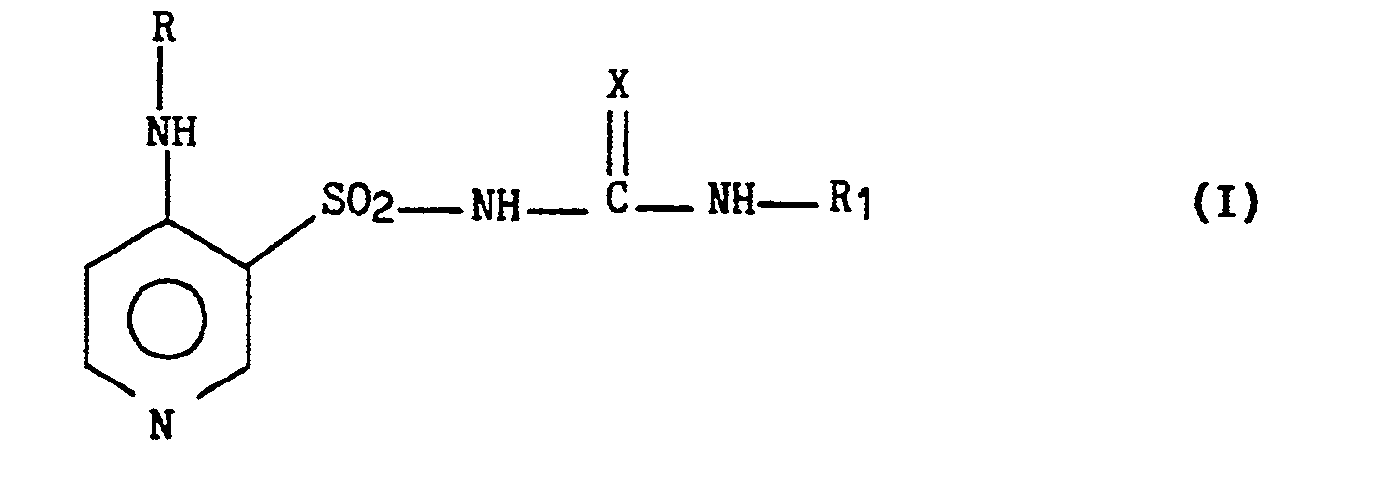
- Plus spécifiquement, l'invention concerne les dérivés de formule (I)
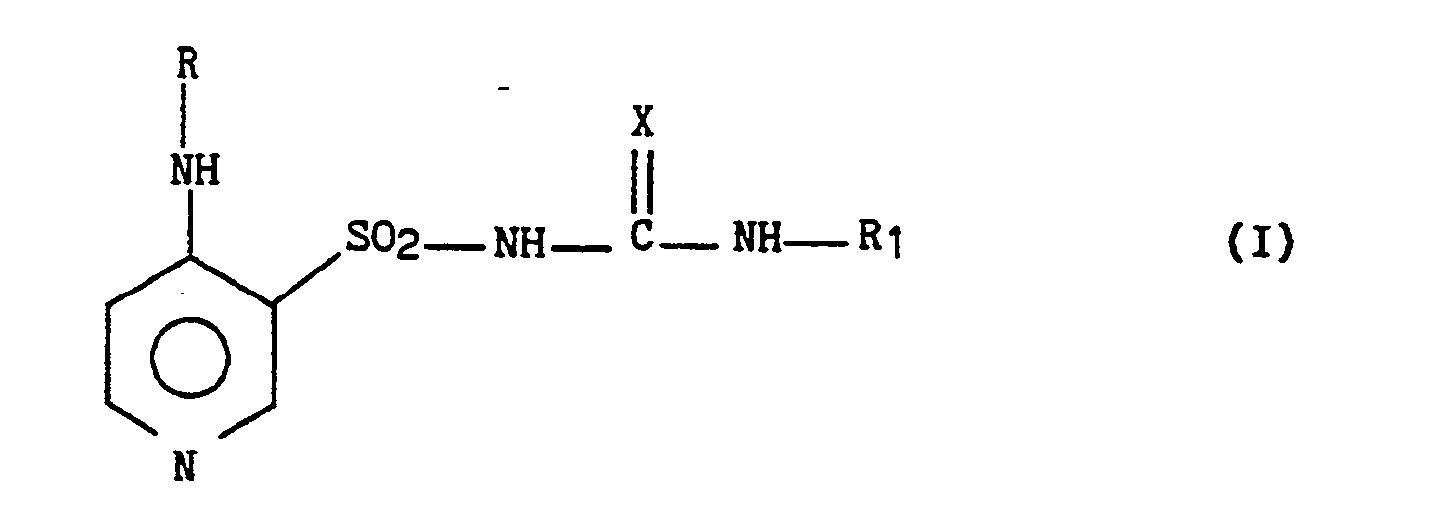
- - R représente un radical cycloalkyle, bicycloalkyle ou polycycloalkyle de 3 à 15 atomes de carbone éventuellement interrompus par un ou plusieurs hétéroatomes choisis parmi azote, oxygène et soufre,
- - X représente un atome d'oxygène ou de soufre.
- - R1 représente un radical alkyle comportant de 1 à 6 atomes de carbone en chaîne droite ou ramifiée ou un radical cycloalkyle, bicycloalkyle ou polycycloalkyle renfermant de 3 à 15 atomes de carbone, éventuellement interrompus par un ou plusieurs hétéroatomes choisis parmi azote, oxygène et soufre, avec la réserve que, lorsque X est un atome d'oxygène et que simultanément R est un radical alkyle monocyclique ou bicyclique, R1 ne peut pas représenter un radical alkyle linéaire ou ramifié ou un groupe hété- romonocyclique azoté saturé pouvant contenir un deuxième hétéroatome, ainsi que leurs sels d'addition à un acide minéral ou organique pharmaceutiquement acceptable, et, lorsque R ou R1 représentent un radical comportant un ou plusieurs centres d'asymétrie, leurs isomères, énantiomères et diastéréoisomères.
- L'invention s'étend aussi au procédé de préparation des dérivés de formule (I), caractérisé en ce que :
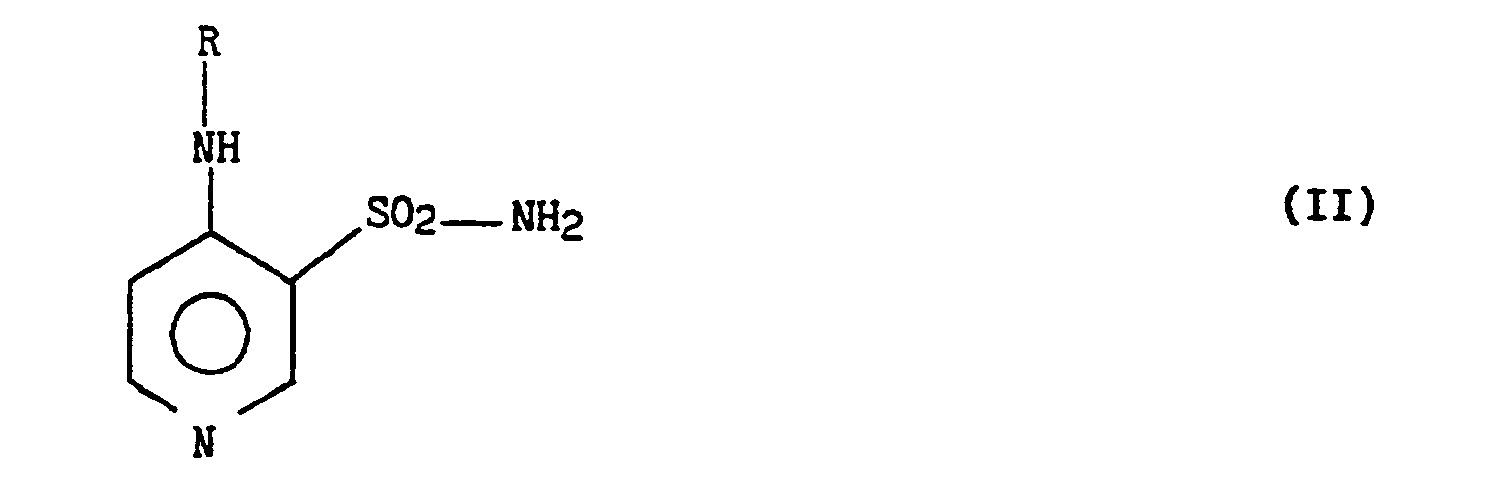
- - soit l'on condense un dérivé de formule (II)

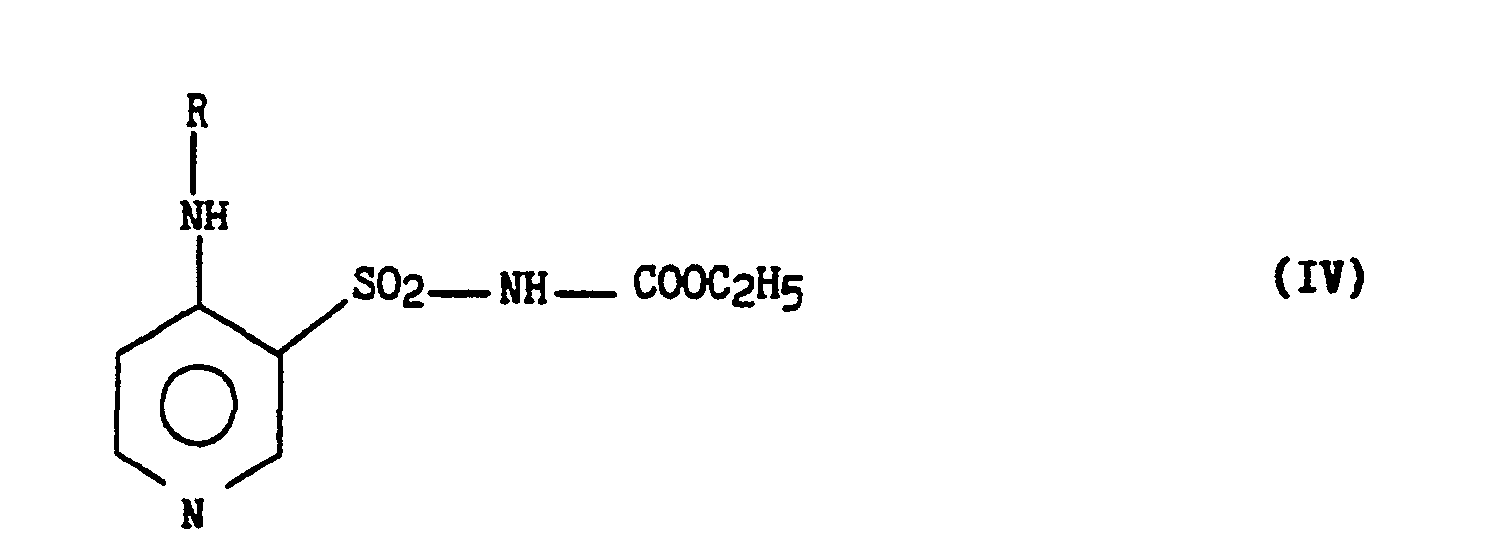
- - soit l'on condense un dérivé de formule (IV)


- Parmi les acides minéraux ou organiques pharmaceutiquement acceptables l'on peut citer, sans que cette liste soit limitative, les acides chlorhydrique, sulfurique, nitrique, acétique, tartrique, malique, maléïque, cam- phorique, méthanesulfonique, éthanesulfonique, camphosulfonique,...
- Les composés de l'invention possèdent des propriétés pharmacologiques très intéressantes.
- Ils présentent des propriétés diurétiques dues à l'inhibition du cotransport Na+ K+ 2CI- et d'un canal chlorure, doublées de propriétés d'épargne du potassium liée à l'inhibition du canal potassique membranaire.
- Les composés de l'invention trouvent donc une application dans le traitement de l'hypertension, d'autant plus intéressante que cette normalisation tensionnelle n'est pas accompagnée d'une fuite potassique dont on connait les effets néfastes, notamment pour le muscle cardiaque.
- Par ailleurs, les composés de l'invention possèdent une lipophilie particulièrement bien adaptée au passage de la barrière hémoméningée et, dès lors, leur action inhibitrice du cotransport Na+ K+ 2CI- peut s'exercer directement au niveau des astrocytes, empéchant ainsi le gonflement astrocytaire qui représente une part très importante de l'oedème cérébral.
- Les composés de l'invention trouvent donc une application dans le traitement des états oedémateux et notamment de l'oedème cérébral.
- La présente invention a également pour objet les compositions pharmaceutiques renfermant comme principe actif au moins un composé de formule (I) ou un de ses sels d'addition à un acide pharmaceutiquement acceptable, seul ou en combinaison avec un ou plusieurs excipients ou véhicules inertes atoxiques.
- Parmi les compositions pharmaceutiques selon l'invention, on pourra citer plus particulièrement celles qui conviennent à l'administration orale, parentérale, nasale, rectale ou cutanée, notamment les comprimés simples ou dragéifiés, les gélules, les cachets et sachets, les comprimés sublinguaux et les glossettes, les suppositoires, les crèmes et gels dermiques, les aérosols, les solutés injectables, les gouttes nasales, etc...
- La posologie utile varie selon l'âge, le poids du patient, la sévérité de l'affection ainsi que la voie d'administration. D'une manière générale, la posologie unitaire s'échelonne entre 0,1 mg à 500 mg en une à trois prises quotidiennes.
- Les exemples suivants illustrent l'invention et ne la limitent en aucune façon.
- Les composés de départ de formule génarale (II) et (IV) sont décrits dans la littérature (Eur. J. Med. Chem. 15 (4), 299-304 (1980) et 16 (1) 65-68 (1981)) ou peuvent être préparés de manière analogue.
- Les composés de formule (II) peuvent notamment être obtenus par action d'un excès d'une amine de formule RNH2 où R à la même signification que dans la formule générale (1) sur un dérivé pyridinique de formule

- Dans les exemples qui suivent, les analyses centésimales, les spectres infra-rouge et 1H RMN sont en accord avec les structures attendues.
- Une solution de 0,01 mole de (4-(cyclohexylamino)pyrid-3-yl)sulfonamide dans 80 ml du mélange eau-acétone (1:1) est additionnée de 0,01 mole de NaOH en solution dans un minimum d'eau. On agite avec un barreau magnétique et on ajoute 0,015 mole de cyclohexylisocyanate. On maintient sous agitation en suivant l'évolution de la réaction par c.c.m. (silicagel 60 F254, phase mobile: acétate d'éthyle 9, méthanol 1, triéthylamine 0,2). Un léger chauffage peut accélérer la réaction. On évapore sous dépression et le résidu est repris par 100 ml de NaOH 0,2 N. L'insoluble éventuel est filtré et la solution est amenée à pH 6,5-7 et abandonnée à cristallisation pendant 1 heure au réfrigérateur. Le précipité recueilli est mis en suspension dans 100 ml du mélange eau-acétone (4:1) saturé par NaHC03. Le mélange est agité pendant 1 heure, filtré et le filtrat ramené à pH 6,5-7 est abandonné à cristallisation au réfrigérateur. Les cristaux sont recueillis, lavés à l'eau froide et séchés sous vide à température ordinaire. Le rendement est voisin de 50 à 60 %. point de fusion : 165-167 °C.
- 0,01 mole de N-(4-(cycloheptylamino)pyrid-3-yl)sulfonylcarbamate d'éthyle, 0,05 mole de cyclohexylamine et 3 g de tamis moléculaire de 4 A sont additionnés de 40 ml de toluène anhydre et portés à reflux pendant quelques heures en suivant l'évolution de la réaction par c.c.m. (silicagel 60F254 phase mobile : acétate d'éthyle 9, méthanol 1, acide acétique 0,2). On sépare le tamis moléculaire et on évapore sous dépression. Le résidu est repris par 100 à 150 ml de NaOH 0,2 N et extrait 2 fois par 50 ml d'éther. La phase aqueuse est amenée à pH 6,5-7 et abandonnée à cristallisation pendant 1 heure au réfrigérateur. Les opérations sont alors poursuivies comme dans l'exemple 1). Le rendement est voisin de 50 à 60 %. Point de fusion : 165-169 °C.
- On utilise les conditions opératoires de l'exemple 2 mais en employant du N-(4-(cyclooctylamino)pyrid-3-yl)sulfonylcarbamate d'éthyle et de la cyclooctylamine comme matières premières. Après séparation du tamis moléculaire et évaporation sous dépression on reprend par 75 à 100 ml de NaOH 0,2 N, on extrait deux fois par 50 ml d'éther et la phase aqueuse est additionnée de 5 à 10 ml d'acide nitrique. On abandonne une nuit au réfrigérateur. Les cristaux sont recueillis sur filtre, lavés avec un minimum d'eau glacée et séchés sous vide à température ordinaire. Le rendement est voisin de 60 à 70 %. Point de fusion : 144-146 °C.
- Une solution de 0,01 mole de (4-(cycloheptylamino)pyrid-3-yl)sulfonamide dans 80 ml du mélange eau-acétone (1:1) est additionnée de 0,01 mole de NaOH en solution dans un minimum d'eau. On agite avec un barreau magnétique et on ajoute 0,015 mole de cyclohexylisothiocyanate. On maintient sous agitation en suivant l'évolution de la réaction par c.c.m. (silicagel 60F254, phase mobile : acétate d'éthyle 9, méthanol 1, triéthylamine 0,2). Un légerchauffage peut accélérer la réaction. On évapore sous dépression et le résidu est repris par 100 ml de NaOH 0,2 N. L'insoluble éventuel est filtré et la solution est amenée à pH 6,5-7 et abandonnée à cristallisation pendant 1 heure au réfrigérateur. Le précipité recueilli est mis en suspension dans 100 ml du mélange eau-acétone (4:1) saturé par NaHC03. Le mélange est agité pendant 1 heure, filtré et le filtrat ramené à pH 6,5-7 est abandonné à cristallisation au réfrigérateur. Les cristaux sont recueillis, lavés à l'eau froide et séchés sous vide à température ordinaire. Le rendement est voisin de 50 à 60 %. Point de fusion : 195-197 °C.
- 2 grammes de (4-(norbornylamino)pyrid-3-yl)sulfonamide sont dissous dans 20 ml d'acétone et additionnés de 5 ml d'isopropylisothiocyanate et de 5 ml de triéthylamine. On chauffe à reflux en suivant l'évolution de la réaction par c.c.m. (silicagel 60F254, phase mobile : acétate d'éthyle 9, méthanol 1, triéthylamine 0,2). On évapore à sec, on reprend par 120 ml de NaOH 0,2 N et on filtre. On extrait 3 fois par 150 ml d'éther, on clarifie au charbon et on amène à pH 7,5. Le produit cristallise. Le rendement est voisin de 50 %. Point de fusion : 194-196 °C.
- Le mode opératoire est identique à celui de l'exemple 5 en utilisant le (4-(cyclooctylamino)pyrid-3-yl)sul- fonamide et l'éthylisothiocyanate comme matières premières. Le rendement est similaire. Point de fusion 196-198°C.
- En utilisant les modes opératoires décrits dans les exemples précédents, on obtient de la même façon les dérivés des exemples 7 à 17.
- Point de fusion : 133-137 °C
- Point de fusion : 156-160 °C
- Point de fusion : 145-150 °C
- Point de fusion : 144-148 °C
- Point de fusion : 140-145 °C
- Point de fusion : 195-196 °C
- Point de fusion : 126-128 °C
- Point de fusion : 196-198 °C
- Point de fusion : 194-195 °C
- Point de fusion : 186-187 °C
- Point de fusion : 185-186 °C
- Les coefficients de partage entre n-octanol et eau ont été déterminés à pH = 7,4 selon les techniques classiques et sont exprimés sous forme de logarithme décimal (Log P)
- Les pKa représentent la constante d'acidité du proton SO2-NH-CO-

- Ces résultats indiquent une lipophilie au pH physiologique en faveur du passage de la barrière hémoméningée.
- Inhibition du cotransport Na+ K+ 2CI- et du canal CI-La concentration inhibant à 50 % le cotransport Na+ K+ 2 CI- présent chez l'animal est réduite, avec le composé de l'exemple 3, d'environ 60 % par rapport au Torasémide (membrane luminale de la branche ascendante de l'anse de Henlé du néphron de lapin perfusé (Arzneim. Forsch. (1988) 38 (1a), 151-152)) et de 85 % par rapport au Torasémide avec le composé de l'exemple 10 (membrane de globules rouges de rat normo- tendu). La concentration inhibant à 50 % le canal CI- au niveau rénal chez l'animal est, avec le composé de l'exemple 8, réduite d'environ 50 % par rapport au Torasémide.
- Formule pour 10 000 comprimés N-((4(cyelohexylamino)pyrid-3yl)sulfonyl

Claims (39)

ainsi que leurs sels d'addition à un acide minéral ou organique pharmaceutiquement acceptable, et, lorsque R ou R1 représentent un radical comportant un ou plusieurs centres d'asymétrie, leurs isomères, énantiomères et diastéréoisomères.




ainsi que leurs sels d'addition à un acide minéral ou organique pharmaceutiquement acceptable, et, lorsque R ou R1 représentent un radical comportant un ou plusieurs centres d'asymétrie, leurs isomères, énantiomères et diastéréoisomères, caractérisé en ce que :






Applications Claiming Priority (2)
| Application Number | Priority Date | Filing Date | Title |
|---|---|---|---|
| FR9002659A FR2659080B1 (fr) | 1990-03-02 | 1990-03-02 | Nouveaux derives de la pyridylsulfonyluree et de la pyridylsulfonylthiouree, leur procede de preparation et les compositions pharmaceutiques qui les contiennent. |
| FR9002659 | 1990-03-02 |
Publications (2)
| Publication Number | Publication Date |
|---|---|
| EP0445039A1 true EP0445039A1 (fr) | 1991-09-04 |
| EP0445039B1 EP0445039B1 (fr) | 1994-06-08 |
Family
ID=9394324
Family Applications (1)
| Application Number | Title | Priority Date | Filing Date |
|---|---|---|---|
| EP91400563A Expired - Lifetime EP0445039B1 (fr) | 1990-03-02 | 1991-03-01 | Nouveaux dérivés de la pyridylsulfonylurée et de la pyridylsulfonylthiourée leur procédé de préparation et les compositions pharmaceutiques que les contiennent |
Country Status (14)
| Country | Link |
|---|---|
| EP (1) | EP0445039B1 (fr) |
| JP (1) | JPH07119216B2 (fr) |
| AT (1) | ATE106873T1 (fr) |
| AU (1) | AU632399B2 (fr) |
| CA (1) | CA2037189A1 (fr) |
| DE (1) | DE69102310T2 (fr) |
| DK (1) | DK0445039T3 (fr) |
| ES (1) | ES2057795T3 (fr) |
| FR (1) | FR2659080B1 (fr) |
| IE (1) | IE66021B1 (fr) |
| NZ (1) | NZ237271A (fr) |
| OA (1) | OA09485A (fr) |
| PT (1) | PT96926B (fr) |
| ZA (1) | ZA911524B (fr) |
Cited By (1)
| Publication number | Priority date | Publication date | Assignee | Title |
|---|---|---|---|---|
| FR2685917A1 (fr) * | 1992-01-06 | 1993-07-09 | Adir | Nouveau derive de la pyridylsulfonyluree des procedes de preparation et les compositions pharmaceutiques le contenant. |
Families Citing this family (1)
| Publication number | Priority date | Publication date | Assignee | Title |
|---|---|---|---|---|
| AU5542101A (en) | 2000-04-14 | 2001-10-30 | Univ Vanderbilt | Purified and isolated potassium-chloride cotransporter nucleic acids and polypeptides and therapeutic and screening methods using same |
Citations (2)
| Publication number | Priority date | Publication date | Assignee | Title |
|---|---|---|---|---|
| FR2267775A1 (fr) * | 1974-04-17 | 1975-11-14 | Christiaens Sa A | |
| EP0003383A2 (fr) * | 1978-01-31 | 1979-08-08 | A. Christiaens Societe Anonyme | Dérivés de 4-amino-3-sulfonamido-pyridine |
-
1990
- 1990-03-02 FR FR9002659A patent/FR2659080B1/fr not_active Expired - Fee Related
-
1991
- 1991-02-27 CA CA002037189A patent/CA2037189A1/fr not_active Abandoned
- 1991-03-01 JP JP3036079A patent/JPH07119216B2/ja not_active Expired - Lifetime
- 1991-03-01 AT AT91400563T patent/ATE106873T1/de active
- 1991-03-01 ES ES91400563T patent/ES2057795T3/es not_active Expired - Lifetime
- 1991-03-01 OA OA59965A patent/OA09485A/fr unknown
- 1991-03-01 AU AU71981/91A patent/AU632399B2/en not_active Ceased
- 1991-03-01 IE IE68491A patent/IE66021B1/en not_active IP Right Cessation
- 1991-03-01 DK DK91400563.2T patent/DK0445039T3/da active
- 1991-03-01 EP EP91400563A patent/EP0445039B1/fr not_active Expired - Lifetime
- 1991-03-01 NZ NZ237271A patent/NZ237271A/xx unknown
- 1991-03-01 ZA ZA911524A patent/ZA911524B/xx unknown
- 1991-03-01 PT PT96926A patent/PT96926B/pt not_active IP Right Cessation
- 1991-03-01 DE DE69102310T patent/DE69102310T2/de not_active Expired - Fee Related
Patent Citations (2)
| Publication number | Priority date | Publication date | Assignee | Title |
|---|---|---|---|---|
| FR2267775A1 (fr) * | 1974-04-17 | 1975-11-14 | Christiaens Sa A | |
| EP0003383A2 (fr) * | 1978-01-31 | 1979-08-08 | A. Christiaens Societe Anonyme | Dérivés de 4-amino-3-sulfonamido-pyridine |
Cited By (2)
| Publication number | Priority date | Publication date | Assignee | Title |
|---|---|---|---|---|
| FR2685917A1 (fr) * | 1992-01-06 | 1993-07-09 | Adir | Nouveau derive de la pyridylsulfonyluree des procedes de preparation et les compositions pharmaceutiques le contenant. |
| EP0551219A1 (fr) * | 1992-01-06 | 1993-07-14 | Adir Et Compagnie | Nouveau dérivé de la pyridylsulfonylurée, ses procédés de préparation et les compositions pharmaceutiques le contenant |
Also Published As
| Publication number | Publication date |
|---|---|
| EP0445039B1 (fr) | 1994-06-08 |
| AU632399B2 (en) | 1992-12-24 |
| DE69102310T2 (de) | 1994-11-03 |
| IE66021B1 (en) | 1995-11-29 |
| ES2057795T3 (es) | 1994-10-16 |
| AU7198191A (en) | 1991-09-05 |
| CA2037189A1 (fr) | 1991-09-03 |
| NZ237271A (en) | 1993-04-28 |
| JPH07119216B2 (ja) | 1995-12-20 |
| FR2659080A1 (fr) | 1991-09-06 |
| IE910684A1 (en) | 1991-09-11 |
| OA09485A (fr) | 1992-11-15 |
| DE69102310D1 (de) | 1994-07-14 |
| JPH04211659A (ja) | 1992-08-03 |
| ZA911524B (en) | 1991-12-24 |
| DK0445039T3 (da) | 1994-10-31 |
| PT96926A (pt) | 1991-10-31 |
| ATE106873T1 (de) | 1994-06-15 |
| PT96926B (pt) | 1998-07-31 |
| FR2659080B1 (fr) | 1994-07-08 |
Similar Documents
| Publication | Publication Date | Title |
|---|---|---|
| EP0487408B1 (fr) | Dérivés d'oxazolopyridines leurs procédés de préparation et les compositions pharmaceutiques qui les contiennent | |
| EP0684241B1 (fr) | N-pyridyl carboxamides et dérivés, leurs procédés de préparation et les compositions pharmaceutiques qui les contiennent | |
| EP0399856A1 (fr) | Pteridin-4 (3H)-ones, procédés de préparation et médicaments les contenant | |
| EP0003383A2 (fr) | Dérivés de 4-amino-3-sulfonamido-pyridine | |
| CA2707853C (fr) | Nouveaux derives diazeniumdiolates, leur procede de preparation et les compositions pharmaceutiques qui les contiennent | |
| FR2705095A1 (fr) | Nouveaux indoles substitués, leur procédé de préparation et les compositions pharmaceutiques qui les contiennent. | |
| CH619463A5 (fr) | ||
| EP0109866B1 (fr) | Nouveaux dérivés de la sulfonylurée, leurs procédés de préparation et les compositions pharmaceutiques les renfermant | |
| EP0566446B1 (fr) | Dérivés d'indane-1, 3-dione et d'indane-1,2,3-trione, leurs procédés de préparation et leur application en thérapeutique | |
| EP0136198B1 (fr) | Dérivés de triazolo pyrimidine, leur procédé de préparation et leur application thérapeutique en tant que toni-cardiaques | |
| US5166162A (en) | Pyridylsulfonylurea and pyridylsulfonylthiourea compounds | |
| EP0445039B1 (fr) | Nouveaux dérivés de la pyridylsulfonylurée et de la pyridylsulfonylthiourée leur procédé de préparation et les compositions pharmaceutiques que les contiennent | |
| DE3875820T2 (de) | Aromatische heterozyklische karbonsaeureamidabkoemmlinge, verfahren zur herstellung und arzneimittel, die diese enthalten. | |
| EP0105881B1 (fr) | Nouvelles cyanoguanidines, leur procede d'obtention et les compositions pharmaceutiques en renfermant | |
| EP0180500A1 (fr) | Dérivés de thiéno et furo - [2,3-c]pyrroles, procédés de préparation et médicaments les contenant | |
| MC546A1 (fr) | Nouvelles benzène-sufonyl-urées et leur préparation | |
| EP0275762B1 (fr) | Dérivés de l'indole carboxamide ainsi que leurs sels, procédé et intermédiaires de préparation, application à titre de médicaments de ces dérivés et compositions les renfermant | |
| FR2701261A1 (fr) | Nouveaux composés glucuronides de la diosmétine, leur procédé de préparation et les compositions pharmaceutiques les renfermant. | |
| CA1207768A (fr) | Carboxamidoguanidines, leur procede d'obtention et les compositions pharmaceutiques en renfermant | |
| EP0663903B1 (fr) | Derives de dihydro-1,2 oxo-2 amino-3 quinoxalines, leur preparation et leur application en therapeutique | |
| EP0275221B1 (fr) | Nouveaux dérivés du N-(1H-indol 4-yl) benzamide ainsi que leurs sels, leur application à titre de médicaments et les compositions les renfermant | |
| EP0412014A1 (fr) | Dérivés benzothiaziniques, leur préparation et leurs applications comme médicaments ou comme intermédiaires de synthèse de médicaments | |
| CA2015626A1 (fr) | Derives benzothiazolinoniques, leur procede de preparation et les compositions pharmaceutiques qui les contiennent | |
| EP0012051A1 (fr) | Dérivés d'amino-3 dioxo-2,4 (1H,3H) quinazolines, leur procédé de préparation et composition thérapeutique les contenant | |
| EP0233801A1 (fr) | Nouveaux amides substitués, leur préparation et les compositions pharmaceutiques qui les contiennent |
Legal Events
| Date | Code | Title | Description |
|---|---|---|---|
| PUAI | Public reference made under article 153(3) epc to a published international application that has entered the european phase |
Free format text: ORIGINAL CODE: 0009012 |
|
| 17P | Request for examination filed |
Effective date: 19910315 |
|
| AK | Designated contracting states |
Kind code of ref document: A1 Designated state(s): AT BE CH DE DK ES FR GB GR IT LI LU NL SE |
|
| 17Q | First examination report despatched |
Effective date: 19931001 |
|
| GRAA | (expected) grant |
Free format text: ORIGINAL CODE: 0009210 |
|
| ITF | It: translation for a ep patent filed | ||
| AK | Designated contracting states |
Kind code of ref document: B1 Designated state(s): AT BE CH DE DK ES FR GB GR IT LI LU NL SE |
|
| REF | Corresponds to: |
Ref document number: 106873 Country of ref document: AT Date of ref document: 19940615 Kind code of ref document: T |
|
| REF | Corresponds to: |
Ref document number: 69102310 Country of ref document: DE Date of ref document: 19940714 |
|
| REG | Reference to a national code |
Ref country code: ES Ref legal event code: FG2A Ref document number: 2057795 Country of ref document: ES Kind code of ref document: T3 |
|
| GBT | Gb: translation of ep patent filed (gb section 77(6)(a)/1977) |
Effective date: 19940915 |
|
| REG | Reference to a national code |
Ref country code: DK Ref legal event code: T3 Ref country code: GR Ref legal event code: FG4A Free format text: 3012968 |
|
| EAL | Se: european patent in force in sweden |
Ref document number: 91400563.2 |
|
| PLBE | No opposition filed within time limit |
Free format text: ORIGINAL CODE: 0009261 |
|
| STAA | Information on the status of an ep patent application or granted ep patent |
Free format text: STATUS: NO OPPOSITION FILED WITHIN TIME LIMIT |
|
| 26N | No opposition filed | ||
| PGFP | Annual fee paid to national office [announced via postgrant information from national office to epo] |
Ref country code: SE Payment date: 19960117 Year of fee payment: 6 |
|
| PGFP | Annual fee paid to national office [announced via postgrant information from national office to epo] |
Ref country code: AT Payment date: 19960125 Year of fee payment: 6 |
|
| PGFP | Annual fee paid to national office [announced via postgrant information from national office to epo] |
Ref country code: GR Payment date: 19960130 Year of fee payment: 6 |
|
| PGFP | Annual fee paid to national office [announced via postgrant information from national office to epo] |
Ref country code: GB Payment date: 19960221 Year of fee payment: 6 |
|
| PGFP | Annual fee paid to national office [announced via postgrant information from national office to epo] |
Ref country code: LU Payment date: 19960301 Year of fee payment: 6 |
|
| PGFP | Annual fee paid to national office [announced via postgrant information from national office to epo] |
Ref country code: CH Payment date: 19960305 Year of fee payment: 6 |
|
| PGFP | Annual fee paid to national office [announced via postgrant information from national office to epo] |
Ref country code: ES Payment date: 19960308 Year of fee payment: 6 |
|
| PGFP | Annual fee paid to national office [announced via postgrant information from national office to epo] |
Ref country code: FR Payment date: 19960322 Year of fee payment: 6 |
|
| PGFP | Annual fee paid to national office [announced via postgrant information from national office to epo] |
Ref country code: DK Payment date: 19960328 Year of fee payment: 6 Ref country code: DE Payment date: 19960328 Year of fee payment: 6 |
|
| PGFP | Annual fee paid to national office [announced via postgrant information from national office to epo] |
Ref country code: NL Payment date: 19960329 Year of fee payment: 6 |
|
| PGFP | Annual fee paid to national office [announced via postgrant information from national office to epo] |
Ref country code: BE Payment date: 19960401 Year of fee payment: 6 |
|
| PG25 | Lapsed in a contracting state [announced via postgrant information from national office to epo] |
Ref country code: LU Free format text: LAPSE BECAUSE OF NON-PAYMENT OF DUE FEES Effective date: 19970301 Ref country code: GB Effective date: 19970301 Ref country code: DK Effective date: 19970301 Ref country code: AT Effective date: 19970301 |
|
| REG | Reference to a national code |
Ref country code: DK Ref legal event code: EBP |
|
| PG25 | Lapsed in a contracting state [announced via postgrant information from national office to epo] |
Ref country code: SE Effective date: 19970302 |
|
| PG25 | Lapsed in a contracting state [announced via postgrant information from national office to epo] |
Ref country code: ES Free format text: LAPSE BECAUSE OF NON-PAYMENT OF DUE FEES Effective date: 19970303 |
|
| PG25 | Lapsed in a contracting state [announced via postgrant information from national office to epo] |
Ref country code: LI Effective date: 19970331 Ref country code: CH Effective date: 19970331 Ref country code: BE Effective date: 19970331 |
|
| BERE | Be: lapsed |
Owner name: ADIR ET CIE Effective date: 19970331 |
|
| PG25 | Lapsed in a contracting state [announced via postgrant information from national office to epo] |
Ref country code: GR Free format text: THE PATENT HAS BEEN ANNULLED BY A DECISION OF A NATIONAL AUTHORITY Effective date: 19970930 |
|
| PG25 | Lapsed in a contracting state [announced via postgrant information from national office to epo] |
Ref country code: NL Effective date: 19971001 |
|
| GBPC | Gb: european patent ceased through non-payment of renewal fee |
Effective date: 19970301 |
|
| REG | Reference to a national code |
Ref country code: GR Ref legal event code: MM2A Free format text: 3012968 |
|
| REG | Reference to a national code |
Ref country code: CH Ref legal event code: PL |
|
| PG25 | Lapsed in a contracting state [announced via postgrant information from national office to epo] |
Ref country code: FR Free format text: LAPSE BECAUSE OF NON-PAYMENT OF DUE FEES Effective date: 19971128 |
|
| NLV4 | Nl: lapsed or anulled due to non-payment of the annual fee |
Effective date: 19971001 |
|
| PG25 | Lapsed in a contracting state [announced via postgrant information from national office to epo] |
Ref country code: DE Effective date: 19971202 |
|
| EUG | Se: european patent has lapsed |
Ref document number: 91400563.2 |
|
| REG | Reference to a national code |
Ref country code: FR Ref legal event code: ST |
|
| REG | Reference to a national code |
Ref country code: ES Ref legal event code: FD2A Effective date: 19990301 |
|
| PG25 | Lapsed in a contracting state [announced via postgrant information from national office to epo] |
Ref country code: IT Free format text: LAPSE BECAUSE OF NON-PAYMENT OF DUE FEES;WARNING: LAPSES OF ITALIAN PATENTS WITH EFFECTIVE DATE BEFORE 2007 MAY HAVE OCCURRED AT ANY TIME BEFORE 2007. THE CORRECT EFFECTIVE DATE MAY BE DIFFERENT FROM THE ONE RECORDED. Effective date: 20050301 |