EP0445190B1 - Produit radiopharmaceutique ayant notamment un tropisme cardiaque comportant un complexe nitruro d'un metal de transition, et son procede de preparation - Google Patents
Produit radiopharmaceutique ayant notamment un tropisme cardiaque comportant un complexe nitruro d'un metal de transition, et son procede de preparation Download PDFInfo
- Publication number
- EP0445190B1 EP0445190B1 EP89913235A EP89913235A EP0445190B1 EP 0445190 B1 EP0445190 B1 EP 0445190B1 EP 89913235 A EP89913235 A EP 89913235A EP 89913235 A EP89913235 A EP 89913235A EP 0445190 B1 EP0445190 B1 EP 0445190B1
- Authority
- EP
- European Patent Office
- Prior art keywords
- radiopharmaceutical product
- product according
- transition metal
- formula
- complex
- Prior art date
- Legal status (The legal status is an assumption and is not a legal conclusion. Google has not performed a legal analysis and makes no representation as to the accuracy of the status listed.)
- Expired - Lifetime
Links
- OTMMCRBCJDEJKA-UHFFFAOYSA-N CN(C)CCSC Chemical compound CN(C)CCSC OTMMCRBCJDEJKA-UHFFFAOYSA-N 0.000 description 1
Classifications
-
- C—CHEMISTRY; METALLURGY
- C07—ORGANIC CHEMISTRY
- C07F—ACYCLIC, CARBOCYCLIC OR HETEROCYCLIC COMPOUNDS CONTAINING ELEMENTS OTHER THAN CARBON, HYDROGEN, HALOGEN, OXYGEN, NITROGEN, SULFUR, SELENIUM OR TELLURIUM
- C07F13/00—Compounds containing elements of Groups 7 or 17 of the Periodic Table
- C07F13/005—Compounds without a metal-carbon linkage
-
- A—HUMAN NECESSITIES
- A61—MEDICAL OR VETERINARY SCIENCE; HYGIENE
- A61K—PREPARATIONS FOR MEDICAL, DENTAL OR TOILETRY PURPOSES
- A61K51/00—Preparations containing radioactive substances for use in therapy or testing in vivo
- A61K51/02—Preparations containing radioactive substances for use in therapy or testing in vivo characterised by the carrier, i.e. characterised by the agent or material covalently linked or complexing the radioactive nucleus
- A61K51/04—Organic compounds
- A61K51/0474—Organic compounds complexes or complex-forming compounds, i.e. wherein a radioactive metal (e.g. 111In3+) is complexed or chelated by, e.g. a N2S2, N3S, NS3, N4 chelating group
- A61K51/0476—Organic compounds complexes or complex-forming compounds, i.e. wherein a radioactive metal (e.g. 111In3+) is complexed or chelated by, e.g. a N2S2, N3S, NS3, N4 chelating group complexes from monodendate ligands, e.g. sestamibi
-
- A—HUMAN NECESSITIES
- A61—MEDICAL OR VETERINARY SCIENCE; HYGIENE
- A61K—PREPARATIONS FOR MEDICAL, DENTAL OR TOILETRY PURPOSES
- A61K2123/00—Preparations for testing in vivo
Definitions
- the subject of the present invention is a radiopharmaceutical product having in particular a cardiac tropism, which comprises a nitride complex of a transition metal comprising a part M ⁇ N, in which M represents the transition metal. It applies more particularly to radiopharmaceutical products with cardiac tropism.
- transition metal is understood to mean a metal of which the layer d is partially filled in the usual degree of oxidation of this metal. These are the elements filling periods III to XII of the periodic table of the elements with eighteen columns.
- Tc By way of example of such metals, mention may be made of Tc, Ru, Co, Pt, Fe, Os, Ir, W, Re, Cr, Mo, Mn, Ni, Rh, Pd, Nb and Ta.
- Nitruro technetium complexes have been described by J. Baldas et Col. in the following documents: international patent application W0-85 / 03 063, J. Chem. Soc. Dalton Trans., 1981, pages 1798-1801, and the book "Technetium in Chemistry and Nuclear Medicine", Ed. M. Nicolini, G. Bandoli, U. Mazzi, Cortine Int. Verona, 1986, pages 103 to 108.
- radiopharmaceutical products having satisfactory properties for use as diagnostic or therapeutic products, in particular radiopharmaceutical products with cardiac tropism, for example for myocardial scintigraphy.
- the subject of the present invention is precisely a radiopharmaceutical product which comprises a complex of a transition metal corresponding to the formula: (M ⁇ N) L1L2 in which M is a transition metal and L1 and L2 which may be identical or different, correspond to the formula: in which V and W which may be the same or different, represent O, S or Se, n and m which can be identical or different, are equal to 0 or to 1, Y represents N, P or As, and R1 and R2 which can be identical or different, represent a linear or branched alkyl radical of 1 to 10 carbon atoms, not substituted or substituted by groups -O-R3, OOC-R3, OCNR4R5 or -NR4R5 in which R3 is a linear or branched alkyl radical of 1 to 5 carbon atoms and R4 and R5 which may be the same or different, its atoms hydrogen or linear or branched alkyl radicals of 1 to 5 carbon atoms, or in which R1 and R2
- the radiopharmaceutical products comprising the transition metal complexes corresponding to the formula given above have in particular a cardiac tropism, which makes them useful as diagnostic or therapy products for the heart.
- the transition metal nitride complex can be of different types.
- Y represents N
- m and n are equal to O
- L1 and L2 are identical and R1 and R2 are unsubstituted alkyl radicals.
- R1 and R2 are preferably also identical.
- L1 and L2 can respond to the following formulas:
- Y represents N
- m and n are equal to O
- L1 and L2 are identical and at least one of R1 and R2 represents an alkoxyalkyl radical.
- L1 and L2 can respond to the following formulas:
- the transition metal complex corresponds to the formula: (M ⁇ N) L1L2 in which M is a transition metal and L1 and L2 correspond to the formula: wherein R1 and R2 have the meaning given in claim 1.
- complexes examples include those for which R1 represents CH3 and R2 represents CH3- or CH3-CH2-. or for which R1 represents CH3-CH2- and R2 represents CH3- or CH3-CH2-.
- the transition metal used depends in particular on the application of the radiopharmaceutical.
- radioactive transition metal having a relatively short period, for example technetium 99m .
- a transition metal is used emitting radiation which is effective for therapy and has a longer lifespan such as rhenium, for example Re-186 or Re -188.
- the nitruro technetium complexes used in the invention can be prepared by the Baldas method. However, it is generally preferred to prepare them by a simpler process, easy to implement in a hospital service and leading to high yields.
- the oxygenated compound of the transition metal may be alkali metal or ammonium pertechnetate.
- the transition metal is rhenium
- an alkali metal or ammonium perrhenate can be used.
- a first nitruro technetium complex is thus prepared which is then reacted with the compound of formula (X) to exchange the first and second ligands with this compound.
- the first ligand and either the alkali metal or ammonium azide or the nitrogen ligand can be aseptically introduced into a container, then the required quantity of oxygenated transition metal compound, for example of technetium pertechnetate 99m , after adjusting the pH to an appropriate value by adding acid or base.
- the reaction can then be carried out at room temperature or at a higher temperature ranging from 50 to 100 ° C.
- the temperature and pH used depend in particular on the second nitrogenous ligand. Generally one operates between pH 2 and 7.
- the first and second ligands can be used in the form of aqueous, alcoholic or hydroalcoholic solutions and simply add these solutions to the oxygenated compound of the transition metal.
- the product obtained in the first step is reacted with the compound of formula (X) in aqueous solution, generally at a pH greater than 7, for example in a carbonate-sodium bicarbonate buffer.
- the first ligand to obtain the formation of a nitruro complex is an organic ligand with an electron donor phosphorus atom chosen from phosphines and aliphatic and aromatic polyphosphines, substituted or unsubstituted.
- the phosphines which can be used can correspond to the formula: in which R7, R8 and R9 which may be the same or different, represent a hydrogen atom, an alkyl radical, an aryl radical, an alkoxy radical or an alkyl or aryl radical substituted by a group chosen from amino, amido, cyano and sulfonate.
- phosphines of this type include triphenylphosphine, trisulfonated triphenylphosphine, diethylphenylphosphine, triethylphosphine, trimethylphosphine and tris (2-cyanoethyl) phosphine P (CH2-CH2CN) 3.
- an alkali metal or ammonium azide for example sodium azide
- a nitrogen ligand comprising the motif ⁇ NN ⁇ , as in hydrazine and its derivatives
- the second reagent can be used as the second reagent .
- nitrogen ligands can be used.
- dithiocarbazic acid or a derivative thereof it is preferred to use as the nitrogen ligand, dithiocarbazic acid or a derivative thereof.
- the second nitrogenous ligand can be dithiocarbazic acid or a derivative thereof corresponding to the formula: in which R10 represents a hydrogen atom, an alkyl radical or an aryl radical, and R14 represents a hydrogen atom, an alkyl radical, an aryl radical, an alkoxy radical, an alkyl radical substituted by at least one group chosen from hydroxy, carboxy, amino, amido and mercapto radicals, or an aryl radical substituted by at least one group chosen from halogen atoms and alkoxy, hydroxy, amino, mercapto and amino radicals substituted by at least one alkyl radical.
- R10 represents a hydrogen atom, an alkyl radical or an aryl radical
- R14 represents a hydrogen atom, an alkyl radical, an aryl radical, an alkoxy radical, an alkyl radical substituted by at least one group chosen from hydroxy, carboxy, amino, amido and mercapto radicals, or an aryl radical substituted by at at least one group chosen from halogen atoms and alkoxy, hydroxy, amino, mercapto and amino radicals substituted by at least one alkyl radical
- R15 and R16 which may be the same or different represent a hydrogen atom, an alkyl radical or an alkyl radical substituted by at least one group chosen from hydroxy, carboxy, amino, amido and mercapto radicals.
- the dithiocarbazic acid derivative used as the second ligand can also be the condensation product of dithiocarbazic acid with a ketone or an aromatic aldehyde.
- the derivative corresponds to the formula: wherein R10 represents a hydrogen atom, an alkyl radical or an aryl radical; R14 represents a hydrogen atom, an alkyl radical, an aryl radical, an alkoxy radical, an alkyl radical substituted by at least one group chosen from hydroxy, carboxy, amino, amido and mercapto radicals or an aryl radical substituted by at least a group chosen from halogen atoms and alkoxy, hydroxy, amino, mercapto and amino radicals substituted by at least one alkyl radical; R17 represents a hydrogen atom, an alkyl radical, an alkyl radical substituted by at least one group chosen from hydroxy, carboxy, amino, amido and mercapto radicals, R18 represents a hydrogen atom, a halogen atom,
- the product obtained by condensation of dithiocarbazic acid with a ketone comprising a 5-link heterocycle can also be used as the second ligand.
- the second ligand corresponds to the formula: wherein R10 represents a hydrogen atom, an alkyl radical or an aryl radical; R14 represents a hydrogen atom, an alkyl radical, an aryl radical, an alkoxy radical, an alkyl radical substituted by at least one group chosen from hydroxy, carboxy, amino, amido and mercapto radicals, or an aryl radical substituted by at at least one group chosen from halogen atoms and alkoxy, hydroxy, amino, mercapto and amino radicals substituted by at least one alkyl radical; R17 represents a hydrogen atom, an alkyl radical, an alkyl radical substituted by at least one group chosen from hydroxy, carboxy, amino, amido and mercapto radicals, R18 represents a hydrogen atom, a halogen atom, a alk
- second nitrogenous ligands capable of being used, mention may be made of S-methyl-beta-N (2-hydroxyphenyl) methylene dithiocarbazate, S-methyldithiocarbazate, S-methyl-N-methyl-dithiocarbazate , alpha-N-methyl-S-methyl-beta-N-pyridylmethylene dithiocarbazate, and alpha-N-methyl-S-methyl-beta-N (2-hydroxyphenyl) methylene dithiocarbazate.
- radiopharmaceutical product of the invention When the radiopharmaceutical product of the invention is intended for diagnosis, it is generally necessary to prepare it at the time of use.
- the products present in the first, second and third bottles respectively can be in liquid form or in lyophilized form.
- the contents of the first two bottles can also be mixed before use.
- the kit will only comprise a first bottle containing a phosphine and the second reagent consisting either of sodium azide, or of dithiocarbazic acid or a derivative thereof, and a second bottle containing the compound of formula VII given above.
- sterile and pyrogen-free water or alcoholic or hydroalcoholic, sterile and pyrogen-free solutions can be used, and the solutions are stored under nitrogen.
- the radiopharmaceutical products of the invention can be used in particular for scintigraphy of the myocardium.
- the quantities of the various ligands are such that they correspond substantially to the stoichiometry of the complexes to be obtained.
- the final quantity injected depends in particular on the ligands used and their toxicity.
- the total dose of transition metal for example technetium, is generally in the range of 185 to 740Mbq (5 to 20millicuries).
- Example 1 Preparation of the nitruro-bis (diethyldithiocarbamate) complex 99m Tc (V) (TcNDEDC).
- step a To the content of the bottle obtained in step a), 0.1 ml of 1N NaOH solution and 0.5 ml of a solution containing 0.18 mol / l of sodium diethyldithiocarbamate trihydrate (40 mg / ml) in a carbonate buffer are added. -sodium bicarbonate 0.5 mol / l ⁇ 1 at pH 9.0.
- the reaction is carried out for 15 minutes at 100 ° C, for 30 minutes at 80 ° C, or for 60 minutes at room temperature.
- the radiochemical purity of the complex obtained is tested by performing thin layer chromatography using silica gel and toluene as solvent.
- the complex obtained has an Rf of 0.3 to 0.4.
- the radiochemical purity is greater than or equal to 93%.
- Example 2 Preparation of the nitruro-bis (diethyldithiocarbamate) complex 99m Tc (V) (TcNDEDC).
- 0.2ml of a solution containing 7.7.10 ⁇ 2mol / l (5.0mg / ml) of sodium azide in water is introduced into a penicillin-type bottle, then 0.2ml of a solution containing 2.10 ⁇ 2mol / l (5mg / ml) of triphenylphosphine in ethyl alcohol and 0.1ml of 1N hydrochloric acid.
- 0.5 to 1 ml of a sodium pertechnetate solution (Tc-99m) is then added and the reaction is carried out at 80 ° C for 30 minutes or at 100 ° C for 15 minutes.
- Example 1 To the contents of the bottle obtained in the step a), 0.1 ml of a 1N NaOH solution and 0.5 ml of a solution containing 0.18 mol / l (40 mg / ml) of sodium diethyldithiocarbamate trihydrate in carbonate buffer are added as in Example 1 / sodium bicarbonate at 0.5 mol / l and at pH 9. The reaction is carried out as in Example 1.
- Example 3 Preparation of the nitruro-bis (diethyldithiocarbamate) complex 99m Tc (V) (TcNDEDC).
- 0.2ml of a solution containing 7.7.10 ⁇ 2mol / l (5mg / ml) of sodium azide in water is introduced into a penicillin-type bottle, then 0.4ml of a solution containing 1.10 ⁇ 2mol / l (2mg / ml) tris (cyanoethyl-2) phosphine in water and 0.1ml of 1N hydrochloric acid.
- Example 4 Preparation of the nitruro-bis (diethyldithiocarbamate) complex 99m Tc (V) (TcNDEDC).
- 0.2ml of a solution containing 7.7.10 ⁇ 2mol / l (5mg / ml) of sodium azide in water is introduced into a penicillin-type bottle, then 0.4ml of a solution containing 1.10 ⁇ 2mol / l of tris (cyanoethyl-2) phosphine.
- step a To the content of the bottle obtained in step a), 0.5 ml of a solution containing 0.18 mol / l (40 mg / ml) of sodium diethyldithiocarbamate trihydrate in a sodium carbonate / sodium bicarbonate buffer at 0.5 mol / is added. l and at pH9. The reaction is carried out as in Example 1.
- Example 5 Preparation of the nitruro-bis (dimethyldithiocarbamate) 99m Tc (V) complex (TcNDMDC).
- Example 2 The same procedure is followed as in Example 1, replacing the diethyldithiocarbamate in the last step with 0.5 ml of a solution containing 0.18 mol / l of sodium dimethyldithiocarbamate dihydrate (30 mg / ml) in the same buffer.
- the technetium complex TcNDMDC is thus obtained with a radiochemical purity equivalent to that of Example 1.
- Example 6 Preparation of the nitruro-bis (di-n-propyldithiocarbamate) 99m Tc (V) complex (TcNDPDC).
- Example 2 The same procedure is followed as in Example 1, replacing the diethyldithiocarbamate with 0.5 ml of a solution containing 0.18 mol / l (40.7 mg / ml) of sodium di-n-propyldithiocarbamate sesquihydrate in a mixture of the sodium carbonate-bicarbonate buffer at 0.5mol / l and at pH 9 and ethyl alcohol in a volume ratio 7: 3.
- TcNDPDC having a radiochemical purity equivalent to that of Example 1.
- rats anesthetized with sodium pentobarbital, are injected with a dose corresponding to 15 ⁇ mol / kg of body mass of myotropic ligand, which corresponds to a radiation dose of 1 to 2.5 ⁇ Ci.
- the rats are sacrificed, their organs are removed and the radioactivity present in each of the organs is determined.
- Example 10 Preparation of the nitruro-bis complex (N, N-dimethoxydiethyl dithiocarbamate) 99m Tc (V) (TcNMEDC).
- a penicillin-type bottle 0.5 ml of a solution containing 0.8 ⁇ 10 -2 mol / l (1 mg / ml) of S-methyl N-methyldithiocarbazate in water is introduced, then 0.5 ml of a 2.10 solution ⁇ 2mol / l (10mg / ml) of triphenylphosphine trisulfonated in water and 0.1ml of 1N hydrochloric acid. 0.5 to 5 ml of a sodium pertechnetate solution (Tc 99m ) are then added and the reaction is carried out at 80 ° C for 30 minutes or at 100 ° C for 15 minutes.
- Tc 99m sodium pertechnetate solution
- step a To the content of the bottle obtained in step a), 0.1 ml of 1N NaOH solution and 0.5 ml of a solution containing 0.1 mol / l of sodium dimethoxyethyldithiocarbamate (23 mg / ml) in a carbonate buffer are added. sodium bicarbonate 0.5 mol / l at pH 9.5.
- the reaction is carried out for 30 minutes at room temperature.
- Example 11 Preparation of the nitruro-bis complex (N-ethyl, N- (2-methoxyethyl) dithiocarbamate) 99m Tc (V) (TcNEMEC).
- Example 10 The same procedure is followed as in Example 10 to prepare the intermediate product from S-methyl N-methyldithiocarbazate and trisulfonated triphenylphosphine.
- the final product is then prepared by following the same procedure than in Example 10 but using 0.5 ml of a 0.1 mol / l solution of sodium N-ethyl, N- (2-methoxyethyl) dithiocarbamate (20 mg / ml) instead of sodium sodium dimethoxyethyldithiocarbamate Example 10.
- Example 12 Preparation of the nitruro-bis complex (N-ethyl, N- (3-methoxypropyl) dithiocarbamate) 99m Tc (V) - (TcNEMPC).
- Example 13 Preparation of the nitruro-bis complex (N-ethyl, N- (2-ethoxyethyl) dithiocarbamate) 99m Tc (V) (TcNEEDC).
- Example 10 The same procedure is followed as in Example 10 to prepare the intermediate product and the final product, except that 0.5 ml of a 0.1 mol / l solution of 0.1 ml / l solution is used as reagent for the preparation of the final product.
- TcNEEDC complex of formula (Tc ⁇ N) L1L2 with L1 and L2 representing the compound of formula (IX).
- Example 14 Preparation of the nitruro-bis complex (N-methoxy, N-methyldithiocarbamate) 99m Tc (TcNMEMC).
- Example 10 The same procedure is followed as in Example 10 to prepare an intermediate product using the same reagents and the same reaction conditions.
- step a To the contents of the bottle obtained in step a), 0.1 ml of 1N NaOH solution and 0.5 ml of a solution containing 0.13 mol / l of sodium N-methoxy, N-methyldithiocarbamate (20 mg / ml) are added. ) in a sodium carbonate-bicarbonate buffer at 0.5 mol / l at pH 9.5.
- the reaction is carried out for 30 minutes at room temperature.
- TcNMEMC complex is thus obtained, that is to say the complex of formula (Tc ⁇ N) L1L2 with L1 and L2 representing:
- Example 15 Preparation of the nitruro-bis complex (N-methoxy, N-ethyldithiocarbamate) 99m Tc (V) (TcNMEEC).
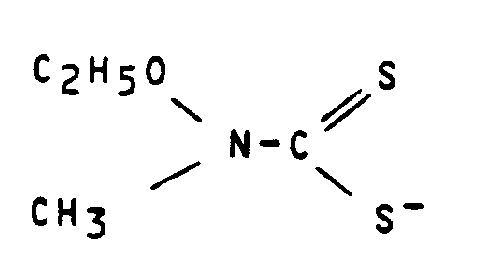
- Example 16 Preparation of the nitruro-bis (N-ethoxy, N-methyldithiocarbamate) 99m Tc (V) complex (TcNET TM).
- Example 14 the same procedure is followed as in Example 14, except that 0.5 ml of a solution at 0.12 mol / l of N-ethoxy is used as reagent for the preparation of the final product, Sodium N-methyldithiocarbamate (20mg / ml).
- Example 17 Preparation of the nitruro-bis (N-ethoxy, N-ethyldithiocarbamate) 99m Tc (V) complex (TcNETEC).
- Example 14 The same procedure is followed as in Example 14 to prepare this technetium complex by using as reagent in the second step 0.5 ml of a solution containing 0.11 mol / l of sodium N-ethoxy, N-ethyldithiocarbamate ( 20mg / ml).
- dogs anesthetized with sodium pentobarbital and kept under ventilation are injected with a dose corresponding to 2 ⁇ mol / kg of body mass of myotropic technetium complex, which corresponds to a radiation dose of 2 to 5 mCi.
- the capture of radioactivity by the myocardium and the surrounding organs is determined by dynamic acquisition, between the injection and the end of the examination, using the gamma camera, by defining areas of interest for each organ.
- the values of the heart / liver and heart / lung contrast are measured by making a simple ratio between the numbers of strokes present per unit area (or pixel) in the organs.
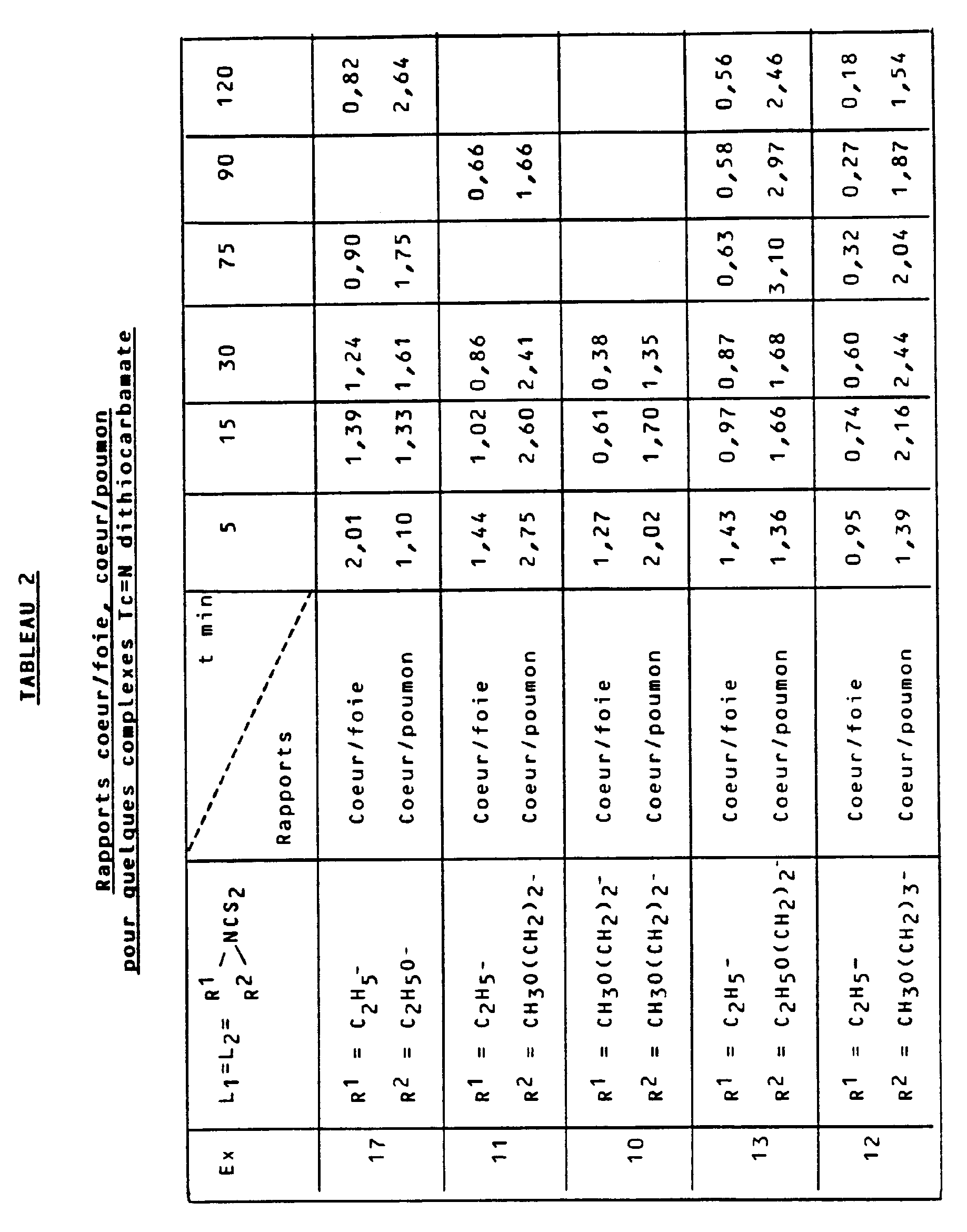
- the values of the heart / liver and heart / lung ratios are given in the attached table 2.
- the target organ / background noise ratios are therefore very favorable.
- rats anesthetized with sodium pentobarbital, are injected with a dose corresponding to 15 ⁇ mol / kg of body mass of myotropic ligand, which corresponds to a radiation dose of 1 to 2.5 ⁇ Ci.
- the rats are sacrificed, their organs are removed and the radioactivity present in each of the organs is determined.
Landscapes
- Chemical & Material Sciences (AREA)
- Health & Medical Sciences (AREA)
- Organic Chemistry (AREA)
- Life Sciences & Earth Sciences (AREA)
- Epidemiology (AREA)
- Medicinal Chemistry (AREA)
- Optics & Photonics (AREA)
- Pharmacology & Pharmacy (AREA)
- Physics & Mathematics (AREA)
- Animal Behavior & Ethology (AREA)
- General Health & Medical Sciences (AREA)
- Public Health (AREA)
- Veterinary Medicine (AREA)
- Proteomics, Peptides & Aminoacids (AREA)
- Medicines Containing Antibodies Or Antigens For Use As Internal Diagnostic Agents (AREA)
- Pharmaceuticals Containing Other Organic And Inorganic Compounds (AREA)
Abstract
Description
- La présente invention a pour objet un produit radiopharmaceutique ayant notamment un tropisme cardiaque, qui comprend un complexe nitruro d'un métal de transition comportant une partie M ≡ N, dans laquelle M représente le métal de transition. Elle s'applique plus particulièrement aux produits radiopharmaceutiques à tropisme cardiaque.
- On précise que l'on entend par métal de transition, un métal dont la couche d est partiellement remplie dans le degré d'oxydation usuel de ce métal. Il s'agit des éléments remplissant les périodes III à XII du tableau périodique des éléments à dix-huit colonnes.
- A titre d'exemple de tels métaux, on peut citer Tc, Ru, Co, Pt, Fe, Os, Ir, W, Re, Cr, Mo, Mn, Ni, Rh, Pd, Nb et Ta.
- Des complexes nitruro de technétium ont été décrits par J. Baldas et Col. dans les documents suivants : demande de brevet internationale W0-85/03 063, J. Chem. Soc. Dalton Trans., 1981, pages 1798-1801, et le livre "Technetium in Chemistry and Nuclear Medicine", Ed. M. Nicolini, G. Bandoli, U. Mazzi, Cortine Int. Verone, 1986, pages 103 à 108.
- Dans ces documents, on décrit la préparation de complexes nitruro de technétium par réaction de substitution sur ⁹⁹mTcNCl₄ et il est indiqué que ces complexes peuvent être utilisés comme produits radiopharmaceutiques, mais ces documents ne donnent aucun résultat probant sur la fixation de ces complexes dans le corps, et ne donnent donc aucune indication sur leurs tropismes, vis-à-vis de certains organes, notamment du coeur.
- Parmi les produits radiopharmaceutiques ayant un tropisme cardiaque, on connaît des complexes de technétium contenant comme ligand des isonitriles substitués par un éther, comme il est décrit dans la demande de brevet européen EP-A- 0233368, et des complexes de technétium à base de dioxime comme il est décrit dans le brevet européen EP-A-0268801. Ces complexes sont formés à partir de ligands difficiles à synthétiser.
- Aussi, des recherches ont été développées pour trouver d'autres produits radiopharmaceutiques présentant des propriétés satisfaisantes pour une utilisation comme produits de diagnostic ou de thérapie, en particulier des produits radiopharmaceutiques à tropisme cardiaque, par exemple pour la scintigraphie du myocarde.
- La présente invention a précisément pour objet un produit radiopharmaceutique qui comprend un complexe d'un métal de transition répondant à la formule :
(M ≡ N) L¹L²
dans laquelle M est un métal de transition et L¹ et L² qui peuvent être identiques ou différents, répondent à la formule :
dans laquelle V et W qui peuvent être identiques ou différents, représentent O, S ou Se, n et m qui peuvent être identiques ou différents, sont égaux à 0 ou à 1, Y représente N, P ou As, et R¹ et R² qui peuvent être identiques ou différents, représentent un radical alkyle linéaire ou ramifié de 1 à 10 atomes de carbone, non substitué ou substitué par des groupements -O-R³, OOC-R³, OCNR⁴R⁵ ou -NR⁴R⁵ dans lesquels R³ est un radical alkyle linéaire ou ramifié de 1 à 5 atomes de carbone et R⁴ et R⁵ qui peuvent être identiques ou différents, son des atomes d'hydrogène ou des radicaux alkyle linéaires ou ramifiés de 1 à 5 atomes de carbone, ou dans laquelle R¹ et R² forment ensemble un cycle hydrocarboné contenant éventuellement un ou plusieurs hétéroatomes. - Les produits radiopharmaceutiques comprenant les complexes de métaux de transition répondant à la formule donnée ci-dessus présentent notamment un tropisme cardiaque, ce qui les rend intéressants comme produits de diagnostic ou de thérapie pour le coeur.
- Dans les produits radiopharmaceutiques de l'invention, le complexe nitruro de métal de transition peut être de différents types.
- Ainsi, selon un premier mode de réalisation de l'invention, dans la formule donnée ci-dessus, Y représente N, m et n sont égaux à O, L¹ et L² sont identiques et R¹ et R² sont des radicaux alkyle non substitués.
- Dans ce premier mode de réalisation de l'invention R¹ et R² sont de préférence également identiques.
- A titre d'exemple, L¹ et L² peuvent répondre aux formules suivantes :


- Selon un second mode de réalisation de l'invention, Y représente N, m et n sont égaux à O, L¹ et L² sont identiques et l'un au moins des R¹ et R² représente un radical alkoxyalkyle.
- A titre d'exemple, L¹ et L² peuvent répondre aux formules suivantes :


- Selon un troisième mode de réalisation de l'invention le complexe de métal de transition répond à la formule :
(M≡N)L¹L²
dans laquelle M est un métal de transition et L¹ et L² répondent à la formule :
dans laquelle R¹ et R² ont la signification donnée dans la revendication 1. - A titre d'exemples de tels complexes, on peut citer ceux pour lesquels R¹ représente CH₃ et R² représente CH₃- ou CH₃-CH₂-. ou pour lesquels R¹ représente CH₃-CH₂- et R² représente CH₃- ou CH₃-CH₂-.
Dans les complexes de l'invention, le métal de transition utilisé dépend en particulier de l'application du produit radiopharmaceutique. - Ainsi, lorsqu'on veut utiliser le produit pour le diagnostic, on utilise un métal de transition radioactif, ayant une période relativement courte, par exemple le technétium 99m.
- Dans le cas où l'on veut utiliser le produit radiopharmaceutique pour la thérapie, on utilise un métal de transition émettant un rayonnement efficace pour la thérapie, et ayant une durée de vie plus longue tel que le rhénium, par exemple Re-186 ou Re-188.
- Les complexes nitruro de technétium utilisés dans l'invention, peuvent être préparés par le procédé de Baldas. Toutefois, on préfère généralement les préparer par un procédé plus simple, facile à mettre en oeuvre dans un service hospitalier et conduisant à des rendements élevés.
- Ce procédé comprend les étapes successives suivantes :
- 1°) faire réagir un composé oxygéné d'un métal de transition M avec :
- a) un premier ligand choisi dans le groupe des phosphines et polyphosphines aliphatiques et aromatiques, substituées ou non substituées, et
- b) un second réactif choisi parmi les azotures de métal alcalin et d'ammonium et les ligands azotés comportant un motif 〉N-N〈 dans lesquels les N sont reliés à des atomes d'hydrogène et/ou à des groupements organiques monovalents par l'intermédiaire d'un atome de carbone, ou dans lequel l'un des N est relié à l'atome de carbone d'un groupe organique bivalent par l'intermédiaire d'une double liaison et l'autre N est relié à des atomes d'hydrogène et/ou à des groupements organiques monovalents par l'intermédiaire d'un atome de carbone, et
- 2°) faire réagir le produit intermédiaire obtenu dans la première étape avec un composé répondant à la formule :
- Lorsque l'on met en oeuvre ce procédé en utilisant comme métal de transition du technétium, le composé oxygéné du métal de transition peut être du pertechnétate de métal alcalin ou d'ammonium. Dans le cas où le métal de transition est le rhénium, on peut utiliser un perrhénate de métal alcalin ou d'ammonium.
- Dans la première étape du procédé, on prépare ainsi un premier complexe nitruro de technétium que l'on fait réagir ensuite avec le composé de formule (X) pour échanger le premier et le deuxième ligands par ce composé.
- Pour réaliser la réaction, on peut introduire aseptiquement le premier ligand et soit l'azoture de métal alcalin ou d'ammonium, soit le ligand azoté, dans un récipient, puis ajouter la quantité requise de composé oxygéné de métal de transition, par exemple de pertechnétate de technétium 99m, après avoir ajusté le pH à une valeur appropriée par addition d'acide ou de base. On peut ensuite effectuer la réaction à la température ambiante ou à une température supérieure allant de 50 à 100°C. La température et le pH utilisés dépendent en particulier du second ligand azoté. Généralement on opère entre pH 2 et 7.
- Dans la première étape, on peut utiliser le premier et le second ligands sous la forme de solutions aqueuses, alcooliques ou hydroalcooliques et ajouter simplement ces solutions au composé oxygéné du métal de transition.
- Dans la deuxième étape, on fait réagir le produit obtenu dans la première étape avec le composé de formule (X) en solution aqueuse, généralement à un pH supérieur à 7, par exemple dans un tampon carbonate-bicarbonate de sodium.
- Dans cette deuxième étape, on peut aussi utiliser une solution alcoolique ou hydroalcoolique du composé (X).
- Le premier ligand qui permet d'obtenir la formation d'un complexe nitruro est un ligand organique à atome de phosphore donneur d'électrons choisi parmi les phosphines et les polyphosphines aliphatiques et aromatiques, substituées ou non substituées.
- Les phosphines utilisables peuvent répondre à la formule :
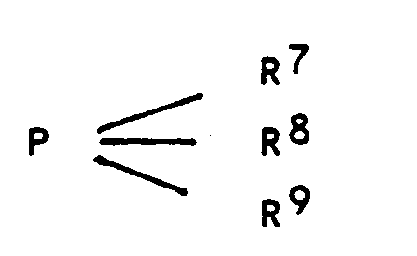
dans laquelle R⁷, R⁸ et R⁹ qui peuvent être identiques ou différents, représentent un atome d'hydrogène, un radical alkyle, un radical aryle, un radical alcoxy ou un radical alkyle ou aryle substitué par un groupement choisi parmi les radicaux amino, amido, cyano et sulfonate. - A titre d'exemple de phosphines de ce type, on peut citer la triphénylphosphine, la triphénylphosphine trisulfonée, la diéthylphénylphosphine, la triéthylphosphine, la triméthylphosphine et la tris(cyanoéthyl-2)phosphine P(CH₂-CH₂CN)₃.
- Dans la première étape, on peut utiliser comme second réactif, soit un azoture de métal alcalin ou d'ammonium, par exemple de l'azoture de sodium, soit un ligand azoté comportant le motif 〉N-N〈 comme dans l'hydrazine et ses dérivés. On peut utiliser de nombreux ligands azotés de ce type. Généralement, on préfère utiliser comme ligand azoté, l'acide dithiocarbazique ou un dérivé de celui-ci.
- Ainsi, le second ligand azoté peut être l'acide dithiocarbazique ou un dérivé de celui-ci répondant à la formule :

dans laquelle R¹⁰ représente un atome d'hydrogène, un radical alkyle ou un radical aryle, et R¹⁴ représente un atome d'hydrogène, un radical alkyle, un radical aryle, un radical alcoxy, un radical alkyle substitué par au moins un groupement choisi parmi les radicaux hydroxy, carboxy, amino, amido et mercapto, ou un radical aryle substitué par au moins un groupement choisi parmi les atomes d'halogène et les radicaux alcoxy, hydroxy, amino, mercapto et amino substitué par au moins un radical alkyle. - Il peut également être un produit de condensation obtenu par réaction de l'acide dithiocarbazique avec une cétone ou un aldéhyde aliphatique de formule R¹⁵-CO-R¹⁶. Dans ce cas, il répond à la formule :

dans laquelle R¹⁰ représente un atome d'hydrogène, un radical alkyle ou un radical aryle ; R¹⁴ représente un atome d'hydrogène, un radical alkyle, un radical aryle, un radical alcoxy, un radical alkyle substitué par au moins un groupement choisi parmi les radicaux hydroxy, carboxy, amino, amido et mercapto, ou un radical aryle substitué par au moins un groupement choisi parmi les atomes d'halogène et les radicaux alkoxy, hydroxy, amino, mercapto et amino substitué par au moins un radical alkyle ; et R¹⁵ et R¹⁶ qui peuvent être identiques ou différents représentent un atome d'hydrogène, un radical alkyle ou un radical alkyle substitué par au moins un groupement choisi parmi les radicaux hydroxy, carboxy, amino, amido et mercapto. - Le dérivé d'acide dithiocarbazique utilisé comme second ligand peut aussi être le produit de condensation de l'acide dithiocarbazique avec une cétone ou un aldéhyde aromatique. Dans ce cas, le dérivé répond à la formule :

dans laquelle R¹⁰ représente un atome d'hydrogène, un radical alkyle ou un radical aryle ; R¹⁴ représente un atome d'hydrogène, un radical alkyle, un radical aryle, un radical alcoxy, un radical alkyle substitué par au moins un groupement choisi parmi les radicaux hydroxy, carboxy, amino, amido et mercapto ou un radical aryle substitué par au moins un groupement choisi parmi les atomes d'halogène et les radicaux alkoxy, hydroxy, amino, mercapto et amino substitué par au moins un radical alkyle ; R¹⁷ représente un atome d'hydrogène, un radical alkyle, un radical alkyle substitué par au moins un groupement choisi parmi les radicaux hydroxy, carboxy, amino, amido et mercapto, R¹⁸ représente un atome d'hydrogène, un atome d'halogène, un radical alcoxy, un radical amino, ou un radical amino substitué par au moins un groupement alkyle, R¹⁹ représente un atome d'hydrogène, un radical hydroxy ou un radical mercapto, E représente un atome de carbone ou un atome d'azote, et n est un nombre entier allant de 1 à 4, ou dans laquelle n est égal à 2 et les deux R¹⁸ sont voisins et forment ensemble un cycle aromatique. - On peut également utiliser comme second ligand le produit obtenu par condensation de l'acide dithiocarbazique avec une cétone comportant un hétérocycle à 5 maillons. Dans ce cas, le second ligand répond à la formule :

dans laquelle R¹⁰ représente un atome d'hydrogène, un radical alkyle ou un radical aryle ; R¹⁴ représente un atome d'hydrogène, un radical alkyle, un radical aryle, un radical alkoxy, un radical alkyle substitué par au moins un groupement choisi parmi les radicaux hydroxy, carboxy, amino, amido et mercapto, ou un radical aryle substitué par au moins un groupement choisi parmi les atomes d'halogène et les radicaux alkoxy, hydroxy, amino, mercapto et amino substitué par au moins un radical alkyle ; R¹⁷ représente un atome d'hydrogène, un radical alkyle, un radical alkyle substitué par au moins un groupement choisi parmi les radicaux hydroxy, carboxy, amino, amido et mercapto, R¹⁸ représente un atome d'hydrogène, un atome d'halogène, un radical alcoxy, un radical amino, ou un radical amino substitué par au moins un groupement alkyle, G est S ou 0, et p est 1, 2 ou 3. - A titre d'exemple de seconds ligands azotés susceptibles d'être utilisés, on peut citer, le S-méthyl-bêta-N(2-hydroxyphényl)méthylène dithiocarbazate, le S-méthyldithiocarbazate, le S-méthyl-N-méthyl-dithiocarbazate, l'alpha-N-méthyl-S-méthyl-bêta-N-pyridylméthylène dithiocarbazate, et le alpha-N-méthyl-S-méthyl-bêta-N(2-hydroxyphényl) méthylène dithiocarbazate.
- Lorsque le produit radiopharmaceutique de l'invention est destiné au diagnostic, il est généralement nécessaire de le préparer au moment de l'utilisation.
- Aussi, l'invention a également pour objet une trousse pour la préparation d'un produit radiopharmaceutique à tropisme cardiaque, qui comprend :
- un premier flacon contenant une phosphine ;
- un second flacon contenant de l'azoture de sodium, de l'acide dithiocarbazique ou un dérivé de celui-ci, et,
- un troisième flacon contenant un composé répondant à la formule :
- Avec cette trousse, on peut préparer directement le produit radiopharmaceutique voulu, dans un service hospitalier de médecine nucléaire, en mélangeant le contenu des deux premiers flacons avec une solution du composé oxygéné de métal de transition, par exemple une solution de pertechnétate de métal alcalin ou d'ammonium, puis ajouter au produit ainsi obtenu le contenu du troisième flacon.
- Les produits présents respectivement dans les premier, second et troisième flacons peuvent être sous forme liquide ou sous forme lyophilisée.
- Dans certains cas, on peut aussi mélanger le contenu des deux premiers flacons avant utilisation. Dans ce cas, la trousse comprendra uniquement un premier flacon contenant une phosphine et le second réactif constitué soit par l'azoture de sodium, soit par l'acide dithiocarbazique ou un dérivé de celui-ci, et un second flacon contenant le composé de formule VII donnée ci-dessus.
- Etant donné que les produits sont destinés à une injection intraveineuse à des êtres vivants, on doit utiliser des conditions appropriées de fabrication et de mise en oeuvre pour obtenir des solutions convenablement stériles et apyrogènes.
- Pour préparer les solutions, on peut utiliser de l'eau stérile et apyrogène ou des solutions alcooliques ou hydroalcooliques, stériles et apyrogènes, et effectuer un stockage des solutions sous azote.
- Pour préparer des compositions lyophilisées, on soumet à une lyophilisation dans un équipement classique des solutions obtenues dans les mêmes conditions que précédemment.
- Les produits radiopharmaceutiques de l'invention peuvent être utilisés en particulier pour la scintigraphie du myocarde.
- Dans ce cas, après préparation du complexe nitruro de technétium, on injecte celui-ci au patient à examiner, et on procède ensuite à un examen du coeur par scintigraphie.
- Pour l'injection du produit, les quantités des différents ligands sont telles qu'elles correspondent sensiblement à la stoechiométrie des complexes à obtenir. La quantité finale injectée dépend en particulier des ligands utilisés et de leur toxicité.
- Généralement, on obtient des résultats satisfaisants en utilisant des quantités totales de ligands allant de 0,05 à 0,40mg/kg de poids corporel.
- La dose totale de métal de transition par exemple de technétium, se situe généralement dans la gamme de 185 à 740Mbq (5 à 20millicuries).
- Après l'administration du complexe nitruro de métal de transition, on peut effectuer un examen satisfaisant dans un délai de 0,5 à 3h en obtenant un bon contraste, des images nettes et une bonne détection des lésions.
- D'autres caractéristiques et avantages de l'invention apparaîtront mieux à la lecture des exemples suivants.
- Dans un flacon type pénicilline, on introduit 0,4ml d'une solution contenant 2.10⁻²mol/l (2,5mg/ml) de S-méthyldithiocarbazate dans l'alcool éthylique, puis 0,2ml d'une solution à 2.10⁻²mol/l (5mg/ml) de triphénylphosphine dans l'alcool éthylique et 0,1ml d'acide chlorhydrique 1N. On ajoute ensuite 0,5 à 1ml d'une solution de pertechnétate de sodium (Tc99m) et on effectue la réaction à 80°C pendant 30 minutes ou à 100°C pendant 15 minutes.
- Au contenu du flacon obtenu dans l'étape a), on ajoute 0,1ml de solution de NaOH 1N et 0,5ml d'une solution contenant 0,18mol/l de diéthyldithiocarbamate de sodium trihydraté (40mg/ml) dans un tampon carbonate-bicarbonate de sodium à 0,5 mol/l⁻¹ à pH 9,0.
- On effectue la réaction pendant 15 minutes à 100°C, pendant 30 minutes à 80°C, ou pendant 60 minutes à la température ambiante.
- La pureté radiochimique du complexe obtenu est testée en effectuant une chromatographie sur couche mince en utilisant un gel de silice et le toluène comme solvant.
- Le complexe obtenu a un Rf de 0,3 à 0,4.
- La pureté radiochimique est supérieure ou égale à 93%.
- Dans un flacon type pénicilline, on introduit 0,2ml d'une solution contenant 7,7.10⁻²mol/l (5,0mg/ml)d'azoture de sodium dans de l'eau, puis 0,2ml d'une solution à 2.10⁻²mol/l (5mg/ml) de triphénylphosphine dans l'alcool éthylique et 0,1ml d'acide chlorhydrique 1N. On ajoute ensuite 0,5 à 1ml d'une solution de pertechnétate de sodium (Tc-99m) et on effectue la réaction à 80°C pendant 30 minutes ou à 100°C pendant 15 minutes.
- Au contenu du flacon obtenu dans l'étape a), on ajoute comme dans l'exemple 1, 0,1ml d'une solution de NaOH 1N et 0,5ml d'une solution contenant 0,18mol/l (40mg/ml) de diéthyldithiocarbamate de sodium trihydraté dans un tampon carbonate/bicarbonate de sodium à 0,5mol/l et à pH 9. On effectue la réaction comme dans l'exemple 1.
- On teste également la pureté radiochimique du produit par chromatographie sur couche mince et on obtient des résultats identiques à ceux de l'exemple 1.
- Dans un flacon type pénicilline, on introduit 0,2ml d'une solution contenant 7.7.10⁻²mol/l (5mg/ml) d'azoture de sodium dans l'eau, puis 0,4ml d'une solution contenant 1.10⁻²mol/l (2mg/ml) de tris(cyanoéthyl-2)phosphine dans l'eau et 0,1ml d'acide chlorhydrique 1N.
- On ajoute ensuite 0,5 à 5ml d'une solution de pertechnetate de sodium (99mTc) et on effectue la réaction à 80°C pendant 30 minutes ou à 100°C pendant 15 minutes. (Préparation sans alcool)
- On suit le même mode opératoire que dans l'exemple 1, paragraphe b) pour préparer le complexe TcNDEDC à partir du produit intermédiaire obtenu précédemment.
- Dans un flacon type pénicilline, on introduit 0,2ml d'une solution contenant 7.7.10⁻²mol/l (5mg/ml) d'azoture de sodium dans l'eau, puis 0,4ml d'une solution contenant 1.10⁻²mol/l de tris(cyanoéthyl-2)phosphine.
- On ajoute ensuite 0,5 à 5ml d'une solution de pertechnétate de sodium (99mTc) et on effectue la réaction à 80°C pendant 30 minutes ou à 100°C pendant 15 minutes.
- Cette opération a lieu à un pH proche de 7.
- Au contenu du flacon obtenu dans l'étape a), on ajoute 0,5ml d'une solution contenant 0,18mol/l (40mg/ml) de diéthyldithiocarbamate de sodium trihydraté dans un tampon carbonate/bicarbonate de sodium à 0,5mol/l et à pH9. On effectue la réaction comme dans l'exemple 1.
- On suit le même mode opératoire que dans l'exemple 1 en remplaçant dans la dernière étape le diéthyldithiocarbamate par 0,5ml d'une solution contenant 0,18mol/l de diméthyldithiocarbamate de sodium dihydraté (30mg/ml) dans le même tampon. On obtient ainsi le complexe de technétium TcNDMDC avec une pureté radiochimique équivalente à celle de l'exemple 1.
- On suit le même mode opératoire que dans l'exemple 1 en remplaçant le diéthyldithiocarbamate par 0,5ml d'une solution contenant 0,18mol/l (40,7mg/ml)de di-n-propyldithiocarbamate de sodium sesquihydraté dans un mélange du tampon carbonate-bicarbonate de sodium à 0,5mol/l et à pH 9 et d'alcool éthylique dans un rapport en volume 7:3.
- On obtient ainsi le complexe de technétium TcNDPDC présentant une pureté radiochimique équivalente à celle de l'exemple 1.
- Dans ces exemples, on teste les propriétés des complexes obtenus dans les exemples 1, 5 et 6, en déterminant leur biodistribution chez des rats mâles de la race Sprague Dawley, pesant 200±20g.
- Dans ce cas, on injecte aux rats, anesthésiés avec du pentobarbital de sodium, une dose correspondant à 15µmol/kg de masse corporelle de ligand myotrope, ce qui correspond à une dose de rayonnement de 1 à 2,5µCi.
- 5 minutes, 30 minutes, ou 60 minutes après l'injection du produit, on sacrifie les rats, on prélève leurs organes et on détermine la radioactivité présente dans chacun des organes.
- Les résultats obtenus sont donnés dans le tableau 1 qui suit, et exprimés en pourcentage de la radioactivité injectée retrouvée dans l'organe, après prélèvement et comptage.
- Les valeurs données dans chaque case du tableau représentent la valeur moyenne et les deux valeurs extrêmes.
- Au vu de ce tableau, on constate que ces complexes présentent un bon tropisme cardiaque.

- Dans un flacon type pénicilline, on introduit 0,5ml d'une solution contenant 0,8.10⁻²mol/l (1mg/ml) de S-méthyl N-méthyldithiocarbazate dans l'eau, puis 0,5ml d'une solution à 2.10⁻²mol/l (10mg/ml) de triphénylphosphine trisulfonée dans l'eau et 0,1ml d'acide chlorhydrique 1N. On ajoute ensuite 0,5 à 5ml d'une solution de pertechnétate de sodium (Tc99m) et on effectue la réaction à 80°C pendant 30 minutes ou à 100°C pendant 15 minutes.
- Au contenu du flacon obtenu dans l'étape a), on ajoute 0,1ml de solution de NaOH 1N et 0,5ml d'une solution contenant 0,1mol/l de diméthoxyéthyldithiocarbamate de sodium (23mg/ml) dans un tampon carbonate-bicarbonate de sodium à 0,5 mol/l à pH 9,5.
- On effectue la réaction pendant 30 minutes à la température ambiante.
- On obtient ainsi le complexe nitruro TcNMEDC, soit le complexe de formule (Tc≡N)L¹L² avec L¹ et L² représentant le composé de formule (VI).
- On suit le même mode opératoire que dans l'exemple 10 pour préparer le produit intermédiaire à partir de S-méthyl N-méthyldithiocarbazate et de triphénylphosphine trisulfonée. On prépare ensuite le produit final en suivant le même mode opératoire que dans l'exemple 10 mais en utilisant 0,5ml d'une solution à 0,1mol/l de N-éthyl, N-(2-méthoxyéthyl)dithiocarbamate de sodium (20mg/ml) à la place du diméthoxyéthyldithiocarbamate de sodium de l'exemple 10.
- On obtient ainsi le complexe nitruro-bis(N-éthyl,N-(2-méthoxyéthyl)dithiocarbamate)99mTc(V),
c'est-à-dire le produit de formule :
(Tc≡N)L¹L²
avec L¹ et L² représentant le composé de formule (VII). - On suit le même mode opératoire que dans les exemples 10 et 11 pour préparer ce complexe à partir du produit intermédiaire obtenu dans l'étape a) de l'exemple 10 en utilisant comme réactif dans l'étape b) 0,5ml d'une solution à 0,1mol/l de N-éthyl,N(3-méthoxypropyl)dithiocarbamate de sodium (22mg/ml).
- On obtient ainsi le complexe nitruro TcNEMPC, soit le complexe de formule (Tc≡N)L¹L² avec L¹ et L² représentant le composé de formule (VIII).
- On suit le même mode opératoire que dans l'exemple 10 pour préparer le produit intermédiaire et le produit final, sauf que l'on utilise comme réactif pour la préparation du produit final 0,5ml d'une solution à 0,1mol/l de N-éthyl, N(2-éthoxyéthyl)dithiocarbamate de sodium (22mg/ml).
- On obtient ainsi le complexe nitruro TcNEEDC, soit le complexe de formule (Tc≡N)L¹L² avec L¹ et L² représentant le composé de formule (IX).
- On suit le même mode opératoire que dans l'exemple 10 pour préparer un produit intermédiaire en utilisant les mêmes réactifs et les mêmes conditions de réaction.
- Au contenu du flacon obtenu dans l'étape a), on ajoute 0,1ml de solution de NaOH 1N et 0,5ml d'une solution contenant 0,13mol/l de N-méthoxy, N-méthyldithiocarbamate de sodium (20mg/ml) dans un tampon carbonate-bicarbonate de sodium à 0,5mol/l à pH 9,5.
- On effectue la réaction pendant 30 minutes à la température ambiante.
- On obtient ainsi le complexe TcNMEMC, soit le complexe de formule (Tc≡N)L¹L² avec L¹ et L² représentant :

- On suit le même mode opératoire que dans l'exemple 14 pour préparer ce complexe de technétium à partir du même produit intermédiaire en utilisant pour la préparation du produit final 0,5ml d'une solution à 0,12mol/l de N-méthoxy,N-éthyldithiocarbamate de sodium (20mg/ml). On obtient ainsi le complexe TcNMEEC, soit le complexe de formule (Tc≡N)L¹L² avec L¹ et L² représentant la formule :

- Dans cet exemple, on suit le même mode opératoire que dans l'exemple 14, sauf que l'on utilise comme réactif pour la préparation du produit final, 0,5ml d'une solution à 0,12mol/l de N-éthoxy, N-méthyldithiocarbamate de sodium (20mg/ml).
- On obtient ainsi le complexe de technétium de formule (Tc≡N)L¹L² avec L¹ et L² représentant la formule :
- On suit le même mode opératoire que dans l'exemple 14 pour préparer ce complexe de technétium en utilisant comme réactif dans la deuxième étape 0,5ml d'une solution contenant 0,11mol/l de N-éthoxy,N-éthyldithiocarbamate de sodium (20mg/ml).
- On obtient ainsi le complexe de formule (Tc≡N)L¹L² avec L¹ et L² représentant la formule :

- On teste les propriétés biologiques des complexes obtenus dans les exemples 10 à 13 et 17 en déterminant la captation du myocarde chez des chiens pesant entre 10 et 15kg.
- Dans ce cas, on injecte aux chiens anesthésiés avec du pentobarbital de sodium et gardés sous ventilation, une dose correspondant à 2µmol/kg de masse corporelle de complexe de technétium myotrope, ce qui correspond à une dose de rayonnements de 2 à 5mCi.
- La captation de la radioactivité par le myocarde et les organes environnants (poumons, foie) est déterminée par acquisition dynamique, entre l'injection et la fin d'examen, à la gamma caméra, en définissant des zones d'intérêt pour chaque organe.
- Tous les complexes essayés permettent une bonne visualisation du myocarde.
- Les valeurs du contraste coeur/foie et coeur/poumon sont mesurées en effectuant un simple rapport entre les nombres des coups présents par unité de surface (ou pixel) dans les organes.
- Les valeurs des rapports coeur/foie, et coeur/poumon sont données dans le tableau 2 annexé.
- Les rapports organe cible/bruits de fond sont donc très favorables.
- Dans ces exemples, on teste les propriétés des complexes obtenus dans les exemples 15 à 18, en déterminant leur biodistribution chez des rats mâles de la race Sprague Dawley, pesant 200±20g.
- Dans ce cas, on injecte aux rats, anesthésiés avec du pentobarbital de sodium, une dose correspondant à 15µmol/kg de masse corporelle de ligand myotrope, ce qui correspond à une dose de rayonnement de 1 à 2,5µCi.
- 5 minutes, 30 minutes, ou 60 minutes après l'injection du produit, on sacrifie les rats, on prélève leurs organes et on détermine la radioactivité présente dans chacun des organes.
- Les résultats obtenus sont donnés dans le tableau 3 qui suit, et exprimés en pourcentage de la radioactivité injectée retrouvée dans l'organe, après prélèvement et comptage.
- Les valeurs données dans chaque case du tableau représentent la valeur moyenne et les deux valeurs extrêmes.
- Au vu de ce tableau, on constate que ces complexes présentent un bon tropisme cardiaque.


dans laquelle R¹, R², V, W, n, m et Y ont la signification donnée ci-dessus,
R⁶ est un ion de métal alcalin, H⁺ ou NH₄⁺, et p est égal à 0 ou est un nombre entier allant de 1 à 5.

dans laquelle R¹, R², V, W, n, m et Y ont la signification donnée ci-dessus, R⁶ est un ion de métal alcalin, H⁺ ou NH₄⁺, et p est égal à 0 ou est un nombre entier allant de 1 à 5.
Claims (23)
- Procédé de préparation d'un produit radiopharmaceutique comprenant un complexe d'un métal de transition répondant à la formule :
(M = N) L¹L² (I)
dans laquelle M est un métal de transition et L¹ et L² qui peuvent être identiques ou différents, répondent à la formule : 1°) faire réagir un composé oxygéné d'un métal de transition M avec :a) un premier ligand choisi dans le groupe des phosphines et polyphosphines aliphatiques et aromatiques, substituées ou non substituées, etb) un second réactif choisi parmi les azotures de métal alcalin et d'ammonium et les ligands azotés comportant un motif 〉N-N〈 dans lesquels les N sont reliés à des atomes d'hydrogène et/ou à des groupements organiques monovalents par l'intermédiaire d'un atome de carbone, ou dans lequel l'un des N est relié à l'atome de carbone d'un groupe organique bivalent par l'intermédiaire d'une double liaison et l'autre N est relié à des atomes d'hydrogène et/ou à des groupements organiques monovalents par l'intermédiaire d'un atome de carbone, et2°) faire réagir le produit intermédiaire obtenu dans la première étape avec un composé répondant à la formule :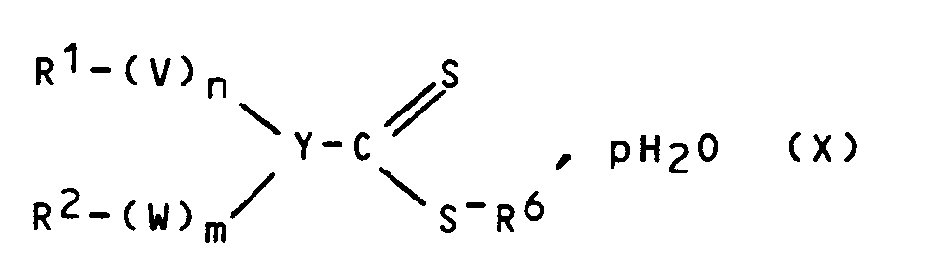
R⁶ est un ion de métal alcalin, H⁺ ou NH₄⁺, et p est égal à 0 ou est un nombre entier allant de 1 à 5. - Procédé selon la revendication 1, caractérisé en ce que M représente un isotope du technétium ou du rhénium.
- Procédé selon la revendication 2, caractérisé en ce que l'isotope de technétium est Tc 99 m.
- Procédé selon la revendication 2, caractérisé en ce que l'isotope de rhénium est Re-186 ou Re-188.
- Procédé selon l'une quelconque des revendications 1 à 4, caractérisé en ce que Y représente N, m et n sont égaux à 0, et L¹ et L² sont identiques.
- Procédé selon la revendication 5, caractérisé en ce que R¹ et R² représentent des radicaux alkyle non substitués.
- Procédé selon la revendication 6, caractérisé en ce que L¹ et L² représentent :

- Procédé selon la revendication 6, caractérisé en ce que L¹ et L² représentent :

- Procédé selon la revendication 6, caractérisé en ce que L¹ et L² représentent :

- Procédé selon la revendication 5, caractérisé en ce que l'un au moins des R¹ et R² est un radical alkoxyalkyle.
- Procédé selon la revendication 10, caractérisé en ce que R¹ représente CH₃O-CH₂-CH₂- et R² représente CH₃-CH₂- ou CH₃OCH₂-CH₂-.
- Procédé selon la revendication 10, caractérisé en ce que R¹ représente CH₃-CH₂- et R² représente CH₃-O-CH₂-CH₂-CH₂- ou C₂H₅-O-CH₂-CH₂-.
- Procédé selon l'une quelconque des revendications 1 à 4, caractérisé en ce que Y représente N et L¹ et L² répondent à la formule :

- Procédé selon la revendication 13, caractérisé en ce que R¹ représente CH₃- et R² représente CH₃- ou CH₃-CH₂-.
- Procédé selon la revendication 13, caractérisé en ce que R¹ représente CH₃-CH₂- et R² représente CH₃- ou CH₃-CH₂-.
- Procédé selon l'une quelconque des revendications 1 et 5 à 15, caractérisé en ce que le composé oxygéné du métal de transition est un pertechnétate de métal alcalin ou d'ammonium.
- Procédé selon l'une quelconque des revendications 1 et 5 à 15, caractérisé en ce que le composé oxygéné du métal de transition est du perrhénate de métal alcalin ou d'ammonium.
- Procédé selon l'une quelconque des revendications 1 à 17, caractérisé en ce que le premier ligand est une phosphine choisie parmi la triphénylphosphine, la diéthylphénylphosphine, la triéthylphosphine, la triméthylphosphine, la tris(cyanoéthyl-2)phosphine et la triphénylphosphine trisulfonée.
- Procédé selon l'une quelconque des revendications 1 à 18, caractérisé en ce que le second réactif est choisi parmi le S-méthyldithiocarbazate, le S-méthyl-N-méthyldithiocarbazate, l'alpha-N-méthyl-S-méthyl bêta-N-pyridylméthylène dithiocarbazate, le S-méthyl-bêta-N-(2-hydroxyphényl)méthylène dithiocarbazate et le alpha-N-méthyl-S-méthyl-bêta-N-(2-hydroxyphényl)méthylène dithiocarbazate.
- Procédé selon l'une quelconque des revendications 1 à 18, caractérisé en ce que le second réactif est l'azoture de sodium.
- Trousse pour la préparation d'un produit radiopharmaceutique, caractérisée en ce qu'elle comprend :- un premier flacon contenant une phosphine,- un second flacon contenant de l'azoture de sodium, de l'acide dithiocarbazique ou un dérivé de celui-ci, et,- un troisième flacon contenant un composé répondant à la formule :

- Utilisation du complexe de métal de transition obtenu par le procédé selon l'une quelconque des revendications 1 à 20 pour la fabrication d'un produit radiopharmaceutique à tropisme cardiaque.
Priority Applications (1)
| Application Number | Priority Date | Filing Date | Title |
|---|---|---|---|
| AT89913235T ATE94412T1 (de) | 1988-11-25 | 1989-11-24 | Uebergangsmetall-stickstoffkomplex enthaltendes radiopharmazeutisches produkt mit einer neigung zum herzgewebe. |
Applications Claiming Priority (4)
| Application Number | Priority Date | Filing Date | Title |
|---|---|---|---|
| FR8815415 | 1988-11-25 | ||
| FR8815415A FR2639542B1 (fr) | 1988-11-25 | 1988-11-25 | Produit radiopharmaceutique a tropisme cardiaque comportant un complexe nitrido d'un metal de transition, et son procede de preparation |
| FR8907731 | 1989-06-12 | ||
| FR898907731A FR2648049B1 (fr) | 1989-06-12 | 1989-06-12 | Produit radiopharmaceutique a tropisme cardiaque comportant un complexe nitruro d'un metal de transition, et son procede de preparation |
Publications (2)
| Publication Number | Publication Date |
|---|---|
| EP0445190A1 EP0445190A1 (fr) | 1991-09-11 |
| EP0445190B1 true EP0445190B1 (fr) | 1993-09-15 |
Family
ID=26227009
Family Applications (1)
| Application Number | Title | Priority Date | Filing Date |
|---|---|---|---|
| EP89913235A Expired - Lifetime EP0445190B1 (fr) | 1988-11-25 | 1989-11-24 | Produit radiopharmaceutique ayant notamment un tropisme cardiaque comportant un complexe nitruro d'un metal de transition, et son procede de preparation |
Country Status (9)
| Country | Link |
|---|---|
| US (1) | US5288476A (fr) |
| EP (1) | EP0445190B1 (fr) |
| JP (1) | JP3015970B2 (fr) |
| AU (1) | AU623204B2 (fr) |
| CA (1) | CA2003880C (fr) |
| DE (1) | DE68909245T2 (fr) |
| ES (1) | ES2059831T3 (fr) |
| RU (1) | RU2049789C1 (fr) |
| WO (1) | WO1990006137A1 (fr) |
Families Citing this family (14)
| Publication number | Priority date | Publication date | Assignee | Title |
|---|---|---|---|---|
| FR2664166A1 (fr) * | 1990-07-04 | 1992-01-10 | Cis Bio Int | Procede de preparation de complexes nitruro de metaux de transition utilisables comme produits radiopharmaceutiques ou pour la synthese de nouveaux produits radiopharmaceutiques. |
| AU9172191A (en) * | 1990-12-12 | 1992-07-08 | Mallinckrodt Medical, Inc. | Method of radioactive labelling of blood cells and kit therefor |
| FR2679452B1 (fr) * | 1991-07-22 | 1993-11-12 | Cis Bio International | Produit radiopharmaceutique ayant notamment un tropisme cerebral, comportant un complexe nitruro d'un metal de transition, et son procede de preparation. |
| FR2698272B1 (fr) * | 1992-11-20 | 1994-12-30 | Cis Bio Int | Procédé de marquage cellulaire au moyen de complexes nitruro-bis (dithiocarbamato)Tc-99m et trousse pour la mise en Óoeuvre de ce procédé. |
| US6017496A (en) | 1995-06-07 | 2000-01-25 | Irori | Matrices with memories and uses thereof |
| US6329139B1 (en) | 1995-04-25 | 2001-12-11 | Discovery Partners International | Automated sorting system for matrices with memory |
| US5751629A (en) | 1995-04-25 | 1998-05-12 | Irori | Remotely programmable matrices with memories |
| US6331273B1 (en) | 1995-04-25 | 2001-12-18 | Discovery Partners International | Remotely programmable matrices with memories |
| US5874214A (en) | 1995-04-25 | 1999-02-23 | Irori | Remotely programmable matrices with memories |
| US6416714B1 (en) | 1995-04-25 | 2002-07-09 | Discovery Partners International, Inc. | Remotely programmable matrices with memories |
| FR2736834B1 (fr) * | 1995-07-17 | 1997-08-29 | Cis Bio Int | Produits radiopharmaceutiques a tropisme cardiaque comportant un complexe nitruro d'un metal de transition et ayant une clairance myocardique rapide |
| DE60136073D1 (de) * | 2000-07-28 | 2008-11-20 | Nihon Mediphysics Co Ltd | Technitium-99m nitrid hetero-komplex radiopharmazeutisches mittel zur bilderzeugung |
| EP1973923B1 (fr) | 2006-01-20 | 2011-08-17 | Nihon Medi-Physics Co., Ltd. | Composé intermédiaire d'un complexe de nitrure de technétium pour imagerie de radiodiagnostic |
| MD3995C2 (ro) * | 2009-05-11 | 2010-07-31 | Государственный Университет Молд0 | Utilizare a di(µ-Ofenoxi)-di{[2-(4-aminobenzensulfamido)-5-etil-1,3,4-tiadiazol]-3,5-dibromosalicilidentiosemicarbazonato(-1)-cupru} în calitate de inhibitor al proliferării celulelor T-47D ale cancerului mamar |
Family Cites Families (7)
| Publication number | Priority date | Publication date | Assignee | Title |
|---|---|---|---|---|
| JPS5361234A (en) * | 1976-11-12 | 1978-06-01 | Matsushita Electric Ind Co Ltd | Memory unit |
| US4247534A (en) * | 1978-07-31 | 1981-01-27 | The Procter & Gamble Company | Radiographic scanning agent |
| JPS55160382A (en) * | 1979-05-31 | 1980-12-13 | Toshiba Corp | Memory unit |
| JPS5786959A (en) * | 1980-11-19 | 1982-05-31 | Matsushita Electric Ind Co Ltd | Data transfer control system |
| JPS6059461A (ja) * | 1983-09-13 | 1985-04-05 | Matsushita Electric Ind Co Ltd | プログラムメモリ装置 |
| DE3484511D1 (de) * | 1983-12-29 | 1991-05-29 | Commw Of Australia | Herstellung von mit 99m tc markierten radioarzneimitteln. |
| US4925925A (en) * | 1988-06-15 | 1990-05-15 | University Of Cincinnati | Radioactive rhenium ligated to 2-hydroxy isobutyric acid and method of use |
-
1989
- 1989-11-24 JP JP2500214A patent/JP3015970B2/ja not_active Expired - Fee Related
- 1989-11-24 DE DE89913235T patent/DE68909245T2/de not_active Expired - Fee Related
- 1989-11-24 RU SU894895504A patent/RU2049789C1/ru not_active IP Right Cessation
- 1989-11-24 ES ES89913235T patent/ES2059831T3/es not_active Expired - Lifetime
- 1989-11-24 US US07/675,938 patent/US5288476A/en not_active Expired - Lifetime
- 1989-11-24 AU AU46392/89A patent/AU623204B2/en not_active Ceased
- 1989-11-24 CA CA002003880A patent/CA2003880C/fr not_active Expired - Fee Related
- 1989-11-24 WO PCT/FR1989/000608 patent/WO1990006137A1/fr not_active Ceased
- 1989-11-24 EP EP89913235A patent/EP0445190B1/fr not_active Expired - Lifetime
Also Published As
| Publication number | Publication date |
|---|---|
| EP0445190A1 (fr) | 1991-09-11 |
| US5288476A (en) | 1994-02-22 |
| WO1990006137A1 (fr) | 1990-06-14 |
| ES2059831T3 (es) | 1994-11-16 |
| CA2003880A1 (fr) | 1990-05-25 |
| DE68909245T2 (de) | 1994-03-17 |
| RU2049789C1 (ru) | 1995-12-10 |
| DE68909245D1 (de) | 1993-10-21 |
| JP3015970B2 (ja) | 2000-03-06 |
| CA2003880C (fr) | 2002-01-08 |
| AU623204B2 (en) | 1992-05-07 |
| JPH04506653A (ja) | 1992-11-19 |
| AU4639289A (en) | 1990-06-26 |
Similar Documents
| Publication | Publication Date | Title |
|---|---|---|
| EP0445190B1 (fr) | Produit radiopharmaceutique ayant notamment un tropisme cardiaque comportant un complexe nitruro d'un metal de transition, et son procede de preparation | |
| EP0403524B1 (fr) | Preparation de complexes nitruro utilisables comme produits radiopharmaceutiques | |
| EP0537242B1 (fr) | Procede de preparation de complexes nitruro de metaux de transition | |
| JPS5896031A (ja) | 放射性診断剤およびその製造用組成物 | |
| EP0426759A1 (fr) | NOUVEAUX COMPLEXES Tc-99m. | |
| EP0596037B1 (fr) | Produit radiopharmaceutique ayant notamment un tropisme cerebral comportant un complexe nitriro d'un metal de transition, et son procede de preparation | |
| JPH11504002A (ja) | 診断医薬品及び治療医薬品としての使用のためのヒドロキシアルキルホスフィン化合物並びにその製造方法 | |
| JPS6126971B2 (fr) | ||
| Jung et al. | Syntheses and First Crystal Structures of Rhenium Complexes Derived from ψ‐Functionalized Fatty Acids as Model Compounds of Technetium Tracers for Myocardial Metabolism Imaging | |
| CN105622450B (zh) | 一种锝‑99m标记的秋水仙素配合物及其制备方法与用途 | |
| EP0839059B1 (fr) | Produits radiopharmaceutiques a tropisme cardiaque comportant un complexe nitruro d'un metal de transition et ayant une clairance myocardique rapide | |
| FR2639542A1 (fr) | Produit radiopharmaceutique a tropisme cardiaque comportant un complexe nitrido d'un metal de transition, et son procede de preparation | |
| FR2648049A1 (fr) | Produit radiopharmaceutique a tropisme cardiaque comportant un complexe nitruro d'un metal de transition, et son procede de preparation | |
| FR2698272A1 (fr) | Procédé de marquage cellulaire au moyen de complexes nitruro-bis (dithiocarbamato)Tc-99m et trousse pour la mise en Óoeuvre de ce procédé. | |
| AU609569B2 (en) | Tc-99m mononuclide complex compound | |
| CN105884646B (zh) | 一种锝‑99m标记的美法仑配合物及其制备方法与用途 | |
| FR2636632A1 (fr) | Produits radiopharmaceutiques constitues par des complexes de tc, re ou y comportant des ligands tetraphosphonates et leur preparation | |
| FR2628428A1 (fr) | Procede de preparation de complexes de metaux de transition utilisables comme produits radiopharmaceutiques ou pour la synthese de nouveaux produits radiopharmaceutiques | |
| FR2639638A1 (fr) | Procede de preparation de complexes de metaux de transition utilisables comme produits radiopharmaceutiques ou pour la synthese de nouveaux produits radiopharmaceutiques | |
| JPS59164796A (ja) | 放射性コバルト錯体 |
Legal Events
| Date | Code | Title | Description |
|---|---|---|---|
| PUAI | Public reference made under article 153(3) epc to a published international application that has entered the european phase |
Free format text: ORIGINAL CODE: 0009012 |
|
| 17P | Request for examination filed |
Effective date: 19910507 |
|
| AK | Designated contracting states |
Kind code of ref document: A1 Designated state(s): AT BE CH DE ES FR GB IT LI LU NL SE |
|
| 17Q | First examination report despatched |
Effective date: 19921228 |
|
| GRAA | (expected) grant |
Free format text: ORIGINAL CODE: 0009210 |
|
| AK | Designated contracting states |
Kind code of ref document: B1 Designated state(s): AT BE CH DE ES FR GB IT LI LU NL SE |
|
| PG25 | Lapsed in a contracting state [announced via postgrant information from national office to epo] |
Ref country code: AT Effective date: 19930915 Ref country code: SE Effective date: 19930915 |
|
| REF | Corresponds to: |
Ref document number: 94412 Country of ref document: AT Date of ref document: 19931015 Kind code of ref document: T |
|
| REF | Corresponds to: |
Ref document number: 68909245 Country of ref document: DE Date of ref document: 19931021 |
|
| ITF | It: translation for a ep patent filed | ||
| EPTA | Lu: last paid annual fee | ||
| GBT | Gb: translation of ep patent filed (gb section 77(6)(a)/1977) |
Effective date: 19931129 |
|
| PLBE | No opposition filed within time limit |
Free format text: ORIGINAL CODE: 0009261 |
|
| STAA | Information on the status of an ep patent application or granted ep patent |
Free format text: STATUS: NO OPPOSITION FILED WITHIN TIME LIMIT |
|
| 26N | No opposition filed | ||
| REG | Reference to a national code |
Ref country code: ES Ref legal event code: FG2A Ref document number: 2059831 Country of ref document: ES Kind code of ref document: T3 |
|
| REG | Reference to a national code |
Ref country code: GB Ref legal event code: IF02 |
|
| PGFP | Annual fee paid to national office [announced via postgrant information from national office to epo] |
Ref country code: LU Payment date: 20031024 Year of fee payment: 15 |
|
| PG25 | Lapsed in a contracting state [announced via postgrant information from national office to epo] |
Ref country code: LU Free format text: LAPSE BECAUSE OF NON-PAYMENT OF DUE FEES Effective date: 20041124 |
|
| PGFP | Annual fee paid to national office [announced via postgrant information from national office to epo] |
Ref country code: FR Payment date: 20051013 Year of fee payment: 17 |
|
| PGFP | Annual fee paid to national office [announced via postgrant information from national office to epo] |
Ref country code: CH Payment date: 20051018 Year of fee payment: 17 Ref country code: NL Payment date: 20051018 Year of fee payment: 17 Ref country code: GB Payment date: 20051018 Year of fee payment: 17 |
|
| PGFP | Annual fee paid to national office [announced via postgrant information from national office to epo] |
Ref country code: DE Payment date: 20051026 Year of fee payment: 17 |
|
| PGFP | Annual fee paid to national office [announced via postgrant information from national office to epo] |
Ref country code: BE Payment date: 20051103 Year of fee payment: 17 |
|
| PGFP | Annual fee paid to national office [announced via postgrant information from national office to epo] |
Ref country code: ES Payment date: 20051104 Year of fee payment: 17 |
|
| PG25 | Lapsed in a contracting state [announced via postgrant information from national office to epo] |
Ref country code: LI Free format text: LAPSE BECAUSE OF NON-PAYMENT OF DUE FEES Effective date: 20061130 Ref country code: BE Free format text: LAPSE BECAUSE OF NON-PAYMENT OF DUE FEES Effective date: 20061130 Ref country code: CH Free format text: LAPSE BECAUSE OF NON-PAYMENT OF DUE FEES Effective date: 20061130 |
|
| PGFP | Annual fee paid to national office [announced via postgrant information from national office to epo] |
Ref country code: IT Payment date: 20061130 Year of fee payment: 18 |
|
| PG25 | Lapsed in a contracting state [announced via postgrant information from national office to epo] |
Ref country code: DE Free format text: LAPSE BECAUSE OF NON-PAYMENT OF DUE FEES Effective date: 20070601 Ref country code: NL Free format text: LAPSE BECAUSE OF NON-PAYMENT OF DUE FEES Effective date: 20070601 |
|
| REG | Reference to a national code |
Ref country code: CH Ref legal event code: PL |
|
| GBPC | Gb: european patent ceased through non-payment of renewal fee |
Effective date: 20061124 |
|
| NLV4 | Nl: lapsed or anulled due to non-payment of the annual fee |
Effective date: 20070601 |
|
| REG | Reference to a national code |
Ref country code: FR Ref legal event code: ST Effective date: 20070731 |
|
| PG25 | Lapsed in a contracting state [announced via postgrant information from national office to epo] |
Ref country code: GB Free format text: LAPSE BECAUSE OF NON-PAYMENT OF DUE FEES Effective date: 20061124 |
|
| BERE | Be: lapsed |
Owner name: *CIS BIO INTERNATIONAL Effective date: 20061130 |
|
| REG | Reference to a national code |
Ref country code: ES Ref legal event code: FD2A Effective date: 20061125 |
|
| PG25 | Lapsed in a contracting state [announced via postgrant information from national office to epo] |
Ref country code: FR Free format text: LAPSE BECAUSE OF NON-PAYMENT OF DUE FEES Effective date: 20061130 Ref country code: ES Free format text: LAPSE BECAUSE OF NON-PAYMENT OF DUE FEES Effective date: 20061125 |
|
| PG25 | Lapsed in a contracting state [announced via postgrant information from national office to epo] |
Ref country code: IT Free format text: LAPSE BECAUSE OF NON-PAYMENT OF DUE FEES Effective date: 20071124 |