EP0445609A2 - Mischkondensationsprodukte - Google Patents
Mischkondensationsprodukte Download PDFInfo
- Publication number
- EP0445609A2 EP0445609A2 EP91102672A EP91102672A EP0445609A2 EP 0445609 A2 EP0445609 A2 EP 0445609A2 EP 91102672 A EP91102672 A EP 91102672A EP 91102672 A EP91102672 A EP 91102672A EP 0445609 A2 EP0445609 A2 EP 0445609A2
- Authority
- EP
- European Patent Office
- Prior art keywords
- mol
- formaldehyde
- condensation products
- optionally substituted
- ketones
- Prior art date
- Legal status (The legal status is an assumption and is not a legal conclusion. Google has not performed a legal analysis and makes no representation as to the accuracy of the status listed.)
- Granted
Links
- 239000007859 condensation product Substances 0.000 title claims description 24
- WSFSSNUMVMOOMR-UHFFFAOYSA-N Formaldehyde Chemical compound O=C WSFSSNUMVMOOMR-UHFFFAOYSA-N 0.000 claims abstract description 97
- 150000002576 ketones Chemical class 0.000 claims abstract description 28
- LSNNMFCWUKXFEE-UHFFFAOYSA-N Sulfurous acid Chemical compound OS(O)=O LSNNMFCWUKXFEE-UHFFFAOYSA-N 0.000 claims abstract description 18
- 238000004043 dyeing Methods 0.000 claims abstract description 16
- 239000003795 chemical substances by application Substances 0.000 claims abstract description 15
- 150000003839 salts Chemical class 0.000 claims abstract description 12
- 239000002270 dispersing agent Substances 0.000 claims description 46
- CSCPPACGZOOCGX-UHFFFAOYSA-N Acetone Chemical compound CC(C)=O CSCPPACGZOOCGX-UHFFFAOYSA-N 0.000 claims description 44
- KWOLFJPFCHCOCG-UHFFFAOYSA-N Acetophenone Chemical compound CC(=O)C1=CC=CC=C1 KWOLFJPFCHCOCG-UHFFFAOYSA-N 0.000 claims description 34
- 239000000203 mixture Substances 0.000 claims description 30
- 238000000034 method Methods 0.000 claims description 14
- 239000004480 active ingredient Substances 0.000 claims description 9
- 229920000728 polyester Polymers 0.000 claims description 9
- 125000004178 (C1-C4) alkyl group Chemical group 0.000 claims description 8
- 239000004952 Polyamide Substances 0.000 claims description 6
- 150000001875 compounds Chemical class 0.000 claims description 6
- 229920002647 polyamide Polymers 0.000 claims description 6
- 238000002360 preparation method Methods 0.000 claims description 5
- 239000003513 alkali Substances 0.000 claims description 4
- 125000005842 heteroatom Chemical group 0.000 claims description 4
- 125000001997 phenyl group Chemical group [H]C1=C([H])C([H])=C(*)C([H])=C1[H] 0.000 claims description 4
- 229920006395 saturated elastomer Polymers 0.000 claims description 4
- 229910052799 carbon Inorganic materials 0.000 claims description 3
- 210000002268 wool Anatomy 0.000 claims description 3
- ZETCGWYACBNPIH-UHFFFAOYSA-N azane;sulfurous acid Chemical class N.OS(O)=O ZETCGWYACBNPIH-UHFFFAOYSA-N 0.000 claims description 2
- 125000004432 carbon atom Chemical group C* 0.000 claims description 2
- 239000006185 dispersion Substances 0.000 abstract description 10
- 238000009833 condensation Methods 0.000 abstract description 9
- 230000005494 condensation Effects 0.000 abstract description 9
- 235000019256 formaldehyde Nutrition 0.000 description 24
- HEMHJVSKTPXQMS-UHFFFAOYSA-M sodium hydroxide Inorganic materials [OH-].[Na+] HEMHJVSKTPXQMS-UHFFFAOYSA-M 0.000 description 23
- 239000000975 dye Substances 0.000 description 21
- IAYPIBMASNFSPL-UHFFFAOYSA-N Ethylene oxide Chemical compound C1CO1 IAYPIBMASNFSPL-UHFFFAOYSA-N 0.000 description 19
- 238000006243 chemical reaction Methods 0.000 description 15
- 239000000047 product Substances 0.000 description 15
- DWAQJAXMDSEUJJ-UHFFFAOYSA-M Sodium bisulfite Chemical compound [Na+].OS([O-])=O DWAQJAXMDSEUJJ-UHFFFAOYSA-M 0.000 description 14
- 235000010267 sodium hydrogen sulphite Nutrition 0.000 description 14
- QTBSBXVTEAMEQO-UHFFFAOYSA-N Acetic acid Chemical compound CC(O)=O QTBSBXVTEAMEQO-UHFFFAOYSA-N 0.000 description 12
- -1 aliphatic radical Chemical class 0.000 description 12
- XLYOFNOQVPJJNP-UHFFFAOYSA-N water Substances O XLYOFNOQVPJJNP-UHFFFAOYSA-N 0.000 description 12
- XLOMVQKBTHCTTD-UHFFFAOYSA-N Zinc monoxide Chemical compound [Zn]=O XLOMVQKBTHCTTD-UHFFFAOYSA-N 0.000 description 10
- JHIVVAPYMSGYDF-UHFFFAOYSA-N cyclohexanone Chemical compound O=C1CCCCC1 JHIVVAPYMSGYDF-UHFFFAOYSA-N 0.000 description 10
- LSNNMFCWUKXFEE-UHFFFAOYSA-M Bisulfite Chemical compound OS([O-])=O LSNNMFCWUKXFEE-UHFFFAOYSA-M 0.000 description 8
- GWEVSGVZZGPLCZ-UHFFFAOYSA-N Titan oxide Chemical compound O=[Ti]=O GWEVSGVZZGPLCZ-UHFFFAOYSA-N 0.000 description 6
- BDAGIHXWWSANSR-UHFFFAOYSA-N methanoic acid Natural products OC=O BDAGIHXWWSANSR-UHFFFAOYSA-N 0.000 description 6
- 239000004359 castor oil Substances 0.000 description 5
- 235000019438 castor oil Nutrition 0.000 description 5
- 239000013530 defoamer Substances 0.000 description 5
- 239000006260 foam Substances 0.000 description 5
- ZEMPKEQAKRGZGQ-XOQCFJPHSA-N glycerol triricinoleate Natural products CCCCCC[C@@H](O)CC=CCCCCCCCC(=O)OC[C@@H](COC(=O)CCCCCCCC=CC[C@@H](O)CCCCCC)OC(=O)CCCCCCCC=CC[C@H](O)CCCCCC ZEMPKEQAKRGZGQ-XOQCFJPHSA-N 0.000 description 5
- WRIDQFICGBMAFQ-UHFFFAOYSA-N (E)-8-Octadecenoic acid Natural products CCCCCCCCCC=CCCCCCCC(O)=O WRIDQFICGBMAFQ-UHFFFAOYSA-N 0.000 description 4
- OJVAMHKKJGICOG-UHFFFAOYSA-N 2,5-hexanedione Chemical compound CC(=O)CCC(C)=O OJVAMHKKJGICOG-UHFFFAOYSA-N 0.000 description 4
- LQJBNNIYVWPHFW-UHFFFAOYSA-N 20:1omega9c fatty acid Natural products CCCCCCCCCCC=CCCCCCCCC(O)=O LQJBNNIYVWPHFW-UHFFFAOYSA-N 0.000 description 4
- TXFPEBPIARQUIG-UHFFFAOYSA-N 4'-hydroxyacetophenone Chemical compound CC(=O)C1=CC=C(O)C=C1 TXFPEBPIARQUIG-UHFFFAOYSA-N 0.000 description 4
- NTPLXRHDUXRPNE-UHFFFAOYSA-N 4-methoxyacetophenone Chemical compound COC1=CC=C(C(C)=O)C=C1 NTPLXRHDUXRPNE-UHFFFAOYSA-N 0.000 description 4
- QSBYPNXLFMSGKH-UHFFFAOYSA-N 9-Heptadecensaeure Natural products CCCCCCCC=CCCCCCCCC(O)=O QSBYPNXLFMSGKH-UHFFFAOYSA-N 0.000 description 4
- 239000005642 Oleic acid Substances 0.000 description 4
- ZQPPMHVWECSIRJ-UHFFFAOYSA-N Oleic acid Natural products CCCCCCCCC=CCCCCCCCC(O)=O ZQPPMHVWECSIRJ-UHFFFAOYSA-N 0.000 description 4
- 150000001447 alkali salts Chemical class 0.000 description 4
- 239000000835 fiber Substances 0.000 description 4
- QXJSBBXBKPUZAA-UHFFFAOYSA-N isooleic acid Natural products CCCCCCCC=CCCCCCCCCC(O)=O QXJSBBXBKPUZAA-UHFFFAOYSA-N 0.000 description 4
- 238000009981 jet dyeing Methods 0.000 description 4
- 239000000463 material Substances 0.000 description 4
- OKKJLVBELUTLKV-UHFFFAOYSA-N methanol Natural products OC OKKJLVBELUTLKV-UHFFFAOYSA-N 0.000 description 4
- 229910000403 monosodium phosphate Inorganic materials 0.000 description 4
- 235000019799 monosodium phosphate Nutrition 0.000 description 4
- ZQPPMHVWECSIRJ-KTKRTIGZSA-N oleic acid Chemical compound CCCCCCCC\C=C/CCCCCCCC(O)=O ZQPPMHVWECSIRJ-KTKRTIGZSA-N 0.000 description 4
- 239000000843 powder Substances 0.000 description 4
- AJPJDKMHJJGVTQ-UHFFFAOYSA-M sodium dihydrogen phosphate Chemical compound [Na+].OP(O)([O-])=O AJPJDKMHJJGVTQ-UHFFFAOYSA-M 0.000 description 4
- 239000011787 zinc oxide Substances 0.000 description 4
- ALSTYHKOOCGGFT-KTKRTIGZSA-N (9Z)-octadecen-1-ol Chemical compound CCCCCCCC\C=C/CCCCCCCCO ALSTYHKOOCGGFT-KTKRTIGZSA-N 0.000 description 3
- ZWEHNKRNPOVVGH-UHFFFAOYSA-N 2-Butanone Chemical compound CCC(C)=O ZWEHNKRNPOVVGH-UHFFFAOYSA-N 0.000 description 3
- OSWFIVFLDKOXQC-UHFFFAOYSA-N 4-(3-methoxyphenyl)aniline Chemical compound COC1=CC=CC(C=2C=CC(N)=CC=2)=C1 OSWFIVFLDKOXQC-UHFFFAOYSA-N 0.000 description 3
- GOOHAUXETOMSMM-UHFFFAOYSA-N Propylene oxide Chemical class CC1CO1 GOOHAUXETOMSMM-UHFFFAOYSA-N 0.000 description 3
- 235000019484 Rapeseed oil Nutrition 0.000 description 3
- 238000001816 cooling Methods 0.000 description 3
- 239000000986 disperse dye Substances 0.000 description 3
- 230000000694 effects Effects 0.000 description 3
- 235000019253 formic acid Nutrition 0.000 description 3
- 238000000227 grinding Methods 0.000 description 3
- 239000001023 inorganic pigment Substances 0.000 description 3
- 239000002480 mineral oil Substances 0.000 description 3
- 235000010446 mineral oil Nutrition 0.000 description 3
- 239000003921 oil Substances 0.000 description 3
- 235000019198 oils Nutrition 0.000 description 3
- 229940055577 oleyl alcohol Drugs 0.000 description 3
- XMLQWXUVTXCDDL-UHFFFAOYSA-N oleyl alcohol Natural products CCCCCCC=CCCCCCCCCCCO XMLQWXUVTXCDDL-UHFFFAOYSA-N 0.000 description 3
- 239000012860 organic pigment Substances 0.000 description 3
- 239000011814 protection agent Substances 0.000 description 3
- 238000010992 reflux Methods 0.000 description 3
- 238000001694 spray drying Methods 0.000 description 3
- 125000000020 sulfo group Chemical group O=S(=O)([*])O[H] 0.000 description 3
- 125000000229 (C1-C4)alkoxy group Chemical group 0.000 description 2
- HXVNBWAKAOHACI-UHFFFAOYSA-N 2,4-dimethyl-3-pentanone Chemical compound CC(C)C(=O)C(C)C HXVNBWAKAOHACI-UHFFFAOYSA-N 0.000 description 2
- XMTQQYYKAHVGBJ-UHFFFAOYSA-N 3-(3,4-DICHLOROPHENYL)-1,1-DIMETHYLUREA Chemical compound CN(C)C(=O)NC1=CC=C(Cl)C(Cl)=C1 XMTQQYYKAHVGBJ-UHFFFAOYSA-N 0.000 description 2
- GNKZMNRKLCTJAY-UHFFFAOYSA-N 4'-Methylacetophenone Chemical compound CC(=O)C1=CC=C(C)C=C1 GNKZMNRKLCTJAY-UHFFFAOYSA-N 0.000 description 2
- 229940073735 4-hydroxy acetophenone Drugs 0.000 description 2
- JOOXCMJARBKPKM-UHFFFAOYSA-N 4-oxopentanoic acid Chemical compound CC(=O)CCC(O)=O JOOXCMJARBKPKM-UHFFFAOYSA-N 0.000 description 2
- QGZKDVFQNNGYKY-UHFFFAOYSA-O Ammonium Chemical compound [NH4+] QGZKDVFQNNGYKY-UHFFFAOYSA-O 0.000 description 2
- VYZAMTAEIAYCRO-UHFFFAOYSA-N Chromium Chemical compound [Cr] VYZAMTAEIAYCRO-UHFFFAOYSA-N 0.000 description 2
- 239000005510 Diuron Substances 0.000 description 2
- KFZMGEQAYNKOFK-UHFFFAOYSA-N Isopropanol Chemical compound CC(C)O KFZMGEQAYNKOFK-UHFFFAOYSA-N 0.000 description 2
- PMZURENOXWZQFD-UHFFFAOYSA-L Sodium Sulfate Chemical compound [Na+].[Na+].[O-]S([O-])(=O)=O PMZURENOXWZQFD-UHFFFAOYSA-L 0.000 description 2
- 150000003863 ammonium salts Chemical class 0.000 description 2
- 238000004458 analytical method Methods 0.000 description 2
- 125000000129 anionic group Chemical group 0.000 description 2
- AAKMSGQPNUGLAZ-UHFFFAOYSA-N atic vat brown r Chemical compound C=1C=CC=CC=1C(=O)NC1=CC=CC(C(C2=C3NC4=C5C=6C(C7=CC=CC=C7C5=O)=O)=O)=C1C(=O)C2=CC=C3C4=CC=6NC(=O)C1=CC=CC=C1 AAKMSGQPNUGLAZ-UHFFFAOYSA-N 0.000 description 2
- 230000015572 biosynthetic process Effects 0.000 description 2
- 239000006227 byproduct Substances 0.000 description 2
- 125000003178 carboxy group Chemical group [H]OC(*)=O 0.000 description 2
- 235000013351 cheese Nutrition 0.000 description 2
- 229910052804 chromium Inorganic materials 0.000 description 2
- 239000011651 chromium Substances 0.000 description 2
- BGTOWKSIORTVQH-UHFFFAOYSA-N cyclopentanone Chemical compound O=C1CCCC1 BGTOWKSIORTVQH-UHFFFAOYSA-N 0.000 description 2
- 239000004744 fabric Substances 0.000 description 2
- 239000003925 fat Substances 0.000 description 2
- 150000002191 fatty alcohols Chemical class 0.000 description 2
- 239000008098 formaldehyde solution Substances 0.000 description 2
- NVVZQXQBYZPMLJ-UHFFFAOYSA-N formaldehyde;naphthalene-1-sulfonic acid Chemical compound O=C.C1=CC=C2C(S(=O)(=O)O)=CC=CC2=C1 NVVZQXQBYZPMLJ-UHFFFAOYSA-N 0.000 description 2
- 238000009472 formulation Methods 0.000 description 2
- 125000005843 halogen group Chemical group 0.000 description 2
- RBTKNAXYKSUFRK-UHFFFAOYSA-N heliogen blue Chemical compound [Cu].[N-]1C2=C(C=CC=C3)C3=C1N=C([N-]1)C3=CC=CC=C3C1=NC([N-]1)=C(C=CC=C3)C3=C1N=C([N-]1)C3=CC=CC=C3C1=N2 RBTKNAXYKSUFRK-UHFFFAOYSA-N 0.000 description 2
- 239000004009 herbicide Substances 0.000 description 2
- 125000002887 hydroxy group Chemical group [H]O* 0.000 description 2
- HJOVHMDZYOCNQW-UHFFFAOYSA-N isophorone Chemical compound CC1=CC(=O)CC(C)(C)C1 HJOVHMDZYOCNQW-UHFFFAOYSA-N 0.000 description 2
- 125000002496 methyl group Chemical group [H]C([H])([H])* 0.000 description 2
- 238000012986 modification Methods 0.000 description 2
- 230000004048 modification Effects 0.000 description 2
- PSZYNBSKGUBXEH-UHFFFAOYSA-M naphthalene-1-sulfonate Chemical compound C1=CC=C2C(S(=O)(=O)[O-])=CC=CC2=C1 PSZYNBSKGUBXEH-UHFFFAOYSA-M 0.000 description 2
- FATBGEAMYMYZAF-KTKRTIGZSA-N oleamide Chemical compound CCCCCCCC\C=C/CCCCCCCC(N)=O FATBGEAMYMYZAF-KTKRTIGZSA-N 0.000 description 2
- 230000003287 optical effect Effects 0.000 description 2
- FDPIMTJIUBPUKL-UHFFFAOYSA-N pentan-3-one Chemical compound CCC(=O)CC FDPIMTJIUBPUKL-UHFFFAOYSA-N 0.000 description 2
- 239000011541 reaction mixture Substances 0.000 description 2
- 229910052938 sodium sulfate Inorganic materials 0.000 description 2
- GEHJYWRUCIMESM-UHFFFAOYSA-L sodium sulfite Chemical compound [Na+].[Na+].[O-]S([O-])=O GEHJYWRUCIMESM-UHFFFAOYSA-L 0.000 description 2
- 235000011152 sodium sulphate Nutrition 0.000 description 2
- 239000007787 solid Substances 0.000 description 2
- 239000007921 spray Substances 0.000 description 2
- 239000000126 substance Substances 0.000 description 2
- 125000001424 substituent group Chemical group 0.000 description 2
- 239000004408 titanium dioxide Substances 0.000 description 2
- 239000002351 wastewater Substances 0.000 description 2
- XOGODJOZAUTXDH-UHFFFAOYSA-M (N-methylanilino)methanesulfonate Chemical compound CN(CS([O-])(=O)=O)c1ccccc1 XOGODJOZAUTXDH-UHFFFAOYSA-M 0.000 description 1
- VPGSXIKVUASQIY-UHFFFAOYSA-N 1,2-dibutylnaphthalene Chemical compound C1=CC=CC2=C(CCCC)C(CCCC)=CC=C21 VPGSXIKVUASQIY-UHFFFAOYSA-N 0.000 description 1
- AOSFMYBATFLTAQ-UHFFFAOYSA-N 1-amino-3-(benzimidazol-1-yl)propan-2-ol Chemical compound C1=CC=C2N(CC(O)CN)C=NC2=C1 AOSFMYBATFLTAQ-UHFFFAOYSA-N 0.000 description 1
- WKBOTKDWSSQWDR-UHFFFAOYSA-N Bromine atom Chemical compound [Br] WKBOTKDWSSQWDR-UHFFFAOYSA-N 0.000 description 1
- ZAMOUSCENKQFHK-UHFFFAOYSA-N Chlorine atom Chemical compound [Cl] ZAMOUSCENKQFHK-UHFFFAOYSA-N 0.000 description 1
- 235000008733 Citrus aurantifolia Nutrition 0.000 description 1
- 235000013162 Cocos nucifera Nutrition 0.000 description 1
- 244000060011 Cocos nucifera Species 0.000 description 1
- PNVJTZOFSHSLTO-UHFFFAOYSA-N Fenthion Chemical compound COP(=S)(OC)OC1=CC=C(SC)C(C)=C1 PNVJTZOFSHSLTO-UHFFFAOYSA-N 0.000 description 1
- PXGOKWXKJXAPGV-UHFFFAOYSA-N Fluorine Chemical compound FF PXGOKWXKJXAPGV-UHFFFAOYSA-N 0.000 description 1
- DGAQECJNVWCQMB-PUAWFVPOSA-M Ilexoside XXIX Chemical compound C[C@@H]1CC[C@@]2(CC[C@@]3(C(=CC[C@H]4[C@]3(CC[C@@H]5[C@@]4(CC[C@@H](C5(C)C)OS(=O)(=O)[O-])C)C)[C@@H]2[C@]1(C)O)C)C(=O)O[C@H]6[C@@H]([C@H]([C@@H]([C@H](O6)CO)O)O)O.[Na+] DGAQECJNVWCQMB-PUAWFVPOSA-M 0.000 description 1
- 101500021084 Locusta migratoria 5 kDa peptide Proteins 0.000 description 1
- NEAPKZHDYMQZCB-UHFFFAOYSA-N N-[2-[4-[2-(2,3-dihydro-1H-inden-2-ylamino)pyrimidin-5-yl]piperazin-1-yl]ethyl]-2-oxo-3H-1,3-benzoxazole-6-carboxamide Chemical group C1CN(CCN1CCNC(=O)C2=CC3=C(C=C2)NC(=O)O3)C4=CN=C(N=C4)NC5CC6=CC=CC=C6C5 NEAPKZHDYMQZCB-UHFFFAOYSA-N 0.000 description 1
- 229930040373 Paraformaldehyde Natural products 0.000 description 1
- KWYUFKZDYYNOTN-UHFFFAOYSA-M Potassium hydroxide Chemical compound [OH-].[K+] KWYUFKZDYYNOTN-UHFFFAOYSA-M 0.000 description 1
- 235000011941 Tilia x europaea Nutrition 0.000 description 1
- 239000002253 acid Substances 0.000 description 1
- 239000013543 active substance Substances 0.000 description 1
- 125000000217 alkyl group Chemical group 0.000 description 1
- PNEYBMLMFCGWSK-UHFFFAOYSA-N aluminium oxide Inorganic materials [O-2].[O-2].[O-2].[Al+3].[Al+3] PNEYBMLMFCGWSK-UHFFFAOYSA-N 0.000 description 1
- 238000013459 approach Methods 0.000 description 1
- 239000002585 base Substances 0.000 description 1
- 239000011324 bead Substances 0.000 description 1
- 235000015278 beef Nutrition 0.000 description 1
- GDTBXPJZTBHREO-UHFFFAOYSA-N bromine Substances BrBr GDTBXPJZTBHREO-UHFFFAOYSA-N 0.000 description 1
- 229910052794 bromium Inorganic materials 0.000 description 1
- 125000002091 cationic group Chemical group 0.000 description 1
- 239000007795 chemical reaction product Substances 0.000 description 1
- 239000000460 chlorine Substances 0.000 description 1
- 229910052801 chlorine Inorganic materials 0.000 description 1
- 238000004140 cleaning Methods 0.000 description 1
- 239000000084 colloidal system Substances 0.000 description 1
- 239000003599 detergent Substances 0.000 description 1
- 235000014113 dietary fatty acids Nutrition 0.000 description 1
- 238000004821 distillation Methods 0.000 description 1
- 238000005516 engineering process Methods 0.000 description 1
- 150000002148 esters Chemical class 0.000 description 1
- RTZKZFJDLAIYFH-UHFFFAOYSA-N ether Substances CCOCC RTZKZFJDLAIYFH-UHFFFAOYSA-N 0.000 description 1
- LYCAIKOWRPUZTN-UHFFFAOYSA-N ethylene glycol Substances OCCO LYCAIKOWRPUZTN-UHFFFAOYSA-N 0.000 description 1
- 238000001704 evaporation Methods 0.000 description 1
- 230000008020 evaporation Effects 0.000 description 1
- 229930195729 fatty acid Natural products 0.000 description 1
- 239000000194 fatty acid Substances 0.000 description 1
- 150000004665 fatty acids Chemical class 0.000 description 1
- 150000002193 fatty amides Chemical class 0.000 description 1
- 239000012065 filter cake Substances 0.000 description 1
- 229910052731 fluorine Inorganic materials 0.000 description 1
- 239000011737 fluorine Substances 0.000 description 1
- JWIGFENOHPRSOM-UHFFFAOYSA-N formaldehyde;propan-2-one;sulfurous acid Chemical compound O=C.CC(C)=O.OS(O)=O JWIGFENOHPRSOM-UHFFFAOYSA-N 0.000 description 1
- 239000011521 glass Substances 0.000 description 1
- 238000010438 heat treatment Methods 0.000 description 1
- 230000002363 herbicidal effect Effects 0.000 description 1
- 229940079826 hydrogen sulfite Drugs 0.000 description 1
- 239000002917 insecticide Substances 0.000 description 1
- 229920000126 latex Polymers 0.000 description 1
- 229940040102 levulinic acid Drugs 0.000 description 1
- 239000004571 lime Substances 0.000 description 1
- 239000007788 liquid Substances 0.000 description 1
- FOXFZRUHNHCZPX-UHFFFAOYSA-N metribuzin Chemical compound CSC1=NN=C(C(C)(C)C)C(=O)N1N FOXFZRUHNHCZPX-UHFFFAOYSA-N 0.000 description 1
- 238000006386 neutralization reaction Methods 0.000 description 1
- 239000012299 nitrogen atmosphere Substances 0.000 description 1
- 239000002736 nonionic surfactant Substances 0.000 description 1
- SNQQPOLDUKLAAF-UHFFFAOYSA-N nonylphenol Chemical class CCCCCCCCCC1=CC=CC=C1O SNQQPOLDUKLAAF-UHFFFAOYSA-N 0.000 description 1
- 150000002888 oleic acid derivatives Chemical class 0.000 description 1
- 229920002866 paraformaldehyde Polymers 0.000 description 1
- XKJCHHZQLQNZHY-UHFFFAOYSA-N phthalimide Chemical compound C1=CC=C2C(=O)NC(=O)C2=C1 XKJCHHZQLQNZHY-UHFFFAOYSA-N 0.000 description 1
- 239000000049 pigment Substances 0.000 description 1
- 229920006149 polyester-amide block copolymer Polymers 0.000 description 1
- DJEHXEMURTVAOE-UHFFFAOYSA-M potassium bisulfite Chemical compound [K+].OS([O-])=O DJEHXEMURTVAOE-UHFFFAOYSA-M 0.000 description 1
- 229940099427 potassium bisulfite Drugs 0.000 description 1
- 235000010259 potassium hydrogen sulphite Nutrition 0.000 description 1
- KRIOVPPHQSLHCZ-UHFFFAOYSA-N propiophenone Chemical compound CCC(=O)C1=CC=CC=C1 KRIOVPPHQSLHCZ-UHFFFAOYSA-N 0.000 description 1
- 150000003254 radicals Chemical class 0.000 description 1
- 239000000376 reactant Substances 0.000 description 1
- 229920005989 resin Polymers 0.000 description 1
- 239000011347 resin Substances 0.000 description 1
- 239000004576 sand Substances 0.000 description 1
- 239000013049 sediment Substances 0.000 description 1
- 239000000344 soap Substances 0.000 description 1
- 235000010265 sodium sulphite Nutrition 0.000 description 1
- 235000012424 soybean oil Nutrition 0.000 description 1
- 239000003549 soybean oil Substances 0.000 description 1
- 239000007858 starting material Substances 0.000 description 1
- 238000003756 stirring Methods 0.000 description 1
- 125000000542 sulfonic acid group Chemical group 0.000 description 1
- 239000000725 suspension Substances 0.000 description 1
- 239000003760 tallow Substances 0.000 description 1
- GSEJCLTVZPLZKY-UHFFFAOYSA-O triethanolammonium Chemical compound OCC[NH+](CCO)CCO GSEJCLTVZPLZKY-UHFFFAOYSA-O 0.000 description 1
- 238000004804 winding Methods 0.000 description 1
Classifications
-
- D—TEXTILES; PAPER
- D06—TREATMENT OF TEXTILES OR THE LIKE; LAUNDERING; FLEXIBLE MATERIALS NOT OTHERWISE PROVIDED FOR
- D06P—DYEING OR PRINTING TEXTILES; DYEING LEATHER, FURS OR SOLID MACROMOLECULAR SUBSTANCES IN ANY FORM
- D06P1/00—General processes of dyeing or printing textiles, or general processes of dyeing leather, furs, or solid macromolecular substances in any form, classified according to the dyes, pigments, or auxiliary substances employed
- D06P1/44—General processes of dyeing or printing textiles, or general processes of dyeing leather, furs, or solid macromolecular substances in any form, classified according to the dyes, pigments, or auxiliary substances employed using insoluble pigments or auxiliary substances, e.g. binders
- D06P1/52—General processes of dyeing or printing textiles, or general processes of dyeing leather, furs, or solid macromolecular substances in any form, classified according to the dyes, pigments, or auxiliary substances employed using insoluble pigments or auxiliary substances, e.g. binders using compositions containing synthetic macromolecular substances
- D06P1/56—Condensation products or precondensation products prepared with aldehydes
-
- C—CHEMISTRY; METALLURGY
- C08—ORGANIC MACROMOLECULAR COMPOUNDS; THEIR PREPARATION OR CHEMICAL WORKING-UP; COMPOSITIONS BASED THEREON
- C08G—MACROMOLECULAR COMPOUNDS OBTAINED OTHERWISE THAN BY REACTIONS ONLY INVOLVING UNSATURATED CARBON-TO-CARBON BONDS
- C08G6/00—Condensation polymers of aldehydes or ketones only
- C08G6/02—Condensation polymers of aldehydes or ketones only of aldehydes with ketones
Definitions
- Suitable substituents for alkyl in the definition of R1, R2 and R3 and for the saturated carbocycle in the definition of R1 and R2 are, for example, halogen atoms such as fluorine, chlorine or bromine, C1-C4-alkyl, hydroxy, C1-C4-alkoxy - Or carboxy or sulfo groups, and the alkali and / or ammonium salts of the latter two, the ammonium ion being 1 to 3 times by, for example Methyl or hydroxyethyl groups can be substituted.
- Suitable substituents for phenyl in the definition of R4 are, for example, halogen atoms, C1-C4-alkyl, C1-C4-alkoxy, hydroxy or carboxy or sulfo groups, as well as the alkali and / or ammonium salts of the latter two, the Ammonium ion can be substituted 1 to 3 times by, for example, methyl or hydroxyethyl groups.
- Preferred condensation products according to the invention are those from mixtures of ketones (I) and (II) in a molar ratio of 0.5-0.6: 0.5-0.4 and, based on 1 mol of this ketone mixture, 2-2.5 mol of formaldehyde and 0.3-0.6 mol of sulfurous acid salt.
- Particularly preferred condensation products according to the invention are those from mixtures of ketones (I) and (II) in a molar ratio of 0.5-0.6: 0.5-0.4 and, based on 1 mol of this ketone mixture, 2-2.2 mol of formaldehyde and 0.4-0.5 mol of sulfurous acid salt.
- the ketone (I) can be used in pure form or as a ketone mixture.
- ketones of the formula (I) acetone, methyl ethyl ketone, diethyl ketone, diisopropyl ketone, cyclopentanone or cyclohexanone.
- ketones of the formula (II) acetophenone, propiophenone, 4-methoxyacetophenone, 4-hydroxyacetophenone, 4-methylacetophenone.
- condensation products according to the invention are obtained if acetone is used as the ketone (I) and acetophenone is used as the ketone (II).
- Formaldehyde is preferably in 30-40% solution or in the form of formaldehyde releasing compounds such as Paraformaldehyde or ketone addition compounds (methylol compounds) are used.
- alkali bisulfites or ammonium bisulfites are used as salts of the sulfurous acid.
- Sodium bisulfite, potassium bisulfite, triethanolammonium bisulfite, diethanolmethylammonium bisulfite, dimethylethanolammonium bisulfite, triisopropanolammonium bisulfite, methyldiisopropanolammonium bisulfite or dimethylisopropanolammonium bisulfite are preferably used.
- the condensation products according to the invention can be prepared by ketones of the formula (I) and ketones of the formula (II) with formaldehyde and a salt of sulfurous acid at a pH of 9-11 and at temperatures between 100 ° C. and 130 ° C. implements. Is preferably carried out at temperatures between 110 ° C and 120 ° C.
- the starting compounds are mixed in accordance with the molar ratios according to the invention.
- the initially two-phase reaction mixture is adjusted to a pH of 9-11 using sodium or potassium hydroxide solution.
- the condensation is carried out at temperatures between 100 ° C. and 130 ° C., preferably at temperatures between 110 ° C. and 120 ° C.
- the reaction is complete after 3 to 5 hours.
- it can be advantageous to carry out the process in a closed boiler under a nitrogen atmosphere.
- the solution obtained can be neutralized, for example, with formic acid.
- DT-PS 870 031 discloses tanning agents which are obtained by condensation of aliphatic ketones with formaldehyde and compounds providing sulfonic acid groups.
- DT-OS 1 720 729 mentions condensation products which can be prepared by the reaction of cycloalkanones, formaldehyde and alkali salts of the sulfurous acid. According to the examples in this laid-open specification, compounds are obtained which contain up to 0.3 mole of sulfo groups per mole of cyclohexanone and have a good tanning action. However, they do not show the good dispersing action of the new products according to the invention. From DDR-PS 84 962 compounds are known which are obtained by condensation of acetone, formaldehyde and sodium bisulfite or sodium sulfite, for example in a molar ratio of 1: 2: 1. These condensation products are light water soluble and have dispersant properties. A major technical disadvantage is their strong red-brown to black-brown intrinsic color.
- the unreacted oil must be separated and the effectiveness of the aqueous condensate is unsatisfactory.
- the general applicability is not available because residual sulfite salt can reduce dyes and pollute waste water.
- Condensation processes are known from DDR-A-84 962 and DE-A-2 657 453, in which pH values of 10 to 13 are set at the start of the condensation.
- By-products such as methanol and isophorone occur in this process. They are flammable and no longer capable of condensation and must be removed, for example by distillation, before the condensation products are isolated or used. Because of the risk of ignition, the aqueous reaction solutions cannot be directly spray dried.
- condensation products are excellent dispersants that can be used in various fields. They are particularly suitable for Dispersion of inorganic and organic pigments, disperse dyes, poorly soluble anionic dyes, e.g. acid or chromium complex dyes, optical brighteners, poorly soluble cationic dyes, lime soaps in detergents and crop protection agents.
- the low foreign salt content of the dispersants is particularly advantageous if the bisulfites have been used as sulfite salts.
- the concentrated solutions can be stored in their present form and used directly, or can be converted into loose, light powders by spray drying without pretreatment.
- the dispersant solutions can be evaporated to give highly concentrated solutions which do not crystallize out.
- the present invention further relates to dyeing auxiliaries based on dispersants according to the invention and nonionic leveling agents for dyeing and leveling wool, polyamide and in particular polyester fibers.
- nonionic leveling agents for dispersion dyes for example oxyalkylated oleic acid and oxyethylated nonylphenol, or the highly oxyethylated fatty alcohols used for 2: 1 chromium complex dyes for wool or polyamide materials, excellently level out when dyeing polyester materials or polyamide materials, but tend to retard the dyes , thereby reducing the dye yield and polluting the wastewater.
- these products tend to foam in the dye bath and are therefore not suitable for jet dyeing.
- dispersants according to the invention can be combined excellently with nonionic leveling agents and the combination can be used for the purpose mentioned above.
- Suitable nonionic leveling agents are described, for example, in: "Nonionic Surfactants", 1967, Marcel / Dekker Inc., New York.
- the ethylene oxide or ethylene oxide / propylene oxide adducts of saturated and unsaturated, predominantly straight-chain fatty alcohols, fatty acids, fatty amides are particularly preferred, the C chain lengths being C10-C18 and the ethylene oxide or propylene oxide units per mole being 3-20 moles .
- reaction products of natural fats and oils for example soybean oil, rapeseed oil, coconut fat, beef tallow, castor oil, with ethylene oxide or mixtures of ethylene oxide and propylene oxide are suitable.
- the concentrated solutions of the dispersants obtained in the preparation can be used directly in the present form by combining them with solutions of the leveling agent or with the leveling agent itself.
- solutions of the dispersant can also e.g. processed into powders by spray drying and mixed with the leveling agent in a suitable form.
- the mixtures according to the invention can be used in particular for polyester dyeing with carrier active ingredients, such as aromatic carboxylic acids and their esters, N-alkylphthalimides (as described in DE-OS 18 04 527).
- carrier active ingredients such as aromatic carboxylic acids and their esters, N-alkylphthalimides (as described in DE-OS 18 04 527).
- defoamers can also be added to eliminate foam problems, in particular polypropylene-ethylene glycol ether or emulsifiable defoamers based on mineral oil or. Natural oil base.
- the new aids are characterized by a low intrinsic color and good light stability.
- the brownish solution obtained had a dispersant content of 36%.
- the solution was stable in storage and did not exude any salts. It could be spray dried directly to a non-hygroscopic powder.
- the dispersing effect was excellent, both for inorganic and organic pigments.
- the following substances can be dispersed equally well: CI Dispersyellow 60, CI Vatbrown 3, copper phthalocyanine of the modification according to Example 1 of DT-PS 1 136 303, the dispersion brightener according to Example 1 of DT-PS 1 080 963 or titanium dioxide (rutile).
- the following substances can be dispersed equally well: CI Dispersyellow 60, CI Vatbrown 3, copper phthalocyanine of the modification according to Example 1 of DT-PS 1 136 303, the dispersion brightener according to Example 1 of DT-PS 1 080 963 or titanium dioxide (rutile).
- the dispersant is ideal for dispersing solids such as zinc oxide or finely ground dyes.
- the herbicide "Diuron” ® was applied in a grinder, e.g. a jet mill, ground in the following formulation: 80% active ingredient, 5% dispersant, 1.25% dibutylnaphthalene sulfonate, 4% "Silikasil S” ®, 9.5% alumina.
- the dispersibility test according to the WHO regulation was fulfilled. In a 1% dispersion in water 25 ° d. Hardness settled after 30 minutes less than 14% of the active ingredient.
- the insecticide "Lebaycid” ® was ground in the following formulation: 40% active ingredient, 4% dispersant, 0.5% dibutylnaphthalenesulfonate, 55.5% "Silkasil” ®. In the WHO test for dispersibility in water (20 ° d. Hardness), less than 17% of the active ingredient was found to be sediment after 30 minutes.
- the dispersant solution obtained was viscous, but miscible with water in all proportions.
- the clear, stable solution is also suitable as a leveling and dispersing agent and does not cause any foam problems even at high liquor speeds in the dyeing machine.
- a knitted fabric made from a textured polyester fiber was dyed according to the following recipe: Start at 70 ° C, in 90 minutes to 130 ° C, 60 minutes at 130 ° C, then rinse and post-treat alkaline-reductive.
- the knitted fabric showed excellent levelness without any apparent differences in the depth of color and in the shade of the beige tone, although no additional dispersant was used.
- Results comparable to those in Example 17 were obtained with the following mixture: 20 parts of oleic acid with 6 mol of ethylene oxide, 10 parts of phthalimide with 6 mol of ethylene oxide, 68 parts of the dispersant solution according to Example 1 and 2 parts of defoamer based on an emulsifiable rapeseed oil.
- Example 17 The procedure was as in Example 17, but the following mixture was used: 33 parts of oleic acid with 6 mol of ethylene oxide, 64 parts of the dispersant solution according to Example 5 and 3 parts of defoamer based on an emulsifiable rapeseed oil.
- Cross-wound bobbins with a textured polyester filament yarn were placed in a liquor ratio of 1: 10 in a bath heated to 70 ° C., containing 0.25 g of a dye of the formula in liters and 1 g per liter of an auxiliary of the composition: 45 parts of N-alkylphthalimides of the mixture according to DE-OS 1804 527 30 parts of the dispersant solution according to Example 5 7 parts of oleic acid amide with 7 moles of ethylene oxide 7 parts castor oil with 30 moles of ethylene oxide 7 parts of oleyl alcohol with 6 moles of ethylene oxide 1 part oleyl alcohol with 20 moles of ethylene oxide 3 parts defoamer contained.
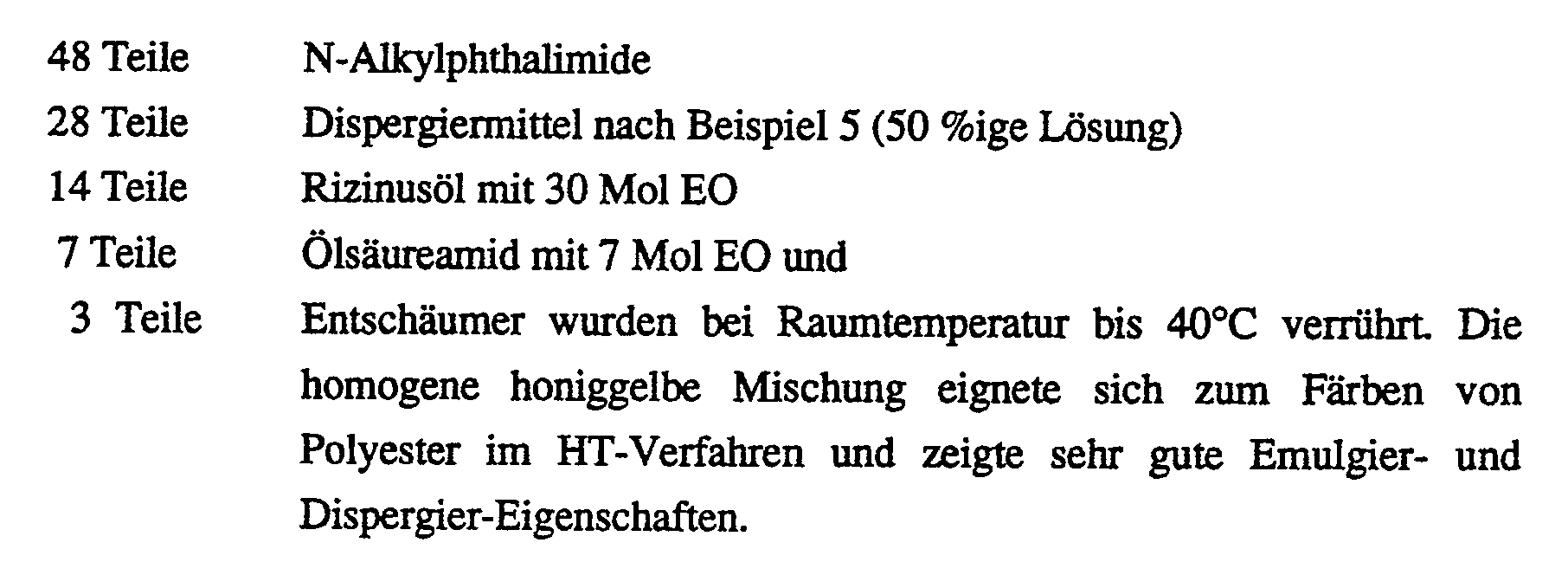
- a piece goods which consisted of warp and weft of polyester staple fiber yarn, was placed on a jet dyeing machine in a liquor ratio of 1:20 in a bath heated to 60 ° C., which was in liters along with 0.2 g of a dye of the formula still contained 1 g of the following leveling and dispersing agent mixture: 34 parts of N-alkylphthalimides 42 parts of the dispersant solution according to Example 2, 3 or 5 14 parts of castor oil with 30 moles of ethylene oxide 7 parts of oleic acid amide with 7 moles of ethylene oxide and 3 parts defoamer based on an emulsifiable mineral oil.
- the pH of the bath was adjusted to 4.5-5 with 2 g per liter of sodium dihydrogen phosphate and acetic acid.
- the dyeing liquor was then heated to 130 ° C. in 90 minutes and held at this temperature for 30 minutes. After cooling and rinsing, a uniform piece of goods colored in a full shade of red was obtained.
- Cross-wound bobbins with a textured polyester filament yarn were placed in a liquor ratio of 1:10 in a bath heated to 70 ° C., which contained 0.25 g of a dye of the formula in liters and 2 g in a liter of an auxiliary of the composition from Example 15.
- a dispersant e.g. of the type of a condensation product of naphthalene sulfonate and formaldehyde was eliminated.
- the pH of the dyebath was adjusted to 4.5-5 with 2 g / l sodium dihydrogen phosphate and acetic acid. The bath was then heated to 130 ° C in 90 minutes and held at that temperature for 30 minutes. Uniformly colored blue cheese was obtained.
- the auxiliary mixture mentioned in Example 15 can also be used as a leveling / dispersing agent with equally good success.
- a piece goods which consisted of a polyester staple fiber yarn in warp and weft, was placed on a jet dyeing machine in a liquor ratio of 1:20 in a bath heated to 60 ° C., which per liter contained 0.2 g of a dye of the formula still contained 2 g of one of the auxiliary mixtures described in Examples 14, 15 and 16 as leveling / dispersing agent.
- the pH of the bath was adjusted to 4.5-5 with 2 g / l sodium dihydrogen phosphate and acetic acid.
- the dye liquor was heated to 130 ° C. in 90 minutes and held at this temperature for 30 minutes. Although the dye liquor did not contain a separate foam suppressant, no foam formation was detectable during the dyeing. After cooling and rinsing, a uniform piece of goods colored in a shade of red was obtained.
Landscapes
- Chemical & Material Sciences (AREA)
- Engineering & Computer Science (AREA)
- Textile Engineering (AREA)
- Health & Medical Sciences (AREA)
- Chemical Kinetics & Catalysis (AREA)
- Medicinal Chemistry (AREA)
- Polymers & Plastics (AREA)
- Organic Chemistry (AREA)
- Coloring (AREA)
- Acyclic And Carbocyclic Compounds In Medicinal Compositions (AREA)
- Phenolic Resins Or Amino Resins (AREA)
- Emulsifying, Dispersing, Foam-Producing Or Wetting Agents (AREA)
Abstract
Description
- Die vorliegende Erfindung betrifft Kondensationsprodukte aus Ketonen der Formel (I),

in welcher - R₁ und R₂
- gleich oder verschieden sind und jeweils für einen gegebenenfalls substituierten aliphatischen Rest, vorzugsweise für gegebenenfalls substituiertes C₁-C₄-Alkyl, das durch Heteroatome und -gruppierungen wie -O- oder -NH- unterbrochen sein kann, stehen,
- R₁ und R₂
- gemeinsam mit dem Kohlenstoffatom, an welches sie gebunden sind, für einen gegebenenfalls substituierten cycloaliphatischen Rest, vorzugsweise für einen 3- bis 7-gliedrigen, gegebenenfalls substituierten gesättigten Carbocyclus stehen,
- Ketonen der Formel (II),

in welcher - R₃
- für einen gegebenenfalls substituierten, aliphatischen Rest, vorzugsweise für gegebenenfalls substituiertes C₁-C₄-Alkyl, das durch Heteroatome und -gruppierungen wie -O- oder -NH- unterbrochen sein kann, steht und
- R₄
- für einen gegebenenfalls substituierten, aromatischen Rest, vorzugsweise für gegebenenfalls substituiertes Phenyl steht,
- Geeignete Substituenten für Alkyl in der Definition von R₁, R₂ und R₃ sowie für den gesättigten Carbocyclus in der Definition von R₁ und R₂ sind beispielsweise Halogenatome wie Fluor, Chlor oder Brom, C₁-C₄-Alkyl-, Hydroxy-, C₁-C₄-Alkoxy- oder Carboxy- oder Sulfogruppen, sowie die Alkali- und/oder Ammoniumsalze der beiden letztgenannten, wobei das Ammoniumion 1- bis 3-fach durch z.B. Methyl- oder Hydroxyethylgruppen substituiert sein kann.
- Geeignete Substituenten für Phenyl in der Definition von R₄ sind beispielsweise Halogenatome, C₁-C₄-Alkyl-, C₁-C₄-Alkoxy-, Hydroxy- oder Carboxy-- oder Sulfogruppen, sowie die Alkali- und/oder Ammoniumsalze der beiden letztgenannten, wobei das Ammoniumion 1- bis 3-fach durch z.B. Methyl- oder Hydroxyethylgruppen substituiert sein kann.
- Bevorzugte erfindungsgemäße Kondensationsprodukte sind solche aus Mischungen der Ketone (I) und (II) im Molverhältnis 0,5-0,6:0,5-0,4 und, bezogen auf 1 Mol dieser Ketonmischung, 2-2,5 Mol Formaldehyd sowie 0,3-0,6 Mol an Salz der schwefligen Säure.
- Besonders bevorzugte erfindungsgemäße Kondensationsprodukte sind solche aus Mischungen der Ketone (I) und (II) im Molverhältnis 0,5-0,6:0,5-0,4 und, bezogen auf 1 Mol dieser Ketonmischung, 2-2,2 Mol Formaldehyd sowie 0,4-0,5 Mol an Salz der schwefligen Säure.
- Das Keton (I) kann in reiner Form oder als Ketonmischung eingesetzt werden.
- Als besonders bevorzugt zu verwendende Ketone der Formel (I) seien genannt: Aceton, Methylethylketon, Diethylketon, Diisopropylketon, Cyclopentanon oder Cyclohexanon.
- Als besonders bevorzugt zu verwendende Ketone der Formel (II) seien genannt: Acetophenon, Propiophenon, 4-Methoxyacetophenon, 4-Hydroxyacetophenon, 4-Methylacetophenon.
- Besonders bevorzugte erfindungsgemäße Kondensationsprodukte werden erhalten, wenn als Keton (I) Aceton und als Keton (II) Acetophenon verwendet wird.
- Formaldehyd wird vorzugsweise in 30-40 %iger Lösung oder in Form von Formaldehyd abgebenden Verbindungen, wie z.B. Paraformaldehyd oder Keton-Additions-Verbindungen (Methylolverbindungen) eingesetzt.
- Als Salze der schwefligen Säure verwendet man beispielsweise Alkalibisulfite oder Ammoniumbisulfite. Vorzugsweise verwendet man Natriumbisulfit, Kaliumbisulfit, Triethanolammoniumbisulfit, Diethanolmethylammoniumbisulfit, Dimethylethanolammoniumbisulfit, Triisopropanolammoniumbisulfit, Methyldiisopropanolammoniumbisulfit oder Dimethylisopropanolammoniumbisulfit.
- Die erfindungsgemäßen Kondensationsprodukte können hergestellt werden, indem man Ketone der Formel (I) und Ketone der Formel (II) mit Formaldehyd und einem Salz der schwefligen Säure bei einem pH-Wert von 9-11 und bei Temperaturen zwischen 100°C und 130°C umsetzt. Vorzugsweise arbeitet man bei Temperaturen zwischen 110°C und 120°C.
- Zur Reaktionsdurchführung werden die Ausgangsverbindungen gemäß den erfindungsgemäßen Molverhältnissen gemischt. Die anfangs zweiphasige Reaktionsmischung wird mit Natrium- oder Kaliumhydroxid-Lösung auf einen pH-Wert von 9-11 eingestellt. Die Kondensation wird bei Temperaturen zwischen 100°C und 130°C, vorzugsweise bei Temperaturen zwischen 110°C und 120°C, durchgeführt. Nach 3 bis 5 Stunden ist die Reaktion beendet. Bei technischen Ansätzen kann die Durchführung in einem geschlossenen Kessel unter Stickstoffatmosphäre vorteilhaft sein.
- Die erhaltene Lösung kann beispielsweise mit Ameisensäure neutralisiert werden.
- Kondensationsprodukte aus Ketonen, Formaldehyd und Alkalisalzen der schwefligen Säure sind bereits bekannt. Die Verwendungsmöglichkeiten dieser Produkte hängen vom Molverhältnis der Reaktionspartner ab. Aus der DT-PS 870 031 sind Gerbstoffe bekannt, die durch Kondensation aliphatischer Ketone mit Formaldehyd und Sulfonsäuregruppen liefernden Verbindungen erhalten werden.
- In der DT-OS 1 720 729 werden Kondensationsprodukte erwähnt, die durch Reaktion von Cycloalkanonen, Formaldehyd und Alkalisalzen der schwefligen Säure herstellbar sind. Nach den Beispielen dieser Offenlegungsschrift werden Verbindungen erhalten, die bis zu 0,3 Mol Sulfogruppen pro Mol Cyclohexanon enthalten und eine gute Gerbstoffwirkung haben. Sie zeigen jedoch nicht die gute Dispergierwirkung der neuen erfindungsgemäßen Produkte. Aus der DDR-PS 84 962 sind Verbindungen bekannt, die durch Kondensation von Aceton, Formaldehyd und Natriumbisulfit oder Natriumsulfit beispielsweise im Molverhältnis 1:2:1 erhalten werden. Diese Kondensationsprodukte sind leicht wasserlöslich und haben Dispergiermitteleigenschaften. Ein großer technischer Nachteil liegt jedoch in ihrer starken rotbraunen bis schwarzbraunen Eigenfärbung.
- Sie sind darum ungeeignet für die Formierung von hellen Dispersionsfarbstoffen oder optischen Aufhellern, insbesondere, wenn diese auf Polyamid aufgebracht werden sollen. Das schwach aufziehende Dispergiermittel übertönt durch seine Eigenfarbe Farbstoff und Aufheller.
- Aus einem Zusatz DE-OS 1 668 051 zur DE-OS 1 720 729 sind Kondensationsprodukte bekannt, die unter Verwendung des wasserunlöslichen Acetophenons hergestellt wurden. Das Verfahren ist wegen der mangelnden Mischbarkeit der Komponenten technisch völlig unbefriedigend, da sich immer nur ein Teil in schwer kontrollierbaren Molverhältnissen umsetzt.
- Das unumgesetzte Öl muß abgetrennt werden und die Wirksamkeit des wäßrigen Kondensates ist unbefriedigend. Die allgemeine Einsetzbarkeit ist nicht vorhanden, da restliches Sulfitsalz Farbstoffe reduzieren kann und Abwässer belastet.
- Aus der DDR-A-84 962 und DE-A-2 657 453 sind Kondensationsverfahren bekannt, bei denen bereits zu Beginn der Kondensation pH-Werte von 10 bis 13 eingestellt werden. Bei dieser Verfahrensführung treten Nebenprodukte wie Methanol und Isophoron auf. Sie sind brennbar und nicht mehr kondensationsfähig und müssen vor der Isolierung oder Verwendung der Kondensationsprodukte beispielsweise durch Destillation entfernt werden. Wegen der Entzündungsgefahr können die wäßrigen Reaktionslösungen nicht direkt der Sprühtrocknung zugeführt werden.
- Überraschenderweise zeigte sich, daß das erfindungsgemäße Verfahren zu Produkten führt, die frei von diesen störenden Nebenprodukten sind. Die Kondensationsprodukte sind hervorragende Dispergiermittel, die auf verschiedenen Gebieten verwendbar sind. Sie eignen sich insbesondere zum Dispergieren von anorganischen und organischen Pigmenten, Dispersionsfarbstoffen, schwerlöslichen anionischen Farbstoffen, z.B. Säure- oder Chromkomplexfarbstoffen, optischen Aufhellern, schwerlöslichen kationischen Farbstoffen, Kalkseifen in Waschmitteln und Pflanzenschutzmitteln.
- Ebenso ist ihre Wirksamkeit zur Dispergierung von synthetischen und natürlichen Latices ausgezeichnet. Sie haben eine geringe Eigenfarbe und eine gute Lichtstabilität.
- Von besonderem Vorteil ist der niedrige Fremdsalzgehalt der Dispergiermittel, wenn als Sulfitsalze die Bisulfite verwendet wurden.
- Die konzentrierten Lösungen können in der vorliegenden Form gelagert werden und direkt zum Einsatz kommen, oder ohne Vorbehandlung durch Sprühtrocknung in lockere, helle Pulver überführt werden.
- Werden die Aminsalze verwendet, so lassen sich die Dispergiermittel-Lösungen zu höchstkonzentrierten Lösungen eindampfen, die nicht auskristallisieren.
- Die vorliegende Erfindung betrifft weiterhin Färbereihilfsmittel auf der Basis von erfindungsgemäßen Dispergiermitteln und von nichtionischen Egalisiermitteln zum Färben und Egalisieren von Wolle, Polyamid und insbesondere Polyesterfasern.
- Es ist allgemein bekannt, daß nichtionische Egalisiermittel für Dispersionsfarbstoffe z.B. oxyalkylierte Ölsäure und oxyethyliertes Nonylphenol, oder die für 2:1-Chromkomplexfarbstoffe für Wolle oder Polyamidmaterialien eingesetzten hochoxyethylierten Fettalkohole, beim Färben von Polyestermaterialien oder Polyamidmaterialien, hervorragend egalisieren, jedoch dabei zum Retardieren der Farbstoffe neigen, dadurch die Farbstoffausbeute vermindern und das Abwasser belasten. Außerdem neigen diese Produkte im Färbebad zum Schäumen und sind deshalb in der Jetfärberei nicht geeignet.
- Der naheliegende Gedanke, diese Egalisiermittel mit den in der Praxis gebräuchlichen anionischen Dispergiermitteln zu kombinieren, scheiterte andererseits daran, daß beide Komponenten sich in den üblichen Handelskonzentrationen nicht mischen.
- Dies gilt sowohl für die bekanntesten Dispergiermittel auf Basis von Naphthalinsulfonsäure-Formaldehyd-Kondensaten, wie auch für die Cyclohexanon-Bisulfit-Formaldehyd-Kondensate (DE-OS 1 720 729) oder Aceton-Bisulfit-Formaldehyd-Kondensate (DDR-PS 84 962).
- Letztere Produkte sind weitgehend frei von Fremdsalzen, wie z.B. Natriumsulfat, und trotzdem nicht mischbar. Dies trifft auch für die Naphthalinsulfonsäure-Formaldehyd-Kondensate zu, die durch geeignete Reinigungsprozesse von den begleitenden Natriumsulfaten befreit wurden, so daß man diese Nichtmischbarkeit bisher als allgemein geltend halten konnte.
- Es wurde nun überraschenderweise gefunden, daß man die erfindungsgemäßen Dispergiermittel ausgezeichnet mit nichtionischen Egalisiermitteln kombinieren und die Kombination für den obengenannten Zweck einsetzen kann.
- Geeignete nichtionische Egalisiermittel sind beispielsweise beschrieben in: "Nonionic Surfactants", 1967, Marcel/Dekker Inc., New York. Besonders bevorzugt sind die Ethylenoxid- bzw. Ethylenoxid/Propylenoxid-Addukte von gesättigten und ungesättigten, überwiegend geradkettigen Fettalkoholen, Fettsäuren, Fettamiden, wobei die C-Kettenlängen bei C₁₀-C₁₈ und die Ethylenoxid- bzw. Propylenoxideinheiten pro Mol bei 3-20 Mol liegen.
Außerdem eignen sich Umsetzungsprodukte von natürlichen Fetten und Ölen, z.B. Sojaöl, Rapsöl, Kokosfett, Rindertalg, Rizinusöl, mit Ethylenoxid oder Gemischen aus Ethylenoxid und Propylenoxid. - Die bei der Herstellung anfallenden konzentrierten Lösungen der Dispergiermittel können in der vorliegenden Form direkt zum Einsatz kommen, indem man sie mit Lösungen des Egalisiermittels bzw. mit dem Egalisiermittel selbst vereinigt.
- Die Lösungen des Dispergiermittels können aber auch z.B. durch Sprühtrocknung zu Pulvern verarbeitet und mit dem Egalisiermittel in geeigneter Form abgemischt werden.
- Die erfindungsgemäßen Mischungen können insbesondere für die Polyesterfärberei mit Carrierwirkstoffen, wie beispielsweise aromatische Carbonsäuren und deren Ester, N-Alkylphthalimiden (wie sie in der DE-OS 18 04 527 beschrieben worden sind) zum Einsatz kommen.
- Bevorzugt für die Jetfärberei im HT-Färbeverfahren können noch zur Beseitigung von Schaumproblemen Entschäumer zugesetzt werden, wobei sich insbesondere Polypropylen-ethylen-glykolether oder emulgierbare Entschäumer auf Mineralöl-bzw. Naturölbasis eignen.
- Die neuen Hilfsmittel zeichnen sich durch eine geringe Eigenfärbung und gute Lichtstabilität aus.
- Besonders hervorzuheben ist die leichte Handhabbarkeit dieser Produkte, da sie nur in einer Handelsform vorliegen und die Komponenten vom Färber nicht erst vor Ort in geeigneter Weise abgemischt werden müssen.
- Die Herstellung und Verwendbarkeit der erfindungsgemäßen Dispergiermittel und der erfindungsgemäßen Färbereihilfsmittel soll anhand der folgenden Beispiele erläutert werden.
- 104 g (0,4 Mol) Natriumbisulfit-Lösung (40 %ig), 220 g (2,2 Mol) Formaldehyd (30 %ige Lösung) und 35 g (0,6 Mol) Aceton sowie 48 g (0,4 Mol) Acetophenon wurden bei Raumtemperatur miteinander verrührt. Die Temperatur stieg nicht über 50°C an. Nach ca. 15 Minuten wurde der pH-Wert kontrolliert (etwa 7,0-7,5) und mit Natronlauge auf pH-Wert 12 gestellt. Hierzu sind je nach Beschaffenheit der Bisulfitlösung und pH-Wert der Formaldehydlösung ca. 9 g konzentrierte Natronlauge (45 %ig) notwendig. Dann wurde langsam auf 70-80°C erwärmt, wobei eine Wärmetönung die einsetzende Kondensation anzeigte. Schon nach 10-15 Minuten war die Lösung homogen. Man ließ unter Rückflußkühlung 4 Stunden lang bei 103-105°C reagieren. Während der Abkühlung neutralisierte man mit Ameisensäure auf pH 7.
- Die erhaltene bräunliche Lösung hatte einen Gehalt von 36 % an Dispergiermittel. Die Lösung war lagerbeständig und schied keine Salze aus. Sie konnte direkt zu einem nicht hygroskopischen Pulver sprühgetrocknet werden.
- Die Dispergierwirkung war ausgezeichnet, sowohl für anorganische wie organische Pigmente.
- Die Eigenschaft, die Thixotropie von Farbstoff-Pigmentpreßkuchen mit geringen Mengen von 0,05 bis etwa 0,3 Prozent zu durchbrechen, ist bei diesem Produkt besonders ausgeprägt, so daß es sich besonders bei der Perlmühlenmahlung bewährt.
- 3 kg eines Pulvers des Farbstoffs C.I. Dispersblue 71 wurden mit 10 kg einer 30 %igen Lösung des erfindungsgemäßen Dispergiermittels homogen verrührt, mittels einer Rotor-Stator-Zahnkolloidmühle vorzerkleinert und in einer schnellaufenden Rührwerksmühle, die mit Glas-Mahlkörpern der Körnung 0,4-0,6 mm gefüllt war, mit einer Verweilzeit von 50 Minuten zerkleinert. Die erhaltene Suspension zeigte gute Lagerstabilität und anwendungstechnische Eigenschaften.
- Ähnlich gut lassen sich folgende Stoffe dispergieren:
C.I. Dispersyellow 60, C.I. Vatbrown 3, Kupferphthalocyanin der Modifikation nach Beispiel 1 der DT-PS 1 136 303, der Dispersionsaufheller nach Beispiel 1 der DT-PS 1 080 963 oder Titandioxid (Rutil). - 10 kg eines 18 %igen Filterkuchens des Farbstoffs C.I. Dispersionsblue 71 wurden unter Zusatz von 1,8 kg des erfindungsgemäßen Dispergiermittels mit dem Schnellrührer verflüssigt und anschließend in einer schnellaufenden Rührwerksmühle, die Ottawa-Sand (Körnung 0,5 - 0,8 mm) enthielt, mit einer Verweilzeit von 40 Minuten naßgemahlen. Nach weiterem Zusatz von 8 kg einer 30 %igen Lösung des erfindungsgemäßen Dispergiermittels und anschließender Sprühtrocknung bei Lufteintrittstemperatur von 180°C und Luftaustrittstemperatur von 80°C wurde eine in Wasser leicht dispergierbare Einstellung erhalten, die gute anwendungstechnische Eigenschaften zeigte.
- Ähnlich gut lassen sich folgende Stoffe dispergieren:
C.I. Dispersyellow 60, C.I. Vatbrown 3, Kupferphthalocyanin der Modifikation nach Beispiel 1 der DT-PS 1 136 303, der Dispersionsaufheller nach Beispiel 1 der DT-PS 1 080 963 oder Titandioxid (Rutil). - 220 g (2,2 Mol) Formaldehyd (30 %ig), 104 g (0,4 Mol) Natriumbisulfit-Lösung (40 %ig) sowie 23 g (0,4 Mol) Aceton, 29 g (0,3 Mol) Cyclohexanon und 36 g (0,3 Mol) Acetophenon wurden bei Raumtemperatur miteinander verrührt. Nach ca. 15 Minuten Rühren wurde der pH-Wert gemessen und mit Natronlauge auf pH 12 eingestellt. Der Verbrauch lag bei etwa 10 g Natronlauge (45 %ig).
- Die Temperatur stieg an und wurde durch zusätzliches langsames Anheizen auf 90°C gesteigert. Weiterer Temperaturanstieg führte zu Rückfluß bei 103-105°C und bei geschlossenem Druckgefäß zum Temperaturanstieg auf etwa 115°C. Man hielt die Reaktionsmischung 3 Stunden bei dieser Endtemperatur. Die Reaktionslösung wurde schon in den ersten 30 Minuten homogen und blieb auch bis zum Ende der Reaktion klar, ohne Kondensationsharze abzuscheiden.
- Das Dispergiermittel eignet sich hervorragend zur Dispergierung von Feststoffen wie Zinkoxid oder feinstgemahlener Farbstoffe.
- Es wurden 220 g (2,2 Mol) Formaldehyd (30 %ig), 104 g (0,4 Mol) Natriumbisulfit-Lösung (40 %ig) sowie 21 g (0,36 Mol) Aceton, 23,5 g (0,24 Mol) Cyclohexanon und 48 g (0,4 Mol) Acetophenon verwendet. Die Reaktionsdurchführung erfolgte analog zu den Beispielen 1 und 2. Es wurde ein Dispergiermittel erhalten, das sich besonders für polare Pflanzenschutzwirkstoffe hervorragend eignet.
- Das Herbizid "Diuron"® wurde in einer Mahlvorrichtung, z.B. einer Strahlmühle, in folgender Formulierung vermahlen: 80 % Wirkstoff, 5 % Dispergiermittel, 1,25 % Dibutylnaphthalinsulfonat, 4 % "Silikasil S"®, 9,5 % Tonerde. Die Prüfung der Dispergierbarkeit nach der WHO-Vorschrift wurde erfüllt. In einer 1 %igen Dispersion in Wasser 25° d. Härte setzten sich nach 30 Minuten weniger als 14 % des Wirkstoffes ab.
- Es wurden 220 g (2,2 Mol) Formaldehyd (30 %ig), 104 g (0,4 Mol) Natriumbisulfit-Lösung (40 %ig) sowie 59 g (0,6 Mol) Cyclohexanon und 48 g (0,4 Mol) Acetophenon verwendet. Die Reaktionsdurchführung erfolgte analog zu den Beispielen 1 und 2. Man erhielt eine dickflüssige Dispergiermittellösung, deren Wirksamkeit auf Zinkoxid nachgelassen hatte, jedoch bei organischen Wirkstoffen hervorragend war.
- Das Insekticid "Lebaycid"® wurde in folgender Formulierung vermahlen: 40 % Wirkstoff, 4 % Dispergiermittel, 0,5 % Dibutylnaphthalinsulfonat, 55,5 % "Silkasil"®. Bei der WHO-Prüfung auf Dispergierbarkeit in Wasser (20° d. Härte) zeigte sich nach 30 Minuten weniger als 17 % des Wirkstoffes als Bodensatz.
- Es wurden 220 g (2,2 Mol) Formaldehyd (30 %ig), 104 g (0,4 Mol) Natriumbisulfit-Lösung (40 %ig) sowie 29 g (0,5 Mol) Aceton und 60 g (0,5 Mol) Acetophenon verwendet. Die Reaktionsdurchführung erfolgte analog zu Beispiel 1.
- Die erhaltene Dispergiermittel-Lösung war dickflüssig, aber in jedem Verhältnis mit Wasser mischbar.
- 104 g (0,4 Mol) Natriumbisulfit-Lösung (40 %ig), 220 g (2,2 Mol) Formaldehyd (30 %ig), 29 g (0,5 Mol) Aceton, 48 g Acetophenon (0,4 Mol) und 15 g (0,1 Mol) 4-Methoxyacetophenon wurden bei Raumtemperatur miteinander verrührt. Die Temperatur der Mischung stieg auf 30 40°C an. Nach ca 15 Minuten wurde der pH-Wert kontrolliert (etwa 7,0-7,5) und mit Natronlauge auf pH-Wert 12 gestellt. Dabei stieg die Temperatur auf 70-100°C an. Man ließ unter Rückfluß 4 Stunden bei 100-105°C nachreagieren. Nach Neutralisation mit Ameisensäure erhielt man eine klare, rotbraune Flüssigkeit, mit einem Gehalt von ca. 40 % Feststoff. Das Produkt stellt ein geeignetes Mittel zum Dispergieren von Wirkstoffen für den Pflanzenschutz dar.
- Eine Lösung von 81 g (0,4 Mol) Methyldiethanolammonium-hydrogensulfit in 7 ml Wasser wurde mit 220 g (2,2 Mol) Formaldehyd-Lösung (30 %ig), 35 g (0,6 Mol) Aceton und 48 g (0,4 Mol) Acetophenon vermischt. Die Temperatur stieg auf 43°C an. Der sich einstellende pH-Wert von pH 7 wurde mit ca. 10 g konz. Natronlauge auf pH 10,5 eingestellt, und die Reaktionslösung im Druckgefäß 4 Stunden auf 110-115°C erhitzt. Die 43 %ige Dispergiermittellösung war sehr hell bräunlich gefärbt. Beim Eindampfen resultierte ein nicht kristallisierendes, zähfließendes Produkt mit sehr gutem Dispergierverhalten.
- 12 g (0,1 mol) Levulinsäure und 50 g Wasser wurden mit 10 g NaOH (45 %ig) auf pH 7-8 gestellt. Nach Zugabe von 104 g (0,4 mol) Natriumbisulfitlösung (40 %ig), 220 g (2,2 mol) Formaldehyd (30 %ig), 23 g (0,4 mol) Aceton und 60 g (0,5 mol) Acetophenon erfolgte die Reaktionsführung analog zu den Beispielen 1 und 2. Das so erhaltene Produkt zeigt hervorragende Eigenschaften beim Dispergieren von Farbstoffen und den Herbiziden Diuron® und Sencor®.
- Es wurden 220 g (2,2 mol) Formaldehyd (30 %ig), 78 g (0,3 mol) Natriumbisulfitlösung (40 %ig) sowie 34 g (0,3 mol) 2,5-Hexandion und 48 g (0,4 mol) Acetophenon verwendet. Die Reaktionsführung erfolgte analog zu den Beispielen 1 und 2. Das Produkt stellt ein geeignetes Mittel zum Dispergieren von Wirkstoffen für den Pflanzenschutz und von Farbstoffen dar.
- Es wurden 220 g (2,2 mol) Formaldehyd (30%ig), 104 g (0,4 mol) Natriumbisulfitlösung (40 %ig) sowie 17,5 g (0,3 mol) Aceton, 17 g (0,15 mol) 2,5-Hexandion und 48 g (0,4 mol) Acetophenon verwendet. Die Reaktionsführung erfolgte gemäß Beispiel 1. Es wurde ein Dispergiermittel mit hoher Wirksamkeit für Pflanzenschutzwirkstoffe und für anorganische und organische Pigmente erhalten.
- Es wurden 220 g (2,2 mol) Formaldehyd (30 %ig), 104 g (0,4 mol) Natriumbisulfitlösung (40 %ig) sowie 35 g (0,6 mol) Aceton, 24 g (0,2 mol) Acetophenon und 28 g (0,2 mol) 4-Hydroxy-acetophenon verwendet. Die Reaktionsführung erfolgte analog zu den Beispielen 1 und 2. Das entstandene Produkt zeigt sehr gute Dispergiereigenschaften bei Pflanzenschutzwirkstoffen.
- Es wurden 130 g (0,5 Mol) Natriumbisulfit-Lösung (40 %ig), 220 g (2,2 Mol) Formaldehyd (30 %ige Lösung) sowie 35 g (0,6 Mol) Aceton und 48 g (0,4 Mol) Acetophenon verwendet Die Reaktionsdurchführung erfolgte analog zu Beispiel 1.
- Man erhielt ein Dispergiermittel mit hoher Wirksamkeit
- Zur Messung der Dispergierwirkung wurde folgende Methode angewandt:
- 10g
- Zinkoxidpulver (für Analyse, Riedel-de Häen, Seelze-Hannover)
- 9,7 g
- Wasser und
- 0,3 g
- Dispergiermittel wurden miteinander bis zur Auflösung des Dispergiermittels verrührt (keine zusätzliche Mahlung).
- 1. Prüfung:
- diese Mischung mußte dünnflüssig sein.
- 2. Prüfung:
- diese dünnflüssige Dispersion wurde in einem 250 ml Meßzylinder, der 190 ml Wasser enthielt, eingegossen und zum Vermischen 10 mal umgeschüttelt.
Nach 3 Stunden Stehen wurden die Zinkoxidkonzentrationen bei einer Meßzylinderhöhe von 50 ml und 150 ml bestimmt.
Dies geschah durch die Entnahme von jeweils 5 ml bei diesen Marken. Der Gehalt an noch vorhandenem Zinkoxid wurde gravimetrisch oder titrimetrisch bestimmt.
Die Angaben erfolgen in Prozent vom theoretisch möglichen Gehalt. - Die Zahlen waren bei:

- Man arbeitete wie in Beispiel 1, verwendete jedoch Ammoniumbisulfit. Dabei wurde eine konzentrierte, lagerstabile Lösung erhalten.
- 30 Teile des Oxyethylierungsproduktes von 1 Mol Rizinusöl mit 20 Mol Ethylenoxid, 65 Teile der Lösung des Dispergiermittels aus Aceton, Acetophenon, Formaldehyd und Natriumbisulfit (wie in Beispiel 1 beschrieben) und 5 Teile Wasser wurden bei Raumtemperatur homogen verrührt. Diese stabile, leicht viskose Lösung eignet sich hervorragend als Egalisiermittel und Dispergiermittel beim Färben von Polyester und Polyamidmaterialien mit feinverteilten Dispersionsfarbstoffen (siehe Colour Index, Vol. 2, P.2483-2741.3. Edition [1971]).
- 20 Teile Ölsäure, umgesetzt mit 6 Mol Ethylenoxid, 10 Teile Rizinusöl mit 30 Mol Ethylenoxid und 67 Teile der Lösung des Dispergiermittels nach Beispiel 1 und 3 Teile eines emulgierbaren Entschäumers aus Mineralöl, werden bei Raumtemperatur homogen verrührt.
- Die klare, stabile Lösung eignet sich gleichfalls als Egalisier- und Dispergiermittel und führt auch bei hohen Flottengeschwindigkeiten in der Färbereiapparatur zu keinerlei Schaumproblemen.
- 20 Teile Ölsäure mit 6 Mol Ethylenoxid, 10 Teile Oleylalkohol mit 20 Mol Ethylenoxid, 68 Teile der Lösung des Dispergiermittels nach Beispiel 1 und 2 Teile Isopropanol wurden bei Raumtemperatur homogen verrührt. Diese klare Lösung ist stabil, lagerfähig und eignet sich hervorragend als Egalisier- und Dispergiermittel.
- Eine Wirkware aus einer texturierten Polyesterfaser wurde nach folgender Rezeptur gefärbt:

Start bei 70°C, in 90 Min. bis 130°C, 60 Min. bei 130°C, anschließend spülen und alkalisch-reduktiv nachbehandeln. - Die Wirkware zeigte eine hervorragende Egalität, ohne daß sich apparativ bedingte Unterschiede in der Farbtiefe und in der Nuance des Beigetons abzeichnen, obwohl kein zusätzliches Dispergiermittel eingesetzt wurde.
- Zum Nachweis des Egalisiervermögens wurde folgender Versuch ausgeführt:
Gleiche Gewichtsteile einer derart gefärbten Ware in den Innenlagen eines Wickelkörpers und ungefärbte Ware in den Außenlagen wurden auf einem Laborfärbeapparat mit 1 g/l einer Mischung nach Beispiel 15 bei pH 4,5-5,5 60 Min. bei 130°C behandelt. Man erhielt einen weitestgehenden Farbtiefenausgleich zwischen der vorher gefärbten und ungefärbten Ware. An diesem Test war die hervorragende Egalisierwirkung der beschriebenen Hilfsmittel-Mischung zu erkennen. - Mit Beispiel 17 vergleichbare Ergebnisse erhielt man mit der folgenden Mischung: 20 Teile Ölsäure mit 6 Mol Ethylenoxid, 10 Teile Phthalimid mit 6 Mol Ethylenoxid, 68 Teile der Dispergiermittel-Lösung nach Beispiel 1 und 2 Teile Entschäumer auf Basis eines emulgierbar eingestellten Rapsöles.
- Man verfuhr wie in Beispiel 17, verwendete aber die folgende Mischung: 33 Teile Ölsäure mit 6 Mol Ethylenoxid, 64 Teile der Dispergiermittel-Lösung nach Beispiel 5 und 3 Teile Entschäumer auf Basis eines emulgierbar eingestellten Rapsöles.
- Kreuzspulen mit einem texturierten Polyester-Filamentgarn wurden im Flottenverhältnis von 1 : 1 0 in ein auf 70°C erwärmtes Bad eingebracht, das im Liter 0,25 g eines Farbstoffs der Formel

und 1 g im Liter eines Hilfsmittels der Zusammensetzung:
45 Teile N-Alkylphthalimide der Mischung nach DE-OS 1804 527
30 Teile der Dispergiermittel-Lösung nach Beispiel 5
7 Teile Ölsäureamid mit 7 Mol Ethylenoxid
7 Teile Rizinusöl mit 30 Mol Ethylenoxid
7 Teile Oleylalkohol mit 6 Mol Ethylenoxid
1 Teil Oleylalkohol mit 20 Mol Ethylenoxid
3 Teile Entschäumer
enthielt. Der sonst allgemein übliche Zusatz eines Dispergiermittels vom Typ eines Kondensationsproduktes aus Naphthalinsulfonat und Formaldehyd entfiel. Der pH-Wert des Färbebades wurde mit 2 g/l Natriumdihydrogenphosphat und Essigsäure auf 4,5-5 eingestellt. Das Bad wurde dann in 90 Minuten auf 130°C erhitzt und 30 Minuten bei dieser Temperatur gehalten. Man erhielt gleichmäßig gefärbte blaue Kreuzspulen.
Anstelle der beschriebenen Dispergiermittel-Lösung nach Beispiel 5 können auch die in den Beispielen 2 und 3 beschriebenen Dispergiermittel mit gleich gutem Erfolg eingesetzt werden. - Eine Stückware, die in Kette und Schuß aus Polyester-Stapelfasergarn bestand, wurde auf einer Jet-Färbeanlage im Flottenverhältnis von 1:20 in ein auf 60°C erwärmtes Bad gegeben, das im Liter neben 0,2 g eines Farbstoffes der Formel

noch 1 g folgender Egalisier- und Dispergiermittelmischung enthielt:
34 Teile N-Alkylphthalimide
42 Teile der Dispergiermittel-Lösung nach Beispiel 2, 3 oder 5
14 Teile Rizinusöl mit 30 Mol Ethylenoxid
7 Teile Ölsäureamid mit 7 Mol Ethylenoxid und
3 Teile Entschäumer auf Basis eines emulgierbar eingestellten Mineralöls.
- Der pH-Wert des Bades wurde mit 2 g im Liter Natriumdihydrogenphosphat und Essigsäure auf 4,5-5 eingestellt. Die Färbeflotte wurde dann in 90 Minuten auf 130°C erhitzt und 30 Minuten bei dieser Temperatur gehalten. Nach Abkühlen und Spülen erhielt man eine gleichmäßige, in einem vollen Rotton gefärbte Stückware.
- Kreuzspulen mit einem texturierten Polyester-Filamentgarn wurden im Flottenverhältnis von 1:10 in ein auf 70°C erwärmtes Bad eingebracht, das im Liter 0,25 g eines Farbstoffs der Formel

und 2 g im Liter eines Hilfsmittels der Zusammensetzung aus Beispiel 15 enthielt. - Der sonst allgemein übliche Zusatz eines Dispergiermittels z.B. vom Typ eines Kondensationsproduktes aus Naphthalinsulfonat und Formaldehyd entfiel. Der pH-Wert des Färbebades wurde mit 2 g/l Natriumdihydrogenphosphat und Essigsäure auf 4,5-5 eingestellt. Das Bad wurde dann in 90 Minuten auf 130°C erhitzt und 30 Minuten bei dieser Temperatur gehalten. Man erhielt gleichmäßig gefärbte blaue Kreuzspulen.
- Anstelle der beschriebenen Hilfsmittel-Mischung kann auch die im Beispiel 15 genannte Hilfsmittel-Mischung als Egalisier-/Dispergiermittel mit gleich gutem Erfolg eingesetzt werden.
- Eine Stückware, die in Kette und Schuß aus einem Polyester-Stapelfasergarn bestand, wurde auf einer Jet-Färbeanlage im Flottenverhältnis von 1:20 in ein auf 60°C erwärmtes Bad gegeben, das im Liter neben 0,2g eines Farbstoffs der Formel

noch 2 g einer der in den Beispielen 14, 15 und 16 beschriebenen Hilfsmittel-Mischungen als Egalisier-/Dispergiermittel enthielt. Der pH-Wert des Bades wurde mit 2 g/l Natriumdihydrogenphosphat und Essigsäure auf 4,5-5 eingestellt. Die Färbeflotte wurde in 90 Minuten auf 130°C erhitzt und 30 Minuten bei dieser Temperatur gehalten. Obwohl die Farbflotte kein separates Schaumdämpfungsmittel enthielt, war während des Färbens keinerlei Schaumbildung feststellbar. Nach Abkühlen und Spülen erhielt man eine gleichmäßige, in einem Rotton gefärbte Stückware. -

-
-

-

-

-

-

-

-

oder
Formaldehyd und einem Salz der schwefligen Säure.
Claims (11)
- Kondensationsprodukte aus Ketonen der Formel (I)
 R₁ und R₂ gleich oder verschieden sind und jeweils für einen gegebenenfalls substituierten aliphatischen Rest, vorzugsweise für gegebenenfalls substituiertes C₁-C₄-Alkyl stehen, das durch Heteroatome und -gruppierungen wie -O- oder -NH- unterbrochen sein kann,oderR₁ und R₂ gemeinsam mit dem Kohlenstoffatom, an welches sie gebunden sind, für einen gegebenenfalls substituierten cycloaliphatischen Rest, vorzugsweise für einen 3- bis 7-gliedrigen, gegebenenfalls substituierten gesättigten Carbocyclus stehen,Ketonen der Formel (II)
 R₃ für einen gegebenenfalls substituierten, aliphatischen Rest, vorzugsweise für gegebenenfalls substituiertes C₁-C₄-Alkyl, das durch Heteroatome und -gruppierungen wie -O- oder -NH-unterbrochen sein kann, steht undR₄ für einen gegebenenfalls substituierten, aromatischen Rest, vorzugsweise für gegebenenfalls substituiertes Phenyl steht,Formaldehyd und einem Salz der schwefligen Säure.
 - Kondensationsprodukte gemäß Anspruch 1 aus Mischungen der Ketone (I) und (II) im Molverhältnis 0,5-0,6:0,5-0,4 und, bezogen auf 1 Mol dieser Ketonmischung, 2-2,5 Mol Formaldehyd sowie 0,3-0,6 Mol an Salz der schwefligen Säure.
- Kondensationsprodukte gemäß Anspruch 1 aus Mischungen der Ketone (I) und (II) im Molverhältnis 0,5-0,6:0,5-0,4 und, bezogen auf 1 Mol dieser Ketonmischung, 2-2,2 Mol Formaldehyd sowie 0,4-0,5 Mol an Salz der schwefligen Säure.
- Kondensationsprodukte gemäß den Ansprüchen 1 bis 3, dadurch gekennzeichnet, daß als Keton (I) Aceton und als Keton (II) Acetophenon verwendet wird.
- Verfahren zur Herstellung der Kondensationsprodukte der Ansprüche 1 bis 4, dadurch gekennzeichnet, daß Ketone der Formel (I) und Ketone der Formel (II) mit Formaldehyd und einem Salz der schwefligen Säure bei einem pH-Wert von 9 bis 11 und bei Temperaturen zwischen 100°C und 130°C umgesetzt werden.
- Verfahren zur Herstellung von Kondensationsprodukten gemäß Anspruch 5, dadurch gekennzeichnet, daß Formaldehyd in 30 bis 40 %iger Lösung oder in Form von Formaldehyd abgebenden Verbindungen eingesetzt wird.
- Verfahren zur Herstellung von Kondensationsprodukten gemäß Anspruch 5, dadurch gekennzeichnet, daß als Salze der schwefligen Säure Alkalibisulfite oder Ammoniumbisulfite verwendet werden.
- Verwendung der Kondensationsprodukte gemäß den Ansprüchen 1 bis 4 als Dispergiermittel.
- Färbereihilfsmittel, enthaltend ein Kondensationsprodukt gemäß Anspruch 1 bis 4 und ein nichtionisches Egalisiermittel.
- Färbereihilfsmittel, enthaltend ein Kondensationsprodukt gemäß Anspruch 1 bis 4, ein nichtionisches Egalisiermittel und einen Carrierwirkstoff.
- Verfahren zum Färben und/oder Egalisieren von Wolle, Polyamid und Polyester, dadurch gekennzeichnet, daß man ein Färbereihilfsmittel gemäß Anspruch 9 und 10 verwendet.
Applications Claiming Priority (4)
| Application Number | Priority Date | Filing Date | Title |
|---|---|---|---|
| DE4007484 | 1990-03-09 | ||
| DE4007484A DE4007484A1 (de) | 1990-03-09 | 1990-03-09 | Mischkondensationsprodukte |
| DE4022220 | 1990-07-12 | ||
| DE19904022220 DE4022220A1 (de) | 1990-07-12 | 1990-07-12 | Faerbereihilfsmittel |
Publications (3)
| Publication Number | Publication Date |
|---|---|
| EP0445609A2 true EP0445609A2 (de) | 1991-09-11 |
| EP0445609A3 EP0445609A3 (en) | 1993-03-31 |
| EP0445609B1 EP0445609B1 (de) | 1996-05-08 |
Family
ID=25890955
Family Applications (1)
| Application Number | Title | Priority Date | Filing Date |
|---|---|---|---|
| EP91102672A Expired - Lifetime EP0445609B1 (de) | 1990-03-09 | 1991-02-23 | Mischkondensationsprodukte |
Country Status (4)
| Country | Link |
|---|---|
| EP (1) | EP0445609B1 (de) |
| JP (1) | JPH04220412A (de) |
| DE (1) | DE59107778D1 (de) |
| ES (1) | ES2085921T3 (de) |
Cited By (1)
| Publication number | Priority date | Publication date | Assignee | Title |
|---|---|---|---|---|
| US5705597A (en) * | 1994-02-16 | 1998-01-06 | Huels Aktiengesellschaft | Ketone-aldehyde resin with wide compatibility, process for its preparation, and composition containing same |
Citations (5)
| Publication number | Priority date | Publication date | Assignee | Title |
|---|---|---|---|---|
| DD84962A (de) | ||||
| DE1668051A1 (de) | 1967-12-06 | 1971-03-25 | Bayer Ag | Kondensationsprodukte |
| DE1720729A1 (de) | 1967-10-17 | 1971-07-08 | Bayer Ag | Kondensationsprodukte |
| DE2542090A1 (de) | 1975-09-20 | 1977-03-31 | Bayer Ag | Kondensationsprodukte |
| DE2657453A1 (de) | 1975-12-23 | 1977-07-07 | Ciba Geigy Ag | Farbstoffzubereitung und deren verwendung zum faerben oder bedrucken von organischem fasermaterial |
Family Cites Families (1)
| Publication number | Priority date | Publication date | Assignee | Title |
|---|---|---|---|---|
| NL78445C (de) * | 1949-10-14 |
-
1991
- 1991-02-23 EP EP91102672A patent/EP0445609B1/de not_active Expired - Lifetime
- 1991-02-23 DE DE59107778T patent/DE59107778D1/de not_active Expired - Fee Related
- 1991-02-23 ES ES91102672T patent/ES2085921T3/es not_active Expired - Lifetime
- 1991-03-08 JP JP3069343A patent/JPH04220412A/ja active Pending
Patent Citations (6)
| Publication number | Priority date | Publication date | Assignee | Title |
|---|---|---|---|---|
| DD84962A (de) | ||||
| DE1720729A1 (de) | 1967-10-17 | 1971-07-08 | Bayer Ag | Kondensationsprodukte |
| DE1668051A1 (de) | 1967-12-06 | 1971-03-25 | Bayer Ag | Kondensationsprodukte |
| DE2542090A1 (de) | 1975-09-20 | 1977-03-31 | Bayer Ag | Kondensationsprodukte |
| FR2324661A1 (fr) | 1975-09-20 | 1977-04-15 | Bayer Ag | Produits de condensation de cycloalcanones, du formaldehyde et d'un bisulfite alcalin, leur obtention et leur application a titre d'agents de dispersion |
| DE2657453A1 (de) | 1975-12-23 | 1977-07-07 | Ciba Geigy Ag | Farbstoffzubereitung und deren verwendung zum faerben oder bedrucken von organischem fasermaterial |
Non-Patent Citations (1)
| Title |
|---|
| "Colour Index", vol. 2, 1971, pages: 2483 - 2741 |
Cited By (1)
| Publication number | Priority date | Publication date | Assignee | Title |
|---|---|---|---|---|
| US5705597A (en) * | 1994-02-16 | 1998-01-06 | Huels Aktiengesellschaft | Ketone-aldehyde resin with wide compatibility, process for its preparation, and composition containing same |
Also Published As
| Publication number | Publication date |
|---|---|
| EP0445609A3 (en) | 1993-03-31 |
| EP0445609B1 (de) | 1996-05-08 |
| DE59107778D1 (de) | 1996-06-13 |
| JPH04220412A (ja) | 1992-08-11 |
| ES2085921T3 (es) | 1996-06-16 |
Similar Documents
| Publication | Publication Date | Title |
|---|---|---|
| DE69807397T2 (de) | Triazinylaminostilben Verbindungen | |
| EP0065751B1 (de) | Anionische Verbindungen auf Basis modifizierter Novolak-Oxalkylate, ihre Herstellung und ihre Verwendung als schaumfreie grenzflächenaktive Mittel | |
| EP0463401A2 (de) | Dispergiermittel | |
| DE2856222C3 (de) | Wäßrige Farbstoffpräparate von in Wasser schwerlöslichen Farbstoffen, deren Herstellung und Verwendung | |
| DE3110411A1 (de) | Ditolylaethersulfonsaeuren und verfahren zur ihrer herstellung | |
| EP0028342A2 (de) | Verwendung von veresterten Oxalkylaten als Präparationsmittel für Farbstoffe und entsprechende Farbstoffzubereitungen | |
| EP0034771B1 (de) | Hochkonzentrierte, lagerstabile und wärmebeständige, fliessfähige, wässrige Dispersion von in Wasser schwer- bis unlöslichen Wirksubstanzen, Verfahren zur Herstellung der Dispersion, Verfahren zum Veredeln von Kunststoffen, Papier oder Textilien sowie veredelte Kunststoffe, veredeltes Papier oder veredelte Textilien | |
| EP0445609B1 (de) | Mischkondensationsprodukte | |
| DE2152523A1 (de) | Farbstoffpraeparate und Verfahren zu deren Herstellung | |
| DE2542090C2 (de) | Kondensationsprodukte aus Cycloalkanonen, Formaldehyd und Alkalibisulfit | |
| CH637988A5 (de) | Stabile feindisperse waessrige zubereitungen von dispersionsfarbstoffen und/oder optischen aufhellern. | |
| EP0014503A1 (de) | Verfahren zur Herstellung von in wässrigen Medien dispergierbaren, hochkonzentrierten, feindispersen, dispergiermittelarmen oder dispergiermittelfreien Präparaten von in Wasser schwer löslichen bis unlöslichen Wirksubstanzen in fester Form | |
| EP0657577A1 (de) | Verfahren zur photochemischen und thermischen Stabilisierung von ungefärbten und gefärbten oder bedruckten Polyesterfasermaterialien | |
| EP0047882A2 (de) | Formaldehydkondensate enthaltende Dispergiermittel | |
| EP0336163B1 (de) | Mischungen von Monoazofarbstoffen | |
| EP0475089B1 (de) | Mischungen von Monoazofarbstoffen | |
| EP0026308B1 (de) | Verwendung von Reaktionsprodukten ungesättigter Dicarbonsäuren und Estern als Hilfsmittel für Pigmentpasten | |
| EP0524520A2 (de) | Flüssige Farbstoffzubereitungen | |
| DE2721730A1 (de) | 1,4-bisstyrylbenzolderivate, verfahren zu deren herstellung und deren verwendung als optische aufheller | |
| EP0279272B1 (de) | Mischungen von Monoazofarbstoffen | |
| DE2301638B2 (de) | Verfahren zur Herstellung von sulfongruppenhaltigen Phenol-Formaldehyd-Kondensationsprodukten | |
| DE3045679C2 (de) | ||
| DE1594916A1 (de) | Spruehgetrocknetes Mittel fuer die Textilveredlung | |
| DE4022220A1 (de) | Faerbereihilfsmittel | |
| EP0081737B1 (de) | Flüssigkristalline Phase eines Azoreaktivfarbstoffs und deren Verwendung zum Färben und Bedrucken von natürlichen und synthetischen Substraten |
Legal Events
| Date | Code | Title | Description |
|---|---|---|---|
| PUAI | Public reference made under article 153(3) epc to a published international application that has entered the european phase |
Free format text: ORIGINAL CODE: 0009012 |
|
| AK | Designated contracting states |
Kind code of ref document: A2 Designated state(s): CH DE ES FR GB IT LI |
|
| PUAL | Search report despatched |
Free format text: ORIGINAL CODE: 0009013 |
|
| AK | Designated contracting states |
Kind code of ref document: A3 Designated state(s): CH DE ES FR GB IT LI |
|
| 17P | Request for examination filed |
Effective date: 19930722 |
|
| 17Q | First examination report despatched |
Effective date: 19950316 |
|
| GRAA | (expected) grant |
Free format text: ORIGINAL CODE: 0009210 |
|
| AK | Designated contracting states |
Kind code of ref document: B1 Designated state(s): CH DE ES FR GB IT LI |
|
| REG | Reference to a national code |
Ref country code: CH Ref legal event code: NV Representative=s name: E. BLUM & CO. PATENTANWAELTE |
|
| REF | Corresponds to: |
Ref document number: 59107778 Country of ref document: DE Date of ref document: 19960613 |
|
| REG | Reference to a national code |
Ref country code: ES Ref legal event code: FG2A Ref document number: 2085921 Country of ref document: ES Kind code of ref document: T3 |
|
| ITF | It: translation for a ep patent filed | ||
| GBT | Gb: translation of ep patent filed (gb section 77(6)(a)/1977) |
Effective date: 19960607 |
|
| ET | Fr: translation filed | ||
| PG25 | Lapsed in a contracting state [announced via postgrant information from national office to epo] |
Ref country code: GB Effective date: 19970223 |
|
| PG25 | Lapsed in a contracting state [announced via postgrant information from national office to epo] |
Ref country code: ES Free format text: LAPSE BECAUSE OF NON-PAYMENT OF DUE FEES Effective date: 19970224 |
|
| PG25 | Lapsed in a contracting state [announced via postgrant information from national office to epo] |
Ref country code: LI Effective date: 19970228 Ref country code: CH Effective date: 19970228 |
|
| PLBE | No opposition filed within time limit |
Free format text: ORIGINAL CODE: 0009261 |
|
| STAA | Information on the status of an ep patent application or granted ep patent |
Free format text: STATUS: NO OPPOSITION FILED WITHIN TIME LIMIT |
|
| 26N | No opposition filed | ||
| GBPC | Gb: european patent ceased through non-payment of renewal fee |
Effective date: 19970223 |
|
| REG | Reference to a national code |
Ref country code: CH Ref legal event code: PL |
|
| PG25 | Lapsed in a contracting state [announced via postgrant information from national office to epo] |
Ref country code: FR Effective date: 19971030 |
|
| PG25 | Lapsed in a contracting state [announced via postgrant information from national office to epo] |
Ref country code: DE Effective date: 19971101 |
|
| REG | Reference to a national code |
Ref country code: FR Ref legal event code: ST |
|
| REG | Reference to a national code |
Ref country code: ES Ref legal event code: FD2A Effective date: 20020603 |
|
| PG25 | Lapsed in a contracting state [announced via postgrant information from national office to epo] |
Ref country code: IT Free format text: LAPSE BECAUSE OF NON-PAYMENT OF DUE FEES;WARNING: LAPSES OF ITALIAN PATENTS WITH EFFECTIVE DATE BEFORE 2007 MAY HAVE OCCURRED AT ANY TIME BEFORE 2007. THE CORRECT EFFECTIVE DATE MAY BE DIFFERENT FROM THE ONE RECORDED. Effective date: 20050223 |