EP0445748A2 - Procédé pour la préparation de poudre granulaire en polytétrafluoréthylène - Google Patents
Procédé pour la préparation de poudre granulaire en polytétrafluoréthylène Download PDFInfo
- Publication number
- EP0445748A2 EP0445748A2 EP91103349A EP91103349A EP0445748A2 EP 0445748 A2 EP0445748 A2 EP 0445748A2 EP 91103349 A EP91103349 A EP 91103349A EP 91103349 A EP91103349 A EP 91103349A EP 0445748 A2 EP0445748 A2 EP 0445748A2
- Authority
- EP
- European Patent Office
- Prior art keywords
- polytetrafluoroethylene
- powder
- granular powder
- aqueous medium
- particle size
- Prior art date
- Legal status (The legal status is an assumption and is not a legal conclusion. Google has not performed a legal analysis and makes no representation as to the accuracy of the status listed.)
- Withdrawn
Links
Images
Classifications
-
- C—CHEMISTRY; METALLURGY
- C08—ORGANIC MACROMOLECULAR COMPOUNDS; THEIR PREPARATION OR CHEMICAL WORKING-UP; COMPOSITIONS BASED THEREON
- C08J—WORKING-UP; GENERAL PROCESSES OF COMPOUNDING; AFTER-TREATMENT NOT COVERED BY SUBCLASSES C08B, C08C, C08F, C08G or C08H
- C08J3/00—Processes of treating or compounding macromolecular substances
- C08J3/12—Powdering or granulating
-
- B—PERFORMING OPERATIONS; TRANSPORTING
- B29—WORKING OF PLASTICS; WORKING OF SUBSTANCES IN A PLASTIC STATE IN GENERAL
- B29B—PREPARATION OR PRETREATMENT OF THE MATERIAL TO BE SHAPED; MAKING GRANULES OR PREFORMS; RECOVERY OF PLASTICS OR OTHER CONSTITUENTS OF WASTE MATERIAL CONTAINING PLASTICS
- B29B13/00—Conditioning or physical treatment of the material to be shaped
- B29B13/10—Conditioning or physical treatment of the material to be shaped by grinding, e.g. by triturating; by sieving; by filtering
-
- B—PERFORMING OPERATIONS; TRANSPORTING
- B29—WORKING OF PLASTICS; WORKING OF SUBSTANCES IN A PLASTIC STATE IN GENERAL
- B29B—PREPARATION OR PRETREATMENT OF THE MATERIAL TO BE SHAPED; MAKING GRANULES OR PREFORMS; RECOVERY OF PLASTICS OR OTHER CONSTITUENTS OF WASTE MATERIAL CONTAINING PLASTICS
- B29B9/00—Making granules
- B29B9/08—Making granules by agglomerating smaller particles
-
- C—CHEMISTRY; METALLURGY
- C08—ORGANIC MACROMOLECULAR COMPOUNDS; THEIR PREPARATION OR CHEMICAL WORKING-UP; COMPOSITIONS BASED THEREON
- C08J—WORKING-UP; GENERAL PROCESSES OF COMPOUNDING; AFTER-TREATMENT NOT COVERED BY SUBCLASSES C08B, C08C, C08F, C08G or C08H
- C08J3/00—Processes of treating or compounding macromolecular substances
- C08J3/12—Powdering or granulating
- C08J3/16—Powdering or granulating by coagulating dispersions
-
- C—CHEMISTRY; METALLURGY
- C08—ORGANIC MACROMOLECULAR COMPOUNDS; THEIR PREPARATION OR CHEMICAL WORKING-UP; COMPOSITIONS BASED THEREON
- C08J—WORKING-UP; GENERAL PROCESSES OF COMPOUNDING; AFTER-TREATMENT NOT COVERED BY SUBCLASSES C08B, C08C, C08F, C08G or C08H
- C08J2327/00—Characterised by the use of homopolymers or copolymers of compounds having one or more unsaturated aliphatic radicals, each having only one carbon-to-carbon double bond, and at least one being terminated by a halogen; Derivatives of such polymers
- C08J2327/02—Characterised by the use of homopolymers or copolymers of compounds having one or more unsaturated aliphatic radicals, each having only one carbon-to-carbon double bond, and at least one being terminated by a halogen; Derivatives of such polymers not modified by chemical after-treatment
- C08J2327/12—Characterised by the use of homopolymers or copolymers of compounds having one or more unsaturated aliphatic radicals, each having only one carbon-to-carbon double bond, and at least one being terminated by a halogen; Derivatives of such polymers not modified by chemical after-treatment containing fluorine atoms
- C08J2327/18—Homopolymers or copolymers of tetrafluoroethylene
Definitions
- the present invention relates to a process for preparing polytetrafluoroethylene granular powder, more particularly to a process for preparing a polytetrafluoroethylene granular powder suitable for use in compression molding.
- Polytetrafluoroethylene powder which is prepared by polymerizing tetrafluoroethylene in an aqueous medium in the substantially absence of an emulsifier is molded by comprision molding which is similar to methods adopted in a field of powder metallurgy, differing from molding methods to which other thermoplastic resins are applied such as melt-molding, melt injection molding and hot compression molding. Therefore, the polytetrafluoroethylene granular powder for molding is required to have some specific properties. As the fundamental properties, it is required to have excellent flowability, to be soft and to be pressed by a comparative low pressure to form a dense preformed article, and to have a large bulk density.
- Japanese Examined Patent Publication No. 57-15128 has proposed a process for preparing a polytetrafluoroethylene granular powder having a uniformer particle size distribution and having better flowability and the process has been widely carried out.
- Japanese Examined Patent Publication No. 57-15128 discloses a process for agglomerating a polytetrafluoroethylene powder by agitating the same in an aqueous medium containing an organic liquid having a surface tention of not more than 35 dynes/cm wherein the agitation is carried out while the crushing of the aggromerates is conducted by using an apparatus provided with an agitating mechanism and a crushing mechanism.
- the organic liquid having the surface tention of not more than 35 dynes/cm is used in an amount of 20 to 300 % by weight based on the polytetrafluoroethylene primary particles, for improving the powder flowability.
- Such an organic liquid is expensive, so it is desirable that the liquid is not used if possible.
- it tends to restrict the use of widely used flon organic liquids such as trichlorotrifluoroethane all over the world, because it is said that the flon organic liquid destroys the ozon layer.
- An object of the present invention is to provide a process for preparing a polytetrafluoroethylene granular powder which is large in bulk density, is dense and is excellent in electric properties, without using any of the organic liquids as mentioned above.
- a process for preparing a polytetrafluoroethylene granular powder which comprises agitating primary particles of a finely divided polytetrafluoroethylene powder having an average particle size of not more than 100 ⁇ m in an aqueous medium containing no organic liquid to from agglomerates while crushing the agglomerates within a temperature range between not less than 20°C and less than 60°C in an apparatus having an agitating mechanism of the aqueous medium and a crushing mechanism of the agglomerates.
- the primary particles namely the finely divided particles of polytetrafluoroethylene suitably used as the starting material has an average particle size of not more than 100 ⁇ m, preferably not more than 50 ⁇ m.
- the primary particles of polytetrafluoroethylene is prepared by grinding a polymer powder which is obtained by polymerizing tetrafluoroethylene monomer in the presence of water containing a polymerization initiator, in the presence or absence of water by means of a grinder such as a hammer mill, a grinder equipped with a vaned rotor, a grinder of high energy fluid type or an impact grinder. Either a fibrous powder or a non-fibrous powder may be employed without any trouble.
- aqueous medium water is usually used. It is not always necessary to employ water purified in high purity. However, in case of employing water containing an inorganic or organic impurities, these impurities remain in the obtained polytetrafluoroethylene granular powder and, as a result, an article obtained from the granular powder is unfavorably made to color and the breakdown voltage is made to lower. Therefore, these impurities resulting in such disadvantages must be previously removed out of the aqueous medium.
- the aqueous medium is suitably employed in the ratio of 150 to 5000 % by weight to the primary particles of finely divided polytetrafluoroethylene, and the obtained slurry containing the primary particles is agitated to form agglomerates.
- An amount capable of giving the flowability to the slurry containing the polytetrafluoroethylene primary particles suffices for the used amount of the aqueous medium.
- the use of much amount of aqueous medium than the above-mentioned range brings to the economically disadvantage and on the other hand the lack of the aqueous medium makes the procedures in agglomerating and in crushing difficult. So long as the slurry containing the Polytetrafluoroethylene powder and the aqueous medium has a flowability, there is no problem in increase and decrease of the aqueous medium to some extent.
- the agitating mechanism of the polytetrafluoroethylene powder in the aqueous medium and the crushing mechanism of the agglomelates are operated simultaneously. That is, the crushing is conducted at the same time as or after the agitation. Under such conditions, the agitation and the crushing are conducted within a temperature range between not less than 20°C and less than 60°C.
- the temperature condition is very important. When the temperature is less than 20°C, there cannot be obtained the polytetrafluoroethylene granular powder having the high bulk density desired in the present invention. On the other hand, when the temperature is not less than 60°C, the electric properties of the obtained granular powder are influenced.
- Preferable temperature range is from 30° to 50°C, more preferable temperature range is from 35° to 50°C.
- the agitation and crushing can be conducted within the above-mentioned temperature range by maintaining the temperature of the aqueous medium to such a range (between not less than 20°C and less than 60°C).
- the agglomeration is conducted under the above-mentioned conditions, there can be obtained the Polytetrafluoroethylene granular powder having the desired particle size, having the uniform particle size distribution, being dense and having the excellent electric properties.
- crushing mechanism means a mechanism capable of lowering a particle size of a secondary agglomerate composed of primary particles by partially crushing an agglomerated powder having an improper large particle size or an abnormally large aggregate.
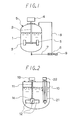
- each of Fig. 1 and Fig. 2 is the schematic front view of the apparatus.
- the numeral 1 is the agitating vessel, and in the agitating vessel 1 the rotor 2 is centered vertically.
- the agitating vane 3 is equipped radially, and the upper end of the rotor 2 is connected with the motor 4.
- the numeral 5 is the providing port for the aqueous medium
- the numeral 6 is the crusher
- the numeral 9 is the motor.
- the crusher 6 is connected with the under region and the upper region of the agitating vessel 1 through the transfer pipes 7 and 8, respectively.
- the crusher 6 there can be employed one making a crushing of the polytetrafluoroethylene particles included in the aqueous medium possible by means of rotating a cutter of turbine blade type in a cylinder with transferring the aqueous medium.
- Examples of such an apparatus are Pipe-line homomixer (trademark) (commercially available from Tokushukika Kogyo Kabushiki Kaisha) and Disintergrator (trademark) (commercially available from Komatsu Mfg. Co., Ltd.) which are equipped with a cutter and a stator being able to provide cutting and impact.
- the aqueous medium including the primary particles of polytetrafluoroethylene is introduced in the agitating vessel 1 through the providing port 5, and then agitated by means of the agitating vane 3. At the same time as the agitation or after agitation, the aqueous medium is introduced to the crusher 6 through the transfer pipe 7. By passing through the crusher 6, agglomerates too large are crushed and the aqueous medium including the particles is returned to the agitating vessel 1 through the transfer pipe 8.
- an agglomerated powder having a uniform particle size can be obtained by carrying out the agglomeration by agitation in the agitating vessel 1 and the crushing of the largely agglomerated powder or the abnormally large aggregate in the crusher 6 at the same time or in order, or alternately.
- Fig. 2 is the schematic front view showing another apparatus which can be employed in the present invention.
- the crusher 21 is set in parallel with the rotor 11 equipped with the agitating vane 12 in the agitating vessel 10.
- the numerals 13 and 22 are the motors for the rotor 11 and the crusher 21, respectively.
- the agitating vane 12 is radiately and spirally fixed on the boss 14 at the under end of the rotor 11. Therefore, in this case, the polytetrafluoroethylene particles included in the aqueous medium is agglomerated while the aqueous medium is agitated by the agitating vane 12 and the resultant agglomerated powder and aggregate are crushed by the crusher 21.
- the agitating vessel for agglomeration is charged with the primary particles of the finely divided polytetrafluoroethylene and water, and then the mixture is agitated while crushing. If circumstances require, the primary particles of polytetrafluoroethylene previously wetted by a small amount of water can be admixed with the residual aqueous medium in the agitating vessel and then agitated. Also the primary particles of polytetrafluoroethylene can be introduced in an agitating vessel previously charged with the aqueous medium and then agitated.
- the primary particles of polytetrafluoroethylene are agglomerated by the effect of agitation, and even if the granular powder having a particle size of more than 5000 ⁇ m is produced, such a large granular powder is crushed by utilizing a crusher at the same time as agitation or after agitation, or alternately with agitation, as stated above, to give a uniform granular powder of at most 600 ⁇ m in particle size.
- polytetrafluoroethylene granular powder by the process of the present invention has the following properties.
- An average particle size of the polytetrafluoroethylene granular powder is determined by a usual manner for measurement as follows: Standard sieves of 10, 20, 32, 48 and 60 mesh ("mesh” in the specification means “inch mesh”) are superposed in order from the top, and the powder is placed in the 10 mesh sieve. The sieves are shaken to make the fine powder fall in order through them, and the ratios of the powder remained on each sieve are calculated by percentage by weight. On a log probability paper, thus obtained cumulative weight percentage figures are plotted on axis of ordinate against sieve-opening size on axis of abscissa, and these points are connected by a straight line. An average particle size is the value corresponding to cumulative percentages of 50.
- a bulk density of the polytetrafluoroethylene granular powder is determined according to Japanese Industrial Standards (JIS) K 6891.
- a breakdown voltage of the polytetrafluoroethylene granular powder is determined according to JIS K 6891.
- a finely divided polytetrafluoroethylene was agglomerated by employing an apparatus as shown in Fig. 1.
- Pipeline homomixer a crusher commercially available from Tokushukika Kogyo Kabushiki Kaisha
- the vane was rotated at a speed of 98 r.p.m., while maintaining the inner temperature of the tank at 40°C, and, at the same time, the slurry in the tank was circulated through the crusher at the ratio of 500 liters/minute. This operation was continued for 10 minutes. For further 3 minutes, the agitation was continued. Then, the polytetrafluoroechylene powder was separated from water and dried to give a polytetrafluoroethylene granular powder having a uniform particle size distribution as shown in Table 1.
- An average particle size was calculated from a log probability paper on which the results of the particle size distribution as shown in Table 1 were plotted, and it was confirmed that the granular powder had an average particle size of 330.8 ⁇ m. Also, the granular powder had a breakdown voltage of 9.5 KV.
- Example 2 The same procedure as in Example 1 was repeated except that primary particles of polytetrafluoroethylene having an average particle size of 50 ⁇ m and a bulk density of 0.33 g/ml were used.
- the treated polytetrafluoroethylene granular powder was separated from water and dried.
- the obtained polytetrafluoroethylene granular powder had a particle size distribution as shown in Table 1.
- the obtained granular powder had an average particle size calculated from the particle size distribution shown in Table 1 of 383 ⁇ m, and a breakdown voltage of 8.5 KV.
- the properties of the granular powder are shown in Table 2 together with those of the primary particles.
- Example 2 The same procedure as in Example 1 was repeated except that the inner temperature of the tank was 20°C.
- the treated polytetrafluoroethylene powder was separated from water and dried.
- the obtained polytetrafluoroethylene granular powder had a particle size distribution as shown in Table 1.
- the obtained granular powder had an average particle size calculated from the particle size distribution shown in Table 1 of 305 ⁇ m, and a breakdown voltage of 10.5 KV.
- the properties of the granular powder are shown in Table 2 together with those of the primary particles.
- the obtained poytetrafluoroethylene granular powder had many large particles and a particle size distribution as shown in Table 1.
- the obtained granular powder had an average particle size calculated from the particle size distribution as shown in Table 1 of 1105 ⁇ m.
- the properties of the granular powder are shown in Table 2 together with those of the primary particles.
- Example 2 The same procedure as in Example 1 was repeated except that the agitation and crushing were conducted at a temperature cf 90°C.
- the treated polytetrafluoroethylene powder was separated from water and dried.
- the obtained polytetrafluoroethylene granular powder had a particle size distribution as shown in Table 1.
- the obtained granular powder had an average particle size calculated from the particle size distribution as shown in Table 1 of 578 ⁇ m, and a low breakdown voltage of 4.5 KV.
- the properties of the granular powder are shown in Table 2 together with those of the primary particles.
- Each of the polytetrafluoroethylene granular powders obtained in Examples 1-3 and Comparative Examples 1 and 2 was molded into a sheet and the surface roughness of the sheet was measured as follows: Test method: A mold having a concave portion with a diameter of 100 mm is charged with 65 g of the polytetrafluoroethylene granular powder and it is preformed under a pressure of 300 kg/cm2 to give a preformed sheet. The obtained sheet is sintered at a temperature of 370°C in an electric furnace for 5.5 hours, then the temperature is dropped down to room temperature at a cooling rate of 5.5°C/hour to give a molded article. The measurement is carried out by employing a roughness tester SE-4 commercially available from Kabushiki Kaisha Kosaka Kenkyusho. The surface roughness is expressed by the value of the obtained central average roughness provided by JIS B 0601.
- the preparation process of the present invention can provide the dense polytetrafluoroethylene granular powder having the excellent electric properties and high bulk density, without using the organic liquid which is expensive and whose use is restricted.
Landscapes
- Chemical & Material Sciences (AREA)
- Health & Medical Sciences (AREA)
- Chemical Kinetics & Catalysis (AREA)
- Medicinal Chemistry (AREA)
- Polymers & Plastics (AREA)
- Organic Chemistry (AREA)
- Engineering & Computer Science (AREA)
- Mechanical Engineering (AREA)
- Dispersion Chemistry (AREA)
- Processes Of Treating Macromolecular Substances (AREA)
- Processing And Handling Of Plastics And Other Materials For Molding In General (AREA)
- Addition Polymer Or Copolymer, Post-Treatments, Or Chemical Modifications (AREA)
Applications Claiming Priority (2)
| Application Number | Priority Date | Filing Date | Title |
|---|---|---|---|
| JP2059297A JPH03259926A (ja) | 1990-03-08 | 1990-03-08 | ポリテトラフルオロエチレン粒状粉末の製法 |
| JP59297/90 | 1990-03-08 |
Publications (2)
| Publication Number | Publication Date |
|---|---|
| EP0445748A2 true EP0445748A2 (fr) | 1991-09-11 |
| EP0445748A3 EP0445748A3 (en) | 1992-05-20 |
Family
ID=13109301
Family Applications (1)
| Application Number | Title | Priority Date | Filing Date |
|---|---|---|---|
| EP19910103349 Withdrawn EP0445748A3 (en) | 1990-03-08 | 1991-03-06 | Process for preparing polytetrafluoro-ethylene granular powder |
Country Status (4)
| Country | Link |
|---|---|
| US (1) | US5156343A (fr) |
| EP (1) | EP0445748A3 (fr) |
| JP (1) | JPH03259926A (fr) |
| KR (1) | KR910016822A (fr) |
Families Citing this family (13)
| Publication number | Priority date | Publication date | Assignee | Title |
|---|---|---|---|---|
| US5658960A (en) * | 1993-02-23 | 1997-08-19 | W.L. Gore & Associates, Inc. | Polytetrafluoroethylene molding resin and processes |
| US5646192A (en) * | 1993-02-23 | 1997-07-08 | W. L. Gore & Associates, Inc. | Polytetrafluoroethylene molding powder |
| US6146923A (en) * | 1993-04-09 | 2000-11-14 | Tadahiro Ohmi | Method of smoothing fluorine-containing resin molded article and smoothed molded article |
| US5379947A (en) * | 1993-11-09 | 1995-01-10 | Basf Corporation | Process for producing a powder coating composition |
| DE19500871A1 (de) * | 1995-01-13 | 1996-07-18 | Basf Ag | Verfahren zum Recyclen von Diaphragmen |
| KR19980702633A (ko) * | 1995-03-14 | 1998-08-05 | 이노우에 노리유끼 | 폴리테트라플루오로에틸렌 성형용 분말의 제조방법 |
| KR19990067436A (ko) * | 1995-11-09 | 1999-08-16 | 이노우에 노리유끼 | 폴리테트라플루오로에틸렌 성형용 조립분말 및 그 제법 |
| DE19547907A1 (de) * | 1995-12-21 | 1997-06-26 | Dyneon Gmbh | Nichtrieselfähige Formpulver aus modifizierten Polytetrafluorethylenen |
| EP0824782B1 (fr) * | 1996-02-29 | 2001-10-24 | Koninklijke Philips Electronics N.V. | Recepteur pourvu d'un traitement numerique de signal d'entree divise en phases |
| JP3319329B2 (ja) * | 1997-03-17 | 2002-08-26 | ダイキン工業株式会社 | フィラー入りポリテトラフルオロエチレン粒状粉末およびその製法 |
| EP1449866A4 (fr) * | 2001-10-24 | 2007-04-11 | Daikin Ind Ltd | Poudre de ptfe, et procede de fabrication correspondant, aux fins de moulage |
| CN109796708B (zh) * | 2019-02-18 | 2020-05-08 | 武汉理工大学 | 一种ptfe基复合介质板用浸渍浆料的物理混合方法及浸渍浆料和应用 |
| CN116766438B (zh) * | 2023-06-06 | 2025-08-29 | 深圳市迈威石油设备技术有限公司 | 一种用高弹性材料制备梯级超微颗粒的系统和方法 |
Family Cites Families (11)
| Publication number | Priority date | Publication date | Assignee | Title |
|---|---|---|---|---|
| US3115486A (en) * | 1960-11-30 | 1963-12-24 | Du Pont | Process for the preparation of polytetrafluoroethylene molding powder |
| FR1457560A (fr) * | 1964-09-16 | 1966-01-24 | Allied Chem | Granules améliorés de résine de polytétrafluoréthylène, leur procédé de fabrication et leur utilisation |
| US3781258A (en) * | 1968-09-11 | 1973-12-25 | Daikin Ind Ltd | Polytetrafluoroethylene powder and method of preparation thereof |
| JPS4817547B1 (fr) * | 1969-07-18 | 1973-05-30 | ||
| US3882217A (en) * | 1970-12-11 | 1975-05-06 | Ici Ltd | Method for the production of free-flowing polytetrafluoroethylene molding powders |
| US3983200A (en) * | 1970-12-11 | 1976-09-28 | Imperial Chemical Industries Limited | Method for the production of polytetrafluoroethylene moulding powders |
| DE2063635C3 (de) * | 1970-12-30 | 1980-01-03 | Daikin Kogyo Co. Ltd., Tokio | Verfahren zur Herstellung eines nicht faserigen ultrafeinen Polytetrafluoräthylen-Formpulvers |
| US4118235A (en) * | 1975-09-18 | 1978-10-03 | Daikin Kogyo Co., Ltd. | Mold release agent |
| US4143110A (en) * | 1977-07-08 | 1979-03-06 | Asahi Glass Company Ltd. | Method of agglomerating polytetrafluoroethylene powder |
| US4123606A (en) * | 1977-09-21 | 1978-10-31 | E. I. Du Pont De Nemours And Company | Deagglomeration process |
| US4241137A (en) * | 1977-11-22 | 1980-12-23 | Daikin Kogyo Co., Ltd. | Process for preparing polytetrafluoroethylene granular powder |
-
1990
- 1990-03-08 JP JP2059297A patent/JPH03259926A/ja active Pending
-
1991
- 1991-03-06 EP EP19910103349 patent/EP0445748A3/en not_active Withdrawn
- 1991-03-07 US US07/665,867 patent/US5156343A/en not_active Expired - Lifetime
- 1991-03-08 KR KR1019910003770A patent/KR910016822A/ko not_active Withdrawn
Also Published As
| Publication number | Publication date |
|---|---|
| US5156343A (en) | 1992-10-20 |
| EP0445748A3 (en) | 1992-05-20 |
| JPH03259926A (ja) | 1991-11-20 |
| KR910016822A (ko) | 1991-11-05 |
Similar Documents
| Publication | Publication Date | Title |
|---|---|---|
| EP0445748A2 (fr) | Procédé pour la préparation de poudre granulaire en polytétrafluoréthylène | |
| US4241137A (en) | Process for preparing polytetrafluoroethylene granular powder | |
| US3766133A (en) | Polytetrafluoroethylene filled and unfilled molding powders and theirpreparation | |
| US4439385A (en) | Continuous process for the agglomeration of PTFE powders in a liquid medium | |
| EP1995270B1 (fr) | Poudre PTFE et procédé de production de poudres de moulage PTFE | |
| JPH0952955A (ja) | 変性ポリテトラフルオロエチレン粒状粉末の製法 | |
| EP0861865A1 (fr) | Poudre granulee de polytetrafluoroethylene contenant une matiere de charge et destinee au moulage, et son procede de production | |
| US5589531A (en) | Preparation and use of pelletized submicron pigment powder/polymer compositions | |
| JPH0834820A (ja) | 高分子量フッ素系溶融樹脂微粉末、その成形品、及びこれらの製造方法 | |
| JPH0420534A (ja) | ポリテトラフルオロエチレン粉末の製法 | |
| EP0448995A1 (fr) | Procédé pour la préparation de polytétrafluoroéthylène en poudre granulaire | |
| JP3453759B2 (ja) | ポリテトラフルオロエチレン成形用粉末の製造方法 | |
| EP0455210B1 (fr) | Procédé de préparation de polytétrafluoroéthylène en poudre granulaire | |
| EP0980886B1 (fr) | Poudre granulaire comportant du polytetrafluorethylene et une charge et procede de fabrication correspondant | |
| JPWO1996028498A1 (ja) | ポリテトラフルオロエチレン成形用粉末の製造方法 | |
| US5646192A (en) | Polytetrafluoroethylene molding powder | |
| US3179646A (en) | Polymerization to produce friable aggregates of individual spheres of polyvinyl chloride | |
| JPH11192469A (ja) | プラスチックの処理方法および該処理方法で得られる固体燃料、鉱石用還元剤 | |
| RU2179562C2 (ru) | Несыпучие формованные порошки из модифицированных политетрафторэтиленов и способ их получения | |
| US6203733B1 (en) | Process for producing granulated polytetrafluoroethylene powder | |
| JP3036065B2 (ja) | フィラー入りポリテトラフルオロエチレン造粒粉末の製造方法 | |
| JPH0413729A (ja) | ポリテトラフルオロエチレン造粒粉末の製造法 | |
| US3331825A (en) | Polytetrafluoroethylene molding powders | |
| US3597405A (en) | Polytertrafluoroethylene powder and method for making the same | |
| EP0607653A1 (fr) | Composition granulée de silice en poudre hautement dispersable et procédé de sa préparation |
Legal Events
| Date | Code | Title | Description |
|---|---|---|---|
| PUAI | Public reference made under article 153(3) epc to a published international application that has entered the european phase |
Free format text: ORIGINAL CODE: 0009012 |
|
| AK | Designated contracting states |
Kind code of ref document: A2 Designated state(s): DE FR GB NL |
|
| PUAL | Search report despatched |
Free format text: ORIGINAL CODE: 0009013 |
|
| AK | Designated contracting states |
Kind code of ref document: A3 Designated state(s): DE FR GB NL |
|
| 17P | Request for examination filed |
Effective date: 19921111 |
|
| 17Q | First examination report despatched |
Effective date: 19931015 |
|
| STAA | Information on the status of an ep patent application or granted ep patent |
Free format text: STATUS: THE APPLICATION IS DEEMED TO BE WITHDRAWN |
|
| 18D | Application deemed to be withdrawn |
Effective date: 19940426 |