EP0446080A1 - Verfahren und Gerät zur elementaren Analyse einer Probe mittels Massenspektrometrie, gekoppelt mit einem durch Hochfrequenz induzierten Plasma - Google Patents
Verfahren und Gerät zur elementaren Analyse einer Probe mittels Massenspektrometrie, gekoppelt mit einem durch Hochfrequenz induzierten Plasma Download PDFInfo
- Publication number
- EP0446080A1 EP0446080A1 EP91400001A EP91400001A EP0446080A1 EP 0446080 A1 EP0446080 A1 EP 0446080A1 EP 91400001 A EP91400001 A EP 91400001A EP 91400001 A EP91400001 A EP 91400001A EP 0446080 A1 EP0446080 A1 EP 0446080A1
- Authority
- EP
- European Patent Office
- Prior art keywords
- plasma
- sample
- cones
- installation
- gas
- Prior art date
- Legal status (The legal status is an assumption and is not a legal conclusion. Google has not performed a legal analysis and makes no representation as to the accuracy of the status listed.)
- Granted
Links
- 238000000034 method Methods 0.000 title claims abstract description 7
- 238000004949 mass spectrometry Methods 0.000 title claims abstract description 5
- 238000000921 elemental analysis Methods 0.000 title abstract 2
- 238000009434 installation Methods 0.000 claims abstract description 19
- 239000010936 titanium Substances 0.000 claims abstract description 13
- 230000006872 improvement Effects 0.000 claims abstract description 9
- RTAQQCXQSZGOHL-UHFFFAOYSA-N Titanium Chemical compound [Ti] RTAQQCXQSZGOHL-UHFFFAOYSA-N 0.000 claims abstract description 4
- 229910052735 hafnium Inorganic materials 0.000 claims abstract description 4
- VBJZVLUMGGDVMO-UHFFFAOYSA-N hafnium atom Chemical compound [Hf] VBJZVLUMGGDVMO-UHFFFAOYSA-N 0.000 claims abstract description 4
- 229910052719 titanium Inorganic materials 0.000 claims abstract description 4
- 230000008021 deposition Effects 0.000 claims abstract 2
- 239000007789 gas Substances 0.000 claims description 21
- XKRFYHLGVUSROY-UHFFFAOYSA-N Argon Chemical compound [Ar] XKRFYHLGVUSROY-UHFFFAOYSA-N 0.000 claims description 14
- 238000005070 sampling Methods 0.000 claims description 13
- 238000004458 analytical method Methods 0.000 claims description 8
- 239000001257 hydrogen Substances 0.000 claims description 8
- 229910052739 hydrogen Inorganic materials 0.000 claims description 8
- 229910052786 argon Inorganic materials 0.000 claims description 7
- 229910045601 alloy Inorganic materials 0.000 claims description 6
- 239000000956 alloy Substances 0.000 claims description 6
- 238000002347 injection Methods 0.000 claims description 6
- 239000007924 injection Substances 0.000 claims description 6
- 239000000463 material Substances 0.000 claims description 5
- 230000008569 process Effects 0.000 claims description 4
- 230000015572 biosynthetic process Effects 0.000 claims description 3
- 238000003754 machining Methods 0.000 claims description 2
- 125000004435 hydrogen atom Chemical group [H]* 0.000 claims 1
- 229910001257 Nb alloy Inorganic materials 0.000 abstract description 2
- 150000002500 ions Chemical class 0.000 description 17
- PXHVJJICTQNCMI-UHFFFAOYSA-N Nickel Chemical compound [Ni] PXHVJJICTQNCMI-UHFFFAOYSA-N 0.000 description 12
- BLRPTPMANUNPDV-UHFFFAOYSA-N Silane Chemical compound [SiH4] BLRPTPMANUNPDV-UHFFFAOYSA-N 0.000 description 7
- XUIMIQQOPSSXEZ-UHFFFAOYSA-N Silicon Chemical compound [Si] XUIMIQQOPSSXEZ-UHFFFAOYSA-N 0.000 description 5
- 239000000203 mixture Substances 0.000 description 5
- 229910052759 nickel Inorganic materials 0.000 description 5
- 229910000077 silane Inorganic materials 0.000 description 5
- 229910052710 silicon Inorganic materials 0.000 description 5
- 239000010703 silicon Substances 0.000 description 5
- UFHFLCQGNIYNRP-UHFFFAOYSA-N Hydrogen Chemical compound [H][H] UFHFLCQGNIYNRP-UHFFFAOYSA-N 0.000 description 4
- 238000009616 inductively coupled plasma Methods 0.000 description 4
- 238000005259 measurement Methods 0.000 description 4
- 239000000243 solution Substances 0.000 description 4
- XEEYBQQBJWHFJM-UHFFFAOYSA-N Iron Chemical compound [Fe] XEEYBQQBJWHFJM-UHFFFAOYSA-N 0.000 description 3
- 125000004429 atom Chemical group 0.000 description 3
- 238000001514 detection method Methods 0.000 description 3
- 150000002431 hydrogen Chemical class 0.000 description 3
- 230000006698 induction Effects 0.000 description 3
- 239000010955 niobium Substances 0.000 description 3
- 239000010453 quartz Substances 0.000 description 3
- VYPSYNLAJGMNEJ-UHFFFAOYSA-N silicon dioxide Inorganic materials O=[Si]=O VYPSYNLAJGMNEJ-UHFFFAOYSA-N 0.000 description 3
- 239000011575 calcium Substances 0.000 description 2
- 230000000694 effects Effects 0.000 description 2
- 230000005284 excitation Effects 0.000 description 2
- INQOMBQAUSQDDS-UHFFFAOYSA-N iodomethane Chemical compound IC INQOMBQAUSQDDS-UHFFFAOYSA-N 0.000 description 2
- 230000003902 lesion Effects 0.000 description 2
- 239000007788 liquid Substances 0.000 description 2
- 229910052751 metal Inorganic materials 0.000 description 2
- 230000009467 reduction Effects 0.000 description 2
- 239000004065 semiconductor Substances 0.000 description 2
- 239000011734 sodium Substances 0.000 description 2
- ZOXJGFHDIHLPTG-UHFFFAOYSA-N Boron Chemical compound [B] ZOXJGFHDIHLPTG-UHFFFAOYSA-N 0.000 description 1
- OYPRJOBELJOOCE-UHFFFAOYSA-N Calcium Chemical compound [Ca] OYPRJOBELJOOCE-UHFFFAOYSA-N 0.000 description 1
- DGAQECJNVWCQMB-PUAWFVPOSA-M Ilexoside XXIX Chemical compound C[C@@H]1CC[C@@]2(CC[C@@]3(C(=CC[C@H]4[C@]3(CC[C@@H]5[C@@]4(CC[C@@H](C5(C)C)OS(=O)(=O)[O-])C)C)[C@@H]2[C@]1(C)O)C)C(=O)O[C@H]6[C@@H]([C@H]([C@@H]([C@H](O6)CO)O)O)O.[Na+] DGAQECJNVWCQMB-PUAWFVPOSA-M 0.000 description 1
- WHXSMMKQMYFTQS-UHFFFAOYSA-N Lithium Chemical compound [Li] WHXSMMKQMYFTQS-UHFFFAOYSA-N 0.000 description 1
- FLHROXIJCMGCJH-UHFFFAOYSA-N [Ti].[Hf].[Nb] Chemical compound [Ti].[Hf].[Nb] FLHROXIJCMGCJH-UHFFFAOYSA-N 0.000 description 1
- 229910052785 arsenic Inorganic materials 0.000 description 1
- RQNWIZPPADIBDY-UHFFFAOYSA-N arsenic atom Chemical compound [As] RQNWIZPPADIBDY-UHFFFAOYSA-N 0.000 description 1
- 238000000889 atomisation Methods 0.000 description 1
- 230000008901 benefit Effects 0.000 description 1
- 238000009835 boiling Methods 0.000 description 1
- 229910052796 boron Inorganic materials 0.000 description 1
- 229910052791 calcium Inorganic materials 0.000 description 1
- 230000008859 change Effects 0.000 description 1
- 229910052729 chemical element Inorganic materials 0.000 description 1
- 230000002301 combined effect Effects 0.000 description 1
- 238000001816 cooling Methods 0.000 description 1
- 239000012809 cooling fluid Substances 0.000 description 1
- 238000000151 deposition Methods 0.000 description 1
- 238000004807 desolvation Methods 0.000 description 1
- 230000006870 function Effects 0.000 description 1
- 230000001771 impaired effect Effects 0.000 description 1
- 239000012535 impurity Substances 0.000 description 1
- 230000010354 integration Effects 0.000 description 1
- 229910052742 iron Inorganic materials 0.000 description 1
- 239000006193 liquid solution Substances 0.000 description 1
- 229910052744 lithium Inorganic materials 0.000 description 1
- 238000004519 manufacturing process Methods 0.000 description 1
- 239000002184 metal Substances 0.000 description 1
- 239000003595 mist Substances 0.000 description 1
- 229910052758 niobium Inorganic materials 0.000 description 1
- GUCVJGMIXFAOAE-UHFFFAOYSA-N niobium atom Chemical compound [Nb] GUCVJGMIXFAOAE-UHFFFAOYSA-N 0.000 description 1
- 238000005086 pumping Methods 0.000 description 1
- 150000003377 silicon compounds Chemical class 0.000 description 1
- 229910052708 sodium Inorganic materials 0.000 description 1
- 239000000758 substrate Substances 0.000 description 1
- XLYOFNOQVPJJNP-UHFFFAOYSA-N water Substances O XLYOFNOQVPJJNP-UHFFFAOYSA-N 0.000 description 1
Images
Classifications
-
- H—ELECTRICITY
- H01—ELECTRIC ELEMENTS
- H01J—ELECTRIC DISCHARGE TUBES OR DISCHARGE LAMPS
- H01J49/00—Particle spectrometers or separator tubes
- H01J49/02—Details
- H01J49/10—Ion sources; Ion guns
- H01J49/105—Ion sources; Ion guns using high-frequency excitation, e.g. microwave excitation, Inductively Coupled Plasma [ICP]
-
- H—ELECTRICITY
- H01—ELECTRIC ELEMENTS
- H01J—ELECTRIC DISCHARGE TUBES OR DISCHARGE LAMPS
- H01J49/00—Particle spectrometers or separator tubes
- H01J49/02—Details
- H01J49/04—Arrangements for introducing or extracting samples to be analysed, e.g. vacuum locks; Arrangements for external adjustment of electron- or ion-optical components
- H01J49/0468—Arrangements for introducing or extracting samples to be analysed, e.g. vacuum locks; Arrangements for external adjustment of electron- or ion-optical components with means for heating or cooling the sample
-
- H—ELECTRICITY
- H01—ELECTRIC ELEMENTS
- H01J—ELECTRIC DISCHARGE TUBES OR DISCHARGE LAMPS
- H01J49/00—Particle spectrometers or separator tubes
- H01J49/02—Details
- H01J49/06—Electron- or ion-optical arrangements
- H01J49/067—Ion lenses, apertures, skimmers
-
- G—PHYSICS
- G01—MEASURING; TESTING
- G01N—INVESTIGATING OR ANALYSING MATERIALS BY DETERMINING THEIR CHEMICAL OR PHYSICAL PROPERTIES
- G01N30/00—Investigating or analysing materials by separation into components using adsorption, absorption or similar phenomena or using ion-exchange, e.g. chromatography or field flow fractionation
- G01N30/02—Column chromatography
- G01N30/62—Detectors specially adapted therefor
- G01N30/72—Mass spectrometers
- G01N30/7206—Mass spectrometers interfaced to gas chromatograph
Definitions
- the present invention relates to an improvement to the known method of analysis of a gas sample by a plasma induced by high frequency, forming a source of ions taken from a mass spectrometer and also relates to an improvement made to the installation. necessary for the implementation of this process.
- the process consists in particular, from a torch formed of a quartz tube receiving a sample to analyze gas or solution previously nebulized and a plasmagenic medium delivered in a ring around the central injection of the sample in the axis of the torch, to establish the plasma by means of a high frequency induction device coaxial with the torch, allowing the output of the latter to excite the gas mixture and to collect a flow of ions, which is then delivered to a sampling device, itself in relation to a mass spectrometer.
- this device comprises two successive cones, generally made of nickel, these cones arranged one behind the other along the axis of the torch, each being provided with an axial orifice to collect a fraction of the flow of ions to be analyzed.
- the first, more open cone is called the sampling cone and is joined to a support member, generally cooled by a continuous circulation of an appropriate refrigerating medium, the second cone, located downstream of the first, being designated under the sampling cone term.
- a majority fraction of the gas flow is evacuated by a pump or the like while the remainder, after passing through the second cone, is admitted into a chamber placed under a high vacuum, of sufficient dimensions to allow the free passage of ions which are then collected by the mass spectrometer where they are detected as a function of the ratio of their mass to their charge.
- the present invention relates to an improvement made to the elementary analysis method of a sample by mass spectrometry, coupled to a plasma induced by high frequency, which overcomes the aforementioned drawback, by limiting the plugging of the cone through orifices. of the installation and a reduction in the signal supplied by the mass spectrometer, a reduction in signal which could possibly be slightly offset by a change in the settings of the ion optics, which cannot however be modified during an analysis.
- the improvement considered is characterized in that it consists in adding to the sample injected into the plasma a given quantity of a make-up gas, with high calorific value, so as to raise the temperature of the plasma for locally heat the sampling cones in order to avoid depositing on them the components of the sample, present in the plasma.
- the temperature of the plasma formed which depends on its electronic density and on its composition, can be appreciably increased by the introduction into the plasma medium and / or the sample injected into the plasma, of an additional contribution d '' a gas with high calorific value, providing in particular an improvement in energy transfers between the plasma and the components of the sample.
- the excitation temperature of the plasma can thus be increased from 5000 to 7000 ° K, simply by adding an appropriate flow of hydrogen.
- the effect of the increase in plasma temperatures is combined with that which results from an appropriate choice of the material of cones carrying out the sampling and the admission of a fraction of the sample to the mass spectrometer.
- the material of the cones is determined so that it has refractory properties at high temperature and satisfactory machining properties for producing the necessary profiles of these cones.
- the cones are made of an alloy of niobium Nb, hafnium Hf, titanium Ti, the relative proportions of these three metallic elements being close to 89% (Nb), 10% respectively. (Hf) and 1% (Ti).
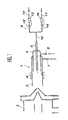
- the installation shown in the figures repeats arrangements known in the art in conventional installations of the ICP / MS type, comprising in particular an injection torch 1, placed opposite a connection structure 2 with a mass spectrometer, not shown in the drawing.
- the torch 1 mainly comprises a quartz tube 3, associated in its outer surface with a high frequency induction coil 4, allowing the creation of a plasma inductively coupled with a gaseous medium injected into the torch with an appropriate flow rate.
- the torch 1 comprises means of admission, of the sample and of the plasmagenic medium, consisting of a tube 5, arranged concentrically in the tube 3 and itself comprising axially an inlet pipe 6.
- the plasmagenic medium is introduced by a connection 7, between the tubing 5 and the internal surface of the quartz tube 3, another connection 8 also making it possible to introduce, inside the tubing 5, an auxiliary flow another gas or the same gas as that which constitutes the plasma medium, in order to adjust the conditions of plasma formation in the torch, in line with the induction coil 4.
- the axial pipe 6 is connected to an assembly 9 for introducing the sample into the installation, comprising two parallel lines, respectively 10 and 11, joined together to a single connection line 12 with the pipe 6.
- the gaseous sample to be analyzed is delivered by line 10 through a valve 12 provided with a servo-control and flow-regulating device 13.
- This sample can be of any kind and, in addition, be in gaseous form or in the form of a liquid solution, the latter being previously nebulized to constitute a mist of very fine droplets.
- an auxiliary flow of a gas with high calorific value preferably from the second line 11, also provided with a valve 14 and a servo-control 15, is introduced. hydrogen, which thus mixes with the sample in the connection line 12 before being injected into the pipe 6 in the axis of the torch 1.
- the gas sample intimately mixed with the additional hydrogen thus supplied is injected into the plasma, part of which is taken to be sent to the connection structure 2 with the mass spectrometer, performing the desired quantitative elementary analysis of the components of the sample.
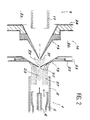
- the sampling of the necessary fraction of the sample is carried out through an interface 16, arranged at the outlet of the torch 1 and before the first electrodes 17 of the electronic optics, making it possible to convey this sampling to spectrometer.
- the interface 16 comprises two successive cones, respectively 18 and 19, placed coaxially one behind the other, the first cone 18 being called the sampling cone, while the second is designated by the term cone direct debit.
- the cones 18 and 19 each have a central orifice, respectively 20 and 21, the sampling cone 18 having a larger aperture at the top than the sampling cone 19.
- the cone 18 is secured to a support jacket 22, hollowed out internally at 23 to allow the circulation of a cone cooling fluid, generally water.
- the cone 19 is carried by a mounting structure 24 which closes a chamber 25 in which the ions taken through the orifices 20 and 21 are taken up by the electrodes 17 which accelerate them towards the spectrometer.
- the chamber 25 is placed under a high vacuum.
- a space 26 also placed under vacuum but lower than that prevailing in the chamber 25, this space 26 being joined to a pumping installation (not shown).
- the plasma jet 27 thus leaving the torch 1 surrounds an axial zone 28, where the gas sample coming from the pipe 6 is strongly ionized; a large fraction of the sample is removed outward along the surface of the first cone 18, while the remainder enters through the orifice 20 into the space 26 where it forms an expansion zone 29, the part central of it entering the chamber 25 through the orifice 21.
- the addition of a gas with high calorific value, in particular hydrogen, in the initial gas sample makes it possible to raise the temperature of the plasma and consequently to locally heat the successive cones 18 and 19, in particular by preventing the orifices 20 and 21 from being progressively obstructed by the deposits of the components of the sample, the temperature of these cones being, in all cases, substantially lower than that which prevails within the plasma.
- a gas with high calorific value in particular hydrogen
- the cones 18 and 19 are thus made of a niobium (89%), hafnium (10%), titanium (1%) alloy.
- the deposits formed on the apertures of the cones are also the main cause of the low value of the average intensity of the 127I ion in the case of cones made of Ni.
- a gain of a factor of 5 is obtained with respect to the intensity of the 127I ion, found with the nickel cones.
Landscapes
- Chemical & Material Sciences (AREA)
- Analytical Chemistry (AREA)
- Physics & Mathematics (AREA)
- Engineering & Computer Science (AREA)
- Plasma & Fusion (AREA)
- Other Investigation Or Analysis Of Materials By Electrical Means (AREA)
- Electron Tubes For Measurement (AREA)
- Investigating, Analyzing Materials By Fluorescence Or Luminescence (AREA)
- Plasma Technology (AREA)
- Sampling And Sample Adjustment (AREA)
Applications Claiming Priority (2)
| Application Number | Priority Date | Filing Date | Title |
|---|---|---|---|
| FR9000065 | 1990-01-05 | ||
| FR9000065A FR2656926B1 (fr) | 1990-01-05 | 1990-01-05 | Perfectionnement au procede d'analyse elementaire d'un echantillon par spectrometrie de masse couplee a un plasma induit par haute frequence et a l'installation pour la mise en óoeuvre de ce procede. |
Publications (2)
| Publication Number | Publication Date |
|---|---|
| EP0446080A1 true EP0446080A1 (de) | 1991-09-11 |
| EP0446080B1 EP0446080B1 (de) | 1994-11-30 |
Family
ID=9392528
Family Applications (1)
| Application Number | Title | Priority Date | Filing Date |
|---|---|---|---|
| EP19910400001 Expired - Lifetime EP0446080B1 (de) | 1990-01-05 | 1991-01-02 | Verfahren und Gerät zur elementaren Analyse einer Probe mittels Massenspektrometrie, gekoppelt mit einem durch Hochfrequenz induzierten Plasma |
Country Status (5)
| Country | Link |
|---|---|
| EP (1) | EP0446080B1 (de) |
| JP (1) | JP3040495B2 (de) |
| CA (1) | CA2033439A1 (de) |
| DE (1) | DE69105307T2 (de) |
| FR (1) | FR2656926B1 (de) |
Cited By (2)
| Publication number | Priority date | Publication date | Assignee | Title |
|---|---|---|---|---|
| US6374111B1 (en) | 1999-03-12 | 2002-04-16 | Telefonaktiebolaget Lm Ericsson (Publ) | System and method for robust automatic cell retune |
| US11667992B2 (en) | 2021-07-19 | 2023-06-06 | Agilent Technologies, Inc. | Tip for interface cones |
Families Citing this family (2)
| Publication number | Priority date | Publication date | Assignee | Title |
|---|---|---|---|---|
| JP3801958B2 (ja) * | 2002-06-28 | 2006-07-26 | 東芝マイクロエレクトロニクス株式会社 | Icp質量分析装置及びその分析方法 |
| US12051584B2 (en) * | 2020-02-04 | 2024-07-30 | Perkinelmer Scientific Canada Ulc | ION interfaces and systems and methods using them |
Citations (2)
| Publication number | Priority date | Publication date | Assignee | Title |
|---|---|---|---|---|
| DE3905303A1 (de) * | 1988-02-24 | 1989-08-31 | Hitachi Ltd | Vorrichtung zur erzeugung eines plasmas durch mikrowellen |
| WO1989012313A1 (en) * | 1988-06-03 | 1989-12-14 | Vg Instruments Group Limited | High resolution plasma mass spectrometer |
Family Cites Families (2)
| Publication number | Priority date | Publication date | Assignee | Title |
|---|---|---|---|---|
| CA1246246A (en) * | 1985-04-24 | 1988-12-06 | Donald J. Douglas | Method and apparatus having rf biasing for sampling a plasma into a vacuum chamber |
| GB8602463D0 (en) * | 1986-01-31 | 1986-03-05 | Vg Instr Group | Mass spectrometer |
-
1990
- 1990-01-05 FR FR9000065A patent/FR2656926B1/fr not_active Expired - Fee Related
- 1990-12-28 JP JP2418559A patent/JP3040495B2/ja not_active Expired - Fee Related
- 1990-12-31 CA CA 2033439 patent/CA2033439A1/en not_active Abandoned
-
1991
- 1991-01-02 EP EP19910400001 patent/EP0446080B1/de not_active Expired - Lifetime
- 1991-01-02 DE DE69105307T patent/DE69105307T2/de not_active Expired - Fee Related
Patent Citations (2)
| Publication number | Priority date | Publication date | Assignee | Title |
|---|---|---|---|---|
| DE3905303A1 (de) * | 1988-02-24 | 1989-08-31 | Hitachi Ltd | Vorrichtung zur erzeugung eines plasmas durch mikrowellen |
| WO1989012313A1 (en) * | 1988-06-03 | 1989-12-14 | Vg Instruments Group Limited | High resolution plasma mass spectrometer |
Non-Patent Citations (3)
| Title |
|---|
| ANALYTICAL CHEMISTRY vol. 52, no. 14, décembre 1980, pages 2283-2289, Washington, US; R.S. HOUK et al.: "Inductively Coupled Argon Plasma as an Ion Source for Mass Spectrometric Determination of Trace Elements" * |
| ANALYTICAL CHEMISTRY vol. 57, no. 11, novembre 1985, pages 2674-2679, Washington, US; J.A. OLIVARES et al.: "Ion Sampling for Inductively Coupled Plasma Mass Spectrometry" * |
| ANALYTICAL CHEMISTRY vol. 58, no. 1, janvier 1986, pages 97A-105A, Washington, DC, US; R.S. HOUK: "Mass Spectrometry of Inductively Coupled Plasmas" * |
Cited By (2)
| Publication number | Priority date | Publication date | Assignee | Title |
|---|---|---|---|---|
| US6374111B1 (en) | 1999-03-12 | 2002-04-16 | Telefonaktiebolaget Lm Ericsson (Publ) | System and method for robust automatic cell retune |
| US11667992B2 (en) | 2021-07-19 | 2023-06-06 | Agilent Technologies, Inc. | Tip for interface cones |
Also Published As
| Publication number | Publication date |
|---|---|
| JPH0618420A (ja) | 1994-01-25 |
| CA2033439A1 (en) | 1991-07-06 |
| DE69105307T2 (de) | 1995-04-06 |
| DE69105307D1 (de) | 1995-01-12 |
| EP0446080B1 (de) | 1994-11-30 |
| FR2656926B1 (fr) | 1993-06-11 |
| JP3040495B2 (ja) | 2000-05-15 |
| FR2656926A1 (fr) | 1991-07-12 |
Similar Documents
| Publication | Publication Date | Title |
|---|---|---|
| Rabeau et al. | The role of C2 in nanocrystalline diamond growth | |
| EP2195643B1 (de) | System zur analyse eines niederdruckgases mittels optischer emissionsspektroskopie | |
| Pisonero et al. | High efficiency aerosol dispersion cell for laser ablation-ICP-MS | |
| Lienemann et al. | Trace metal analysis in petroleum products: sample introduction evaluation in ICP-OES and comparison with an ICP-MS approach | |
| FR2533944A1 (fr) | Procede de fabrication d'articles par depot en phase vapeur d'une matiere a constituants multiples | |
| EP0446080B1 (de) | Verfahren und Gerät zur elementaren Analyse einer Probe mittels Massenspektrometrie, gekoppelt mit einem durch Hochfrequenz induzierten Plasma | |
| Martín-Esteban et al. | Electrothermal vaporization—inductively coupled plasma–mass spectrometry (ETV-ICP-MS): a valuable tool for direct multielement determination in solid samples | |
| Deng et al. | Interface-free integration of electrothermal vaporizer and point discharge microplasma for miniaturized optical emission spectrometer | |
| Conver et al. | New developments in thermospray sample introduction for atomic spectrometry | |
| Greda et al. | Flow injection gas analysis (FIGA) for more sensitive determination of Hg by inductively coupled plasma optical emission spectrometry | |
| FR2742863A1 (fr) | Dispositif et procede d'introduction d'echantillon pour spectrometrie atomique analytique permettant l'analyse concomitante de mercure | |
| Dietz et al. | Simultaneous determination of As, Hg, Se and Sb by hydride generation-microwave induced plasma atomic emission spectrometry after preconcentration in a cryogenic trap | |
| US5229605A (en) | Process for the elementary analysis of a specimen by high frequency inductively coupled plasma mass spectrometry and apparatus for carrying out this process | |
| Liu et al. | Correlation of gas-phase composition with film properties in the plasma-enhanced chemical vapor deposition of hydrogenated amorphous carbon nitride films | |
| Giersz et al. | Effect of temperature on direct chemical vapor generation for plasma optical emission spectrometry: An application of programmable temperature spray chamber | |
| EP0305241A1 (de) | Verfahren und Vorrichtung zur Behandlung von Oberflächen unter Verwendung von elektrischem Nachglimmen in strömendem Gas | |
| Fliegel et al. | Low pressure laser ablation coupled to inductively coupled plasma mass spectrometry | |
| Maaloul et al. | Measurements of sputtered neutrals and ions and investigation of their roles on the plasma properties during rf magnetron sputtering of Zn and ZnO targets | |
| Benzo et al. | Analytical characteristics in electrothermal atomization studies of cadmium, copper, germanium, molybdenum, lead and vanadium from pyrolytic and tungsten coated L'vov platforms by atomic absorption spectrometry | |
| EP1337843A2 (de) | Verfahren zur kopplung eines mikrochromatographens mit einem massenspektrometer und analysevorrichung | |
| Imai et al. | Investigations of pyrolysed ascorbic acid in an electrothermal graphite furnace by inductively coupled argon plasma mass spectrometry and Raman spectrometry | |
| GB2240176A (en) | Introduction of affluent into mass spectrometers and other gas-phase or particle detectors | |
| Kalähne et al. | Comparison of AAS with hydride concentration in a graphite furnace with other spectrometric techniques | |
| Gravel et al. | Trace level determination of lead in solid samples by UV laser ablation and laser-enhanced ionization detection | |
| EP0200645B1 (de) | Verfahren und Probeneinlassvorichtung für ein Massenspektrometer |
Legal Events
| Date | Code | Title | Description |
|---|---|---|---|
| PUAI | Public reference made under article 153(3) epc to a published international application that has entered the european phase |
Free format text: ORIGINAL CODE: 0009012 |
|
| 17P | Request for examination filed |
Effective date: 19910107 |
|
| AK | Designated contracting states |
Kind code of ref document: A1 Designated state(s): DE FR GB IT |
|
| 17Q | First examination report despatched |
Effective date: 19940203 |
|
| GRAA | (expected) grant |
Free format text: ORIGINAL CODE: 0009210 |
|
| AK | Designated contracting states |
Kind code of ref document: B1 Designated state(s): DE FR GB IT |
|
| ITF | It: translation for a ep patent filed | ||
| GBT | Gb: translation of ep patent filed (gb section 77(6)(a)/1977) |
Effective date: 19941206 |
|
| REF | Corresponds to: |
Ref document number: 69105307 Country of ref document: DE Date of ref document: 19950112 |
|
| PLBE | No opposition filed within time limit |
Free format text: ORIGINAL CODE: 0009261 |
|
| STAA | Information on the status of an ep patent application or granted ep patent |
Free format text: STATUS: NO OPPOSITION FILED WITHIN TIME LIMIT |
|
| 26N | No opposition filed | ||
| REG | Reference to a national code |
Ref country code: GB Ref legal event code: IF02 |
|
| PGFP | Annual fee paid to national office [announced via postgrant information from national office to epo] |
Ref country code: FR Payment date: 20031208 Year of fee payment: 14 |
|
| PGFP | Annual fee paid to national office [announced via postgrant information from national office to epo] |
Ref country code: GB Payment date: 20031211 Year of fee payment: 14 |
|
| PGFP | Annual fee paid to national office [announced via postgrant information from national office to epo] |
Ref country code: DE Payment date: 20031212 Year of fee payment: 14 |
|
| PG25 | Lapsed in a contracting state [announced via postgrant information from national office to epo] |
Ref country code: IT Free format text: LAPSE BECAUSE OF NON-PAYMENT OF DUE FEES;WARNING: LAPSES OF ITALIAN PATENTS WITH EFFECTIVE DATE BEFORE 2007 MAY HAVE OCCURRED AT ANY TIME BEFORE 2007. THE CORRECT EFFECTIVE DATE MAY BE DIFFERENT FROM THE ONE RECORDED. Effective date: 20050102 Ref country code: GB Free format text: LAPSE BECAUSE OF NON-PAYMENT OF DUE FEES Effective date: 20050102 |
|
| PG25 | Lapsed in a contracting state [announced via postgrant information from national office to epo] |
Ref country code: DE Free format text: LAPSE BECAUSE OF NON-PAYMENT OF DUE FEES Effective date: 20050802 |
|
| GBPC | Gb: european patent ceased through non-payment of renewal fee |
Effective date: 20050102 |
|
| PG25 | Lapsed in a contracting state [announced via postgrant information from national office to epo] |
Ref country code: FR Free format text: LAPSE BECAUSE OF NON-PAYMENT OF DUE FEES Effective date: 20050930 |
|
| REG | Reference to a national code |
Ref country code: FR Ref legal event code: ST |