EP0446112A1 - Elastomer-Verbindung für integrierte Schaltungen oder ähnliche Anordnungen und Herstellungsverfahren dafür - Google Patents
Elastomer-Verbindung für integrierte Schaltungen oder ähnliche Anordnungen und Herstellungsverfahren dafür Download PDFInfo
- Publication number
- EP0446112A1 EP0446112A1 EP91400573A EP91400573A EP0446112A1 EP 0446112 A1 EP0446112 A1 EP 0446112A1 EP 91400573 A EP91400573 A EP 91400573A EP 91400573 A EP91400573 A EP 91400573A EP 0446112 A1 EP0446112 A1 EP 0446112A1
- Authority
- EP
- European Patent Office
- Prior art keywords
- layer
- support
- electrically conductive
- conductive lines
- thin layer
- Prior art date
- Legal status (The legal status is an assumption and is not a legal conclusion. Google has not performed a legal analysis and makes no representation as to the accuracy of the status listed.)
- Withdrawn
Links
Images

Classifications
-
- H—ELECTRICITY
- H05—ELECTRIC TECHNIQUES NOT OTHERWISE PROVIDED FOR
- H05K—PRINTED CIRCUITS; CASINGS OR CONSTRUCTIONAL DETAILS OF ELECTRIC APPARATUS; MANUFACTURE OF ASSEMBLAGES OF ELECTRICAL COMPONENTS
- H05K3/00—Apparatus or processes for manufacturing printed circuits
- H05K3/10—Apparatus or processes for manufacturing printed circuits in which conductive material is applied to the insulating support in such a manner as to form the desired conductive pattern
- H05K3/107—Apparatus or processes for manufacturing printed circuits in which conductive material is applied to the insulating support in such a manner as to form the desired conductive pattern by filling grooves in the support with conductive material
-
- H—ELECTRICITY
- H05—ELECTRIC TECHNIQUES NOT OTHERWISE PROVIDED FOR
- H05K—PRINTED CIRCUITS; CASINGS OR CONSTRUCTIONAL DETAILS OF ELECTRIC APPARATUS; MANUFACTURE OF ASSEMBLAGES OF ELECTRICAL COMPONENTS
- H05K3/00—Apparatus or processes for manufacturing printed circuits
- H05K3/02—Apparatus or processes for manufacturing printed circuits in which the conductive material is applied to the surface of the insulating support and is thereafter removed from such areas of the surface which are not intended for current conducting or shielding
- H05K3/04—Apparatus or processes for manufacturing printed circuits in which the conductive material is applied to the surface of the insulating support and is thereafter removed from such areas of the surface which are not intended for current conducting or shielding the conductive material being removed mechanically, e.g. by punching
- H05K3/046—Apparatus or processes for manufacturing printed circuits in which the conductive material is applied to the surface of the insulating support and is thereafter removed from such areas of the surface which are not intended for current conducting or shielding the conductive material being removed mechanically, e.g. by punching by selective transfer or selective detachment of a conductive layer
- H05K3/048—Apparatus or processes for manufacturing printed circuits in which the conductive material is applied to the surface of the insulating support and is thereafter removed from such areas of the surface which are not intended for current conducting or shielding the conductive material being removed mechanically, e.g. by punching by selective transfer or selective detachment of a conductive layer using a lift-off resist pattern or a release layer pattern
-
- H—ELECTRICITY
- H10—SEMICONDUCTOR DEVICES; ELECTRIC SOLID-STATE DEVICES NOT OTHERWISE PROVIDED FOR
- H10W—GENERIC PACKAGES, INTERCONNECTIONS, CONNECTORS OR OTHER CONSTRUCTIONAL DETAILS OF DEVICES COVERED BY CLASS H10
- H10W70/00—Package substrates; Interposers; Redistribution layers [RDL]
- H10W70/01—Manufacture or treatment
- H10W70/05—Manufacture or treatment of insulating or insulated package substrates, or of interposers, or of redistribution layers
-
- H—ELECTRICITY
- H10—SEMICONDUCTOR DEVICES; ELECTRIC SOLID-STATE DEVICES NOT OTHERWISE PROVIDED FOR
- H10W—GENERIC PACKAGES, INTERCONNECTIONS, CONNECTORS OR OTHER CONSTRUCTIONAL DETAILS OF DEVICES COVERED BY CLASS H10
- H10W70/00—Package substrates; Interposers; Redistribution layers [RDL]
- H10W70/60—Insulating or insulated package substrates; Interposers; Redistribution layers
- H10W70/611—Insulating or insulated package substrates; Interposers; Redistribution layers for connecting multiple chips together
-
- H—ELECTRICITY
- H10—SEMICONDUCTOR DEVICES; ELECTRIC SOLID-STATE DEVICES NOT OTHERWISE PROVIDED FOR
- H10W—GENERIC PACKAGES, INTERCONNECTIONS, CONNECTORS OR OTHER CONSTRUCTIONAL DETAILS OF DEVICES COVERED BY CLASS H10
- H10W70/00—Package substrates; Interposers; Redistribution layers [RDL]
- H10W70/60—Insulating or insulated package substrates; Interposers; Redistribution layers
- H10W70/67—Insulating or insulated package substrates; Interposers; Redistribution layers characterised by their insulating layers or insulating parts
- H10W70/688—Flexible insulating substrates
-
- H—ELECTRICITY
- H05—ELECTRIC TECHNIQUES NOT OTHERWISE PROVIDED FOR
- H05K—PRINTED CIRCUITS; CASINGS OR CONSTRUCTIONAL DETAILS OF ELECTRIC APPARATUS; MANUFACTURE OF ASSEMBLAGES OF ELECTRICAL COMPONENTS
- H05K2201/00—Indexing scheme relating to printed circuits covered by H05K1/00
- H05K2201/03—Conductive materials
- H05K2201/0332—Structure of the conductor
- H05K2201/0364—Conductor shape
- H05K2201/0376—Flush conductors, i.e. flush with the surface of the printed circuit
-
- H—ELECTRICITY
- H05—ELECTRIC TECHNIQUES NOT OTHERWISE PROVIDED FOR
- H05K—PRINTED CIRCUITS; CASINGS OR CONSTRUCTIONAL DETAILS OF ELECTRIC APPARATUS; MANUFACTURE OF ASSEMBLAGES OF ELECTRICAL COMPONENTS
- H05K2201/00—Indexing scheme relating to printed circuits covered by H05K1/00
- H05K2201/09—Shape and layout
- H05K2201/09009—Substrate related
- H05K2201/09036—Recesses or grooves in insulating substrate
-
- H—ELECTRICITY
- H05—ELECTRIC TECHNIQUES NOT OTHERWISE PROVIDED FOR
- H05K—PRINTED CIRCUITS; CASINGS OR CONSTRUCTIONAL DETAILS OF ELECTRIC APPARATUS; MANUFACTURE OF ASSEMBLAGES OF ELECTRICAL COMPONENTS
- H05K3/00—Apparatus or processes for manufacturing printed circuits
- H05K3/0011—Working of insulating substrates or insulating layers
- H05K3/0017—Etching of the substrate by chemical or physical means
- H05K3/0041—Etching of the substrate by chemical or physical means by plasma etching
-
- H—ELECTRICITY
- H05—ELECTRIC TECHNIQUES NOT OTHERWISE PROVIDED FOR
- H05K—PRINTED CIRCUITS; CASINGS OR CONSTRUCTIONAL DETAILS OF ELECTRIC APPARATUS; MANUFACTURE OF ASSEMBLAGES OF ELECTRICAL COMPONENTS
- H05K3/00—Apparatus or processes for manufacturing printed circuits
- H05K3/10—Apparatus or processes for manufacturing printed circuits in which conductive material is applied to the insulating support in such a manner as to form the desired conductive pattern
- H05K3/14—Apparatus or processes for manufacturing printed circuits in which conductive material is applied to the insulating support in such a manner as to form the desired conductive pattern using spraying techniques to apply the conductive material, e.g. vapour evaporation
- H05K3/146—By vapour deposition
-
- H—ELECTRICITY
- H05—ELECTRIC TECHNIQUES NOT OTHERWISE PROVIDED FOR
- H05K—PRINTED CIRCUITS; CASINGS OR CONSTRUCTIONAL DETAILS OF ELECTRIC APPARATUS; MANUFACTURE OF ASSEMBLAGES OF ELECTRICAL COMPONENTS
- H05K3/00—Apparatus or processes for manufacturing printed circuits
- H05K3/10—Apparatus or processes for manufacturing printed circuits in which conductive material is applied to the insulating support in such a manner as to form the desired conductive pattern
- H05K3/14—Apparatus or processes for manufacturing printed circuits in which conductive material is applied to the insulating support in such a manner as to form the desired conductive pattern using spraying techniques to apply the conductive material, e.g. vapour evaporation
- H05K3/16—Apparatus or processes for manufacturing printed circuits in which conductive material is applied to the insulating support in such a manner as to form the desired conductive pattern using spraying techniques to apply the conductive material, e.g. vapour evaporation by cathodic sputtering
-
- H—ELECTRICITY
- H05—ELECTRIC TECHNIQUES NOT OTHERWISE PROVIDED FOR
- H05K—PRINTED CIRCUITS; CASINGS OR CONSTRUCTIONAL DETAILS OF ELECTRIC APPARATUS; MANUFACTURE OF ASSEMBLAGES OF ELECTRICAL COMPONENTS
- H05K3/00—Apparatus or processes for manufacturing printed circuits
- H05K3/46—Manufacturing multilayer circuits
- H05K3/4644—Manufacturing multilayer circuits by building the multilayer layer by layer, i.e. build-up multilayer circuits
- H05K3/467—Adding a circuit layer by thin film methods
-
- Y—GENERAL TAGGING OF NEW TECHNOLOGICAL DEVELOPMENTS; GENERAL TAGGING OF CROSS-SECTIONAL TECHNOLOGIES SPANNING OVER SEVERAL SECTIONS OF THE IPC; TECHNICAL SUBJECTS COVERED BY FORMER USPC CROSS-REFERENCE ART COLLECTIONS [XRACs] AND DIGESTS
- Y10—TECHNICAL SUBJECTS COVERED BY FORMER USPC
- Y10S—TECHNICAL SUBJECTS COVERED BY FORMER USPC CROSS-REFERENCE ART COLLECTIONS [XRACs] AND DIGESTS
- Y10S428/00—Stock material or miscellaneous articles
- Y10S428/901—Printed circuit
-
- Y—GENERAL TAGGING OF NEW TECHNOLOGICAL DEVELOPMENTS; GENERAL TAGGING OF CROSS-SECTIONAL TECHNOLOGIES SPANNING OVER SEVERAL SECTIONS OF THE IPC; TECHNICAL SUBJECTS COVERED BY FORMER USPC CROSS-REFERENCE ART COLLECTIONS [XRACs] AND DIGESTS
- Y10—TECHNICAL SUBJECTS COVERED BY FORMER USPC
- Y10T—TECHNICAL SUBJECTS COVERED BY FORMER US CLASSIFICATION
- Y10T29/00—Metal working
- Y10T29/49—Method of mechanical manufacture
- Y10T29/49002—Electrical device making
- Y10T29/49117—Conductor or circuit manufacturing
- Y10T29/49204—Contact or terminal manufacturing
-
- Y—GENERAL TAGGING OF NEW TECHNOLOGICAL DEVELOPMENTS; GENERAL TAGGING OF CROSS-SECTIONAL TECHNOLOGIES SPANNING OVER SEVERAL SECTIONS OF THE IPC; TECHNICAL SUBJECTS COVERED BY FORMER USPC CROSS-REFERENCE ART COLLECTIONS [XRACs] AND DIGESTS
- Y10—TECHNICAL SUBJECTS COVERED BY FORMER USPC
- Y10T—TECHNICAL SUBJECTS COVERED BY FORMER US CLASSIFICATION
- Y10T428/00—Stock material or miscellaneous articles
- Y10T428/24—Structurally defined web or sheet [e.g., overall dimension, etc.]
- Y10T428/24802—Discontinuous or differential coating, impregnation or bond [e.g., artwork, printing, retouched photograph, etc.]
- Y10T428/24917—Discontinuous or differential coating, impregnation or bond [e.g., artwork, printing, retouched photograph, etc.] including metal layer
Definitions
- the invention relates to an elastomeric connector for integrated circuits or the like, as well as to the method of manufacturing such a connector.
- connectors have a certain number of advantages compared to conventional connectors: they offer a high density of conductive lines per unit of length, they can be used in a wide range of temperatures, they resist shocks and vibrations, they can be assembled and disassembled a large number of times without deterioration, and they are resistant to many chemical agents (silicone-based elastomers are resistant in particular to oxygen, ozone and ultraviolet rays).
- the flexible nature of the elastomer support also makes it possible to connect, with a slight bending of this support, circuits which are not exactly at the same level.
- the invention particularly aims to overcome these various drawbacks of known prior connectors.
- an electrical connector of the aforementioned type comprising an elastomer support on which are formed electrically conductive lines of small width, in which the lines can have excellent electrical conductivity, with widths which can be reduced to micrometer.
- the invention also relates to a connector of this type, which has different superimposed levels of electrically conductive lines.
- the invention also relates to a connector of this type, which can be manufactured by a relatively simple and inexpensive process, using proven techniques used until now in microelectronics for the manufacture of integrated circuits and hybrid circuits by example.
- the invention proposes, for this purpose, an elastomeric connector for integrated circuits or the like, comprising a support of elastomeric material on which electrically conductive lines of small width are formed, the ends of which are intended to be connected by pressure contact to input and output conductors of said integrated circuits or the like, characterized in that these electrically conductive lines are solid and continuous metallic conductors, partially buried in the support of elastomeric material and having minimum widths of the order of the micrometer.
- the minimum thicknesses of these electrically conductive lines are a few micrometers.
- the elastomeric material of the support is transparent, which facilitates precise positioning of the connector relative to an integrated circuit or to a hybrid circuit.
- the connector comprises at least two superposed levels of electrically conductive lines, the upper level being separated from the lower level by a thickness of a dielectric polymer material, and the electrically conductive lines from the lower level being connected to electrically conductive lines or pads of the upper level by electrically conductive metal studs passing through said thickness of polymeric material.
- the polymer material interposed between two levels can also be transparent, like the elastomer material of the support, to facilitate the positioning of the connector according to the invention.
- the invention also provides a method of manufacturing a connector of this type, characterized in that it consists in depositing on a face of the support a thin layer of peelable material such as polysiloxane, to form channels or grooves by photoengraving. in this thin layer and in the underlying face of the support, depositing a thin layer of electroconductive metal on this layer of peelable material and in the aforementioned channels or grooves of the support, then removing from the support said layer of peelable material with the layer of metal covering it, to leave the metal only in the aforementioned channels or grooves of the support.
- peelable material such as polysiloxane
- the method according to the invention makes it possible to precisely fix the dimensions of the conductive lines, both in width and in thickness, and to give them very small dimensions if necessary, thanks to proven techniques applied hitherto to the manufacture of circuits. integrated electronics.
- the method according to the invention is therefore reliable, precise and inexpensive insofar as it can be carried out by means of existing installations.
- the method according to the invention consists in depositing on the layer of peelable material a layer of photo-sensitive resin, in exposing this layer of resin to light radiation of an appropriate nature through a mask, in developing said layer of resin , then to etch said peelable layer and then the face of the support before depositing the thin layer of electrically conductive metal.
- the method consists in initially depositing on said face of the support an intermediate thin layer of polymeric material, on which the thin layer of peelable material is then deposited, then in etching this intermediate thin layer at the same time as said face of the support.
- this thin intermediate layer of polymeric material makes it possible in particular to adjust the height of the conductive lines relative to the aforementioned face of the support of the elastomeric material.
- the method then consists in covering the face of the support on which the electrically conductive lines are formed, with a thin layer of polymeric material, to be formed in the aforementioned manner by etching and depositing of metal , electrically conductive pads passing through this thin layer and connected to the aforementioned electrically conductive lines, then depositing a new thin layer of polymeric material, and forming therein by etching and depositing of metal in the above-mentioned manner, a new series of electrically conductive lines and pads, some of which are connected to the aforementioned studs.
- a connector is thus produced in a simple manner with two levels of electrically conductive lines. By repeating the above operations, a connector is obtained with several superposed levels of electrically conductive lines.
- Figure 1 is a partial schematic view of a connector according to the invention.
- Figure 2 is a partial schematic view of an alternative embodiment of this connector
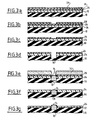
- FIGS. 3a to 3g schematically illustrate the main steps of a method of manufacturing a connector according to the invention
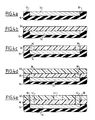
- FIGS. 4a to 4e schematically illustrate the main steps of a variant of this method.
- FIGS. 1 and 2 in which two possible embodiments of a connector according to the invention have been shown diagrammatically.
- the connector of FIG. 1 comprises a support 10 of elastomeric material, which may have a thickness of the order of 2 mm for example, on a face 12 of which electrically conductive lines 14 are formed, connecting two by two of the pads of contact 16, 18, some of which are formed along the edges of the support 10 and the others along the sides of a location of a hybrid circuit or of an integrated circuit.
- the electrically conductive lines 14 can have a width as small as a micrometer and a thickness of the order of a few micrometers.
- the width of the lines 14 can have any desired value depending on the intended use, for example a width of 5, 10, 25, 50 or 100 micrometers.
- electrically conductive lines 14 are formed by solid and continuous metallic conductors, for example of copper, aluminum, silver or gold, they have a very high conductivity.
- the connector according to the invention also comprises a support 10 made of elastomeric material, on one face 12 of which are formed series of electrically conductive lines 14 intended to connect together conductors 20, 22 shown in dotted lines, some of which are formed on a test card for example, and the others of which are input / output conductors of a hybrid circuit or an integrated circuit.
- electrically conductive lines 14 have a width which can be much less than that of the conductors 20, 22, it is possible to provide several lines 14 per pair of conductors 20, 22 and thus make redundant connections between these conductors, which allows a easier positioning of the connector on the components to be connected. In addition, redundant connections are a guarantee of establishing the desired electrical connections.
- the support 10 of elastomeric material may be made of fluorinated rubber, not transparent, or of silicone-based elastomer (transparent) to facilitate the precise positioning of the connector.
- FIGS. 3a to 3g schematically represent the essential steps of a method of manufacturing a connector according to the invention.
- the reference 10 designates, as in FIGS. 1 and 2, the support of elastomeric material, the face 12 of which is covered with a thin intermediate layer 24 of polymeric material (for example of transparent epoxy resin).
- This layer 24 is itself covered with a thin layer 26 of peelable material (commonly called lift-off layer) such as polysiloxane for example.
- the support 10 of elastomeric material may have a thickness of approximately 2 mm, while the intermediate layer 24 has a thickness of approximately 2 to 3 ⁇ m, the layer 26 of peelable material a thickness of approximately 0.3 to 0.5 ⁇ m, and the layer 28 of photo-sensitive resin a thickness of 1 to 1.5 ⁇ m.
- the first step of the process according to the invention consists in subjecting this layer 28 of photo-sensitive resin to sunshine, by exposure to appropriate light radiation, for example ultraviolet radiation, through a mask defining the network of electrically conductive lines 14 to be formed on the face 12 of the support 10. This exposure of the photo-sensitive resin is followed by a development operation of the resin, to arrive at the structure shown in FIG. 3b.
- appropriate light radiation for example ultraviolet radiation
- the method according to the invention then consists in etching the network of electrically conductive lines 14 in the layer 26 of peelable material (FIG. 3c) by means of a sulfur hexafluoride plasma (SF6), then in the intermediate layer 24 and the support 10 (FIG. 3d) by means of an oxygen-rich plasma.
- SF6 sulfur hexafluoride plasma
- This etching makes it possible to form grooves or channels 30 in the face 12 of the support 10, in which the electrically conductive lines 14 will be partially buried.
- the following steps of the method according to the invention consist (FIG. 3e) of depositing a thin layer 32 of the metal chosen on the support thus prepared, that is to say inside the grooves or channels 30 and on the layer 26 of removable material.
- the thickness of the metal layer 32 is for example greater than or equal to approximately 5 ⁇ m, so as to fill the channels or grooves 30 over a height corresponding roughly to the level of the upper face of the intermediate layer 24.
- the metal is deposited by any suitable technique, for example by evaporation, or by spraying, or else by spraying in a thin layer with thickening of the layer by electro-chemical growth, or again by chemical vapor deposition.
- the elastomeric material of the support 10 and the polymeric material of the intermediate layer 24 are chosen so as to withstand the temperatures of deposition of the metal, that is to say at temperatures of the order of 150 to 250 ° C.
- the next step in the process is shown in FIG. 3f and consists in removing the layer 26 of peelable material, as well as the layer of metal 32 which covers it. This can be done mechanically (soaking in liquid nitrogen, causing delamination of layer 26 by differential thermal expansion between this layer on the one hand, and the intermediate layer 24 and the support 10 on the other hand) or chemically (using a dilute hydrofluoric acid solution which attacks the material of layer 26).
- a limited chemical etching of the metal layer can be carried out beforehand to break the thin bridges 34 which connect the metal filling the channels or grooves 30 and the metal layer 32 formed on the layer 26 of peelable material.
- the metal which fills the channels or grooves 30 thus forms the above-mentioned electrically conductive lines 14.
- the height of these lines 14 relative to the face 12 of the support 10 can be adjusted by an additional etching of the intermediate layer 24, making it possible to reduce its thickness, by means of an oxygen-rich plasma.
- all of the material in layer 24 can be removed.
- FIG 4a there is shown a support 10 of elastomeric material, one face 12 of which comprises a network of electrically conductive lines 14, formed of solid and continuous metallic conductors which are buried in the support 10, that is to say that the upper face of the electrically conductive lines 14 is substantially at the level of the upper face 12 of the support 10.
- These electrically conductive lines 14 were formed on the support 10 by means of the method which has just been described with reference to FIGS. 3a to 3g, the height of the channels or grooves 30 receiving the electrically conductive lines 14 and 30 being however calculated so that these lines 14 do not substantially protrude above the support 10.
- the next step of the process consists in depositing on the support 10 a thin layer 36 of polymeric material, for example of the material used for the above-mentioned intermediate thin layer 24.
- This layer 36 may have a thickness of approximately 5 ⁇ m, for example.
- the following stages of the process consist in forming in this layer 36 conductive metal pads which are connected to the electrically conductive lines 14 and which extend over the entire thickness of the layer 36, to lead to the upper face of the latter. .
- This etching of the layer 36 and the deposition of metal forming the pads 38 are carried out by the process steps shown in Figures 3a to 3f.
- the next step consists in depositing a new layer 40 of polymeric material on the aforementioned layer 36 and the bonding pads 38.
- the polymeric material of layer 40 can of course be the same as that of layer 36.
- a final oxygen-rich plasma etching operation makes it possible to reduce the thickness of the layer 40 in order to partially emerge the pads and the lines 42, 44.
- Such a connector is useful in particular when the number of points to be connected is very high and / or when crossing of the interconnection lines is inevitable, for example in the case of circuits in which the contact points are distributed over an entire surface, or on concentric surfaces.
Landscapes
- Engineering & Computer Science (AREA)
- Manufacturing & Machinery (AREA)
- Microelectronics & Electronic Packaging (AREA)
- Manufacturing Of Electrical Connectors (AREA)
- Manufacturing Of Printed Circuit Boards (AREA)
- Drying Of Semiconductors (AREA)
- Internal Circuitry In Semiconductor Integrated Circuit Devices (AREA)
- Wire Bonding (AREA)
Applications Claiming Priority (2)
| Application Number | Priority Date | Filing Date | Title |
|---|---|---|---|
| FR9002781A FR2659495B1 (fr) | 1990-03-06 | 1990-03-06 | Connecteur elastomerique pour circuits integres ou analogues, et son procede de fabrication. |
| FR9002781 | 1990-03-06 |
Publications (1)
| Publication Number | Publication Date |
|---|---|
| EP0446112A1 true EP0446112A1 (de) | 1991-09-11 |
Family
ID=9394406
Family Applications (1)
| Application Number | Title | Priority Date | Filing Date |
|---|---|---|---|
| EP91400573A Withdrawn EP0446112A1 (de) | 1990-03-06 | 1991-03-01 | Elastomer-Verbindung für integrierte Schaltungen oder ähnliche Anordnungen und Herstellungsverfahren dafür |
Country Status (4)
| Country | Link |
|---|---|
| US (1) | US5152868A (de) |
| EP (1) | EP0446112A1 (de) |
| JP (1) | JPH07122322A (de) |
| FR (1) | FR2659495B1 (de) |
Cited By (1)
| Publication number | Priority date | Publication date | Assignee | Title |
|---|---|---|---|---|
| US6410859B1 (en) * | 1995-07-10 | 2002-06-25 | Micron Technology, Inc. | Electrical assembly for semiconductor dice |
Families Citing this family (9)
| Publication number | Priority date | Publication date | Assignee | Title |
|---|---|---|---|---|
| JPH045844A (ja) * | 1990-04-23 | 1992-01-09 | Nippon Mektron Ltd | Ic搭載用多層回路基板及びその製造法 |
| EP0805493B1 (de) * | 1991-02-22 | 2007-02-28 | Canon Kabushiki Kaisha | Elektrischer Verbindungskörper und Herstellungsverfahren dafür |
| EP0526133B1 (de) * | 1991-07-26 | 1997-03-19 | Nec Corporation | Mehrschichtige Leiterplatte aus Polyimid und Verfahren zur Herstellung |
| US5244534A (en) * | 1992-01-24 | 1993-09-14 | Micron Technology, Inc. | Two-step chemical mechanical polishing process for producing flush and protruding tungsten plugs |
| US5329695A (en) * | 1992-09-01 | 1994-07-19 | Rogers Corporation | Method of manufacturing a multilayer circuit board |
| US5890915A (en) * | 1996-05-17 | 1999-04-06 | Minnesota Mining And Manufacturing Company | Electrical and thermal conducting structure with resilient conducting paths |
| US6403226B1 (en) | 1996-05-17 | 2002-06-11 | 3M Innovative Properties Company | Electronic assemblies with elastomeric members made from cured, room temperature curable silicone compositions having improved stress relaxation resistance |
| DE10332333B4 (de) * | 2003-07-16 | 2006-08-03 | Siemens Ag | Detektormodul |
| JP2012164388A (ja) * | 2011-02-07 | 2012-08-30 | Showa Denko Kk | 磁気記録媒体の製造方法及び磁気記録再生装置 |
Citations (5)
| Publication number | Priority date | Publication date | Assignee | Title |
|---|---|---|---|---|
| EP0072673A2 (de) * | 1981-08-13 | 1983-02-23 | Minnesota Mining And Manufacturing Company | Verdrahtungsträgerfolie für die elektrische Verbindung zwischen elektronischen Bauelementen und einer externen Schaltung |
| DE3616493A1 (de) * | 1985-05-20 | 1986-11-20 | Tektronix, Inc., Beaverton, Oreg. | Verfahren zum packen von chips fuer integrierte schaltungen und integrierte schaltungspackungen |
| US4681654A (en) * | 1986-05-21 | 1987-07-21 | International Business Machines Corporation | Flexible film semiconductor chip carrier |
| EP0310357A2 (de) * | 1987-09-29 | 1989-04-05 | Microelectronics and Computer Technology Corporation | Adaptierbarer Schaltkreis |
| WO1989012911A1 (en) * | 1988-06-24 | 1989-12-28 | Unistructure, Inc. | Protected lead frame and method for fabricating lead frames |
Family Cites Families (5)
| Publication number | Priority date | Publication date | Assignee | Title |
|---|---|---|---|---|
| US3711625A (en) * | 1971-03-31 | 1973-01-16 | Microsystems Int Ltd | Plastic support means for lead frame ends |
| US4400234A (en) * | 1975-11-13 | 1983-08-23 | Tektronix, Inc. | Method of manufacturing electrical connector |
| US4606787A (en) * | 1982-03-04 | 1986-08-19 | Etd Technology, Inc. | Method and apparatus for manufacturing multi layer printed circuit boards |
| US4650545A (en) * | 1985-02-19 | 1987-03-17 | Tektronix, Inc. | Polyimide embedded conductor process |
| US4964948A (en) * | 1985-04-16 | 1990-10-23 | Protocad, Inc. | Printed circuit board through hole technique |
-
1990
- 1990-03-06 FR FR9002781A patent/FR2659495B1/fr not_active Expired - Fee Related
-
1991
- 1991-03-01 EP EP91400573A patent/EP0446112A1/de not_active Withdrawn
- 1991-03-04 US US07/664,342 patent/US5152868A/en not_active Expired - Fee Related
- 1991-03-05 JP JP3063991A patent/JPH07122322A/ja active Pending
Patent Citations (5)
| Publication number | Priority date | Publication date | Assignee | Title |
|---|---|---|---|---|
| EP0072673A2 (de) * | 1981-08-13 | 1983-02-23 | Minnesota Mining And Manufacturing Company | Verdrahtungsträgerfolie für die elektrische Verbindung zwischen elektronischen Bauelementen und einer externen Schaltung |
| DE3616493A1 (de) * | 1985-05-20 | 1986-11-20 | Tektronix, Inc., Beaverton, Oreg. | Verfahren zum packen von chips fuer integrierte schaltungen und integrierte schaltungspackungen |
| US4681654A (en) * | 1986-05-21 | 1987-07-21 | International Business Machines Corporation | Flexible film semiconductor chip carrier |
| EP0310357A2 (de) * | 1987-09-29 | 1989-04-05 | Microelectronics and Computer Technology Corporation | Adaptierbarer Schaltkreis |
| WO1989012911A1 (en) * | 1988-06-24 | 1989-12-28 | Unistructure, Inc. | Protected lead frame and method for fabricating lead frames |
Cited By (1)
| Publication number | Priority date | Publication date | Assignee | Title |
|---|---|---|---|---|
| US6410859B1 (en) * | 1995-07-10 | 2002-06-25 | Micron Technology, Inc. | Electrical assembly for semiconductor dice |
Also Published As
| Publication number | Publication date |
|---|---|
| US5152868A (en) | 1992-10-06 |
| JPH07122322A (ja) | 1995-05-12 |
| FR2659495B1 (fr) | 1997-01-24 |
| FR2659495A1 (fr) | 1991-09-13 |
Similar Documents
| Publication | Publication Date | Title |
|---|---|---|
| EP0222668B1 (de) | Verfahren zum Herstellen eines Dünnschichttransistors mit in Bezug auf Source und Drain selbstausrichtendem Gate durch stufenweises Ätzen und danach hergestellter Transistor | |
| EP0596456B1 (de) | Methode zur Herstellung eines integrierten kapazitiven Transduktors | |
| EP0975979A1 (de) | Verfahren zur herstellung von kartem mit mehreren kontaktspitsen zum testen von halbleiterchips | |
| FR2659495A1 (fr) | Connecteur elastomerique pour circuits integres ou analogues, et son procede de fabrication. | |
| EP1421623A1 (de) | Farbbildsensor mit verbesserter kalorimetrie und verfahren zu seiner herstellung | |
| EP2577723B1 (de) | Lithografisches verfahren zur herstellung von netzwerken aus anhand von durchkontaktierungen verbundenen leitern | |
| EP1421624B1 (de) | Verfahren zur herstellung eines farbbildsensors mit ausgesparten kontaktaperturen vor der ausdünnung | |
| FR2502399A1 (fr) | Dispositif a semi-conducteurs comportant un contact rapporte a faible resistance | |
| EP1700343A1 (de) | Verfahren zur herstellung von aus verdünntem silizium bestehenden elektronischen chips | |
| EP0372644A1 (de) | Verfahren zum Herstellen einer integrierten Schaltung einschliesslich Schritte zum Herstellen einer Verbindung zwischen zwei Schichten | |
| FR2829290A1 (fr) | Capteur d'image couleur sur substrat transparent et procede de fabrication | |
| EP0190243B1 (de) | Verfahren zur herstellung einer integrierten schaltung vom mis-typ | |
| EP0059206B1 (de) | Gedruckte schaltungsplatte und verfahren zu deren herstellung | |
| FR2779274A1 (fr) | Circuit integre avec couche d'arret et procede de fabrication associe | |
| EP0058577B1 (de) | Halbleiteranordnung mit Elektronenablenkung vom Typ des "ballistischen Transportes" und Verfahren zum Herstellen einer solchen Anordnung | |
| EP1719173A1 (de) | Mikroelektronische verbindungseinrichtung mit lokalisierten leitfähigen pins | |
| EP0163581B1 (de) | Herstellungsverfahren einer elektrischen Anschlussvorrichtung zwischen zwei Leiterplatten, Vorrichtung und Verfahren zum elektrischen Anschluss unter Anwendung dieser Vorrichtung | |
| FR2933535A1 (fr) | Dispositif electronique comprenant une pluralite de composants electroniques rapportes sur un substrat et capteur infrarouge associe | |
| EP0813237A1 (de) | Verfahren zum Montieren einer integrierten Schaltung auf einem Träger und resultierender Träger | |
| EP0506526A1 (de) | Hybridmodul und sein Herstellungsverfahren | |
| WO2007113194A1 (fr) | Procédé de réalisation de structures en multicouches à propriétés contrôlées | |
| FR3076061B1 (fr) | Realisation d'un collecteur de dispositif microelectronique | |
| WO2008012481A1 (fr) | Procédé de fabrication d'un circuit intégré encapsulé et circuit intégré encapsulé associé | |
| FR2528248A1 (fr) | Procede de fabrication de plaquettes utilisables dans des systemes micro-electroniques |
Legal Events
| Date | Code | Title | Description |
|---|---|---|---|
| PUAI | Public reference made under article 153(3) epc to a published international application that has entered the european phase |
Free format text: ORIGINAL CODE: 0009012 |
|
| AK | Designated contracting states |
Kind code of ref document: A1 Designated state(s): DE GB |
|
| 17P | Request for examination filed |
Effective date: 19920224 |
|
| 17Q | First examination report despatched |
Effective date: 19950306 |
|
| STAA | Information on the status of an ep patent application or granted ep patent |
Free format text: STATUS: THE APPLICATION IS DEEMED TO BE WITHDRAWN |
|
| 18D | Application deemed to be withdrawn |
Effective date: 19970114 |