EP0448075A1 - Immunoglobulin G und Verfahren zu seiner Herstellung - Google Patents
Immunoglobulin G und Verfahren zu seiner Herstellung Download PDFInfo
- Publication number
- EP0448075A1 EP0448075A1 EP91104334A EP91104334A EP0448075A1 EP 0448075 A1 EP0448075 A1 EP 0448075A1 EP 91104334 A EP91104334 A EP 91104334A EP 91104334 A EP91104334 A EP 91104334A EP 0448075 A1 EP0448075 A1 EP 0448075A1
- Authority
- EP
- European Patent Office
- Prior art keywords
- igg
- immunoglobulin
- aggregates
- filtration
- membrane
- Prior art date
- Legal status (The legal status is an assumption and is not a legal conclusion. Google has not performed a legal analysis and makes no representation as to the accuracy of the status listed.)
- Granted
Links
Images
Classifications
-
- C—CHEMISTRY; METALLURGY
- C07—ORGANIC CHEMISTRY
- C07K—PEPTIDES
- C07K16/00—Immunoglobulins [IG], e.g. monoclonal or polyclonal antibodies
-
- C—CHEMISTRY; METALLURGY
- C07—ORGANIC CHEMISTRY
- C07K—PEPTIDES
- C07K16/00—Immunoglobulins [IG], e.g. monoclonal or polyclonal antibodies
- C07K16/06—Immunoglobulins [IG], e.g. monoclonal or polyclonal antibodies from serum
- C07K16/065—Purification, fragmentation
-
- A—HUMAN NECESSITIES
- A61—MEDICAL OR VETERINARY SCIENCE; HYGIENE
- A61K—PREPARATIONS FOR MEDICAL, DENTAL OR TOILETRY PURPOSES
- A61K38/00—Medicinal preparations containing peptides
Definitions
- This invention relates to a process for the production of an immunoglobulin G preparation having low anticomplementary activity and suitable for use in intravenous injection.
- Immunoglobulin G (IgG) preparations isolated from human blood plasma are effective in the treatment of various severe infectious desceases and immunological deficiency syndrome such as hypogammaglobulibemia and agammaglobulinemia.
- the widely used method for isolating IgG from human blood plasma is Cohn's plasma protein fractionation method.
- IgG is obtained from Cohn fraction II or II+III.
- the recovered IgG may contain a significant amount of aggregates because IgG tends to aggregate spontaneously during storage of human blood plasma or tends to aggregate in contact with alcohol or other chemicals during the fractionation procedure, or also tends to aggregate during lyophilization. If IgG containing aggregates is administered intravenously, the aggregates may exert an anticomplement effect to cause serious anaphylactoid reactions such as hypotension, chill and fever.
- IgG preparations for use in intravenous injection require that no aggregates are detectable when they are analyzed by the gel filtration method using a suitable carrier and that their anticomplementary activity is not greater than 20 units when determined at an IgG concentration of 5%.
- the term "aggregate” as used herein means any cluster formed by the combination of a plurality of IgG molecules, but does not include the dimer of IgG. It is desirable that, in addition to meeting the above requirement, the anticomplement activity is as low as possible.
- the methods which can be used for this purpose include:
- IgG monomer
- IgG dimer usually contained in an aqueous solution of IgG has a size of about 12nm
- the above-described polyethylene glycol precipitation method, the adsorption method (using an ion exchange resin, activated charcoal, tricalcium phosphate or the like) and the gel filtration method have been disadvantageous in that, even if aggregates are removed to such an extent that they are not directly detectable by gel filtration analysis, the anticomplementary activity believed to be attributable mainly to aggregates cannot be reduced satisfactorily.
- the membrane separation method makes it possible to remove aggregates completely and thereby reduce the anticomplementary activity satisfactorily.
- the membrane separation method since the size of IgG monomer and dimer (hereinafter referred to collectively as IgG) is close to that of aggregates, the membrane separation method also has the disadvantage that, if it is tried to remove aggregates completely, the recovery of IgG and the treating efficiency become too low to be practicable.
- the membrane separation method also has the disadvantage that IgG tends to aggregate again at the interface between the membrane and the solution and, therefore, the resulting filtrate has a high anticomplementary activity.
- the present inventors have made an intensive study and have discovered that, by treating an aqueous solution of crude IgG according to a conventional technique to remove aggregates therefrom to such an extent that they are not detectable by gel filtration analysis, and then filtering the resulting IgG solution (or stock solution) through a porous polyolefin membrane in the presence of a stabilizer having surface activity, the anticomplementary activity can be greatly reduced without causing any substantial reaggregation of IgG by the filtration.
- the present invention has been completed on the basis of this discovery.
- the present invention provides a process for the production of immunoglobulin G which comprises providing an aqueous solution of immunoglobulin G isolated from human blood plasma, removing aggregates from the aqueous solution of immunoglobulin G to such an extent that they are not detectable by gel filtration analysis, and filtering the aqueous solution of immunoglobulin G through a porous polyolefin membrane in the presence of a stabilizer having surface activity.
- the aqueous solution of IgG thus obtained or its freeze-dried product is suitable for use in intravenous injection.
- the porous membrane used had a pore diameter which is essentially incapable of rejecting IgG aggregates
- the aggregates can be efficiently removed to obtain an aqueous solution of IgG having a greatly reduced anticomplementary activity, without causing any reaggregation of IgG by the filtration.
- the pore size of the porous membrane is relatively large, the process of the present invention does not suffer from a reduction in IgG recovery or treating efficiency.
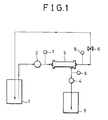
- Fig. 1 is a flow diagram illustrating a membrane filtration apparatus used in the examples of the present invention.
- an IgG-containing material obtained from Cohn fraction II or II+III is referred to as "crude IgG”
- an IgG-containing solution preliminarily purified to such as extent that aggregates are not detectable is referred to as “an IgG stock solution”
- an IgG-containing solution obtained by filtering an IgG stock solution through a porous polyolefin membrane is referred to as "an IgG filtrate”.
- the crude IgG used in the process of the present invention can be recovered according to any of conventional techniques including Cohn's plasma protein fractionation method. However, it is common practice to employ Cohn's plasma protein fractionation method. Although both a pastelike material obtained as Cohn fraction II or II+III and a freeze-dried product of Cohn fraction II or II+III can be used, it is preferable to use a pastelike material because the amount of aggregates is increased by freeze drying.
- crude IgG is dissolved in distilled water, physiological saline or a buffer solution having a pH of about 4 to 9. Then, the resulting solution is subjected to the following treatment.
- an aqueous solution of crude igG is first freed of aggregates to such an extent that they are not detectable by gel filtration analysis.
- gel filtration analysis means an analysis by aqueous size-exclusion chromatography having accuracy enhanced by use of a hard gel with a particle diameter of about 10 ⁇ m. Typically, this analysis is carried out by using a TSK-G3000 SW column manufactured by Tosoh Co., Ltd.
- the methods which can be employed for this purpose include, for example, the polyethylene glycol precipitation method, the method of adsorption by an ion exchange resin, the method of adsorption by tricalcium phosphate, activated charcoal, aluminum hydroxide, bentonite or the like, the gel filtration method, the low-pH treatment method, and the method comprising a combination of low-pH treatment and proteolytic enzyme treatment.
- any other method that can remove aggregates to an undetectable extent may also be employed.
- no matter which method is employed it is difficult to reduce the anticomplementary activity of the resulting aqueous solution of IgG to less than 10 units at an IgG concentration of 5%.
- the resulting aqueous solution of IgG has an anticomplementary activity of about 10 to 30 units.
- the anticomplementary activity shown herein refers to a value measured by the method of Kabat and Mayer [Mayer, M.M.: Experimental Immunochemistry (ed. by Kabat, E.A., and Mayer, M.M.), 2nd. edition, pp. 133-240 (1961)].
- the method of adsorption by tricalcium phosphate is preferred.
- the method of adsorption by tricalcium phosphate may be carried out by adding tricalcium phosphate powder to a solution to be treated in an amount of 2% by weight based on the weight of the solution, stirring this mixture to cause aggregates to be adsorbed to the tricalcium phosphate, and then separating the tricalcium phosphate by filtration.
- the IgG stock solution from which aggregates have been removed in the above-described manner is then filtered through a porous polyolefin laminatene in the presence of a stabilizer having surface activity, whereby its anticomplementary activity can be greatly reduced without causing any appreciable reaggregation of IgG.
- the IgG stock solution filtered through a polyolefin membrane should preferably have an IgG concentration of 1 to 10% by weight. If necessary, therefore, the IgG concentration of the IgG stock solution is adjusted in advance by dilution with distilled water or physiological saline, or by concentration through ultrafiltration or other suitable technique. It is essential that a stabilizer having surface activity be added to the stock solution.
- the stabilizer used in the present invention has the function of preventing the aggregation of IgG and exhibits marked adsorption to solid-liquid interfaces.
- Useful stabilizers includes, for example, protein type polymers of plant origin, animal origin such as human serum albumin, Cohn fraction V and gelatin derivatives (e.g., polyoxygelatin, decomposed/succinylated gelatin and decomposed/urea-crosslinked gelatin), and polymeric nonionic surfactants such as polyvinyl pyrolidone, polyethylene glycol and oxyethylene-oxypropylene block copolymers.
- These stabilizers may be used alone or in admixture of two or more.
- the amount of stabilizer used may vary according to the type thereof, it is preferably used in an amount of 0.01 to 1 part by weight per part by weight of the IgG present in the IgG stock solution. Too small amounts of stabilizer will produce no effect, while too large amounts will bring about no further improvement in effect.
- IgG IgG tends to aggregate irrespective of the type of membrane used, so that it is difficult to reduce its anticomplementary activity.
- filtration of an IgG stock solution by using membranes except those mede of polyolefin also tends to cause the aggregation of IgG.
- the process of the present invention can prevent the aggregation of IgG during membrane filtration and can reduce the anticomplementary activity efficiently.
- the stabilizer having surface activity is preferentially adsorbed to the hydrophobic surface of the polyolefin membrane and, therefore, the IgG being filtered is protected from aggregation.
- the polyolefin membranes which can be used in the process of the present invention include, for example, those formed of such materials as polyethylene, polypropylene and poly-4-methylpentene-1.
- Useful polyolefin membranes are porous ones, and the pore diameter thereof may be such that, when an aqueous solution of crude IgG containing aggregates is filtered and the resulting filtrate is analyzed by the gel filtration method, aggregates are detectable therein. Rather, membranes having such a large pore diameter are preferred because they can provide a high flux and a high recovery of IgG.
- the process of the present invention makes it possible to capture aggregates efficiently and reduce the anticomplementary activity attributable thereto.
- the pore diameter of the membrane as measured by the standard particle filtration method, is preferably within the range of 0.015 to 0.17 ⁇ m, more preferably within the range of 0.018 to 0.10 ⁇ m, and most preferably within the range of 0.02 to 0.06 ⁇ m. If the pore diameter is less than the lower limit of the above range, the filtration rate tends to become lower and, therefore, the treating efficiency tends to be reduced.
- membranes which substantially reject aggregates are not suitable for prectical purposes because they provide a low recovery of igG and a low filtration efficiency. Even if the pore diameter is greater than the upper limit of the above range, no serious problem arises, but the degree of reduction of the anticomplementary activity of the resulting filtrate tends to decrease. The reason why anticomplementary activity can be effectively decreased by a membrane having a geometrical pore size larger than the size of aggregates is unknown. It is possible to speculate that the anticomplementary activity is partially due to the presence of slight amount of aggregates which may be too small to be detected by gel filtration analysis and too large to pass through said membrane. Judging from the fact that the presence of a stabilizer having surface activity is indispensable, the interfacial adsorptivity of the stabilizer is also believed to take part in the capture of aggregates.
- polyolefin membranes examples include polyethylene hollow-fiber membranes EHF® 390A, EHF® 390C and EHF® 270H that are manufactured by Mitsubishi Rayon Co., Ltd. These membranes, which have been made porous by stretching, are preferred in that they do not contain any additive used to make them porous.
- polyolefin membranes are naturally hydrophobic, it is difficult to allow an aqueous solution to pass through a polyolefin membrane used as such.
- a polyolefin membrane which has been subjected to some treatment for hydrophilization.
- porous polyolefin membranes whose surface are not chemically modified (i.e., polyolefin membranes which have not undergone the so-called permanent hydrophilization) are preferred because they can effectively prevent the interfacial aggregation of IgG during membrane separation procedure.
- Polyolefin membranes which have undergone non-permanent hydrophilization include, for example, one which has been treated by wetting the inner wall of the pores with a water-miscible organic solvent such as alcochol and then replacing it with water to make the membrane capable of filtering aqueous solutions, and one which has been treated by physically attaching a surface-active stabilizer as described above to the inner wall of the pores to make the membrane capable of water filtration.
- a water-miscible organic solvent such as alcochol
- the anticomplementary activity can be substantially reduced by causing the coexistent stabilizer having surface activity to be efficiently adsorbed to the membrane surface and suppressing the interfacial aggregation of IgG at the membrane surface.
- the membrane may be in the form of a flat film or a tubular film.
- a hollow-fiber membrane is preferred because it permits a compact apparatus to be fabricated.
- the membrane filtration is of the cross flow type.
- Fig. 1 is a flow diagram illustrating an exemplary apparatus which can be used for purposes of membrane filtration in the process of the present invention.
- an IgG stock solution is introduced from an IgG stock solution tank 1 into a membrane filtration module 3 by means of a feed pump 2.
- the resulting filtrate is collected by means of a suction pump 4 and recovered in a filtrate tank 5.
- the pressures at the inlet and outlets of module 3 are measured with pressure gauges 7, 8 and 9 and controlled by means of a pressure regulating valve 6.
- a solution to be treated over the membrane surface preferably at a linear speed of 0.1 to 10 cm/sec and filtering it at a transmembrane pressure of 300 mmHg or less and preferably 150 mmHg or less.
- concentration of the IgG stock solution may become higher as the treatment proceeds.
- appropriate amounts of solvent can be added to the IgG stock solution so as to adjust the IgG concentration properly and thereby maintain a high recovery of IgG.
- the operating temperature for the membrane filtration is usually in the range of 2 to 37°C and preferably in the range of 4 to 20°C.
- the IgG stock solution is subjected to the membrane filtration after its IgG concentration has been properly adjusted to a desired level by dilution with distilled water or physiological saline or by concentration through ultrafiltration.
- the aqueous solution of IgG thus obtained can also be freeze-dried for use in intravenous injection as necessary.
- anticomplementary activity was determined by the method of Kabat and Mayer described above.
- a module having a membrane area of 0.6 m2 was fabricated by using, as a porous polyolefin membrane, the porous polyethylene hollow-fiber membrane HEF® 390C (manufactured by Mitsubishi Rayon Co., Ltd. and having an average pore size of 0.03 ⁇ m as measured by the standard particle filtration method).
- This module was temporarily hydrophilized by impregnating the membrane with ethanol and then substituting water for the ethanol. Thereafter, this module was incorporated into an apparatus having a flow path as illustrated in Fig. 1.
- the stock solution was filtered under conditions including an operating temperature of 6°C, a transmembrane pressure of 100 mmHg (as controlled with a pressure regulating valve 6), and a stock solution feed rate of 200 ml/min., so that 300 ml of filtrate was recovered.
- the IgG concentration of the filtrate was 3.1%, the apparent permeability was 55%, and the IgG recovery was 42%.
- the anticomplementary activity of the stock solution adjusted to an igG concentration of 2.5% was 10 units, whereas that of the filtrate having the same IgG concentration was 1 unit.
- the ratio of the anticomplementary activity after filtration to that before filtration was 0.1.
- Example 1 The procedure of Example 1 was repeated except that there was used a filtration module (having the same membrane area) fabricated by using, as the porous polyethylene hollow-fiber membrane, EHF® 390A (having an average pore diameter of 0.02 ⁇ m as measured by the standard particle filtration method) in place of EHF® 390C.
- a filtration module having the same membrane area
- EHF® 390A having an average pore diameter of 0.02 ⁇ m as measured by the standard particle filtration method
- the IgG concentration of the filtrate was 2.8%, the apparent permeability was 50%, and the IgG recovery was 27%.
- the anticomplementary activity of the filtrate was 3 units at an IgG concentration of 2.5%, and the ratio of the anticomplementary activity after filtration to that before filtration was 0.3.
- Cohn fraction II in paste form was dissolved in 4 parts by weight of distilled water. Then, tricalcium phosphate was added thereto in an amount of 2% by weight based on the distilled water. This mixture was stirred for 12 hours to cause aggregates to be adsorbed to the tricalcium phosphate, and then filtered to obtain a solution. To this solution was added Heamaccel® as a stabilizer in an amount of 0.4 part by weight per part by weight of IgG. Thereafter, the solution was concentrated by ultrafiltration to obtain 2,800 ml of an IgG/Heamaccel® mixed solution having an IgG concentration of 6%.
- the above stock solution was circulated through a flow path as illustrated in Fig. 1 and filtered in a constant-rate filtration process using a pump 4.
- a stock solution feed rate of 200 ml/min. and a filtrate flow rate of 10 ml/min., 2100 ml of filtrate was recovered.
- the transmembrane pressure was within the ragne of 80 to 120 mmHg.
- the IgG concentration of the filtrate was 5.1%, the apparent permeability was 86%, and the IgG recovery was 64%.
- the anticomplementary activities of the stock solution and the filtrate were measured at an IgG concentration of 4%, the stock solution had an anticomplementary activity of 11 units and the filtrate had an anticomplementary activity of 4 units.
- the ratio of the anticomplementary activity after filtration to that before filtration was 0.36.
- Example 3 The procedure of Example 3 was repeated except that the concentration by ultrafiltration was carried out until an IgG concentration of 5% was attained. Thus, there was obtained 2,800 ml of an IgG/Heamaccel® mixed solution.
- the above stock solution was circulated through a flow path as illustrated in Fig. 1 and filtrated in a constant-rate filtration process using a pump 4.
- the stock solution was filtered with a 150 mM aqueous solution of sodium chloride continuously added thereto at a rate of 4.8 ml/min.
- the transmembrane pressure was within the range of 80 to 120 mmHg.
- the IgG concentration of the filtrate was 3%, the apparent permeability was 64%, and the IgG recovery was 99%.
- the anticomplementary activities of the stock solution and the filtrate were measured at an IgG concentration of 4%, the stock solution had an anticomplementary activity of 11 units and the filtrate had an anticomplementary activity of 3 units.
- the ratio of the anticomplementary activity after filtration to that before filtration was 0.27.
- Cohn fraction II in paste form was dissolved in 5 parts by weight of distilled water. Then, tricalcium phosphate was added thereto in an amount of 2% by weight based on the distilled water. This mixture was stirred for 12 hours to cause aggregates to be adsorbed to the tricalcium phosphate, and then filtered to obtain a solution. To this solution was added human serum albumin as a stabilizer in an amount of 0.08 part by weight per part by weight of IgG. Thereafter, the solution was concentrated by ultrafiltration to obtain 2,800 ml of an IgG/albumin mixed solution having an IgG concentration of 6%.
- the IgG concentration of the filtration was 3%, the apparent permeability was 60%, and the IgG recovery was 98%.
- the anticomplementary activity of the stock solution adjusted to an IgG concentration of 2.5% was 9 units, whereas that of the filtrate having the same IgG concentration was 3 units.
- the ratio of the anticomplementary activity after filtration to that before filtration was 0.33.
- a membrane filter having an average pore diameter of 0.1 ⁇ m i.e., a nylon 66 membrane commercially available from Pall Corp. under the trade name of Seal Kleen®
- 270 ml of the same IgG/Heamaccel® mixed solution (having an IgG concentration of 6%) as used in Example 3 was filtered at a treating temperature of 5-6°C and an inlet pressure of 0.5 kg/cm2.
- the IgG concentration of the filtrate was 5.8%, the apparent permeability was 96%, and the IgG recovery was 71%.
- the stock solution and the filtrate were adjusted to an IgG concentration of 4% and their anticomplementary activities were measured, the stock solution had an anticomplementary activity of 11 units and the filtrate had an anticomplementary activity of 8 units.
- the ratio of the anticomplementary activity after filtration to that before filtration was 0.73, indicating that no substantial reduction in anticomplementary activity was caused by the filtration.
- Comparative Example 1 The procedure of Comparative Example 1 was repeated except that the same IgG/Heamaccel® mixed solution (having an IgG concentration of 5%) as used in Example 4 was filtered at an inlet pressure of 0.3 kg/cm2. The IgG concentration of the filtrate was 5%.
- the anticomplementary activities of the stock solution and the filtrate were measured at an IgG concentration of 4%, the stock solution had an anticomplementary activity of 11 units and the filtrate had an anticomplementary activity of 7 units.
- the ratio of the anticomplementary activity after filtration to that before filtration was 0.64.
- An IgG/Heamaccel® mixed solution was obtained in the same manner as described in Example 1, except that its IgG concentration was adjusted to 5.7%.
- an ultrafiltration module (having a membrane area of 0.6 m2) was fabricated by using a flat ultrafiltration membrane formed of polyether sulfone (Omega® 1000K manufactured by Filtron Corp. and having a fractionating molecular weight of 1,000,000). Using this module, 760 ml of the above stock solution was filtered at a filtering temperature of 15°C and a stock solution feed rate of 190 ml/min. The IgG concentration of the filtrate was 5.6%, the apparent permeability was 98%, and the IgG recovery was 86%.
- the stock solution had an anticomplementary activity of 20 units and the filtrate had an antiocomplementary activity of 19 units.
- the ratio of the anticomplementary activity after filtration to that before filtration was 0.95.
- An ultrafiltration module (having a membrane area of 0.07 m2) was fabricated by using a flat ultrafiltration membrane formed of polyether sulfone (Omega® 300K manufactured by Filtron Corp. and having a fractionating molecular weight of 300,000). Using this module, 760 ml of the same IgG/Heamaccel® mixed solution as used in Example 3 was filtered at a filtering temperature of 15°C and a stock solution feed rate of 190 ml/min. The IgG concentration of the filtrate was 2.7%, the apparent permeability was 98%, and the IgG recovery was 80%.
- the stock solution had an anticomplementary activity of 10 units and the filtrate had an anticomplementary activity of 6 units.
- the ratio of the anticomplementary activity after filtration to that before filtration was 0.6.
Landscapes
- Chemical & Material Sciences (AREA)
- Organic Chemistry (AREA)
- Health & Medical Sciences (AREA)
- General Health & Medical Sciences (AREA)
- Biochemistry (AREA)
- Biophysics (AREA)
- Life Sciences & Earth Sciences (AREA)
- Genetics & Genomics (AREA)
- Medicinal Chemistry (AREA)
- Molecular Biology (AREA)
- Proteomics, Peptides & Aminoacids (AREA)
- Immunology (AREA)
- Separation Using Semi-Permeable Membranes (AREA)
- Medicines Containing Antibodies Or Antigens For Use As Internal Diagnostic Agents (AREA)
- Peptides Or Proteins (AREA)
Applications Claiming Priority (2)
| Application Number | Priority Date | Filing Date | Title |
|---|---|---|---|
| JP68210/90 | 1990-03-20 | ||
| JP2068210A JPH0778025B2 (ja) | 1990-03-20 | 1990-03-20 | 免疫グロブリンgの製造方法 |
Publications (2)
| Publication Number | Publication Date |
|---|---|
| EP0448075A1 true EP0448075A1 (de) | 1991-09-25 |
| EP0448075B1 EP0448075B1 (de) | 1995-11-02 |
Family
ID=13367207
Family Applications (1)
| Application Number | Title | Priority Date | Filing Date |
|---|---|---|---|
| EP91104334A Expired - Lifetime EP0448075B1 (de) | 1990-03-20 | 1991-03-20 | Immunoglobulin G und Verfahren zu seiner Herstellung |
Country Status (4)
| Country | Link |
|---|---|
| US (1) | US5219999A (de) |
| EP (1) | EP0448075B1 (de) |
| JP (1) | JPH0778025B2 (de) |
| DE (1) | DE69114158T2 (de) |
Cited By (2)
| Publication number | Priority date | Publication date | Assignee | Title |
|---|---|---|---|---|
| WO1995003826A1 (fr) * | 1993-07-30 | 1995-02-09 | Pasteur Merieux Sérums Et Vaccins | Preparations d'immunoglobulines stabilisees et procede pour leur preparation |
| WO1996035710A1 (en) * | 1995-05-08 | 1996-11-14 | Suomen Punainen Risti Veripalvelu | Preparation of immunoglobulin |
Families Citing this family (26)
| Publication number | Priority date | Publication date | Assignee | Title |
|---|---|---|---|---|
| US5429746A (en) * | 1994-02-22 | 1995-07-04 | Smith Kline Beecham Corporation | Antibody purification |
| WO1998044948A2 (en) | 1997-04-07 | 1998-10-15 | Cangene Corporation | Intravenous immune globulin formulation containing a non-ionic surface active agent with improved pharmacokinetic properties |
| US5886154A (en) | 1997-06-20 | 1999-03-23 | Lebing; Wytold R. | Chromatographic method for high yield purification and viral inactivation of antibodies |
| SE0001128D0 (sv) * | 2000-03-30 | 2000-03-30 | Amersham Pharm Biotech Ab | A method of producing IgG |
| RU2238106C2 (ru) * | 2002-07-29 | 2004-10-20 | Федеральное государственное унитарное предприятие "Научно-производственное объединение по медицинским иммунобиологическим препаратам "Микроген" | Препарат внутривенного противоаллергического иммуноглобулина и способ его получения |
| US9096648B2 (en) * | 2011-08-19 | 2015-08-04 | Emd Millipore Corporation | Methods of reducing level of one or more impurities in a sample during protein purification |
| KR101993488B1 (ko) | 2011-09-01 | 2019-06-26 | 추가이 세이야쿠 가부시키가이샤 | 한외여과에 의해 고도로 농축된 항체를 포함하는 조성물의 제조 방법 |
| EP2682168A1 (de) * | 2012-07-02 | 2014-01-08 | Millipore Corporation | Reinigung biologischer Moleküle |
| US9650411B2 (en) * | 2012-08-07 | 2017-05-16 | Kyowa Hakko Kirin Co., Ltd. | Method of purifying protein |
| JP2014105180A (ja) * | 2012-11-27 | 2014-06-09 | Hoya Corp | モノマー化方法 |
| JP6067889B2 (ja) * | 2013-02-26 | 2017-01-25 | イー・エム・デイー・ミリポア・コーポレイシヨン | 溶液条件を調整することによる活性化炭素を使用したタンパク質混合物からの1種のタンパク質の選択的除去 |
| US9380973B2 (en) | 2013-04-15 | 2016-07-05 | Becton, Dickinson And Company | Biological fluid sampling transfer device and biological fluid separation and testing system |
| ES2832756T3 (es) | 2013-04-15 | 2021-06-11 | Becton Dickinson Co | Dispositivo de toma de muestra de fluido biológico |
| JP6177996B2 (ja) | 2013-04-15 | 2017-08-09 | ベクトン・ディキンソン・アンド・カンパニーBecton, Dickinson And Company | 生体液収集装置および生体液分離試験システム |
| ES2958415T3 (es) | 2013-04-15 | 2024-02-08 | Becton Dickinson Co | Dispositivo de separación de fluidos biológicos y sistema de separación y análisis de fluidos biológicos |
| EP3513727B1 (de) * | 2013-04-15 | 2020-09-09 | Becton, Dickinson and Company | Vorrichtung zur entnahme biologischer flüssigkeitsproben |
| US9597028B2 (en) | 2013-04-15 | 2017-03-21 | Becton, Dickinson And Company | Biological fluid collection device and biological fluid separation and testing system |
| BR112015026241B1 (pt) | 2013-04-15 | 2022-02-08 | Becton, Dickinson And Company | Sistema de amostragem de fluido biológico e sistema de separação e exame de fluido biológico para uma amostra de sangue de múltiplos componentes |
| WO2014172239A1 (en) | 2013-04-15 | 2014-10-23 | Becton, Dickinson And Company | Biological fluid collection device and biological fluid separation and testing system |
| MX2015014472A (es) | 2013-04-15 | 2016-02-05 | Becton Dickinson Co | Dispositivo medico para la recogida de una muestra biologica. |
| EP2986383B1 (de) | 2013-04-15 | 2020-08-26 | Becton, Dickinson and Company | Vorrichtung zur trennung einer biologischen flüssigkeit sowie system zur trennung und untersuchung einer biologischen flüssigkeit |
| WO2014172247A1 (en) | 2013-04-15 | 2014-10-23 | Becton, Dickinson And Company | Blood sampling transfer device |
| ES2662110T3 (es) | 2013-04-15 | 2018-04-05 | Becton, Dickinson And Company | Dispositivo de transferencia de muestras de fluidos biológicos y sistema de separación y de análisis de fluidos biológicos |
| JP6339663B2 (ja) * | 2013-04-15 | 2018-06-06 | ベクトン・ディキンソン・アンド・カンパニーBecton, Dickinson And Company | 生体液採集装置、および、生体液採集検査システム |
| BR112015026246B1 (pt) | 2013-04-15 | 2022-10-18 | Becton, Dickinson And Company | Dispositivo de transferência de coleta de sangue, sistema de separação e teste de sangue e sistema de transferência de coleta de sangue |
| EP4061826A1 (de) * | 2019-11-20 | 2022-09-28 | CSL Behring AG | Verfahren zum extrahieren eines proteins aus einer ausfällung und verfahren zum ausfällen von verunreinigungen |
Citations (6)
| Publication number | Priority date | Publication date | Assignee | Title |
|---|---|---|---|---|
| DE2026076B2 (de) * | 1969-05-29 | 1979-05-10 | Monsanto Co., St. Louis, Mo. (V.St.A.) | Verfahren zum selektiven Adsorbieren von einem oder mehreren, spezifischen, nicht-viralen Proteinen aus flüssigem Plasma oder Serum |
| EP0085747A2 (de) * | 1982-02-08 | 1983-08-17 | Schweizerisches Serum- und Impfinstitut und Institut zur Erforschung der Infektionskrankheiten | Intravenös verabreichbares humanes Immunglobulin und Verfahren zu dessen Herstellung |
| WO1986006727A1 (en) * | 1985-05-15 | 1986-11-20 | Commonwealth Serum Laboratories Commission | PREPARATION OF MONOMERIC IgG |
| EP0246579A2 (de) * | 1986-05-19 | 1987-11-25 | Green Cross Corporation | Verfahren zur Herstellung von Immunoglobulinzubereitungen für intravenöse Injektion |
| EP0268973A2 (de) * | 1986-11-27 | 1988-06-01 | Biotest Pharma GmbH | Verfahren zur Herstellung eines virussicheren, lagerstabilen und intravenös verträglichen Immunglobulin-G-Präparates |
| EP0270025A2 (de) * | 1986-12-02 | 1988-06-08 | Heilmittelwerke Wien Gesellschaft m.b.H. | Verfahren zur Herstellung eines intravenös anwendbaren und in flüssiger Form stabilen Immunglobulins |
Family Cites Families (7)
| Publication number | Priority date | Publication date | Assignee | Title |
|---|---|---|---|---|
| US3743480A (en) * | 1971-04-09 | 1973-07-03 | Allied Chem | Sterilization of biological fluids |
| JPS5659716A (en) * | 1979-10-22 | 1981-05-23 | Toyo Soda Mfg Co Ltd | Separating method of gamma-globulin aggregate with membrane |
| JPS579723A (en) * | 1980-06-20 | 1982-01-19 | Mitsubishi Chem Ind Ltd | Stabilizing agent for immunological reaction and measuring method of antigen-antibody reaction |
| DE3026718A1 (de) * | 1980-07-15 | 1982-02-04 | Akzo Gmbh, 5600 Wuppertal | Hohlfasermembran fuer die plasmaseparation |
| JPH0665651B2 (ja) * | 1984-09-14 | 1994-08-24 | 富士レビオ株式会社 | 静注用免疫グロブリン製剤の製造法 |
| US5022988A (en) * | 1988-05-06 | 1991-06-11 | Applied Immunesciences | Device for plasma modification--composition and remodeling |
| US4933092A (en) * | 1989-04-07 | 1990-06-12 | Abbott Laboratories | Methods and devices for the separation of plasma or serum from whole blood |
-
1990
- 1990-03-20 JP JP2068210A patent/JPH0778025B2/ja not_active Expired - Fee Related
-
1991
- 1991-03-15 US US07/669,992 patent/US5219999A/en not_active Expired - Lifetime
- 1991-03-20 DE DE69114158T patent/DE69114158T2/de not_active Expired - Fee Related
- 1991-03-20 EP EP91104334A patent/EP0448075B1/de not_active Expired - Lifetime
Patent Citations (6)
| Publication number | Priority date | Publication date | Assignee | Title |
|---|---|---|---|---|
| DE2026076B2 (de) * | 1969-05-29 | 1979-05-10 | Monsanto Co., St. Louis, Mo. (V.St.A.) | Verfahren zum selektiven Adsorbieren von einem oder mehreren, spezifischen, nicht-viralen Proteinen aus flüssigem Plasma oder Serum |
| EP0085747A2 (de) * | 1982-02-08 | 1983-08-17 | Schweizerisches Serum- und Impfinstitut und Institut zur Erforschung der Infektionskrankheiten | Intravenös verabreichbares humanes Immunglobulin und Verfahren zu dessen Herstellung |
| WO1986006727A1 (en) * | 1985-05-15 | 1986-11-20 | Commonwealth Serum Laboratories Commission | PREPARATION OF MONOMERIC IgG |
| EP0246579A2 (de) * | 1986-05-19 | 1987-11-25 | Green Cross Corporation | Verfahren zur Herstellung von Immunoglobulinzubereitungen für intravenöse Injektion |
| EP0268973A2 (de) * | 1986-11-27 | 1988-06-01 | Biotest Pharma GmbH | Verfahren zur Herstellung eines virussicheren, lagerstabilen und intravenös verträglichen Immunglobulin-G-Präparates |
| EP0270025A2 (de) * | 1986-12-02 | 1988-06-08 | Heilmittelwerke Wien Gesellschaft m.b.H. | Verfahren zur Herstellung eines intravenös anwendbaren und in flüssiger Form stabilen Immunglobulins |
Non-Patent Citations (2)
| Title |
|---|
| DATABASE WPIL, No. 82-149 04E (08), DERWENT PUBLICATIONS LTD., London * |
| PATENT ABSTRACTS OF JAPAN, unexamined applications, C section, vol. 10, No. 235, August 14, 1986 THE PATENT OFFICE JAPANESE GOVERNMENT page 112 C 366 * |
Cited By (3)
| Publication number | Priority date | Publication date | Assignee | Title |
|---|---|---|---|---|
| WO1995003826A1 (fr) * | 1993-07-30 | 1995-02-09 | Pasteur Merieux Sérums Et Vaccins | Preparations d'immunoglobulines stabilisees et procede pour leur preparation |
| FR2708467A1 (fr) * | 1993-07-30 | 1995-02-10 | Pasteur Merieux Serums Vacc | Préparations d'immunoglobulines stabilisées et procédé pour leur préparation. |
| WO1996035710A1 (en) * | 1995-05-08 | 1996-11-14 | Suomen Punainen Risti Veripalvelu | Preparation of immunoglobulin |
Also Published As
| Publication number | Publication date |
|---|---|
| DE69114158D1 (de) | 1995-12-07 |
| JPH03271234A (ja) | 1991-12-03 |
| EP0448075B1 (de) | 1995-11-02 |
| US5219999A (en) | 1993-06-15 |
| JPH0778025B2 (ja) | 1995-08-23 |
| DE69114158T2 (de) | 1996-04-25 |
Similar Documents
| Publication | Publication Date | Title |
|---|---|---|
| EP0448075B1 (de) | Immunoglobulin G und Verfahren zu seiner Herstellung | |
| US6365395B1 (en) | Process for removing protein aggregates and virus from a protein solution | |
| EP0312104B1 (de) | Verfahren zum Entfernen von Pyrogenen | |
| US4780210A (en) | Tangential flow affinity ultrafiltration | |
| RU2311460C2 (ru) | Способ очистки липопептида (варианты), антибиотическая композиция на основе очищенного липопептида (варианты) | |
| CA2089663C (en) | Improved tangential filtration process and apparatus | |
| SU786854A3 (ru) | Способ получени препарата на основе белковой сыворотки | |
| US4322275A (en) | Fractionation of protein mixtures | |
| US4386068A (en) | Antihemophilic factor concentrate and method for preparation | |
| CA1082625A (en) | Pressure-driven affinity sorption membranes | |
| EP0046915B1 (de) | Verfahren zur Rückgewinnung eines Peptid enthaltenden Produktes und Apparat zur Durchführung des Verfahrens | |
| CN1499978A (zh) | 制备血红蛋白氧载体 | |
| EP0190212A1 (de) | Abtrennung von wasser aus organischen flüssigkeiten. | |
| US5407579A (en) | Hemoglobin purification | |
| US4333870A (en) | Process for separating γ-globulin aggregate by polysulfone membrane | |
| CA2502221A1 (en) | Plasma preparation or serum preparation and process for producing the same | |
| SI9500265A1 (en) | Process for purification of the aqueous fermented broth filtrate of streptomyces sp. p 6621 ferm p 2804 by ultrafiltration | |
| CA1274250A (en) | Purification and recovery of phenylalanine with calcium salts | |
| GB2067200A (en) | Separation of plasma albumin by ultra filtration | |
| JPS6111054A (ja) | 血液浄化システム | |
| CN1055095C (zh) | 白蛋白的纯化方法 | |
| WO1997003092A1 (en) | A process for removal of polyethylene glycol from a protein or peptide solution | |
| JPH11215980A (ja) | 菌体含有液の処理方法 | |
| JP2991826B2 (ja) | 液体だし類の処理方法 | |
| JPS58175565A (ja) | 血漿処理装置 |
Legal Events
| Date | Code | Title | Description |
|---|---|---|---|
| PUAI | Public reference made under article 153(3) epc to a published international application that has entered the european phase |
Free format text: ORIGINAL CODE: 0009012 |
|
| AK | Designated contracting states |
Kind code of ref document: A1 Designated state(s): BE CH DE FR GB LI |
|
| 17P | Request for examination filed |
Effective date: 19920310 |
|
| RAP1 | Party data changed (applicant data changed or rights of an application transferred) |
Owner name: THE JAPANESE RED CROSS SOCIETY Owner name: MITSUBISHI RAYON CO., LTD |
|
| 17Q | First examination report despatched |
Effective date: 19940516 |
|
| GRAA | (expected) grant |
Free format text: ORIGINAL CODE: 0009210 |
|
| AK | Designated contracting states |
Kind code of ref document: B1 Designated state(s): BE CH DE FR GB LI |
|
| REF | Corresponds to: |
Ref document number: 69114158 Country of ref document: DE Date of ref document: 19951207 |
|
| REG | Reference to a national code |
Ref country code: CH Ref legal event code: NV Representative=s name: R. A. EGLI & CO. PATENTANWAELTE |
|
| ET | Fr: translation filed | ||
| PLBE | No opposition filed within time limit |
Free format text: ORIGINAL CODE: 0009261 |
|
| STAA | Information on the status of an ep patent application or granted ep patent |
Free format text: STATUS: NO OPPOSITION FILED WITHIN TIME LIMIT |
|
| 26N | No opposition filed | ||
| PGFP | Annual fee paid to national office [announced via postgrant information from national office to epo] |
Ref country code: FR Payment date: 19980310 Year of fee payment: 8 |
|
| PGFP | Annual fee paid to national office [announced via postgrant information from national office to epo] |
Ref country code: GB Payment date: 19980311 Year of fee payment: 8 |
|
| PGFP | Annual fee paid to national office [announced via postgrant information from national office to epo] |
Ref country code: DE Payment date: 19980327 Year of fee payment: 8 |
|
| PGFP | Annual fee paid to national office [announced via postgrant information from national office to epo] |
Ref country code: CH Payment date: 19980408 Year of fee payment: 8 |
|
| PGFP | Annual fee paid to national office [announced via postgrant information from national office to epo] |
Ref country code: BE Payment date: 19980518 Year of fee payment: 8 |
|
| PG25 | Lapsed in a contracting state [announced via postgrant information from national office to epo] |
Ref country code: GB Free format text: LAPSE BECAUSE OF NON-PAYMENT OF DUE FEES Effective date: 19990320 |
|
| PG25 | Lapsed in a contracting state [announced via postgrant information from national office to epo] |
Ref country code: LI Free format text: LAPSE BECAUSE OF NON-PAYMENT OF DUE FEES Effective date: 19990331 Ref country code: CH Free format text: LAPSE BECAUSE OF NON-PAYMENT OF DUE FEES Effective date: 19990331 Ref country code: BE Free format text: LAPSE BECAUSE OF NON-PAYMENT OF DUE FEES Effective date: 19990331 |
|
| BERE | Be: lapsed |
Owner name: THE JAPANESE RED CROSS SOCIETY Effective date: 19990331 Owner name: MITSUBISHI RAYON CO. LTD Effective date: 19990331 |
|
| GBPC | Gb: european patent ceased through non-payment of renewal fee |
Effective date: 19990320 |
|
| REG | Reference to a national code |
Ref country code: CH Ref legal event code: PL |
|
| PG25 | Lapsed in a contracting state [announced via postgrant information from national office to epo] |
Ref country code: FR Free format text: LAPSE BECAUSE OF NON-PAYMENT OF DUE FEES Effective date: 19991130 |
|
| REG | Reference to a national code |
Ref country code: FR Ref legal event code: ST |
|
| PG25 | Lapsed in a contracting state [announced via postgrant information from national office to epo] |
Ref country code: DE Free format text: LAPSE BECAUSE OF NON-PAYMENT OF DUE FEES Effective date: 20000101 |