EP0449560B1 - Procédé de tricotage et tricot à utiliser comme tissu d'ameublement - Google Patents
Procédé de tricotage et tricot à utiliser comme tissu d'ameublement Download PDFInfo
- Publication number
- EP0449560B1 EP0449560B1 EP91302593A EP91302593A EP0449560B1 EP 0449560 B1 EP0449560 B1 EP 0449560B1 EP 91302593 A EP91302593 A EP 91302593A EP 91302593 A EP91302593 A EP 91302593A EP 0449560 B1 EP0449560 B1 EP 0449560B1
- Authority
- EP
- European Patent Office
- Prior art keywords
- fabric
- loops
- courses
- wales
- yarn
- Prior art date
- Legal status (The legal status is an assumption and is not a legal conclusion. Google has not performed a legal analysis and makes no representation as to the accuracy of the status listed.)
- Expired - Lifetime
Links
Images
Classifications
-
- D—TEXTILES; PAPER
- D04—BRAIDING; LACE-MAKING; KNITTING; TRIMMINGS; NON-WOVEN FABRICS
- D04B—KNITTING
- D04B1/00—Weft knitting processes for the production of fabrics or articles not dependent on the use of particular machines; Fabrics or articles defined by such processes
- D04B1/10—Patterned fabrics or articles
- D04B1/102—Patterned fabrics or articles with stitch pattern
-
- D—TEXTILES; PAPER
- D10—INDEXING SCHEME ASSOCIATED WITH SUBLASSES OF SECTION D, RELATING TO TEXTILES
- D10B—INDEXING SCHEME ASSOCIATED WITH SUBLASSES OF SECTION D, RELATING TO TEXTILES
- D10B2401/00—Physical properties
- D10B2401/06—Load-responsive characteristics
- D10B2401/062—Load-responsive characteristics stiff, shape retention
-
- D—TEXTILES; PAPER
- D10—INDEXING SCHEME ASSOCIATED WITH SUBLASSES OF SECTION D, RELATING TO TEXTILES
- D10B—INDEXING SCHEME ASSOCIATED WITH SUBLASSES OF SECTION D, RELATING TO TEXTILES
- D10B2505/00—Industrial
- D10B2505/08—Upholstery, mattresses
Definitions
- This invention relates to a process for weft knitting fabric suitable for use as an upholstery fabric, for example for covering seats of vehicles such as automobiles, aircraft and trains.
- the term "seats" is used generally to include seat backs.
- weft knitted fabric has potential advantages for use in vehicle upholstery in terms of the ability of weft knitting machines to shape the fabric so that the number of seams required in a seat cover can be reduced.
- the inherent stretchability of conventional weft knitted fabric has been a major factor in preventing its use in vehicle upholstery because it gives rise to unsightly distortion and to damage of the fabric in use.
- the present invention is based on the discovery that the choice of the right stitch structure together with a sufficient degree of tightness in that structure, that is a sufficiently small loop size, permit weft knitted fabrics to be produced which are sufficiently rigid and resistant to deformation as to make them suitable for upholstery use and some such fabrics can be made which are able to fulfil the stringent requirements for potential use in upholstery covers for automobile seats.
- the rigidity required for such upholstery fabric has been assessed as an extensibility in the course and wale directions of 12% or less in each case, when measured by the standard test procedure on a Fryma extensiometer.
- a process for weft knitting a double jersey fabric suitable for use as an upholstery fabric comprises feeding yarns to beds of needles on a weft knitting machine and knitting the yarns using said needles to form a weft knitted fabric and is characterised by knitting at least a substantial part of the fabric with a repeating structure of a group of at least three courses which includes a course or courses having loops pulled to both faces of the fabric, a course or courses having all, or substantially all, loops pulled to one face of the fabric, and yarn regions extending course-wise without loops, the wales transverse to said group of courses comprising repeating sets of wales in which a first set of two or more wales is adjacent to a second set of two or more wales, adjacent wales in the first set having loops on opposite faces of the fabric with the loops on one face being in number ratio to the loops on the other face of at least 3:1, preferably at least 4:1, and the second set of wales being traversed in at least one of
- a group of courses preferably comprises at least four courses and these are preferably knitted to include at least two courses which have a yarn region without loops which extends between loops across two or more wales in said second set of wales.
- the number of courses knitted having loops pulled to both faces of the fabric may be equal to the number of courses knitted having all, or substantially all, loops pulled to one face of the fabric.
- the group of courses has been referred to as repeating which means that each repeat has the structure referred to but does not necessarily imply identity between repeats.
- a first set of wales in the first group of courses may be knitted in alignment with a second set of wales in the second group of courses and a second set of wales in the first group of courses may be knitted in alignment with a first set of wales in the second group of courses.
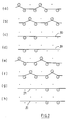
- a structure of this type is illustrated in Figure 2 of the drawings.
- the yarn region referred to as extending between loops over at least two wales in the second set of wales is preferably incorporated to extend over at least three wales, more preferably over at least four wales, and may even extend over seven wales or more.
- additional yarn regions may be incorporated to extend course-wise without loops across at least one wale in one or more other courses.
- courses of both types referred to that is courses with loops pulled to both faces of the fabric and courses with all, or substantially all, loops pulled to one face of the fabric.
- all, or substantially all, of the additional yarn regions extend between loops which are pulled to the same face of the fabric as the loops in the courses which incorporate the yarn regions extending between loops across at least two wales.
- the off-setting as between wales of the relatively inextensible yarn regions which extend along different courses helps to counter-balance the inherent extensibility provided by sections of courses in which loops are pulled to both faces of the fabric and to promote rigidity throughout the fabric.
- the process of the invention preferably is carried out on a flat V-bed knitting machine of gauge in the range 10 to 14.
- Gauge is an expression of the number of needles per inch along the bed of the knitting machine so that 10 to 14 gauge machines have needle bed densities in the range 3.94 to 5.51 needles per cm.
- a preferred machine is a 12 gauge machine. Cylinder and dial circular machines may also be used.
- the desired low extensibility is achieved by limiting the yarn supplied to form the courses of knitting.
- the length of yarn supplied per length of needle bed over which the fabric is knitted is no more than 4.0 cm/cm and in at least some courses having all, or substantially all, loops pulled to one face of the fabric, the length of yarn supplied per length of needle bed over which the fabric is knitted is no more than 2.0 cm/cm, preferably no more than 1.8 cm/cm.
- the yarn supplied to the needles may also be characterised in terms of the length of yarn supplied to a course per the number of active needles used in knitting that course. This is called the yarn length per active needles.
- the yarn length per total needles in a course is less than 0.40 cm in at least some courses having loops pulled to both faces of the fabric and is less than 0.20 cm in at least some courses in which all, or substantially all, loops are pulled to one face of the fabric.
- the invention includes a knitted fabric suitable for use as an upholstery fabric which has been made by the process of the invention.
- the fabric of the invention may have an extensibility in wale and course directions which is no more than 12%. In one or both wale and course directions the extensibility may be no more than 10% or no more than 8%.
- the yarn used for knitting the weft knitted fabric of the invention is preferably a textured continuous filament synthetic yarn. It preferably has a count in the unrelaxed state in the range 550 to 850 decitex, more preferably in the range 680 to 750 decitex.
- a particularly preferred yarn is an air-textured continuous filament polyester yarn.
- the invention includes an upholstery cover for a vehicle seat, particularly an automotive vehicle seat, which comprises weft knitted fabric according to the invention.
- a vehicle seat particularly an automotive vehicle seat
- weft knitted fabric is shaped in the knitting to produce a cover which is thereby shaped at least in part to fit the vehicle seat.
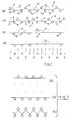
- Figure 1 of the drawings illustrates diagrammatically knitting of four successive courses in a striped fabric according to the invention.
- the points 10 represent needles of the two opposed needle beds of a flat V-bed knitting machine.
- course 1(a) yarn 11 is supplied to needles of both needle beds of the knitting machine so that in this course loops 12 are pulled to one face 8 of the fabric produced and loops 13 are pulled to the other face 9 of the fabric.
- the pattern of loops in the course 1(a) is 1 x 2, that is single loops 12 pulled to the face 8 of the fabric are interspersed in each case with two loops 13 pulled to the face 9 of the fabric, thus forming yarn regions 14, which contain no knitted loops, and extend in the direction of the course 1(a) between adjacent loops 13 pulled to the face 9 of the fabric.
- the regular 1 x 2 loop configuration of this rib (i.e. double-jersey) course 1(a) ensures that the yarn regions 14 occur at regular wale locations along the course.
- Course 1(b) of the fabric of Figure 1 also has a 1 x 2 stitch configuration formed on the needles 10, loops 15 being pulled to face 8 and loops 16 to face 9 of the fabric.
- Adjacent loops 16 have yarn regions 17, without knitted loops, extending course-wise between them but the loop configuration in course 1(b) is such that the wale location of the yarn regions 17 is different from the location of the yarn regions 14.
- the wales in the fabric are indicated by letters A, B, C, etc. at the bottom of Figure 1 and the yarn regions 14 in course 1(a) occur in wales C, G and K whereas the yarn regions 17 in course 1(b) occur in wales A,E, I and M.
- the regions of the fabric represented, for example, by wale groups D, E and F or H, I and J which, according to the structure of course 1(a), would be expected to be relatively extensible in the course-wise direction are rendered more rigid (that is less extensible) because of the presence of the course-wise extending yarn regions 17 without knitted loops in the adjacent course 1(b).
- the yarn regions 14 of course 1(a) provide rigidity in the wale regions B, C, D and F, G, H, etc.
- Course 1(c) of the fabric following course 1(b), comprises loops 18 pulled to face 9 of the fabric only.
- the loops 18 are arranged in groups of three separated by yarn regions 21 extending course-wise and containing no knitted loops.
- the yarn regions 21 extend between loops 18 drawn to the same face 9 of the fabric and have a length equal to four needle spaces of the needle bed on which the course 1(c) is knitted (equivalent to eight needle spaces taking both needle beds into account).
- the length of the yarn regions 21 can also be characterised as equal to seven wales which means that each region 21 extends across seven empty needles, taking account of needles of both beds or three empty needles taking account of needles of the bed on which the course 1(c) is knitted.
- a fabric may be knitted on a half-gauge machine, that is using only half the needles of the machine so that references to empty needles in indicating the length of the regions 21 must be taken as references to "empty, active" needles, that is to needles empty in course 1(c) but used elsewhere in forming the fabric structure. For this reason it is better to characterise the length of such regions by reference to the wales over which the regions extend.
- the other course-wise regions of yarn 22 in the course 1(c) each extend between loops 18 over one wale.
- Course 1(d) which follows course 1(c) has exactly the same configuration as course 1(c) and is followed by a course sequence exactly like courses 1(a) to 1(c) and so on. That is, the fabric pattern is a four course repeat and by choosing appropriate colours of yarn for the four courses, a striped pattern is produced.
- wales A to G comprise a first set of wales as defined according to the process of the invention and wales H to L comprise a second set of wales as defined according to the process of the invention.
- Wales M, N, O also constitute a first set of wales as aforesaid. Looking at the sets of wales A to G and M, N, O, it can be seen that as between adjacent wales in those sets, the ratio of loops pulled to opposite faces of the fabric is 4:1.
- the second set of wales H to L there are two courses (c) and (d) having yarn regions (21) without loops which extend across two or more wales as specified, in fact across seven wales in this case.
- the fabric was knitted on both needle beds of the knitting machine which had a total of 600 needles.
- courses 1(a) and 1(b) 450 of the needles were active (i.e. yarn was taken into the needle hooks) in knitting those courses and the length of yarn supplied to the courses was 229.5 cm and 230.9 cm respectively.
- courses 1(c) and 1(d) 150 of the needles were active in knitting those courses and the length of yarn supplied to the courses was 98.0 cm and 97.6 cm respectively.
- the width of the fabric produced on a total of 600 active needles was measured at 54.5 cm after the fabric had been removed from the knitting machine and given a steam relaxation.
- the fabric of Figure 2 has a structure similar to that of Figure 1 but in this case an eight course repeat (a) - (h) is used and the wale location of the knitted loops in the single bed courses (c), (d) and (g), (h), is different in each four course section of the repeat.
- the yarn regions 30 of the courses 2(c) and 2(d) in which yarn not containing knitted loops extend course-wise between loops of the respective course are situated in different wale locations from similar yarn regions 31 of the courses 2(g) and 2(h).
- Each of the yarn regions 30 and 31 extends over five wales, that is over five needles which at other stages in the formation of the fabric take yarn and form loops to contribute to the production of a knitted wale in the fabric.
- the relatively inextensible yarn regions 30 and 31 alternate between a second set of wales and a first set of wales at four course intervals. This alternating between wales further improves the rigidity of the fabric. If appropriate colours of yarn are chosen for the eight courses, a checked pattern is produced.
- Figure 3 illustrates the three course repeat of a "Milano Rib" fabric (which is outside the scope of the invention) in which successive courses 3(a) and 3(b) each have loops pulled to a single face of the fabric but to a different face respectively.
- Course 3(c) is a 1 x 1 rib structure.
- a piece of fabric with a width of 49.2 cm after steaming was produced on 600 needles in this structure.
- 300 of the needles were active in knitting and the length of the yarn supplied to the courses was 124.3 cm and 120.9 cm respectively.
- course 3(c) 600 of the needles were active and the length of yarn supplied to the course was 289.6 cm.
- the extensibility test was carried out on a Fryma dual extensiometer on fabric specimens cut to a size of 90 mm by 75 mm, the longer dimension corresponding to the direction of measurement of the stretch (wale or course).
- the tests were carried out in accordance with the conditions prescribed in british Standard Specification BS 4294:1968 with the jaw separation of the extensiometer set at 75 mm.
- One end of the specimen under test was clamped in the fixed jaw, a "Perspex" (Trade Mark) plate was placed on top of the specimen to ensure it was flat and the other end of the specimen was then clamped in the movable jaw.
- the "Perspex” (Trade Mark) plate was removed and the specimen was then loaded and measured as specified in BS 4294:1968.
- the measurements were carried out at 20°C and 65.0% Relative Humidity.
- Extensibility is expressed as percentage extensibility, that is the percentage of the original length of the fabric sample before stretching by which the fabric is extended in the test.
- the ability of the fabric to recover after being stretched was assessed by measuring the amount by which the fabric sample remained extended beyond its original length in the direction in which it had been stretched after the load had been removed. This was assessed 1 minute and 30 minutes after removal of the stretching load and expressed as a percentage extension based on the original length of the sample.
- the Milano Rib fabric of Figure 3 is not made by a process according to the invention and its high extensibility of 25.3% in the course direction does not meet the desired standard for vehicle seat upholstery fabric of 12% or less extensibility.
- the fabric of Figure 1 has an extensibility in both wale and course directions of less than 10%
- a fabric having the structure of Figure 1 was knitted over the same number of needles with a shorter average length of yarn supplied to courses 1(a) and 1(b) of 222.5 cm and to courses 1(c) and 1(d) of 96.8 cm.
- Table 4 Table 4 Course Length of Yarn Supplied (cm) Length of Yarn (cm) per Active Needles Length of Yarn (cm) per Total Needles 1(a) 219.8 0.49 0.37 1(b) 226.1 0.50 0.38 1(c) 99.4 0.66 0.17 1(d) 94.2 0.63 0.17
- the fabrics described above were produced on a flat V-bed knitting machine having a gauge of 12, that is 12 needles to the inch (2.54 cm). This gauge is sometimes designated E12.
- the yarn used was a 715 decitex air-textured yarn of continuous polyester filaments.
- the fabrics according to the invention were knitted very tightly with as short a stitch length as possible in a commercial knitting operation, taking into account the nature of the yarn and its count and the gauge of the machine. If a finer gauge machine is used to knit fabric according to the invention, a shorter stitch length and thus a shorter length of yarn per active needles would be appropriate to achieve fabric according to the invention.
- the figures in relation to the length of yarn supplied in each course given in relation to the fabrics of Figures 1 and 2 are representative of fabrics according to the invention knitted on a 12 gauge machine.
- the length of yarn supplied to each course is adjusted according to the machine gauge to give the equivalent tight stitch structure and therefore the required stretch in the fabric of 12% or less.
- the general rule is that the yarn supplied per length of needle bed should remain approximately the same for a given structure knitted on different gauges if equivalent stretch properties are to be achieved and thus the length of yarn supplied per total needles will decrease as the gauge becomes finer.
Landscapes
- Engineering & Computer Science (AREA)
- Textile Engineering (AREA)
- Knitting Of Fabric (AREA)
Claims (20)
- Procédé de tricotage trame d'un tricot en double piqué approprié à l'utilisation en tant que tissu d'ameublement comprenant l'alimentation de fils (11) à des fontures d'aiguilles (10) sur un métier à tricot trame et le tricotage des fils en utilisant lesdites aiguilles pour former un tricot trame, caractérisé par le tricotage d'au moins une partie substantielle du tricot avec une structure a répétition d'un groupe d'au moins trois rangées (a-d) qui comporte une rangée ou des rangées (a, b) dont les boucles (12, 13, 15, 16) sont tirées vers les deux faces (8, 9) du tricot, une rangée ou des rangées (c, d) dont toutes, ou substantiellement toutes les boucles (18) sont tirées vers une face (9) du tricot, et des régions de fil (21, 30, 31) s'étendant en rangée sans boucles (18), les colonnes (A-O) transversales audit groupe de rangées (a-d) comprenant des jeux à répétition de colonnes (A-O) dans lesquels un premier jeu (A-G) de deux colonnes ou plus est adjacent à un second jeu (H-L) de deux colonnes ou plus, des colonnes adjacentes dans le premier jeu ayant les boucles (12, 13, 15, 16, 18) sur des faces opposées (8, 9) du tricot avec les boucles (13, 16, 18) sur une face (9) étant en rapport numérique d'au moins 3:1 par rapport aux boucles (12, 15) sur l'autre face (8) et le second jeu de colonnes (H-L) étant traversé dans au moins l'une des rangées (c, d) dans laquelle toutes, ou substantiellement toutes les boucles (18) sont tirées vers une face (9) du tricot par une région de fil (21) sans boucles (18) qui s'étend entre les boucles (18) en travers de deux colonnes ou plus et limitant l'alimentation de fil aux fontures d'aiguilles de sorte que dans au moins certaines rangées (a, b) dont les boucles (12, 13, 15, 16) sont tirées vers les deux faces du tricot, la longueur du fil (11) fourni par longueur de fonture d'aiguilles sur laquelle le tricot est tricoté n'est pas de plus de 4,0 cm/cm et dans au moins certaines rangées (c, d) dans lesquelles toutes, ou substantiellement toutes les boucles (18) sont tirées vers une face (9) du tricot, la longueur de fil fourni par longueur de fonture d'aiguilles sur laquelle le tricot est tricoté n'est pas de plus de 2,0 cm/cm.
- Procédé selon la revendication 1, dans lequel dans des rangées (c, d) dans lesquelles toutes, ou substantiellement toutes les boucles (18) sont tirées vers une face (9) du tricot, la longueur de fil fourni par longueur de fonture d'aiguilles n'est pas de plus de 1,8 cm/cm.
- Procédé selon la revendication 1 ou la revendication 2, caractérisé en ce qu'un groupe de rangées (a, b, c, d) comprend au moins quatre rangées.
- Procédé selon la revendication 2, caractérisé en ce que dans un groupe de rangées (a, b, c, d) au moins deux rangées (c, d) sont tricotées avec une région de fil (21) sans boucles (18) qui s'étend entre les boucles (18) en travers de deux colonnes ou plus dans ledit second jeu de colonnes (H-L).
- Procédé selon la revendication 3 ou la revendication 4, caractérisé en ce que dans un groupe de rangées (a, b, c, d) le nombre de rangées (a, b) tricotées dont les boucles (12, 13, 15, 16) sont tirées vers les deux faces (8, 9) du tricot est égal au nombre de rangées (c, d) tricotées dont toutes, ou substantiellement toutes les boucles (18) sont tirées vers une face (9) du tricot.
- Procédé selon l'une quelconque des revendications 3 à 5, caractérisé en ce que dans le premier jeu de colonnes (A-G), ledit rapport numérique des boucles est d'au moins 4:1.
- Procédé selon l'une quelconque des revendications précédentes, caractérisé en ce que dans deux groupes successifs de rangées comme spécifié, un premier jeu de colonnes dans le premier groupe de rangées est tricoté en alignement avec un second jeu de colonnes dans le second groupe de rangées et un second jeu de colonnes dans le premier groupe de rangées est tricoté en alignement avec un premier jeu de colonnes dans le second groupe de rangées (figure 2).
- Procédé selon l'une quelconque des revendications précédentes, caractérisé en ce que de même qu'une région de fil (21, 30, 31) sans boucles s'étendant entre les boucles (18) en travers de deux colonnes ou plus dans au moins l'une des rangées (c, d) dans lesquelles toutes, ou substantiellement toutes les boucles sont tirées vers une face (9) du tricot, des régions de fil supplémentaires (14, 17) sont incorporées, s'étendant en rangée sans boucles en travers d'au moins une colonne dans une autre rangée ou plus (a, b) dans ledit groupe de rangées.
- Procédé selon la revendication 8, caractérisé en ce que lesdites régions de fil supplémentaires (14, 17) sont situées dans deux rangées ou plus (a, b) dont les boucles sont tirées vers les deux faces (8, 9) du tricot avec lesdites régions de fil supplémentaires (14) dans une telle rangée (a) s'étendant en travers de colonnes qui sont différentes des colonnes en travers desquelles lesdites régions de fil supplémentaires (17) s'étendent dans une autre telle rangée (b).
- Procédé selon l'une quelconque des revendications précédentes, caractérisé en ce que dans le second jeu de colonnes, une région de fil (21, 30, 31) sans boucles est incorporée de manière à s'étendre entre les boucles en travers d'au moins trois ou quatre ou sept colonnes.
- Procédé selon l'une quelconque des revendications précédentes, caractérisé en ce que pour toutes, ou substantiellement toutes les rangées (c, d) dans lesquelles toutes, ou substantiellement toutes les boucles (18) sont tirées vers une face (9) du tricot et qui incorporent lesdites régions de fil s'étendant entre les boucles (18) en travers d'au moins deux colonnes, c'est la même face (9) du tricot vers laquelle lesdites boucles sont tirées.
- Procédé selon les revendications 8 et 11, caractérisé en ce que toutes, ou substantiellement toutes les régions de fil supplémentaires (14, 17) sont incorporées de manière à s'étendre entre les boucles tirées vers ladite même face (9) du tricot que les boucles dans les rangées qui incorporent les régions de fil (21, 30, 31) s'étendant entre les boucles en travers d'au moins deux colonnes.
- Procédé selon l'une quelconque des revendications précédentes, caractérisé par le fait d'être effectué sur un métier à tricoter rectiligne en V de 12 pas.
- Procédé selon l'une quelconque des revendications précédentes, caractérisé en ce que dans au moins certaines rangées (a, b) dont les boucles (12, 13, 15, 16) sont tirées vers les deux faces (8, 9) du tricot, la longueur du fil (11) fourni par aiguilles totales est inférieure à 0,40 cm et dans au moins certaines rangées (c, d) dans lesquelles toutes, ou substantiellement toutes les boucles (18) sont tirées vers une face (9) du tricot, la longueur de fil fourni par aiguilles totales est inférieure à 0,20 cm.
- Tricot trame en double piqué approprié pour l'utilisation en tant que tissu d'ameublement, dans lequel au moins une partie substantielle du tricot est tricotée par un procédé tel que revendiqué dans l'une quelconque des revendications 1 à 14, caractérisé par une extensibilité de pas moins de 12% dans les directions des colonnes et des rangées respectivement.
- Tricot trame selon la revendication 15, caractérisé par une extensibilité de pas moins de 10% ou pas plus de 8% dans les directions des colonnes et des rangées respectivement.
- Tricot trame selon la revendication 15 ou 16, caractérisé par le fait qu'il comprend un fil ayant un compte dans l'état non détendu de 550 à 850 décitex, de préférence de 680 à 750 décitex.
- Tricot trame selon l'une quelconque des revendications 15 à 17, caractérisé par le fait qu'il comprend un fil de polyester texturé à l'air.
- Housse d'ameublement pour un siège de véhicule, caractérisée par le fait qu'elle comprend un tricot trame tel que revendiqué dans l'une quelconque des revendications 15 à 18.
- Housse d'ameublement selon la revendication 19, caractérisée en ce que le tissu a été formé lors du tricotage pour produire une housse qui est formée par ce biais au moins en partie pour s'adapter à la forme du siège de véhicule.
Applications Claiming Priority (2)
| Application Number | Priority Date | Filing Date | Title |
|---|---|---|---|
| GB909006773A GB9006773D0 (en) | 1990-03-27 | 1990-03-27 | Knitted fabric |
| GB9006773 | 1990-03-27 |
Publications (3)
| Publication Number | Publication Date |
|---|---|
| EP0449560A2 EP0449560A2 (fr) | 1991-10-02 |
| EP0449560A3 EP0449560A3 (en) | 1992-02-26 |
| EP0449560B1 true EP0449560B1 (fr) | 1995-11-22 |
Family
ID=10673298
Family Applications (1)
| Application Number | Title | Priority Date | Filing Date |
|---|---|---|---|
| EP91302593A Expired - Lifetime EP0449560B1 (fr) | 1990-03-27 | 1991-03-26 | Procédé de tricotage et tricot à utiliser comme tissu d'ameublement |
Country Status (8)
| Country | Link |
|---|---|
| US (1) | US5209084A (fr) |
| EP (1) | EP0449560B1 (fr) |
| JP (1) | JP2638323B2 (fr) |
| BR (1) | BR9101182A (fr) |
| CA (1) | CA2039003C (fr) |
| DE (1) | DE69114745T2 (fr) |
| ES (1) | ES2079563T3 (fr) |
| GB (2) | GB9006773D0 (fr) |
Families Citing this family (22)
| Publication number | Priority date | Publication date | Assignee | Title |
|---|---|---|---|---|
| GB2256654B (en) * | 1991-06-13 | 1995-03-29 | Gen Motors Corp | Fabric and knitting |
| GB2263485B (en) * | 1992-01-16 | 1996-01-03 | Gen Motors Corp | Knitted structure |
| FR2741637B1 (fr) * | 1995-11-29 | 1998-02-13 | Delcar | Revetement textile pour siege |
| US5596888A (en) * | 1995-10-23 | 1997-01-28 | Milliken Research Corporation | Knitted furniture support fabric |
| US5682771A (en) * | 1996-03-12 | 1997-11-04 | General Motors Corporation | Knitted cover |
| DE19636208A1 (de) * | 1996-09-05 | 1998-03-12 | Keiper Recaro Gmbh Co | Elastisches Mehrlagengestrick |
| US6151926A (en) * | 1998-06-30 | 2000-11-28 | Lear Corporation | Vehicle seat cover |
| US6006550A (en) * | 1998-08-20 | 1999-12-28 | Kronfli Spundale Mills, Inc. | Reversible knit fabric for use in athletic apparel and method for making same |
| RU2163649C1 (ru) * | 2000-05-04 | 2001-02-27 | Московский государственный текстильный университет им. А.Н. Косыгина | Двухслойный трикотаж |
| US6633830B2 (en) * | 2001-05-16 | 2003-10-14 | Lear Corporation | Method for selecting a cover material for use with a vehicle seat based on a fabric stretch requirement |
| US6609408B2 (en) | 2001-05-16 | 2003-08-26 | Lear Corporation | Method for selecting a cover material for use with a vehicle seat |
| US6745600B2 (en) | 2002-11-13 | 2004-06-08 | Harbor Healthcare, Inc. | Weft knitted blanket fabric and method of manufacturing the same |
| US7207629B2 (en) * | 2003-06-23 | 2007-04-24 | Herman Miller, Inc. | Tilt chair |
| RU2288980C1 (ru) * | 2005-04-15 | 2006-12-10 | Государственное образовательное учреждение высшего профессионального образования "Ульяновский государственный технический университет" | Двухслойный трикотаж |
| GB2430443A (en) * | 2005-09-23 | 2007-03-28 | Lenzing Fibers Ltd | Wicking fabric |
| RU2302485C1 (ru) * | 2006-01-31 | 2007-07-10 | Государственное образовательное учреждение высшего профессионального образования "Московский государственный текстильный университет им. А.Н. Косыгина" | Двухслойный трикотаж комбинированного переплетения |
| US20080189894A1 (en) * | 2007-02-12 | 2008-08-14 | Joel Weichelt | Knit Cleaning Pad |
| US7481079B1 (en) * | 2007-10-03 | 2009-01-27 | Milliken & Company | Circular knit fabric and method |
| CN102373570A (zh) * | 2010-08-24 | 2012-03-14 | 常州丽友针织有限公司 | 毛衫点提花面料的织造方法 |
| CN107419419A (zh) * | 2017-08-16 | 2017-12-01 | 上海新倩实业有限公司 | 高纱支高密度的针织面料及其制造方法 |
| US11001946B2 (en) * | 2018-08-10 | 2021-05-11 | GM Global Technology Operations LLC | Knitted durable fabrics for use on vehicle seats |
| WO2024054583A1 (fr) * | 2022-09-09 | 2024-03-14 | MillerKnoll, Inc. | Structure de siège dotée d'un matériau de suspension tricoté |
Family Cites Families (14)
| Publication number | Priority date | Publication date | Assignee | Title |
|---|---|---|---|---|
| GB1166473A (en) * | 1966-09-03 | 1969-10-08 | Inv S Finance Corp | An apparatus for Injection Moulding |
| GB1166273A (en) * | 1966-10-05 | 1969-10-08 | Camp & Mcinnes Inc | Compressive Hose and Method of Making Same. |
| DE1917373A1 (de) * | 1969-04-03 | 1970-10-15 | Alain De Naurois | Verfahren zum Herstellen eines Trikot |
| GB1482416A (en) * | 1973-11-22 | 1977-08-10 | Goscote Eng Ltd | Knitted fabrics |
| GB1558561A (en) * | 1975-05-03 | 1980-01-03 | Bryas Of London Inc Austen | Two bed knitting machine |
| GB1571584A (en) * | 1976-03-19 | 1980-07-16 | Iws Nominee Co Ltd | Plush fabrics |
| GB1552231A (en) * | 1976-05-11 | 1979-09-12 | Iws Nominee Co Ltd | Knitting attachment |
| GB1558425A (en) * | 1978-01-13 | 1980-01-03 | Bestobell Seals Ltd | Sealing ring assemblies |
| DD143275A1 (de) * | 1979-06-25 | 1980-08-13 | Eberhard Friedrich | Verbundmaschenbahn aus zwei getrennten maschenbahnen,insbesondere fuer moebelstoff |
| ES2013723B3 (es) * | 1985-11-22 | 1990-06-01 | Soc Civile D'inventeurs Spml | Nueva estructura de malla con alta resistencia principalmente a la horadacion y al desgarramiento. |
| US5073441A (en) * | 1985-11-22 | 1991-12-17 | Societe Civile D'inventeurs Spml | Mesh structure with high resistance to piercing and tearing |
| FR2590518B1 (fr) * | 1985-11-22 | 1988-07-15 | Spml Soc Civ Inventeurs | Nouveau produit composite a base d'armature de fils ou fibres notamment tisses ou tricotes enroulee sur elle-meme |
| AU594787B2 (en) * | 1987-06-26 | 1990-03-15 | Tachi-S Co., Ltd. | Method of knitting to form a trim cover assembly for an automotive seat |
| GB8822637D0 (en) * | 1988-09-27 | 1988-11-02 | Gen Motors Corp | Knitted fabric |
-
1990
- 1990-03-27 GB GB909006773A patent/GB9006773D0/en not_active Ceased
-
1991
- 1991-03-25 CA CA002039003A patent/CA2039003C/fr not_active Expired - Fee Related
- 1991-03-26 EP EP91302593A patent/EP0449560B1/fr not_active Expired - Lifetime
- 1991-03-26 US US07/675,167 patent/US5209084A/en not_active Expired - Lifetime
- 1991-03-26 BR BR919101182A patent/BR9101182A/pt not_active IP Right Cessation
- 1991-03-26 DE DE69114745T patent/DE69114745T2/de not_active Expired - Fee Related
- 1991-03-26 GB GB9106463A patent/GB2243164B/en not_active Expired - Fee Related
- 1991-03-26 ES ES91302593T patent/ES2079563T3/es not_active Expired - Lifetime
- 1991-03-27 JP JP3063423A patent/JP2638323B2/ja not_active Expired - Fee Related
Also Published As
| Publication number | Publication date |
|---|---|
| GB2243164A (en) | 1991-10-23 |
| CA2039003A1 (fr) | 1991-09-28 |
| AU637889B2 (en) | 1993-06-10 |
| DE69114745T2 (de) | 1996-04-18 |
| AU7379891A (en) | 1991-10-03 |
| JPH04214449A (ja) | 1992-08-05 |
| GB9006773D0 (en) | 1990-05-23 |
| DE69114745D1 (de) | 1996-01-04 |
| CA2039003C (fr) | 1994-08-16 |
| JP2638323B2 (ja) | 1997-08-06 |
| EP0449560A2 (fr) | 1991-10-02 |
| ES2079563T3 (es) | 1996-01-16 |
| BR9101182A (pt) | 1991-11-05 |
| GB9106463D0 (en) | 1991-05-15 |
| EP0449560A3 (en) | 1992-02-26 |
| GB2243164B (en) | 1994-04-06 |
| US5209084A (en) | 1993-05-11 |
Similar Documents
| Publication | Publication Date | Title |
|---|---|---|
| US5209084A (en) | Knitted fabric having low stretch for upholstery | |
| EP0989219B1 (fr) | Procédé de tricotage d'une étoffe à trames incorporées | |
| EP0361856B1 (fr) | Etoffe tricotée | |
| US5265445A (en) | Breathable elastic fabric and method of making same | |
| EP0503836B1 (fr) | Etoffe de revêtement | |
| EP0414497A2 (fr) | Procédé de tricotage chaîne | |
| US4881383A (en) | Warp knitted fabric with satin-like back and brushable face and method of knitting same | |
| EP1612312A1 (fr) | Tissu a mailles jetees a structure sterique | |
| KR960013902B1 (ko) | 횡편기 | |
| GB2256654A (en) | Fabric and knitting | |
| US4079602A (en) | Limited stretch double knit fabric | |
| JP2693533B2 (ja) | 縦糸編成方法 | |
| EP1348788A1 (fr) | Textile double parois épais et procédé de tricotage | |
| AU637889C (en) | Knitted fabric | |
| EP0676495A1 (fr) | Etoffe tricotée et procédé de fabrication | |
| CN117043405B (zh) | 双拉舍尔针织物和包含双拉舍尔针织物的表皮材料 | |
| RU2864706C1 (ru) | Способ вязания кулирного трикотажа для изготовления двунаправленных армирующих волокнистых наполнителей | |
| CA2204542A1 (fr) | Procede de tricotage | |
| US6653250B1 (en) | Low-shrinkage, stable print platform knitted fabric | |
| CA1086972A (fr) | Tissu thermique a trame de type raschel, et methode de tissage | |
| JP2549645Y2 (ja) | 弾性経編地 | |
| EP0694641A1 (fr) | Procédé pour la fabrication d'une étoffe en tricot-chaîne à structure de nid d'abeilles et étoffe ainsi obtenue | |
| JPH06235149A (ja) | 添糸編地の製造方法 | |
| JPH03213542A (ja) | 縞模様の縦編み伸縮性生地 | |
| JP2693533C (fr) |
Legal Events
| Date | Code | Title | Description |
|---|---|---|---|
| PUAI | Public reference made under article 153(3) epc to a published international application that has entered the european phase |
Free format text: ORIGINAL CODE: 0009012 |
|
| AK | Designated contracting states |
Kind code of ref document: A2 Designated state(s): BE DE ES FR GB IT NL SE |
|
| PUAL | Search report despatched |
Free format text: ORIGINAL CODE: 0009013 |
|
| AK | Designated contracting states |
Kind code of ref document: A3 Designated state(s): BE DE ES FR GB IT NL SE |
|
| 17P | Request for examination filed |
Effective date: 19920410 |
|
| 17Q | First examination report despatched |
Effective date: 19941110 |
|
| GRAA | (expected) grant |
Free format text: ORIGINAL CODE: 0009210 |
|
| ITF | It: translation for a ep patent filed | ||
| AK | Designated contracting states |
Kind code of ref document: B1 Designated state(s): BE DE ES FR GB IT NL SE |
|
| REF | Corresponds to: |
Ref document number: 69114745 Country of ref document: DE Date of ref document: 19960104 |
|
| REG | Reference to a national code |
Ref country code: ES Ref legal event code: FG2A Ref document number: 2079563 Country of ref document: ES Kind code of ref document: T3 |
|
| ET | Fr: translation filed | ||
| PLBE | No opposition filed within time limit |
Free format text: ORIGINAL CODE: 0009261 |
|
| STAA | Information on the status of an ep patent application or granted ep patent |
Free format text: STATUS: NO OPPOSITION FILED WITHIN TIME LIMIT |
|
| 26N | No opposition filed | ||
| REG | Reference to a national code |
Ref country code: GB Ref legal event code: 732E |
|
| REG | Reference to a national code |
Ref country code: FR Ref legal event code: TP |
|
| NLS | Nl: assignments of ep-patents |
Owner name: LEAR CORPORATION |
|
| REG | Reference to a national code |
Ref country code: GB Ref legal event code: IF02 |
|
| PGFP | Annual fee paid to national office [announced via postgrant information from national office to epo] |
Ref country code: FR Payment date: 20030304 Year of fee payment: 13 |
|
| PGFP | Annual fee paid to national office [announced via postgrant information from national office to epo] |
Ref country code: SE Payment date: 20030305 Year of fee payment: 13 Ref country code: NL Payment date: 20030305 Year of fee payment: 13 |
|
| PGFP | Annual fee paid to national office [announced via postgrant information from national office to epo] |
Ref country code: BE Payment date: 20030401 Year of fee payment: 13 |
|
| PGFP | Annual fee paid to national office [announced via postgrant information from national office to epo] |
Ref country code: ES Payment date: 20030408 Year of fee payment: 13 |
|
| PG25 | Lapsed in a contracting state [announced via postgrant information from national office to epo] |
Ref country code: SE Free format text: LAPSE BECAUSE OF NON-PAYMENT OF DUE FEES Effective date: 20040327 Ref country code: ES Free format text: LAPSE BECAUSE OF NON-PAYMENT OF DUE FEES Effective date: 20040327 |
|
| PG25 | Lapsed in a contracting state [announced via postgrant information from national office to epo] |
Ref country code: BE Free format text: LAPSE BECAUSE OF NON-PAYMENT OF DUE FEES Effective date: 20040331 |
|
| BERE | Be: lapsed |
Owner name: *LEAR CORP. UNE SOCIETE DE L'ETAT DE DELAWARE Effective date: 20040331 |
|
| PG25 | Lapsed in a contracting state [announced via postgrant information from national office to epo] |
Ref country code: NL Free format text: LAPSE BECAUSE OF NON-PAYMENT OF DUE FEES Effective date: 20041001 |
|
| EUG | Se: european patent has lapsed | ||
| PG25 | Lapsed in a contracting state [announced via postgrant information from national office to epo] |
Ref country code: FR Free format text: LAPSE BECAUSE OF NON-PAYMENT OF DUE FEES Effective date: 20041130 |
|
| NLV4 | Nl: lapsed or anulled due to non-payment of the annual fee |
Effective date: 20041001 |
|
| REG | Reference to a national code |
Ref country code: FR Ref legal event code: ST |
|
| PGFP | Annual fee paid to national office [announced via postgrant information from national office to epo] |
Ref country code: GB Payment date: 20050323 Year of fee payment: 15 |
|
| PG25 | Lapsed in a contracting state [announced via postgrant information from national office to epo] |
Ref country code: IT Free format text: LAPSE BECAUSE OF NON-PAYMENT OF DUE FEES;WARNING: LAPSES OF ITALIAN PATENTS WITH EFFECTIVE DATE BEFORE 2007 MAY HAVE OCCURRED AT ANY TIME BEFORE 2007. THE CORRECT EFFECTIVE DATE MAY BE DIFFERENT FROM THE ONE RECORDED. Effective date: 20050326 |
|
| PGFP | Annual fee paid to national office [announced via postgrant information from national office to epo] |
Ref country code: DE Payment date: 20050502 Year of fee payment: 15 |
|
| REG | Reference to a national code |
Ref country code: ES Ref legal event code: FD2A Effective date: 20040327 |
|
| PG25 | Lapsed in a contracting state [announced via postgrant information from national office to epo] |
Ref country code: GB Free format text: LAPSE BECAUSE OF NON-PAYMENT OF DUE FEES Effective date: 20060326 |
|
| PG25 | Lapsed in a contracting state [announced via postgrant information from national office to epo] |
Ref country code: DE Free format text: LAPSE BECAUSE OF NON-PAYMENT OF DUE FEES Effective date: 20061003 |
|
| GBPC | Gb: european patent ceased through non-payment of renewal fee |
Effective date: 20060326 |